Schm
arb. t. 75 2917 angustifólia Ph. narrow-leaved or 6 jn.jl G N. Amer. 1806.
L p.l 510. CEANO'THUS. W. CEANOTHUS.
Rhamni. Sp. 8-20. 2918 americána W.
New Jersey Tea or 2 jl.o W N. Amer. 1713. S p.l Bot. mag. 1479 2919 intermédia Ph. intermediate or 2 jn.jl W N. Amer. 1812. C 1.p Pl. alm. t. 28. f. 6 2920 sanguínea Ph. red-stalked or 2 my.jl W Missouri 1812. C l.p 2923 africána W. 2921 microphýlla Ph. 2922 asiática W. 2924 globulósa H. K. 2925 azúrea Desf. 511. STA'AVIA. W. 2926 radiáta W. 2927 glutinósa W. 2896 rayed clammy 2898 small-leaved or 1½ jn.jl W N. Amer. 1806. L p.l Asiatic or 12 jl.au Pa.Y Ceylon 1691. C p.l Cav.ic.5.t.440.f.1 African or 6 mr.ap W C. G. H. 1712. C p.l round-headed or 6 ap.my Co N. Holl. 1803. C p.l blue or 10 ap Pa.B Mexico 1818. C p.1 Pl. ph. t. 126. f. 1 Lab. no. h.1. t.85 Bot. reg. 291 STAAVIA.
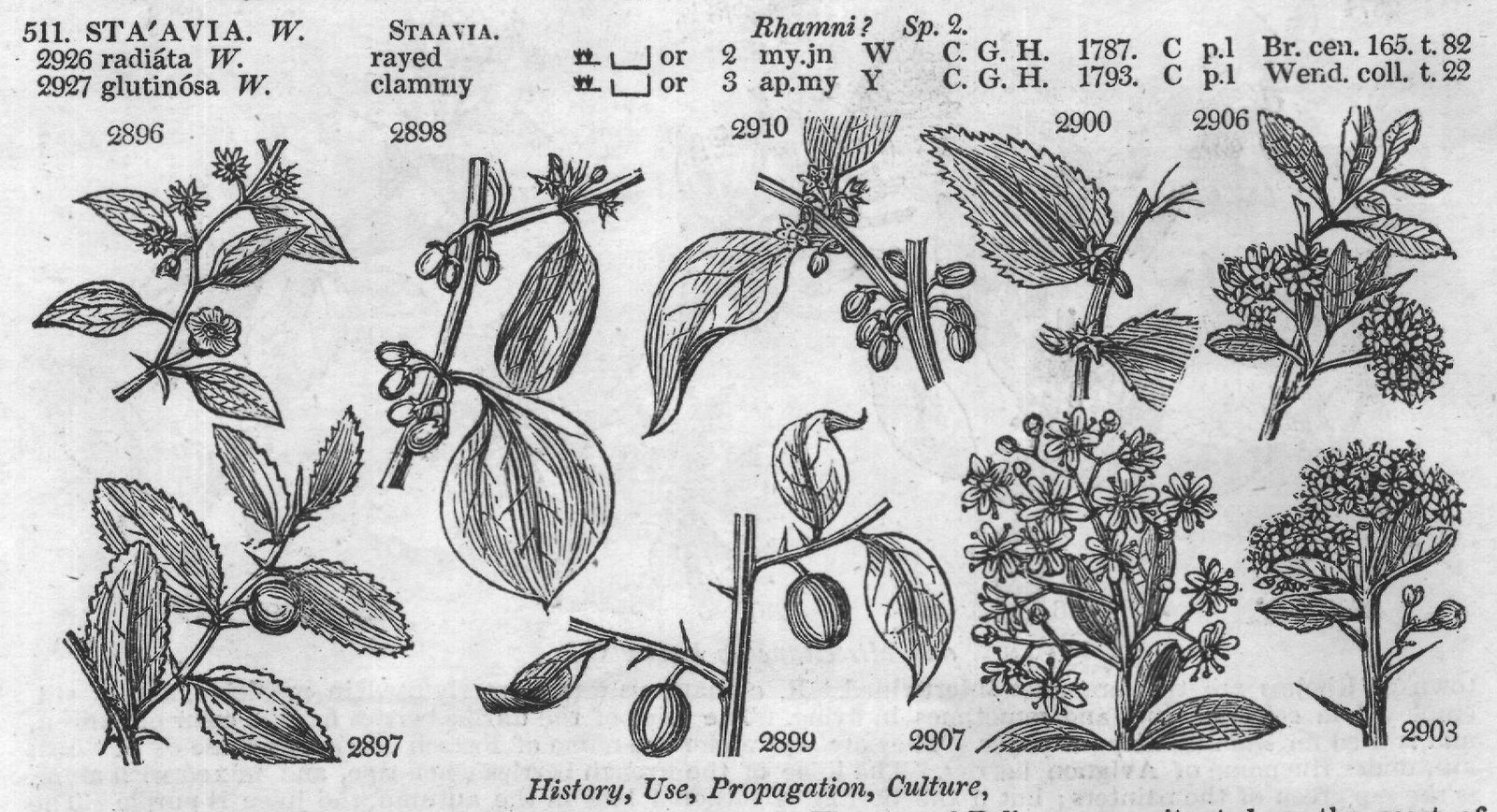
Rhamni? Sp. 2. or 2 my.jn W C. G. H. 1787. C p.l or 3 ap.my Y C. G. H. 1793. C p.1 Br. cen. 165. t. 82 Wend. coll. t. 22 2910 2900 2906 2897 2899 2907 2903 History, Use, Propagation, Culture, 505. Paliurus. Πaλiερoς is the Greek name of a place. The city of Paliurus was situated on the coast of Africa over against Candia. Paliurus australis is a handsome free flowering, but very prickly shrub: it has broad roundish buckler-shaped seed-vessels, which have borders like the brims of a hat, the footstalks being fastened to the middle. From this singular appearance of the fruit, like a head with a broad-brimmed hat on, the French call it porte chapeau. This shrub is by many persons supposed to be that from which the crown of thorns which was put upon the head of Jesus Christ was composed; the truth of which is supported by many travellers of credit, who affirm that this is one of the most common shrubs in the country of Judea; and from the pliableness of its branches, which may easily be wrought into any figure, it may afford a probability. Hasselquist, however, is of opinion, that it was a species of Rhamnus, called therefore by Linnæus R. Spina Christi. 506. Zizyphus. A name altered by the Greeks from asafifa, its name in the East. Vide Shaw's Voyage, 47. Suppl. It is called Zizouf in Arabic, Golius. Z. Lotus, is the true Lotus of the Lotophagi. It is a prickly branching shrub, with alternate, small, blunt, three-nerved leaves, solitary flowers, and the fruit a spherical drupe, the size of a wild plum, sweet and harmless; inclosing a small, round, bony, two-celled nucleus; first green, but when ripe tinged with saffron-color. It is found on the eastern as well as the western extremity of the African desert; and Major Rennel thinks he has seen it on the Ganges. Dr. Shaw found the fruit common in Barbary; it was sold in the markets, cattle fed with it, and a liquor drawn from it. Mr. Park found it very common in all the kingdoms which he visited: he describes the fruit as small farinaceous berries, of a yellow color and delicious taste. The natives, he says, convert them into a sort of bread, by exposing them some days to the sun, and afterwards pounding them gently in a wooden mortar, until the farinaceous part is separated from the stone. This meal is then mixed with a little water, and formed into cakes, which, when dried in the sun, resemble in color and flavor the sweetest gingerbread. A gruel is next made from the meal which still adheres to the stones. The Greeks supposed the people who ate the lotus to be confined to an extent of sea-coast on the north of Africa, including the gulphs of Syrtes. The plant grows readily in our greenhouses, and might be fruited if thought desirable. It is propagated by ripened cuttings planted in sand under a hand-glass.
ORDER I.
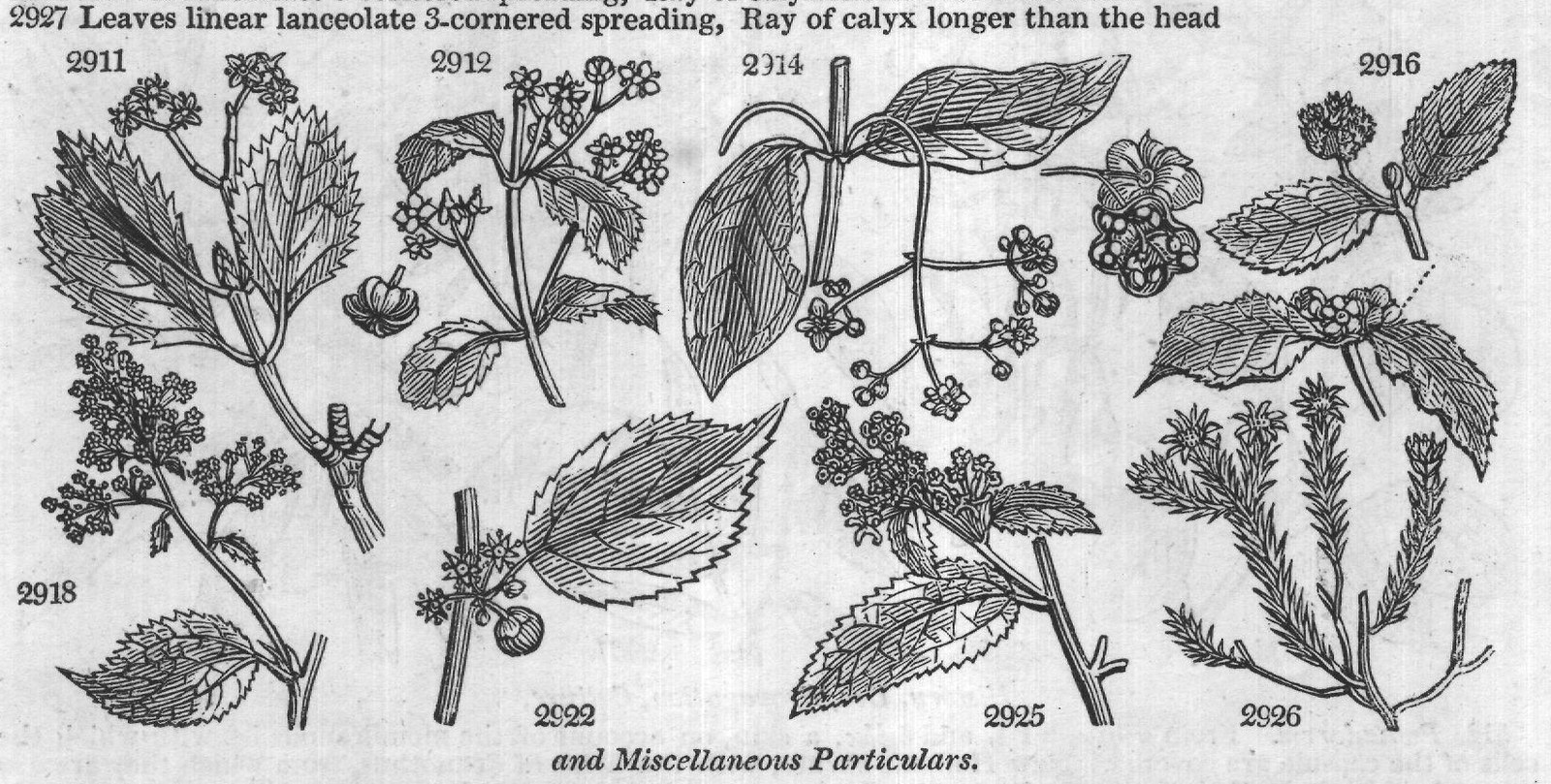
PENTANDRIA MONOGYNIA. 2896 Prickles stipulary twin, one straight one recurved, Leaves ovate crenulate smooth stalked 2897 Prickles twin, one recurved, Leaves ovate oblong obsoletely crenate 2898 Prickles in pairs recurved, Pedunc. corym. Fls. half digynous, Leaves ov. oblique smooth on both sides 2899 Prickles solitary recurved, Leaves rounded ovate obtuse downy beneath, Peduncles aggregate 2900 Prickles in pairs, one recurved, Leaves ovate retuse toothed smooth 2901 Leaves oval acute shining margined smooth, Flowers axillary 2902 Leaves ovate acute, Panicles terminal 2903 Leaves oblong acuminate serrated, Racemes terminal, Stem twining 2904 Leaves ovate acute at each end serrated evergreen, Flowers axillary 2905 Leaves ovate serrated, Branches square 2906 Spines axillary, the larger leafy, Leaves lanceolate obovate serrated obtuse, the younger acute 2907 Spines naked, Branches rounded acute 2908 Spines naked, Branches angular, Leaves obovate serrate toothed, Cymes axillary 2909 Leaves lanceolate stalked wavy at edge, Cymes umbelled terminal, Caps. 2-celled 2-seeded 2910 Leaves elliptical angular nerveless evergreen, Caps. 1-seeded 2911 Flowers 4-cleft, Leaves rounded ovate toothed 2912 Flower-stalks compressed 3-flowered, Flower usually tetrandrous, Leaves oblong-lanceolate smooth 2913 Flower-stalks filiform rounded, Leaves ovate acuminate smooth, Branches warted 2914 Flower-stalks filiform rounded many-fl. Lvs. ovate oblong acuminate, Branches smooth, Petals roundish 2915 Flower-stalks compressed many-flowered, Stigmas square truncated, Lvs. obl. acuminate pubes. beneath 2916 Flower-stalks rounded 3-flowered, Fl. pentan. Lvs. obl. lanc. smooth subsess. acute serr. Branches square 2917 Branches square, Leaves subsessile long linear elliptical subfalcate entire, Fruit warted 2918 Leaves ovate oblong acute subcordate serrate 3-nerved beneath soft with hairs, Corymbs contracted 2919 Leaves oblong acuminate mucronate serrulate 3-nerved, Corymbs loose 2920 Leaves obovate serrated pubescent beneath, Panicles on very short stalks, Branches deep red 2921 Decuinbent smooth, Leaves very small in bundles oblong entire, Corymbs of the branches terminal 2922 Leaves ovate acuminate veiny, Cymes axillary 2923 Leaves lanceolate obtuse netted with veins, Panicle terminal 2924 Leaves obovate tomentose beneath, Heads of flowers in panicles 2925 Leaves oblong somewhat cordate serrate tomentose beneath, Racemes compound stalked 2926 Leaves lanceolate 3-cornered spreading, Ray of calyx shorter than the head 2927 Leaves linear lanceolate 3-cornered spreading, Ray of calyx longer than the head 2911 2912 2914 2916 2918 2922 2925 2926 and Miscellaneous Particulars.
Z. jujuba is a middle-sized tree, with ovate leaves, pale yellowish flowers, and red oval fruit, about the size of olives, inclosing a stone of the same shape. They are sweet, and eaten in the East Indies and China. Z. vulgaris is a middle-sized branching tree, bearing a saffron-colored drupe shaped like an olive, but smaller. The plant grows wild in Calabria, and is cultivated in other parts of Italy, and in Spain. The fruit is eaten green or dried as a sweatmeat. It is common in China, Japan, Syria, &c. and is said to have been first introduced into Italy from the latter country in the time of Augustus. All the species are readily increased by ripened cuttings planted under a hand-glass. 507. Celastrus. From κηλaς, the latter season. The ancients considered the holly, the Genista, and the Celastros, the trees which ripened their fruit latest. The Celastros of the ancients is thought to have been a kind of Euonymus, to which this genus is nearly allied. It consists of shrubs or small trees, with alternate leaves, and numerous small flowers. The plants are of easy culture, but of no great beauty. 508. Senacia. A genus divided by M. de Lamarck from Celastrus, and founded upon the Celastrus undulatus of L'Heritier. 509. Euonymus. From εv, well, and ovoμa, a name, well named. The application of the name is, however, obscure to us. Euonymus was also a Heathen divinity; according to Epimenides she was the mother of the Furies by Saturn. Fusain, or Bonnet de Prêtre, Fr., Spindelbaum, Ger., and Fusaggine, Ital. The species form neat little trees of no great beauty or use. E. europæa is called prick-wood, from the use of the wood formerly as skewers. E. americana best merits culture, and next, E. latifolia. They are easily increased by seed or ripened cuttings. 510. Ceanothus. Kεavωθoς is a name used by Theophrastus to designate a prickly plant, from κεω, to prick. This is a genus of North American plants, one species of which, C. americana, is very common in gardens. The leaves are dried in Carolina and used as tea, and the root to dye wool a Nankeen cinnamon color. The species are of the easiest culture, but of very little beauty. 511. Staavia. Named after Martin Staaf, a correspondent of Linnæus. Little Cape shrubs, with heads of flowers resembling those of some compound plant. Young cuttings in sand, and covered with a bell, soon strike root.
N2 1,80 PENTANDRIA MONOGYNIA. 512. POMADER RIS. Lab. POMADERRIS.
Rhamni. Sp. 4.
CLASS V. or 6 or 2928 apétala H. K. apetalous 2929 ellíptica H. K. oval-leaved 2930 lanígera B. M. woolly 2931 phylicifólia Lodd.
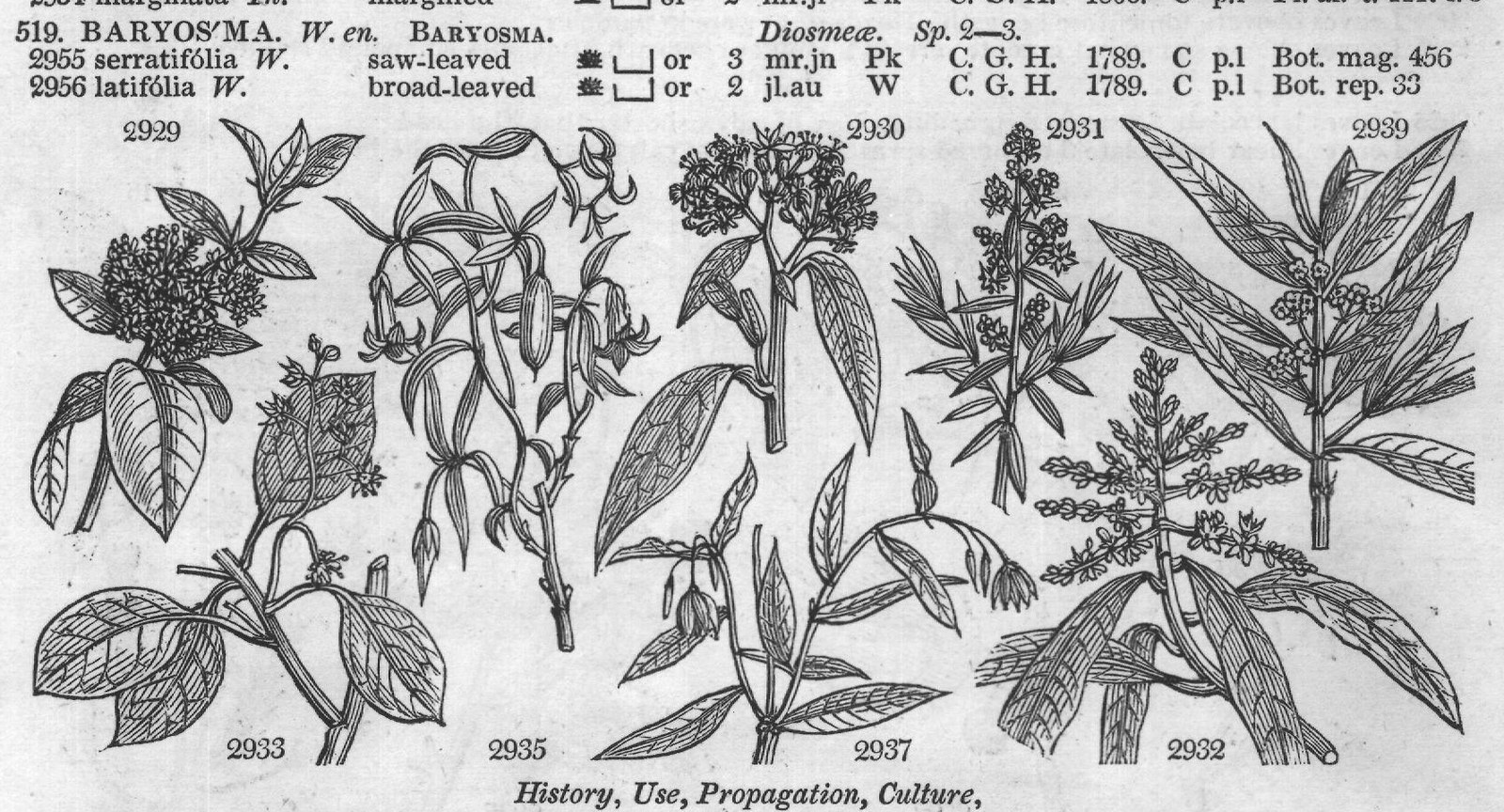
Phylica-leaved 513. MANGIFERA. W. MANGO-TREE. or 7 my.jn Pa.Ý N. Holl. 1803. Cs.p Lab. no. h. 1.t.87 or 10 my.jl Pa.Y N. Holl. 1805. C s.p Bot. mag. 1510 or 3 ap.jn Pa.Y N. Holl. 1806. C s.p Bot. mag. 1823 or 2 ap.jn Pa.Y N. Holl. 1819. C s.p Bot. cab. 120