Home › S › Switzerl (Lco Carniola L co Act bon t)
Switzerl (Lco Carniola L co Act bon t)
1752. Lco Carniola 1752. L co Act. bon. 3. t. 24 Corn. can. t. 100 Jac. vind. 3. t. 50 Brow. jam. t. 29 Pall, ross. t. 63 Eng. bot. 1629 Ard. me. 78. t.14 Cav. ic. 2. t. 182 Jac. aust. 1. t. 53 Hall. his. 1. t. 40 Jac. coll. 2. t. 11 berry-bearing or 12 ap.my W broad-leaved or 4 jl G Britain woods. S co Azores 1778. L co Eng. bot. 250 Dend. brit. 11 Madeira or 15 jn.jl G Winter-ber.-lv. or 15 au.s W wiry or 13 n W.G Canaries C. G. H.
Africa 1775. S p.l 1785. C p.1 1778. C p.1 Vent. malm. 34 L'Her. sert. t. 9 Alder-leaved or 4 my G N. Amer. 1778. L co hybrid or 12 my.jn G .. ... ...
Lco L'Her. sert. t. 5 2892 Alatérnus W.en. bd.-lvd.-Alater. or 40 ap.jn G S. Europe 1629. L co 2893 Clusii W. narrow-leaved or 30 ap.jn G S. Europe 1629. L co 504. ENOP'LIA. Mich. ENOPLIA.
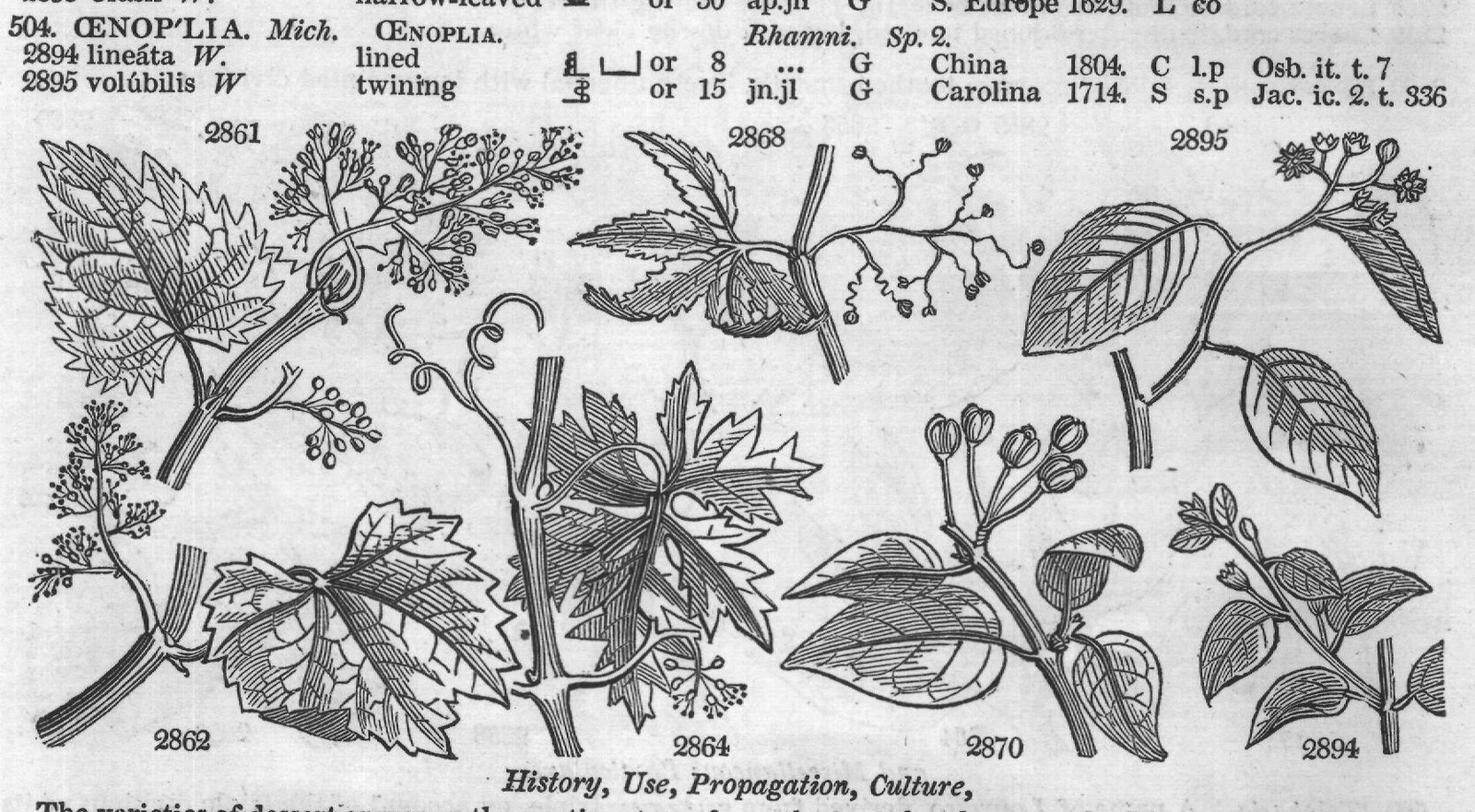
Rhamni. Sp. 2. 2894 lineáta W. 2895 volúbilis W lined twining or 8 ...
G China 1804. C 1.p or 15 jn.jl G Carolina 1714. S s.p Osb. it. t. 7 Jac. ic. 2. t. 336 2861 2868 2895 2862 2864 2870 2894 History, Use, Propagation, Culture, The varieties of dessert grapes on the continent are few: the best they have, as the Muscats and Frontignacs, have been obtained from this country. The Chasselas or frame grape (our Muscadine), is almost the only eating grape known in the Paris fruit market. In Britain, we have not only the best varieties, but we grow the fruit to a larger size and of a higher flavor than is done any where else in the world. This is owing to the perfection of our artificial climates, and the great attention paid to soil and subsoil, and other points of culture. The vine is universally propagated by cuttings, either a foot or more long, with a portion of two year old wood, or short with only one bud, or one bud and half a joint, &c. Varieties without end are raised from seed; and it is thought that by propagating from the seeds of successive generations some sorts may ultimately be procured better adapted for ripening their fruit in the open air than now known. A seedling vine carefully treated will show blossoms in its fourth or fifth year; say that it produces a fair specimen of its fruit in the sixth year, then a new generation may be obtained so often. The vine will thrive in any dry soil, or in any soil with a dry subsoil; but it produces the best flavored fruit among granitic and calcareous fragments, and loamy soil in thin strata, with little manure, and when the vine is old and the berry and bunch small: on the contrary, the most luxuriant crops, large bunches and berries, in a good depth of friable loam, dry below and richly manured with the strongest of animal manures. There are three methods of pruning the vine in hot-houses; the fruit tree method, in which the plant is spread out in the fan manner, and treated like a common fruit tree; the long or young wood method, in which all the wood above a year old is cut out down to the stool or stock; and the spurring-in method, in which the fruit is produced from young wood grown annually from the sides of a main shoot or shoots of old wood. The two last methods are the best..
Vitis vulpina, the foxgrape, (so called from the foxy flavor of its berries) is cultivated much in North America, of which country it is a native. Many improved varieties have been raised by the American gardeners, and have been sent to Europe under the name of the Bland, the Isabella, the Oswego Tokay, &c. &c.; but they are all tainted with the bad taste peculiar to the species, and can be in no estimation when even an early July grape is to be procured. 502. Ampelopsis. From aμπελoς, a vine, and oψiς, resemblance. The genus resembles the vine in habit, leaves, and flowers; is commonly employed for covering old walls, for which the rapidity of its growth renders it very suitable. 503. Rhamnus. From the Celtic ram, signifying branching. From this word the Greeks have gained ξaμvoς, the Latins ramus, and the French rame, or in old French reim; for which reason the arms of the ORDER I.
PENTANDRIA MONOGYNIA. 2861 Leaves cordate acuminate nearly equally toothed smooth on both sides, Racemes loosely many-fruited 2862 Leaves unequally cut toothed shortly trifid, Stalk nerves and edge pubescent shining on both sides reniform cordate equally toothed, Flowers in many little heads 2863 Leaves shining 2864 Leaves quinate, Leaflets many-cleft 2865 Shoots very cæsious, Leaves cordate angular 2866 Leaves cordate acute toothed 3-lobed, Nerves villous beneath, Racemes twin bifid 2867 Leaves bipinnate smooth, Leaflets cut-lobed, Racemes stalked twin bifid 2868 Leaves palmate 3-5-leaved smooth on both sides, Leaflets stalked oblong acuminate 2869 Leaves palmate 3-5-leaved on each side pubescent, Leaflets ovate acuminate coarsely toothed 2870 Flowers monogynous hermaphrodite erect, Caps. 3-coccous, Stalks rusty tomentose 2871 Flowers hermaphrodite trigynous axillary in umbels, Leaves elliptical acute entire villous beneath 2872 Spines terminal, Leaves linear-lanceolate serrate acute 2873 Unarmed, Leaves lanc. acute at each end serrated with hairs at the axillæ, Flowers axillary clustered 2874 Spines terminal, Flowers 4-cleft diœcious, Leaves ovate, Stem erect, Berry 4-seeded 2875 Spines terminal, Flowers 4-cleft diœcious, Stems procumbent 2876 Spines terminal, Leaves linear entire obtuse terminal, 2877 Spines terminal, Leaves oblong entire 2878 Branches spiny. spiny, Flowers 4-cleft or trifid diœcious, Leaves oblong obtuse evergreen 2879 Spines terminal, Flowers 4-cleft hermaphrodite 2880 Spines terminal, Leaves ovate serrulate, Branches divaricating 2881 Leaves ovate entire smooth sessile, Branches square 2882 Unarmed, Leaves lanceolate serrulate acute at each end pubescent beneath 2883 Flowers diœcious, Leaves ovate-lanceolate glandular crenulate 2884 Creeping, Flowers hermaphrodite, Leaves stalked ovate crenate 2885 Flowers monogynous hermaphrodite, Leaves entire smooth, Berry 2-seeded 2886 Flowers monogynous hermaphrodite, Cal. villous, Leaves elliptical entire acuminate rounded at base 2887 Flowers hermaphrodite racemose, Leaves ovate bluntly serrated smooth at the base glandular 2888 Flowers polygamous, Style triple, Leaves ovate serrated 2889 Flowers hermaphrodite, Stigma triple, Leaves cordate, Branches with tendrils 2890 Flowers hermaphrodite, Leaves oval acuminate serrated veiny beneath 2891 Flowers hermaphrodite, Leaves oblong acuminate scarcely perennial 2892 Flowers diœcious, Stigma triple, Leaves evergreen elliptical serrated acute at the base obtuse 2893 Flowers diœcious, Stigma triple, Leaves evergreen lanceolate acute at each end mucronate toothed 2894 Leaves ovate ribbed veiny repand, Flower-stalks one flowered, Stem erect 2895 Diœcious unarmed, Stem twining, Leaves ovate mucronate répand subcrenate striated 2874 2885 2876 2886 2879 and Miscellaneous Particulars. 2884 2888 town of Rheims are two branches intertwined. R. catharticus was formerly used in medicine, and is stil employed in color-making, and sometimes in dying. The juice of the unripe berries has the color of saffron, and is used for staining maps or paper. They are sold under the name of French berries, as those of R. Clusii are, under the name of Avignon berries. The juice of the French berries when ripe, and mixed with alum, is the sap green of the painters; but if the berries be gathered late in the autumn, the juice is purple. The bark affords a beautiful yellow dye. The inner bark, like that of elder, is said to be a strong cathartic, and to excite vomiting. The berries operate briskly by stool, but occasion thirst and griping. It is said by Woodville that the flesh of birds which feed on them is purgative. R. lycioides furnishes the wood of which the Monguls make their images, on account of its hardness and orange red color.
R. saxatilis greatly resembles R. catharticus. The berries are used to dye the Maroquin or Morocco leather yellow.
R. theezans has leaves like the common tea, which are used as such by the poor of China, and called Tia. (Osbeck.) R. frangula has dark purple berries, which are purgative, like those of the common buckthorn. Gathered before they are ripe they dye wool green and yellow; when ripe, blue-gray, blue, and green. The bark dyes yellow, and with preparations of iron, black. From a quarter to half an ounce of the inner bark boiled in small beer, is a sharp purge. In dropsies or constipations of the bowels in cattle, it is a very certain purgative. The flowers are particularly grateful to bees. Goats devour the leaves voraciously; and sheep will eat them. Charcoal prepared from the wood is used by the makers of gunpowder. The berries of this species, and also of the cornus, are said to be brought to market and sold for those of the buckthorn; but they are easily distinguished, the true buckthorn having four seeds, this two, and the cornus one. R. hybridus is the offspring of R. alpinus and alaternus, first procured by L'Heritier about 1778. R. alaternus is an ornamental evergreen, with mellifluous blossoms, much frequented by bees. It is sometimes confounded with the Phillyrea; but they may be easily distinguished by the position of their leaves, which are alternate in these, but placed opposite by pairs in that. It is a rapid growing shrub, and useful for thickening screens, clothing walls, &c. 504. Enoplia. From oivoπλuξ, vinous. Its little fruit, full of juice, resembles the berry of a grape. The Rhamnus volubilis and lineatus belong to this genus, and are beautiful little climbing plants, but rather impatient of cold.
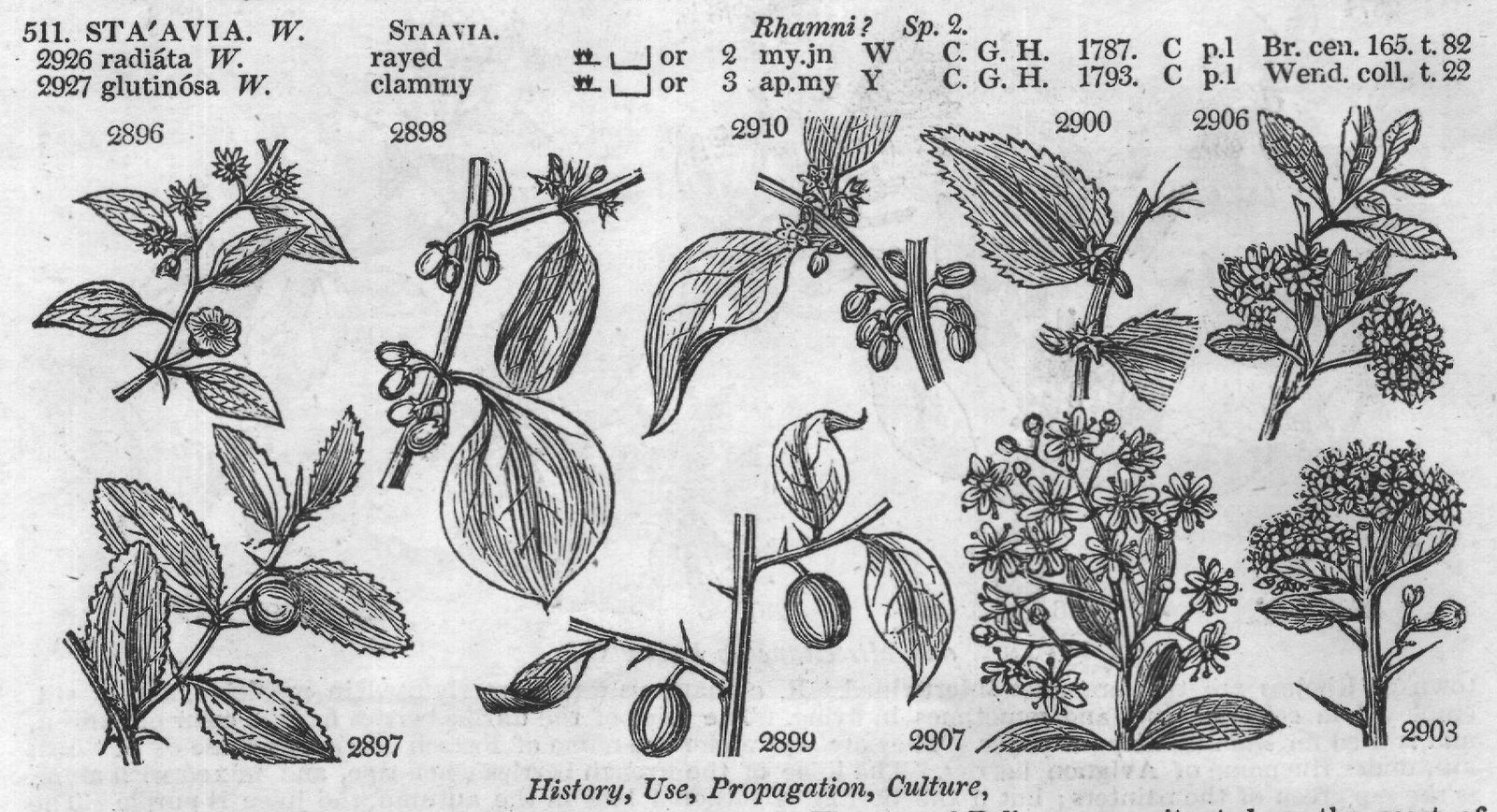
N PENTANDRIA MONOGYNIA. 505. PALIU'RUS. Gært. CHRIST'S-THORN. 2896 austrális Gært.
European 506. ZIZYPHUS. W.
ZIZYPHUS 2897 Lótus W.
Lote-tree 2898 Napéca W. 2899 Jújuba W. 2900 vulgáris W. 507. CELASTRUS. W. 2901 lúcida W. 2902 bulláta W. 2903 scándens W. 2904 cassinoídes W. 2905 tetragóna P. S. 2906 buxifólia W. 2907 pyracantha W. 2908 cymósa B.M. 508. SENA'CIA. Lam. 2909 unduláta Lam. 2910 octogóna Lam. 509. EUO'NYMUS. W. 2911 japónica W. oblique-leaved blunt-leaved common STAFF-TREE. shining Virginian. angular-leaved SPINDLE-TREE.
Japan European COOC or