Sturm's Deuts
fun.t.42 16507 green white stem. golden yell. 16509 rather weak very stiff gregar. aut.
Y.G rotten wood Bull. t. 481. f. 1 aut.
Gl.
T sp. aut. Y dead beech wood decaying trunks Grev. crypt. 16512 16513 16516 16508 16510 16511 16517 History, Use, Propagation, Culture, 16519 16520 2443. Lycoperdon. So called by Tournefort, from λuκoς, a wolf, and περδω, to explode backwards, that author certainly having improved upon the foolish old name, Crepitus lupi, by making it less generally intelligible. (Smith.) These are roundish tuber-like plants, when ripe, exploding and emitting the sporules in the form of smoke, whence country people call the species puff-balls. 2444. Bovista. A name of barbarous origin, having been formed by Dillenius, from the German Bofist. Bovista furfuracea, an Italian species, is said by Micheli, to be common on heaths near Florence, where it is sold with others of its tribe, as an article of food. Bovista gigantea is the largest of the genus, and, indeed, of the whole order, measuring not unfrequently nearly 2 feet in diameter. Bulliard mentions having seen many of eighteen, twenty, and twenty-three inches in diameter, and on the authority of others, affirms them to attain the enormous bulk of nearly nine feet in circumference. The flesh is at first white, afterwards of a greenish-yellow, lastly of a brown-grey. The outer peridium cracks and peels off in large flakes on being handled. 2445. Geastrum. So called from γης, the earth, and aσης, a star, in allusion to the stellate appearance of the species when burst and lying on the ground. A genus formed by Micheli upon the Puff-balls with a stellated volva. 2446. Craterium. So named from κρaτης, a cup, in allusion to the form of the peridium, which in C. vulgare is formed like a small goblet. This is a minute subsolitary plant, with the habit of Calicium. ORD. IX. TRIBE II.
FUNGI GASTEROMYCETES. 16507 Large obconical soft whitish plicate beneath, Scales broad often indistinct 16508 White soft hemispherical subsessile somewhat smooth, Warts scattered 16509 Large white variable, Peridium subglob. cover. with spinul. warts, Stipes somew. smooth long and plicate 16510 Cæspit. pyrif. umbon. pale-brown, Scales in form of min. slender spin. process. Root consist. of long fibres 16511 Large white becoming blackish-brown plicate beneath 16512 Almost sessile very large globular yellowish-white, with scattered nearly obsolete scales 16513 Volva multifid, Peduncles and oscula of the peridium numerous 16514 Smaller, Head flat above, Orifice acuminate with longer ciliæ 16515 Peridium globose stalked, Orifice hoary, Radii somewhat quadrifid arched 16516 Volva multifid spreading, Laciniæ equal, Head depressed spherical sessile, Orifice acuminate Division II. Trichocisti. 16517 Cup-shap. redd.-brown, Operculum convex whit. very thin evanescent, Filam. white, Sporules very dark 16518 Campanulate chesnut-color, Operculum firm white, Stipes orange, Sporules blackish 16519 Crowded cylindrical, Stipes black arising from a shining subjacent membrane, Peridia very fugacious blackish-brown, Stipes continued to the summit of the peridium 16520 Dark-brown globose stipitate, Stipes penetrating through the summit of the peridium 16521 Gregarious roundish, Stipes short blackish 16522 Gregar. brownish-purple nodding umbilicated, Membrane of peridium deciduous, Flocci persistent robust 16523 Gregarious often cæspitose stipitate dull crimson, Sporules abundant crimson-red 16524 Pale-yellow substipitate cylindrical long weak drooping 16525 Yellow globose stipitate, Peridium splitting into holes which are beautifully expanded and reflexed 16526 Sporangium sess. Peridium splitting into many regular reflexed segm. Colum. very min. Spor. pedicellat. 16527 Effused forming an irregular sort of reticulation yellowish or pale-brown 16528 Crowded obovate ochrey-yellow bursting at the summit 15529 Shortly stipitate reddish at length yellowish bursting at the apex plicate beneath 16530 Sessile subglobose smooth greyish-white: both of the peridia fragile, Sporules globular 16531 Head globose flattish beneath grey inclined, Stipes rather long pale weak sulcate, Sporules dark-brown 16532 Head glob. flatt. ben. blueish-grey nodd. Stipes thin weak whit. not furrow. Spor. and filam. dark-brown 16533 Head globose dark-grey, Stipes long firm black, Sporules and filaments very dark 16534 Subglob. umbilicate ben. yellowish-green, Stipes slender rather weak brown. Sporules and filam. very dark 16535 Head globose depressed pale-glaucous, Stipes very short thick pale at length brownish 16536 Peridium subglobose fine yellow, Stipes slender rather long greyish-brown, Sporules globose 16521 오 16528 16529 영 16522 16523 16530 16525 16524 16527 16536 and Miscellaneous Particulars. 2447. Stemonitis. From σημωv, a stamen, in allusion to the form of some of the species, which may be compared to the male organ of a flower, taking the stipes for the filament, and the head for the anthera. 2448. Cribraria. A genus formed by Schrader out of the Sphærocarpi of Bulliard. It has for its essential character, a peridium, the upper part of which has numerous apertures, whence the name, from cribro, to perforate. All the species are found in autumn upon rotten wood. 2449. Dictydium. From δiκτuov, a net, and εiδoς, similar; the peridium appears like net-work fastened together by minute delicate ribs. Very minute pinheaded plants, with the appearance of Calicium. 2450. Arscyria. From aρκuς, a net. The sporules are fastened together by a net-work of fibres. Beautiful little minute fungi, found upon wood. 2451. Leangium. From λεioς, smooth, and aγγioς, a vessel, in reference to the smoothness of the peridium. Small wart-like plants, resembling a minute Lycoperdon. 2452. Trichia. From θρiξ τρiχoς, hair, in allusion to the internal mass of elastic fibres gradually expanding after the head bursts. These are pin-headed plants, growing upon old wood, and very rarely seen in this country. 2453. Diderma. From δis, double, and δερμa, a skin, on account of the double peridium. 2454. Physarum. So named, on account of the bladdery appearance of the peridium, from φuση, a vesicle. CRYPTOGAMIA.
CLASS XXIV. enc aut.
Sp. 1-?.
R.Br stems of grasses Grev. crypt. 111 2455. LEOCARPUS. Link. LEOCARPUS. 16537 vernicósus Link. varnished enc Lycopérdon frágile Sowerb. 2456. LYCOGA'LA. Mich. LycOGALA. 16538 miniáta Pers.
Division III. Fuliginoidei.
Sp. 3-?. vermilion granular 0 sp. aut. R rotten wood 16539 argentea Pers. silvery fragile 0 aut. Wsh rotten wood Reticulária Lycopérdon Sowerb. 16540 minúta Grev. minute gregario. 0 aut.
W decayed leaves Grev. crypt. fl. t. 38 Grev. crypt. t. 106 Grev. crypt. fl. t. 40 2457. SPUMA'RIA. Pers. SPUMARIA. 16541 álba Grev. white frothy 1 aut.
Sp. 1-?.
Br rott.wood, grass, &c. Sow. t. 280. Reticularia 2458. DICHOSPO'RIUM. Nees. DICHOSPORIUM. 16542 aggregátum Nees clustered Spumária physaroides Pers. 2459. LICEA. Schrad. LICEA. 16543 circumscis'sa Pers. pared Division IV. Liceoidei.
DICHOSPORIUM. spots 0 aut.
Sp. 1.
Bl bark of trees Nees syst. f. 99 Sp. 2-?. like ovules 0 aut.
Ysh between bark & wood 16544 fragifórmis Nees strawberry-like pulpy Class IV. MUCOROIDEI. 0 aut.
Nees syst. t. 8. f. 102 2460. MU'COR. Pers. 16545 stercórea Grev.
MUCOR.
Sp. 1-?. common watery 2 wint. W dung Hydróphora stercórea Tode. 2461. THAMNI DIUM. Link. THAMNIDIUM.
Sp. 1-?. 16546 élegans Link. elegant whorled aut.
Pale putrid substances Nees syst. 75 2462 ASCO PHORA. Tode. ASCOPHORA.
Sp. 1-?. 16547 mucédo Link. mouldy very slend. all sea. W putrid substances Sow. t.378.f.5,6,7. Mucor DI.R rotten wood Class V. PERISPORIA. 2463. EURO'TIUM. Link. EUROTIUM. 16548 herbariórum Link. herbarium punctiform0 all sea. Y 16549 Rosárum Grev. rose patches 0 sum. W Sp. 2-?. dried plants rose bushes Grev. crypt. 164 Grev. crypt. 164 2464. AMPHISPO'RIUM. Link. AMPHISPORIUM. 16550 versícolor Link. changeable spots hyacinths in glasses Nees syst. 100 Sp. 1. changeable spots 0 wint. Y HYPHOMYCETES.
Class I. CEPHALOTRICHI. 2465. CERA'TIUM. Albertini. CERATIUM. 16551 hydnóides Alb. Hydnum-like fugacious aut.
Sp. 1-?.
W dead wood Berl. mag. v. 3. t. 1. f. 33 16537 16538 16539 16540 16541 16542 History, Use, Propagation, Culture, 16544 2455. Leocarpus. A word with the same meaning as Leangium; which see. L. vernicosus appears as if varnished over with vermilion. The plants grow in clusters upon bits of rotten wood, and are each formed of a pear-shaped stalked peridium, bursting at the end, and letting fall out a nucleus of sporules held together by fibres. 2456. Lycogala. From λuκoς, a wolf, and γaλa, milk, a genus of fungi whose internal appearance and substance in an early state are like a mass of thick cream. It is included under Mucor by Linnæus, Schreber, and others. L. argenteum is found upon rotten wood in the autumn. It is about an inch or more in diameter, brown and pulpy when young, of a brilliant white when arrived at maturity, discharging, by one or more irregular accidental openings, a mass of rich dark snuff-colored powder. 2457. Spumaria. From spuma, froth. S. mucilago is spread in the autumn over the leaves and stems öf living plants, or over dead branches, when it resembles in some measure stiffened foam or froth. 2458. Dichosporium. From δiχa, double, and σπoρa, a seed; in allusion, we presume, to the double coat of he peridium, the innermost of which is formed of granules like sporules. The only species known is found upon the bark of the oak. 2459. Licea. The meaning of this word is unexplained. The species have been referred to Trichia, Didy- ORD. IX. TRIBE II.
FUNGI GASTEROMYCETES. 16537 Shortly stipitate obovate reddish-brown shining crowded, Stipes whitish Division III. Fuliginoidei. 16538 Globular gregarious red changing to brown, Sporules orange-red at length purple-grey 16539 Large suboval very fragile silvery-white, Sporules profuse deep-brown, Filaments few 16540 Minute white roundish depressed rarely confluent fragile, Sporules black intermixed with a few filaments 16541 Effused frothy, Peridium furnished internally with horn-like grey processes inclosing brown sporules 16542 The only species Division IV. Liceoidei. 16543 Gregarious sessile yellowish or chesnut-brown subglobose: the upper half of the peridium separating like a lid, Sporules rarely mixed with one or two filaments 16544 Peridia cylindrical very fragile densely crowded forming a roundish or hemispherical mass dull-red changing to pale-brown, Sporules brown in the form of minute abundant dust Class IV. MUCOROIDEI. 16545 Byssus-like white becoming yellowish, Stipes erect or lax simple bearing a minute subglobose head 16546 Filaments branched whorled, Peridium elevated 16547 Stipes simple, Heads inflated spherical dark-grey bursting close to the stipes which is long and filiform Class V. PERISPORIA. 16548 Gregarious punctiform yellow, Filaments whitish branched 16549 Tufted, Peridia gregar. greenish covered by the filam. which are elongat, simple profuse somew. erect in [centre 16550 Changes from yellow to grey HYPHOMYCETES.
Class I. CEPHALOTRICHI. 16546 16552 Growing in small tufts, Filaments subconfluent simple or branched and fasciculated 16545 16548 16550 A 16547 16551 and Miscellaneous Particulars. 16549 mium, &c. by various writers. They are minute productions scarcely bigger than pins' heads, found chiefly on rotten wood of the fir kind. 2460. Mucor. An alteration of μuκης, the name of a small fungus. To this genus are referable the greater part of the substances which form the mould upon cheese and other materials. of the substances which form the mould upon cheese and other materials. 2461. Thamnidium. From θaμvoς, a rod or twig, in allusion to the appearance of the plants under the microscope. Minute plants, with a bushy branched stipes, and a head like that of Mucor. 2462. Ascophora. From aσκoς, a term used by mycologists to denote a peculiar kind of receptacle of sporules, and pegw, to bear. These are pin-headed fungi, with the habit of Mucor, from which they chiefly differ in φέρω, to bear. These are pin-headed fungi, with the habit of Mucor, from which they chiefly differ in their peridium being turned inside out after bursting , and being somewhat persistent. 2463. Eurotium. Euρως was the Greek name of a sort of mouldiness, and has been with a sufficient reason applied to this genus of plants. 2464. Amphisporium. From aμφi, double, and σπoρa, a sporule. These organs are of two forms, either roundish with three dots in the middle, or ovate acuminate, and quite pellucid. 2465. Ceratium. So named from κερaς, a horn, on account of the cornute appearance of the plants under a microscope. 2466, ISA'RIA. Pers.
ISARIA.
CRYPTOGAMIA. 16552 microscópica Grev. microscopic very min. O spring W 2467. STIL/BUM. Tode. STILBUM. 16553 vulgáre Tode. common CLASS XXIV.
Sp. 1-?.
Trichia clavata Grev. crypt. fl. t. 3 Class II. STILBOIDEI.
Sp. 1-?. very min. 0 aut.
Wsh decayed stems Tode fun. meckl.t.2.f.16 Class III. INOMYCETES. - Division I. Byssacei. 2468. TO'RULA. Link.
TORULA. 16554 herbárum Link herbaceous fragile 0 aut. 2469. MONI'LIA. Pers.
MONILIA. 16555 aúrea Pers. golden yell. stalked Sp. 1-?.
Bl Sp. 1-?.
Tall sea. Y dead stems rotten wood 2470. RACO DIUM. Pers. RACODIUM.
Sp. 1-?. 16556 celláre Pers. wine-cellar shaggy 3 all sea. Sooty cellars Sower. t. 432 herbaceous 16560 vegétum Nees Fibrillária vinária Sowerb. 2471. DEMA'TIUM. Pers. DEMATIUM. 16557 articulátum Pers. articulated minute 2472. CLADOSPORIUM. Link. CLADOSPORIUM. 16558 herbárum Link 16559 velutínum Grev. velvety 2473. HELICOSPO'RIUM. Nees. very min. O su. aut. Ol. G patches 0 spring G.Bl quickening cloud-like 0 oct. 2474. OZO'NIUM. Lk. OZONIUM. 16561 aurícomum Link yell.-headed byssoid 3 aut. 0 aut.
Sp. 1-?.
Blsh stems of herbs Pers. disp. t. 4. f. 2 Sp.2-?. dead stems rotten wood Nees syst. t. 5. f. 64 HELICOSPORIUM.
Sp. 1.
Gr foot of trees Nees syst. 66 Sp. 1-?.
Or rotting wood 2475. RHIZOMORPHA. Roth. RHIZOMORPHA.
Sp. 5-?. 16562 subcorticális Pers. subcortical net-like 72 all sea. Br subcortical net-like 16563 divérgens Grev. 16564 farinácea Grev. 16565 subterránea Pers. 16566 medulláris Sm. diverging creeping 24 aut. mealy much branc. 36 all sea. W subterrane. filament. 24 all sea. Bl medullary much branc. 144 all sea. W 72 all sea. Br Rsh beneath bark beneath bark Sow. 392. f. 1 & 2. patens Grev. crypt. 154 decayed trunks mines cellars Linn. trans.12. t. 20 2476. SEPEDO'NIUM. Link. SEPEDONIUM. 16567 mycophilum Link yellow Division II. Mucedines. cloudy 0 aut.
Sp. 1-?.
Or dying fungi Grev. crypt. 198 2477. ACREMO'NIUM. Link. ACREMONIUM. 16568 fúscum Schmidt Sp. 1-?. patches brown 0 aut.
Ol. G dead sticks Schm. mycol. 1. t. 2. f.23 2478. SPOROTRICHUM. Link. SPOROTRICHUM. 16569 macrospórum Grev. large grained blotches 0 spr. su. Hoa. Sp. 6-?. apple leaves 16570 minútum Grev. minute tufts 0 aut. w. W dung Wern. trans. 4. t. 5. f. 16571 sulphúreum Grev. sulph.-color. tufts 16572 aurantíacum Grev. orange-col. 0 all sea. Y casks in cellars Wern. trans. 4. t. 5. f. tufts 0 all sea. Or damp cellars Wern, trans. 4. t. 5. f. 16573 stercorárium Link dung tufts 0 all sea. Or damp cellars 16574 tenuis'simum Grev. thin thin coat 0 aut.
W dead bark Wern. trans. 4. t. 5. f. 2 16552 16553 16554 16555 16556. 0000000 00 16557 16558 16560 History, Use, Propagation, Culture, 2466. Isaria. From 1005, equal, on account, perhaps, of the equality which exists among the filaments of the plants both in size and length. 2467. Stilbum. From σiλβoς, shining. The species are all found upon old rotten wood, and are at first watery or gelatinous, but become opake and turbid as they ripen. 2468. Torula. A diminutive of thorus or torus, a bed. This plant forms a thick compact bed or layer upon the plants on which it grows. 2469. Monilia. From monile, a necklace, with reference to the peculiar manner in which the filaments are articulated. articulated. 2470. Racodium. Paxiov was the name among the Greeks for a worthless worn-out ragged garment; and has been applied to the present genus, in allusion to the dirty interwoven cloth-like substance with which it clothes whatever it grows upon. R cellare is the black substance which overruns the bottles of the wine merchant, and which often hangs in long thick festoons from the sides and roof of his cellars. 2471. Dematium. A diminutive of δεμa, a bundle or parcel. The filamentous thallus is often collected into bundles. 2472. Cladosporium. From κλaδoς, a branch, because the sporules are attached to the branches of the fungi. 2473. Helicosporium. From helix, a spiral, in allusion to the manner in which the sporules are curved. ORD. IX. TRIBE III.
FUNGI HYPHOMYCETES. 16552 Extremely minute scattered simple club-shaped very white, Filaments and sporidia indistinct Class II. STILBOIDEI. 16553 Head roundish whitish semifluid becoming firmer and yellowish, Stipes rather thick cylindrical Class III. INOMYCETES. - Division I. Byssacei. 16554 Filaments densely crowded so as to form a black crust 16555 Tufted gold color 16556 Very soft lax much interwoven of a greenish black color, Filaments intermixed with irregular granules 16557 Minute blackish fascicled, Bristles diverging sometimes jointed 16558 Tufted extremely minute of an olive-green color becoming blackish and rigid in old age 16559 Very minute spreading on old wood in wide velvety patches greenish-black, Filaments simple or branched jointed somewhat thickened upwards 16560 The only species 16561 Very irregular rigid diverging: when young from a common centre; afterwards straggling, Filaments tawny orange-color compressed of various sizes [regularly patent 16562 Compressed brown or black shining anastomising often broad and very extensive 16563 Stem pale redd. cylind. subflex. never anastomis. Branches spread. in all directions free, Fructific. clavate 16564 Stems covered with a mealy substance 16565 Long branched roundish somewhat separate black 16566 Round much branched snow-white, cellular and yellow inside Division II. Mucedines. 16567 Spreading widely within putrefying Agarici and Boleti, Filam. white, Spor. profuse bright orange-yellow 16568 Filaments spreading branched olive-brown, Pedicels of the sporules numerous alternate 16569 Forming a pulverulent hoariness interspersed with very minute tufts, Filaments few branched straggling, Sporules large obtusely oval 16570 Tufts roundish minute very white, Filaments loosely entangled, Sporules very numerous oval 16571 Tufts yellow irregular roundish, Filaments lax entangled, Sporules numerous subglobose 16572 Tufts of a reddish orange-color, Filaments very slender much entangled, Sporules glob. extremely minute 16573 Differs from the last, chiefly in its paler color 16574 Very white forming a web, Filam. densely interwoven very fine, Sporules globular scattered very minute 16561 16562 Boy 16563 16571 16567 16570 16568 ana Miscellaneous Farticulars. 2474. Ozonium. We presume, from oζoς, a branch, in allusion to the manner in which the filaments branch or diverge from a common centre. This genus has been extracted from Dematium by Link. diverge from a common centre. This genus has been extracted from Dematium by Link. 2475. Rhizomorpha. So called from its resemblance to the branching fibrous roots of various plants. All the productions referred to this genus are very obscure and uncertain. R. phosphorea, the Clavaria phosph of Sowerby, is a plant sometimes existing as a parasite between the wood and bark of trees, or in wine-cellars phosphorea among saw-dust, and is, when fresh, remarkably luminous in the dark. 2476. Sepedonium. From σηπεδωv, putrescence. The species grow among the decaying parts of fungi, and other putrid substances. 2477. Acremonium. From aκρεμωv, a branch; the thecæ are produced about the filaments in fascicles, as branches are about trees. 2478. Sporotrichum. From σπoρa, and θρiξ, hair, in allusion to the filamentous nature of the sporules. A very destructive parasite in some seasons, and probably of general distribution, for it has been detected on a great variety of plants. To gardeners it is well known as a kind of mildew or blight, and is commonly taken for an insect. The leaves of the peach-trees, even when protected by glass, are often attacked by it, nor does the fruit itself always escape, in which case it frequently drops off. The leaves are more or less distorted by it. As its production is probably the result of a peculiar state of the atmosphere, there is little chance of any means being discovered for its prevention.
CRYPTOGAMIA.
Sp. 1-?. 2479. TRICHOTHE CIUM. Link. TRICHOTHECIUM.
CLASS XXIV. rotten herbac.stems Wern. trans. 4.t. 5. f. 7 decaying fungi 16575 róseum Link rose-colored tufts 0 aut. w. W rotten wood 2480. ACROSPO'RIUM. Nees. ACROSPORIUM. 16576 monilioides Nees Monilia-like spots Sp. 2-?. 0 sp. aut. W leaves of grasses Grev. crypt. fl. t. 73 16577 fasciculátum Grev. fascicled patches 0 spring Gl. rotten oranges 2481. BOTRYTIS. Mich. BOTRYTIS. 16578 diffúsa Alb. diffuse broad tufts aut.
Sp. 4?.
W Agaric wool.coat 0 aut.
W 16580 effúsa Grev. effused spots 0 aut. parasitic lax 0 spr. su. W 16582 glaúcus Link blue white green patches 0 all sea. B 16579 agaricína Link 16581 parasítica Pers. 2482. ASPERGIL/LUS. Mich. MOULDINESS. 16583 láneus Link. 16584 vírens Link 16585 penicillátus Grev. pencilled 2483. STACHYLI DIUM. Link. 16586 candidum Grev. white Pu. Gr underside of live lvs.
Sp. 4-?. patches aut. Wsh broadspots aut. Gsh spots O all sea. D.Gr 2484. PENICIL/LIUM. Link. PENICILLIUM. on shepherd's purse Sower. t.359 rotten substances Berl. mag. 3. t. 1. f. 23 putrid fungi putrid fungi [barium damp specimens in Her- Grev.crypt.fl.t.32 STACHYLIDIUM. spreading aut.
Sp. 1-?.
W dead wood Sp. 2-?. 16587 spársum Grev. scattered broad lines 11 aut. tufts aut. W all sea. Gl. 2485. TRICHODER/MA. Pers.
TRICHODERMA.
Sp. 1-?. 16589 víride Pers. green tufts 0 aut. w. W 16588 glaúcum Link blue Wern. trans. 4. t. 5. f. 6 rotten herbac.stems Grev. crypt. fl. t. 58. f.2 rotten substances Grev. crypt. fl. t. 58. f.1 rotten wood 2486. RUBI'GO. Link. RUBIGO. 16590 al'nea Pers. alder spots 0 sum. 2487. ERI'NEUM. Pers. ERINEUM. 16591 aúreum Pers. golden sum. 16592 gríseum Pers. grey 16593 acerínum Pers.
Class IV. PHYLLERIACEE. velvety spots 0 velvety spots 0 Sp. 1-?.
D.Br under alder leaves Nees syst. 63 Sp. 9-?.
Bt. Y lvs. Populus nigra Edin.phil.jour. 6.t.3.f.15 spr. su. Dl.Pu under oak leaves Ed.ph.jo.6.t.3.f.17.minu Sycomore depress.tufts 0 sp. aut. R.Br und. sycomore lvs. Edin.phil.jou.6.t.2.f.1&6 16594 pyrínum Pers.
Pear depress.tufts 0 aut. R.Br on crab-tree lvs.
Grev. crypt. fl. t. 22 16595 tortuósum Kunze tortuous depress.tufts 0 spr. su. Wsh on birch leaves 16596 Juglándis Dec. Walnut 16597 clandestinum Kunz. concealed depress.tufts 0 sum. depress.tufts 0 sum.
Pale under walnut lvs.
W.Pk und. hawthornlvs.
Grev. crypt. fl. t. 94 Ed.ph. jo.6.t.2.f.4. subul.
Edin. phil. jour. 6.t.2.f.8 16598 róseum Kunze rose-colored depress.tufts 0 sum. Crim. on birch lvs. 16599 betulínum Rebent. Birch Grev. crypt. fl. t. 21 Edin.phil. jour.6.t.3.f.16 depress.tufts 0 spr. su. Wsh on birch lvs.
CONIOMYCETES.
Class I. TUBERCULARIÆ.
Sp. 3-?. gregario. all sea. Dp.R 2488. TUBERCULA'RIA. Tode.
TUBERCULARIA. 16600 vulgáris Pers. common Clavária coccinea Sowerb. 16601 cónfluens Pers. confluent 16602 granuláta Pers. rough 16575 16576 Sower. t. 294 Grev. crypt. 187 decayed sticks gregario. 0 aut. sp. F.R dead sycomore branches scattered aut. Br 16585 dead branches 16579 イイイイ 16586 16588 History, Use, Propagation, Culture, 16578 JER 20 16589 2479. Trichothecium. The thecæ are intermixed among a mass of hair-like filaments; whence the name. 2480. Acrosporium. From azeos, the top of any thing, and σπoρa, a sporule; the latter occupying the summit of the simple filaments. 2481. Botrytis. So called from βoτouς, a bunch of grapes, in allusion to the clusters of little globular seeds or seed vessels. 2482. Aspergillus. This is the name of the brush with which the holy-water is scattered in Catholic ceremonies. The little plant, consisting of a stem and a cluster of sporules at the top, is not unlike a little brush with its handle. 2483. Stachylidium. From στaχuς, a spike, and εiδoς, similar. The sporules are dispersed in a sort of spiked manner on the filaments.
ORD. IX. TRIBE III.
FUNGI HYPHOMYCETES. 16575 Tufted, Tufts distinct at length sometimes confluent, Filam. white, Sporules pink very numerous oval 16576 Filaments simple forming white spots of one or two lines in length on the living leaves of grasses 16577 Filam. branched somew. fasciculated erect in spreading tufts white at first at length a fine glauc. color 16578 Very lax tuft. white branch. Branch. few long spread. set with short patent ramuli bear. round clust. of spor. 16579 Tufted confluent white, Filaments one line high, Branches divaricate, Sporules numerous ovate large 16580 Pale purpl.-grey spread. Filam. branch. towards summ t, Branch. divaric. short, Spor, large oval numerous 16581 Somewhat tufted lax white not much branched, Sporules roundish 16582 Tuft. min. formed of white erect filaments with little heads at first white but when mature of a glauc. color 16583 In dense tufts composed of whitish or yellowish suberect entangled filaments with yellowish heads 16584 Tufts rather dense, Filaments entangled suberect heads as well as the filaments greenish 16585 Filaments scattered gregarious about a line high supporting an elongated tuft of beaded sporidia 16586 Filaments branched erect remotely jointed scattered white, Sporules globular 16587 Barren filaments effused interwoven: fertile ones simple somewhat scattered, Heads of sporules white 16588 Densely tufted spreading, Heads of sporules at length glaucous 16589 Tufted, Tufts roundish composed of snow-white interwoven filaments, Sporules profuse green at length. giving the whole a green-color Class IV. PHYLLERIACEE. 16590 Irregularly tufted or effused and confluent whitish at length reddish-brown, Peridia shortly branched, Branches thick bearing several round or ovate lobes 16591 On the surface of the leaf bright gold-color effused sometimes spreading over the whole leaf, Peridia 16592 Hypophyllous, so minute as scarcely to be raised above the surface of the leaf pale obscure purple widely 16593 On the under surface of the leaf depressed distinct or confluent pale becoming reddish-brown, Peridia 16594 Mostly on the under surface of the leaf scattered subeffused rich reddish-brown, Peridia compressed lin. 16595 Mostly on the under surface irregularly tufted whitish becoming ferruginous, Peridia linear cylindrical 16596 Hypophyll. silky or toment. pale or quadrangular, Peridia erect cylindric. long and attenuated to a point 16597 On the under surface whitish-pink becoming subferruginous rarely in the form of spots or tufts but consimple crowded club-shaped, Sporules evident excessively minute yellow effused, Peridia simple obtusely club-shaped club-shaped very rarely turbinate flaccid, the upper half often inclined somewhat lax with the apex club-shaped and often truncate twisted with rounded summits fluent at the margin of the leaf which is rolled inwards and conceals it, Peridia short 16598 Mostly on the upper surface unequally scattered confluent fine crimson, Peridia polymorphous turbinate club-shaped or capitate, the summit frequently truncate 16599 Mostly on the under surface whitish at length dark ferruginous often confluent, Peridia short polymorphous sometimes turbinate but generally with two blunt horn-like patent summits CONIOMYCETES.
Class I. TUBERCULARIE. 16600 Gregarious deep-red rugose furnished with a very short thick pale stipes 16601 Gregarious confluent depressed flesh-red small somewhat plane 16602 Somewhat round somewhat shortly stipitate dull-red at length black, Surface tuberculate wrinkled 16590 16591 16592 16596 16597 16593 16594 and Miscellaneous Particulars. 16595 16598 2484. Penicillium. A name with the same meaning as Aspergillus, to which genus this is extremely similar in appearance. 2485. Trichoderma. From ρiξ τρiχoς, hair, and δερμa, a coat. The threads to which the sporules are attached spread round, radiating through the powdery mass in little tufts from a subjacent membrane. 2486. Rubigo. An ancient Latin name of blight. There was a inferior deity whom the Romans acknowledged under the name of Rubigus, and whom they propitiated in bad seasons. All the productions referred hither are popularly called mildew or blight. 2487. Erincum. So named in reference to its hispid appearance, which resembles the common hedge-hog, Erinaceus. Found growing upon leaves in little tufts. 2488. Tubercularia. So named in allusion to its warted appearance. 3 X 2493. STILBOSPO'RA. Hoffm. STILBOSPORA. 16608 profúsa Grev. profuse spots 0 spring Br 16609 microspérma Pers. small grain. emerging 0 all sea. Bl 2489. FUSA'RIUM. Link. FUSARIUM.
CRYPTOGAMIA.
Sp. 1-?.
CLASS XXIV. 16603 tremelloides Grev. gelatinous very small 0 spring Pksh dead nettle stems Grev.cryp. fl. t. 10 2490. EXOSPO'RIUM. Link. EXOSPORIUM. 16604 Tiliæ Link punctif.
Linden Sp. 1-?.
O sept. Bl linden branches Class II. ENTOPHYTE. Division I. Stilbosporei. 2491. FUSIDIUM. Link. FUSIDIUM. 16605 gríseum Grev. effus. spo. 0 aut. grey 16606 flavo-vírens Dittm. yellow-green effus. spo. 0 aut. 2492. POLYTHRIN CIUM. Kunze. POLYTHRINCIUM. 16607 Trifólii Kunze punctif. 0 aut.
Trefoil Grev. crypt. 208 Grev. crypt. 216 sycamore branches Grev. crypt. 212 Sp. 2-?.
Wsh dead beech leaves Ysh dead beech leaves Sp. 1.
BL Grev. crypt. fl. t. 102 Grev. crypt. fl. t. 102 clover leaves Sp. 4-?. 16610 ováta Pers. ovate dots 0 aut. Br 16611 biloculáta Grev. 2494. SPORIDER'MIUM. Link. SPORIDERMIUM. 16612 átrum Link. dark 2495. NÆMASPORA. Pers. NEMASPORA.
Hornbeam irregular 0 16613 Carpíni Sowerb. 16614 filamentósa Grev. filamentous tortuous 0 two-celled emerging 0 all sea. Bl parasitic 0 aut. all sea. Bl all sea. Gr. Bl dead branches dead beech bran. dead branches dead furze branch.
Grev. crypt. 212 Sp. 1-?.
Bl on species of Thelephora Grev. crypt. 194 Sp. 3-?. dead hornbeam Sower. t. 376 16615 Rosárum Grev. Rose slightly prom. O all sea. Bl dead rose branches Grev. crypt. fl. t. 20 Division II. Hypodermia. 2496. CYLINDROSPO'RIUM. Grev. CYLINDROSPORIUM. Sp. 1-?. 16616 concéntricum Grev. concent. speck-lik. hea. 0 my. jn. W cabbage leaves 2497. URE'DO. Pers. UREDO. 16617 Geránii Dec. 16618 Ficáriæ Alb. 16619 suavéolens Pers. 16620 Polygonórum Dec. 16621 Prímulæ Dec.
Sp. 45-?.
Geranium scattered 0 sum. D.Br on Geranium lvs.
Pile-wort pulverul. O su.aut. D.Br under Ficaria lvs. odoriferous fragrant 0 spr. su. Pu.Br Cnicus arvensis lvs. Grev. crypt. fl. t. 27 Grev. crypt. fl. t. 8 Polygonum spreading 0 su.aut. Pa.Br under Polygonum lvs. Grev. crypt. fl. t. 80 Primrose scattered 0 sum. Pa. Br under primrose lvs. 16622 Cichoraceárum Dec. Syngenesious spots 16623 Heráclei Grev.
Cow-Parsnep patches 0 su.aut. D. Br on Compositæ lvs. 0 sum.
Pa. Br under Sphondylium lvs. 16624 bífrons Grev. two-sided spots 0 aut.
Pa. Br both sides of sorrel leaves 16625 Rúmicum Dec.
Dock small 0 aut.
Br on Rumex leaves 16626 Fábæ Pers.
Bean patches 0 aut.
Pa. Br on bean leaves Grev. crypt. fl. t. 95 16627 Labiatárum Dec. Mint pustular 0 aut.
Y.Br on mint leaves 16628 intrúsa Grev. depressed scattered 0 aut.
R.Br on Alchimella lvs. 16629 oblongata Lk. oblong pustular 0 sum.
R.Br on Luzula leaves Grev. crypt. fl. t. 12 16603 16604 16605 16607 16608 16612 16613 16615 History, Use, Propagation, Culture, 2489. Fusarium. The sporules are remarkable for their regular fusiform figure. 2490. Exosporium. So called by Link, from εξ, on the outside, and σπoρoς, a sporule; on account of their external situation. Entire plant about one-third of a line in diameter, rarely larger, very gregarious, deep black, convex, bursting from beneath the epidermis, and appearing bristly under a pocket magnifier. Sporidia very crowded, elongated, obtuse at the apex, subopake, divided transversely about five times, fixed at the base upon a roundish dark-colored, solid receptacle, and there persistent. 2491. Fusidium. A name with the same meaning as Fusarium. 2492. Polythrincium. From πoλuς, many, and θρiγκoς, a little division. To the naked eye, this little plant appears in the form of numerous minute black spots of unequal size. Under the microscope, these spots are each found to consist of a number of distinct little roundish tufts of filaments, nearly equidistant from one another, and becoming smaller towards the circumference. The filaments are densely crowded, semitransparent, gradually thickening upwards, somewhat moniliform from the numerous articulations, erect, simple; the sporidia oval, two-celled, scattered among the filaments. 2493. Stilbospora. From 5iλβω, to shine, and σπoρoς, a sporule. Asci or sporules naked, imbedded in a black substance flowing from the branches of trees.
ORD. IX. TRIBE IV.
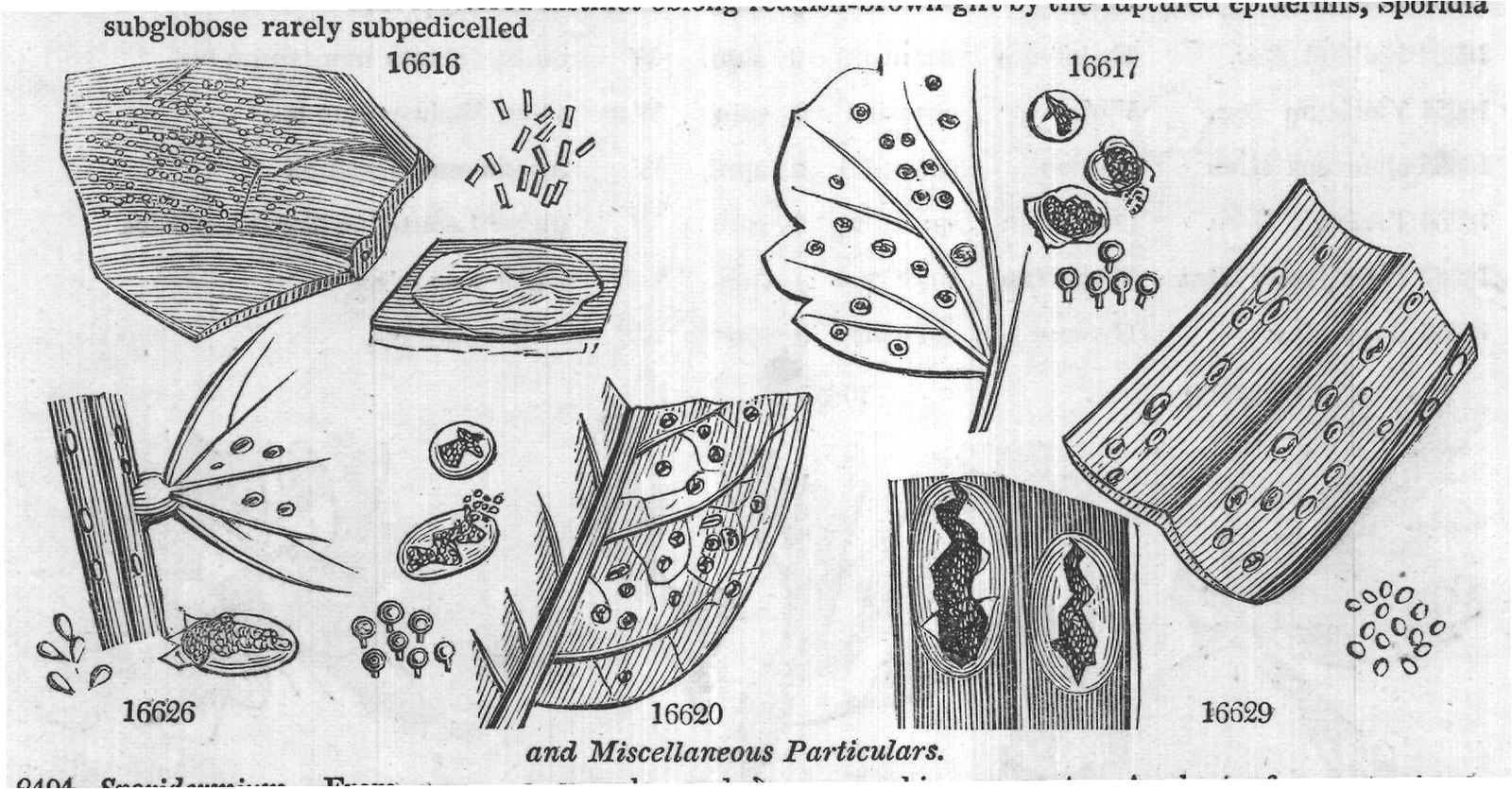
FUNGI CONIOMYCETES. 16603 Minute roundish or oval subgelatinous, Sporules long slender slightly curved 16604 Gregarious black minute convex, Sporidia elongated obtuse about 5 times transversely divided Class II. ENTOPHYTE. - Division I. Stilbosporei. 16605 Mass thin irregular of a whitish or grey color 16606 Mass irregular thin bright-yellow or greenish 16607 The only species 16608 Heaps rather large, Sporidia extremely minute nearly equally 2-celled 16609 Black granulated irregularly ovate at length shapeless, Sporules ovate attenuated at each extremity 16610 Heaps small, Sporidia ovate unilocular 16611 Heaps roundish bursting through the bark, Sporules ovate obtuse 2-celled 16612 Black very crowded, Filaments linear-oblong 4 or 5 times divided 16613 Spherules depressed black immersed, Sporules large ovate escaping in the form of thick black tendrils 16614 Spherules very small grey black, Sporules excessively minute dust-like under a high magnifying power escaping in the form of long capillary entangled dull-orange tendrils 16615 Spherules waved when divided horizontally elevating the epidermis, Orifice blackish with a cottony margin, Sporules very minute forming a single short slightly tortuous whitish tendrils 16616 The only species Division II. Hypodermia. 16617 Hypophyllous scattered dark fuscous round very pulverulent sometimes confluent, Sporidia globose 16618 Aggregated deep-brown chiefly hypophyllous confluent, Sporidia oval sometimes with a very min. stipes 16619 Hypophyllous scattered becoming confluent reddish or purplish-brown, Sporidia globose greenish under a high power of the microscope 16620 Hypophyllous circular scattered rarely disposed in a circle round a pale-brown centre, Sporidia globular 16621 Hypophyllous scattered single or disposed in a circle round a central one light-brown, Sporidia globular subovoid and rarely furnished with a minute pedicel 16622 On both sides of leaf dark fuscous minute round scattered, Sporidia globular rarely with a minute pedicel 16623 Hypophyllous scattered sometimes subconfluent roundish light-brown girt by the remains of epidermis, Sporidia oviform sometimes furnished with a very short blunt pedicel 16624 On both surfaces of the leaf and opposite to each other scattered round light-brown girt with the remains 16625 On both surfaces of the leaf brown round minute often not bursting: the epidermis rarely disposed in a 16626 Scattered round depressed light-brown girt with the remains of the epidermis, Sporidia rounded or 16627 Hypophyllous pale yellowish-brown sometimes disposed in a circle round: a central one minute rarely of the epidermis, Sporidia globose circle, Sporidia ovoid sometimes with minute pedicels suboval rarely with minute pedicels confluent, Sporidia roundish or egg-shaped and rather hyaline unequal, Sporidia roundish or oval rarely pedicelled subglobose rarely subpedicelled 16616 16628 Hypophyllous scattered or partially aggregated reddish-brown rounded somewhat prominent minute very 16629 On both sides of the leaf scattered distinct oblong reddish-brown girt by the ruptured epidermis, Sporidia 16617 00 16626 16620 16629 and Miscellaneous Particulars. 2494. Sporidermium. From σπoρoς, a sporule, and δερμa, a skin, or coat. A plant of a very simple structure, composed entirely of linear-oblong or club-shaped semi-opake bodies, closely arranged side by side, exactly of the same height, and transversely divided by three or four dissepiments. When viewed with the naked eye, it resembles an intensely black thin crust, creeping over the surface of