Cordiaceæ
Sp. 2-20. 1808. Cs.l 2425 tinifólia W.
Tinus-leaved tm 30 jn.jl W 2426 áspera Roxb. rough-leaved or 10 W ... 431. BOURRE'RIA. Gært. BOURRERIA.
Cordiaceæ.
Jamaica 1734. C p.l E. Indies 1795. C p.1 Sp. 2.
Trew. ehr.4. t.25 Roxb. cor. 1. t.55 2427 succulénta Jac. fleshy-fruited tm 45 W ... 2428 exsúcca Jac. dry-fruited or 15 W ...
W. Indies 1758. C s.l W. Indies 1804. C s.l Ja. obs.2.p.2. t.26 Jac.am.t.173.f.17 432. ELLI'SIA. W.
ELLISIA.
Hydrophylleæ. Sp. 1-2. 2429 Nycteléa W. cut-leaved O cu 2 jl.au W Virginia 1755. S co Eh.n.cu.2. t.7.f.1 433. SERSALI'SIA. R. Br. SERSALISIA.
Sapoteæ. Sp. 1-2. 2430 serícea R. Br. silky-leaved or 6 W ...
N. Holl. 1772. C p.l 434. MANGLILLA. Juss. MANGLILLA.
Sapoteæ. Sp. 1-11. 2431 milleriána Pers.
Miller's tm 30 jn.jl W C. G. H. ...
Cco Bot. mag. 1858 435. ARDI'SIA. W. 2432 acuminata W. 2433 solanácea Roxb. 2434 crenuláta P. S. 2435 lateriflóra W. 2436 littoralis B. R. 2437 élegans And. 2438 coloráta Lk. 2439 excélsa W. acuminated Nightsh.-like crenulated ARDISIA.
Myrsineæ.
Sp. 13-28. or 7 jl.au Guiana 1803. C p.1 Bot. mag. 1678 or 10 jn.s R E. Indies 1798. S p.l Bot. mag. 1677 or 10 jn.s R W. Indies 1809. S p.1 Vent. choix. t. 5 side-flowering sea-side elegant red-flowered or 6 ...
W W. Indies 1793. S p.1 or 4 jl.au R E. Indies 1809. C p.1 Bot. rep. 630 or 10 jl.au R E. Indies 1809. S p.l Bot. rep. 49 or 10 jl.au R E. Indies 1816. C s.1 Bot. cab. 465 Laurel-leaved or 30 jl.au Pk Madeira 1784. Cs.l Gært.sem.1. t.77 2440 paniculáta Roxb. panicled ☐ or 12 jl.au R E. Indies 1818. C s.l Bot. reg. 638 2441 pyramidális Rth. pyramidal ☐ tm 25 jl.au R Santa Cruz1818. C s.l Bot. cab. 448 2442 lentiginósa Ker. dusty or 6 ja.d W China 1814. C s.l Bot. reg. 533 2443 punctáta Lindl. dotted or 10 jn.au W China 1823. C s.l Bot. reg. 827 2444 coriácea Swz. coriaceous or 7 S Antilles 1824. C s.l 436. ARDUI'NA. W.
ARDUINA.
Apocyneæ. Sp. 1. 2445 bispinósa W. two-spined cu 2 mr.au W C. G. H. 1760. C p.l Bot. cab. 387 437. STRYCH'NOS. W. STRYCHNOS.
Apocyneæ. Sp. 2-9. 2446 Nux-vómica W.
Poison-nut 2447 potatórum W.
Clearing-nut 호 438. CARIS'SA. W.
CARISSA. 2448 Carándas W.
Jasmine-flow. 2449 spinárum W spiny 어어 오호 p 15 ...
G.w E. Indies 1778. S p.1 Roxb. cor. 1. t. 4 m 15 ...
WE. Indies 1794. S p.1 Roxb. cor. 1. t. 5 Apocynea. Sp. 2-10. fr 15 jl W E. Indies 1790. C s.p Bot. cab. 663 tm 20 au.d W E. Indies 1809. C s.p Bot. cab. 162 439. PÆDE'RIA. W.
PÆDERIA.
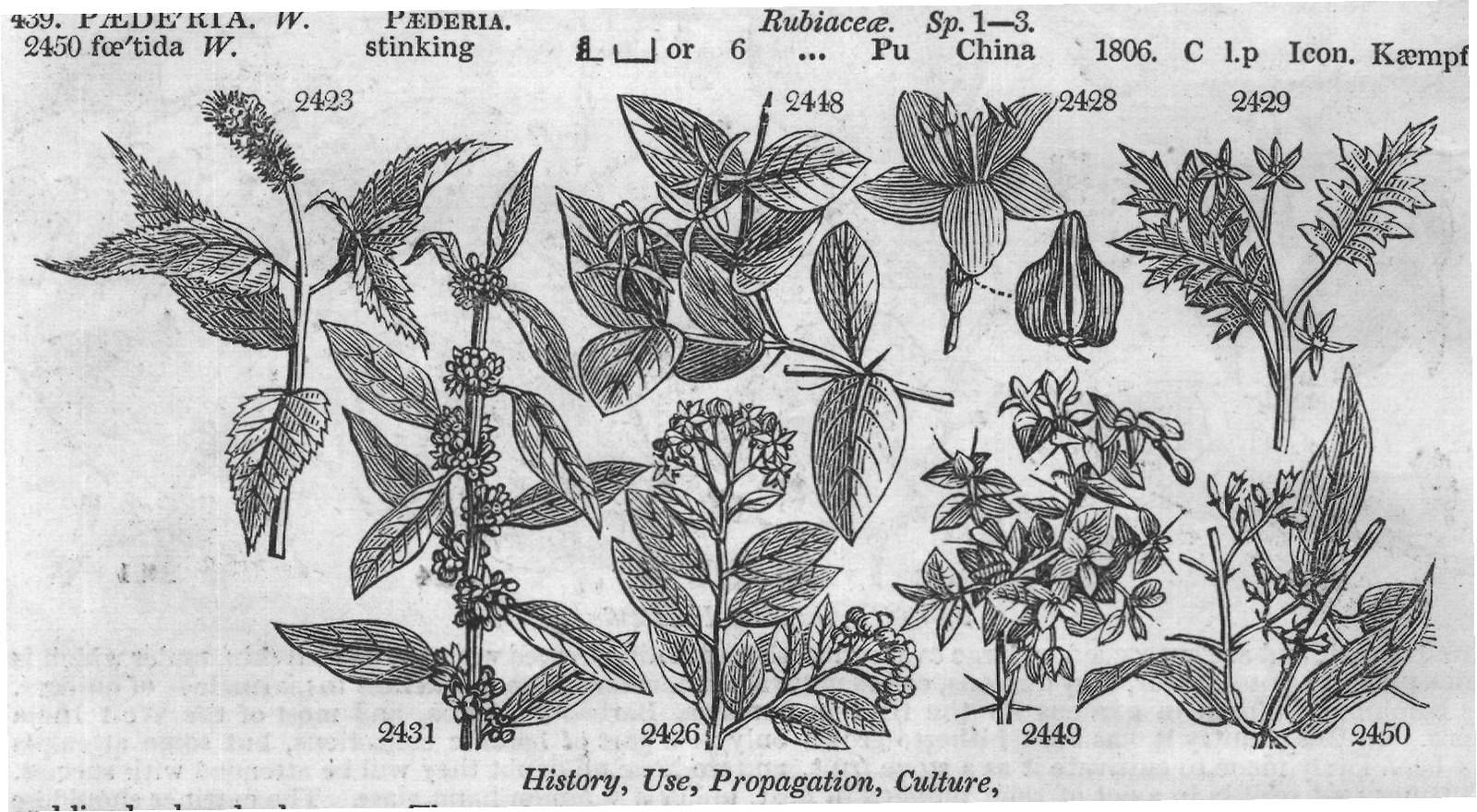
Rubiaceæ. Sp. 1-3. 2450 fœ'tida W. stinking or 6 Pu China ... 1806. C l.p Icon. Kæmpf. 9 2423 2448 2428 2429 2431 2426 2449 2450 History, Use, Propagation, Culture, and lived a hundred years. The work he left upon the agriculture of his time is invaluable. In French a species is called Monjoli, (my beauty) on account of its beauty. 430. Ehretia. So named by Linnæus in honor of D. G. Ehret, a famous French botanist and draughtsman. He made all the drawings for Patrick Browne's History of Jamaica: and a large collection of his drawings made all the drawings for Patrick Browne's History of Jamaica; and a large collection of his drawings is now extant in the Banksian collection.
Large trees of the Tropics, with handsome foliage and white flowers, which are not often produced in Europe. 431. Bourreria. A genus divided from Ehretia, with which it nearly agrees. It was named after one Bourer, an apothecary at Nuremberg. 432. Ellisia. Joseph Ellis was an English naturalist, fellow of the London Royal Society, and correspondent of Linnæus. He published, besides his Natural History of Corallines, many papers in the Transactions of the Royal Society. Linnæus. He published, besides his Natural History of Corallines, many papers in the Transactions of the Royal Society. 433. Sersalisia. Named after John Baptiste Sersalis, a Neapolitan clergyman, much praised by Fabius Columna. Culture the same as for Sideroxylon. 434. Manglilla. This genus is called in Dombry's Manuscript Papers, from which M. de Jussieu obtained his knowledge of it, Manglille de Perou. The original species was a Peruvian shrub, with alternate leaves and bunches of numerous axillary flowers. 435. Ardisia. A name derived from aρδiς, a point, on account of the acute segments of the corolla. An ornamental genus of plants, much valued by collectors for the beauty of their foliage, flowers, and berries. They are of easy culture: cuttings strike root freely in a pot of sand, plunged in a moist heat, under a handglass. 436. Arduina. In honor of Pietro Arduini, curator of the economical garden of Padua. A genus scarcely distinct from Carissa. It is a pretty little plant not unlike the box, easily propagated by cuttings under a bellglass in sand. 437. Strychnos. A name given by the Greeks to the Solanum. The root of the name has been found in the verb τρωω, to strew, to throw down; the property of the original and modern plants being narcotic. S. nux-vomica is a middling sized tree with a crooked trunk and smooth ash-colored bark: the leaves round, shining, smooth, ORDER I.
PENTANDRIA MONOGYNIA. 2423 Leaves broad ovate serrate rugose, Spikes terminal, Flowers clustered, Cal. large inflated 2424 Leaves linear toothed obtuse revolute at edge rough above tomentose beneath, Spikes linear oblong 2425 Leaves oblong ovate entire smooth, Flowers panicled 2426 Leaves ovate roughish, Flowers corymbose spiked 1-sided 2427 Leaves ovate entire smooth, Flowers corymbose, Cal. smooth 2428 Leaves ovate very smooth reflexed at edge, Berry juiceless 4-cornered 2429 The only species, resembling a Hydrophyllum 2430 Leaves ovate obtuse downy beneath, Cor. villous outside, Barren filaments lanceolate 2431 Leaves oblong acute at each end, Flowers solitary lateral 2432 Panicles axillary and terminal, Leaves oblong acuminate narrowed at base 2432 Corymbs axillary 3-parted, Leaves oblong narrowed towards each end 2434 Panicles terminal, Leaves lanceolate ovate repand crenate acuminate attenuated at base 2435 Racemes lateral axillary compound, Leaves oblong acuminate entire 2436 Corymbs axillary simple, Leaves entire ovate elliptical coriaceous 2437 Leaves oblong entire coriaceous shining, Pan. terminal, Sepals rounded, Cor. thrice as long as calyx 2438 Leaves oblong entire coriaceous shining, Pan. terminal, Sepals round, Cor. twice as long as calyx 2439 Racemes axillary simple, Leaves obovate at the edge cartiliginous serrated 2440 Leaves wedge-shaped oblong nearly sessile entire smooth reflexed, Panicles decompound 2441 Raceme terminal pyramidal, Pedunc. altern. umbelliferous, Leaves oblong obtuse smooth entire 2442 Leaves lanc. crenate, Corymbs compound, Flowers spotted 2443 Leaves lanceolate coriaceous sinuate narrowed towards the base, Cor. campan. dotted: Lobes obtuse 2444 Flowers panicled, Leaves oblong entire veinless coriaceous 2445 Leaves cordate ovate mucronate subsessile, Spines bifid at end 2446 Unarmed, Leaves ovate stalked, Cymes subterminal 2447 Leaves opp. ovate acute 5-nerved veiny, Cymes axillary 2448 Leaves ovate mucronate netted veiny, Segm. of cor. lanceolate 2449 Leaves ovate acute veiny, Segments of cor. oblong 2450 Leaves cordate lanceolate, panicles short opp. few-flowered, Bractes very small 2433 2437 2440 2442 2445 2447 2448 and Miscellaneous Particulars. entire; and the berry the size of a pretty large apple. The wood is hard, durable, and very bitter. The seeds, which form the officinal nux-vomica, are employed in the distillation of country spirits, to render them more intoxicating. The pulp of the fruit seems perfectly innocent, being eaten greedily by many sorts of birds. The seed consists chiefly of a gummy matter with a little resin, the latter intensely bitter. It is reckoned amongst the most powerful poisons of the narcotic kind. It proves fatal to dogs in a very short time, and to most other quadruped vermin, and even some birds, as crows and ducks From dissections both of the human subject and of dogs that have been poisoned by it, no injury appears done to the stomach or intestines, which proves that it acts upon the nervous system, and destroys life by the virulence of its narcotic influence. S. potatorum is a larger tree than the other. The pulp of the fruit when ripe is eaten by the natives: the ripe seeds are dried and sold in every market of the East Indies to clear muddy water. A precious quality in countries where the water is rarely of a good quality. Hence the English name of clearing-nuts. The natives never drink clear well-water, if they can get pond or river water, which is always more or less impure. One of the seeds is rubbed very hard for a minute or two round the inside of the vessel containing the water, which is generally an unglazed earthen one, and the water left to settle; in a very short time the impurities fall to the bottom, leaving the water clear, and perfectly wholesome. These nuts are constantly carried about by the more provident part of our officers and soldiers in time of war, to enable them to purify their water; they are easier to be had than alum, and are probably less hurtful to the constitution. 438. Carissa. A word of no known meaning. Carandas is a slight alteration of Caraunda, the Bengalese name of the tree. .Carandas is a small tree, with dichotomous branches, and entire, glossy, ovate leaves, flowers of the tree. C. Carandas is a small tree, with dichotomous branches, and entire, glossy, ovate leaves, flowers like those of Jasminum grandiflorum, and berries black when ripe, eatable, and of a sweet acid flavor. Currant-jelly is made of them in the East Indies. C. spinarum is a diœceous plant with horizontal branches, coriaceous glossy leaves, and terminal peduncles of five or six small flowers. Neither of the species require much water, and the pots should be well drained five or six small flowers. Neither of the species require much water, and the pots should be well drained to prevent their getting sodden. Cuttings strike root freely under a bell-glass in sand plunged in heat. 439. Pæderia. From pædor, stink, in allusion to the fœtid smell of the flowers. A climbing smooth shrub, with opposite stalked entire leaves, and dull purple flowers. PENTANDRIA MONOGYNIA.
CLASS V. 440. GELSEMIUM. J. GELSEMIUM.
Apocyneæ. Sp. 1. 2451 sempervirens H. K. evergreen உ or 6 jn.jl Y N. Amer. 1640. Cs.p Cat. car. 1. t. 53 441. RAUWOL'FIA. W. RAUWOLFIA.
Apocyneæ. Sp. 4-12. 2452 nítida W. shining cu 12 jn.s W S. Amer. 1752. C s.p Bot. cab. 339 2453 canéscens W. hoary cu 7 Pk ... 2454 tomentósa W. downy cu 3 ap.o W 2455 ternifólia Kunth. three-leaved cu 3 my W Jamaica 1739. C 1.p W. Indies 1823. C 1.p W. Indies 1823. C 1.p Plum.ic.t.236.f.2 Bot. mag. 2440 442. VALLE'SIA. Fl. per. VALLESIA. ... 2456 glábra Lk. smooth or 3 my.jn W 443. BEOBO'TRYS. Vahl. BEOBOTRYS. 2457 indica Roxb.
Rhamneæ. Sp. 1.
Indian or 3. n W E. Indies 1817. C co Sp. 1-2.
N. Spain 1822. Cr.m Cav. ic. 3. t. 297 Bot. mag. 2052 444. SOLAN'DRA. W.
SOLANDRA.
Solaneæ. Sp. 2-3. 2458 grandiflóra W. great-flowered 2459 viridiflóra B. M. green or or 15 mr Pa. Y Jamaica 1781. 3 my.jl G S. Amer. 1815.
Cr.m Jac.schœn.1.t.45 Cr.m Bot. mag. 1948 445. CES'TRUM. W. 2460 laurifólium W. Laurel-leaved 2461 macrophyllum Vent. large-leaved 2462 fœtidíssimum W.en. stinking 2463 noctúrnum W. night-smelling 2464 Párqui W.
CESTRUM.
Solanece. Sp. 19-50. p 7 my.au W W. Indies 1691.
C p.l Smith spic. 2. t.2 P 7 my.au W P p W Willow-leaved p 2465 auriculátum W. ear-leaved p 12 jn.jl 2466 vespertínum W. cluster-flower'd ☐ p 12 my.jl G G Peru 1774.
W. Indies 1759. 2467 fastigiátum Jacq.
Honeysuckle p 4 n W W. Indies 2468 diúrnum W. day-smelling p p 10 n W 10 my.au Y 7 n W. Indies 1812. C p.1 E. Indies Cp.l E. Indies 1732. C p.l 7 jn.jl Pa. Y Chili 1787. C p.1 C p.l C p.l C p.l W. Indies 1732. C p.1 Vent. choix. 18 Jac.schœ.3. t.329 Di.elt.t.153.f.185 Bot. mag. 1770 L'Her. s. n. 1.t.35 Jac.schœ.3. t.328 Bot. mag. 1729 Di.elt.t. 154. f.186 ... ... 2459 venenátum W. poisonous P 7 f.ap W C. G. H. 1787. S p.1 2470 salicifólium Jacq. sallow-leaved P 5 ap.jn G.w Caraccas ...
C1.p Jac.schœ.3. t.326 2471 tomentósum W. downy P 6 jn.jl Y S. Amer. 1790. C p.1 2472 hirsútum Jacq. hairy P 8 jn.jl G ...... 1818. C p.l Jac.schœ.3. t.324 2473 pendulínum Jacq. pendulous P 6 jn.jl G.w 2474 odontospermum Jac. tooth-seeded p 6 jl.au W 2475 tinctórium Jacq. dyer's dy 4 ap.jn W 2476 undulátum Fl. per. wavy p 15 ...
Y 2477 cauliflórum Jacq. stem-flowering P 4 my.jn W ...... 2478 citrifólium Retz. lemon-leaved P 6 jn.jl Y Caraccas 1824. C p.1 W. Indies 1793. C p.l Caraccas 1823. C p.1 Peru 1822. C p.1 1821. C p.l 1820. C p.l Jac. schœ.3.t.327 Jac. sch. 3. t. 332 Fl. per. 2. t. 155 Jacq. sch. 3. t.325 446. A'TROPA. W.
ATROPA.
Solaneæ. Sp. 4-14. 2479 Belladonna W.
Deadly-Nights.P 2480 frutéscens W. shrubby P 5 ja.mr Y 2481 aristáta Poir. bearded P 5 ...
Y 2482 arboréscens L. tree 오p 15 jn.au W 5 jn.jl V Britain Spain Canaries 1779. C s.l Jamaica 1733. C s.1 rub. Rco 1737. C s.l Eng. bot. 592 Cav. ic. 2. t. 102 Plum. ic. 46. f. 1 447. MANDRAGO'RA. W.en. MANDRAKE.
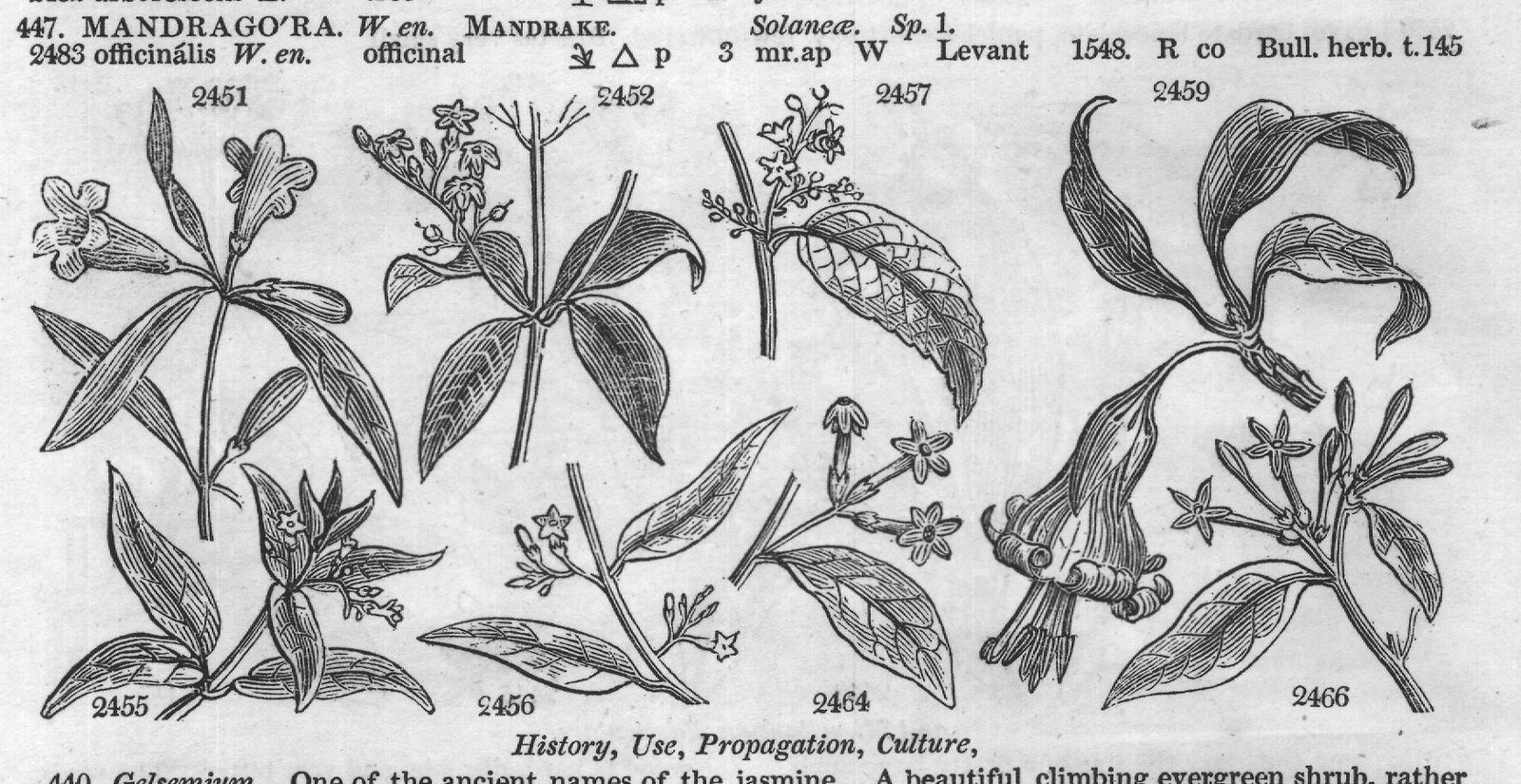
Solaneæ. Sp. 1. 2483 officinalis W. en. officinal X p 3 mr.ap W Levant 1548. R co Bull. herb. t.145 2451 2452 2457 2459 2455 2456 2464 2466 History, Use, Propagation, Culture, 440. Gelsemium. One of the ancient names of the jasmine. A beautiful climbing evergreen shrub, rather too delicate to bear the cold of our winters; but with a little protection it produces in abundance its charming yellow flowers of delicious fragrance. 441. Rauwolfia. So named by Plumier, in honor of Leonhard Rauwolf, physican at Augsburg, who travelled through Palestine and other countries of the east, in 1753-5. His travels were translated into English, under the revision of Mr. Ray, and with additions by him. The species abound in a milky juice, which is considered more or less of a deleterious nature. They produce berries about the size and color of those of the privet. Cuttings root in sand under a hand-glass. 442. Vallesia. In honor of Fr. Vallesio, principal physician to Philip II., king of Spain. He wrote upon the plants of holy writ. Small Peruvian shrubs. 443. Bœobotrys. From βaioς, small, and βoτρuς, a bunch; the flowers growing in little bunches. An elegant shrub with white flowers, produced freely from the axillæ of the leaves. 444. Solandra. In honor of the celebrated and excellent Daniel Solander, whose botanical merits will never be forgotten in this country. He accompanied Sir Joseph Banks in his voyage with Captain Cook, and the information afforded by his manuscript notes made at that time has not yet been exhausted. The species are very beautiful, and remarkable for the extraordinary size of their flowers. Sweet observes, " if allowed plenty of room and moisture, they grow very rapidly, but produce no flowers. The best way is to plant them in a loamy soil, and allow them to grow fast at first, till they have made a great many shoots; then keep them very dry till their leaves drop off, and they will produce plenty of flowers. Cuttings taken off and stuck in a pot of mould, will root without any further care. The best way to have plants flower young, is to take the cuttings from the flowering shoots." (Bot. Cult. 107.) 445. Cestrum. A name given by the Greeks to the Betony, but having no relation whatever to the plant which bears the name now. Cestreau, Fr. This is a genus of easy cultivation, but of little beauty. The flowers are all white, and in some cases sweet-scented; the fruit of all poisonous. 446. Atropa. A mythological name. Atropos was one of the Fates, and it was her especial duty to cut the thread of human life. The fruit of this genus is well adapted to fulfilling her office. A. belladonna (fine lady) has ORDER I.
PENTANDRIA MONOGYNIA. 2451 Scandent quite smooth, Leaves lanceolate, Flowers axillary subsolitary 2452 Leaves 3 or 4 together lanceolate acuminate shining, Flowers terminal 2453 Leaves 4 together oblong ovate acuminate pubescent, Flowers terminal and axillary 2454 Leaves 4 together oblong narrowed both ways tomentose, Flowers terminal and axillary 2455 Leaves 3 together oblong acuminate smooth, Flowers between the petioles corymbose 2456 Leaves lanceolate cymbiform incurved at end 2457 Leaves oblong ovate acuminate coarsely serrated 2458 Leaves smoothish stalked, Anthers of the same shape 2459 Flowers stalked, Segm. of flower long acuminate revolute 2460 Filaments toothed or naked, Leaves elliptical coriaceous shining, Flowers fascicled stalked 2461 Filam . toothed, Leaves ovate oblong acuminate smooth, Flowers fascicled sessile 2462 Filam, naked, Segm. of cor. emarginate, Flowers racemose, Leaves ovate and lanceolate 2463 Filam. toothed, Peduncles racemose as long as leaves 2464 Filam. toothed or naked, Flower-bearing stem panicled, Stipules linear 2465 Filam, naked, Stipules amplexicaule lunate, Leaves ovate, Flowers panicled terminal 2466 Filam, naked shorter than throat of cor. Flowers aggreg. sessile terminal and lateral, Leaves elliptical 2467 Filam , naked, Pedunc. elong. as long as leaves spiked at end, Leaves oblong, Stip. elliptical 2468 Filam. naked, Segm. of cor. rounded reflexed, Leaves lanceolate 2469 Leaves lanceolate oblong coriaceous, Flowers sessile 2470 Filam. toothed, Flowers racemose, Leaves linear lanceolate 2471 Flowers clustered sessile terminal, Branches leaves and calyxes downy 2472 Filam. toothletted, Spikes axillary longer than leafstalks, Leaves obl. pub. on both sides, Stip. falcate 2473 Filam. naked the length of the tube of the corolla, Flowers aggreg. sessile terminal, Leaves elliptical 2474 Filam. naked, Leaves lanceolate, Racemes short axillary and terminal, Cor. revolute 2475 Filam. naked, Leaves lanc. ovate, Racemes axillary and terminal, Flowers pedicellate, Cor. acum, reflex 2476 Filam. toothed, Leaves ovate acute wavy, Pedunc. axillary and terminal few flowered 2477 Filam. naked exserted, Flowers stalked clustered, Cor. campanulate, Leaves elliptical 2478 Leaves large ovate acute entire shining naked on both sides coriaceous nerved, Petioles black shining 2479 Stem herbaceous, Leaves ovate entire 2480 Stem shrubby, Peduncles clustered, Leaves cordate ovate obtuse 2481 Stem shrubby, Leaves oblong entire smooth, Branches downy, Sepals aristate 2482 Stem shrubby, Peduncles clustered, Cor. revolute, Leaves oblong 2483 The only species 2470 2467 2472 2473 2477 2480 2483 2479 and Miscellaneous Particulars. its specific name, according to some, from its being used as a wash among the ladies, to take off pimples or other excrescences from the skin; or, according to others, from its quality of representing phantasms of beautiful women to the disturbed imagination. The inspissated juice of the berries is used in the form of extract for anointing the eyelids in some opthalmic complaints. Its effect in dilating the pupil is quite remarkable. It has branching stems with the root leaves often a foot long and five inches broad, and the whole plant is more or less tinged with purple. The flowers are void of scent; the berries are larger than cherries, at first green, but when ripe of a beautiful shining black color, full of purple juice, with roundish dotted channelled seeds. The whole plant, and especially the berries, is poisonous. Buchanan relates the destruction of the army of Sweno the Dane, when he invaded Scotland, by the berries of this plant, which were mixed with the drink which the Scots, according to truce, were to supply the Danes with. The Danes became inebriated, and the faithless Scots fell on them in their sleep. Dr. Milne (Indigenous Botany) remarks, that nature has been more parsimonious in her warnings with respect to this plant, than to others of the same natural family. Neither the smell nor the taste is offensive; and if the color of the flowers proves in some degree a repellant, that of the fruit, on the other hand, is in an equal degree, at least, attractive and inviting. 447. Mandragora. From μavδρa, something relating to cattle, and aγauρoς, hurtful: dangerous to cattle. It is a venomous plant, and was an important engine in the days of medical charlatanry, from the roots being supposed to bear a resemblance to the human form. In old herbals the figures display the male mandrake with a long beard, and the female with a prolix head of hair. Miller says, " mountebanks carry about fictitious images, shaped from roots of bryony and other plants, cut into form or forced to grow through moulds of earthenware, as mandrake roots." Happily such mountebanks have ceased to exist in Britain. On the continent they are still common, and Box tells us (in 1810), that by means of a few cuts with a knife, they add the image of the exterior organs of generation, male or female, to mandrake roots, and then sell them to ensure boys or girls to pregnant women, procure happy births, &c. We have ourselves seen them exposed by mountebanks in sea-port towns of France. For an ingeniously indelicate figure of a mandrake root, see the Flora Græca, the plates for which have been all selected by Sir James Smith. The plant is of easy culture, but is the better for the protection of a frame or shelter of a south wall during winter. 448. PHY'SALIS. W.
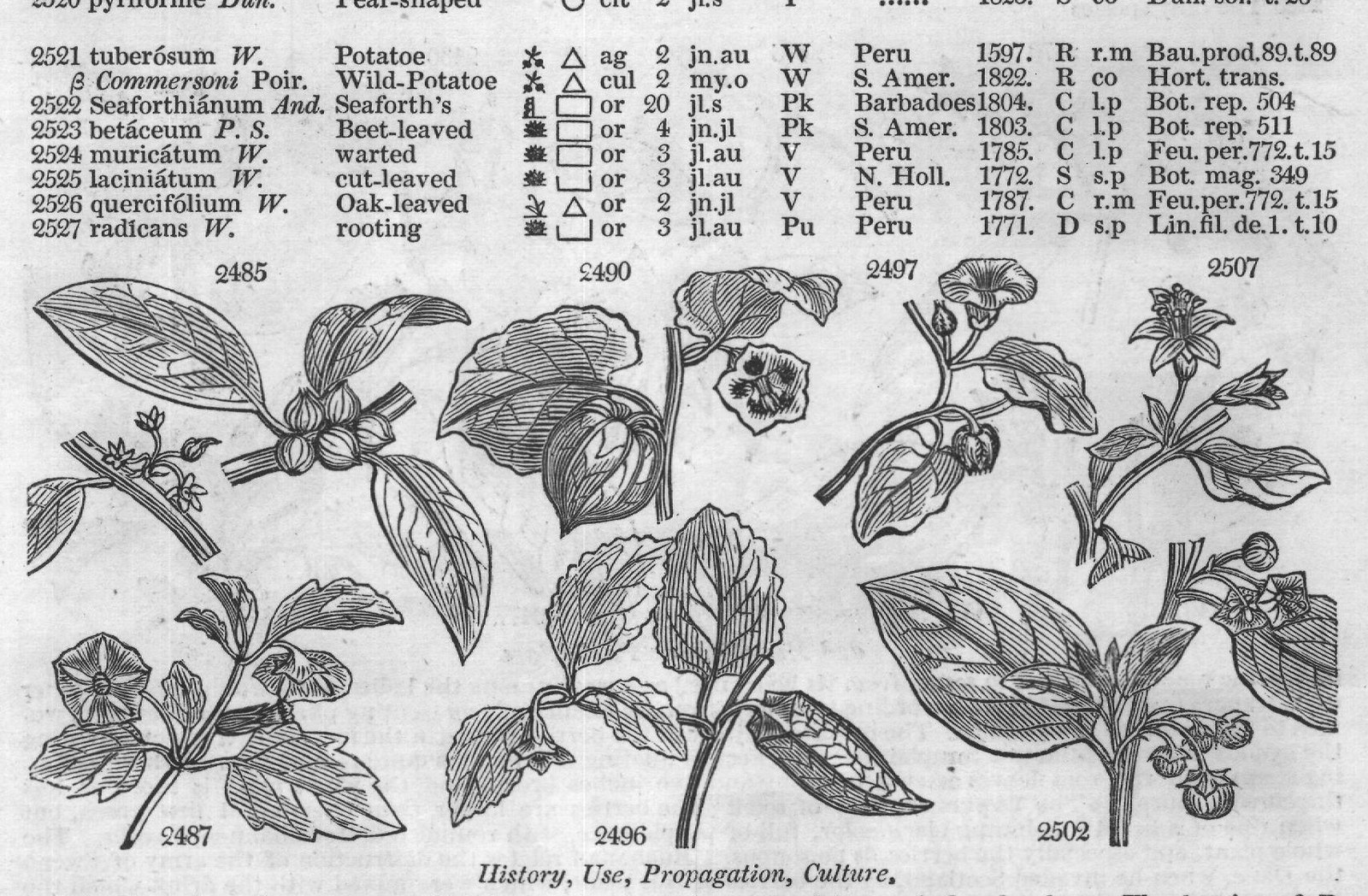
WINTER CHERRY. 2484 somnífera W. clustered W 2 jl.au 2485 flexuósa W. flexuose W 2 jl.au 2486 curassávica W.
Curaçao W 1½ jn.s 2487 viscósa W. clammy W 2 jl 2488 pensylvánica W.
Pensylvanianw 1 jl.s Y 2489 Alkekéngi W. common or 1 jl.s W 2490 peruviána W. eatable fr 1½ ap.o W 2491 pubéscens W. downy W 2 jlau Y 2492 anguláta W. angular-branch w 2 jn.s W 2493 chenopodifolia W Goose-foot-lvd.
W 2 jl.au Y 2494 barbadénsis W.
Barbadoes W 2 jl.au PENTANDRIA MONOGYNIA.
Solaneæ. Sp. 18-37.
G.Y Mexico 1796. C co G.Y E. Indies 1759. C co St.Y S. Amer. 1699. D co St. Y America 1732. D co N. Amer. 1726. D p.l S. Europe 1548. D s.l S. Amer. 1772. S s.l America 1640. S s.l India 1732. S s.1 Peru 1798. S s.l Pa.Y W. Indies 1798. S s.l CLASS V.
Cav. ic. 2. t. 103 Rhed. mal.4.t.55 Plu.alm.t.111.f.5 Jac. vind.2. t. 136 Bot. mag. 1068 Feuill. it. 3. t. 1 D.elt. 13.t.12.f. 12 Jac. ic. 1. t. 39 2495 mínima W. small W 1½ jl.au Pa.Y E. Indies 1759. S s.1 2496 pruinósa W. 2497 prostráta W. hairy-annual W 1 jl.au Pa.Y America 1726. S s.1 Rhed.ma. 10.t.71 Dill.elt. 10.t.9.f.9 trailing W 1 jl.au L.B Peru 1782. S s.p Bot. rep. 75 2498 tuberósa W. E. tuberous W 2 jl.au W ...... 1815. D s.p 2499 parviflóra W. E. small-flowered W 1 jl.au Y ... 1820. S s.p 2500 dúbia Lk. doubtful W 2 jl.au Y Brazil 1821. S s.p 2501 fœtidíssima Lag. stinking W 2 jl.au Y N. Spain 449. SA'RACHA. Fl. per. SARACHA.
Solaneæ.
Sp. 2. 2502 procúmbens F. p. procumbent or 3 n.jl Pa. Y Peru 2503 umbelláta Jacq. umbelled or 4 jn.jl Pa.Y Peru 1820. S s.p 1822. D co 1822. D co Fl. per. 2. t. 180 2504 áfrum W. 450. LYCIUM. W. 2505 rígidum W. 2506 ruthénicum W.
BOX-THORN.
Solaneæ. Sp. 12-28.
African or 10 jn.jl V C. G. H. 1712. C p.l Bot. reg. 354 rigid Russian or 6 or 4 ap.my V Pk C. G. H. 1795. C p.1 Siberia ... 1804. C p.1 2507 bárbarum P. S.
Willow-leaved or 12 my.au V 2508 turbinátum P. S. top-shaped or 12 my.au V 2509 europæ'um P. S.
European or 12 my.au Pk 2510 lanceolátum Poir. spear-leaved or 12 my.au Pk 2511 chinénse Mill.
Chinese or 6 my.au Pu S. Europe China 2512 hórridum W. succulent-lvd. 2513 boerhaaviæfólium W. glaucous-leaved ココ or 3 jl.au W C. G. H. or 2514 caroliniánum Ph.
Carolina 2515 trewiánum Duh.
Trew's * or 15 my.au Pu 6 ap.my P.Pu or 4 jl.s B China 1818. C co Peru Carolina C co C co 1791. C p.1 1780. C p.l Barbary 1696. R co China 1709. C co S. Europe 1730. C co ...
Tre. ehr. t.24. f.1 M.co.go.1779. t.2