Home › C › Cor (Superior petals the larger)
Cor (Superior petals the larger)
superior, 3 petals, the larger segments hastate. 571. Strelitzia. Spathes universal and partial. Cal. O. Nect. 3-leaved, surrounding the stamens. Stigmas 3. Caps. 3-celled. Cells many-seeded. Order 2. DIGYNIA. 5 Stamens. 2 Styles. 1. Flowers monopetalous, inferior. Fruit a follicle or capsule. (ASCLEPIADE.) 572. Apocyпиt. Cor. campanulate. Filaments 5, alternate with the stamens. Style none. Stigma broad. Follicles long, linear. 573. Melodinus. Cal. campanulate, 5-toothed. Cor. hypocrateriform. Limb spreading, with falcate, crenulate segments. Corona 5-cleft, with short, stellate, torn divisions. Stigmas 2. Fruit a fleshy globose, 2-celled, , many-seeded berry. 574. Periploca. Anthers bearded at back. Pollen-masses solitary, made up of 4 confluent ones. Stigma blunt. Follicles cylindrical, divaricating, smooth. Seed comose. 575. Cryptostegia. Cor. funnel-shaped. Tube with two included bifid scales, alternate with the divisions of the limb. Stamens included, inserted in the base of the tube. Filaments distinct. Anthers cohering with the stigma by their base. Glands 5, spatulate. Pollen granular, simple. 576. Hemidesmus. Cor. with 5 blunt scales under the sinuses. Anthers free from the stigma, simple at end. Stigma blunt. Follicles cylindrical, much spreading, smooth. Seeds comose. 577. Secamone. Corona 5-leaved. Pollen-masses 20, smooth, erect, fixed by fours to the point of each corpuscle of the stigma. Stigma contracted at end. 578. Microloma. Tube of cor. inflated, angular, shorter than the limb. Scales inserted into the middle of the tube below the sinuses. Anthers terminated by a membrane , sagittate. Pollen-masses compressed, pendulous. Stigma with a little point. 579. Sarcostemma. Cor. rotate. Pollen-masses pendulous. Stigma blunt. Seeds comose. 580. Dæmia. Cor. rotate, with a short tube. Outer corona 10parted, short. Pollenmasses pendulous, compressed. Stigma blunt. Seeds comose. 581. Cynanchum. Cor. rotate, 5-parted. Pollen-masses inflated. Stigma with a little point. Follicles smooth. 582. Oxystelma. Cor. spreading, rotate, with a short tube. Columna exserted. Crown 5-leaved, with compressed, acute, undivided leaflets. Pollen-masses compressed, pendulous, fixed by a narrow end. Stigma blunt. Follicles smooth. Seeds comose. 583. Gymnema. Cor. 5-cleft. Scales or little teeth of the orifice 5, inserted in the sinuses. Crown none. Masses of pollen erect, fixed by the base. Follicle slender, smooth ORDER II.
PENTANDRIA DIGYNIA. 584. Calotropis. Cor. with an angular tube: the angles saccate inside. Crown with carinate leaflets, united lengthwise to the tube of the filaments. lengthwise to the tube of the filaments. Pollen-masses pendulous, fixed by the narrow end. Stigma blunt. Corona with subulate, spreading, recurved segments. Pollenmasses erect, fixed by the base. Stigma blunt. Follicles smooth. Seeds comose. 586. Xysmalobium. Cor. 5-cleft, spreading. Corona 10-parted in a 'single row: the 5 divisions next to the anthers fleshy, round, simple within, the 5 others small. Pollen-masses pendulous, with lax connecting processes. Stigma blunt. 587. Gomphocarpus. Corona 5-leaved, the segments simple within. Pollen-masses compressed, pendulous, fixed by a fine end. Stigma depressed, blunt. Follicles ventricose, covered with innocuous spines. Seeds comose. 588. Asclepias. Corona 5-leaved, with a process on the inside. Pollen-masses fixed by a fine end. Stigma depressed, blunt. 589. Gonolobus. Cor. rotate, 5-parted. Corona shield-shaped. Anthers opening across, terminated by a membrane. Stigma flat, depressed. 590. Pergularia. Cor. hypocrateriform, with an urceolate tube. Pollen-masses erect, fixed by their base. Stigma blunt. Follicles ventricose, smooth. Seeds comose. 591. Marsdenia. Cor. urceolate, 5-cleft, sometimes rotate. Pollen-masses erect, fixed by the base. Follicles smooth. Seeds comose. 592. Hoya. Cor. 5-cleft. Pollen-masses fixed by the base, conniving, compressed. Stigma depressed, with an obtuse wart. Follicles smooth. Seeds comose. 593. Ceropegia. Outer corona short, 5-lobed; inner 5-leaved, with ligular undivided leaflets. Pollen-masses fixed by their base with simple edges. Stigma blunt. Follicles cylindrical, smooth. Seeds comose. 594. Stapelia. Cor. rotate, 5-cleft, fleshy. Column of fructification exserted. Pollen-masses fixed by the base. Stigma blunt. Follicles cylindrical, smooth. Seeds comose. . Stigma blunt. Follicles cylindrical, smooth. Seeds comose. 595. Piaranthus. Cor. fleshy. Outer corona none. Pollen-masses fixed by the base, with one edge cartilaginous, pellucid. Stigma blunt. 596. Huernia. Accessory segments of cor. tooth-like. Leaflets of the inner corona from a gibbous base subulate, undivided, alternate with the outer segments. Pollen-masses fixed by the base, with one edge cartila- , undivided, alternate with the outer segments . Pollen-masses fixed by the base, with one edge cartilaginous, pellucid. Stigma blunt. Follicles cylindrical, smooth. Seeds comose. 597. Brachystelma. Cor. campanulate, with angular recesses. Column included. Crown 1-leaved, 5-cleft, with the lobes opposite the anthers, simple at back. Anthers without a membrane at the end. Pollen!masses erect, inserted by the base. the lobes opposite the anthers, simple at back. Anthers without a membrane at the end. Pollen!masses erect, inserted by the base. 598. Caralluma. Cor. rotate, deeply 5-cleft. Cal. of fructification exserted. Pollen-masses erect, fixed by the base with simple edges. Stigma blunt. Follicles slender, smooth. Seeds comose. base with simple edges. Stigma blunt. Follicles slender, smooth. Seeds comose. 2. Flowers monopetalous, inferior. Fruit a capsule. 599. Swertia. Caps. of 1 cell. Cor. wheel-shaped, with 2 nectariferous pores at the base of each segment. 600. Gentiana. Caps. of 1 cell. Cor. tubular at the base, destitute of nectariferous pores. 601. Hydrolea. Caps. 2-valved, 2-celled. Cor. rotate, campanulate. Stamens inserted in the tube. 602. Falkia. Cal. inflated, 5-parted, 5-angular. Cor. campanulate, emarginate, crenate. Styles spreading. Stigma globose, woolly. Seeds 4, globose, with an arillus in the bottom of the calyx. 603. Dichondra. Cal. 5-parted, with spatulate segments. Cor. short, campanulate, 5-parted. Stigma peltate, Seeds round. 3. Flowers pentapetalous, inferior. 604. Velezia. Cal. slender, 5-toothed. Cor. of 5 small petals. Caps. 1-celled, at the end 4-valved. Seeds many, attached to a filiform central receptacle. 605. Bumalda. Cal. 5-parted. Petals 5. Styles villous. Caps. 2-celled, with 2 bractes. 606. Heuchera. Petals 5. Caps. 2-celled, with 2 bractes. 607. Cussonia. Invol. O. Cal. 1-leaved, truncated, crenated. Pet. 5, oblong, acute. Fruit twin, 2-celled, crowned by the calyx and styles. 608. Anabasis. Cal. 3-leaved. Pet. 5. Berry 1-seeded, surrounded by the calyx. 609. Salsola. Caps. closed, imbricated in the fleshy calyx. Seed with a spiral embryo. 610. Kochia. Cal. 1-leaved, campanulate, in the fruit expanding into a leafy rim resembling 5 petals. Cor. O. Stigmas 2-3, long. Caps. 1-celled, 1-2-seeded. Seed incurved. 611. Chenopodium. Seed lenticular, truncated, superior. 612. Beta. Seed kidney-shaped, imbedded in the fleshy calyx. 613. Bosea. Cal. 5-leaved. Cor. O. Berry 1-seeded. 614. Herniaria. Caps. closed, membranous, invested with the calyx. Stam. with 5 imperfect filaments. 615. Ulmus. Caps. closed , membranous, compressed, bordered, superior. 616. Planera. Cal. membranous, subcampanulate, 4-5-cleft. Cor. O. Stigmas 2, oblong, glandular, spreading . Caps. globose, membranous, 1-celled , not opening, either smooth or scaly, not winged, 1-seeded. Stamens 4-6. Polygamous. 4. Flowers pentapetalous, superior. 617. Phyllis. Cal. 2-leaved. Pet. 5. Stigmas hispid. Seeds 2, oblong, fixed to a filiform axis. 5. Flowers pentapetalous, superior. Seeds 2. (UMBELLIFERE.) A. Fruit of a single or double globe. 618. Coriandrum Fruit a single or double globe, smooth, without ribs. Cal. broad, unequal. Petals radiant. Floral recept. none.
B. Fruit beaked. 619. Scandix. Beak much longer than the seeds, fruit somewhat bristly. Cal. none. Pet. unequal, undivided. Floral recept. 5-lobed, colored. 620. Anthriscus. Beak shorter than the seeds, even. Fr. rough, with scattered prominent bristles. Cal. none. Petals equal, inversely heart-shaped. Fl. recept. slightly bordered. . Petals equal, inversely heart-shaped . Fl. recept. slightly bordered. 621. Chærophyllum. Beak shorter than the seeds, angular. Fr. smooth, without ribs. Cal. none. Pet. inversely heart-shaped, rather unequal. Fl. recept. wavy.
C. Fruit solid, prickly, without a beak. 622. Eryngium. Fr. ovate, clothed with straight bristles. Cal. pointed. Pet. oblong, equal, inflexed, undivided. Fl. aggregate. Common recept. scaly. 623. Sanicula. Fr. ovate, clothed with hooked bristles. Cal. acute. Pet. lanceolate inflexed, nearly equal. Fl. separated, dissimilar. 624. Echinophora. Fr. ovate, imbedded in the enlarged armed receptacle. Seed solitary. Cal, spinous. Pet. inversely heart-shaped, unequal. Fl. separated. 625. Daucus. Fr. elliptic oblong, compressed transversely. Seeds with four rows of flat prickles, and rough intermediate ribs. Cal. obsolete. Pet. inversely heart-shaped, unequal. Fl. separated. 626. Caucalis. Fr. elliptic oblong, compressed transversely. Seed with 4 rows of ascending, awl-shaped, hooked prickles, the interstices prickly or rough.
Cal. grooved, acute, unequal. Pet. inversely heart-shaped, unequal. Fl. imperfect, separated. 627. Torilis. Fr. ovate, slightly compressed laterally. Seeds villous, rough, with scattered prominent, I2 PENTANDRIA DYGYNIA.
CLASS V. ascending, rigid prickles. Cal. short, broad, acute, nearly equal. Pet. inversely heart-shaped, nearly equal. Fl. united. 628. Oliveria. Leaflets of the involucres 3-parted. Umbels fascicled, as long as the involucres. Petals split to the base. Fr. ovate, hispid, with three streaks. 629. Ledeburia. Involucres O. Fr. ovate, with spreading bristles. Bases of styles 2, conical, connate at base. Styles persistent. 630. Myrrhis. Fr. deeply furrowed. Cal. none. Pet. inversely heart-shaped, rather unequal. Fl. recept. none. Flowers imperfectly separated. 631. Bunium. Fr. slightly ribbed. Cal. small, acute, unequal. Pet. inversely heart-shaped, equal. Fl. recept. none. Flowers imperfectly separated.
D. Fruit solid, nearly round, unarmed, without wings. 632. Enanthe. Fr. ribbed, somewhat spongy. Cal. large, lanceolate, acute, spreading, unequal. Pet. inversely heart-shaped, very unequal. Fl. recept. dilated, depressed. Fl. separated. 633. Crithmum. Fr. ribbed, coriaceous. Cal. small, broad, acute, incurved. Pet. elliptical, acute, incurved, equal. Fl. recept. none. Fl. united, all perfect. 634. Athamanta. Fr. ribbed, ovate, hairy. Styles short. Cal. lanceolate, acute, incurved. Pet. inversely heart-shaped, broadly-pointed, equal. Fl. recept. none. Fl. imperfectly separated. 635. Pimpinella. Fr. ovate, ribbed, with convex interstices. Styles capillary, as long as fruit. Cal. none. Pet. inversely heart-shaped, nearly equal. Fl. recept. none. Fl. either united or diœcious. 636. Phellandrium. Flowers fertile. Fruit crowned. Fruit ovate, smooth, crowned by the calyx and styles. Involucres partial, not universal. 637. Dondia. Umbels capitate. Involucre 6-leaved, longer than umbel. Petals entire. Fruit ovate, solid, with 4 ribs, and convex intervals. 638. Trachyspermum. Leaves of involucre pinnatifid. Fruit striated, with 5 muricated ribs. Rudiments of calyx 5. Fl. receptacle conical. Style withering. 639. Ammi. Involucre pinnate or pinnatifid. Fruit oblong, with 5 obtuse ribs, and convex intervals. 640. Bubon. Involucres O. Fruit ovate, solid, hispid, or villous, with 5 ribs, and broadish bands of the interbands of the intervals and raphe. 641. Cuminum. Involucres 5-leaved. Fruit ovate, prismatic, smoothish, bladdery, with 7 ribs, and bearded intervals. 642. Seseli. Common involucre 0; partial 5-leaved, sometimes 1-leaved. Fruit ovate, solid, with 5 acute ribs, and furrowed, striated intervals. 643. Thapsia. Fruit narrow, but little compressed, scarcely ribbed, with 2 dorsal and marginal wings. 644. Actinotus. Umbel capitate. Involucre woolly woolly, very large. Cor. O. Cal. 5 sepals. Male flowers mixed with hermaphrodite. Fruit ovate, villous, with 5 stripes, crowned by the calyx. 645. Trinia. Flowers diœcious. Involucre few-leaved. Pet. ovate, lanceolate. Seeds roundish, with 5 ribs, with the intervals once-banded.
E. Fruit solid, unarmed, without wings, compressed laterally, the diameter of its juncture being at least twice as narrow as the opposite diameter. 646. Sium. Fr. ovate or orbicular, ribbed, furrowed. Cal. small, acute, unequal, or obsolete. Pet. inversely heart-shaped or obovate, equal. Styles cylindrical, shorter than the petals. Fl. receptacle none. Fl. uniform, united. 647. Sison. Fr. ovate or nearly orbicular, ribbed. Cal. obsolete or blunt. Pet. elliptical or inversely heartshaped, with an involute point, equal. Styles very short and thick. Fl. recept. none. Fl. uniform, united. 648. Cicuta. Fr. nearly orbicular, heart-shaped at the base, with 6 double ribs. Cal. broad, acute, rather with 6 double ribs. Cal. broad, acute, rather unequal. Pet. ovate or slightly heart-shaped, nearly equal. Style scarcely tumid at the base. Fl. recept. depressed, withering. Fl. uniform, nearly regular, united. 649. Conium. Fr. ovate, with 10 acute ribs, wavy in an unripe state. Cal. obsolete. Pet. inversely heartshaped, slightly unequal. Styles a little tumid at the base. Fl. recept. dilated, depressed, wavy, permanent .
Fl. slightly irregular, united. 650. Smyrnium. Fr. broader than long, concave at each side, with 6 acute dorsal ribs; interstices convex. Cal. very small, acute. Pet. equal, lanceolate, incurved or inversely heart-shaped. Styles tumid and depressed at the base. Fl. recept. none. Fl. nearly regular, partly barren or abortive. 651. Apium. Fr. roundish, ovate, with 6 acute dorsal ribs; ; interstices flat. Pet. roundish, with an inflexed point, very nearly equal. Styles greatly swelled at the base. Fl. recept. thin, orbicular, wavy. Fl. nearly reorbicular, wavy. gular, united. 652. Ægopodium. Fr. elliptic-oblong, with equidistant ribs; interstices flattish. Cal. none. Pet. inversely heart-shaped, broad, a little unequal. Style ovate at the base. Fl. recept. none. Fl. united, all perfect, slightly radiate. 653. Meum. Fr. elliptic, oblong, with equidistant ribs; interstices flattish. Cal. none. Pet. obovate, with an inflexed point, equal. Styles tumid at the base, short, recurved. Fl. recept. none. Fl. united, all perfect, regular. 654. Anethum. Invol. none. Pet. involute, yellow. Seeds compressed, with 3 ribs; intervals once-banded. 655. Carum. Fr. elliptic, oblong, with equidistant ribs interstices convex. Cal. minute, acute, often obsolete. Pet. inversely heart-shaped, unequal. Styles tumid at the base, subsequently elongated, widely spreading. Fl. recept. angular, thin, wavy, permanent. Fl. separated, irregular . 656. Cnidium. Fr. ovate, acute, with equidistant sharp ribs; interstices deép, concave; juncture contracted. Cal. none. Pet. equal, obovate or inversely heart-shaped. Styles hemispherical at the base subsequently elongated, spreading, cylindrical. Fl. recept. annular, thin, undulated, erect, afterwards depressed. Flower imperfectly separated, nearly regular. 657. Bupleurum. Fr. ovate-oblong, obtuse, with prominent, acute, abrupt ribs; interstices flat; juncture contracted. Cal. none. Pet. equal, broadish, wedge-shaped, very short, involute. Styles very short, not extending beyond the circumference of their broad tumid bases. Fl. recept. none. Fl. all perfect and regular. 658. Hydrocotyle. Fl. nearly orbicular, rather broader than long, angular, much compressed, juncture very than long, angular, much compressed, juncture very narrow. Cal. none. Pet. equal, ovate, spreading, undivided. Styles cylindrical, shorter than the stamens, tumid at the base. Fl. recept. none. Fl. all perfect and regular. 659. Spananthe. Umbel simple, with few rays. Involucre few-leaved. Fruit ovate, solid, smooth, with the juncture and sides contracted, and 5 ribs at the back. 660. Ulospermum. Involucre few-leaved. Germen oblong. Ribs of fruit membranous, wavy, curled. Calyx scarcely any. Fl. receptacle flattened. Styles withering. F. Fruit solid, unarmed, compressed transversely, the diameter of the juncture being much greater than the opposite diameter. 661. Æthusa. Seeds ovate, convex, with 5 tumid, rounded, acutely keeled ribs; interstices deep, acute, angular; border none. Cal. pointed, very minute. Pet. inversely heart-shaped, rather angular. Fl. recept. none. Fl. all perfect, slightly radiant. 662. Imperatoria. Seeds obicular, with a notch at each end, a little convex, with 3 prominent dorsal ribs,. and a dilated, flat, even border. Cal. none. Pet. inversely heart -shaped, very slightly irregular. none. Fl. all perfect, scarcely radiant. 663. Selinum. Scales elliptical, slightly convex, with 3 acute dorsal ribs, and a dilated, flat, even border. Cal. minute, pointed, spreading. Pet. inversely heart-shaped, involute, equal. Fl. recept. obsolete. Fl. perfect, regular, a few occasionally abortive. ORDER V.
PENTANDRIA PENTAGYNIA. 664. Angelica. Seeds elliptic-oblong, convex, with 3 dorsal wings, and a narrow, flat, even border. Cal. none. Pet. lanceolate, flattish, undivided, contracted at each end, equal. Fl. recept. thin, wavy, narrow, permanent. Fl. all perfect, 665. Ligusticum. Seeds oblong convex, with 3 dorsal and 2 marginal equal wings. wings. Cal. small, pointed, erect, broad at the base. Pet. elliptical, flattish, undivided, contracted at each end, equal. Fl. recept. none. Fl. all perfect, regular. 666. Hasselquistia. Involucres various. Flowers radiant. Fruit compressed at edge, flat, roundish. Bark turgid in the circumference with 5 obtuse ribs. Fruit in the middle of the umbel deformed, navicular, torn at edge, with 3 stripes at back. 667. Artedia. Fruit oblong, compressed, with the marginal wings sinuated, 5 dorsal ribs, and scaly juncture. Flowers radiant. Involucres pinnatifid. 668. Ferula. Fruit compressed, flat, thickened at edge, with 3 obtuse dorsal ribs, and banded intervals and juncture. Flowers polygamous Involucres various. 669. Laserpitium. Fruit oval, somewhat compressed, with the 3 principal ribs acute, the secondary winged. Involucres many-leaved.
G. Fruit thin and almost flat, compressed transversely, without dorsal wings. 670. Peucedanum. Seeds broadly elliptical, with a notch at each end, a little convex, with 3 slightly prominent ribs, interstices striated, border narrow, flat, even, smooth, and entire. Cal. pointed, ascending. Pet. inversely heart-shaped, all very nearly equal. Fl. recept. none. Flowers regular, imperfectly separated. 671. Pastinaca. Seeds elliptic-obovate, with a slight notch at the summit, very nearly flat, with 3 dorsal ribs and 2 marginal ones; border narrow, flat, thin, even, smooth, and entire. Cal. very minute, obsolete. Pet. broadly lanceolate, involute, equal. Fl. recept. broad, orbicular, wavy, rather thin, concealing the calyx. Fl. regular, uniform, perfect. 672. Heracleum. Seeds inversely heart-shaped, with a notch at the summit, very nearly flat, with 3 slender dorsal ribs, 2 distant marginal ones, and 4 intermediate, colored, depressed, abrupt lines from the top; border narrow, slightly tumid, smooth, even, and entire. Cal. of 5 small, acute, evanescent teeth. Pet. inversely heart-shaped, radiant. Fl. recept, wavy, crenate, obtuse. Fl. separated. + 673. Tordylium. Seeds orbicular, nearly flat, roughish, without ribs; border tumid, wrinkled or crenate, naked or bristly. Cal. of 5 awl-shaped unequal teeth. Pet. inversely heart-shaped, radiant, variously unequal and irregular. Fl. recept. none. Fl. separated. 674. Astrantia. Umbels fascicled. Involucres as long as umbels. Fruit oblong, surrounded by furrowed, wrinkled, little bladders. 675. Zosimia. Both involucres many-leaved. Petals obcordate, with the little segment involute, acute. Fruit compressed, villous, thickened at edge, at the back with 4 bands, which are jointed and conniving. H. Fruit with a coarse, corky, or spongy bark. 676. Rumia. Partial involucre, 3-8-leaved. Cal. 5-toothed. Petals ovate, incurved, with a short crenulate segment. Seeds ovate, fleshy, rugose, scaly. 677. Cachrys. No involucre. Cal. O. Petals ovate, lanceolate, acute. Seed obovate, oblong, rounded, smooth, fungous. 678. Hippomarathrum. Fruit with scaly, rough ribs, covered with a thick bark. Order 3. TRIGYNIA. 5 Stamens. 3 Styles. 1. Flowers superior. 679. Viburnum. Cor. 5-cleft. Berry with 1 seed. 680. Sambucus. Cor. 5-cleft. Berry with 3 seeds. 2. Flowers inferior. 681. Rhus. Cal. 5-parted Petals 5. Berry 1-seeded. 682. Cassine. Cal. 5-parted. Petals 6. Berry 3-seeded. 683. Spathelia. Cal. 5-leaved. Petals 5. Caps. 3-angular, 3-celled. Seeds solitary. 684. Staphylea. Petals 5. Caps. 2 or 3, inflated. 685. Tamarix. Pet. 5. Caps. of 3 valves. Seeds numerous, feathered. 686. Turnera. Cal. 5-cleft, infundibuliform; the outer 2-leaved. Petals 5, inserted in the calyx. Stigmas many-cleft. Caps. 1-celled, 3-valved. 687. Drypis. Cal. 5-toothed. Petals 5. Caps. cut round, 1-seeded. 688. Alsine. Cal. 5-leaved. Pet. 5 equal. Caps. superior, 1-celled, 3-valved, many-seeded. Receptacle central, free. 689. Telephium. Cal. 5-leaved. Petals 5, inserted in the receptacle. Caps. 1-celled, 3-valved. 690. Corrigiola. Pet. 5. Seed 1, naked, triangular. 691. Pharnaceum. Cal. 5-leaved. Cor. O. Caps. 3-celled, many-seeded. 692. Portulacaria. Cal. 2-leaved. Petals 5. Seed 1, winged, 3-cornered. 693. Basella. Cal. O. Cor. 7-cleft; at length berried, with the two opposite segments larger than the rest. Order 4. TETRAGYNIA. 5 Stamens. 4 Styles. 694. Parnassia. Nectaries fringed with bristles bearing globes. Caps. of 4 valves. ' 695. Evolvulus. Cal. 5-leaved. Cor. rotate, campanulate, with emarginate lobes. Styles 2, deeply bifid. Stigma simple. Caps. 2-celled, 4-valved, 4-seeded. Seeds 2. Order 5. PENTAGYNIA. 5 Stamens. 5 Styles. 1. Flowers superior. 696. Aralia. Involucre very small. Umbels globose. Cal. very small, 5-toothed. Petals 5, ovate, oblong, spreading, or reflexed. Stigmas nearly round, 5-10. Berry roundish, crowned, 5-seeded. Seeds hard, oblong. 697. Actinophyllum. Cal. an entire rim. Cor. calyptrate, jumping off. Stam. 5-6-8-9. Styles 4-7. Berry with 7 angles and 7 cells. Seeds solitary, bony. Flowers clustered. 2. Flowers inferior. 698. Rochea. Cal. 5-parted. Cor. funnel-shaped, 5-cleft. Scales 5, at base of ovary. Caps. 5. 699. Crassula. Cal. 5-leaved. Pet. 5. Scales 5, nectariferous at base of ovary. Caps. 5. 700. Gisekia. Cal. 5-leaved. Cor. O. Caps. 5, close together, roundish, 1-seeded. 701. Linum. Pet. 5. Capsule of 10 cells. 702. Drosera. Pet. 5. Caps. of 3 valves, with many seeds. I3 PENTANDRIA PENTAGYNIA.
CLASS V. 703. Commersonia. Cal. 1-leaved, bearing the cor. Petals 5. Nectary 5-parted. Caps. 5-celled, echinate. 704. Rulingia. Petals 5, with a cucullate base. Sterile stamens 5, undivided. Ovary 5-celled. Caps. with double septa. 705. Armeria. Cal. 2-leaved, entire, plaited, scarious. Petals 5. Seed 1, superior. Flowers in heads, with a common many-leaved involucrum. 706. Statice. Cal. 2-leaved, entire, plaited, scarious. Petals 5. Seeds 1, superior. Flowers scattered in a panicled or spiked scape.
MONOGYNIA. 322. MIRA'BILIS. W. 1855 dichotoma W. 1856 Jalápa W.
B fláva álba d rubro-álba e rubro-fláva 1857 hýbrida W. en. 1858 longiflóra W.
MARVEL OF PERU.
Nyctagineæ.
Sp. 4-5. forked or 2 jl.au Y Mexico 1640.
R co Mart. cent. 1. t.1 common * or 2 jn.s R W. Indies 1596. yellow-flowered or 2 jn.s Y W. Indies 1596.
Rr.m Bot. mag. 371 Rr.m white-flowered or 2 jn.s W W. Indies 1596.
Rr.m red and white * or 2 jn.s R.w W. Indies 1596.
R r.m red and yellow or 2 jn.s R.Y W. Indies 1596.
R r.m close-flowered ✗ ☐ or 2 jn.s R ...... 1813. R r.m long-flowered or 2 jn.s W Mexico 1759.
R r.m Ex. bot. 1. t. 23 323. ABRO'NIA. Juss.
ABRONIA.
Nyctagineæ.
Sp. 1. 1859 umbelláta J. umbelled el ap.my R California 1823.
D s.p 1861 zeylánica W. 1862 rósea W. 1863 scándens W. 324. PLUMBA'GO. W. 1860 europæ'a W.
European cingalese Rose-colored climbing LEADWORT.
Plumbagineæ. Sp.7-11. or 3 s.o B S. Europe 1596.
C p.l Bot. mag. 2139 or 2 ap.s W E. Indies 1731.
Sk s.p Rhed. mal. 10. t.8 or 1 mr.jl R E. Indies 1777.
Sk r.m Bot. mag. 230 or 3 jl.au W W. Indies 1699.
Sk s.p Slo.im. 1.t.133.f.1 1864 trístis H. K. 1865 capénsis W. dark-flowered Cape or 1½ my.jn Br C. G. H. 1792.
C l.p 2 or 1 n B C. G. H. 1818.
Cl.p Bot. reg. 417 1866 lapathifólia W.
Dock-leaved or 1 jn.jl W Iberia 1822.
Sk s.p 1867 peruviánum W. 325. HELIOTROPIUM. TURNSOLE. 1868 corymbósum B. M. large-flowered 1869 parviflórum W. small-flowered 1870 europæ'um W. European 1871 oblongifólium Lk. oblong-leaved 1872 chenopodioides W.en. Goose-foot 1873 curassavicum W. glaucous 1874 húmile Lam.
Boragineæ.
Sp. 10-77.
Peruvian or 2 my.s Li or 4 my.s Li w 1 jl.s W or jn.o W or jn.o W or 1 jn.jl W dwarf 1875 índicum W.
Indian 1876 supínum W. trailing 326. MYOSO'TIS. B. P.
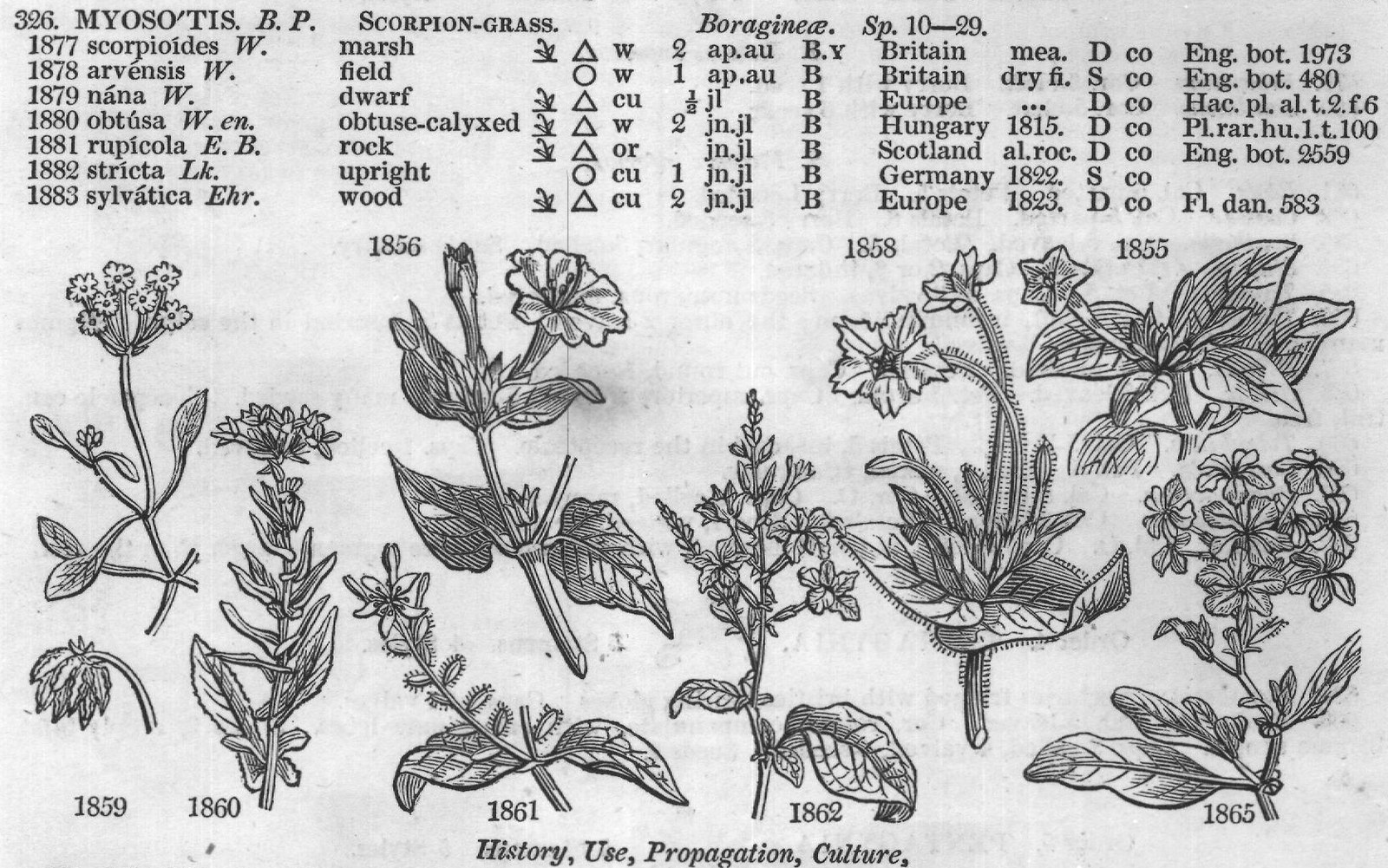
SCORPION-GRASS. 1877 scorpioídes W. 1878 arvensis W. 1879 nána W. 1880 obtúsa W.en. 1881 rupícola E. B. 1882 strícta Lk. 1883 sylvática Ehr. wood 1856 marsh W field W dwarf cu B obtuse-calyxed W 2 jn.jl B rock or jn.jl B upright cu 1 jn.jl B cu 2 jn.jl B 1858 সপ or jn.jl W 1 jn.au B or jn.jl W Boragineæ.
Sp. 10-29. or 1 my.jn W or 2 ap.au B.Y 1 ap.au B از Peru 1757. Cr.m Bot. mag. 141 Peru 1808. Cr.m W. Indies 1732. C s.l S. Europe 1562. C s.l S. Europe 1824. S s.l S. Amer. 1823. S l.p W. Indies 1731. C s.l S. Amer. 1752. C s.l W. Indies 1713. S s.p S. Europe 1640. S co D co Britain mea. D co Britain dry fi. S co Europe Hungary 1815. D co Scotland al.roc. D co Germany 1822. Sco Europe 1823. D co Bot. mag. 1609 Jac. aust. 3. t.207 Mr.s. 11. t.31. f.12 Plum. ic. 227. f.2 Plk. phyt.245. f.4 Goua.m.17.c.tab Eng. bot. 1973 Eng. bot. 480 Hac. pl. al. t.2.f.6 Pl.rar.hu.1.t.100 Eng. bot. 2559 Fl. dan. 583 1855 Dil, el. t. 146.f.175 1859 1860 1861 1862 History, Use, Propagation, Culture, 1865 322. Mirabilis, is a Latin word, signifying something wonderful or admirable; and applied with some reason to this, the most fragrant of flowers. Clusius called it Admirabilis. We from the same cause call it Marvel of Peru. The French botanists still call the genus by Van Royen's name, Nyctago; derived from vuξ, night, and ago, to act, on account of the flowers expanding at night. M. dichotoma is called the four-o'clock flower in the West Indies, from the flowers opening regularly at that time of the afternoon. M. jalapa is a very ornamental plant in warm borders. When cultivated, it sports into many agreeable varieties. It flowers best when treated as a tender annual, and then planted out; but if sown at once in the open air, it will flower late in the season in favorable summers. Its large tuberous roots, if taken up and preserved during winter like those of Dahlia, or even covered well with litter in the open garden, will flower perennially. The powder of these roots washed, scraped, and dried, is one of the substances which form the jalap of druggists. 323. Abronia. Derived from aβρoς, delicate. The little plant produces flowers surrounded by an involucrum of a charming rose color. 324. Plumbago. Pliny says this plant was so called from plumbum, because it possessed the power of curing a disorder in the eyes called by that name, which appears to have been the same as what we call cataract. There disorder in the eyes called by that name, which appears to have been the same as what we call cataract. There ORDER VI.
PENTANDRIA POLYGYNIA.
Order 6. POLYGYNIA. 5 Stamens. Many styles. 707. Myosurus. Pet. 5, with tubular honey-bearing claws. Seeds naked. Cal. spurred at the base. 708. Ceratocephalus. Cal. 5-leaved, persistent. Petals 5, with a honey pore at base covered by a scale. Seeds several, naked, attached to a bearded receptacle. 709. Xanthorhiza. Cal. O. Petals 5. Nectaries 5, stalked. Caps. 5, 1-seeded. 710. Sibbaldia. Cal. 10-cleft. Petals 5, inserted in the calyx. Styles from the side of the ovary. Seeds 5. MONOGYNIA. 1855 Flowers sessile erect axillary solitary 1856 Flowers clustered stalked, Leaves smooth 1857 Flowers clustered somewhat stalked, Tube of cor. 4 times as long as limb, Leaves cordate smooth 1858 Flowers clustered sessile, Leaves pubescent 1859 The only species, resembling Primula farinosa. Very beautiful 1860 Leaves stem-clasping lanceolate rough, Stem erect 1861 Leaves stalked ovate smooth, Stem filiform 1862 Leaves stalked ovate smooth somewhat toothed, Stem with swollen joints 1863 Leaves stalked ovate smooth, Stem flexuose climbing 1864 Leaves obovate retuse smooth 1865 Leaves stalked oblong entire glaucous beneath, Stem erect 1866 Leaves stem-clasping lanceolate smooth, Stem divaricating 1867 Leaves lanceolate ovate, Stem shrubby, Spikes numerous aggregate corymbose 1868 Leaves oblong lanceolate, Stem shrubby, Spikes terminal aggregate corymbose, Sepals long subulate 1869 Leaves ovate rugose scabrous opposite and alternate, Spikes in pairs 1870 Leaves ovate entire tomentose rugose, Spikes in pairs 1871 Leaves stalked oblong obtuse entire rough with scattered hairs 1872 Leaves lanceolate glaucous smooth obsoletely veined opposite and alternate, Spikes in pairs 1873 Leaves linear lanceolate glaucous smooth opposite and alternate, Spikes in pairs or compound 1874 Leaves ovate lanceolate villous, Spikes solitary lateral stalked 1875 Leaves cordate ovate subserrate rugose, Spikes terminal simple solitary, Stem herbaceous 1876 Leaves ovate entire tomentose plaited, Spikes solitary and in pairs 1877 Cal. 5-toothed smoothish, Teeth nearly equal obtuse as long as the tube of cor. Leaves lanceolate obtuse smooth, Limb of cor. more than twice as long as cal. 1878 Stem hairy, Calyx with dense spreading hairs hooked at the end 1879 Seeds smoothish sawed at edge, Stem simple few-flowered and oblong, Leaves villous 1880 Stem nearly sim. with lanc. nearly acute somew. repand lvs. hispid, Sp. in pairs somew. corym. Cal. very obt. 1881 Seeds naked, Radical leaves stalked, Racemes without bracteæ, Hairs of calyx spreading. 1882 Stem diffuse, Branches and flower-stalks much shorter than cal. Leaves oblong ovate obtuse upright 1883 Cal. spreading 5-parted, Segments unequal acute, Hairs long downy 1867 1868 1874 1878 1881 1870 1877 and Miscellaneous Particulars. 1883 is also a modern reason for the application of the name to this genus. P. europæa is called toothwort, and dentelaire, Fr., from its curing the tooth-ach, for which purpose the bruised root is chewed, when it excites by its causticity a healthy salivation, but stains the teeth of a lead color. The species are all pretty, easily cultivated, and almost always in flower. 325. Heliotropium. From ήλioς, the sun, and τρέπω, to turn. Both Pliny and Dioscorides assert that the flowers are always turned towards the sun. It was called Verrucaria by the Latins, because the juice of the leaves mixed with salt was said to be excellent in removing warts, verrucæ. H. peruvianum and europæum are popular plants, with the smell of new hay: the former is rather tender; but both keep flowering during most of the summer months. Curtis recommends keeping H. peruvianum in a stove during winter. 326. Myosotis. So named from μuς, a rat, and ἐς, ότoς, an ear. Its oval velvety leaves are like the ear of a rat or mouse. M. scorpioides, Forget-me-not, has its specific name from the racemes of flowers, which, when or mouse . M. scorpioides, Forget-me-not, has its specific name from the racemes of flowers, which, when young, bend in at the top like a scorpion's tail. It is a well known sentimental flower, will grow any where, and varies more than most plants with situation. On dry walls and rubbish, it is dwarfish, rough, and hairy, not hower, rising when in flower more than two or three inches; in muddy ditches it is smooth all over, of a shining light I4 PENTANDRIA MONOGYNIA.
CLASS V. 1884 suaveolens W. K. sweet-scented or jn.jl B 1885 sparsiflóra Mik. scattered or 1886 pedunculáris Trev. stalked or 327. ECHINOSPERMUM. Sw. ECHINOSPERMUM. 1 my.jn B 1½ my.jn B Boragineæ.
Hungary 1823. D co S. France 1822. S co Astracan 1824. S co Sp.4-16. 1887 virginiánum P. S.
Virginian or 2 jn.jl W 1888 Láppula P.S. common or 1889 squarrósum P. S. squarrose or 1 ap.au B 2 ap.au B Siberia Virginia 1699. S co Europe 1656. S co 1802. S co M. h. s. 11.t.30.f.9 1890 barbátum Lehm. bearded or 1½ jn.jl B Tauria 1823. S co 328. MATTIA. Sch.
MATTIA.
Boragineæ.
Sp. 2-4. 1891 umbelláta Sch. umbelled or 1892 lanáta Sch. woolly or 1 my.jn R 2 jn Pk Hungary 1822. D s.l Pl.rar.hun. t.148 Levant 1800. D s.1 Ann.mus.10.t.37 329. TIARI'DIUM. Lehm. TIARIDIUM. 1893 índicum Lehm. Indian Boragineæ.
Sp. 1-3. or 1 jn.jl B W. Indies 1820. S s.l Plk. phyt.245.f.4 330. LITHOSPERMUM. W. GROMWELL.
Boragineæ. 1894 officinále W. officinal cu 2 my.au Y 1895 arvénse W. corn W 1896 ápulum W. small cu Y 1897 purp.-cærúleum W. creeping 1898 fruticósum W. shrubby 1899 dîstichum P. S. two-rowed 1900 tenuiflórum W. 1901 dispérmum W. two-seeded 1902 orientále W. yellow 1903 canéscens Lehm. hoary or 1 jn.jl Y slender-flower'd or 2 my.jn W jn.jl 1 my Pu or 2 my.jn B or 1 my.jn W or my.jn B B Oorjn.jl Aor 2 jn.jl Y Sp. 10-35.
Britain ch.hil. D co Britain cor.fi. S co S. Europe 1768. S co England ch. so. D co S. Europe 1683. C co Cuba 1806. D co Egypt 1796. S. co Spain 1799. S co Levant 1713. D co N. Amer. 1823. D co Col. ecph.1. t. 185 Eng. bot. 117 Barr. ic. 1168 Jac. ic. 2. t. 313' Linn. dec. 1. t. 7 Bot. mag. 515 Mich. am. t. 14 Eng. bot. 134 Eng. bot. 123 331. BAT'SCHIA. Mich. BATSCHIA.
Boragineæ.
Sp. 2-4. 1904 Gmelíni Ph.
Gmelin's 1905 longiflóra Ph. long-flowered পপ or or my.jl Y my.jl Y Carolina 1812. D co Missouri 1812. D co 332. ONOSMA. W.
ONOSMA.
Boragineæ.
Sp.7-23. 1906 simplicissimum W. linear-leaved or 1907 taúricum H. K. golden-flowered or 1908 orientále W. oriental or 1909 echioídes W. hairy or 1910 seríceum W. silky-leaved or 1911 arenárium W. K. sand or 1912 trinérvium Lehm. three-nerved or 1 BUGLOSS. panicled Cape 333. ANCHU'SA. W. 1913 paniculáta W. 1914 capénsis W. 1915 officinalis W. 1916 ochroleúca Bieb.
B itálica W. 1917 angustifólia W. 1918 Barrelieri Dec. 1921 tinctória W. common pale-flowered Italian narrow-leaved Barrelier's waved-leaved dyer's 1919 rupéstris R. Br. 1920 unduláta W. rock 1922 sempervirens W. 1923 Milléri W. en. 1887 evergreen pink 1892 সপ Boragineæ. or 2 my.jn B or B jl A or 2 jn.o Pu or 2 jl.au 4 jn.o or or or Pu 2 my.jn 2 my.jn B B Siberia 1768. D s.l Caucasus 1801. D s.l Levant 1752. D s.l S. Europe 1683. D s.1 Levant 1752. D co Hungary 1804. D s.1 S. Amer. 1824. Cs.l Sp. 11-50.
Madeira C. G. H.
Britain 1777. C p.1 1800. S p.l sea co. D co Pa.Y M.Caucas. 1810. D co R.Pu S. Europe 1597. S co S. Europe 1640. D co S. Europe 1820. D co Siberia 1802. D co Spain 1752. D co Montpel. 1596. D co Britain rub. D co Levant 1713. D co 1905 Aor jl A or 2 jn.au B Aor 1 jn.o Pu Aor 1 my.jn B A or 1½ my.jn Pk 4 Fl. græc. 163 Bot. rep. 336 Eng. bot. 662 Bot. mag. 1608 Bot. reg. 483 Bot. mag. 1897 Bot. mag. 2349 P.i.3.a.71. t. E.f.3 Bot. mag. 2119 Bot. rep. 576 Eng. bot. 45 1893 1 ap.jn Y Bot. mag. 2248 ap.jn Y Bot. mag. 889 my.jn Y 1 mr.jn W jn.jl Y 1 ap.jn Y ...
Y Jac. aust. 3. t.295 Lehm.ic.asp.t.10 W.et. K.hu.t.279 Lehm. ic.asp. t.9 1897 1898 1902 1891 History, Use, Propagation, Culture, green, and two or three feet high. In common soils, as in a garden or loamy corn-field, it assumes an intermediate character. Linnæus considers the plant as deadly to sheep. In gardens it does well in pots in the shade, or treated as a bog-plant, than which few better deserve the name of pretty. 327. Echinospermum. Named by Lehmann from εχivoς, a hedgehog, and σπερμη, seed, the seeds being very prickly, by which character, and their being compressed, not depressed, and the bracteæ of the inflorescence, the genus is principally distinguished from Myosotis and Cynoglossum. 328. Mattia. A genus divided by Professor Schultes from Cynoglossum, with which it agrees in general character. Named after some unknown botanist. 329. Tiaridium. From τiaρa, an episcopal head-dress, and εiδoς, similar; on account of the resemblance between its seeds and a mitre. Three species have been described, of which one is the H. indicum of Linn., a plant of no beauty or merit. 330. Lithospermum. From λiθoς, a stone, and σπερμη, seed, the seeds being hard and shining, like little pebbles. L. officinale has stony, brittle, egg-shaped nuts, exquisitely polished, grey or yellowish; and being considered like a stone, were for that reason used as a cure for the disease so named. The bark of L. arvense abounds with a deep red dye, which stains paper, linen, &c. and is easily communicated to oily substances, like the alkanet root, and hence is called bastard alkanet. The country girls in the north of Sweden stain their faces with the root on days of festivity.
ORDER I.
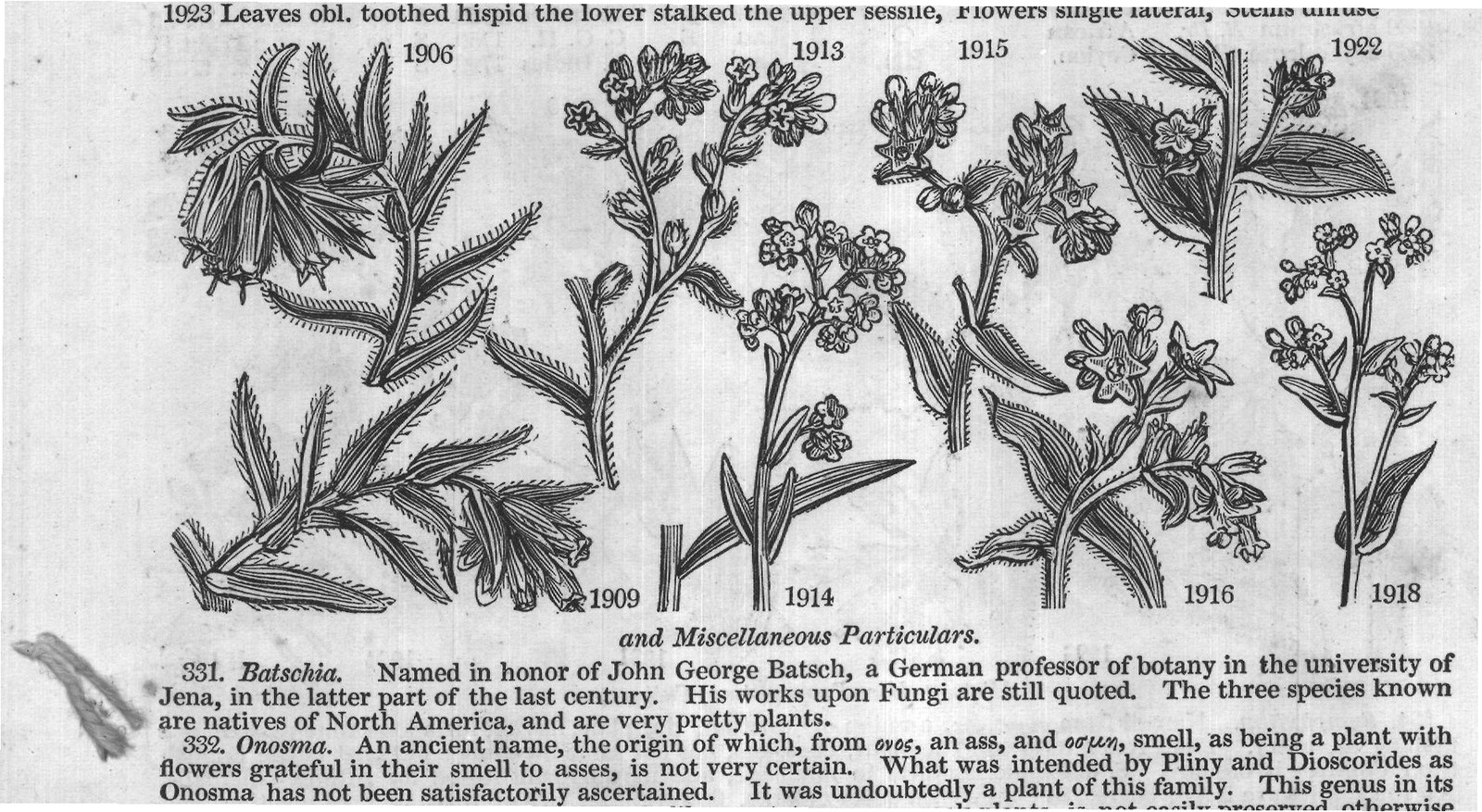
PENTANDRIA MONOGYNIA. 1884 Stem nearly simple hispid, Leaves lanc. acute hairy ciliated at base, Cal. very spreading 1885 Stem branched diffuse, Lvs. lanc. acute hispid, Racemes simple elongated, Flow. very remote, Cal. acute 1886 Stem branched, Leaves obovate obtuse mucr. Fl.-stalks in fruit much spreading thickened under calyx 1887 Seeds all over prickly, Leaves ovate oblong, Racemes divaricating 1888 Seeds with a double row of marg. prickles, Lvs. lanc. with incumb. hairs, Limb of cor. camp. longer than cal. 1889 Seeds with a single row of marginal prickles, Leaves obl. obtuse with spreading hairs, Cal. as long as cor. 1890 Seeds with a doub. row of very short mar. prickl. Lvs. lanc. with incum. hairs, Cor. twice as long as cal. with a flat limb 1891 Stam. as long as cor. Segments of cor. obtuse, Racemes terminal umbelled, Leaves hoary 1892 Cal. woolly, Limb of cor. acute deeply 5-cleft, Racemes cernuous 1893 Stem herbaceous erect hairy, Leaves ovate cordate acute hairy, Tube of cor. twice as long as calyx 1894 Seeds smooth, Cor. scarcely longer than calyx, Leaves lanceolate acute veiny 1895 Leaves lanceolate linear strigose, Cal. the length of cor. spreading in fruit 1896. Leaves linear lanceolate acute, Spikes terminal 1-sided, Bractes lanceolate, Seeds muricated 1897 Seeds smooth, Cor. much longer than cal. Leaves lanceolate acute at each end, Stem herbaceous 1898 Leaves linear hispid revolute at edge, Stamens as long as corolla 1899 Seeds smooth, Cor. twice as long as cal. Lvs. obl. lanc. acute, Spikes leafy distichous term. and axillary 1900 Leaves linear lanceolate strigose, Cal. as long as tube of cor. in fruit conniving 1901 Seeds smooth, Cal. spreading incurved, Leaves linear 1902. Flower branches lateral, Bractes cordate stem-clasping 1903 Stem nearly simple villous, Leaves oblong obtuse hoary, Tube of cor. twice as long as calyx 1904 Hairy, Floral leaves ovate, Cal. long lanceolate 1905 Silky, Leaves linear, Cal. long linear, Corolla crenate, Tube long 1906 Hirsute, Hairs prost. scattered, Fl.-stems simp. aggregate, Lvs. lin. acute, Anthers shorter than filaments 1907 Flowers ventricose, Fruit erect, Leaves lanceolate hispid, Hairs stellulate 1908 Flowers cylindrical acute, Fruit pendulous, Leaves linear hairy 1909 Hispid, Hairs erect scattered, Stem branched, Leaves lanceolate, Anthers as long as filaments 1910 Silky, Hairs prostrate very minute, Stems branched, Leaves spatulate, Anthers as long as filaments 1911 Flowers clavate cylindrical, Leaves oblique the lower lanceolate obtuse, Fruit erect, Seeds smooth 1912 Stem simple leafy, Leaves linear lanceolate very long acute 3-nerved above hispid beneath closely hairy 1913 Leaves lanceolate strigose entire, Panic. dichotomous divar. Flower stalked, Cal. 5-parted subulate 1914 Leaves lanceolate callous villous, Racemes trichotomous 1915 Leaves lanceolate strigose, Spikes 1-sided imbricated, Cal. as long as tube of corolla 1916 Leaves linear-lanceolate coarsely dotted hispid, Calyx in fruit camp. nodding 1917 Racemes nearly naked in pairs 1918 Leaves oblong entire narrowed at both ends with the simple stem hispid, Peduncles trifid 1919 Leaves linear lanceolate villous, Racemes alternate 1920 Strigose, Leaves linear toothed, Stalks less than bracteæ, Cal. in fruit inflated 1921 Leaves oblong, Bractes longer than the 5-parted calyx, Valves of corol. shorter than stamens 1922 Leaves ovate strigose, Racemes somewhat capitate in pairs leafy, 2-leaved at base, Cal. 5-cleft 1923 Leaves obl. toothed hispid the lower stalked the upper sessile, Flowers single lateral, Stems diffuse 1906 1909 1913 1914 1915 1916 1922 1918 and Miscellaneous Particulars. 331. Batschia. Named in honor of John George Batsch, a German professor of botany in the university of Jena, in the latter part of the last century. His works upon Fungi are still quoted. The three species known are natives of North America, and are very pretty plants. 332. Onosma. An ancient name, the origin of which, from ovos, an ass, and oσμη, smell, as being a plant with flowers grateful in their smell to asses, is not very certain. What was intended by Pliny and Dioscorides as Onosma has not been satisfactorily ascertained. It was undoubtedly a plant of this family. This genus in its wild state is found chiefly on rocks; and, like most temporary rock-plants, is not easily preserved otherwise than on dry walls, heaps of rubbish, or artificial rock-work. The species are pretty, and all have yellow flowers. 333. Anchusa. Derived from aγχouσa, paint. In early times, the root of A. tinctoria was used for staining the features when more delicate colors were unknown. The English name Bugloss has been formed from B8s, name Bugloss has been formed from βες, an ox, and γλωσσa, a tongue, in allusion to the long rough leaves. A. officinalis is nearly allied in qualities to Borago. The tube of the corolla is melliferous, and very attractive to bees; the leaves are juicy, and the roots mucilaginous, and used in China for promoting the eruption of the small-pox. A. tinctoria is cultivated in the south of France for the roots, which communicate a fine deep red to oils, wax, and all unctuous substances, as well as to spirits of wine. It is used chiefly by the apothecaries for coloring plaisters, lip-salves, &c and by vintners for staining the corks of their port wine bottles, or for coloring and flavoring the spurious compounds sold as port wine. red-flowered 1930 híspidum M. 1931 mólle M. 1932 officinále W. common 1933 sylváticum E.B. green-leaved 1934 píctum W.
Madeira eastern 1927 tauricum W. en. blistered 1928 aspérrimum H. K. roughest 1929 cordátum W. heart-leaved Virginian soft PENTANDRIA MONOGYNIA. 334. SYM/PHYTUM. W. COMFREY. 1924 officinále W.
ẞ patens Sibth. y bohémicum Sch. 1925 tuberósum W. 1926 orientále W. en. common spreading tuberous CLASS V.
Boragineæ.
Sp. 6-10. * or 4 my.jl W Britain wet. pl. D co Eng. bot. 817 or 4 my.jl Pk Britain wet. pl. D co or 3 my.jl R Bohemia .../ D co or 4 my.o Y Scotland m.s.pl. D co Eng. bot. 1502 or 3 my.jl W Turkey 1752. D co Bot. mag. 1912 or 3 my.jl W Tauria 1806. D co Bot. mag. 1787 A or 4 my.s R.B Caucasus 1799. D co Bot. mag. 929 or 2 my.jl Y Transylv. 1813. D s.1 Pl. rar. hung. t.7 335. ONOSMO DIUM. Mich. ONOSMODIUM. 336. CYNOGLOSSUM. W. HOUND'S-TONGUE.
Boragineæ.
Sp. 2-3. পপপপপপপ Aor 1 in Y N. Amer. 1759. D s.1 M.h.3.s.11.t.28f.3 or or or 1935 amplexicaúle Ph. 1936 cheirifólium W. 1937 apennínum W.en. 1938 hirsútum W. 1939 glomerátum Fraz. stem-clasping silvery-leaved Apennine hirsute clustered or 2 au 337. OMPHALO'DES. Lehm. VENUS' NAVEL-WORT. 1940 vérna Lehm. 1941 linifólia Lehm. 1942 nítida Lehm. 338. PULMONA'RIA. W. LUNGWORT. el 2 my.jl 1 jn.jl 6 ap.jl R 1 jlau L.B 1 jn.au W 1 3 ap.jn W rub. S co Britain sha. la. S co Madeira 1658.
N. Amer. 1812. D p.l Levant 1596. S co Italy 1731. D co C. G. H. 1806. S co N. Amer. 1812. D co Sp.3-10.
Bot. mag. 2134 Col. ecph.1. t.170 Jac. Schön, t.489 Bot. mag. 7 H.&L.fl.p.1. t.23 2 jn.jl 3 jn.jl jn.au W Boragineæ.
P.R B N. Amer. 1812. D s.1 Mich. amer. t. 15 Sp. 8-40.
Britain Eng. bot. 921 Eng. g. bot. bot. 1642 1642 L.B B B ...
Boragineæ. blue mr.ap B common or S. Europe 1633. D co Portugal 1648. S co shining or Portugal 1812. D co Boragineæ.
Sp. 10-19. 1943 angustifólia W. narrow-leaved or ap.my V Britain woods. D p.1 1944 officinalis W. common or 1 my Pk 1945 davúrica Fisch.
Daurian or 1 my Li 1946 paniculáta W. panicled or 1 my.jn L.B 1947 lanceoláta Ph. spear-leaved or 1 my.jn Pu England woods. D p.1 Dauria 1812. D s.l Hud. Bay 1778. D p.l Louisiana 1813. D s.l Bot. mag. 1743 Eng. bot. 118 Eng. bot. 1628 Eng. bot. 1628 1948 virgínica W.
Virginian or 1½ mr.my B N. Amer. 1699. D p.1 Bot. mag. 160 1949 sibírica W.
Siberian or 3 jn.jl Pu N. Amer. 1801. D s.1 G. sib.4.n.15.t.39 1950 marítima E. B. sea or jn.jl B 1951 móllis Wulf. soft or 3 ap.my B Britain sea sh. D s.p N. Amer. 1805. D co Eng. bot. 368 Bot. mag. 2422 1952 azúrea Bess. sky-blue or 1½ ap.jn B Poland 1823. D co 339. CERIN'THE. W.
HONEYWORT.
Boragineæ.
Sp. 4-6. 1953 májor W. great 1954 áspera W. rough 1955 minor W. small 1956 maculáta W. spotted ocob or 3 jl.au Y.P S. France 1596. S co Bot. mag. 333 or 2 jl.au Y.P or 1½ jn.o Y S. France 1633. S co Austria 1570. S co Fl. græc. t. 170 Jac. aus. 2. t. 124 or 2 jn.o Y.R S. France 1804. Sco 340. BORA'GO. W.
BORAGE.
Boragineæ.
Sp. 4-7. 1957 officinális W. common cul 3 jn.s B 1958 orientális W. oriental or 1959 laxiflóra B. M. bell-flowered or 1960 crassifólia Vent. thick-leaved or 2 mr.my B 1 my.au B 2 jn.jl Pk England rub. S co Turkey Corsica 1813. C s.1 Persia 1822. C s.1 1752. D co Eng. bot. 36 Bot. reg. 288 Bot. mag. 1798 Vent. cels. 100 341. TRICHODES MA. 1961 índicum R. Br.
R. Br. TRICHODESMA.
Boragineæ.
Indian 1962 africánum R. Br.
African 1963 zeylánicum R. Br.
Ceylon 1 jn.o B 1 jl.au B 1 jl.au W Sp. 3-4.
E. Indies 1759. S co C. G. H. 1759. S co E. Indies 1799. S co 1924 1927 1929 Pl. al.30. t.76. f.3 Is. ac. p.1718.t.11 Jac. ic. 2. t. 314 1936 1926 1931 1934 1940 History, Use, Propagation, Culture, 334. Symphytum. Named from σuμφuσiς, a union or junction, the plant having for a long time passed for a famous vulnerary. The French name for the plant, Consoude, has the same meaning; but that of the English vulnerary. The French name for the plant, Consoude, has the same meaning; but that of the English term Comfrey is obscure. S. officinale abounds in mucilage, and may be substituted for Althæa officinalis. All the species are large, coarse , but showy shrubbery plants, flowering for two or three months together, and S. asperrimum the whole season. 335. Onosmodium. From Onosma and εiδoς, similar to Onosma; from which it is not very different either in habit or characters. 336. Cynoglossum. From zuωv κuvoς, a dog, and γλωσσa, a tongue. Its long soft leaves have been compared to the tongue of a dog. C. officinale smells like mice, was considered anti-scrophulous, and is disliked by cattle. the tongue of a dog. C. officinale smells like mice, was considered anti-scrophulous, and is disliked by cattle. 337. Omphalodes. From oμφaλoς, a navel, and εiδoς, resemblance; the round seeds, which are depressed in the centre, may be compared to a little navel; for the same cause it is called Navelwort in English. O. linifolia centre, may be compared to a little navel; for the same cause it is called Navelwort in English. O. linifolia is a common border annual. O. verna is a beautiful little plant with blue flowers, like the Forget-me-not, peeping from among the snow in every cottager's garden in the early spring. 338. Pulmonaria. Derives its name, some say, from the speckled appearance of the leaves resembling diseased lungs but others think that its name has arisen from the plant having been used with success in pulmolungs; but others think that its name has arisen from the plant having been used with success in pulr nary complaints; ; whence also , perhaps, the English name Lungwort. It must not, however, be inferred from ORDER I.
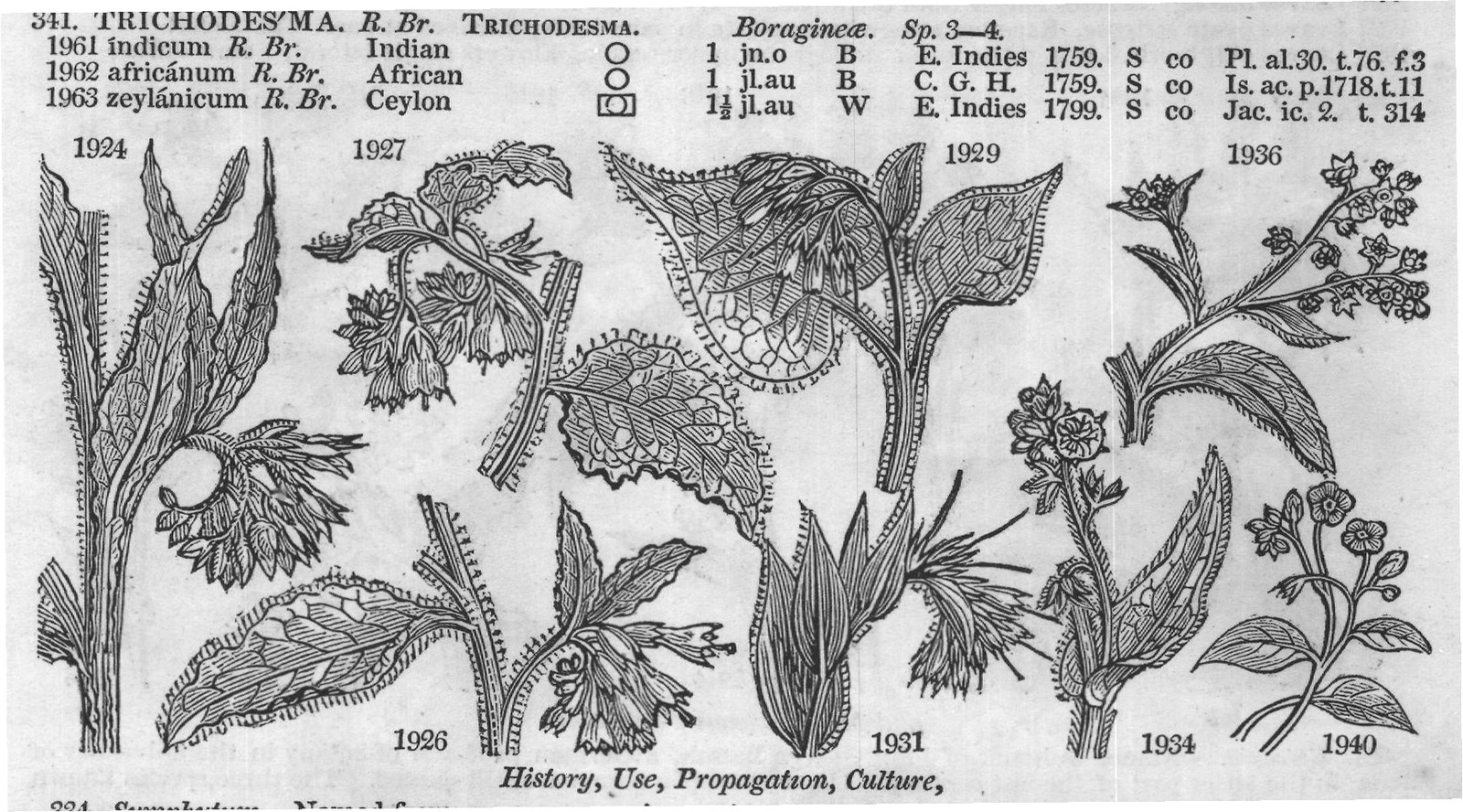
PENTANDRIA MONOGYNIA. 1924 Leaves ovate lanceolate decurrent 1925 Leaves ovate oblong narrowed at base the lower stalked, Segments of flower very short obtuse 1926 Leaves ovate obl. narr. at base hairy the lower stalked the flor. opp. sess. Cal. spread. Segm. of fl. acute 1927 Leaves cordate ovate hairy stalked the floral opp. sess. Segments of flower obtuse, Stem branched 1928 Lvs. cord. ovate or lanc. acumin. stalked very rough, Stem muric. with reversed bristles, Limb of fl. camp. 1929 Leaves cordate ovate acuminate hairy, floral sessile nearly opposite, Stem simple 1930 Hispid, Leaves oval lanceolate acute papillose, Segments of cor. very acute 1931 Hoary, Leaves oblong about 3-nerved, Segments of cor. oval 1932 Leaves broad lanceolate wavy hoary on each side sessile close together, Seeds warted 1933 Leaves spatulate lanceolate shining nearly naked scabrous beneath 1934 Leaves lanceolate tomentose the upper obovate lanceolate cordate stem-clasping, Sepals ovate 1935 Very hairy, Leaves oval the upper stem-clasping, Corymb. terminal leafless on a long stalk 1936 Leaves villous, Cal. hairy, Stamens longer than corolla 1937 Stamens longer than corolla, Cal. villous, Radical leaves ovate stalked very large 1938 Leaves lanceolate villous, Seeds with hooked prickles 1939 Leaves spatulate obtuse, Flowers heaped 1940 Radical leaves ovate cordate, Cauline ovate stalked, Shoots creeping 1941 Leaves linear lanceolate smooth roughish with little teeth at the edge, Seeds urceolate rugose 1942 Leaves obl. lanc. nerved smooth and shining above pubesc. beneath the lower on long stalks the upper sess. 1943 Cal. length of the tube of the cor. Leaves oblong lanceolate the radical sessile cauline stalked 1944 Cal. length of the tube of the cor. Radical leaves ovate cordate scabrous cauline ovate sessile 1945 Cal. short 5-parted hispid, Radical lvs. ovate cordate stalked, cauline half stem-clasping, Flowers panicled 1946 Cal. short 5-parted hispid, Leaves ovate oblong acuminate hairy 1947 Smooth erect, Radical leaves on long stalks lanceolate, cauline linear oblong, Flowers panicled, Cal. short 1948 Cal. much shorter than tube of cor. which is longer than limb, Radical leaves ovate elliptical cauline ob- 1949 Cal. short, Rad. leaves cordate 1950 Smooth, Leaves ovate glaucous fleshy, Stem branching procumbent [ovate lanceolate obtuse 1951 Leaves ovate lanceolate acuminate downy decurrent radical stalked, Cal. longer than tube 1952 Leaves hispid radical obl. lanc, acuminate narr. into the stalk, Cauline decurrent, Cor. campanulate 1953 Cor. obtuse spreading ventricose campanulate at end, Stamens shorter than corolla, Leaves smooth 1954 Cor. obtuse spreading cylindrical, Stamens as long as cor. Leaves rough 1955 Leaves stem-clasping entire, Cor. acute closed whole colored, Segm. of cal. unequal 1956 Leaves stem-clasping entire, Cor. acute closed with a red band in middle, Seg. of cal. uneq. Stems many 1957 Leaves ovate the lower stalked all alternate, Cal. spreading, Pedunc. terminal many-flowered 1958 Leaves cordate stalked, Pedunc. many-flowered, Stamens exserted villous 1959 Leaves alternate oblong sessile, Pedunc. axillary 1-flowered, Cor. campanulate nodding 1960 Glaucous, Stem smooth, Leaves decurrent rough above, Segments of cor. lin. lanc. spreading unequal 1961 Leaves of stem and branches lanc. half stem-clasping, Pedunc. 1-flowered, Sepals auriculated at base 1962 Leaves opposite stalked ovate, Pedunc. many-flowered, Sepals ovate acute erect 1963 Sepals not auriculated, Nuts smooth without an edge, Leaves sessile attenuated at the base 1945 1943 1951 1948 1955 1954 1957 1963 1959 and Miscellaneous Particulars.
English names of this sort having been applied to plants, either that lungwort was ever used in this country for the lungs, or liverwort for the liver. The truth is, that the old herbalists, or translators of the classical writers upon natural history, made English names after their Latin denominations, without enquiring whether such continued to be applicable or not, and their less informed successors had no difficulty in finding those virtues in the plants which were indicated by the names of the translators. P. virginica, sibirica, and maritima are elegant plants, greatly resembling each other, and considered by some as most probably only varieties. They are among the most elegant ornaments of the flower-garden in dry springs; but they require some care in keeping, unless in a soil almost entirely of sand. 339. Cerinthe. From zngos, wax, and avθoς., flower, because there is great attraction for bees in the flowers. The French word melinet and the English honeywort have been formed in the same sense. C. major is a shewy border annual, much frequented by bees. In Italy and Sicily it is very common, and a biennial. 340. Borago, is said by Apuleius to be an alteration of corago, and to have been named on account of its cordial qualities. Pliny says that wine, with this infused in it, cheers the spirits. B. officinalis was formerly in great repute as a cordial. According to Withering, the young leaves may be used as a salad or as a pot-herb, and the flowers form an ingredient in cool tankards. 341. Trichodesma. From θρiξ τρiχoς, hair, and δεσμη, a bond, the stamens being united by interwoven hairs; small W oriental cu 345. ECHIUM. W.
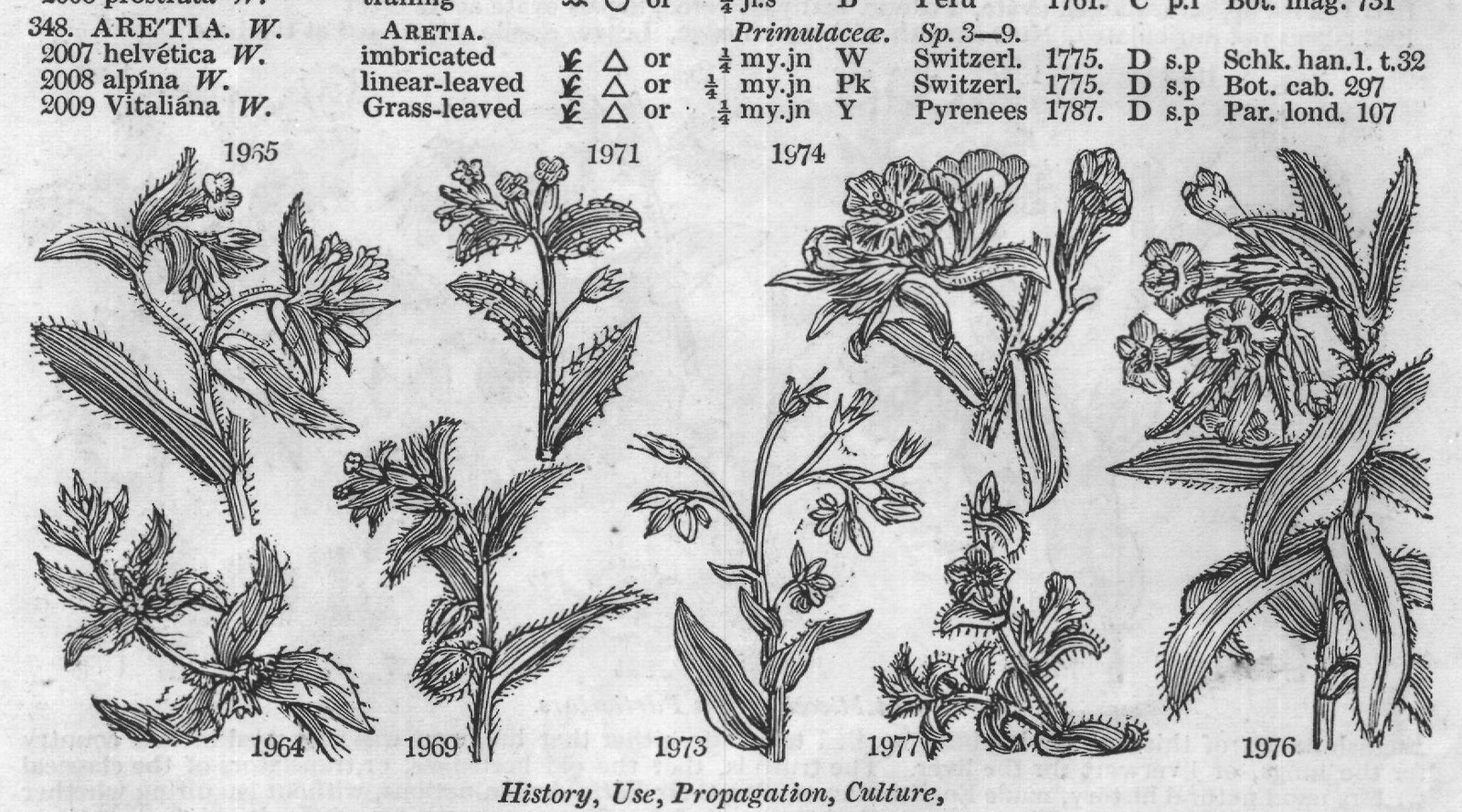
VIPER'S-BUGLOSS. shrubby or 1975 cándicans W. hoary-tree or or or 6 jn.jl $124 342. ASPERU'GO. W. 1964 procúmbens W. 343. NO'NEA. Mönch 1965 púlla Dec 1966 lútea Dec. 1967 rósea Lk. 1968 nígricans Dec. 1969 violácea Dec. 1970 ciliáta W. 344. LYCOP'SIS. W. 1971 variegáta W. 1972 arvénsis W. 1973 orientális W. 1974 fruticósum W.
PENTANDRIA MONOGYNIA.
GERMAN-MADWORT. procumbent NONEA. dark-flowered yellow rose-colored black-flowered violet ciliated WILD-BUGLOSS. variegated 1976 grandiflórum H. K. great-flowered 1977 ferocissimum B. R. prickly-stalked W cu CLASS V. rub. S có Eng. bot. 661 Sp. 6-8.