Home › S › Switzerl (C m s Hercynia C m s N Amer C)
Switzerl (C m s Hercynia C m s N Amer C)
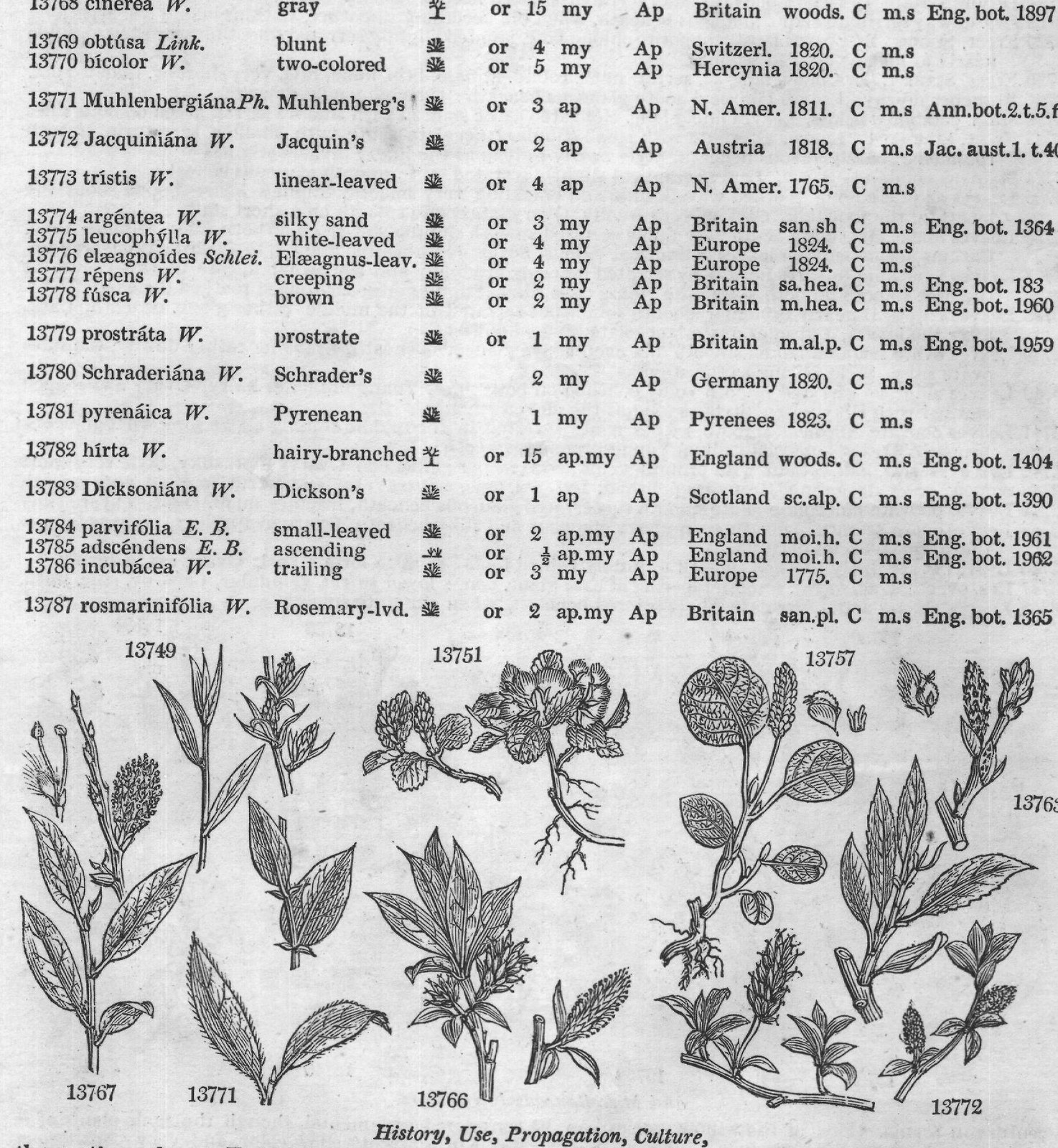
1820. C m.s Hercynia 1820. C m.s N. Amer. 1811. C m.s Ann.bot.2.t.5.f.9 Austria 1818. Cm.s Jac. aust.1. t.409 N. Amer. 1765. C m.s Britain san.sh. Cm.s Eng. bot. 1364 13775 leucophýlla W. white-leaved or 4 my Ap Europe 1824. Cm.s 13776 elæagnoídes Schlei. Elæagnus-leav. or 4 my Ap Europe 1824. C m.s 13777 répens W. creeping or 2 my Ap Britain sa.hea. C m.s Eng. bot. 183 13778 fúsca W. brown or 2 my Ap Britain m.hea. C m.s Eng. bot. 1960 13779 prostráta W. prostrate or 1 my Ap Britain m.al.p. Cm.s Eng. bot. 1959 13780 Schraderiána W. Schrader's 2 my Ap Germany 1820. C m.s 13781 pyrenáica W.
Pyrenean 1 my Ap Pyrenees 1823. C m.s 13782 hírta W. hairy-branched or 15 ap.my Ap England woods. C m.s Eng. bot. 1404 13783 Dicksoniána W.
Dickson's or 1 ap Ap Scotland sc.alp. C m.s Eng. bot. 1390 13784 parvifólia E. B. 13785 adscéndens E. B. small-leaved ascending or 2 ap.my Ap 杯 or or ap.my Ap 13786 incubácea W. trailing or or 3 my Ap England moi.h. Cm.s Eng. bot. 1961 England moi.h. C m.s Eng. bot. 1962 Europe 1775. C m.s 13787 rosmarinifólia W. Rosemary-lvd. or 2 ap.my Ap Britain san.pl. C m.s Eng. bot. 1365 13749 13751 13757 13763 13767 13771 13766 History, Use, Propagation, Culture, 13772 the poet's garden at Twickenham, was a cutting from some rods employed in a package which came from Spain. Pope being present when the package was opened, observed that the pieces of stick appeared as if they had some vegetation, and added , perhaps they may produce something which we have not in England. Under this idea he planted it in his garden, and it produced the willow tree that has given birth to so many others; not as the parent tree of all the willows in the country, but as an admired and celebrated specimen. S. herbacea is not properly an herbaceous plant, but possesses the Linnean character of a tree, and is the smallest yet ORDER II.
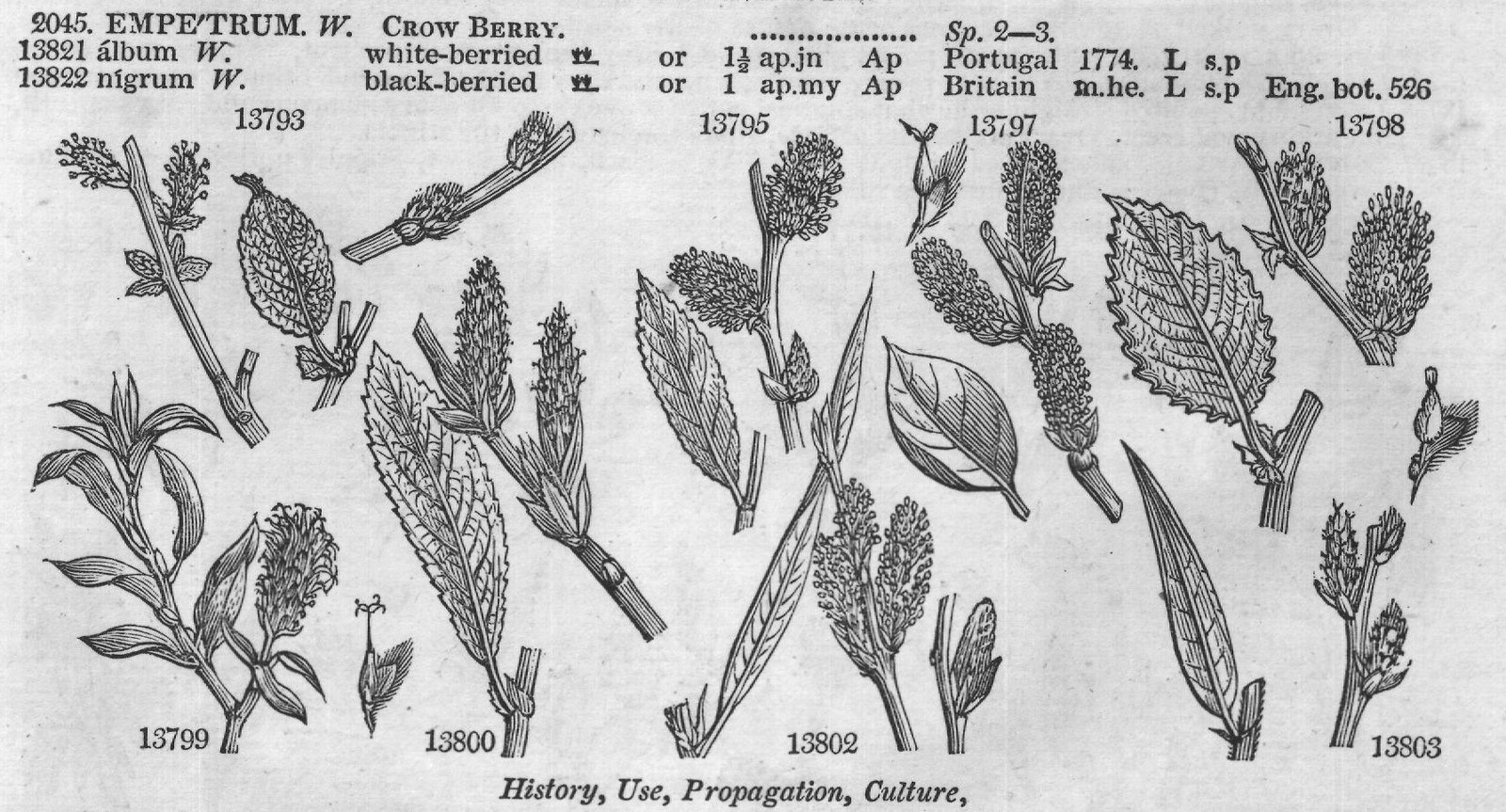
DIECIA DIANDRIA. 13749 Lvs. lanc. acut. serrul, smooth glauc. ben. Catkins appearing with lvs. Caps. ov. lanc, smooth, Styles twin 13750 Lvs. obl. lanc. acute crenul.-serr. glaucous beneath, Stipules obsolete, Scales short round with long hairs 13751 Lvs. orbicul. somew. retuse serrated shining on each side, Fem. catkins about 5-fl. Caps. ov. lanc. smooth 13752 Lvs. obl, and ovate acute toothletted glaucous beneath, Stipules large toothed, Catkins short, Styles long 13753 Leaves lanc. acute obscurely serrated smooth and shining on both sides reticulated with veins beneath, Ovary lanceolate hairy, Style elongated, Stigmas deeply divided §2. Leaves smooth entire. [lanceolate smooth ovary 13754 Leaves obovato-lanc. ent. emarg. smooth shining above, Catk. cylind. many-fl. Scales shorter than ovato- 13755 Leaves obovate entire smooth shining above, Fem. catk. obl. of few-fl. Scales length of obl. smooth ovary 13756 Lvs. ov. or ovato-lanc. acute ent. smooth shin. above, Catk. obl. of few-fls. Caps. ellipt. smooth, Stigm. sess. 13757 Leaves orbicular somewhat ellipt. obt. entire coriaceous smooth with reticulated veins glaucous beneath, Stigmas nearly sessile, Capsule shaggy 13758 Lvs. ovate entire bluntish smooth glaucous beneath, Ovary ovato-lanc. smooth its stalk longer than scale 13759 Leaves obov. lanc. acute entire glandular at edge smooth glaucous ben.: young ones silky, Stipules none 13760 Stem depressed, Leaves spatulate obovate obtuse entire smooth shining above gland. at margin beneath, Stip. none, Catk. lax, Scales obl. fringed, Ovary stalked ovate smooth, Style deeply divid. Stigm. 2-lobed 13761 Stem depressed, Leaves oval rather acute entire reticulated with veins heart-shaped at the base smooth above pale with a hairy rib and margin beneath, Stipules heart-shaped 13762 Stem erect, Branches smooth, Lvs. obov. lanc. acute entire smooth, Stip. none, Catk. stalked very smooth, Scales oblong scarcely hairy, Ovary ovate obl. smooth its stalk twice as long as scale, Stigm. sess. divided [ovate woolly 13763 Leaves nearly entire ellipt.-lanc. even and nearly smooth above woolly ben. Footst. decurrent, Ovary sess. 13764 Leaves oblong lanceolate entire obtuse silky on each side, Caps. ovate oblong villous sessile 13765 Leaves roundish ovate acute entire shaggy on both sides hoary beneath, Capsules sessile smooth, Style 3. Leaves villous. four times as long as the blunt divided stigmas 13766 Leaves lanceolate entire bluntish clothed on both sides with long silky hairs, Ovary sessile very woolly, 13767 Leaves nearly entire ovate acute reticulated and somew. downy above veiny and densely woolly beneath, Ovary sessile very woolly, Style about the length of the deeply separated linear divided stigmas Style about the length of the deeply separated cloven blunt stigmas 13768 Stem erect, Lower leaves entire: upper more or less serrated obovate lanc. reticulated with veins glaucous and downy ben. Stip. half heart-shaped serr. Ovary lanc. stalked silky, Style as long as blunt stigmas 13769 Leaves ovate acute serrulate smooth above hairy beneath, Stipules minute, Catkins long 13770 Leaves elliptical acute waved and slightly serrated nearly smooth glaucous beneath, Footstalks dilated at the base, Catkins before the leaves, Ovary stalked lanceolate silky elliptical downy, Style elongated 13771 Leaves lanceolate sharpish nearly entire downy revolute veiny and rugose beneath, Stipules lanc. decid. Scales of the catk. oblong fringed, Ovary ovato-lanceolate silky stalked, Style short, Stigmas divided 13772 Leaves elliptical entire tapering at each end polished: the veins beneath as well as the margin hairy, Ovary 13773 Leaves entire elliptical somewhat revolute with a recurved point rather downy above silky and shining beneath as well as the branches, Ovary stalked ovato-lanceolate silky, Style shorter than the stigmas 13774 Leaves elliptical entire recurved acute above downy beneath silky, Ovary ovate lanceolate villous 13775 Leaves brown above downy with short hairs hoary beneath acute nearly entire 13776 Leaves obtuse brown smooth and opaque above silky beneath [ovate downy, Stem depressed 13777 Lvs. ellipt.-lanc. straight somew. point. nearly ent. almost naked above glauc. and silky ben. Ovary stalked 13778 Leaves elliptic-obl. acute straight flat with a few glandular teeth glaucous and silky beneath, Footstalks slender, Stem erect much branched, Stipules none 13779 Leaves elliptical acute convex rarely toothed glaucous rugged and silky beneath, Stem prost. Branches 13780 Leaves elliptical acute finely downy on both sides glaucous beneath slightly serrated towards the point, elongated straight, Ovary stalked ovate silky, Style shorter than the stigm. Stipules very small, Catkins rather before the leaves ovate hairy 13781 Leaves elliptical entire acute at each end reticulated with veins glaucous beneath most hairy at margin, Ovary somewhat stalked ovato-lanceolate villous, Style the length of the deeply divided stigm. 13782 Leaves elliptical heart-shaped pointed finely notched downy on both sides, Stipules half heart-shaped flat-toothed nearly smooth, Branches hairy 13783 Leaves elliptical acute slightly-toothed smooth, Young branches very smooth, Catkins ovate short erect, 13784 Lvs. ellipt. nearly ent. with recurv. points glaucous and silky ben. Stem decumbent, Stipules ovate entire 13785 Lvs. ellipt.-obl. somew. serrat. with recurv. points glauc. and silky ben. Stem ascend. Stipules ovate serrated 13786 Leaves lanc. pointed straight somewhat elliptical entire convex smooth above glaucous and silky beneath, Ovary ry stalked ovate silky, Stigmas ovate obtuse nearly sessile Catkins oval erect, Ovary stalked lanceolate, Style the length of the stigma 13787 Leaves linear-lanceolate pointed straight entire silky beneath, Stem erect, Stipules upright flat, Catkins 13782 13774 recurved, Ovary stalked lanceolate silky 13777 13783 13784 13779 13785 13778 13787 and Miscellaneous Particulars. known; being only from one to three inches in height. S. retusa is nearly as little as S. herbacea. S. vitellina with its brilliant yellow bark, planted in shrubberies, contrasts well with evergreens and the purple twigged dogwood.
Almost all the willows are of the easiest propagation and culture. Plantations for basket-work or hoops should be made on deep loamy soil on the banks of rivers, within reach of water, but by no means saturated with it. Few willows are either bog or marsh plants. The cultivated species require as much attention as DIECIA DIANDRIA.
CLASS XXII. 13788 ripária W. bank or 6 ap.my ap Germany 1821. C m.s 13789 angustifólia W. 13790 grísea W. narrow-leaved or 3 ap.my Ap Caspian 1825. C m.s grizzly or 6 ap.my Ap Pensylv. 1820. Cm.s 13791 spatuláta W. spatulate or 5 ap.my Ap Germany 1818. C m.s 13792 auríta W. en. eared clt 2 ap.my Ap 13793 uliginósa W.en. marsh or 2 ap.jn Ap Europe 1820. C m.s Hof.sal.1.t.22.f.1 Britain woods. C m.s Eng. bot. 1487 auríta E. B. 13794 aquática W. water or 10 ap Ap Britain w.thi. Cm.s Eng. bot. 1437 13795 oleifólia W.
Olive-leaved or 4 mr Ap 13796 cotinifólia W.
Quince-leaved or 2 ap Ap Britain thick. C m.s Eng. bot. 1402 Britain woods. Cm.s Eng. bot. 1403 13797 sphaceláta W. withered-point. or 2 ap.my Ap 13798 cáprea W. great round-lvd. or 30 ap.my Ap 13799 Stuartiána E. B.
Stuart's or 4 jl.au Ap 13800 acumináta W. acuminate 挫 or 15 ap Ap 13801 conífera Ph.
Cone-bearing or 10 my Ap Scotland sc.alp. C m.s Eng. bot. 2333 Britain dr.wo. Cm.s Eng. bot. 1488 Scotland sc.alp. Cm.s Eng. bot. 2586 Britain moi.w. Cm.s Eng. bot. 1434 N. Amer. 1820. Cm.s Wa.am.t.31.f.72 13802 viminális W.
Common Osier clt 12 ap.my Ap Britain os.gro. C m.s Eng. bot. 1898 13803 mollíssima E. B.
Smith's or 20 ap.my Ap England os.gro. C m.s Eng. bot. 1509 13804 stipuláris W. auricled clt 6 mr.ap Ap England os.gro. C m.s Eng. bot. 1214 13805 cándida Ph. hoary or 10 ap.my Ap N. Amer. 1811. C m.s 13806 Fluggeána W.
Flugge's or 10 ap.my Ap S. France 1820. Cm.s Vi.del.3.t.51.f.28 13807 álba W. common white clt 40 ap.my Ap Britain woods. C m.s Eng. bot. 2430 13808 cærúlea E. B. blue or 40 ap.my Ap England m.me. C m.s Eng. bot. 2431 13809 rupéstris E. B. silky root 茶 or 3 ap Ap Scotland sc.alp. C m.s Eng. bot. 2342 13810 Andersoniána E. B. Anderson's or or 3 ap.my Ap Scotland sc.mo. C m.s Eng. bot. 2343 13811 Forsteriána E. B. Forster's 1 or 10 ap.my Scotland sc.wo. C m.s Eng. bot. 2344 13812 finmar'chica W.
Finmarck * or 10 ap.my Ap Sweden 1825. C m.s 13813 holosericea W. velvety or 8 ap.my Ap Germany 1822. C m.s 2043. CECRO'PIA. W. SNAKE-WOOD.
Urticeæ. Sp. 1-3. 13814 peltáta W. peltated 오 or 30 ...
Ap Jamaica 1778. C p.1 Lam. ill. t. 800 2044. BOʻRYA. W.
BORYA. 13815 porulósa W.
Florida un 6 ... 13816 ligustrína W.
Privet-leaved 业 un 6 ... 13817 acumináta W. pointed un 6 ... 13818 prinoídes W.
Prinos-like un 6 ... 13819 nítida W. shining un 6 G ... 13820 retúsa W. glaucous un 6 G ...
Euphorbiace. Sp. 6.
G Florida 1806. C m.s GN. Amer. 1812. Cms GN. Amer. 1812. Cm.s Mich.ame.2.t.28 GN. Amer. 1824. Cm.s N. Amer. 1824. C m.s N. Amer. 1824. C m.s 2045. EMPE/TRUM. W. CROW BERRY. 13821 álbum W. 13822 nigrum W. 13793 white-berried black-berried TRIANDRIA. or 1½ ap.jn Ap or 1 ap.my Ap 13795 13799 13800 13802 Sp. 2-3.
Portugal 1774. L s.p Britain m.he. L s.p Eng. bot. 526 13797 13798 13803 History, Use, Propagation, Culture, young trees in a nursery, otherwise they will soon become stunted and of irregular growth. Excellent directions for their culture may be found in Sang's Planter's Kalendar. 2043. Cecropia. From κεκρaγω, to cry out, a sort of translation of the English word trumpet-wood. This tree has the trunk and branches hollow every where, and sloped from space to space with membranaceous septas, and answering to so many annual marks in the surface. The leaves are large, peltate, lobed like those of Carica Papaya, and placed at the ends of the branches. The fruits rise four, five or more, from the very top of a common peduncle, and shoot into so many oblong cylindrical berries, composed of a row of little acini, something like our raspberry, which they resemble in flavor when ripe, and are agreeable to most European palates on that account. The wood of this tree, when dry, is very apt to take fire by attrition. The native Indians have taken the hint, and always kindle their fires in the woods by rubbing a piece of it against some ORDER II.
DIECIA DIANDRIA. 13788 Leaves linear-lanceolate with small glandular teeth entire at the base clothed with close-pressed hairs above downy and rugged with veins beneath, Ovary ovate smooth 13789 Leaves linear very narrow without stipules nearly entire ovate at the base hoary above silky beneath 13790 Leaves lanceolate pointed serr. smooth above glauc. and silky beneath, Stipules linear deflex, deciduous, Catk. before the leaves, Scales hairy, Ovary stalked oblong silky, Stigm. nearly sessile rugged veiny and downy beneath, Stipules lanceolate 13791 Leaves lanceolate-obovate with a recurved point serrated at the end clothed with depressed hairs above 13792 Leaves obovate lanceolate obtuse mucronate with a hooked point subserrate green above hoary beneath 13793 Leaves obovate with a recurved point with wavy serrat. at end green and downy above hoary and shaggy with rugged veins beneath, Stip. heart-shaped toothed, Caps. lanceolate stalked, Stigm. nearly sessile 13794 Lvs. slightly serrat. obov.-ellipt. downy flat rather glauc. ben. Stipules rounded tooth. Stigm. nearly sess. 13795 Lys. obov. lanc. flat rather rigid minute. indent. ac. undern. glauc. and hairy, Stip. small notch. Catk. ellipt. 13796 Lvs. ellipt. almost circular slightly tooth. downy with rectang. veins ben. Style as long as notched stigmas 13797 Leaves entire elliptical acute even downy on both sides somewhat withered at the point, Stipules obsol. Ovary lanceolate silky on a long hairy stalk, Stigmas nearly sessile 13798 Leaves ovate pointed serrated waved downy beneath, Stipules somewhat crescent-shaped, Ovary ovate 13799 Leaves nearly entire lanceolate acute shaggy above densely silky beneath, Stigmas capillary deeply 13800 Leaves lanc. oblong pointed waved slightly downy beneath, Stipules kidney-shaped, Ovary ovate silky, downy on a long hairy stalk, Stigmas undivided nearly sessile divided, Style as long as the ovary Style the length of the linear stigmas 13801 Leaves oblong lanceolate acute distantly serrated smooth above flat and downy beneath, Stipules lunate somewhat toothed, Ovary stalked lanceolate silky, Style elongated, Stigm. deeply cloven 13802 Leaves linear inclining to lanceolate very long pointed entire somewhat wavy silky beneath, Branches straight and slender, Ovary sessile, Style as long as the undivided linear stigmas 13803 Leaves lanceolate pointed obsoletely crenate whitish and silky beneath, Stipules crescent-shaped minute, Stigmas linear deeply divided about the length of the style 13804 Leaves lanc. pointed obscurely crenate downy beneath, Stipules half heart-shaped very large, Nectary cylindrical, Stigmas linear undivided longer than the style 13805 Leaves linear lanceolate pointed revol. obscurely toothed downy above snow-white and cottony beneath, Stip. lanc. about the length of the footstalk, Scales of the catk. with hairs as long as the stamens 13806 Lvs. obl. lanc. ac. at each end nearly ent. without stipul. smooth. above downy ben. Ovary ovate lanc. silky 13807 Leaves elliptic-lanceolate acute serrated permanently silky on both sides: the lowest serratures glandular, Stamens hairy, Stigmas deeply cloven 13808 Lvs. lanc, taper-point, serrat.: under-side at length almost naked; lowest serrat. gland. Stigm. deeply cloven 13809 Leaves obovate serrated flat even silky on both sides, Stipules hairy, Branches minutely downy, Ovary stalked awl-shaped silky, Style as long as the undivided stigmas 13810 Leaves elliptic obl. acute finely notched slightly downy paler beneath, Stipulas half-ovate nearly smooth, Branches minutely downy, Ovary stalked smooth, Style as long as the cloven stigmas minutely downy, Ovary stalked silky, Style longer than the thick undivided stigmas 13811 Leaves elliptical obovate acute notched slightly downy glaucous beneath, Stipules vaulted, Branches 13812 Lvs. obl. acute entire silky on each side hoary ben. Ovaries long-pointed lax, Scales very blunt smooth 13813 Lvs. lanc. acum. toothl. at end smooth above rugose and soft beneath, Caps. downy lanc. Stigmas sessile 13814 Leaves 9-lobed: lobes oblong bluntish hispid and rough above white and downy beneath 13815 Leaves oblong lanceolate obtuse sessile coriaceous revolute at edge dotted beneath 13816 Leaves ovate-lanceolate acute subsessile somewhat membranous 13817 Leaves ovate-lanceolate narrowed at each end stalked membranous serrulated 13818 Leaves 24 inches long 1 broad serrated 13819 Leaves acute serrulate very smooth shining opposite and alternate 13820 Leaves alternate tapered into a short stalk retuse emarginate mucronulate very smooth glaucous TRIANDRIA. 13821 Erect, Branches downy, Leaves linear revolute at edge roughish above 13822 Procumbent, Leaves linear oblong 13811 13804 13807 13817 13808 + 13814 13809 13822 and Miscellaneous Particulars. harder wood. The bark is strong and fibrous, and is frequently used for all sorts of cordage. The trunk is very light, and for that reason much used for bark-logs and fishing-floats. The smaller branches, when cleaned of the septums, serve for wind instruments. Both trunk and branches yield a great quantity of fixed salt, which is much used among the French, to despumate and granulate their sugars. The fruit is much fed upon by pigeons and other birds, and thus the tree is much spread and propagated. (Browne.) It may be increased like Brosimum. like Brosimum. 2044. Borya. Named in honor of M. Bory de St. Vincent, a distinguished French traveller and naturalist, known out of the scientific world by the violence of his liberal opinions. Small bushes of North America, of little beauty. Sir James Smith has altered the name to Bigelovia. 2045. Empetrum. So called from the places of its natural growth, εv, in, and πετρoς, a stone. E. nigrum is DIECIA TRIANDRIA. 2046. WILLDENO VIA. Th. WILLDENOVIA.
CLASS XXII.
Restiaceæ. Sp. 1-S. 13823 téres W. round-stalked Apr 2 jn.jl Ap C. G. H. 1790. Rs.p Ac.h.1790.t.2.f.2 2047. RES'TIO. W.
ROPE GRASS.
Restiaceæ.
Sp. 5-47. 13824 tectórum W. thatch 3 my.jn Ap C. G. H.
R s.p Ro.gra.10. t.3.f.2 13825 virgátus W. twiggy un 3my.jn Ap C. G. H. 1824.
R. s.p Rot.gra.5. t. 1. f.2 13826 dichótomus W. 13827 paniculátus W. 13828 vaginátus W. dichotomous panicled sheathed un 3 my.jn Ap C. G. H. 1823.
R s.p Rot.gra.4. t. 2. f.1 un 2 my.jn Ap C. G. H. 1824.
R s.p Rot.gra.4. t.2. f.3 3 my.jn Ap C. G. H. 1820. R s.p 2049. PHOE/NIX. W. 13831 dactylifera W. 13832 reclináta W. 13833 farinífera W. 13834 acaúlis Roxb. 13835 Búnius W. 13836 diándra W. 2048. ELEGIA. W. 13829 júncea Thunb. 13830 racemósa Lam. 2050. STILA'GO. W.
ELEGIA.
Rush-like racemed DATE PALM. common reclining small stemless Restiaceæ.
Sp. 2-3. 1 jl.au Ap C. G. H. 1789. C l.p Rot.gra.8. t.3. f.4 my.jn Ap C. G. H. 1804. C 1.p Lam. ill. t.804.f.4 Palmæ. Sp. 4. fr W.G Levant ... 1597. Sr.m K.amæ.686.t.1,2 or 10 ...
W.GC. G. H. 1792. S l.p Jac.frag. 27. t. 24 or 8 ...
W.GE. Indies 1800. S r.m Rox.cor. 1. t. 74 or 6 ...
W.G E. Indies 1816. Sr.m STILAGO.
Laurel-leaved diandrous un 20 au Ap Indies E. Indies 1757. C p.l Rhee.mal.4. t.56 un 20 ...
Ap E. Indies 1800. C p.l Rox. cor.2. t.166 2051. OSY RIS, IW. 13837 álba W.
POET'S CASSIA.
Santalaceæ. Sp. 1-2. white or 3 W ...
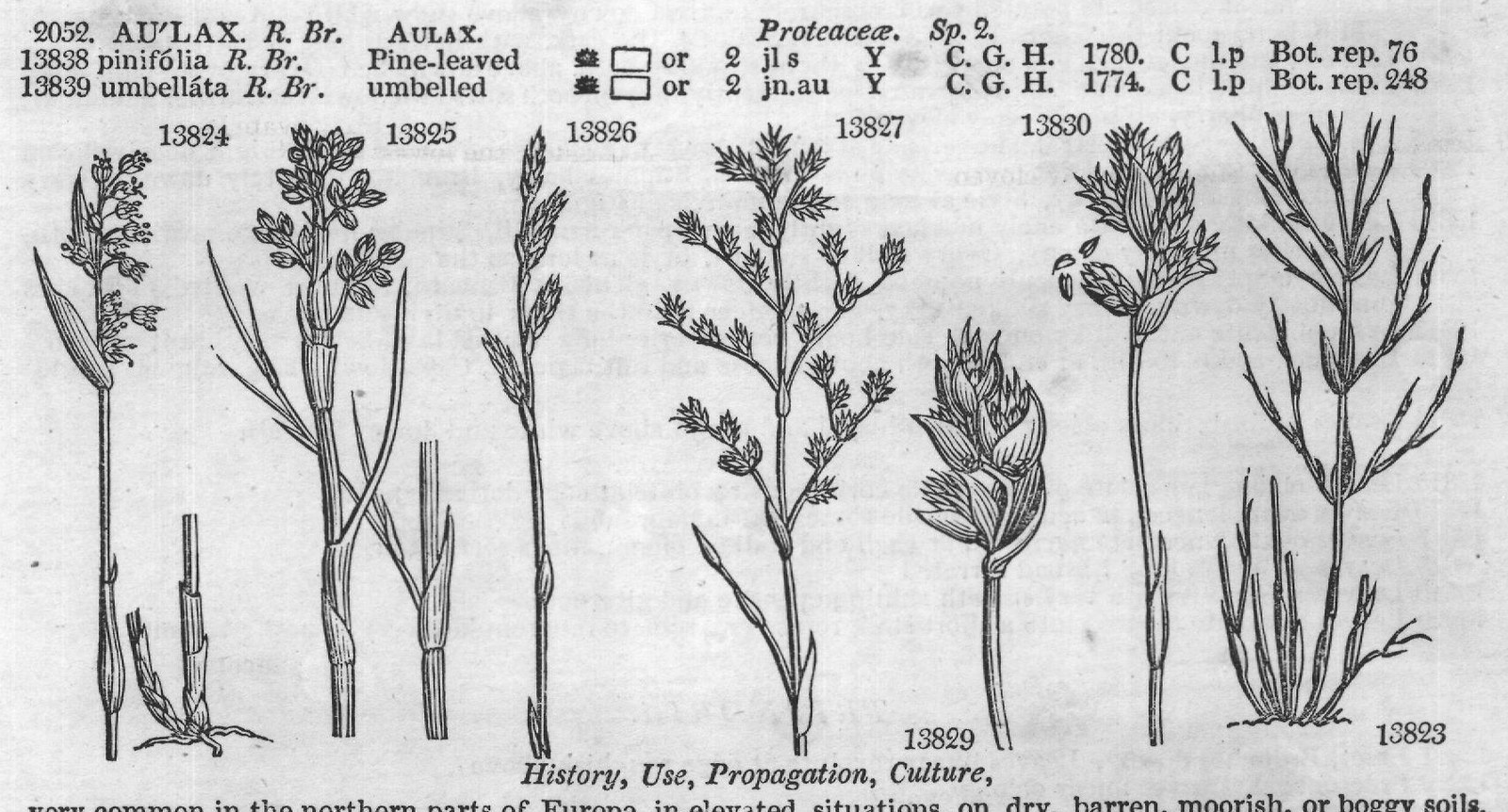
S. Europe 1739. C l.p Lam. ill. t. 802 TETRANDRIA. 2052. AU'LAX. R. Br. 13838 pinifólia R. Br. 13839 umbelláta R. Br. 13824 13825 AULAX.
Pine-leaved umbelled Proteaceæ.
Sp. 2. or 2 jls Y C. G. H. 1780. C 1.p Bot. rep. 76 or 2 jn.au Y C. G. H. 1774. C L.p Bot. rep. 248 13826 13827 13830 13829 13823 History, Use, Propagation, Culture, very common in the northern parts of Europe, in elevated situations, on dry, barren, moorish, or boggy soils. It is more patient of cold than even the common heath. The Highlanders' children eat the berries, but they are no very desirable fruit; and taken in large quantities, are said to bring on a slight head-ache. The Russian peasants, however, eat them, and the Kamtschadales gather great quantities of them to boil with their fish, or to make a sort of pudding with the bulbs of their lillies. They are esteemed antiscorbutic and diuretic. Grouse and heathcocks feed upon them, and they give the excrement a tinge of purple. Boiled in alumwater they afford a dark purple dye; and boiled with fat, they are said to be used in dying otter and sable skins black. Cattle do not seem to browse on this shrub. The French word Camarine, is an alteration of Camarinhas, the Portuguese name of E. album. 2046. Willdenovia. A rush-like plant, with long flexible slender shoots, named in honor of Charles Louis Willdenow, a celebrated Prussian botanist, whose edition of Linnæus's Species Plantarum is not only the best which has been published in modern days, but excellent in itself. 2047. Restio. From restis, cord; the supple shoots of many species are used as withs at the Cape of Good Hope. The houses of the Cape of Good Hope are commonly thatched with this plant both in town and country, and sometimes whole huts are built with it. A roof thatched with it will last twenty or thirty years, and would last much longer, if the south-east wind did not blow much dirt into it, which causes it to rot. 2048. Elegia. From ελέγoς, lamentation, in allusion to the sad or mourning color of the whole plant. A hard rushy plant, with the habit of a Restio. 2049. Phœnix. The Greek name of the date, and probably so called from Phœnicia, whence the best dates were brought. Dactylifera is the Greek version of Palma, both signifying the hand, to the fingers of which the ancients likened the bunches of dates. P. dactylifera is a lofty palm, with a rugged trunk, on account of the persisting vestiges of the decayed leaves. These leaves, when the tree is grown to a size for bearing fruit, are six or eight feet long, with pinnæ three feet long, and a little more than an inch broad. The flowers of both sexes come out in very long bunches from the trunk between the leaves, and are covered with a spatha, which opens and withers; those of the male have six short stamina, with narrow four-cornered anthers filled with farina. The female flowers have no stamina, but have a roundish germ, which afterwards becomes an oval berry, with a thick pulp enclosing a hard oblong stone, with a deep furrow running longitudinally. The fruit of this tree makes a great part of the diet of the inhabitants of Arabia and part of Persia. In Upper Egypt many families subsist almost entirely upon it. They make a conserve of it with sugar; and even grind the hard stones in their hand-mills for their camels. In Barbary they turn handsome beads for paternosters of these stones. The date is said to strengthen the stomach and intestines, to stop looseness, and promote expectoration, for which purpose it is given in pectoral decoctions. It is also recommended in the piles, given in red wine. From the leaves of the tree they make baskets or bags in Barbary. In Egypt they make fly-flaps of them, and brushes to clean their sofas or clothes. The hard boughs are used as fences to their gardens, and cages to carry their fowls to market. The trunk is split for the same purposes, and is even used in small buildings. It serves likewise for firing. The threads of the web-like integument between the ORDER III.
DICECIA TRIANDRIA. 13823 Culm and branches round smooth 13824 Culm simple leafless, Spikes racemose somewhat 1-sided roundish triquetrous cernuous with bractee 13825 Culm dichotomous leafy, Branches compressed, Spikes panicled pendulous 13826 Culm dichotomous leafy decumbent, Branches round, Spikes solitary and alternate 13827 Culm dichotomous leafy, Branches compressed, Spikes sessile alternate erect 13828 Culm simple leafiess, Spikes alternate erect, Scales acuminate 13829 Culm simple nearly naked, Spathes very large ovate nearly acute, Spikes clustered thyrsoid 13830 Culm channelled, Spathes large ovate obtuse, Spikes racemose 13831 Fronds pinnated unarmed, Leaflets folded together linear-lanceolate straight 13832 Fronds pinnated unarmed, Leaflets folded together linear-lanceolate loosely spreading 13833 Fronds pinnated unarmed, Leaflets linear-subulate folded together, Flowers hexandrous 13834 Pinnæ linear-ensiform folded together: lower spiny 13835 Flowers triandrous 13836 Flowers diandrous 13837 The only species TETRANDRIA. 13838 Leaves filiform channelled 13839 Leaves flat spatulate-linear 13833 13831 13836 13838 13837 13835 13839 and Miscellancous Particulars. boughs make ropes and the rigging of smaller vessels. The juice of the date tree is procured by cutting off the head or crown of the more vigorous plant, and scooping the top of the trunk into the shape of a basin; where the sap in ascending lodges itself, at the rate of three or four quarts a day, during the first week or fortnight; after which, the quantity daily diminishes, and at the end of six weeks or two months the tree becomes dry, and serves for timber or firewood. This liquor, which has a more luscious sweetness than honey, is of the consistence of a thin syrup, but quickly becomes tart and ropy, acquiring an intoxicating quality, and giving upon distillation an agreeable spirit or araky, which is the general name in the East for all hot liquors extracted by the alembick.
P. farinifera produces black drupes of the size of a large kidney bean; these the natives of Coromandel eat as gathered from the bush without any preparation. The leaflets are wrought into mats; the common petioles are split into three or four, and used for making ordinary baskets of various kinds; but they are not so proper for this purpose as the bamboo. The small trunk, when divested of its leaves, and the strong brown fibrous web that surrounds the trunk at their insertions, is generally fifteen or eighteen inches long, and six in diameter at the thickest part; its exterior or woody part consists of white fibres matted together, which envelope a large quantity of farinaceous substance, used as food by the natives in times of scarcity; but to separate this from the fibres, the trunk is split into six or eight pieces, then dried, beaten in wooden mortars, and afterwards sifted: the rest of the preparation consists in boiling the meal into a thick gruel, or, as it is called in India, congee. It seems to be much less nutritive than sago, and is less palatable. 2050. Stilago. Perhaps so called from the length of the style; but the name is unexplained by its author. S. diandra produces an eatable fruit used by the natives, but not esteemed by Europeans. The species thrive in sandy loam, and cuttings root in sand under a hand-glass. 2051. Osyris. The Greek name of a tree with long supple branches, which were used for brushes and similar purposes. The modern shrub has also slender flexible branches, of which packing materials are formed throughout the south of Europe. 2052. Aulax. From auλaξ, a furrow; in allusion, we presume, to the furrows on the under-side of the leaves of the original species. Neat shrubs with narrow leaves; nearly allied to Protea. This, Sweet observes, is "a pretty genus belonging to the Proteaceæ, which thrives best in a very sandy loam, with a great many potsherds broken small at the bottom of the pot, to let the water drain off freely, as they frequently get too much water, which makes the mould sodden, and stagnates their growth. Ripened cuttings, taken off at a joint, and planted in a pot of sand, will strike root, if placed under a hand-glass in the propagating house, and the glass to be occasionally left off, an hour or two at a time, to give them air, and keep them from damping; which should be done in a morning before the sun has much power, or it will make them flag and injure them. Plants are readily raised from seeds, which should be sown in a mixture of two-thirds loam and one-third sand: as soon as they come up, they should be planted off in small pots, in the same kind of soil, as they are very apt to die, if left too long in the seed-pot." (Bot. Cult. 143.) DIŒCIA TETRANDRIA. 2053. LEUCADEN'DRON. R. Br. LEUCADENDRON. Proteaceæ. Sp. 24-37. CLASS XXII. 13840 argénteum R. Br.
Silver Tree 오 or 15 au Y C. G. H. 1693. C 1.p Lam. ill. t.53. f.1 13841 plumósum R. Br. feather-flower'd or 4 jn.au Y C. G. H. 1774. C 1.p 13842 imbricátum R. Br. imbricated or Y C. G. H. 1790. C 1.p 13843 buxifólium R. Br.
Box-leaved or Y C. G. H. 1812. C l.p 13844 Levisánus R. Br. short-leaved or 4 ap.jn Y C. G. H. 1774. C 1.p Bur.afr. t. 100.f.2 13845 linifólium R. Br.
Flax-leaved or 4 ap.jn Y C. G. H. ...
Cl.p Jac. schœ. 1. t. 26 13846 fusciflórum R. Br. starred or 4 my.jn Y C. G. H. ...
Cl.p Bot. mag. 881 Prótea stelláris B. M. 13847 tórtum L. T. twisted-leaved 13848 cinéreum L. T. gray 13850 decórum L. T. 13851 cóncolor L. T. 13849 corymbósum L. T. corymbed 13852 grandiflórum L. T. great-flowered decorous one-colored コココココ or 3 mr.my Y C. G. H. 1790. C 1.p Bot. reg. 826 or 3 jl.au Y C. G. H. 1774. C l.p or 3 ap.jl Y C. G. H. 1790. C l.p Bot. reg. 102 or 3 ...
Y C. G. H. 1790. C 1.p or 3 mr.jn Y C. G. H. 1774. C l.p Bot. rep. 307 or 3 ap.jn Y C. G. H. 1789. C 1.p Par. lond. 105 13853 decúrrens L. T. decurrent or 3 Y ...
C. G. H. 1812. C l.p 13854 stríctum L. T. upright or 3 ap.jn Y C. G. H. 1795. C 1.p Par. lond. 75 13855 virgátum L. T. slender or 3 ap.jn Y C. G. H. ...
Cl.p 13856 adscéndens L. T. 13857 concínnum L. T. 13858 salígnum L. T. 13859 uliginósum L. T. 13860 flóridum L.T. 13861 æ'mulum L. T. 13862 abietínum L. T. 13863 scábrum L. T. 2054. VISCUM. W. 13864 álbum W. 2055. MYRICA. W. 13865 Gále W. 13866 cerífera W. pale or 2 jn.au Y C. G. H. 1774. C 1.p Pl.man. t.229. f.6 neat or 3 Y ...
C. G. H. 1800. C 1.p Willow-leaved or 3 ap.jn Y C. G. H. 1774. C l.p Boer.lug.2. t.204 swamp or 3 ap.jn Y C. G. H. 1795. Cl.p Breyn.cen.21.t.9 florid or 3 ap.jn Y C. G. H. 1795. C 1.p Bot. rep. 572 incurved or 3 jn.s Y C. G. H. 1789. C l.p Bot. rep. 429 Pine-leaved or 3 jl.s Y C. G. H. 1789. C l.p Bot. rep. 461 rough or 3 Y ...
C. G. H. 1812. C 1.p MISLETOE.
Lorantheæ.
Sp. 1. common E cu 2 my G England trees. Sm.s Eng. bot. 1470 CANDLEBERRY MYRTLE.
Amentaceæ.
Sp. 12-21.
Sweet Gale or 4 my Ap Britain sp. bo. L s.p Eng. bot. 562 common or 8 my.jn Ap N. Amer. 1699. S s.p Cat. car. 1. t. 69 13867 carolinénsis W. 13868 pensylvánica Ph. 13869 Fáya W. broad-leaved or 4 my Ap N. Amer. 1730. S s.p Cat. car. 1. t. 13 Pensylvanian or 3 my Ap N. Amer. ...
Cs.p Du.ar.e.n. 2. t.55 Azorian or 6 jn.jl Ap Azores 1777. L s.1 Du.ar.e.n. 2. t.56 13870 æthiópica W.
African or 8 jn.jl Ap C. G. H. 1795. L s.l Plu.alm. t.48. f.8 13871 serráta W. saw-leaved or 3 au Ap C. G. H. 1793.
L s.l Plu.am. t.424.f.3 13872 laciniata W. en. smooth Oak-lv. or 3 jn.jl Ap C. G. H. 1752.
L s.l Jac.frag.2.t.1.f.4 13873 quercifólia W. en. hairy Oak-lvd. 数 or 3 jn.jl Ap C. G. H. 1752.
L r.m 13875 mexicána W. 13874 cordifólia W. 13876 segregata Jacq. heart-leaved or 4 my.jl Ap C. G. H. 1759.
L p.l Plu.alm.t.319.f.7 Mexican netted ココ or 8 f Ap Mexico 1823.
L p.l or 6 ...
Ap S. Amer. 1824.
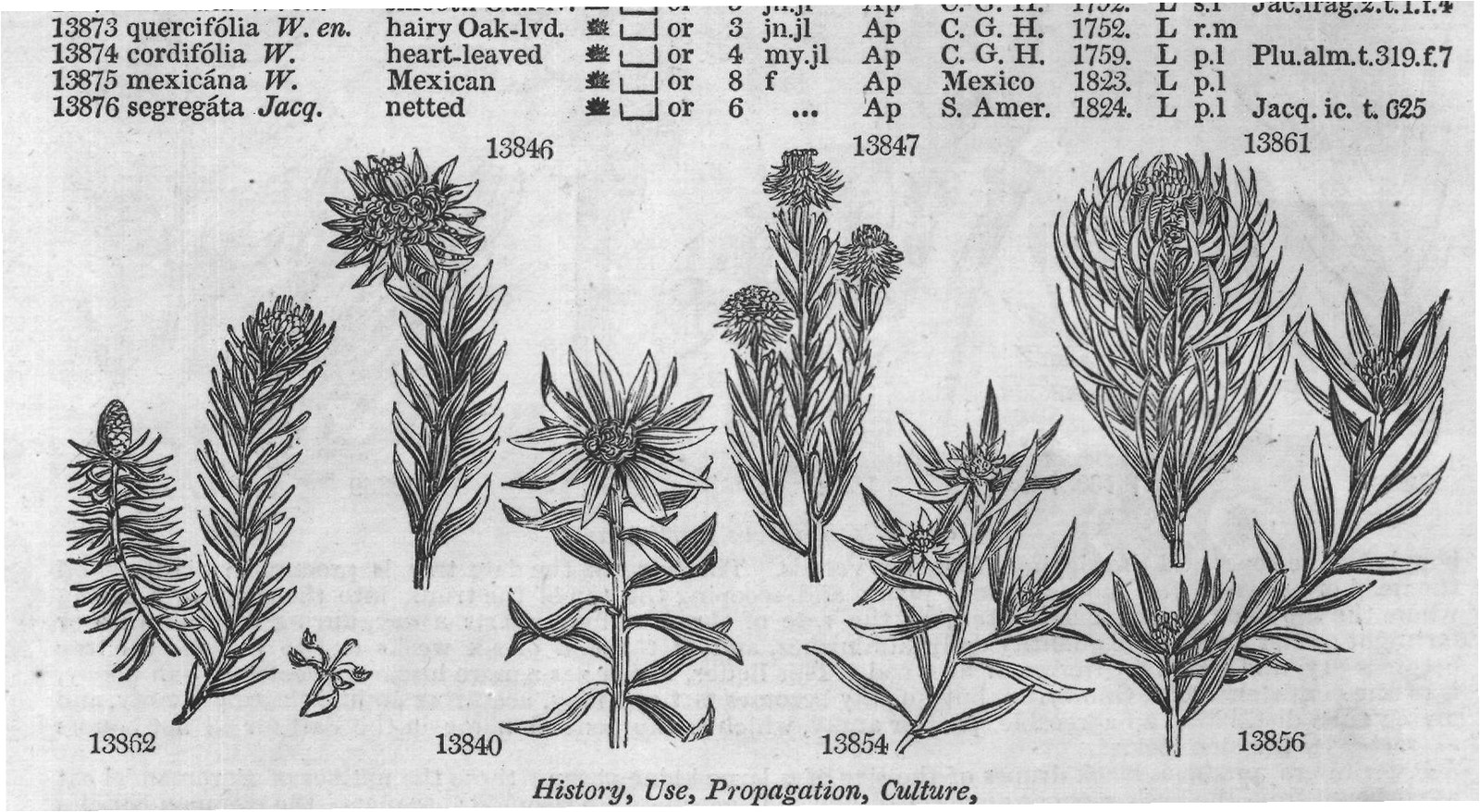
L p.1 Jacq. ic. t. 625 13846 13847 13861 13862 13840 13854 13856 History, Use, Propagation, Culture, 2053. Leucadendron. From λεuκoς, white, and δεvδρov, a tree, in allusion to the appearance of the most common species, No. 13,840. The species are evergreen shrubs, with handsome foliage; they grow in light soil species, No. 13,840 . The species are evergreen shrubs, with handsome foliage; they grow in light soil well drained and not over watered, and are increased by ripened cuttings in sand under a hand-glass. 2054. Viscum. From the Latin viscus, clammy, on account of the sticky nature of the berries. Gui, Fr., Mistl, Ger., and Visco, Ital. This may be considered the only true parasitical plant indigenous to Britain, as , Ger., and Visco, Ital. This may be considered the only true parasitical plant indigenous to Britain, as at no period of its existence does it derive any nourishment from the soil like Orobanche, or from decayed bark or wood like certain Fungi, and other epiphytes. The root of the misletoe insinuates its fibres into the woody substance of the tree; the shoots are dichotomous, round, smooth, and even; and of a pale green, like the leaves, which are tongue -shaped and entire. The whole forms a pendant bush of from two to five feet in diameter, evergreen, and in winter covered with small white very glutinous berries. The British species of misletoe is commonly found on fruit trees; but it will grow on various others, as the thorn, oak, maple, poplar, lime, ash, &c.; and in the neighbourhood of Magdebourg it is abundant on Pinus sylvestris. It is not difficult to propagate by inserting the berries in slits in the bark early in spring, and tying a shred of mat over the slit to protect them from the birds. The Druids sent round their attendant youths with branches of the misletoe to announce the entrance of the new year; and something like the same custom is still continued in France. In England branches of it are hung up in most houses at Christmas, along with other evergreens. The berries are devoured by several birds of the thrush kind, and especially by the Misletoe Thrush. Birdlime is made from the berries, and also from the bark, boiled in water, beaten in a mortar and washed. It is, however, more commonly manufactured from the bark of the holly. 2055. Myrica. The Greek (μuρuκη) synonym of the Tamarix. It is said to have been derived from μuρω, to flow, because the plants are always found on the banks of rivers, and in inundated spots. M. Gale has leaves , because the plants are always found on the banks of rivers, and in inundated spots. M. Gale has leaves of a bitter taste, but fragrant like those of the myrtle. Their essential oil rises in distillation. The northern nations formerly used this plant instead of hops, and it is still in use for that purpose in some of the western isles, and a few places in the Highlands of Scotland. Unless it be boiled a long time, it is reported to occasion head-ache. The catkins or cones boiled in water throw up a scum resembling bees' wax, which gathered in sufficient quantities would make candles. It is used to tan calf-skins. Gathered in the autumn it dyes wool ORDER IV.
DIECIA TETRANDRIA. 13840 Arborescent, Leaves lanceolate silky, Branches villous, Bractes short downy, Cal. silky 13841 Shrubby, Leaves linear lanceolate oblique smoothish, Male cal. smooth: female feathery, Fruit villous 13842 Lvs. lanc. lin. smooth rounded at base, Branches vill. Scales of cone silky cuneate, Fruit comose mucronate 13843 Leaves oval lanceolate: when old smooth, Scales of cone dilated-cuneate silky 13844 Leaves spatulate callous at end, and branches villous, Fruit comose pointless 13845 Leaves linear spatulate tapering at base and branches smooth, Male head sessile larger than leaves 13846 Leaves linear lanceolate smooth: the younger straight tapering at base, Female head shorter than leaves 13847 Leaves linear bluntish twisted smooth, Branchlets somewhat silky, Cal. silky, Fruit comose pointless 13848 Leaves spatulate linear silky with a callous beard at end, Cal. very shaggy, Fruit cuneate downy 13849 Lvs. lin. acute channelled imbricated erect smooth, Scales of cone acute recurved, Fruit obcord. ciliated 13850 Lvs. obl. veiny callous at end recurved smoothish: floral colored scarious, Scales of cone downy outside 13851 Leaves spatulate obl. callous at end smooth, Branches downy, Scales of cone retuse ciliated downy at base 13852 Lvs. lanc. obl. callous at end smooth: floral colored, Branches somewhat downy, Scales ovate obt. smooth 13853 Lvs. spatul. lanc. call. at end subdecurrent concave and branches smooth, Scales of cone roundish smoothish 13854 Lvs. lin. lanc. mucron. finally smooth, Invol. ov. ac. longer than head, Scales of cone round. dilated smooth 13855 Lvs. lin. acute with transparent edges and branches quite smooth: floral lin. lanc. long, Fr. winged emargin. 13856 Leaves linear lanceolate acute: floral lanceolate colored concave, Shrub low with ascending branches 13857 Lvs. obl. lanceolate bluntish veinless and branches quite smooth: floral-colored, Fruit winged emarginate 13858 Leaves linear lanceolate cuspidate somewhat silky: floral lanceolate colored, Fruit very narrow winged 13859 Leaves lanc. lin. silky with down on each side with callous points at end, Branches downy, Calyx hairy 13860 Lvs. lanc. lin. silky with down on each side with call. points at end, Branches shag. Cal. of male hairy in lines 13861 Upp. lvs. lanc. spatul, ac. rugose, Cones ov. Scales cohering at base distinct above with recurv. beardl. edges 13862 Lvs. all filiform chann. bluntish smooth spreading incurved, Scales cohering at base distinct above 2-lobed 13863 Lvs. all filiform channelled acute imbric. straightish ciliated, Scales cohering at base distinct above 2-lobed 13864 Leaves lanceolate obtuse, Stem dichotomous, Heads of flowers axillary 13865 Leaves lanceolate broader upwards serrated, Stem shrubby 13866 Leaves oblong narrowed at base subserrate at end, Scales of male catkins acute, Berries globose 13867 Leaves oblong narrowed at base coarsely serrated, Scales of male catkins acute, Berries globose 13868 Leaves oblong acute at each end entire or slightly serrated at end revolute at edge 13869 Leaves elliptical lanceolate subserrate, Male catkins compound, Drupe with a 4 celled nucleus 13870 Leaves elliptical toothed: the lowest quite entire 13871 Leaves lanceolate unequally acuminate serrated, Catkins long lax 13872 Leaves oblong deeply sinuated smooth 13873 Leaves oblong oppositely sinuated hairy 13874 Leaves subcordate serrate sessile 13875 Leaves oblong lanc. cuneate tapered at base nearly entire smooth shining with the middle nerve downy 13876 Leaves lanceolate entire netted with veins, Catkins few-flowered lax 13864 13870 13871 13865 13872 13867 13874 13876 and Miscellaneous Particulars. yellow, and is used for that purpose both in Sweden and Wales. The Swedes sometimes use a strong decoction of it to kill bugs and lice, and to cure the itch. The Welsh lay branches of it upon and under their beds to keep off fleas and moths, and give it as a vermifuge in powder and infusion, applying it also externally to the abdomen. In most of the Hebrides, as well as in the Highlands of Scotland, an infusion of the leaves is frequently given to children to destroy the worms. In Isla and Jura the inhabitants garnish their dishes with it, and lay it between their linen and other garments to give them a fine scent, and to drive away moths. When it grows within reach of a port, the sailors make besoms of it for sweeping their ships. In the isle of Ely they make faggots with it to heat their ovens. Linnæus was induced to suspect, from the smell of this shrub, that camphor might possibly be prepared from it. Horses and goats eat sheep and cows refuse it. M. cerifera may be used for most of the purposes of the former species. Candles are made from the berries are made from the berries in North America, whence it is called there the tallow shrub or candleberry tree; some also name it the bayberry-bush. It grows abundantly on a wet soil, and seems to thrive particularly well in the neighbourhood of the sea, nor does it seem ever to be found high up in the country. The berries intended for making candles of country. The berries intended for making candles are gathered late in autumn, and are thrown into a pot of boiling water their fat melts out, floats at the top of the water, and may be skimmed off. The fat when congealed looks like tallow or wax, but has a dirty green color it is therefore melted again and refined, by which means it acquires a fine and pretty transparent green color. It is dearer than common tallow, but cheaper than wax. They usually mix some tallow with it. Candles of this kind do not easily bend or melt in summer as common candles do they burn better and slower, nor do they cause any smoke, but rather yield an agreeable smell when they are extinguished. At present not many the are extinguished. At present not many candles of this kind are used, the animal tallow is readily come at, it being very troublesome to gather the berries. They are chiefly used by poor people, who live near where the bushes grow, and have not cattle enough to supply them. A soap is made from the fat which has an agreeable scent, and is excellent from these for an agreeable scent, and is excellent for shaving; and it is used by surgeons for plasters. In Carolina they likewise make sealing-wax from these berries. The root is accounted a specific in the tooth-ache. All the species grow well in peat soil or sandy loam, in a moist situation. They are increased by seeds or layers, but not readily by cuttings.
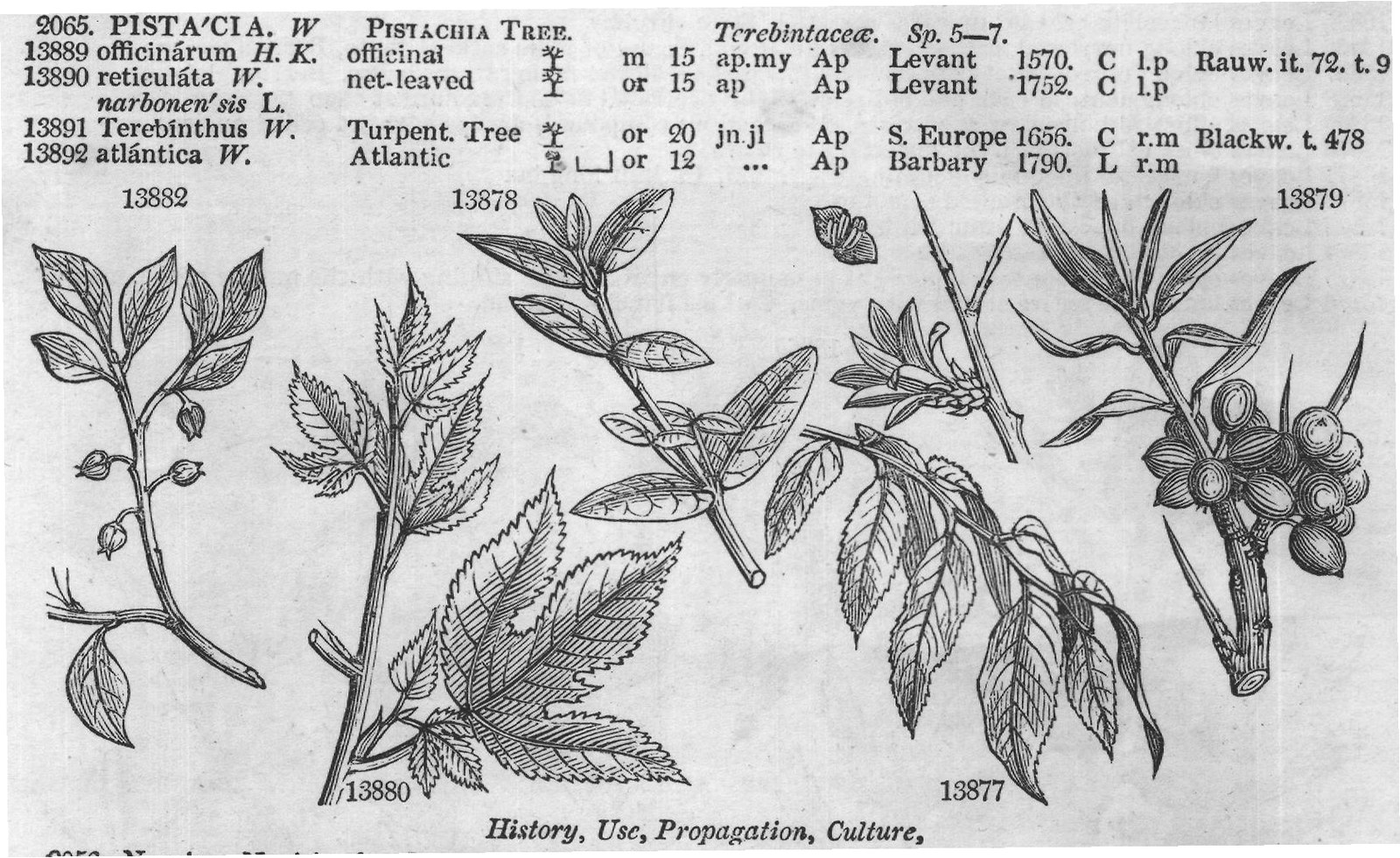
DICECIA TETRANDRIA. 2056. NAGEIA. Gærtn. NAGEIA. 13877 Putranjiva Roxb. grey-barked Amentaceæ. Sp. 1-3.
Ap E. Indies 1822. Cr.m Elæagneæ. Sp. 1. un 12 2057. SHEPHER'DIA. Nutt. SHEPHERDIA. 13878 canadénsis Nutt. Canadian or 10 ap.my Ap N. Amer. 1759. L co 2058. HIPPO'PHAE. W. SEA BUCKTHORN 13879 rhamnoídes W.
Elæagne.e. Sp. 1. common CLASS XXII. entire-leaved white-flowered or 2059. BROUSSONETIA. W. BROUSSONETIA. 13880 papyrífera W. Paper Mulberry 13881 spatuláta Hort. 2060. SCHÆFFE'RIA. W. SCHEFFERIA. 13882 compléta W. or 12 ap.my Ap England sea co. L co Eng. bot. 425 Urticeæ. Sp. 2. or 12 f.s Ap or 12 f.s Ap Japan 1751. C co Kæm.amœ.t.472 ...... 1824. C co ..
Sp. 1-2. 6 au G W. Indies 1793. C p.1 Lam. iil. t. 809 2061. BRU'CEA. W.
BRUCEA. 13883 ferrugínea W.
Ash-leaved or 6 ap.my G 13884 sumatrána Roxb.
Sumatra or 10 ap.my G 2062. ANTHOSPER'MUM. W. AMBER TREE.
Rubiaceæ. 13885 æthiópicum W.
Ethiopian or 2063. TROPHIS. W.
RAMOON TREE. ... 13886 americana W.
American 13887 áspera W. rough-leaved호는 or 20 ap.my G or 25 ...
G 2064. MONTI'NIA. W. MONTINIA. 13888 caryophyllacea H. K. Sea Pursl.-lvd.or Onagrariæ. 1 jl