Exot
bot. 1. t.59 1116. FABRICIA. W.
FABRICIA.
Myrtaceæ.
Sp. 2. 6933 myrtifólia W. opposite-leaved or 3 ...
Y N. Holl. ... 6934 lævigáta W. smooth-leaved or 3 my.jn Y Cs.p Gæ.se.1.t.355.f.4 N. S. W. 1788. C s.p Bot. mag. 1304 6911 6912 6914 6915 6918 6916 6917 History, Use, Propagation, Culture, C. tuna (tyn the Arabic name for fig) is used as a hedge plant in Spain, South America, and the West Indies. When the island of St. Christopher was to be divided between the English and the French, three rows of the tuna were planted by common consent between the boundaries. (Sloane.) Sir J. E. Smith informs us, that the stamens of the flower are very irritable; and that if a feather be drawn through them, in two or three seconds they begin to lie down gently on one side, and in a short time become recumbent at the bottom of the flower. C. cochinillifer is the species on which the cochineal insect chiefly feeds. The insect feeds on other succcиient plants besides those of the Cactus genus, but this species is cultivated because least annoying by its prickles. It produces an edible fruit larger than that of C. opuntia. On the top of the fruit there grows a red flower: this when the fruit is ripe, falls down on the top of it, and covers it so that no rain or dew can wet the inside. A day or two after, the flower being scorched up by the heat of the sun, the fruit opens wide, and the inside appears full of small red insects. The Indians, when they perceive the fruit open, spread a large linen cloth, and then with sticks shake the plant, to disturb the insect, so that they take wing to be gone, but keep hovering over the plant, till by the heat they fall down dead on the cloth, where the Indians let them *remain two or three days till, they are dry. The cochineal plants are called by the Spaniards Toona. They are pianted in the country about Guatimala, Chiape, and Guaxaca, in the kingdom of Mexico. The difference, in point of goodness, observable in the cochineal, is entirely owing to the plant it feeds upon. The prickly pear (C. tuna) so abundant in Jamaica, is covered with the insects, but not having their proper food, they are in general diminutive, and have very little red tincture in their bodies. The delicate red colored juice of the fruit is the natural food of the insect. The exuviæ and animal salts of the insect are, from the minuteness of its parts, inseparable from the essential principles of the dye, and must diminish the brilliancy of the color and this has put some persons upon inspissating the juice of the fruit itself. The ripe fruit is said to check fluxes by its mild restringency; it is also a powerful diuretic, and sometimes imparts a tinge to the urine.
C. pereskia, so cailed from the generic name of Plumier, who made this species a distinct genus, in memory of N. F. Peiresk of Aix, whose name, as Tournefort says, is his only monument, has fruit about the size of a walnut, having tufts of small leaves on it, and within a whitish mucilaginous pulp. In our stoves, according to Sweet, "sandy loam, or loam mixed with a little brick rubbish, is the best soil for all the Cacti: the pots should be as small as the plants will allow, and well drained with potsherds. They ORDER I.
ICOSANDRIA MONOGYNIA. 6903 Branched, Joints short oblong truncated 6904 Leaves elliptical fleshy, Spines about an inch long, Buds little woolly 6905 Spines numerous variable strong, Leaves lanc. oblong with a strong rib beneath 6906 Leaves elliptical fleshy, Spines an inch long, Buds very woolly 6907 Branches pendulous whorled round smooth naked green 6908 Branches pendulous whorled round green the younger covered with bundles of white hairs 6909 Branches round as thick as a quill, Spines scarcely any 6910 Pendulous, Branches rounded fascicled, Hairs bundled in six lines 6911 Jointed erect, Branches round and angular, Young spines in minute inconspicuous parcels 6912 Ovary leafy, Seeds naked 6913 Ovary naked, Seeds winged 6914 Leaves somewhat toothed ovate oblong 6915 Leaves quite entire 6916 Leaves ovate acuminate toothletted, Axils of veins hairy, Stigmas 4 linear 6917 Leaves hairy oblong-ovate acute sharply and angularly toothed 6918 Leaves ovate mucronate obsoletely 3-nerved, Cal. smooth with colored membranous teeth 6919 Leaves lin.-lanc. obtuse nerveless, Cal. smooth with membranous naked teeth 6920 Leaves lanc. lin. acute 3-nerved, Cal. silky villous, with membr. colored naked teeth 6921 Leaves oblong or oval mucr. pubescent on each side obsoletely 3-nerved, Branches villous, Cal. very vill. 6922 Leaves lanc. oblong hairy oblique reflexed at end 6923 Leaves oval lanceolate, Young shoots colored, Flowers large, Teeth of calyx colored 6924 Leaves obovate nerveless, Branches and calyxes hairy with membranous colored teeth 6925 Leaves ovate lanceolate short three nerved, Fl. sol. sessile, Cal. entire persistent 6926 Leaves subulate pungent, Branches hairy, Calyxes and teeth villous 6927 Branches flexuose, Flowers sessile fascicled, Cal. hairy 6928 Leaves lin.-lanc. pungent, Branches silky, Cal. smooth with membranous colored naked teeth 6929 Leaves lin.-lanc. pungent, Branches hairy, Cal. smooth with membranous col. pubescent teeth 6930 Leaves oblanc. densely dotted, Fl. sol. terminal, Sepals deciduous 6931 Leaves acicular rigid fascicled, Flowers solitary, Teeth of calyx colored 6932 Leaves linear recurved at end, Cal. smoothish, Teeth leafy lanc, naked, Stamens longer than cor. 6933 Leaves lanceolate obovate opp. Teeth of calyx round 6934 Leaves obovate altern. glaucous, Teeth of calyx triangular a 6934 114 6923 6925 6931 6926 6932 6929 1911 and Miscellaneous Particulars. require very little water. The best way to flower them is to expose them to the air all the summer, which makes them get plump and throws them into flower-bud. Most of the species are fine flowers. Cuttings, after they are taken off, should be left to dry a few weeks till they are shrivelled, then potted, and they will root immediately. (Bot. Cult. 31.) 1112. Rhipsalis. From ῥiψ, a willow branch, in allusion to the flexible decumbent branches of the genus. Curious, branched, jointed, leafless, prostrate plants. Culture as in Cactus. 1113. Bartonia. Named by Pursh, in honor of Dr. B. S. Barton of Philadelphia, an American botanist. Beautiful plants, with alternate pinnatifid rough glaucous leaves, and large white flowers, which open during the night, and spread a most agreeable odor. Very rare, if they yet exist, in collections. 1114. Philadelphus. A name used by Athenæus for a tree which is now unknown. Bauhin applied it to this genus. The species are free flowerers, well adapted for the shrubbery. The native country of P. coronarius is not known; it is generally referred to the south of Europe, but it has only been found twice in Italy, and then in situations where it might have been planted. The flowers have the appearance and odor of those of the orange, but the odor in near contact is much more powerful. Seeds are seldom produced in this country. The leaves taste like fresh cucumbers. P. grandiflorus is a very shewy plant. All the species grow freely in common soil, and are increased by layers. 1115. Leptospermum. From λεπτoς, slender, and σπερμη, seed, in allusion the extreme tenuity of the seeds. Pretty New Holland plants. L. scoparium grows commonly in dry places near the shores in New Zealand, New Holland plants. L. scoparium grows commonly in dry places near the shores in New Zealand, and the underwood in Adventure Bay, Van Dieman's Land, chiefly consists of this shrub. The leaves were used by Captain Cook's ships' crews as tea, whence they named it the tea plant. The leaves have a very agreeable bitter flavor, with a pleasant smell, when fresh; but lose something of both, when dry. If the infusion was made strong, it proved emetic to some, in the same manner as green tea. It was also used with spruce leaves, in equal quantity, to correct their astringency in brewing beer from them; and they rendered the beer exceedingly palatable.
Young cuttings of all the species will root readily in sand, under a bell-glass: the species may also be raised from seeds; but plants from cuttings are best, as they flower young, and the seedlings do not flower till they attain a considerable size. (Bot. Cult. 214.) 1116. Fabricia. Dedicated by Gærtner to John Christian Fabricius, the famous Entomologist. The species ICOSANDRIA MONOGYNIA. 1117. METROSIDE'ROS. W. METROSIDEROS.
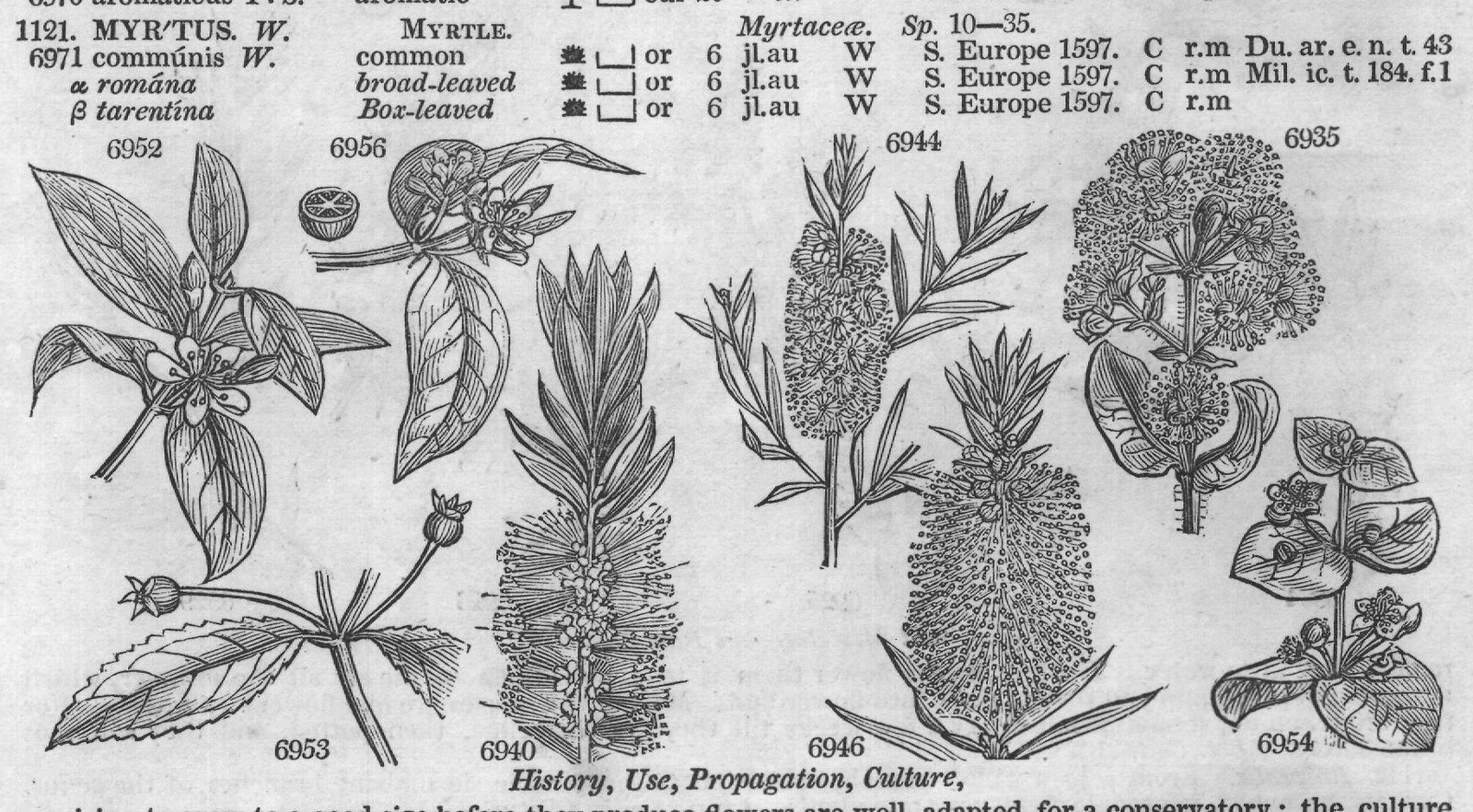
Myrtaceæ. Sp. 16-20. 6935 híspida Sm. rough or 6 my.au Y N. S. W. 1789. C s.l CLASS XII.