Home › E › Exot (Bot t florib nda Sm)
Exot (Bot t florib nda Sm)
bot. 1. t.42 6936 floribúnda Sm. many-flowered or 6 jlau WN. S. W. 1788. C s.l 6937 costáta Sm. ribbed or 6 Y N. S. W. 1816. C s.l Gæ. se. 1. t.34.f.2 6938 glomulífera W. cluster-flowered or 15 my.jn Y.G N. S. W. 1805. C s.l 6939 angustifólia W. narrow-leaved or 6 Y.G C. G. H. 1787. C s.l ... 6940 margináta P. S. margined or 6 ...
P.Y N. S. W. 1816. C s.l Cav. ic. 4. t. 332 6941 lineáris W. linear-leaved or 6 jn.jl W N. S. W. 1788. C s.1 Ser. han. 19. t.11 6942 pinifólia W. en.
Pine-leaved or 6 jn jl G N. S. W.
Cs.l Wen. col. 1. t.16 6943 viminális W. long-leaved or 10 mr.jn R N. S. W. 1800. C s.l Gæ. se. 1. t.34.f.4 6944 salígna W. willow-leaved or 6 my.jn R N. S. W. 1788. C s.1 Bot. mag. 1821. 6945 lanceoláta W. spear-leaved or 10 jn.n Cr N. S. W. 1788. C s.l Bot. mag. 260 6946 speciósa B. M. splendid or 10 mr.jn Cr N. S. W. 1803. C. s.l Bot. mag. 1761 6947 véra Lindl. true Iron-wood or 20 mr.jn GE. Indies 1819. C s.1 Lindl. coll. 18 6948 semperflórens Lodd. ever-blowing or 6 mr.jn Cr N. S. W. 1818. C p.l Bot. cab. 523 6949 linearifólia Link. linear-leaved or 10 mr.jn R N. S. W. 1820. C p.l 6950 rugulósa W. wrinkled or 6 mr.jn Pk N. S. W. 1821.
C p.l 1118. PSI DIUM. W.
GUAVA.
Myrtaceæ.
Sp. 7-10. 6951 pyríferum W. white 6952 pomíferum W. red 6953 aromáticum W. aromatic 6954 cordátum B. M. cordate 6955 montánum W. mountain 6956 polycárpum And. clustered 6958 malaccénsis W. 6957 Cattleianum Lindl. purple 1119. EUGENIA. W. 6959 Jámbos W. 6960 baruénsis W. 6961 myrtifólia Ker.
M. austrális B. M. 6962 axilláris W.
EUGENIA.
Malay Apple-tr. narrow-leaved many-flowered myrtle-leaved axillary 어어어어어어호 fr 7 jn.jl W W. Indies 1656.
Cr.m Rum. am. 1. t.47 fr 20 jn.jl W W. Indies 1692.
Cr.m Rhe. mal. 3. t. 35 or 5 W W. Indies 1779.
Cr.m Aub. gui. 1.t.191 ... fr 5 my.jl W W. Indies 1811.
Cr.m Bot. mag. 1779 fr 4 ... or 8 ap.jl W W W fr 3 my W fr 20 my.jn W Myrtaceæ. fr 25 my.au S fr 25 f.jl G.Y or 20 ...
E. Indies 1768. C s.p E. Indies 1768. L s.p S. Amer.
Ls.p N. Holl. 1818. L s.p ...
W. Indies 1779.
Cr.m Trinidad 1810.
Cr.m Bot. reg. 653 S. Amer. 1818.
Cr.m Lindl. coll. 16 Sp. 14-37.
Bot. rep. 458 Bot. mag. 1696 Jac. ic. 3. t. 486 Bot. reg. 627 or 10 s W 6963 frágrans W. 6964 Mini W. sweet-scented small-fruited or 10 ap.my W or 10 W ... 6965 ellíptica W. round-fruited or 8 my.s W 6966 ligustrína W. privet-leaved 6967 uniflóra W. one-flowered 6968 zeylánica W.
Ceylon 6969 latifólia W. broad-leaved or 10 or 8 au W or 7 ja.mr or 10 jn.jl W W W ...
Jamaica 1793. C s.p Jamaica 1790. C s.p Guiana 1803. C s.p N. S. W. 1790. C s.p Hispaniol.1798. C s.p Brazil 1759. C s.p Ceylon 1798. C s.p Guiana 1793. C s.p Bot. mag. 1242 Au. gui. 1. t. 197 Bot. mag. 1872 Bot. mag. 473 Bot. rep. 619 Aub. gui. 1.t.199 1120. CARYOPHYLLUS. P. S. CLOVE-TREE.
Myrtaceæ. Sp. 1 6970 aromáticus P. S. aromatic 오 cul 20 W ...
Moluccas 1797.
C l.p Ru. amb. 2. t.1.2 1121. MYR'TUS. W.
MYRTLE.
Myrtaceæ.
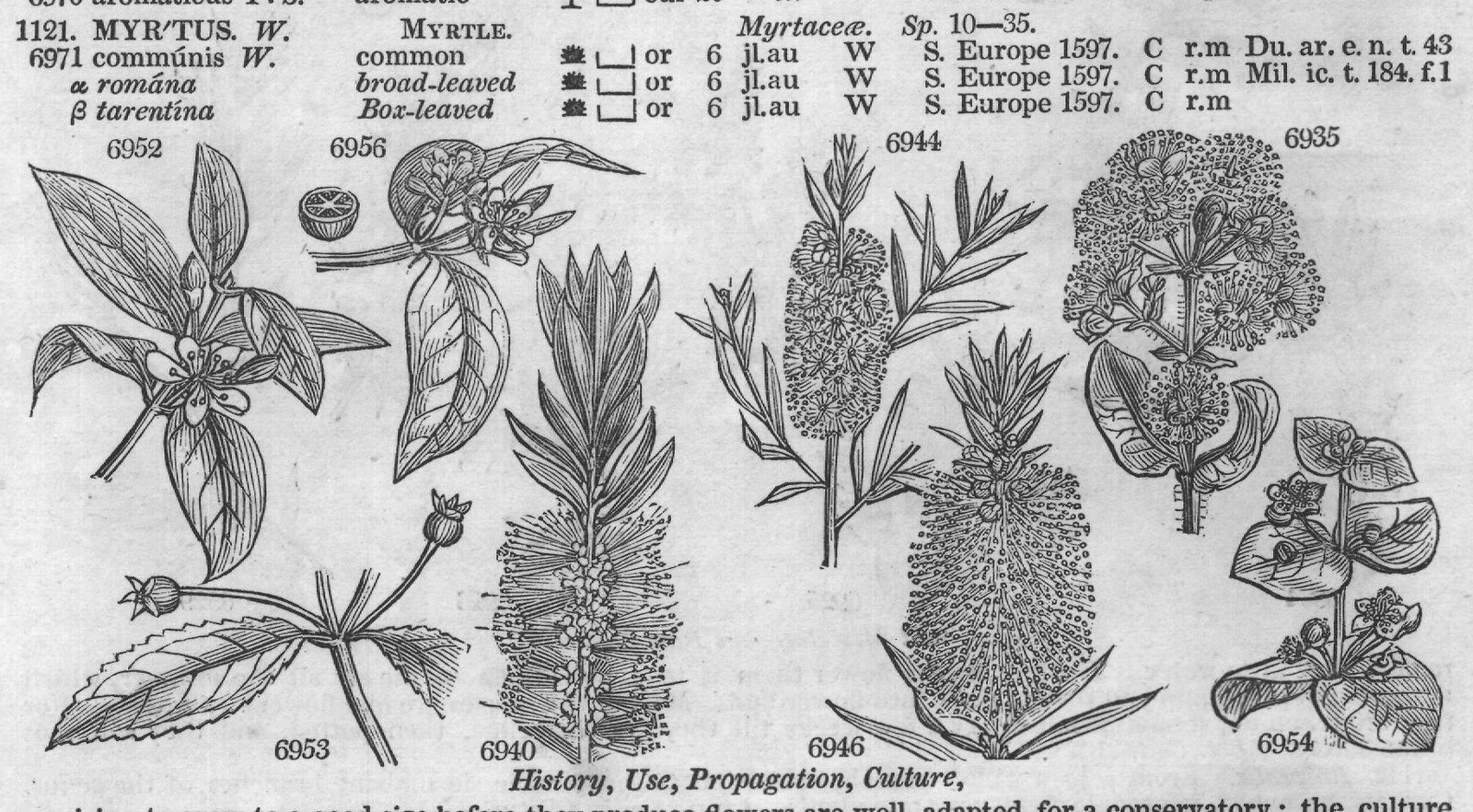
Sp. 10-35. 6971 commúnis W. a romána ẞ tarentina 6952 6956 common broad-leaved Box-leaved ㄷㄷㄷ or 6 jlau W S. Europe 1597.
Cr.m Du. ar. e. n. t. 43 or 6 jl.au W S. Europe 1597.
Cr.m Mil. ic. t. 184. f.1 or 6 jl.au W S. Europe 1597.
Cr.m 6944 6935 400 6953 6940 6946 6954 History, Use, Propagation, Culture, requiring to grow to a good size before they produce flowers are well adapted for a conservatory: the culture and propagation as in Leptospermum. 1117. Metrosideros. From μητρa, the heart of a tree, and σiδηρov, iron, in allusion to the hardness of the wood. One species (M. vera) is called iron wood. The Chinese make their rudders and anchors of it; and among the Japanese it is so scarce and valuable that it is only allowed to be manufactured in the service of their king. The bark is used as a remedy for fluor albus and diarrhea, being mixed with Pinang, and a small quantity of cloves and nutmegs. This is a genus distinguished at sight by the peculiar character of the shrubs of Australasia, with both sides of the leaf alike. M. hispida, lanceolata, and speciosa, are beautiful plants, but not free flowerers. They are rather difficult to strike. Sweet recommends "ripened wood planted under a bell-glass in sand." 1118. Psidium. One of the Greek names of the Pomegranate. In English it is called Guava, a corruption of the American name Guayaba. Most of the species are cultivated in the tropics for their fruit, which also ripens freely in this country, though it is of little merit. P. pyriferum bears fruit the size of a hen's egg, yellowish, with a peculiar smell. The rind is brittle and fleshy; pulp rather firm, full of bony seeds, flesh colored, sweet, aromatic, and pleasant. In the West Indies it is eaten with avidity, not only by the natives, but by Europeans: with those who are not accustomed to it, the Guava is apt to occasion a slight flux; but Jacquin affirms, that when he has been thirsty on a journey he has eaten of it to satiety without suffering any harm. It is eaten raw in the dessert, but the seeds are scarcely separable. It is also preserved with sugar. P. pomiferum has fruit like a pomegranate, which is seldom eaten, though eatable, and being astringent is counted strengthening for the stomach. P. Cattleianum is reckoned one of the best of the Guavas; the fruit is of a fine deep claret color, and the pulp in consistence and flavor bears a considerable resemblance to the strawberry. All the species are of easy culture in light and rather rich loam, and are increased readily by seeds, layers, or cuttings in sand under a hand-glass.
ORDER I.
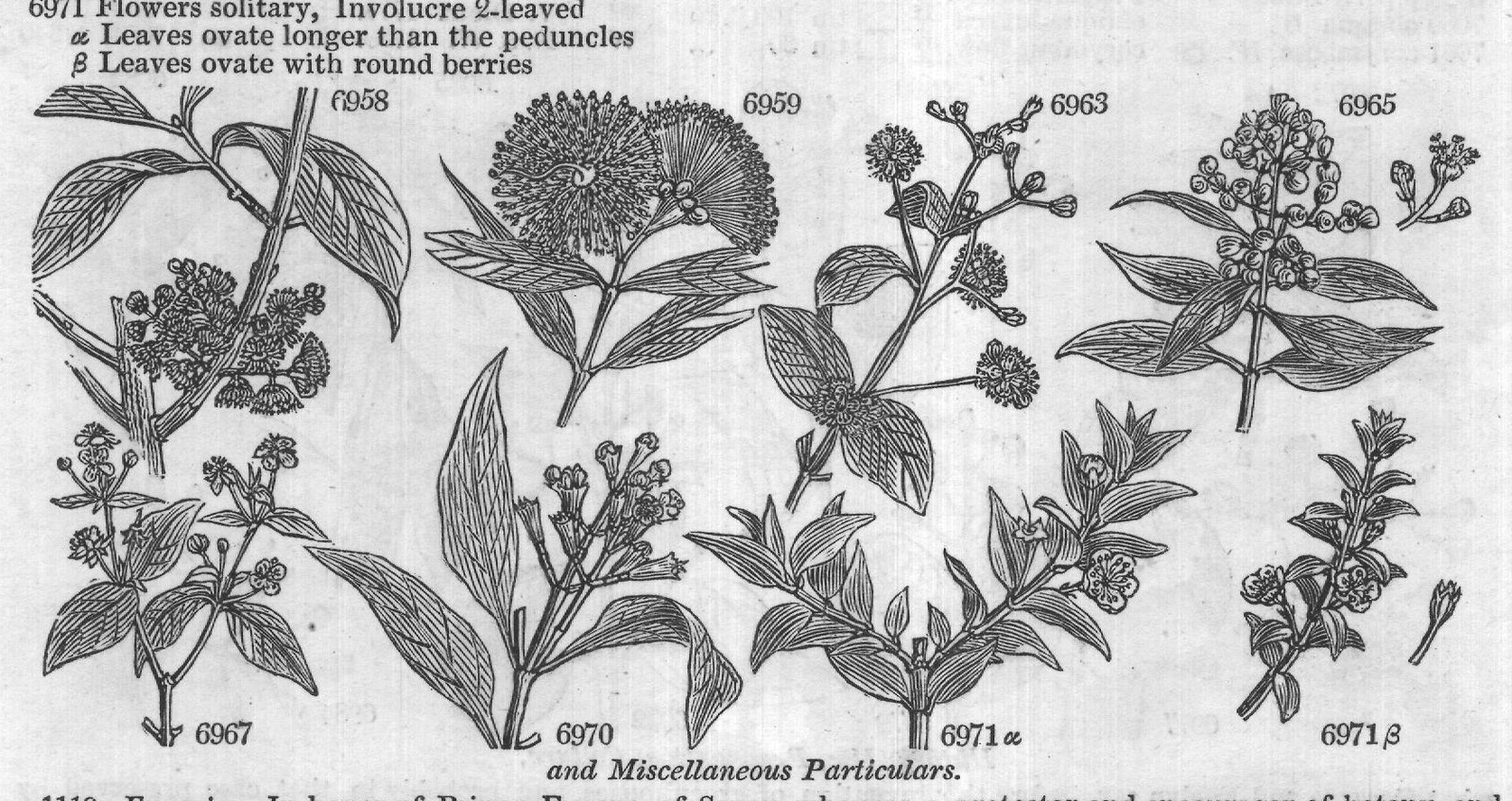
ICOSANDRIA MONOGYNIA. 6935 Leaves opposite cordate at base stem-clasping, Branches calyxes and peduncles hispid 6936 Leaves opposite stalked ovate lanceolate, Panicle brachiate, Pedic. umbelled 6937 Leaves opposite stalked lin.-lanc. acuminate oblique, Panicle brachiate decompound 6938 Leaves opposite ovate netted veiny beneath pubescent, Heads lateral stalked and bractes downy 6939 Leaves opposite lin.-lanc. naked, Pedunc. axillary umbelled, Bractes lanc. smooth 6940 Leaves alternate lanceolate 3-nerved, Fl. racemose clustered terminal smooth 6941 Leaves scattered linear channelled acute rigid, Fl. lateral clustered sessile 6942 Leaves alternate lin. filiform rigid mucronate channelled rough, Fl. clustered sessile 6943 Leaves alternate linear-lanceolate, Fl. clustered lateral pubescent 6944 Leaves alternate lanceolate narrowed at each end mucronate, Fl. lateral clustered sessile smooth 6945 Leaves alternate lanceolate mucronate, Fl. lateral clustered sessile pubescent 6946 Leaves scattered lanceolate veiny glandular mucronate, Caps. downy at end 6947 Leaves ovate-lanceolate acuminate quite smooth, Cymes stalked many-flowered 6948 Very like M. lanceolata, but the blossoms appear more copiously 6949 Leaves alternate lin.-lanceolate with a long acute point 6950 Leaves lin.-lanceolate with a long point dotted rough 6951 Leaves elliptical pubescent beneath, Peduncles 1-flowered 6952 Leaves oblong lanceolate pubescent beneath, Peduncles 3-flowered 6953 Leaves oblong acuminate smooth, Peduncles 1-flowered 6954 Leaves sessile cordate rounded smooth on each side, Pedunc. 1-fl. clustered 6955 Leaves oblong acuminate crenulate shining, Peduncles many-fl. 6956 Leaves ovate oblong acute sub-crenate, pubescent above rugose beneath, Branches reclinate 6957 Leaves obovate smooth coriaceous, Fruit purple 6958 Leaves entire oblong, Peduncles 4-fi. lateral 6959 Leaves entire lanceolate, Pedunc. 4-fl. terminal 6960 Leaves entire ovate-lanceolate, Ped. many-fl. axillary shorter than petiole 6961 Leaves elliptical, Pedunc. trichotomous lateral and terminal, Stamens much longer than petals 6962 Leaves entire oblong acuminate obtuse flat, Pedunc. axill. many-fl. the length of petioles 6963 Leaves entire roundish ovate obtuse, Pedunc. axill. many-fl. trichotomous the length of leaves 6964 Leaves entire oblong-lanceolate acuminate, Pedunc. axillary many-fl. racemose shorter than leaf 6965 Leaves entire elliptical acuminate, Pedunc. panic. axill. and terminal, Fruit globose 6966 Leaves entire lanceolate narrowed at base obtuse veinless, Pedunc. 1-fl. solitary terminal 6967 Leaves entire ovate-lanceolate, Pedunc. 1-flowered solitary lateral 6968 Leaves entire oblong acuminate coriaceous not dotted, Pedunc. 1-fl. filiform 6969 Leaves entire ovate oblong acuminate netted with veins, Pedunc. 1-fl. about 3 in fruit nodding 6970 The only species 6971 Flowers solitary, Involucre 2-leaved a Leaves ovate longer than the peduncles ẞ Leaves ovate with round berries 6967 6958 6970 6959 6963 6965 6971 a 6971 β and Miscellaneous Particulars. 1119. Eugenia. In honor of Prince Eugene of Savoy, who was a protector and encourager of botany, and possessed a botanic garden. Some of the species bear edible fruits: that of E. malaccensis is ovate, an inch and a half in diameter, flesh smelling like the rose, agreeable to the taste, and wholesome. It is generally cultivated between the tropics. E. Jambos bears smaller fruit, edible, but not so much esteemed; it is nevertheless excellent, resembling in appearance and flavor a Brussels apricot, and produced in great abundance in the stove. All the species grow freely in two-thirds loam and one-third peat, and flower abundantly when the plants are of a good size. Ripened cuttings strike root freely in sand under a hand-glass. 1120. Caryophyllus. The Arabs, who have been acquainted from all antiquity with the clove, called it qarunfel, which the Greeks altered into Caryophyllon. Giroflier, Fr. The fruit is thought to bear some resemblance to a nail, and hence is called clove, clou, Fr., Chiode, Ital., Clavo, Span., Naghel, Ger. and Dutch. The whole tree is aromatic, and the fruit or clove is considered as one of the hottest and most acrid substances of the aromatic class, and as such is often used, not only internally, but externally, as a stimulant; as in paralytic cases for example, in which the oil of cloves has been administered to advantage: it is also made use of in the tooth ache, in which it often succeeds in suddenly abating and subduing the pain. A tincture of cloves in rectified spirit is kept in the shops, as well as the essential oil, which latter is perhaps seldom free from sophistication. For culinary purposes, the uses of cloves are innumerable. The Dutch, who had for a long time the monopoly of the spice trade, prevented while they could the tree from being removed from the Moluccas and other islands, where it grows naturally; but the French now cultivate it in Cayenne and St. Domingo. There are a few specimens in the British gardens. It grows freely in loam and peat, and ripened cuttings are not difficult to root in sand, in moist heat under a hand-glass. 1121. Myrtus. From μύρov, perfume. Muρτoς of the Greeks. Le Mirte, Fr., Myrte, Ger., Myrtus, Dutch, Mirto, Ital. and Span., Myrta, Portug., Myrter, Dan. and Myrten, Swed. The common myrtle is a well known popular shrub, which has been in English gardens for an unknown length of time; evidently from Ee yitálica bæ'tica e lusitánica Italian, or upr. or 6 jl.au Orange-leaved or 6 jl.au W Portugal or 6 jl.au W § bélgica broad-lvd. Dutch or 6 jl.au W η mucronata Rosemary-lvd. or 2 jlau 6972 tomentósa W. woolly-leaved or 6 jn.jl Pu 6973 biflóra W. two-flowered ☐ or 10 ap.my W 6974 lúcida W. shining or 6 W ...
ICOSANDRIA MONOGYNIA.
WS. Europe 1597. Cr.m CLASS XII.
S. Europe 1597. Cr.m Blackwell, t. 114 S. Europe 1597. Cr.m Clus. hist. 1. t. 1 S. Europe 1597. Cr.m W、S. Europe 1597. Cr.m China Jamaica 1759. L s.p Br. jam. t. 25. f.3 Surinam 1793. L s.p 1776. C s.p Bot. mag. 250 6975 dumósa W. bushy or 3 jn.jl W W. Indies 1793. L s.p 6976 Grégii W.
Greg's or 6 W ...
Dominica 1776. Ls.p Gæ. se. 1. t.33 f.3 6977 virgultósa W. twiggy or 6 jl.au W 6978 ácris W.
Wild Clove-tree or 10 my.jl W 6979 coriácea W.
Sumach-leaved or 30 W ... 6980 pimentoídes Lindl. Allspice-like or 20 my W Jamaica 1787. Ls.p Jamaica 1759. L s.p Hispaniol.1759. L s.p W. Indies Ls.p Plu. ic. t.208. f. 1 ...
Pl. alm. t. 155.f.3 Pl. ic. t. 208. f. 2 Bot. cab. 178 1122. CALYPTRAN'THES. W. CALYPTRANTHES. Myrtaceæ.
Sp. 4-6. 6981 Zuzýgium W. oval-leaved tm 20 my.jl W W. Indies 1778.
Ls.p Br. jam. t. 7. f.2. 6982 Jambolána W.
Jambolana-tree ☐ or 20 W ...
E. Indies 1796.
L s.p Ru. amb. 1. t. 42 6983 Chytracúlia W. forked 6984 caryophyllifolia W. clove-leaved 00 1123. PIMEN'TA. Lindl.
PIMENTA. or 20 mr.my W or 20 ...
Myrtaceæ.
W Jamaica 1778.
E. Indies 1822.
L s.p Ls.p Br. jam. t. 37. f.2 Ru. amb. 1. t. 41 Sp. 1. 6985 vulgáris Lindl.
Allspice-Tree오 cul 30 my.jl W W. Indies 1723. L s.p Bot. mag. 1236 Myrtus Pimenta. L. 1124. OLYN'THIA. Lindl. OLYNTHIA.
Myrtaceæ.
Sp. 1. 6986 dísticha Lindl. globe-berried or 2 ap.jl W Jamaica 1793. Ls.p Bot. mag. 867 Mýrtus dísticha W. 1125. STRAVA'DIUM. Juss. STRAVADIUM. 6987 acutangulum Juss. sharp-angled Myrtaceæ. Sp. 1-2. or 20 ... ...
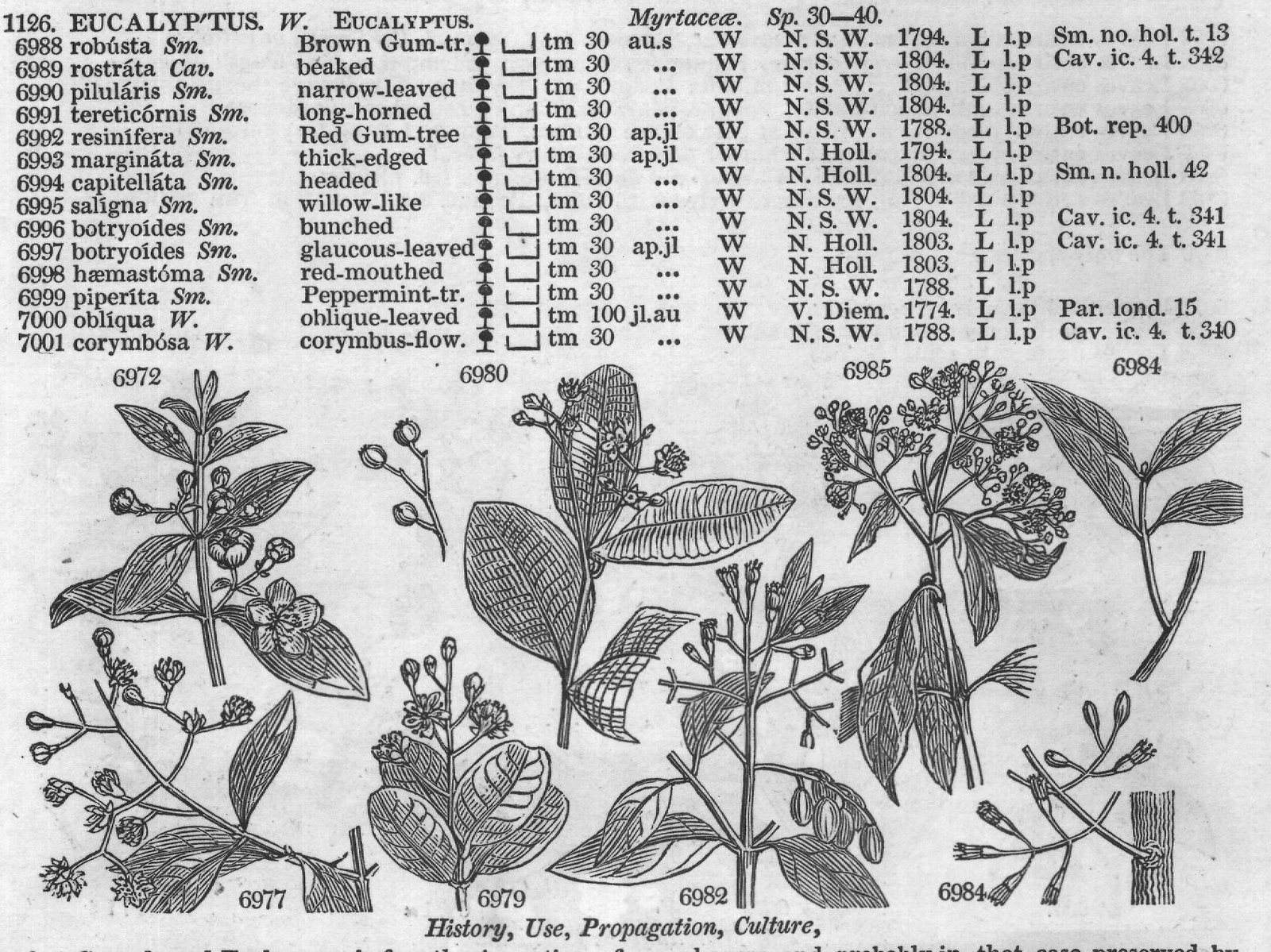
E. Indies 1822. Ls.p Rumph. 3. t. 116 1126. EUCALYPTUS. W. EUCALYPTUS.
Myrtaceæ. Sp. 30-40. 6988 robústa Sm.
Brown Gum-tr. tm 30 au.s WN. S. W. 1794.
L 1.p Sm. no. hol. t. 13 6989 rostráta Cav. beaked tm 30 ...
WN. S. W. 1804.
L l.p Cav. ic. 4. t. 342 6990 piluláris Sm. narrow-leaved tm 30 ...
WN. S. W. 1804.
L 1.p 6991 tereticórnis Sm. long-horned tm 30 ...
WN. S. W. 1804.
L l.p 6992 resinífera Sm. 6993 margináta Sm. 6994 capitelláta Sm.
Red Gum-tree tm 30 ap.jl W N. S. W. 1788.
L l.p Bot. rep. 400 thick-edged tm 30 ap.jl W N. Holl. 1794.
L l.p 6995 salígna Sm. 6996 botryoídes Sm. 6997 botryoídes Sm. 6998 hæmastóma Sm. 6999 piperíta Sm. 7000 oblíqua W. 6972 7001 corymbósa W. headed willow-like glaucous-leaved red-mouthed Peppermint-tr. oblique-leaved corymbus-flow. 6980 tm 30 W N. Holl. 1804.
L l.p Sm. n. holl. 42 ... tm 30 W N.S. W. 1804.
L l.p ... bunched tm 30 W N. S. W. 1804.
L l.p Cav. ic. 4. t. 341 ... tm 30 ap.jl W N. Holl. 1803. Ll.p Cav. ic. 4. t. 341 ココココ tm 30 W N. Holl. 1803. L l.p ... tm 30 ...
W N. S. W. 1788. L l.p tm 100 jl.au W V. Diem. 1774. L l.p Par. lond. 15 tm 30 W ...
N. S. W. 1788. L l.p Cav. ic. 4. t. 340 6985 6984 6977 6979 6982 History, Use, Propagation, Culture, 6984 what Gerarde and Evelyn say, before the invention of greenhouses, and probably in that case preserved by covering or housing in rooms. It was a great favorite among the ancients, for its elegance, and its evergreen sweet leaves. It was sacred to Venus, either on this account, or perhaps because it flourishes most in the neighbourhood of the sea. Myrtle-wreaths adorned the brows of bloodless victors, and were the symbol of authority for magistrates at Athens. Both branches and berries were put into wine, and the latter were used in the cookery of the ancients. The myrtle was also one of their medicinal plants. All parts of it are astringent, but it is discarded from modern practice. M. coriacea, sometimes called wild cinnamon, is a most elegant tree, with a handsome ash-colored straight trunk, and pyramidal head. It grows slowly, and flowers late twice a year In old trees, the bark becomes white, and hangs down in shreds which have an aromatic quality. The timber is red, very hard, and used in mill-work. The berries, which are the size of peas, and of an agreeable aromatic smell and taste, are used in culinary purposes. 1122. Calyptranthes. From κaλuπτρov, a lid, and avθoς, a flower, in allusion to the peculiar manner in which the segments of the calyx, being grown together, fall off. Zuzygium, is so called from σuζuγoς, coupled, in allusion to the manner in which the branches, and leaves are united by pairs. C. Jambolana, frequently called the Java plum, bears a black esculent berry. Cuttings of this genus, Sweet observes, " do not strike freely; ripened ones strike best in sand under a bell-glass; but the plants root best from layers." (Bot. Cult. 34.) 1123. Pimenta. A genus readily distinguishable from Myrtus by the structure of its ovarium. It is a handsome tree, common in the hilly parts of the north side of Jamaica. The flowers are without shew, and are succeeded by spherical purple berries crowned with a persistent calyx: they are called Jamaica pepper or all-spice, from their taste being thought to resemble a composition of all other spices. The berries are gathered before being ripe, and are carefully dried on mats or terraced floors in the shade. In ten or twelve ORDER I.
ICOSANDRIA MONOGYNIA.
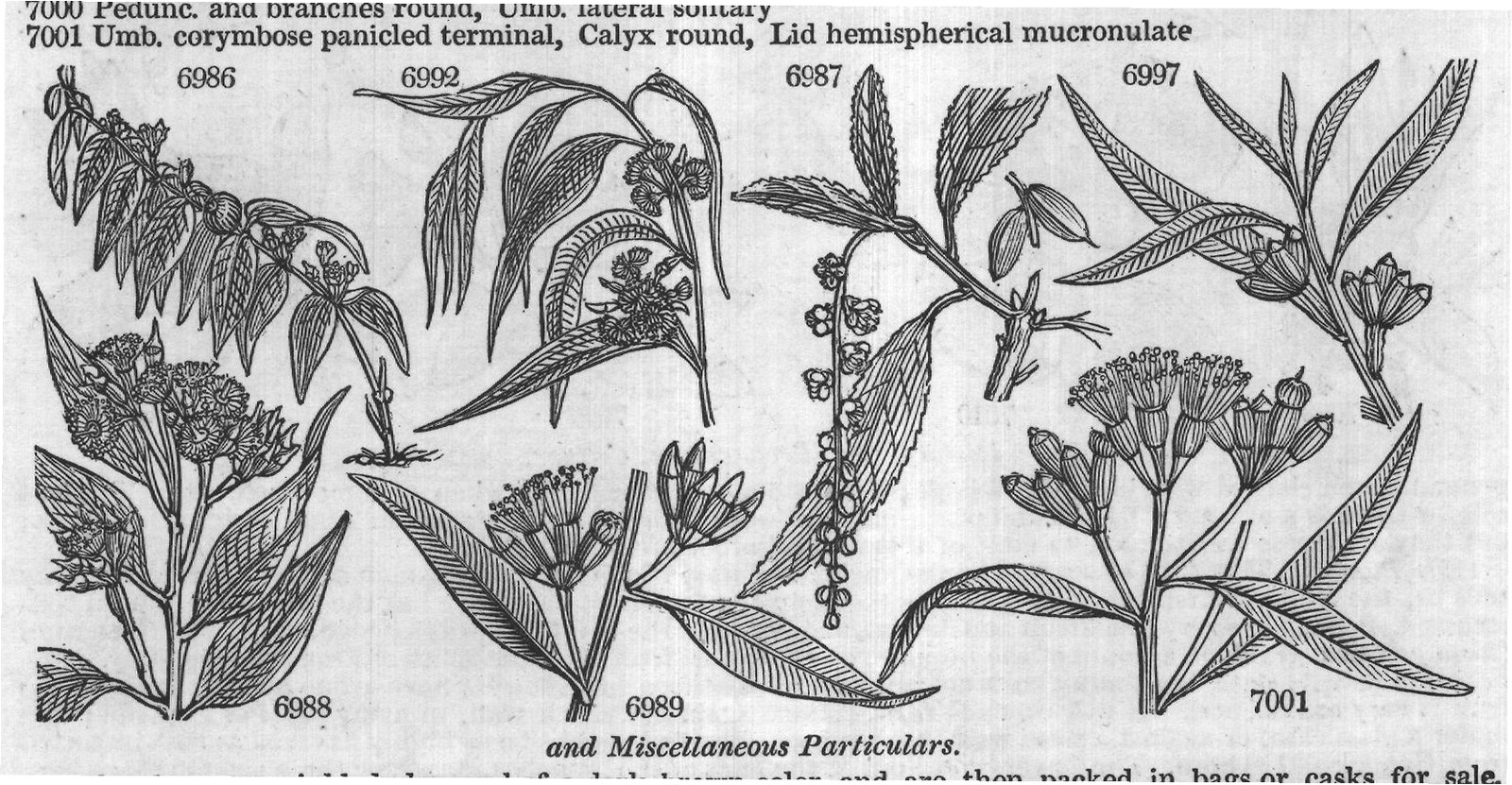
Leaves ovate-lanceolate acute Leaves ovate-lanceolate close together & Leaves lanceolate ovate acute Leaves lanceolate acuminate η Leaves lin.-lanceolate acuminate. Very small 6972 Peduncles 1-flowered, Leaves 3-nerved downy beneath 6973 Peduncles 2-flowered, Leaves lanceolate 6974 Peduncles about 3-fl. Leaves subsessile lanceolate attenuated 6975 Racemes axillary very short, Leaves stalked broad lanceolate acuminate 6976 Peduncles axillary many-fl. Leaves ellipt. acute entire pubescent beneath 6977 Racemes lateral and terminal, Leaves broad lanceolate attenuated 6978 Peduncles axillary terminal and corymb. trichotomous, Leaves ellipt. convex coriaceous veiny dotted 6979 Peduncles 3-chotomous terminal, Leaves roundish elliptical convex coriaceous veinless dotted 6980 Leaves elliptical flat with close parallel transverse veins, Cymes stalked few-flowered shorter than leaves 6981 Pedunc. axillary 3-chotomous spreading, Leaves ovate obtuse, Branches dichotomous 6982 Panic. subterminal, Leaves ovate emarginate 6983 Peduncles terminal panicled trichotomous downy, Leaves ovate attenuated at end 6984 Panicles lateral, Leaves elliptical ovate entire 6985 Flowers trichotomous panicled, Leaves oblong lanceolate acuminate 6986 Leaves distichous deflexed ovate-lanceolate 6987 Leaves crenate, Raceme very long, Drupe ovate 6988 Lid conical contracted in middle broader than calyx, Leaves ovate 6989 Lid rostrate, Umbels lateral, Leaves ovate-lanceolate attenuate oblique 6990 Leaves linear lanceolate, Lid conical contracted in middle, Umb. lateral 6991 Lid conical rounded very smooth membranous, Umb. lateral solitary 6992 Lid conical rounded coriaceous twice as long as calyx, Umb. lateral solitary 6993 Leaves ovate thickened at edge, Umbels lateral 6994 Leaves ovate-lanceolate, Heads lateral solitary, Fruit globose 6995 Leaves lin.-lanceolate, Heads lateral solitary, Fruit turbinate 6996 Lid hemispherical obtuse, Heads lateral solitary, Fruit turbinate 6997 Heads lateral solitary, Pedunc. cuneate compressed, Fruit turbinate 6998 Umb. lateral and terminal, Pedunc. compressed, Branches angular 6999 Pedunc. compressed, Branches angular, Umbels lateral panicled or solitary 7000 Pedunc. and branches round, Umb. lateral solitary 7001 Umb. corymbose panicled terminal, Calyx round, Lid hemispherical mucronulate 6986 6988 6992 6989 6987 6997 7001 and Miscellaneous Particulars. days they become wrinkled, dry, and of a dark brown color, and are then packed in bags or casks for sale. Some kiln-dry them by which the same object is sooner effected. The berries have an agreeable aromatic subastringent taste, resembling that of a mixture of cinnamon, cloves, and nutmegs, with the warm pungent taste of the cloves; qualities which reside chiefly in the cortical part of the dried berry, and are better extracted by a watery infusion, than by spirit or distillation. They are much used in the kitchen, and also by the druggists to cover the disagreeable taste of other remedies, or to give them warmth. An oil is obtained by distillation which is said to be nearly equal to that of oil of cloves, and sometimes substituted for it. 1124. Olynthia. So named from oλuvθoς, a little fig or berry. A genus separated from Myrtus on account of the singular manner in which all the parts of the seed are consolidated. A small stove plant common in collections. 1125. Stravadium. The Malabar name of this plant is Tsjera samstravadi, from which Stravadium has been contrived. A fine tree with racemose flowers, and large, four-cornered, oblong fruit. A delicate stove plant rarely seen. 1126. Eucalyptus. From ɛv, well, and κaλuπτω, to cover as with a lid; a name, therefore, with the same meaning as Calyptranthes, No. 1122. This genus consists of the loftiest timber trees of New Holland. Botanists knowing them principally from dried specimens, their respective heights cannot be stated correctly. .
They are all of the tallest habit, and soon grow beyond the limits of our stoves. In Van Dieman's Island a Van Dieman's Island a manufactory has been established for the preparation of extract of tannin from the bark of various species of Eucalyptus. A considerable quantity of the substance has been imported into England recently, and it is said to have been found by the tanners to be twice as powerful in its operation as oak-bark. E. resinifera produces a gum resin something like the Kino of druggists (obtained from a species of Pterocarpus), and for all medical purposes full as efficacious. All the species, Sweet observes, " are fine plants for a large conservatory, as they grow very fast, and are Ee 2 7002 paniculáta L. T. 7003 cornúta Lab. 7004 reticuláta Link. 7005 longifólia Link.
ICOSANDRIA MONOGYNIA. panicled horned or 30 W N. S. W. or 30 W 1804. L s.p CLASS XII.
N. Holl. 1803. L s.p Lab. voy. 1. t. 20 netted or 30 W N. Holl. 1823. I. co long-leaved or 30 W N. Holl. 1823. L co 7006 média Link. intermediate or 30 W N. Holl. 1823. L co 7007 mucronáta Link. mucronate or 30 W ...
N. Holl. 1823. L co 7008 triántha Link. three-flowered or 30 ...
WN. Holl. 1823. L co 7009 persicifólia Lodd.
Peach-leaved or 30 jl W N. Holl. 1817. L co Bot. cab. 501 7010 pulverulénta Link. powdery or 30 jn W N. Holl. 1816. L co Bot. mag. 2087 7011 elongáta Link. long or 30 ...
WN. Holl. 1823. L co 7012 myrtifólia Link. myrtle-leaved or 6 ...
WN. Holl. 1823. L co. 7013 microphýlla Link. small-leaved 7014 stenophýlla Link. narrow-leaved 7015 hypericifólia Dum. Hypericum-lvd. ☐ or 30 7016 hirsúta Link. hairy 7017 purpuráscens Link. dark-branched 어어어어어 or 30 W ...
N. Holl. 1823. L co or 30 W ...
N. Holl. 1823.
L co W N. Holl. 1823. L co or 30 W ...
N. Holl. 1823.
L co or 30 W ...
N. Holl. 1823.
L co 1127. PU'NICA. W.
POMEGRANATE.
Myrti.
Sp. 2. 7018 nána W. dwarf or 5 jl.s R W. Indies 1723.
Cr.m Bot. mag. 634 7019 Granátum W. common fr 18 jn.s S S. Europe 1548.
Cr.m Bot. mag. 1832 B álba 2 pléna 1128. AMYGDALUS.
W. white-flowered double-flowered ALMOND. or 10 jn.s S China ...
Cr.m Bot. rep. 96 or 10 jn.s S S. Europe ...
Cr.m Tr. ehr. t. 71. f. 2 Rosaceæ. Sp. 6. 7020 Pérsica W. common Peach fr 15 ap.my R Persia 1562. B h.l ẞ Nectarína Nectarine fr 15 ap.my R Persia 1562. B h.l v pléna 7021 commúnis W.
B amára 7022 nána W. 7023 incána W. 7024 orientális W. 7025 púmila W. double-flowered Sweet-almond or 15 ap.my R Persia B h.l ... fr 15 mr.ap R Bitter-almond fr 15 mr.ap R common-dwarf or 2 mr.ap R woolly or 2 mr.ap R silvery-leaved or 10 mr.ap R double-dwarf or 4 my.jn R Prúnus sinensis P. S. 7009 7018 Barbary 1548. S h.l Barbary 1548. Sh.l Russia 1683. B s.l Bs.1 ...
Caucasus Levant 1756. B s.l China 1683. L s.1 7019 β Blackw. t. 195 Bot. mag. 161 Pall. ross. 1. t. 7 Bot. mag. 2176 7008 7010 7019 History, Use, Propagation, Culture, 7019 generally well clothed with beautiful foliage; they will also flower freely, when of a moderate size. The best soil for them is a mixture of loam and peat and cuttings of them may be struck in sand under a bell-glass for them is a mixture of loam and peat; and cuttings of them may be struck in sand under a bell-glass; but they are not so free to root, as most of this natural order are. (Bot. Cult. 189.) 1127. Punica. This fruit was called by the ancients Malum Punicum, Carthaginian apple; because, as Pliny tells us, the tree was first known to grow in the vicinity of Carthage. Hence has the term Punica been conus, the tree was first known to grow in the vicinity of Carthage. Hence has the term Punica been constructed. P. nana has very small fruit and flowers, and is used in the West Indies as a hedge-plant, as P. Granatum (from granum, grain, on account of the numerous grains of its fruit) is in the south of France and in Italy. The latter, in its wild state, is a thorny bush not unlike our hawthorn: the flowers have a fine appearance, and the fruit is very ornamental. It will produce fruit, trained against a south wall, in many parts of England; and under a glass-case, or against a flued wall, it is probable, the fruit might be as highly flavored as that imported from Genoa and Leghorn.
The flowers come out at the ends of the branches, singly, or three and four together; and, therefore , in pruning, care must be had to bring into action only the strongest buds. For this purpose, all the weak shoots should be cut out, and the stronger ones shortened, so as to produce bearing-shoots over the whole tree. The best soil is a rich strong loam.
The double-flowering varieties are to be treated in the same manner, and are highly ornamental. 1128. Amygdalus. The Greek name of the almond. The species are fruit-trees, or ornamental trees and shrubs, both much esteemed for the gay color and early appearance of their flowers. A. Persica, the peach , both much esteemed for the gay color and early appearance of their flowers. A. Persica, the peach and nectarine, bears the most exquisitely delicious of European fruits; it is more gratifying to the palate by its mass of juicy pulp than the grape, and more delicate than the melon. Some, however, prefer the grape and melon of juicy pulp than the grape, and more delicate than the melon. Some, however, prefer the grape and melon to the peach and nectarine; but the most delicate of taste consider the latter as surpassed only by the pine-apple. The varieties of peach and nectarine are numerous, and by raising from seed might easily be rendered innumerable. The best varieties have been raised in France, at Montreuil, a village of peach growers for the Paris market. Some good varieties have been raised in England by Mr. Knight, and other members of the Horticultural Society. The peach, to attain its proper flavor, must be protected by glass during the spring and earlier summer months, and exposed to the direct influence of the weather during the ripening process. Ripened under glass, unless very liberal supplies of air are given, the flavor will be very inferior. Mr. Knight considers that the direct rays of the sun (without the intervention of glass) are of great advantage to the proper ripening, and essential to the coloring of the peach.
Linnæus divides the A. Persica into two varieties; that with downy fruit, or the peach, and that with smooth fruit, or the nectarine. There are various instances on record (Hort. Trans. vol. i. p. 103.) of both fruits growing , or the nectarine. There are various instances on record (Hort. Trans. vol. i. p. 103.) of both fruits growing on the same tree, even on the same branch; and one case has occurred of a single fruit partaking of the nature of both. The French consider them as one fruit, arranging them in four divisions; the péches, or free-stone peaches, the flesh of whose fruit separates readily from the skin and the stone; the péches lisses, or free-stone nectarines, or free-stone smooth peaches; the pavies, or cling-stone peaches, whose flesh is firm, and adheres ORDER I.
ICOSANDRIA MONOGYNIA. 7002 Lid hemispherical obtuse, Cal. angular, Umb. panicled terminal 7003 Lid very long and cornute, Heads lateral solitary, Style persistent 3-4-fid at base, Leaves lin, lanceolate 7004 Leaves lanceolate subfalcate acuminate subovate at base oblique netted with veins beneath 7005 Leaves lanceol. unequal at base, on one side rounded with an incurved point, Branches axillary many-fl, 7006 Leaves lanceolate with a long point at the base subovate oblique with parallel nerves beneath 7007 Leaves lanceol. with a short point wavy with parallel nerves beneath and a marginal nerve on both sides 7008 Leaves obl. unequal at base attenuated somewhat falcate with axillary 3-fl. peduncles and sessile flowers 7009 Leaves lanceolate stalked, Pedunc. short axillary 6-12-flowered 7010 Leaves amplexicaul. with a short point glaucous beneath 7011 Leaves lanc. attenuated with a filiform point netted with veins beneath 7012 Leaves acute reticulated, the nerves united at the margin 7013 Leaves falcate at end, those on the branchlets small clustered 7014 Leaves linear narrowed at base obtuse veiny with nerves united on this side the edge 7015 Leaves 6 lines long and 1½ broad with the lateral parallel nerves united on this side the edge 7016 Leaves stalked cordate obtuse with nerves downy beneath, Branches and peduncles strigose 7017 Leaves amplexicaul. lanceolate with a long point glaucous beneath 7018 Leaves linear, Stem shrubby 7019 Leaves lanceolate, Stem arborescent 7020 Leaves with all the serratures acute, Flowers sessile solitary 7021 Lower serratures of the leaves glandular, Flowers sessile in pairs 7022 Leaves ovate attenuate at base simply and finely serrate 7023 Leaves oblong lanceolate serrate downy beneath 7024 Leaves lanceolate entire silvery perennial shorter than footstalk 7025 Leaves lanceolate doubly serrated 7020 7021 7022 7023 7025 and Miscellaneous Particulars. both to the skin and stone; and the brugnons, or nectarines, or cling-stone smooth peaches. Knight. (Hort. Trans. iii. 1.) The double-blossomed peach is one of the most ornamental of spring-flowering trees; its blossoms appear about three weeks later than those of the common peach .
A. communis and amara, and especially the former, are employed as ornamental trees in front of shrubberies, and in suburban gardens. In the south of France, Italy, Spain, and different parts of the Levant, they are cultivated for their fruit. In France they have above a dozen species or varieties, besides a hybrid called the almondpeach. (See Duhamel.) The common and bitter almond are only to be distinguished by the taste of the kernels of their fruit. The Jordan almonds, which come from Malaga, are the best sweet almonds brought to England; the bitter come chiefly from Magadore. The bitter cuticle of almonds is taken off by immersion boiling bitter cuticle of almonds is taken off by immersion in boiling water. The almond eaten as food is not very digestible, and requires to be well masticated. Robertson (Hort. Trans. iii. 382.) and various botanists consider the peach and almond as one species. Four distinguished and ingenious attempts have been made to class the varieties of peaches and nectarines by the leaf and flower as well as the fruit: the first is by Poiteau, in the Bon Jardinier; the next by Count Lelieur, in his Pomone Française; the third by Robertson , nurseryman, of Kilkenny, whose arrangement is founded on the glands of the leaves; and the fourth, and most important, by Mr. George Lindley, in the fifth volume of the Horticultural Society's Transactions . The latter writer has, in a peculiarly distinct manner, arranged no fewer than 155 sorts of peaches and nectarines in well defined divisions or sections.
The bitter almond contains less fixed oil, than the sweet almond, and a portion of prussic acid or The acid, upon which its narcotic power is supposed to depend. This variety is said distilled to operate water to depend. This variety is said to operate as a poison on dogs and some other animals, but not generally on the human species. The distilled water a poison on not less deleterious than that of laurel water on the human frame. It produces vertigo, exerts an action tinnitis aurium, dizziness of sight, and vomiting, when taken to the extent of thirty follows. drops only In , when taken to the extent of thirty drops only; and a drachm of it has killed a stout dog . When a large doze is taken, death almost instantly follows. In order to counteract its poisonous effects recourse is had to diffusibles, as brandy and ammonia; or three or four spoonfuls of oil of turpentine may be given at intervals of half an hour. The fixed oil, which both varieties of the almond yield by expression in large quantity, is insipid and inodorous when heat has not been employed.
Sweet almonds are used more as food than as medicine, but they afford little nourishment. Heartburn is said to be relieved by eating six or eight of them decorticated. When triturated with water, milky mixtures or emulsions are formed; and they are also used in pharmacy for assisting, by trituration, the combination of substances, such as camphor and the resins with water. Bitter almonds are scarcely ever used medicinally. (London Dispensatory, 151.) A. nana and pumila are very ornamental shrubs, both in their double and single varieties. Ee3 1129. PRU'NUS. W.
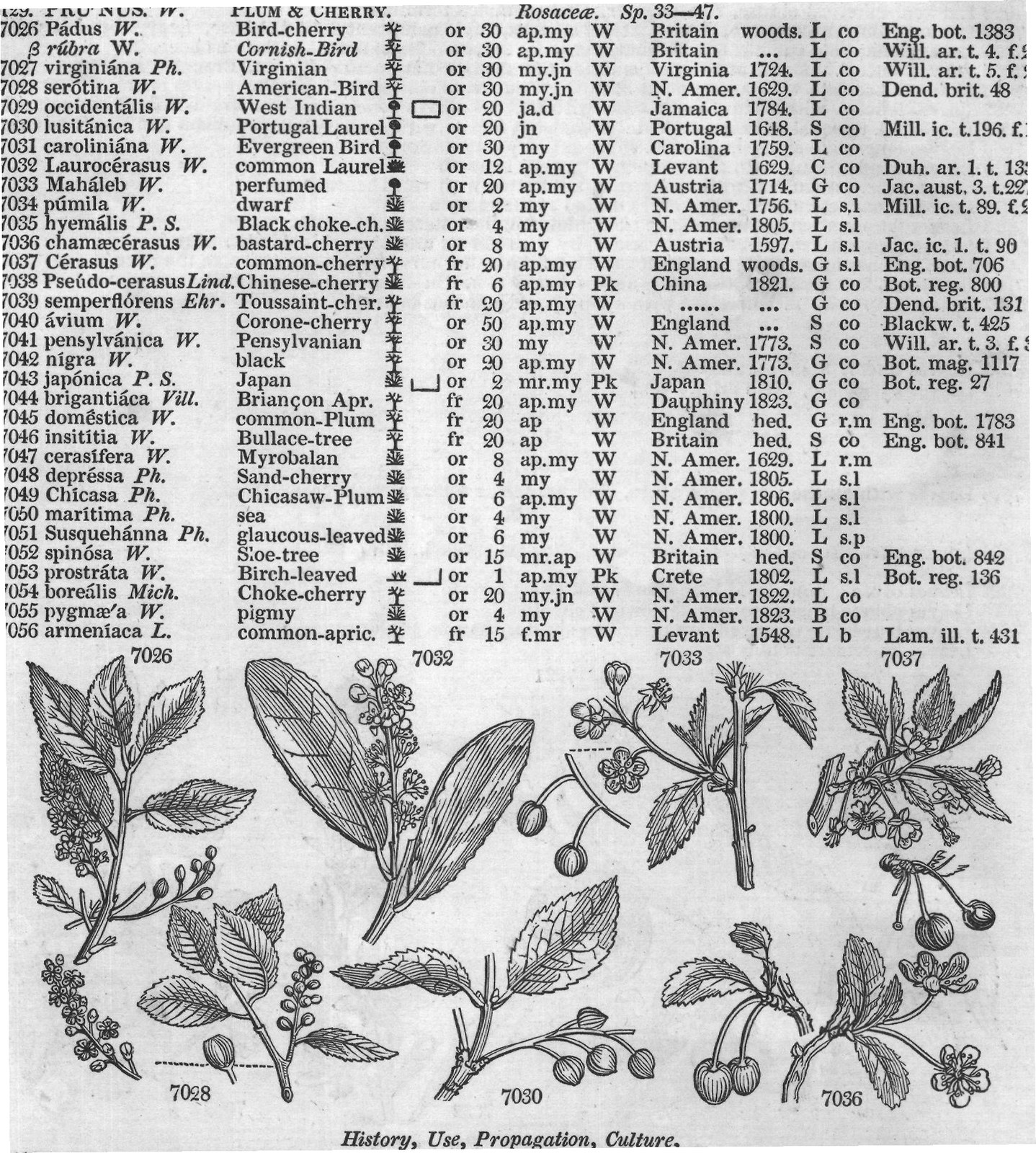
PLUM & CHERRY. 7026 Pádus W..
Bird-cherry or 30 ap.my W B rúbra W. or 30 ap.my W 7027 virginiána Ph. 7028 serótina W. or 30 my.jn W American-Bird or 30 my.jn W 7029 occidentális W. 7030 lusitánica W.
West Indian or 20 ja.d W Portugal Laurel or 20 jn W 7031 caroliniána W. 7032 Laurocérasus W. 7033 Maháleb W.
Evergreen Bird or 30 my W common Laurel or 12 ap.my W perfumed 7034 púmila W. dwarf or 2 my W 7035 hyemális P. S.
Black choke-ch. or 4 my 7036 chamæcérasus W. bastard-cherry W 7037 Cérasus W. common-cherry fr 20 ap.my W 7038 Pseúdo-cerasus Lind. Chinese-cherry ICOSANDRIA MONOGYNIA.
Cornish-Bird Virginian Rosaceæ. Sp. 33-47. or 20 ap.my W Britain woods. L co Britain L co Virginia 1724. Lco N. Amer. 1629. L co Jamaica 1784. L co Portugal 1648. S co Carolina 1759. L co Levant 1629. C co Austria 1714. G co N. Amer. 1756. L s.1 WN. Amer. 1805. L s.l CLASS XII.
Eng. bot. 1383 Will. ar. t. 4. f.2 Will. ar. t. 5. f. 2 Dend. brit. 48 Mill. ic. t.196. f.1 Duh. ar. 1. t. 133 Jac. aust, 3. t.227 Mill. ic. t. 89. £.2 Austria 1597. L s.l England woods. G s.l Jac. ic. 1. t. 90 Eng. bot. 706 7039 semperflórens Ehr. Toussaint-cher. 7040 ávium W.
Corone-cherry 7041 pensylvánica W.
Pensylvanian 7042 nígra W. black 7043 japónica P. S.
Japan 7044 brigantiáca Vill.
Briançon Apr. 7045 doméstica W. common-Plum 7046 insitítia W.
Bullace-tree fr 20 ap W 7047 cerasífera W. 7048 depréssa Ph.
Myrobalan Sand-cherry or 8 ap.my W or 4 my W 7049 Chícasa Ph.
Chicasaw-Plum or 6 ap.my W 7050 marítima Ph. sea or 4 my W 7051 Susquehanna Ph. glaucous-leaved or 6 my W 7052 spinósa W. 7053 prostráta W. 7054 boreális Mich. 7055 pygmæ'a W. 7056 armeníaca L. 7026 Sloe-tree or 15 mr.ap W Birch-leaved or 1 ap.my Pk Choke-cherry pigmy or 20 my.jn W or 4 my W common-apric. fr 15 f.mr W 7032 or 8 my fr 6 ap.my Pk fr 20 ap.my W or 50 ap.my W or 30 my W or 20 ap.my W or 2 mr.my Pk fr 20 ap.my W fr 20 ap W China 1821. G co Sco England N. Amer. 1773. S co N. Amer. 1773. G co Japan 1810. G co Dauphiny 1823. G co England hed. Gr.m Britain hed. S co N. Amer. 1629. Lr.m N. Amer. 1805. L s.1 N. Amer. 1806. L s.l N. Amer. 1800. L s.l N. Amer. 1800. L s.p Britain Crete hed. Sco 1802. L s.l L co N. Amer. 1822.
N. Amer. 1823. B co Levant 1548. L b 7033 Bot. reg. 800 Dend. brit. 131 Blackw. t. 425 Will. ar. t. 3. f. 3 Bot. mag. 1117 Bot. reg. 27 Eng. bot. 1783 Eng. bot. 841 Eng. bot. 842 Bot. reg. 136 Lam. ill. t. 431 7037 7028 7030 History, Use, Propagation, Culture, 7036 1129. Prunus. The origin of this name is wholly unknown. The Greeks called it πρoύvη, and the Latins prunus. From this genus have been obtained the principal characters of that section of the natural order Rowhich is curiously and chemically known by the presence of Prussic acid all in the species, and in all their parts. P. Padus (a name of Theophrastus), t Theophrastus), the bird-cherry, is an ornamental tree, by its purple bark, leafy bunches of white flowers, and berries successively green, red, and black. It is common in the native woods of Scotland and Sweden, and in both countries the berries are infused in spirits in order to give them an agreeable flavor. The fruit is nauseous to the taste, though greedily eaten by birds. The bark is used by the Finlanders to cure venereal complaints, and also with success by regular practitioners in Stockholm for the same purpose. (Stockholm Acts.) The tree is very leafy, and dislikes a wet soil; but bears lopping as copsewood. The wood is beautifully veined, and used for cabinet work in France, as is that of P. virginiana in America.
P. rubra greatly resembles P. Padus. P. caroliniana is an imperfect evergreen. P. Lauro-cerasus is one of our most popular evergreens. It was first brought from Constantinople to Holland in 1576; the first we read of in England was one at Highgate, in the garden of Mr. James Cole, a merchant in 1576; the first we read of in England was one at Highgate, in the garden of Mr. James Cole, a merchant of London, who, as Parkinson informs us, used to cover it in winter with a blanket. In less than half a century afterwards (1688), Ray informs us, the laurel was common in English gardens. It is now as universal in shrubberies as the rose. The kernel-like flavor of the fresh leaves has led to their use in flavoring custards and other culinary preparations ; but as these leaves are poisonous, they ought to be used with caution. To brute animals the effect of the distilled water of laurel leaves is almost instant death; and two women in Dublin, and Sir T. Boughton in England, have been poisoned by it.
P. lusitanica is a most beautiful evergreen shrub, nearly as universal as the lauro-cerasus. It was brought to England from Portugal, but does not appear to be a native of that country; probably of Madeira or some England from Portugal , but does not appear to be a native of that country; probably of Madeira or some other islands possessed by the Portuguese in the sixteenth or seventeenth centuries.
P. Mahaleb (Mahhaleb the Arabic name) flowers profusely, and disperses an odor resembling that of Clematis for a considerable distance around. Its fruit is round, shining black, and so hard that it has been bored for beads by the catholics. The wood is perfumed and used by the French in cabinet-work, especially in the village of St. Lucie, near Commercy, whence, among the French, the plant has obtained the name of Bois de St. Lucie.
P. Cerasus, the cultivated cherry, is by some considered a distinct species, and by others only a variety of P. avium, the gean or wild black cherry. Lucullus is said to have first introduced the cultivated cherry to avium, the gean or wild black cherry . Lucullus is said to have first introduced the cultivated cherry to Italy, in 73 A. C. from a town in Pontus in Asia, called Cerasus, whence its specific name, and it was introduced to Britain 120 years afterwards. Many suppose that the cherries introduced by the Romans into Britain were lost, and that they were reintroduced in the time of Henry VIII. by Richard Haines, the fruiterer to that monarch. But though we have no proof that cherries were in England at the time of the Norman conquest, or for some centuries after it; yet Warton has proved, by a quotation from Lidgate, a poet who wrote about for some centuries after it; yet Warton has proved, by a quotation from Lidgate, a poet who wrote about ORDER I.
ICOSANDRIA MONOGYNIA. 7026 Flowers racemose, Racemes pendulous, Lvs. decid. doubly serrat. somewhat rugose, Petioles with 2 glands ẞ Serratures of leaves less, Racemes more erect 7027 Flowers racemose, Racemes erect, Leaves deciduous doubly toothed smooth, Stalks with 4 glands 7028 Flowers in loose racemes, Lvs. decid. simply serrated lower serratures glandular, Rib beard. towards base glandular, Rib beard. towards base 7029 Flowers in lateral racemes, Leaves without glands oblong acuminate entire smooth on each side 7030 Flowers racemose, Racemes lateral, Leaves evergreen without glands oblong acuminate entire 7031 Flowers racemose, Leaves evergreen ovate-lanceolate serrated without glands 7032 Flowers racemose, Leaves evergreen with two glands at back 7033 Flowers corymbose terminal, Leaves ovate 7034 Umbels sessile aggregate few-flowered, Cal. acute, Branches virgate round, Leaves narrow lanceolate 7035 Umbels sessile aggregate few-fl. Sepals lanc. Stipules setaceous compound, Lvs. obl. oval suddenly pointed Lvs. obl. oval suddenly pointed 7056 Umbels sessile, Leaves obovate obtuse smooth with glandular serratures 7037 Umbels somewhat stalked, Leaves ovate-lanceolate smooth folded together 7038 Leaves obovate acuminate flat serrated, Racemes pubescent 7039 Flowers racemose, Calyxes serrated, Leaves ovate serrated glandular at base 7040 Umbel sessile, Leaves ovate-lanceolate pubescent beneath folded together 7041 Umbel subsessile aggregate many-fl. at length panicled, Leaves obl. lanceolate serrated smooth 7042 Umbel sessile solitary few-fl. Leaves deciduous ovate acuminate finely serrated, Petioles with 2 glands 7043 Peduncles solitary, Leaves ovate acuminate smooth, Branches unarmed 7044 Fl. lateral clustered, Leaves doubly serrated roundish acute 7045 Peduncles subsolitary, Leaves lanceolate ovate convolute, Branches not spiny 7046 Peduncles twin, Leaves ovate villous beneath convolute, Branches spiny 7047 Peduncles solitary, Leaves elliptical smooth, Fruit pendulous, Branches nearly unarmed 7048 Umbel sessile clustered few-fl. Cal. obtuse, Branches angular prostrate, Lvs. cun. lanc. glaucous beneath 7049 Buds clustered 2-fl. Ped. very short, Cal. smooth, Leaves oblong acum. serrulate, Branches spiny 7050 Pedunc. subsolitary, Leaves ovate-oblong acuminate doubly serrated 7051 Peduncles solitary, Leaves obovate obl. beneath glaucous serrated entire at base 7052 Peduncles solitary, Leaves ellipt. lanceolate pubescent beneath, Branches spiny 7053 Peduncles twin, Leaves ovate cut serrate without glands beneath white, Stem prostrate 7054 Flowers corymbose, Ped. elongated, Leaves oval oblong eroded membranous smooth 7055 Umbels sessile aggregate few-fl. Leaves ovate ellipt. acute smooth on each side with 2 glands at base on each side with 2 glands at base 7056 Flowers sessile, Leaves subcordate 7039 7042 7043 7045 7046 7052 7053 and Miscellaneous Particulars. 7056 or before 1415, that the hawkers in London were wont to expose cherries for sale in the same manner as is now done early in the season. The tree is now very generally cultivated both as a wall and standard fruit, and has been forced for upwards of two centuries.
The Romans had eight varieties of cherry: in the British gardens are upwards of forty sorts. The French divide their cherries into griottes, or tender-fleshed bigarreaux, or hard-fleshed; and guignes, or small fruits. The fruit of many varieties is somewhat heart-shaped, hence the very general cognomen; why some sorts are called dukes is not as obvious. The Morello cherry is very distinct from the other varieties, bearing almost exclusively on the preceding year's wood, and the pulp of the fruit having the consistence and flavor of from the having the consistence and flavor of the Morel, whence the name. Cherries are grafted or budded on seedlings from cherry-stones, or better the from cherry-stones, or better from seedlings of the wild cherry. For dwarfing, they are worked on the bird cherry or perfumed cherry the latter is preferred in Holland.
Cherry trees are very ornamental in shrubberies and woods, and valuable as encouraging the different species of thrush. The gum of cherry trees is eatable, and equal to that of gum arabic; the wood is hard and tough, and used by the turner and cabinet maker. Prunus Pseudo-Cerasus, the Chinese cherry, is of recent introduction, and most valuable on account of its bearing an excellent fruit, and producing it abundantly in a forcing-house. P. avium, the gean, guigne, Fr., attains a large size, and its timber is of considerable value: the black corone cherry is supposed to be an improved variety of it , as are the different geans.
P. domestica is generally considered the original of the plum tree, Prune, Fr., Pflaumen, men, Ger., and Prugno, Ital. Many, however, conjecture that P. insititia, spinosa, and domestica, are the same species. There are several sorts of plums found wild in Britain, independently of the sloe, such as the bullace, damson, muscle, and winesour. The plum is said to love a lofty exposure , and to be favorable to the growth of grass under it. The bark dyes yellow, the wood is used in turnery , and the dried fruit or prune is formed into electuaries and gentle purgatives. Prunes were originally brought from Damascus, whence their name of damask, but are now chiefly imported from France.
There are a great many varieties of the plum in France, and in British gardens nearly a hundred sorts. By far the best dessert plum is the greengage, Reine Claude, Fr. , Regina Claudio, Ital. It is well known throughout Europe, and perfectly distinct from every other variety. The damson is the best baking plum, and the winesour the best for sweetmeats. Plums are generally grafted or budded on muscle or damson stocks.
Prunus Armeniaca, Abricot, Fr., Abricosenbaum, Ger., Albicocco, Ital., Albarcoque, Portug. is a fruit tree next in esteem to the peach. From its trivial name, it is generally supposed to have originated in tree Armenia, but Regnier and Sickler assign it a parallel between the Niger and the Atlas; and Pallas with states the Niger and the Atlas; and Pallas states it to be a native of the whole of the Caucasus; the mountains there, to the top, being covered the it, there, to the top, being covered with it, Thunberg describes it as a very large, spreading, branchy tree in Japan. Grossier says, that it covers doubletree in Japan. Grossier says, that it covers the barren mountains to the west of Pekin, that the Chinese have a great many varieties of the tree double- E ICOSANDRIA MONOGYNIA.
CLASS XII. 7057 sibírica W.
Siberian-apric. fr 6 ap Pk Siberia 7058 dasycárpa Ehr.
Black-apricot fr 15 ap W Siberia 1130. CHRYSOBA'LANUS. W. COCOA PLUM.
Rosacea. Sp. 2-4. 7059 Icáco W.
West Indian ☐ fr 15 7060 oblongifólius Ph.
American or 3 my.jn W 1788. Lr.m Pall. ross. 1. t. 8 1800. B co W W. Indies 1752. Lr.m Jac. amer. t. 94 Georgia 1812. Cl.p Bartr. iter. c. ic DI-PENTAGYNIA. 1131. MES PILUS. Lindl. MEDLAR. 7061 germánica W. 7062 grandiflóra H. K.
Rosacea. Sp. 2. common-eatabl. fr 12 my.jl W England hed. Gh.l large-flowered or 12 my.jn W 1800. Lco Eng. bot. 1523 Ex. bot. 1. t. 18 1132. CRATÆGUS. L.
Rosaceæ. Sp. 21-32. 7063 coccínea W.
Scarlet-fr. Haw.** or 20 ap.my W N. Amer. 1683. B co Dend, brit, 62 7064 cordáta W.
Maple-leaved 7065 pyrifólia W.
Pear-leaved or 20 my WN. Amer. 1738. B co or 15 jn Dend. brit. 63 WN. Amer. 1765. B co Dend. brit. 61 C. edulis Hort. 7066 ellíptica W. oval-leaved * or 20 my W N. Amer. 1765. B co 7067 glandulósa W. hollow-leaved or 20 my.jn W N. Amer. 1750. B co Dend. brit. 58 7068 fláva W. yell. Pear-berr. or 20 my WN. Amer. 1724.
B co Dend. brit. 59 7069 parvifólia W.
Gooseberry-lvd. or 15 my.jn W N. Amer. 1704. co Dend. brit. 65 7070 punctáta W. spotted-fruited or 15 my W N. Amer. 1746.
B co Dend. brit. 57 7071 Crus-gálli W.
Cockspur-thorn or 20 my.jn W N. Amer. 1691.
B co Dend, brit. 56 pyracanthifólia Pyracantha-lv. or 20 my.jn W N. Amer. ...
B co salicifólia Willow-leaved or 20 my.jn W N. Amer. ...
B co 7072 Pyracantha Lindl.
Evergr.-thorn or 10 my W S. Europe 1629. S s.l Schm. arb. t. 90 7073 spathuláta Ph. spatula-leaved or 15 my.jn W N. Amer. 1806. B co 7074 apiifólia Ph.
Parsley-leaved or 15 my.jn W N. Amer. 1812. B co 7075 Oxyacantha E. B. common-Haw. or 15 my.jn W Britain hed. S co Eng. bot. c. ic.
ẞ rósea red-flowered or 15 my.jn R ...... ...
B co major great-fruited or 15 my.jn W ...... ...
B co & præcox ɛ pléna aúrea 7076 eriocárpa Lindl. 7077 monógyna Pall. 7078 Azarólus W. 7079 tanacetifólia B. R.
Glastonbury double-flowered yellow-berried woolly-fruited one-styled Azarole Tansy-lv. Azar. or 15 my.jn W ...... ...
B co or 15 my.jn W ...... ...
B co or 15 my.jn W B co ...
A or 15 my.jn W or 15 my.jn W Siberia or 15 my.jn W or 15 my.jn W 7080 odoratíssima B. R. sweet-sc. Azar. or 15 my.jn W Britain woods. B co S. Europe 1610. B co Greece 1789. B co Crimea B co ...
B co Pall. ross. 1. t. 12 Bot. rep. 579 Bot. rep. 591 Bot. rep. 590 7081 pentagyna W. & K. five-styled or 15 my.jn W Hungary 1820. B co 7082 torminális L.
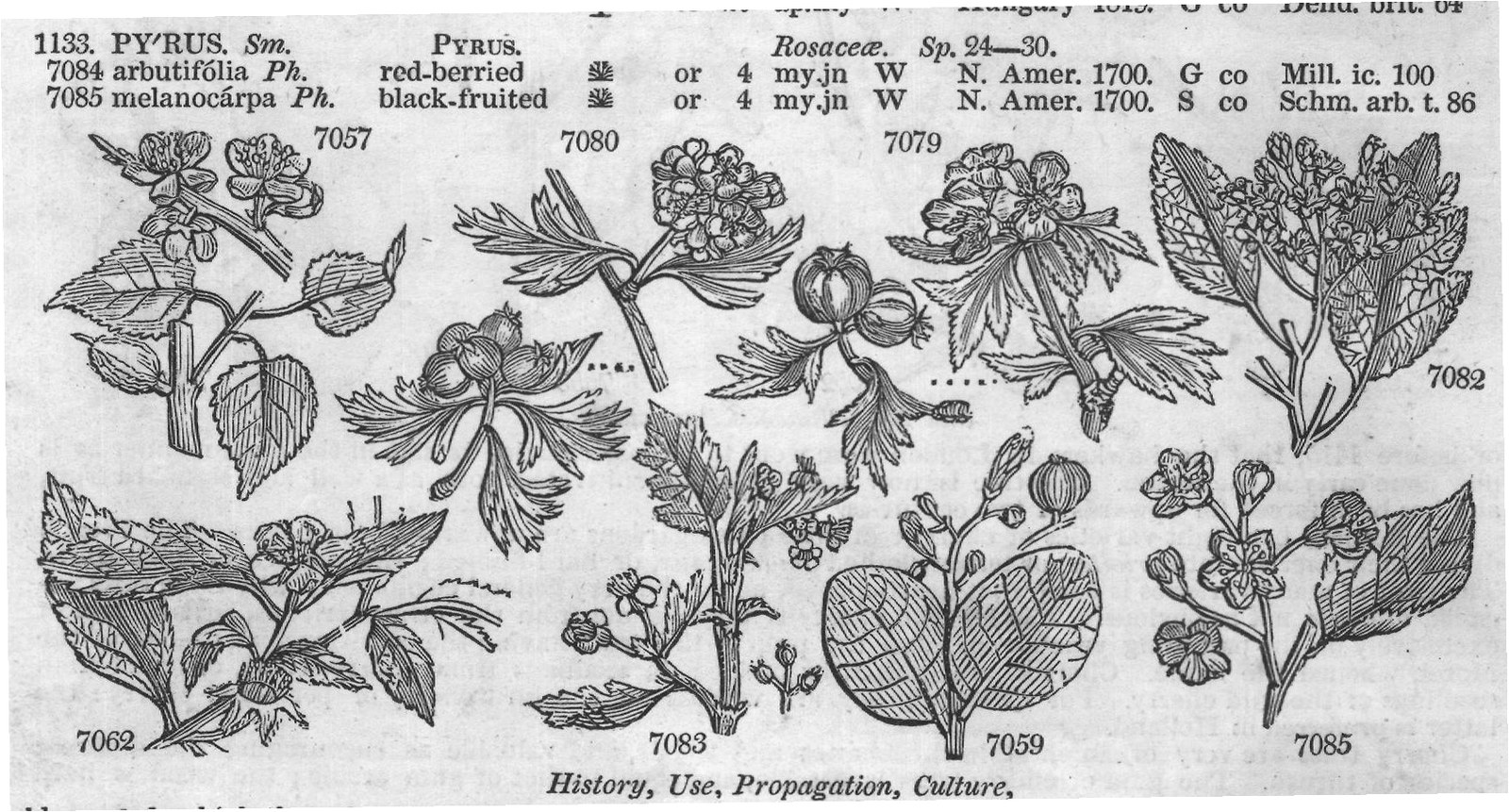
Wild-service tm 50 ap.my W England woods. Sco Eng. bot. 298 7083 nígra W. & K. black or 20 ap.my W Hungary 1819. G co Dend. brit. 64 1133. PYRUS. Sm. 7084 arbutifólia Ph. 7085 melanocárpa Ph.
PYRUS.
Rosaceæ. Sp. 24-30. red-berried black-fruited or 4 my.jn W N. Amer. 1700. G co Mill. ic. 100 or 4 my.jn W N. Amer. 1700. S co Schm. arb. t. 86 7057 7080 7079 7082 7062 7083 7059 History, Use, Propagation, Culture, 7085 blossomed, which they plant on little mounts for ornament, and dwarfs in pots for their apartments. It appears from Turner's Herbal, that the apricot was cultivated here in 1562; and in Hackluyt's Remembrancer, 1582, it is affirmed, that the apricot was procured out of Italy by Wolfe, a French priest, gardener to Henry VIII. The fruit seems to have been known in Italy in the time of Dioscorides, under the of to Berkoch; whence the Tuscan, Bacoche or Albicocco, and the English Apricock; or, as Professor Martyn observes, a tree when first introduced, might have been called a præcox, or early fruit; and gardeners, taking the article a for the first syllable of the word, might easily have corrupted it to apricocks. The orthography seems to have been finally changed to apricot about the end of the last century.
There are fifteen or twenty excellent varieties of apricot, besides the peach apricot, a large fruit supposed trained to a hybrid between a peach and an apricot. The trees are generally budded on plum stocks, and always against walls. Apricots do not force freely. be a hybrid between a peach and an apricot. The trees are generally budded on plum stocks, and always trained against walls. Apricots do not force freely. 1130. Chrysobalanus. From χρuσoς, gold, and βaλavoς, an acorn; in allusion to the size, color, and form of its fruit. C. Icaco (the West Indian name) bears flowers and fruit not unlike the plum, which is sold in fruit. C. Icaco (the West Indian name) bears flowers and fruit not unlike the plum, which is sold in the markets of the West Indies, and eaten both raw and preserved. Both species grow well in a sandy loam.
Large cuttings root best, taken off at a joint, and planted thinly in a pot of sand, without having their leaves injured, and a hand-glass placed over them. (Bot. Cult. 39.) 1131. Mespilus. In Greek μεσπiλη, from μεσoς, half, and πiλoς, bullet; the fruit resembling half a bullet or round ball. In French it is called nefle, from the Celtic naff, which also signifies truncate. M. Germanica, bears a turbinated berry, which is eaten raw in a state of incipient decay. two trees are generally introduced in shrubberies or in complete orchards. besides the wild sort; what is called the Dutch medlar is reckoned the best.
It is little cultivated, but one or There are one or two varieties It is grafted on seedlings of the ORDER I.
ICOSANDRIA MONOGYNIA. 7057 Flowers sessile, Leaves ovate acuminate simply serrate, Petioles without glands 7058 Flowers sessile, Leaves ovate acuminate doubly serrate, Petioles with glands 7059 Leaves orbicular alternate, Flowers in loose racemes 7060 Leaves wedge-shaped hoary beneath, Stamens smooth, Flowers in large panicles DI-PENTAGYNIA. 7061 Unarmed, Leaves lanceolate downy beneath, Flowers sessile solitary 7062 Leaves cuneate oblong woolly beneath, Petals roundish or oval, Stamens smooth, Fruit obl. ovate 7063 Spiny, Leaves cordate ovate cut angular smooth, Petioles and cal. glandular, Styles 5 7064 Spiny, Leaves cordate ovate cut angular smooth, Pet. and cal. without glands, Styles 5 7065 Spiny or not, Lvs. ovate ellipt. cut serrate somewhat plaited and hairy, Cal. villous, Sep. lin.-lanc. Styles 3 7066 Spiny, Leaves ellipt. unequally serr. smooth, Pet. and cal. glandular, Berries round with 5 seeds 7067 Spiny, Lvs. ov. wedge-shaped ang. smooth shining, Pet. stip. and cal. glandular, Berries oval with 5 seeds ang. smooth shining, Pet. stip. and cal. glandular, Berries oval with 5 seeds 7068 Spiny, Lvs. obov. cuneiform angul. smooth shining, Pet. stip. and cal. glandular, Berries turbin . 4-seeded 7069 Spiny, Leaves cuneiform ovate cut serrate, Sepals lanc. cut the length of pet. Styles 5 7070 Spiny or not, Leaves obovate cuneiform smooth serrated, Cal. villous, Sepals subulate entire obovate cuneiform smooth serrated, Cal. villous, Sepals subulate entire 7071 Spiny, Leaves obovate cuneiform subsessile shining coriaceous, Sepals lanc. serrate, Styles 2 7072 Spiny, Leaves lanc. ovate crenate, Cal. of fruit obtuse 7073 Spiny, Leaves fascicled small very much narrowed downwards subspatulate trifid, Cal. downy 7074 Spiny, Leaves deltoid cut-lobed, Tube of calyx oblong with serrated sepals 7075 Leaves obtuse subtrifid serrated smooth, Pedunc. and cal. nearly smooth, Sepals lanc. acute 7076 Leaves obtuse 3-lobed serrated smooth, Pedunc. and calyx covered with wool 7077 Spiny, Leaves 5-cleft cut wedge-shaped, Lower lobes divaricating, Stipules half cordate 7078 Leaves obtuse subtrifid toothed pubescent, Sepals ovate 7079 Leaves pinnatifid hairy on both sides, Segments serrate, Flowers with bractes 7080 Leaves pinnatifid downy on both sides, Segments trifid 7081 Leaves ovate trifid serrated: at the axillæ of the veins beneath hairy, Pedunc. and cal. pubesc. Styles 5 7082 Leaves cordate ovate cut-lobed serrated, Lower lobes divaricating, Flowers corymbose 7083 Leaves lobed sinuate serrated: at the base truncate cuneate beneath villous, Calyxes villous, Styles 5 7084 Unarmed, Lvs. obovate obl. acute crenate toothed downy beneath, Rachis glandular above, Cal. downy 7085 Unarmed, Leaves obovate obl. acuminate serrated smooth beneath, Rachis glandular above, Cal. smooth 7067 obl. acuminate serrated smooth beneath, Rachis glandular above, Cal. smooth 7063 7068 7064 7069 7065 7070 7067 7071 and Miscellaneous Particulars. wild medlar, or on any other species of the same genus: often on the common thorn. The other species bears fruit similar to M. germanica, but more dry. 1132. Cratægus. From κρaτoς, force, on account of the extreme hardness of the wood of the original Cratægus, which appears to be what is now called Pyrus aria, the beam-tree. This is a very ornamental genus of small hardy trees, valuable for the neatness of their foliage, the earliness of their flowers in spring, valuable for the neatness of their foliage, the earliness of their flowers in spring, and the rich colors of their berries in autumn.
C. oxyacantha, oξuς, aκavθa, sharp-spine, is the best hedge plant in Europe, and also furnishes some highly ornamental varieties, especially the double-blossomed and scarlet-blossomed. The fruit of C. odoratissima is very agreeable. That of the Azarole (âl z'aroûr Arabic, according to Castel and John de Souza) is much esteemed in the South of Europe. In this country it rarely arrives at much esteemed in the South of Europe. In this country it perfection. 1133. Pyrus. From the Celtic peren, the Anglo-Saxons made pere, the English, pear, the French, poire, and the Latins, pyrus, or for the fruit, pyrum. From the Celtic word api, which also signified a fruit resembling an apple, the Greeks obtained aπioς, the English, apple, the Germans, apfel. To this day the French distinguish a tribe of small fruited apples by the name api. P. malus, Pomme, Fr., Apfel, Ger., and Pomo, Ital., is the most popular of British fruits. None can be brought to so high a degree of perfection with so little trouble; and of no other are there so many excellent varieties in general cultivation, calculated for almost every soil, situation, and climate, which our islands , calculated for almost every soil, situation, and climate, which our islands afford. Very good apples are grown in the Highlands and Orkneys, and even in the Shetland isles, (Caled. grown in the Highlands and Orkneys, and even in the Shetland isles, (Caled.
Hort. Mem. vol. ii.) as well as in Devonshire and Cornwall; some sorts are ripe in the beginning of July, and in Devonshire and Cornwall; some sorts are ripe in the beginning of July, and others, which ripen later, will keep till June. Unlike other fruits, those which ripen latest are the best. keep till June. Unlike other fruits, those which ripen latest are the best.
The tree attains a great age, is in general very prolific, and the timber is valuable for the turner, millwright ICOSANDRIA DI-PENTAGYNIA. 7086 commúnis W. common-Pear or 20 ap W 7087 Pollvéria W. 7088 salicifólia W. 7089 nivális W. 7090 Málus W. 7091 spectábilis W. 7092 prunifólia W. 7093 baccáta W. 7094 coronária W.
Apple-tree woolly-leaved or 15 ap.jn W Willow-leaved or 20 my.jn W white-leaved or 6 my W Austria England woods. G co Germany 1786. G co Russia 1780. G co Lp.l CLASS XII.
Eng. bot. 1784 Bot. reg. 514 fr 20 ap.my W Britain woods. Gr.m Chinese-apple fr 20 my Pk China Siberian-crab fr 20 ap.my Pk Siberia small-fruited or 15 ap.my Pk Siberia sweet-sc. crab or 20 my Pk 7095 angustifólia W. narrow-leaved or 20 my Pk 7096 A'ria W. white Beam-tr. tm 40 my.jn W 7097 intermédia W. 7098 hýbrida Mönch.
Swedish Bm-tr. hybrid tm 40 ap.my W tm 40 ap.my W 1780. G co 1758. G co 1784. G co Virginia 1724. G co N. Amer. 1750. G co Britain moi.w. G co Sweden 1789. G co .. 7099 pinnatífida E. B.
Bastard Serv. tm 40 my.jn W Sórbus hýbrida W. 7100 doméstica E. B.
True Service ** 7101 aucupária E. B.
Mountain Ash fr 30 my.jn W or 30 my.jn W 7102 americána Ph. purple-berried 7103 microcárpa Ph. small-fruited 7104 Chamæ Méspilus Li. Bastard Quince 7105 sinaica Thouin.
Mt. Sinai Medl. 106 édulis W. eatable 107 dioíca W. diœcious cu 10 ap.my W or 15 my.jn W or 10 my.jn W or 8 my.jn W fr 20 my.jn W fr 10 ap.my W ...
Sco England rocks. S co ...
L co England moi.w. S co Britain moi.w. S co Canada 1782. Lco N. Amer.
Pyrenees 1683. L co Levant 1820. G co France 1816. G co 1818. G co ...
Eng. bot. 350 Eng. bot. 337 Dend. brit. 54 Schm. arb. t. 87 Dend. brit. 49 Dend. brit. 52 Jac. aus. 2. t. 107 Eng. bot. 179 Bot. mag. 267 Mill. ic. 2. t. 269 Dend. brit. 51 Bot. mag. 2009 Dend. brit. 132 Eng. bot. 1858 Fl. dan. 301 Mönch weis. t.9 Eng. bot. 2331 1134. CYDO'NIA. Juss.
QUINCE.
Rosacea. Sp. 3-4. 7108 vulgáris W.en. common * fr 20 my.jn W Austria 7109 japónica P. S.
Japan or 4 ja.d S Japan 1573 Balba white or 4 ja.d Pk ... 1573. L h.l 1815. L r.l Lr.l Jac. aus. 4. t. 342 Bot. mag. 622 7110 chinensis Thouin.
Chinese fr 15 my.jn Pk China 1818. L co 1135. PHOTI'NIA. Lindl. PHOTINIA.
Rosacea. Sp. 3-5. 7111 serruláta Lindl. smooth-leaved ☐ or 10 ap.jl W China 1804. C p.l Bot. mag. 2105 Cratægus glábra B. 7112 arbutifólia Lindl. Arbutus-lvd. 7113 dúbia Lindl. doubtful 오호 CL or 10 jlau or 10 W W ...
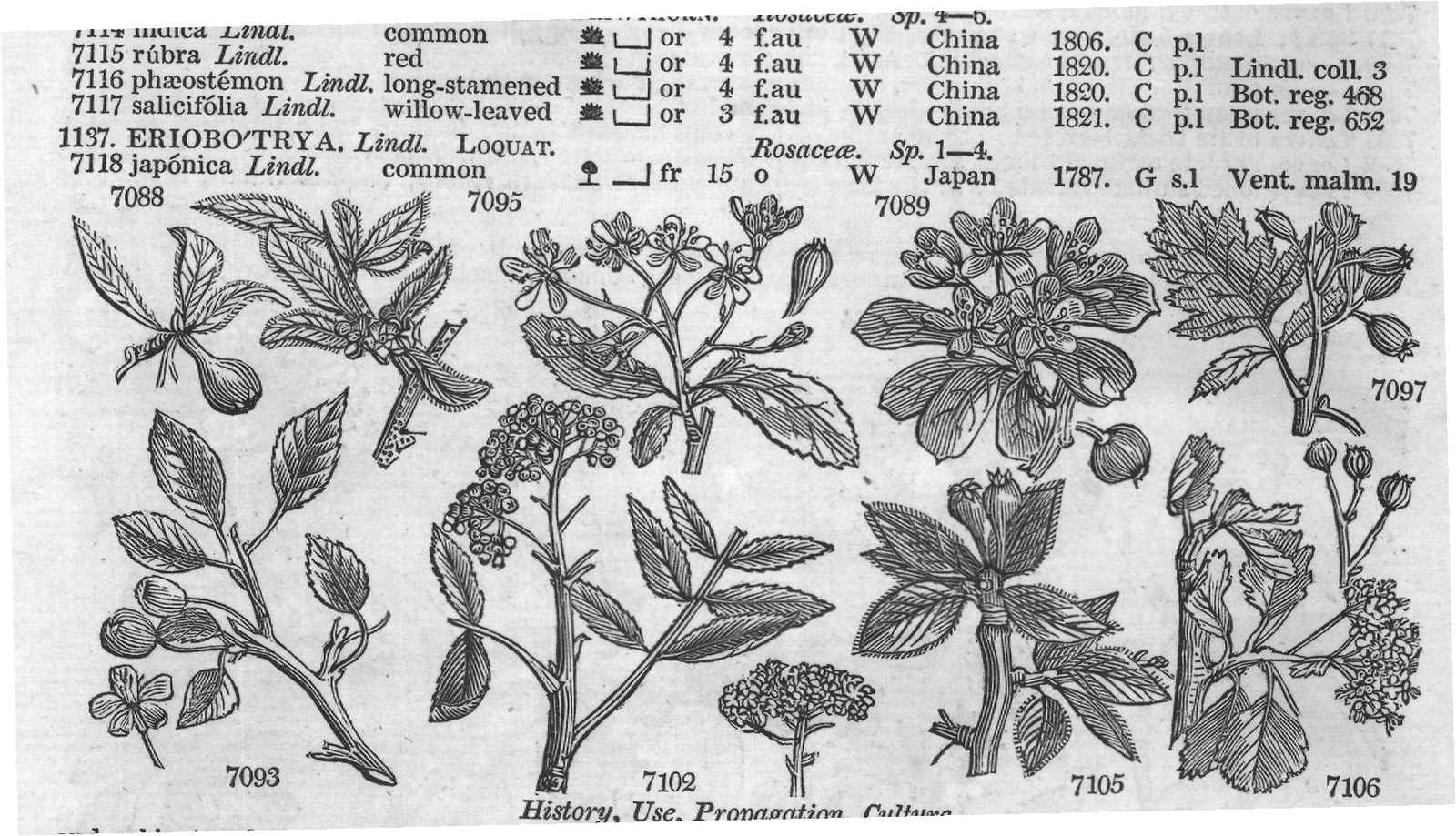
California 1796. G p.1 Nepal Bot. reg. 491 1821. L p.l Linn. tr. 13. t. 10 Mesp. bengalensis Hort. 1136. RAPHIOLE'PIS. Lindl. INDIAN HAWTHORN. Rosaceæ. Sp. 4-6. 7114 índica Lindl. common or 4 f.au W China 1806. C p.l 7115 rúbra Lindl. red or 7116 phæostémon Lindl. long-stamened or 4 f.au 4 f.au W W China 1820. C p.l China 1820. C p.l 7117 salicifólia Lindl. willow-leaved or 3 f.au W China 1821. C p.1 Lindl. coll. 3 Bot. reg. 468 Bot. reg. 652 1137. ERIOBOTRYA, Lindl. LOQUAT.
Rosacea. Sp. 1-4. 7118 japónica Lindl. common fr 15 0 W Japan 1787. G s.l Vent. malm. 19 7088 7095 7089 7097 7093 7102 History, Use, Propagation, Culture: 7105 7106 and cabinet maker. The Romans had twenty-two varieties, and there are now several hundreds in Britain and France, and some excellent sorts from America. They are usually divided into dessert, baking, and cyder fruits; the first high flavored, the second such as fall or become mellow in baking or boiling, and the third austere, and generally fruits of small size. Besides this division, apples are austere, and generally fruits of small size. Besides this division, apples are classed as pippins or seedlings, pearmains or somewhat pear-shaped fruits, rennets or queens, specked fruits pearmains or somewhat pear-shaped fruits, rennets or queens, specked fruits, calvilles or white-skinned fruits, russets or brown fruits, codlings or falling fruits, and burknots, which grow readily by cuttings. Most sorts of apple form ugly trees as standards, but are otherwise very ornamental sorts of apple form ugly trees as standards, but are otherwise very ornamental in shrubberries from their blossoms. The crabs, and especially the varieties obtained from the Siberian crab, form much the handsomest heads, and have also more brilliant blossoms. The apple may be propagated by layers, and many sorts by cuttings ; but the usual mode is by grafting on crab-stocks, and for dwarfing on stocks of the paradise apple.
P. communis, Poirier, Fr., Birnbaum, Ger., and Pero, Ital., is a fruit-tree next in popularity and value to the apple tree. It is a greatly superior dessert fruit, but not so valuable for culinary purposes and the press. apple tree. It is a greatly superior dessert fruit, but not so valuable for culinary purposes and the press.
There are fewer good sorts of pears, in proportion to the number of current varieties, than of apples; but a few, as the Jargonelles, Bergamots, Beurrées, Chaumontelles, &c. are most exquisite dessert fruits, and are much easier of digestion than the apple. It arrives in greater perfection in France and the north of Italy than in England. The Chaumontelles of Guernsey are in high repute, as are the St. Germain's and other sorts of Picardy, and the Beurrées of Milan. The Romans had thirty-six varieties, and there are many hundreds in the French and British nurseries, most of them good for little. Professor Van Mons, of Brussels, and M. Duquessie, of Mons, fruited about 8000 seedling pears, from which they obtained nearly 800 sorts worth cultivating. (Neill's Hort. Tour.) The varieties are divided into dessert and baking fruits; and also into melting or butter pears, beurrées, Fr., breaking pears, crevers, Fr., and perry, poirée, Fr., fruits. The tree is grafted on seedlings of the same species, and for dwarfing and precocity on the quince. It is a much handsomer upright growing tree than the apple, more durable, and its wood hard and valuable for the turner and millwright; but its blossoms being white, are less shewy than those of the apple. P. domestica, and the other species of service are very ornamental trees; their leaves are mostly white ORDER II.
ICOSANDRIA DI-PENTAGYNIA. 7086 Leaves ovate serrated, Pedunc. corymbose 7087 Leaves serrated downy beneath, Flowers corymbose 7088 Leaves lin. lanc. hoary white with down beneath, Fl. axillary solitary subsessile 7089 Leaves ovate stalked entire silky beneath, Flowers corymbose 7090 Umbel sessile, Leaves ovate oblong acuminate serrated smooth, Claws shorter than cal. Styles smooth 7091 Umbel sessile, Leaves oval oblong serrated smooth, Claws longer than cal. Styles woolly at base 7092 Umbel sessile, Pedunc. pubescent, Styles woolly at base, Leaves ovate acuminate 7093 Leaves equally serrulate, Pedunc. clustered, Apples like berries, Cal. deciduous 7094 Leaves cordate cut-serrate angular smooth, Pedunc. corymbose 7095 Leaves lanc. oblong shining tooth-serrated narrowed at base entire, Pedunc. corymbose 7096 Leaves roundish ovate cut serrate hoary beneath, Flowers corymbose 7097 Leaves ovate lanceolate cut-lobed toothed beneath snow-white, Flowers corymbose 7098 Leaves pubescent beneath pinnated with the last pinna very large pinnatifid and simple 7099 Leaves half pinnated downy beneath 7100 Leaves pinnated villous beneath 7101 Leaves pinnated smooth on both sides 7102 Leaves pinnated, Leaflets acute almost equally serrated and common petiole smooth 7103 Lvs. pinnated, Leaflets acuminate unequally cut serrated and common petiole smooth, Serratures bristly 7104 Leaves oval acutely serrated smooth, Fl. in corymbose heads 7105 Leaves ovate oblong entire somewhat downy, Peduncle simple downy corymbose 7106 Leaves oblong cuneate at base unequally and doubly serrated hoary beneath, Fl. corymbose 7107 Leaves oval serrated, Fl. solitary diœcious, Pet. linear the length of calyx 7108 Leaves downy deciduous 7109 Leaves smooth shining evergreen 7110 Leaves smooth deciduous 7111 Leaves oblong acute serrulate, Pedicels longer than calyx 7112 Leaves oblong lanc. distantly toothed, Pedicels shorter than calyx 7113 Leaves lanceolate distantly serrated, Panicle hairy 7114 Raceme imbricated with persistent foliaceous bractes, Petals roundish [mucronate 7115 Leaves ovate lanceolate acuminate at each end, Pet. lanc. Stamens upright shorter than calyx 7116 Leaves long lanceolate, Stamens spreading longer than the calyx 7117 Leaves linear lanceolate, Sepals subulate much longer than stamens, Panicle contracted 7118 Leaves lanceolate serrated 7115 7111 7108 7117 7112 7113 7118 and Miscellaneous Particulars. underneath, and they are generally profusely covered with blossoms and fruit. Of P. domestica there are two varieties, the pear and apple-shaped, cultivated in some parts of France and near Genoa for their fruits. Those like the medlar and quince are not eaten till in a state of incipient decay. There are but few of the true service in English gardens, but the P. hybrida and pinnatifida are common, and their fruit, which resembles that of the mountain ash, is sometimes made use of. P. aucuparia and Americana are handsome trees for shrubberies, the former very popular in suburban gardens. 1134. Cydonia. So called from being native of the ancient town Cydon in the Island of Crete; or perhaps it may be a corruption of malus-cotonea, by which the Latins designate the fruit . C. vulgaris is a deformed low tree, sometimes cultivated for its fruit, which is a pome with a persisting calyx like the medlar. It is used as a marmalade for flavoring apple-tarts. It prefers moist loam, and is raised by layers. It is most in use, however, as a stock for the pear. C. japonica is a beautiful low bush, remarkable for the brilliancy of its blossoms, which vary from the richest scarlet to the most delicate blush color. It is hardy, and well adapted for single plants, upon grass, or for forming ornamental hedges in flower gardens. 1135. Photinia. So named, we believe, from φως φωτoς, light, in allusion to the lucid surface of the leaves of the species. P. serrulata and arbutifolia are elegant shrubs, and nearly hardy. The latter succeeds perfectly against a south wall. 1136. Raphiolepis. From ρaφiς, a needle, and λεπiς, a scale, in allusion to the numerous, subulate, persistent bracteæ, which are mixed among the racemes of flowers. Pretty Chinese small shrubs, formerly known under the collective name of Cratægus indica. 1137. Eriobotrya. From ερiov, wool, and βoτρuς, a bunch of grapes, in allusion to the woolliness of its raceme. This genus is excellently characterized by the structure of its seed, of which the radicula is retracted within the cotyledons, not exserted as in all the other genera of Pomaceæ. E. Japonica produces an agreeable fruit about the size of a gooseberry, of a fine yellow color, and, according to Sir Joseph Banks, as good as the mango. To ripen it with flavor, it requires the temperature of the stove, and comes into use in March. It may be grafted on any species of the genus, or on the hawthorn. oval-leaved ICOSANDRIA DI-PENTAGYNIA. 1138. AMELAN CHIER. Lindl. 7119 vulgáris Lindl. Alpine 7120 Botryápium Lindl. snowy 7121 ovális Lindl. 1139. COTONEASTER. Lindl. COTONEASTER.
Rosacece. Sp. 3-4.
AMELANCHIER. or 6 ap.my W S. Europe 1596.
Lco or 12 ap.my W N. Amer. 1746.
L co CLASS XII.
Bot, mag. 2430 Schm. arb. t. 84 or 8 ap.my W N. Amer. 1800.
L co Rosaceæ. Sp. 4-5. 7122 vulgáris Lindl. dwarf or 4 ap.my Pk Europe 1656. L co Schm. arb. t. 89 7123 tomentósa Lindl. quince-leaved or 4 ap.my Pk 1759. L co 7124 acumináta Lindl. taper-pointed业 or 4 ap.my Pk Nepal 1820. L co Linn. tr. 13. t. 9 7125 affínis Lindl. downy Nepal or 4 ap.my Pk Nepal 1820. L co 1140. WALDSTEINIA. W. WALDSTEINIA.
Rosacea. Sp. 1. 7126 geoídes W.
Avens-like Apr jn.jl Y Hungary 1804. Dl.p Bot. cab. 492 1141. SPIRÆ'A. W.
SPIREA.
Rosacea. Sp. 23-34. 7127 lævigáta W. smooth-leaved or 4 ap.jn R Siberia 1774. L p.1 Sch. arb. 1. t. 49 S. altaica Pall. 7128 salicifólia W. en.
B alba 7129 carpinifólia W.en. 7130 tomentósa W. 7131 alpína W. 7132 hypericifólia W. 7133 chamædrifólia W. 7134 ulmifólia W. willow-leaved white-flowered Hornbeam-lvd. tomentose Alpine Italian May Germander-lvd.
Elm-leaved or 5 jn.au Pk Britain moi.h. L co Eng. bot. 1468 or 5 jn.au W N. Amer. ...
Lco Mil. ic. t.257. f.2 or 4 jn.au W N. Amer. ...
Lco Dend. brit. 66 泰 or 5 au.s Pk N. Amer. 1736.
Sk p.l Sch. arb. 1. t. 51 or 3 jl W Siberia 1806. or 5 ap.my W N. Amer. 1640. or 1½ jn.jl W or 3 jn.jl W 7135 betulifólia Pall.
Birch-leaved or 2 jn.jl Pk 7136 crenáta W.
Hawthorn-lvd. or 2 ap.my W 7137 oblongifólia W. en. oblong-leaved业 or 3 my.jn W 7138 tríloba W. three-lobed 业 or 3 my W Sk p.1 L co Siberia 1789. L p.1 Carniola 1790. L p.1 N. Amer. 1812. L p.1 Siberia 1739. L p.1 Hungary 1816. L p.1 Siberia 1801. L p.1 Sch. arb. 1. t. 26 Pall. ros. 1. t. 15 Jac. vin. 2. t. 140 Dend. brit. 67 Pall, ros. 1. t. 20 Sch. arb. 1. t. 55 Pl. rar. h. 3.t.235 Dend. brit. 68 7139 thalictroídes W.
Meadow Rue-lv. or 2 my W 7140 obováta W. en. obovate-leaved or 3 my.jn W 7141 opulifólia W.
Gueld. Rose-lv. or 5 jn.jl W Siberia 1790. Sk p.1 Hungary 1816. Sk p.1 N. Amer. 1690. L co Pall, ros. 1. t. 18 Sch. arb. 1. t. 52 7142 sorbifólia W. β alpína 7143 bélla Sims. 7144 corymbósa Lodd. 7145 cratægifólia Link. 7146 Arúncus W. pinnated or 4 au W Siberia large-flowered or 3 au W Siberia pretty or 2 jl.au R Nepal 1759. Sk co 1817. Sk co 1820. L co corymbose 业 or 1 jl.au W Hawthorn-lvd. or 3 jl.au W ......
Goat's-beard or 4 jn.jl W Siberia N. Amer. ?1819. L co 1823. L co 1633. D p.1 Sch. arb. 1. t. 58 Pall. ros. 1. t. 25 Bot. mag. 2426 Bot. cab. 671 Pall. ros. 1. t. 26 7147 Filipéndula W.
Dropwort or 2 jn.o W B pléna double-flowered or 1½ jn.o W Britain m. pas. D co Eng. bot. 284 7148 Ulmária W.
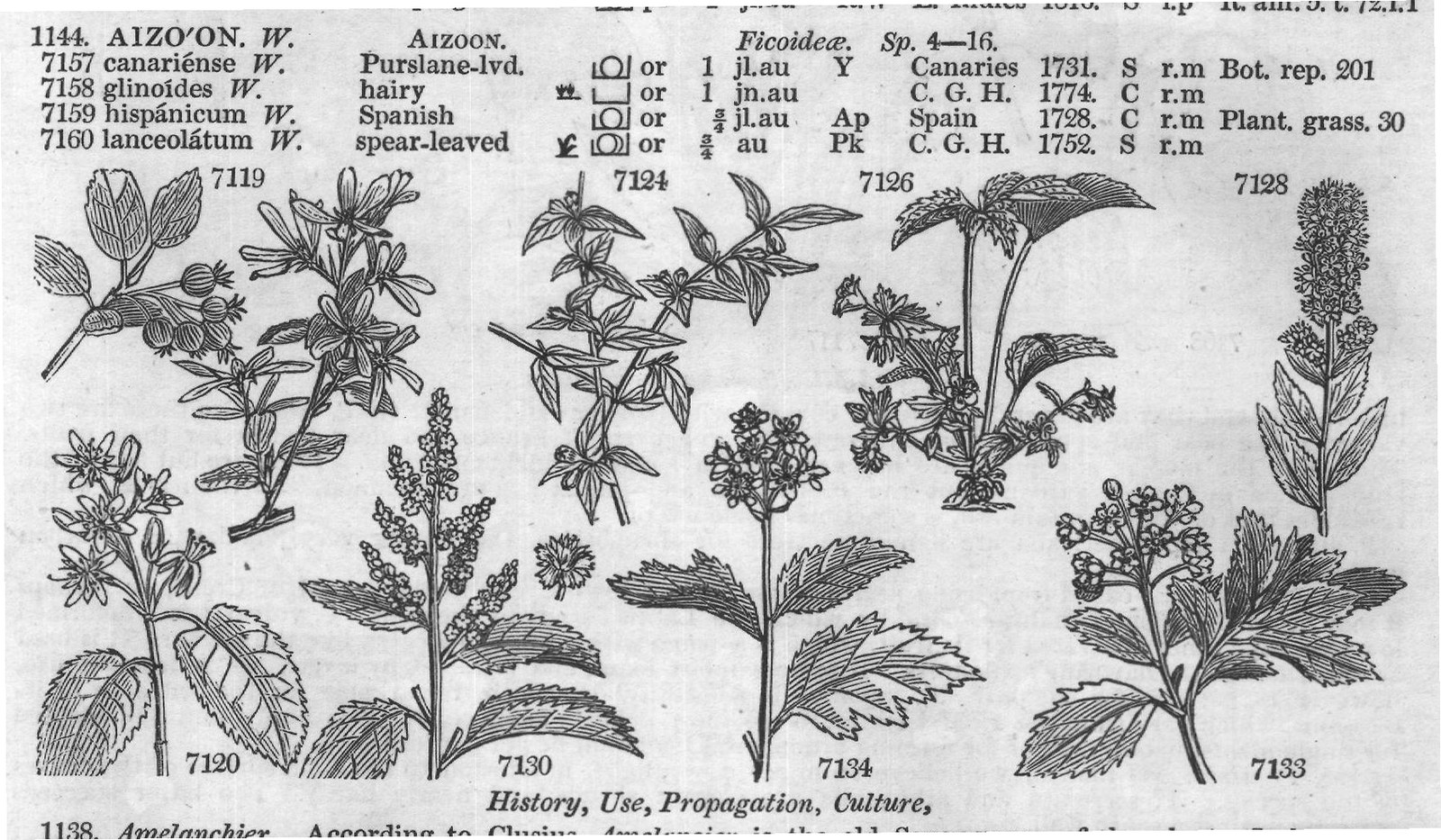
Meadow-sweet or 2 jn.o W Britain m. me. D co Eng. bot. 980 B pléna double-flowered or 2 jn.o W Britain m. me. D p.l 7149 lobáta W. palmated or 2 jl.au R Siberia 1765. D p.l Jac. vin. 1. t. 88 Rosacea. Sp. 2. or 2 jn.au R.w N. Amer. 1713. large-stipuled or 2 jn.au R.W N. Amer. 1805. L co D p.l Bot. mag. 489 1142. GILLE'NIA. Mönch. GILLENIA. 7150 trifoliáta Mönch. three-leaved 7151 stipulácea W. 1143. SESU'VIUM. W. SESUVIUM. 7152 Portulacastrum W. Purslane-lvd. 7153 séssile P. S. sessile-flowered 7154 revolutifólium W.en. revolute-leaved 7155 longifólium W. en. long-leaved 7156 répens W.en. creeping 1144. AIZO'ON. W. 7157 canariénse W. 7158 glinoídes W. 7159 hispánicum W. 7160 lanceolátum W. 7119 AIZOON.
Purslane-lvd. hairy Spanish spear-leaved সমস or or or or or or 7124