Home › F › Fluviales (Sp monost chyon W)
Fluviales (Sp monost chyon W)
Sp. 3. 4993 monostáchyon W. simple-spiked cu au.o Pk E. Indies 1803.
O p.1 Bot. rep. 406 4991 distáchyon W. broad-leaved cu my.jl W C. G. H. 1788.
O p.1 Bot. mag. 1293 4995 angustifolium W. narrow-leaved cu ap.s W C. G. H. 1788.
O p.l Bot. mag. 1268 855. SABAL. P. S.
SABAL.
Palma. Sp. 1. 4996 Adansóni B. M.
Adanson's or 6 jn.au G Florida 1810. S s.l Bot. mag. 1434 856. RU'MEX. W.
Dock.
Polygoneæ.
Sp. 37-79. 4997 Patiéntia W. 4998 sanguíneus W. 4999 críspus W. 5000 Britannica W.
Patience bloody-veined curled Virginian 5001 persicarioídes W. Persicaria-like 5002 ægyptíacus W. 5003 dentátus W. 5004 marítimus W. 5005 palústris Sm. 5006 divaricátus W. 5007 acútus W. 5008 obtusifólius W. 5009 púlcher W. 5010 confértus W. 5011 nemorósus Schr. 5012 condylódes Bieb. 5013 brasiliensis Lk. 4977 Egyptian dentated golden yellow-marsh spreading sharp broad-leaved Fiddle close-headed wood whole-colored Brazilian **** A cul 4 jn.jl G Italy 1573. R co cul 3 jn.jl G England sha.pl. co Eng. bot. 1533 m 2 jn.jl G Britain rubble. co Eng. bot. 1998 G N. Amer.
G ******* ** W W Ow 2 jl.au G dy 2 jn.jl G W 3 jn.au G W 2 jn.au G cu 4 jn.jl G ......
A cu 2 jl G O cu 3 jl G Germany Caucasus ...
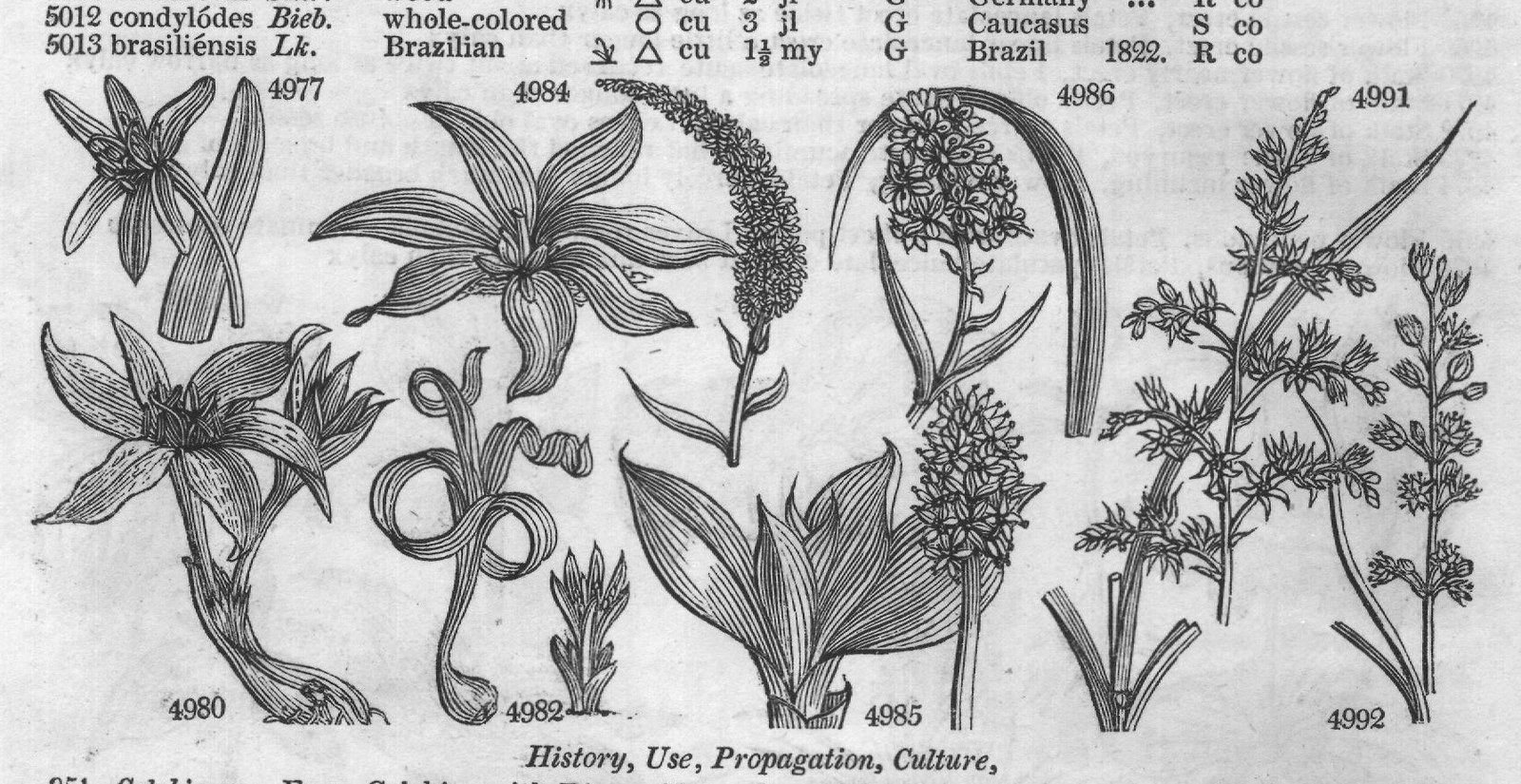
Sco cu 1 my G Brazil 1822. R co 4984 4986 4991 m 2 jn.jl cu 2 jn.jl Ocu 1 jn.jl G Ocu jl.au 2 G 1 jl.au G G 2 jl.au N. Amer. 1773. S co Egypt 1734. S co Egypt 1732. S co Britain salt ma. R co England mar. R co Italy 1793. S co Britain wat.pl. R co Britain rubble. R co Britain gra.pa. R co 1796. R co Till. pis. t.37. f.1 Di.el. t. 158. f.191 Eng. bot. 725 Eng. bot. 1932 Til. pis. t. 37. f. 2 Eng. bot. 724 Eng. bot. 1999 Eng. bot. 1576 ... co 4980 4982 4985 4992 History, Use, Propagation, Culture, 851. Colchicum. From Colchis, saith Dioscorides, where this plant grows in abundance; but it is probable that the term Colchicum was applied to all poisonous plants, among which this certainly held no inconsiderable place. The economy of this plant in regard to its bulbs, flowers, and seeds, is singular, and may be classed with other anomalies found in Crocus, &c. The bulb, which in C. autumnale is about the shape and size of that of a tulip, is formed in the following manner:
From the permanent, striated, dilated tuber of the old root, sinuated on one side, and clothed with the coats of the preceding root-leaves, a new plant springs, which is tuberous at the base, throws out fibres at bottom like other bulbs, and is received into the bosom of the former tuber, which embraces it half round. This has an outer radical spathe, which is cylindric and tubular, cloven at top on one side, and half under ground. From two to six flowers half emerge from this spathe without leaves. In the mean time the fruits, much later than the flowers, sit on the stem rising out of the spathe. As the plant advances the new tuber increases, the old one, deprived of its nutriment, perishes, and at the same time the former pushes forth from its base the germ of a succeeding plant. There are commonly two lateral germs from the same tuber; one lower, just described, bearing the flower and seed; the other superior, caulescent like the former, but more slender, and scarcely floriferous.
The flowers, which arise with long slender tubes from the root, die off in the end of October, without leaving any external appearance of seeds. These lie buried all the winter within the bulb; in spring they grow up on a fruit-stalk, and are ripe about the time of hay-harvest. May not the very great length of the styles account in some measure for the delay in the ripening of the seeds? As this plant blossoms late in the year, and probably would not have time to ripen its seeds before winter, Providence has contrived its structure such, that it may be performed at a depth within the earth, out of the reach of the usual effects of frost; and as seeds buried at such a depth are known not to vegetate, a no less admirable provision is made to raise them above the surface when they are perfected, and to sow them at a proper season. ORDER III. 4977 Leaves flat lanceolate erect HEXANDRIA TRIGYNIA. 4978 Leaves linear channelled erect, Styles shorter than flower 4979 Leaves 5 ovate-oblong very broad, Flowers very numerous 4980 Leaves wavy spreading 4981 Two or many-flowered, Sepals linear oblong obtuse, Leaves small oval grassy-green 4082 Leaves 4 glaucous spiral, Flowers small very dwarf, Style one 4983 Leaves appearing with flower linear much spreading 4984 Scape leafy, Leaves oblong lanceolate, Flowers diœcious 4985 Leaves lanceolate ensiform nerved, Bractes linear-lanceolate 4986 Scape leafy, Raceme oblong, Bractes short oblong, Leaves smooth lanceolate linear 4987 Leaves channelled nerved, Segments of flower broad ovate with a transverse nectary at base 4988 Root horizontal, Leaves lanc. erect, Bractes longer than flower, Nectaries distinct 4989 Scape leafy, Raceme showy lax, Bractes membranous, Leaves subulate setaceous very long 4990 Raceme oblong lax, Leaves very long and narrow, Caps. oblong 4991 Leaves grassy, Panicle loose, Segments of flower ovate acute 4992 Leaves very long narrow dry, Flowers racemose 4993 Leaves oval, Spike one cylindrical 4994 Spike bifid, Leaves linear oblong floating, Bractes entire 4995 Spike bifid, Leaves linear lanc. erect, Bractes bipartite 4996 The only species §1. Hermaphrodite. Valves marked with a grain. 4997 Valves cordate entire: one grained, Leaves ovate lanceolate 4998 Valves entire: one grained, Leaves cordate lanceolate 4999 Valves entire all grained, Leaves lanceolate wavy acute 5000 Valves ovate entire veinless all grained, Fruit-stalks pendulous, Leaves lanceolate 5001 Valves toothed all grained, Leaves lanceolate 5002 Valves trifid setaceous: one grained 5003 Valves toothed all grained, Leaves lanceolate 5004 Valves toothed grained, Leaves linear 5005 Valves lanceolate grained toothed at base, Leaves linear lanc. Whorls distant 5006 Valves toothed all grained, Leaves cordate-oblong obtuse pubescent 5007 Valves toothed all grained, Leaves cordate-oblong acuminate 5008 Valves toothed all grained, Leaves cordate oblong obtuse crenate 5009 Valves toothed: one grained, Radical leaves panduriform 5010 Valves rounded cordate repand: one grained, Leaves cordate oblong wavy at edge 5011 Valves oblong obtuse entire: one grained, Leaves lanceolate 5012 Valves entire lanceol. one grained, Leaves cordate lanceolate 5013 Valves entire lanceolate acute grained, Upper leaves linear-lanceolate 4991 4996 5004 5008 4998 5009 4999 and Miscellaneous Particulars, There are a few varieties of common Colchicum cultivated by florists; viz. the white, striped-flowered, striped-leaved, broad-leaved, many-flowered, and double-flowered. No cattle are said to eat it; though it is remarkably abundant in the meadows of the Italian Alps, and the leaves must certainly be frequently made into hay.
C. autumnale, as a medicine, has been known since the days of Hippocrates. It possesses diuretic, purgative, and narcotic properties: and on the continent, where it was recommended to notice by Baron Stoerck, it is a favorite remedy in dropsy, particularly hydrothorax, and in humoral asthma. But as it does not differ in its mode of action from squill, and is more uncertain in its operation, it has not been much used in that complaint in this country. În gout and rheumatism, however, its efficacy has been fully ascertained: and in allaying the pain it may be almost said to possess a specific property. It operates on the bowels chiefly, and the nerves, diminishing the action of the arterial system. (Thomson's Mat. Med. 257.) All the species are ornamental as border-flowers, and may be blown in water-glasses. 852. Helonias. Derived from ἑλoς, a marsh. Some of the species grow in bogs in N. America. These plants delight in a moist situation and peat soil: they increase slowly by dividing at the root or by seeds. 853. Nolina. Named after an American botanist of French extraction, called P. C. Nolin. This plant is . This plant is best grown in pots, as it requires protection during winter. 854. Aponogeton. A name of the same meaning as Potamogeton (see that genus), of which it is probably an incomplete anagram. These plants are bulbous aquatics, and grow freely in loam and peat plunged in a cistern of water. They are very pretty ornaments of the aquarium. 855. Sabal. A name employed by Adanson. It is supposed to have no meaning. 856. Rumex. A name given by the Latins to a root of thorn. R. patientia (so called from the slowness of its operation as a medicine) and sanguineus, were formerly U3 HEXANDRIA TRIGYNIA. 5014 purpúreus Lk. purple W 4 jl CLASS VI.
R co 5015 stríctus Lk. upright W 2 jn.jl 1823. R co 5016 ucránicus Horn.
Ukraine cu 2 jn G Ukraine 1822. S co 5017 aquáticus H. K. great-water W 5 jlau G Britain riv.ba. R co Eng. bot. 2104 5018 bucephalophorus W. Basil-leaved cu 1 jn G Italy 1683. S co Cav. ic.1. t.41. f.1 5019 Lunária W. tree cu 2 jn.jl G Canaries 1698. C s.l Plu.alm.t.252.f.3 5020 vesicárius L. bladder cu 2 jl.au G Africa 1656. S co Moris.s.5.t.28.f.7 5021 róseus W. rose cu 1 jl.au G Egypt 1737. S co 5022 tingitánus W.
Tangier A cu 1 jn.au G Barbary 1680. R co Zanon.hist.9. t.6 5023 scutátus W. 5024 sarcorhízus Lk.
French-sorrel fleshy-rooted cul 1 jn.jl G France 1596. R co A cu 1 jl G C. G. H. 1824. C co 5025 hastifólius Bieb. 5026 alpínus W. 5027 aculeátus W. spear-leaved cu 1 au G Crimea 1823. R co Alpine m 1 jn.jl G France 1597. R 1.p Zorn. ic. 261 5028 spinósus W. small-prickly large-prickly cu 1 jl G Candia ...
R co Bauh.prodr. t.55 cu 2 jn.jl G Candia 1656. S co Fl. græc. 347 5029 gigantéus H. K. 5030 tuberósus W. tall A cu 6 jn.au G Sandw. Is. 1796. R co tuberous-root.
A cu 1 jn.au G Italy 1752. R co Fl. græc. 348 5031 acetósa W. common-sorrel Δ A cul 2 jn.jl G 5032 acetosélla W.
Sheep's-sorrel w 1 my.jl G Britain Britain me.pa. R co Eng. bot. 127 gra.pa. R co Eng. bot. 1674 5033 arifólius W. halberd-leaved cu 1 ap.d G Africa 1775. C s.l Jac. vind. 3. t. 93 857. OXY'RIA. Dec.
Polygoneæ.
Sp. 1. 5034 ácida R. Br. common cu jn.jl G Britain alp.pa. Rp.1 Eng. bot. 910 Indian 858. WENDLAN DIA. W. WENDLANDIA.
POLYGYNIA. 5035 populifólia W. Poplar-leaved or 859. DAMASO'NIUM. W. DAMASONIUM. 5036 índicum W. 860. ACTINOCAR PUS. R. Br. ACTINOCARPUS.
Menispermeæ. Sp. 1. 6 jn.jl W Florida 1759. C co Hydrocharideæ. Sp. 1-2. or 1 jl.s W E. Indies 1800. Saq Bot. mag. 1201 Alismaceæ. Sp. 2-4. 5037 minor R. Br. small or my.au W N. S. W. ...
S s.l 5038 Damasónium R. Br. common or jn.au W England dit. S m.s Eng. bot. 1615 861. ALIS MA. W.
Alismaceæ.
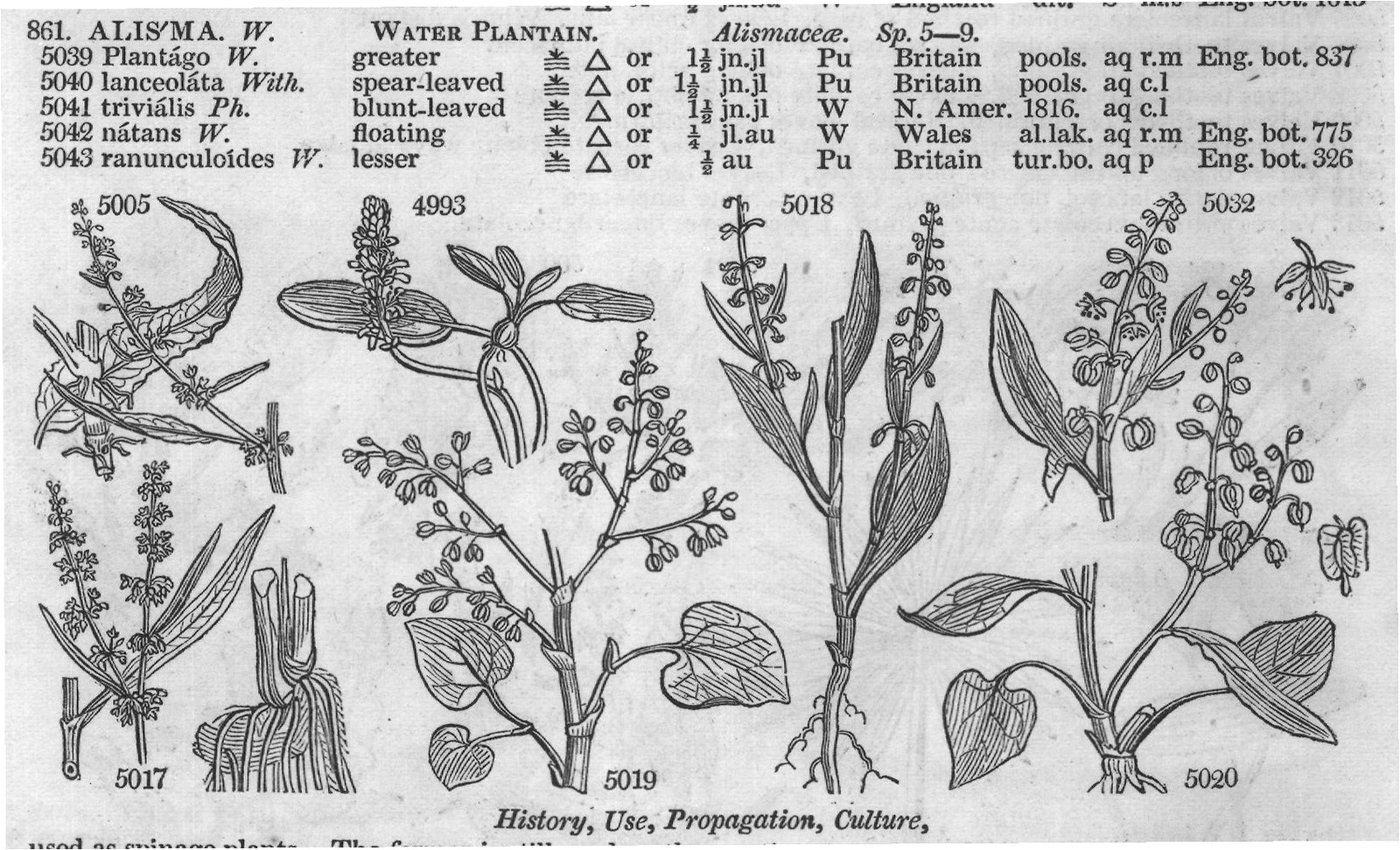
Sp. 5-9. 5039 Plantágo W. greater or 1½ jn.jl Pu 5040 lanceoláta With. spear-leaved or 1½ jn.jl 2 Pu Britain pools. aq r.m Eng. bot. 837 Britain pools. aq c.l 5041 triviális Ph. blunt-leaved or 5042 nátans W. floating or 1 jn.jl W jl.au W N. Amer. 1816. aq c.l Wales al.lak. aq r.m Eng. bot. 775 5043 ranunculoídes W. lesser △or au Pu Britain tur.bo. aq p Eng. bot. 326 $ 5005 4993 5018 5032 D 5017 5019 History, Use, Propagation, Culture, 5020 used as spinage plants. The former is still used on the continent, and mashed with a small proportion of R. acetosa or scutata, makes a very good spinage.
R. crispus has a fusiform yellow root, which, taken in a recent state, and bruised and made into an ointment or decoction, is said to cure the itch. decoction, is said to cure the itch.
R. obtusifolius is a domestic weed of the worst description: it is found in every country of Europe, but almost confined to cultivated grounds or rubbish, rick-yards, neglected gardens, and places used as retiring confined to cultivated grounds or rubbish, rick-yards, neglected gardens, and places used as retiring grounds by men or cattle. It is never found on poor or wet-bottomed land. It is refused by cattle; but the leaves were formerly used for wrapping round butter and cream-cheese; and the roots, along with those of R. acutus, by the dyers. In powder, the roots of most docks are said to be one of the best articles for cleaning the teeth. The leaves of all of them are considered laxative rather than otherwise.
R. acetosa has been long cultivated in gardens for its leaves as spinage and salad; but R. scutatus is much more delicate. The Laplanders use the leaves of the R. acetosa to turn their milk sour in Ireland they are delicate.
The Laplanders use the leaves of the R. acetosa to turn their milk sour: in Ireland they are eaten with fish and other alkalescent food. The root is powerfully astringent, and considered antiscorbutic: dried and boiled it gives out a beautiful red color. All domestic cattle eat this and most other species of the genus .
R. acetosella, where it abounds naturally, is a certain indication of dry, poor, gravelly, irony soil. R. alpinus, monk's or bastard rhubarb, was formerly used as true rhubarb, but in larger doses. The different species of Rumex attract the cultivator's attention as weeds more powerfully than as culinary, medicinal, or dying plants. The sorts vulgarly known as docks produce a large quantity of seeds, and ripen , or dying plants. The sorts vulgarly known as docks produce a large quantity of seeds, and ripen them rapidly and perfectly. Fortunately they are heavy, and are not carried to a great distance from the parent; but almost every one grows, and once a year old they are tedious and expensive to eradicate. The first season they may be destroyed by hoeing; but when the tap-root is established, unless it be wholly eradi cated by the weeding, or dock-hook, or spade, the ground cannot be considered as cleared. Any part of the by the weeding, or dock-hook, or spade, the ground cannot be considered as cleared. Any part of the ORDER III.
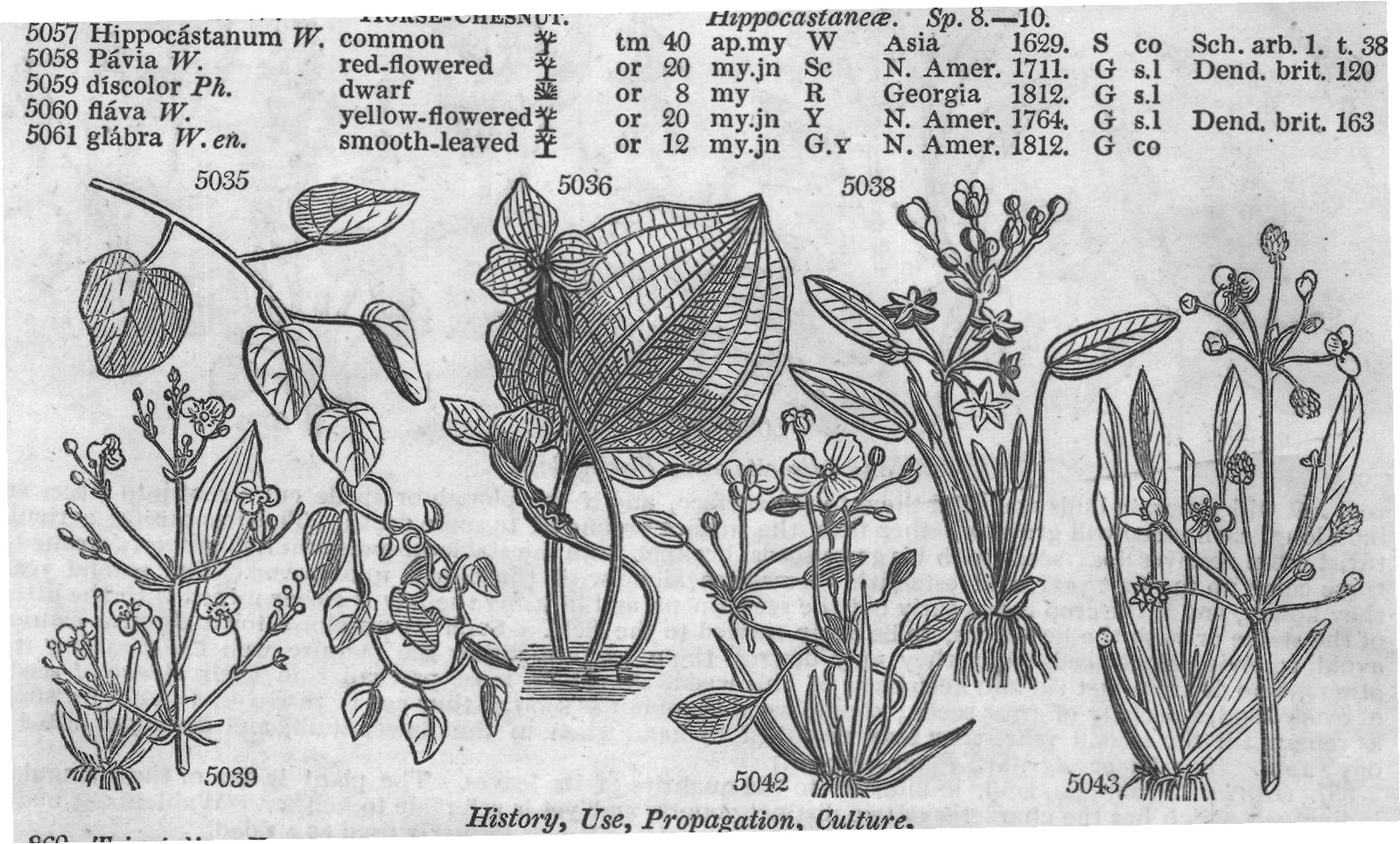
HEXANDRIA TRIGYNIA. 5014 Valves veiny toothed grained, Lower leaves cordate oblong, upper oval, all with colored veins 5015 Valves toothed one grained, Leaves ovate lanceolate repand entire 5016 Like R. persicarioides but differing in having auricled leaves and longer teeth to the valves §2. Hermaphrodite. Valves naked. 5017 Valves entire, Leaves cordate smooth acute 5018 Valves toothed, Flower-stalks flat reflexed thickened 5019 Valves smooth, Stem shrubby, Leaves cordate 5020 Flowers in pairs, All the valves very large membranous reflexed, Leaves undivided 5021 Flowers distinct, Wing of one valve very large membranous veiny, Leaves eroded 5022 Flowers distinct, Valves cordate obtuse entire, Leaves hastate-ovate 5023 Leaves cordate hastate 5024 Stem shrubby, Root tuberous, Leaves roundish running down into the stalk 5025 Valves entire reniform, Leaves hastate, Middle lobe cordate, Stem much branched diffuse §3. Flowers diœcious. 5026 Valves entire naked,, Leaves cordate obtuse rugose 5027 Leaves lanceolate stalked, Fruit reflexed, Valves fringed 5028 Female calyx 1-leaved, Outer valves reflexed hooked 5029 Flowers monœcious, Valves naked, Leaves oblong ovate 5030 Leaves lanceolate sagittate, Lobes spreading 5031 Leaves oblong sagittate 5032 Leaves lanceolate hastate 5033 Leaves stalked hastate serrated acute with simple spreading auricles, Valves naked entire 5034 Leaves sagittate reniform POLYGYNIA. 5035 Leaves alternate stalked cordate ovate with a glandular point 5036 Leaves cordate 5037 Fruit 8-cleft, Leaves 3-nerved 5038 Leaves cordate oblong, Fruit 6-cleft 5039 Leaves ovate acute, Capsules bluntly 3-cornered 5040 Leaves lanceolate 5041 Leaves oval cordate 9-nerved 5042 Leaves elliptical obtuse, Capsules striated 5043 Leaves linear-lanceolate, Capsules 5-cornered incurved 5028 5030 5031 5032 AAA 5027 5033 and Miscellaneous Particulars. 5034 root left will generate buds and send them to the surface, and if the plough or spade cut a root into pieces an inch long, each piece will grow, whether near the surface or buried to some depth. The less careful agriculturist often receives dock-seeds with his grass-seeds, brought from the stable-keepers and not properly cleaned these come up the first year, and establish themselves along with the clover unobserved. The second year establish themselves along with the clover unobserved. The second year they flower, and if the crop is not early cut the seed ripens, and in using the hay is either mixed with the litter is not early cut the seed ripens, and in using the hay is either mixed with the litter of the stable or with the hay-seeds, to be again carried to the field. Such as purchase townmanure cannot avoid receiving dock-seeds; but they may destroy them by fermenting the manure well before using it may destroy them by fermenting the manure well before using it: others, who desire to get rid and keep clear of this weed, should be most particular in their choice of seeds clear of this weed, should be most particular in their choice of seeds of every kind, especially of grass -seeds; should weed them out as soon as they can be discovered; and , for such as remain till the second year, they may be pulled by hand when in the flower-stalk, and during or after a , they may be pulled by hand when in the flower-stalk, and during or after a day's rain. (See Encyc. Agr. art. Peren . Weeds.) 857. Oxyria. From oξuς, acid, in allusion to the qualities of its leaves. The plant is one of those singular individuals which has the character of two distinct genera, and yet is referable to neither. Wahlenberg made it a Rheum, Linnæus a Rumex, Mr. Brown what it now is. It was formerly used as a salad. 358. Wendlandia. Named in honor of J. C. Wendland, a German botanist. He has published various works upon plants, many of them illustrated with numerous colored figures. This is a climbing plant, referred by Decandolle to Cocculus. 859. Damasonium. From δaμaω, to take away or diminish. This plant had the reputation of removing the effects of the venom of the sea -dog. Handsome floating aquatics. 860. Actinocarpus. From aκτiv, a ray, and κaρπoς, fruit, in allusion to the radiate disposition of the little carpella round a common axis. Pretty floating aquatics. 861. Alisma. Derived from alis, water, in Celtic. Alisma Plantago grows in watery places, and is called water-plantain, from the resemblance between its leaf and that of the common plantain. resemblance between its leaf and that of the common planțain. U 4 HEPTANDRIA MONOGYNIA.
CLASS VII.
CLASS VII.- HEPTANDRIA. 7 STAMENS.
A SMALL class, of which the Parinarium, which is a good tropical fruit, and the valuable Horse-chesnut, Æsculus, are the only remarkable genera. The Astranthus is a curious genus of the natural order of Homalineæ.
Order 1.
Order 1. MONOGYNIA. 7 Stamens. 1 Style. 862. Trientalis. Cal. 7-leaved. Cor. 7-parted, equal, flat. Berry without juice. 863. Disandra. Cal. about 7-parted. Cor. rotate, 7-parted. Caps. 2-celled, many-seeded. 864. Pisonia. Cal. campanulate, 5-cleft. Cor. O. Berry 1-celled, 1-seeded. 865. Petiveria. Cal. 4-leaved. Cor. O. Style lateral. Stigma pencil-shaped. Seed 1, with four reflexed awns at the end. 866. Æsculus. Cal. 1-leaved, inflated. Cor. 4-5-petaled, unequal, pubescent, inserted in the calyx. Caps. 3-celled. Seeds large, chesnut-like. celled. Seeds large, chesnut-like. 867. Jonesia. Cal. 2-leaved. Cor. funnel-shaped, with a closed fleshy tube and 4-cleft limb. Nectary, a ring inserted in the throat of the tube. A Legumen.
MONOGYNIA. 862. TRIENTA'LIS. W. WINTER-GREEN.
Primulaceæ. Sp. 2. 5044 europæ'a W. oval-leaved cu my.jn W Britain m. wo. R s.p Eng. bot. 15 5045 americána Ph. spear-leaved cu jl.au WN. Amer. 1816. R s.p 863. DISANDRA. W.
DISANDRA.
Scrophularineæ. Sp. 1. 5046 prostráta W. trailing or my.au Y Madeira 1771. R p.l Bot. mag. 218 864. PISO'NIA. W.
PISONIA.
Nyctagineæ.
Sp. 8.-12. 5047 aculeáta W. prickly cu 10 mr.ap G 5048 frágrans Lk. fragrant cu 3 ... ... ......
Jamaica 1739. C p.1 1823. C p.l Lam, ill. t. 861 5049 macrophýlla Lk. long-leaved cu 3 ... ... ...... 1823. C p.l 5050 nigricans W. black cu 3 ....
G.w W. Indies 1806. C p.1 5051 obováta Lk. obovate cu 3 ... ... ...... 1823. C p.l 5052 mexicána W.
Mexican cu 4 ... ... 5053 nítida W. shining cu 3 ...
Mexico 1824. C p.l Madagas. 1824. C p.l 5054 grándis R. Br. large or 12 ... ...
N. Holl. 1805. C p.1 865. PETIVERIA. W. PETIVERIA.
Chenopodeæ.
Sp. 2. 5055 alliácea W.
Garlic-scented cu 2 jn.jl W 5056 octándra W. dwarf 业 cu 2 jn.jl W Jamaica 1759. C p.1 W. Indies 1737. C p.1 Tr. ehr. 33. t. 67 Pl. ic. 213. t. 219 866. ESCULUS. W.
HORSE-CHESNUT. 5057 Hippocastanum W. common Hippocastaneæ. Sp. 8.-10. * 5058 Pávia W. red-flowered tm 40 ap.my W or 20 my.jn Sc 5059 díscolor Ph. dwarf 5060 fláva W. yellow-flowered 5061 glábra W.en. smooth-leaved or 8 my R or 20 my.jn Y or 12 my.jn G.Y Asia 1629. S co N. Amer. 1711. G s.l Georgia 1812. G s.l N. Amer. 1764. G s.l N. Amer. 1812. G co Sch. arb. 1. t. 38 Dend. brit. 120 Dend. brit. 163 5035 5036 5038 5039 5042 5043 History, Use, Propagation, Culture, 862. Trientalis. From triens, the third of a thing; why so named we do not understand. Sir J. E. Smith says, " Few persons have seen the fruit of this plant, and it was most unaccountably mistaken, even by , "Few persons have seen the fruit of this plant, and it was most unaccountably mistaken, even by Linnæus and Gærtner. The valves of the ripe capsule become concave externally, convex and polished within, and have been taken for a permanent corolla. But they are opposite to the calyx leaves, which the segments of the corolla are not. The beautiful tunics of the seeds were supposed to be the skin of a dried berry, and are not faithfully represented by Gærtner. (English Flora, vol. ii. 208.) 863. Disandra. From δuς, difficult, and avης avδρoς, a male, or, in botanical composition, a stamen; that is with bright yellow flowers. to say, a plant of which the stamens are subject to vary, and therefore difficult for botanists. A trailing plant say, a plant of which the stamens are subject to vary, and therefore difficult for botanists. A trailing plant with bright yellow flowers. 864. Pisonia. So named by Plumier, in honor of William Piso, a physician at Amsterdam, author of the Natural History of Brazil, 1648, fol. wanting support. It is common in the savannahs and other low places in the island of Jamaica, and in Natural History of Brazil, 1648, fol. P. aculeata is an inelegant tree with round reciining spiny branches, P. aculeata is an inelegant tree with round reclining spiny branches, ORDER I.
HEPTANDRIA MONOGYNIA. 868. Dracontium. Spathe cymbiform. Spadix covered. Cal. O. Petals 5. A berry. 869. Calla. Spathe ovate. Spadix covered. Cal. O. Cor. O. A berry. 870. Parinarium. Cal. 5-cleft. Petals 5. Stamens 14, of which 7 are barren. Drupe fleshy cribrose. Nut 2-celled, with 1-seeded cells.
Order 2. DIGYNIA. e 7 Stamens. 2 Styles. 871. Limeum. Cal. 5-leaved. Petals 5, equal. Caps. globose, 2-celled. 50 Order 3. TETRAGYNIA. 7 Stamens. 4 Styles. 872. Saururus. Cal. a spike of 1-flowered scales. Cor. O. Ovaries 4. Berries 4, 1-seeded. 873. Astranthus. Cal. O. Cor. hypocrateriform, with a 14-cleft limb. Seed 1, small, superior. Order 4. HEPTAGYNIA. 7 Stamens. 7 Styles. 874. Septas. Cal. 7-parted. Petals 7. Ovaries 7. Caps. 7, many seeded. MONOGYNIA. 5044 Leaves lanceolate entire 5045 Leaves narrow lanceolate acuminate oblique 5046 Leaves reniform crenate, Flower-stalks in pairs 5047 Spines axillary horizontal, Leaves ovate narrowed at each end, Corymbs axillary 5048 Unarmed, Leaves opposite acuminate narrowed into a short stalk very smooth fleshy 5049 Unarmed, Leaves opposite a little narrowed towards the base entire smooth, Lateral nerves parallel 5050 Unarmed, Leaves ovate acuminate, Flowers cymose erect, Fruit berried 5051 Unarmed, Leaves opposite acute scarcely narrowed at the base entire smooth with parallel nerves 5052 Leaves ovate entire villous, Flowers in umbels 5053 Leaves shining pointed (Lilac de Madagascar.) 5054 Leaves oblong acuminate smooth, Cymes compound, Flowers polygamous, Fruit spiny 5055 Flowers hexandrous 5056 Flowers octandrous 5057 Leaves digitate 7, Petals 5 spreading 5058 Leaves quinate smooth unequally toothed, Petals 4 with connivent claws the length of the calyx 5059 Leaves quinate pointed at each end downy beneath unequally toothed, Petals 4 5060 Leaves quinate beneath at the rib pubescent, Petals 4 with connivent claws longer than the calyx 5061 Leaves quinate quite smooth, Petals 4 spreading with claws the length of the calyx, Fruit spiny 5046 5057 5058 5044 5055 5056 5047 5060 and Miscellaneous Particulars. several other islands in the West Indies, where it is very troublesome to whoever passes, fastening itself by its strong crooked thorns to the clothes; and the seeds being glutinous and burry, also fasten themselves to whatever touches them: so that the wings of the ground-doves and other birds, are often so loaded with the seeds, as to prevent their flying, by which means they become an easy prey. 865. Petiveria. So named by Plumier, in honor of James Petiver, apothecary of London, and fellow of the Royal Society, author of Museum, 1695; Gazophylacium, 1702, collected into one volume folio, with many plates. P. alliacea, is common in savannahs and woods in the West Indies, where it is a troublesome weed, and tastes the milk of cows that feed on it. It is so acrid, that on chewing a little, it burns the mouth and leaves the tongue black, dry, and rough, as it appears in a malignant fever. It is thought, however, to be coveted by Guinea-hens, and hence its vulgar name of Guinea-hen weed. 866. Æsculus, or Esculus, as Pliny writes it. A name which the Latins gave to a tree which furnished them with an esculent nut: that plant was the Quercus Esculus of Linnæus. Marronier, Fr., Marronien- HEPTANDRIA MONOGYNIA.
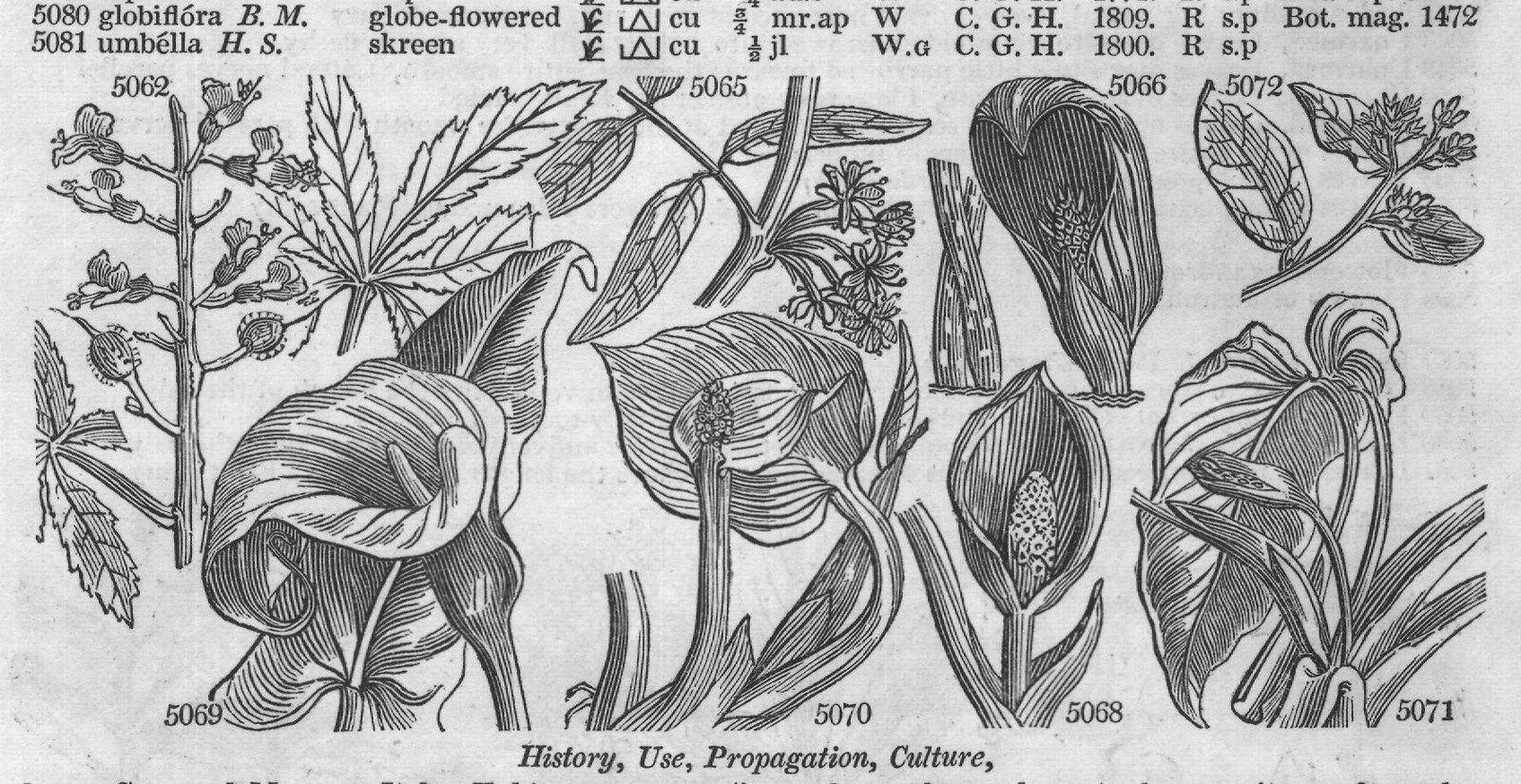
CLASS VII. 5062 cárnea Hort. 5063 pállida W.en. 5064 parviflóra H. K. ✓ flesh-colored pale-flowered small-flowered or or 7 jn 12 jn or 6 jl.au Pu N. Amer. 1823. G co G.Y N. Amer. 1812. G co W N. Amer. 1786. L s.l Dend. brit. 121 867. JONESIA. W.
JONESIA. 5065 pinnáta. W. winged-leaved ft 20 ...
Leguminosæ. Sp. 1. 0 E. Indies 1796. C p.l Rh. mal. 5. t. 59 868 DRACON'TIUM. W. DRAGON.
Aroideæ. Sp. 3-9. 5067 spinósum W. 5066 polyphýllum W. purple-stalked cu 2 mr.jn Ap India prickly cu 5068 pertúsum W. perforated cu 2 ap.my Ap Ceylon 6 ap.jn Ap W. Indies 1752. 1759. R. lt.l 1759. R lt.1 R p.l Bot. reg. 700 J. sch. 2. t. 184. 5 869. CAL/LA. W.
CALLA.
Aroideæ. Sp. 3-5. 5069 æthiópica W.
Ethiopian or 3 ja.my Ap C. G. H. 1731.
Sk r.m Bot. mag. 832 5070 palústris W. marsh cu jl.au Ap 5071 aromática Roxb. aromatic or 2 jl Ap N. Europe1768. D p Bot. mag. 1831 China 1813. Dr.m Bot. mag. 2279 870. PARINA'RIUM. Juss. PARINARIUM.
Chrysobalaneæ. Sp. 2-5. 5072 excélsum Sab.
Guinea Plum fr 60 W ...
S. Leone 1822. C 1 5073 macrophýllum Sab. Gingerbr. Tree fr 6 W S. Leone 1822. Cr.l DIGYNIA. 871. LI MEUM. W.
LIMEUM.
Portulaceæ. Sp. 1-4. 5074 africánum W.
African AW jn.jl W C. G. H. 1774. R s.p TETRAGYNIA. 872. SAURU'RUS. W.
LIZARD'S-TAIL.
Aroideæ. Sp. 3. 5075 cérnuus W. drooping 5076 lúcidus Jacq. shining 5077 chinénsis Hort.
Chinese A cu 1 s cu 1층 cu 2 s Ap Ap ...
Ap Virginia 1759. D s.p N. Amer. 1791. D 1 China 1819. D 1 Jacq. ecl. t. 18 873. ASTRAN'THUS. L. ASTRANTHUS.
Homalineæ. 5078 cochinchinensis Lour. Cochinchinese cu 4 jn.jl W HEPTAGYNIA.
Sp. 1-2.
China 1823. Cr.m Bot. mag. 2659 874. SEP'TAS. W.
SEPTAS.
Semperviveæ. Sp. 3. 5079 capénsis W. 5080 globiflóra B. M.
Cape cu au.s W C. G. H. 1774.
R s.p globe-flowered cu mr.ap W C. G. H. 1809.
R s.p Bot. rep. 90 Bot. mag. 1472 5081 umbélla H. S. skreen cu jl W.G C. G. H. 1800.
R s.p 5062 5065 5066 5072- 5069 5070 5068 5071 History, Use, Propagation, Culture, baum, Ger., and Marrone, Ital. E. hippocastanum (ἱππoς, horse, horse-chesnut; because it was formerly a veterinary medicine) is a magnificent tree, at once grand from its magnitude and massy form, and beautiful when in blossom, from being covered with spikes of delicate white and pink flowers, protruding from among elegant digitate leaves. It is a rapid growing tree, and speedily produces a considerable bulk of timber, which, however, is of little value as such. The plant is best adapted for an ornamental tree in the outskirts of plantations, in avenues, or singly on lawns. It is much prized by the French as an ornamental avenue tree, and when the geometric style of gardening was in vogue in this country was a good deal planted, as at Bushy park, Canons, Castle Howard, &c. During the rage for the picturesque, it fell into disrepute from its "compact lumpish parabolic form;" but the public are now convinced that there are other beauties besides those peculiarly adapted for representation by painters, and the taste for trees beautiful or interesting from their flowers, foliage, or other details, is now reviving. The nuts or capsules are large and mahogany colored, and have often occasioned regret that they are not edible, like those of the Spanish chesnut. Deer eat them greedily, and may be seen watching about the trees for their fall during windy weather. In Turkey they are ground and mixed with horse provender. According to some, swine and sheep may be fattened on them, and poultry when they are boiled. They are of a saponaceous nature, and broken and steeped in hot water might save soap, where that article is excessively dear. This tree migrated from the northern parts of Asia into England by Constantinople, Vienna, Italy, and France. Parkinson in 1629 places it in his orchard as a fruit tree, and describes the nuts as superior to the ordinary sort. E. Pavia was so named by Boerhaave, in honor of Peter Paw, a Dutchman, and professor of botany at Leyden, in 1601.
The other species have beautiful flowers, but are not free growing trees. ORDER I.
HEPTANDRIA MONOGYNIA. 5062 Leaves 6-7-nate obov. acuminate 2-serrate, Petals 4 connivent with claws shorter than cal. Anth. smooth 5063 Leaves quinate, Petals spreading with claws shorter than calyx, Stam. twice as long as cor. Fruit spiny 5064 Leaves quinate, Petals 4, Stamens twice as long as corolla 5065 The only species 5066 Leaves supradecompound, pedate, Segments pinnatifid, Scape much shorter than leaf-stalks 5067 Leaves sagittate, Peduncles and petioles prickly 5068 Stem climbing, Leaves cordate ovate bored through 5069 Leaves sagittate cordate, Spathe cucullate, Spadix male upwards 5070 Leaves cordate, Spathe flat, Spadix hermaphrodite all over 5071 Leaves cordate acuminate, Spathe boat-shaped hiding the spadix 5072 Leaves ovate-oblong green above white beneath 5073 Leaves long oblong-lanceolate very white all over 5074 Leaves oblong stalked DIGYNIA.
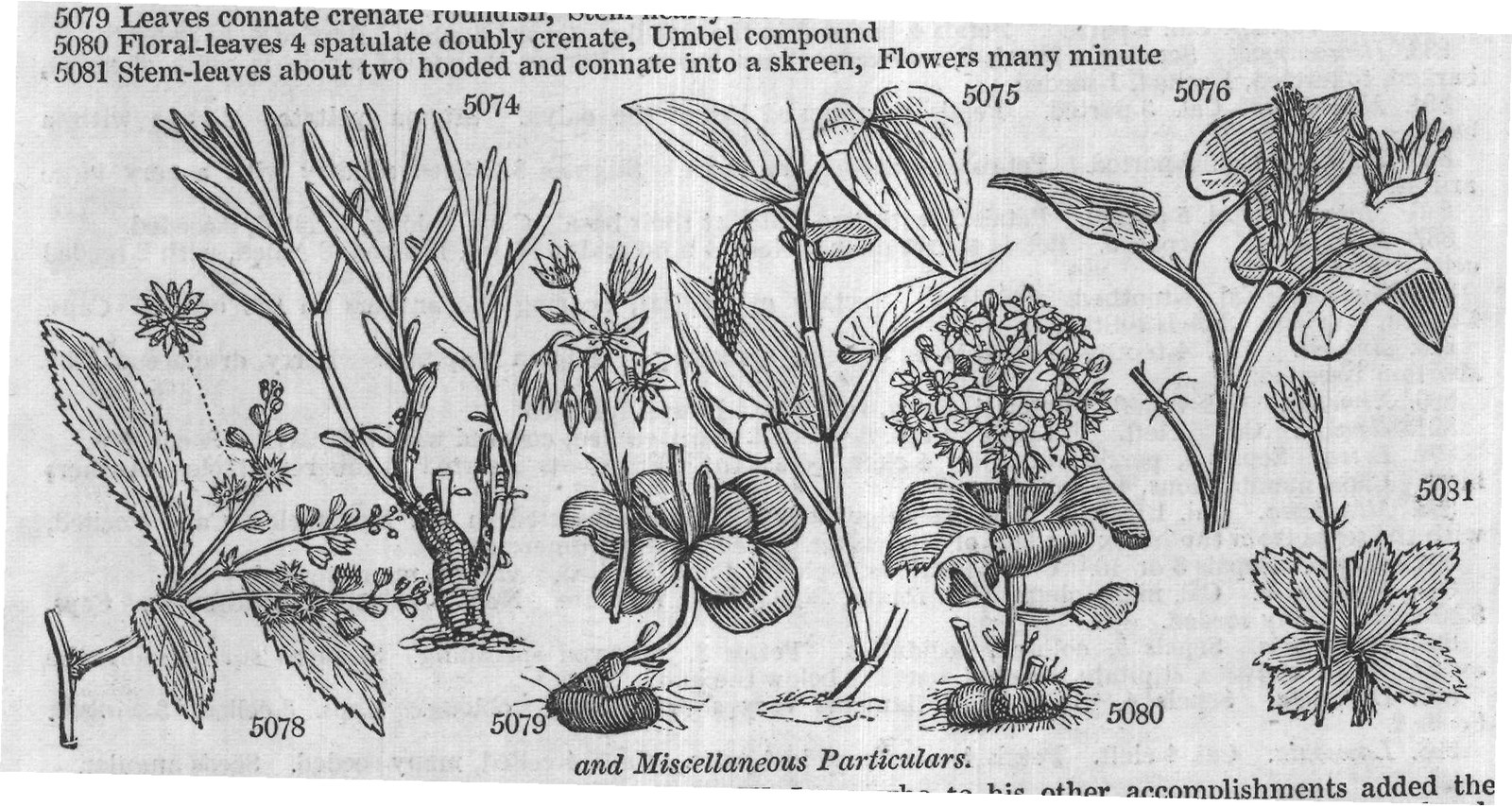
TETRAGYNIA. 5075 Leaves cordate stalked 5076 Leaves deeply cordate ovate-lanceolate shining 5077 Leaves cordate ovate acuminate shining nerved 5078 Leaves ovate lanceolate serrated HEPTAGYNIA. 5079 Leaves connate crenate roundish, Stem nearly leafless 5080 Floral-leaves 4 spatulate doubly crenate, Umbel compound doubly crenate, Umbel compound 5081 Stem-leaves about two hooded and connate into a skreen, Flowers many minute two hooded and connate into a skreen, Flowers many minute 5078 5074 5079 5075 5080 5076 5031 and Miscellaneous Particulars. 867. Jonesia. Named in honor of the famous Sir W. Jones, who to his other accomplishments added the knowledge of botany. The most fragrant tree of India. Large cuttings root well in sand under a handglass. 868. Dracontium. From δράκωv, a dragon. The stems of some species are mottled like the skin of a snake. 869. Calla. A name of one of Pliny's plants, which probably was applied to something of the same natural order as that now called Calla. 870. Parinarium. The Guiana name of the genus is Parinari. Very fine trees with fine bunches of terminal flowers, which are succeeded by plum-like fruits, that in hot climates are esteemed and served up at table. It has been called Petrocarya by Schreber and other Linnæan botanists, who fancy science to depend Petrocarya by Schreber and other Linnæan botanists, who fancy science to depend upon names. 871. Limeum. An ancient name of a poisonous plant. It is derived from λoiμoς, post, poison. It was used, says Pliny, to poison arrows with. The plant to which modern botany has applied this name is a dangerous poison. 872. Saururus. From σauρa, a lizard, and ερa, a tail; on account of its long and pyramidal tail, which may be compared to the tail of a lizard. 873. Astranthus. From asgov, a segments of the flower . A small flowers. 874. Septas. From septem, seven. with umbels of white flowers.
Aquatic plants with neat foliage, but with no beauty in their flowers. star, and avθoς, a flower, on account of the star-like disposition of the Chinese bush with serrated leaves, and spikes of pale whitish green All the parts of the flower are in seven. Very neat little Cape plants, OCTANDRIA.
CLASS VIII.