Important: Safety Warning
This page prescribes plants as medicine according to pre-modern medical theory. Several of the plants named are toxic, correct identification is difficult, and the doses given have no scientific basis. Do not ingest or apply any preparation described here.
This page presents medical treatment from an era before modern medicine. The remedies described are ineffective against the conditions named, and some of the ingredients or doses are harmful. Do not use them to treat any illness; consult a qualified medical professional.
This information has been left in for historical purposes but should not be acted upon.
Home › F › Fumariaceæ (Sp my jl P Y Spain D co Bocc t)
Fumariaceæ (Sp my jl P Y Spain D co Bocc t)
Sp. 1-2. 1 my.jl P.Y Spain 1714. D co Bocc. 2. t. 73. f. 1 Fumariacea. Sp. 4-10.
CLASS XVII. 9981 officinális P. S. common 9982 capreoláta P. S. ramping B 9983 parviflóra P.S. small-flowered 9984 spicáta P. S. narrow-leaved 0000 W 2 my.au Pk W 4 my.s F W 2 au.s Pk W 8 jl.au F Britain cul.gr. Sco Britain corn fi. S co England corn fi. S co S. Europe 1714. Sco Eng. bot. 589 Eng. bot. 943 Eng. bot. 590 M.his.3. t.12.f.11 OCTANDRIA. 1508. POLY'GALA. W. MILKWORT.
Polygaleæ. 9985 incarnáta W. flesh-colored or 1 jn.jl Pk 9986 amára W. bitter or jn B Sp. 27-163.
N. Amer. 1812. S co Europe 1775. D l.p Pluk, t. 438. f. 5 Bot. mag. 2437 9987 vulgáris W. common or my.jn B Britain dry pa. D s.l Eng. bot. 76 9988 májor W. large Austrian or 1 jl.au R Austria 1739. D s.l Jac: aust.5. t.418 9989 paucifólia W. naked-stalked or my.au Pu N. Amer. 1812. D s.l 9990 bracteoláta W. spear-leaved or 6 my.o Pu C. G. H. 1713. S s.p Bot. mag. 345 9991 speciósa B. M. showy or 6 my.o Pu C. G. H. 1814. C s.p Bot. reg. 150 9992 teretifólia W. columnar-lvd. or 3 my.au Pu C. G. H. 1791. S s.p Bot. rep. 370 9993 purpúrea H. K. purple or 1 my.jn Pu N. Amer. 1791. C s.p 9994 virgáta Th. twiggy or 3 my.au Pu C. G. H. 1812. C s.p 9995 myrtifólia W.
Myrtle-leaved or 3 my.au Pu C. G. H. 1707. S p.1 Bot. reg. 669 9996 oppositifólia W. opposite-leaved or 2 my.au R C. G. H. 1790. C s.p Bot. mag. 492 9997 cordifólia W. heart-leaved or 3 mr.au Pu C. G. H. 1791. C s.p Bot. mag. 2438 9998 tomentósa W. woolly-leaved or 2 mr.au Pu C. G. H. 1812. C s.p 9999 Chamæbúxus W. Box-leaved or my.jn Y Austria 1658. Sk s.l Bot. mag. 316 10000 latifólia Ker. broad-leaved or my.jn Pu C. G. H. 1820. C s.l Bot. reg. 645 10001 liguláris Ker. strap-leaved or 1½ my.au Pu C. G. H. 1820. C s.p Bot. reg. 637 10002 filifórmis W. filiform or 1 my.d Pu C. G. H. 1812. C s.p 10003 micrántha W. small-flowered or 1 ja.d Pu C. G. H. 1800. S s.p Bot. rep. 324 10004 paniculáta W. panicled prjl.au 10005 Sénega W.
Rattlesnake root or W jl 10006 lútea W. golden or jn.jl Y 10007 viridéscens W. 10008 húmilis Lodd. greenish-flower.or jl.au dwarf pr my 10009 sanguínea W. purple-spiked or 1 jl.s 10010 verticilláta W. whorl-leaved or jl.au 10011 cruciáta W. four-leaved or jn.jl Pa.pu S. Amer. 1822. S co N. Amer. 1739. S co N. Amer. 1739. S co G.Pu N. Amer. 1815. S co Pk C. G. H. 1817. C s.p Pu N. Amer. 1739. S co W N. Amer. 1739. S co G.Pu N. Amer. 1739. S co Bot. cab. 490 Bot. reg. 761 Bot, mag. 1051 Plu.am. t.438.1.6 Pluk. t. 438.f.5 Pluk. t. 438. f. 4 1509. MURAL'TIA. Neck. MURALTIA.
Polygaleæ.
Sp. 4-37. 10012 Heistéria W.
Furze-leaved 10014 stipulácea W. 10015 míxta W. 10016 spinósa W. 10013 alopecuroídes W. Foxtail 1510. MUN'DIA. Kunth. MUNDIA. 1511. SECURIDA CA. W. SECURIDACA. stipuled Heath-leaved or ココココ or 6 ja.d Pu C. G. H. 1787.
C s.p Bot. mag. 340 or 3 my.au Pu C. G. H. 1800.
S s.p Bot. mag. 1006 or 3 ap.s R C. G. H. 1801.
C s.p Bot. mag. 1715 3 ja.d Pu C. G. H. 1791.
C s.p Bot. mag. 1714 Polygaleæ.
Sp. 1. spiny or 3 ja my Pu C. G. H. 1780. C s.p Polygaleæ.
Sp. 1-8. 10017 volúbilis W. 9980 climbing 9981 Σ ft 10 W ...
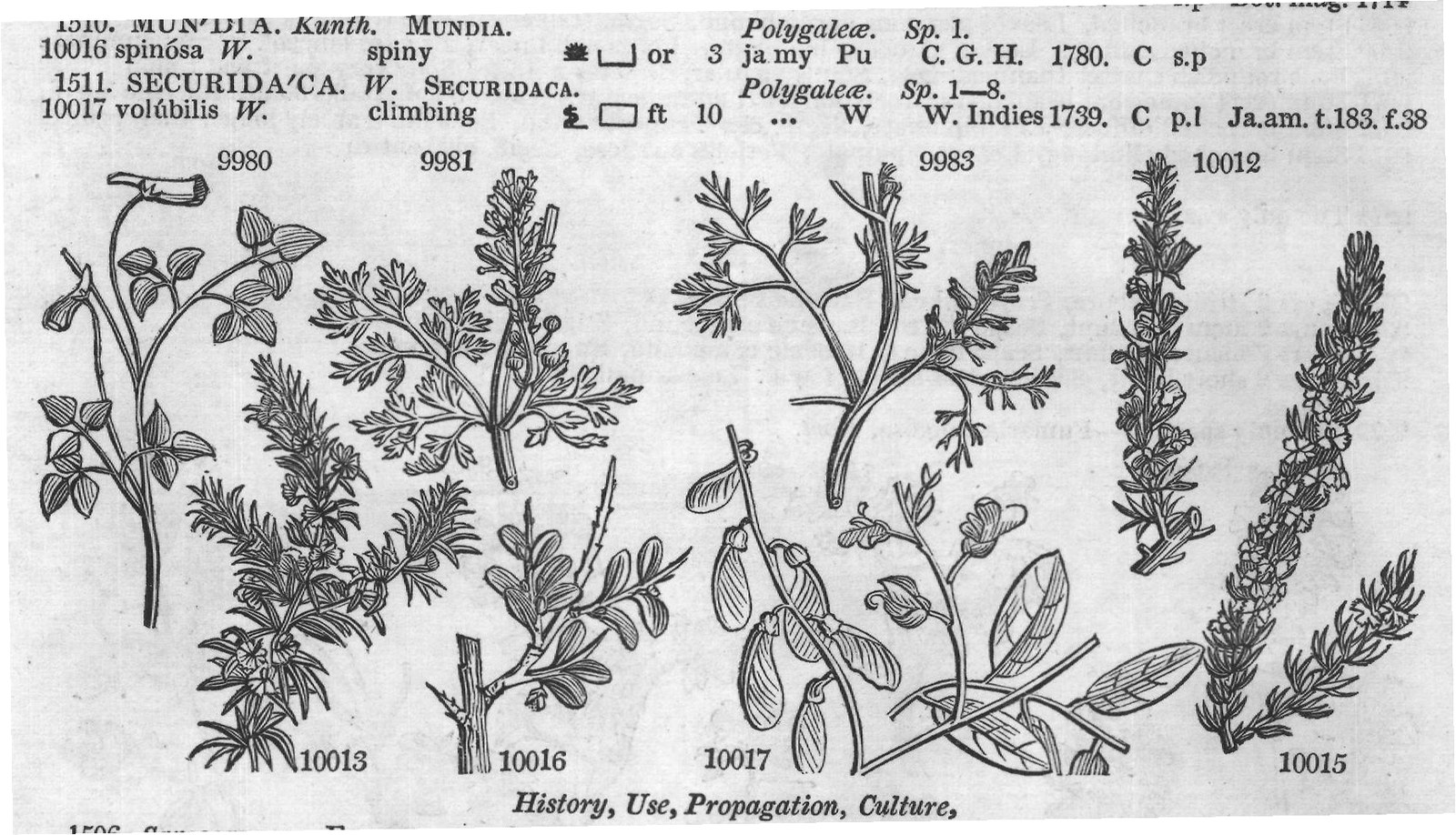
W. Indies 1739. C p.l Ja.am. t.183. f.38 9983 10012 10013 10016 10017 10015 History, Use, Propagation, Culture, 1506. Sarcocapnos. From σaρκoς, flesh, and κaπvoς, fumitory. So named by Decandolle on account of the fleshy substance of the leaves of the plants contrasted with those of other allied genera. 1507. Fumaria. From fumus, smoke; in allusion to the disagreeable smell of the plant. The French, with the same meaning, call it Fumeterre, whence our English word Fumitory. The species are handsome weeds. same meaning, call it Fumeterre, whence our English word Fumitory. The species are handsome weeds.
F. officinalis was formerly considered a valuable antiscorbutic, and much used in obstructions of the viscera. 1508. Polygala. From πoλu, much, and γaλa, milk.
Dioscorides says, that the plant was believed to excite the lacteal secretions in women. The species are handsome free-flowering plants. The greenhouse kinds are lacteal secretions in women. The species are handsome free-flowering plants. The greenhouse kinds are highly ornamental, and some of them continue in bloom all the winter: P. stipulacea all the year. They grow freely in sandy loam, or loam and peat; and are readily increased by cuttings of the young wood, in sand, under a bell-glass.
P. vulgaris was thought to possess something of the properties of P. Senega. Sir J. E. Smith found that an infusion of the herb taken in a morning, fasting, about a quarter of a pint daily, promoted expectoration, and was good in a catarrhous cough. He tried it at Montpelier by the advice of Professor Gouan with success, and has since known it useful. Foreign writers celebrate it as a grateful and nutritious food for cattle. According to the Swedish experiments, kine, sheep, and goats eat it, but swine refuse it.
P. Senega has a woody, branched, contorted root, about half an inch thick, and covered with ash-colored ORDER II.
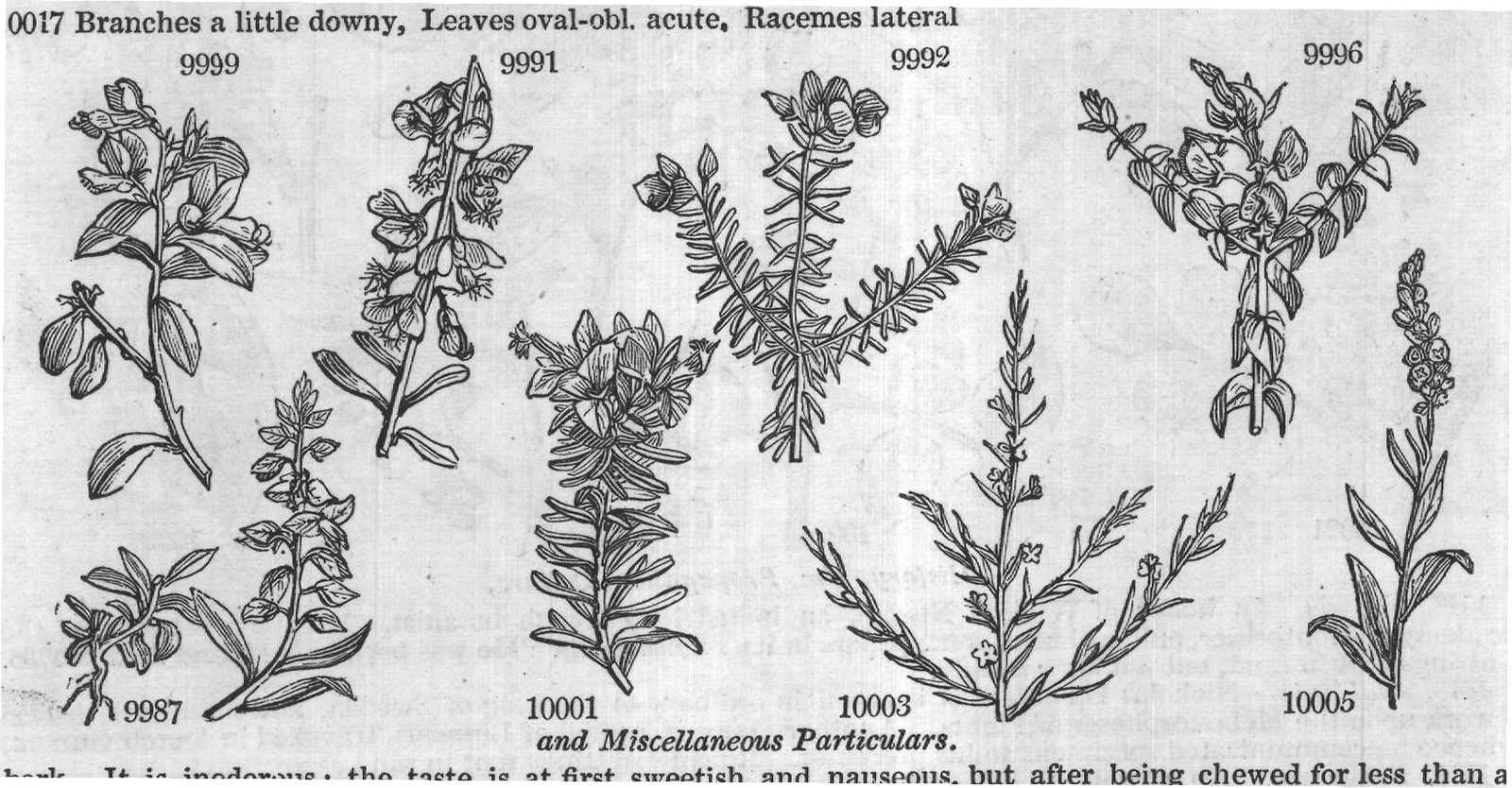
DIADELPHIA HEXANDRIA. 9980 Leaves with a branched stalk triternate, Segments ovate angular 9981 Pods round retuse, Pedicels of fruit erect twice as long as bractes, Racemes lax 9982 Pods globose, Pedicels of fruit recurved longer than bract, Racemes oblong 9983 Pods globose with a little point, Pedicels of fruit erect longer than bract 9984 Pods compressed oval smooth, Raceme spiked, Pedicels much shorter than bract OCTANDRIA. 9985 Flowers crested spiked, Stem herbaceous branched erect, Leaves alternate subulate 9986 Fl. crested racem. Wings of cal. 3-nerved blunt longer than cor. Stems erect, Lvs. blunt: radic. obovate 9987 Fl. crested racem. Wings of cal. 3-nerved blunt length of cor. Stems procumb. Leaves linear-lanc. acute 9988 Fl. crest. racem. Wings of cal. many-nerv. blunt mucron. short. than cor. Stems erect, Lvs. lin. lanc. acute 9989 Fl. crested term. in threes, Stems quite simple erect naked beneath, Leaves ovate 9990 Fl. crested, Raceme term. Wings of cal. cuspidate many-nerv. Stem erect shrubby, Lvs. lin. lanc. smooth 9991 Fl. crest. Appendage double, Racemes without bractes subterm. many-fl. Lvs. altern. obl. cuneate smooth 9992 Fl. crest. Raceme term. few-fl. Wings of cal. ovate acute many-nerved, Stem shrubby, Lvs. linear subulate 9993 Fl. crested somewhat umbelled, Leaves ovate fleshy 9994 Fl. crested racemose, Bractes 3-leaved, Leaves obovate oblong 9995 Fl. crested, Racemes few-fl. term. Keel falcate, Stem shrubby, Leaves obl. bluntish smooth 9996 Fl. crested, Stem shrubby, Leaves opposite ovate acute 9997 Fl. crested, Raceine terminal, Stem shrubby, Branches downy, Leaves cordate mucronate opposite 9998 Fl. crested whorled, Leaves cordate downy beneath 9999 Fl. beardless, Pedunc. terminal and axill. about 2-fl. Stem shrubby, Leaves obl. lanceolate acute 10000 Fl. crested, Branches downy, Leaves decussating coriaceous glaucous ovate downy beneath 10001 Fl. crest. Branches vill. Lvs. scattered lingulate smooth, Outer lobe of the petals of vexillum very short 10002 Fl. beardless lateral, Leaves solitary 3-cornered mucronate 10003 Fl. beardless axillary sessile, Leaves linear mucronate 10004 Fl. crested, Racemes axillary on long stalks, Stems erect branched upwards, Leaves linear acute 10005 Fl. beardless, Spike terminal filiform, Stem erect herbaceous quite simple, Leaves oblong lanceolate 10006 Fl. beardless, Raceme cylindr. capitate terminal, Stem simple, Leaves obl. lanc. acute 10007 Fl. beardless globose capitate terminal, Stem erect simple, Leaves linear bluntish 10008 Leaves ovate-lanceolate imbricated, Stem branched decumbent 10009 Flowers beardless, Pedunc. squarrose, Stem branched erect 10010 Flowers beardless distant, Leaves linear whorled, Stem branched 10011 Flowers beardless in headed spikes, Leaves in fours linear-lanceolate, Stem somewhat branched erect 10012 Fl. beardless lateral, Stem arborescent, Leaves 3-cornered mucronate spiny 10013 Fl. beardless, Peduncles solitary axillary, Leaves fascicled ovate mucronate ciliated at edge 10014 Fl. beardless lateral, Leaves in threes linear acute 10015 Fl. beardless sessile, Leaves round mucronate very close 10016 Leaves obovate or oval, Branches short spiny 10017 Branches a little downy, Leaves oval-obl. acute, Racemes lateral 9987 9999 9991 10001 9992 9996 10003 10005 and Miscellaneous Particulars. bark. It is inodorous; the taste is at first sweetish and nauseous, but after being chewed for less than a minute, becomes pungent and hot, producing a very peculiar tingling sensation in the fauces. Medically, it is considered stimulating, expectorant, and diuretic, and in large doses emetic and cathartic: it increases absorpion, and consequently augments the natural excretions, particularly that of urine, and frequently occasions a copious ptyalism. It was introduced to the notice of physicians by Dr. Tennant, who, having discovered that it was the antidote employed by the Senegare Indians against the bite of the rattle-snake, and and reasoning from the effects of the poison, and of the remedy in removing these, was induced to try it in pneumonic affections, and found it useful. On account of its stimulant properties, however, it can be employed in these complaints only after the resolution of the inflammation by bleeding and evacuations. It proves more directly useful in humoral asthma, chronic catarrh, and some kinds of dropsy. (Thomson's London Dispensatory, p. 450.) 1509. Muraltia. Named after John Von Muralt, a Swiss botanist, who lived in the commencement of the eighteenth century. Handsome bushes, of easy cultivation in a greenhouse, or even in a good pit. 1510. Mundia. So named, in allusion, we presume, to the neatness (munditia) of its appearance. No explanation of the word is given given by its author. Pretty little Cape bushes, easily cultivated in a good pit. 1511. Securidaca. From securis, a hatchet, in allusion to the form of the end of the pod. It grows freely in form of the end of the pod. It grows freely in light loam, or loam and peat; eat; and cuttings root in sand covered with a glass. 1512. NISSO'LIA. W.
NISSOLIA. 10018 fruticosa W. shrubby or 15 jl.n Y 10019 retúsa W. en. blunt or 6 ...
DIADELPHIA DECANDRIA.
Leguminosæ. Sp. 3-6. ...
CLASS XVII.
S. Amer. 1766. S p.l Jac. vind.2. t. 167 S. Amer. 1819. C s.l 10020 glabráta Link. polished or 12 W ... ...... 1823. C s.l 1513. DALBER GIA. W. DALBERGIA.
Leguminosæ. Sp. 4-9. 10021 latifólia W. broad-leaved or 30 W ...
E. Indies 1811. C s.l Rox. cor. 2. t.113 10022 rubiginósa W. climbing or 10 W ...
E. Indies 1811. C s.l Rox. cor.2. t.115 10023 paniculáta W. panicled or 30 W ...
E. Indies 1811. C s.l Rox. cor.2. t.114 1514. PONGA'MIA. Vent. PONGAMIA.
Leguminosæ. Sp. 1-3. 10024 glábra P. S. smooth-leaved or 30 ...
W E. Indies 1699. C s.1 Vent.malm. t.28 1515. PTEROCARPUS. W. PTEROCARPUS.
Leguminosæ. Sp. 3-9. 10025 Marsúpium W. emarginate-lvd. or 40 W ...
E. Indies 1811. C s.l Rox. cor.2. t.116 10026 lunátus W. crescent-podded or 6 W ...
S. Amer. 1792. C s.l Lam.ill. t.602.f.5 10027 santalínus W. Red Saunders Wood ec 60 ...
Y E. Indies 1800. C s.l 1516. ECASTAPHYLLUM. Rich. ECASTAPHYLLUM.
Leguminosæ. Sp. 1-4. 10028 Brow'nei Rich. oval-leaved or 10 W ...
W. Indies 1733. Cr.m Br. jam, t. 32. f.1 1517. GEOFFROYA. W. BASTARD CABBAGE-TREE. 10029 inérmis W.
Leguminosæ. Sp. 1-5. smooth 오 or 8 ...
Jamaica 1778. C p.l Ph.tran.1777.t.10 1518. DIP'TERIX. W. TONQUIN BEAN. 10030 odoráta W.
Leguminosæ. Sp. 1-2. sweet-scented ec 60 Pu ...
Guiana 1793. C l.p Aub. gui.2. t.296 1519. PARIVO'A. Aubl. PARIVOA.
Leguminosæ. Sp. 1. 10031 grandiflóra Aubl. large-flowered or 30 ...
Pu Guiana 1821. Cr.m Aub. gui. t. 303 1520. AMERIM'NUM. W. AMERIMNUM. 10032 Brównei W.
Leguminosæ. Sp. 3-5.
Browne's or 10 W ...
W. Indies 1793. 10033 latifólium W.
Cr.m Ja.am. t.180. f.58 broad-leaved or 12 ...
Y 10034 E'benus W.
S. Amer. 1814.
Jamaica Ebony or 12 jl.au Y W. Indies 1713.
C l.p Ja.am. t.177. f.50 C r.m Br. jam. t. 31. f.2 1521. ERYTHRI'NA. W. CORAL TREE. 10035 herbácea W.
Leguminosæ. herbaceous Sp. 10-21. or 3 jn.s S 10036 cárnea W.
Carolina 1724.
Cl.p Bot. mag. 877 flesh-colored 10037 Corállodendrum W. smooth-leaved or 12 my Pk Vera Cruz 1733. or 20 my.jn S 10038 índica W.
Indian or 20 S ... 10039 fúsca W. brown-flowered or 20 ...
S 10040 cáffra W.
Cape or 6 S ... 10041 pícta W. prickly-leaved or 6 S ... 10042 speciósa H. K. large-flowered or 10 au.o S W. Indies 1690.
E. Indies 1814. S r.m Rheed.mal.6. t.7 E. Indies 1800. C 1.p Rum.amb.2. t.78 C. G. H. 1816. C l.p Bot. reg. 736 E. Indies 1696. Sr.m Rum.amb.2. t.77 W. Indies 1805. S r.m Bot. rep. 443 S r.m Trew. ehret. t. 8 Sr.m Com.hor.1. t. 108 10018 10022 10025 10029 10021 10024 10026 10028 History, Use, Propagation, Culture, 1512. Nissolia. In honor of William Nissole, an industrious French botanist. He was a member of the academy of Montpellier, and author of some papers in its Transactions. He was born in 1647, and died in 1735. Cuttings root in sand, but not very readily. 1513. Dalbergia. Nicholas Dalberg was surgeon in ordinary to the king of Sweden, and published in 1755 a work upon the Metamorphoses of Plants. Another Dalberg, a pupil of Linnæus, travelled in Dutch Guiana, work upon the Metamorphoses of Plants. Another Dalberg, a pupil of Linnæus, travelled in Dutch Guiana, whence he communicated specimens to his preceptor. Ripened cuttings root in sand. 1514. Pongamia. An alteration of the vernacular name of the plant in India. 1515. Pterocarpus. From πτερov, a wing, and κaρπoς, fruit. Its pods have membranous wings. P. santalinus is a lofty tree, with alternate branches, and a bark resembling that of the common alder it yields the true a lofty tree, with alternate branches, and a bark resembling that of the common alder; it yields the true officinal red saunders wood, first detected by Kœnig in India. It is brought home in billets, which are very heavy, and sink in water. Red saunders wood has an aromatic odor, and is nearly insipid. It is extremely hard, of a fine grain, takes a high polish, and a bright garnet red color, which deepens on exposure to the air.
It yields its coloring matter, which appears to be of a resinous nature, to ether and alcohol, but not to water. (Thomson's London Dispensatory, 458.) The sap yields one sort of Sanguis draconis. Many of the red Indian woods trasude a blood red juice through the clefts of the bark, which hardens into a red resin, not differing from Sanguis draconis, which, therefore, is collected from several trees, and from this among others. ( Linn. Suppl.) This drug, however, is chiefly obtained from the P. Draco, and the fruit of Calamus Rotang. In our stoves these plants thrive in light loamy soil; and cuttings, with their leaves untouched, will root in sand under a common hand-glass. 1516. Ecastaphyllum. From εκaσoς, every one, and φuλλov, a leaf; that is to say, a leaf which is always simple, and not compounded of several others, as those of neighbouring genera. 1517. Geoffroya. In honor of Etienne Francois Geoffroi, Memb. Acad. Par., Professor of botany at the Jardin du Roi, and a foreign member of the Royal Society of London. He was the author of several medical botanical Roi, and a foreign member of the Royal Society of London. He was the author of several medical botanical works, especially of a Materia Medica. He was born in 1672, and died in 1731. A tree, branchy at top, with a smooth grey bark and pinnate leaves; and, what is remarkable in papilionaceous plants, a drupe for a fruit. ORDER IV.
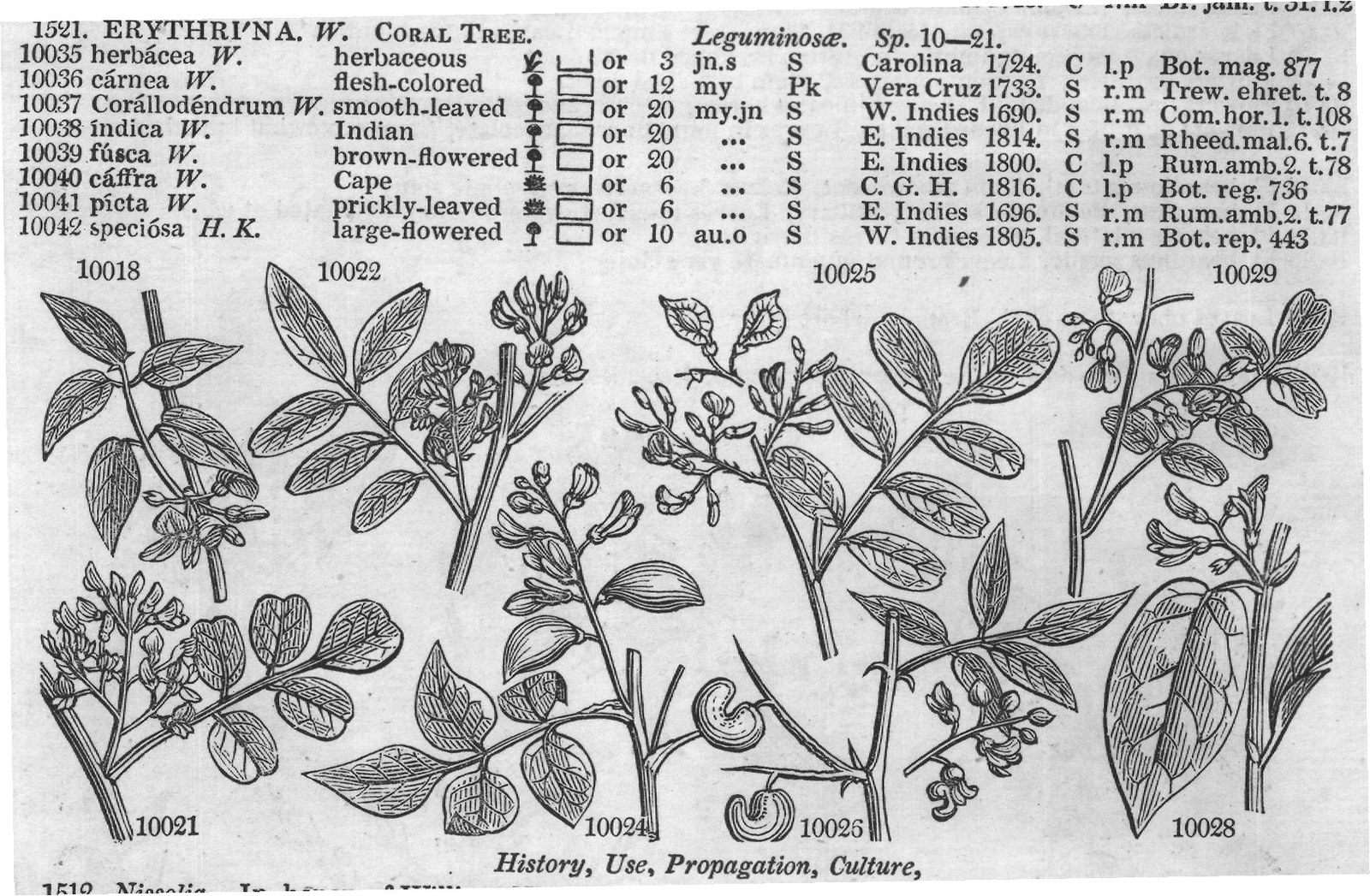
DIADELPHIA DECANDRIA. 10018 Stem shrubby twining, Leaves pinnated, Leaflets ovate acute smoothish 10019 Leaves pinnated, Leaflets ovate -oblong emarginate 10020 Leaves ternate and quinate, Leaflets oval acuminate smooth, Fl. racemose 10021 Leaves pinnated, Leaflets roundish emarginate, Fruit lanceolate 10022 Leaves pinnated, Leaflets obl. obtuse, Branches and petioles downy 10023 Leaves pinnated, Leaflets ellipt. emarginate smooth, Panicle terminal, Fruit lanceolate 10024 Leaves pinnated, Leaflets ovate acuminate smooth, Fruit ovate acute veinless 10025 Leaves pinnated, Leaflets elliptical emarginate, Stipules none, Panicle termin. 10026 Leaves pinnated, Spines stipulary, Fruit lunate 10027 Leaves ternate roundish blunt quite smooth, Petals crenate wavy 10028 Leaves simple cordate-ovate downy beneath 10029 Unarmed, Leaflets ovate-lanceolate 10030 Leaves alternate, Raceme terminal 10031 Leaves pinnated, Flowers smooth 10032 Unarmed, Leaves simple stalked alternate subcordate ovate, Racemes compound axillary and lateral 10033 Leaves pinnated, Leaflets ovate acuminate, Stem arboreous 10034 Spiny, Leaves subsessile aggregate obovate oblong, Peduncles 2-flowered 10035 Leaves ternate rhomboid smooth, Stem herbaceous unarmed, Calyxes truncate 10036 Leaves ternate smooth, Stem arboreous prickly, Calyxes campanulate truncate 10037 Leaves ternate unarmed, Stem arboreous prickly, Calyxes truncate 5-toothed 10038 Leaves ternate unarmed, Stem arboreous prickly, Calyxes spathaceous 10039 Leaves ternate unarmed lanceolate, Stem arboreous prickly, Calyxes bifid 10040 Leaves ternate unarmed, Leaflets blunt, Stem arboreous prickly 10041 Leaves ternate prickly , Stem arboreous prickly 10042 Leaves ternate prickly beneath, Petioles unarmed, Stem prickly 10031 10030 10034 10035 10037 10038 10042 and Miscellaneous Particulars.
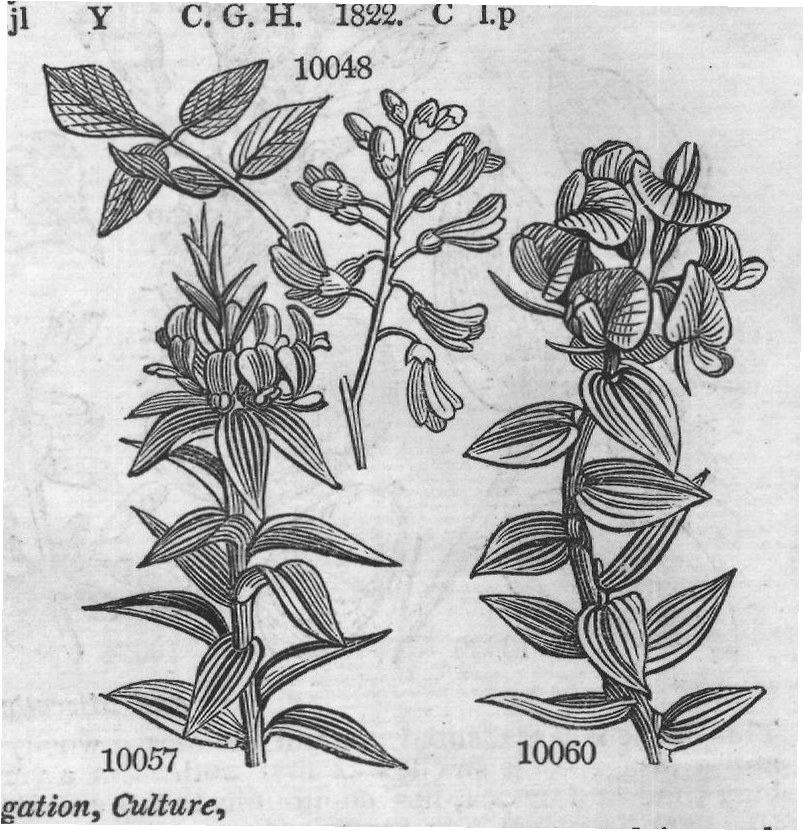
This drupe is large, subovate, and incloses a woody nut. The bark, which has a mucilaginous sweetish taste and a disagreeable smell, was first noticed as a vermifuge by Peter Duguid; but Dr. Wright, who resided a long time at Jamaica, has communicated the fullest information concerning this tree. According to him, the bark is powerfully medicinal; and its anthelmintic effects have been established at Jamaica by long experience. 1518. Dipterix. From δiς, double, and πτερuξ, a wing, in allusion to the two appendages of the calyx. A tree much branched at top, with large alternate pinnate leaves, and racemes of flowers succeeded by almond-like fruits. The kernels of these are very fragrant, and are put by the Creoles into chests of clothes, in order to drive away insects, and communicate a grateful odor. They are in their own country called Tonga, and are the sweet-scented seed sold in shops under the corrupted name of Tonquin bean, for perfuming snuff and other substances. Ripened cuttings root in sand in moist heat. 1519. Parivoa. The name of the tree in Guiana. A very handsome tree. 1520. Amerimnum. One of the names given to the Houseleek by the Greeks. It is derived from a, privative, and usgina, care, because the plants require no attention. It is not easy to tell why the name was x, applied , and μερiμva, care, because the plants require no attention . It is not easy to tell why the name was applied to this genus, which has nothing in common either with the Houseleek or its ancient name. A. Ebenus is common in the West Indies, and the wood is sent to Europe under the name of American Ebony. Though not the true ebony, yet being of a fine greenish-brown color, and polishing well, it is much coveted by the instrument makers, and is of a very hard durable nature. The flowers of Amerimnum latifolium are yellow, and smell like new hay. In our stoves the species may be treated like Pterocarpus. 1521. Erythrina. From ερuθρoς, red; nearly all the species being remarkable for the brilliant scarlet color of their flowers. The species are small trees, prickly or unarmed, or else shrubs, sometimes almost herbaceous flowers. The species are small trees, prickly or unarmed, or else shrubs, sometimes almost herbaceous; leaves, as in Dolichos, ternate, stipulaceous, the petiolules jointed and awned, or glandular, very seldom simple; flowers in fascicles from the axils, or in spikes at the end of the stem and branches, often scarlet. (Jussieu.) In our stoves they thrive well in a light loamy soil. to place them on a dry shelf in winter, when they have no leaves, and give them scarcely any water when our stoves they thrive well in a light loamy soil. " The best way to flower them," Sweet observes, is place them on a dry shelf in winter, when they have no leaves, and give them scarcely any water; when "The best way to flower them," Sweet observes, "is they show flower-buds, they may be plunged in a moist heat, which will make the flowers finer than they DIADELPHIA DECANDRIA.
CLASS XVII. 10043 Crísta-galli W.
Cock's-Comb or 40 my.jl S 10044 ovális Wall. oval or S Brazil Nepal 1771. Sr.m Exot. bot. 2. t. 95 1820. C l.p 1522. BU'TEA. W.
BUTEA.
Leguminosæ. Sp. 2. 10045 frondósa W. downy-branch. 10046 supérba W. smooth-branch. spl 30 spl 30 S E. Indies 1796. Cr.l S E. Indies 1798. Cr.l Roxb. cor.1. t.21 Roxb. cor. 1. t.22 ... 1523. VIBOR'GIA. W. VIBORGIA.
Leguminose. Sp. 1-4. 10047 serícea W. silky or 3 jl.au C. G. H. 1780. C l.p 1524. PISCI DIA. W.
PISCIDIA.
Leguminosæ. Sp. 1-5. 10048 Erythrína W.
Jamaica Dogw. tm 25 ...
W W. Indies 1690. S p.1 Lam. ill. t. 605 1525. PLATYLO BIUM. Sm. FLAT-PEA.
Leguminosæ. Sp. 3-5. 10049 formósum H. K. large-flowered or 4 jn.au Or N. S. W. 1790. S s.p Bot. mag. 469 10050 parviflórum H. K. small-flowered or 4 my.s Or N. S. W. 1792. S s.p Bot. mag. 1520 10051 trianguláre H. K. triangular-lvd.or 4 jn.s Or V. Di. L. 1805. S s.p Bot. mag. 1508 1526. BORBO'NIA. W. BORBONIA.
Leguminosæ.
Sp. 9-11. 10052 ericifólia W.
Heath-leaved or 4 jl.au Y C.G. H. 1812. C l.p 10053 trinérvia W. three-nerved or 6 jl.au Y C. G. H. 1759. S p.l Plu.alm.t.297.f.4 10054 lanceoláta W. many-nerved or 5 jl.au Y C. G. H. 1752. C p.l Jac.schœ.2.t.217 10055 perfoliáta W. 10056 unduláta W. perfoliate or 6 jl.au Y C. G. H. 1812. C p.l wave-leaved or 4 jl.au Y C. G. H. 1812. C p.l 10057 cordáta W. heart-leaved or 6 jl.s Y C. G. H. 1759.
S p.l Jac.schœ.2.t.218 10058 crenáta W. notch-leaved or 6 jn.au Y C. G. H. 1774. S p.1 Bot. mag. 274 10059 lævigáta B. C. 10060 ruscifólia B. M. polished or 3 jl.au Y C. G. H. 1799. S p.l Bot. cab. 247 Butcher's Broom or 3 jl Y C. G. H. 1790. S p.1 Bot. mag. 2128 1527. RAF'NIA. Th.
RAFNIA.
Leguminosa.
Sp. 1-4. 10061 triflóra W. three-flowered or 3 jn.jl Pu C. G. H. 1786. S s.1 Bot. mag. 482 1528. ASPAʼLATHUS, W. ASPALATHUS.
Leguminosæ.
Sp. 18-75. 10062 Chenopóda W.
Goosefoot pr 3 jl.au Y C. G. H. 1759. C p.l