Home › F › Fumariaceæ (Sp africana W en)
Fumariaceæ (Sp africana W en)
Sp. 1. 9974 africana W.en.
African or 4 jn.jl Y C. G. H. 1696. S s.l Boer. lug. 1. t.300 Fumária vesicária H. K. 1504. DICLY'TRA. Dec. DICLYTRA.
Fumariacea. Sp. 4-8. 9975 Cucullária Dec. naked-stalked 9976 formósa Dec. blush 9977 exímia Dec. choice 9978 canadénsis Dec.
Canadian পপপপ or jn.jl W N. Amer. 1731.
D s.p Bot. mag. 1127 or 1 jn.jl F N. Amer. 1796.
D p.l or 1 jn.jl F N. Amer. 1812.
D p.l Bot. mag. 1335 Bot. reg. 51 or jn.jl Pk N. Amer. 1819.
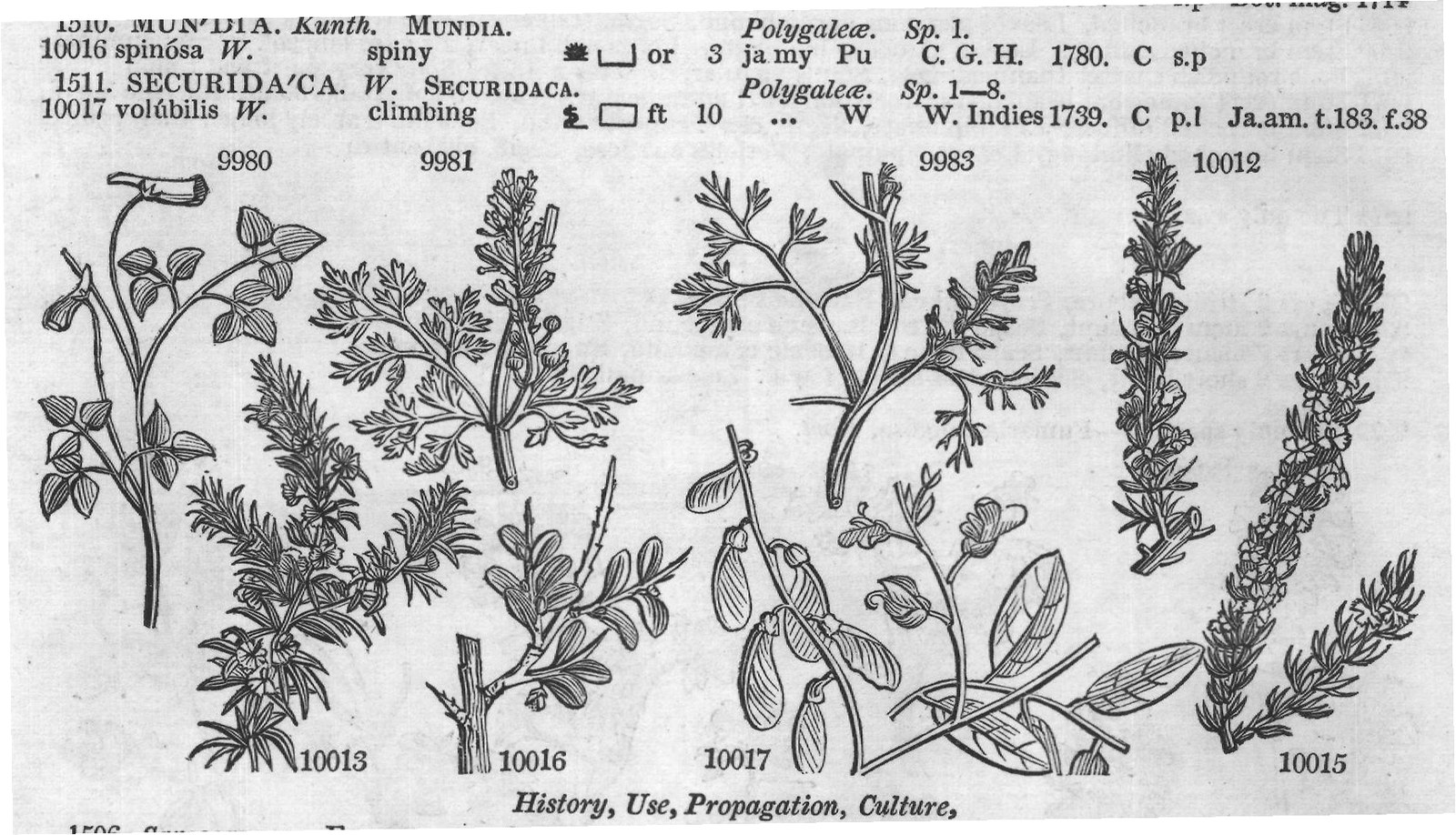
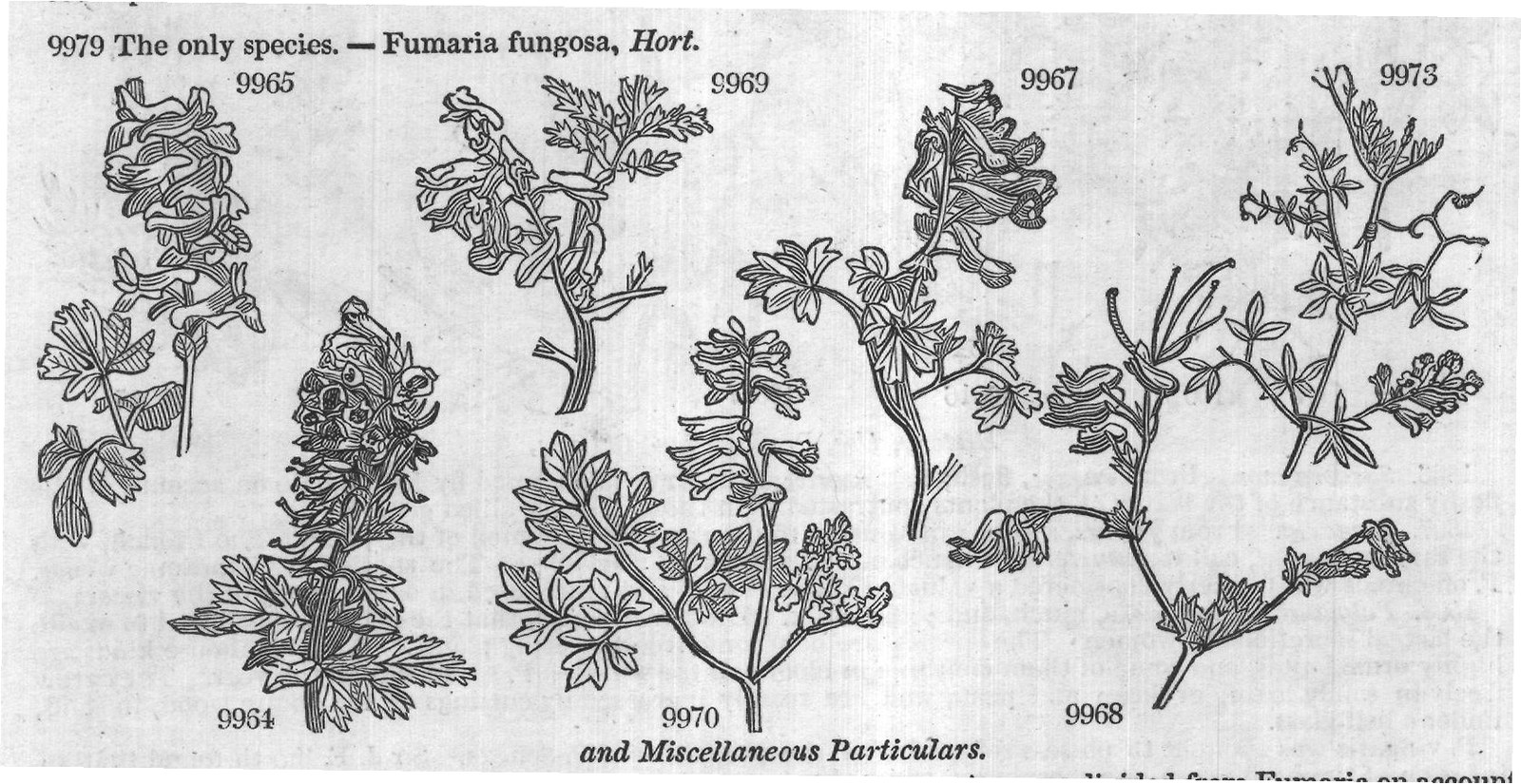
D co 9979 cirrhósa Raf. 1505. ADLU'MIA. Raf. ADLUMIA. spongy-flower'd or 15 jn.s W.pu N. Amer. 1778. D s.1 Vent.Choix.t.19 Fumariacce. Sp. 1. 9959 9975 9976 9977 9962 9960 9974 9979 History, Use, Propagation, Culture, 1500. Monnieria. In memory of Monsieur Le Monnier, professor of botany in the garden of plants at Paris. He published, in 1745, "Observations sur les Plantes dangereuses des Pyrénées et du Roussillon." 1501. Petalostemum. From πετaλov, a petal, and σημov, a stamen; in allusion to the union of these two parts into a tube. 1502. Corydalis. Koρuδaλiς is an ancient Greek name for the Fumitory, from which genus this has been separated. Pretty little plants, well adapted for rook-work or growing on pots. They are easily cultivated and increased.
CLASS XVII.
DIADELPHIA. 1591. Galega. Cal. with subulate nearly equal teeth. Legume with oblique streaks between the seeds. 1592. Phaca. Cal. 5-toothed, two upper teeth most distant. Legume half 2-celled, inflated. 1593. Oxytropis. Carina ending in a mucro. Legume 2-celled or half-2-celled, with the upper suture turned inwards. 1594. Astragalus. Legume 2-celled, more or less gibbous, with the lower suture turned inwards. Carina blunt. 1595. Biserrula. Legume 2-celled, flat, with a contrary dissepiment serrated on each edge. 1596. Dalea. Alæ and carina adhering to the column of stamens. Stamens 5-10, united, without a separate . Stamens 5-10, united, without a separate filament. Legume 1-seeded. 1597. Psoralea. Cal. the length of pod. 1598. Melilotus. Cal. tubular, 5-toothed. than calyx, rugose.
Stamens diadelphous. Legume 1-seeded, subrostrate, valveless. Carina simple, shorter than alæ and vexillum. Legume longer 1599. Lupinaster. Cal. campanulate, 5-toothed, with setaceous teeth. Stigma uncinate. Legume not knotted, round, many-seeded. 1600. Trifolium. Legume (in general) shorter than the cal., 1 or many-seeded, indehiscent, deciduous. Flowers more or less capitate. 1601. Lotus. Legume cylindrical, straight. Alæ of the cor. cohering by their upper edge. Filaments dilated upwards. 1602. Tetragonolobus. The characters of Lotus, but the pod square with 4 wings. 1603. Trigonella. Vexillum and alæ nearly equal, spreading, in the form of a tripetalous corolla. the form of a tripetalous corolla. 1604. Dorycnium. Cal. 5-toothed, 2-lipped. Filaments subulate. Stigma capitate. Legume turgid, 1 or . Stigma capitate. 2-seeded. 1605. Medicago. Legume falcate or spirally twisted, compressed, membranaceous. 1606. Hymenocarpus. Lik Like Medicago, but the legumes reniform, winged at edge. 1 PENTANDRIA. 9959 Stem dichotomous, Leaves ternate, Spike bifid 9960 Spike cylindrical stalked, Bractes longer than flower, Leaves in 3 pairs lanceolate 9961 Spike cylindrical stalked, Bractes subulate length of calyx, Leaflets lanceolate 9962 Spike cylindrical stalked, Bractes nearly as long as calyx, Leaves in 2 pairs linear calyx, Leaves in 2 pairs linear 9963 Heads with a scaly involucre, Calyxes plumose, Leaflets linear pointless HEXANDRIA. 9964 Stem erect simple without scales, Leaves bipinnate, Lobes cuneate cut at end, Bractes acute 9965 Stem simple without scales, Lvs. 2 biternate, Segm. cuneate multifid, Bractes ovate entire, Roots hollow 9966 Stem subsimple erect with scales below the lowest leaf, Leaves 3-4-stalked biternate, Segments obl. blunt 9967 Stem subsimple erect with scales below the lowest leaf, Lvs. 3-4-stalk. bitern. cut, Segm. cuneate or oblong 9968 Stem erect branched, Leaves glaucous decompound , Segm. stalked cuneate trifid, Pods linear 9969 Stem branched diffuse, Leaves glaucous bipinnate, Lobes obl. linear, Bractes lanceol. linear acuminate 9970 Pods roundish shorter than peduncle, Stems angular, Bractes minute, Spur very short and round 9971 Stem erect somewhat branched scarcely longer than radical lvs. Lvs. on long stalks 3-cut, Raceme few-fl. 9972 Stem branched diffuse, Lvs. bipinnate, Segm. obov. cuneate trifid, Pods lin. scarcely longer than pedicel 9973 Stem branched climbing, Leaves bipinnate, Petioles cirrhose, Segm. oval entire 9974 The only species 9975 Spurs 2 straight acute, Scape naked, Raceme simple 9976 Spurs 2 incurved blunt, Scape naked, Raceme compound, Stigma with 2 angles 9977 Spurs 2 incurved blunt, Scape naked, Raceme compound, Stigma with 4 angles 9978 Spurs 2 short blunt, Scape naked simple few-fl. Leaves multifid 9979 The only species. - Fumaria fungosa, Hort. 9965 9969 9967 9973 9964 9970 and Miscellaneous Particulars. 9968 1503. Cysticapnos. From κuσiς, a bladder, and κaπvoς, fumitory. A genus divided from Fumaria on account of its bladdery fruit. 1504. Diclytra. So named by Borckhausen, a German botanist, on account of the two spurs or pouches of the flower. Handsome herbaceous plants, frequently cultivated among choice collections of rare flowers. Their roots are impatient of cold and wet, and should therefore be planted in a warm dry border well exposed to the southern sun. 1505. Adlumia. A name unexplained by its author, M. Rafinesque Schmalz. A tall climbing annual plant of little beauty in its flowers, but covering a large space in the course of a summer. of a summer. 1506. SARCOCAPNOS. Dec. SARCOCAPNOS. 9980 enneaphýlla Dec. nine-leaved or 1507. FUMA'RIA. P. S. FUMITORY.
DIADELPHIA HEXANDRIA.