Important: Safety Warning
This page prescribes plants as medicine according to pre-modern medical theory. Several of the plants named are toxic, correct identification is difficult, and the doses given have no scientific basis. Do not ingest or apply any preparation described here.
This information has been left in for historical purposes but should not be acted upon.
Ficoideæ
Sp. 1.
Hypericum-like w pr 2 jl.o Pu Syria Zorn. ic. 119 Sch. han.2. t.146 Bot. mag. mag. 1265 1265 Bot. mag. 1264 1800. Ls.p Bot. reg. 845 Bot. mag. 22 linifólia P. L. 1211. COLBERTIA. Salisb. COLBERTIA.
Dilleniacea.
Sp. 1. 7896 coromandelianaSal. Coromandel or 15 mr.ap Y Coroman. 1803. L p.l Roxb. cor. t. 20 1212. TETRA CERA. L. TETRACERA. 7897 potatória Afz.
Dilleniaceæ. Sp. 1-23.
Water Vine $ or 20 ... ...
S. Leone 1822. L p.l POLYGYNIA. 1787. R m.s Bot. mag. 903 Casp. Sea 1822. R m.s Carolina 1810. R m.s 1213. NELUMBIUM. J. SACRED-BEAN. 7898 speciósum W.
Nymphæceæ.
Sp. 2.
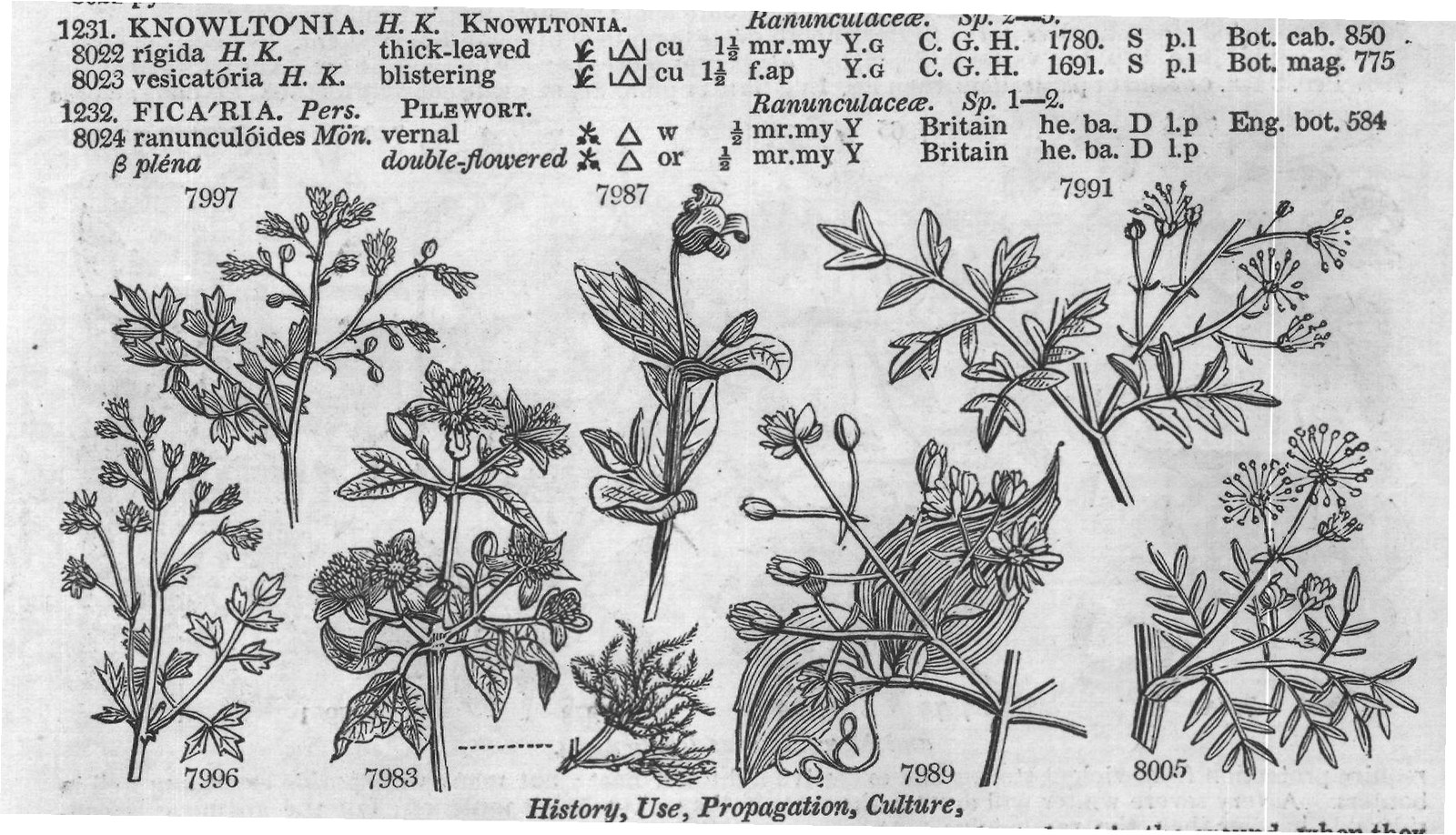
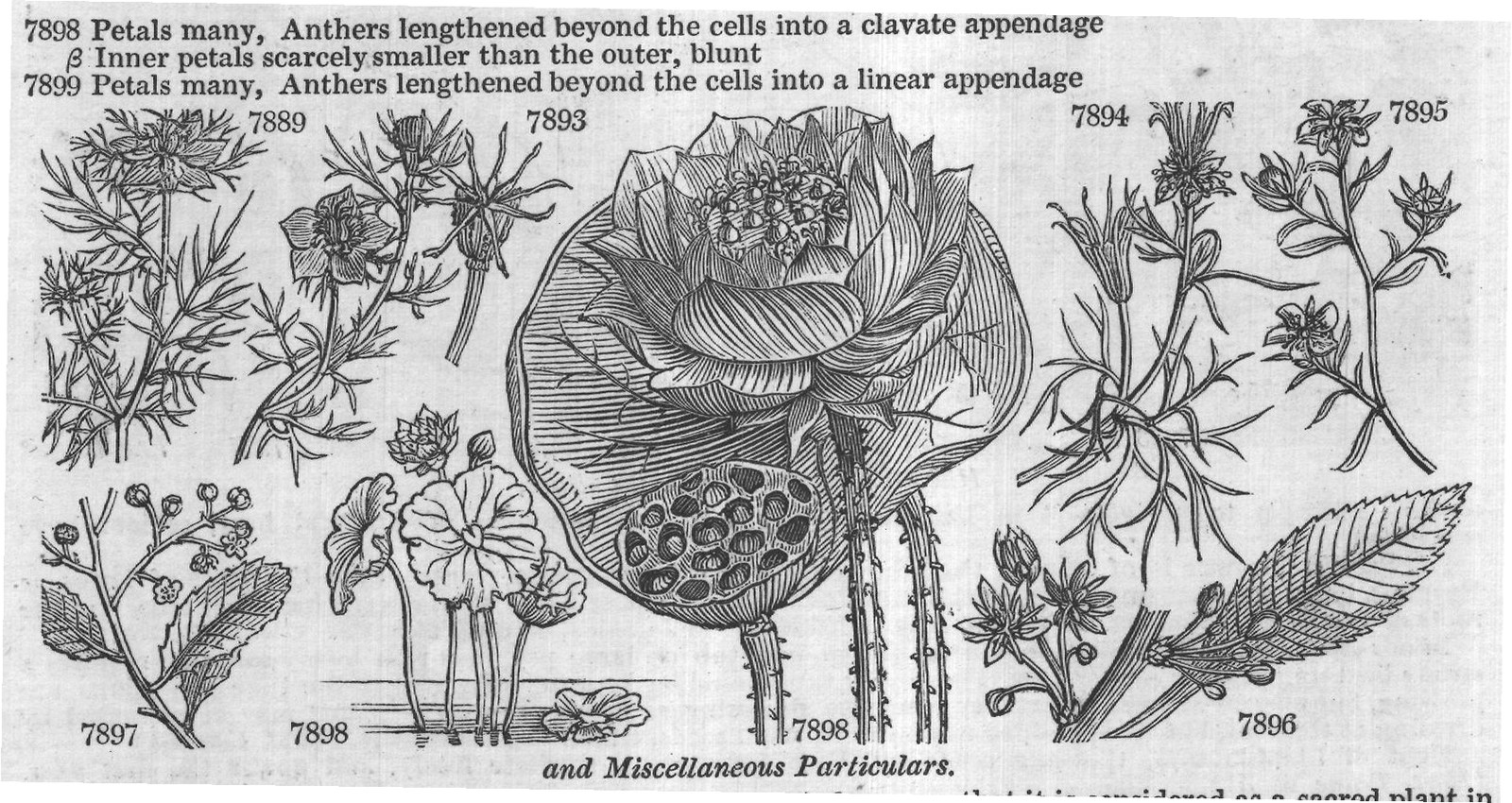
Indian or jn.au Pk India ẞ cas'picum Fisch. 7899 lúteum W. 7877 Caspian or yellow-flowered or Pk Y ... 7878 7879 7882 7884 7885 7886 7880 7887 History, Use, Propagation, Culture, 1207. Cimicifuga. From cimex, a bug, and fugo, to drive away, indicating certain virtues a species is supposed to possess. The C. serpentaria is used with success by the native practitioners in North America, for curing the dangerous bite of the rattlesnake. Tall, leafy, herbaceous plants, with the appearance of Actæa. 1208. Aquilegia. From aquila, an eagle; the inverted spurs of the flower have been likened to the talons of a bird of prey. The species are smooth-leaved, handsome-flowered plants. A. vulgaris is an old inhabitant of the flower border: the whole plant has been recommended to be used medicinally, but it belongs to a suspicious natural order, and Linnæus affirms, that children have lost their lives by it. A. alpina is the handsomest species. 1209. Nigella. From niger, black, because of the color of the seeds, which are the part of the plant known in cookery. The species are curious or neat little plants, with fine cut leaves like fennel. N. damascena and sativa are sown as hardy annual flowers; and on the continent, the leaves and seeds of the latter species and N. arvensis, are used in cookery instead of more expensive aromatics. They are also said to be extensively used in the adulteration of pepper. 1210. Reaumuria. So named by Hasselquist, in honor of René A. F. de Reaumur, author of several entomological works; Histoire des Insectes, &c. He died in 1757. A small cæsious plant, bearing an abundance of bright lilac flowers. 1211. Colbertia. Named by Mr. Salisbury after the famous Colbert, a patron of the Paris garden, who destroyed with his own hands the vines which had been planted therein in lieu of more curious objects. A fine plant, with leaves like those of Dillenia speciosa. 1212. Tetracera. From τετρa, four, and κερaς, a horn, because of its four capsules recurvèd like as many horns. Shrubs or small trees, which are often climbers with alternate stalked naked leaves, often rough above. The flowers are panicled or racemose. The leaves are remarkable as an exemplification of that mode of nervation which M. Decandolle calls feather-nerving. 1213. Nelumbium. This is called in Ceylon Nelumbo. Sir James Smith proposed to call the genus by the more classical name of Cyamus, but it has been remarked, that it remains to be proved that the holy κuaμoς, was this plant. N. speciosum is a native both of the East and West Indies, China, Cochin-China, and Japan, ORDER IV.
POLYANDRIA PENTAGYNIA. 7877 Monogynous, Racemes very long, Caps. dry dehiscent, Leaves biternate with serrate or cut segments 7878 Ovaries 4 subsessile very vill. Racemes panicled," Lvs. ternate or biternate, Segm. ovate-lanc. cut toothed 7879 Ovaries 2-3 smooth sessile, Racemes panicled, Leaves biternate, Segments cordate at base 7880 Ovaries 12-15 in a roundish head, Racemes dichotomous panicled, Leaves palmate 7881 Spurs incurved, Caps. vill. Stem few or 1-fl. Lvs. covered with viscid down, Styles not longer than stamens 7882 Spurs incurved, Caps. villous, Stem leafy many -fl. Leaves nearly smooth, Styles not longer than stamens 7883 Spurs incurved twice as short as petals, Upper part of the plant and capsules covered with glandular hairs 7884 Spurs straight longer than limb, Stam. as long as petals, Styles long, Petals oval obl. shorter than petals the as petals, Styles long, Petals oval obl. shorter than petals 7885 Spurs straight longer than very blunt limb, Styles scarcely longer than stamens and petals, Sepals acute the length of petals 7886 Spurs straight somewhat incurved at end twice as short as limb of petals, Stem 2-3-fl. leafy, Lvs. finely cut length of petals 7887 Spurs straight, Styles and stamens exserted, Sepals acute a little longer than petals, Segm. of leaves 3-parted 7888 Spurs straight as long as limb, Styles and stamens as long as sepals, Sepals the length of petals 7889 Anthers blunt, Caps. 5 smooth 2-cell. united as far as end into an ovate globose one, Fls. in a leafy involucre 7890 Anthers blunt, Flowers in an involucre, Sepals erect conniving 7891 Anthers blunt, Caps. muricate, Stem erect hairy, Flowers naked 7892 Anthers pointed, Styles 5-7 revolute, Capsules sules and stem smooth, Branches diverging 7893 Anthers pointed, Styles 8-10 erect, Caps. smooth 1-nerved at back, Stem erect smooth, Branches erect 7894 Caps. 5-10 smooth erect, Styles straight 7895 A low shrub, with narrow glaucous leaves 7896 Leaves smooth 10-nerved 1-1 foot long 6 inches broad 7897 Lvs. oval-obl. blunt or nearly acute smooth roughish above somewhat toothed at end, Pedunc. panicled POLYGYNIA. 7898 Petals many, Anthers lengthened beyond the cells into a clavate appendage β Inner petals scarcely smaller than the outer, blunt 7899 Petals many, Anthers lengthened beyond the cells into a linear appendage 7897 7889 7898 7893 7898 [pubescent 7894 7895 7896 and Miscellaneous Particulars.
Persia, and some parts of the Russian empire. Thunberg informs us, that it is considered as a sacred plant in Japan, and pleasing to their deities, and that the images of their idols were often drawn sitting on its large leaves. The long stalks are there eaten among other potherbs. Loureiro relates, that it abounds in muddy marshes in India and China, and is cultivated in large handsome pots in the gardens and houses of the mandarins that there is a variety with the flower of a pure white, and another with a very beautiful luxuriant flower, having about one hundred large petals, white or rose-colored. Both root and seeds are esculent, sapid and wholesome. In China it is called Lien-wha, and the seeds and slices of the hairy root, with the kernels of apricots and walnuts, and alternate layers of ice, were frequently presented to the British ambassador and his suite at breakfasts given by some of the principal mandarins. The Chinese have always held this plant in such high value, that at length they regarded it as sacred. That character, however, has not limited it to merely ornamental purposes; for the roots are not only served up in summer with ice, but they are also laid up in salt and vinegar for the winter. The seeds are somewhat of the size and form of an acorn, and of a taste more delicate than that of almonds. The ponds are generally covered with it, and exhibit a very beautiful appearance, when it is in flower; and the flowers are no less fragrant than handsome. Sir George Staunton remarks, that the leaf, besides its common uses, has, from its structure, growing entirely round the stalk, the advantage of defending the flower and fruit arising from its centre from contact with the water, which might injure them. He also remarks, that the stem never fails to ascend in the water from whatever depth, unless in case of a sudden inundation, until it attains the surface, when its leaf expands, rests, and swims upon it, and sometimes rises above it. This plant bears the rigorous cold of the Pekin winter, though it is reared with difficulty in European stoves. It often grows spontaneously in China, and is propagated in the open air with ease both by the seed and root. The Chinese distinguish many varieties of it.
From the root of the Nelumbo, Sir George Staunton says, the Egyptians are supposed to have prepared their Colocasia, but the plant is now no longer found in that country from which circumstance some naturalists infer, that it never was indigenous there, but cultivated by the inhabitants with extreme care. The ancient Romans made repeated efforts to raise it among them, from seeds brought out of Egypt; and the 1214. DILLENIA. W.
DILLENIA.
Dilleniacea. Sp. 1-9. 7900 speciósa W. large-flowered오 tm 30 Y E. Indies 1800. C p.1 CLASS XIII.
Ex. bot. 1. t. 2, 3 1215. ILLI CIUM. W.
ANISEED-TREE.
Magnoliaceæ. Sp. 2-3. 7901 floridánum W. red-flowered or 8 ap.jn R Florida 1766. L s.p Bot. mag. 439 7902 parviflórum W. yellow-flowered or 6 my.jn Y Florida 1790. L p.l Vent. cels. 22 1216. LIRIODENDRON. W. TULIP-TREE.
Magnoliaceæ. Sp. 1. 7903 tulipífera W. common * or 60 jn.jl Y.R N. Amer. 1663. S s.l Bot. mag. 275 ẞ obtusiloba obtuse-lobed or 60 jn.jl Y.R Pensylv. 1663. S s.l 1217. MAGNOLIA. W. MAGNOLIA.
Magnoliacea. Sp. 14-17. 7904 grandiflóra W.
Laurel-leaved spl 20 jn.o W Carolina 1734. L l.p a clliptica ferruginous spl 20 jn.o W Carolina 1734. L l.p Bot. rep. 518 β obováta broad-leaved 오 spl 20 jn.o W y lanceoláta long-leaved 오 spl 20 jn.o W 7905 glaúca Ph. decidu. swamp or 20 jn.s W 7906 longifólia Ph. evergr. swamp or 20 jn.s W Carolina 1734. L l.p Carolina 1734. L L.p N. Amer. 1688. S p.1 N. Amer.
Mich. arb. t. 1 Bot. mag. 2164 ...
S p.l 7907 conspícua H. K.
Yulan or 30 f.ap W China 1789. G p.l Bot. mag. 1621 M. Yulan Dec. 7908 obováta W. purple or 6 ap.jn Pu China 1790. Lp.l Bot. mag. 390 7909 tomentósa Thunb. slender ☐ or 20 mr.ap Pu China 1804. L p.1 Par. lond. 87 M. gracilis Thunb.
M. Kobus Dec. 7910 púmila W. dwarf 7911 fuscáta H. K. brown-stalked ẞannónæfólia P. L. small-flowered コココ or 4 ja.d W China 1786. C p.1 Bot. mag. 977 or 3 ap.my Br China 1789. Lp.1 Bot. mag. 1008 or 3 ap.my Br China 1804.
L p.l Par. lond. 5 7912 cordáta Ph. heart-leaved or 40 jn.jl Y.w N. Amer. 1801.
L s.l Bot. cab. 474 7913 acumináta W. bluish-flowered or 60 my.jl Y.G N. Amer. 1736.
L s.l Bot. cab. 418 7914 tripétala W. umbrella or 30 my.jn W N. Amer. 1752.
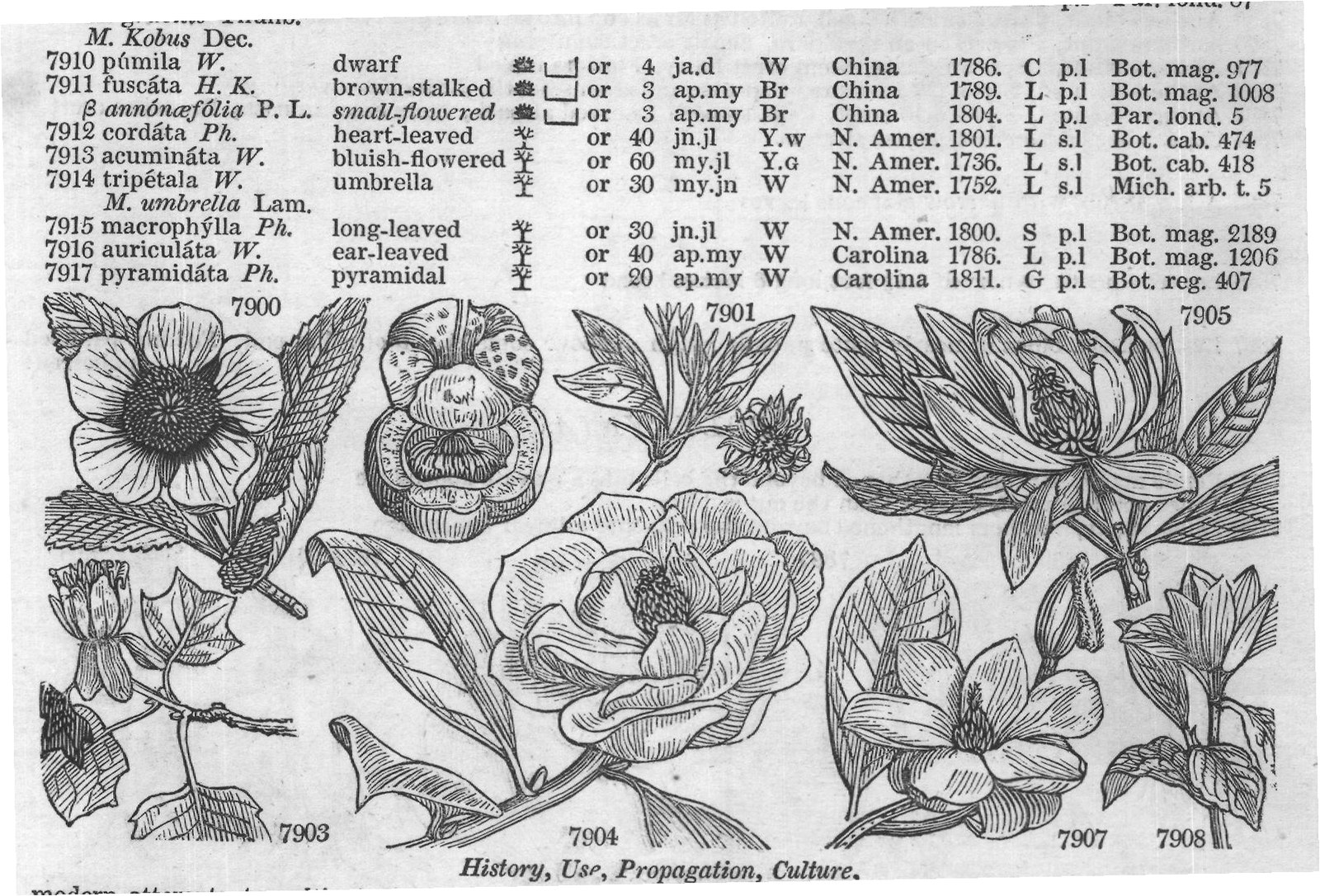
L s.l Mich. arb. t. 5 M. umbrella Lam. 7915 macrophýlla Ph. long-leaved or 30 jn.jl W N. Amer. 1800. S p.l Bot. mag. 2189 7916 auriculáta W. ear-leaved or 40 ap.my W Carolina 1786. L p.1 Bot. mag. 1206 7917 pyramidáta Ph. pyramidal or 20 ap.my W Carolina 1811. G p.1 Bot. reg. 407 7900 7901 7905 7903 7904 7907 7908 History, Use, Propagation, Culture, modern attempts to cultivate it in Europe, though with the assistance of artificial heat, seldom have succeeded.
Dr. Patrick Browne is of opinion that the ancients confounded two plants under the name of Lotus or Egyptian bean, and that under these titles they described the upper parts of the Nymphæa Nelumbo, and the , Arum Colocasia. (Jam. 243. 332.) In our stoves the Nelumbium should be grown in a tub or large pot, in a rich loamy soil, and requires a strong heat to flower in perfection. The pot or tub should be kept full of water all the time the plants are growing, but may be allowed to get dry when the flowering season is over. dividing at the root, but it is obtained more readily from seeds, which vegetate freely. (Bot. Cult. 83.) The plants may be increased by Kent of Clapton says, that the seeds will keep forty years, vegetate freely, and flower the first year. (Hort. Trans. iii. 36.) Hort. Trans. iii. 36.) 1214. Dillenia. So named by Linnæus, in honor of John James Dillenius, the famous professor of botany at Oxford, author of Historia Muscorum, Hortus Elthamensis, &c. The species are beautiful trees, with large leathery leaves, and axillary or terminating flowers often also large. They thrive best in a light loamy soil.
Ripened cuttings, not deprived of their leaves, strike root freely, in a pot of sand plunged under a hand-glass in heat. Good seeds sometimes arrive from India, when the sooner they are sown the better; placed in a moderate hot-bed frame, they will succeed well. (Bot. Cult. 50.) 1215. Illicium. From illicio, to attract, on account of its agreeable perfune. I. floridanum has very fragrant leaves, and capsules having a strong smell of anise when rubbed. This species, and more especially anisatum powerfully carminative and stomachic. In China it is in frequent use for seasoning dishes, especially such as are sweet. In Japan they place bundles and garlands of the aniseed-tree in their temples before their idols, and on the tombs of their friends. They also use the powdered bark as and on the tombs of their friends. They also use the powdered bark as incense to their idols. A branch put into the decoction of Tetraodon hispidum is supposed to increase the virulence of that poison. The bark, finely powdered, is used by the public watchmen to make a chronometer or instrument for measuring the hours, by slowly sparkling at certain intervals in a box, in order to direct when the public bells are to sound.
Ripened cuttings will root in sand, but the plant is most readily increased by layers. 1216. Liriodendron. From λεiρiov, a lily, and δεvδρov, a tree. The flowers, which may be likened to a lily or tulip, grow upon one of the loftiest trees of the forest. A smooth tree, not less admired for its fiddle-shaped leaves , than its tulip-like flowers, which are produced at the end of the branches; they are composed of six petals, three without and three within, which form a sort of bell-shaped flower, whence the inhabitants of North America gave it the title of tulip. These petals are marked with green, yellow , and red spots, making a fine appearance when the trees are well charged with flowers. When the flowers drop the germ swells, and forms a kind of cone, but it does not ripen in England. The timber is used in America for canoes, but is unfit for boards or planks, as it contracts and expands more than the wood of any other tree.
The tulip tree is now very common in Europe; in the south of France and Italy, it is frequent in public avenues, and flowers when twenty or thirty feet high, and of six or seven years growth. In Britain it requires a ORDER V.
POLYANDRIA POLYGYNIA. 7900 Leaves elliptic oblong simply serrated, Peduncles 1-flowered 7901 Petals 27-30 purple: outer oblong; inner lanceolate 7902 Petals 9-12 yellowish ovate roundish 7903 Leaves truncate at end with two broad opposite stipules 7904 Leaves evergreen oval-obl. coriaceous shining above ferrugineous beneath, Flowers erect with 9-12 petals 7905 Leaves elliptical blunt glaucous beneath, Flowers with 9-12 contracted petals which are ovate concave 7906 Like the last, but leaves evergreen elliptical acute at each end 7907 Lvs. deciduous obovate abruptly acuminate the younger pubescent, Flowers naked erect with 6-9 petals. 7908 Lvs. deciduous obov. acute netted nearly smooth, Fls. erect, Sepals 3, Petals 6 obovate, Styles very short 7909 Lvs. decid. obov. point. at each end, younger downy ben., old ones smooth, Fls. erect, Sep. 3, Pet. 6, Styles [very short 7910 Leaves evergreen smooth netted ellipt. acuminate at each end subglaucous, Flowers cernuous 7911 Leaves evergreen elliptic obl.: the old smooth; younger and branches fuscous downy, Flowers erect 7912 Lvs. deciduous heart-shaped subovate acute, above smooth, beneath somewhat tomentose, Pet. 6-9. obl. 7913 Leaves deciduous oval acuminate pubescent beneath, Petals 6-9 7914 Leaves deciduous lanc. much spreading, younger downy beneath, Petals 9-12, the outer hanging down 7915 Lvs. deciduous very large obl. obov. subcuneate cordate at base, beneath whitish glaucous, Pet. 6-9 ovate 7916 Lvs. decid. smooth spatulate obov. subcord. at base, Auricles blunt close, Sep. 3 much spread. Pet. 9 oblong 7917 Lvs. decid. smth spatul. obov. subcord. at base, of same color on both sides, Auric. spread. Pet. 9 lanc. acum. 7913 7911 7910 7915 7916 7909 7912 7917 and Miscellaneous Particulars. greater age, though ringing might probably be successfully applied to throwing this and other ornamental trees into a flowering state. There are many fine old trees round London, in the parishes of Fulham, Walham-green, Kew, &c., and a very fine one even so far north 1217. Kew, &c., and a very fine one even so far north as Pitcaithly wells in Fifeshire. 1217. Magnolia. In honor of Pierre Magnol, professor of medicine, and prefect of the botanic garden at Montpelier; author of Botanicum Monspeliense, 1676, and other works. The species are chiefly large trees with large leaves, and axillary flowers, also very large and highly odorous.
M, grandiflora is the noblest species; the leaves, which are persistent, are nine or ten inches long, and not unlike those of a common laurel. The flowers are produced at the ends of the branches: they are very large, and composed of eight or ten petals, narrow at their base, but broad, rounded, and a little waved at their extremities; they spread open very wide, are of a pure white color, and have an agreeable scent.
The variety g. elliptica or Exmouth (having been raised from the seed of an old tree in Sir John Collington's garden of that place) flowers earliest and most freely: Collington's garden of that place) flowers earliest and most freely it is also the hardiest. M. glauca is deciduous. In America it is known by the names of white laurel, swamp sassafras, and beaver tree. It has the last name, because the root is eaten tree. has the last name, because the root is eaten as a great dainty by beavers swamp and sassafras, this may be discovered by the scent of the blossoms at the distance of three quarters of a mile, if the wind be favorable. It is beyond description pleasant to travel in the woods at the flowering season, especially in the evening. They retain their flowers for three weeks, and even longer. The berries also look very handsome when they are ripe, being of a rich red color, and hanging in bunches on slender threads. They cure coughs and other pectoral diseases by putting these berries into brandy, and giving a draught of the liquor every morning. The wood is made use of for joiners' planes. Dillenius remarks, that the flowers never open in a morning, that the calyx falls off at the second opening of the flower, but that the petals dry on, and that the scent resembles that of the lily of the valley, with a mixture of aromatic.
M. conspicua is much valued as a free flowerer, and on account of the early appearance of its white odoriferous blossoms. Yulan is the vernacular name in Japan.
M. acuminata bears a fruit about three inches long, like a small cucumber, and is thence called cucumber tree in America.
M. tripetala has leaves twelve or fifteen inches long and five or six inches wide, narrowing to a point at each extremity, and placed at the ends of the branches in a circular manner like an umbrella, whence its extremity, and placed at the ends of the branches in a circular manner like an umbrella, whence its name. The flowers are composed of ten, eleven, or twelve large oblong white petals; the wood is soft and spongy, and the leaves drop off earlier than in the other deciduous sorts.
The different species, Sweet observes, are generally increased by layers or seeds: when the layers are first taken off they should be potted in a mixture of loam and peat, and placed in a close frame till they have taken fresh root None of the leaves should be taken off or shortened, nor any shoots be cut off, or their tops shortened, as they will not succeed so well; for the more branches and leaves are on them, the sooner they will strike fresh root. Most cultivators cut off many of the leaves and shoots of layers, when they are first taken off, thinking the roots will not have so much to nourish, which is the very reason sweet-scented POLYANDRIA POLYGYNIA. 1218. MICHELIA. W. MICHELIA. 7918 Champáca W.
Magnoliaceæ. Sp. 1-7.
CLASS XIII. tm 20 Y E. Indies 1779. C s.l Rhe. mal. 1. t.19 1219. UVA'RIA. W.
UVARIA.
Annonacea. Sp. 1-9. 7919 Zeylánica W.
Ceylon 走 or 20 R.G É. Indies 1794. C p.l Rhe. mal. 2. t. 10 1220. ANNO'NA. P. S.
CUSTARD APPLE.
Annonacea.
Sp.7-36. 7920 muricáta W.
Sour-sop fr 10 ...
G.Y W. Indies 1656.
Cr.m Jac. obs. 1. t. 5 7921 Cherimólia Mill.
Cherimoyer fr 18 jl.au Br S. Amer. 1739.
Cr.m Trew. ehr. t. 49 tripetala W. 7922 squamósa W.
Sweet-sop 7923 paludósa W. paludósa marsh 7924 reticuláta W. netted 7925 palústris W.
Cork-wood 7926 glábra W. smooth-fruited 오오오 fr 20 ...
W.G S. Amer. 1731.
Cr.m Rhe. mal. 3. t.29 or 4 ...
G Guiana 1803.
Cr.m Aub. gui.1. t. 246 fr 20 ...
W.G S. Amer. 1690.
Cr.m Rh. m. 3. t. 30,31 or 6 Y W. Indies 1731.
Cr.m Pl. alm. t.240.f.6 ... or 16 jl.au Br Carolina 1774.
Cr.m Cat. car. 2. t. 64 1221. ARTABO TRYS. R. Br. ARTABOTRYS. 7927 odoratissima R. Br. sweet-scented 1222. GUATTERIA. R.&P. GUATTERIA.
Annonaceæ.
Sp. 1. or 6 jn.jl G China 1758. Sr.m Bot. reg. 423 Sp. 2-22.
U. hexapetala W. 7928 rúfa Dun. rufous 7929 virgáta Dun.
Lancewood or tm 30 ...
Uvaria lanceolata Swz. 1223. ASIMINA. Ad.
ASIMINA. 7930 tríloba Ph. trifid-fruited 7931 parviflóra Ph. small-flowered 7932 pygmæ'a Ph. dwarf cu cu 1 ...
Annonace Annonacea. 3 jl.au China Br W 1822. Cr.m Bot. reg. 836 Jamaica 1793. C p.l Dun. mon. t. 31 Annonacea. Sp. 3-5. or 3 au Pa.pu N. Amer. 1736. 2 ap.my Br W N. Amer. 1806. L p.1 N. Amer. 1812. L p.l S p.1 Cat. car. 2. t. 83 Dun. mon. t. 9 Bartr. trav. t. 1 1224. XYLO'PIA. W.
XYLOPIA.
Annonacea.
Sp. 2-9. 7933 muricáta W. rough-fruited or 4 ... ... 7934 glábra W. smooth-fruited tm 20 ...
W. Indies 1793. C p.l Jamaica Cp.l Br. jam. t. 5. f. 2 ...
Pl. al. t. 238. f. 4 1225. HEPAʼTICA. W. en. HEPATICA. 7935 tríloba W. a cærulea ẞ cærúleo-pléna rúbra rubro-pléna & álba ξ nivea 7918 Ranunculacea. Sp. 1-3. common blue double-blue red double-red red-anth. white સજામાજાજાજા or f.ap Pu Europe 1573. D s.l or f.ap B D s.l ...... ... or f.ap B D s.l ...... ... or f.ap R ...... ...
D s.1 Bot. mag, 10 or f.ap R ...... ...
D s.l or f.ap W ...... ...
D s.l snowy-white প or f.ap W ...... ...
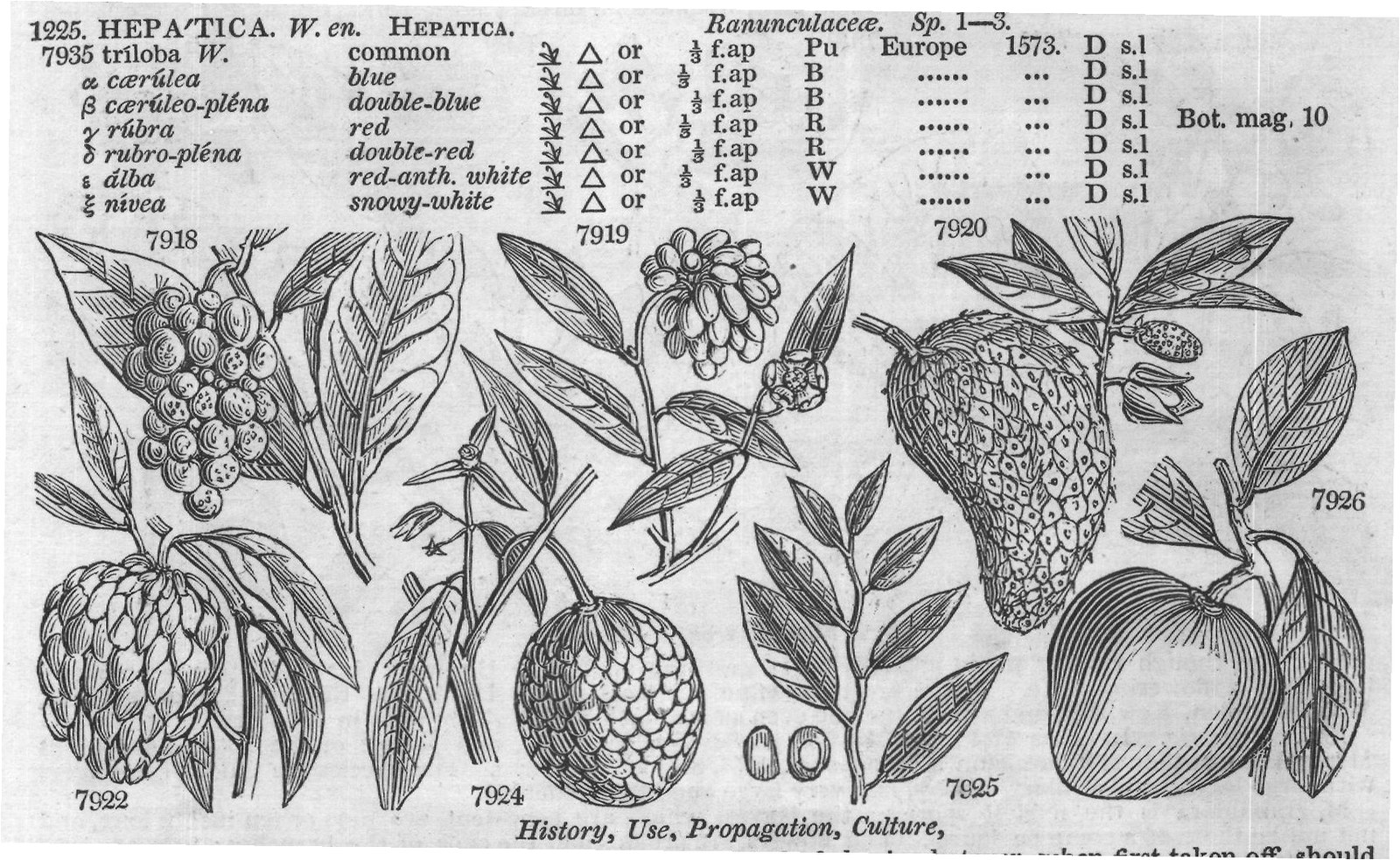
D s.l 7919 7920 7922 7924 00 7925 7926 History, Use, Propagation, Culture, they often lose great part of their crop; layers of any kind of shrub whatever, when first taken off, should not have a single leaf taken off till they have made fresh root: supposing their tops flag ever so much, as long as there is life it will draw up the sap, and help the plant to root afresh. The Chinese kinds are often inarched or budded on M. obovata, which takes readily. (Bot. Cult. 306.) 1218. Michelia. Named by Linnæus, in honor of Pietro Antonio Micheli, of Florence, author of Nova Plantarum Genera, Flor. 1729, fol. A lofty tree, with fragrant flowers, and fruit edible, but not agreeeable.
In our stoves it grows well in light loam, and cuttings root in sand under a glass and plunged in heat. 1219. Uvaria. The fruit grows in bunches like a small bunch of grapes, whence it has been called Uvaria from Uva. The berries are considered a specific for gonorrhea , and are used under the name of cubebs.
These are trees or shrubs with erect or trailing stems, and 1-4-flowered axillary peduncles. 1220. Anona. This is called by the Malays, manoa, and at Banda, menona, which it is presumed that the Europeans have corrupted into Anona. As the word signifies in Latin food, it has been adopted by the Linnæus signifies in Latin food, it has been adopted by Linnæus in this sense, because of the habitual use made of the fruit by the Americans. The species are for the most part fruit trees, with soft pulpy subacid berries, sometimes as large as an orange, but generally more like a plum.
A. muricata is common in every savannah of Jamaica, flowering in the spring. The large the , flowering in the spring. The large succulent fruit agreeable to new-comers and over-heated habits but it is so common, and so much in use among the negroes, that it is now hardly ever used among the better sort of people. The smell and taste of the fruit, flowers, and whole plant, resemble very much those of black currants, A. tripetala is a large tree with large bright green leaves. The fruit is oblong, scaly on the outside, and of a dark purple color when ripe; the flesh is soft and sweet , and has many brown seeds intermixed with it which are very smooth and shining. It is esteemed by the Peruvians as one of their most delicate sorts. A. palustris grows wild in soft marshy places in Jamaica, and bears a fine sweet-scented fruit, of no disflavour; grows but it is said to be a strong narcotic, and is not eaten on that account. It is the narcotic, and is not eaten on that account. It is called alligator apple. The wood of this tree is so very soft, even after it is dried, that it is frequently used by the country people instead of corks, to stop up their jugs and calabashes whence it has now universally obtained the name of cork-wood in Jamaica. (Browne.) To bear fruit in our stoves, these trees require a rich loamy soil, rather moist, and to be trained on a wall or trellis close under the glass. Ringing would also be useful. They are propagated by ripened cuttings, a useful. They are propagated by ripened cuttings, of a good size, with their leaves on, planted in sand, and plunged in heat. :
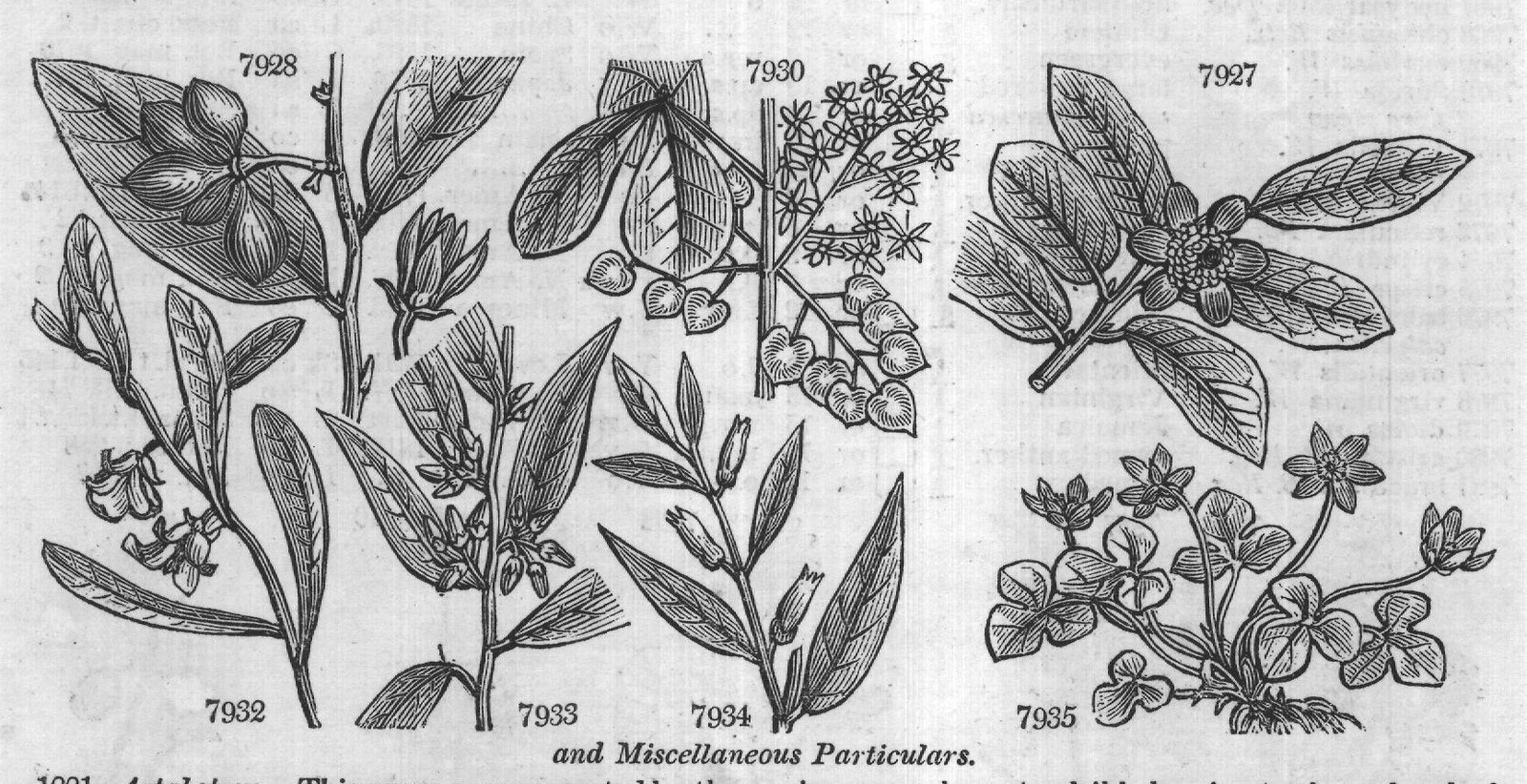
ORDER IV. 7918 Leaves lanceolate smooth POLYANDRIA POLYGYNIA. 7919 Leaves lanc. acuminate, Pedunc. lateral solitary 1-flowered 7920 Leaves ovate lanceolate smooth somewhat shining, Pedunc. solitary 1-flowered 7921 Leaves ovate lanceolate not dotted very finely silky beneath, Outer petal downy outside 7922 Leaves lanceolate smooth with pellucid dots, Outer petals smooth 7923 Leaves obl. acute somewhat downy above, silky and rufous beneath, Flowers on short stalks 7924 Leaves obl. lanc. acute smooth somewhat dotted, Outer petals obl. somewhat closed 7925 Leaves ovate obl. coriaceous very smooth, Fl. solitary stalked 7926 Leaves ovate lanc. smooth, Pedunc. opposite the leaves 2-flowered 7927 Leaves obl. lanc. acuminate smooth shining 7928 Leaves oval acuminate cordate covered beneath, as on the branches, with brown down 7929 Leaves ovate acuminate very smooth nearly sessile, Pedunc. axillary 1-flowered 7930 Leaves obl. cuneate acuminate, Branches quite smooth 7931 Leaves cuneate obovate mucronate beneath, as on the branches, rufous with down 7932 Leaves obl. linear long-cuneate, Branches quite smooth 7933 Leaves lanc. acuminate strigose beneath bearded at end 7934 Leaves obl. ovate smooth, Pedunc. 1-fl. solitary 7935 Leaves cordate 3-lobed, Lobes entire 7928 7930 7927 7932 7933 7934 and Miscellaneous Particulars. 7935 1221. Artabotrys. This name was suggested by the curious grapple or tendril belonging to the peduncle, by which the growing fruit is conveniently suspended on the nearest support. A beautiful Chinese plant, cultivated as an ornamental covering to walls, as well as on account of the fragrance of the blossom, which diffuses an odor like that proceeding from the finer kinds of ripe fruit. The genus is intermediate, between Kadsura and Guatteria. 1222. Guatteria. Named by the authors of the Flora Peruviana, after John Baptist Guatteri, an Italian professor of botany at Parma. G. virgata is one of the best timber trees in Jamaica for strength and elasticity; it is imported under the name of lance-wood, and much used by coachmakers for shafts to light carriages. 1223. Asimina. A name coined by Adanson, without any meaning. Shrubs with deciduous, oblong, often cuneate leaves, and axillary flowers, which often appear before the leaves. The species are natives of shady woods in the more southern provinces of North America. 1224. Xylopia. Named by syncope from ξuλov πiκρov, bitter wood, in allusion to the properties of the wood. Fruit-bearing trees, but not in much esteem as such. X. glabra is the most useful species. The wood, bark, and berries have an agreeable bitter taste, not unlike that of the orange seed. The wild pigeons feed much upon the latter, and owe that delicate bitterish flavor, so peculiar to them in the season, wholly to this part of their food. Fresh gathered from the tree, they are agreeable to the palate and grateful to the stomach. The bark is also richly impregnated with this juice as well as the wood, and both yield a very agreeable bitter in the mouth while fresh; but that delicacy diminishes greatly after they are dried. The wood is easily wrought, and esteemed a good timber where it is not much exposed to the weather. The bitter quality of this tree is communicated with great facility. A handful of the shavings immersed in water and instantly taken out again, will render it of a very bitter taste. Sugar sent over in hogsheads made of this wood was so bitter that no person would purchase it. Bedsteads and presses made of it, are proof against cockroaches and other insects. Carpenters who work the wood, perceive a bitter taste in their mouths and throats. A decoction of it is said to be of service in cholics, and to create appetite. 1225. Hepatica. From ήπaτiκoς, of or relating to the liver. The three lobes of the leaves have been compared to the three lobes of the liver. A great favorite of the flower border, both as being evergreen in its foliage, and for its abundant blossoms and great variety of colors and shades. POLYANDRIA POLYGYNIA.
Switzerl. 1792. R s.p Germany 1596. R s.p ...
Rs.p CLASS XIII 1226. ANEMO'NE. W. en. 7936 coronária W.
B pléna 7937 horténsis W.
A. stellata Dec. 7938 palmáta W. 7939 sibírica W. 7940 álba Juss. 7941 baldénsis W. 7942 sylvéstris W. 7943 pavonína Dec. 7944 virginiána W.
Ranunculacea. Sp. 27-40.
Poppy or ap.my St Levant 1596. R l.p Bot. mag. 841 double-flowered or ap.my St Rr.l star or ap.my St Italy 1597. R s.p Bot. mag. 123 palmated or my.jn Y Portugal 1597. R. s.p Bot. reg. 200 Siberian or jn W Siberia 1804. R s.p white or jn W Siberia 1820. R s.p Bot. mag. 2167 Strawberry-like or my W Snow-drop or ap.my W Jac. ic. 1. t. 103 Bot. mag. 54 Peacock-eye or 1 ap.my R France Clus. ic. f. 1,2 Virginian or my.jn W Herm. par. t. 18 7945 uralénsis Dec.
Ural or my B 7946 pensylvánica Ph.
Pensylvanian or 1 my.jn W 7947 dichotoma Ph. forked or N. Amer. 1768. R s.p Lin. fil. d. 2. t.15 7948 trifólia W. three-leaved or ap.my W Mor. s. 4. t. 25.f.1 7949 nemorósa W. wood or 7950 apennína W. blue mountain or mr.my W mr.ap B Eng. bot. 355 7951 ranunculoídes W. yellow wood or mr.ap Y 7952 narcissiflóra W.
Narcissus-flow.or my W 7953 thalictroídes W.
Meadow-rue-lv. A or ap.my W 7954 alpína W. en.
Alpine or از W 7955 pratensis W. en. meadow or 7956 obsoléta Sims. pale-flowered or 7957 Pulsatílla L. com. Pasque fl.or 7958 Halléri W. en. 7959 vernális W. en. 7960 cérnua W. 7961 pátens W. en. 7962 capénsis Dec.
Atragene capensis 1227. CLEMATIS. L. 7963 austríaca H. K. 7964 sibírica H. K. 7965 verticilláris Dec.
A. Americana H.K. 7966 glaúca W. 7967 hedysarifólia Dec. 7968 chinensis Retz. 7969 cirrhósa W. 7970 flórida W.
ẞ flore pléno 7971 Viticélla W. 3 pléna 7972 Viórna W. 7973 reticuláta Ph. 7974 cylíndrica H. K. 7975 críspa B. M.
Haller's P. fl.or spring P. fl. 1 my.jn Pa.w N. Amer. 1722. Rs.p Siberia 1824. R s.p N. Amer. 1766. R s.p France 1597. R s.p Britain woods. R s.p England woods. R s.p England woods. R s.p Siberia 1773. R s.p N. Amer. 1768. R s.p Austria 1658. R s.p my D.Pu Germany 1731. R s.p my Pu ap.my V ap.my Pu ap Pa.w my.jn R.w or drooping P. fl.or spreading P. fl.or 1 jn.jl Li. Y Cape L.
VIRGIN'S BOWER.
Alpine Siberian American glaucous hedysarum-lv.
Chinese or 1 mr.ap Pu Germany ...
Rs.p England ch. pa. R s.p Switzerl. 1816. R. s.p Switzerl. 1752. R s.p Japan 1806. R s.p Siberia C. G. H. 1752. R s.p 1795. S p.l Ranunculacea. Sp. 26-90. or 12 my.jl B or 12 jn.jl W or 15 my.jn Pu or 12 ap or 12 o or 12 or 12 mr.ap Austria 1792. C co Siberia 1753. L co N. Amer. 1797. L s.p ...
Pa. Y Siberia Lco W E. Indies 1819. L co W.G China 1820. L co 1596. C co 1776. L s.l L s.1 1569. S co Lco ...
Eng. bot. 1062 Eng. bot. 1484 Bot. mag. 1120 Bot. mag. 866 Jac. aus. 1. t. 85 Fl. dan. t. 611 Bot. mag. 1863 Eng. bot. 51 All. ped. t. 80.f.2 Fl. dan. t. 29 Bot. mag. 1994 Bot. mag. 716 Bot. rep. 180 Pall, ross. 2. t.76 Bot. mag. 887 Dend, brit. 73 Bot. reg. 599 Retz. obs. t. 2 Bot. mag. 1070 Bot. mag. 834 ... evergreen உ W.G Spain large-flowered or 10 ap.s double-flowered B or 10 ap.s W.Y Japan W.Y purple B or 20 jn.s Pu Spain Bot. mag. 565 double-purple B or 20 jn.s Pu ...... leathery-flower. netted or 12 jn.s Pu N. Amer. 1730.
S co Di. el. t. 118.f.144 or 8 jn.s Pu N. Amer. 1812.
L s.p Dend. brit. 72 long-flowered B curled-flowered or 8 jl.s B N. Amer. 1802.
L p.l Bot. mag. 1160 or 6 jl.s Pa.pu N. Amer. 1726.
L p.l Bot. mag. 1892 Minorca or 12 f.mr Y.w Minorca 1783.
C co Bot. mag. 959 oriental or 8 jl.o Y.w Levant 1731.
Sk co Di. el. t. 119.f.145 or 15 jn.au G N. Amer. 1767.
L s.p Dend. brit. 74 or 15 my.jn G.Y W. Indies 1733.
Ls.p Slo. ja. 1.t.128.f.1 or 15 my.au G.Y or 12 o.d Y.G N. Holl. 1812.
L s.p Bot. reg. 238 C. G. H. ...
Ls.p Bot. reg. 97 7936 7937 7938 7940 7976 baleárica Rich. calycina W. 7977 orientális W. 7978 virginiána W. 7979 dioíça W. 7980 aristáta B. Reg. 7981 brachiata B. Reg.
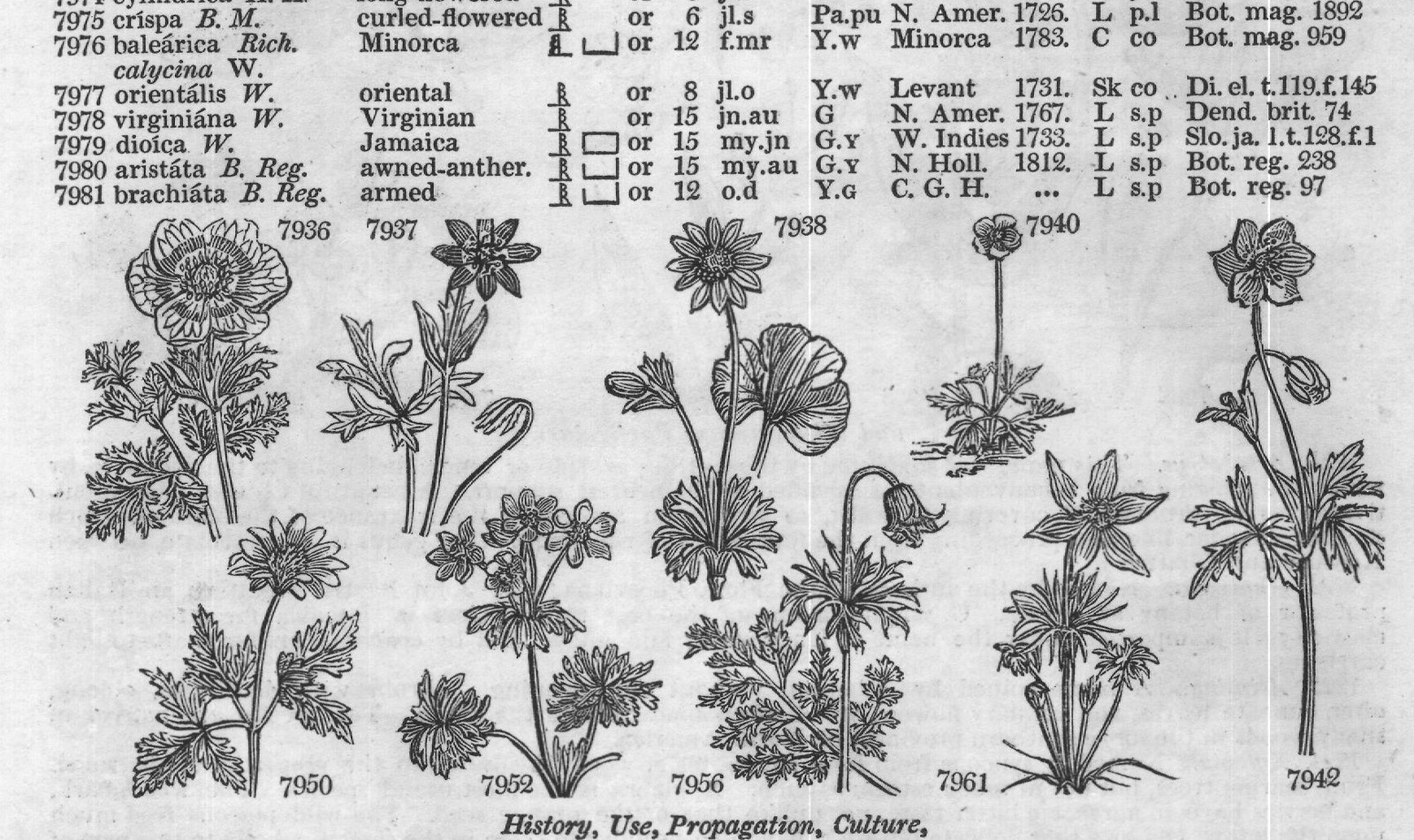
Virginian Jamaica awned-anther. armed CCO 7950 7952 7956 7961 7942 History, Use, Propagation, Culture, 1226. Anemone. From avεμoς, wind, because the greater part of the species grow in elevated places much exposed to the wind. The species are shewy flowering plants, and A. coronaria and hortensis are well known florists' fiowers, valued for their hardy nature, and also because they will flower at almost any season, according to the time the roots are kept out of the ground, and the season when they are replanted. The prevailing colors are red, white, and blue, and semidouble flowers are in nearly as much repute as double ones. Many new varieties have been raised from seed; but they are not named by the florists, as in the case of tulips and and pinks. The roots of anemones are solid flattened masses like those of ginger, and like them are multiplied by division. A root which has remained in the soil two or three years, if it has room to extend, attains a great breadth, but is still only one root; and hence the mode of sale is by weight, and the roots are divided when planted.
The soil preferred by the anemone is a fresh loam, rather heavy or light. The usual time of planting is the end of October, covering the roots three inches; but to have an early bloom they may be planted in the beginning of September, and to have a bloom every month in the year, plant every month. The finer sorts ORDER IV.
POLYANDRIA POLYGYNIA. 7936 Leaves ternate with multifid segments and linear mucronate lobes, Sep. 6 oval close 7937 Leaves 3-parted with cuneate cut-toothed lobes, Invol. sessile obl. entire or cut, Sepals 10-12 oblong 7938 Leaves cordate roundish bluntly 3-5-lobed toothed, Invol. sessile trifid, Sepals 10-12 oblong 7939 Leaves ternate with cut-toothed ciliated segments, Invol. on short stalks 3 cut, Sepals 6 round 7940 Leaves ternate or quinate, Segments cut-toothed at the end, Invol. stalked similar, Sepals 5 obovate 7941 Lvs. biternate with a branch. stalk, Segm, many-part . with lin. lobes, Inv. shortly stalk. multifid, Sep. obl. 7942 Leaves ternate or quinate, Segm. cut-toothed at end, Invol. stalked similar, Sepals 6 elliptical 7943 Leaves 3-parted with cuneate cut-toothed lobes, Invol. sessile oblong entire or a little cut, Sep. very acute 7944 Leaves ternate with trifid acuminate cut-toothed segments, Invol . stalked similar, Sepals 5 elliptical 7945 Invol. leaves on short stalks thrice cut with linear cut-toothed 7946 Leaves short stalks thrice cut with linear cut-toothed segments, Sepals 5-6 Invol. sessile similar, Sepals 5 elliptical, Fruit hairy 7947 Leaves 3-parted with cut-toothed oblong lobes, Invol. sessile similar, Sepals 5 elliptical, Fruit smooth 7948 Leaves all stalked ternate with ovate lanc. acute-toothed segments, Sepals 5 elliptical obtuse 7949 Leaves ternate with trifid cut-toothed lanc. acute segments, Invol. stalked similar, Sepals 6 elliptical 7950 Leaves 3-ternate with a branched stalk, Sepals 12-14 oblong obtuse, Leaves of invol. stalked 7951 Radical lvs. 3-5 cut with subtrifid cut-toothed segments 7952 Radical leaves lvs. 3-5 cut with subtrifid cut-toothed segments, Invol. stalk. 3-parted toothed, Sep. 5-6 elliptical , Lobes lin. acute, Fl. umbelled 7953 Flowers umbelled, Floral leaves stalked biternate forming a sort of involucre 7954 Leaves biternate with a branched petiole, Segm. pinnated cut serrate, Sepals 6 spreading 7955 Leaves pinnated with multifid segments, Lobes linear, Flowers pendulous, Sepals 6 erect refiexed at end 7956 Like the last, but the flower larger and paler, and the lobes of the pinnæ broader and awned 7957 Leaves pinnated with multifid segments, Lobes 7958 Leaves pinnated with multifid segments, Lobes linear, Flower somewhat nodding, Sepals awned 6 lin. acum. Fl. erect, Sep. 6 oval lanceol. 7959 Leaves pinnated with cuneate lanceolate trifid smoothish segments, Fl. erect, Invol. very villous 7960 Leaves pinnated villous beneath, Segm. pinnatifid, Lobes 7961 Leaves pinnated villous beneath, Segm. pinnatifid, Lobes cut oblong, Fl. subcernuous, very villous toothed cut at end, Fl. erect spreading 7962 Leaves biternate rigid smooth, Segm. cuneiform toothed at end 7963 Pedunc. 1-fi. longer than leaf, Lvs. biternate, Segm. ovate-lanc. acum, serrate, Pet. subspatulate obtuse 7964 Pedunc. 1-fl. the length of leaf, Leaves biternate with obl. lanc. acumin. segments, Pet. emarginate at end 7965 Pedunc. 1-fl. Leaves whorled in fours ternate, Segm. stalked cordate lanc. entire, Petals acute 7966 Leaves pinnate, Segm. glaucous smooth cuneiform lobed, Lobes entire blunt, Pedunc, trifid 7967 Fl. panicled, Leaves ternate, Segm. ovate lanc. acumin. nearly entire smooth 5-nerved at base 7968 Leaves pinnated, Segm. ovate lanc. entire, Pedunc 7969 Pedunc. pinnated, Segm. ovate lanc. entire, Pedunc. few-fl. longer than leaf, Ovaries about at 4, base Tails almost 7970 Pedunc. 1-fl. longer than leaf , Leaves tern. decompound, Segm. ovate acute entire, Sepals much pointed [naked 7971 Pedunc. 1-fl. longer than leaf, Leaves entire or ternate decomp. Lobes or segm. entire, Sepals obovate 7972 Pedunc. 1-fl. Sep. connivent thick reflexed at end acuminate, Lvs. smooth with ent. or 3-lob. ov. acute segm. 7973 Pedunc. 1-fl. Sep. connivent, Lvs. coriaceous netted nerved smooth with stalked 3-lobed or entire segments 7974 Pedunc. 1-fl. Sep. acumin. wavy at edge thin, Lvs. smooth 7975 Pedunc. 1-fl. Sep. acumin. wavy at edge thin, Lvs. smooth thin decompound with stalked or segments acute, Sepals conniving at base spreading at end 7976 Pedunc. 1-fl. with an involucre under the leaf, Leaves ternate with stalked ternate cut-toothed segments 7977 Leaves pinnate with glaucous smooth wedge-shaped 3-lobed segments, Lobes toothed acuminate 7978 Fl. panicled diœcious, Leaves ternate, Segm. cordate acute coarsely toothed and lobed 7979 Fl. panicled diœcious, Lvs. tern. Segm. smooth ovate cordate acuminate 3-nerved ent. Pedicels pubescent 7980 Fl. panic. diœc. Sep. 4. Lvs. tern. Segm. ovate subcord, acute 7981 Ped. 1-fl. Sep. 4. Lvs. tern. Segm. ovate subcord. acute coarsely toothed 3-nerv. Anth. pubescent pinn. Segm. ovate coarsely toothed, Fl.-buds globose 7963 7965 7966 7971 7974 7975 7978 7981 and Miscellaneous Particulars. require protection from violent storms and excessive light and heat; but many varieties do exceeding well in borders. A very severe winter will destroy the roots if the surface is not mulched; but the anemone is considerably hardier than the ranunculus. Anemone pulsatilla is common in borders. The roots are mostly tuberous, and when taken up should not be long kept out of ground. Like most tuberous plants, they thrive best in a sandy loam. 1227. Clematis. From κλημa, a tendril; the climbing habit of this genus is well known. The species are C. florida, climbing shrubs of rapid growth, free-flowerers, very ornamental, and some are highly species mostly climbing shrubs of rapid growth, free-flowerers, very ornamental, and some are highly odoriferous.
C. florida, viticella, and flammula are admired species. The plants formerly called Atragene, but now properly united to Clematis, are shewy climbers, especially C. austriaca, which grows and flowers freely. Any common garden soil will suit them, and they are readily increased by layers; or young cuttings, planted under a common hand-glass, will root freely. Seeds are often ripened in abundance, by which any quantity may be raised; they are best sown in pans, or wide-mouthed pots, and placed in a shady situation, where they will Ii 2 or 12 or 20 jl.s or 20 jl.o or 20 jl.o broad-leaved or 20 jl.o narrow-leaved Aor 20 jn.s upright or 7986 angustifolia W. narrow-leaved or 7987 ochroleúca W. silky or 7988 integrifólia W. entire-leaved or ẞ angustifólia narr.-entire-lv.or 7989 zeylánica W.
Ceylon உ or 12 1229. THALIC/TRUM.
W. MEADOW-RUE. 7982 Massóniana Dec. 7983 Vitálba W. 7984 Flámmula W. a rotundifólia C. frágrans Tenore.
B vulgaris marítima W. 7985 erécta W.
POLYANDRIA POLYGYNIA.
Masson's Traveller's Joy sweet-scented round-leaved 1228. NARAVE'LIA. Dec. NARAVELIA. পপপপপ C. G. H.
L s.p W England hed. S co France 1596. S co France 1596. L co D p.l S. Europe Austria 1597. D p.l Austria 1787. D p.1 N. Amer. 1767. D p.l Hungary 1596. D p.1 Hungary D p.l CLASS XIII.
Eng. bot. 612 Kn. th. 2. t. c. 9 Jac. aus. 3. t. 291 Dend. brit. 112 Bot. cab. 661 Bot, mag. 65 Ceylon 1796. Ls.p Rox.cor.2. t. 188 Ranunculacea. Sp. 26-52.
W W France W W 3 jn.au W 4 my.s W 2 jn.jl L.Y 2 jn.au B 2 jn.au B ...
Ranunculaceæ. Sp. 1.
Y ... 7990 alpínum W.
Alpine or my.jl W Britain bgs. m. D co Eng. bot. 262 7991 fœ'tidum W. fœtid or my.jl W 7992 tuberósum W. tuberous-rooted or jn Spain W France 1640. D co 1713. D co Pl. ra. h. 2. t. 174 M. ic. 2. t.265.f.2 7993 Cornúti W.
Canadian or 3 my.jl W N. Amer. 1640. D co Corn. can. t. 187 T. corynellum Dec. 7994 dioícum W. diœcious or 1 jn.jl L.Y N. Amer. 1759. D co 7995 elátum W. tall or 2 jn.au L.Y Hungary 1794. D co Jac. vind. 3. t. 95 7996 május W. greater or 3 jn.jl G.Y England m.thi. D co Eng. bot. 611 7997 médium W. middle or 1 jn.au G.
Hungary 1789. D co Jac. vind. 3. t. 96 7998 mínus W. lesser or 1 jn.jl Pu Britain ch. pa.
D co Eng. bot. 11 7999 concínnum W. en. neat or 3 jn.jl W.G D co ... 8000 rugósum W. rough or 2 jl W N. Amer. 1774.
D co 8001 sibíricum W.
Siberian or 1 jn.jl L.Y Siberia 1775. D co 8002 squarrósum W. squarrose or 1 jn.jl L.Y Siberia 1806. D co 8003 pubéscens Ph. pubescent or 1½ jn.jl L.Y N. Amer. 1806. D co 8004 purpuráscens W. 8005 augustifolium W. purple or 3 jn.jl L.P N. Amer. 1699. D co narrow-leaved or 3 jn.jl W Germany 1739. D co Jac. vind. 3. t. 43 8006 lúcidum W. shining or 4 my.jl Li.Y Spain 1739. D co Pl. alm. t. 65. f.5 8007 flávum W. common or 4 my.jl O Britain m.me. D co Eng. bot. 367 8008 nígricans W. black 8009 glaúcum Desf. glaucous-leav'dor speciósum W. en. 8010 ranunculínum W.en. Ranuncul.-lvd. 8011 símplex W. simple-stalked 8012 aquilegifólium W. Columbine-lvd.
B átro-purpúreum dark-purplc 8013 galioídes W. en. 8014 contórtum W. sweet-scented સસ્ત્રણ ઋચામાસ or 2 my.jl P Austria 1798. D co Jac. aus. 5. t. 421 5 jn.jl Y Spain 1798. D co Mo. his. t. 20. f.1 or 1 jn.jl Pa.Y N. Amer. 1806. D co or 1 my.jn L.Y Sweden 1778. D co Fl. dan. 244 or 3 my.jl L.Pu Austria 1731. D co Bot. mag. 2025 or 3 my.jl D.Pu Austria 1731. D co Bot. mag. 118 or 1 my.jl Y Alsace 1816. D co Mo, his. t. 20. f.8 crook-seeded or 2 jn.jl W Siberia 1796. D co 8015 petaloídeum W.
Daurian or 3 jn.jl W Dauria 1799. D co Bot. cab. 891 1230. ADONIS. L. 8016 æstivális W. tall ADONIS.
Ranunculaceæ. Sp. 6-14.
Opr 1 jn.jl Sc 8017 autumnális W. 8018 flámmea W.
Pheasant's-eye flame-colored pr 1 jn.jl Y 8019 vernális W. 8020 fláva Vill. perennial yellow or 1 mr.ap Y pr 1 jn.jl 8021 pyrenáica Dec.
Pyrenean or 14 jl 1231. KNOWLTONIA.
H.K. KNOWLTONIA. 8022 rígida H. K. thick-leaved 8023 vesicatória H. K. blistering 1232. FICA'RIA. Pers. PILEWORT.
Opr 1 my.o Cr S. Europe 1629. S co Britain cor.fi. S co Austria 1800. S co Europe 1629. D s.p ...
S. Europe Y Y Sco Pyrenees 1817. D co Ranunculacea. Sp. 2-5. cu 1 mr.my Y.G C. G. H. 1780. S p.l cu 1 f.ap Y.G C. G. H. 1691.
S p.l Ranunculacea. Sp. 1-2.
Kn. th. 2. t. A.12 Eng. bot. 308 Jac. aus. 4. t. 355 Bot. mag. 134 Wein. phy. t. 28 Bot. cab. 850 Bot. mag. 775 8024 ranunculóides Mön. vernal W ẞ pléna double-flowered or mr.my YBritain he. ba. D l.p mr.my Y Eng. bot. 584 Britain he. ba. D 1.p 7997 7987 7991 7996 7983 7989 History, Use, Propagation, Culture, 8005 remain some time before they come up; they may then be potted off, or planted out in the ground, when they will require to be shaded a little if the weather be warm, till they have taken fresh root. (Bot. Cult. 281.) require Naravelia. An alteration of narawæl, the name by which the plant is known in Ceylon. A plant , the name by which the plant is known in Ceylon. A plant with the habit of Clematis, but bearing leaves of only one opposite many-nerved pair, like Lathyrus. 1229. Thalictrum. This name is said to be derived from θaλλω, to grow green; from the bright color of the young shoots. The species are vigorous growing plants, with ramose roots and smooth finely divided leaves; they grow in any soil and situation , and T. tuberosum, cornuti, and aquilegifolium, are reckoned handsome ornaments in a border or shrubbery. 1230. Adonis. The plant which sprang from the blood of Adonis when wounded by the boar. Handsome border flowers, especially A. vernalis and autumnalis, and of the easiest culture in any common soil.
ORDER IV.
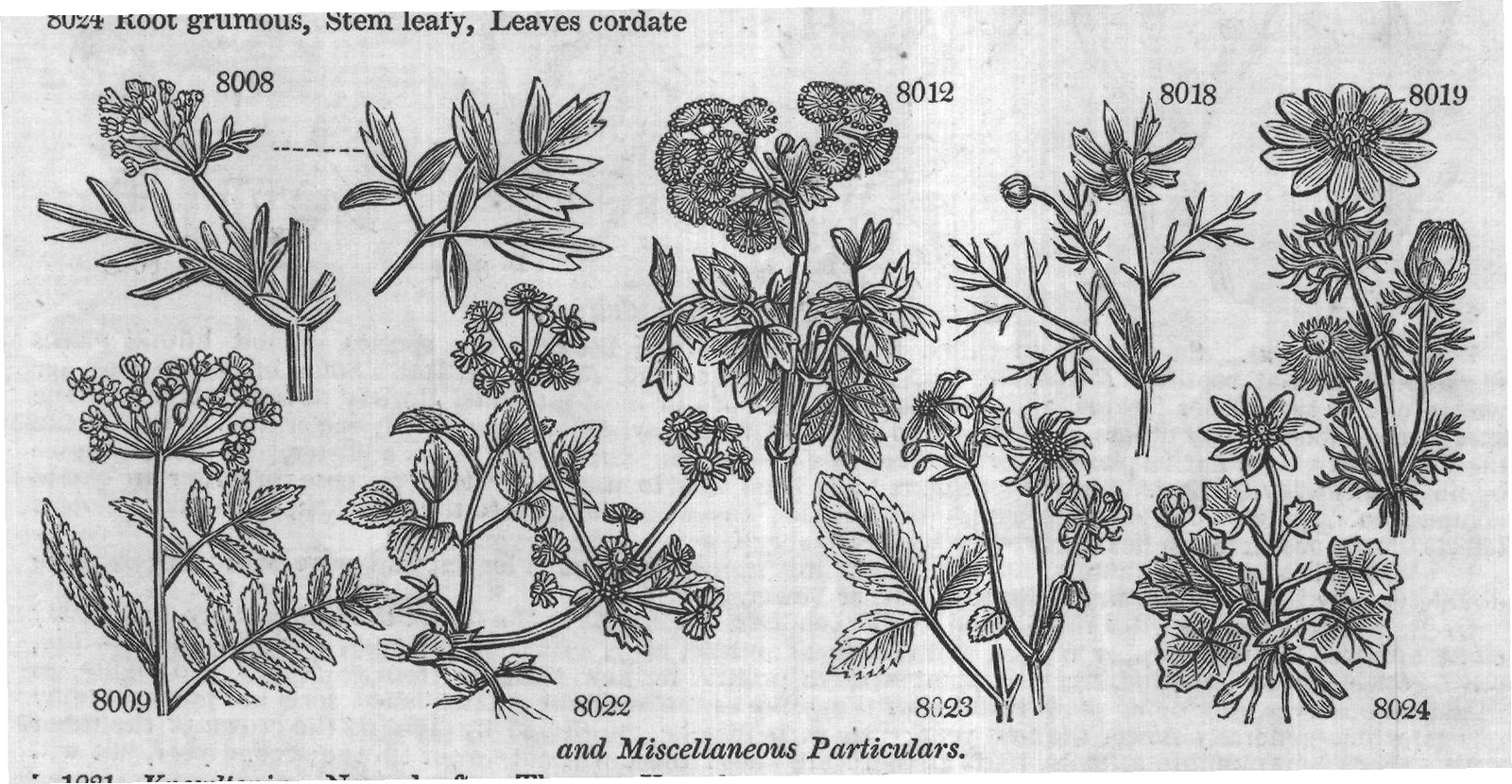
POLYANDRIA POLYGYNIA. 7982 Leaves pinnate with smooth subglaucous ovate cut-toothed 3-lobed segments 7983 Lvs. pinn. Segm. ovate-lanc. cut-toothed acuminate truncate cordate at base, Pedunc. shorter than leaf 7984 Leaves pinnate, Segments smooth entire or 3-lobed round oval oblong or linear rather acute a Segments nearly round ẞ Segments oval or oblong lanceolate Segments linear 7985 Leaves pinnate with stalked ovate-lanc. entire segments 7986 Pedunc. 1-fl. Sepals 6-8 blunt, Leaves pinnate, Segm. lanc. lin. acute or 3-lobed, Stems erect 7987 Pedunc. 1-fl. Fl. suberect, Leaves entire ovate; young ones silky 7988 Pedunc. 1-fl. Fl. nodding, Leaves entire ovate lanc. smooth 7989 The only species 7990 Stem simple almost naked, Raceme simple terminal, Fl. nodding, Segm. smooth 7991 Stem simple naked at base: leafy in middle; panicled af end, Lvs. pubescent viscid, Segm: blunt toothed 7992 Fl. loosely corymbose or subsolitary, Invol. none , Bract subsessile 7993 Fl. diœcious, Filam. clavate at end, Pericarp obl. sessile striated, Segm. of leaves bluntly 3-lobed 7994 Fl. diœcious, Fil. filiform, Segm. of leaves roundish cordate bluntly lobed smooth 7995 Stem round without bloom, Fl. panicled erect, Segm. of leaves smooth ovate or subcordate subtrifid 7996 Stem round without bloom, Fl. loosely panic . Segm. of leaves smooth glauc. ben. Peric. obliq. round. at base 7997 Stem round without bloom, Fl. loosely panicled, Segm. of lvs. obl. cuneiform sharply trifid: upper entire 7998 St. round cover. with a glauc. bloom, Fl. loose. pan . cern. Segm. of lvs. roundish tooth. at end, glauc. beneath 7999 Stem round upright, Fl. cernu. in a very large spreading panic. Segm. of lvs. smooth cuneif. trifid acute 8000 St. erect round striat. green, Pan. erect. comp. Fl. clust. Segm. oflvs. ov. subcord, coarsely cren. shin. above 8001 Stem roundish, Fl. panic. cernuous, Segm. oflvs. smooth ov. cuneate trifid, Lobes acute entire or finely cut 8002 Stem round, Fl. panicled cernuous, Petioles stemclasping winged 8003 Stem simple covered with scattered leaves panicled at end, Stem downy viscid 8004 Fl. diœcious or monœc. Filam. filif. colored, Segm. of lvs. roundish coarsely tooth. smooth glauc. beneath 8005 Stem upright round somewhat furrowed, Root fibrous, Panic. multiple erect, Segm. of lvs. lin. lanc. entire 8006 St. branch. round somew. furrow. Root fibr. Pan. multiple erect, Segm. of lvs. lin. lanc. ent. cuneate at base 8007 Stem branch. erect somewhat furrowed, Root fibr. Pan. multiple erect, Segm. of lvs. cuneiform trifid acute 8008 St. branch. erect somew. furrow. Root fibr. Pan. multiple erect, Segm. of rad. lvs. cuneif. trif. Caul. obl. lin. 8009 Stem erect round striat. glauc. Pan. multip . erect close, Seg. of lvs. subcord. ov. bluntly trifid glauc. beneath 8010 Leaves simple 5-lobed serrated 8011 Stem erect simple angular, Root creeping, Panic. erect racemose few-flowered, Segm. of leaves linear 8012 Stipules ovate, two at the base of the ramifications of the petiole, Panic. corymb. Fruit 3-cornered 8013 Stem round upright somewhat furrowed, Root creeping, Panic. erect, Segm. of lvs. lin. very narrow entire 8014 Stipules O, Fl. loosely corymbose racemose, Fruit 3-cornered pendulous 8015 Stem round nearly naked, Fl. corymb. Filam. dilated at end, Segm. of lvs. smooth ovate entire or 3-lobed 8016 Cal. hispid at base, Pet. flat obl. blunt, Fruit netted in a long lax spike 8017 Cal. smooth, Pet. conc. conniving scarcely longer than cal. Fruit netted in an ovate head 8018 Cal. hispid at base, Pet. flat acute longer than cal. Flower large, Fruit in a cylindrical head 8019 Lower leaves abortive, Upper sessile, Fruit velvety, Pet. 10-12 oblong somewhat toothed 8020 Cal. smooth distinct at base, Pet. flat obl. twice as long as cal. Fruit smooth in an oblong head 8021 Rad. leaves on long stalks , Stalks trifid, Fruit smooth, Pet. 8-10 obl. cuneate entire 8022 Umb. supradecompound much spreading 8023 Umb. simple few-flowered 8024 Root grumous, Stem leafy, Leaves cordate 8009 8008 8022 8012 8018 8019 8023 8024 and Miscellaneous Particulars. 1231. Knowltonia. Named after Thomas Knowlton, once the curator of the botanic garden at Eltham. The species grow freely in loam and peat, and are increased by dividing at the root, and by seeds. species grow freely in loam and peat, and are increased by dividing at the root, and by seeds. 1232. Ficaria. So named because the grumous roots bear tubercles like little figs. A common wood plant, remarkable for its shining leaves and bright yellow flowers. The young leaves are sometimes used as greens for its shining leaves and bright yellow flowers. The young leaves are sometimes used as greens in Sweden , and the roots were formerly applied in poultices to piles in England, probably from their resemblance to that disease. These roots or tubercles lie near the surface, and are sometimes laid bare by the rains, and in this state have induced the ignorant, under the influence of superstition, to fancy that it rained wheat. The plant is injurious in moist grass lands, but is effectually destroyed by a dressing of coal or wood ashes.
I 3 1233. RANUNCULUS. W. CROW-FOOT. 8025 Flámmula W. lesser-Spearw.cu 1 jn.s Y 8026 réptans W. least-Spearw. cujn.s Y 8027 Língua W. great-Spearw.cu 2 jn.au Y 8028 nodiflórus W. knot-flowered 이 W my.jl Y 8029 gramíneus W. 8030 parnassifólius W. grassy or 1 ap.jn Y Parnassia-Ivd.or jn.jl St 8031 amplexicaúlis W.
Plantain-leav'd or 1 ap.my W 8032 bullátus W.
Portugal or 1 my.jn Y 8033 Thóra W. kidney-leaved or my.jn Y 8034 monspeliácus Gouan. Montpelier or 1 ap.my Y POLYANDRIA POLYGYNIA.
Ranunculacea. Sp. 49-160.
Britain wa. pl. D co Britain wa. pl. D co Britain mud.d. D. co 1714. S co Wales al. me. D co S. Europe 1769. D co Pyrenees 1633. D co S. Europe 1640. D co Austria 1710. D co S. France CLASS XIII.
Eng. bot. 387 Fl. dan. 108 Eng. bot. 100 Bot. mag. 2171 Eng. bot. 2306 Bot. mag. 386 Bot. mag. 266 M. his. t. 31. f. 50 Jac. aus. 5. t.442 Sicily ... 8035 lácerus Dec. torn cu my.jn Y 8036 ophioglossifólius Dee. Snake's-tongue-1. O w jn Y S. France 1821.
S. Europe 1823.
D co D co M. his. t. 30. f.43 Bell. taur. 5. t.8 co 8037 salsuginosus Pall. salt cu 1 ap.my Y Siberia 1822.
D co Jac. vind. t. 31 8038 fumariæfólius Desf. fumitory-leav'd cu 1 my.jn Y ...... ... 8039 créticus W.
Cretan or 1 ap.my Y Candia D co 1658. D co 8040 cassúbicus W.
Caltha-leaved or 2 jn.jl Y Siberia Siberia 1794. D co Mo. his. t. 31.f.48 Bot. mag. 2267 8041 aurícomus W. wood W ap.my Y Britain woods. D co Eng. bot. 624 3042 arbortívus W. three-flowered W 3 4 my.au Y 8043 scelerátus W. 8044 aconitifólius W. -. flore pléno ẞ platanifólius W. 8045 pedátus W.en. 8046 illýricus W.
R. sericeus W. 8047 asiáticus W. 8048 chærophyllus L. 8049 rutæfólius W.
Celery-leaved p Aconite-leaved or 1 my.jn W double-flowered or 1 my.jn W Plane-tree-lvd. or 2 jn.jl W pedate or 1 my.jn Y Illyrian or 1½ my.jn Y common-gard. or my.jn Va villous cu 1 my.jn Y Rue-leaved pr my.jl Y 8050 glaciális W. two-flowered prjn.au Y 8051 nivális W. snowy pr jn.au Y 8052 montánus W. mountain prjn.au Y 8053 alpéstris W. alpine pr jn.au W 8054 pensylvánicus W. Pensylvanian w 1 jn.jl Y 8055 bulbósus W. bulbous 8056 hirsútus H. K. pale hairy W W my.jn Y 1 jn.o Y 8057 marylándicus Ph.
Maryland 8058 répens W. creeping W my.au Y ẞ flore pléno double-flowered or my.au Y 8059 polyánthemos W. many-flowered un my.jn Y 8060 ácris W. upright Aw 1 jn.jl Y ẞ flore pléno double-flowered or 2 jn.jl Y 8025 8027 8034 2 my.jn Y Aun 1 my.jl Pa.Y N. Amer. 1713. D co Britain wa.pl. S co Al. of Eur. 1596. D co Al.of Eur. 1596. D co Germany 1769. D co Hungary 1806. D co S. Europe 1596. D co Levant 1596. Dr.m Portugal Austria 1759. Dr.m ...
Bot. mag. 204 Fl. dan. 111 Bot. mag. 2229 Jac. aus. 3. t. 222 Mill. ic. 2. t. 216 Dr.m Mo. h. t. 30. f. 44 Jac. col. 1. t. 6, 7 Fl. dan. 19 Lapland 1775. D s.l Lapland 1775. D s.l Lapland 1775. D s.l Scotland al.riv. S co N. Amer. 1785. D p.1 Britain me.pa. S co England rubble. D co N. Amer. 1811. D Co Britain me.pa. D co N. Europe 1596. D co Britain me. pa. D co Britain ...... ... ...
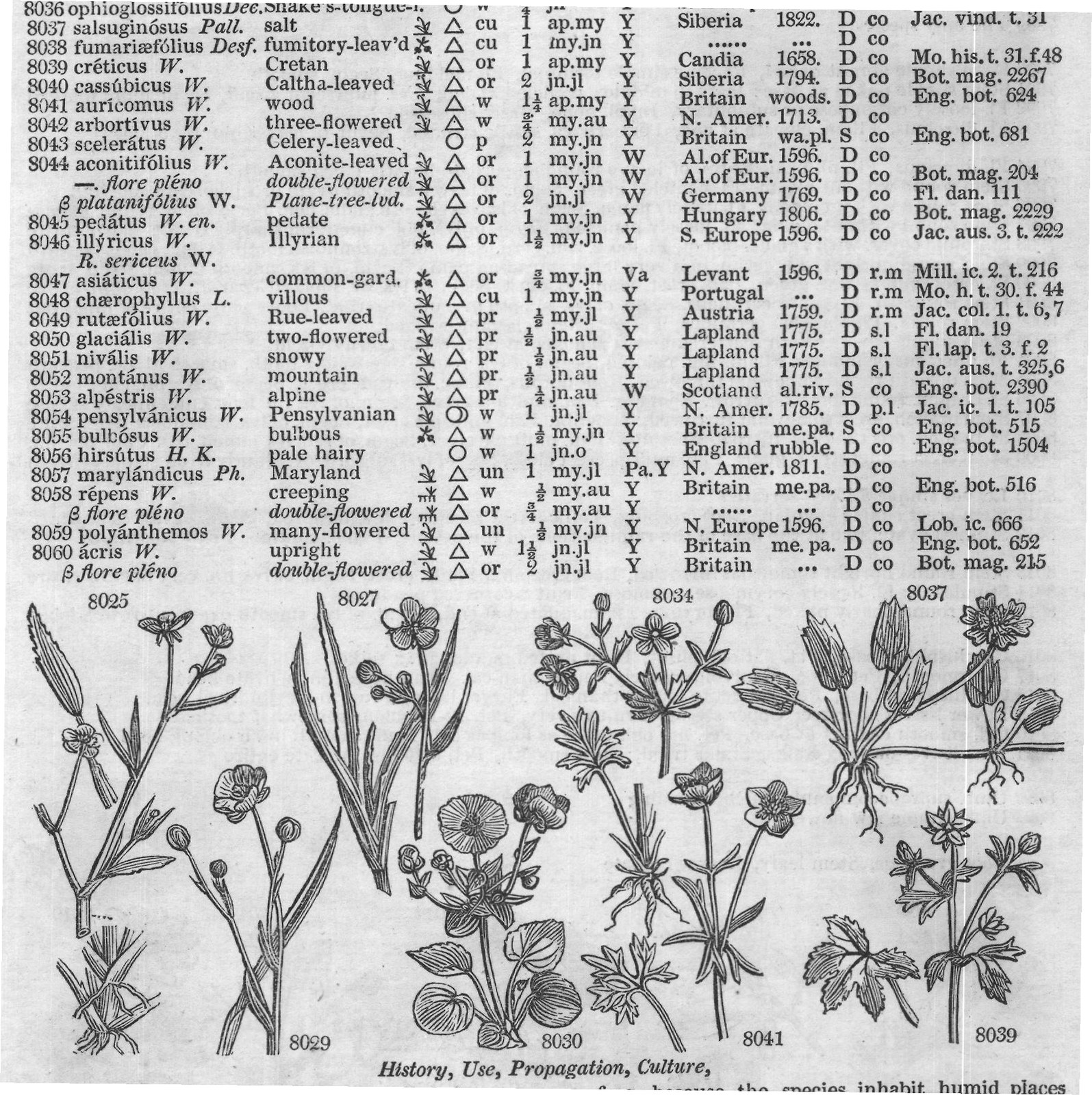
Eng. bot. 2390 Jac. ic. 1. t. 105 Eng. bot. 515 Lob. ic. 666 Eng. bot. 652 Bot. mag. 215 8037 Eng. bot. 681 Fl. lap. t. 3. f. 2 Jac. aus. t. 325,6 Eng. bot. 1504 Eng. bot. 516 8029 8030 History, Use, Propagation, Culture, 8041 8039 1233. Ranunculus. Said to be so called from rana, a frog, because the species inhabit humid places frequented by that reptile. Renoncule, Fr., Ranunkel, Ger., and Kanuncole, Ital. Some of the species are weeds, one or two border flowers, and R. asiaticus is one of our most esteemed florists' flowers. Some of the species are tuberous and others bulbous rooted, but the most part are tuberous. R. sceleratus is one of the most virulent of our native plants. Bruised and applied to the skin it soon raises a blister, and makes a sore most means easy to heal. Strolling beggars have been said to use it for that purpose, in order to violent have been said to use it for that purpose, in order to excite by compassion. no When chewed, it inflames the tongue; and when taken into the stomach, it produces violent effects. It is suspected to have proved poisonous to sheep. R. aconitifolius is a handsome plant, with branching stems, deep green leaves, and pure white flowers; the double variety is an old and much admired border flower. Of R. asiaticus the varieties raised from seed are endless. Maddock, in the end of the last century, had nearly eight hundred, all with proper names, and ranged as purple, gray, crimson, red, rosy, orange, two yellow, white, as purple, gray, crimson, red, rosy, orange, yellow, white, olive, coffee, striped, spotted, &c. No plant is more prolific in new varieties from seeds; no two plants, as olive, Maddock observes, producing flowers alike, or the same as the original. Established sorts are propagated the tuber by the same as the original. Established sorts are propagated by offsets, which generally flower the first year: rare sorts may be multiplied by dividing the crown of the tuber with a sharp penknife into as many parts as there are buds: these will not flower till the second year, but will diminish the risk of losing a very rare variety.
The ranunculus prefers a fresh loamy soil, rather than otherwise inclined to clay: it should be well manured; and it is customary, in forming the beds, to place a stratum of well rotted cow-dung six or nine inches below the surface, which both retains moisture and supplies nourishment. The roots may either be planted in November or earlier, in which case, to prevent their being destroyed by the frost, they should be mulched, or they need not be planted till March. The former mode gives much the strongest bloom, as the roots, when kept in air all the winter, are apt to be over dried , and kept in sand they sometimes get mouldy: and in this and similar cases, the progress of vegetation from the planting to the blossoming period, is more rapid than is natural to the species. Ranunculus roots will retain their vegetative properties two and sometimes three years; a thing not common among bulbs and tubers, unless preserved dormant in an ice cold room.
R. bulbosus has a solid white bulb about the size of that of the common Crocus. The flowers are some- ORDER IV.
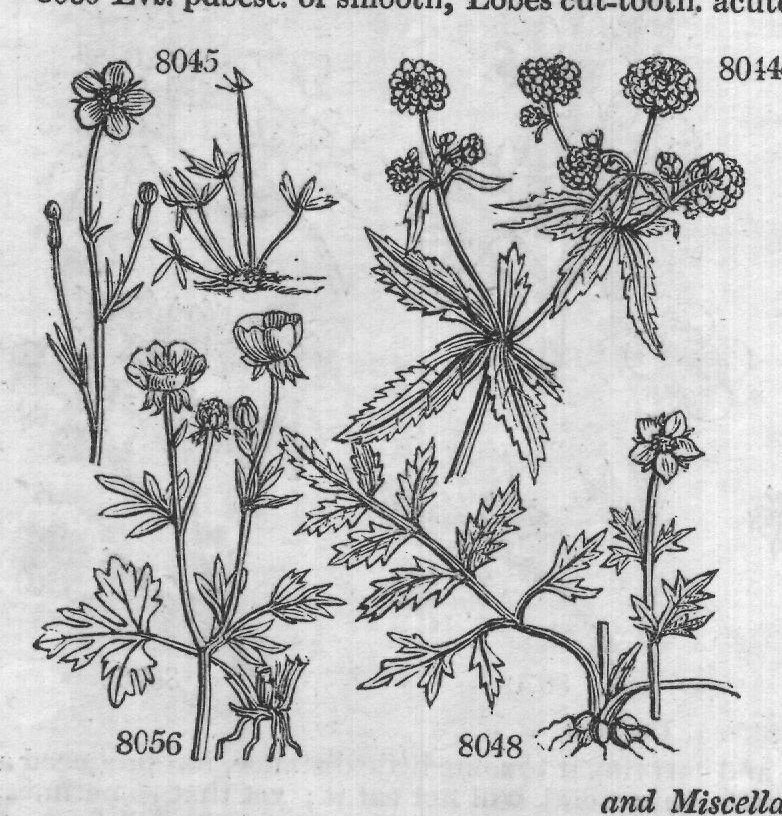
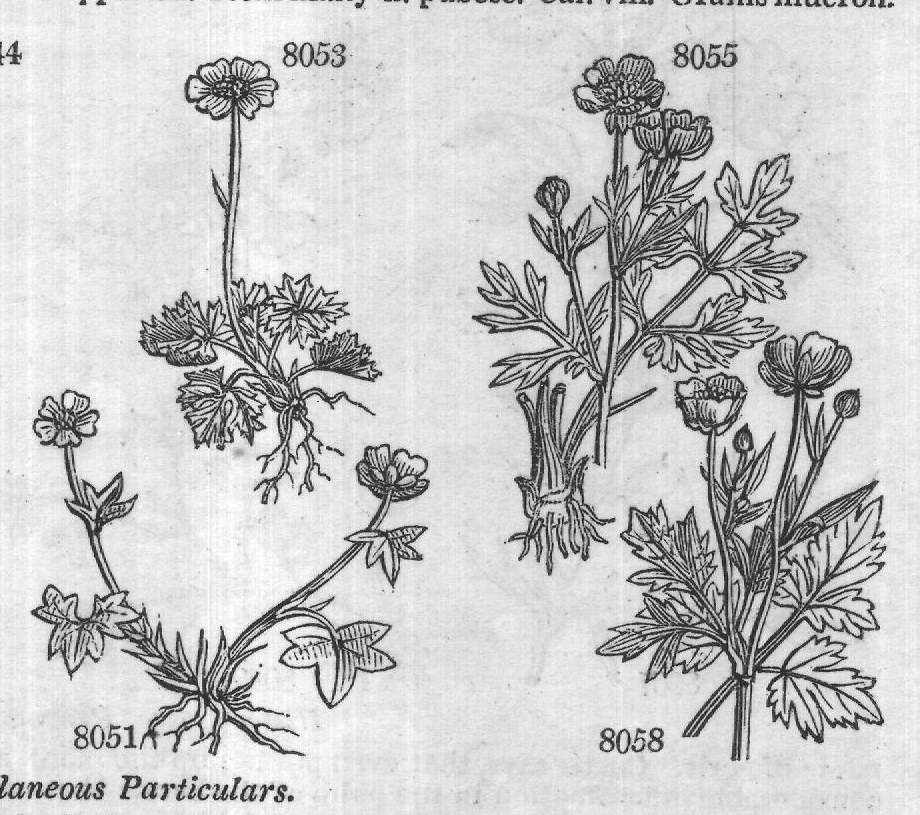
POLYANDRIA POLYGYNIA. 8025 Leaves smooth lin. lanc.: lower stalked, Stem declinate solid rooting at base, Fruit smooth 8026 Leaves lin. entire smooth, Stem creeping and rooting at every joint 8027 Leaves lanc. subserrate sessile half stem-clasping, Stem erect smooth 8028 Rad. leaves stalked oval-obl. Fl. sess. opposite the leaves, Fruit granular scarcely crowned with the style 8029 Leaves lanc. or lin. entire, Stem erect very smooth, Scales of the petals tubular 8030 Rad. leaves stalked subcordate ovate-roundish : cauline sessile ovate-lanc. Pedunc. hirsute 8031 Leaves oval-lanceolate acuminate stem-clasping, Scape and peduncles smooth 8032 All the leaves radical stalked ovate toothed, Scapes naked 1-flowered 8033 Leaves smooth reniform crenate, Floral cut, Stem 2:3-fl. smooth 8034 Lvs. woolly 3-lobed with trifid toothed cuneate lobes: upper 3-parted with entire lin. lobes, Cal. reflexed 8035 Leaves cuneiform irregularly cut at the end, Stem smooth branched many-fi. Cal. appressed 8036 Lower leaves stalked cordate blunt: upper obl. sessile, Stem erect hollow, Fruit granular 8037 Rad. lvs. stalked oval or subcord. 3-5-tooth. at end, Runners from neck of plant, Scapes Scapes naked 1-fl. erect 8038 Lvs. very smooth many-parted, Lobes obl. Scapes many 1-fl. with appressed hairs, Cal. spreading smooth 8039 Covered with soft hairs, Rad. lvs. stalk. cord. orbic. somewhat cut-tooth. Stem branched, Cal. appressed 8040 Lvs. smooth: radic. stalked reniform crenate; caul. in linear lobes, Cal. pubescent shorter than petals 8041 Leaves smooth: radic. stalked cordate generally 3-parted or lobed, Calyx pubescent shorter than petals 8042 Lvs. smooth: radic. stalk. cordate-roundish crenate some 3-parted or cut, Cal. smooth longer than petals 8043 Lvs. smooth: radic. stalk. 3-part. Lobes 3-lob. bluntly cut, Cal. smooth, Fruit very small in an obl. spike 8044 Lvs. palm. 3-7-parted cut-toothed: upper sessile with lin. lanc. lobes, Stem branch, many-fl. Cal. appressed ẞ Radic. leaves 5-7-lobed with acuminate lobes, Bractes lin. entire 8045 Leaves smooth: radic. stalked 3-parted or pedate; upper linear, Stem erect few-fl. Calyx appressed 8046 Lvs. silky: first ent. lin. lanc.; rest 3-part. with entire or 3-part, lobes, Stem many-fi. Cal. somewhat reflexed 8047 Leaves tern. or bitern. Segm. toothed or cut trifid, Stem erect simple or branched, Fruit in a cylindr. spike 8048 Rad. lvs. stalked villous 3 cut: first ovate toothed or 3-lobed, Stem erect 1-2-fl. Cal. spreading subreflexed 8049 Leaves pinnate with 3-lobed cut multifid lobes, Stem about 1-fl. Cal. smooth, Pet. 8-10 8050 Radical leaves stalked palmate 3-parted with trifid blunt thick lobes, Calyx very hirsute 8051 Leaves smooth: radical stalked 5-fid with entire ovate lobes, Calyx very hirsute twice as short as petals 8052 Rad. lvs. smooth 3-parted round with trifid blunt segments: cauline sess. linear-lobed, Cal. nearly smooth 8053 Leaves round 3-lobed, Lobes blunt crenate at end, Stem about 1-fl. Cal. smooth, Pet. obcord. or 3-lobed 8054 Stem and petioles cover. with stiff hairs, Lvs. 3-fid with stalk. acutely 3-lob. segm. Cal. reflex. Style smooth 8055 Rad. lvs. stalked 3-cut with trifid cut segm., of which the middle one is stalked, Stem erect, Cal. reflexed 8056 Lvs. 3lob. with blunt cut lobes, of which the mid. is stalk. Cal. refl. Grains with a single row of minute warts 8057 Stem and petioles with soft hairs at base, Lvs. smooth. trif. with 3-lob. ac. cut segm. Cal. smooth spreading 8058 Lvs. pinnate 3-fid with cuneate 3-lobed cut segm. Runners creeping, Cal. erect, Grains with an acute point 8059 Lvs. 3-5-lob. with lin. divisions, Stem erect and petioles with spreading hairs, Pedunc. furrowed, Cal. hairy 8060 Lvs. pubesc . or smooth, Lobes cut-tooth, acute: upper lin. Stem many-fl. pubesc. Cal. vill. Grains mucron. 8045 8056 8048 8014 8051 8053 8058 8055 and Miscellaneous Particulars. times double, but not so frequently as R. acris. It is distinguished from the repens, with which it has been confounded by some authors, by its roots, by its never throwing out runners, and by its reflexed calyx; this last character arises from its particular structure, the lower half being thin and almost transparent, and therefore not having a sufficient degree of solidity to support itself upright. It is the second flower which, next to the Dandelion, covers the meadows with dazzling yellow. Like most of the Crow-foots, it possesses the property of inflaming and blistering the skin; particularly the root, which is said to raise blisters with less pain and more safety than Spanish flies; hence these roots have been applied for that purpose, particularly to the joints in cases of the gout. According to Hoffman, beggars make use of them to blister their skins, with a view of exciting compassion.
The juice of the herb is said to be more acrid than that of R. sceleratus, and if applied to the nostrils, it provokes sneezing. The roots, on being kept, lose their stimulating quality, and are even eatable when boiled. Hogs are fond of them, and frequently dig them up. The herb is too acrid to be eaten unmixed by cattle; accordingly the flowering-stalks are left to perfect the seed in pastures: some of it, however, is consumed, and it is not improbable that this and other pungent plants, mixed with the grasses, may act as a powerful stimulus to some animals, as salt does to others. It abounds in dry pastures, and flowers in May. Besides the name of round-rooted or bulbous Crowfoot, it is called by the common people butter-flower, butter-cups, king-cups, gold-cups; and it is the cuckoo-buds of yellow hue, of Shakspeare. The repens, hirsutus, and acris, however, are all confounded with this under one name by the vulgar. R. repens is an obnoxious plant in every description of gardening and agriculture. From the great variety of soil and situation in which it is found, it assumes many varieties; by a river's side, or in marshes, it will grow three or four feet high, with a stem nearly as large as the human thumb; in barren gravelly fields it is entirely procumbent, with a stem not larger than a small wheat-straw; but in all states it retains the character of the creeping stem, and it does not lose it in cultivation. Its principal time of flowering is in June, but it may be found in blossom during most of the ensuing summer months in meadows and pastures, under hedges, in shady waste places, church-yards, and gardens. The qualities of this and bulbosus are similar: both blister the skin, and are very acrid in taste. Like the acris and bulbosus, it is sometimes found double, but more rarely.
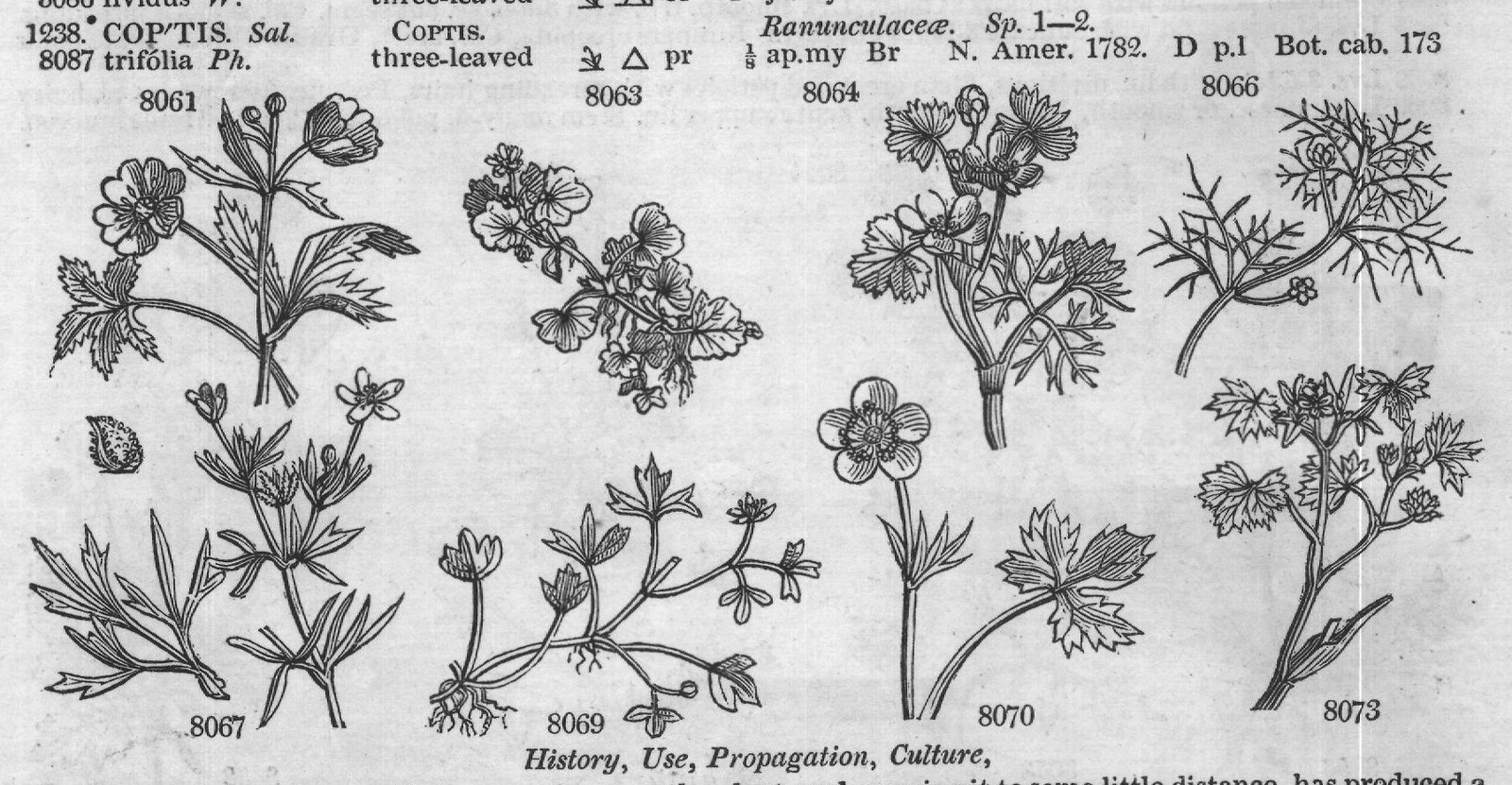
R. acris is supposed to possess the blistering property in a considerable degree, whence Linnæus gave it the Ii 4 8061 lanuginósus W. 8062 par vúlus W. 8063 hederáceus W. 8064 aquátilis W. 8065 tripartítus Dec. 8066 pan tothrix Dec. fluviatilis W. 8067 arvénsis W. 8068 oxyspérmus W. 8069 hyperbóreus L. 8070 Gouáni W. 8071 nemorósus Dec. 8072 muricátus W. 8073 parviflórus W. 1234. TROL/LIUS. W. 8074 americánus Muhl. láxus Ph. 8075 europæ'us W. 8076 asiáticus W.
ẞ intermédius yhýbridus 1235. ISOPY'RUM. W. 8077 fumarioídes W. 8078 thalictroídes W.
POLYANDRIA POLYGYNIA. woolly-leaved little-upright or 1 jn.jl Y W jl.au Y S. Europe 1683. D co England CLASS XIII.
Fl. dan. 397 Sco Col. ec. t. 316. f.1 Ivy-leaved pr my.au W various-leaved pr ap.au W Britain wat. pl. D co Britain dit. D co Eng. bot. 2003 Eng. bot. 101 three-parted pr ap.au W Europe rigid-leaved pr ap.au W Britain dit. D co ... long-lvd.-water or ap.au W Britain D co Fl. dan. 376 ... corn W 1 jn.au Y Britain cor.fi. D co Eng. bot. 135 sharp-grained or 1 my Pa. Y Caucasus 1822. D Co northern cu ap.my Y N. Europe 1820. D co Fl. dan. t. 331 Gouan's or 1 my.au Y wood or 1 my.au Y Pyrenees 1818. D co Switzerl. 1810. D co Go. ill. t. 17.f.1,2 prickly-seeded W jl.au Y S. Europe 1683. S co Vent. cels. t. 73 small-flowered W my.jn Y England gra. pl. S co Eng. bot. 120 GLOBE-FLOWER.
Ranunculacea. Sp. 3-5.
American or my.jl Y N. Amer. 1805. D co Bot. mag. 1988 European or 2 my.jn Y Britain Asiatic or 1 my.jn D.O Siberia intermediate or 1 my.jn Y ...... ... hybrid or 1 my.jn Y ... ... groves. D p.1 1759. D p.1 D p.l D p.l Eng. bot. 28 Bot. mag. 235 ISOPYRUM.
Fumitory-lvd. pr meadow-rue-lv. pr Ranunculacea. Sp. 2-4. 1 jn W.G Siberia 1741. S s.1 mr.ap W.G Italy 1759. D s.l Am. rut. 74. t. 12 Jac. aust. 2.t.105 1236. ERAN'THIS. Sal.
WINTER-ACONITE.
Ranunculacea. Sp. 1-2. 8079 hyemális Sal. common or ja.mr Y Italy 1596. O co Bot. mag. 3 1237. HELLE BORUS.
W. HELLEBORE.
Ranunculacea. Sp. 7-9. 8080 níger W.
Christmas Rose A or 1 ja.mr Pk Austria 1596. Dr.m Bot. mag. 8 8081 viridis W. green or 2 mr.ap G Britain woods. D co Eng. bot. 200 8082 purpuráscens Pers. purplish or 1 mr.ap Pu.g Hungary 1817. D s.1 Pl. ra. h. 2. t. 101 8083 odórus W. en. sweet-scented or 1 mr.ap G Hungary 1817. D s.l 8084 dumetórum W. en. bushy or 1 mr.ap G Hungary 1817. D s.l 8085 fœ'tidus W.
Rear's-foot 8086 lívidus W. three-leaved or 1 f.ap G or England cha.pa. D co Eng. bot. 613 1 ja.my Pu Corsica 1710. D p.l Bot. mag. 72 1238. COP'TIS. Sal.
COPTIS.
Ranunculacea. Sp. 1-2. 8087 trifólia Ph. three-leaved pr ap.my Br N. Amer. 1782. D p.1 Bot. cab. 173 8061 8063 8064 8066 8067 8069 8070 History, Use, Propagation, Culture, 8073 name of acris. Curtis says, that even pulling up the plant, and carrying it to some little distance, has produced a considerable inflammation in the palm of the hand: that cattle, in general, will not eat it; yet that sometimes, when they are turned hungry into a new field of grass, or have but a small spot to range in, they will feed on it, and hence their mouths have become sore and blistered. According to Linnæus, sheep and goats eat it but kine, horses, and swine refuse it. When made into hay it'loses its acrid quality, but then it seems to be too stalky and hard to afford much nourishment if it be of any use it must be to correct, by its warmth, the insipidity of the grasses. In many pastures the flowering stems are left standing in vast abundance to disseminate their seeds before they do that, they might easily be cut down with the scythe, or pulled up by women and children after a shower, which would more effectually destroy the plants; they should be gathered into heaps and burnt. It flowers in June and July, and is confounded vulgarly with the repens and bulbosus, under the name of butter-flower or butter-cups, under a notion that the yellow color of butter is owing to these plants. It is the richness and exuberance of the pasture that communicates this color, and not these flowers, which the cattle seldom or ever touch. It is frequent in gardens with a double flower, among other herbaceous perennials, under the name of yellow bachelor's buttons. R. aquatilis produces flowers which are sometimes very large, and make a handsome show in ponds and ditches: the curious variety in the floating and immersed leaves, occasioned by the depth and velocity of the stream, adds to the beauty of this common aquatic plant. Dr. Pulteney (Linn. Trans. vol. 5. p. 19.) contradicts the assertions of its deleterious qualities, and proves that it is not merely innoxious, but nutritive to cattle, and capable of being converted to useful purposes in agricultural economy. In the neighbourhood of Ringwood, on the borders of the Avon, some of the cottagers support their cows, and even horses, almost wholly by this plant. A man collects a quantity every morning, and brings it in a boat to the edge of the water, from which the cows eat it with great avidity, insomuch that they stint them, and allow only about twenty-five or thirty pounds to each cow daily. One man kept five cows and one horse so much on this plant with the little which the heath afforded, that they had not consumed more than half a ton of hay throughout the whole year, none being used except when the river is frozen over. Hogs also are fed with this plant, and improve so well on it, that it is not necessary to give them any other sustenance till they are put up to fatten. This property of water-crowfoot is the more remarkable, as all the species have been deemed acrimonious, and some of them are, without doubt, highly so. It is probable this species is rendered inert as a poison by growing in the water; although it must be confessed, that in other instances moisture heightens the deleterious property of vegetables, especially in the umbelliferous tribe. ORDER IV.
POLYANDRIA POLYGYNIA. 8061 Leaves trifid silky, Lobes broad toothed cut, Stem and petiole with reflexed hairs, Grains hooked 8062 A small variety of R. hirsutus, with a dwarf 1-flowered stem 8063 Lvs. reniform 3-5-lobed with broad entire blunt lobes, Pet. scarcely longer than cal. Petals 5-12 [bristles 8064 The submersed lvs. capill, multifid: emersed 3-part. with cuneif. lobes tooth. at end, Grains hispid with stiff 8065 The submersed lvs. capillary multifid: emersed 3-part. with cuneif. lobes toothed at end, Grains smooth 8066 All the leaves capillary multifid, Pet. obovate larger than calyx, Grains smooth 8067 Leaves smooth: radical 3-parted; cauline multifid with lin. lobes, Grains with long prickles on each side 8068 Lvs. vill.: radic. stalk. ov. 3-part. cut; floral 3-part. Stem erect dichotom. with spread. hairs, Grains muric. 8069 Lvs. smooth stalk. bifid, Lobes oval obl. divaricat.: the mid. entire, Sheaths auricled at hase, Stem filiform 8070 Radical leaves round with 5 cut lobes: cauline sessile palmate, Stem pubescent, Cal. subvillous 8071 Rad. lvs. trifid beyond midd. with cuneif. trifid lobes, Stem with spread. hairs, Grains hooked with style 8072 Lvs. smooth stalk. roundish 3-lob. coarsely tooth. Pedunc. opp. lvs. Cal. spreading, Grains muricate cornute 8073 Lvs. vill, round 3-lob. coarsely tooth. Stems soft decumb. Cal. reflexed as long as pet. Grains tuberculate 8074 Sepals 5-10 spreading, Pet. 10-15 shorter than stamens 8075 Sepals 15 globose, Pet. 5-10 the length of stamens 8076 Sepals 10 spreading, Pet. 10 longer than stamens 8077 Caps. 10-20, Sepals acute, Root slender nearly simple perpendicular 8078 Caps. 1-3, Sepals blunt, Root creeping grumous 8079 Sepals 6-8-oblong 8080 Radical leaves pedate smooth, Scape leafless with 1-2-fl. and bractes 8081 Radical leaves pedate smooth: cauline subsessile palmate, Sepals roundish ovate green 8082 Radical leaves palmate downy beneath, Segm. cuneate at base 3-5-lobed at end, Sepals roundish colored 8083 Radical leaves palmate downy beneath, Segm. obl. undivided serrate at end, Sepals ovate obl. acute green 8084 Radical leaves very smooth pedate: cauline subsessile palmate, Sepals roundish green 8085 Stem many-fl. leafy, Leaves pedate very smooth with obl. linear segments 8086 Stem many-fl. leafy, Leaves 3 cut smooth glaucous beneath, Segments ovate-lanceolate 8087 Leaves trifid with obovate toothed blunt 3-lobed segments, Scape 1-flowered 8074 8075 8076 8070 8080 8081 and Miscellaneous Particulars. 8078 This remark of Dr. Pulteney's is the more important, as in the Swedish experiments the R. aquatilis is recorded as the only one rejected by all the species of domestic cattle; of the common sorts, there is no doubt but that R. Flammula, bulbosus, acris, sceleratus, and arvensis are acrimonious. Before the introduction of Cantharides they were used as vesicatories, and are said to act with less pain than flies, without any effect on the urinary passages; but their action is related to be uncertain, and they are accused of frequently leaving ill-conditioned ulcers.
The acrimony, even of the most virulent, is wholly dissipated in drying; so that in form of hay they appear to be harmless. It is also expelled in decoction; accordingly, the shepherds of Morlachia boil the R. sceleratus and eat it; and both R. auricomus and repens are said to be wholly inoffensive, and are ranked by some authors among oleraceous plants.
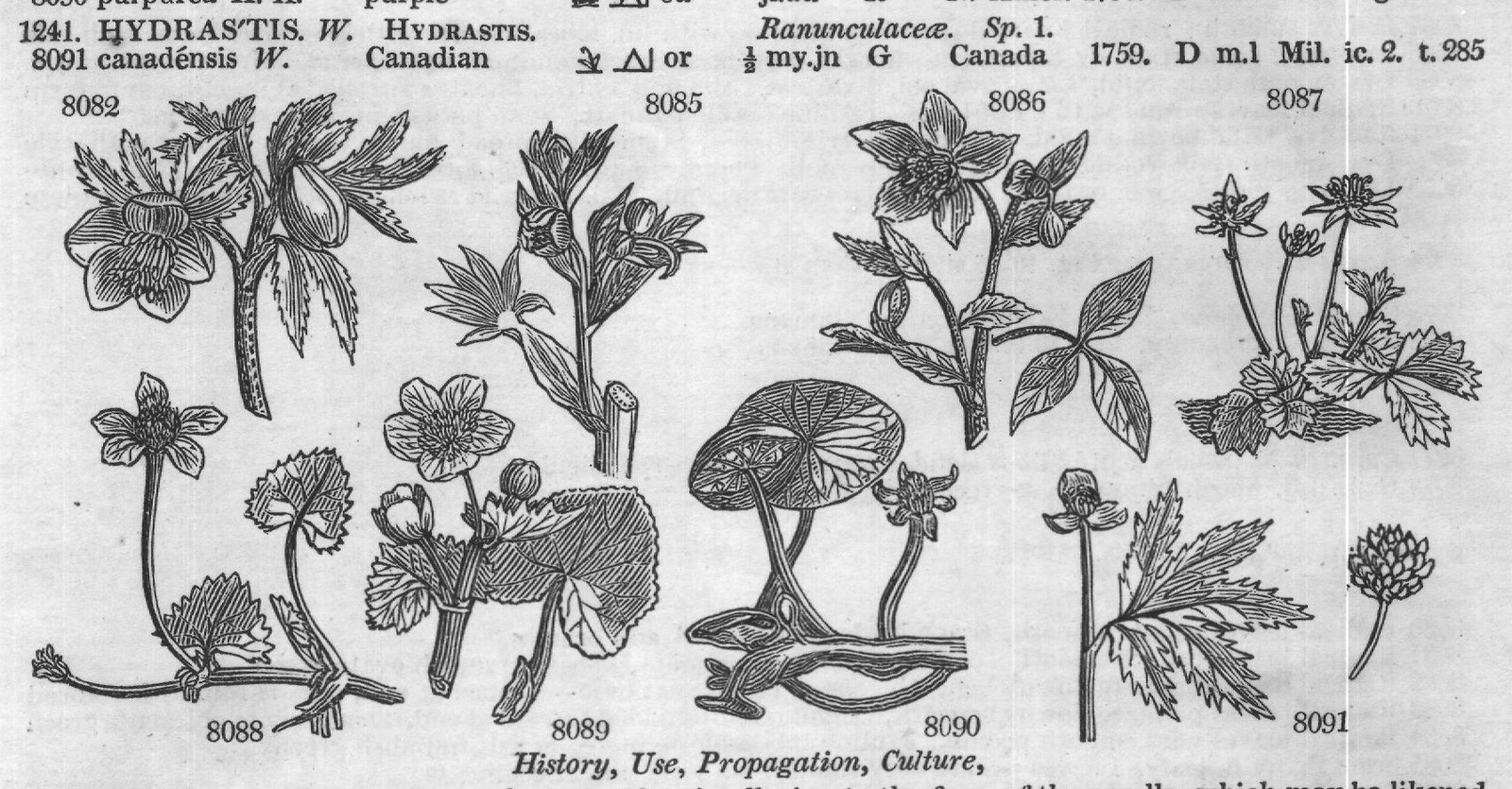
The Ranunculi give out their acrimony wholly in distillation. The distilled water of R. sceleratus is intensely acrimonious; and when cold deposits crystals, which are scarcely soluble in any menstruum, and are of an inflammable nature. 1234. Trollius. A name given to this plant by Conrad Gesner. It is derived from trol or trolen, an old German word, signifying something round, in allusion to the form of the flowers. The species are showy flowers for the general border, and of the easiest possible culture. 1235. Isopyrum. A name given by the Greeks to a plant resembling Nigella, the seeds of which had the same taste. These are small herbaceous plants related to Nigella, but with the habit of Thalictrum. 1236. Eranthis. From ερa, the earth, and avθoς, flower, because the bright yellow blossoms seem to lie upon the earth. A pretty little tuberous rooted plant, valuable for the early period at which it flowers. 1237. Helleborus. From ἑλεiv, to cause death, and Loga, food. The dangerous qualities of Hellebore are well known. Leathery leaved plants, most of which are evergreen, and flower in winter and early in spring. H. niger and fœtidus have long been in use in popular medicine, especially the latter, as a vermifuge and cathartic. They are both admitted in the London Materia Medica, but being violent poisons, require caution in their application. H. fœtidus, from its deep green and finely divided leaves, forms a most ornamental evergreen bush for the shrubbery. 1238. Coptis. From κόπτω, to cut, in reference to the numerous divisions of the leaves. Small plants, with the habit of Trientalis.
POLYANDRIA POLYGYNIA.
CLASS XIII. 1239. CAL/THA. W.
MARSH-MARYGOLD.
Ranunculaceæ. Sp.2-7. 8088 rádicans L. T. creeping or ap.my Y 8089 palústris W. common or 1 ap.my Y Scotland sc. ma. D m.s Linn. tr. 8. t. 17 Britain mar. D m.s Eng. bot. 506 flore pléno double-flower'd or 1 ap.my Y D. m.s 1240. HYDROPEL/TIS. H. K. HYDROPELTIS. 8090 purpúrea H. K. purple 1241. HYDRASTIS. W. HYDRASTIS.
Hydropeltideæ. Sp. 1.
Acu 8091 canadénsis W. 8082 Canadian or jl.au R N. Amer. 1798. D m.s Bot. mag. 1147 Ranunculacea. Sp. 1. my.jn G Canada 1759. D m.l Mil. ic. 2. t. 285 8085 8086 8087 8088 8089 8090 8091 History, Use, Propagation, Culture, 1239. Caltha. A syncope of κaλaθoς, a goblet, in allusion to the form of the corolla, which may be likened to a golden cup. The flower-buds of C. palustris, gathered before they expand, are said to be a good substitute for capers. The juice of the petals boiled with alum dyes paper yellow. The whole plant is acrid, and not eaten by cows, unless in case of extreme hunger.
CLASS XIV. - DIDYNAMIA. 4 STAMENS, of which two are shorter than the others. THIS class, which, as its name applies, depends upon the presence of four stamens in the corolla, two of them being longer than the others, is, with the exception of Syngenesia and Gynandria, the most natural and best defined of all Linnæus's great groups, or, as he named them, classes. It is divided into two orders, called Gymnospermia and Angiospermia. Gymnospermia contains all the genera with what are popularly but erroneously called by the Linnæan school of botany, naked seeds. It answers to the natural order of Labiatæ of Jussieu's method, with the exception of some genera which are excluded on account of having only two stamens, and are found in Diandria. Nearly all the class consists of herbaceous plants, those which are called shrubs being for the most part herbaceous plants, whose stems, from the mildness of the climate in which they grow, become perennial. The most remarkable plants are the rosemary, hyssop, balm, thyme, mint, and marjoram, for the kitchen or laboratory; and the various species of Teucrium, Lavandula, Phlomis, and Dracocephalum, for the flower garden. In Angiospermia are included the genera with numerous, or rarely a few, seeds, enclosed in a simple pericarpium. These would be combined in a manner not altogether unnatural, if some of the genera were excluded. For instance, the beautiful Linnæa, the emblem of the most highly gifted naturalist the world has ever produced, belongs to Caprifoliaceæ, and stands alone in point of natural affinity; the same may be said of Melianthus. The greater part of Scrophularineæ, ail Melampyraceæ and Orobancheæ, and nearly the whole of Verbenaceæ and Gesnerieæ are found here. A considerable portion of Acanthaceæ also occupy a station in this order. Among these are many genera of much beauty, but few of interest as useful plants. Among the ornamental families every one will recognize the Bignonia, with its elegant orange or yellow trumpet flowers, and frequently twining stem; the Jacaranda, with its fern-like umbrageous foliage and magnificent diadem of blue; the Acanthus, consecrated to sculpture; the noble Clerodendrum, the pride of the Japanese; and the modest Eyebrights (Euphrasia) of our English meadows. In one part of the class we have the Vervain, surrounded by its mystic moonlight charms; in another, the Antirrhinum tribe, remarkable for the grotesque resemblance of its blossoms to the snouts of animals; and close behind it, imperial Pedicularis, proudly rearing her heraldic honours among the snows and deserts of the frozen north. These are succeeded by a long line of forms, principally European, and of various degrees of beauty. Among the useful plants, Digitalis, used in medicine, and Sesamum as oil seed, are all which can be particularized. Order 1. GYMNOSPERMIA. 1242. Ajuga. Upper lip of cor. very minute, 2-toothed. Stamens longer than upper lip. 1243. Anisomeles. Calyx tubular, 10-striated, 5-cleft. Pericarpium divided into four lobes resembling naked seeds.
Upper lip of corolla small, entire; lower trifid, with the middle segment 2-lobed. Stamens exserted, ascending. Anthers of the short stamens 2-celled, with close cells; of the longer halved or dissimilar. Seeds smooth. 1244. Teucrium. Upper lip of cor. none, 2-parted beyond the base. Stamens exserted. 1245. Westringia. Cal. campanulate, 5-toothed. Corolla subrotate, with the upper segment bifid. Two of the anthers barren. 1246. Satureja. Cal. tubular, striated. Segments of corolla nearly equal. Stamens distant. ORDER IV.
POLYANDRIA POLYGYNIA. 8088 Stem creeping, Leaves triangular cordate serrate crenate 8089 Stem erect, Leaves cordate roundish crenate with round auricles 8090 An aquatic floating plant, covered all over with viscid slime, Roots fibrous 8091 The only species. A small plant with simple stems and a few 3-5-parted leaves 8094 8092 8093 8096 8095 8097 8098 and Miscellaneous Particulars. 1240. Hydropeltis. From ύδως, water, and πελτη, a buckler; that is to say, a water-plant, with a leaf like a round shield. A curious little floater, with the aspect of Hydrocharis. 1241. Hydrastis. From ύδως, water, in reference to the humid places wherein it grows. The root of this plant is yellow, bitter, pungent, and tonical. 1247. Thymbra. Cal. subcylindrical, 2-lipped, with a villous furrowed line on each side. Segm. of cor. flat. Style half bifid. 1248. Hyssopus. Lower lip of cor. 3-parted, with the intermediate segm. subcrenate. Stamens straight, distant. 1249. Nepeta. Cal. dry, striated. Cor. with a longish tube; the middle segments of lower lip crenate. Orifice reflexed at edge. Stamens approximating. 1250. Elsholtzia. Cal. tubular, 5-toothed. Upper lip of corolla 4-toothed; lower longer, undivided, somewhat crenulate. Stamens distant. 1251. Lavandula. Cal. ovate, somewhat toothed, supported by a bractea. Corolla resupinate. Stamens within the tube. 1252. Sideritis. Cal. 5-fid. Cor. ringent or subregular: the upper lip bifid, lower 3-parted. Stamens within the tube. The short stigma wrapping over the other. 1253. Bystropogon. Cal. with 5 subulate teeth, closed at the orifice with hairs. Upper lip of cor. bifid; lower trifid. Stamens distant. 1254. Mentha. Cor. nearly equal, 4-fid, with the broadest segment emarginate. Stamens erect, distant. 1255. Perilla. Cal. with the upper segment very short. Stamens distant. Styles 2, united. 1256. Hyptis. Cal. 5-toothed, increasing in size. Corolla ringent: the upper lip bifid the lower 3-parted, ringent: the upper lip bifid; the lower 3-parted, with the intermediate segment shaped like a little bag. Stamens inserted in the swollen part of the tube, and declinate. 1257. Horminum. Cal. 2-lipped, awned, smooth in the orifice; when past flower, having its upper teeth crossing each other. Upper lip of corolla 2-lobed; lower 3-lobed, with nearly equal segments. Leaves radical. Scape nearly naked. 1258. Glechoma. Cal. 5-fid. Each pair of anthers forming by their union the figure of a cross. 1259. Lamium. Upper lip of corolla entire, vaulted; lower 2-lobed; the orifice toothed at the edge on both ; the orifice toothed at the edge on both sides. 1260. Galeopsis. Upper lip of corolla somewhat crenate, vaulted; lower 2-toothed above. 1261. 1260. Galeobdolon. Cal. 5-fid, unequal, awned. Upper lip of corolla vaulted, entire; lower trifid, with of corolla vaulted, entire; lower trifid, with acute segments. Anthers smooth. 1262. Betonica. Calyx awned. Upper lip of cor. ascending, flattish. Tube cylindrical. 1263. Stachys. Upper lip of cor. vaulted lower reflexed at edges, intermediate larger and emarginate. at edges, intermediate larger and emarginate.
Stamens after flowering reflexed towards the sides. 1264. Zietenia. Cal. 5-parted, with subulate very long equal segments. Segments of lower lip of cor. reflexed intermediate folded together and emarginate. Stamens after flowering reflexed towards the sides. Grain one. 1265. Ballota. Cal. hypocrateriform, 5-toothed, 10-lined. Upper lip of cor. crenate concave. Grains ovate 3-cornered. 1266. Marrubium. Cal. hypocrateriform, rigid, 10 lined. Upper lip of cor. bifid, linear, straight. 1267. Leonurus. Cal. 5-angled, 5-toothed. Upper lip of cor. villous, flat, entire; lower 3-parted, with the , flat, entire; lower 3parted, with the middle segment undivided. Anthers covered, with shining spots . 1268. Phlomis. Calyx 5-angled, 5-toothed. Helmet compressed, keeled, emarginate. Seeds bearded at end. 1269. Leucas. Cal. tubular, 10-striated, 8-10-toothed, with an orifice, either equal or oblique. Corolla ringent. .
Helmet concave, entire, bearded: lower lip 3-fid, with the middle segment largest. Anthers twin, beardless, with divaricating lobes. Stigma 2-lipped, with the upper segment very short. 1270. Leonotis. Differs from the last in having an elongated helmet, and the lower lip small and withering : the middle segment scarcely larger than the others. 1271. Moluccella. Cal. campanulate, enlarged, wider than corolla, spiny. 1272. Clinopodium. Invol. of many bristles beneath the whorl. Corolla 2-lipped. Upper lip of corolla flat, obcordate, straight.
DIDYNAMIA.
CLASS XIV. 1273. Pycnanthemum. Involucre of many bractes beneath the little heads. Cal. tubular, striated. Upper lip of corolla nearly entire; lower trifid. Stamens nearly equal. of corolla nearly entire; lower trifid. Stamens nearly equal. 1274. Origanum. Cone 4-cornered, spiked, collecting the calyxes. Upper lip of corolla erect, flat; lower 3-parted, with nearly equal segments. parted, with nearly equal segments. 1275. Thymus. Orifice of bilabiate calyx closed with hairs. Upper limb of corolla flat, emarginate. 1276. Acynos. Cal. 2-lipped, furrowed, hispid, gibbous at base, villous at orifice. Cor. ringent, inflated at orifice, with the upper lip erect, emarginate; the lower 3-parted, spreading intermediate segm. concave. All the stamens fertile. , with the upper lip erect, emarginate; the lower 3-parted, spreading: intermediate segm. concave. All the stamens fertile. 1277. Calamintha. Cal. after flowering closed by hairs. Orifice of cor. inflated. Upper lip emarginate; lower 3-parted, with the intermediate segment entire subemarginate or crenulate. 1278. Melissa. Cal. dry, flattish above, with the upper lip somewhat fastigiate. Upper lip of cor. somewhat vaulted, 2-fid: lower less, with middle lobe cordate. 1279. Dracocephalum. Cor. inflated at orifice, with the upper lip concave. 1280. Melittis. Cal. sm smooth, campanulate, blunt, oblique at orifice. Upper lip of cor. flat; lower crenate. Anthers cruciate. 1281. Ocytиt. Cal. with the upper lip lip orbicular; lower 4-fid. Corolla resupinate, with one lip 4-cleft, the other undivided. Exterior filaments having a process at their base. 1282. Plectranthus. Upper lip of cal. largest. Corolla resupinate, ringent, with the tube gibbous upwards, or spurred. 1283. Trichostema. Upper lip of cor. falcate, Stamens very long. 1284. Prostanthera. Calyx 2-lipped, in fruit closed. Tube striated, lips undivided, blunt. Corolla ringent, with a half bifid helmet middle segment of lower lip large, 2-lobed. Anthers spurred beneath. a half bifid helmet: middle segment of lower lip large, 2-lobed. Anthers spurred beneath. 1285. Scutellaria. Cal. entire, after flowering closed with a lid. Tube of the corolla elongated. 1286. Prunella. Upper lip of calyx dilated. Filaments forked, upon one point bearing their anthers. Stigma bifid. 1287. Cleonia. Filaments forked, upon one point bearing their anthers. Stigma bifid. 1288. Prasium. Cal. campanulate, 2-lipped. Upper lip of cor. vaulted; lower trifid, with the middle segm. largest cordate. Grains berried. 1289. Phryma. Cal. 2-lipped, 5-toothed. Grain only one. Order 2. ANGIOSPERMIA.
Seeds several, enclosed in an undivided pericarpium. I. Ovary inferior, or nearly inferior. 1290. Gesneria. Cal. 5-fid. Corolla incurved and recurved. Capsule 2-celled. 1291. Gloxinia. Cal. 5-leaved. Cor. campanulate, with an oblique limb. Filaments with the rudiment of a fifth inserted upon the receptacle. inserted upon the receptacle. 1292. Linnæa. Cal. double: of the fruit 2-leaved; of the flower 5-parted. Cor. campanulate. Berry dry, 3celled.
II. Ovary superior, polypetalous. 1293. Melianthus. Cal. 5-leaved, with the lower leaflet gibbous. Petals 4, with the nectary below the lowest. Capsule 4-celled.
III. Ovary superior, monopetalous.
A. Filaments 5, the upper only rudimentary. 1294. Bignonia. Cal. 5-fid, cup-shaped. Cor. campanulate, 5-fid, ventricose beneath. Pod 2-celled. Seeds with membranous wings. 1295. Jacaranda. Cal. 5-toothed. Cor. tubular at base, with a dilated throat, and a 5-lobed unequal limb. Fifth filament sterile, long, villous at end. Stigma with two lips. Capsule large, round, woody, with the edge dividing into two valves. 1296. Sesamum. Cal. 5-parted. Cor. campanulate 5-fid, with the lower lobe largest. Stigma lanceolate Capsule 2-celled, the cells divided in two by the inflexed edges of the valves. 2celled, the cells divided in two by the inflexed edges of the valves. 1297. Pentstemon. Cal. 5-leaved. Cor. 2-lipped, ventricose. Fifth filament longer than the rest, and bearded at its upper end. Capsule compressed, 2-celled, 2-valved. Seeds numerous, subglobose. its upper end. Capsule compressed, 2-celled, 2-valved. Seeds numerous, subglobose. 1298. Chelone. Cal. 5-parted, with two bractes. Cor. ringent, ventricose. Fifth filament shorter than the others .
Caps. 2-celled, 2-valved. Seeds numerous, with a membranous edge. 1299. Tourretia. Cal. 2-lipped. Corolla ringent: the upper lip galeate, large; lower 2-toothed, very small. Nectary annular, 4-lobed. Stigma truncate. Capsule 4-celled. Dissepiments with wings. Seeds cordate. 1300.
Martynia. Cal. 5-fid. Cor. ringent. Capsule woody, coated, with a hooked beak, 4-celled, 2-valved. Capsule many-seeded, opening with elasticity. Seeds large, flat. B. Filaments 4. * Calyx bifid. 1301. Acanthus. Cal. 4-parted: the two lateral inner segments short; the two outer long, with 3 bractes, of which the middle one is toothed, spiny. Cor. labiate, having the orifice closed with hairs. Lower lip very the middle one is toothed, spiny. Cor. labiate, having the orifice closed with hairs. Lower lip very large, 3-lobed. Anthers villous. Stigma bifid. Caps. ovate, with 1-2-seeded cells. 1302. Barleria. Cal. 4-parted. 2-valved, elastic, without claws. Seeds 2. ** Calyx 4-fid.
Stamens 2, much smaller than the others. Capsule with 4 angles, 2-celled, *** Calyx 5-fid. 1303. Phaylopsis. Calyx unequal, with a large dorsal segment. Cells of the ovary 2-seeded, with the sogments of the dissepiment spontaneously dividing in two. Otherwise like Blechum. of the dissepiment spontaneously dividing in two. Otherwise like Blechum. 1304. Ruellia. Cal. 5-parted, generally with two bractes. Corolla campanulate, with a 5-lobed limb. Stamens in pairs. Capsule narrowed to each end. Teeth opening elastically. Seeds not many. 1305. Blechum. Cal. 5-parted, equal. Cor. funnel-shaped. Capsule about 2-celled, 2-valved: the segments of the crosswise dissepiment finally becoming loose. Seeds many, with hooks. 1306. Aphelandra. Cal. 5-parted, unequal. Cal. 2-lipped. Anthers 1-celled. Capsule 2-celled, 2-valved, with a dissepiment crosswise. Seeds with hooks. 1307. Crossandra. Cal. 5-parted, unequal. Cor. 1-lipped. Stamens included. Anthers 1-celled. Capsule 2celled, 2-valved, with a dissepiment crosswise. Seeds with hooks. **** Calyx multifid. 1308. Thunbergia. Cal. double: outer 2-leaved; inner about 12-toothed. Cor. campanulate. Capsule beaked, celled.
C. Filaments 4. Capsule, drupa, or berry few seeded. Seeds erect. * Calyx bifid. 1309. Hebenstreitia. Cal. spathaceous, opening lengthwise beneath. Cor. tubular, unequal, with one upper fid lip. Stamens projecting from the lower cleft of the corolla. Caps, 2-seeded. CLASS XIV.
DIDYNAMIA. ** Calyx 4-fid. 1310. Hosta. Cal. obsoletely 2-lipped, 4-toothed. Corolla ringent, with the middle segment of the lower lip large, emarginate. Drupe with a 4-celled, 4-seeded nut. 1311. Gmelina. Cal. about 4-toothed. Cor. 4-fid, campanulate. Two of the anthers 2-parted, 2-simple. Drupe baccate. Putamen bony, 4-celled. Cells 1-seeded, the lower sterile. 1312. Lantana. Flowers capitate. Cal. obsoletely 4-toothed. Limb of corolla 4-fid, with an open orifice. Stigma hooked backwards. Drupes heaped, with a 2-celled smooth nut. 1313. Aloysia. Calyx deeply 4-cleft. Corolla tubular, 4-lobed. Stigma emarginate. Stamens 4, perfect. Seeds two. 1314. Lippia. Flowers capitate. Cal. 4-toothed, roundish, erect, compressed, membranous. Corolla 4-fid, funnel-shaped. Drupe dry, 1-seeded, thin, covered by the calyx. Nuts two, 1-seeded. 1315. Melampyrum. Capsule 2-celled. Seeds 2, gibbous, polished. *** Calyx 5-fid. 1316. Selago. Cal. 5-fid. Tube of corolla filiform. lobe with a seed.
Limb nearly equal. Capsule simple or 2-lobed, each 1317. Vitex. Cal. 5-toothed. Limb of cor. 5-6-fid. Drupe 1-seeded, with a 4-celled nut. 1318. Cornutia. Cal. 5-toothed. Stamens longer than corolla. Style very long. Berry 1-seeded. 1319. Zapania. Flowers capitate. Cal. 5-toothed. Cor. 6-fid. Stigma peltate, capitate, oblique. Fruit Cor. 6-fid. Stigma peltate, capitate, oblique. Fruit covered, bladdery, enclosing two seeds. 1320. Priva. Cal. inflated, 5-toothed. Cor. a little longer than the tube of calyx, contracted at orifice. Drupe covered by the calyx. Nuts two, 2-celled, 2-seeded. Stamens 2-4. 1321. Spielmannia. Cal. 5-fid. Limb of cor. 5-fid, the orifice closed by hairs. Stigma hooked. Drupe with a 2-celled warted nut. 1322. Verbena. Cal. 5-fid. Cor. funnel-shaped, with an incurved tube, and an unequal 5-fid limb. Stamens 4, fertile. Fruit bladdery, covered, withering. Seeds 4. 1323. Avicennia. Cal. 5-parted. Cor. 2-lipped: the upper lip square. Caps. coriaceous, rhomboid, 1-seeded. Seed germinating within the capsule. 1324. Caldasia. Cal. tubular, 5-toothed. Cor. hypocrateriform, nearly equal. Filaments inserted in top of tube. Caps. 3-celled, 3-seeded, 3-valved. Seeds elliptical. 1325. Clerodendrum. Cal. 5-fid, campanulate. Corolla with a filiform tube and a 5-parted equal limb. Stamens very long, projecting from between the segments of corolla. Drupe 4-seeded, with a 1-celled nut. 1326. Volkameria. Cal. 5-fid. Cor. with 1-sided segments. Drupe 2-seeded. Nuts 2-celled, with 1seeded cells. 1327. Holmskioldia. Cal. colored, very large, campanulate, spreading, with a nearly entire limb a little shorter than the ringent corolla. 1328. Petræa. Cal. 5-parted, very large, colored. Corolla rotate. Caps. 2-celled, 2-seeded in the bottom of the calyx. Seeds solitary. 1329. Citharexylum. Cal. 5-toothed, campanulate. Corolla funnel-shaped, rotate. Segments villous, above equal. Drupe 2-seeded. Nuts 2-celled. 1330. Duranta. Cal. 5-fid, superior. Drupe 4-seeded, covered by the calyx. Nut 4-2-celled, 2-seeded. 1331. Pedalium. Cal. 5-parted. Cor. tubular, ringent, with a 5-cleft limb. Filaments hairy at base. Anringent, with a 5-cleft limb. Filaments hairy at base. Anthers in pairs, forming a cross. Nut corky, with spiny angles. Seeds 2, with an arillus. 1332. Myoporum. Cal. 5-parted. Corolla campanulate, with a spreading nearly equal 5-parted limb. Drupe 1-2-seeded, with 2-celled nuts. 1333. Stenochilus. Cal. 5-parted. Cor. ringent: the upper lip erect, half 4-cleft: lower undivided, narrow, deflexed. Stamens didynamous, exserted. Ovary 4celled, with 1-seeded cells. Stigma blunt, undivided. Drupe berried, 4-celled. Seeds solitary. 1334. Bontia. Cal. 5-parted. Cor. 2-lipped, with an oblong tube: the lower lip 3-parted, revolute. Drupe ovate, 1-seeded, oblique at end.
D. Filaments 4. Capsule or berry many-seeded. Seeds small, attached to a central receptacle. * Calyx bifid. 1335. Orobanche. Cal. of 2-lobed lateral leaflets. Corolla ringent. Capsule 1-celled, 2-valved, many-seeded. Gland at the base of the ovary. 1336. Crescentia. Cal. 2-parted, equal. Corolla gibbous. Berry stalked, 1-celled, many-seeded. Seeds immersed in pulp.. 1337. Castilleija. Cal. spathaceous; the upper lip bifid, lower none. Cor. 2-lipped: the lower lip very short, trifid, with 2 glands between the segments. Caps. 2 celled. ** Calyx trifid. 8 1338. Halleria. Cal. 3 or 5-leaved. Cor. 4-fid, somewhat inflated. Berry 2-celled, many-seeded *** Calyx 4-fid. 1339. Lathræa. Cal. 4-fid. A depressed gland at the base of the suture of the ovary. Capsule 1-celled. 1339. 1340. Rhinanthus. Cal. 4-fid, ventricose. Cor. ringent, with the upper lip generally compressed. Capsule , with the upper lip generally compressed.
Capsule 2-celled, blunt, compressed. 1341. Bartsia. Cal. 4-lobed, emarginate, colored. Cor. smaller than the calyx: the upper lip longest. Capsule 2-celled. Seeds angular. 1342. Euphrasia. Cal. cylindrical, 4-fid. Corolla 2-lipped: the upper lip bifid; the lower 3-lobed, with bifid lobes. Lower anthers with spiny lobes. **** Calyx 5-fid. 1343. Antirrhinum. Cal. 5-leaved. Cor. not spurred, gibbous at base: the upper lip bifid, reflexed; lower trifid, closed by the prominent palate. Caps. oblique at base, without valves, opening at the end by three pores. 1344. Linaria. Cal. 5-parted, with the two lower segments remote. Cor. spurred, ringent: the orifice closed by the prominent palate. Caps. ovate 2-valved, opening at the end into 3-5-segments. 1345. Anarrhinum. Cal. 5-leaved. Cor. prominent at base, honey bearing: lower lip flat, without a prominent palate. Caps 2-celled, many-valved. 1346. Nemesia. Cal. 5-parted. Cor. spurred, with a prominent palate. Caps. compressed, truncate, opening lengthwise in the middle, 2-celled, 2-valved. Seeds numerous , linear. 1347. Maurandya. Cal. 5-parted. Cor. campanulate, unequal. Filaments callous at base. Caps. 2, united, half 5-valved at end. 1348. Gerardia. Cal. 5-fid. Cor. 2-lipped, the lower lip 3-parted, with emarginate lobes: the middle 2-parted. Capsule 3-celled, splitting. 1349. Pedicularis. Cal. 5-fid, Cor. ringent. Capsule 2-celled, mucronate, oblique. Seeds truncated. Leaves multifid. 1350. Erinus. Cal. 5-leaved. Cor. with a 5-fid, equal limb. Lobes emarginate: the upper lip very short, reflexed. Caps. 2-celled. 1351. Mimulus. Cal. prismatical, 5-toothed. Cor. ringent, with the upper lip folded back at the sides. Stigma thick. Capsule 2-celled, many-seeded.
DIDYNAMIA.
CLASS XIV. 1352. Hornemannia. Cal. tubular, 5-toothed, plaited. Cor. with the upper lip emarginate: lower 3-lobed. Seeds minute, scurfy. 1353. Mazus. Cal. large, campanulate, spreading. Cor. ringent, with a pimpled throat. Anthers connected. Stigma spatulate. Caps. 2-celled, many-seeded. 1354. Isoplexis. Like Digitalis, but corolla campanulate, with the upper segment as long as the lip, and incumbent upon it before expansion. 1355. Digitalis. Cal. 5-parted. Corolla campanulate, ventricose, 5-fid. Capsule ovate 2-celled. 1356. Scrophularia. Cal. 5-fid. Cor. subglobose, resupinate. Caps. 2-celled. 1357. Vandellia. Cal. 4-fid. Cor. ringent. Two outer filaments from the disk of the lip of cor. Anthers united in pairs. Caps. 1-celled, many-seeded. 1358. Sibthorpia. Cal. 5-parted. Cor. 5-parted, equal. Stamens in remote pairs. Caps. orbicular, compressed, 2. celled, with a transverse dissepiment. 1359. Limosella. Cal. 5-fid. Cor. 5-fid, equal. Stamens approximating in pairs. Caps. 1-celled, 2-valved, many-seeded. 1360. Browallia. Cal. 5-toothed. Cor. closed by the prominent orifice. Two of the anthers larger than the others. Caps. 1-celled. 1361. Stemodia. Cal. 5-parted. Cor. 2-lipped. Stamens 4: each filament bifid, and bearing two anthers. Capsule 2-celled. 1362. Trevirana. Cal. 5-leaved. Cor. declinate funnel-shaped. Limb flat, 5-parted, nearly equal. Caps. half 2-celled. 1363. Columnea. Cal. 5-parted, spreading. Corolla ringent: the upper lip 3-parted, with the intermediate segment arched, above the base gibbous. Capsule berried, 1-2-celled. celled. 1364. Russelia. Cal. 5-leaved. Cor. 2-lipped, with a hairy throat: upper lip broader, emarginate, lower trifid, with linear segments. Stigma globose Caps . 1-celled, 2-valved, many seeded. 1365. Dodartia. Cal. campanulate, angular, 5-toothed. Lower lip of cor. broad, 3-fid. Stigma bifid. Caps. globose, 2-celled, covered by the calyx.
GYMNOSPERMIA. 1242. A'JUGA. W.
BUGLE.
Labiatæ. Sp. 8-17. 8092 orientális W. oriental 8093 pyramidális W. pyramidal A or 1½ my.jn B Levant 1732. D s.p Dill.elt. t.53. f.61 or my.jn Pu Britain 8094 alpína W.
Alpine or my.jl B 8095 genevénsis W.
Geneva or my.jn F sc.mo. D s.p England moun. D co Switzerl. 1656. D co Eng. bot. 1270 Eng. bot. 477 Bull. herb. t. 361 8096 réptans W. common B álba white-flowered rúbra red-flowered পপপ or my.jn B Britain moi.w. D s.p or Eng. bot. 489 my.jn W Britain moi.w. D s.p Aor my.jn R Britain moi.w. D s.p 8097 Chamæ pitys W.
Ground Pine pr ap.jl Y 8098 I'va W. musky cu jlau R 8099 furcáta Link. furcate or jl.au B 1243. ANISOMELES. R. Br. ANISOMELES.
Labiate. 8100 malabarica R. Br.
Malabar or 1 jl.au V 8101 ováta H. K. broad-leaved or 1244. TEU CRIUM. W.
GERMANDER. 8102 campanulátum W. small-flowered or 8103 orientále W. great-flowered or 1 jl.au B 8104 Bótrys W. cut-leaved or jl.s R 8105 nissoliánum W.
Spanish 8106 trífidum W. trifid-leaved or 1 jn.au Pu 8107 frúticans W. 8108 latifólium B. M. 8109 Márum W. 8110 multiflórum W. 8111 régium W. 8100 narrow-leav. tr. or 3 jn.s V Spain broad-leav. tree or 3 jn.s V Spain Cat-thyme or 1 jl.s Pa.pu Spain many-flowered or 1 jl.s royal or 1½ my.o L.R Spain Pu Spain 1 jl.au Pk Labiatæ. 1 jl.au W Aor 1 jn.jl Pu England san.fi. S s.1 S. Europe 1759. S s.1 Nepal 1824. D co Sp. 2-5.
E. Indies 1817. C co E. Indies 1783. S l.p Sp. 44-87.
Levant 1728. D co Levant 1752. D co S. Europe 1633. S co Spain 1752. D co C. G. H. 1791. Cr.m Fl. græca, 525 Rheede, 10. t. 93 Bur.zeyl. t.71.f.1 Bot. mag. 1279 Ger.ema. 525.f.2 Mor.his.t.22.f.19 1640. Cr.m Dil.el.t.284.f.366 1640. Cr.m Bot. mag. 245 1640. Cr.m Park. thea.17.f.2 1731. C co Bocc. mus. t.117 1699. Cr.m Plu.alm.t.65. f.1 Eng. bot. 77 8104 8105 8103 8101 8107 8108 History, Use, Propagation, Culture, 1242. Ajuga. Said to be an alteration of abigo, to expel or drive away. The Latins attributed emmenagogue qualities to a plant called ajuga, which is believed to be our Teucrium chamæpitys. Handsome flowering plants. A. reptans is vulgarly reputed vulnerary, cooling , and gently astringent. It is commonly called bugle, which appears to be a corruption of bugula, a contracted diminutive of buglossum, which the plant resembles in medical qualities. 1243. Anisomeles. So named by Mr. Brown, from a, privative, ίσoς, equal, and μελoς, a member. Tropical downy herbaceous plants. Their leaves are crenated, flowers grow in whorls supported by minute bracteæ; the calyxes are glandular, and the corolla of all the species purple. 1244. Teucrium. Teucer, the Trojan prince, is said by Pliny to have been the first to employ this plant CLASS XIV.
DIDYNAMIA. 1366. Lindernia. Cal. 5-parted. Cor. ringent: upper lip very short. Two lower stamens with a terminal tooth and lateral anther. Capsule 1-celled. 1367. Herpestis. Cal. 5-parted, unequal: 2 inner sepals smaller, covered by the others. Cor. tubular, somewhat 2-lipped. Stamens included. Lobes of anthers spreading. Stigma emarginate. 1368. Capraria. Cal. 5-parted. Cor. campanulate, 5-fid, acute. Caps. 2-valved, 2-celled, many-seeded. 1369. Buchnera. Cal. absolutely 5-toothed.
Limb of corolla 5-fid, equal, with cordate lobes. Capsule 2celled. 1370. Manulea. Cal. 5-parted. Cor. funnel-shaped. Limb 5-parted, with subulate segments; the four upper large, connected. Caps. 2-celled, many-seeded. 1371. Angelonia. Cal. 5-parted, nearly equal. Cor. irregular, spreading, 2-lipped, with a short tube, and arched orifice: upper lip 2-parted; lower much larger, 3-parted, with the middle segment slipper-shaped at base. 1372. Schizanthus. Cor. irregular: the upper lip 5-fid; lower 3-parted. Two filaments sterile. Capsule 2celled. 1373. Besleria. Cal. 5-parted. Cor. tubular, gibbous on each side, with a 5-lobed unequal limb. Berry roundish, 1-celled, many-seeded. Seeds nidulant 1374. Teedia. Cal. 5-parted. Cor. hypocrateriform, 5-fid, blunt. Style short, persistent. Berry 2-celled, many-seeded. 1375. Brunsfelsia. Cal. 5-toothed, small. Tube of cor. very long, with a flat 5-lobed limb. Capsule berried, 1-celled, many-seeded, with a very large receptacle. celled, many-seeded, with a very large receptacle . 1376. Celsia. Cal. 5-parted. Cor. rotate. Filaments bearded. Capsule 2-celled. 1377. Alonsoa. Cal. 5-parted. Cor. subrotate, resupinate, 5-fid, with the upper segment largest. Stamens declinate. Filaments smooth. Anthers approximating, similar. Capsule 2-celled. 1378. Anthocercis. Cal. 5-fid. Cor. campanulate, regular. Rudiment of a 5th filament. Stigma capitate. Caps. 2-celled, 2-valved, many-seeded. The inflexed edges of valves inserted in the placenta. ***** Calyx multifid. 1379. Cymbaria. Cal. 10-toothed. Upper lip of cor. bifid, lower trifid. Capsule cordate, 2-celled. GYMNOSPERMIA. 8092 Leaves ovate, Cor. pubescent resupinate 8093 Four-cornered pyramidal villous, Radical leaves very large 8094 Stem simple, Cauline leaves as long as radical leaves 8095 Radical leaves smaller than cauline leaves 8096 Stolones creeping 8097 Leaves trifid, Fl. axillary solitary shorter than leaf, Stem diffuse 8098 Leaves linear toothed forwards, Flowers axillary solitary 8099 Leaves stalked subcordate ovate acuminate acutely crenate hairy, Thyrses axillary stalked 8100 Bractes filiform, Leaves lanceolate entire downwards 8101 Leaves ovate subcordate crenate, Whorls many-fl. Bractes linear, Calyx hairy, Glands inconspicuous 8102 Leaves multifid, Flowers lateral solitary 3103 Leaves multifid linear, Raceme compound, Pedicels short 8104 Leaves multifid, Whorls halved 8105 Leaves trifid or 5-fid filiform, Flower stalked solitary opposite, Stem decumbent 8106 Leaves lanceolate trifid, Pedunc. axillary 3-flowered 8107 Leaves lanceolate entire white beneath, Flowers solitary 8108 Leaves entire rhomboid acute villous downy beneath, Flowers solitary 8109 Leaves quite entire ovate acute stalked downy beneath, Flowers racemose one-sided 8110 Leaves oval toothed forwards, floral entire stalked, Whorls racemose, Stem much branched 8111 Leaves ovate toothed forwards, floral entire sessile, Whorls racemose, Stems branched 8109 8112 8114 8110 8111 8117 and Miscellaneous Particulars. 8121 medicinally. Under-shrubs or herbs of little beauty; but several of them aromatic. The leaves and younger branches of T. marum (Mar, Arabic, signifying bitter), when recent, on being rubbed between the fingers, emit a volatile aromatic smell, which readily excites sneezing, but to the taste they are bitterish, accompanied with a sensation of heat and acrimony ony. Cats are very fond of this plant, and where there are few will destroy them.
T. scorodonia (σκoρoδov, garlic, the smell of which this plant possesses) in Jersey is used as a substitute for hops , and the beer is said sooner to become clear than when hops are made use of. Withering found on trial that it gave too much color to the liquor.
T. scordium, also from σκoρoδov, garlic, was once in high esteem for destroying worms and for fomentations. 8112 Laxmánni W. 8113 sibíricum W. 8114 asiáticum W. 8115 lusitánicum Lam. 8116 Arduíni L. 8117 cubénse W.
DIDYNAMIA GYMNOSPERMIA.
Laxmann's or 1 jn.au Var Siberia 1800. C co CLASS XIV.
Pl. rar. hu.1. t.69 Siberian A or 1 jl Pu Siberia 1804. C co Asiatic or 2 jn.o Pu 1777. Cr.m Jac. vind. 3. t. 41 Portuguese or 1½ jn.o Pu Arduini's 豐or 1½ jn.o Y 2 Cuba or 1 my Pu 8118 canadénse W. nettle-leaved or 2 au.s Pu 8119 virgínicum W. 8120 inflátum W.
Virginian or 2 my.jn B thick-spiked or 2 au.o Li Portugal 1822. C co Candia 1823. C co Cuba 1733. C co N. Amer. 1768. D co N. Amer. 1768. D co Jamaica 1778. D co Jac. obs. 2. t. 30 Schk. hand. 160 8121 hyrcánicum W. 8122 Abutiloídes W. 8123 Scorodónia W.
Betony-leaved or 1½ au.o P Mulberry-leav. or 14 ap.my Y Wood Sage or 1 jl Y 8124 betónicum W. 8125 resupinátum W. 8126 massiliénse W. hoary resupinate O or 1 jl.au sweet-scented or 2 jn.jl 8127 Scórdium W. water or jl.au Pu 8128 Chamæ'drys W. wall Aor my.au Pu 8129 heterophýllum W. various-leaved or 2jn.jl Pu 8130 lúcidum W. shining or 1 jn.s Br 8131 flávum W. yellow-flower.or 2 jl.s Y or 1 my.au Li 1763. D co Persia Madeira 1777. Cr.m Jac.schæ.3.t.358 Britain woods. C co Eng. bot. 1543 Madeira 1775. Cr.m Bot. mag. 1114 Pa.Y Barbary 1801. Cr.m Desf. atl.2. t. 117 Pu France 1731. Cr.m Jac. vind. 1. t. 94 England mar. Cr.m Eng. bot. 828 England old w. C co Eng. bot. 680 Madeira 1759. Cr.m S. Europe 1730. Cr.m Magn. hort. 52 S. Europe 1640. Cr.m Park.the.109.f.1 Bot. mag. 2013 8132 montánum W. dwarf mount. _ or jl.o W S. Europe 1710. C co 8133 supínum W. procumbent or jn.o W Austria 1752. C co Jac. aust.5. t.417 8134 thymifólium P. S. thyme-leaved or jn.o Pu Spain 1816. C co 8135 pyrenáicum W.
Pyrenean or jn.au Pa.w Pyrenees 1731. D co 8136 aúreum W. golden Poly or 1 jn.jl Y S. Europe 1731. D co Cav. ic. 2. t. 117 8137 Pólium W.
Poly or 1 jl.s S. Europe 1562. Cr.m Barr. rar. t. 1074 8138 flavéscens P.S. yellow Poly 8141 capitátum W. round-headed 8143 púmilum W. 8144 spinósum W. small thorny 姓or 1245. WESTRIN GIA. Sm. WESTRINGIA. 8147 Dampiéri B. P.
Dampier's 1246. SATUREJA. W.
SAVORY. 8148 juliána W. linear-leaved 8149 Teneriffæ W.en.
Teneriffe 8150 Thýmbra W. whorl-flowered 8151 græca W.
Grecian 8152 montána W. winter 8153 tenuifólia Tenore. fine-leaved 8154 rupéstris W. rock 8155 hortensis W. summer ODL LELL [[ COLDL LL or 1 jl.s Y S. Europe Cco Barr. rar. t. 1073 ... or or or or or 8139 gnaphalódes P. S. woolly-calyxed 8140 Pseudohyssopus W. Hyssop-leaved业 8142 pycnophýllum P. S. close-leaved 8145 subspinósum W. en. Minorca 8146 rosmarinifórmisSm. Rosemary-lvd. or 4 my.au Pa.B N. S. W. 1791. Cs.p Bot. rep. 214 1½ jl.s Pu Spain 1816. C co Barr. rar. t. 1083 or 1 jn.jl W Italy 1804. C co Col. ecphr.1.t.67 jl.au Pu Spain 1731. C co Cav. ic. 2. t. 119 jl.au Pu Spain 1816. C co Barr. rar. 1096 jl.au Pu Spain 1816. C co Barr. rar. t. 1092 my.jn W Spain 1640. S co Cav. ic. 1. t. 31 1 Pu Minorca 1816. C co ...