Home › F › Ficoideæ (Sp smooth cu jl o Pa Y C G H S)
Ficoideæ (Sp smooth cu jl o Pa Y C G H S)
Sp. 1. smooth cu jl.o Pa.Y C. G. H. 1787. S s.l Bot. rep. 57 POLYGYNIA. 1148. ROSA. W.
ROSE. 7463 berberifólia Pall. Berberry-leavd. or Rosaceæ. Sp. 59-90. jn.jl Y Persia 1790. Cr.m Par. lond. 101 7464 férox Lawr. hedge-hog or 3 jn.au R Caucasus 1796. L co Bot. reg. 420 7465 Kamchática Vent.
Kamtchatka or 4 jl.au R Kamtsch. 1802. L co Bot. reg. 419 7469 rápa Bosc.
ẞ K. nitens Lindl. 7466 involucráta Rox. 7467 bracteáta Wendl. Macartney ẞ b. scabricaúlis Lindl. rough-stemmed 7468 nítida W. 7470 lúcida Ehr. shining or 4 jl.au R 1822. L co ......
Bot. reg. 824 involucrated or 3 jl.au W or 2 au.o China W 01 2 au.o W China E. Indies 1818. L co 1795. C l.p C 1.p ...
Bot. reg. 739 Vent. cels. t. 28 Bot. mag. 1377 glossy or 2 jn.au R N. Amer. 1807.
L co Lindl. ros. t. 2 Turneps or 4 jn.au R N. Amer.
Lco ... shining-leaved or 2 jn.au R N. Amer. 1724.
L co Red. ros. 1. t. 7 Di. el. t.245.f.316 7471 gemélla W. twin-flowering or 3 jl.au R N. Amer. 1800.
L co 7472 láxa Lindl. sprdg. Carolina or 3 jl.au R N. Amer.
L co Lindl. ros. t. 3 7473 parviflóra Ehr small-flowered pr 1 jn.au F N. Amer. 1724.
Ls.p Lawr. ros. t. 3 - flore pleno double pr 1 jn.au F N. Amer.
L co ... 7474 Woodsii Lindl. 7475 carolína L.
ẞ florida Donn. 7476 fraxinifólia Bork. 7477 cinnamómea L.
ẞ c. flore pléno flore semipleno 7478 majális Retz. 7458 Wood's or 3 my.jn R N. Amer.
L co ...
Carolina or 6 jn.jl R N. Amer. 1726. L s.p Lindl. ros. t. 4 smooth Carolina or 5 jn.jl R N. Amer. ...
Ls.p ash-leaved or 6 my.jn R Newfound.
L co ...
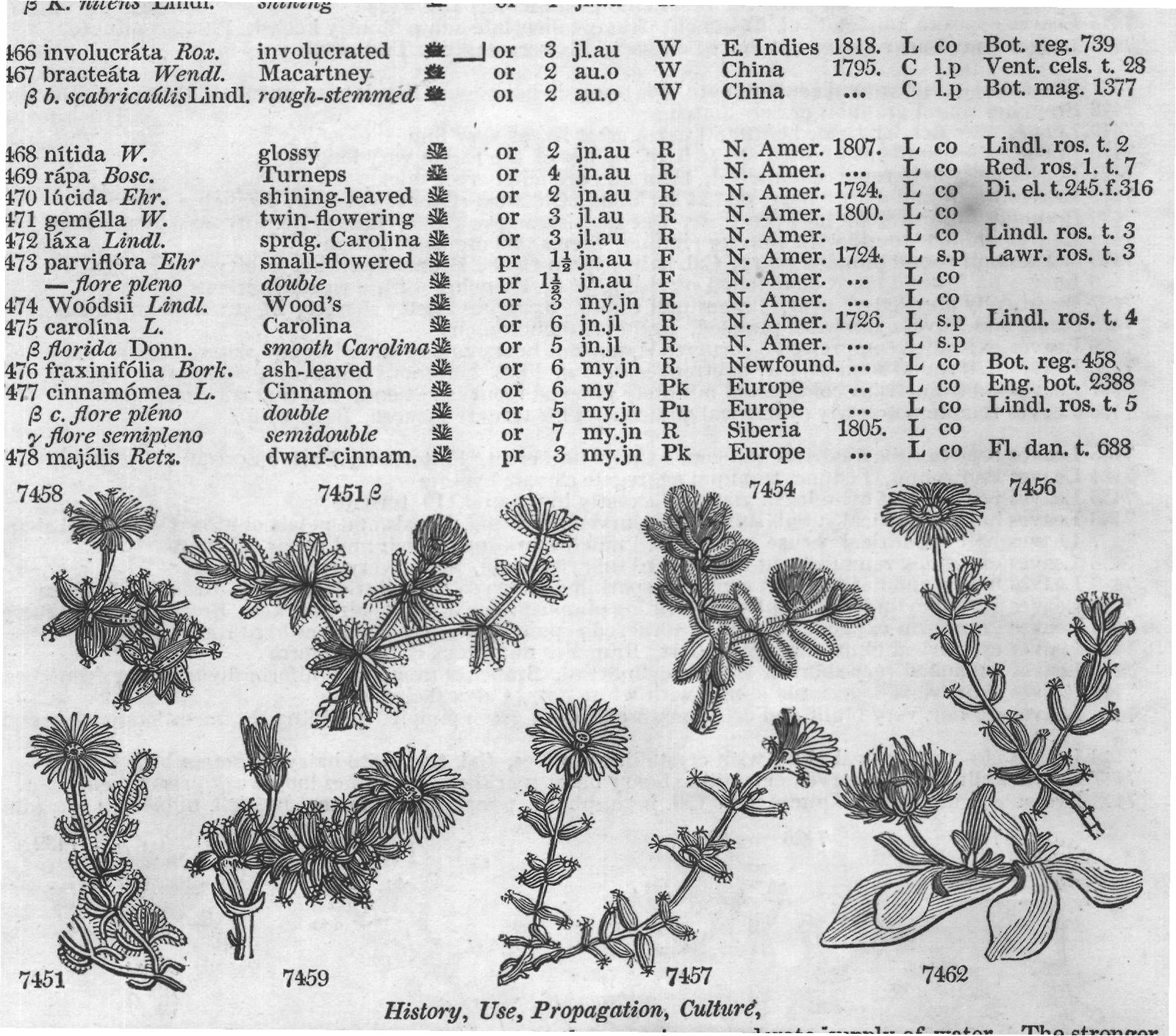
Bot. reg. 458 Cinnamon or 6 my Pk Europe L co ... double or 5 my.jn Pu Europe L co Eng. bot. 2388 Lindl. ros. t. 5 semidouble or 7 my.jn R Siberia 1805. L co dwarf-cinnam. 7451 β pr 3 my.jn Pk Europe L co ... 7454 Fl. dan. t. 688 7456 7451 7459 7457 7462 History, Use, Propagation, Culture, but when growing freely, and at the flowering season, they require a moderate "supply of water. The stronger and more woody kinds may be planted in a richer soil ; but the poorer the soil is, the dwarfer they will grow, and the more abundantly they will flower; they also require more water than the dwarf kinds, particularly at the flowering season, but need very little in winter. A good dry frame is sufficient to preserve them through the winter, with the covering of mats in frosty weather. Cuttings of any of them strike root readily, , planted in pots of earth, and kept dry till they begin to wither when they may have a little water, and they will root very soon. (Bot. Cult. 224.) 1147. Hymenogyne. From ὑμηv, a membrane, and γuvη, a woman, or, in botanical language, a style, in allusion to the cohesion of the styles into a membranous tube. An artificial division of Mesembryanthemum. 1148. Rosa. From rhos, signifying red in Armorican, whence ῥoδov, Greek, and rosa, Latin. The rose has been a favorite flower from time immemorial among the civilized nations of Europe and Asia. The shrub varies in size in different species, from one foot to six or eight, and the colors are red, white, yellow, purple, striped simple, or in almost numberless shades and mixtures; the flowers are single, semi-double, and double. The odour is universally grateful. It is cultivated in every garden, from that of the most humble cottager upwards some species, as R. centifolia, damascena, &c. are also cultivated by commercial gardeners on a large scale for distilling rose water, and for making attar, or essential oil of roses. Six pounds of rose leaves will impregnate by distillation a gallon of water strongly with their odor; but a hundred pounds affords scarcely half an ounce of attar. The rose is also used in medicine. Botanists are not agreed as to the number of ORDER II..
ICOSANDRIA DI-PENTAGYNIA. ['styles 7449 Lvs. subcylindr. incurved pimpled obt. hoary, Cal. hemispheric. pimpled numerous, Stamens longer than 7450 Leaves cylindrical fine, Two sepals leafy much longer than the others 7451 Erect, Leaves subulate half cylindrical, Cal. woolly, Stamens the length of styles 7452 Slender, Lvs. half cylindr. blunt or half round, Cal. hairy at base, Pedunc. long and branches decumbent 7453 Branches, leaves, peduncles, and calyxes hispid 7454 Leaves obl. ovate subtriquetrous gibbous, Sepals very unequal filiform ragged hispid the length of petals 7455 Leaves close depressed cylindrical hispid all over, Old root tuberous 7456 Procumbent, Leaves remote suboblong exactly half erect with 5 rays at end, Cal. 5-cleft very irregular 7457 Erect decumbent, Leaves remote nearly oblong horizontal flat above with 6 rays at end, Cal. 5-cleft equal 7458 Lvs. tufted hoary thick half round pimpl. rough with many rays at end ciliated at base, Cal. 6-8-fid hairy 7459 Densely tufted, Leaves half round papulose rough with many rays at end, Cal. 6-cleft very hairy 7460 Branches villous, Leaves horizontal, Root tuberous 7461 Branches erect decumbent hairy, Leaves with about 10 rays at end, Calyx with a black beard 7462 Leaves on long stalks spatulate lanceolate green 7463 Leaves simple POLYGYNIA.
Div. I. SIMPLICIFOLIA. Lindl. ros. mon. p. 1.
Div. II. FEROCES. Lindl. p. 3. 7464 Arms very close unequal of the same form 7465 The prickles below the stipules falcate larger than the rest, Leaves opaque ẞ Leaflets shining Div. III. BRACTEATE. Lindl. p. 7. 7466 Leaflets lanceolate elliptical downy beneath, Bractes contiguous pectinate 7467 Leaflets oblong obtuse very smooth, Bractes closely appressed pectinate β Branches covered with setæ Div. IV. CINNAMOMEE. Lindl. p. 13. 7468 Dwarf, Arms very close and slender, Leaflets shining narrow lanceolate flat 7469 Tall diffuse, Branchlets unarmed, Leaflets oblong wavy shining, Fruit hemispherical 7470 Compact, Prickles of the branches stipulary, Leafl. obl. imbricated flat shining, Fruit depressed globose 7471 Fruit depressed glob. and pedunc. smooth, Fl. twin, Leafl. obl. acute, Petioles and veins pubesc. beneath 7472 Diffuse, Branches twiggy nearly unarmed, Leafl. oblong wavy opaque glaucous 7473 Dwarf, Stipules linear, Prickles acicular, Leaflets lanceolate smoothish finely serrated, Cal. viscid 7474 Erect, Prickles stipulary straight, Leaflets oblong glaucous blunt smooth 7475 Stipules convolute, Leaflets lanceolate, Sepals spreading B Leaflets not downy 7476 Tall unarmed, Branches upright glaucous, Leafl. opaque wavy not downy upright, Prickles stipulary straight, Stipules wavy, Leafl. oblong rugose downy [beneath [beneath 7478 Dwarf cæsious, Branches straight coloured, Prick. scatt. nearly equal, Stip. lin. Leafl. obl. flat glaucous 7463 7464 7465 7465 β 7470 7466 7467 7477 and Miscellaneous Particulars. 7477 β original species of this genus: some regard all the European species as originated from one source; others, and especially the moderns, divide them into species , subspecies, and varieties. The most scientific work which has appeared in England on roses is the Rosarum Monographia of Mr. Lindley, 1819, in which above a hundred species or subspecies are described, and some of them figured; Miss Lawrence has published ninety plates of A Collection of Roses from Nature, 1810. In France, Guillemeau has published Histoire Naturelle de la Rose, 1800; and Redouté and Thory are engaged in a splendid work, in folio, entitled Les Roses, containing plates plates of all the known Les Roses, containing plates of all the known species and varieties of this flower. Thory has published a a separate tract on their culture, entitled Prodrome de la Monographie du Genre Rosier, &c. 1820 Pronville, Observations, &c., in 1820. A copious and intelligent account of the Scotch roses has been given by Mr. Sabine (Hort. Trans. iv. 231.), and some hundreds of new varieties have flowered from seedling plants in the Hammersmith nursery, and will soon be found in the sale catalogues.
Species and varieties. The lists of the London and Paris nurserymen contain upwards of 500 names: that of Calvert and Co., Englishmen, who have established a nursery at Bonne Nouvelle near Rouen, names enumerates Calvert and Co., Englishmen, who have established a nursery at Bonne Nouvelle near Rouen, enumerates near 900 sorts. The greater part of these have been raised , within the last thirty years, from seed on the continent, where it ripens better than in this country. A number of varieties have also been raised in Britain, especially of the R. spinosissima, or Scotch rose, of which above 300 varieties are procurable in the Glasgow nursery. New varieties are raised in France and Italy annually; Villaresi, royal gardener at Monza, has raised upwards of fifty varieties of Rosa indica; not one of which has, as far as we know, reached this 7480 alpína L.
Alpine ICOSANDRIA POLYGYNIA. 7479 macrophýlla Lindl. long-leaved ẞ pyrenaica Gouan. Pyrenæan or Nepal 1822. C co CLASS XII.
Lindl. ros. t. 6 or 3 jn.jl Pk or 3 jn.jl Pk pendulina L. pendulous or 5 my.jn Pu Switzerl. 1683. Lr.m L co Pyrenees Switzerl. 1726. L co 7481 rubélla Sm. reddish or 2 jn.jl Pk Br. melanocarpa Lind.intermediate or 2 jn.jl Pk England sea sh. L co Bot. reg. 424