Forsk
ic. t. 2 1784 capénsis W.
Cape or 30 G ...
C. G. H. 1792. C s.p 1785 cæsia R. B. 1786 5-folia B. M. 1787 ácida W. 1788 trifoliáta W. 1789 pentaphýlla W. 1790 quináta H. K. 306. COR'NUS. W. 1791 suécica W. 1792 canadénsis W. 1793 flórida W. 1794 máscula W. 1795 sanguínea W. 1796 álba W.
B ros'sica 1797 serícea W. 1798 circináta W. 1799 stricta W. 1800 paniculáta W. 1801 alternifólia W.
Sier. Leo. grape five-leaved. or 15 S. Leone 1822. D co ... ... or 12 jlau G acid உ or 6 ...
G Brazil 1822. D co Jamaica 1692. C p.1 Bot. mag. 2443 Jac.schen.1.t.33 three-leaved உ or 6 ...
G Jamaica 1739. C p.1 Slo. ja. 1. t.144.f.2 five-leaved or 6 ap.s G Japan wedge-leaved 1 or 10 jl G C. G. H. 1790. C s.p 1790. C s.p DOGWOOD.
Caprifoliæ.
Sp. 11-14. dwarf Canadian or or 1. ap Pu jn.au Pu great-flowered or 15 ap.my W Cornel.-cherry or 15 f.ap Y common or 8 jn.jl W white-berried or 10 jn.s W Russian or 8 jn.s W Britain woods Lco Siberia 1741. L co Siberia L co Britain sc.alp. R s.p Canada 1774. R s.p N. Amer. 1731. L co Austria 1596. L co Eng. bot. 249 Eng. bot. 310 Bot. mag. 880 Bot. mag. 526 Schm. arb.2. t.63 Sch. arb. 2. t. 65 blue-berried or 5 au W ...
N. Amer. 1683. L co Sch. arb. 2. t. 64 Pensylvanian upright panicled or 6 jl.au W N. Amer. 1784. L co Sch. arb. 2. t. 69 * or 10 jn.jl W N. Amer. 1758. L co Sch. arb. 2. t. 67 or 6 jn.jl W N. Amer. 1758. L co Sch. arb. 2. t. 68 alternate-leav'd or 15 s W N. Amer. 1760. Lco Sch. arb. 2. t. 70 307. SAN TALUM. W. 1802 álbum W.
SANDAL-WOOD.
Santalaceæ.
Sp. 2-6. true 1803 myrtifólium Roxb. myrtle-leaved tm 10 or ...
Pu 4 R ...
E. Indies 1804. C p.1 E. Indies 1804. C p.1 Rum. amb.2.t.11 Roxb. cor. 1. t. 2 1771 1774 1777 1786 1768 1776 History, Use, Propagation, Culture, 1778 1779 302. Ammannia. Named in honor of John Ammann, a native of Siberia, who was a physician and professor of botany at St. Petersburg. He published a work upon the plants of Finland, and some papers in the Transactions of the Academy at St. Petersburg. None of the species have any beauty. They may be treated like balsams and other tender annuals. 303. Fagara. The name of an aromatic plant mentioned by Avicenna. The foliage of the present plant has a strong smell of turpentine. Cuttings root readily in sand under a hand-glass. 304. Zieria. So called by Sir J. E. Smith, in honor of his friend Mr. Zier, of whom nothing more is known than that he was " a learned and industrious botanist." The species is a pretty greenhouse plant. 305. Cissus. The Greek name of the ivy. The Latin name hedera having been retained for the real plant; the Greek word was given to this genus, which climbs like the ivy. The species greatly resemble Vitis in generic character. None of them are ornamental, with the exception of C. quinquefolia, justly admired for its quinquefid leaves, and the different tints of yellow, red, and purple which these take in autumn. It grows rapidly in any soil, and is well adapted for covering naked walls, decorating old unsightly elevations of houses, ruins, cottages, bowers, &c. All the species root freely by cuttings in any soil. 306. Cornus. From cornu, a horn: the wood being thought to be as hard and durable as horn. Its value as a material for warlike instruments has been celebrated by Virgil Bona bello cornus. The larger species of this genus are very ornamental and hardy shrubs, not only from their flower and berries of different colors, but by their green, red, purple, or striped barks, which have a fine effect in winter, especially among evergreens. C. florida blossoms early, but does not bear berries in this country. C. mascula, the Cormier of old authors, blossoms still earlier, and bears handsome fruit, which were formerly made into tarts and rob de cornis: the wood is very hard; and Evelyn says, made into wedges, it will last like iron. C. sanguinea, alba, and sericea, ORDER I.
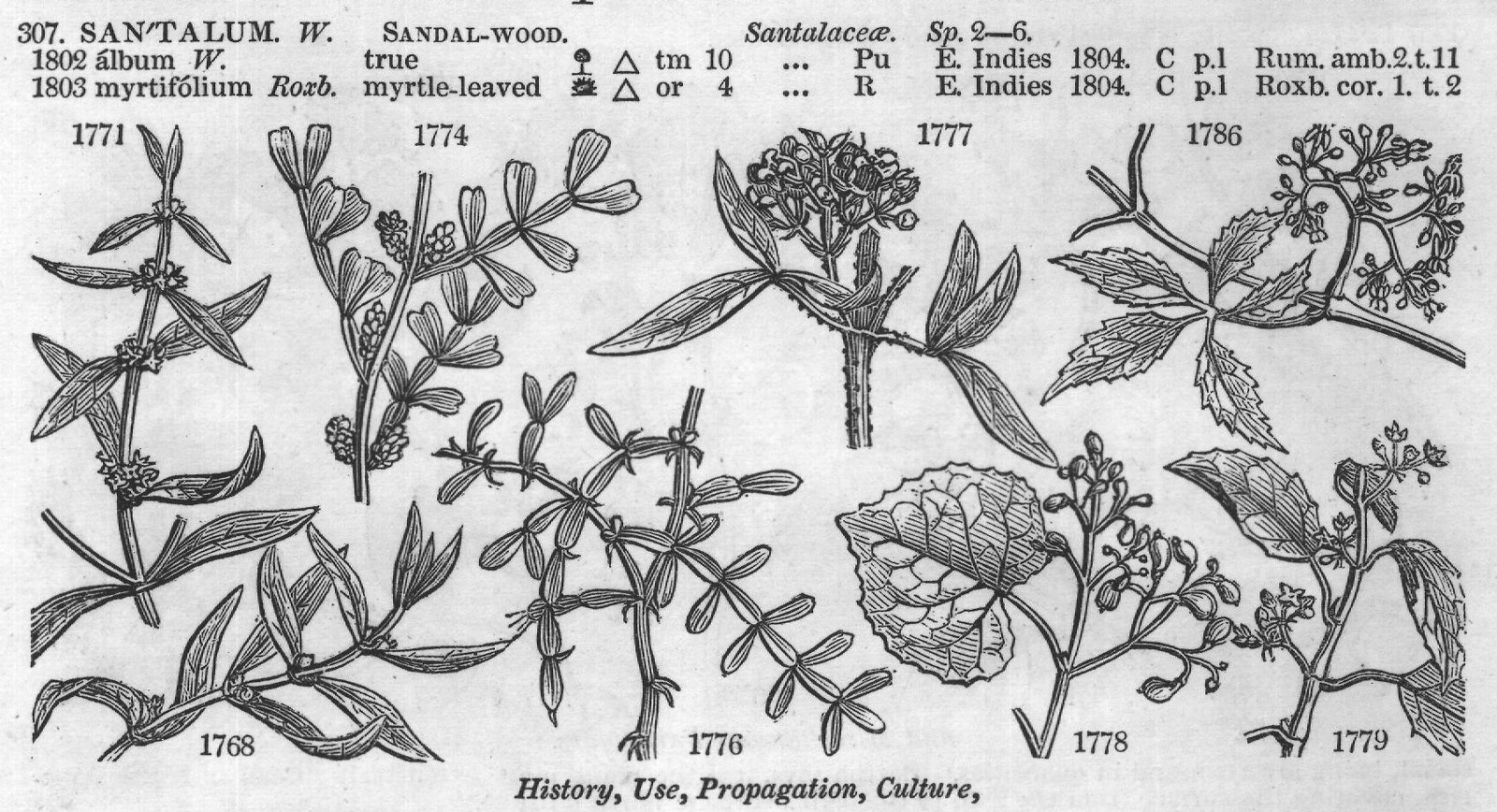
TETRANDRIA MONOGYNIA. 1768 Leaves stem-clasping, Stem square, Branches erect 1769 Leaves lanceolate attenuated at base, Stem branched, Flowers fascicled axillary, Caps. 2-locular 1770 Leaves sessile lanceolate attenuated at base, Flowers axillary clustered, Sepals rigid acute 1771 Leaves somewhat stalked, Caps. larger than calyx colored 1772 Leaves half stem-clasping, Stem square, Branches much spreading 1773 Leaves half stem-clasping linear lanceolate cordate at base, Pedunc. very short many-flowered 1774 Leaves pinnated, Leaflets obovate emarginated, Common footstalk margined jointed unarmed 1775 Leaves pinnated, Leaflets oblong unequal at base crenate 1776 Leaves pinnated, Leaflets wedge-shaped emarginate, Common stalk winged jointed prickly beneath 1777 The only species. It may be known by the stamens being inserted into large glands 1778 Leaves cordate roundish 3-5 lobed angular repand beneath ferruginous 1779 Leaves ovate loosely serrated smoothish, Nerves glandular at base, Petioles and branches pubescent 1780 Branches rounded subpubesc. Petioles with a pubesc. line, Lower lvs. simple, middle tern., upper quinate 1781 Leaves ovate serrate toothed, Pedicels and cal. hispid glandular 1782 Leaves ovate cordate smooth thickish bristly serrated, Serratures appressed, Branches rounded 1783 Leaves cordate ovate serrated fleshy, Stem 4-cornered winged 1784 Leaves 5 angular toothed beneath ferruginous, Flowers headed 1785 Leaves cordate serrated, Branches very glaucous 1786 Leaves in fives, Leaflets narrowed each way acuminate stalked, Branches rounded knotted smooth 1787 Leaves ternate obovate wedge-shaped fleshy smooth toothed at end entire at base 1788 Leaves ternate rounded hairy toothed, Branches with membranous angles 1789 Leaves quinate, Leaflets undivided ovate serrated 1790 Leaves quinate, Leaflets obovate wedge-shaped serrated above 1. Flowers in umbels with an involucrum. 1791 Herbaceous, Branches binate, Umbel axillary stalked, Nerves of leaves distinct 1792 Herbaceous, Branches none, Upper leaves whorled stalked veiny 1793 A tree, Involucr. very large colored, Leaflets obcordate 1794 A tree, Umbels as long as involucrum 2. Flowers in naked cymes. 1795 Branches upright, Leaves ovate whole-colored, Cymes depressed flat 1796 Branches recurved, Branchl. smooth, Leaves broad ovate acute pubesc. hoary beneath, Cymes depressed 1797 Branches sprdg. Branchl. woolly, Lvs. ovate acum. beneath ferrugin. Cymes depr. woolly, Nuts compr. 1798 Branches warted, Leaves orbicular beneath hoary, Cymes depressed 1799 Branches upright, Leaves ovate whole-colored naked, Cymes panicled 1800 Branches erect, Leaves ovate acuminate smooth hoary beneath, Cyme panicled 1801 Leaves alternate, Stem dichotomously forked 1802 Leaves oblong 1803 Leaves lanceolate 1787 1788 1797 1798 1793 1803 1802 1799 and Miscellaneous Particulars. have fine red twigs; the wood of the first is equal to that of the cornel for hardness, and makes excellent mill cogs, bobbins for lace, toothpicks, and butchers' skewers. An oil may be extracted from the berries, by boiling and pressing. C. sericea from its large leaves, whitish underneath, and its terminating branches of white flowers, is valuable for the shrubbery or lawn. All the species may be propagated by seeds, layers, suckers, or cuttings; the second is the most common mode.
C. sanguinea is very common in woods, and after a smothered combustion, affords a charcoal esteemed the best for entering into the composition of gunpowder. It grows in the shade and drip of other trees, and is therefore a valuable plant for thickening strips of plantations which have become naked below. C. suecica is called by the Highlanders Lus-a-chrasis, or plant of gluttony, from its berries, which are eaten by the children, being supposed to create an appetite. This plant is difficult to preserve in gardens: a bed of peat in a shady situation, and kept moist, is the most suitable for it; or it may be planted in small pots of peat, and treated as an alpine. 307. Santalum. From its Persian name Sundul-sufed. It is a low tree in habits; leaves and inflorescence a good deal resembling the privet. It produces the white and yellow sandal wood of the materia medica, formerly thought to be the produce of different trees. But in India, as in a certain degree in every other country, most trees when large and old, become colored towards the centre, and when the sandal tree becomes large, its centre acquires a yellow color, and great fragrance and hardness; while the exterior part of the same tree that covers the colored part is less firm, white, and without fragrance. It is only the yellow part that is in use, being in universal esteem for its fragrance. According to Wathen (Voy. to China, 1812, p. 116.), it sells so high that the tree is seldom allowed to grow more than a foot in diameter. It is manufactured into musical instruments, small cabinets, escrutoires, boxes, and similar articles, as no insect can exist, or iron rust (as It is H 4 308. TRA'PA. W. 1804 nátans W. 1805 bicórnis W. 309. LUDWIGIA. W. 1806 alternifólia W. 1807 hirsúta Ph.
European Chinese clt TETRANDRIA TETRAGYNIA.
Hydrocharideæ. Sp.2-3. clt jn.au W.P Europe 1781. Sco W China 1790. S co CLASS IV.
Bot. reg. 88 Gært.sem.2. t.95 LUDWIGIA.
Onagrariæ. Sp. 2-16. large-capsuled W 1 jn.jl Y Virginia 1752. S co Lam. ill. 1. t. 77 hairy W 1 jn.au Y N. Amer. 1812. D p.l DIGYNIA. 310. CUS CUTA. W.
DODDER.
Convolvulaceæ. Sp. 5-10. 1808 europæ'a W. 1809 Epithymum W. 1810 chinénsis common cu jl W Britain hea.
D par Eng. bot. 378 lesser cu jl W Britain hea.
D par Eng. bot. 55 Eng. bot. 378 Chinese cu au.s W China 1803. D par 1811 chilénsis B. M.
Chili cu ja.d W Chili 1821. D par Bot. reg. 603 1812 verrucósa Sweet.
Nepal cu ap.o W Nepal 1821. D par Scot. fl. gard. 6. 311. BUFO'NIA. W.
BUFONIA. 1813 tenuifólia W. slender-leaved w Caryophylleæ. Sp. 1-2. jn W England sea có. S co Eng. bot. 1313 312. HAMAMELIS. W. WITCH-HAZEL.
Berberideæ. Sp. 1-2. 1814 virgínica W.
Virginian Y or 10 my.n W N. Amer. 1736. L p.l Duh. arb.1. t.114 313. HYPEE/COUM. W.
HYPECOUM. 1815 procum'bens W. procumbent or 1816 péndulum W. pendulous or 1 jn.jl Y Y 1817 eréctum W. erect or my.jn Y Papaveraceæ. Sp.3-6.
S. Europe 1596. S co S. France 1640. S co Siberia 1759. S co Par. thea. 372. f.2 Am. ruth. 58. t.9 Schk. han. 1. t.27 314. MYGIN'DA. W. 1818 Uragóga W. 1819 Rhácoma W. 1820 latifólia W. 315. I'LEX. W. 1821 Aquifólium W.
B heterophýlla > crassifólia d recúrva & férox 1804 MYGINDA. saw-leaved blunt-leaved broad-leaved HOLLY. common various-leaved thick-leaved slender hedgehog 1805 TETRAGYNIA.
Rhamni. Sp. 3-6. or 4 aus Pu S. Amer. 1790. Lp.l Jamaica 1798. L p.l W. Indies 1795. C s.p Jac.amer.24.t.16 Jac. ic. 2. t. 311 Fl.peruv. t.84.f.b Britain hedg. S co Eng. bot. 496 or 4 ... ... or 4 ap.my ...
Rhamni. Sp. 12-29. tm 20 ap.jn W or 20 ap.jn W Britain ...
Gco or 20 ap.jn W Britain ...
Gco or 20 ap jn W Britain ...
Gco or 12 ap.jn W Britain ...
Gco 1809 3 1806 1808 1811 1813 History, Use, Propagation, Culture, said) within its influence. It is of the dust of this wood that the Bramins form the pigment which they use in giving the tilac or frontal mark to the God Vishnoo: and the oil used in their ceremonies is obtained from the shavings, or at least scented by them. Cuttings root readily in a pot of sand under a bell-glass. The true sandal wood is the Santalum album, found chiefly on the coast of Malabar, and in the Indian Archipelago.
Santalum myrtifolium, which has been confounded with it, is the kind which grows upon the Circar mountains, the wood of which is of little value. An amusing specimen of German critical puzzling upon this subject may be seen in Messrs. Römer and Schultes, Species Plantarum, vol. iii. p. 328. 308. Trapa. Abridged from calcitrapa, the Latin name of a dangerous instrument called caltrops, furnished with four spines, which was formerly used in war to impede the progress of cavalry. The fruit of this plant is hard, and has four spines also. T. natans is a curious aquatic, with long brown and green roots and floating leaves, with petioles inflated into a tumour, as in the marine algæ. The seed is larger than the kernel of the filberd, with two cotyledons, one large, and the other very small, and not increasing in size during the germination. Hence, Gærtner considers this plant like the Nelumbium, as in a sort of middle state between the monocotyledoneæ and dicotyledoneæ. The nuts are farinaceous, and are esteemed nourishing and pectoral. The skin with the spines being removed, there is a white sweet kernel within, somewhat like a chestnut. They are sold in the market at Venice under the name of Jesuits' nuts. They are also much eaten in Switzerland and the south of France. Some of the canals at Versailles are covered with the plant; and Neill informs us (Hort. Tour.), that the nuts are sometimes served up like chestnuts. Pliny says that the Thracians made them into bread; and Thunberg states that they (the seed of Trapa bicornis) are commonly put into broth in Japan. In this country the plant is generally kept in a cistern in the stove, and so treated, was fruited by A. B. Lambert, Esq. in 1815, and specimens of the fruit sent to the Horticultural Society. T. bicornis is cultivated by the Chinese in marshes; and the nuts used as food. 309. Ludwigia. So named by Linnæus, in honor of C. G. Ludwig, professor of botany at Leipsic, in the middle of the last century. He left behind him several works which are now almost forgotten. The species are of no beauty. 310. Cuscuta. This is a genus of parasitical plants, which fasten themselves to, and draw their nourishment from others. The seed does not split into lobes, but opens and puts forth a little spiral body, which is the em- ORDER III.
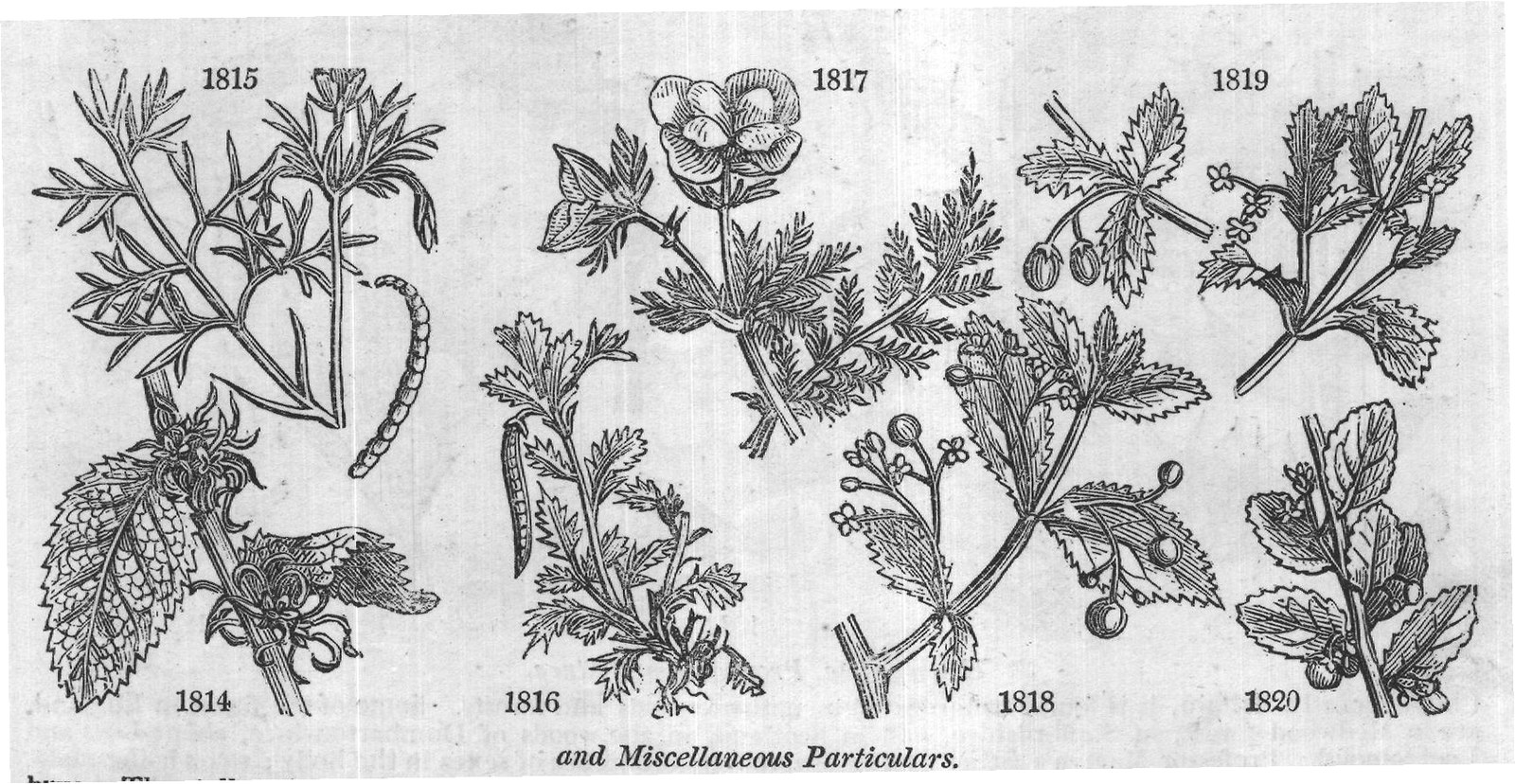
TETRANDRIA TETRAGYNIA. 1804 Nuts 4 horned, Spines spreading 1805 Nuts 2 horned 1806 Erect branched smooth, Leaves altern. lanc. hoary beneath, Caps. large crowned with the col. lvs. of cal. 1807 Leaves alternate lanceolate, Flowers axillary solitary subsessile, Stem rounded diffuse. DIGYNIA. 1808 Flowers sessile, Orifice of cor. naked, Stigma acute 1809 Flowers sessile, Stamens with a scale at their base, Stigma acute 1810 A species of which no account has yet been published. Shoots short white 1811 Flowers 5-cleft, Segments oblate rounded, Anthers sessile, Stigmas pileate 1812 All over warted, Color dull brown, Shoots very long 1813 Stem branched at end, Branches erect, Calyx scariose at edge 1814 Leaves obovate acutely toothed cordate with a small sinus 1815 Pods jointed compressed arcuate, Pet. 3-lobed the outside smooth at the back 1816 Pods knotty rounded pendulous, Petals smooth the 2 outer ovate oblong pendulous 2 inner 3-parted 1817 Pods not jointed erect compressed, Pet. smooth outer wedge-shaped about 3-lobed inner trifid the lateral lobes 2-lobed the middle one small TETRAGYNIA. 1818 Leaves ovate and subcordate acuminate subserrated pubescent 1819 Leaves lanceolate ovate obtuse crenated, Flowers monogynous, Style quadrifid 1820 Leaves elliptical crenated subcoriaceous, Stigmas 2-4 sessile 1821 Leaves ovate acute spiny shining waved, Flowers axillary umbelled 1815 1814 1816 1817 1818 1819 1820 and Miscellaneous Particulars. bryo. The stalk twines about some other plant, contrary to the sun's apparent motion, or from right to left, sending out from the inner surface a number of little vesicles which attach themselves to the bark of the supporting plant. By degrees, degrees, the longitudinal vessels of the stalk shoot from their extremities, and insinuate themselves so intimately with it, that it is easier to break than to disengage them. Plants raised from seed soon die when they have no plant to which they can attach themselves. They adhere to the ground by the original root, and draw a part of their nutriment from thence at first; but the original root withers away as soon as the young stem has fixed itself to any other plant. C. euro æa may be sown in peat soil by the sides of other plants; in a wild state it is commonly found in hedges, and on hops, brambles, woody nightshade, fern, thistles, hemp; as also on flax, nettles, clover, grass, &c.
C. epithymum will thrive well on any small shrub when once it has got hold. According to Sweet, "it will flower freely, and be very handsome."
C. chinensis may be treated like C. europӕa. 311. Bufonia. So named after the celebrated Count de Buffon. It is slender, like the botanical acquirements of illustrious naturalist. Some say that Linnæus slily dropped an f in the name. that illustrious naturalist. Some say that Linnæus slily dropped an f in the name. 312. Hamamelis. Homomelis is the name under which Athenæus describes a fruit like an apple. This is another of the not very commendable freaks of gentlemen who name genera; the present plant being more like a hazel-nut than an apple-tree. In New England this tree has ripe fruit and fresh blossoms at the same time. 313. Hypecoиt. From ὑπηχεω, to rattle, on account of the noise the seeds make in the pods. It is not impossible that Hypecoum procumbens is the Hypecoon of Pliny: the wild Cumin of Gerarde. The juice of all the species is yellow, like that of celandine, and is said to have the same effect as opium. 314. Myginda. So named by Jacquin, in honor of Counsellor Mygind of Vienna; a botanical amateur and patron. A tree resembling some kind of Ilex. 315. Ilex.. A word upon which much ingenuity and learning have been tortured in vain. De Théis derives it I. ec or ac, a point in Celtic; but that explanation applies better to the specific name acquifolium. derives from ec or ac, a point in Celtic; but that explanation applies better to the specific name acquifolium.
I. aquifolium is one of our most beautiful shrubs or low trees, displaying either character, according to situation, age, and application by art. It is found in most parts of Europe, and in North America, Japan, Cochinflava η albo-margináta I aureo-marginata I medio-picta TETRANDRIA TETRAGYNIA.
CLASS IV. yellow-berried or 15 ap.jn W Britain Gco silver-edged or 12 ap.jn W Britain Gco gold-edged or 12 ap.jn W Britain Gco painted or 10 ap.jn W Britain Gco 1822 chinensis B. M.
Chinese or 10 jl W 1823 laxiflóra Ph. loose-flowered or 20 ap.jn W 1824 opáca W.
Carolina or 10 my.jn W 1825 crócea W.
African tm 30 ... ... 1826 Perádo W. thick-leaved or 10 ap.my Pk 1827 Prinoídes W. deciduous or 2 jl W 1828 Cassíne Ph. br.-lv.-Dahoon 1 or 12 au W 1829 Dahóon Ph.
Dahoon 1830 augustifólia. W. en. Myrtle-leaved LL or 6 my.jn W or 6 ray.jn W 1831 vomitória W.
South Sea Tea or 10 ... ... 1832 canadénsis Ph.
Canadian or 3 ap.my W China 1814. G s.l Carolina 1811. G s.p Carolina 1744. G p.1 C. G. H. 1794. G s.p Madeira 1760. Gs.Î N. Amer. 1760. G s.p Carolina 1726. G s.I Carolina 1726. G s.l Carolina 1806. G s.l Florida 1700. G p.1 N. Amer. 1802. G s.1 Bot. mag. 2043.
Lam. ill. t. 89 Meerb. ic. 2. t. 5 Meerb. ic. 2. t. 6 Cat. car. 1. t. 31 Cat. car. 2. t. 57 Mich. am. 2. t.49 316. COLDENIA. W.
COLDENIA.
Boragineæ.
Sp. 1-2. 1833 procúmbens W. trailing or 2 jlau W E. Indies 1699. S co Lam, ill. t. 89 317. POTAMOGETON.
W. POND-WEED.
Alismaceæ.
Sp. 13-44. 1834 nátans W. broad-leaved cu au G Britain riv.
D co Eng. bot. 1822 1835 flúitans W. long-leaved cu jl.au R Britain dit.
D co Eng. bot. 1286 1836 heterophýllum W. various-leaved cu jl.au G Britain dit.
D co Eng. bot. 1285 1837 perfoliátum W. perfoliate cu jl.au P Britain riv.
D co Eng. bot. 168 1838 den'sum. W. close-leaved cu my.jl G Britain dit.
D co Eng. bot. 397 1839 lúcens W. shining cu jn.jl Britain G dit.
D co Eng. bot. 376 1840 críspum W. curled cu jn.jl R Britain rivul.
D co Eng. bot. 1012 1841 compréssum W. flat-stalked cu jn.jl G Britain rivul. D co Eng. bot. 418 1842 pectinátum W. fennel-leaved cu jn.jl 01 Britain dit. D co Eng. bot. 323 1843 lanceolátum E. B. spear-leaved cu jl.au Ol England w.lak. D co Eng. bot. 1985 1844 gramíneum W. grass-leaved cu jl.au G Britain dit.
D co Eng. bot. 2253 1845 pusíllum W. small cu jl.au G Britain dit. D co Eng. bot. 215 1846 setáceum W. bristle-leavedcu jl.au G Britain D co ... 318. RUPPIA. W.
RUPPIA.
Fluviales. Sp. 1. 1847 marítima W. sea cu jl G Britain s. w. d. S s.l Eng. bot. 136 319. SAGI'NA. W.
PEARLWORT Caryophylleæ. Sp.5-7. 1848 procum'bens W. 1849 cerastoídes W. procumbent tetrandrous 00 W my.s W Britain rub. S s.l Eng. bot. 880 W jn.jl W Britain sea sh. S co Eng. bot. 166 1821 β 1824 1832 1821 ε 1821 1822 History, Use, Propagation, Culture, 1828 1831 China, &c. In Britain, it is found congregated in natural woods and forests. Some of the finest in England, are in Medwood forest, in Staffordshire, and in Scotland, in the woods of Dumbartonshire, about Luss and Lochlomond. Professor Martyn's father first discovered the difference of sexes in the holly; some being male, others female, and others hermaphrodite. It is a tree of great longevity, and will grow in any soil not very wet, but best in a dry deep loam; such is the soil of Medwood forest. By culture alone, a hundred varieties and subvarieties have been produced, differing in the variegation, margin, and size of the leaves, and in the color of the fruit. These make gay and elegant shrubs for lawns and small groups, and form an important furniture in the general shrubbery. The common green prickly-leaved holly makes the best of all hedges, , whether we regard its qualities for defence, shelter, duration, or beauty. It has one fault, it is very slow of growth unless carefully cultivated, and for this reason hawthorn is preferred. It was a very general custom about the end of the 17th century to divide gardens by hedges of this tree, and to keep them exactly shorn. Evelyn's impenetrable holly hedge at Deptford has been much celebrated. It was 400 feet long, 9 feet high, and 5 feet broad. Gibson, (Archæologia Brit. &c.) who mentions Evelyn's hedge, made a tour of the principal gardens near London, and states, as next in grandeur, that of Sir M. Decker at Richmond: of neither does there exist a single plant. The largest holly hedge in Scotland is at Tynningham near Dunbar, planted by a by a former earl of Haddington, author of a Treatise on Fruit Trees. It has for many years past been left uncut, and now presents a noble phalanx of deep shining green leaves, and numerous spiry tops with spikes of coral berries. In cultivating the holly, the kernel or stone of the berries is divested of its skin and glutinous pulp, by mixing with sand in heaps in the open garden, and turning over frequently. The berries being gathered in November, may be rotted in this way till the October following, and then sown in beds, and covered three quarters of an inch with fine mould; or they may remain on the trees till spring, then gathered and mashed in a tub of water to separate the pulp, after which they may be sown. In general, the stones do not vegetate till the second year from the gathering; some will occasionally germinate the first year, and a number not till the third. In transplanting and pruning the holly, the months of October and April are to be chosen the oftener young plants are removed before planted in the final site the better, as it has naturally but few roots, and those chiefly ramose and descending. Miller recommends cutting holly hedges with a knife, as clipping renders them unsightly. The variegated and other curious sorts are generally propagated by budding and grafting on the on the common green. Evelyn says he raised some of the variegated sorts by sowing the seeds, and Miller always found the hedgehog variety continue the same when so propagated. Some raise them by layers, and Sweet says all of them "will root freely by cuttings taken off at a joint in ripened wood, and planted in sand under a hand-glass in a shady situation."
ORDER III.
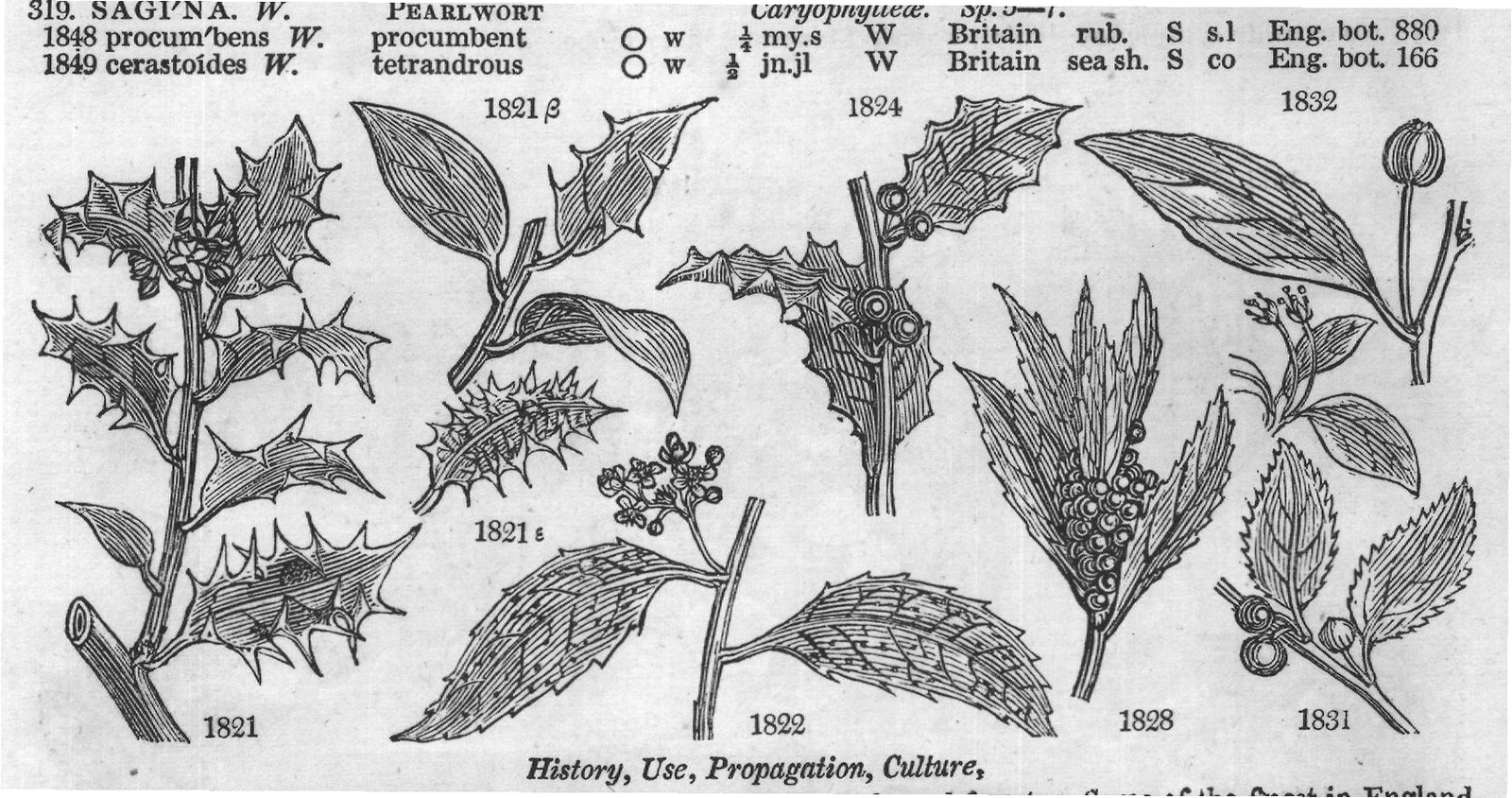
TETRANDRIA TETRAGYNIA. 1822 Leaves ovate oblong edge with little cartilaginous scarcely pungent teeth, Corymbs pedunc. dichotomous 1823 Leaves ovate sinuate-toothed slightly spiny, Stipules subulate, Pedunc. lax divided 1824 Leaves ovate acute spiny smooth flat, Flowers scattered at the base of the older branches 1825 Leaves oblong serrated, Serratures prickly-ciliated 1826 Leaves ovate with a point unarmed nearly entire 1827 Leaves elliptic-lanceolate acute deciduous serrated, Serratures unarmed 1828 Leaves alternate distant evergreen lanceolate attenuated both ways serrated at the end 1829 Leaves lanceolate elliptical nearly entire reflexed at the edge, Rib villous beneath 1830 Leaves alternate distant evergreen linear lanceolate shining serrated at end, Rib smooth beneath 1831 Leaves alternate distant oblong obtuse crenated serrated, Serratures not prickly 1832 Leaves oblong acuminate subserrated at the end, Pedunc. long axillary 1-flowered 1833 Leaves wedge-shaped stalked shorter on one side coarsely sawed and plaited 1834 Leaves all elliptical stalked floating, Lower petioles submersed leafless 1835 Leaves floating on long stalks lanceolate ovate narrowed at both ends 1836 Upper leaves stalked elliptical narrowed at both ends the lower close together sessile linear 1837 Leaves cordate stem-clasping all immersed 1838 Leaves ovate acuminate opposite close, Stem dichotomous, Spike 4-flowered 1839 Leaves ovate-lanceolate flat narrowed into the stalks, Spike many-flowered contracted 1840 Leaves lanceolate alternate wavy serrated 1841 Leaves linear obtuse, Stem compressed 1842 Leaves setaceous parallel close together in two rows 1843 Leaves lanceolate membranous flat entire, Spike ovate dense few-flowered 1844 Leaves linear lanceolate alternate sessile broader than their stipule 1845 Leaves linear opposite and alternate narrower than their stipule spreading at base, Stem rounded 1846 Leaves lanceolate opposite acuminated 1847 The only species 1848 Branches procumbent smooth, Petals very short 1849 Stem diffuse dichotomous, Leaves spatulate and obovate recurved, Fruit-stalks reflexed 1833 1834 1835 1836 1838 1837 1839 and Miscellaneous Particulars.
I. cassine and vomitoria have bitter leaves, of which the N. American Indians make a tea, which is almost their only physic. At a certain time of the year they come down in droves from a distance of some hundred from droves from a distance of some hundred miles, to the coast, for the leaves of this tree, which is not known to grow at any considerable distance from the sea. They make a fire on the ground, and putting a great kettle of water on it, they throw in a large quantity of these leaves, and setting themselves round the fire, from a bowl that holds about a pint they begin drinking large draughts, which in a very short time occasion them to vomit easily and freely thus they continue drinking and vomiting for the space of two or three days, until they have sufficiently cleansed themselves; and then every one taking a bundle of the tree to carry away with him, they all retire to their habitations. 316. Coldenia. So named by Linnæus, in honor of Cadwallader Colden, an English naturalist, who published in 1742, an account of the planis of New York. 317. Potamogeton. From πoτaμoς, a river, and γεiτov, near. Most of the species grow wholly immersed in water, but like most aquatics, flower above its surface. It should seem, Professor Martyn observes, that the respiration of such truly-aquatic vegetables must be as different from those which inhale atmospheric air, as the breathing of fishes is from that of beasts and birds. Accordingly, they are, as Haller remarks, of a different texture, pellucid, like oiled paper, very vascular, harsh, and ribbed, but often very brittle; and their surface, like that of aquatic animals, destitute of hair or down of any kind. The leaves of aquatic plants afford shade and spawning places to fish, and habitations for aquatic insects and worms for their nourishment. The roots of P. natans are a favorite food of the swan, and that bird is in consequence erroneously considered as keeping ponds and lakes clear of all aquatics. Ducks eat the seeds and leaves of P. crispum. Haller informs us, that in P. crispum. Haller informs us, that in the Swiss lakes P. serratum grows from ten to twenty fathoms long, forming, as it were, immense woods in the midst of these immense reservoirs. Most of the species may be considered as ornamental in a botanic garden, when kept within bounds or in pots. They are readily propagated by seeds or by dividing their long roots, and for the most part, grow best on a clayey bottom. 318. Ruppia. Named after Henry Bernard Ruppi, a German. He published in 1718, a Flora Jenensis. It is remarked by Dr. Goodenough, that the flower-stalk of this plant is spiral, like that of Valisneria, and relaxes or contracts itself according to the depth of the water. The truth is, the flower and leaf-stalks of all aquatics have a power of accommodating themselves to the depth of the water, so as just to emerge above its surface ; but the singularity in Ruppia and Valisneria appears to be the employment of a flower-stem for that purpose. (See Valisneria.) 319. Sagina. This plant, says Linnæus, is so called for its qualities. In Latin, sagina expresses something 1850 apétala W. 1851 marítima E. B. 1852 erécta Sm. 320. TILLÆ'A. W. 1853 muscósa W. 321. RADIOLA. Sm. 1854 millegrána Sm. 1841 1840 TETRANDRIA TETRAGYNIA.
CLASS IV. small-flowered W my.jn W Britain rub. S co Eng. bot. 881 sea-side W my.au W Ireland sc. alp. S co Eng. bot. 2195 glaucous W ap.my W Britain Sco Eng. bot. 609 TILLÆA.
Sempervive. Sp. 1-4. mossy cu jn.o Pl England sa. he. S co Eng. bot. 116 RADIOLA.
Caryophylleæ. Sp. 1. all-seed W jl.au W Britain san. pl. S co Eng. bot. 893 1842 1844 1843 1845 History, Use, Propagation, Culture, nourishing. The species are very common in dry pastures, where they are valuable for sheep-food. S. procumbens is a small but troublesome weed in shaded garden-walks and paved courts, and with S. apetala, seeds the whole summer. Curtis remarks, that the latter species ripens its seeds more rapidly than almost any other plant.