Home › F › Fluviales (Sp mar na L common ec au s Ap)
Fluviales (Sp mar na L common ec au s Ap)
Sp. 1. 120 marína L. common ec au.s Ap Britain sea sh. S s Eng. bot. 467 25. CHLORAN'THUS. W. CHLORANTHUS."
Chlorantheæ. Sp. 3-4. 121 inconspicuus W. trailing cu 1 ap.s Ap China 1781. C co 122 monostáchys Lindl. herbaceous cu 1 f.my Ap China 1819. C co Lind. coll. 17 123 monánder Br. upright cu 1 jn Ap China 1817. C co DIGYNIA. 126 Redówskii Fisch.
Redowsky's 26. CORISPERMUM. W. TICKSEED. 124 hyssópifólium W. hyssop-leaved 125 squarrósum W. rough-spiked 127 intermédium Schw. intermediate 27. CALLIT RICHE. W. WATER STARWORT.
Chenopodeæ. 4-9. 0000 1 jl Ap Europe 1739. S co Fl. græc. 1. t. 1 1 au.s Ap Russia 1759. S co Pall, ross. 2. t.99 jl.au Ap Siberia 1822. S co jl.au Ap Poland 1822. S co Halorageæ. Sp. 1. 128 aquática E. B. common 0 ap.o W Britain dit. Saq Eng. bot. 722 28. BLI TUM. W.
STRAWBERRY BLITE.
Chenopodeæ.
Sp. 3. 129 capitátum W. berry-headed 130 virgátum W. slender 131 chenopodioides Lam. goosefoot 29. ASPICAR'PA. Rich. ASPICARPA. 000 or 2 my.au Ap Austria 1633. S ru Pt.etT.fl.p. 1. t. 2 or 2 my.s Ap S. Europe 1680. Sru Bot. mag. 276 2 my.au Ap Crimea 1797. S co M. h. 1. t. 32. f.11 132 úrens Rich. 1 105 Malpighiacece. Sp. 1. stinging 5 jn.jl Ap S. Amer. 1821. C co 112 113 Mem. m. 2. t. 13 115 107 111 History, Use, Propagation, Culture, 118 119 24. Zostera. From ζωστης, a riband; the leaves of Z. oceanica are a foot long and an inch broad, resembling a riband. La Zostére, Fr., and Seetang, Ger. This plant abounds on the coast of Yarmouth, where it is thrown on shore in such abundance that mounds are made with it to enclose the encroachments of the sea. It is also used as thatch, and said to endure for upwards of a century; by exposure it bleaches white. In Sweden and Holland it is used as a manure, and is preferred to hay for stuffing beds. Horses and swine eat it, but cows are not fond of it. The rush-like envelopes of Italian liquor-flasks are prepared from this plant. 25. Chloranthus. So named from χλωρoς, green, and άvθoς, a flower, on account of the greenish hue of its inconspicuous inflorescence. The structure of the flower is very curious, and so anomalous, as to render it difficult to tell to what class of Linnæus it is referable. For further remarks upon this subject, see Mr. Lindley's Collectanea Botanica, p. 17. 26. Corispermum. From κoρiς, a bug or tick, and σπερμa, a seed. Le Corrisperme, Fr., and Der Wansen- CLASS II. - DIANDRIA. 2 STAMENS.
THIS class, which is not large, and so entirely artificial that no other characters than those of the Linnæan definition can be assigned to it, contains some elegant and fragrant plants belonging to Jasmineæ, Scrophularineæ, and Labiatæ: examples of the two latter orders are Veronica and Salvia, extensive genera chiefly of hardy herbaceous plants. The most useful of the class are the pepper and the olive: the jasmine is used in perfumery; the sage and rosemary in cookery; and the privet and syringa for garden hedges. One or two species are employed in medicine; several are border flowers; but the greater number of the class are plants of curiosity.
Codarium is a leguminous plant, and is widely removed from its natural place, which is Diadelphia; so are Salvia, Monarda, Rosmarinus, Veronica, and many others, which would have been naturally referred to Didynamia. Under this class Persoon has placed the genus Gunnera, which Willdenow injudiciously referred to Gynanaria. A great variety of diandrous plants are scattered through the other classes of Linnæus; but as such plants are chiefly, with the exception, perhaps, of grasses, diandrous, on account of the incomplete formation of some of their stamens, the rudiments of which are usually obvious, it is scarcely necessary to particularise more than the following, viz. : - D. MONOGYNIA. Viola diandra; Salicornia herbacea, virginica; Anychia dichotoma; several species of Boerhaavia. D. DIGYNIA. Polycnemum salsum; Bufonia tenuifolia. D. TRIGYNIA. Holosteum diandrum. Order 1. MONOGYNIA. 2 Stamens. 1 Style. §1. Flowers complete, inferior, monopetalous, regular. 30. Codarium. Cal. 5-cut, with a persistent tube. Cor. flattish. Legumen one-seeded, filled with a soft fæcula. 31. Maytenus. Cal. 5 lobed. Cor. campanulate, entire. Caps. compressed, 2-valved, with 2 cells, and 2 seeds. ORDER II.
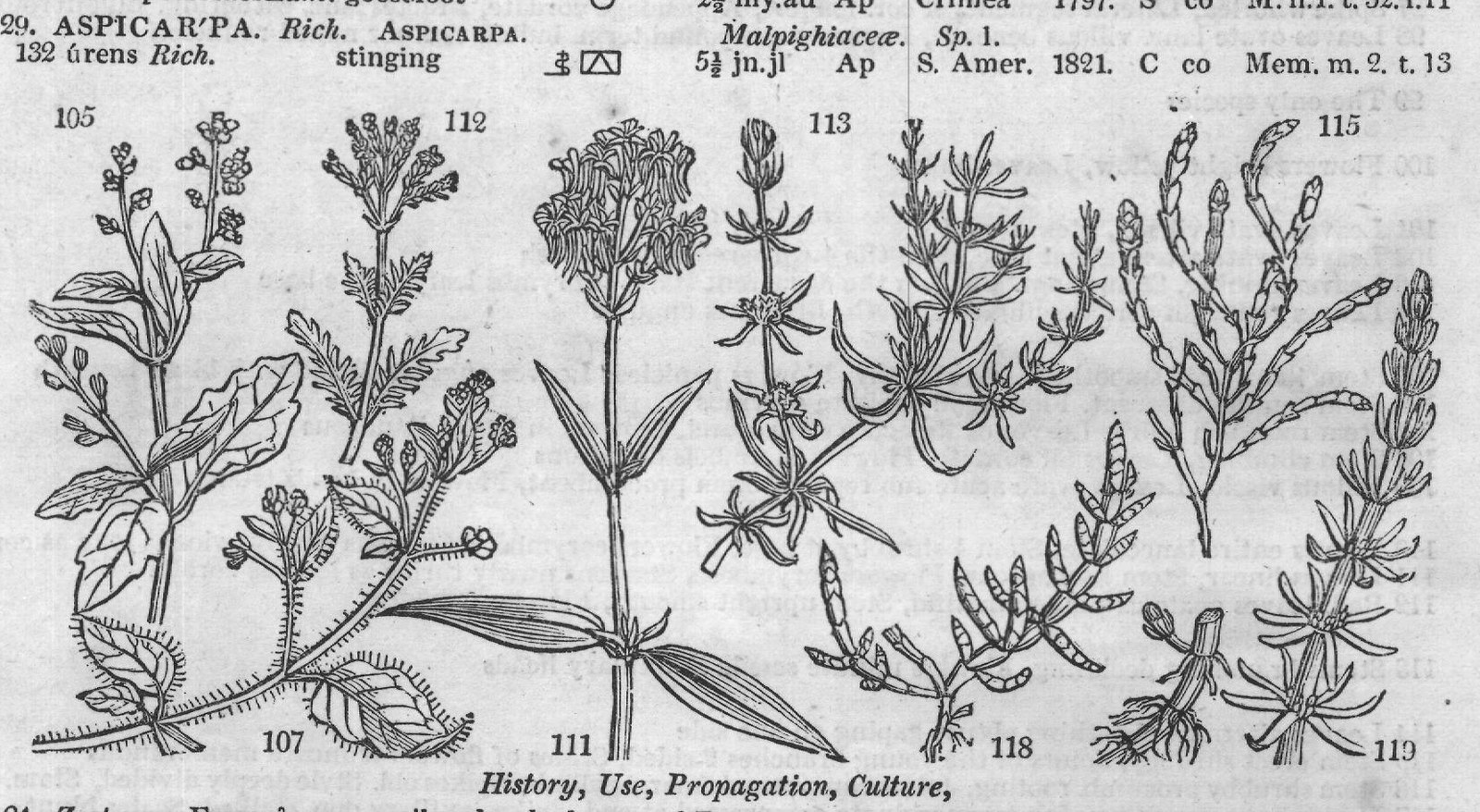
MONANDRIA DIGYNIA. 120 Leaves entire somewhat 3-nerved, Stems nearly round 121 Spikes compound, Stem decumbent 122 Spike simple solitary, Stem upright 123 Spikes 2-4 simple, Stem upright, Leaves thick DIGYNIA. 124 Spikes terminal, Flowers distant, Leaves nerveless and bractes unarmed 125 Spikes axillary, Flowers close imbricat. Leaves nerveless and bractes mucronate pungent 126 Spikes terminal, Flowers becoming remote, Leaves nerveless and bractes pungent, Fruit incurved 127 Spikes terminal and axillary, Flowers imbricate, Leaves and bractes mucronate, Stem villous 128 A small floating plant resembling Lemna 129 Heads in terminal spikes 130 Heads lateral scattered 131 Heads axillary small not juicy, Stem very branching 132 A stinging twining perennial plant 120 122 125 124 130 123 131 129 and Miscellaneous Particulars. same, Ger. The species abound in the south of Russia in marshy steppes with Salsola and Atriplex. Round the Caspian sea they grow six feet high, are red in winter, and eaten by camels. 27. Callitriche. From κaλλoς or κaλoς, and θρiξ, hair. Le Callitrice, Fr. Der Wasserstirn, Ger., and Callitrica, Ital. A little aquatic plant, liable to variation in its appearance; on which account some botanists have divided it into several species. 28. Blitum. From βλiτov, insipid, or, according to Dr. Theis, from the Celtic blith, which has the same inport. Le Blète, Fr. Die Beermelde, Ger., and Blito, Ital. After the flowers are past, the heads swell to the size of wood-strawberries, and when ripe have the same color and appearance. They are succulent, stain the hands, and were formerly used by cooks for coloring puddings. Some consider the B. virgatum as only a variety of the other. 29. Aspicarpa. From ἀσπiς, a round shield, and κaρπoς, fruit, in reference to the form of the ripe fruit. 32. Olea. Cor. 4-cleft. Segments subovate. Drupe one-seeded. 33. Phillyrea. Cor. 4-cleft. Berry one-seeded. 34. Chionanthus. Cor. 4-cleft. Segments very long. Drupe one-seeded, with a furrowed nut. petals united by the base of the stamens. Filaments 35. Notelæa. Cal. 4-toothed. Cor. 4 short oval petals 4-horned. Style O. Stigma bifid. Drupe with a papery putamen. 36. Ligustrum. Cor. 4-cleft. Berry 4-seeded. 37. Syringa. Cor. 4-cleft. Capsule of two cells. 38. Nyctanthes. Cor. 4-cleft. Segments truncated. Caps. with two cells edged. Seeds solitary. 39. Jasminum. Cor. 5 or 8-cleft. Berry with two divisions. Seeds solitary with an arillus. §2. Flowers complete, inferior, monopetalous, irregular. 40. Veronica. Cor. 4-cleft: limb flattish; the lowest segment the narrowest. Capsule 2-celled. 41. Galipea. Cor 4 or 5-cleft, hypocrateriform. Stam. 4: 2-sterile. 42. Schwenkia. Cor. nearly equal: the orifice plaited, stellate, and glandular. Stam. 5: 3-sterile. Capsule 2-celled. 43. Gratiola. Cor. 4-cleft, 2-lipped, resupinate. Stamens 4: 2-sterile. Caps. 2-celled. 44. Schizanthus. Cal. 5-parted. Cor. 2-lipped resupinate: the upper lip 5-parted, the lower 3-parted. Stam. 4, 2-sterile. Caps. 2-valved, 2-celled. 45. Elytraria. Cal. 4-5-parted. Cor. 5-cleft, nearly equal. Caps. 2-valved, 2-celled. Seeds attached below to a dissepiment contrary to the valves. 46. Hypoestes. Cal. 5-cleft equal, with a 4-cleft 3-flowered involucrum. Cor. 2-lipped. Stamens 2. Anthers 1-celled. Seeds fixed by little hooks. 47. Justicia. Cal. 5-parted equal. Cor. 2-lipped or ringent: the lower lip divided. Anthers 2-celled. Seeds attached by little hooks. 48. Dicliptera. Cal. 5-parted. Cor. bilabiate. Caps. with two elastic valves, 2-celled, the dissepiment retaining the seeds by its inflexed toothed edge. 49. Eranthemum. Cal. 5-parted. Cor. 5-cleft, with the tube curved in the middle. Caps. many seeded. 50. Wulfenia. Cor. 4-cleft: smooth bearded. Cal. 5-parted. Caps. 2-celled. 51. Calceolaria. Cor. ringent, inflated. Cal. 4-cleft. Caps. 2-celled, 4-valved. 52. Pinguicula. Cor. ringent, spurred. Cal. 5-cleft. Caps. 1-celled. 53. Utricularia. Cor. ringent, spurred. Cal. 2-leaved. Caps. 1-celled. DIANDRIA MONOGYNIA.
CLASS II. 54. Stachytarpheta. Cal. tubular, 4-toothed. Cor. hypocrateriform, unequal, 5-cleft, curved. Stam. 4: 2 sterile. Seeds two. 55. Lycopus. Cor. 4-cleft, nearly equal, with one segment emarginate. Stamens distant. Seeds naked. 56. Amethystea. Cor. 5-cleft, nearly equal, with the lowest segment concave. Stamens near each other. Seeds naked. 57. Ziziphora. Cal. cylindrical with ten lines, somewhat 2-lipped, 5-toothed, closed with hairs. Cor. 2-lipped. Seeds 4 naked. 58. Cunila. Cal. oblong, 5-toothed, closed with hairs. Cor. 2-lipped. Seeds 4 naked. 59. Hedeoma. Cal. 2-lipped, gibbous at the base. Cor, ringent. Stamens 4: 2 sterile. 60. Monarda. Cor. ringent: helmet linear, wrapping up the anthers. Seeds naked. 61. Rosmarinus. Cor. ringent. Helmet arched, bifid. Stamens curved, with a tooth. Seeds naked. 62. Salvia. Cor. ringent. Filaments stalked cross-wise. Seeds naked. 63. Collinsonia. Cor. somewhat ringent: the lip very finely divided. Seeds naked. 64. Catalpa. Cor. 5-cleft, irregular. Cal. 2-parted. Stam. 3 sterile. Caps. 2-celled. Seeds at each end with a membranous pappus. 65. Ghinia. Cor. ringent. Cal. with 5 bristles. Fruit, a fleshy 4-celled nut. $9. Flowers complete, inferior, polypetalous. 66. Fontanesia. Cor. with 2 petals. Cal. 4-parted. Caps. 2-celled, not opening. 67. Linociera Cor. with 4 petals. Cal. 4-toothed. Berry with 2 cells. 68. Ancistrum. Cal. 1-leaved, armed with barbed spines. Cor. 4 petals inserted into edge of calyx. Stam. 2-4-5. Stigm. finely divided. Seed one, inclosed in the calyx. Leguminosæ. Sp. 1-2.