Important: Safety Warning
This page offers rules for telling edible mushrooms from poisonous ones. No such rules are reliable, and these identifications predate modern mycology. Deadly species closely resemble edible ones, and mistakes are regularly fatal. Never eat a wild mushroom on the strength of this text.
This information has been left in for historical purposes but should not be acted upon.
Home › D › Division I (Pileati This constitutes)
Division I (Pileati This constitutes)
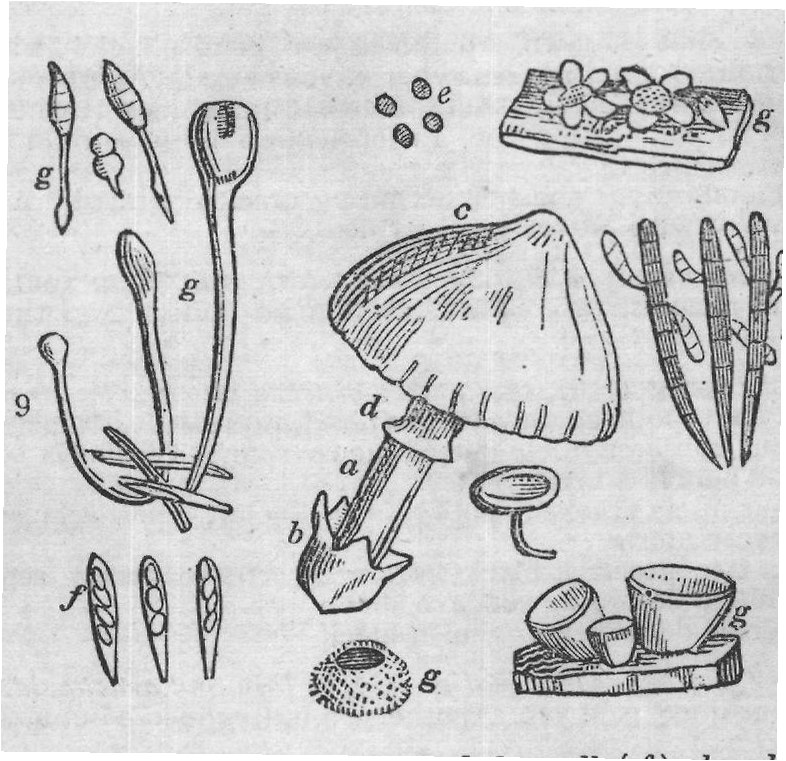
Pileati. This constitutes the most extensive division in Fungi, and includes almost every thing which was known to the ancients. Dioscorides mentions one or two species distinctly, comprehending the remainder among his eatable and unwholesome kinds. Pliny talks of the very numerous kinds of fungi, but describes very few. C. Bauhin knew about sixty, which he chiefly obtained from Clusius; Tournefort had two genera and eighty-seven species; Micheli six genera and about 800 species; Linnæus three genera and fifty species; Persoon, in his Synopsis, mentions nine genera and 683 species; finally, Fries describes more than a 1000 species arranged under many genera and subgenera.
The species are widely scattered over all Europe, but the extra European fungi, with the exception of those ORDER IX.
FUNGI. 3. Armillaria. Veil simple, partial, separate, annular, somewhat persistent. 4. Limacium. Veil very fugacious, viscid. Lamellæ adnate, decurrent. 5. Tricholoma. Veil very fugacious, flocculose, marginal. Lamellæ emarginate or rounded. ** Stem central, naked. Gills unchangeable. Sporidia white. 6. Russula. Pileus fleshy, becoming depressed. Lamellæ equal, juiceless. 7. Galorhœus. Pileus fleshy, becoming depressed. Lamellæ unequal, milky. 8. Clitocybe. Pileus fleshy, when young convex. Lamellæ unequal, juiceless. 9. Collybia. Pileus fleshy-membranous, flattish. Small, dry. § 10. Myceпa. Pileus membranous, campanulate. Slender. Stipes hollow. 11. Omphalia. Pileus membranous or fleshy-membranous, when young umbilicated. *** Stem out of the centre, none. Gills unchangeable. Sporidia white. 12. Pleurotus. Pileus out of the centre or lateral. **** Stem always central. Veil O. Gills changing color. Sporidia rose-colored. §13. Mouceron. Pileus fleshy, becoming depressed. Lamellæ long, decurrent. Odor of new flour. 14. Clitopilus. Pileus fieshy, convex. 15. Leptonia. Pileus fleshy, membranous, from convex becoming plane. Small. 16. Nolanea. Pileus membranous, campanulate. Slender. Stipes hollow. 17. Eccilia. Pileus umbilicate. Lamellæ adnate. ***** Stem always central. Veil like cobweb. Gills changing color, becoming dry. Sporidia ochre-colored. §18. Telamonia. Veil annular, woven, somewhat persistent. Lamellæ distant. 19. Inoloma. Veil fugacious. Lamellæ emarginate. Stipes bulbous. Color something of violet. 20. Dermocybe. Veil fugacious. Lamellæ closely packed. Stipes equal. ****** Veil distinct, not like a cobweb. Gills discolored, somewhat persistent. Sporidia ferruginous. 21. Pholiota. Veil dry, annular. 22. Myxacium. Veil viscid, fugacious. Lamellæ affixed. 23. Hebeloma. Veil marginal, fugacious. Lamellæ emarginate. ******* Veil very fugacious or spurious, not like a cobweb. Gills discolored, somewhat persistent. Sporidia ferruginous. 24. Flammula. Pileus fleshy, convex, smooth, somewhat viscid. Lamellæ not emarginate. 25. Inocybe. Veil formed of the longitudinal fibres of the fleshy convex pileus. Lamellæ whitish. 26. Naucoria. Pileus fleshy, membranous, flattish, squamulose. Smail. Lamellæ cinnamon-colored. 27. Galera. Pileus membranous, campanulate. Slender. Stipes hollow. §28. Tapinea. Pileus umbilicate, villous at edge. §29. Crepidotus. Pileus out of the centre or sessile. ******** Veil present, not unlike a cobweb. Gills becoming discolored, cloudy, dissolving. Sporidia brownish-purple. §30. Volvaria. Veil universal, separate. A volva. 31. Psalliota. Veil annular. §32. Hypholoma. Veil marginal, fugacious. Lamellæ emarginate. Stipes bulbous. 33. Psilocybe. Veil very fugacious. Pileus somewhat fleshy, and stipes equal, tenacious. 34. Psatyra. Pileus somewhat membranous, and stipes brittle. 35. Coprinarius. Lamellæ with a tendency to deliquesce. Veil partial. Sporidia black. 2366. Coprinus. Hymenium in lamellæ, which finally become deliquescent. Asci separate with sporidia in four rows. 2367. Gomphus. Hymenium in lamellæ, which are long branched and decurrent. Pileus turbinate, umbonate . 2368. Cantharellus. Hymenium veined. Veins dichotomous, subparallel, sometimes anastomosing. 2369. Merulius. Hymenium veined. Veins flexuose, or forming very irregular pores. Plants sessile, resupinate or effused. 2370. Schizophyllum. Hymenium in lamellæ. Lamellæ bifid, lengthwise revolute. 2371. Dædalea. Hymenium sinuous, composed of anastomosing lamellæ or flexuose elongated pores. 2372. Polyporus. Hymenium porous, not separable from the substance of the pileus nor the pores from each other. Pores sometimes lacerating in age. Pileus very rarely with a central stipes. 1. Favolus. Pores ample, with four or six angles resembling an honeycomb. 2. Microporus. Pores minute, roundish. 3. Polysticta. Dots superficial only. 2373. Boletus. Hymenium tubular. Tubes separable from the pileus and from each other. Pileus always with a central stipes. 2374. Fistulina. Hymenium tubular. Tubes loose, the young ones closed. 2375. Hydnum. Hymenium subulate. Subulæ loose. 2376. Sistotrema. Pileus carnose, irregularly stipitate. Hymenium composed of dentate, interrupted lamellæ. 2377. Phlebia. Hymenium rugose, formed of long or confluent papillæ. 2378. Thelephora. Plant with very few exceptions more or less adnate, thin, coriaceous, very rarely infundibuliform. Hymenium covering the outer surface. 2. Phylacteria. Sporidia four in a row. Resupinate and growing on the earth. 3. Himantia. Effuse resupinate, when young byssoid. Sporidia few, innate in the hymenium, which is smooth and naked in the middle. 4. Leiostroma. Resupinate, somewhat contiguous, smooth, or with spurious papillæ. Asci none. Observations. on the coasts of Barbary, and a few from North America, are almost universally distinct from the European kinds. They are found growing on the earth, or in decayed wood, or similar substances; never upon rocks. Those which have been described as natives of vaults and places underground, are believed to be mere monstrous formations. They are in greatest perfection in warm rainy weather, being chiefly the creations of summer and autumn; a few only appear in the spring, and scarcely any in the winter. The duration of the pileate fungi is often only ephemeral; some last from a week to a fortnight; and a few for a longer time. The Dædaleæ and Polypori are often called perennial, but it is the opinion of Fries, that their substance decays, and is only covered yearly by a fresh layer of pores. The roots of many of those which grow upon trees is perennial; of others merely annual. When crude they are mostly poisonous, with a mucilaginous taste, which is often acrid, but they become less dangerous by cooking. The dangerous qualities of some of the kinds is attributable to the larvæ with which they are infested. 3R2 CRYPTOGAMIA.