Home › U › Urticeæ (Sp whorl-flowered cu ap s)
Urticeæ (Sp whorl-flowered cu ap s)
Sp. 3-5. whorl-flowered cu 2 ap.s 933. FORSKOH'LEA.
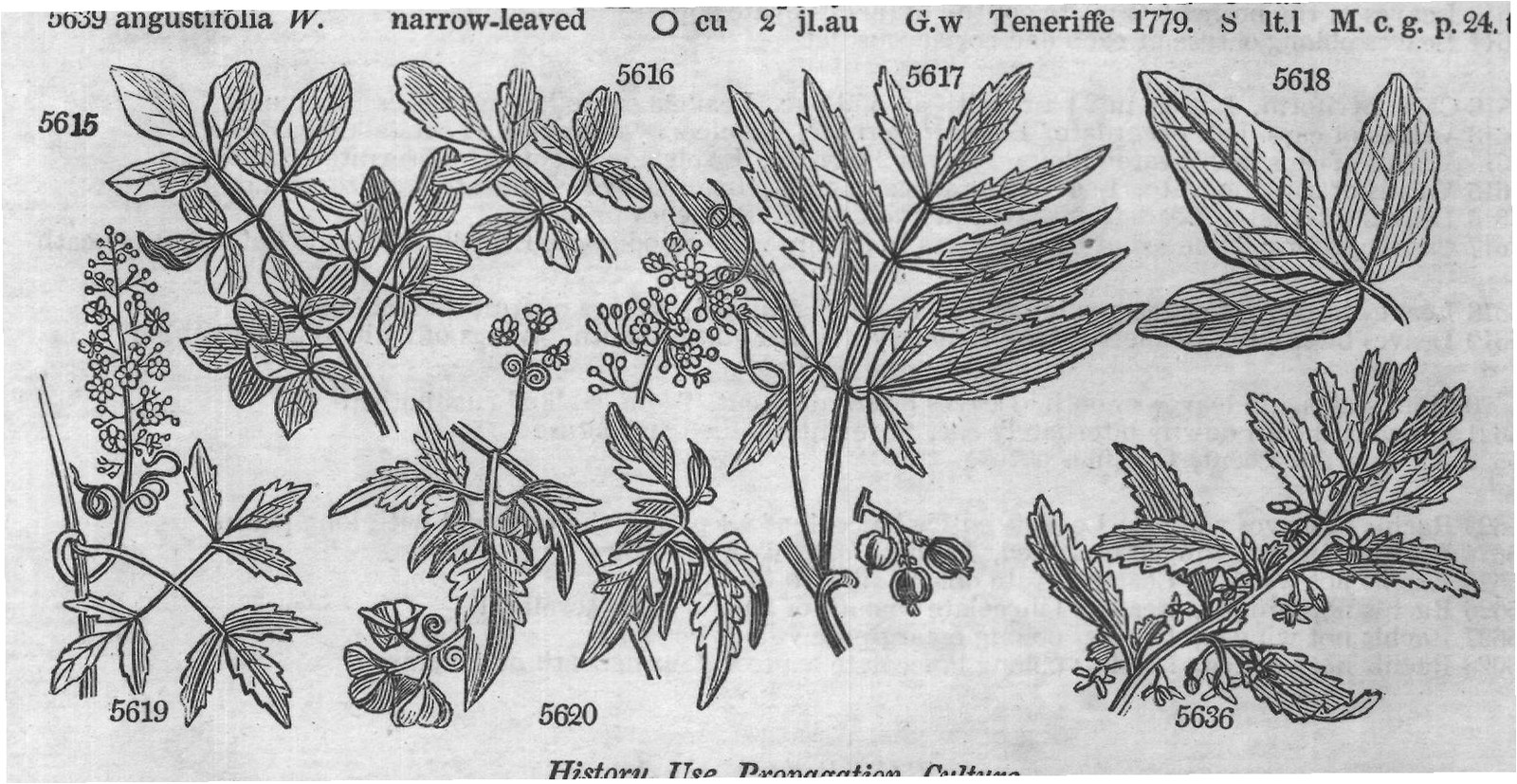
FORSKOHLEA. 5637 tenacíssima W. clammy cu 1 jl.au 5638 cándida W. rough cu 1 jn.jl 5639 angustifólia W. narrow-leaved cu 2 jl.au 5616 5615 G Egypt 1767. S lt.l Jac. vind. 1. t. 48 W.G C. G. H. 1774. C lt.1 G.w Teneriffe 1779. S lt.1 M. c. g. p. 24. t. 2 5617 5618 5619 5620 5636 History, Use, Propagation, Culture, 932. Haloragis. From ἁλς, aλoς, the sea, and çağ, the berry of a bunch of grapes. This plant grows on the sea shore, and its fruit is globular like a berry. 933. Forsköhlea. In memory of Peter Forsköhl, a Swede, born in 1732; he was professor at Copenhagen; ORDER IV.
OCTANDRIA TETRAGYNIA. 5636 Leaves serrate, Flowers whorled 5637 Pilose hispid, Leaves elliptical unarmed, Sepals oblong lanceolate acute 5638 Rough, Leaves elliptical wavy unarmed, Sepals ovate obtuse 5639 Strigose, Leaves lanceolate with spiny teeth, Sepals lanceolate subulate 5605 5608 5623 5637 1 5639 and Miscellaneous Particulars. travelled at the expence of the king of Denmark into Egypt and Arabia, and died in the latter country of the plague in 1763. Inelegant plants, with the aspect of a nettle. ENNEANDRIA.
CLASS IX.
CLASS IX. - ENNEANDRIA. 9 STAMENS.
ONE of the smallest of the Linnean classes; containing, however, three important genera; the Laurel, famous for the valuable spices it produces, and for the beautiful foliage of its insipid species; the Cashew nut, well known at the tables of the great or luxurious; and the Rhubarb, one of the most valuable of medicines.
The class itself is extremely unnatural, and the assemblage of genera most incongruous.
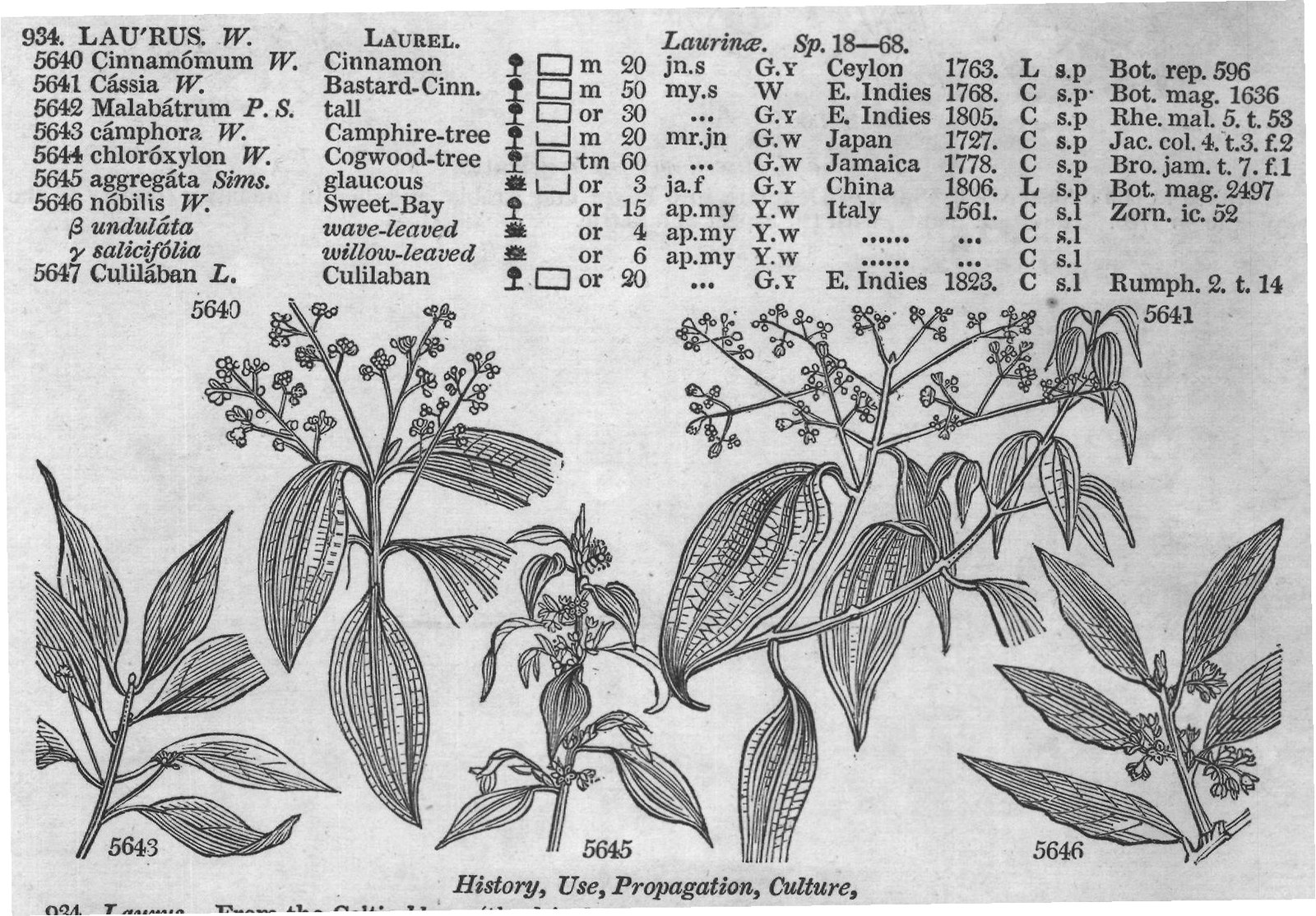
Order 1. MONOGYNIA. ✔ 9 Stamens. 1 Style. 934. Laurus. Cal. 4-6-parted. Nect. 3 glands, with 2 bristles surrounding the ovary. Anthers opening transversely. Valves hinged to the upper side. 934. LAU'RUS. W. 5640 Cinnamómum W. 5641 Cássia W. 5642 Malabátrum P. S. 5643 cámphora W. 5644 chloróxylon W. 5645 aggregáta Sims. 5646 nóbilis W.
B unduláta 2 salicifólia 5647 Culilaban L. 5640 MONOGYNIA.
Laurinæ. Sp. 18-68.
LAUREL.
Cinnamon m 20 jn.s Bastard-Cinn. tall Camphire-tree Cogwood-tree glaucous Sweet-Bay G.Y Ceylon m 50 my.s W or 30 ...
G.Y m 20 mr.jn G.w tm 60 or ...
G.w 1763. L s.p E. Indies 1768. C s.p.
E. Indies 1805. C s.p Japan Jamaica 3 ja.f G.Y China or 15 ap.my Y.w Italy wave-leaved or 4 ap.my Y.w willow-leaved or Culilaban 오 or 20 6 ap.my Y.w ... ...... 1727. C s.p 1778. C s.p 1806. L s.p 1561. C s.l C s.1 ... ...
Bot. rep. 596 Bot. mag. 1636 Rhe. mal. 5. t. 53 Jac. col. 4. t.3. f.2 Bro. jam. t. 7. f.1 Bot. mag. 2497 Zorn. ic. 52 G.Y E. Indies 1823. C s.1 Rumph. 2. t. 14 5641 5643 5645 History, Use, Propagation, Culture, 5646 934. Laurus. From the Celtic blaur (the bis dropped in pronunciation, laur), green. The laurel is perpetually green. This genus contains several important spice or drug-bearing trees, besides the poetical laurel and a fruit tree.
L. Cinnamomum (qu. China Amomum) has a smooth ash-colored bark, a short erect trunk, and wide spreading branches, which form an elegant head. The leaves are of a bright green above, pale beneath, and white veined; the flowers are in panicles, have no shew , and are inodorous, or perhaps somewhat fœtid; the fruit is the size of a middling olive, soft, insipid, and of a deep blue; it encloses a nut, the kernel of which germinates soon after it falls, and therefore cannot easily be transported to a distance. The timber is white, and not very solid; the root is thick and branching, and exudes abundance of camphor. The inner bark forms the cinnamon of commerce. There are many varieties, and probably some of them species, especially in the island of Ceylon, but only four are said to be barked. Besides Ceylon, the tree grows plentifully in Malabar, Cochin China, Sumatra, and the Eastern islands. It has been cultivated in the Brazils, the Mauritius, India, Jamaica, and other places. The soil in which it thrives best is nearly pure quartz sand. That of the cinnamon garden near Colombo in Ceylon, was found by Dr. Davy to consist of 98.5 of silicious sand, and of 1.0 only of vegetable matter in 100 parts. ation is sheltered; the climate is remar "The garden is nearly on a level with the lake of Colombo; its situremarkably damp; uncommonly equable." (Davy's Ceylon, p. 39.) ; showers are frequent, and the temperature is high and The trees that grow in the valleys, in a white sandy soil, are fit to be barked when four or five years old, but those in a wet soil or in shady places, require to be seven or eight years of age. The bark is good for nothing if the tree be older than eighteen years. The tree was formerly propagated by a species of pigeon that ate the fruit and voided the seed; but since Falck, one of the Dutch governors, about the middle of the eighteenth century, raised it from berries sown in his garden, it has been regularly cultivated.
The barking commences early in May, and continues until late in October. Branches of three years old are selected, and topped off with a pruning knife or bill hook. To remove the bark a longitudinal incision is made through it on both sides of the shoot, so that it can be gradually loosened and taken off entire, forming hollow cylinders. The bark in this state, tied up in bundles, is allowed to remain for twenty-four hours, by which a fermentation is produced that facilitates the separation of the epidermis, which, with the green pulpy matter under it, is carefully scraped off. The bark now soon dries, contracts, and assumes the quilled form, after which the smaller pieces are put within the larger. The cinnamon, when dry, is tied up in bundles of 30lbs. weight, and carried to the Government store-house, where the quality is determined by inspection of the bundles. It was formerly chewed for this purpose; and the surgeons who used to be thus employed, had their CLASS IX.
ENNEANDRIA. 935. Anacardium. Cal. 5-parted. Petals 5, reflexed. Anthers 9, and one filament barren. Nut reniform, upon a fleshy receptacle. 936. Cassytha. Cal. 6-parted. Nect. 3 truncate glands surrounding the ovary. Inner filaments glanduliferous. Drupe 1-seeded. 937. Eriogonum. Cal. campanulate, 6-cleft. Nut 1, 3-cornered, covered by the calyx. Order 2. TRIGYNIA. 938. Rheum. Cor. 6-cleft, persistent. Nut 1, 3-cornered. 9 Stamens. 3 Styles.
Order 3. HEXAGYNIA. 9 Stamens. 6 Styles. 939. Butomus. Sepals 6. Caps. 6, many-seeded.
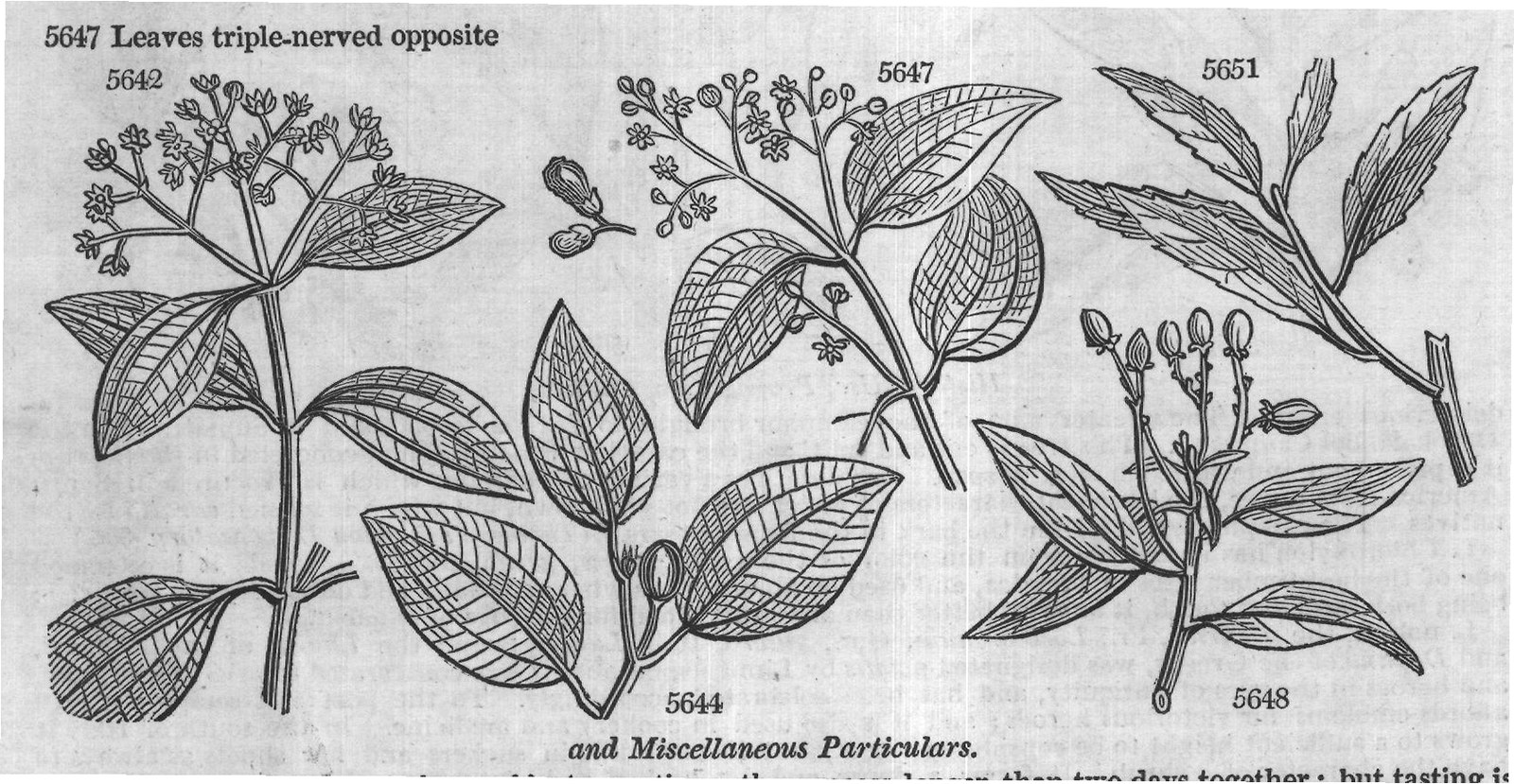
MONOGYNIA. 5640 Leaves 3-nerved ovate-oblong, Nerves vanishing towards the end 5641 Leaves triple-nerved lanceolate 5642 Leaves opp. very long acute at each end triple-nerved veiny across 5643 Leaves triple-nerved lanceolate ovate 5644 Leaves 3-nerved ovate coriaceous, Nerves reaching the end 5645 Leaves ovate acuminate 3-nerved glaucous beneath, Flowers axillary numerous 5646 Leaves lanceolate veiny perennial, Flowers 4-fid dioicous 5647 Leaves triple-nerved opposite 5642 5647 5644 5651 5648 and Miscellaneous Particulars. mouths so excoriated, as to be unable to continue the process longer than two days together: but tasting is now seldom had recourse to.
Cinnamon bark is astringent, cordial, and tonic. But the principal use of cinnamon is to cover the nauseous state of other remedies. (Thomson's London Dispensatory, 354.) An oil is procured from the leaves and roots of cinnamon; ; the former is called the oil of cloves, and the latter the oil of camphor: both are powerfully stimulant, and used in cramps of the stomach, flatulent colic, hiccough, toothach, and nervous langour.
According to Sweet L. Cinnamomum is the hardest plant of the genus to cultivate in our stoves. " I have scarcely," he says, " ever seen it do well any where but at Messrs. Loddiges," who generally keep their stoves keep their stoves warmer than other gardeners usually do ; and the cinnamon likes a warm atmosphere, and very little water in winter. It grows best in a mixture of sandy loam and peat, the pots being well drained with small potsherds. Ripened cuttings soon take root in a pot of sand, plunged under a hand-glass, in a good moist heat. (Bot. Cult. 74.) The plant has regularly flowered and ripened seeds in the hothouse of the Bishop of Winchester for several years past.
L. Cassia is also decorticated like the cinnamon, but it is considered of inferior value, on account of containing a greater proportion of mucilage. What are called Cassia buds, are not obtained from this tree, but are the hexangular fleshy receptacles of the seed of the L. Cinnamomum. Cassia bark and buds are used in the same manner as cinnamon bark the tree also affords an oil of similar use. In our stoves, the cassia grows more readily than the cinnamon; the same kind of soil suits it; and cuttings root freely treated in the same manner. (Bot. Cult. 74.) L. Camphora, an alteration of the Arabic name, kâfour, is nearly allied to the cinnamon tree. The roots, wood, and leaves of this tree have a very strong odor of camphor; and from the roots and smaller branches it branches it is obtained by distillation. They are cut into chips, which are suspended in a net within a kind of still or iron pot, the bottom of which is covered with water, and an earthen head fitted to it; heat is then applied, and the steam of the boiling water, penetrating the contents of the net, elevates the camphor into the capital, where it concretes on straws, with which this part of the apparatus is lined. Camphor is stimulant, narcotic, and diaphoretic, but its stimulant powers are very transitory, and followed by sedative effects. In moderate doses it operates as a cordial, increasing the heat of the body, and exhilarating, besides softening, and rendering fuller the pulse, and promoting diaphoresis; in large doses it allays irritation and spasm, abates pain, and induces sleep. But in immoderate doses camphor produces vomiting, vertigo, delirium, convulsions, and other 5648 índica W.
Royal-bay ENNEANDRIA MONOGYNIA. tm 20 mr.o CLASS IX.
G.Y Madeira 1665. C L.p Pl. alm. t. 304.f. 1 5649 fœ'tens W.
Madeira, or Til. ☐ tm 20 mr.o G.Y Madeira 1760. C 1.p 5650 canariensis W.en.
Canary or 10 G.Y Canaries 1815. C 1.p 5651 Pérsea W.
Alligator Pear fr 30 G.Y 5652 Borbónia W. brd.-lvd.-Carol. or 15 ap.my Y.G 5653 carolinensis P. S. Red-Bay 5654 geniculáta Ph. flexuose tm 15 ap.my Y.G or 6 ap.my Y N. Amer. 1806.
N. Amer. 1759. 5655 Dióspyrus Ph. twiggy or 6 ap.my G.Y 5656 Benzóin W.
Benjamin-tree m 5657 Sássafras W.
Sassafras-tree N. Amer. 1633. 935. ANACAR'DIUM.
W. CASHEW-NUT. 5658 occidentále W. common 오 fr 12 936. CASSY THA.
CASSYTHA. 8 ap.my Y.G m 50 my.jn G.Y R W. Indies 1739. C 1p N. Amer. 1739. C 1.p N. Amer. 1810.
N. Amer. 1683.
Terebintaceæ. Sp. 1.?
India Laurine. Sp. 1-2. ...
L 1.p L 1.p L S p.s.l Com. hort.1.t.97 S p.s.l Cat. car. 1. t. 55 1699. Cr.m Cat. car. 3. t. 9 Pl. alm. t. 267.f.1 Cat. car. 1. t. 63 Bot. mag. 1471 Bot. mag. 1470 5659 filifórmis W. 937. ERIO'GONUM. Mi. ERIOGONUM. 5660 tomentósum Ph. 5661 seríceum Ph. filiform cu 3 ap.au W E. Indies 1796. C s.p Pl. al. t. 172. f. 2 Polygoneæ.
Sp. 2-3. woolly silky cu 2 my.jn Y Carolina 1811. S 1.p Mich. am. t. 24 cu 1 jl Y Missouri 1811. S l.p 938. RHEUM. W.
RHUBARB. 5662 Rhapónticum W. 5663 undulátum W. common Bucks 5652 TRIGYNIA.
Polygoneæ. Sp. 7-10. * * cul 4 my.jn W.G Asia cul 4 my.jn W.G China 5654 5656 1573. R co Sabb. hort. 1.t.34 1734. R co Amæn, ac. 3. t. 4 5655 5657 History, Use, Propagation, Culture, deleterious effects. The greater part of the camphor brought to Europe is obtained in Sumatra from the Dryobalanops Camphora. This tree is cut and split, and the camphor which is found concreted in the heart of it is picked out and washed in a ley of soap. Zea describes a variety of camphor which is procured in South America from a tree, the botanical characters of which are not yet known, but which is termed caratta by the natives. The camphor exudes from the bark in the form of tears. (Thomson's London Dispensatory, 356.) L. Chloroxylon has its specific from the color of the wood, χλωρov, green, and ξuλov, wood; it is esteemed one of the best timber trees in Jamaica, and used on all occasions where strength and durability are required : being both hard and tough, it answers better than any other wood for the cogs of sugar mills.
L. nobilis, the Laurier, Fr., Lorbecrbaum, Ger., Alloro, Ital., Laurel, Span., the Laurus of the Romans, and and heroes Daphne of the Greeks, was designated nobilis by Linnæus, because it was consecrated to priests, sacrifices, Romans, Daphne of the Greeks, was designated nobilis by Linnæus, because it was consecrated to priests, sacrifices, and heroes in the ages of antiquity, and has been celebrated affords emblems in the ages of antiquity, and has been celebrated accordingly. To the poet and sculptor it still and medicine. In the south of Italy it grows to a sufficient height to be considered a tree; but is so prolific in suckers and low shoots as always to have the character of a shrub. It forms a dense and yet broken and picturesque mass of a very fine deep green, inclining to olive, and is abundantly covered with berries, which are dark purple or black, when ripe.
Oil is obtained from the latter by boiling water. Both the leaves and the berries have a sweet fragrant odour, and an aromatic, astringent taste; and the oil, which is of a yellowish green color, has a stronger but similar odor and taste. Water distilled from the leaves shews traces of prussic acid; and it is probably on this component that their medicinal and poisonous property depend. Leaves, berries, and oil are narcotic and carminative. (Thomson's London Dispensatory, 360.) L. indica grows in the Canary Isles and Virginia. The wood is of a yellow color, not heavy, good for building, but better still for furniture: it is called Vigniatico in the island of Madeira, and is probably what is imported into England under the name of Madeira mahogany . mahogany, except that it is somewhat less brown. (Hawksw. Voy. ii. p. 5.) It is hardly to be distinguished from L. Persea (Persea is a name under which Theophrastus describes an Egyptian tree not now known,) has a trunk as large as our common apple tree; the bark is smooth, and of an ash color; the branches are very succulent and soft, beset with pretty large oblong smooth leaves, like those of laurel, of a deep green color.
The flowers are, for the most part, produced towards the extremities of the branches. The fruit is the size of one of our biggest pears. The pulp of the fruit is covered with a tough skinny coat, and contains a large rugged seed, which is wrapped up in one or two thin membranous covers. great esteem in the West Indies: the pulp is of a pretty firm consistence, and has a delicate rich This fruit is held in flavor; it gains upon the palate of most persons, and becomes soon agreeable even to those who cannot like it at first; but it is so rich and mild, that most people make use of some spice or pungent substance to give it a poignancy; and, for this purpose, some make use of wine, some of sugar, some of limejuice, but most of pepper and salt. This fruit seems equally agreeable to the horse, the cow, the dog, and the cat, as well as to all sorts of birds; when plentiful, it makes a great part of the delicacies of the negroes. (Browne.) L. Borbonea was regarded by Plumier as a genus distinct from Laurus, and he applied what is now its specific name, in memory of Gaston Bourbon, son of Henry IV. and uncle of Louis XIV. It is a very common tree in swamps in Carolina, and affords a fine grained wood excellent for cabinets; some of the best resembles watered satin.
L. Sassafras (Sassafras is an alteration of the Spanish word Salsafras, which signifies Saxifrage, the virtues and of female are attributed by the Spanish Americans to this plant,) has the flowers often imperfect Saxifrage, to the virtues which are attributed by the Spanish Americans to this plant,) has the flowers often imperfect as to the male and female organs, which, before observation was so accurate and scientific as at present, led to the conclusion ORDER I.
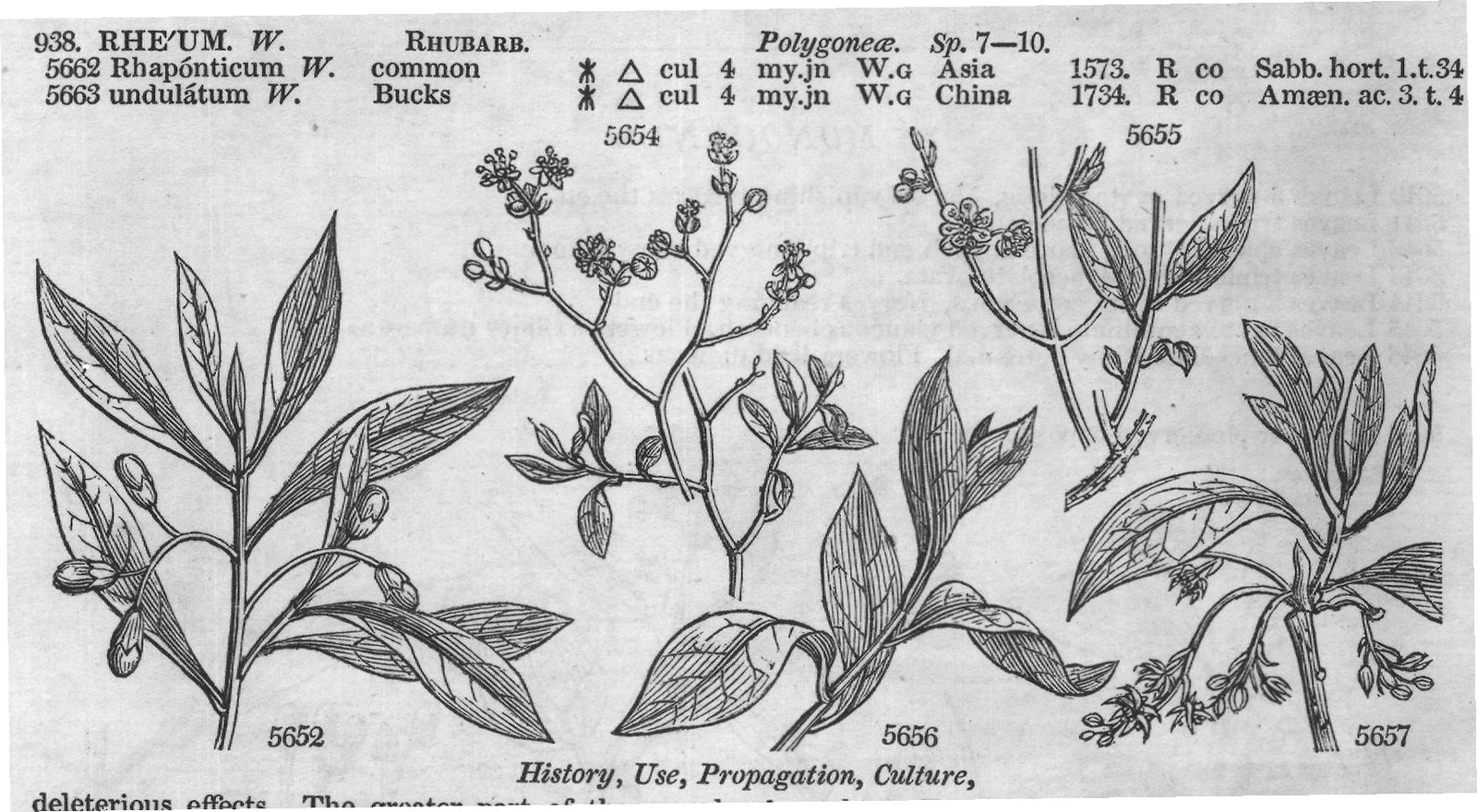
ENNEANDRIA MONOGYNIA. 5648 Leaves veiny lanceolate perennial flat, Branches scarred, Flowers racemose 5649 Leaves veiny elliptical acute perennial, Axils of veins villous beneath, Racemes panicled 5650 Leaves veiny oblong acute at each end perennial shining, Pedunc. axill. 3-4-flowered 5651 Leaves ovate coriaceous transversely veiny perennial, Flowers corymbose 5652 Leaves lanceolate perennial, Calyx of fruit berried 5653 Leaves oval lanc. perenn. glaucous beneath, Berries globose 5654 Branches divaricating flexuose, Leaves oval obtuse smooth at the base beneath bearded, Anth. 4-celled 5655 Twiggy nakedflowering, Leaves decid. oblong beneath veiny downy, Flowers clustered, Buds villous 5656 Leaves nerveless ovate acute at each end entire annual 5657 Leaves entire and 3-lobed 5658 The only species 5659 Branches filiform lax 5660 Leaves sessile cauline 3-4 cuneate obovate smooth above 5661 Leaves radical stalked lanc. oblong villous above TRIGYNIA. 5602 Leaves obtuse smooth, Veins beneath hairy, Leafst. furrowed above rounded at edge 5663 Leaves villous wavy, Leafst. flat above with an acute edge 5658 5660 5659 5662 5663 and Miscellaneous Particulars. that one plant bore only males and the other only hermaphrodites; it is now found the alleged males are only imperfect hermaphrodites. The wood, root, and bark have a fragrant odor, and a sweetish aromatic taste their sensible qualities and virtues depend on an essential oil, which can be obtained separate by distilling the depend on an essential oil, which can be obtained separate by distilling the chips or the bark with water it is a stimulating diaphoretic and diuretic, and has been employed in cases of a stimulating diaphoretic and diuretic, and has been employed in cases of scurvy, chronic rheumatism, gout, and in cutaneous affections ; but its effects are very uncertain ; and even the and in cutaneous affections; but its effects are very uncertain; and even the diaphoresis which it is supposed to occasion may rather be ascribed to the guaiac, and other more powerful medicines, with which it is generally combined. (Thomson's London Dispensatory, 361.) The species are well divided into several genera, such as Laurus, Tetranthera, Cinnamomum, and others: but as this division has not been applied to the old species of Laurus generally, it has not been practicable to adopt it here. 935. Anacardium. From ava, in composition, like, and κaρδia, heart, in allusion to the form of the nut. This is an elegant tree, bearing panicled corymbs of sweet-smelling flowers, succeeded by an edible fruit of the pome kind, of a yellow or red color. This fruit or apple has an agreeable sub-acid flavor, with some degree of astringency. The juice expressed and fermented yields a pleasant wine ; and distilled, a spirit is drawn from fermented yields a pleasant wine; and distilled, a spirit is drawn from it, far exceeding arrack or rum, making an admirable punch, and powerfully promoting urine. The dried and broken kernels are occasionally imported for mixing with old Madeira wine, the flavor of which they improve prodigiously. Some planters in the West Indies roast the ripe fruit, or slice one or two into a bowl of punch, to give it a pleasant flavor. The astringency of the juice has recommended it as a very signal remedy in dropsical habits.
The nut protrudes from one end of the apple. (Long.) It is of the size and shape of a hare's kidney, but is much larger at the end next the fruit than at the other. The outer shell is of an ash color, and very smooth, under this is another which covers the kernel; between these there is a thick inflammable oil, which is very the kernel; between these there is a thick inflammable oil, which is very caustic; this will raise blisters on the skin, and has often been very troublesome to those who have inthe skin, and has often been very troublesome to those who have incautiously put the nuts into their mouths to break the shell. This oil has been used with great success in mouths to break the shell. This oil has been used with great success in eating off ring-worms, cancerous ulcers, and corns but it ought to be applied with caution. The kernel when ulcers, and corns; but it ought to be applied with caution. The kernel when fresh, has a most delicious taste, and abounds with a sweet milky juice. It is an ingredient in puddings, &c. , and abounds with a sweet milky juice. It is an ingredient in puddings, &c.
When older it is generally roasted; and in this state is not so proper for costive habits. Ground with cacao, ; and in this state is not so proper for costive habits. Ground with cacao, it makes an excellent chocolate. When kept too long it becomes shrivelled, and loses its flavor and best . When kept too long it becomes shrivelled, and loses its flavor and best qualities. The thick oil of the shell tinges linen of a rusty iron-color, which can hardly be got out and if linen of a rusty iron-color, which can hardly be got out; and if any wood be smeared with the oil, it prevents the wood from decaying. From the body of the tree is procured, by tapping or incision, a milky juice, which will stain linen of a deep black, that cannot be washed out again.
This tree also annually transudes from five to ten or twelve pounds weight of a fine semi-transparent gum, similar to gum arabic, and not inferior to it in virtue or quality, except that it has a slight astringency, which, perhaps, renders it in some respects more valuable. (Long's Jam. iii. 725, &c.) As a stove-plant it grows in light loam or rich mould, and ripe cuttings with their leaves, planted in a pot of sand, and plunged under a hand -glass, will strike root. 936. Cassytha. The Greek name of the Cuscuta, which this plant much resembles in habit and characters of analogy. Its affinity, however, is very curious; from a minute analysis of its constituent parts it has been decided by the most learned botanists to be referable to Laurinæ. 937. Eriogonum. From ερiov, wool, and γovu, a knee. The stem of this plant is very woolly at the joints. The species thrive best in pots, and are principally to be increased by seeds. 938. Rheum. This name was ingeniously supposed by Linnæus to have been derived from ῥεω, to flow, because the root causes a discharge of bile. It, nevertheless, was formed from Rha, the ancient name of the Volga. 5664 palmátum W. 5665 compáctum W. 5666 tatáricum W. 5667 Ríbes W. 5668 hýbridum W. officinal 939. BU TOMUS. W. 5669 umbellátus W.
G 5664 ENNEANDRIA TRIGYNIA.
CLASS IX. m 5 ap.my W.G Bucharia 1763. R co Lin. fasc. 7. t. 4 thick-leaved Tartarian m 3 my.jn W.G Tartary 1758. R co Mill. ic. 2. t. 218 m 3 my.jn W.G Tartary 1793. R co warted-leaved bastard cul 2 my.jn W. Levant cul 5 my.jn W.G Asia 1724. R co 1778. R co An. mus. 2. t. 49 Mur. co. got. t. 1 HEXAGYNIA.
FLOWERING-RUSH. umbelled Butomeæ. Sp. 1-2. △el 2 jn.jl Pk Britain dit. Dr.l Eng. bot. 651 5665 History, Use, Propagation, Culture, Ammianus Marcellinus, lib. xii., says, its name, and is much renowned in medicine." The construction of the specific names confirms this; Rha "the Rha is a river, on the border of which grows a root, which bears ponticum, Rha barbarum, whence the name Rhubarb was obtained. R. Rhaponticum was thought to be the true rhubarb of druggists, till Dr. Hope of Edinburgh described the R. palmatum, some seeds of which he had received from Russia, as of the genuine species. It is not, however, palmatum, some seeds of which he had received from Russia, as of the genuine species. It is not, however, finally settled, whether these species or the R. compactum yield the foreign roots , nor does it appear of much consequence, as these three species agree so nearly in their medical properties, that any of them may be used with equal certainty of success.
East Indian or Chinese, grows on the declivities of the chain of mountains in Tartary which stretches from All the rhubarb of commerce, known under the names Turkey or Russian, and the Chinese town Sini to the lake Kokonor near Thibet. The soil is light and sandy; and the Bucharians assert that the best grows in the shade on the southern side of the mountains. Rhubarb, however, is also cultivated in China, in the province of Chen-See, where it is called Hai-houng. In Tartary, the roots are taken up twice a-year, in spring and in autumn, and after being cleansed and decorticated , and the smaller branches cut off, the body of the root is divided transversely into pieces of a moderate size, which are placed on tables, and turned three or four times a-day, during five or six days. A hole is then bored through each piece, by which it is hung up to dry, exposed to the air and wind, but sheltered from the sun. the roots have lost seven parts in eight of their weight , and are fit for the market. In China, the roots are not In about two months, dug up till winter; and the cultivators, after cleaning, scraping off the bark, and cutting them, dry the slices by frequently turning them on stone slabs heated by a fire underneath; after which , the drying is completed by hanging them up in the air exposed to the greatest heat of the sun. (Thomson's London Dispensatory, 471.) Rhubarb has been cultivated in different parts of Britain with a view to drying the root for medical purposes with the most perfect success; but such is the prejudice in favor of the foreign article, that sufficient de- ORDER 1.
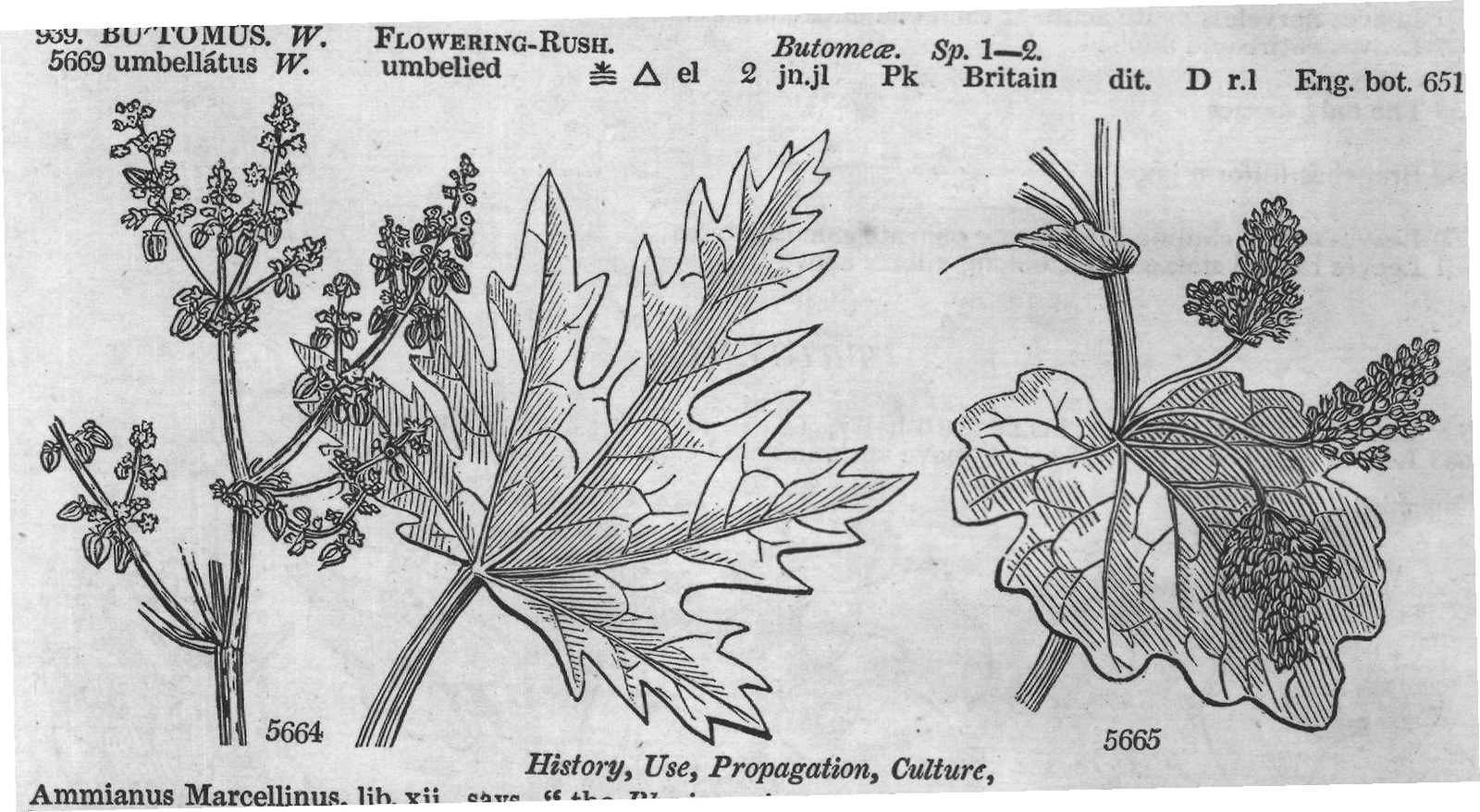
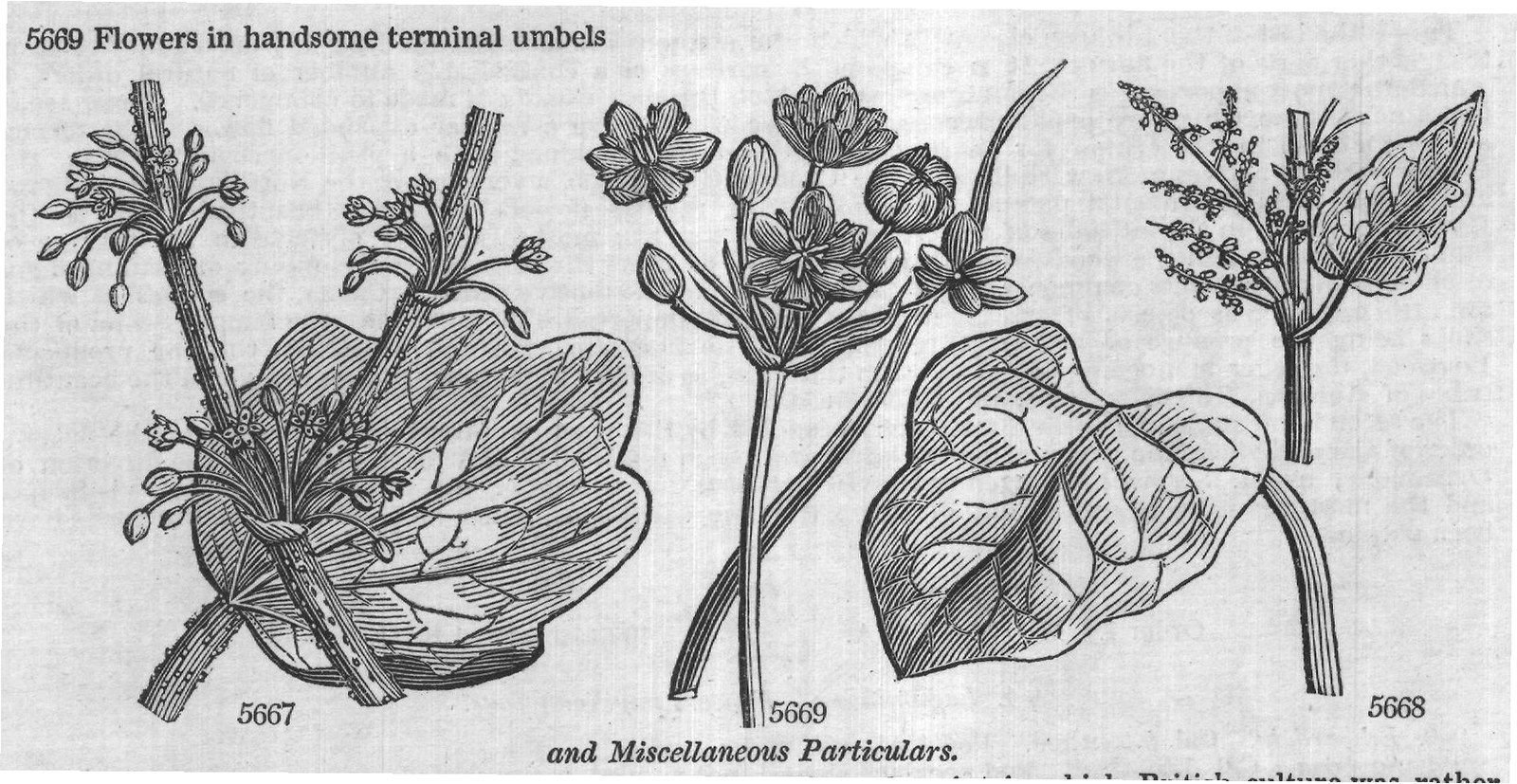
ENNEANDRIA TRIGYNIA. 5664 Leaves palm. acute roughish, Leafst. above obscurely furrowed rounded at edge 5665 Leaves somewhat lobed very obtuse shining finely toothletted smooth 5666 Leaves cordate ovate entire flat smooth, Leafst. half-round angular, Panicle furrowed 5667 Leaves very obtuse somewhat warted, Veins beneath spinulose, Leafst. flat above rounded at edge 5668 Leaves smooth above somewhat lobed acute, Recess of base contracted HEXAGYNIA. 5669 Flowers in handsome terminal umbels 5667 5669 5668 and Miscellaneous Particulars. mand was not produced to encourage the cultivator. The only point in which British culture was rather deficient was in the drying, but that a little experience would soon have overcome. R. Rhaponticum and hybridum, indeed any of the species, are or may be cultivated for the petioles of the leaves in a green state, to be used in tarts and pies, as a substitute or along with gooseberries. All that is required is a dry soil well enriched and trenched two, or better, three feet deep. The plants the year after planting may have half their leaves slipped off for the cook, as soon as they arrive at full growth. Keeping the plants from flowering will obviously strengthen the leaves. Tart rhubarb may be forced either by taking up the roots and planting them in pots, or by covering them with dung where they grow in the open garden, as is done with sea-kale. It may also be blanched, as is done with that vegetable. (See Encyc. of Gard. art. Rheum.) R. Ribes is so called from a rob made from its stalks, and called Rybès of Serapias. It is thought that all the supposed species are reducible to Rhaponticum, undulatum, palmatum, and ribes. It is certainly very difficult to distinguish the others. 939. Butomus. From ẞ8s, an ox, and τέμvω, to cut ; the sharp leaves of the plant cut and cause to bleed the mouths of cattle feeding upon it.
This is the only plant of the class Enneandria that grows wild in Britain. It is an elegant aquatic. water-Gladiole, or grassie-Rush," says Gerarde, " is of all others the fairest and most pleasant to behold, and most pleasant to behold, and serveth very well for the decking and trimming up of houses, because of the beautie and braverie thereof." The corolla varies in different shades of red, or purple mixed with white, and is sometimes entirely white. The stem at bottom and the peduncles at top are often tinged with red. The number three is evidently predominant in the fructification; the corolla being doubly tripetalous, the stamens thrice three, the pistils six, , the capsules six, in a hexagon form, the involucre three-leaved. Z DECANDRIA.
CLASS X.
CLASS X. - DECANDRIA. 10 STAMENS.
THIS is the last of the Linnean classes in which the stamens are distinct, and bear any determined relation which to the other the parts of the flower. It is composed of portions of a considerable number of natural orders, of the other parts of the flower. It is composed of portions of a considerable number of natural orders, of which the most important is Leguminosæ, with which the class usually is made to commence. These are of two kinds: those which are papilionaceous, and those which have a regular expanded flower. The former are remarkable in their kind for bearing distinct stamens combined with a papilionaceous corolla; the greater part are natives of New Holland or the Cape of Good Hope, a very few of the Northern Hemisphere; and all of them ornamental plants. Of those with regular flowers the most beautiful genus is the Bauhinia, which, in the latitudes of the tropics, constitutes the most formidable obstacle to the passage of human beings through the woods, which are interlaced in every direction by the climbing or leaning stems of these and other plants commonly called Lianes; the most extensive genus is Cassia, the species of which are little esteemed as objects of ornament, but of material importance in medicine; the famous Senna of the shops being the produce of at least three species. The Hematoxylon and Swietenia, the one producing Logwood, the other Mahogany, are included in this class, as are the important Quassia drug, and the beautiful tribes of Kalmias, Rhododendrons, and Andromedas.
Rhododendrons, The second and succeeding orders are chiefly occupied by the most important of the genera of the natural order of Caryophylleæ, the whole of which have lately been remodelled and arranged, under the direction natural botanist. Of this order the most extensive genus is Silene, and the most beautiful Dianthus, out of which the fine carnations, pinks, and piccotees of the florist have been obtained Order 1. MONOGYNIA. 10 Stamens. 1 Style. § 1. Leguminosæ. Flowers papilionaceous. 940. Edwardsia. Cal. 5-toothed. Pod +-winged, many-seeded. 941. Sophora. Cal. 5-toothed. Pod necklace-shaped, not winged, many-seeded. 942. Ormosia. Cal. 5-cleft, 2-lipped. Stigmas 2, approximate, obtuse: one on one side. Pod compressed, woody, 1-3-seeded. 943. Anagyris. Cal. 5-toothed, 2-lipped. Keel of 2 petals, which are larger than the wings, which are longer than the standard. Pod compressed, manyseeded. 944. Thermopsis. Cal. oblong-5-cleft, 2-lipped, convex behind. Petals of equal length. Standard reflexed at edges. Keel obtuse. Stamens persistent. ent. Pod compressed, linear, many-seeded. 945. Virgilia. Cal. 5-cleft. Petals of equal length; standard not reflexed at edges. Stigma beardless. Pod compressed, oblong, many-seeded. 946. Cyclopia. Cal. 5-cleft, unequal, pushed inwards at base. Standard with longitudinal wrinkles: wings with a transverse plait. Stamens deciduous. Stigma bearded on one side. Pod compressed, many-seeded. 947. Baptisia. Cal. half 4-5-cleft, 2-lipped. Petals of equal length. Standard reflexed at edges. Stamens deciduous. Pod ventricose, stalked, many-seeded. 948. Podalyria. Cal. 5-cleft, unequal, pushed inwards at base. Standard larger than the rest. Stamens persistent, connate at base. Pod ventricose, many-seeded. 949. Chorozemia. Cal. half-5-cleft, 2-lipped. Keel ventricose, shorter than wings. Style short, hooked. Stigma oblique, obtuse. Pod ventricose, many-seeded. 950. Podolobium. Cal. 5-cleft, 2-lipped. Keel compressed, the length of the wings, which are equal to the expanded standard. Ovary many-seeded in a single row. Style ascending. Stigma simple. Pod stalked, linear, oblong, moderately ventricose, smooth inside. 951. Oxylobium. Cal. deeply 5-cleft, rather 2-lipped. Keel compressed, the length of the wings, which are equal to the open standard. Style ascending. Stigma simple. equal 952. to the open standard. Style ascending. Stigma simple. Pod many-seeded, ventricose, ovate, acute. keel and wings drooping. Style incurved. Stigma simple. Pod stalked, woody before ripening, many-celled. 953. Brachysema. Cal. 5-cleft, but little unequal, with a ventricose tube. Standard shorter than the compressed keel, which is as long as the wings. Ovary with a stalk, surrounded at base by a little sheath. Style filiform, long. Pod many-seeded, ventricose 954. Gompholobium. Cal. 5-parted, nearly equal. Standard unfurled. Stigma simple. Pod many-seeded, nearly spherical, very obtuse, smooth. 955. Burtonia. Cal. deeply 5-cleft. Cor. deciduous. Petals nearly equal. Ovary 2-seeded. Style subulate, dilated at base. Stigma blunt, beardless. Pod roundish, moderately inflated. No appendage to the seed.
Corolla and stamens deciduous. Ovary 2-seeded. Style subulate, filiform. Stigma simple. Pod moderately inflated , ovate or oblong, with valves downy inside. No appendage to the seed. 957. Viminaria. Cal. 5-toothed, angular. Style capillary, a little longer than the 2-seeded ovary. Stigma simple. Pod valveless, ovate. No appendage to the seed. 958. Sphærolobium. Cal. 5-fid, 2-lipped. Style on one side at the end, with a membranous appendage, on the other beardless. Stigma terminal. Pod spherical. . 959. Aotus. Cal. 5-cleft, 2-lipped. Stamens deciduous. Ovary 2-seeded. Style filiform. Pod 2-valved. No appendage to the seed. 960. Dillwynia. Cal. 5-cleft, 2-lipped, narrow at base. Petals and stamens deciduous, inserted into the middle of tube of calyx. Standard twice as broad as long, spreading, 2-lobed. Ovary 2-seeded. Style hooked. Stigma capitate. Pod inflated. Seeds with an appendage 961. Eutaxia. Cal. 2-lipped. Standard a little broader than long. Ovary 2-seeded. Style hooked. Stigma capitate. Pod moderately ventricose. Seed with an appendage. Leaves opposite. 962. Sclerothamnus. Cal. 5-cleft, 2-lipped, with 2 bractes at base. Keel as long as wings. Ovary 2-seeded, stalked. Style ascending filiform. Stigma simple. Pod ventricose. 1963. Gastrolobium. Cal. 5-cleft, 2-lipped, without bractes. Petals of equal length. Ovary 2-seeded, stalked. Style subulate, ascending. Stigma simple.
Pod ventricose. Seeds with an appendage. 964. Euchilus. Cal. deeply 5-cleft, 2-lipped, the upper lip very large, with 2 bractes at base. Keel as long as wings. Ovary 2-seeded, stalked. Style subulate, ascending. Stigma simple. Pod compressed. Appendage of the seed with the hind lobes entire. . Ovary 2-seeded, stalked. Style subulate, ascending. Stigma simple. Pod compressed. Appendage of the seed with the hind lobes entire. 965. Pultenea. Cal. 5-cleft with even-sized lips, 2-bracted. Ovary sessile, 2-seeded. Style subulate, ascending. Stigma simple. Appendage of the seed with the hind lobes cut. . Stigma simple. Appendage of the seed with the hind lobes cut. 966. Daviesia. Cal. angular without bractes. Keel shorter than standard. Ovary stalked, 2-seeded. Style straight. behind. Stigma simple. Pod compressed, angular, opening with elasticity. Appendage of seed entire . Stigma simple. Pod compressed, angular, opening with elasticity. Appendage of seed entire behind. 967. Mirbelia. Cal. 5-cleft, 2-lipped. Pod 2-celled, with each suture bent inwards. CLASS X.
DECANDRIA. 968. Cercis. Cal. 5-toothed. Pod compressed with the seed-bearing suture winged. Seeds obovate, with a straight embryo. 969. Schotia. Cal. 5-cleft. Petals 5, inserted on the calyx, and approaching the papilionaceous form. Pod §2. Leguminosa. Flowers nearly regular. stalked. 970. Bauhinia. Cal. 5-cleft, deciduous. Petals spreading, oblong, clawed; the upper one more distant; all inserted in the calyx. 971. Afzelia. Cal. tubular, with a 4-cleft deciduous limb. Petals 4, with claws: the upper very large. The upper filaments sterile. Pod many-celled. Seed with an arillus at base. 972. Hyteпoba. Cal. 5-parted. Petals 5, nearly equal. Pod filled with a powdery fæcula. 973. Cynometra. Cal. 4-leaved the opposite leaves largest. Pod 1-seeded, fleshy. 974. Cassia. Cal. 5-leaved. Petals 5. The three upper anthers sterile: three lower beaked. 975. Cathartocarpus. Cal. 5-parted, deciduous. Cor. regular, of 5 petals. The lower filaments bowed. Pod long, round, woody, many-celled. Cells filled with pulp. 976. Parkinsonia. Cal. 5-cleft. Petals 5, ovate, the lowest reniform. Style O. Pod necklace-shaped. 977. Poinciana. Cal. 5-parted. Petals 5, clawed; the upper dissimilar. Stamens very long, all fertile. Pod plano-compressed. 978. Cæsalpinia. Cal. 5-parted, with the lowest segment largest and vaulted. Petals 5. Stamens woolly at base, all fertile. Pod unarmed. Seeds compressed. 979. Guilandina. Cal. 5-cleft, the lowest segment largest. Petals inserted in the neck of the calyx, nearly equal. Pod prickly. Seeds stony. 980. Hyperanthera. Cal. 5-parted. Petals inserted in calyx, unequal. Pod 3-valved, torulose. Seeds winged. 981. Hoffmannseggia. Cal. 5-parted, persistent. Petals 5, clawed, spreading: the upper broader, glandular at base. Filaments glandular. Stigma clavate. Pod linear, compressed, many-seeded. 982. Adenanthera. Cal. 5-toothed. Petals 5. Anthers with a globose gland at their extremity. Pod membranous. Seeds lentiform. 983. Cadia. Cal. 5-cleft. Petals 5, equal, obcordate. Pod many-seeded. 984. Prosopis. Cal. hemispherical, 4-toothed. Pod many-seeded. 985. Hæmatoxylon. Cal. 5-parted. Petals 5. Caps. lanceolate, 1-celled, 2-valved; valves navicular. 986. Copaifera. Cal. O. Petals 4. Pod 1-seeded. §3. Ovary superior. Stamens united in a tube. Flowers complete. 987. Trichilia. Cal. 4-5-toothed. Petals 4-5, ovate or oblong. Stamens sometimes nearly distinct. Caps. 3-celled, 3-valved, with one or two seeded cells. Seeds with a berried arillus. 988. Melia. Cal. 5-toothed. Petals 5. Drupe with a five-celled nut. 989. Quivisia. Cal. urceolate, 4-5-toothed. Petals 4-5, short, silky outside. Stamens with a short tube. Stigma capitate. Caps. coriaceous, 4-5-celled, opening at the end into 4-5-valves. 990. Swietenia. Cal. 5-cleft. Petals 5. Caps. 5-celled, woody, opening at base. Seeds imbricated, winged. 991. Ekebergia. Cal. 4-parted. Petals 4. Nect. a ring surrounding the ovary. Berry 5-seeded. 992. Heynea. Cal. 5-toothed. Petals 5. Style 1. Ovary 2-celled. Caps. 2-valved, 1-celled, 1-seeded. Seed with an arillus not winged. §4. Ovary superior. Stamens separate. Flowers complete. 993. Guaiacum. Cal. 5-parted, unequal. Petals 5, equal. Caps. angular, 2-5-celled. 994. Zygophyllum. Cal. 5-leaved. Petals 5. Nect. 10-leaved, covering the ovary and bearing the stamens. Caps. 5-celled. 995. Fagonia. Cal. 5-leaved. Petals 5, cordate. Caps. 5-celled, 10-valved; with 1-seeded cells. 996. Tribulus. Cal. 5-parted. Petals 5, spreading. Style O. Caps. 5, gibbous, spiny, many-seeded. 997. Dictamnus. Cal. 5-leaved, deciduous. Petals 5, clawed, unequal. Filam. declinate, with glandular dots. Caps. 5, united. 998. Ruta. Cal. 5-parted. Petals concave. Recept. surrounded by 10 honey-spots. Caps. lobed. 999. Crowea. Cal. 5-parted. Petals 5, sessile. Stamens flat, subulate, connected by entangled hairs. Anthers united lengthwise to the filaments on their inner side. Style from the base of the ovary. Caps. 5, united. Seeds with an arillus. 1000. Codon. Cal. 10-parted. Cor. campanulate, 10-cleft. Caps. many-seeded. double pore. 1001. Gomphia. Petals 5. Filaments scarcely any. Anthers long, pyramidal, erect, opening at end by a 1002. Quassia. Cal. 5-leaved. Petals 5. Nect. 5-leaved. Drupes 5, distant, 2-valved, 1-seeded, inserted on a fleshy receptacle. 1003. Limonia. Parts of the flower 4 or 5. Stamens free, twice as numerous as petals, or sometimes as many only. Fruit berried, pulpy, 4-5-celled, with 1-celled seeds. 1004. Glycosmis. Parts of the flower 5. Stamens with flat subulate filaments, and elliptical anthers. Style short, cylindrical. Ovary 5-celled. Fruit fleshy, 1-2-celled, 1-2-seeded. Coat of the seed membranous. 1005. Murraya. Parts of the flower 5. Cor. campanulate. Stamens with linear subulate stamens, and roundish anthers. Fruit fleshy, berried, 1-2-celled, 1-2-seeded. Coat of the seed thick, woolly. 1006. Cookia. Parts of the flower 5. Petals navicular, villous. Stamens with linear distinct filaments, and roundish anthers. Fruit berried, globose, 1-5-celled, with one-seeded cells. 1007. Gærtnera. Cal. 5-parted. Petals 5 torn. Filaments slightly cohering at base: one longer than the rest. Samara 1-seeded, with four unequal wings. 1008. Monotropa. Cal. like a corolla, gibbous at the base. Capsule 5-celled, many-seeded. 1009. Dionea. Cal. 5-leaved. Petals 5. Capsule 1-celled, gibbous, many-seeded. 1010. Garuga. Cal. campanulate, 5-cleft, bearing the stamens. Petals equal. Stigma 5-lobed. Drupe with 2-5 1-seeded nuts. 1011. Kalmia. Cal. 5-parted. Cor. hypocrateriform, with a limb having 5 horns beneath. Caps. 5-celled. 1012. Ledum. Cal. 5-cleft. Cor. flat, 5-parted. Caps. 5-celled, bursting at base. 1013. Rhodora. Cal. 5-toothed. Petals 3. Stamens declinate. Caps. 5-celled. 1014. Rhododendron. Cal. 5-parted. Cor. somewhat funnel-shaped. Stamens declinate. Caps. 5-celled. 1015. Epigan. Outer calyx 3-leaved, inner 5-parted. Cor. salver-shaped. Caps. 5-celled. 1016. Andromeda. Cal. 5-parted. Cor. ovate, with a 5-cleft orifice. Caps. 5-celled: valves contrary to the dissepiment. 1017. Enkianthus. Cal. small, persistent. Cor. campanulate, with a 5-cleft limb. corolla. Anthers 2-horned. Capsule 1. 1018. Gualtheria. Outer calyx 2-leaved inner 5-cleft, ovate. Nect. with 10 points. Caps. 5-celled, clothed with an inner berried calyx.
Nectaries 5, at base of 1019. Arbutus. Cal. 5-parted. Cor. ovate, with a 5-cleft orifice pellucid at base. Berry 5-celled. 1020. Clethra. Cal. 5-parted. Petals 5. Stigma 3-fid. Caps. 3-celled, 3-valved. 1021. Mylocaryum. Cal. 5-toothed. Petals 5. Stigma capitate, 3-cornered, sessile. Caps. 3 or 4-winged, 3-celled. 1022. Pyrola. Cal. 5-parted. Petals 5. Capsule 5-celled, opening at the angles. 1023. Chimaphila. Cal. 5-parted. Petals 5. Stigma sessile, thick, orbicular, sunk in the ovary. Anthers beaked, opening by a 2-valved cleft. Caps. 5-celled, opening at the angles. Z2 DECANDRIA.
CLASS X. 1024. Inocarpus. Cal. bifid. Cor. funnel-shaped. Stamens in a double row. Drupe 1-seeded. 1025. Styrax. Cal. inferior. Cor. funnel-shaped. Drupe 2-seeded. §5. Ovary inferior. Flowers complete. 1026. Jussiæa. Cal. 4-5-parted. Petals 4-5. Caps. 4-5-celled, oblong, opening at the angles. Seeds numerous, minute. 1027. Getonia. Cal. 5-leaved, persistent. Filaments alternately broader, 5 in the orifice of the calyx. Seed coated, oblong, crowned by the calyx. 1028. Quisqualis. Petals 5, inserted on a filiform calyx. 1029. Melastoma. Cal 5-cleft, campanulate. Petals 5, inserted in calyx. Berry 5-celled, surrounded by ca vx. 1030. Petaloma. Petals 5, between the segments of the calyx. Berry 1-celled. 1031. Acisanthera. Cal. ventricose, 5-cleft. Petals 5. Anthers sagittate, versatile. Caps. crowned, 2-celled, many-seeded. 6. Flowers incomplete, or apetalous. 1032. Dais. Involucre 4-leaved, Cor. 4-5-cleft. Berry 1-seeded. 1033. Bucida. Cal. 5-toothed, superior. Berry 1-seeded. 1034. Samyda. Cal. 5-parted, colored. Nect. campanulate, stamen-bearing. Caps. berried inside, 4-valved, 1 ce.led. Seeds nidulant.
Order 2. DIGYNIA. 10 Stamens. 2 Styles. 1035. Royena. Cal. urceolate. Cor. 1-petalous, with a revolute limb. Caps. 1-celled, 4-valved. 1036. Trianthema. Cal. mucronate under the end. Cor. O. Stam. 5-10. Ovary blunt. Caps. cut round. 1037. Scleranthus. Cal. 1-leaved. Cor. O. Seeds 2, included in calyx. 1038. Cunonia. Petals 5. Sepals 5. Capsule 2-celled, acute. 1039. Hydrangea. Cal. superior, 5-toothed. Petals 5. Caps. 2-celled, 2-beaked, opening by a hole between the beaks. 1040. Chrysosplenium. Cal. 4-5-cleft, colored. Cor. O. Caps. 2-beaked, 1-celled, many-seeded. 1041. Saxifraga. Cal. 5-parted. Petals 5. Caps. 2-beaked, 1-celled, many-seeded. 1042. Tiarella. Cal. 5-parted. Petals 5, inserted in the calyx, entire. Caps. 1-celled, 2-valved: one valve largest. 1043. Mitella. Cal. 5-cleft. Petals 5, inserted in calyx, pinnatifid. Caps. 1-celled. 2-valved; with equal valves. 1044. Gypsophila. Cal. 1-leaved, campanulate, angular. Petals 5, ovate, sessile. Caps. globose, 1-celled. 1045. Saponaria. Cal. 1-leaved, naked. Petals 5, clawed. Caps. 1-celled, oblong. 1046. Dianthus. Cal. cylindrical, 1-leaved, with scales at the base. Petals 5, clawed. Capsule cylindrical, 1-celled.
MONOGYNIA. 940. EDWARD'SIA. Sal. EDWARDSIA.
Leguminosæ.
Sp.3. 5670 grandiflóra Sal. large-flowered or 12 my.jn Y1 N. Zeal. 5671 chrysophýlla Sal. golden-leaved or 12 my.jn Y N. Zeal. ... 1772. C s.p Cs.p Bot. mag. 167 Bot. reg. 738 5672 microphýlla Sal. small-leaved or 6 my.jn Y N. Zeal. 1772. C s.p Bot. mag. 1442 941. SOPHO'RA. H. K. SOPHORA.
Leguminosæ. 5673 tomentósa W. downy or 12 W ... 5674 japónica W.
Japanese 5675 alopecuroídes W. Fox-tail Aor tm 40 au.s W 4 jl.au B 5676 flavéscens W.
Siberian or 2 my.jl Y Sp. 4.
India 1690. C p.1 Japan 1753. S s.l Levant 1731. Dr.l Siberia 1785. D r.l Trew. ehret. t.59 Bot. rep. 585 Pall. astr. t. 87 942. ORMO'SIA. Jacks.
ORMOSIA.
Leguminosæ. Sp. 1-4. 5677 dasycárpa Jacks. smooth-leaved or 10 jn.jl B W. Indies 1793. C lt.l Lin. tran. 10. t.26 5670 5671 5672 5673 5675 5674 5677 History, Use, Propagation, Culture 940. Edwardsia. Named after the late Mr. Sydenham Edwards, a celebrated botanical draughtsman. The reputation of the Botanical Magazine has arisen almost wholly from the skill he displayed in the management of the figures of that work. These plants are hardy enough to survive through our winters out of doors, when they are not very severe: but are best protected under a frame, or planted in a conservatory: they generally ripen seeds, by which, or by young cuttings planted under a bell-glass in sand, they may be readily encreased. (Bot. Cult. 183.) CLASS X.
DECANDRIA.
Order 3. TRIGYNIA. 10 Stamens. 3 Styles. 1047. Cucubalus. Cal. 1-leaved, inflated. Petals 5, clawed. Berry superior, 1-celled, many-seeded. 1048. Silene. Cal. 1-leaved, ventricose. Petals 5, clawed. Caps. -3-celled, opening at end, many-seeded. 1049. Stellaria. Cal. 5-leaved, spreading. Petals 5, 2-parted. Caps. 1-celled, many-seeded. 1050. Arenaria. Cal. 5-leaved, spreading. Petals 5, entire. Caps. 1-celled, many-seeded. 1051. Cherleria. Cal. 5-leaved. Nectaries 5, bifid, petal-like. Every other anther sterile. Caps. 3-valved, 3-celled, 3-seeded. 1052. Brunnichia. Cal. ventricose, 5-cleft. Cor. O. Caps. 3-cornered, 1-celled, 1-seeded. 1053. Garidella. Cal. 5-leaved, petaloid. Nect. 5, two-lipped, bifid. Caps. 3, united, many-seeded. 1054. Malpighia. Sepals 5, with two honey pores at base. Petals 5, roundish, clawed. Filaments cohering , clawed. Filaments cohering at base. Drupe 1-celled, with 3 one-celled nuts. 1055. Banisteria. Cal. 5-parted, with two honey pores outside at the base. Petals roundish, clawed. Filaments cohering at base. Samaræ 3, 1-seeded, with a single wing at end. 1056. Hiræa. Cal. without glands. Petals 5, with claws. Samaræ 3, surrounded by two opposite wings. ん Order 4. PENTAGYNIA. 10 Stamens. 5 Styles. 1057. Cnestis. Petals 5. Capsules 5, one-seeded. 1058. Averrhoa. Sepals 5. Petals 5, spreading upwards. Stamens inserted in a nectariferous ring : every other one shorter. Apple 5-cornered, 5-celled. 1059. Spondias. Cal. 5-toothed. Petals 5. Drupe with a 5-celled nut. 1060. Cotyledon. Cal. 5-cleft. Cor. 1-petalous. Five honey scales at the base of ovary. Caps. 5. 1061. Sedum. Cal. 5-cleft. Petals 5. Five honey scales at base of ovary. Caps. 5. 1062. Penthorum. Cal. 5-cleft. Petals O. to 5. Caps. 5-pointed, 5-celled. 1063. Grielum. Cal. 5-cleft. Petals 5. Filaments persistent. Pericarps 5, one-seeded. 1064. Biophyton. Sepals 5. Petals 5. Stamens all distinct; the five outer shortest. Styles 5, emarginate at end. Capsule ovate, round, somewhat 5-cornered. 1065. Oxalis. Sepals 5, distinct or united at base. Petals 5. Stamens united at base, the five outer shortest. Styles 5, pencil-shaped, or capitate at end. Capsule oblong or cylindrical. 1066. Agrostemma. Cal. 1-leaved, coriaceous. Pet. 5-clawed. Limb obtuse, undivided. Caps. 1-celled. 1067. Lychnis. Cal. 1-leaved, oblong, smooth. Petals 5-clawed, with a nearly 2-fid limb. 1068. Cerastium. Sepals 5. Petals bifid. Capsule 1-celled, opening at end. 1069. Larbræa. Cal. 5-cleft, urceolate at base. Petals 5, biparted, perigynous. Styles 5. Ovary 1-celled, many-seeded. Capsule 6-valved at end. 1070. Spergula. Sepals 5. Petals 5, entire. Capsule ovate, 1-celled, 5-valved. Order 5. DECAGYNIA. 10 Stamens. 10 Styles. 1071. Phytolacca. Sepals 5. Berry superior, 10-celled, 10-seeded. Caps. 5-celled.
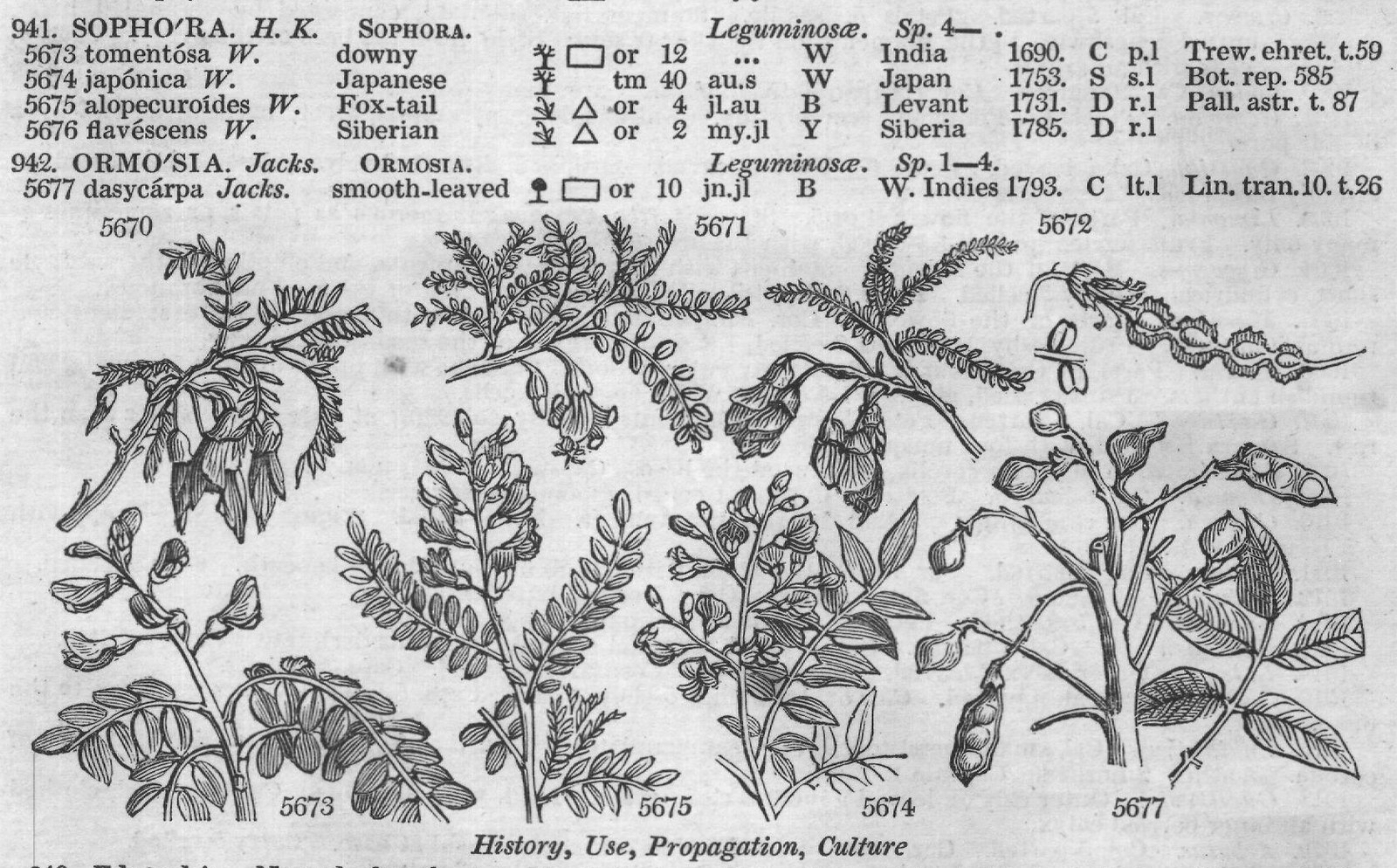
MONOGYNIA. 5670 Leaflets 13-19 lanceolate oblong 5671 Leaflets 8-10 lines long obovate, Pubescence yellowish brown 5672 Leaflets 25-41 obovate 5673 A tree, Leaflets roundish or oval very obtuse at each end as well as the calyx downy 5674 A tree, Leaflets oblong ovate acute and pods smooth 5675 Herbaceous, Leaflets oblong when full-grown silky above 5676 Herbaceous, Leaflets ovate-oblong smoothish 5677 Leaflets 9-11 acuminate smooth on each side, Pods downy 5708 5689 5690 and Miscellaneous Particulars. 941. Sophora. An alteration of the Arabic name Sophera. This genus has been much altered from what it formerly was. It now consists chiefly of fine trees, some of which are hardy. 942. Örmosia. From oρμoς, a necklace, for making which the handsome seeds, red with a black-eye, of the species are well adapted. The kind cultivated in England is exceedingly rare. Z3 DECANDRIA MONOGYNIA.
CLASS X. 943. ANAGY'RIS. W.
BEAN-TREFOIL.
Leguminosæ. Sp. 3. 5678 fœtida W. stinking ☐ or 9 ap.my Y 5679 latifólia W.en. broad-leaved 5680 índica Wall.
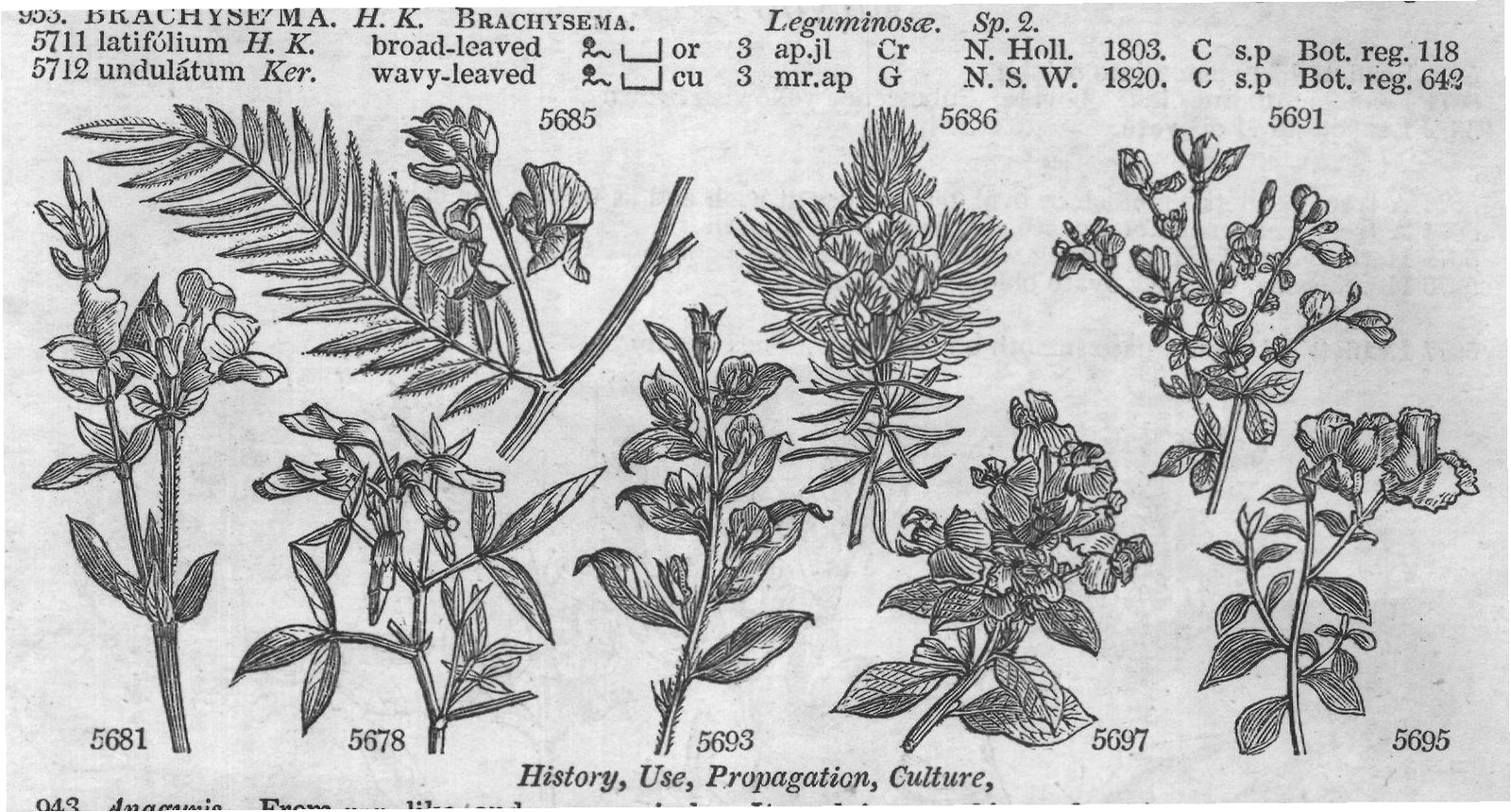
Nepal or 10 ap.my Y or 8 jl Spain 1570. C p.1 Teneriffe 1815. C p.l Bot. cab. 740 Y Nepal 1821. S. p.1 Hook ex. fl. 131 Baptísia nepalénsis Hook. 944. THERMOP'SIS. R. Br. THERMOPSIS. 5681 lanceoláta R. Br. sharp-leaved Apr 1 jn.jl Podalýria lupinoides W.
Leguminosæ. Sp.1-3.
Y Siberia 1776. D lt.l Bot. mag. 1389 945. VIRGILIA. Lam. VIRGILIA.
Leguminosæ. Sp. 4-7. 5682 lútea Ph. yellow-flower'dor 15 jn.jl Y N. Amer. 1812. C p.1 5683 aúrea H. K. 5684 intrúsa H. K. great-flowered or 6 jl small-flowered or Y my.au Y.w Abyssinia 1777. C p.l C. G. H. 1790. C p.l Mich. arb. c. ic.
L'H.st. no.1.t.75 5685 capensis H. K. vetch-leaved or 2 jl.au W C. G. H. 1767. C p.1 Bot. mag. 1590 946. CYCLO'PIA. R. Br. CYCLOPIA.
Leguminosæ. Sp. 1-2. 5686 genistoídes H. K. Genista-leaved or 2 jlau Y C. G. H. 1787. C p.l Bot. mag. 1259 947. BAPTISIA. R. Br. BAPTISIA.
Leguminosæ. Sp. 5-7. 5687 perfoliáta H. K. perfoliate Apr 3 au Y 5688 villósa Ph. villous or 2 jn.jl Y Carolina 1732. D c N. Amer. 1811. D c D.elt. t. 102. f. 122 5689 austrális H. K. blue-flowered or 4 jn.jl B 5690 álba H. K. white-flowered Aor 2 jn.jl W N. Amer. 1758. D c N. Amer. 1724. D c Bot. mag. 509 Bot. mag. 1177 5691 tinctória H. K. dyer's or 1 jl.au Y N. Amer. 1759. D c Bot. mag. 1099 948. PODALY'RIA. R. Br. PODALYRIA.
Leguminosæ. Sp. 10-13. 5692 myrtillifólia W.
Myrtle-leaved or 6 ap.jl Pu C. G. H. 1795. C p.1 5693 serícea H. K. silky or 6 ja.o Pu C. G. H. 1778. C p.1 Bot. mag. 1923 5694 cuneifólia V. wedge-leaved or 6 my.au W C. G. H. 1804. C p.1