Home › U › Urticeæ (Sp ag jn au Y Britain hed D r)
Urticeæ (Sp ag jn au Y Britain hed D r)
Sp. 1. ag 15 jn.au Y Britain hed. D r.m Eng. bot. 427 ...
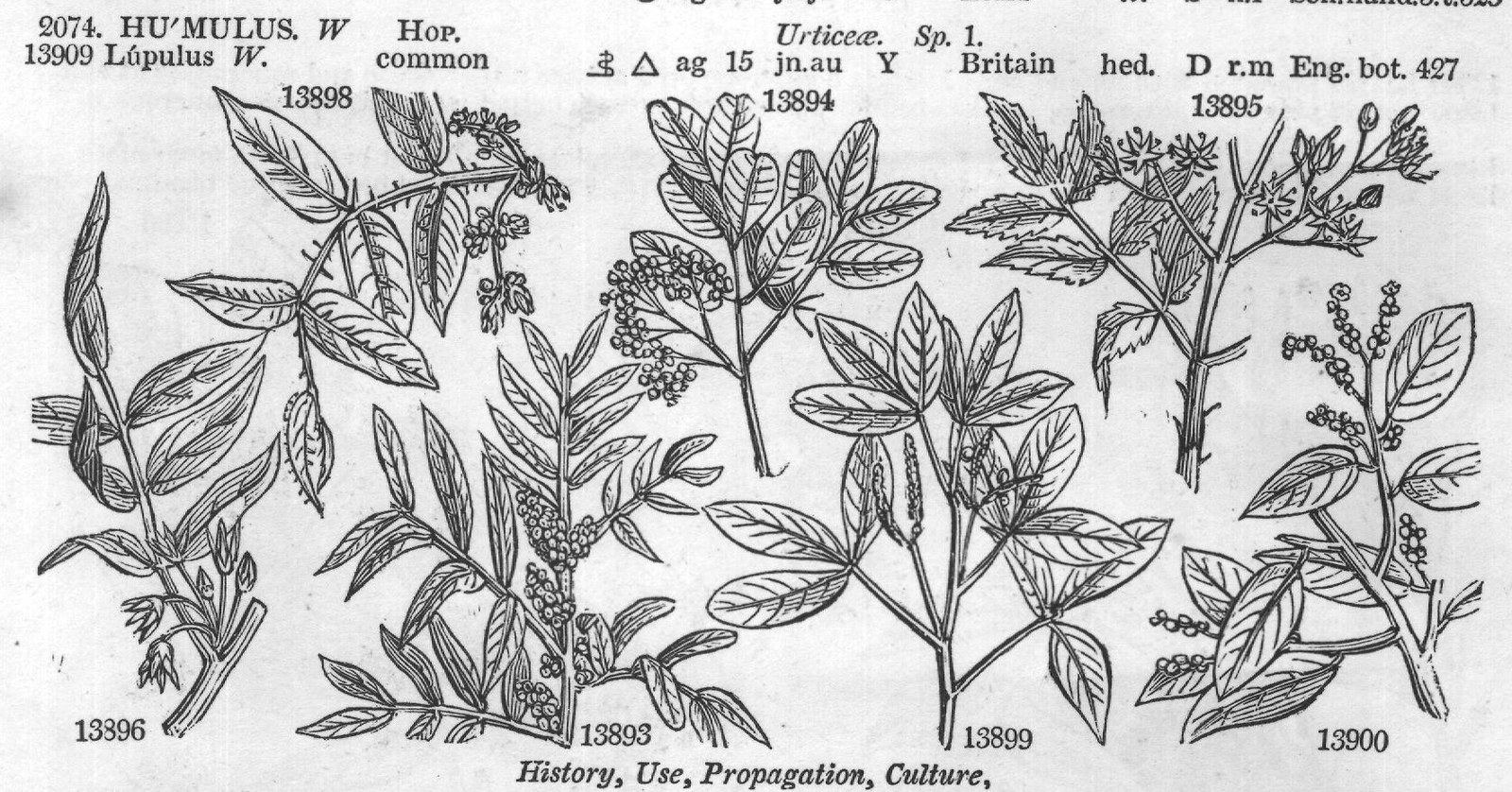
Sh.l Sch.hand.3.t.325 13898 13894 13895 13896 13893 13899 13900 History, Use, Propagation, Culture, to run down to the ground, and after they are concreted they are collected for use. These incisions are made at the beginning of August, when the weather is very dry, and are continued till the end of September. Turpentine and mastick are considered as astringent and diuretic; but though they retain a place in our Materia Medica, they are not much used by modern practitioners. Mastick is used by the Turkish and Armenian women as a masticatory for cleaning the teeth and giving an agreeable smell to the breath. It is also employed to fill the cavities of carious teeth. (Thom. Lond. Disp. 444.) 2066. Xanthoxylum. From ξavθoς, yellow, and ξuλov, wood. X. Clava-Herculis is esteemed a good timber tree in Jamaica; and an infusion of the leaves is used to cure the tooth-ach there and in Carolina. All the species may be increased by ripened cuttings, or by cuttings of the roots. 2067. Picramnia. From πiκρoς, bitter. A small tree with fruit the size of a gooseberry, and pinnate leaves; the whole plant abounding in the bitter principle. Large cuttings strike freely in sand under a hand-glass. 2068. Antidesma. So called from the use of the bark in making ropes ; from avτi, like, and δεσμoς, a bond. A. alexiteria is a middle-sized evergreen tree, with leaves resembling those of the lemon, and fruit in racemes, red and acid like the barberry. A decoction of the leaves is reputed to be an antidote against the bite of serpents, and the bark is used for making ropes. All the species require a rich loamy soil, and ripened cuttings with their leaves on root in sand in a moist heat. 2069. Iresine. Suppliants were accustomed among the Greeks to present themselves before the altar with a branch of olive bound with wool, which offering they called εiρεσiovη; whence this plant, which is very like such a branch, on account of its close clusters of woolly flowers, has been named. Herbaceous plants not of great beauty. 2070. Spinacia. From spina, a prickle, on account of the processes of the seed. A well known annual esculent of the easiest culture in any rich soil. 2071. Fluggea. Named by Willdenow, in honor of - Flügge, a German Cryptogamic botanist. A shrub with round ash-colored spiny branches. The spines are from one and a half to three inches long, very strong and numerous, whitish, and covered with leaves. 2072. Acnida. From a, privative, and κviδη, a Greek name of the nettle; that is to say, a nettle-like plant, which does not sting. does not sting. 2073. Cannabis. According to Bullet, this name is taken from the Celtic can, a reed, and ab, small. But Golius says, the plant has been known by the Arabs from time immemorial under the name of qaneb. The hemp is a manufactorial plant of equal antiquity with the flax. It grows to a great height on rich soils under a warm climate; in some parts of Italy it has been found eighteen feet high (Cruds. Agr.); the common height in Lombardy and the Bolognese territory is twelve feet; in this country it seldom exceeds six feet, and the fibre of British hemp is no finer than where it is three times the length. The culture, management, and uses of hemp are nearly the same as those of flax; but the male and female flowers being on different plants, and the male plant decaying long before the female, the former requires to be pulled up as soon as the setting of the seed in the females shews that they have effected their purpose. Hemp is sown on well prepared ORDER V.
DIECIA PENTANDRIA. 13893 Leaves abruptly pinnate, Leaflets lanceolate about 8, Petiole winged 13894 Unarmed, Leaves pinnate of 2 or 3 pair, Leaflets ovate emarginate villous, Racemes terminal 13895 Prickly, Leaves pinnate of 4 pair, Leaflets ovate repand-toothed unequal at base sessile, Panicles terminal 13896 Lvs. pinn. with an odd one of 4-5 pair, Leaff. ov. obsoletely serrul. equal at base, Petiol, rounded unarmed 13897 Lvs. pinn. with odd 1 of 3-5 pair, Leaf. stalkl. obl. oval acum. serrul.obliq. at base, Petiol. and branch. prickly 13898 Branches petioles and ribs prickly, Leaves pinnate with an odd one of 2-3 pairs, Leaflets oblong shining with remote glandular crenatures 13899 Racemes filiform pendulous, Flowers triandrous, Styles 2 recurved 13900 Lvs. obl. narrowed at base acumin. at end smooth shining on each side, Racemes axillary twin or solitary 13901 Lvs. roundish ellipt. rounded at each end retuse emarginate at point downy beneath, Racem. term. panicled 13902 Leaves dotted scabrous: lower oblong acuminate; upper ovate-lanceolate, Panicle branched compact 13903 Leaves ovate-oblong acute, Panicle erect, Branches simple, Stem furrowed 13904 Leaves ovate smooth cuspidate, Panicle diffuse branched, Stem furrowed 13905 Leaves sagittate, Fruit sessile 13906 The only species. Leaves alternate orbic ovate entire smooth, Spines 2 or 3 inches long 13907 Leaves lanceolate, Capsules smoothish acutangular 13908 The only species 13909 The only species 13905 13903 13908 13902 13906 13907 and Miscellaneous Particulars. 13909 loamy soil about the end of April: the male plants are generally pulled about the beginning of July, and the females four or five weeks after them, when they have ripened their seeds. The plants being tied in bundles, are watered and bleached, in the same manner as flax; or they are dried and stacked without having gone through this process, and the fibres separated when wanted by the flax-breaking machine of recent invention, or by steeping in hot water and soft soap. The produce of hemp in fibre varies from three to six hundred weight per acre; in seed, from eleven to twelve bushels. The fibre produces a cloth stronger than that from flax, and the best of all cordage and ropes. An oil is extracted from the seeds of hemp, which is used in cookery in Russia, and in this country by painters. The seeds themselves are reckoned a good food for poultry, and are supposed to occasion hens to lay a greater quantity of eggs. Small birds in general are very fond of them, but they should be given to caged birds with caution, and mixed with other seeds. A very singular effect is recorded, on very good authority, to have been sometimes produced by feeding bullfinches and goldfinches on hemp-seed alone, or in too great quantity; viz, that of changing the red and yellow on these birds to a total blackness. (Ency. of Agr. 5327.) 2074. Humulus. From humus, fresh earth; the hop grows only in rich soils. Our English word hop, seems to be the Anglo-Saxon hoppan, to climb. Lupulus is a contraction of Lupus salictarius, the name by which it was, according to Pliny, formerly called, because it grew among the willows, to which, by twining round and choking up, it proved as destructive as the wolf to the flock. The hop has been cultivated in Europe an unknown length of time for its flowers, which are used for preserving beer. Its culture was introduced from Flanders in the reign of Henry VIII., though indigenous both in Scotland and Ireland: it is little cultivated in those countries, owing to the humidity of their autumnal season. Like other plants of this sort, the hop bears its flowers on different individuals; the female plant, therefore, is alone cultivated. There are several varieties grown in Kent and Surrey under the names of Flemish, , Canterbury, Goldings, &c.; the first is the most hardy, differing little from the wild or hedge-hop; the Goldings is a very improved and highly productive variety, but more subject to the blight than the other. The hop prefers a deep loamy soil on a dry bottom a sheltered situation exposed to the south or south-west, but at , but at the same time not so confined as to prevent a free circulation of air. The soil requires to be well pulverized and manured previously to planting. In hop districts, the ground is generally trenched either with the plough or spade. The mode of planting is generally in rows, six feet apart, and the same distance in the row. Five, six, or seven plants are generally placed together in a circular form, and at a distance of five or six feet from each other. The plants or cuttings are procured from the most healthy of the old stools ; each should have two joints or buds ; from the one which is placed in the ground springs the root, and from the other the stalk. Some plant the cuttings at once where they are to remain, and by others they are nursed a year in a garden. An interval crop of beans or cabbages is generally taken the first year. Sometimes_ no poles are placed at the plants till the second year, and then only short ones of five or six feet. The third year the hop year the hop generally comes into full bearing, and then from four to six poles from fourteen to sixteen feet in length are placed to each hill. The most durable timber for poles is that of the Spanish chesnut, which is much grown 3 H 2 DIECIA PENTANDRIA.