Home › U › Umbelliferæ (Sp Cyn pium W common p jl s W)
Umbelliferæ (Sp Cyn pium W common p jl s W)
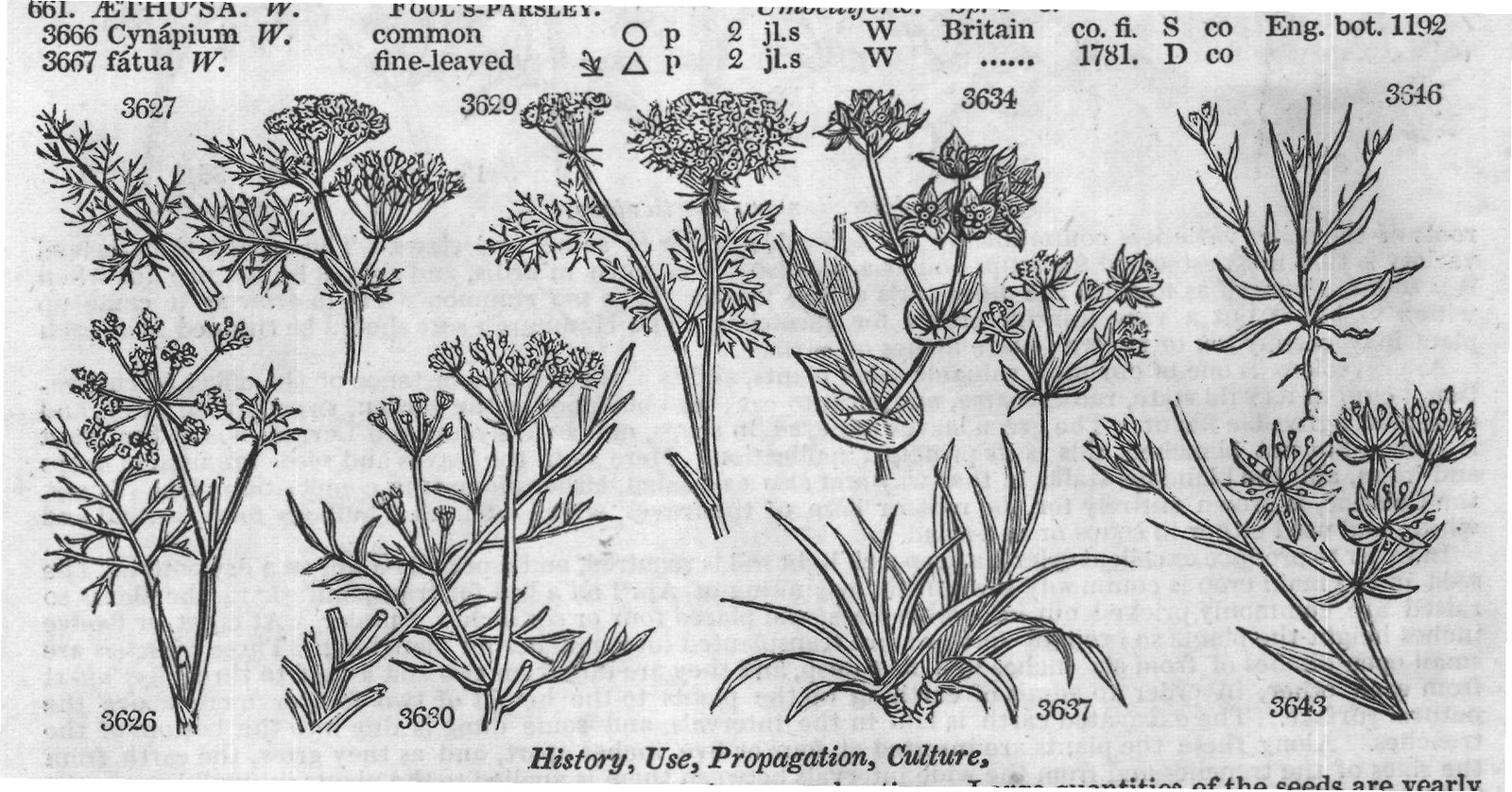
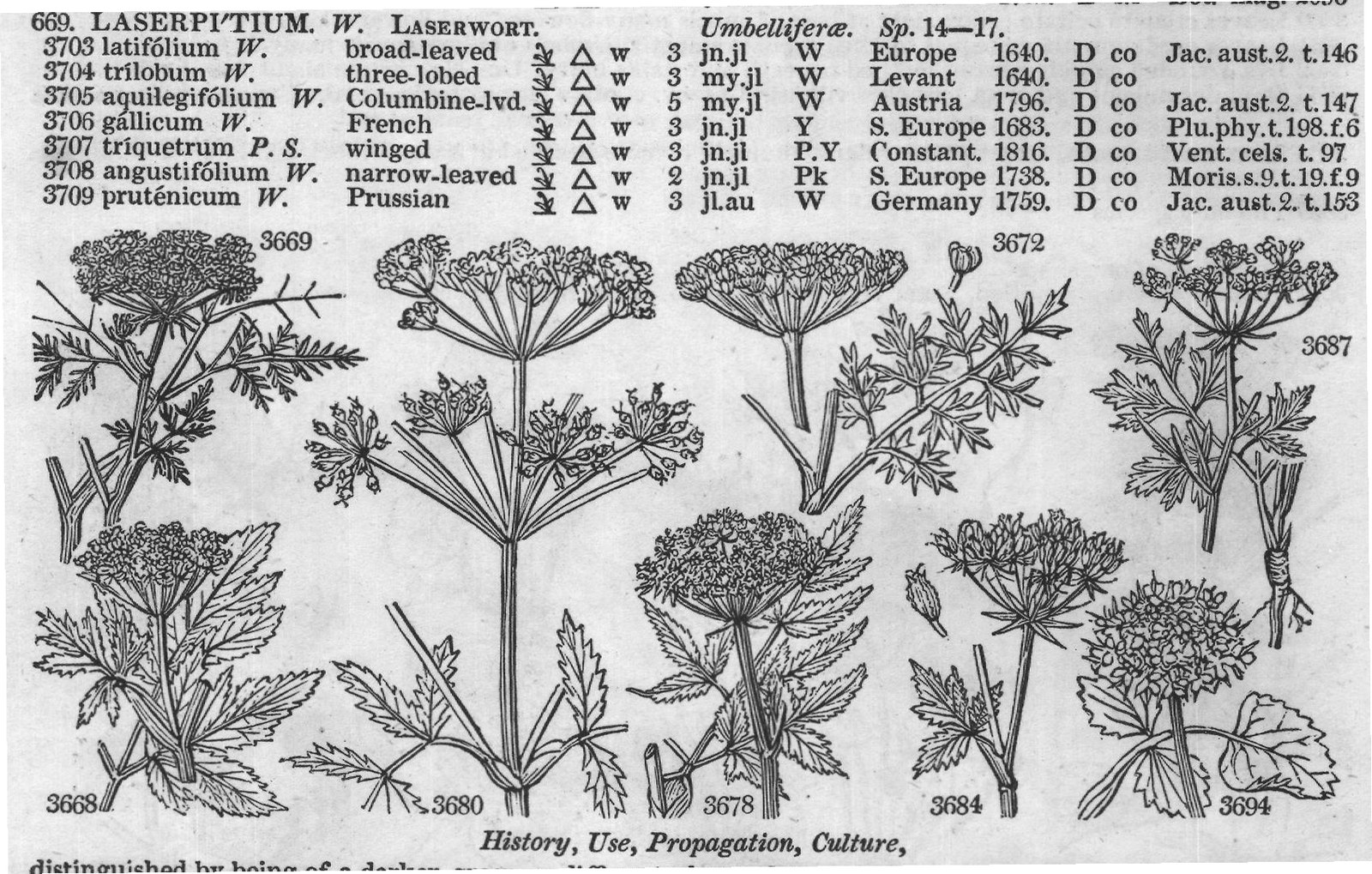
Sp. 2-3. 3666 Cynápium W. common p 2 jl.s W Britain 3667 fátua W. fine-leaved P 2 jl.s W ...... co. fi. S co Eng. bot. 1192 1781. D co 3627 3629. 3634 3646 3626 3630 3637 3643 History, Use, Propagation, Culture, 654. Anethum. From aiθω, to burn, the plant being very heating. Large quantities of the seeds are yearly imported into this country from the south of France. They are used in medicine as carminatives, and, as it is said, in the manufacture of the British gin. No one has succeeded in growing the plant for a crop in this country. 655. Carum. A native of Caria, according to Pliny, b. xix. c. 8. Carvi, Fr., Kümmel, Ger., and Carvi, Ital. C. Carvi is cultivated both in agriculture and horticulture in the former for its seeds, which are used to flavor cakes, to form sugar plums, to flavor spirits, and form a carminative distilled water. In the culinary art the leaves are sometimes used as an ingredient in salads, or as a pot herb, like parsley and the roots are said to be superior in flavor to those of the parsnip. 656. Cnidium. The ancient name of an herb, supposed to have been an Orach, and certainly having no affinity to the plants now called Cnidium. 657. Bupleurum. From ẞ8s, an ox, and πλεuρov, a rib. How applied is not apparent. These are plants remarkable among the Umbelliferous tribes for having simple leaves. ORDER II. 3623 Fruit compressed PENTANDRIA DIGYNIA. 3624 Cauline leaves three, Fruit oval 3625 Leaves supra-decompound, Umbel with 5-15 rays, Fruit obl. flat with three ribs at base 3626 Fruit ovate 3627 Stem branched, Sheaths of leaves ventricose, Common involucre O. 3628 Stem quite simple, Sheaths of leaves appressed, Common invol. many-leaved 3629 Umbels close, Comm. invol. reflexed, Seeds with 5 membranous ribs 3630 Leaves thrice pinnated, Pinnules distinct with a nerve lanceolate 3-lobed with an odd one 3631 Leaflets pinnatifid, Segm. trifid bluntish 3632 Leafstalks of the branches somewhat membranous loose entire, Lvs. supra-decom. Leaflets lanc. awned 3633 Leaves doubly pinnate Leaflets cut acute, Involucels bristly longer than the umbel 3634 Common involucres none, Leaves perfoliate 3635 Involucels joined together: the universal three-leaved 3636 Involucels about 5-leaved joined together, universal 5-leaved, Caul, leaves cord. lanc. stem-clasping 3637 Involucels 7-leaved; universal about 3-leaved, Radical leaves linear, Scape one-leaved 3638 Involucels 5-leaved orbicular; universal 3-leaved ovate, Leaves cord. lanc. stem-clasping 3639 Invol. 5-leaved roundish emarginate con.; universal 3-leav. cut at base, Lvs. lanc. cordate stem-clasping 3640 Involucels 5-leaved ovate; universal about 5-leaved, Leaves stem-clasping 3641 Involucels 5-leaved acute; universal about 5-leaved, Leaves lanceolate, Stem flexuose 3642 Stem branched leafy, Lvs. lin.-lanc. chan. nerved, Invol. 4-leaved uneq. very narrow shorter than umbel 3643 Involucels 5-leaved acute, universal 3-leaved, Central florets tallest, Branches divaricating 3644 Leaves lanceolate, Umbels terminal and axillary, Seeds rough 3645 Involucels 5-leaved lanceolate longer; universal 3-leaved, Leaves cauline lanceolate 3646 Umbels simple alternate 5-leaved about 3-flowered 3647 Stem erect branching, Lvs. lin. acum. Invol. 5-leaved, Involucels 5-leaved lin. subul. longer than umbel 3648 Stem erect panicled, Leaves linear, Involucr. 3-leaved as long as umbel, Involucels 5-leaved 3649 Stem branched leafless, Radical leaves decompound flat cut, Involucres and involucels lanceolate-oblong 3650 Leaves lanceolate obovate entire sessile 3651 Leaves lanceolate narrowed each way entire sessile 3652 Leaves linear, Involucre common and partial 3653 Lvs. peren. lanc. mucronate nerved, Flowering branches branched striated, Involucr. subulate appressed 3654 Branches of panicle sessile naked spiny, Leaves linear 3655 Vernal leaves decompound flat cut, Summer leaves filiform angular trifid 3656 Leaves peltate, Umbels 5-flowered 3657 Leaves orbicular reniform 5-7-lobed, Flowers capitate sessile, Peduncle shorter than petiole 3658 Leaves orbicular reniform 7-lobed crenated, Flowers in numerous heads on short stalks 3659 Root tuberous, Leaves peltate roundish lobed unequally crenate, Clusters subsessile few-flowered 3660 Leaves crenate peltate emarginate at base, Umbels many-flowered and flowers stalked 3661 Leaves cordate reniform equal toothed crenate smooth, Umbels axillary sessile many-flowered 3662 Lvs. rounded cordate repand toothed beneath and stalks hairy, Umbels capitate about 3-fl. Fruit netted 3663 Stem decumbent and erect branches villous, Lvs. ov. cordate cuspidate 3-nerved, Umbels axillary sessile 3664 Stem erect smooth, Leaves triangular acuminate crenate bearded at base, Umbels axillary spreading 3665 The only species 3666 Leaves all of one shape 3667 Leaflets verv fine whorled, Stem very leafy, Comm. invol. many-leaved 3651 3657 3656 3658 3664 3666 3665 and Miscellaneous Particulars. 658. Hydrocotyle. From ύδως, water, and κoτuλη, vessel ; its leaf is round and a little depressed in the centre, so as to hold a drop of water. This is a genus of aquatics and marsh plants of no great beauty, their flowers being obscure and of dull colors. H. vulgaris, the Wassernabel of the Germans, has been supposed to communicate the liver rot to sheep. This is a vulgar error, arising from the circumstance of the fluke or flounder insect (Fasciola hepatica) being found in marshes where this plant, and also the Drosera and Pinguicula, abound, as well as in sheep's livers. It is a known fact, however, that sheep never feed on any of these plants. 659. Spananthe. From σπavoς, rare, and avθoς, a flower, in allusion to the small number of flowers in the umbel. 660. Ulospermum. From δuλoς, curled, and σπερμa, seed, on account of the membranous curled ribs of the seed. A plant referred to Conium by Desfontaines, and to Cachrys by Sprengel, but very distinct from both. 661. Æthusa From aiθω, to burn, on account of its dangerous acridity. Æ. Cynapium (κuvoς aπiov, dogparsley) is a common weed in gardens, and sometimes mistaken for parsley; from which, however, it is easily PENTANDRIA DIGYNIA. 662. IMPERATORIA. W. MASTERWORT. 3668 Ostrúthium W. 663. SELI NUM. W. 3669 palústre W. common MILK-PARSLEY marsh 3670 montánum W. en. mountain 3671 austríacum W. 3672 Carvifólia W. 3673 Chabræ'i W.- 3674 Seguiéri W.