Monotropeæ
Sp. 2-4. 5911 uniflóra Mich. one-flowered cu 12 W 5912 Hypópithys W. common cu jn.jl W N. Amer. 1824. S s.p Britain woods. S s.p Hook. ex. fl. 85 Eng. bot. 69 1009. DIONEA. W.
DIONEA.
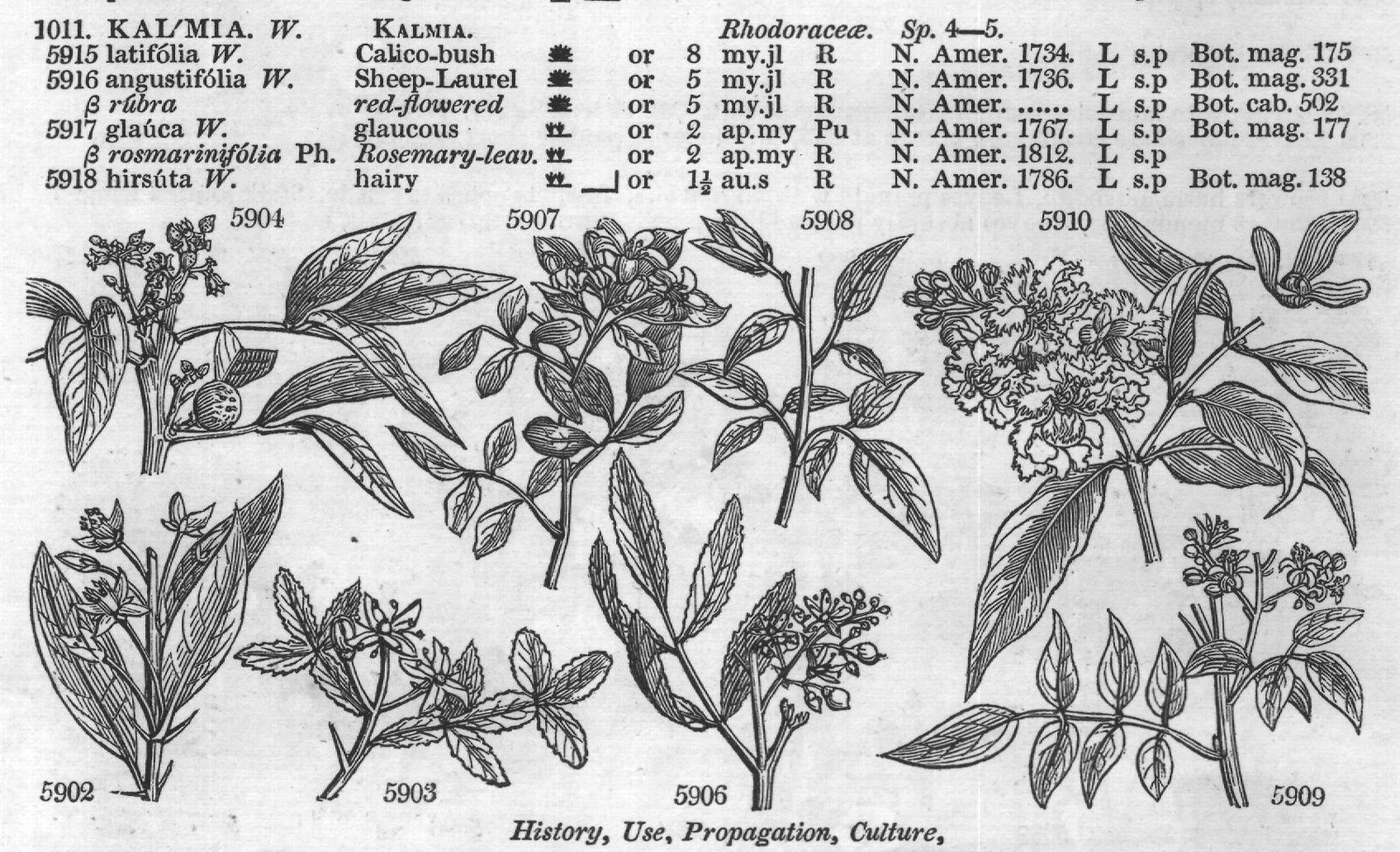
Droseraceæ. Sp. 1. 1010. GARU'GA. Rox. 5918 hirsúta W. 5904 5913 Muscípula W. 5914 pinnáta H. K. 1011. KAL/MIA. W. 5915 latifólia W. 5916 angustifólia W.
ẞrúbra 5917 glaúca W.
ẞ rosmarinifólia Ph.
KALMIA.
Calico-bush Sheep-Laurel red-flowered glaucous Rosemary-leav. hairy Venus's Flytrap cu jl.au W Carolina 1768. L s.p Bot. mag. 785 GARUGA.
Terebintaceæ. Sp. 1. winged-leaved or 20 ...
E. Indies 1808. S p.1 Rox. cor.3. t. 208 Rhodoraceæ.
Sp. 4-5. or 8 my.jl R N. Amer. 1734.
L s.p Bot. mag. 175 or 5 my.jl R N. Amer. 1736.
L s.p Bot. mag. 331 or 5 my.jl R N. Amer. ......
Ls.p Bot. cab. 502 or 2 ap.my Pu N. Amer. 1767.
L s.p Bot. mag. 177 or 2 ap.my R N. Amer. 1812.
L s.p 业 or 1½ au.s R N. Amer. 1786.
Ls.p Bot. mag. 138 5907 5908 5910 5902 5903 5906 5909 History, Use, Propagation, Culture, 1003. Limonia. The general denomination of the citron in Arabia is lymoùn, whence limon and lemon, to which fruits this genus is nearly related. L. monophylla is a small thorny tree, with a berry the size of a small nutmeg, very like a lime, and called by the Hindoos wild lime. Ripened cuttings of the species root in sand, under a hand-glass plunged in a moist heat. 1004. Glycosmis. From γλuκuς, sweet, and oσμη, smell; all the parts of the plant, leaves, flowers, fruit, having an agreeable perfume. G. pentaphylla is an elegant fragrant shrub, very common in most uncultivated lands in Coromandel, but chiefly under large trees, where birds have dropped the seeds. It flowers all the year there. The whole plant, when drying in the shade, diffuses a pleasant permanent scent; the flowers are exquisitely fragrant; birds eat the berries greedily. G. arborea has also very fragrant flowers.
G. citrifolia is a beautiful stove plant, not, indeed, remarkable for the shewiness of its flowers, but most valuable on account of its fruit, which is about the size of a hazel nut, very juicy and sweet, and produced in profusion in our stoves. 1005. Murraya. So named by Koenig, in honor of John Andrew Murray, knight of the Swedish order of Vasa, professor of medicine and botany at Gottingen, and an editor of Linnæus's Systema Vegetabilium. The species are trees of the smallest size, with dotted pinnated leaves and fragrant white flowers, quite like those of an orange. 1006. Cookia. Named by Sonnerat in honor of our celebrated Captain Cook. The fruit is much esteemed in China, where it arrives at the size of a pigeon's egg, growing in bunches, and it is called Wampee. It grows well in light loam, and ripened cuttings with their leaves on root in sand in a moist heat. 1007. Gærtnera. In memory of Joseph Gærtner, M. D. F. R. S. Acad. Imp. Petrop. Memb., author of a most excellent work on the fruits and seeds of plants, Stutg. 1788. It is a large climbing woody shrub, cultivated all over the coast of Coromandel, on account of the beauty and fragrance of its flowers. In the stove it requires a good deal of room to flower freely. It is easily increased in sand under a hand-glass. The genus is now referred to the natural order of Malpighiaceæ, among which it is remarkable for its white flowers. 1008. Monotropa. From μovoς, one, and τρεπω, to turn : its flowers are all turned one way. It is parasitical and without leaves, of a pale uniform hue, having a simple scaly stem; allied in habit to Orobanche, to some of the Orchis tribe in its peculiarity of scent, which is like that of primrose, or beans in blossom. The root is fibrous, much branched, and somewhat creeping, growing among dead leaves or in half decaying vegetable mould. Sir J. E. Smith says, he could never find it truly parasitical. In Sweden, Linnæus informs us, it is given dry to sheep affected with a cough.
Its natural affinity, which is certainly to the heath, Pyrola, and similar plants, is very singular and unexpected. ORDER I.
DECANDRIA MONOGYNIA. 5902 Leaves simple, Spines solitary 5908 Leaves pinnate, Leaflets oblong lanceolate crenulate, Spines solitary 5904 Leaves simple and 3-leaved, Leaflets ovate-oblong acuminate, Peduncles axillary shorter than stalk 5905 Leaves pinnate in 2 pairs, Leaflets elliptical entire 5906 Leaves pinnate in 2 pairs, Leaflets oblong obsoletely serrate 5907 Leaflets ovate, Peduncles many-fl. corymbose 5908 Leaflets ovate-acuminate, Pedunc. axill. and solitary 5909 Leaves ovate-lanceolate acuminate nearly equal at base 5910 Leaves pinnated, Leaflets ovate-lanceolate 5911 Large cernuous, Scales close together 5912 Flowers smooth lateral octandrous 5913 The only species 5914 The only species 5915 Leaves ovate-elliptical ternate and scattered, Corymbs terminal 5916 Leaves oblong, Corymbs axillary, Bractes linear-lanceolate, Pedunc, and calyx downy with glands 5917 Leaves opposite oblong polished beneath glaucous revolute at edge, Branches 2-edged ẞ Leaves linear more revolute green beneath 5918 Leaves alternate and opposite ovate-lanceolate and branches hairy, Pedunc. axill. 1-flowered 5912 5914 5913 5915 5911 5916 5917 5918 and Miscellaneous Particulars. 1009. Dionea. One of the names of Venus. It is a singular plant in respect of its leaves, which are of an anomalous form, and have a singular motion by which they catch insects, whence the specific an and not prolific in fibres. The leaves have the petiole winged as in the orange; the extreme part, or proper leaf, is the part that operates as a trap. Linnæus the leaf opens and permits it to escape.
This does not agree with Ellis's account, for he affirms that the lobes never open again, so long as the animal continues there. He thinks it probable, that a sweet liquor discharged by the red glands tempts the insect to its destruction. He adds, that if a straw or a pin be introduced between the lobes, they will grasp it as fas as if it were an insect. The flowers grow in a corymb resembling an umbel. It is rather difficult to preserve.
Sweet finds it "thrive best when planted in a pot of Sphagnum with a little mould at the bottom of the pot, and placed in a pan of water." Shepherd, of the Liverpool botanic garden, finds that leaves of Dionæa so placed will root and form new plants. In all cases it is necessary that an abundance of fresh cool air should be supplied to the plants. 1010. Garuga. Garugo is the Telinga name of the plant, which is rare in our stoves, although not of recent introduction. 1011. Kalmia. So named by Linnæus in honor of Peter Kalm, professor at Abo in Sweden, author of Travels in America. The species are beautiful peat earth shrubs, deserving a place in every American ground.
K. latifolia is a native of Carolina and other parts of North America, America, of Pennsylvania, New York, &c. but only in particular places; on rocks, hanging over rivulets, and on the sides of barren hills on the most sterile soil. The noxious qualities of this elegant shrub lessen that esteem which its beauty claims; for though deer feed on its green leaves with impunity, yet when cattle and sheep, by severe winters deprived of better feed, eat the leaves, many die annually. It blossoms in May, and continues in flower a great part of the feed, to be poisonous in the winter from its feeding upon the buds of this plant. But Wilson denies this statement. The Indians use a decoction of the leaves for purposes of self-destruction. A few drops of the tincture poured upon the body of a large and made of the powdered leaves has been used with much success in tænia capitis, and some other cutaneous affections. (See Bigelow's Medical Botany.) The wood, being very hard, is very useful in smaller works. The Indians are said to make small dishes, spoons, and other domestic utensils out of the roots: these are large, of a soft texture, and easily wrought when green; but when dry become hard and smooth. (Curtis.) K. angustifolia is also reputed poisonous to sheep and cattle. Aa3 DECANDRIA MONOGYNIA.
CLASS X. 1012. LEDUM. W.
LABRADOR. EA.
Rhodoraceæ. Sp. 3. 5919 palústre W.
B decúmbens 5920 latifólium W. marsh or 2 ap.my W Europe 1762.
Ls.p Bot. cab. 560 dwarf 业 or ap.my W Huds. Bay 1762.
L s.p broad-leaved or 3 ap.my W N. Amer. 1763.
L s.p Bot. cab. 584 5921 buxifólium W. box-leaved 业 or ap.my W N. Amer. 1736.
Ls.p Bot. reg. 531 Ammyrsine buxifolia Ph. 1013. RHODORA. W. RHODORA Rhodoraceæ. Sp. 1. 5922 canadénsis W.
Canadian or 3 ap.my Pu N. Amer. 1767. L p.l Bot. mag. 474 1014. RHODODENDRON. W. RHODODENDRON. 5923 ferrugíneum W. 5924 hirsútum W.
Rhodoraceæ.
Sp. 15-23. rusty-leaved or 1½ my.jl S Switzerl. 1752.
L s.p Bot. cab. 65 5925 daúricum W. hairy-leaved 业 Daurian or 1 my.jl S Switzerl. 1656.
Ls.p Bot. mag. 1853 or 3 mr.d Pu Siberia 1780. L s.p Bot. mag. 636 ẞ atrovirens dark-leaved or 3 f.ap Pu Siberia ...
Ls.p Bot. reg. 194 5926 camtcháticum W.
Kamtchatka or 2 Pu ...
Kamtsch. 1802.
Ls.p Pall. ross.1. t. 33 5927 chamæcistus W.
Thyme-leaved or 5328 caucásicum W.
Caucasian A or 1 au Pu Caucasus 1803. my.jn Pa.pu Austria 1786.
Ls.p Bot. mag. 1145 Cs.p Bot. mag. 488 5929 chrysánthum W. yellow 业 or jn.jl Y Siberia 1796.
Ls.p Par. lond. 80 5930 punctátum W. dotted-leaved or 4 jn.au Pk N. Amer. 1786.
Ls.p Bot. rep. 36 B major large dotted-lvd. or 6 jn.au Pk N. Amer. 1786.
Ls.p Bot. reg. 37 5931 máximum W. large 오 spl 20 jn.au Pk N. Amer. 1736.
L s.p Bot. mag. 951 ẞ álbum Ph. 2 purpúreum Ph. 5932 catawbiénse Ph. 5933 pónticum W.
B obtúsum myrtifólium 5934 arbóreum Sm. 5935 azaloídes Hort. 5936 hýbridum B. Reg. 1015. EPIGE'A. W. 5937 répens W. tree Catawba common obtuse myrtle-leaved tree white or 20 jn.au W N. Amer. 1811.
L s.p spl 25 jn.au Pu N. Amer. ...
L s.p or 4 jn.au Pu N. Amer. 1809.
Ls.p Bot. mag. 1671 spl 12 my.jn Pu spl 12 my.jn Pu Gibraltar 1763.
Ls.p Bot. mag. 650 Gibraltar 1763.
L s.p Dend. brit. 162 spl 12 my.jn Pu Gibraltar 1763.
L s.p Bot. cab. 908 spl 20 Pu ...
Nepal 1820.
L s.p Ex. bot. t. 6 Thompson's hy. spl 3 jn.au Pk .. ...
Ls.p Bot. rep. 379 Herbert's hybr. spl 3 jn.au Pk ...... ...
Ls.p Bot. reg. 195 EPIGEA.
Rhodoraceæ. Sp. 1. creeping pr jl.au W N. Amer. 1736. L s.p Bot. reg. 201 1016. ANDROMEDA.
W. ANDROMEDA.
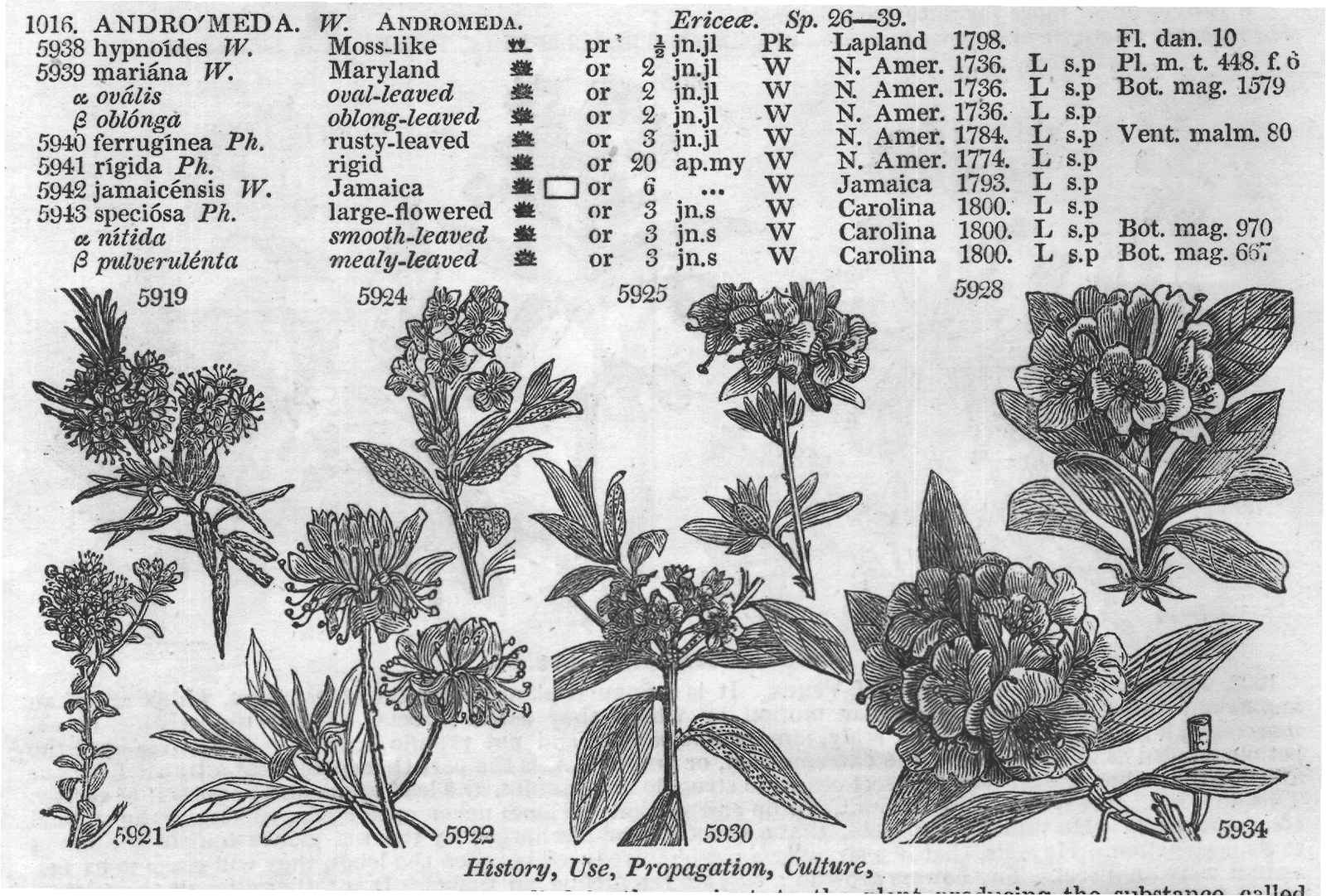
Ericeæ. Sp. 26-39. 5938 hypnoídes W.
Moss-like prjn.jl Pk Lapland 1798.
Fl. dan. 10 5939 mariána W.
Maryland or 2 jn.jl W N. Amer. 1736.
L s.p Pl. m. t. 448. f. ò a ovális oval-leaved or 2 jn.jl W N. Amer. 1736.
L s.p Bot. mag. 1579 B oblónga oblong-leaved or 2 jn.jl W N. Amer. 1736. L s.p 5940 ferrugínea Ph. rusty-leaved or 3 jn.jl W N. Amer. 1784. Ls.p Vent. malm. 80 5941 rígida Ph. rigid or 20 ap.my W N. Amer. 1774. L s.p 5942 jamaicénsis W.
Jamaica or 6 W ...
Jamaica 1793. L s.p 5943 speciósa Ph. large-flowered or 3 jn.s W Carolina 1800. L s.p a nítida smooth-leaved or 3 jn.s W Carolina 1800. L s.p Bot. mag. 970 B pulverulénta 5919 mealy-leaved or 3 jn.s W 5924 5925 Carolina 1800. L s.p Bot. mag. 667 5928 5921 5922 5930 History, Use, Propagation, Culture, 5934 name applied by the ancients to the plant producing the substance called name of Cistus Ledum. In foliage the Ledum of modern botanists agrees Pretty American plants, very commonly cultivated for the beauty of their 1012. Ledum. Ληδov was the Ladanum, and now known by the with the plant of the ancients. flowers. 1013. Rhodora. A name of the same meaning as Rhododendron. It is well known in shrubberies as remarkable for its purple flowers appearin appearing on the naked shoots before the leaves come out. 1014. Rhododendron. From ῥoδov, a rose, and δεvδρov, a tree, because the flowers resemble in color bunches of roses. Some of the species form beautiful and even splendid ornaments to the shrubbery or American ground; and all of them are interesting and deserving of culture. R. ferrugineum and hirsutum abound on the high mountains of Switzerland, Austria, Savoy, Piedmont, Dauphiné, and terminate ligneous vegetation as we ascend, and furnish the shepherds with their only fuel.
The grouse are said to eat them ; and the white hares sometimes gnaw the bark in hard weather but animals in hard weather; but animais do not seem to feed on them, except from want of other food; and they are suspected of being in a small degree poisonous. The galls of some small insect are frequent on them. R. dauricum is almost peculiar to the subalpine tracts of eastern Asia; it appears first at the mouth of the river Jenisea, and beyond that, especially from the river Uda, in the pine woods, it begins to be common; but about Baikal it is most abundant, and extends through the deserts of the Mongols to China and Tibet: at the Lena it becomes more rare, and beyond that it is much lower, with a more slender flower and narrower leaves. (Pallas.) R. Camtschaticum is an elegant evergreen under shrub; it grows abundantly in the peninsula of Kamtchatka and Behring's island in muddy places on the mountains. R. caucasicum is a native of the higher rocks of Caucasus, near the perpetual ice, in the highest range of shrubby vegetation, with Myrtillus and Vitis idæa.
R. chrysanthum is a beautiful evergreen, resembling R. dauricum, and like it is a native of the alpine regions of Siberia, where it is a noted remedy for rheumatism. It is cultivated in this country with the ORDER I.
DECANDRIA MONOGYNIA. 5919 Leaves linear revolute at edge beneath downy 5920 Leaves oblong revolute at edge beneath downy, Flowers about pentandrous 5921 Leaves ovate oblong flat smooth 5922 The only species 5923 Leaves smooth leprous beneath, Corolla funnel-shaped 5924 Leaves elliptical acute ciliated dotted beneath, Corolla funnel-shaped 5925 Leaves smooth dotted naked, Corolla rotate 5926 Leaves ciliate nerved, Corollas rotate, Calyxes leafy 5927 Leaves elliptical acute glandular ciliated naked, Cor. rotate, Petals obtuse 5928 Leaves scabrous rusty with down beneath, Umb. terminal, Cor. rotate, Petals roundish 5929 Leaves oblong scabrous beneath discolored smooth, Umbels terminal, Cor. rotate, Pet. obovate irregular 5930 Leaves oblong smooth beneath dotted with resin, Umbels terminal, Cor. funnel-formed 5931 Leaves oblong glabrous discolored beneath, Umb. terminal, Cor. rotate, Petals roundish ẞ Leaves cuneate-lanceolate flat Leaves larger oblong-elliptical flattish 5932 Leaves short oval rounded at each end smooth discolored beneath, Sepals elong. obl. Cor. campanulate 5933 Leaves oblong smooth: of the same color on both sides, Corymbs terminal, Cor. campan. rotate 5934 Leaves lanceolate acute silvery beneath, Flowers clustered campanulate, Calyxes woolly 5935 Leaves thin rugose lanceolate smooth subdeciduous 5936 Leaves oval coriaceous glaucous beneath 5937. Leaves cordate ovate entire, Cor. cylindrical 5938 Leaves imbricated subulate smooth, Pedunc. solitary terminal, Cor. globose-campanulate 5939 Pedunc. aggregate on the branches, Cor. ovate cylindrical, Leaves oblong-ovate entire deciduous 5940 Pedunc. aggregate axillary, Cor. globose, Leaves ellipt. entire beneath mealy scaly 5941 Arborescent, Lvs. coriaceous cuneate-lanc. acute entire with downy scales beneath, Fl.-stalks scurfy rusty 5942 Pedunc. aggregate, Cor. ovate transparent, Lvs. altern. broad lanc. obtuse entire cinereous beneath 5943 Pedunc. aggregate, Cor. globose campanulate, Leaves oval subserrate shining 5937 5931 5939 5932 5943 5933 5931 and Miscellaneous Particulars. greatest difficulty. The leaves have an austere, astringent, bitterish taste, and are stimulant, narcotic, and diaphoretic. When taken, they first increase the arterial action and the heat of the body, producing diaphoresis; and these effects, according to Dr. Home's observations, are followed by a proportional diminution of excitement, the pulse in one case having been reduced thirty-eight beats. It has not been much used in this country. (Thomson's London Dispensatory, 477.) R. maximum grows on rocks and in barren soils, where it continues flowering great part of the year, and is very ornamental.
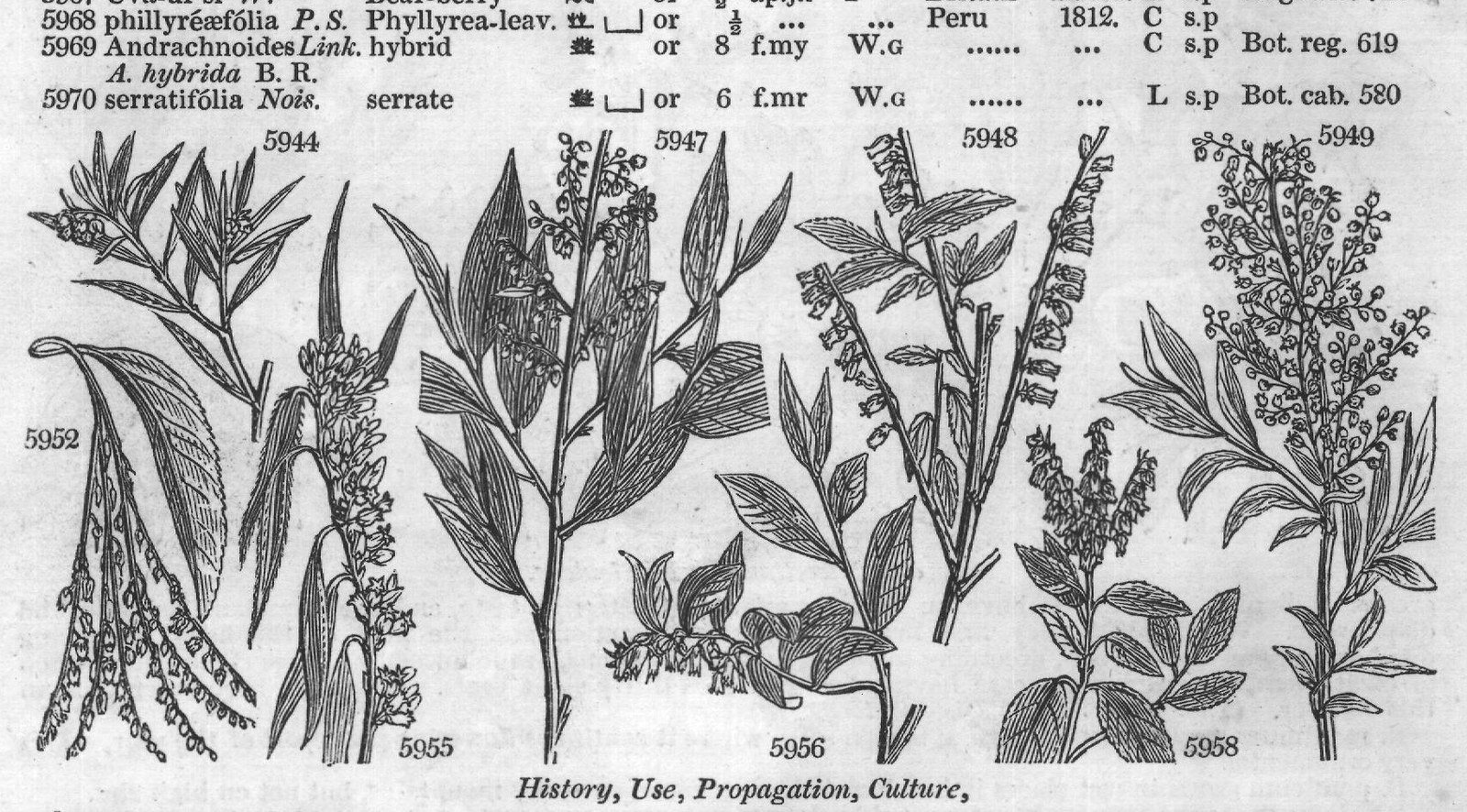
R. ponticum grows in wet places in beech and alder coppices, on rocky mountains, but not on high alps. Rhododendrons are commonly propagated by layers, but some sorts produce seeds, and seeds of others are obtained from America. The seeds " should be sown early in spring, in flat pans or pots of peat soil, and very thinly covered: they may then be set in a close frame, or at the front of a hothouse, till they come up, watering them slightly when dry; as soon as they are high enough to be laid hold of, they must be pricked out in other pots, which should be placed in a shady situation; they may stand in a frame a few days till they have taken fresh root, but they must not remain long, or it will spoil them. The small kinds may be propagated freely by cuttings, taken off in the young wood, and planted in sand, under a bell-glass." (Bot. Cult. 815.) 1015. Epigea. From επi, upon, and γη, the earth. The stem grows flat upon the ground, and throws out roots all the length of its branches. A very pretty little American plant with delicate white flowers. 1016. Andromeda. Named in allusion to the virgin Andromeda, who, like this plant, was confined in a marsh, and surrounded by monsters of the waters. For an ingenious explanation of this application, see Linnæus's Flora Lapponica. The species are neat little plants, and some of them considerable shrubs and trees. They all require peat earth, and a moist situation; for those of them which do not grow naturally in bogs are mostly inhabitants of alpine regions, where the air is always more moist than on plains. A. hypnoides has the appearance of a moss, spreads over great tracts of ground in the Lapland alps, and adorns them with its beautiful red flowers. The Andromeda is generally increased by layers, but may be also raised from seeds. "These must be very thinly covered, as they are small, and would rot if covered deep: a 4 $60 5944 polifólia W. a latifolia 18 média 2 angustifólia A. glaucophylla Lk. & subuláta 5945 japonica W. 5946 paniculáta Ph. 5947 salicifólia Wats. 5948 spicáta Wats. 5949 multiflóra Wats. 5950 críspa Link. 5951 frondósa Ph. 5952 arbórea W. 5953 racemósa W. 5954 Cateshæ'i W.
A. spinulosa Psh. 5955 axilláris W. longifólia 5956 coriácea W.
A. nitida Psh.
B rubra Lodd. 5957 acumináta W.
A. lucida Jacq.
A. populifólia Lam.
A. reticulata Walt.
A. laurína Mich. 5958 floribúnda Ph. 5959 calyculáta Ph. a ventricósa ẞ latifólia nana 5960 angustifólia Ph.
DECANDRIA MONOGYNIA.
CLASS X.
L s.p L s.p Ls.p P. ro. 2. t. 70.f.13 N. Amer.
Britain tur.bo. L s.p Eng. bot. 713 ...... ... ...
Japan 1806.
N. Amer. 1748.
W N. Amer. 1824.
W N. Amer. 1806.
WN. Amer. 1752.
W N. Amer. 1736.
WN. Amer. 1793.
Ls.p L s.p Th. jap. t. 22 Ls.p Dend. brit. 37 Ls.p Dend. brit. 38 Ls.p Dend. brit. 36 Ls.p Dend. brit. 128 L s.p L s.p S s.p Bot. mag. 905 S s.p Sk s.p Bot. mag. 1955 marsh Or 1 my.s Pk broad-leaved or 1 my.s Pk N.
Wild Rosemary or 1 my.s W narrow-leaved or 1 my.s Pk N. Amer. awl-leaved or 1 my.s Pk Japan or 3 W ... panicled or 3 my.jn W willow-leaved or 4 jn jn WN. Amer. ... spiked or 2 jn many-flowered or 2 jl W N. Amer.
WN. Amer. ... ... curled or 3 bristly-flowered or 3 my.jn Sorrel-tree 오 or 40 jl.s branching ft 3 jl Catesby's or 2 jn.jl or 1 my.au W N. Amer. 1765.
Sk s.p or 1 my.au W N. Amer. ...
Sk s.p thick-leaved or 2 jn.au Pk N. Amer. 1765.
L s.p Bot. mag. 2357 Bot. mag. 1095 or 3 jn.au R N. Amer.
Bot. cab. 672 or 3 au W N. Amer. 1765. Ls.p Ex. bot. 2. t. 89 axil-flowering long-leaved red-flowered acute-leaved Pipe or stem-w. many-flowered Box-leaved or 3 my.jn W N. Amer. 1812.
L s.p Bot. mag. 1566 or 1½ f.ap W N. Amer. 1748.
L s.p P. ro. 2. t. 72. f. 1 globe-flowered or 1 f.ap W Russia 1748.
L s.p Bot. mag. 1286 broad-leaved or 1 f.ap W