Home › E › Eng (Bot Retz obs t)
Eng (Bot Retz obs t)
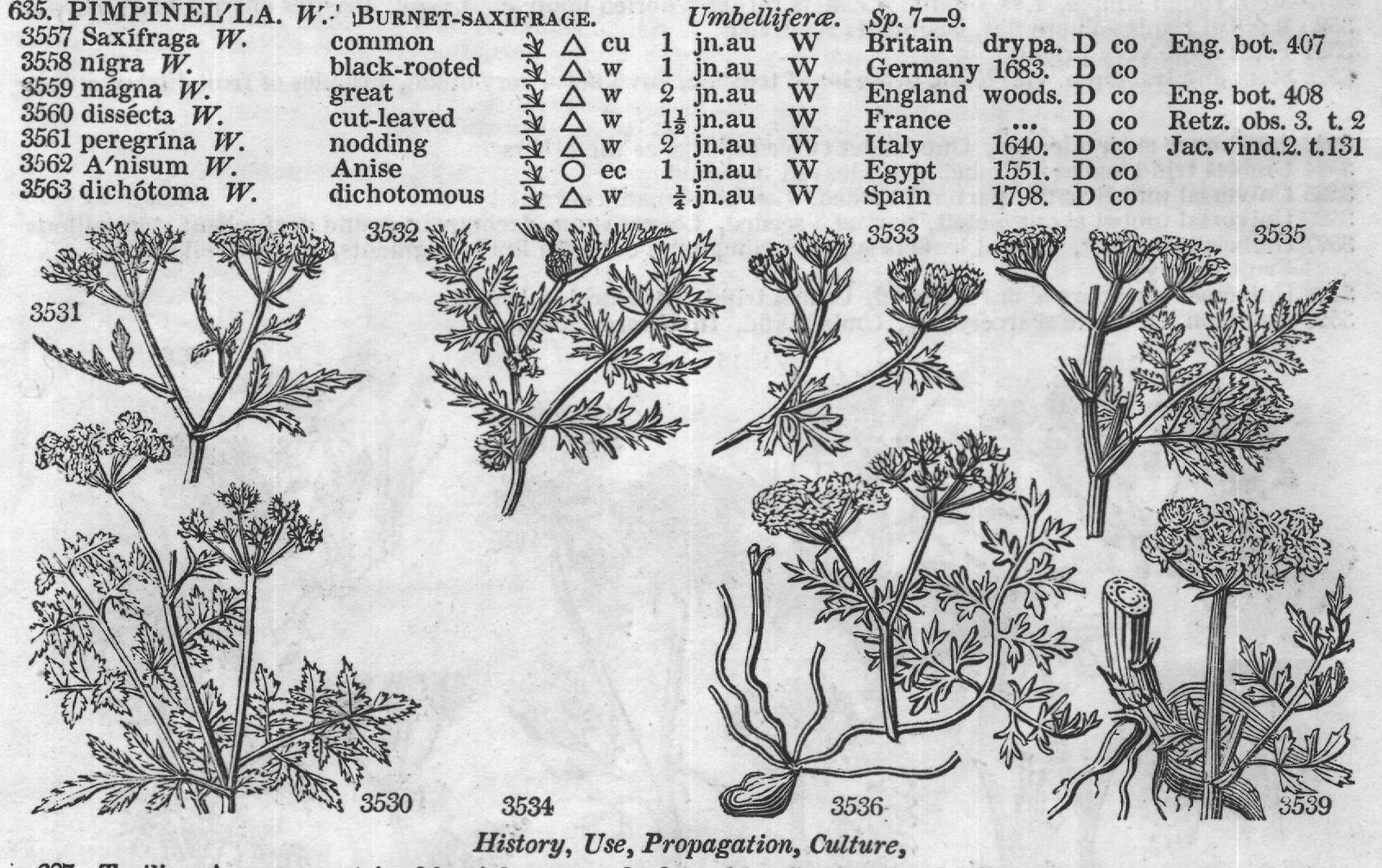
bot. 408 Retz. obs. 3. t. 2 ...
W ec 1 jn.au W Italy Egypt 1640. D co Jac. vind.2. t.131 1551. D co 3563 dichotoma W. dichotomous W jn.au W Spain 1798. D co 3532 3533 3535 3531 3530 3534 3536- 3539 History, Use, Propagation, Culture, 627. Torilis. A name contrived by Adanson and adopted by Gærtner, and other botanists. It probably, like many of Adanson's words, has no meaning. 628. Oliveria. Named in honor of G. A. Olivier, a French botanist, who travelled in the East. He published a splendid work on insects, by which he is better known than by his botanical merits. 629. Ledeburia. So named by Professor Link, after M. Ledebure, the author of a Catalogus Horti Dorpatensis, published in 1819; in which work this plant stands as Tragium tauricum. 630. Myrrhis. This plant has been long in cultivation. Formerly the young leaves were put into salads; and the roots were boiled and eaten cold, or in tarts, and in a variety of sauces, or candied. The seeds are put into soups in Germany, and in the north of England employed in polishing and perfuming oak floors and furniture. 631. Bunium. From βεvioς, a hill, because the plant grows in dry and elevated situations. Terre Noix, Fr., Erdnuss, Ger., Castagno di terra, Ital. The roots of B. Bulbocastanum are or used to be dug up and eaten raw by the poorer classes. They are farinaceous, sweet, and supposed to be very nourishing. Swine are very fond of them, and will soon become fat by feeding on them. 632. Enanthe. From oivη, a vine, and avθoς, a flower. The Enanthe, says Pliny, smells like the vine in flower, and it is from that that it takes its name. This genus, like most of the aquatic umbelliferæ, is chiefly poisonous. E. crocata is considered eminently so. The juice of the root or an infusion of the leaves is very efficacious in cutaneous diseases: in large doses it produces a fatal tetanus. The herb is applied in poultices to those ulcers that form in the cleft of the hoof of kine. ORDER II.
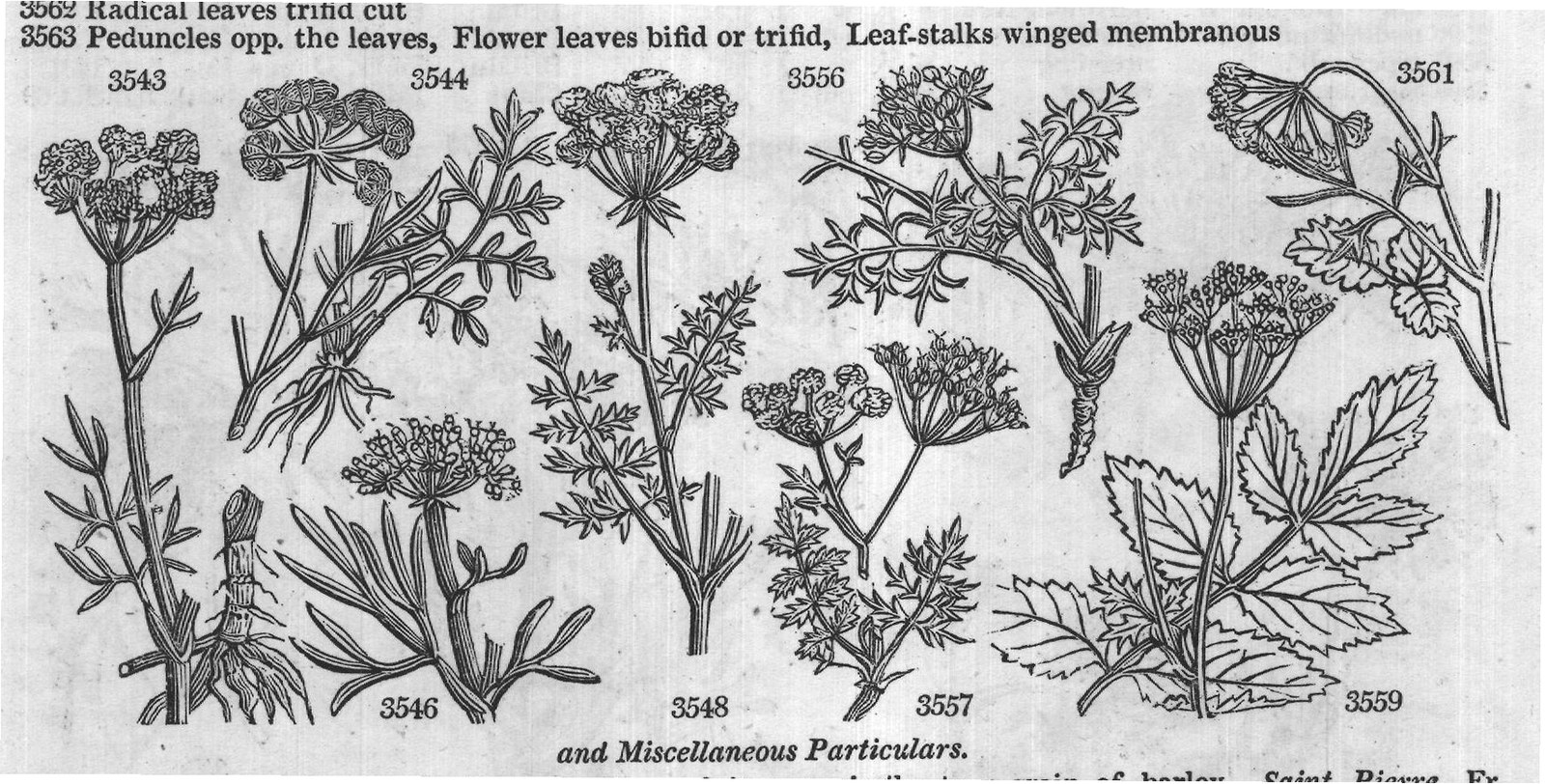
PENTANDRIA DIGYNIA. 3530 Involucres many-leaved, Seeds ovate, Styles reflexed, Leaves decompound, Outer leaflet lin. lanceolate 3531 Universal involucre scarcely any, Seeds ov. Styles reflexed, Leaves decompound, Stem much branched 3532 Umbels simple subsessile, Leaves supra-decompound 3533 Leaves pinnate, Leaflets sessile 3-5-cleft, Segm. 3-fid ciliated, Flowers fascicled villous 3534 Radical leaves pinnate, Pinnæ ovate serrated cut, The upper 3-pinnatifid with linear 3-forked segments 3535 Villous, Leaves ternate decompound, Leaves ovate lanceolate pinnatifid, Central fl. male 3536 Leaves uniform, Involucre many-leaved 3537 Seeds somewhat muricated, Peduncles furrowed, Leaflets channelled obtuse 3538 Stoloniferous, Cauline leaves with filiform fistulous pinnæ 3539 All the leaves many cut obtuse nearly equal 3540 Outside stalks of the umbels longest branched male 3541 Leaves bipinnate, Fruit globose 3542 Leaves bi-tripinnate; the upper pinnate, Leaflets wedge-shaped cut serrate striated 3543 Cauline leaves pinnate; radical bipinnate, Leaflets linear 3544 Radical leaves caudate split: cauline entire very long simple 3545 Lower pinnæ of the leaves ovate; upper linear, Stalks angular 3546 Leaflets lanceolate fleshy 3547 Leaflets wedge-shaped split (Tenoria, Spr.) 3548 Leaves bipinnate flat, Umbel hemispherical, Seeds hairy 3549 Leaves pinnate decussate cut angular, Seeds naked 3550 Leaves pinnate cut angular 3551 Leaves subpinnate, Leaflets imbricated downwards, Umbel lens-shaped 3552 Pubes. hoary, Lvs. supra-decompound, Leaflets wedge-shaped 4-toothed, Umbel with many rays globose 3553 Leaflets divaricating, Leaves thrice pinnate 3554 Lower leaves shining, First umbels subsessile, Seeds hairy 3555 Leaves capillary, Styles persistent erect, Seeds oblong hairy 3556 Leaflets linear flat hairy, Petals divided, Seeds oblong hairy 3 Leaves many-parted, Segm. linear rounded acuminated 3557 Stem furrowed smooth, Leaves pinnated smooth: radical roundish finely toothed; cauline linear 3558 Stem furrowed pubescent, Leaves pinnate pubescent: radical cordate cut obtuse toothed; cauline linear 3559 Leaves all alike pinnate, Leaflets lobed, the odd one 3-lobed 3560 Leaves pinnate, Pinnæ many-parted, Segments falcate acute 3561 Radical leaves pinnate crenate; upper wedge-shaped cut, Umbels nodding 3562 Radical leaves trifid cut 3563 Peduncles opp. the leaves, Flower leaves bifid or trifid, Leaf-stalks winged membranous 3543 3544 3546 3548 3556 3557 3561 3559 and Miscellaneous Particulars. 633. Crithmum. From κρiθη, barley. Its seed is very similar to a grain of barley. Saint Pierre, Fr., Meerfenchel, Ger., and Finochio marino, Ital. The C. maritimum is found on stone walls, as well as by the sea shore. The inhabitants, where it abounds, not only use it as a pickle, but as an ingredient in salads, and as a pot-herb. In the garden it may be grown on beds of sand and rubbish, or in pots. Braddick, an ingenious horticulturist, cultivated it at Thames Ditton, in a sheltered dry situation screened from* the morning sun he protected it by litter during winter, and in spring sprinkled the soil with a little powdered barilla. " This I do," says he, to furnish the plant with a supply of soda, since in its native place of growth it possesses the power of decomposing sea water, from which it takes the fossil alkali, and rejects the muriatic acid." With this treatment it flourished abundantly, producing an ample supply of leaves and shoots, which were cut twice in the season. (Hort. Trans. ii. 232.) 634. Athamanta. A plant found upon Mount Athamas in Thessaly, as some say; others, however, believe it to have been named after King Athamas, a king of Thebes, who first brought it into use. 635. Pimpinella. According to Linnæus, this name has been altered from bipennula, twice pinnate, in allusion to the leaves. P. saxifraga differs surprisingly in size and foliage in different situations, insomuch size and foliage in different situations, insoinuch that some make several species, as P. minor, major, and dissecta. The root is acrid, and used as a masticatory in tooth-ache, also externally to take away freckles, and in gargles to dissolve viscid mucus. P. anisum (ânysun, Arabic; Golius.) is cultivated in Malta and Spain, whence the seeds are annually imported into England for their use in medicine. They are aromatic and carminative, and yield an oil both by distillation and expression, which is much used in flatulencies, as are the seeds in substance. The oil is also P3 PENTANDRIA DIGYNIA.
CLASS V. 636. PHELLAN DRIUM. W. WATER-HEMLOCK.
Umbelliferæ. Sp. 1. 3564 aquáticum W. common OP 3 jn.jl W Britain rivul. Caq Eng. bot. 684 637. DON'DIA. Spreng. DONDIA.
Umbelliferæ. Sp. 1. 3565 Epipáctis Spr. yellow Apr mr.ap Y Alps 1823. D p.l Jacq. aust.5. t.11 638. TRACHYSPERMUM. Lk. TRACHYSPERMUM.
Umbelliferæ. Sp. 1. 3566 cop'ticum Spr.
Egyptian W 2 jn.jl W Egypt 1773. D co Jac. vind.2. t. 196 639. AM'MI. W.
AMMI.
Umbelliferæ. Sp. 4-8. 3567 Visnága W.
Carrot-like 3568 május W. great 3569 glaucifólium W. 3570 daucifólium W. glaucous-leav'd w Carrot-leaved 640. BU BON. W. 3571 macedónicum W. 3572 rígidum W.
ẞ gummiferum Sm. 3573 Galbanum W. 3574 lævigátum W. 3575 gummiferum W. 641. CUMINUM. W.
BUBON.
Macedonian stiff-leaved gummy Lovage-leaved smooth gum-bearing 0044 000]]] W 2 jn.au W S. Europe 1596. S co Gæ. de.fr. 1. t.107 W 2 jn.jl W 1½ jn.jl W S. Europe 1551. D co France 1816. D co Blackw. t. 447 W 2 jl.au P.Y Pyrenees 1734. D co Scop. carn. t. 10 Umbelliferæ.
Sp. 5-7. cu 2 jn.au P.Y Greece 1596. S co Blackw. t. 382 cu 3 jn.au Pk Sicily 1710. S co Bocc. mus. 2. t.76 cu 3 jls Pk Crimea 1804. S co Ex. bot. 120 m 6 jl.au Y.G C. G. H. 1596. S s.1 Bot. mag. 2489 ☐ cu 4 mr.d Y C. G. H. 1774. S s.l ec 7 jl P.Y C. G. H. 1731. S s.l Com. hort.2. t.58 CUMIN.
Umbelliferæ. Sp. 1. 3576 Cýminum W. common clt jn.jl W Egypt 1594. S co Cav. ic. 4. t. 360 642. SE SELI. W.
MEADOW SAXIFRAGE.
Umbelliferæ. Sp. 10-14. 3577 pimpinelloídes W. nodding-flow.
W 1 jl W 3578 leucospermum W.et K.woolly-headed W 1 jl W 3579 montánum W. mountain W 1 jn.jl W 3580 glaúcum W. glaucous W 2 jl.au W S. Europe 1796. D co Hungary 1805. D co Italy 1658. D co France 1759. D co 3581 ammoídes W.
Milfoil-leaved W jn.jl W 3582 tortuósum W. crooked W 10 W 3583 divaricátum Ph. shining-leaved or 1 jn.jl Y 3584 Hippomarathrum W.various-leaved W 2 jl Pu 3585 grácile W. en. slender W 1½ jn.jl Y 3586 elátum W. tall w 1 jl.au W 643. THAP'SIA. W.
DEADLY CARROT.
Umbelliferæ.
S. Europe 1759. S co S. Europe 1597. D co N. Amer. 1812. D co Austria 1656. D co Hungary 1805. D co Austria 1710. D co Sp. 4-9.
Pl. rar. hung. 80 Jac.vind. 2. t. 129 Jac. aust. 1. t. 144 Jac. vind. 1. t. 52 Bot. mag. 1742 Jac. aust.2. t.143 P.ra.hun.2. t.117 Gouan. ill.16. t.8 3587 villósa W. villous 3588 fœtida W. stinking A p 2 jn.jl Y 2 jl.au Y S. Europe 10.
Spain 1596. D s.l 3589 Asclépium W. oriental 3590 gargánica W.
Garganian cu 644. ACTINOTUS. Lab.
ACTINOTUS. 3591 Helianthi Lab.
Sun-flower cu 2 jl.au Y Levant Umbelliferæ. Sp. 1. cu 2 jn WN. Holl.
D s.l Moris.s.9 t.18.f.3 Moris.s.9.t.18.f.7 Moris.s.9.t. 18.f.9 2 jlau L.Y Barbary 1683.
D s.l Gouan.il. 18. t.10 1821. D s.1 Bot. reg. 654 645. TRI NIA. Hoffm.
TRINIA.
Umbelliferæ. Sp.2. 3592 Hoffman'ni Bieb.
Hoffmann's W my.jn W England rocks. D co Eng. bot. 1209 Pimpinella dioica E. Bot. 3593 Hennin'gii Bieb.
Henning's W jn.au W Hungary 1803.
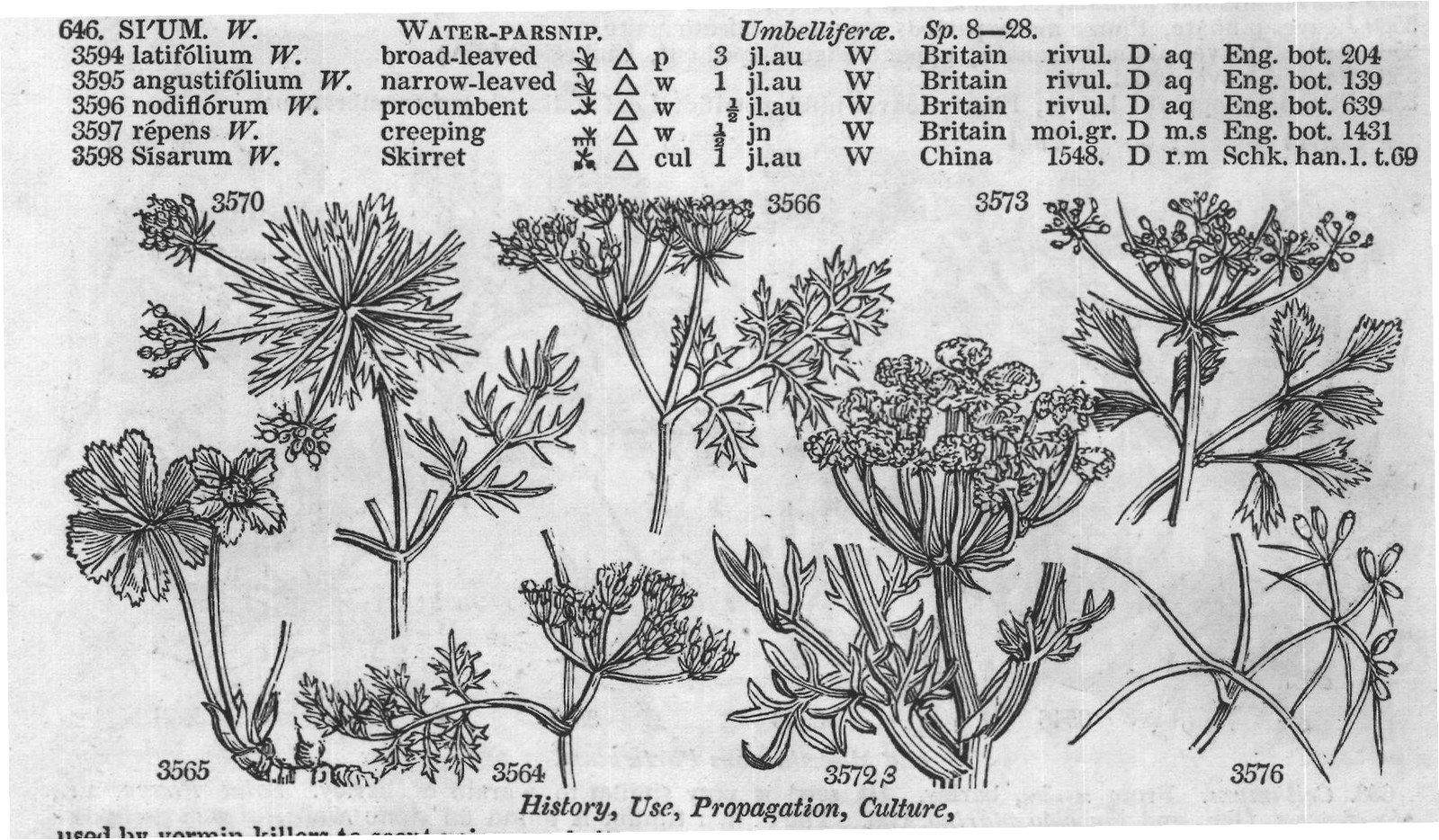
Pl.rar.hung. t.27 646. SI'UM. W.
WATER-PARSNIP.
Umbelliferæ.
Sp. 8-28. 3594 latifólium W. broad-leaved p 3 jl.au W Britain rivul. D'aq