Important: Safety Warning
This page prescribes plants as medicine according to pre-modern medical theory. Several of the plants named are toxic, correct identification is difficult, and the doses given have no scientific basis. Do not ingest or apply any preparation described here.
This page presents medical treatment from an era before modern medicine. The remedies described are ineffective against the conditions named, and some of the ingredients or doses are harmful. Do not use them to treat any illness; consult a qualified medical professional.
This information has been left in for historical purposes but should not be acted upon.
Home › E › Eng (Bot cu my jl P Y Candia D s l)
Eng (Bot cu my jl P Y Candia D s l)
bot. 230 cu 1 my.jl P.Y Candia 1731. D s.l or 1½ jn.jl D.Pu N. Amer. 1597. D s.1 Thápsia trifoliata W. 3615 aúreum W. golden cu 1 my.jn Y N. Amer. 1699. Dr.m 3616 integérrimum W. entire-leaved 1½ jn Y N. Amer. 1759. Dr.m 651. A'PIUM. W.
PARSLEY.
Umbelliferæ.
Sp. 2-5. 3618 gravéolens W. 3617 Petroselínum W. garden 652. ÆGOPODIUM. W. GOUT-WEED. cul 3 jn.jl L.Y Sardinia 1548. Sr.m Celery cul 4 jn.au W Britain ditch. S m.s Eng. bot. 1210 Umbelliferæ.
Sp. 1. 3619 Podagrária W. common W 2 my.jl W Britain sh. pl. D m.s Eng. bot. 940 653. MEUM. Jacq.
BAWD-MONEY.
Umbelliferæ.
Sp. 3-7. 3620 Búnius Jacq.
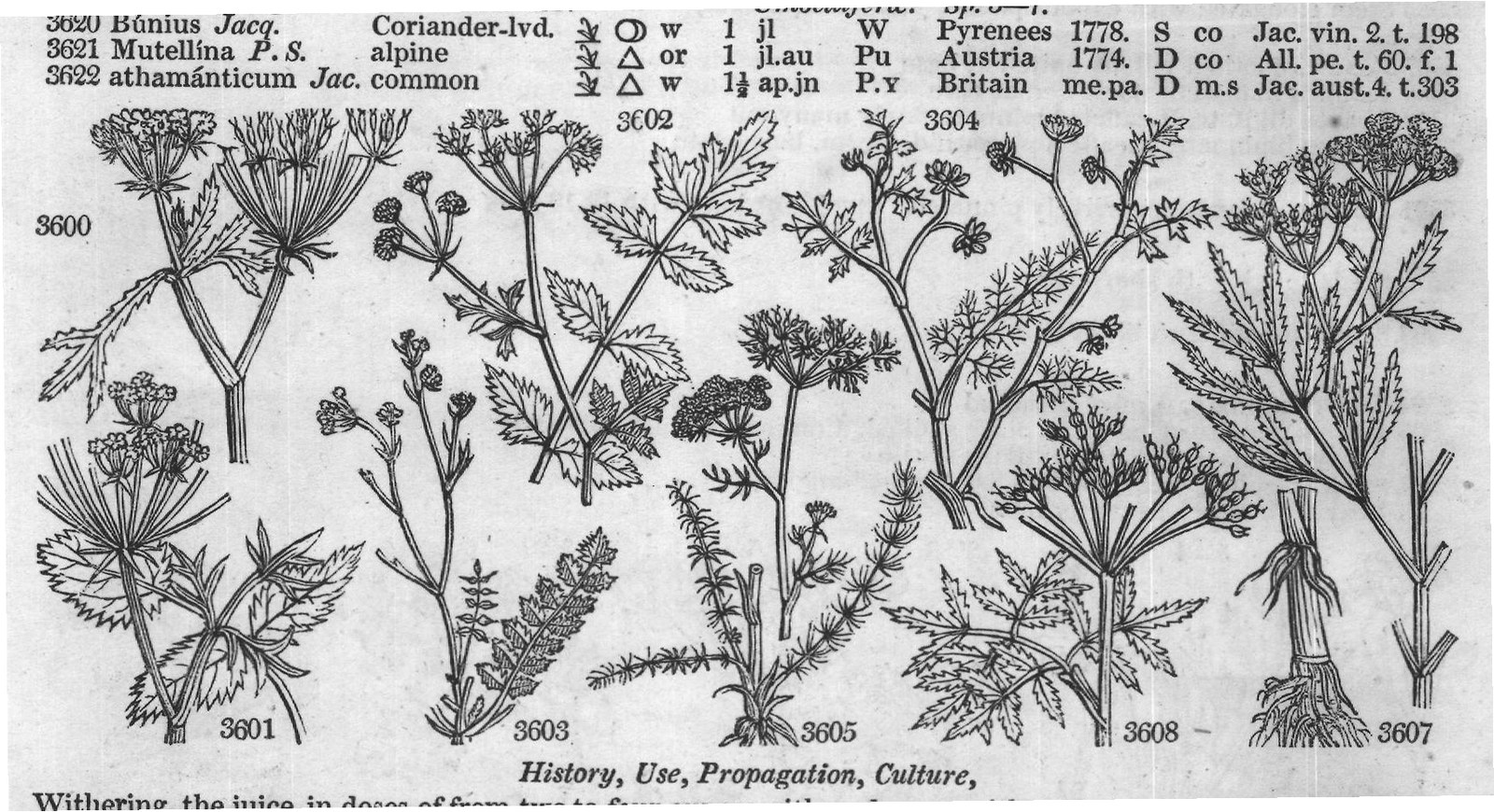
Coriander-lvd.w 1 jl W Pyrenees 1778. S co Jac. vin. 2. t. 198 3621 Mutellína P. S. alpine or 1 jl.au Pu Austria 1774. D co 3622 athamánticum Jac. common All. pe. t. 60. f. 1 W 1 ap.jn P.
Britain me.pa. D m.s Jac. aust. 4. t.303 3602 3604 3600 3601 3603 3605 3608 3607 History, Use, Propagation, Culture, Withering, the juice, in doses of from two to four ounces, either alone or with milk, every morning, is an excellent alterative in cutaneous diseases. S. sisarum (from Dgizer, its Arabic name, in which language it signifies carrot), Chervis, Fr., Zuckerwürtzel, Ger., and Sisaro, Ital., is cultivated for its roots or tubers, which, boiled and eaten with butter, are sweet and ., and Sisaro, Ital., is cultivated for its roots or tubers, which, boiled and eaten with butter, are sweet and agreeable. A crop may either be raised from seed or offsets; if from the former, sow in March or the beginning of April, and when the plants come up, whether in rows or broadcast, thin them, so as nine or ten square inches may be allowed to each plant. With the usual summer culture the roots will have attained their full size in September, and may be taken up as wanted for use. tance planting about the end of April, and giving the usual culture afterwards. In growing from offsets, allow about the same dis- 647. Sison. From the Celtic sizun, which signifies a running stream. Many of the plants grow in such situations. This genus is called Honewort, from its being used formerly to cure a swelling in the cheek called the Hone. 648. Cicuta. A word used by Virgil (Ecl. 2 and 5.), but of unknown meaning. C. virosa is poisonous to mankind and kine, but not to horses, sheep, or goats; the smell being weak in the spring, cows are apt to be killed by it, but afterwards the odour enables them to avoid it. C. maculata is used in medicine like Conium maculatum. 649. Conium. Said by Linnæus to be derived from KOVIS, powder, dust but the application of the term is not evident. C. maculatum is a well known poisonous plant, lately admitted into the Materia Medica. Acevident. C. maculatum is a well known poisonous plant, lately admitted into the Materia Medica. According to Linnæus, sheep eat the leaves, but horses, cows, and goats refuse them. Ray informs us, that the thrush will feed upon the seeds, even when corn is to be had. Curtis says hemlock is eaten by few or no insects. The dried fistulous stalks of this and several other umbelliferous plants are called by the country people kecksies. As a medicine, hemlock seems to act on the constitution in a great measure like opium. 650. Smyrnium. Σμuρva, is a synonym of μuρρa, myrrh. Its juice smells like myrrh, saith Pliny. Maceron, Fr., Smyrnerkraut, Ger., and Macerone, Ital. S. perfoliatum and olusatrum are or may be cultivated as , Smyrnerkraut, Ger., and Macerone, Ital. S. perfoliatum and olusatrum are or may be cultivated as Asparaginous and salad plants, though they are now almost entirely supplanted by the celery, which they somewhat resemble in flavour. The seeds are sown in March in rows two feet apart, and afterwards thinned out to six inches. As the plants advance, they are earthed up like celery, and, like it, are ready for use during autumn and winter. Olusatrum is from olus, pot-herb , and atrum, black, from the dark colour of its foliage. Our English name, Alexanders, is certainly a mere corruption of Olusatrum. 651. Apium. From apon, water, in Celtic; ; from the place where the plant grows. A. Petroselinum, (πετρa, stone, and selinum- Stone Selinum) Persil, Fr., Petersilie, Ger., and Petroselina, Ital., is a well known season- , and selinum - Stone Selinum) Persil, Fr., Petersilie, Ger., and Petroselina, Ital., is a well known seasoning herb, and it is also sown among pasture grasses as likely to counteract the liver rot in sheep. There is a variety called the Hamburgh or large rooted parsley, which is cultivated for its roots, which, as well as the ORDER II.
PENTANDRIA DIGYNIA. 3599 Leaves pinnate, Leaflets lanceolate nearly entire 3600 Leaves linear decurrent connate 3601 Radical leaves ternate; cauline bipinnate 3602 Leaves pinnate, Umbels erect 3603 Leaves pinnate, Umbels cernuous 3604 Creeping, Umbels bifid 3605 Leaflets whorled capillary 3606 Rad. lvs. compound, Leaflets whorled fascicled lanc. Stem leafless, Umbellif. branches dichotomous 3607 Umbels opp. to the leaves, Leaf-stalks edged obtuse 3608 Serratures of leaves mucronate, Leaf-stalks membranous two-lobed at end 3609 Seeds unarmed, Stem branched shining spotted 3610 Seeds muricated, Petioles and peduncles smooth 3611 Cauline leaves simple stem-clasping 3612 Cauline leaves ternate stalked serrate 3613 Cauline leaves wedge-shaped obtuse trifid toothed 3614 Radical leaves simple cordate crenate; cauline ternate serrate, Umbels terminal 3615 Leaves pinnate serrate, All the florets fertile 3616 Cauline leaves doubly ternate entire 3617 Cauline leaves linear with minute involucres 3618 Cauline leaves wedge-shaped 3619 Upper leaves ternate, Lower biternate sessile 3620 Stem diffuse branching, Radical leaves broad; cauline very narrow 3621 Stem simple, Sheaths of leafstalks dilated membranous, Leaflets multifid pinnatifid 3622 All the leaves very finely cut 3609 3629 3612 3618 3619 3612 3610 and Miscellaneous Particulars. roots of the other varieties, communicate an agreeable flavor to soups and stews. The curled thick-leaved variety is that most esteemed for soups and as a garnish : it is sown in drills, and should be thinned out when it is so far advanced as to shew the finer curls of the leaves. It is too commonly left to grow as it came up which makes it but a very inferior article for garnishes . The Hamburgh sort should be thinned so as each plant may occupy ten or twelve square inches of surface. A. graveolens is one of our most valuable salad plants, and is a remarkable instance of the effect of cultivation, being in its wild state, rank, coarse, and unfit to eat; and blanched in the garden, sweet, crisp, juicy, and , being in its wild state, rank, coarse, and unfit to eat ; and blanched in the garden, sweet, crisp, juicy, and of a most agreeable flavor. The green leaves are used in soups, and in Italy and the Levant, where the plant is grown, but not blanched, this is its principal application. Here both the leaves and seeds are used in soups and stews, and the blanched stalks in that way and also as a salad, either alone or in composition. One variety, the Celeriac, is grown entirely for the root or base of the leaves, which assumes a bulbous form, is solid and white, and used either in soups or as a salad.
In order to produce excellent celery, a deep rich light soil is required, and especially a soil on a dry bottom. The seed in the main crop is commonly sown in the beginning of April on a bed for transplantation the plants so in the main crop is commonly sown in the beginning of April on a bed for transplantation; the plants so raised are commonly pricked out into other beds, and placed four or six inches asunder. At eight or twelve inches height the plants so brought forward are transplanted into trenches for blanching. These trenches are small open ditches of from six inches to a foot deep, and they are dug from two and a half to three feet apart from each other, in order to admit of earthing up the plants to the height of two feet or more above the natural surface. The excavated earth is laid in the intervals , and some dung is dug into the bottom of the trenches. Along these the plants are inserted at four or five inches apart, and as they grow, the earth from the sides of the trenches and from the wide intervals between them is applied to the plants in small layers at a time, till at the end of the autumn the ditches have become banks two or three feet high. The celery is now fit to use, and by earlier and later crops this salad is had in perfection from August or September till May following. Cel Celery is grown to great perfection in Lancashire, where blanched stalks have been dug up four feet six inches long, and weighing nine or more pounds, of the best quality. A variety of modes of cultivating the celery are brought together in the Encyclopædia of Gardening, which well deserve the perusal of those who aim at growing this root in the best manner. 652. Ægopodium. From aiξ aiγoς, a goat, and πες, a foot. Each of the parts of the leaf is split so as to resemble the cloven foot of a goat. The leaves of E. Podagraria smell like those of Angelica, and may be eaten in spring salads. 653. Meum. From μεiov, very small, in allusion to the extreme delicacy of the leaves, which are as fine as hairs. 654. ANE/THUM. W. 3623 gravéolens W. common 3624 ségetum W.
Portugal 3625 Sówa Roxb.
Indian 3626 Fœnículum W.
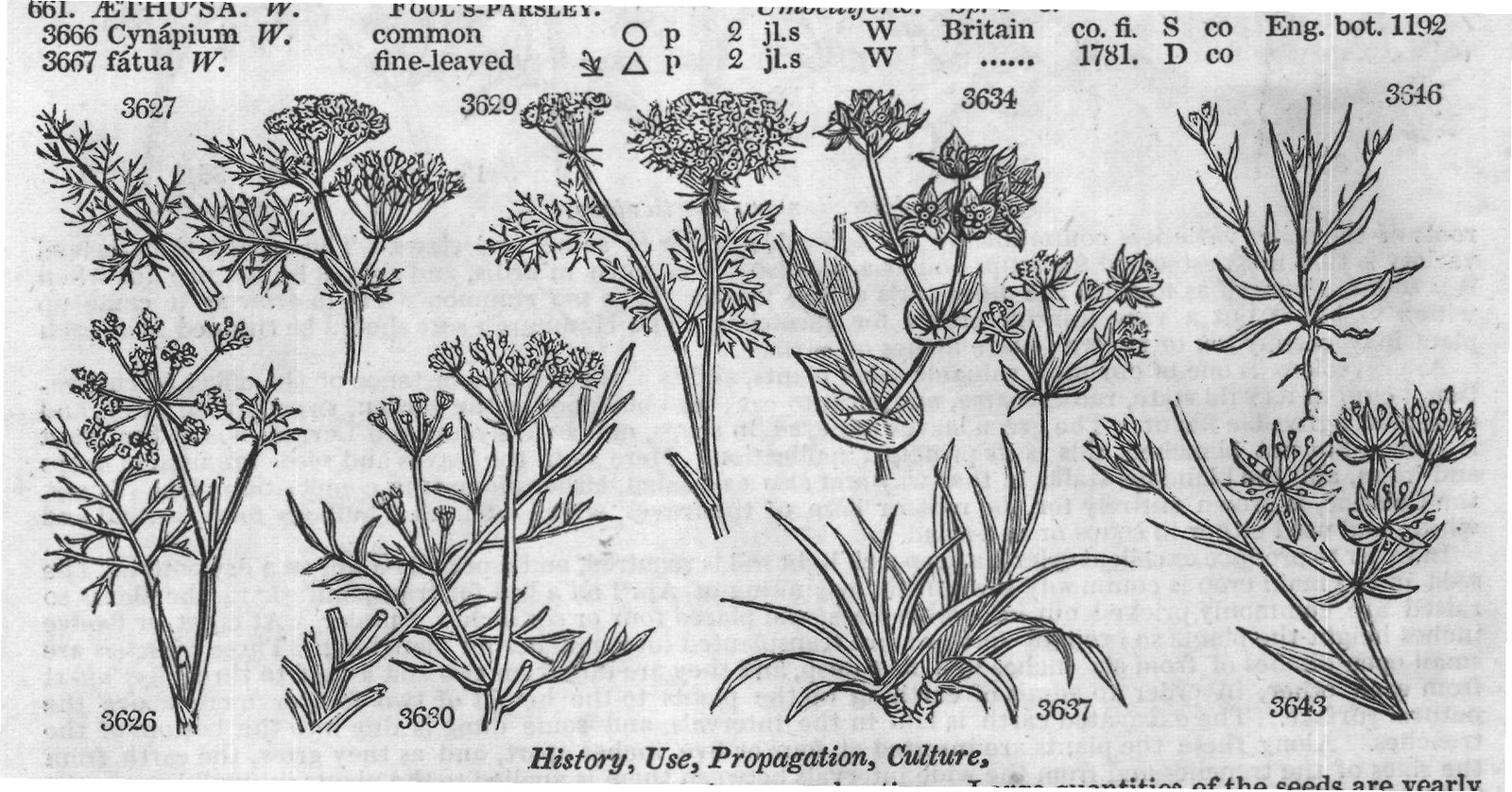
ẞ dulce 3630 Siláus W. 3631 alsáticum W. 655. CA'RUM. W. 3627 Cárui W. 3628 símplex W. 656. CNIDIUM. Cuss. 3629 Monniéri W.
Fennel Finochio CARAWAY. common simple-stalked CNIDIUM. annual meadow small-headed Umbelliferæ. clt 2 my.jn W W 1 my.jn W PENTANDRIA DIGYNIA.
Umbelliferæ. Sp. 4-5. cul 3 jn.jl Y Y Cw cul 6 jl.au Y cul 4 jl.au Y 00 Spain 1570. S r.m Portugal 1796. S co E. Indies 1810. S co CLASS V.
England ch. pl. S s.1 Eng. bot. 1208 Italy S s.l Britain me. pa. S s.1 Eng. bot. 1503 ...
Sp. 2.
Siberia 1816. S s.l Umbelliferæ.
Sp. 5-6.
W 1½ jl.au W S. Europe 1771. S co Jac. vind. 1. t. 62 W 2 jn.au Y England mea. D co