Euphorbiaceæ (II)
Sp. 1-2.
W 1979. ZIZA'NIA. W.
ZIZANIA. 13313 aquática H. K.
Canada Rice 1980. PHA'RUS. W. 13314 latifólius W.
PHARUS.
HEXANDRIA. ec لا Gramineæ.
Gramineæ.
Sp. 1-5. 6 jl.s G N. Amer. 1790. S co Lin. trans.7. t. 13 Sp. 1-3. broad-leaved or 6 jl.au G Jamaica 1793. S r.m Br. jam, t. 38. f.3 1981. GUETTAR'DA. 13315 speciósa W. 13316 rugósa W.
W. GUETTARDA. great-flowered Rubiaceæ.
Sp.2-17. spl 30 Sc ...
E. Indies 1771. S p.l rough-leaved 호 or 20 ... ...
W. Indies 1793. S r.m 1982. SA'GUS. W. 13317 Rúmphii W. 13318 Rúffia W. 13319 vinífera Hort. 1983. CO COS. W. 13320 nucífera W. 13321 aculeáta W. 13322 fusifórmis W.
SAGO PALM.
Palmæ. Sp. 3-4.
Rumphius's ☐ clt 50 G ...
E. Indies 1800.
Skr.m Ru.am.1. t. 17, 18 turbinate or CO G ...
Madagasc.1820.
Sr.m prickly or 50 G ...
Guinea 1820. Sr.m Bea. fl. d'Oware COCOA-NUT-TREE.
Palmæ. Sp. 3-11. common clt 50 ... prickly clt 50 ...
Great Macaw-tree clt 30 ...
Pa.G E. Indies 1690.
Pa.G W. Indies 1796.
Pa.G Jamaica 1731.
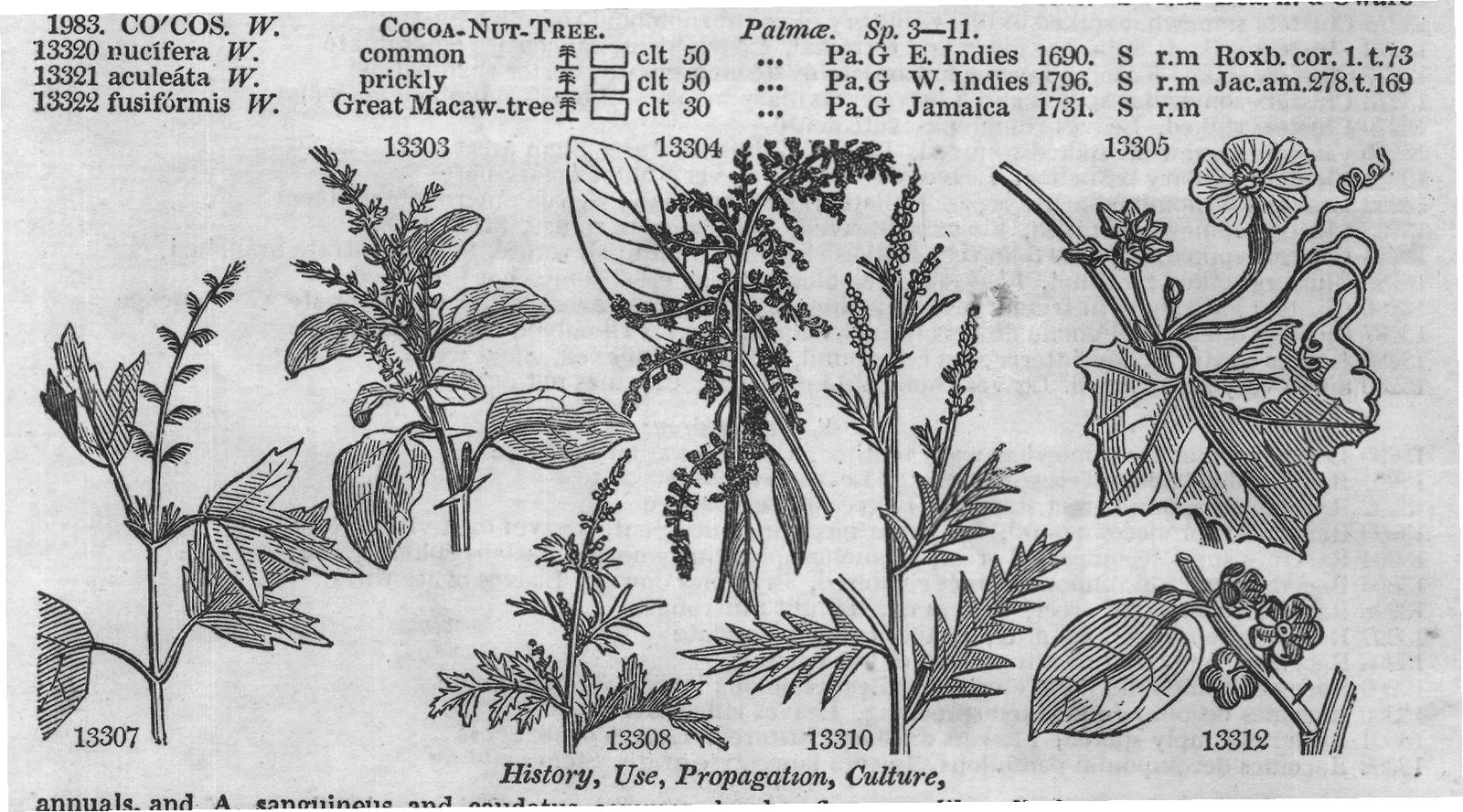
Sr.m Roxb. cor. 1. t.73 Sr.m Jac.am.278.t.169 S r.m 13303 13304 13305 13307 13308 13310 13312 History, Use, Propagation, Culture, annuals, and A. sanguineus and caudatus common border flowers; like all the species, they are of easy culture in light rich soil. Most of the species are very prolific in seeds, which preserve their germinating quality several years. 1976. Luffa. Its name in Arabic is loùff, according to Forskahl. A curious kind of gourd, not often seen on account of its offensive odor. It is cultivated in Arabia and China. It climbs up the Palm trees, covering account of its offensive odor. It is cultivated in Arabia and China. It climbs up the Palm trees, covering and elegantly adorning their trunks. The fruit when young is pickled, like the Mango; but Europeans think it has a disagreeable taste, and is not very wholesome. L. Charantia has a fruit with a yellowish skin, but very red flesh, and when ripe, it bursts elastically. Culture as in Cucumis. 1977. Ambrosia. A poetical name. Ambrosia is the name of the food of the heathen divinities, as nectar was their beverage; of the former, the odor was delightful, whence its name has been applied to an herb, the their beverage; of the former, the odor was delightful, whence its name has been applied to an herb, the leaves of which, when bruised, emit a grateful scent. Weedy plants of no beauty. 1978. Securinega. From securis, a hatchet. 'The name was given by Commerson, because the wood was so hard as to be capable of being manufactured into cutting instruments. It grows and flowers freely in loam and as to be capable of being manufactured into cutting instruments. It grows and flowers freely in loam and peat, and cuttings strike in sand under a handglass. 1979. Zizania. One of the Greek names of the rye-grass was ζiζaviov ; according to Golius, the same plant was called by the Arabs Zoùân. The modern plant has no relation to the ancient, being a native of America, called by the Arabs Zoùân. The modern plant has no relation to the ancient, being a native of America, where it is called Canada rice. This plant has been acclimated in Middlesex and Ross-shire; it grows on the margins of ponds, and is exceedingly prolific of bland farinaceous seeds, which afford a very good meal. It abounds in all the shallow streams of North West America, where its seeds contribute essentially to the support of the wandering tribes of Indians , and feed immense flocks of wild swans, geese, and other water fowl. Pinkerton says, this plant seems intended by nature to become the bread corn of the north. 1980. Pharus. From pagos, a covering. Brown gave this name to the plants, because their long broad leaves are employed as wrappers for various purposes by the natives of Jamaica. Fine stove grasses. employed as wrappers for various purposes by the natives of Jamaica. Fine stove grasses. 1981. Guettarda. Etienne Guettard was a French botanist, who published in 1747, a catalogue of the plants growing in the vicinity of Estampes. Splendid plants, which grow in loam, peat, and sand; and are increased in the vicinity of Estampes . Splendid plants, which grow in loam, peat, and sand; and are increased by cuttings in sand in a moist heat and covered. 1982. Sagus. So named in allusion to the nutritive properties of the substance obtained from it. From this palm is produced the Sago of the shops. The wood is full of white pith, like that of elder; the pith is palm is produced the Sago of the shops.
The wood is full of white pith, like that of elder; the pith is taken out, bruised in a mortar, and then put into a cloth or strainer, held over a trough, and water being poured in, the pith is washed through the cloth into the trough; the water being then drawn off, the sago is taken out and dried for use or transportation . The fruit is eaten by the Japanese, but the tree is chiefly esteemed for its highly nutritive pith. 1983. Cocos. Linnæus regards this name as of Greek origin. In that language, κoκκoς means a kind of fruit, but it does not appear that there was any relation between that and the modern cocoa nut. D'Herbelot , but it does not appear that there was any relation between that and the modern cocoa nut. D'Herbelot ORDER V.
MONCECIA PENTANDRIA. 13303 Racemes pentandrous terminal compound, Axillæ spiny 13304 Clusters densely spiked somewhat whorled, Spikes decompound erect colored, Lvs. obl. ellipt. red beneath 13305 Leaves cordate 5-lobed, Flowers large, Gourd a span long 13306 Leaves ovate sessile acuminate serrate ciliated at base 13307 Leaves 3-lobed serrated 13308 Leaves bipinnatifid smoothish, Petioles with long ciliæ, Racemes terminal panicled pinnatifid, 13309 Leaves bipinnatifid hoary beneath: upper pinna 13310 Leaves smooth bipinnatifid: upper pinnatifid, Racemes terminal solitary, Branches fastigiate 13311 Leaves bipinnatifid blunt hoary beneath, Racemes terminal solitary, Branches villous 13312 Leaves alternate ovate, Flowers axillary clustered HEXANDRIA. 13313 Panicle effuse, Glumes aristate: male and female mixed 13314 Panicle branched, Glumes awnless smooth, Leaves ovate-lanceolate 13315 Leaves obovate acute downy beneath, Flowers 7-androus 7-fid 13316 Leaves subcordate ovate acute scabrous downy beneath, Flowers hexandrous 13317 Branchlets of the spadix smooth 13318 Branchlets of the spadix annular 13319 Pinnæ spinulose, Fruit oblong furrowed 13320 Unarmed, Fronds pinnated, Leaflets replicate ensiform 13321 Caudex cylindrical prickly upwards, Fronds pinnated prickly 13322 Aculeate spiny, Caudex fusiform, Fronds pinnated, Stems and spathes spiny 13315 13317 13313 13319 13314 13321 13320 and Miscellaneous Particulars. says, (Bibl. Or. 278.) that in India the fruit is called cozi, whence the Turkish name coz, for a nut: bu this requires confirmation. In Malabar it is called tenga, in the Moluccas calappa, and by the Brahmins medo.
C. nucifera is a native of, and cultivated in, most places within the tropics. The trees grow to a great height, with a straight trunk, and, like almost every species of the Palm tribe, without branches. The leaves are from twelve to fifteen feet long; the flowers come out round the top of the trunk in large clusters, inclosed in a of the trunk in large clusters, inclosed in a sheath, and the nuts succeed them, commonly ten or twelve together. There are few trees more extensively or variously useful. The leaves are employed as thatch to cover houses, and to make mats either for sitting or lying upon. The leaf, when reduced to fine fibres, is the material of which a beautiful and costly carpeting is fabricated for those in the higher ranks; the coarse fibres is for those in the higher ranks; the coarse fibres are made into brooms. After these useful materials are taken from this leaf, the stem still remains, which is about the thickness of the ankle, and furnishes firewood. The wood of this palm, when fresh cut, is spongy; but becomes hard after being seasoned, and assumes a dark brown color. On the top of the tree a large shoot is produced, which, when boiled, resembles brocoli, but is said to be of a more delicate taste; and though much liked, is seldom used by the natives, because on cutting it off, the pith is exposed, and the tree dies. Between this cabbage -like shoot and the leaves, there spring several buds, from which, on making an incision, there distils a juice differing little from water, either in distils a juice differing little from water, either in the color or consistence. It is the employment of a certain class of men to climb to the top of the trees in the evening, with earthen pots tied to their waists, which they fix there to receive the juice, which is regularly carried away before the sun has had any influence upon it. This liquor is sold at the bazaars by the natives under the name of toddy. It is used for yeast, and forms an excellent substitute. In this state it is drank with avidity. both by the low Europeans and the natives, and is reckoned a cooling and agreeable beverage. After being kept a few hours, it begins to ferment, acquires a sharp taste, and a slight intoxicating quality. By boiling it, a coarse kind of sugar is obtained and by distillation, it yields a strong ardent spirit, which being every where sold, and at a low price, constitutes one of the most destructive annoyances to our soldiers. The name given to this pernicious drink by Europeans, is Pariah arrack, from the supposition that it is only drank by the Pariahs, or out-casts, that have no rank.
The trees from which the toddy is drawn do not bear any fruit, on account of the destruction of the buds; but if the buds be left entire, they produce clusters of the cocoa nut. This nut in the husk is as large as a is as large as a man's head, and when ripe falls with the least wind. If gathered fresh, it is green on the outside; the husk and the shell are tender. The shell, when divested of the husk, may be about the size of an ostrich's egg, and is lined with a white pulpy substance, which contains about a pint and a half of a liquor like water; and though the taste be sweet and agreeable, it is different to that of the toddy.
In proportion as the fruit grows old, the shell hardens, and the liquor diminishes, till it is at last entirely absorbed by the white milky substance, which gradually acquires the hardness of the kernel of the almond, 3E3 1984. E'LATE. W. 13323 sylvéstris W. 1985. BACTRIS. W. 13324 mínor W. 13325 major W.
Palma. Sp. 2. or 12 or 25 G G ...
MONCECIA HEXANDRIA.
ELATE. prickly-leaved BACTRIS. lesser greater Palmæ. Sp. 1.
CLASS XXI. or 14 ap.jn G E. Indies 1763. S r.m Rh.mal.3.t.22.25 S. Amer. 1691. S r.m Jac.am. t.171. f.1 Carthag. 1800. Sr.m Jac.am. t.171. f.2 POLYANDRIA. 1986. CERATOPHYLLUM. W. HORNWORT.
Fluviales. Sp. 2- 13326 demérsum W. common △un 1 jl.s G Britain dit. Dl.p Eng. bot. 947 13327 submérsum W. unarmed un 1 jl.s G Britain dit.
Dl.p Eng. bot. 679 13328 spicátum W. 13329 verticillátum W. 1987. MYRIOPHYLLUM. W. WATER MILFOIL. 1988. SAGITTA'RIA. W. ARROW-HEAD.
Onagrariæ.
Sp. 2-5. spiked pr 1 jn.au R Britain dit. Dl.p Eng. bot. 83 verticillate pr 1 jl G England ponds. D l.p Eng. bot. 218 Alismaceæ. 13330 sagittifólia W.
Sp. 6-16. common △or 2 jn.au W 13331 sinensis B. M.
Chinese England rivers. D 1.p Eng. bot. 84 or 2 s.n W China 13332 obtusifólia W. blunt-leaved or 2 jl.au 1812. D l.p W China 13333 lancifólia W. 1804. D l.p lance-leaved or 1½ jn.jl W 13334 rígida. B. M. brittle-leavedor 1 jn.jl W 13335 gramínca W.
Grass-leaved or 1 jl.au W 1989. BEGONIA. W. 13336 nítida W.
BEGONIA. ........ shining-leaved or 1½ my.d W 13337 dichotoma W. forked or 2jl.au W 13338 díscolor H. K. two-colored or 3 my.s W Evansiána B. R.
W. Indies 1787. Dl.p N. Amer. 1806. D L.p Carolina 1812. D l.p Sp. 16-38.
Jamaica 1777. C s.p Caraccas 1800. C s.p China 1804. R s.p Bot. mag. 1473 Bot. mag. 1631 Rhe. mal.11. t.45 Bot. mag. 1792 Bot. mag. 1632 Par. lond. 72 Jac. ic. 3. t. 619 13339 macrophýlla W. large-leaved or 3 my.s W Jamaica 1793. C s.p 13340 tuberósa W.
Plu.ic.34.t.45. f.1 tuberous or jl.s W 13341 acumináta W.
Amboyna 1810. C l.p R.am.5. t. 169. f.2 pointed-leaved or 1 my.d W 13342 húmilis W.
Jamaica 1790. Cs.p Bot. reg. 364 small or 34 W 13343 hirsúta W.
W. Indies 1788.
Cl.p Lin. trans. 1. t.15 shaggy-leaved or 1 my.jn 13344 ulmifólia W.
WW. Indies 1789.
Cl.p elm-leaved or 2 my.jn W S. Amer. 1822.
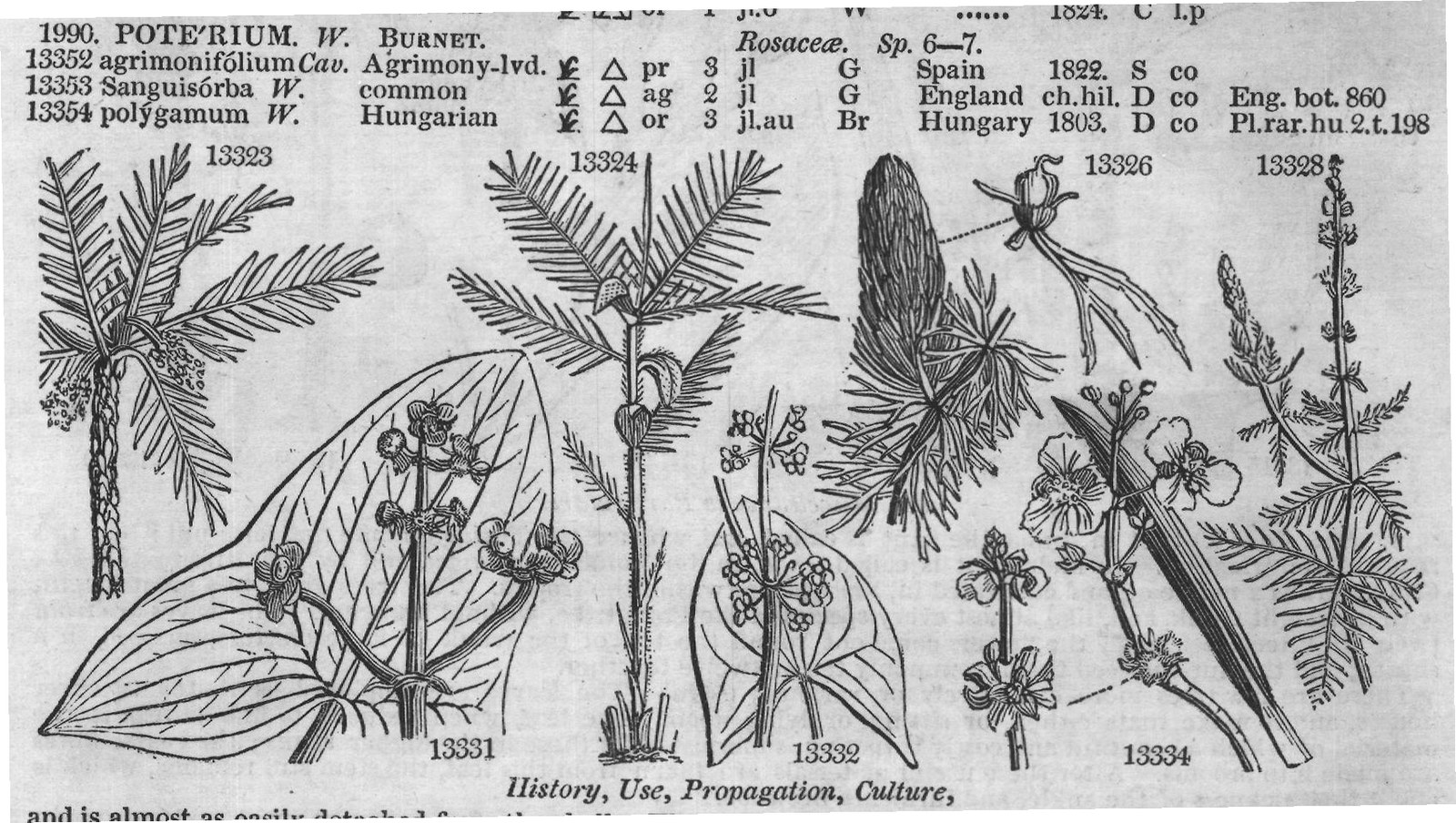
C l.p 13345 argyrostigma Fisch. silver-spotted Aub. gui.2. t.348 Bot. cab. 638 or 3 jl.o W Brazils 1819. C l.p Bot. reg. 666 maculata Raddi 13346 spatuláta W. spatulate or 1 jl.o W W. Indies 1819. Cl.p Bot. cab. 107 13347 pícta Lodd. painted or Pk Nepal 1818. Cl.p Bot. cab. 571 13348 pauciflóra Lindley few-flowered or 1 jl.o W ..... 1816. Cl.p Bot. reg. 471 13349 odoráta W. sweet-scented or 1 jl.o W 13350 hirtélla Link. 2 ...... 1824. C l.p hairy or 1 jl.o W ...... 1824. C l.p 13351 dísticha Link. distichous or 1 jl.o W ...... 1824. C l.p 13353 Sanguisórba W. 1990. POTE'RIUM. W. BURNET. 13352 agrimonifólium Cav. Agrimony-lvd. pr 3 jl Rosaceæ. Sp. 6-7.
G Spain 1822. S co 13354 polýgamum W. common Hungarian ag 2 jl G England ch.hil. D co Eng. bot. 860 EΔ 3 jl.au Br Hungary 1803. D co Pl.rar.hu.2.t.198 13323 13324 13326 13328 13331 13332 13334 Cia History, Use, Propagation, Culture, and is almost as easily detached from the shell. The natives use this nut as their victuals; and from it they also express a considerable quantity of the purest and best lamp oil. The substance which remains after this operation, supplies an excellent food for poultry and hogs. Cups and a variety of excellent utensils are made of the shell.
The husk of the cocoa nut is nearly an inch thick, and is, perhaps, the most valuable part of the tree; for it consists of a number of strong fibres, easily separable, which furnish the material for the greatest part of the Indian cordage; but is by no means the only substitute which the country affords for hemp. This the natives work up with much skill.
Plants of the cocoa nut tree are frequent in our stoves, being easily raised from the nuts sold in the shops, planted in rich earth, and on a moist heat; but the plants are seldom allowed room enough to come into flower; though it has been observed, that this is almost the only palm that could be cultivated in this country for perfecting its fruit; all the others being diœcious plants. Sweet observes, that they seldom succeed well in our collections; perhaps from being too much exposed to the sun : he is " informed they thrive best in the shade in the West Indies, where cultivators of them plant tall trees near them for that purpose." (Bot. Cult. p. 42.) C. aculeata has a trunk the thickness of the human body; the pinne of the fronds are longer than in the cocoa, and prickly like the bark of the trunk. The fruit is as large as a crab, and of the same shape; under a green skin it has a thin sweetish astringent pulp; and within that, a nut full of a white sweet eatable kernel. The nut is said to yield the true palm oil. The outside of the trunk is made into laths, hows, and darts. 1984. Elate. This was one of the names given by the Greeks to the membrane which envelopes the female flowers of the date; that is to say, to its spatha. Modern authors have applied the word to a kind of Indian palm. The fruit of E. sylvestris resembles a wild plumb . The poorer sort of people chew it in the same manner with the Areca nut, with the leaf of the betel pepper and quick-lime. The elephants are fond of the fruit-stalks, which are very sweet. In our stoves the plants require a sandy loam, and a strong heat.
ORDER VI.
MONECIA HEXANDRIA. 13323 Fronds pinnated, Leaflets opposite 13324 Fruit roundish 13325 Fruit ovate POLYANDRIA. 13326 Fruit armed with three spines 13327 Fruit unarmed 13328 Sterile flowers in interrupted leafless spiked whorls 13329 Leaves pinnated capillary: upper pectinate-pinnatifid, Flowers axillary whorled 13330 Leaves lanceolate acuminate sagittate: lobes lanceolate straight, Scape simple 13331 Leaves 3-fid and 3-parted: lobes nearly equal nerved, Scape branched angular, Male fl. solitary terminal 13332 Leaves ovate rounded blunt sagittate lobes ovate acuminate spreading, Scape panicled 13333 Leaves ovate narrowed at each end, Scape branched below 13334 Leaves lanceolata keeled, Petioles 3-cornered, Scapes simple, Female flowers sessile 13335 Leaves lanceolate linear, Female heads small 13336 Shrubby erect, Lvs. very smooth unequally cordate obsoletely toothed, Wing of caps. very large roundish 13337 Shrubby erect, Lvs. unequally cord. subangul. toothletted smooth hairy ben. at the veins, Pan. dichotom. 13338 Leaves angular serrulate crimson beneath, Stem nodose, Wings of caps. unequal rounded 13339 Caulescent, Lvs. unequally cord. cren-tooth.: lower angular, Wings of caps. with obt. ang. one very large 18340 Creeping, Leaves unequally cordate angular toothed, Wings of capsule parallel 13341 Caulescent, Leaves hispid cordate acuminate unequally toothed, Largest wing of caps. obtusangular toothed, Largest wing of caps. obtusangular 13342 Caulescent erect, Leaves hispid cordate doubly serrate, Wings of caps. rounded nearly equal 13343 Caulescent, Leaves hispid cordate doubly serrated, Largest wing of caps. very large obtusangular Largest wing of caps. very large obtusangular 13344 Caulescent erect, Lvs. hisp. on each side unequally oblong doubly tooth. Largest wing of caps. obtusangul. doubly tooth. Largest wing of caps. obtusangul. - 13345 Leaves long acuminate repand spotted with white above red beneath 13346 Leaves blunt obsoletely toothletted smoothish, Stipules spatulate unequal ciliated, Wings of caps. blunt 13347 Stemless, Leaves ovate cordate hirsute finely serrulated mottled, Capsules hairy 13348 Leaves nearly equally cordate very blunt crenate downy: upper cucullate, Stipules lanceolate scariose 13349 Leaves acuminate somewhat angular unequally obsoletely toothletted smooth on each side, Stip. scariose smooth on each side, Stip. scariose 13350 Leaves angular unequally serrulate-ciliated hairy beneath at the veins, Stipules scariose lanceol. fringed 13351 Leaves acute crenulate smooth strigose beneath, Cyme distichous, One wing of capsule very large acute 13352 Hirsute, Leaflets lanceolate, Spikes oblong ovate 13353 Thorns none, Stem somewhat angular, Stamens much longer than the calyx 13354 Unarmed, Stems angular, Terminal flowers female: lower male; intermediate hermaphrodite 13336 13346 13338 13348 13342 13353 13344 13354 and Miscellaneous Particulars. 1985. Bactris. So called by Jacquin, from βaκτρov, a cane, because the small stem is made into walkingsticks, which are much valued. B. minor produces a fruit of a dark purple color, the size of a common cherry, containing an acid juice, of which the Americans make a sort of wine. It is also eaten raw, but is not pleasant. Canes are made of the stem; they are dark -colored, shining, jointed, and very light; the French call them Cannes de Tobago. B. major has a large nut with a solid kernel, which is eaten in Carthagena. a solid kernel, which is eaten in Carthagena. In our stoves they form handsome plants, and grow freely in sandy loam ; like other palms, they are only to be increased by seed. 1986. Ceratophyllum. So called from zερaς, a horn, and φuλλov, a leef, on account of the numerous horned divisions of the leaves. Aquatic weeds of no beauty. 1987. Myriophyllum. From μuρioς, a myriad, and φuλλov, a leaf, on account of the infinite number of divisions of its leaves. Aquatics of some beauty, and the easiest culture. 1988. Sagittaria. So called from sagitta, an arrow, in reference to the arrow-headed form of the leaves. S. sagittifolia is one of the handsomest of British aquatics, and is common in Siberia, China, Japan, and Virginia. The bulb, which fixes itself in the solid earth below the mud, constitutes an article of food among the Chinese, and upon that account they cultivate it extensively. The roots are larger in those countries than with us. All the species are of common culture. 1989. Begonia. Named in honor of Michael Begon, a Frenchman, born in 1638; he was an intendant of Marine, and a promoter of botany. These are universally plants remarkable for the neatness of their foliage, and their succulent habit. B. argyrostigma and discolor are the two most beautiful species. They are all cultivated without difficulty either from seeds or cuttings 1920. Poterium. Literally, this word signifies a drinking vessel, and in the same sense, a kind of beverage. A drink was made of it, which was reckoned useful in many complaints; it is also an ingredient in cool tankards. P. sanguisorba is sometimes sown along with clover as an herbage plant; it is now, however, out of 3E4 MONŒCIA POLYANDRIA.
CLASS XXI. 13355 hýbridum W. sweet or 2 jn.jl G France 13356 caudátum W. smooth shrubby or 3 ja.ap G 13357 spinósum W. prickly shrubbyn or 2 ap.au G 1683. D co Canaries 1779. S p.l Levant 1595. S p.1 Moris.s.8.t.18.f.5 Barr. ic. t. 632 1991. AMIRO'LA. Pers. AMIROLA.
Terebintaceæ. Sp. 1. 13358 nítida Pers. shining-leaved or 24 ... ... 1992. ACIDO'TON. W. ACIDOTON.
Peru Sp. 1. 1824. C p.l 13359 úrens W. stinging un 8 G ... 1993. THELY'GONUM. W. THELYGONUM. 13360 Cynocrámbe W. Dog's-cabbage un S. Europe 1710. S co 1994. CASTA'NEA. W. CHESNUT.
Jamaica 1793. C l.p Slo.jam.1.t.83.f.1 Urticeæ. Sp. 1.
G jl Amentaceæ. Sp. 2.
Lam. ill. t. 777 13361 vésca W. common 13362 púmila W. dwarf 1995. O'STRYA. W.
HOP-HORNBEAM. 13363 vulgáris W. common 坐垫 坐 tm 50 my.jn G England woods. S 8.1 Eng. bot. 886 or 12 jl G.Y N. Amer. 1699. S p.1 Mich. arb. 2. t.7 Amentaceæ. or 20 my Ap Sp. 2-4.
Italy 1724. L s.l 13364 virgínica W.
American or 20 my.jn Ap 1996. CARPINUS. W. HORNBEAM.
Amentaceæ.
N. Amer. 1692. L s.l Sp. 3-5.
Dend. brit. 143 Abb. ins. 2. t. 75 13365 Bétulus W. common ẞincísa cut-leaved 13366 americána W.
American 来 or 20 tm 30 mr.my Ap or 15 mr.my Ap Ap ...... ... 13367 orientális W. eastern or 12 ...
Ap 1997. FA'GUS. W.
BEECH.
Amentaceæ. 13368 sylvática W. common tm 70 ap.my Ap ẞatro-rúbens Duroi S. incisa W. purple-leaved Fern-leaved or 30 ap.my Ap or 10 ap.my Ap L co ... 13369 ferruginea W. 1998. CO'RYLUS. W. 13370 Avellána W.
B álba rúbra grandis & glomcráta cris'pa 13371 tubulósa W.
American NUT-TREE. frizzled or 30 my.jn Ap Amentaceæ.
Sp. 5-7.
Common Hazel White Filbert fr 10 f.ap Ap fr 10 f.ap Ap L co ...... ...
Red Filbert fr 10 f.ap Ap ...... ... ...
Britain woods. S co L co N. Amer. 1812. S co Levant 1739. L co Sp. 2.
Britain woods. S co Eng. bot. 1846 ...... ......
G s.l N. Amer. 1766. Ls.l Mich. arb. 2. t. 9 Britain woods. S co Eng. bot. 723 Lco Eng. bot. 2032- Dend. brit. 157 Dend. brit. 98 Cob clustered fr 8 f.ap Ap L co ...... ... fr 8 f.ap Ap ......
L co ... fr 8 f.ap Ap Lco ...
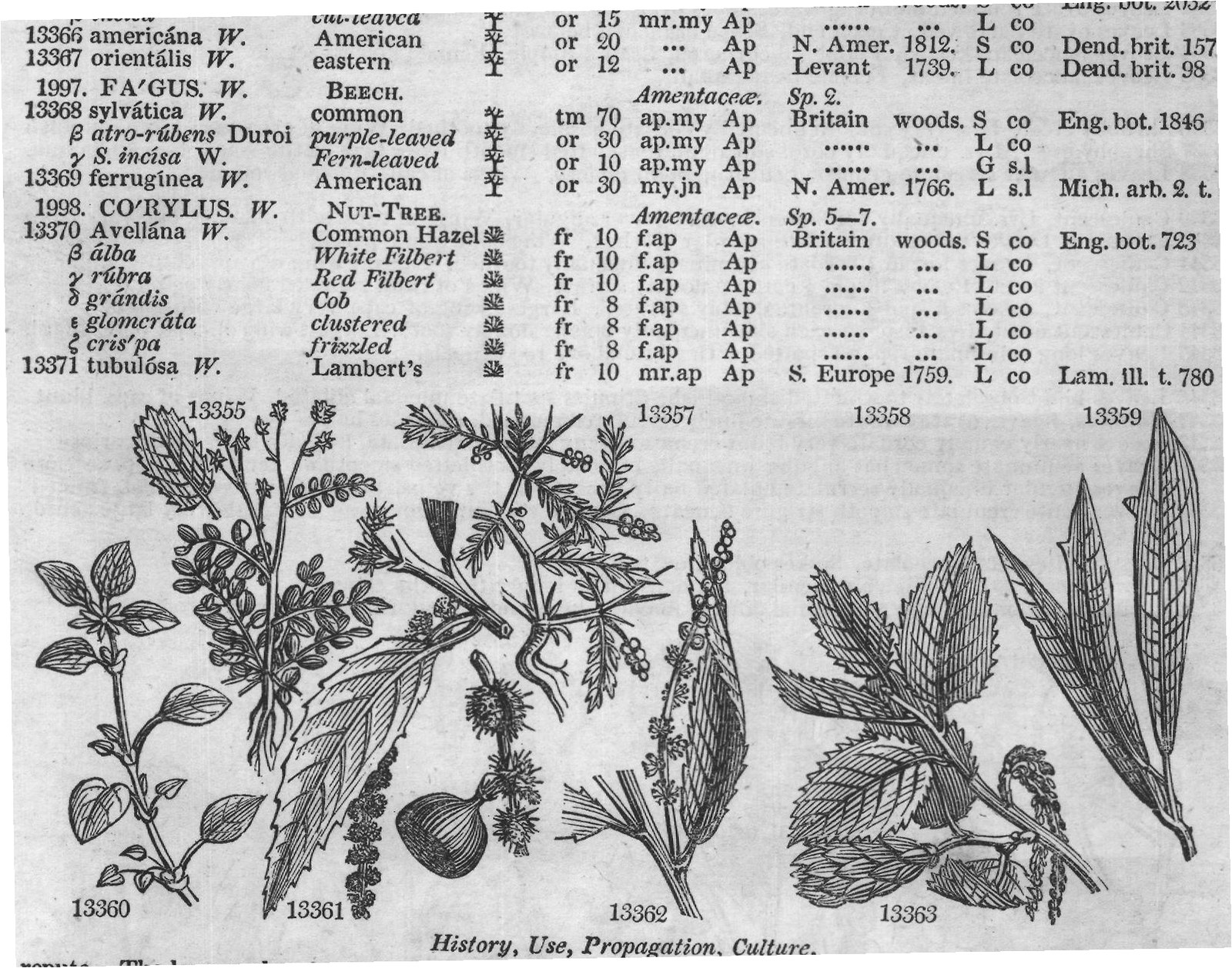
Lambert's fr 10 mr.ap Ap S. Europe 1759. L co Lam. ill. t. 780 13355 13357 13358 13359 -898 13360 13361 13362 13363 History, Use, Propagation, Culture, repute. The leaves when bruised smell like cucumbers, and taste something like the parings of that fruit; they are sometimes put into salads. All the species are of the easiest culture. 1991. Amirola. A word with an unknown meaning. The Peruvians form the shining black seeds of Amirola nitida into rosaries. 1992. Acidoton. From aκiδωτoς, pointed; in allusion to the stinging pointed hairs of the leaves. 1993. Thelygonum. A name under which Pliny described a plant which appears to have been Mercurialis.
It was derived from Indus, a woman, and you, a knee, because of its joints, which where thought to resemble was derived from θηλuς, a woman, and you, a knee, because of its joints , which where thought to resemble a woman's knee. Cyno-crambe, literally interpreted dog-cabbage , was the Greek name of Mercurialis perennis. 1994. Castanea. A native of the territory of Castanea, a town of Thessaly, near the borders of the river Peneus, where magnificent chesnut trees still are found. The chesnut, Châtagnier, Fr., Castanienbaum, Ger., Castagno, Ital., is, like the walnut, both a timber and a fruit tree; some of the oldest trees in the world are of this Tortworth, in Gloucestershire. The fruit is generally eaten roasted; abroad, it is not only boiled and roasted, but ground into meal, and puddings, cakes, and bread are made from it. The timber is thought to have been formerly in very general use for house carpentry, though some consider what is generally called chesnut in our old buildings as oak. It is one of the best trees for hop poles, and scarcely any other is now planted in Kent and other hop districts for that purpose.
Some excellent fruit-bearing varieties have been lately imported from France; these are increased by grafting or budding in the usual methods, but the plants for coppice woods or timber are best raised from nuts. There is a variety with striped leaves which is very ornamental. The most esteemed of the French kinds are called Marron, a word which in old French literally signifies a substance, which it must be confessed the fruit is not unlike.
The American chesnut differs so little from the European, that no specific distinction can be drawn. It is one of the largest and most useful trees of the forests, the wood being extremely durable, and in high esteem of the largest and most useful trees of the forests, the wood being extremely durable, and in high esteem for posts and rails to construct fences. The nuts are very delicious. The Castanea pumila or Chinquapin nut, is a small tree, or rather shrub, growing to the height of thirty feet in the southern states, but scarcely exceeding seven or eight in cold latitudes. The fruit is very sweet and agreeable to eat. 1995. Ostrya. So called from oστεov, a scale, in allusion to the scaly catkins of the fruit, which resemble those of the hop, whence the plants are called Hop-Hornbeam. The wood of Ostrya virginica is exceedingly hard and heavy, whence it is generally known in America under the name of Iron-wood. In some parts it is called Lever-wood, 1996. Carpinus. From the Celtic words car, wood, and pin, the head; that is to say, wood fit for the yokes of cattle. The wood is white, and of a fine close texture, which makes it peculiarly fit to be wrought into the cattle. The wood is white, and of a fine close texture, which makes it peculiarly fit to be wrought into the ORDER VII.
MONECIA POLYANDRIA. 13355 Unarmed, Stems round striated 13356 Unarmed shrubby, Branches round villous, Spikes long loose 13357 Spiny shrubby, Spines branched, Branches villous somewhat angular, Spikes oblong loose 13358 Leaves simple and ternate ovate serrated, Petioles thickened on each side 13359 Leaves alternate lanceolate ovate, Flowers in racemes 13360 Leaves ovate, Stem diffuse 13361 Leaves oblongo-lanceolate acuminate mucronate serrate glabrous on each side 13362 Leaves oblong acute mucronate serrate white with down beneath 13363 Cones ovate pendulous, Leaves ovate acute, Buds blunt 13364 Cones oblong ovate erect, Leaves oblong ovate acuminate, Buds acute 13365 Scales or bracteas of the fruit oblong serrated with two smaller lateral lobes 13366 Scales of cones 3-parted: middle segment oblique ovate lanceolate 1-toothed on one side 13367 Scales of cones ovate unequal at base undivided somewhat angular unequally serrated 13368 Leaves ovate glabrous obsoletely dentate, their margins ciliated 13369 Leaves ovate acuminate downy beneath coarsely toothed ciliated at edge 13370 Stip. obl. obt. Lvs. roundish-cordate pointed, Invol. of fruit campanulate rather spreading torn at margin 13371 Stip. obl. blunt, Cal. of fruit tubul. cylind. contracted at end cut toothed, Leaves roundish cord. acuminate 13365 13368 13371 13371 13366 13370 13367 13369 and Miscellaneous Particulars. various forms with which the country people of all nations have delighted to ornament their yokes. Our English word Horn-beam has evidently the same meaning. C. Betulus is a tree of little merit or beauty, having persistent leaves like the beech ; it is well adapted for hedges or separation, where the object is shelter. 1997. Fagus. From the Greek φηγoς, which also signifies eatable. We all know that mast was the original food of man. The Fagus of Virgil, was the Quercus Æsculus. Hêtre, Fr., Büche, Ger., Faggio, Ital. F. sylvatica is a handsome tree in every stage of its growth. It seems to thrive best in a chalky clay or loam, rather sheltered. It is one of the handsomest single trees for parks, and is well adapted to form lofty hedges. The timber is brittle, and not of long duration but it is much used by turners, joiners, and millwrights. The bark is remarkably thin, and has been used for making baskets and band-boxes. The leaves are used in France by the country people, on account of their elastic quality, instead of straw for the paillasse to lay under their mattrasses. The mast is readily eaten by swine and deer. F. cuprea, the copper colored, and F. purpurea, the purple beech, are two of the most striking of timber trees, from the color of their foliage. They are propagated by grafting, and grow as freely as the common beech. Fagus ferruginea is distinguished by the Americans from the common kind by the name of Red Beech, the wood being of a darker color. 1998. Corylus. From xogus, a bonnet; to which the enwrapping calyx may be very well compared. Our word Hazel is in like manner derived from the Anglo-Saxon Hæsel, which signifies an head-dress. Noisette, Fr., Nussbaum, Ger., and Avellano, Ital. C. avellana has the specific name from Avellino, a city of the kingdom of Naples, near which, in a valley, it grows to a great extent, and in Swinburne's time, brought in an annual profit of near 12,000L. sterling. It is said they were originally imported into Italy from Pontus, and known among the Romans by the appellation of nux Pontica, which in process of time, was changed into that of nux Avellana, from the place where they had been propagated with the greatest success. The common Hazel-nut is wild in many woods and coppices in Britain, whence the fruit is gathered in plenty and sent to the neighbouring markets. As underwood, the plant is of some value for hoops, fishing-rods, walking-sticks, withes for faggoting, crate-making, hurdles, wattling-fences, and springles to fasten down thatch. Formerly the roots were used by the cabinet-makers and where yeast was scarce, they twisted the twigs, steeped them in ale during its fermentation, hung them up to dry, and when they brewed put them into the wort. There are several varieties of the cultivated filbert. What is called the frizzled filbert is esteemed the best. The plants do not require a rich soil, but one with a dry bottom. They are generally propagated by suckers, , and grown as dwarf standards, each plant with a single clean stem, from six feet high down to twelve inches.
When allowed to throw up suckers from the root and form a thick bush, they cease to bear fruit in any quantity. The filbert bears principally upon the sides of the upper young branches, and from small shoots which proceed from the bases of side branches cut off the preceding year. Hence the spurring-in method of MONŒCIA POLYANDRIA.
CLASS XXI. 13372 americána W.
Dwarf Cuckold 13373 rostráta W.
Com. Cuckold fr 6 mr.ap Ap fr 5 mr.ap Ap 13374 Colúrna W.
Constantinople fr 10 mr.ap Ap N. Amer. 1798. L co N. Amer. 1745. L co Constant. 1665. L co Wa. am.t.29.f.63 Willd. arb.t.1.f.2 Dend. brit. 99 1999. JUGLANS. W.
WALNUT.
Terebintaceæ. Sp. 10-14. 13375 régia W. common 13376 nígra W. black 13377 cinérea W.
Butter Nut 13378 olivæfórmis W.
Pekan Nut tm 50 ap.my Ap tm 30 ap.my Ap tm 30 ap.my Ap tm 30 ap.my Ap N. Amer. ...
Persia 1562. S co N. Amer. 1629. S co N. Amer. 1656. S co Lam. ill. 781 Dend. brit. 156 Jac. ic. 1. t. 192 192 Mich. arb. 1.tt. 3 angustifólia H. K. 13379 sulcáta W. thick shell-bark Hickory tm 30 ap.my Ap N. Amer. 1804. S co 13380 álba W. shell-bark Hickory tm 30 ap.my Ap N. Amer. 1629. S co Dend. brit. 148 Mich. arb. 1. t. 8 148 13381 compréssa W. flat-fruited tm 30 ap.my Ap 13382 amára Mich. bitter Nut tm 30 my Ap 13383 obcordáta W. obcordate tm 30 my Ap 13384 glábra W.
Hog-nut tm 30 my Ap N. Amer. 1730. S co N. Amer. 1800. S co N. Amer. 1812. S co N. Amer. 1799. S co Mich, arb. 1. t. 7 M. arb.1.t.9.f.3,4 M. arb.1.t.9.f. 1,2 porcína Mich. 2000. QUER'CUS. W. 13385 Phéllos Ph. 13386 marítima Ph. 13387 serícea Ph. 13388 vírens Ph. 13389 cinérea Ph. 13390 imbricária Ph. 13391 laurifólia W.
B obtúsa Mich. 13392 lútea W. 13393 Ballóta W. 13394 I'lex W. a integrifólia ẞ serráta yoblónga 13395 Súber W. 13396 coccífera W. 13397 gramúntia W. 13374 OAK.
Willow running live ash-colored shingle Laurel blunt-leaved yellow Barbary evergreen common notched-leaved long-leaved Cork-tree Kermes Holly-leaved 13376 Amentaceæ.
Sp. 50-98. sea 오些幽오오 空型 오오오오오오오 tm 60 my.jn Ap N. Amer. 1723. S 6.1 Mich. arb. 1.t.12 or 6 my.jn Ap N. Amer. 1811. S co Mi. quer. t.13.f.1 or 2 my.jn Ap tm 40 my Ap N. Amer. 1724. S co N. Amer. 1739. S s.l Mich. arb. 2.t.15 Mich. arb. 2. t.11 or 10 my.jn Ap N. Amer. 1789. S co Mich. arb. 2.t 14 tm 40 my.jn Ap tm 50 my Ap tm my Ap tm 20 my Ap N. Amer. 1786. S co N. Amer. 1786. S co N. Amer. 1786. S co Mexico 1825. S co Mich. arb. 2. 1.13 Mich. querc.t.17 Mich. querc.t.18 tm 60 my.jn Ap Barbary ...
S s.l tm 60 my.jn Ap tm 60 my.jn Ap or 60 my.jn Ap S. France 1581. or 60 my.jn Ap clt 20 jn Ap clt 10 my Ap or 30 jn Ap S. France 1581. S s.1 S. France 1581. S s.1 S. France 1581. G s.l S. France 1699.
S s.1 S. France 1683. G s.l France 1730. G s.l Dend. brit. 90 Gs.l Duh. arb.1.t.123 Duh. arb.1 t. 124 Dend. brit. 89 Dend. brit. 91 13375 13380 13377 13381 13378 13384 History, Use, Propagation, Culture, pruning is the most successful in the production of fruit. C. Colurna may be treated in the same manner as the other, but the plants kept at a somewhat greater distance apart. The nuts of the American Hazel-nut, Corylus americana, are very excellent. 1999. Juglans. That is to say, Jovis glans, the nut of Jove, on account of its excellence, which must have been great indeed, when gods had nothing but oak or beech-mast to eat. J. regia, walnut, from gaul-nut, the great indeed, when gods had nothing but oak or beech-mast to eat. J. regia, walnut, from gaul-nut, the tree being introduced from France, Noyer, Fr., Walnussbaum, Ger ., and Noci, Ital., is cultivated both as a fruit and timber-tree. The fruit in a green state, before the stone hardens, is much used for pickling, and also as an adulteration of soy sauce. An oil, which supplies the place of that of almonds, is expressed from the hard nuts, first peeled, into their tarts and other meats. The leaves strewed on the ground, and left there, annoy worms; or macerated in warm water, afford a liquor, which from its bitterness may effect their death. The unripe fruit is used in medicine for the same purpose. Pliny says, "the more walnuts one eats, with the more ease will he drive worms out of the stomach." The timber is used in this country for gun-stocks, being lighter in proportion to its strength and elasticity than any other. It is used in cabinet-work in most parts of the continent: the young timber is held to make the finest colored work, but the old to be finer variegated for ornament. When propagated for timber, the nut is sown; but when fruit is the object, inarching from the branches of fruit-bearing trees is preferable.
Budding has also been successfully adopted by Mr. Knight ; the buds succeed best when taken from the base of the annual shoots; ordinary-sized buds from the upper parts of such shoots generally fail. Walnut trees that have not been grafted or budded, may be induced to produce blossoms by ringing the bark.
Juglans nigra, the black walnut, is a tree of large size, and its nuts are eaten by men and several species of animals. The wood is put to various mechanical and economical uses . J. cathartica is known under the name of butter-nut, oil-nut, and white walnut; the nuts are used by the American Indians medicinally. The fruit of J. olivæformis, or the Pekan-nut, is delicious; sometimes it is exposed in the fruiterers' shops for sale. The nuts of J. sulcata, which is called thick shell-bark hickory, and Springfield and Gloucester nut, are large and well-tasted. The shell-bark hickory, shag-bark, or scaly-bark hickory, J. alba , is so called on account of its bark, which is torn lengthwise in long loose strips, as in J. sulcata. The wood of J. tomentosa, the Mocker-nut, white-heart hickory, or common hickory, is excellent for mechanical purposes, and particularly esteemed as fire-wood; but the nuts are hard, with but little kernel in them. The Americans make very good and durable of J. glabra, which is called pig or hog-nut, also broom hickory.
ORDER VII.
MONŒCIA POLYANDRIA. 13372 Cal. of fruit roundish campan. larger than nut, Limb dilated tooth serrated, Lvs. roundish cord. acumin. 13373 Stip. lin. lanc. Cal. of fruit camp. tubul. larger than nut 2-parted: seg. cut toothed, Lvs. obl. ovate acumin. 13374 Stip. lanc. acum. Cal, of fruit double: outer many-parted; inn. 3-part. Seg. palm. Lvs. roundish ov. cordate 13375 Leaflets about nine oval smooth subserrated nearly equal, Fruit globose 13376 Leaflets numerous lanceolate serrated beneath with the petioles downy, Fruit globose dotted rough 13377 Leaflets numerous oblong lanceolate serrated soft with down beneath, Petioles viscid, Fruit oblong ovate 13378 Leaflets numerous lanceolate serrated, the odd one with a long stalk, Fruit oblong 4-cornered 13379 Leafl, about 9 lanceolate acuminate serrate downy beneath: the odd one sess. Fruit roundish with 4 keels 13380 Leaflets 7 obl, lanc, acuminate serrated rough and downy beneath: the odd one sess. Fruit squarish smooth 13381 Leafl. 7 obl. lanc. acum, serr, downy beneath and soft: the odd one sess. Fruit ov. Nuts oblique compressed 13382 Leaflets about 9 ovate-oblong acum. finely serrated smooth on each side; the odd one with a short stalk 13383 Leaflets 7 ovate acuminate serrated smooth on each side with resinous dots beneath, Nuts obcord, smooth 13384 Leaflets 7 ovate acuminate serrated smooth on each side with resinous dots beneath, Fruit and nuts oblong A. Leaves entire, or little toothed. 13385 Leaves membranaceous linear lanc. tapering at each end entire smooth with a small point, Nut roundish 13386 Leaves coriaceous elliptical-lanceolate entire smooth with a small point, Nut roundish 13387 Lv. lanc.-obl. somewhat wavy obt. at the base rather dilated upwards silky beneath, Nut almost globular 13388 Lvs. coriac. ellipt.-obl. revol. ent. pointless obt. at base clothed with starry down ben. Fr. stalk. Nut oblong 13389 Lvs. coriac, ellipt.-lanc. revol. ent. blunt. with a small point clothed with starry down beneath, Fruit sessile, Nut nearly globose 13390 Leaves elliptical oblong acute at each end entire almost sessile downy beneath, Nut nearly globose 13391 Leaves obovate entire smooth nearly sessile tapering at the base, Nut roundish even 13392 Leaves obovate entire shining somewhat heart-shaped at the base downy and yellow beneath B. Leaves toothed spiny. 13393 Leaves elliptical coriaceous entire or serrated very downy beneath, Bark even, Nut cylindrical elongated 13394 Leaves ovate-oblong acute coriaceous entire or serrated hoary beneath, Bark even, Nut ovate 13395 Leaves ovate-oblong bluntish coriaceous entire or sharply serrated downy beneath, Bark cracked fungous 13396 Lvs. ellipt.-obl. rigid smooth on both sides with spread. brist. spin. teeth, Nut ov. Cal. with spread. point. sc. 13397 Leaves roundish ellipt. nearly sess. undulated with deep spin. divaricat. teeth densely downy beneath somewhat heart-shaped at the base 13385 13386 13391 13395 13387 13390 13388 13396 and Miscellaneous Particulars. 2000. Quercus. This name is derived from the Celtic quer, fine, and cuez, a tree; it was so called, in distinction to other trees, because the holy misseltoe grew upon it: otherwise the common name of the oak in Celtic was derw, whence druids, and the Greek δρuς. Phellos was the Greek name of the cork, Q. suber. Gramuntia has derived its name from growing in the wood of Grammont, near Montpelier. Suber is generally thought to have been formed from the Latin sub, under, because the bark was used by the Roman women as sandals, both for keeping their feet dry, and increasing their stature; but Vossius is of opinion, that it comes from σuφaς, the Greek name of bark of any kind. Coccifera has been so called because the little insect, coccus, which affords the well-known kermes dye, is found upon it. Kermes itself is an alteration of qermez, which signifies in Arabic, a little worm; the same people called the red dye qermexy, whence our Norman-English word cramoisye. Robur is an alteration of rove, a Celtic synonym of the oak. Ægilops, literally goat's-beard, was so called on account of the long truss or beard-like lichens which were frequently found hanging suspended from it.
The oak is a genus of trees familiar to man in the temperate zones of both hemispheres. Q. Robur, now valued for its timber and bark, and formerly for its acorns, is familiar to every Briton. There are two distinct varieties or subspecies; Q. sessiliflora and pedunculata, and another Q. pubescens. Q. pedunculata is thought to be the common oak of England, being much more frequent in natural woods than the others. The timber of this variety is said to be whitish and hard, while that of the sessile-fruited is reddish and brittle. The bark of this and all the hardy species of oak is or may be used by the tanner. Oak saw-dust is the principal indigenous vegetable used in dyeing fustian; and different shades of drab and brown are also made from it. Oak-apples are used in dyeing as a substitute for galls; the black got from them by the addition of copperas is more beautiful than that from galls, but not so durable. These galls are occasioned by an insect of the Cynips kind, which deposits its eggs in the substance of the leaf. When the bark of the oak has performed its office to the tanner, it is employed by the gardener to produce heat by its fermentation. Oak leaves are also used for the same purpose. When a great proportion of the island was in forest, acorns were of importance for feeding swine; they are still valued for this purpose in districts where the oak abounds, as in Hampshire and Northamptonshire. Q. cerris is a very handsome tree, and the timber is considered nearly as valuable as that of the common oak. The Lucombe (from the name of the nurseryman who raised it) and Fulham (from the name of the nursery where it was first originated) varieties are nearly evergreens; they retain their verdure till Christmas, and remain on the tree in a brown or withered state till April or May following. Q. coccinea is one of the handsomest of the American oaks; the leaves, which are six inches long, change in MONECIA POLYANDRIA.
CLASS XXI. 13398 lusitánica W.
Portugal tm 40 In Ap 13399 Prinoídes W.
Dwarf Chesnut or 3 jn Ap N. Amer. 1823.
Portugal 1824. s.l Gs.l Cav. ic. 2. t. 129 Mi.querc. t.9. f.1 Chin'quapin Ph. 13400 infectória W.
Dyer's 쏘 tm 40 my.jn Ap Levant 1822.
G CQ 13401 Turnéri W.
Turner's * tm 40 my.jn Ap ......
G co 13402 Prínus Ph.
Chesnut tm 60 my.jn Ap N. Amer. 1730.
S s.l Mich, arb. 2. t. 7 13403 bícolor Ph. white swamp tm 60 my Ap N. Amer. 1811.
S s.l Mich. arb. 2. t. 6 13404 montána Ph.
Rock Chesnut tm 50 my Ap N. Amer. 1800.
Sal Mich. arb. 2. t. 8 13405 aquática Ph. water 1 tm 40 my Ap N. Amer. 1723.
S s.l Mich. arb.2. t.17 13406 nána Ph. dwarf or 12 my Ap N. Amer. 1738. S 8.1 Abb. ins. 2. t. 59 13407 Castánea Ph.
Yellow tm 60 my Ap N. Amer. 1822. S s.l 13408 nígra Ph. black or 20 my Ap N. Amer. 1739. S s.1 Mich. arb.2. t.18 13409 tríloba Ph. downy-black tm 30 my Ap N. Amer. 1800. S $.1 Mich.querc. t.26 13410 stelláta W.
Iron Y tm 60 my Ap N. Amer. 1819. S s.1 Mich. querc. t. 1 obtusiloba Mich. 13412 elongáta W. falcata Mich. 13411 hemisphærica Ph. hemispherical or 10 my Ap N. Amer.
S s.l ...
Spanish Y tm 50 my Ap N. Amer.
S s.l .... 13413 tinctória Ph.
Quercitron tm 70 my Ap N. Amer. 1800. S s.1 Mich.querc. t.24 13414 díscolor Ph. two-colored tm 60 my Ap N. Amer. 1763. S s.1 Mich.querc. t.25 13415 rúbra Ph. champion tm 40 my Ap N. Amer. 1739. S s.l Mich. arb.2. t.26 13416 heterophýlla Ph. various-leaved tm 40 my Ap N. Amer.
Ss.l Mich. arb.2. t.16 ... 13417 coccínea Ph. scarlet 平 tm 50 my Ap N. Amer. 1691. S s.1 Mich. arb.2. t.23 13418 Catesbæ'i W. barren scrub or 15 my Ap N. Amer. 1823. S s.l Mich. querc.t.29 13419 palústris Ph. marsh tm 60 my Ap N. Amer. 1800. $ s.l Mich. arb.2. t.25 13420 macrocarpa Ph 13421 Banistéri Mich. 13422 Æ'gilops W. 13423 álba Ph. over-cup white tm 40 my Ap Banister's or 6 my Ap Velonia tm 20 ...
Ap white tm 60 my Ap N. Amer. 1800. S s.1 N. Amer. 1800. S s.1 Levant 1731. S s.1 N. Amer. 1724. S s.l Mich. arb. 2. t. 3 Mich. arb.2. t.19 Mil.dic.n.7.t.215 Mich. arb. 2. t. 1 ẞ repánda Mich. 13424 E'sculus W. 13425 Róbur W.
Q. sessiliflóra Sm. 13426 pedunculáta W. 13427 pubéscens W. 13428 fastigiáta Lam. 13429 Taúzin Lam. 13430 Cérris W.
ẞ bulláta sinuáta exoniensis E sempervirens Z dentáta 13431 austríaca W. 13402 toothed Austrian 13404 repand-leaved tm 60 my Ap N. Amer.
S co ...
Italian tm 40 my Ap S. Europe 1739. S s.l sessile-fruited tm 60 ap.my Ap Britain woods. Sh.l Eng. bot. 1845 common tm 60 ap.my Ap Britain ...
Sh.l Eng. bot. 1342 durmast tm 40 ap.my Ap Britain Sh.l ...
Cypress-oak tm 40 ap.my Ap S. Europe 1820.
G co hoary tm 40 ap.my Ap S. Europe 1822.
G co Turkey tm 50 my Ap S. Europe 1735.
S co Dend. brit. 92 rough-leaved tm 50 my Ap S. Europe ...
Gco narrow-leaved tm 50 my Ap S. Europe ...
G co Lucombe tm 50 my Ap G co ...... ...
Fulham tm 50 my Ap ...... ...
G co tm 50 my Ap G co Dend. brit. 93 ...... ... 型 tm 40 my Ap Austria 1824. G.co Clus. hist. 1. p.20 13408 13415 13403 13405 13416 History, Use, Propagation, Culture, autumn to a beautiful scarlet color, and unless hard frost comes on early, they do not fall off the tree till near Christmas. Q. rubra bears a near resemblance to the last species. Q. tinctoria, Quercitron, Fr., has been recommended to be cultivated on account of its bark, which affords a valuable yellow dye. (Caled. Hort. Mem. iii. 378.) Q. suber is cultivated in Spain, Portugal, and the south of France, for its cork-bark. The exterior bark is the cork, which is taken from the tree every eight or ten years; but there is an interior bark which is left on to protect the tree, so that stripping off the outer bark is so far from injuring the trees, that it is necessary to their continuation. Trees that are never barked are said to die at the age of fifty or sixty years. The bark is taken off for the first time when the tree is about fifteen years old; it soon grows again, and may be rebarkei three times, the bark improving every time till the tree attains the age of thirty years. It is taken off in sheets or tables, much in the same way as oak or larch bark is taken from the standing trees in this country. After being detached, it is flattened by presenting the convex side to heat, or by pressure. In either case it is charred on both surfaces to close the transverse pores, previously to its being sold. The carbonized surface produced by this charring, may be seen in bungs and taps; but not in corks, which being cut in the lengthway of the wood, the charring is taken off in the rounding.
ORDER VII.
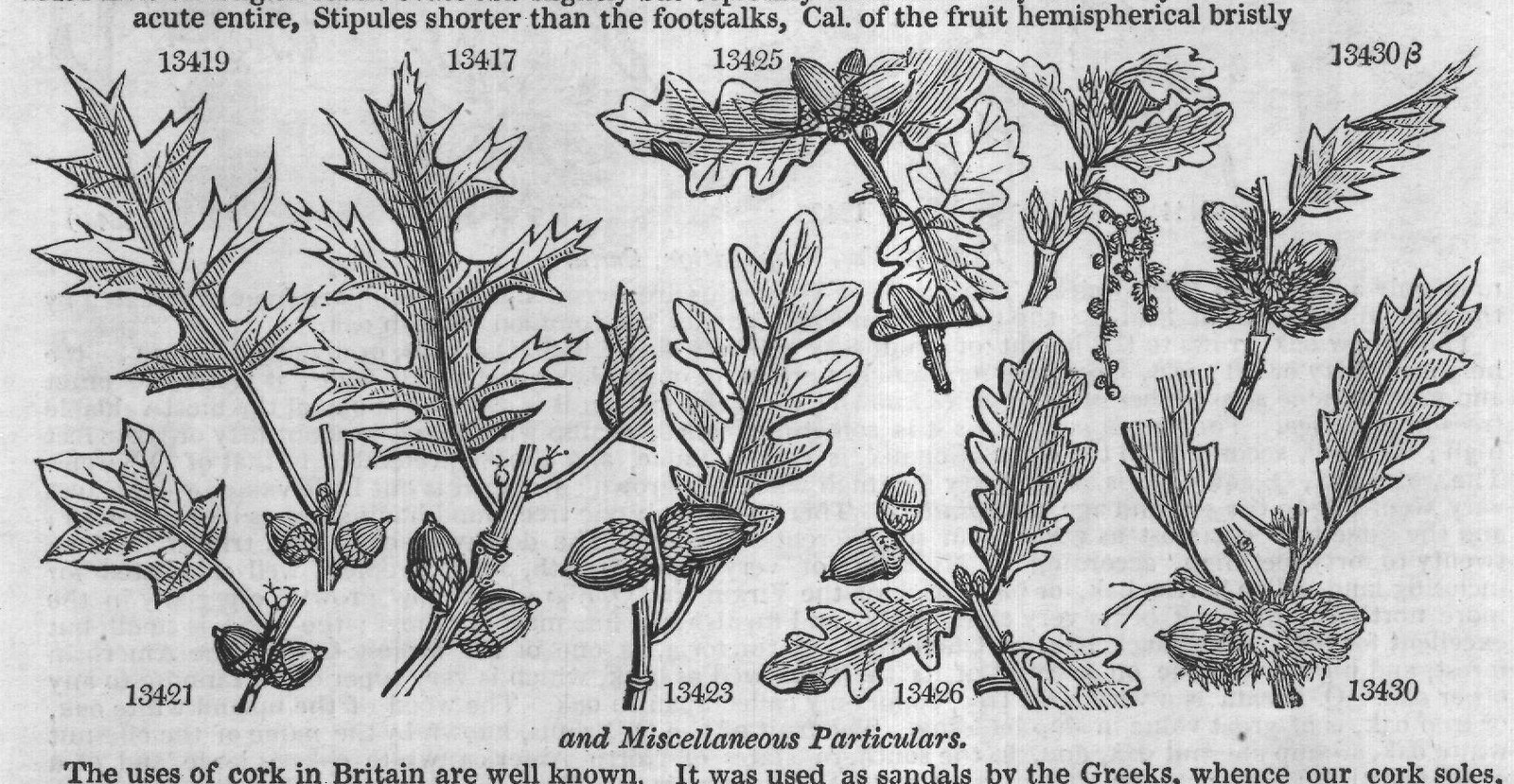
MONECIA POLYANDRIA. 13398 Leaves elliptic. with deep point. serratures downy beneath, Fruit racemose, Cal. hemispherical, Nut obl. 13399 Lvs. on short stalks obov. acutely and coarsely toothed at base glaucous ben. Cup hemispheric. Acorn ov. C. Leaves sinuated. 13400 Leaves oblong mucronate-toothed smooth on each side 13401 Leaves oblong coarsely mucronate-toothed smooth on each side cuneate at base, Branchlets hairy 13402 Lvs. on long. stalks obov. ac. somew. downy ben. with near. eq. serrat. Cal. of fr. contract. at base, Nut ov. 13403 Lvs. nearly sess. obovate downy and white beneath with very broad unequal teeth, Fruit in pairs on long bristle-pointed stalks, Calyx hemispherical, Nut oblong ovate 13404 Lvs. on shortish stalks obovate acute downy and white beneath with nearly equal dilated short blunt serr. 13405 Lvs. wedge-shaped smooth tapering at the base dilated and obscurely 3-lobed at the end: the middle lobe 13406 Lvs. obl. wedge-shaped smooth somew. sinuated 3-lobed at extrem. Lobes divaricated pointed: the middle Cal. hemispherical with rugged scales, Nut oblong ovate largest, Calyx nearly hemispherical, Nut roundish one largest, Forks of the vein downy beneath Cal. hemispherical, Nut round ovate 13407 Lvs. on long footst. obl. lanc. pointed somewhat downy ben. with numerous nearly equal dilated serratures, 13408 Lvs. wedge-shaped somew. cord. dilated very slightly 3-lobed at the end, smooth above rusty beneath, Cal. 13409 Lvs. wedge-shaped with 3 terminal bristly-pointed lobes: the midd. one longest downy beneath, Cal. of the fruit flattish, Nut nearly round hemispherical with membranous scales, Nut round ovate 13410 Leaves oblong sinuated downy beneath: lobes blunt; upper dilated 2-lobed, Cups hemispherical 13411 Leaves evergreen oblong-lanceolate undivided 3-lobed or sinuated smooth on both sides, Lobes pointed 13412 Lvs. downy ben. sinuat. with 3 or more somew. falc. brist.-point. lobes: term. one elong. jagg. Cal. hemisph. [undern. Nut globose 13413 Lvs. downy ben. obov. obl. dilat. wide. sinuat. Lobes short obt. slight. toothed bristle-point. Cal. of fruit flat 13414 Leaves downy beneath oblong pinnatifid toothed bristle-pointed, Calyx turbinate, Nut ovate 13415 Lvs. smooth obl. sinuat. on long stalks, Lobes ac. sharply tooth. bristle-point. Cal. of fr. flat undern. Nut ov. 13416 Lvs. on long stalks ovate lanc.or obl. entire or unequally lobed, Cup hemispherical, Acorn nearly globose 13417 Lvs. smooth obl. deeply and widely sinuated on long stalks, Cal. of the fruit turbinate as long as the nut 13418 Lvs. smth. obl. wedge-shap. at base deeply and widely sinuat. on short stalks, Cal. of fr. turbin. as long as nut 13419 Lvs. smooth obl. deeply and widely sinuated on long stalks, Forks of the veins densely woolly beneath, Cal. of the fruit flattened, Nut nearly globose 13420 Lvs. obl. lyr. downy ben.: term. lobe very large 3-cleft sinuat. Cal. of fr. hemisph. scaly fring. with bristles 13421 Leaves obovate cuneiform 3-5-lobed, Lobes setaceous mucronate downy beneath [elong. spread. scales 13422 Lvs. ov. obl. with bristle-pointed tooth-like lobes hoary ben. Cal. of fr. very large hemispherical with lanc. 13423 Lvs. obl. deeply pinnatif. glaucous ben. Lobes lin. obl. obt. ent. dilated upw. Fr. stalked, Cal. depress. warty ẞ Leaves slightly lobed green on each side [hemispherical 13424 Lvs. ov. obl. sinuat. smooth paler ben.: segm. bluntish somew. angular at base, Fruit nearly sess. Cal. scaly 13425 Lvs. decidu, oblong smooth dilated upwards stalked, Lobes obtuse, Stalks of fruit elongated, Nut oblong 13426 Leaves oblong subsessile smooth sinuated: lobes round, Fruit oblong stalked [Fruit nearly sessile 13427 Lvs. obl. obov. stalked sinuat. downy ben.: lobes obt. angul. wavy somew. heart-shap. and unequal at base, 13428 Leaves subsessile smooth oblong ovate pinnatifid sinuated blunt, Branches ascending 13429 Leaves softly villous deeply pinnatifid: segm. oblong blunt sinuated, Cups warted [hemisph. bristly 13430 Lvs. on very short stalks obl. deeply and uneq. pinnatif. hairy ben. Stip. longer than footst. Cal. of the fruit 13431 Lvs. on longish stalks ovate obl. slightly but copiously sinuated downy and hoary ben.: lobes short ovate acute entire, Stipules shorter than the footstalks, Cal. of the fruit hemispherical bristly 13430 β 13419 13417 13425 13421 13423 13426 and Miscellaneous Particulars. 13430 The uses of cork in Britain are well known. It was used as sandals by the Greeks, whence our cork soles, and probably the Venetian choppings (cioppini, Ital.), or shoes so high heeled, as to raise the women above the men. The poor people in Spain lay broad planks of it by their bed-side to tread on, as great persons use Turkey and Persian carpets to defend them from the floor; and sometimes they line the walls and insides of their houses built of stone with this bark, which renders them very warm, and corrects the moisture of the air. Both in Spain and Barbary bee-hives are made of cork; for this purpose, they roll the bark into a cylinder of five or six feet long, and six inches in diameter, boring holes for the entrance and exit of the bees, as in the Polish hive. (Encyc. of Gard. 1738.) Q. coccifera, Cusoja, Span., has prickly leaves like those of the holly, or Q. ilex, from this species is collected the kermes or scarlet grain, a little red gall, occasioned by the puncture of the Coccus ilicis. With these galls scarlet color was dyed, till the discovery of America, when another species of Coccus, the cochinillifer, was found in the Mexican woods upon the Cactus.
Q. phellos is remarkable for the form of the leaves, which differ in character from those of the rest of the species. Q. ilex, the holly, or holm oak, Chêne verd, Fr., Elice, Ital., and Enzina, Span., is a handsome evergreen tree, and the timber is supposed equal to that of the common oak. Q. gramuntia is thought by some MONECIA POLYANDRIA. 13432 Pseudo súber Desf. false Cork tm 40 my Ap 13433 olivæfórmis Ph. mossy-cup tm 50 my Ap S. Europe 1824. G co N. Amer. 1811. S h.l CLASS XXI.
Sant.itin. 156. t.4 Mich. arb. 2. t. 2 13434 lyráta Ph.
Swamp-post or 15 my Ap N. Amer. 1786. S h.l Mich. arb. 2. t. 5 2001. LIQUIDAM'BAR. W. LIQUIDAMBAR.
Amentaceæ.
Sp. 2. 13435 Styracíflua W.
Sweet-gum tm 60 mr.ap Ap 13436 imbérbe W. oriental or 6 ...
Ap 1759. L s.l N. Amer. 1683. S s.l Mi.ar.3.p.194.t.4 Levant 2002. PLA'TANUS. W. PLANE-TREE.
Amentaceæ. 13437 orientális W. oriental * tm 50 ap.my Ap Sp. 4-5.
Levant 1548. C co Dend. brit. 101 13438 cuneáta W. wave-leaved 13439 acerifólia W.
Maple-leaved or 6 ap.my Ap tm 70 ap.my Ap Levant 1739. C co Levant 1724. C co 13440 occidentális W.
American tm 70 ap.my Ap N. Amer. 1640. C co Dend. brit. 100 2003. SALISBU'RIA. L. T. SALISBURIA.
Amentaceæ. 13441 adiantifólia L. T. Maiden-hair-lv. or 20 ap.my Ap Sp. 1.
Japan 1754. C s.l Dend. brit. 168 2004. CARLUDOVICA. Fl. per. CARLUDOVICA.
Pandaneæ. 13442 angustifólia Fl. per. narrow-leaved or 3 W Sp. 3-5.
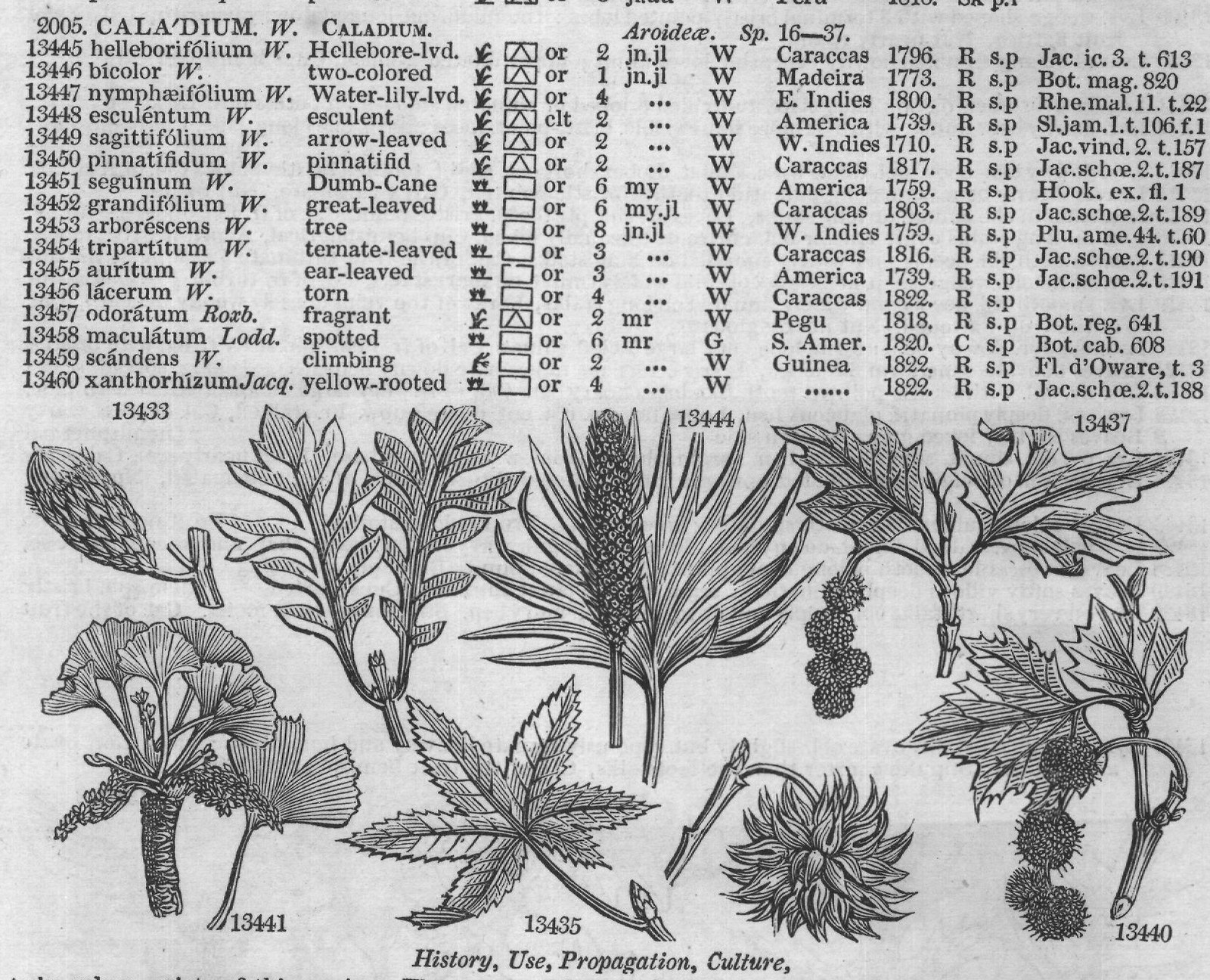
Peru ... 1818. Sk p.l 13443 latifólia Fl. per. broad-leaved or 3 jl.au W Peru 1818. Sk p.l 13444 palmáta Fl. per. palmate or 3 jl.au W Peru 1818. Sk p.l 2005. CALA'DIUM. W. CALADIUM. 13445 helleborifólium W. Hellebore-lvd. 13446 bícolor W.
Aroideæ. Sp. 16-37. or 2 jn.jl W Caraccas 1796. R s.p Jac. ic. 3. t. 613 two-colored or 1 jn.jl W 13447 nymphæifólium W. Water-lily-lvd. 13448 esculéntum W.
Madeira 1773. R s.p Bot. mag. 820 or 4 W ...
E. Indies 1800. R s.p Rhe.mal. 11. t.22 esculent clt 2 W ...
America 1739. R s.p Sl.jam.1.t.106.f.1 13449 sagittifólium W. 13450 pinnatifidum W. 13451 seguínum W. arrow-leaved or 2 ...
W W. Indies 1710. R s.p Jac.vind. 2. t.157 pinnatifid or 2 W ...
Caraccas 1817. R s.p Jac.schœ.2.t.187 Dumb-Cane or 6 my W America 1759. R s.p Hook. ex. fl. 1 13452 grandifólium W. 13453 arboréscens W. 13454 tripartítum W. 13455 aurítum W. great-leaved 业 or 6 my.jl W tree or 8 jn.jl W Caraccas 1803. R s.p W. Indies 1759. R s.p Jac.schœ.2.t.189 Plu. ame. 44. t.60 ternate-leaved or 3 W ...
Caraccas 1816. R s.p Jac.schœ.2.t.190 ear-leaved or 3 W ...
America 1739. R s.p Jac.schœ.2.t.191 13456 lácerum W. torn or 13457 odorátum Roxb. fragrant or 13459 scándens W. 13458 maculátum Lodd. 13460 xanthorhízum Jacq. yellow-rooted spotted or climbing or 2 4 W ... 2 mr W 6 mr G W ... or 4 W Caraccas 1822. R s.p Pegu 1818. R s.p S. Amer. 1820. C s.p Guinea 1822. R. s.p Fl. d'Oware, t. 3 Bot. reg. 641 Bot. cab. 608 Jac.schœ.2.t.188 13433 13444 13437 13441 13435 13440 History, Use, Propagation, Culture, to be only a variety of this species. The acorns of Q. esculus are sweet, and, it is said, are frequently eaten by the poor in the south of France: the tree very much resembles the common English oak. The willow oak grows to the height of about fifty or sixty feet. The Q. virens, or live oak, grows to the height of forty or fifty feet, spreading its branches, when in open places, extremely wide; it yields the finest and most durable ship-timber of any species known; for which reason it is considered one of the most valuable trees in America. The laurel-oak, or, as it is sometimes called, swamp willow oak, is about fifty or sixty feet high; its wood, according to the elder Michaux, is very valuable, and almost preferable to that of Q. virens. The water oak, Q. aquatica, is about forty feet high when full grown: its wood is but little valued. Its leaves vary according to the soil and age, ad infinitum. There is scarcely one tree found having leaves like the other; and the same tree is almost as variable in its different branches. The downy black oak, Q. triloba, is from twenty to forty feet high, according to Michaux, of very rapid growth, and extremely well calculated for inclosing land. The barren oak, or black jack of the Virginians, Q. nigra, is of low growth, especially in the more northern states; it bears very abundantly, and furnishes a fine mast for hogs; the wood is small, but excellent for fuel. The black oak, or Quercitron, Q. tinctoria, is one of the largest trees of the American forest, and highly valuable on account of its timber as well as bark, which is very superior for tanning to any other oak. Q. falcata is a very large tree, commonly called Spanish oak. The wood of the upland white oak, or iron oak, is of great value in ship-building. The fruit of the Q. Prinus, known by the name of the chesnut white oak, swamp chesnut oak, and, in the southern states of North America, white oak, is large, and of a sweet taste. The bark of the rock chesnut oak, Q. montana, is excellent for tanning. The yellow oak, Q. castanea, is a large and beautiful tree with eateable acorns. 2001. Liquidamba Liquidambar. From this tree flows a strong balsamic substance, which has been compared to ambergris, and named from Ambar, amber, and liquidum, fluid. L. styraciflua, in its general form and leaves, bears a considerable resemblance to the lesser Maple, (Acer campestre) as the wood is good timber and beautifully variegated. Between the wood and the bark issues a fragrant gum, which trickles from the wounded trees, and by the heat of the sun congeals into transparent drops, which the Indians chew as a preservative to their teeth. It smells like the balsam of Tolu. The species are propagated by layers, or from seeds. The sweet gum-tree, or Liquidambar styraciflua, is sometimes found of an immense size, particularly in the southern states; its wood is of an exquisite hard texture and fine grain, and furniture made of it has a handsome appearance. 2002. Platanus. From πλaτuς, ample, broad, in allusion to the shadow afforded by the foliage. The species are trees of peculiar grace and elegance, and from that circumstance, and the classical associations attached to trees of peculiar grace and elegance, and from that circumstance, and the classical associations attached to them, they are eminently adapted for pleasure grounds. The chenar, or eastern plane, is very much employed ORDER VII.
MONECIA POLYANDRIA. 13432 Leaves oblong sinuate serrated downy beneath, Bark fungous 13433 Lvs. obl. smooth glaucous ben, deeply and unequally pinnatif. Fruit ellipt.-ovate, Cal. cup-shaped fringed 13434 Lvs. obl. deeply sinuated smooth much contracted in the middle: lobes acute; the upper ones dilated angular and abrupt, Calyx of the fruit globose muricated nearly covering the nut 13435 Leaves palmate-lobed, Recesses at the base of the veins villous 13436 Leaves palmate-lobed, Recesses at the base of the veins smooth 13437 Leaves 5-lobed palmate cuneate at base, Segm. lanceolate sinuated, Stipules nearly entire 13438 Leaves 3-5-lobed toothed cuneate at the base smoothish 13439 Leaves cordate 5-lobed remotely toothed truncate at base 15440 Leaves 5 angular obsoletely lobed toothed cuneate at base downy beneath 13441 The only species 13442 Fronds forked: segments ensiform narrow, Stems round 13443 Fronds forked: segments lanceolate, Stems channelled 13444 Fronds flabelliform 3-5-parted 13445 Stemless, Leaves pedate entire, Spadix as long as spathe [contracted in the middle 13446 Stemless, Lvs. pelt.-cordate sagittate colored in the disk, Spadix shorter than the hooded spathe, which is 13447 Stemless, Lvs. peltate -cordate sagittate, Spadix longer than the cylindrical spathe sagittate at end 13448 Stemless, Leaves peltate-cordate, Spadix shorter than ovate-lanceolate spathe 13449 Stemless, Leaves sagittate acuminate, Spadix shorter than ovate-cucullate spathe 13450 Stemless, Leaves pinnatifid 13451 Caulescent suberect, Leaves oblong cuspidate, Spadix shorter than oblong spathe 13452 Caulescent rooting, Leaves cordate sagittate, Spadix as long as the cucullate ovate spathe 13453 Caulescent erect, Leaves sagittate, Spadix shorter than the cucullate ovate spathe 13454 Caulescent rooting, Leaves ternate, Petioles naked, Spadix as long as the cucullate ovate spathe 13455 Caules. root. Lvs. tern.: lat. leaflets eared at base on outside, Petiol. winged bel. Spad. shorter than spathe 13456 Caulescent rooting, Leaves cordate sinuate 13457 Caulescent, Leaves cordate with rounded lobes, Spadix as long as cymbiform spathe 13458 Caulescent suberect, Leaves oblong acuminate cuspidate cordate at base finely spotted with clear white 13459 Caulescent scandent, Leaves ovate oblong acuminate, Spadix longer than cucullate spathe 13460 Caules. erect, Lvs. cord, sagittate , Spadix shorter than spathe, which is cucullate and contracted in middle 13446 13459 13449 13458 13450 13457 and Miscellaneous Particulars. 13448 13460 in the gardens of Persia and India; it was highly esteemed by the Greeks and Romans, and was planted near their houses in the form of avenues and groves. Groves of these trees are still equally revered in India, and are commonly found near the native temples and burial places of the princes. The timber is considered of similar quality to that of sycamore. All the species are of easy culture by layers, and they will also grow by cuttings.
The Platanus occidentalis is known in America by the name of the button-wood, water beech, sycamore, and plane-tree; in Canada it is called cotton-tree. It is, perhaps, the largest tree in North America; on the plane-tree; in Canada it is called cotton-tree. It is, perhaps, the largest tree in North America; on the fertile banks of the Ohio and Mississipi there are trees measuring from ten to sixteen feet in diameter. 2003. Salisburia. So called in honor of Richard Anthony Salisbury, F. R. S., a modern distinguished botanist. A large tree remarkable for its fan-shaped leaves, cloven like some of the Adiantum species. The fruit is a pale large tree remarkable for its fanshaped leaves, cloven like some of the Adiantum species. The fruit is a pale brown drupe of a globular form; it has never been produced in this country, though there are trees of a considerable size. The fruit is yellow when ripe , with a fleshy, juicy, white pulp, adhering closely to the drupe, which is like that of an apricot. The kernel is white, rather firm, sweet, with a mixture of austerity or bitterness when raw, but agreeable when roasted. Dr. Abel says, he saw the fruit exposed in the markets in China, but could not find out to what purpose it was applied. 2004. Carludovica. Named by the authors of the Flora Peruviana, in honor of Charles IV., king of Spain, and Luiza, his queen; both of whom were noble patrons of botany, and deserving of a finer genus to Luiza, his queen; both of whom were noble patrons of botany, and deserving of a finer genus to commemorate their virtues.
The species are low palm-like herbs, of little beauty, but of great botanical interest. 2005. Caladium. A name originally employed by Rumphius, to designate some species of Arum, and revived by Ventenat. Its meaning is unknown. The species have the appearance of Areca, and are only cultivated for their singularly spotted stems , or neat green leaves, which are rarely disfigured by any of the accidents to which other stove plants are liable. The species are plants of the same general appearance as Arum. C. sagittifolium, Chou- Arum. C. sagittifolium, Chou-de-Bresil, Fr., and Essbare Arum, Ger., bears a near resemblance to Arum - Bresil, Fr., and Essbare Arum, Ger., bears a near resemblance to Arum Colocasia, and is carefully cultivated in the West Indies for the leaves, which are boiled and eaten as coleworts, being extremely pleasing to the taste . The roots are also eaten there, but they are in less esteem than the leaves. This is generally supposed to be the species of the Arum family the most universally cultivated. is found in the East and West Indies, China, Japan, New Zealand, and the South Sea Islands. The root is extremely acrid, and when eaten raw, will excoriate the mouth; but baked in hot ashes, it looses its acrimonious quality, and becomes mild and well tasted; it is, however, heavy on a weak stomach, and is apt to occasion costiveness. The leaves , which are very soft, glaucous, and covered with a very fine silky nap, are used in many places instead of plates and dishes.
It MONECIA POLYANDRIA. 2006. A'RUM. W.
ARUM.
Aroideæ.
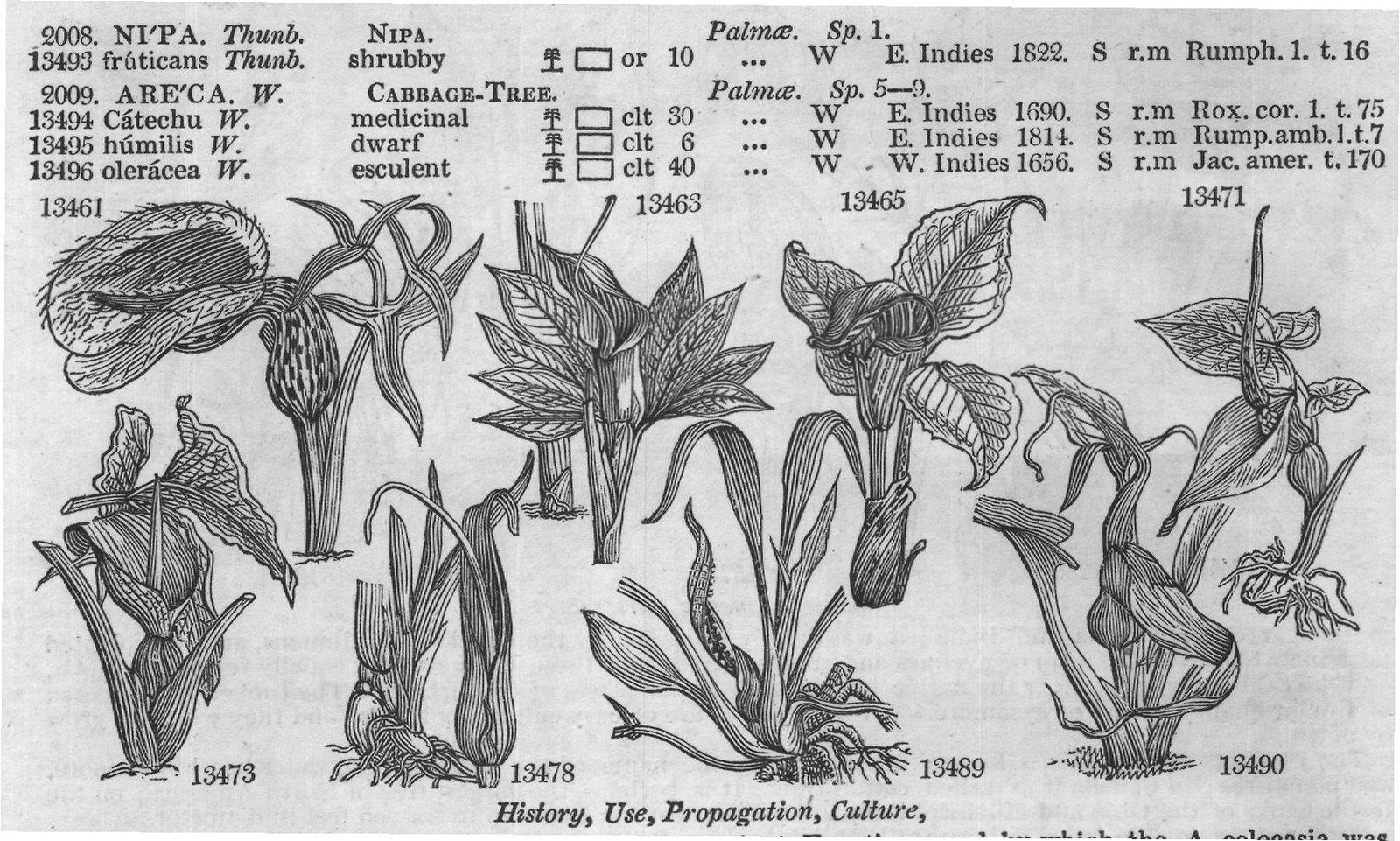
Sp. 30-45. 13461 crinítum W. 13462 Dracúnculus W. 13463 Dracóntium W. hairy-sheathed Comm. Dragon Green Dragon cu 1 mr.ap Br or 3 jn.jl Br or 2 jn G Minorca 1777. R 8.1 S. Europe 1548. R s.l N. Amer. 1759. R s.l CLASS XXI.
Bot. reg. 831 Mor. s. 13.t.5.f.46 Bot. reg. 668 13464 venósum W. purple-flower'd cu 1 mr Pu 1774. R s.l 13465 triphýllum W. 13466 atrorúbens W. 13467 ternátum W. 13468 Colocásia W. 13469 macrorhízon W. 13470 divaricátum W. 13471 trilobátum W. 13472 maculátum W. 13473 orixénse R. Br.
Japan long-rooted common Orixian three-leaved cu my.jn Br N. Amer. 1664. R s.l Bot. mag. 950 purple-stalked cu 1 jn.jl Br N. Amer. 1758. R s.l Pluk.al. t. 148.f.6 cu my.jl Pu Japan 1774. R s.l Egyptian cul 2 G ... cu 2 G ... divaricated cu 2 jn.jl G three-lobed cu 1 my.jn Pu W 1 my.jl W or 1 au.o Pu 13474 itálicum W.
Italian or 14 my.jn L.Y Italy 13475 minútum W. small cu my.jl Pu Levant 1551. R s.p E. Indies 1803. R s.p E. Indies 1759. R s.p Ceylon 1714. R s.p Britain sha.pl. R co E. Indies 1802. R s.p 1683. R co E. Indies 1812. R co Herm. parad. 73 Rhe.mal.11. t.20 Bot. mag. 339 Eng. bot. 1298 Bot. reg. 450 Bot. mag. 2432 Rhe.mal. 11. t.17 13476 virgínicum W.
Virginian cu 1 jn.jl R 13477 Arisárum W.
Friar's Cowl cu 1 ap.jn L.Y N. Amer. 1759.
S. Europe 1596.
R s.p R. s.I Jac.schœ.2.t.192 1348 tenuifólium W.
Grass-leaved cu 1 ap.jn W S. Europe 1570.
Rs.p Bot. reg. 512 13479 cucullátum Lour. hooded cu 2 China G 1824. R. s.p ... 13480 índicum Lour.
Indian 业 cu 5 Br China 1824. R s.p ... 13481 obtusilóbum Link. blunt-lobed or 2 1824. R 1.p ... ... 13482 sagittifólium Link. arrow-headed or 2 ... ... ...... 1824. R l.p 13483 vivíparum Lodd. viviparous or 1½ my G ...... 1817. R 1.p Bot. cab. 281 13484 integrifólium Link. entire-leaved or 3 my.jn G ...... 1825. R l.p 13485 ramósum Link. branched or 3 my.jn ... ...... 1810. R l.p 13486 hederáceum W.
Ivy-leaved cu 6 my.jn Pu 13487 lingulátum W. 13488 bulbíferum B. M. tongue-leaved bulb-bearing cu 6 ... ...
W. Indies 1793. R 1.p W. Indies 1793. R l.p or 3 my Pa 13489 spirále W. spiral or 1 my Br Bengal China 13490 flagellifórme Lodd. whip-lash cu 1 my Br Bengal 1813. R l.p 1816. R l.p 1819. R l.p Jac. amer. t. 152 Plum. ic. 26. t.37 Bot. mag. 2072 Bot. mag. 2220 Bot. cab. 396 2007. CARYOTA. W. 13491 úrens W. 13492 mítis Lour.
CARYOTA. torn-leaved unarmed Palma. Sp. 2-3. 토토 or 20 W ... or E. Indies 1788. Sr.m Rhee.mal.1. t.11 1820. Sr.m China ...
MONADELPHIA.
Palmæ. Sp. 1. 2008. NI'PA. Thunb. 13493 frúticans Thunb. 2009. ARECA. W. 13494 Cátechu W. 13495 húmilis W. 13496 olerácea W. 13461 NIPA. shrubby CABBAGE-TREE. medicinal dwarf esculent 至至更 13473 13478 or 10 W ...
E. Indies 1822. Sr.m Rumph. 1. t. 16 Palmæ. Sp. 5-9. clt 30 W ...
E. Indies 1690.
Sr.m Rox. cor. 1. t. 75 clt 6 W ...
E. Indies 1814.
S r.m Rump.amb.1.t.7 clt 40 W ...
W. Indies 1656.
Sr.m Jac. amer. t. 170 13463 13465 13471 13489 13490 History, Use, Propagation, Culture, 2006. Arum. Formerly aron; supposed to be an ancient Egyptian word by which the A. colocasia was known. The last mentioned name is an alteration of its Arabic denomination qolqâs, according to Forskahl. denomination qolqas, according to Forskahl.
Perennial herbaceous plants, mostly natives of hot climates. The roots are fleshy, hot, and acrid, but in many species eatable they are generally without stems, and altogether, with the Caladiums, form a very singular family. A. Dracunculus, Serpentaire, Fr., Drachenwarz, Ger., and Dracunculo, Ital., is a very remarkable plant the stalks of the leaves being spotted with brown and purple, like the belly of a snake. The flower, which, like others of the genus, has a very singular appearance, smells so strongly of carrion, that few persons can endure it. It might be used in medicine and domestic economy for the same purposes as A. maculatum. A. Colocasia has a tuberous thick large oblong root, and leaves resembling those of the water-lily. In Egypt and the Levant, this plant is esteemed a wholesome food, though not very delicate. The roots and petioles are boiled, and the leaves when young are sometimes eaten raw. A. trilobatum, and various others, are similarly used in the West Indies. There and in Europe the culture of all the species is of the simplest kind .
A. maculatum, Gouet, Fr., Aronswartzel, Ger., and Aro, Ital., has a tuberous whitish root about the size of a large nutmeg, which is used both as food and medicine. On tasting them, they seem to be merely mucilaginous and insipid, but they soon affect the tongue with a pungency as if pricked by needles; this uneasy sensation may be alleviated by milk, butter, or oil. The acrimony is lost in drying, and the roots become farinaceous, insipid, and fit for boiling or baking. In the Isle of Portland, where the plant is very abundant, the roots are generally eaten by the country people; they are macerated, steeped, and the powder so obtained is dried and sent to London, and sold under the name of Portland sago. Medicinally, the root in its recent state is stimulant, diaphoretic, and expectorant. Though retained in the Materia Medica, it is seldom used. The berries which succeed the flower are devoured by birds; and Mr. Curtis thinks, that even the roots are eaten by them, particularly pheasants. Dried and powdered, they are used by the French as a wash for the skin, under the name of cypress powder. 2007. Caryota. The Greeks gave this name to a kind of cultivated date. Pliny says, it was so called, ORDER VII.
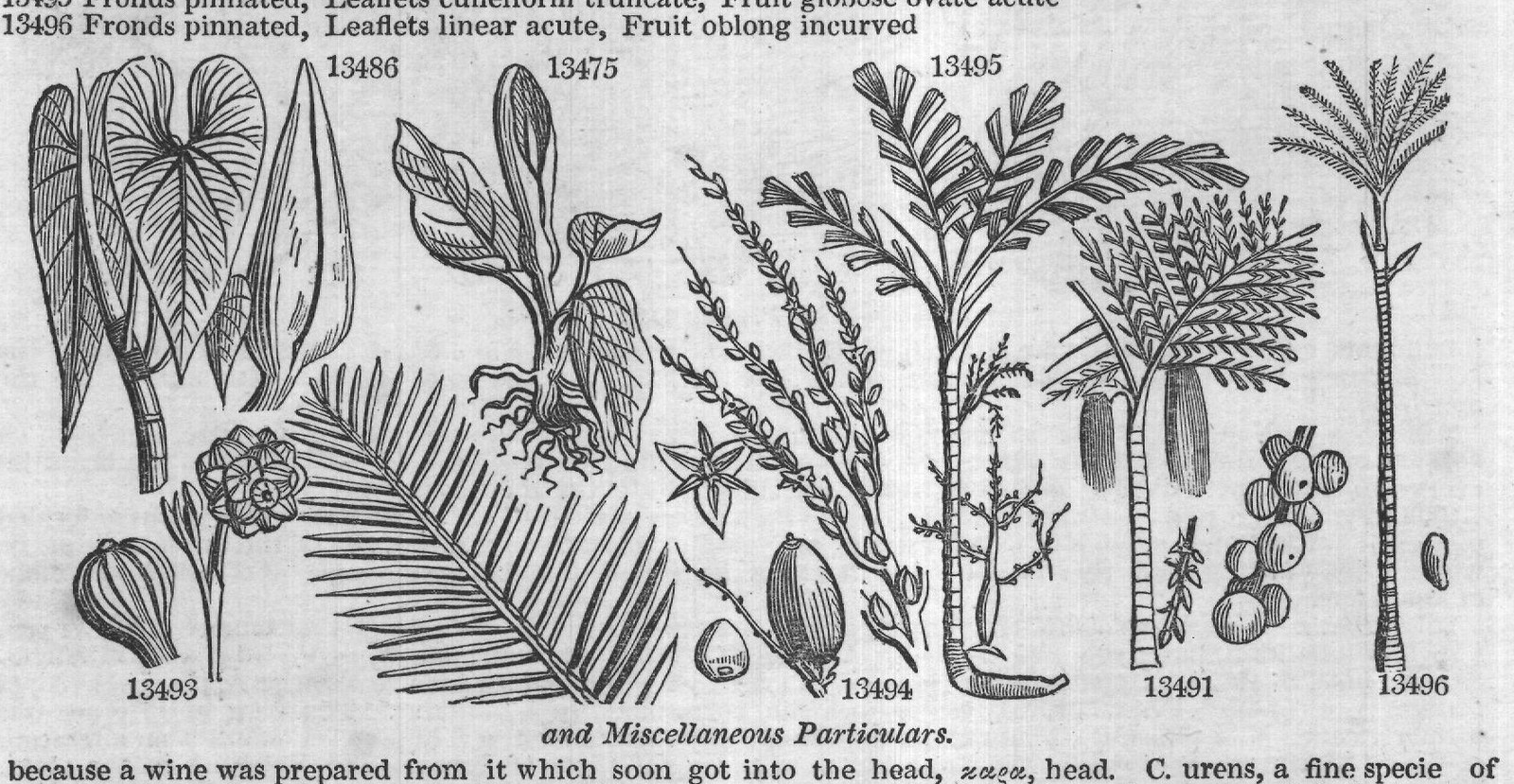
MONECIA POLYANDRIA. 13461 Leaves pedate entire, Spadix cylindrical shorter than ovate flat spathe, which is hairy inside 13462 Leaves pedate entire, Spadix lanceolate shorter than the ovate flat smooth spathe 13463 Leaves pedate entire, Spadix subulate longer than the oblong convolute spathe 13464 Leaves pedate entire, Spadix shorter than lanceolate spathe 13465 Stemless, Leaves ternate entire, Spadix clavate shorter than ovate acuminate flat stalked spathe 13466 Stemless, Leaves ternate ovate twice as short as spadix 13467 Stemless, Leaves ternate, Spadix longer than spathe 13468 Stemless, Leaves peltate ovate repand emarginate at base 13469 Stemless, Leaves paltate cordate repand 2-parted at base 13470 Stemless, Leaves cordate hastate, Spadix subulate longer than the reflexed ovate-lanceolate spathe 13471 Stemless, Leaves sagittate 3-lobed, Flowers sessile 13472 Leaves all radical hastato-sagitate: lobes deflexed, Spadix club-shaped obtuse shorter than the spathe 13473 Leaves hastate 3-parted, Spathe stalked 2-colored longer than spadix: the end lanceolate and deflexed 13474 Stemless, Lvs. veiny with white hastate sagit.: lobes auricled diyaricating, Spad. clav, shorter than spathe 13475 Stemless, Lvs. hastate sagittate mucronate: lobes deflex. Petioles dotted, Spad, cylind. shorter than spathe 13476 Stemless, Leaves hastate cordate acute: angles obtuse [cucullate spathe 13477 Stemless, Lvs. hast. sagittate mucron. : lobes deflexed oblong obtuse, Spadix cylind. incurved shorter than 13478 Stemless, Leaves linear-lanceolate, Spadix subulate longer than lanceolate spathe 13479 Caulescent erect, Leaves peltate cordate: auricles cucullate 13480 Caulescent suberect, Leaves ovate bifid at base rounded, Spadices axillary 13481 Caulescent, Leaves peltate cordate acute cut out at the base with a wide recess 13482 Leaves sagittate acute rounded at base 13483 Leaves peltate cordate sagittate, Spathe roundish oblong acute, Spadix obtuse much shorter than spathe 13484 Leaves lanceolate acute entire, Edge of petiole sheathing, Spathe cucullate 13485 Leaves peltate cordate 13486 Caulescent rooting, Leaves cordate oblong acuminate, Petioles round 13487 Caulescent creeping, Leaves cordate lanceolate, Petioles with a membranous edge 13488 Stemless, Leaves decompound bulbiferous, Spadix oblong ovate shorter than the obtuse veiny spathe 13489 Stemless, Leaves linear lanceolate, Spadix lanceolate shorter than the oblong lanc. spirally twisted spathe 13490 Steml. Lvs. ov. ent. or 3-lob. Spathe urceol. at base: reflex, and taper-point. at end, Spadix length of spathe 13491 Unarmed fronds bipinnate, Leaflets cuneiform obliquely bitten off 13492 Fronds bipinnate, Petioles nodding, Fruit 1-seeded MONADELPHIA. 13493 Frond pinnated, Female flowers terminal capitate: male lateral with dichotomous peduncles 13494 Fronds pinnated, Leaflets plaited terminal bitten off, Stems and spadices smooth 13495 Fronds pinnated, Leaflets cuneiform truncate, Fruit globose ovate acute 13496 Fronds pinnated, Leaflets linear acute, Fruit oblong incurved 13493 13486 13475 D 13494 13495 13491 13496 and Miscellaneous Particulars. because a wine was prepared from it which soon got into the head, κaρa, head. C. urens, a fine specie of palm, produces flowers in long pendulous spikes, which are succeeded by strings of succulent globular berries, dark red when ripe, with a thin skin, soft pulp, and very sharp and acrid to the taste. In Ceylon, it yields a sort of liquor, sweet, wholesome, and no stronger than water. It is taken from the tree twice or thrice a day, and an ordinary tree will yield three or four gallons. They boil this liquor, and thus make a kind of brown sugar of it, called Jaggory. The fruit is not eatable. When the tree has come to maturity, there comes out a bud from the top; this bud they cut and prepare by putting salt, pepper, lemons, garlick, leaves, &c. over it, which keep it from ripening. They daily cut off a thin slice from the end, and the liquor drops into a vessel, which they set to catch it. The buds, like those of the Cocoa and Betel-nut, are excellent in taste, resembling walnuts or almonds. C. mitis is a very beautiful palm, with fronds four feet long and a branched spike of flowers, succeeded by berries, round, coriaceous, smooth, black, the size of a musket bullet, but not eatable. Both species grow freely in sandy loam. 2008. Nipa. The name given to this fine palm in the Moluccas. 2009. Areca. The name which this palm bears in Malabar is, when it is an old tree, Areec; when young it is called Paynga. A. Catechu produces the nut which is cut in slices, wrapped in the aromatic leaves of the betel-pepper, and chewed as we do tobacco. These leaves are previously covered with a thin layer of shelllime (Ehunam), to preserve the flavor longer in the mouth. In most parts of the East Indies the natives are continually chewing it, swallowing their saliva tinctured with the juice, and spitting out the rest. The inside of their mouths appears as red as blood, and it gives their teeth a dark color: but it preserves the teeth, sweetens the breath, and is a stomachic and diuretic. This palm is very generally cultivated in the East Indies.
A. oleracea is the highest of the American palms, and is very distinct from the East Indian Areca. The sheaths of the leaves are very close, and form the green top of the trunk a foot and a half in length. The 3 F 13497 criníta W.
MONECIA MONADELPHIA.
CLASS XXI. hairy-coated 13498 lutéscens W. yellow or 20 or 20 W I. France 1824. S r.m W I. France 1824. S r.m 2010. BELIS. Salisb.
BELIS.
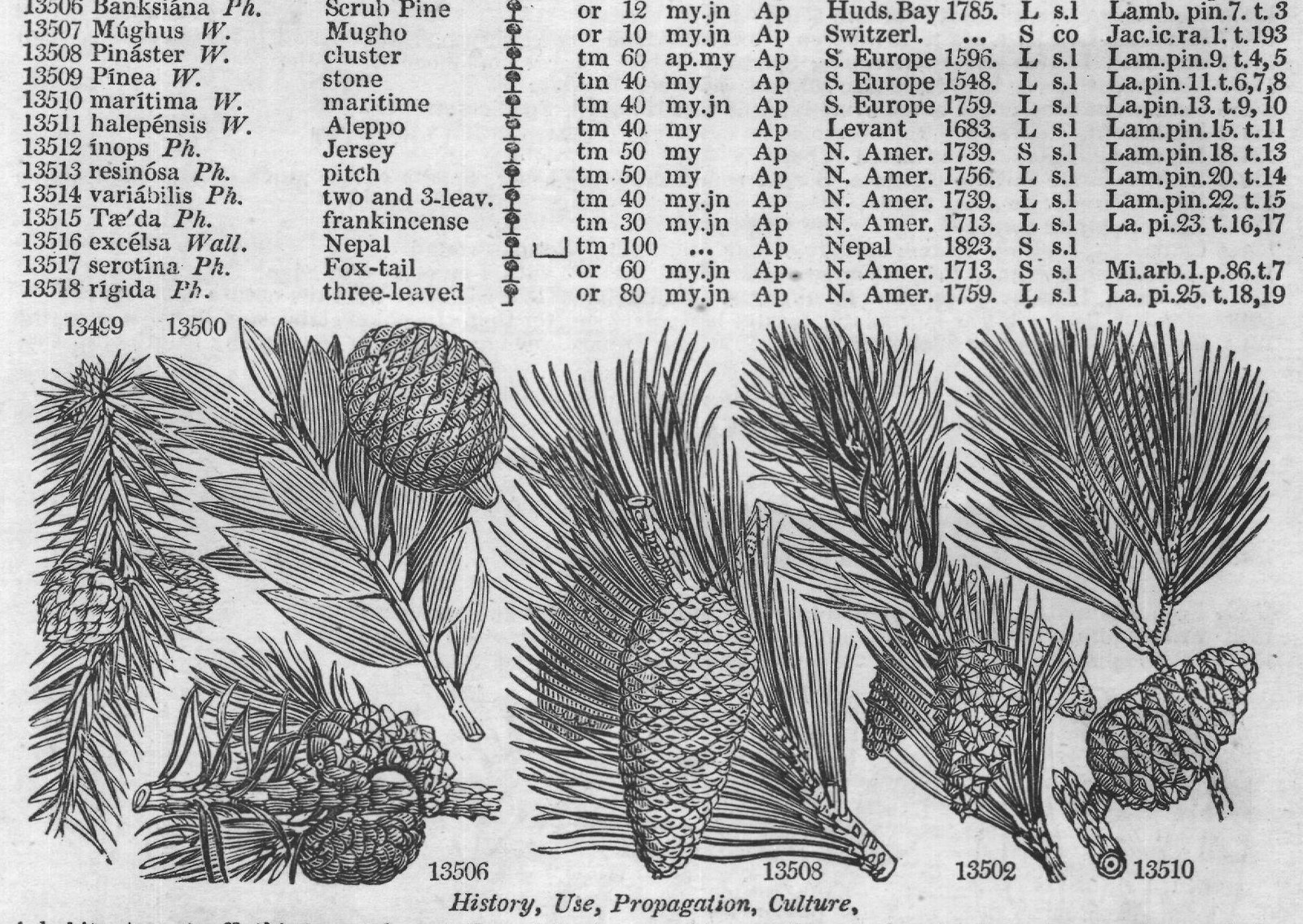
Coniferæ. Sp. 1. 13499 jaculifólia Salisb. lance-leaved 오or 20 Ap China 1804. C p.1 Lam.pin.52. t.34 Pinus lanceolata 2011. A'GATHIS. Salisb. DAMMAR PINE. 13500 loranthifólia Salisb. common Coniferæ. Sp. 2-?. 오 or 30 ...
Ap Amboyna 1804. C p.1 Rumph. 2. t. 57 Pinus Dam'mara 13501 austrális Hort.
Kawrie Pine tm 100 ...
Ap. N. Zeal. 1821. C p.l 2012. PINUS. W.
PINE.
Coniferæ. Sp. 22-27. 13502 sylvéstris W. 13503 Pumílio W.
Scotch dwarf 13504 Larício P. S. 13505 púngens Ph 13506 Banksiána Ph. 13507 Múghus W. 13508 Pináster W. 13509 Pínea W. 13510 marítima W. 13511 halepénsis W. 13512 inops Ph.
Corsican pungent Scrub Pine Mugho cluster stone maritime 어어어어 tm 80 my Ap or 20 ap.my Ap Scotland sc.alp. S s.1 Lamb. pin. 1. t. 1 Carniola 1779. S s.1 Lamb. pin.5. t. 2 tm 80 ...
Ap tm 40 ...
Ap or 12 my.jn Ap or 10 my.jn Ap Switzerl. ...
Sco Corsica 1814. S s.l N. Amer. 1804. L s.l Huds. Bay 1785. L s.l Jac.ic.ra. 1. t. 193 Mi.arb.1.p.61.t.5 Lamb. pin.7. t. 3 tm 60 ap.my Ap S. Europe 1596.
L s.l Lam.pin.9. t.4,5 tin 40 my Ap S. Europe 1548.
L s.l La.pin.11.t.6,7,8 tm 40 my.jn Ap S. Europe 1759.
L s.l La.pin. 13. t.9, 10 Aleppo tm 40 my Ap Levant 1683. L s.l L s.1 Lam.pin. 15. t.11 Jersey tm 50 my Ap N. Amer. 1739. S s.l Lam.pin.18. t.13 13513 resinósa Ph. pitch tm 50 my Ap N. Amer. 1756. L s.l Lam.pin.20. t.14 13514 variábilis Ph. two and 3-leav. tm 40 my.jn Ap N. Amer. 1739. L s.l.
L s.1 Lam.pin.22. t. 15 13515 Tæ'da Ph. frankincense tm 30 my.jn Ap N. Amer. 1713. L s.l La. pi.23. t. 16,17 13516 excélsa Wall. 13517 serotína Ph. 13518 rígida Ph. 13499 13500 Nepal tm 100 ...
Ap Nepal 1823.
S s.l Fox-tail or 60 my.jn Ap.
N. Amer. 1713. S s.l S s.1 Mi.arb.1.p.86.t.7 three-leaved or 80 my.jn Ap N. Amer. 1759. s.l La. pi.25. t.18,19 13506 13508 13502 13510 History, Use, Propagation, Culture, inhabitants cut off this top, take out the white heart of two or three inches in diameter, consisting of the leaves closely folded together, and eat it, either raw with pepper and salt, or fried with butter like the artichoke. 2010. Belis. Named by R. A. Salisbury, in the Transactions of the Linnean Society, from βελoς, a javelin, on account of the form and texture of the leaves, which are not unlike a javelin head. B. lanceolata is a beautiful evergreen shrub, with distichous neat leaves, easily cultivated in any good conservatory. 2011. Agathis. From aγaθiς, a cluster, because the flowers are collected in clusters. This genus is formed of the Dammar Pines, of which the A. australis, or New Zealand Cowdie Pine, is one of the finest trees in the world, often growing perfectly straight to the height of 100 feet or more, and yielding one of best descriptions of wood for masts. 2012. Pinus. This name is of Celtic origin, and is the same in all the dialects of that tongue. Pin or pen, a rock or mountain, has given rise to pin, in Armorican; peinge, in Erse; pinua, in Welsh; pinu, in Anglo- Saxon; pine, in English; pynbaum, in German; all signifying the fir-tree: hence also the Appennines (Alpes pennines), Pennafiel, Pennaflor, &c. towns of Spain embosomed in mountains. The fruit of P. Pinea was formerly called Nux pinea, the pine nut. Pinaster is Pliny's name for the wild pine. Cembra is an alteration of the word cembro or cirmolo, the name given by the inhabitants of Trentin and Valteline to the plant. Tæda is derived from the Greek δaς δaδoς, which signifies a torch, for which the wood of P. tæda is particularly adapted. Strobus is a name employed by Pliny for an eastern tree, which was used to perfume apartments. The moderns have applied it to a noble North American species. The trees which compose this genus are not less remarkable for their grandeur and beauty, than for their valuable timber. They are all evergreens, and of lofty and erect growth. The trunk of the Scotch pine is more generally employed and more universally applicable as timber than any other tree in the temperate zone of the northern hemisphere. P. sylvestris, Pin, Fr., Keifer or Föhre, Ger., and Pina, Ital., is erroneously called a fir; and has the term Scotch applied to it, because it is the only species of the genus indigenous to Britain, and there only in the northern parts of Scotland. It is also indigenous in the Alps, in the north of Germany, Russia, and abundantly so in Sweden and Norway. The finest pine woods in Britain, are at Invercauld in Inverness-shire, and Gordon Castle in Aberdeenshire. The timber of the Scotch pine is the red or yellow deal of the north of Europe, and is the most durable and valuable of any of the genus, unless we except, in point of durability, the larch. That grown in cold elevated situations in the highlands of Scotland, is found to be not inferior in quality to any imported from Norway; but that which has been planted in the low districts, is greatly inferior in point of durability, and can seldom be used in house carpentry and joinery. The tree is of great value as a nurse plant to others less hardy. The trunk of the tree produces resin by incision, and the roots tar by distillation. Several varieties of the wild pine have been noticed by botanists. According to Sang, the variety commonly cultivated is least worth the trouble. "The P. sylvestris, var. montana," he says, " is the variety which yields the red wood: even young trees of this sort are said to become red in their wood and full of resin very soon. The late Mr. Don, of Forfar, exhibited specimens of cones of each variety to the Highland Society of Scotland, and likewise to the Caledonian Horticultural Society. The variety preferred by Don, is distinguished by the disposition of its branches, which are remarkable for their horizontal direction, and for a tendency to bend downwards close to the trunk. The leaves are broader and shorter than in the common kind, and are distinguishable at a distance by their much lighter and beautiful glaucous appearance. ORDER VIII.
MONECIA MONADELPHIA. 13497 Fronds pinnated, Stems hirsute, Spadixes branched spiny, Spines incurved 13498 Fronds pinnated, Leaflets plaited bitten off, Stems and spadixes branched smooth, Fruit roundish gibbous 13499 Leaves solitary lanceolate flat spreading, Cones round, Scales acuminate 13500 Leaves elliptical lanceolate striated 13501 Leaves ovate oblong smooth not striated 13502 Leaves in pairs rigid, Cones conico-ovate acute as long as the leaves, generally in pairs 13503 Leaves in pairs, Trunk ascending, Cones ovate erect 13504 Lvs. twin very long of two forms, Cones ovate, Scales narrowed at base very thickened at end not angular 13505 Leaves twin short acute, Cones ovate conical, Prickles of scales long subulate incurved: lower reflexed 13506 Leaves twin divaricating oblique, Cones recurved twisted, Crest of anthers dilated 13507 Leaves double or triple rigid, Cones oblong generally in pairs rounded at base 13508 Leaves twin roughish at edge, Cones oblong conical shorter than leaf narrowed at base, Scales echinate 13509 Leaves twin: the first ciliated, Cones ovate blunt somewhat unarmed longer than leaf, Nuts hard 13510 Leaves twin very fine, Cones ovate-conical very smooth solitary stalked 13511 Leaves twin, Cones ovate-conical rounded at base somewhat shorter than leaf, Scales blunt 13512 Leaves twin, Cones oblong-conical the length of leaves solitary rounded at base, Scales echinate 13513 Leaves twin, Cones ovate-conical rounded at base solitary half as short as leaves, Scales unarmed 13514 Leaves twin or ternate, Cones ovate-conical subsolitary, Prickles of scales incurved 13515 Leaves long, Cones deflexed: spines inflexed, Sheath of leaves long 13516 Leaves in 5s very long slender lax toothletted, Cones cylindrical smooth pendulous longer than leaves 13517 Leaves 3 very long, Cones roundish ovate mucronate 13518 Leaves 3, Cones ovate clustered, Spines of scales reflexed, Sheath of leaves short 13514 13512 13511 13515 13513 13509 and Miscellaneous Particulars.
The bark of the trunk is smoother than in the common kind. The cones are thicker, and not so much pointed. The plant is more hardy than the common sort, grows freely in almost any soil or situation, and quickly arrives at a considerable size."
P. laricio is said to be nearly allied to the Scotch pine, but a much handsomer and finer tree. Professor Thouin considered it equally hardy with P. sylvestris; its wood is more weighty and resinous, and consequently more compact, stronger, and flexible. It grows wild on the summits of the highest mountains in Corsica . P. resinosa, the red Canadian pine, is not unlike the Scotch pine, but rather redder in the bark. The timber of this tree is frequently imported as masts, and is considered valuable. Grown on a damp_and fertile soil , it is much less durable than from elevated situations; it is equally hardy with P. sylvestris. P. pinaster is a grand and picturesque tree, and is a great favorite with the Roman and Florentine painters. The timber is of less value than that of any of the others that have been mentioned; in Switzerland it is cut into shingles for covering their houses. It is highly deserving of culture as an ornamental tree, but not for timber. P. Pinea is very common in the south of Italy; there is an immense forest of them at Ravenna, and they are much planted in the gardens of the villas of Rome and Florence. The seeds of this and the last species are eaten throughout Italy, both by the poor and rich. They are as sweet as almonds, but with a slight flavor of turpentine. The wood is not so resinous as that of most of the other sorts, and the tree can only be considered as deserving culture for its pictorial effect. P. Cembra, the Tannenbaum of Lord Byron (Childe Harolde), and the Aphernousli pine of Harte (Essays), grows higher up the Alps than other pines, and is even found at elevations where the larch will not grow. The wood is very soft, and having scarcely any grain, is very fit for the carver. The peasants of the Tyrol, where this tree abounds, make various sorts of carved works with the wood, which they dispose of in Switzerland among the common people, who are fond of the resinous smell which it exhales.
P. Tæda has longer leaves than the wild pine, and larger cones than P. Pinea; the timber is like that of the Scotch pine, but has more resin. There are a number of these trees at Woburn Abbey, which grow as freely as the Scotch pine, and the timber, as far as it has been tried, is superior. P. palustris is remarkable for the length of its leaves, which often exceed a foot, and hang down in tufts at the end of the branches, having a singular appearance. It grows in a warmer climate than most other pines; produces a valuable timber in America, but has been but little cultivated in this country. P. strobus forms the connecting link between the pine and the larch tribe, and is the tallest tree of the genus. The bark is smooth and elegant, and the leaves numerous, soft, and of a bluish green. The timber is imported in vast quantities under the name of white pine; it is much used in house carpentry, but is considered less durable than the red deal of Norway (P. sylvestris), or the pitch pine of Canada (P. resinosa). The tree seems to be of so delicate a habit, as to prevent our expecting it ever to become very large or valuable in Britain. It has been a good deal cultivated, having formerly been supposed the most valuable tree of the genus, next to the common pine.
The Pinus canariensis seems never to have been well described or understood. Some have taken it for the Pinus Larix, others for the Pinus tæda, whilst others had confounded it with the Pinus maritima. Von Buch, and the late Christian Smith, named it in their catalogue of the vegetation of Teneriff, Pinus canariensis, and they state, that it inhabits that island from the edge of the sea to an elevation of 6700 Parisian feet above the level of the sea; but that the region where it is most abundant may be reckoned at frem 4080 3F2 Canary long-leaved Weymouth 13519 palústris Ph. 13520 canariénsis Buch. 13521 longifólia W. 13522 Stróbus W. swamp MONCECIA MONADELPHIA. tm 20 Ap or 40 Ap or 40 Ap tm 50 ap Ap 13523 Cémbra W.
Siberian tm 25 my Ap N. Amer. 1730. S s.1 Canaries 1815. S s.1 E. Indies 1801. G p.l N. Amer. 1705. L s.1 Siberia 1746. S s.l CLASS XXI.
Lam.pin.27. t.20 Pl. r. gen. c. ic.
Lam.pin.29. t.21 Lam.pin.31.t.22 La. pi.34. t. 23, 24 2013. A'BIES. Salisb.
FIR.