Home › E › Euphorbiaceæ (Sp proc mbens W trailing pr mr)
Euphorbiaceæ (Sp proc mbens W trailing pr mr)
Sp. 2. 13249 procúmbens W. trailing pr mr.ap W N. Amer. 1800. D s.p Bot. reg. 33 13250 coriácea Hooker. coriaceous pr 4 jn.jl W Nepal 1822. C co Hook. ex. fl. 148 1964. DIO'TIS. W.
DIOTIS. 13251 ceratoídes W. shrubby or 2 mr Ap Chenopodeæ. Sp. 1.
Siberia 1965. EMPLEU'RUM. W. EMPLEURUM.
Diosmeæ. Sp. 1. 13252 serrulátum W.
Cape or 3 jn.jl Pk 1780. L s.p Jac. ic. 1. t. 189 C. G. H 1774. C p.l Exot. bot. 2. t.63 1966. AU'CUBA. W.
AUCUBA.
Rhamnea? Sp. 1. 13253 japónica W. blotch-leaved or 6 my.jl Ap Japan 1783. C co Bot, mag. 1197 1967. LITTOREL/LA. W. SHORE WEED. 13254 lacústris W.
Plantain-leav'd pr Plantagineæ. Sp. 1. jn.au W 1968. SERPICULA. W. SERPICULA. 13255 répens W. creeping jlau Apr 1969. MACLU'RA. Nutt. OSAGE ORANGE.
Britain w.sa.p. S p.1 Eng. bot. 468 Onagrariæ. Sp.1-3.
W C. G. H. 1789. D p.1 Lam. ill. t. 758 Urticeæ. Sp. 1. 13256 aurantíaca Nutt. common 挫 fr 20 ... 13231 13235 ApN. Amer. 1818. C p.1 Lamb.pin. supp. 13239 13240 FOP 13241 13242 13243 History, Use, Propagation, Culture, sting of the nettle, its own juice, or that of the dock, may be applied. The exotic species are of easy culture. 1963. Pachysandra. From πaχuς, thick, and avης avδρoς, signifying, in botanical language, a stamen; the stamens are very stout. A plant of easy culture in common light soil, and freely increased by suckers from the roots. 1964. Diotis. From δiς, double, and 8ς ωτoς, an ear, on account of the two appendages which exist at the base of the florets. A shrub of no great beauty, which thrives in light soil, and is easily increased by layers or cuttings under a hand-glass. 1965. Empleurum. From ev, in, and πλεuρov, the pleura, or membrane which envelopes the lungs. The seeds of this plant are attached to a sort of coriaceous membrane. 1966. Aucuba. The Japanese name of the plant. It is a well known laurel-like evergreen shrub, with leaves mottled with yellow. Male flowers only have been produced in the gardens; but according to Kæmpfer, ORDER IV.
MONŒCIA TETRANDRIA. 13224 Leaves opposite elliptic-oblong acute serrated towards the point reticulated beneath, Stipulas ovate-entire, Clusters panicled about the length of the footstalks 13225 Leaves opposite elliptical acute serrated triple-ribbed their veins hairy, Stipulas roundish permanent, 13226 Leaves opposite elliptical with about 5 ribs, Clusters of flowers nearly simple Clusters slightly branched, Stem shrubby shaggy with rusty hairs 13227 Leaves ovate acuminate cordate at the base, Clusters of flowers much branched in pairs mostly diœcious 13228 Leaves opposite broadly ovate somewhat heart-shaped coarsely serrated, Fls. monœcious: male in twin upright unbranched stalked spikes with winged recept.: fem, in nearly sess. spikes shorter than footst. 13229 Leaves opposite ovate obl. acute 3-ribbed serrated thickish reticulated and pale beneath, Corymbs stalked forked longer than the leaves, Flowers tufted 13230 Stem petioles and lvs. covered with rigid dense stimuli, Lvs. ov. acum. doubly serrat. Spikes comp. whorled 13231 Leaves opposite in three deep pinnatifid segments, Clusters cylindrical in pairs erect 13232 Leaves opposite elliptical serrated 3-ribbed rugged, Clusters short dense terminal, Stem simple erect 13233 Lvs. chiefly term. opposite_ellipt.-lanc. pointed 3-ribbed entire nearly smth. Stem angul. leafl. below, Cluster lateral diœcious 13234 Leaves opposite ovato-lanc. serr. heart-shaped at the base, Stem and footstalks hispid, Flowers diœcious, Clusters in pairs somewhat branched about as long as the footstalks 13235 Leaves opposite ovato-lanc. entire, Stem much branched, Flowers diœcious 13236 Leaves opposite ellipt. 3-ribbed crenate fringed acute at each end entire at the base, Stem divaricated, Flowers aggregate on axillary stalks about the length of the footstalks 13237 Leaves long lanc. very rugose: glabrous above; beneath having a fine white down 13238 Stem downy roughish, Lvs. on long stalks ov. acute crenat. downy roughish 3-nerv. Stip. lanc. acute scar. 13239 Lvs. alternate ov. serrat. minutely heart-shap. at the base, Clusters axill, forked, Fruit in orbicular corymbs 13240 Lvs. alternate ovate somewhat hairy serrated, Stipulas obtuse, Clusters axill. compound spreading shorter than the leaves: the lower ones male sessile; upper female stalked 13241 Leaves alternate roundish-ovate pointed toothed 3-ribbed snow white and downy beneath, Clusters axill. repeatedly compound, Fl. fasciculate 13242 Leaves alternate heart-shaped toothed prickly as well as the shrubby stem, Calyx of the fruit pulpy 13243 Leaves altern. heart-shaped acutely crenate rough above soft and downy beneath, Panicles lateral leafless forked divaricated, Flowers capitate diœcious, Stem arboreous 13244 Leaves on long stalks cordate acuminate acutely serrated stinging, Spikes panicled 13245 Leaves stalked cordate acuminate serrated stinging, Racemes axillary 13246 Leaves cordate entire and 3-lobed coarsely tooth-serrated, Petioles and stem with long strigose prickles 13247 Stem with very long stimuli, Leaves pinnatifid with finely toothed segments, Spikes axillary compound 13248 Stem downy, Leaves on long stalks ovate-lanceolate acuminate subcrenate rough above soft beneath 13249 Stem procumbent, Leaves short oval crenate toothed above, Calyx minutely ciliated 13250 Leaves ovate lanceolate acuminated nerved 13251 Leaves lanceolate downy, Female flowers woolly 13252 Leaves lanceolate ensate crenate smooth, Capsules-1-celled 13253 The only species 13254 The only species 13255 Flowers tetrandrous, Leaves alternate linear lanceolate entire rough 13256 A small lactescent tree with alternate entire leaves and spiny branches 13249 13251 13253 13254 13255 13252 13256 and Miscellaneous Particulars. the fruit is a red oblong drupe, like a laurel berry, with a white sweetish pulp, and a kernel with a bitter taste. 1967. Littorella. From littus, the shore, in allusion to the places where it grows. A pretty little delicate plant, with long tremulous white stamens. 1968. Serpicula. From serpo, to creep, on account of the habits of the species. 1969. Maclura. Dedicated by Nuttall, to William Maclure, Esq. of the United States, a philosopher, whose devotion to natural history, and particularly to the geology of North America, has scarcely been exceeded by Ramond or Saussure in Europe. A spreading deciduous tree, about twenty or thirty feet high, with a yellow axillary berry the size of an orange, nearly as succulent, and said to be as agreeable when fully ripe. It was originally found by Hunter and Dumbar, on the banks of the Little Missouri or Washita river, also near Natchitoches, and upon the banks of the Arkansa. 3 E 1970. EXOCARPUS. Lab. EXOCARPUS. 13257 cupressifórmis Lab, Cypress-like, tm 40 1971. NEPHELIUM. W. RAMBUTAN. 13258 lappáceum W.
MONECIA PENTANDRIA.
Coniferæ. Sp. 1.
CLASS XXI.
Ap V. Di. L 1824. C p.l Lab.voyage.t.14 Sapindaceæ. Sp. 1.
Bur-seeded 오 fr 20 ...
G E. Indies 1809. C s.p Lam. ill. t. 764 1972. SCHIZANDRA. W. SCHIZANDRA. 13259 coccínea W.
Menispermeæ. Sp. 1. scarlet-flower'd or jn.jl Sc 1973. FRANZE/RIA. Cav. FRANZERIA.
N. Amer. 1806. L s.p Bot, mag. 1413 Sp. 2-4. 13260 artemisioídes W.
Mugwort-leav. un 6 jl.s G 13261 ambrosioídes W.
Ambrosia-leav. un 4 jl.s G 1974. XANTHIUM. W. XANTHIUM. ...
Sp. 4-5. 13262 Strumárium W.
Small Burdock 13263 orientále W. oriental 13264 spinósum W. spiny 13265 echinátum W. hedgehog 1975. AMARAN'TUS.
W. AMARANTH. 13266 tenuifólius W. fine-leaved 13267 angustifólius W. narrow-leaved 13268 álbus W. white 13269 græcízans W.
Pellitory-leaved 13270 melancholicus W. melancholy ○○○○○○○○○ un 3 jl.s G un 4 jl.s G un 3 jl.s G un 3 jl.s G ...... ...
Amarantaceæ. Sp. 37-45. un 1 jl.s G Oun 1 jl.s G ☐ un 11 jl.s G ○ un 1 jl.s G Oor 1 jn.s Pu 13271 trícolor W. three-colored or 2 jn.s 13272 bícolor W. two-colored O or 1½ jl.s Peru 1759. C p.1 Mexico 1796. C p.l England dungh. S co China 1685. S co S. Europe 1713. S co Sco E. Indies 1801. S co Levant 1723. S co N. Amer. 1778. S co N. Amer. 1759. S co E. Indies 1731. S co R.Y E. Indies 1548. Sr.m R.Y E. Indies 1802. S r.m W. ama.9.t.1.f.2 W. ama.8.t.4.f.7 W.am.15.t.9.f.18 Kn. th. 2.t. A.3.6 W. hort. ber. 2 Cav. ic. 2. t. 200 Eng. bot. 2544 Sch.hand.3.t.291 Herm.parad.246 Co.got.1784 c.ic. 13273 polýgamus W. hermaphrodite un 2 jl.s G 13274 gangéticus W. oval-spiked Oun 2 jl.s G 13275 mangostánus W. rhomb-leaved Oun 2 jl.s G E. Indies 1780. S co E. Indies 1778. S co W.am.16.t.6.f.11 E. Indies 1801. S co W. amar.13.t.12 Rum.amb.5.t.82 13276 polystáchyus W. 13277 trístis W. many.spiked round-headed O un jl.s G E. Indies 1816. S co un 2 jn.au Pu China 1759. S co 13278 inamœ'nus W. 13280 lívidus W. 13279 incom'tus W.en.s. 13281 oleráceus W. 13282 bullátus Besser. 13283 Blítum W. 13284 prostrátus W. 13285 spicátus P. S. 13286 víridis W. 13287 polygonoídes W. 13288 scándens W. 13289 defléxus W. unpleasant un 2 jn.au G Japan 1820. S co W.am.21.t.5.f.10 Hout.pf.t.72.f.1 shabby livid Oun 2 jn.au G 1823. S co ...... un 5 jl.s R N. Amer. 1759. S co W. am. 20.t.1.f.1 eatable clt 6 jl.au Pa.R E. Indies 1764. S co W. am. 17.t.5.f.9 blistered Oun 4 jl.au G 1822. S co ...... wild un 2 jn.au G trailing un 2 jl.s G England dungh. S co France 1739. S co Eng. bot. 2212 spiked un 3 jl.s Europe green un 3 au.s G spotted-leaved un 1 jl.au G climbing bending ☑ un 1 jl.au G un 2 jl.au G G Brazil 1768. S co W.am.18.t.8.f.16 Jamaica 1778. S co America 1796. S co W.am.11.t.6.f.12 ...... 1805. S co W. a.10.t.10.f.20 13290 cauliflórus Link. stem-flowering un 4 jn.s G Nepal 1821. S co 13291 hýbridus W. 13292 stríctus W. 13293 paniculátus W. 13294 sanguíneus W. 13295 retrofléxus W. 13296 læ'tus W. 13297 flávus W. 13298 chlorostáchys W. 13299 hypochondriacus W. 13300 cruéntus W. 13301 hécticus W. 13302 caudátus W.
B máximus 13257 clustered Oun 4 jn.s G N. Amer. 1656. S co W.am.26.t.9.f.17 upright un 2 jl.s G ...... panicled O or 6 jl.s G spreading hairy O or 3 jl.s Oun 2 jl.s R G blunt-leaved Oun 2 jl.s R 1793. S co N. Amer. 1798. S co Bahama I. 1775. S co Pensylva. 1759. S co 1799. S co W. am.27.t.3.f.5 W. am.32.t.2.f.4 W. am. 31.t.2.f.3 pale nodding or 4 jl.s un 3 jl.s Prince's Feather Oor 5 jl.s various-leaved or 3 jn.au oval-leaved or 3 au Pk ......
Love lies bleeding or 4 au.s R tree or 6 au.s R ...... ..
L.Y India 1759. S co G 1796. S co 1684. S co 1728. Sr.m D.R Virginia D.R China 1796. S co W.am.25.t.7.f.13 E. Indies 1596. S co 1820. S co W. a. 33.t.11.f.21 W.am.28.t.8.f.15 W. am. 35.t.3.f.6 W. a. 34.t.10.f.19 13258 13259 13261 13262 13264 13268 13270 History, Use, Propagation, Culture, 1970. Exocarpus. So called from εξω, outside, and κaρπoς, fruit, because the nut appears to be seated on the outside of the pericarp, on account of the great receptacle on which it is placed. 1971. Nephelium. According to Dodoens, Nephelion was a name anciently given to the Burdock. The modern plant bears bristly fruit like the involucrum of the Burdock. It is an excellent fruit, known in the islands of the Indian Archipelago by the name of Rambutan; grows in rich light loam, and is struck in pots of sand under a glass. 1972. Schizandra. From σχiζω, to cut, and avης, a stamen; its stamens are split. A handsome plant, which grows in light loam and peat, and ripened cuttings root in sand under a hand-glass. ORDER V.
MONECIA PENTANDRIA. 13257 The only species 13258 Leaves alternate pinnated, Racemes erect shorter than leaves 13259 Leaves lanceolate oval acute at each end end, rarely somewhat toothed 13260 Leaves bipinnatifid toothed, Petioles winged 13261 Leaves ovate-lanceolate cordate toothed, Petioles with an appendage 13262 Stem unarmed, Leaves cordate 3-nerved 13263 Stem unarmed, Leaves cuneiform ovate somewhat 3-lobed 13264 Spines ternate, Leaves 3-lobed 13265 Stem unarmed, Fruit oval aculeate, Prickles hooked echinate at base 1. Triandrous. 13266 Clusters axillary, Leaves linear-lanceolate cuneate retuse, Stem branched diffuse 13267 Clusters axillary, Leaves linear-lanceolate acute mucronate, Stem branched erect 13268 Clusters axillary, Leaves obovate retuse, Stem square simple 13269 Clusters axillary, Flowers trifid, Leaves obovate emarginate, Stem roundish branched 13270 Clusters axillary stalked roundish, Leaves ovate-lanceolate colored 13271 Clusters sessile, Leaves oblong lanceolate colored 13272 Clusters sessile capitate, Leaves ovate acuminate blunt colored 13273 Clusters in short spikes, Cal. and bract. with hooked bristles, Leaves oblong lanceolate emarginate 13274 Clusters shortly spiked ovate, Leaves ovate lanceolate emarginate 13275 Clusters somewhat spiked axillary solitary, Leaves rhomboid roundish 13276 Clusters spiked, Spikes axillary and terminal, Leaves ovate-lanceolate emarginate 13277 Clusters spiked loosely, Leaves subcordate ovate emarginate shorter than petiole 13278 Clusters somewhat spiked and 3-leaved: axillary in pairs, Leaves rhomboid lanceolate 13279 Clusters spiked, Leaves rhomboid-ovate acute 13280 Clusters somewhat spiked rounded, Leaves elliptical retuse, Stem erect 13281 Clusters axillary branched, Leaves rugose oblong very blunt emarginate 13282 Leaves subrhomboid acute repand bellate, Spikes terminal, Sepals mucronate pungent 13283 Clusters somewhat spiked, Flowers 3-leaved, Leaves ovate retuse, Stem diffuse 13284 Clusters spiked, Flowers 3-leaved, Leaves rhomb.-ov. bluntish retuse, Stem prostrate branched 13285 Clusters spiked terminal, Leaves ovate-oblong, Stem erect somewhat branched 13286 Clusters axillary twin triandrous, Male flowers 3-leaved, Leaves elliptical emarginate wavy at edge 13287 Clusters 3-leaved, Female flowers funnel-shaped, Leaves rhomboid ovate emarginate 13288 Leaves ovate, Spikes interrupted compound, Spikelets inflexed, Stem weak 13289 Spike very short few-fl. Leaves rhomboid lanceolate, Capsules not dehiscent 2. Pentandrous. 13290 Leaves oval acute somewhat wavy toothed, Clusters axillary cymose 13291 Raceme decompound clustered erect, Leaves ovate-lanceolate 13292 Raceme compound erect straight, Leaves ovate concave 13293 Racemes supradecompound, Branches spreading pubescent, Leaves ovate-lanceolate 13294 Racemes supradecompound erect, Branches spreading smooth, Leaves oblong acute 13295 Racemes supradecompound erect clustered, Branches downy, Leaves ovate wavy 13296 Racemes compound erect, Leaves ovate blunt mucronate 13297 Racemes compound nodding, Leaves ovate lanceolate 13298 Racemes compound nodding, Leaves lanceolate 13299 Racemes compound erect clustered, Leaves oblong lanceolate mucronate 13300 Racemes decompound naked spreading, Leaves lanceolate ovate 13301 Racemes simply spiked, Flowers axillary clustered, Leaves ovate acute 13302 Racemes decompound pendulous, Leaves lanceolate ovate, Stem nodding 13277 13275 13280 13287 13283 13297 13291 and Miscellaneous Particulars. 1973. Franzeria. A genus dedicated by Cavanilles to Antony Franzer, a botanical physician, whose merits are forgotten. Cuttings root in loam and peat under a hand-glass. 1974. Xanthium. From ξavθoς, yellow, a color which it is asserted by Dioscorides, lib. 4. cap. 133, that an infusion of this plant communicates to the hair. Weeds of little beauty and easy culture. 1975. Amarantus. From a, privative, and μaςaivω, to wither, because the flowers of most of the species retain their bright colors when dead. Some of the species are very ornamental, and most of them might probably be used as spinage, as some sorts are in the East. A. polygamus is used in this way in Guiana and China, and A. oleraceus, tristis, and viridis, in India. A. melancholicus and tricolor are popular tender 3E2 MONECIA PENTANDRIA. un 2 jl.s CLASS XXI.
G India R Nepal 1683. S co 1819. $ co W.am.38. t.4. f.8 Bot. mag. 2227 Cucurbitaceæ. Sp. 1-2. 13303 spinósus W. prickly 13304 speciósus B. M. shewy or 6 jl.au 1976. LUF FA. Cav.
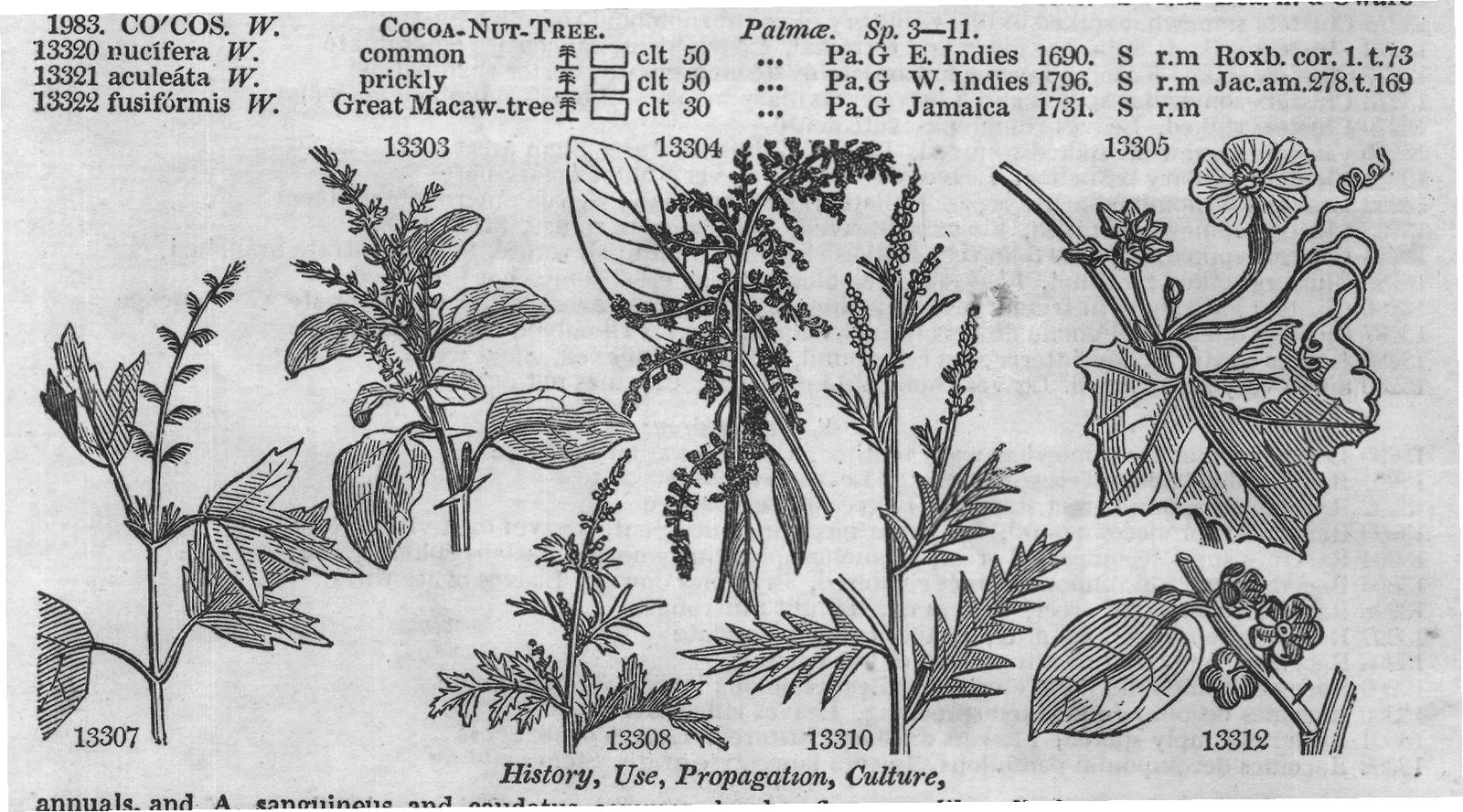
LUFFA. 13305 fœ'tida Cav. stinking or 12 jn.o 1977. AMBRO'SIA. W. AMBROSIA. 13306 integrifólia W. entire-leaved un 3 jl.s G 13307 trifida W. trifid-leaved Oun 6 jl.s 13308 elátior W. tall 13309 artemisifólia W. 13310 paniculáta W.
Mugwort-leav, panicled O un 8 jl.au un 5 jl.au un 3 jl.s G G 13311 marítima W. sea India 1812. S co Bot. mag. 1638 Sp. 6-10.
N. Amer. 1816. S co GN. Amer. 1699. S co G N. Amer. 1696. S co N. Amer. 1759. S co N. Amer. 1811. S co Italy 1570. S co Moris. s.6. t. 1. f.4 Herm. lugd. t.35 Plu.alm. t. 10. f.5 Sch.hand.3.t.292 tm 40 jn.jl Mauritius 1793. C co Lindl, coll. 9 un 3 jl.au G 1978. SECURINE/GA. W. OTAHEITE MYRTLE. 13312 nítida W. shining-leaved오