Euphorbiaceæ
Sp. 1.
CLASS XXI.
G E. Indies 1796. C p.l Jac.schœ.2.t.194 MULBERRY.
Urticeæ. Sp. 5-7. white clt 30 jn Ap China 1596. L co Schk.han.3.t.290 Tartarian or 20 jn Ap fr 30 jn Ap Tartary 1784. L co Italy 1548. Lco Pall. ros. 2. t. 52 Dend. brit. 159 or 10 jn.jl or 20 ...
Ap N. Amer. 1629.
Ap Lr.m W. Indies 1739.
Cr.m Plum. ic. t. 204 Urticeæ. Sp. 4-13. un 4 jn.au G or 10 f.my G branch-flower. un 8 f.my G Virginia 1759. Sk s.p Canaries 1779. C s.p Jamaica 1823. C co Slo.jam.1.t.82.f.2 Jac. frag. t. 5. f 1 Jacq. amer.t.157 side-flowering un 1 f.my G N. Amer. 1820. Sk co PILEA.
Urticea. Sp. 1-3. small-leaved pr ap.my G W. Indies 1793. C co Lind. coll. 4.
Urticeæ. Sp. 32-67.
W 1½ jn.au G Ow 1 jn.jl G England rub. S co BalearicI. 1733. S co Eng. bot. 148 Blackw. t.321.f.1 W 1½ jn.jl G 1824. S co ......
Dodart's dwarf ○W 1 jl. au G W jl.au G S. Europe 1683. S co N. Amer.
Sco ... un 1 jl.au G 13223 grandifólia W. great-leaved un 3 jl.au G W. Indies 1821. C co Jamaica 1793. C co Bot. mag. 2481 Slo.jam. 1.t.83.f.2 13206 13267 13208 13209 13211 13212 13213 13214 History, Use, Propagation, Culture, flute maker; and the roots for the inlayer, and cabinet maker. Of box are made wheels and shivers, pins, pegs for musical instruments, nut-crackers, button-moulds, weavers' shuttles, hollar-sticks, bump-sticks, and dressers for the shoemaker, rulers, rolling-pins, pestles, mall-balls, beetles, tops, tables, chessmen, screws, bobbins for bone-lace, spoons, knife-handles, but especially combs." The English wood is esteemed inferior to that which comes from the Levant, and the American box is said to be preferable to ours, for most purposes; but the English is superior for the purpose of the engraver. The ancients made combs of box, and musical instruments to be played upon by the mouth The Romans likewise clipped it into form, for which nothing, says Pliny, is more fit. And Martial mentions clipped box trees in the gardens at Bassus's country-house.
The tree box was second to the yew with us in former tímes for the purpose of being clipped into the shape of animals, &c.; but the dwarf box stood unrivalled " for bordering up a knot, and was esteemed a marvellous fine ornament to the flower garden."
The branches were in request among our ancestors for decking up houses; they are still seen among other evergreens in churches at Christmas, and in some countries they are borne by attendants at funerals. Box has been much celebrated as a medicine in the venereal disease, colicks, intermittent fevers, and even madness. According to Dr. Blaine, it is the principal ingredient in Well's Watford Drink, which is given as a preventive to canine madness.
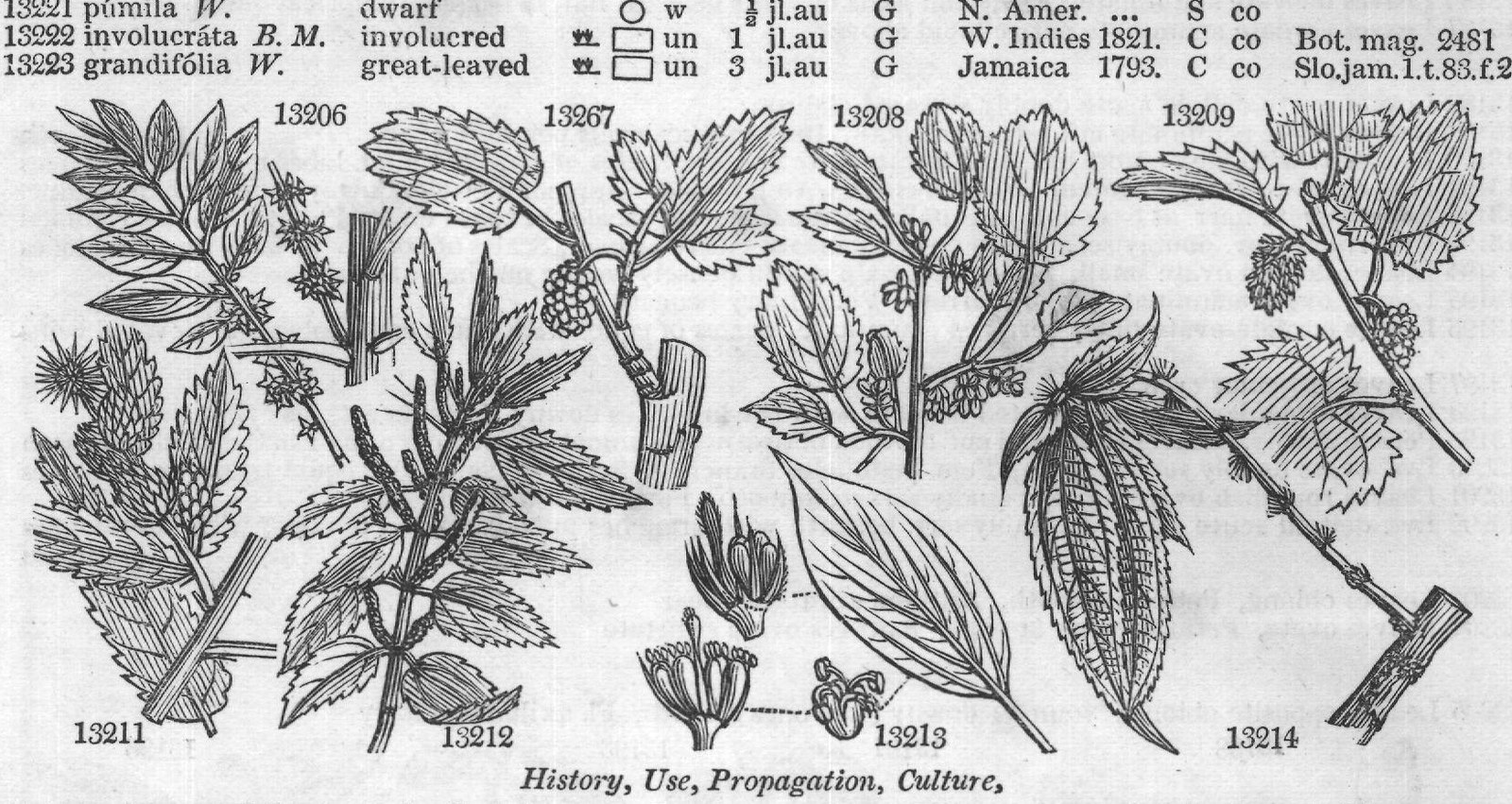
Pliny affirms, that no animal will touch the seed of box. Gmelin relates, that the branches are fatal to the camels that eat them. None of our animals seem to touch this tree. Corsican honey was supposed by the ancients to owe its infamy to the bees feeding on the box. 1958. Cicca. A word of unknown meaning. Cicca disticha thrives in light loamy soil, and is increased by cuttings with their leaves on, planted in sand, and covered with a hand-glass. 1959. Morus. Moρεa was the Greek name of the Mulberry; it is derived from the Celtic mor, which signifies black. Murier, Fr., Maulbeerbaum, Ger., and Moro, Ital. M. alba is commonly cultivated in France and other countries for its leaves, to feed silk-worms; though in some parts of Spain and in Persia they are said to prefer the black mulberry. In China, it appears that both sorts are grown for the same purpose. The most valuable variety of M. alba is one grown in Italy, and especially in Lombardy, with vigorous shoots, and much larger leaves than the other. A number of plants of this variety have been lately imported for the purpose of making a plantation in the south of Ireland, with a view to try the growth of silk in that country. In France the white mulberry is grown as pollard elms are in England; in Lombardy it is grown exactly in the same way as we grow willows for baskets, and in similar soil; in China it is also grown in moist. loamy soil, and both there and in the East Indies as low bushes, and the plantation rooted up and renewed every three or four years. In many parts of the continent, when the leaves are wanted for the worms, they are stript off the young shoots, which are left naked on the tree; in other places the shoots are cut off, which is not so injurious to the tree, while the points of the shoots, as well as the leaves, are eaten by the worms. The plants are sometimes raised by seed, but more commonly by layers; the Italian variety is frequently grafted on seedling stocks of the common sort, in order to preserve it from degenerating. In the East Indies, the plants are raised from cuttings, three or four of which are placed together where they are finally to remain. (Encyc. of Agr. 884.) The fruit of the white mulberry is white, and less acid than that of the black species. M. nigra is naturally a stronger tree than the other; the fruit is of a dark blackish red, and of an agreeable aromatic and acid flavor. It has a place in the Materia Medica, as cooling and laxative, allaying thirst, and being grateful in febrile diseases. Young trees, like most others of the Monœcious class, often produce ORDER IV MONECIA TETRANDRIA. 13206 Leaflets oblong, Racemes lateral 13207 Leaves deeply cordate unequal at the base ovate lobed unequally serrated smoothish 13208 Leaves slightly cordate equal at base ovate or lobed equally serrated smooth 13209 Leaves cordate ovate or lobed unequally toothed scabrous 13210 Leaves cordate ovate acuminate or 3-lobed equally serrate scabrous soft beneath, Fem. spikes cylindrical 13211 Leaves oblong unequal at base, Spines axillary solitary 13212 Leaves opp. ovate-obl. acum. toothed smooth, Fl. diœcious, Male spikes clust. interrupt.: fem. cylindrical 13213 Lvs. altern. obl. narrow. at each end entire, Spikes axill. clustered interruptedly branched, Branches hairy 13214 Lvs. altern. broadly lanc. acum. serrated rugose, Fl. cluster, axill. and lateral moncecious, Males 3-androus 13215 Lvs. altern. ovate-lanceolate acuminate serrated scabrous, Fl. clustered lateral, Stem herbaceous 13216 Leaves ovate acute entire, Stem simple ascending 13217 Leaves opposite ovate or somewhat heart-shaped deeply serrated, Heads of fruit globose 13218 Leaves opposite cordate serrate, Fruit-bearing catkins globose 13219 Leaves opposite entire convex oblong, Fruit-bearing catkins globose 13220 Leaves opposite ovate nearly entire, Heads of fruit globose 13221 Leaves opp. ovate blunt-pointed 3-ribbed serrated, Fl.-stalks somewhat corymbose shorter than footstalks 13222 Leaves opposite ovate rugose obtuse, Flower-stalks in the axillæ of the upper leaves serrated, Stipulas elliptical entire glauc. Corymbs much branched 13223 Leaves opposite ovate pointed copiously ser 13216 axillary longer than the footstalks 13217 13222 २७ 13223 13224 13226 and Miscellaneous Particulars. 13227 only male blossoms for many years after they are planted, and yet afterwards become fruitful. As the tree increases in age, it increases in fruitfulness; and in full grown trees the fruit is much larger and better flavored than in young ones. age, which are very healthy and fruitful. Bradley says, that most of these were planted in the times of James I., In some of the old gardens near London, there are mulberry trees of a great who attempted unsuccessfully to set up a silk manufacture in England. The fruit of the mulberry, like that of the strawberry and raspberry, is said not to undergo the acetous fermentation in the stomach, and therefore it may be safely eaten by gouty and rheumatic persons. It is a mistake, however, to suppose that these fruits are lighter than others which have not the same antifermentative qualities.
The mulberry is generally propagated by layers, but it may also be increased by seeds, cuttings, or grafting. It is generally grown as a standard in orchards; but will produce fruit sooner as an espalier or wall tree.
M. rubra has black shoots, rougher leaves than the black mulberry, and a dark reddish fruit, longer than the common sort, and of a very pleasant taste. The tree is cultivated in China for feeding silk-worms, but not so generally as the white mulberry.
M. indica is also cultivated for the same purpose red berries of an insipid taste, mulberry. but eaten M. indica in is also cultivated for the same purpose. feeding M. silk-worms, tatarica but not red berries of an insipid taste, but eaten in Russia fresh, conserved, or dried; a wine and a spirit are also made from them, and the leaves are used for feeding silk-worms.
M. tinctoria is a tall branching tree, with a fine head, smooth leaves, and awl-shaped solitary spines. The whole plant abounds in a slightly glutinous milk of a sulphureous color. The timber is yellow, and a good deal used in dying that color, for which it is chiefly imported into Europe, under the name of Fustick-wood.
The berries are sweet and wholesome, but not much eaten, excepting by birds.
All the species of Morus are remarkable for putting out their leaves late; so that when they appear, gardeners may safely set out their greenhouse plants, taking it for granted, that all danger from frost is over. 1960. Bæhmeria. Named after George Rudolph Böhmer, a German botanist, and a member of the academy vegetables. 1961. Pilea. Plants of little beauty, and easy cultivation and academical propagation. Wittemberg. He published several George works, Rudolph besides Böhmer, an a German dissertation botanist, and a member the of the over. academy upon Wittemberg. He published several works, besides an academical dissertation upon the cellular tissue of vegetables. Plants of little beauty, and easy cultivation and propagation. 1961. Pilea. So called by Mr. Lindley, from πiλεoς, a cap ; in allusion to the nature of one of the divisions of the perianthium. A neat little creeping plant, which makes a good cover to hide the earth of large pots of tropical plants. 1962. Urtica. A word formed from uro, to burn, in allusion to the stinging properties of most of the species. the same language. term Nettle U. dioica seems to be the Anglo-Saxon Netel, which is itself an properties alteration of of most of a the species. English term Nettle seems to be the Anglo-Saxon Netel, which is itself an alteration of nædl, a needle, in the same language. U. dioica grows all over Europe, in Barbary, Siberia, and Japan, in hedges, neglected fields, gardens, and pastures.
This species, U. urens, and pilulifera, with one or two others, are furnished with stings. The small projecting bristles or prickles with which they are covered are tubular , and stand on a bag filled with a poisonous juice; they are perforated at the point, and when they are gently pressed vertically, the pressure at once forces the poison to ascend the tube, and enables the point to lodge it in the skin. The tops of the tender shoots of U. dioica are sometimes used as a pot herb early in spring, and they have even been forced for that purpose.
A strong decoction of the plant salted, will coagulate milk very readily and without any disagreeable flavor . The stalk is found to have a texture somewhat like that of hemp, and to be capable of being manufactured into cloth, ropes, and paper. The leaves are the only food of the caterpillars of three of our most beautiful butterflies, Atalanta, Paphia, and Urticæ, the principal food of the Io, and the occasional food of the Comma album; the caterpillars also of the urticata and verticalis moths feed on it: a great number of other indiscriminate feeders devour its foliage, and the bases of the leaves in autumn are frequently disfigured by tubercles, which contain small maggots, probably producing Musca Urtice. As a remedy for the MONŒCIA TETRANDRIA.
CLASS XXI. 13224 reticuláta W. net-leaved un 2 jn.au G Jamaica 1793. C co Bot. mag. 2567 13225 rúfa W. rusty un 1 jn.s G Jamaica 1793. C co 13226 úrens W. small W 1 jn.s Ap Britain clt.gr. C co Eng. bot. 1236 13227 dioíca W. common W 1 jl.s Ap Britain wa.gr. C co Eng. bot. 1750 13228 membranácea W. membranous A un 1 jl.s Ap Spain 1820. C co 13229 crassifólia thick-leaved un 2 jl.s Ap S. Amer. 1822. C co 13230 árdens Link. burning un 1 jl.s Ap Nepal 1821. S co 13231 cannabína W.
Hemp-leaved un 3 jl.s Ap Siberia 1749. S co Am,rut. 249.t.25 13232 rugósa W. rough-stalked un 2 my.jl Ap Jamaica 1793. C co 13233 nudicaúlis W. naked-stalked un 3 my.jl Ap Jamaica 1793. C co 13234 grácilis W. slender-stalked un 3 jn.au Ap Huds. B. 1782. C co 13235 Parietária W.
Pellitory-leav'd un 1 jl.s Ap 13236 ciliáta W. ciliated un 1 jl.s Ap 13237 pulchélla Link. pretty un 1 jl.s Ap 13238 scabrélla Rox. rough un 1 ...
Ap 13239 æ'stuans W. 13240 canadénsis W.
Surinam un 1 jn.jl Ap Canada Aun 3 au.o Ap Jamaica 1793. C co Slo.jam.1.t.93.f.1 Jamaica 1815. C cc E. Indies 1820. C co E. Indies 1815. C co Surinam 1803. C co Canada 1656. C co Jac.schœ.3.t.388 Pl. alm. t. 237.f.2 13241 nívea W. white-leaved un 2 au.s Ap China 1739. C p.l Jac. vind. 2.t.166 13242 baccífera W. berry-bearing un 4 jl.au Ap 13243 caracásana W.
Caraccas un 8 jl.au Ap S. Amer. 1793. Sk s.p Caraccas 1824. C co Bot. rep. 454 Jacq. 13244 caravellána Schrk. long-stalked 13245 elongáta Link. lengthened 80 un 4 jl.au Ap un 3 jl.au Ap 13246 diversifólia Link. various-leaved ☐ un 3 au.s Ap 13247 hórrida Link. horrid un 3 au.s Ap S. Amer. 1825. S co Philipp. Is.1823. S co E. Indies 1823. S co Nepal 1821. S co 13248 arborescens Link. arborescent un 8 au.s Ap Manilla 1822. C. co 1963. PACHYSAN'DRA. Mi. PACHYSANDRA.