Euphorbiace
Sp. 3.
Minorca or 8 jl Y.G Minorca 1780. C co common or or 8 ap Y.G narrow-leaved or 8 ap dwarf or 1 ...
Chinese or 3 n Y.G Y.G Y.G China ...... ... ...... ...
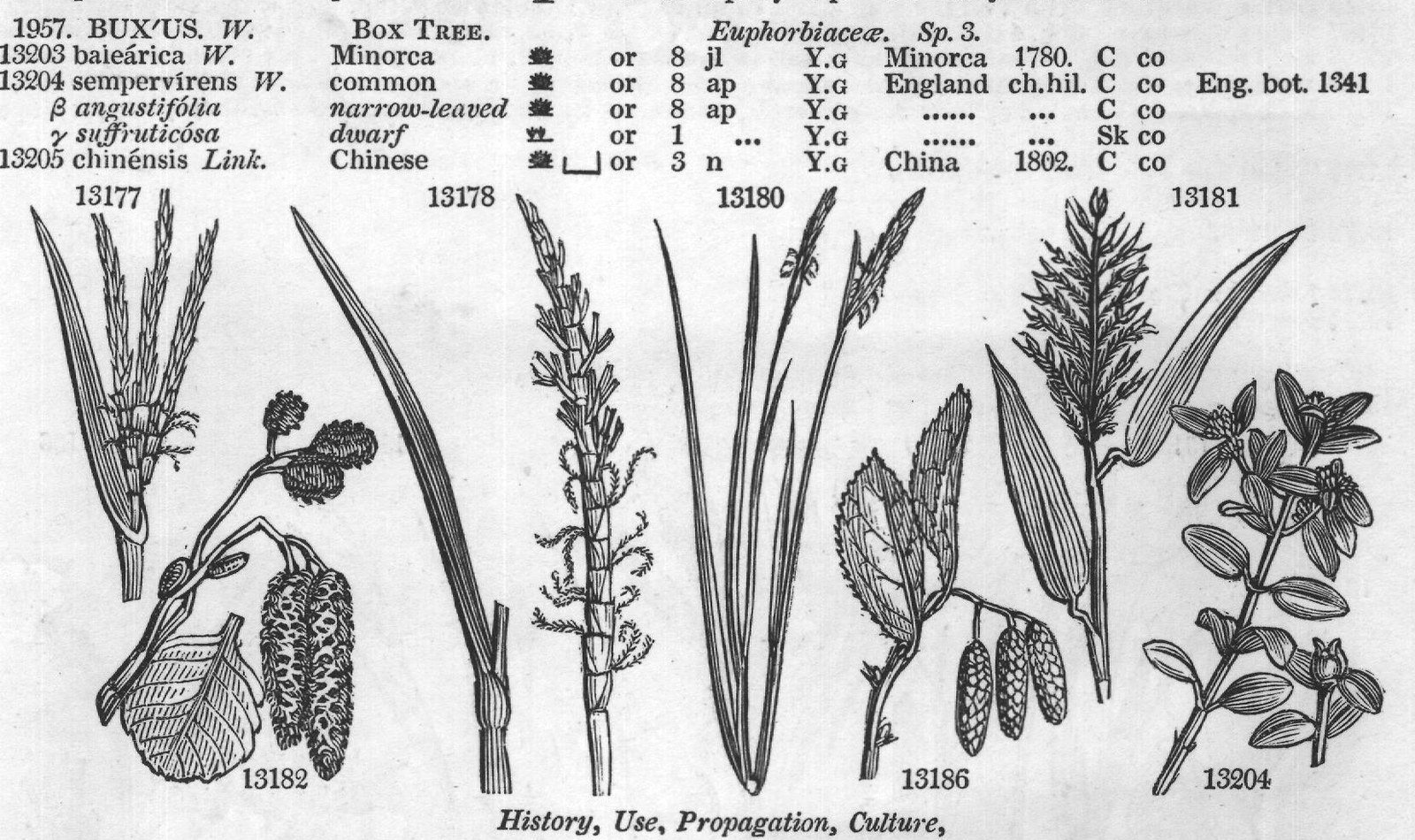
England ch.hil. C co Eng. bot. 1341 C co Sk co 1802. C co 13178 13180 13181 13182 13186 13204 History, Use, Propagation, Culture, 1952. Tripsacum. So called by Linnæus, from τρiβω, to bruise or crusi, in allusion to the purpose to which its grain may be applied. Forage grasses of the West Indies. 1953. Heteropogon. From ἑτερoς, various, and πωγωv, a beard; in allusion to the various kinds of awns with which the flowers are furnished. 1954. Olyra. A name under which Homer speaks of a grain which was used as the food of horses, and which has been thought analogous to Barley. The plant now so called is a native of America, and has no resemblance to that of the ancients. 1955. Alnus. From the Celtic word al, near, and lan, the edge of a river, in reference to the places where the species grow. A. glutinosa, Aulne, Fr., Eller, Ger., and Alno, Ital., is a well known timber tree, which will grow in marshy situations. The timber is applied to a variety of purposes, and in general for all works intended to be constantly under water, for turnery and furniture. The bark is used by dyers and tanners; the sap being of a yellow color and very astringent. There is a variety with cut leaves sold by the nurserymen as an ornamental tree, though it is more curious than showy. 1956. Betula. Betu is the Celtic word for the Birch. Bouleau, Fr., Birchenbaum, Ger., and Betulla, Ital. B. pendula is the most graceful tree of the genus; it grows both in mountainous situations and bogs, from Lapland to the subalpine parts of Italy and Asia. B. lenta, the mahogany birch, mountain mahogany, or cherry birch of Canada, abounds in the middle states of Pennsylvania, New York, and the Jerseys; but disappears altogether in the higher latitudes of the northern states. It is thought a very fit tree for planting in the valleys of the mountainous districts of Britain. Its growth is rapid, and the timber is close grained, beautifully variegated, and well adapted for cabinet work. The leaves, which appear early in spring, possess ORDER III.
MONECIA TRIANDRIA. 13177 Spikes 3 clustered: male above; female below 13178 Spike solitary: male above; female below 13179 Spike solitary hermaphrodite flexuose, Spikelets somewhat distant 13180 Culm nearly simple, Sheath of leaves bearded at edge, Spike smooth 13181 Culm branched, Panicle terminal TETRANDRIA. 13182 Lvs. roundish cuneiform obt. lobed at margin and serrat. somew. glutin. downy in axils of veins beneath ẞ Leaves oblong pinnatifid, Segments cut 13183 Leaves oblong bluntish glutinous, Axils of the veins naked ẞ Leaves elliptical 13184 Leaves oblong acute downy beneath, Axils of the veins naked, Stipules lanceolate ẞ Leaves green beneath, Petioles green 13185 Lvs. obl. acute rounded at base, Petioles and veins hairy beneath, Axils of veins naked, Stipules ov.-obl. 13186 Leaves obovate acuminate, Veins and axils of veins beneath hairy, Stipules elliptical blunt 13187 Leaves cordate acuminate entire lucid above 13188 Leaves ovato-deltoid acute doubly serrated glabrous 13189 Leaves ovate acuminate cut serrate smooth, Branches scabrous pendulous smooth 13190 Lvs. delt. with long points unequal, serrat. quite smooth, Scales of cones with lat. lobes roundish, Petioles 13191 Leaves ovate acute serrated, Scales of cones with lat. lobes rounded, Petioles downy shorter than pedunc. 13192 Leaves ovate narr. at base ent. unequally toothed smooth, Scales of cones ciliated: lateral lobes rounded 13193 Lvs. rhomb. ov. doubly serr. acute downy beneath entire at base, Scales of cones vill. with lin. uneq. lobes 13194 Leaves deltoid ovate small, Scales of female catkin densely woolly on the outside 13195 Leaves ovate acuminate doubly serrate, Veins hairy beneath 13196 Leaves cordate-ovate finely serrated acuminate, Scales of cones with blunt equal lobes and elevated veins 13197 Leaves orbicular crenate 13198 Leaves orbicular obovate serrated beneath with the branches downy, Female catkins cylindrical 13199 Petiole downy, Leaves rhomboid cut-toothed obtuse nearly smooth with tufts of hair in the axillæ beneath 13200 Lvs. ovate doubly serr. smooth, Fem. peduncles branched, Scales of cones with equal trunc. nerved lobes 13201 Leaves roundish ovate nearly equally serrate smooth, Female catkins oblong 13202 Lvs. deltoid acute subcord. doubly serr. beneath with branches pubesc. Scales of cones with lateral lobes 13203 Leaves oblong, Petioles smooth, Anthers sagittate linear 13204 Leaves ovate, Petioles hairy at edge, Anthers ovate sagittate 13205 Leaves opposite oblong: younger downy; old ones smooth, Fl. axillary solitary 13188 13197 13191 13193 8.0 13199 and Miscellaneous Particulars. 13200 [rounded 13196 13201 a peculiar fragrance, which they retain after being dried in a stove, affording by infusion an agreeable diluent, superior to some of the common teas of commerce.
B. populifolia and papyracea are elegant rapid growing trees, well deserving culture for their timber. All the species are ornamental, and more or less fragrant; and B. pumila and nana are pretty little shrubs. Of the Betula papyracea the North American Indians construct their large portable canoes, from which circumstance that species is known by the name of canoe birch. Betula lenta is the most interesting of the genus, on account of the excellence of its wood. It is known by the names of mountain mahogany, black birch, cherry birch, and sweet birch. This last appellation it has from the sweet scent the branchlets give when bruised. 1957. Buxus. An alteration of πuξoς, its Greek name. B. sempervirens, Buis, Fr., Buchsbaum, Ger., and Bosso, Ital. is one of the most useful of evergreen shrubs; edgings of the dwarf variety are of universal use in the walled gardens of Europe; and what is called the tree box is not less valuable as an evergreen shrub, which will grow under the shade and drip of trees. The box is a native of most parts of Europe, from Britain southwards, and is very abundant in different parts of France and Switzerland. It abounds in many countries of Asia, as about Mount Caucacus, in Persia, China, Cochin China, and America. It was formerly very cominon in England, but has gradually disappeared as agriculture extended. Box-Hill in Surrey, Boxley in Kent, and Boxwell in Gloucestershire, are named from their abounding in this tree. The timber of the box tree is of considerable value. It is sold by weight, and being very hard and smooth, and not apt to warp, is very well adapted to a variety of nicer works. It is as extensively employed now as it appears to have been in the days of Evelyn, " for the turner, engraver, carver, mathematical instrument maker, comb and pipe or 1958. CIC/CA. W.
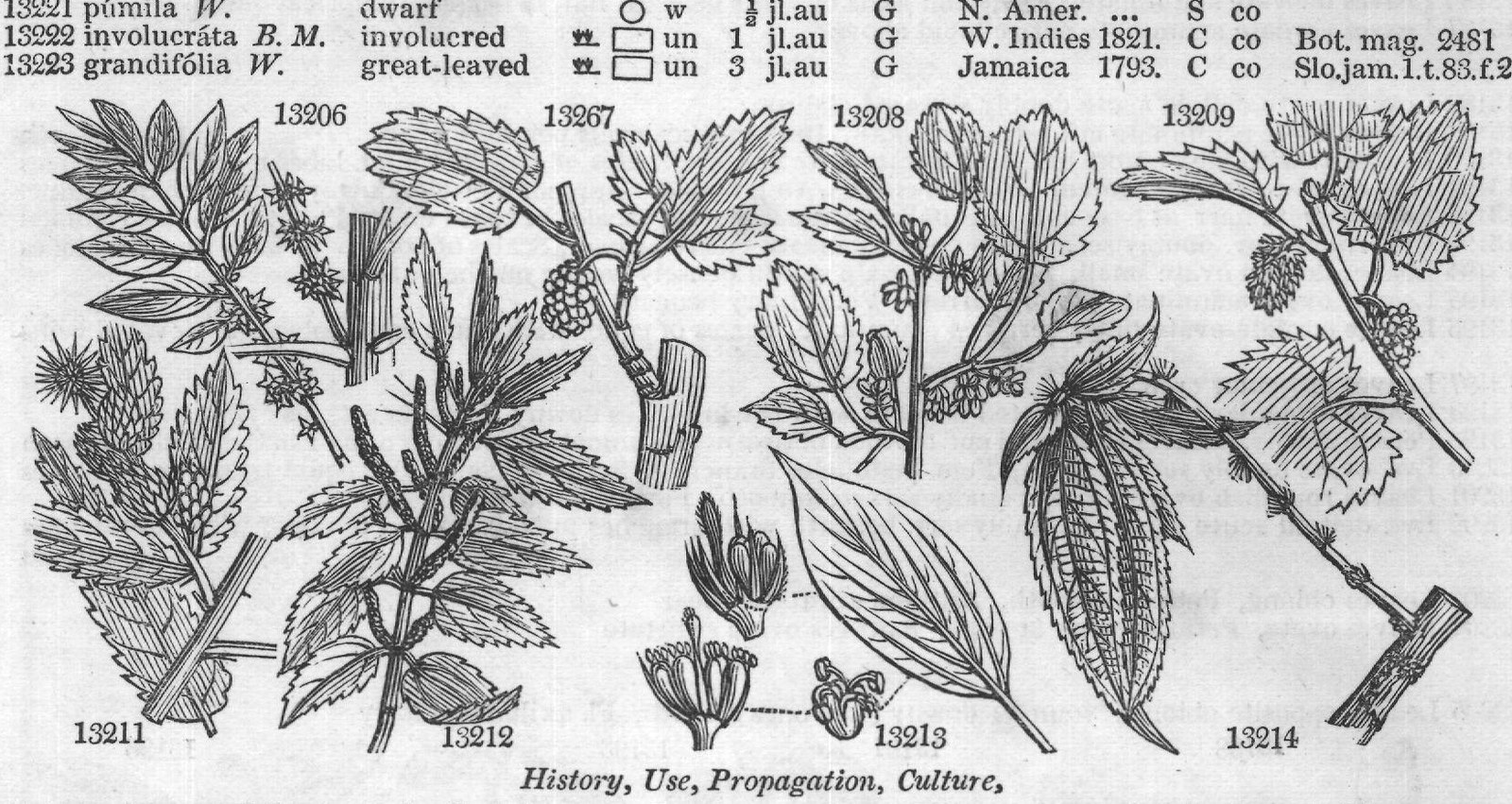
CICCA. 13221 púmila W. 13206 dísticha W. 1959. MO'RUS. W. 13207 álba. W. 13208 tatárica W. 13209 nígra W. 13210 rúbra W. 13211 tinctória W. 1960. BEHMERIA. 13212 cylíndrica W. 13213 rubéscens W. 13214 ramiflóra W. 13215 lateriflóra W. 1961. PILEA. Lindl. 13216 muscósa Lindl. 1962. URTICA. W. 13217 pilulífera W. 13218 baleárica W. 13219 convéxa Hort. 13220 Dodártii W. common red Fustick-wood W. BEHMERIA. cylindrical tree NETTLE.
Roman Balearic convex 13222 involucráta B. M. involucred 业 long-leaved 오 fr 10 MONECIA TETRANDRIA.