Home › E › Euphorbiaceæ (Sp telephio des W annual W jl)
Euphorbiaceæ (Sp telephio des W annual W jl)
Sp. 1-2. 13600 telephioídes W. annual W jl.au W Italy 1732. S co Lam. ill. t. 797 2026. STILLIN'GIA. W. STILLINGIA.
Euphorbiace. Sp. 3. 13601 sylvática W. wood un 2 jl.au Y Carolina 1787. C s.p 13602 ligustrína W.
Privet-leaved un 5 Y N. Amer. 1812. Cs.p 13603 sebífera W.
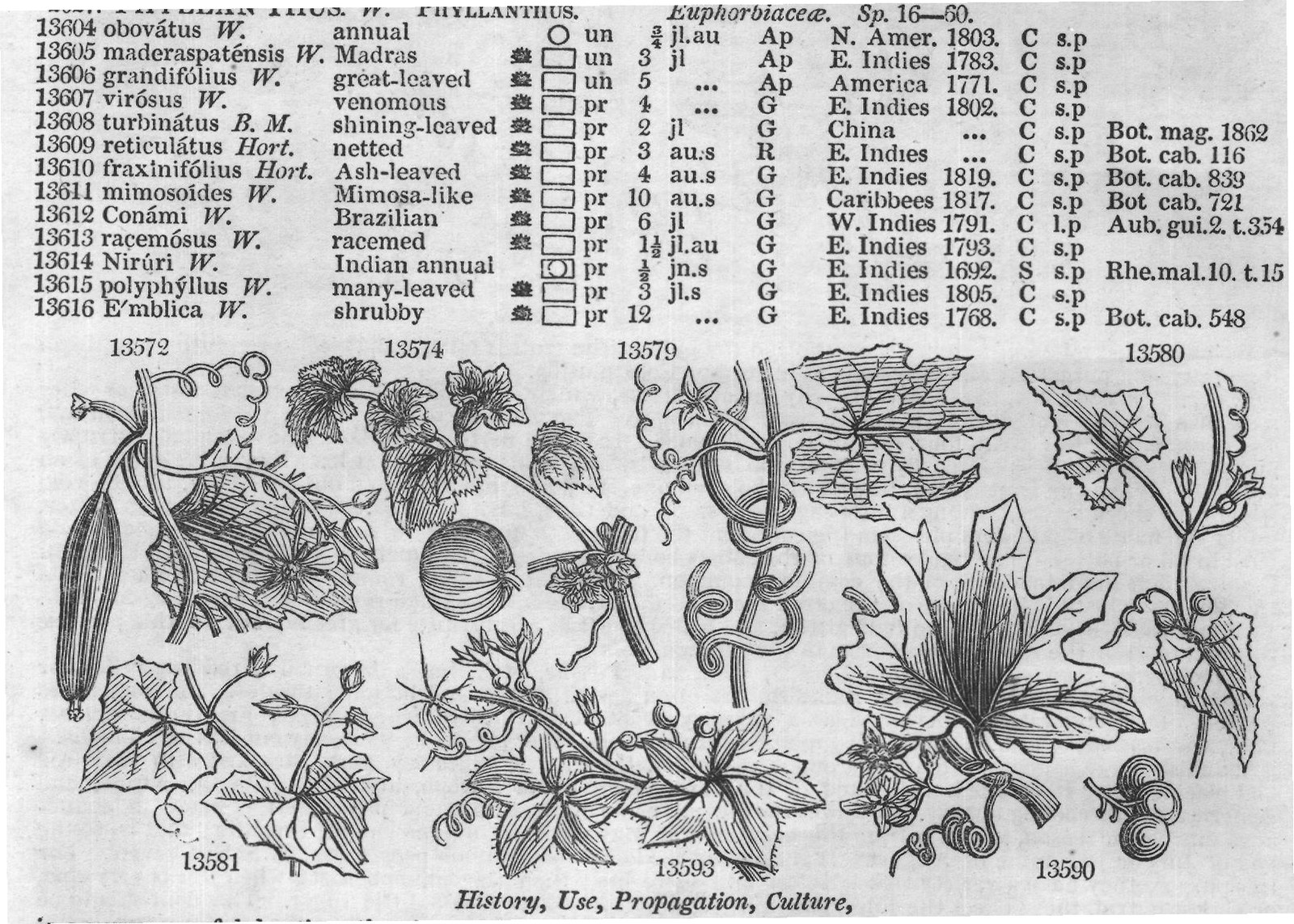
Tallow-tree ec 10 s Y China 1703. C s.p Plu.am. t.390.f.2 13604 obovátus W. 2027. PHYLLANTHUS. W. PHYLLANTIIUS. 13605 maderaspaténsis W. Madras Euphorbiacea. Sp. 16-60. annual un jl.au Ap N. Amer. 1803. C s.p un 3 jl Ap 13606 grandifólius W. great-leaved un 5 ...
Ap E. Indies 1783. C s.p America 1771. C s.p 13607 virósus W. venomous pr 4 ...
G E. Indies 1802. C s.p 13608 turbinátus B. M. shining-leaved pr 2 jl G China ...
Cs.p Bot. mag. 1862 13609 reticulátus Hort. netted pr 3 au.s R E. Indies ...
Cs.p Bot. cab. 116 13610 fraxinifólius Hort.
Ash-leaved 数 pr 4 au.s G E. Indies 1819. C s.p 13611 mimosoídes W.
Bot. cab. 839 Mimosa-like pr 10 au.s G Caribbees 1817. C s.p Bot cab. 721 13612 Conámi W.
Brazilian pr 6 jl G W. Indies 1791. C l.p 13613 racemósus W.
Aub. gui.2. t.354 racemed pr 1 jl.au G E. Indies 1793. C s.p 13614 Nirúri W.
Indian annual prjn.s G E. Indies 1692. S s.p Rhe.mal.10. t. 15 13615 polyphýllus W. many-leaved pr 3 jl.s G E. Indies 1805. C s.p 13616 Emblica W. shrubby pr 12 ...
G E. Indies 1768. C s.p Bot. cab. 548 13572 13574 13579 13580 13581 13593 History, Use, Propagation, Culture, 13590 is a very powerful drastic cathartic, requiring to be employed with caution, on account of its violent effects. When given alone, even in moderate doses, it purges vehemently, producing violent gripings, bloody ejections, and not unfrequently convulsions and inflammations of the bowels. (Thom. Lond. Disp. 271.) C. sativus and Melo (μελov, an apple) are too well known to require farther notice in a work of this description. C. anguria has hispid angular stems, and small flowers like those of Bryony. The fruit is of the size . C. anguria has hispid angular stems, and small flowers like those of Bryony. The fruit is of the size and shape of a pullet's egg, of a dark-green color, and prickly like a hedgehog. It is eaten green, or with other herbs in soups in the West India Islands, and is esteemed an agreeable and wholesome ingredient. C. prophetarum has a striped fruit smaller than a melon; the odor nauseous, and the taste as bitter as Coloquintida. The fruit of C. acutangulus is very insipid, but in India is eaten boiled and pickled. C. Chate has a roundish fruit almost like that of the melon; the taste is somewhat sweet and cool, but not so cool as the water melon. In Egypt it is eaten as the most pleasant fruit they have, and that from which delicate persons have least to apprehend. The culture of all the species is similar to that of the common cucumber. 2023. Sicyos. Σiκuoς was one of the Greek names of the cucumber, from σiκχoς, unpleasant. The species are trailing plants like those of Cucumis, but with much smaller fruits. trailing plants like those of Cucumis, but with much smaller fruits. 2024. Bryonia. From βρω, to push or grow rapidly, in allusion to the manner of its growth. B. alba and dioica, differ in little else besides the color of the berries, and by some are considered one species. Goats are , differ in little else besides the color of the berries, and by some are considered one species. Goats are ORDER VIII.
MONECIA MONADELPHIA. 13572 Leaves roundish angular, Fruit with 10 acute angles 13573 Angles of leaves rounded, Fruit torulose 13574 Angles of leaves rounded, Fruit spherical with a retuse nipple 13575 Hirsute, Angles of leaves entire toothed, Fruit fusiform narrowed at each end hairy 13576 Leaves cordate subangular acutish finely toothed scabrous, Fruit elliptical blunt downy scabrous, Fruit elliptical blunt downy 13577 Angles of leaves straight, Fruit oblong rough 13578 Leaves angular somewhat lobed, Fruit cylindrical furrowed curved 13579 Leaves lobed, Fruit cylindrical very long smooth doubled up 13580 Leaves cordate entire toothletted, Fruit globose smooth 13581 Leaves cordate with an obtuse angle, 5-angular toothletted smooth 13582 Leaves roundish-cordate with a recess 5-lobed toothed hairy viscid 13583 Leaves cordate angular toothed rough with callous dots above and hairs beneath, Fl. in umbels 13584 Leaves 3-lobed smooth above rough beneath 13585 Leaves cordate angular above and the veins beneath covered with callous dots, Tendrils simple 13586 Leaves cordate angular entire smooth with callous dots above and 5 glands at the base beneath 13587 Leaves 3-lobed rough toothed, Lateral lobes angular somewhat 2-lobed, Fl. axillary somewhat umbellate angular somewhat 2-lobed, Fl. axillary somewhat umbellate 13588 Lvs. 3-lobed toothed hispid on each side, Lat. lobes dilated angular: middle elong. Stem muricato-hispid 13589 Leaves somewhat 3-lobed hairy narrowed at base 13590 Leaves cordate palmate 5-lobed toothed with callous dots, Fl. racemose dicæcious 13591 Leaves cordate 5-lobed toothed rough with callous dots, Flowers racemose 13592 Leaves cordate 5-lobed apiculate hairy, Peduncles in umbels 13593 Leaves cordate 5-lobed entire with callous asperities on each side 13594 Leaves 5-lobed toothletted scabrous above, Peduncles 1-flowered 13595 Leaves 5-lobed somewhat toothletted, Lobes obtuse, Petioles and stem hispid 13596 Leaves palmate smooth 5-parted: segments lanceolate repand serrated 13597 Leaves 5-parted palmate, Segm. oblong lanc. acuminate serrated, Petioles muricated, Peduncles 1-flowered 13598 Upper leaves 5-parted palmate, Segments oblong cut -toothed: lower cordate angular toothed 13599 Lvs. 5-parted palmate, Segm. pinnatifid linear revolute at edge rough, Flowers in umbels, Berries acute Segm. pinnatifid linear revolute at edge rough, Flowers in umbels, Berries acute 13600 Procumbent herbaceous 13601 Leaves sessile oblong blunt narrowed at base serrulate, Stem herbaceous 13602 Leaves petiolate lanceolate narrowed at each end entire, Stem shrubby 13603 Leaves stalked rhomboid acuminate entire, Stem arborescent 13604 Leaves obovate bluntish, Flowers twin axillary stalked, Stem branched round erect 13605 Leaves lanceolate cuneate blunt mucronate, Flowers solitary stalked axillary, Stem shrubby branched 13606 Leaves ovate-oblong blunt mucronate, Flowers axillary in threes, Branches compressed 3-cornered 13607 Leaves elliptical ovate blunt narrowed at base, Fls. axillary aggregate diœcious, Branches square compr. at base, Fls. axillary aggregate diœcious, Branches square compr. 13608 Leaves simple orbicular-ovate lucid, Flowers axillary male turbinate nodding 13609 Leaves oblong obtuse netted with red veins beneath, Flowers racemose and fasciculate 13610 Leaves elliptical acute at each end, Stipules ovate acute as long as petiole, Flowers fascicled 13611 Lvs. pinn. flower-bearing leaflets oblong attenuated at base and narrower on one side, Fls. axill. aggreg. attenuated at base and narrower on one side, Fls. axill. aggreg. 13612 Lvs. ovate acute, Fls. axill. somew. umbelled, Pedunc. filiform with 2 bractes at base, Branchlets compr. 13613 Leaves lanceolate acute, Flowers terminal about 3, Branches pinnæform 2-edged 13614 Lvs. pinn. fl. bearing: leafl. elliptical obtuse, Pedunc. axill. lower usually twin and male; upp. solit. fem. 13615 Lvs. pinn. fl. bearing leaflets linear obtuse mucronate, Flowers axillary solitary the female uppermost 13616 Leaves pinnate fl. bearing: leaflets linear sharpish, Flowers axillary clustered, Petioles round downy 13608 13603 13616 13600 13614 13610 13609 and Miscellaneous Particulars. the only quadrupeds said to eat this plant. The root grows to a vast size. Gerarde says, "the queene's chiefe chirurgeon, Master William Goodorous, shewed me a roote heereof, that waied halfe an hundred waighte, and of the bignesse of a childe of a yeere old." To this Linnæus ascribes the quickness of its growth, though it springs late. The roots have been formerly by impostors brought into an human shape, carried about the country, and shewn for mandrakes to the common people. The method which these people practised, was to open the earth round a young thriving Bryony plant, being careful not to disturb the lower fibres of the root ; to fix a mould such as is used by those who make plaster figures close to the root, fastening it with wire to keep it in its proper situation, and then to fill in the earth about the root, leaving it to grow to the shape of the mould, which is effected in one summer. This root is a famous hydragogue, and highly purgative and acrid. 2025. Andrachne. The Greek name of the Purslane. The modern plant bears some analogy to that of the Greeks, in its thick and fleshy leaf. Plants of little beauty, and the easiest culture. 2026. Stillingia. Named after Dr. Benjamin Stillingfleet, an English botanist. S. Sebifera is the tallow-tree of China. An oil is expressed from the kernel, which hardens by cold to the consistence of common tallow, and by boiling becomes as hard as bees' wax. Stillingia sylvatica is considered a specific in cases of syphilis. 2027. Phyllanthus. From φuλλov, a leaf, and avθoς, a flower, because the flowers grow upon the edges of the MONECIA MONADELPHIA.
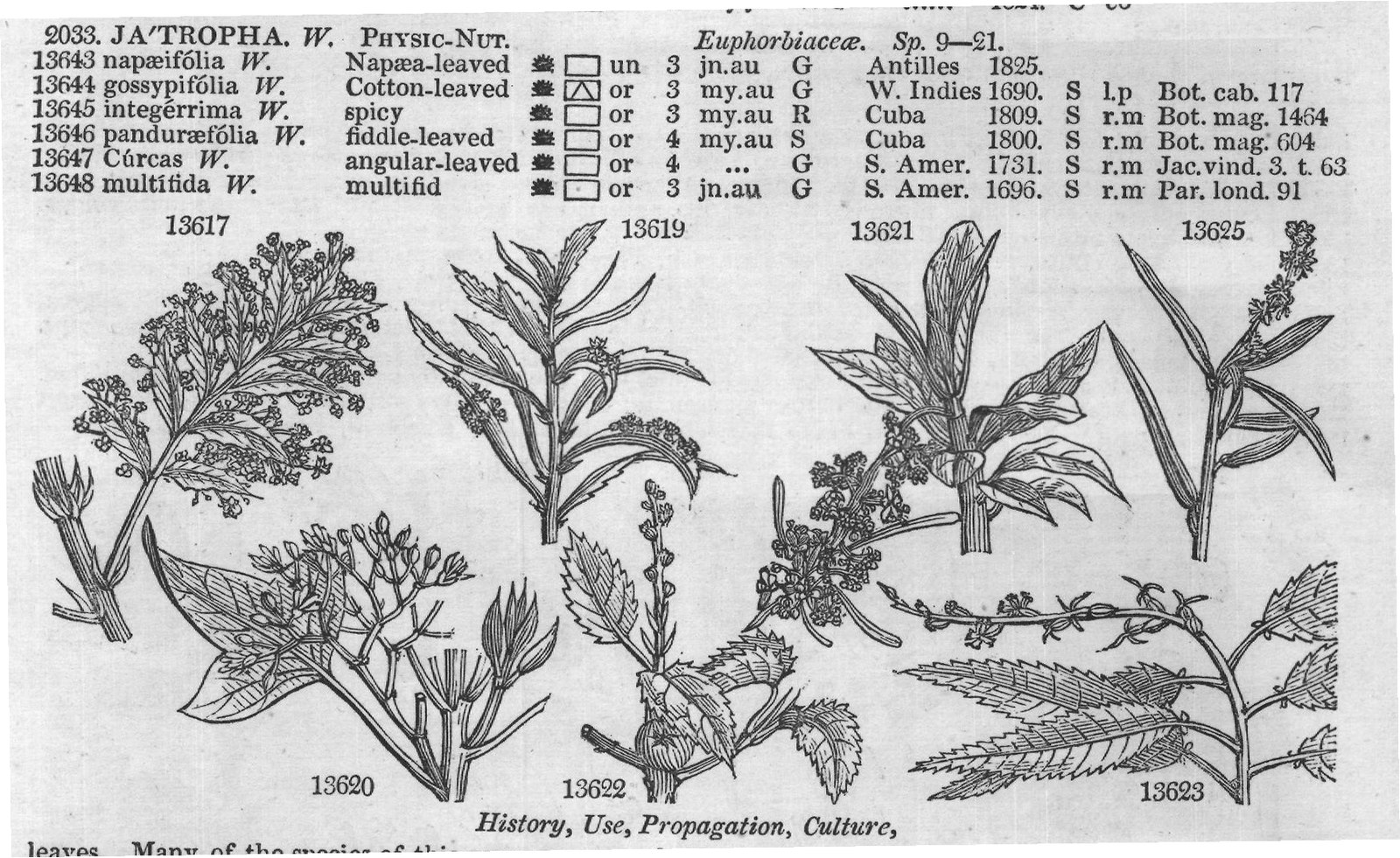
CLASS XXI. 13617 latifólius W. en. Sea-side Laurel pr 2 au o R Xylophýlla latifolia W. 13618 angustifólius W. en. narrow-leaved 13619 falcátus W. en. sickle-leaved 数 pr pr 2 jl.au R 2 jl.au R Jamaica 1783. C s.p Bot. mag. 1021 Jamaica 1789. C s.p Bahama I.1699. C 8.p Bot. rep. 331 2028. ALEURI'TES. W. ALEURITES. 13620 tríloba W.