Home › E › Eng (Bot Cav ic t aspalatho des W)
Eng (Bot Cav ic t aspalatho des W)
bot. 1986 Cav. ic. t. 122 11045 aspalathoídes W.
Aspalathus-like or 1 jn.au Y Carolina 1811. C s.l 1618. ASCY'RUM. W.
ASCYRUM.
Hypericineæ.
Sp. 5-6. 11046 púmilum Ph. dwarf prjn.au Y 11047 Crux A'ndreæ Ph. St. Andrew's Cross pr 2 jl Y 11048 hypericoídes Ph.
Hypericum-like pr 1½ jl.s Y 11049 stans W. large-flowered pr 12 jl.s Y 11050 amplexicaúle Ph. stem-clasping pr 2 jl.s Y Georgia 1806. C 1.p N. Amer. 1759. C l.p N. Amer. 1759. C l.p N. Amer. 1806. C 1.p Vent. malm. 90 N. Amer. 1823. C co 1619. LOA'SA. L.
LOASA.
Loaseæ. Sp. 4-10. 11051 Plácei Lindi.
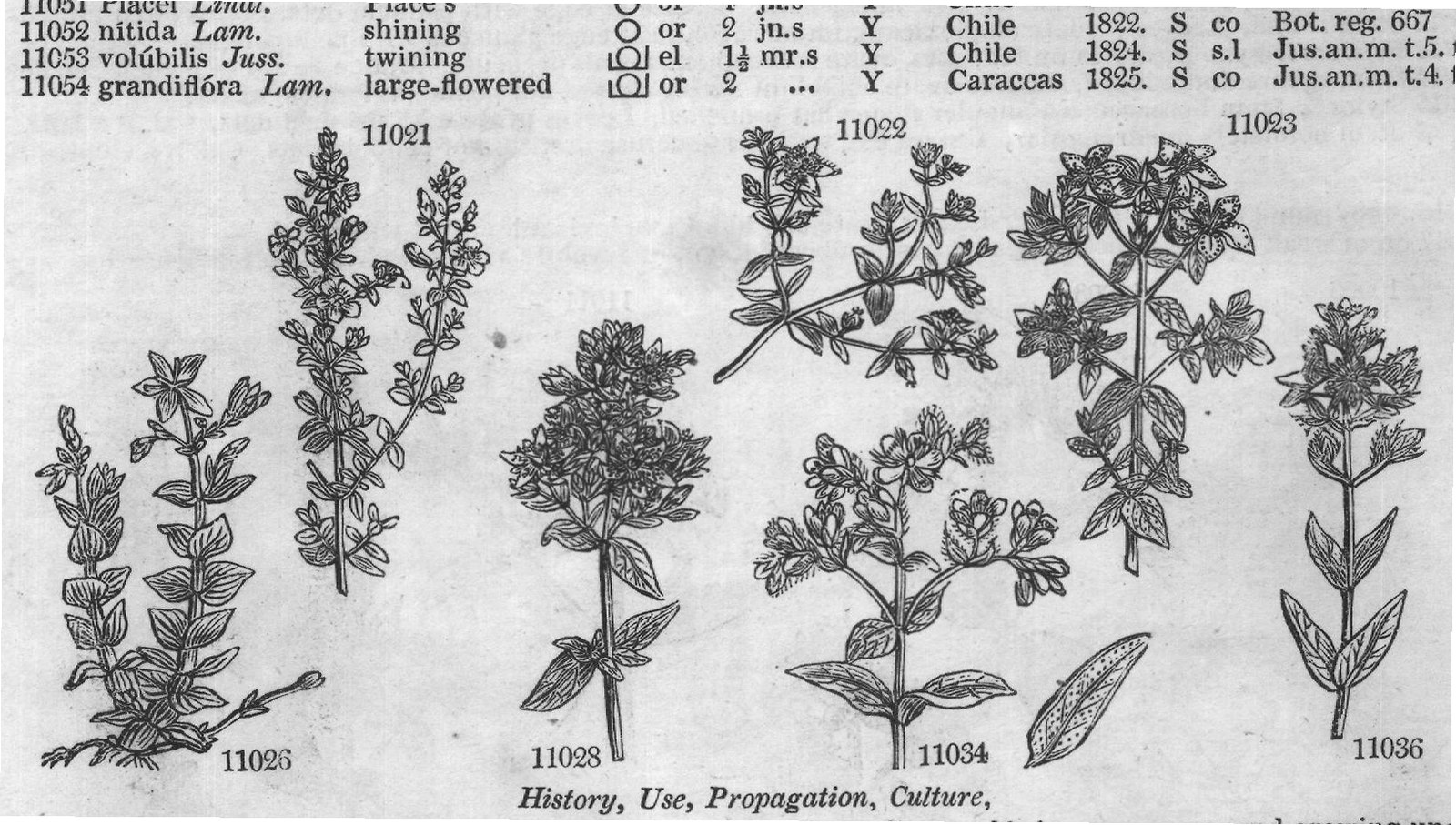
Place's or 4 jn.s Y Chile 1822. Sco Bot. reg. 785 11052 nítida Lam. shining or 2 jn.s Y Chile 1822. S co Bot. reg. 667 11053 volúbilis Juss. twining el 1 mr.s Y Chile 1824. S s.l Jus.an.m. t.5. f.2 11054 grandiflóra Lam. large-flowered or 2 Y Caraccas 1825. S co Jus.an.m. t. 4. f.2 ... 11021 11022 11023 11026 11028 11034 History, Use, Propagation, Culture, 11036 shrubberies. H. calycinum soon spreads over a considerable surface, and being evergreen, and growing under the shade, it is well adapted for covering bare spots under trees, and at the base of walls where few plants will thrive.
H. Androsæmum; from avης, a man, and ἁiμa, blood, because the fresh capsules, bruised between the fingers, give out a blood-colored juice, is called Tutsan from Toute-saine, Fr., from its bruised capsules being formerly applied to fresh wounds.
H. perforatum was formerly used in external wounds and hæmorrhages as a balsamic, and was reputed to have other medical properties. The semi-transparent dots on the leaves are the receptacles of an essential oil The flowers tinge spirits and oils of a fine purple color; and the dried plant, boiled with alum, dyes wool of a yellow color. The common people in France and Germany gather it with great ceremony on St. John's day, and ORDER II.
POLYADELPHIA POLYANDRIA. 11018 Stem round much branched, Lvs. sess. lanc. undul. wavy at base with pellucid dots, Cal. very small blunt 11019 Flowers 2-3-gynous terminal, Cal. lanc. entire, Leaves lanc. oblong and erect, Stem simple downy 11020 Stem round, Lvs. lin. lanc. with pelluc. dots: low. closely imbric. very short blunt, Cal. acute rather unequal 11021 Stem round, Leaves very small ovate close not dotted, Flowers few subsessile, Cal. acute lanceolate 11022 Styles 3, Flowers terminal subcymose, Stems comp. prostrate, Leaves oblong obtuse glabrous 11023 Styles 3, Stem compressed, Leaves elliptico-oblong obtuse with pellucid dots, Cal. leaves lanceolate 11024 Stem herbaceous upright 4-winged, Lvs. lin. somewhat blunt with fine pellucid dots and black dots beneath 11025 Stem round diffuse, Leaves lanceol. linear narrow at base revolute at edge, Calyx somewhat unequal ** Sepals toothed, or toothed glandular. 11026 Styles 3, Cal. with (reddish) glandular serratures glabrous, Lvs. roundish pubesc. Stem rounded creeping 11027 Stem downy round ascend.. Lvs. ovate blunt somewhat amplexicaul. with black dots at edge, Cal. acuminate 11028 Styles 3, Cal. with (black) glandular serratures, Stem erect rounded pubesc. Lvs. ov. slightly downy beneath 11029 Stem round ascending, Leaves orbicular stalked, Calyx ovate blunt 11030 Stem straight slightly wing. Lvs. ov.-lanc. subamplex. blunt. with pellucid dots, Anthers dotted with black 11031 Stem round straight branched, Lvs. ellipt. lanc. acute glandular at edge with pellucid dots, Cal. lanc. acute 11032 Stem round a little villous at end, Leaves amplexicaul. lanceol. acute generally reflexed, Panic. lax few-fl. 11033 Styles 3, Cal. with (black) glandul. serratures, Stem erect, Lvs. cord. glab. amplexicaul. [dots beneath 11034 Sty. 3, Corymbs term. Cal. fring. with long peduncul. glands, Stem erect round. Lvs. ov.with (black) scattered 11035 Stem round ascending, Leaves amplexicaul. oblong bluntish with pellucid dots: upper sometimes toothed 11036 Styles 3, Fis. paniculate-corymb. Cal. with glandul. serratures, Stem erect round. smooth, Lvs. ov. glabrous 11037 Stem round purplish simple, Lvs. amplexicaul. ovate dotted with black at the edge, Cal. ov. acute ciliated 11038 Stem round, Leaves ovate blunt with a small petiole revolute at edge, Calyx ovate blunt [with black 11039 Stem round slightly winged, Lvs. amplexicaul. subcord. ovate obl. blunt with pellucid dots, Anthers dotted 11040 Stem with 2 angles decumbent at base, Lvs. linear-lanc. spreading blunt revolute at edge, Cal. ovate acute 11041 Stem round ascending, Lvs. obl. lanc. bluntish narrowed at each end with pellucid dots, Cal. somewhat blunt 11042 Stem round, Branches somewhat winged, Leaves in threes linear revolute at edge, Calyx very small blunt 11043 Stem round ascending, Leaves whorled linear revolute at edge, Calyx linear somewhat blunt 11044 Stem round tortuous minute, Leaves round acute clustered dotted glaucous very small §5. Sepals 5, entire, equal, like the leaves. Stamens 00. Styles 3-5. BRATHYS. 11045 Stem round compressed at end, Leaves dense not dotted channelled revolute at edge, Cal. equal straight 11046 Stem small simple quadrangular, Leaves oval blunt fascicled, Pedicels 6 lines long reflexed 11047 Stem round, Branches erect, Lvs. ovate linear blunt generally fascicled in the axillæ, Inner sepals orbicular 11048 Stem round, Leaves oblong linear blunt with 2 glands at base, Inner sepals somewhat orbicular 11049 Stem winged straight, Leaves ovate ellipt. blunt glaucous, Inner sepals cordate orbicular 11050 Stem dichotomous panicled, Leaves ovate cordate crisp, Corymb naked, Styles 3 11051 Sepals scarcely toothed reflexed as long as petals, in fruit reflexed and longer than the obovate capsule 11052 Sepals toothed shorter than petals, in fruit erect and shorter than the pear-shaped capsule 11053 Stem twining, Leaves bipinnatifid with narrow obtuse segments 11054 Hispid, Leaves opposite and alternate cordate ovate lobed, Petals flattish, Flower very large 11043 11052 11044 11051 11048 11053 11054 and Miscellaneous Particulars. hang it in their windows as a charm against storms, thunder, and evil spirits; mistaking the meaning of some medical writers, who have fancifully given this plant the name of Fuga Dæmonum, from a supposition that it was good in maniacal and hypochondriacal disorders. In Scotland it was formerly carried about as a charm against witchcraft and enchantment.
H. humifusum is one of the prettiest little plants of the genus, well adapted for growing in pots. 1618. Ascyrum. From a, privative, and σκuρoς, roughness; that is to say, a smooth plant, Linn. Curious little plants, of the same culture as the Hypericums. 1619. Loasa. A name applied to these plants by Adanson, but of unknown meaning. Stinging, mostly annual plants; some of the species are handsome hardy annuals, remarkable for the beauty of their highly curious flowers. L. volubilis will not succeed in the open air. Uu 2 SYNGENESIA.
CLASS XIX.
CLASS XIX. - SYNGENESIA. STAMENS 5. ANTHERS united by their edges. THIS is one of the most extensive and best defined of all the Linnean classes. Its essential character depends, as its name indicates, (σuv, together, and γεvεσiς, generation,) upon the adhesion of the antheræ or male organs of the flower into a single tube. It comprehends the whole of the Corymbiferæ, Cichoraceæ, and Cinarocephalæ of Jussieu; and, with the exception of Acicarpheæ, nothing else. The genera constituting the order Monogamia of Linnæus are excluded by Linnean botanists of the present day. In addition to the cohesion of the anthers, upon which this class immediately depends, it is further characterized by the flowers, commonly called florets, being clustered together in heads, and inserted upon a common receptacle, which is surrounded by an involucrum, commonly, but very improperly, termed calyx. The few genera, such as Kuhnia, Euxenia, Acicarpha, &c., in which a union of anthers either does not exist at all, or in a very incomplete degree, are therefore retained in Syngenesia, because of their congruity in the structure of their inflorescence.
The real nature of the various constituent parts of syngenesious inflorescence being, from its complicated nature, very puzzling to the unlearned, and, as it would seem, to some professors also, it may be useful to explain briefly the analogy the various parts bear to the organs of other plants, and the terms employed in describing them. The Head or Capitulum is a cluster of flowers of the nature of an umbel, inserted upon a common rachis, which, by contraction or incomplete developement, assumes the form of a conical or flat body, out of which the flowers proceed, and which is called a receptacle. This is surrounded by the involucrum. M. Cassini calls the head Calathide.
The Involucrum is the most external part of the head. It consists of a more or less considerable number of scales or leaves, placed in a single row, either distinctly from each other, or united at their edges, in which case the involucrum is called one-leaved; or placed in many rows, becoming gradually shorter as they are external, in which case they are called imbricated. If the external scales surround the internal at the base in a regular manner, then the involucrum is said to be calyculate. The involucrum was called common calyx by Linnæus, and has been more recently denominated a perianthium. M. Cassini names it Periclinium. The Receptacle (Clinanthium of Cassini) is a cellular fungous surface surrounded by the involucrum, and bearing the florets. It is either columnar, conical, flat, or depressed; and naked, or covered with appendages called hairs or bristles, according to their nature, or paleæ, when they are dilated and have a glumaceous appearance. If naked, and merely scarred by the insertions of the florets, it is called dotted or puncticulate; when the scars are more considerable and deeper, the receptacle is said to be scrobiculate; if the insertions are so deep as to appear to be divided by membranous partitions, it is cellular, or favose, or alveolate; if furnished with hairs, it is villose; if with paleæ, it is paleaceous or chaffy. The Paleæ are of the same nature as bracteæ, and exist in various degrees of developement. Occasionally they are as large as the scales of the involucrum, which they in that case closely resemble. The flower, usually termed Floret, consists of two parts, the ovarium and the corolla, each with its appendages. The Ovarium is always one-celled, but it occasionally has two additional obsolete cells, as in Arctotis. It is either naked, or covered with hairs in various degrees, occasionally becoming enveloped in fine wool, and it is surmounted by an organ named the pappus.
The Pappus has generally been esteemed a superior calyx, and it is the opinion of M. Cassini that it is analogous to the scales of the receptacle, and the leaves of the involucrum. The Corolla is placed on the top of the ovarium. It is either funnel-shaped, with a limb divided into four or five equal lobes, in which case, the florets are denominated tubular; or it is split on one side, and spread open into the form of a strap, when the florets are called ligulate; or it is divided into two portions, of which one is unequal to the other; this form is called bilabiate or two-lipped. Bilabiate corollas may be either ligulate cr flosculous, according to the species to which they belong. Occasionally the corolla appears to be absent. The Stamens are attached to the orifice of the tube of the corolla, just below the limb. Their filaments are usually, but not always, distinct; their anthers are adherent by their edges, and furnished with a little membranous appendage at the tip, and sometimes with two spur-like processes at their base. The Style is filiform, and either split at the summit into two linear spreading stigmas, or consists of a single piece from the base to the summit. The form and surface of the stigma, and the upper part of the style are subject to a great diversity of appearances, which are of the utmost importance in determining the affinities of the genera.
The Florets are either hermaphrodite, unisexual, or neuter. Upon these differences of sex the orders of Linnæus are founded. In Syngenesia æqualis the florets are all hermaphrodites. In Syngenesia superflua, those of the disk or centre are hermaphrodite, of the circumference or ray female, (and superfluous.) In Syngenesia frustranea, those of the disk are hermaphrodite, of the ray neuter, (and useless.) In Syngenesia necessaria, those of the disk are male, of the ray female, (and necessary.) Syngenesia segregata is only characterized by the heads themselves being clustered and surrounded by a commen involucrum. The genera of Syngenesia have always attracted much attention from systematic botanists, who have met with very unequal success in characterizing them. The older botanists comprised them all under a few general heads or names. Tournefort, with his usual happiness, pointed out a large proportion of the most natural genera. Vaillant established a considerable number. Linnæus, profiting by the labours of his predecessors, rejecting some genera, and dividing others, increased their number, and adapted them to his sexual system, in nearly the same order in which they exist at the present day. Jussieu, by applying to the genera the principles of his natural method, reduced them to an arrangement much superior in point both of facility and of natural affinity to that of his northern rival. But however meritorious the labours of these great systematists may have been, much remained to be effected, even among their own plants, by those who followed them. The indefatigable Gærtner, who worked upon the only satisfactory or philosophical principle, that of strict analysis, soon discovered that the combinations of Linnæus and Jussieu were often too vague and ill defined to accord with his notions of accurate subdivision. Hence many other genera arose. But since his days, the extent of Syngenesia has, like all other parts of botanical science, increased exceedingly, and has arrived in our days at a state little short of absolute confusion. Injudicious or superficial botanists, impressed with the fear of innovation, and with a pious reverence even for the errors of those who went before them, have from time to time crowded the genera of Jussieu and Linnæus with the most incongruous species, and so have rendered many of those which were originally pure and simple, heterogeneous masses of species. Much has been done by our learned countryman, Mr. Robert Brown, to reduce to order this class of individuals, and, as far as his published observations have extended, with the happiest success. In France, an ingenious and accurate observer, Mr. Henry Cassini, has undertaken a revision of the whole class, upon principles peculiar to himself; and it must be allowed, that what he has executed has given ample room for regret that he has not published more. Unfortunately, his observations are scattered over the face of many books, and are in no case in such a state of arrangement as to be extensively useful. It is hoped that a period will soon arrive when he, or at least some CLASS XIX.
SYNGENESIA. of his countrymen, will place in one view the result of his labours, so as to enable the world to judge with more accuracy, both of their extent, and of their real importance in defining the limits of the genera and their orders. The style and stigma, which had been previously almost overlooked, have furnished M. Cassini with what appear to be beautiful distinguishing marks of his orders; and it is upon these organs that much of the peculiarity of his arrangement depends. In the mean while, till it can be ascertained what the ultimate division of Compositæ is likely to be, it has been considered more prudent in this work to indicate none of the divisions of either M. Cassini, or of his fellow-labourers in France or elsewhere. In a popular point of view, Syngenesia may be considered interesting in a high degree. It abounds in plants of ornament, all of which are, without exception, of easy cultivation. It is not necessary to particularize the merits of the brilliant varieties of the Dahlia, or of the Chinese Chrysanthemum, which are the chiefest ornaments of every autumnal garden; nor to point out the beauty of the various tribes of Aster, Helianthus, Coreopsis, Xeranthemum, or Gnaphalium. These and an hundred others must be familiar to every lover of gardening. It is, however, worth remarking, that nearly all syngenesious plants are autumn flowers. In the tropics, many become trees of considerable dimensions; in temperate climates, they are mostly herbaceous or low bushes.
With regard to the qualities of syngenesious plants, considered economically or medicinally, it may be stated, that, whatever they may be, they consist in a bitter principle, and an oily secretion. But these vary in particular tribes. In some the bitter is combined with a resinous principle, by which its powers are increased in different degrees. In those plants in which the resin is found in small quantities only, and mixed with a bitter or astringent mucilage, tonic, stomachic, and febrifugal properties seem to be acquired, as in the camomile, the golden rod, the feverfew, and the Eupatorium perfoliatum; and the stimulant powers of these plants appear to increase in proportion as the resin is abundant. Some kinds are anthelmintic, as the wormwood and tansy; others are emmenagogue, as the feverfew, the yarrow, and various kinds of wormwoods. Certain species possess sudorific qualities, as the Eupatorium, the yarrow, the wormwood, and the marigold; others, again, are powerful diuretics, as Liatris; while stimulating powers exist in considerable activity in others, as in the Sneezewort and Arnica. The Spilanthus, Anthemis, Pyrethrum, and some others, excite salivation. The Eupatorium Ayapana of Brazil, and the Guaco of Peru, which is another species of Eupatorium, are most powerful alexiterics. According to the analysis of M. Braconnot, the wormwood owes its bitterness to an extremely bitter animalized matter, which forms a little less than one fifth of its weight; the same chemist also states that plant to contain a volatile oil, and an acid, apparently new, which is found in combination with potash. Before the perfect developement of the leaves, the bitter principle is so much diluted with insipid mucilage, that the young shoots of some of the thistle tribe, the Cardoon for example, are used for culinary purposes; and it is probable, that it is owing to the small proportion which the bitter bears to the whole mass, that the receptacle of the artichoke, of the Onopordum, and of the cotton thistle, is found fit for food. The corollas of the Cardoon, and of many thistles, have the power of curdling milk. The juice of the lettuce and other cichoraceous plants is milky, bitter, astringent, and narcotic. In a wild state, the narcotic principle is so abundant, that the inspissated juice of Lactuca virosa has been used as a substitute for opium, and with much success. But under the effect of cultivation, the mucilage is so much more abundant than any other substance, that the same species often form well-known articles of wholesome and agreeable food. And, indeed, under any circumstances, wild or domesticated, the young shoots, when the narcotic principle is scarcely developed, are frequently eaten with safety; it is for the same reason, namely, the incomplete formation of the bitter principle, and the superabundance of mucilage, on account of the absence of light, that the blanched leaves of cardoons and chiccory, and the white roots of the Scorzonera and the Salsafy, are capable of being eaten without inconvenience. The seeds of all syngenesious plants abound in oil, which is expressed from those of the Madia of Chili, the Verbesina sativa, and the common sunflower. Owing to the difficulty of procuring this oil in a pure state, its virtues are not ascertained with much accuracy. They are generally believed to be slightly purgative and diaphoretic.
Order 1.
ÆQUALIS.
Flowers of the disk and ray all hermaphrodite. 1620. Geropogon. Receptacle setose-paleaceous. Invol. many-leaved, simple, or with bracteolæ. Pericarps of disk with branched pappus, of the ray with five awns. 1621. Tragopogon. Involucre simple, of many leaves. Receptacle naked. Pappus feathery, stipitate. Pericarps longitudinally striated. 1622. Troximon. Invol. oblong, conical, simple, or imbricated with unequal scales. Recept. naked, dotted. Pappus sessile, hairy. 1623. Arnopogon. Recept. naked. Pappus feathery, stipitate. Involucre 1-leaved, 8-parted, turbinate. 1624. Podospermum. Recept. warted. Pericarps cylindrical on a long stalk. Leaves finely cut. Otherwise cut.
Otherwise as Scorzonera. 1625. Scorzonera. Recept. naked. Pappus feathery, somewhat stalked. Invol. imbricated, with scales scarious at edge. 1626. Picridium. Invol. ventricose at base, imbricated with broadish scales, membranous at edge. Pappus sessile, villous, simple. Pericarps 4-cornered, warted across. 1627. Sonchus. Învolucre imbricated, swelling at the base. Receptacle naked. Pappus simple, sessile. 1628. Lactuca. Involucre imbricated, cylindrical, its scales with a membranous margin. Receptacle naked. Pappus simple, stipitate. 1629. Chondrilla. Receptacle naked. Invol. with bracteolæ. Pappus simple, stalked. Florets in many rows. Pericarps muricated. 1630. Prenanthes. Involucre with scales at the base. Receptacle naked. Pappus simple, sessile. Florets few. simple, stipitate. 1631, Leontodon. Involucre with scales that are frequently lax and flaccid. Receptacle naked. Pappus 1632. Apargia. Involucre imbricated with scales at the base. Receptacle naked, dotted, Pappus feathery, 1633. Thrincia. Recept. favose. Pappus of the ray membranous, multifid, of the disk stalked, feathery. Irvol. with 8 angles and 8 leaves. sessile, unequai. 1634. Picris. Cal. double, the inner equal, the outer lax. Receptacle naked. Pappus feathery. Pericarps transversely striated. 16:35. Hieracium. Involucre ovate, imbricated. Receptacle nearly naked, dotted. Pappus simple, sessile. 1636. Lagoscris has the characters of Crepis, but the pappus is stalked. 1637. Borkhausia. Invol. oblong in two rows, the outer much shorter than the inner. Recept. alveolate. Pappus of the centre stalked, of the circumference sessile or subsessile. 1638. Crepis. Involucre surrounded with deciduous scales, and at length swelling into protuberances. Receptacle roughish. Pappus sessile. 1639. Helminthia. Recept. naked. Invol. double: outer 8-leaved, equal; inner 5-leaved, as long as outer. Pericarps striated across. Pappus stalked, ous stalked, feathery. 1640. Myoseris. Recept. paleaceous. Paleæ capillary. Invol. calyculated. Pappus hairy, sessile. 1641. Tolpis. Recept. favose. Invol. with bracteolæ, which are subulate, and as long as invo!. Pappus of the ray toothed, of the disk with 2 or 4 awns. 1642. Andryala. Recept. villous. Invol, many-parted, nearly equal, rounded. Pappus simple, sessile. Uu 3 SYNGENESIA.
CLASS XIX. 1643. Rothia. Recept. villous, chaffy at edge. Invol. many-leaved, equal. Pappus hairy, of the disk sessile, of the ray none. 1644. Krigia. Recept. naked. Pappus membranous, 5-leaved, with 5 bristles between. Invol. many-leaved, simple 1645. Hyoseris. Recept. naked. Invol. with bracteolæ. Pappus double: exterior capillary; interior paleaceous, awned. 1646. Hedypnois. Recept. naked. Invol. with bracteolæ. Pappus of disk double outer obsolete, of many bristles; inner paleaceous, 5-leaved; of the ray a membranous toothletted margin. 1647. Robertia. Invol. many-leaved, equal. Recept. scaly. Pappus feathery, the hairs being slightly membranous at base. . 1648. Seriola. Recept. paleaceous. Invol. simple. Pappus somewhat hairy. 1649. Soldevilla. Invol. imbricated, in fruit ventricose at base, with scales conniving at end. Recept. paleaceous ; paleæ very short, setose. Pappus O. 1650. Hypochæris. Involucre oblong, imbricated. Receptacle chaffy. Pappus feathery, stipitate, or sessile. 1651. Lapsana. Involucre with scales at the base. Receptacle naked (its inner leaves equal, channelled, Sm.) Pericarps destitute of pappus (deciduous). .) Pericarps destitute of pappus (deciduous). 1652. Zacintha. Recept. naked. Pericarps of the ray incurved, of the disk straight. Pappus very short, somewhat feathery. Invol. with bracteolæ, which are membranous. feathery. Invol. with bracteolæ, which are membranous. 1653. Rhagadiolus. Recept. naked. Pericarps arcuate, spreading. Pappus O. Invol. with bracteolæ. 1654. Moscaria. Invol. 6-leaved, equal. pappus; central with none. 1655. Catananche. Recept. paleaceous. awned.
Recept. flat, paleaceous. External pericarps with a short feathery Invol. imbricated, scarious. Pappus paleaceous, 5-leaved; paleæ 1656. Triptilion. Invol. imbricated, the exterior scales somewhat squarrose. Florets bilabiate: the upper lip 3-toothed; lower entire revolute. Recept. villous. Pappus with 3 feathers. 3-toothed; lower entire revolute.
Recept. villous. Pappus with 3 feathers. 1657. Cichorium. Involucre surrounded with scales or smaller leaflets. Receptacle naked or slightly hairy. Pappus sessile, scaly, shorter than the pericarp. sessile, scaly, shorter than the pericarp. 1658. Bacazia. Invol. imbricated, scarious. Florets, one in the middle large tubular; the others 4-toothed, with a revolute bristle inserted in the mouth of the tube. Recept. pilose. Pappus feathery. a revolute bristle inserted in the mouth of the tube. Recept. pilose. Pappus feathery. 1659. Scolymus. Receptacle paleaceous. Invol. imbricated, spiny. Pappus O. 1660. Arctium. Involucre globose, each of its scales with an incurved hook at the extremity. Receptacle chaffy. Pappus simple. 1661. Serratula. Involucre cylindrical, imbricated with scales that are not spinous. Receptacle chaffy. Pappus roughish or feathery, rigid, persistent. roughish or feathery, rigid, persistent. 1662. Saussurea. Involucre imbricated, not spiny, outer scales acute, inner obtuse, membranous. Pappus feathery, in two rows, the exterior being shortest, the inner somewhat united at base. 1663. Carduus. Involucre swelling, imbricated with spinous scales. Receptacle hairy. Pappus deciduous, roughish. 1664. Silybum. Invol. ventricose, imbricated: outer leaves with appendages at end; inner cochleate. Recept. chaffy. Pappus linear, chaffy, deciduous. . chaffy. Pappus linear, chaffy, deciduous. 1665. Cnicus. Involucre swelling, imbricated with spinous scales. Receptacle hairy. Pappus deciduous, feathery. 1666. Onopordum. Involucre swelling, its scales spreading, and spinous. Receptacle cellular. Pappus deciduous, rough. 1667. Berardia. Invol. imbricated with linear unarmed scales. Recept. somewhat favose, naked. Pappus hairy, generally twisted spirally, persistent. , generally twisted spirally, persistent. 1668. Cynara. Recept. setose. Invol. dilated, imbricated; scales fleshy, emarginate, with a point. Pappus sessile , feathery. 1669. Carlina. Involucre swelling: the exterior scales with numerous spines; the inner ones colored, scariose. 1670. Atractylis. Recept. paleaceous. Pappus feathery. Invol. imbricated with bracteolæ. Florets of ray 5toothed. 1671. Acarna. Recept. paleaceous. Pappus feathery. culous .
Invol. imbricated with bracteolæ. Florets flos- 1672. Stokesia. Recept. naked. Pappus with 4 bristles. Invol. leafy, somewhat imbricated. Heads radiated; florets of ray funnel-shaped, irregular. 1673. Stobea. Invol. imbricated, with toothed spiny scales. Florets flosculous. Recept. hispid, favose. Pappus paleaceous. 1674. Onobroma. Invol. ventricose: outer scales large, herbaceous, spiny, acuminate; inner coriaceous, unarmed. Recept. paleaceous, Pappus setaceous, rigid, unequal. 1675. Carthamus. Recept. paleaceous, setose. Invol. ovate, imbricated; scales ovate, leafy at end. Pappus paleaceous, hairy, or none. 1676. Cardopatum. Invol. 6-8-fl. many-leaved, imbricated, the outer scales branched, spiny. Recept. paleaceous, with long fascicled paleæ.. Pericarps villous. 1677. Stæhelina. Recept. with very short paleæ. Pappus feathery. Anthers awned at base. Invol. hemispherical, imbricated. 1678. Palafoxia. Invol. oblong, somewhat imbricated, 8 or many-leaved, many-flowered. Cor. flosculous, longer than calyx, with a 5-fid limb. Pappus chaffy. Receptacle naked. Fruit marginal, wrapped up in the involucre. 1679. Pteronia. Recept. paleaceous; paleæ many-parted. Pappus somewhat feathery. Invol. imbricated with keeled scales. 1680. Vernonia. Recept. naked. Invol. ovate, imbricated. Pappus double: outer paleaceous; inner capillary. 1681. Ammobium. Invol. imbricated, colored, radiant. Anthers with 2 bristles at the base. Chaffs of receptacle distinct. Pappus a toothed edge. 1682. Liatris. Recept. naked. Invol. oblong, imbricated. Pappus feathery. 1683.
Mikania. Recept. naked. Invol. 4-6-leaved, equal, 4 or 6-flowered. Pappus hairy. 1684. Sparganophorus . Invol. subglobose, imbricated with unequal scales, recurved, spreading at end. Recept. naked. Pericarps crowned with a somewhat cartilaginous cup. 1685. Eupatorium. Involucre imbricated, oblong. Florets few. Receptacle naked. Pappus rough. 1686. Dumerilia. Invol. many-parted, equal.
Receptacle paleaceous. Florets bilabiate. Anthers spurred at base. Pappus feathery, sessile. 1687. Ageratum. Recept. naked. Pappus with 5 somewhat-awned paleæ. Invol. oblong in a double row. Corollas 4-5-fid. 1688. Cælestina. Invol. cylind. many-leaved, imbricated. Recept. convex, naked, Florets all tubular. Stigmas very long, spreading. Pericarps truncate , 5-cornered. Pappus a membranous rim. 1689. Stevia. Recept. naked. Pappus paleaceous. Invol. cylindrical in a single row. 1690. Cephalophora. Recept. naked, hemispherical. Pappus paleaceous, many-leaved. Invol. many-leaved, reflexed. 1691. Amphircpis. Invol. hemispherical, imbricated. Recept. flat, naked. Florets all tubular. Pericarps cylindrical, naked. Pappus hairy, deciduous. 1692. Hyteпopappus. Invol. many-leaved, spreading; scales ovate, colored. Recept. naked. Pappus many-leaved, paleaceous. 1693. Melananthera. Recept. paleaceous, convex. Invol. many-leaved, in a double row. Pappus of from 2 to 18 rough bristles. Pericarps turbinate, angular. to 18 rough bristles. Pericarps turbinate, angular.
CLASS XIX.
SYNGENESIA. 1694. Marshallia. Recept. paleaceous. Pappus of 5 membranous acuminate paleæ. Invol. imbricated; scales somewhat lanceolate, incumbent. somewhat lanceolate, incumbent. 1695. Spilanthes. Recept. paleaceous, conical. Pappus with 2 awns, one smaller than the other. Invol. nearly equal. 1696. Salmea. Recept, conical, paleaceous. Pappus with 2 awns. Pericarps depressed. Invol. imbricated. 1697. Bidens. Involucre of many leaves, with many foliaceous bracteas at the base. Receptacle plane, chaffy . Cor. sometimes radiant. Pericarps crowned with from 2-5 persistent awns, which are rough, with minute deflexed bristles. 1698. Platypteris. Invol. many-leaved, imbricated, squarrose. Recept. convex, paleaceous. Pericarps compressed, winged, with 2 awns at top. 1699. Lagascea. Invol. 1-leaved, tubular, 1-flowered, divided at end. Floret tubular, hermaphrodite. Pericarps linear, cuneate, compressed. Pappus a small fringed crown. 1700. Lavenia. Recept. naked. cated. 1701. Cacalia. Recept. naked, 1702. Kleinia. Recept. naked. 1703. Ethulia. Recept. naked. 1704. Piqueria. Recept. naked.
Pappus with 3 awns, glandular at end. Invol. ovate, somewhat imbri- Pappus pilose. Invol. cylindrical, oblong, at the base only with bracteolæ. Pappus hairy. Invol. simple, equal, 5-leaved. 1703. Ethulia. Recept. naked. Pappus a very narrow rim. Invol. equal, in a double row. Invol. equal, 4-leaved, 4-flowered, Pappus none. Pericarps pentagonal. 1705. Chrysocoma. Recept. naked. Pappus simple. Invol. hemispherical, imbricated. Style scarcely longer than florets. 1706. Tarchonanthus. Recept. villous. Pericarps enveloped in hair. Invol. 1-leaved, half 7-fid, turbinate. 1707. Calea. Recept . paleaceous. Pappus hairy. Invol. imbricated. 1708. Isocarpha. Recept. paleaceous conical, the outer paleæ forming the involucrum. Pappus O. Anthers not spurred at base. Stigmas with a long appendage. spurred at base.
Stigmas with a long ong appendage. 1709. Petrobium. Recept. paleaceous, flattish. Invol. many-leaved, in 2 rows: outer row shortest. Pericarps angular. Pappus awned. . 1710. Neurolæna. Recept. paleaceous, flattish. Pappus capillary, toothletted, persistent. Invol. imbricated, leafy. Anthers awnless at the base. . Anthers awnless at the base. 1711. Humea. Recept. minute, glandular. Pappus none. Invol. loosely imbricated, membranous. Florets about 3, tubular. Anthers awned. 1712. Cæsulia. Recept. paleaceous: paleæ enveloping the pericarps. Pappus O. Invol. 3-leaved. 1713. Ixodia. Recept. paleaceous. Pappus O. Invol. imbricated: inner scales radiant colored. 1714. Santolina.
Recept. paleaceous. Pappus O. Invol. imbricated, hemispherical. 1715. Otanthus. Invol. hemispherical imbricated. Florets with 2 appendages at base. Recept. convex, paleaceous. Pappus O. 1716. Caleacte. The same as Calea, but it has a radius of ligular female florets. 1717. Athanasia. Recept. paleaceous. Pappus paleaceous, very short. Invol. imbricated. 1718. Balsamita. Recept. naked. Pappus O. Invol. imbricated. 1719. Pentzia. Recept. naked. Pappus a membranous torn rim. Invol. imbricated, hemispherical, SUPERFLUA.
Florets of the disk hermaphrodite of the ray female. 1720. Tanacetum. Invol. hemispherical, imbricated. Recept. naked. Florets of the ray trifid, obsolete sometimes wanting. Pericarps crowned with a membranous margin or pappus. 1721. Artemisia. Invol. ovate or rounded, imbricated. Recept. naked (or downy, Sm.). Florets of the ray subulate. Pericarps crowned with a membranaceous pappus. 1722. Gnaphalium. Recept. naked. Pappus hairy or feathery. Invol. imbricated: marginal scales round, scarious, colored. 1723. Leontopodium. Heads sessile in the leaves. Invol. woolly. Florets 5-fid. Pappus pencilled or hairy. Otherwise Guaphalium. 1724. Evax. Heads surrounded by bracteæ. Invol. ovate, imbricated, with appressed acuminate scales. Florets of disk 4-toothed of the ray not toothed. Recept. subulate, paleaceous. Pericarps of the female of disk 4-toothed: of the ray not toothed. Recept. subulate, paleaceous. Pericarps of the female flowers without pappus. 1725. Antennaria. Recept. scrobiculate. Pappus capillary. Invol. imbricated, scarious, colored. Anthers spurred at base. Florets diœcious. 1726. Metalasia. Invol. cylindrical, radiant colored. Pappus deciduous, capillary, clavate. Florets few, hermaphrodite. Otherwise as Gnaphalium. 1727. Astelma. Recept. naked. Pappus feathery, sessile: rays connate at base. Invol. imbricated: with scarious scales, the interior of which are connivent. 1728. Athrixia. Heads radiant. Invol. obl. imbricated, awned, squarrose. Florets bilabiate. Pappus feathery. Recept. alveolate. . Recept . alveolate. 1729. Xeranthemum. Recept. paleaceous. Pappus paleaceous-setaceous. Invol. imbricated, radiated: with a colored ray. 1730. Elichrysum. Recept. naked. 1731. Carpesium. Recept. naked. 1732. Baccharis. Recept. naked. with the hermaphrodite ones.
Pappus hairy or feathery. Invol. imbricated, radiated: ray colored. Pappus O. Invol. imbricated, with the outer scales reflexed. Pappus pilose. Invol. imbricated, cylindrical. Female florets mixed 1733. Molina. Invol. campanulate, imbricated. Pappus feathery. Recept. convex, naked, dotted. Flowers diœcious . 1734. Conyza. Invol. roundish, imbricated. Recept. naked. Florets of the ray 3 cleft. Pappus rough. 1735. Madia. Recept. naked. Pappus O. Invol. double: outer 8-10-leaved, equal, longer than the inner, which is many-leaved. 1736. Erigeron. Invol. imbricated. Recept. naked. Florets of the ray numerous, very narrow, mostly of a different color from the disk. Pappus simple. 1737. Tussilago. Invol. simple, equal, submembranaceous, swelling. Recept. naked. Pappus simple. 1738. Senecio. Invol. subcylindrical, equal, scaly below; the scales withered at the tip. Recept. naked. Pappus simple. 1739. Aster. Invol. imbricated, its lowermost scales spreading (except in A. trifolium). Recept. naked. Florets of the ray more than 10. Pappus simple. 1740. Solidago. Invol. imbricated, its scales connivent. Recept. naked. Florets of the ray (of the same colour as the disk) about 5. Pappus rough. 1741. Cineraria. Recept. naked. Pappus simple. Invol. simple, many-leaved, equal. 1742. Calotis. Recept. naked. Pericarps crowned with two opposite paleæ and 1-3-barbed awns. Invol. nearly equal, many-leaved, in a single or double row. 1743. Kaulfussia. Invol. simple: leaflets keeled. Recept. naked, convex. Pappus of the ray a minute fringed rim; of the disk stiff and feathery. 1744. Inula. Invol. imbricated. Recept. naked. Florets of the ray very numerous, linear. Anthers with 2 bristles at the base. Pappus simply composed of hairs. 1745. Pulicaria. Invol. roundish, imbricated: scales linear, acuminate. Recept. naked. Pappus compound: outer a membranous cup; inner setaceous. Pericarps uniform. 1746. Grindelia. Recept. naked. Pappus setaceous, deciduous. Invol. imbricated, hemispherical. Uu 4 SYNGENESIA. 1747. Podolepis. Recept. naked. Pappus hairy. guiculate. 1748. Chatanthera. Invol. many-leaved, ciliated. segment at the divisions. Anthers spurred at base. Recept. naked, flat. Pappus hairy. CLASS XIX.
Invol. imbricated, scarious, hemispherical: scales un- Florets of ray linear, 3-toothed, with a fine bifid spiral 1749. Arnica. Recept. naked. Pappus simple. Invol. with equal leaves. Florets of ray generally with 5 filaments without anthers. 1750. Gerberia. Florets bilabiate, those of the ray ligulate. Invol. imbricated, coriaceous. Recept. flat, naked. Pappus with long bearded paleæ. 1751. Doronicum. Scales of the invol. in 2 equal rows, longer than the disk. Recept. naked. Pericarps of the disk crowned with a simple pappus, those of the ray without a pappus. 1752. Perdicium. Recept. naked. Pappus hairy. Florets 2-lipped. 1753. Tetragonotheca. Recept. paleaceous. Pappus O. Invol. 1-leaved, 4-cornered, 4-parted. 1754. Ximenesia. Recept. paleaceous. Pappus 6. Pericarps of ray naked, emarginate; of the disk winged. Invol. many-leaved, nearly equal. 1755. Helenium. Recept. naked, of the ray paleaceous. Pappus 5-awned. Invol. 1-leaved, many-parted. Florets of ray half-trifid. 1756. Bellis. Invol. hemispherical, its scales equal. Recept. naked, conical. 1757. Bellium. Recept. naked. Pericarps conical, with a paleaceous 8-leaved crown and awned pappus. Leaves of invol. equal. 1758. Dahlia. 8-parted.
Recept. paleaceous. Pappus O. Invol. double: outer many-leaved; inner 1-leaved, Invol. double: outer many-leaved; inner 8-leaved. Recept. naked. Pappus hairy. 1759. Bæbera. 1760. Tagetes. Recept. naked. Pappus with 5 erect awns. Invol. simple, 1-leaved, 5-toothed, tubular. Florets of ray 5, persistent.- 1761. Heterospermum. Recept. naked. Outer grains compressed with a membranous edge; inner oblong with two awns. Invol. double: outer 4-parted; inner many-leaved. 1762. Schkuhria. Recept. naked. Pappus paleaceous. Invol. 5-leaved. Florets of ray solitary. 1763. Pectis. Recept. naked. Pappus with 3 or 5 awns. Invol. 5-leaved. Florets of ray 5. 1764. Longchampsia. Differs from Pectis and Leysera, in having a double pappus, the exterior of which is edged, the inner feathery. 1765. Leysera. Recept. somewhat paleaceous. Pappus paleaceous: of the disk feathery. Invol. scarious. 1766. Selloa. Invol. imbricated, ovate. Recept. naked. Pappus O. Female florets inconspicuous, mixed among the leaves of the involucrum.
Rays numerous. 1767. Relhania. Recept. paleaceous. Pappus membranous, cylindrical, short. Invol. imbricated, scarious. 1768. Zinnia. Recept. paleaceous. Pappus with 2 erect awns. Invol. ovate, cylindrical, imbricated. Florets of ray 5, persistent, entire. 1769. Chrysanthemum. Invol. hemispherical, imbricated with scales whose borders are membranous. Recept. naked. Pappus none. 1770. Pyrethrum. Recept. hemispherical, imbricated with scales whose borders are membranous. Recept. naked. Pericarps crowned with a membranous margin. 1771. Matricaria. Invol. hemispherical or almost plane, imbricated with scales whose borders are membranous. Recept. naked, almost cylindrical. Pappus none. 1772. Boltonia. Recept. favose, hemispherical. Pappus toothed, awned, somewhat 2-horned. Rays numerous. Invol. imbricated. 1773. Lidbeckia. Recept. naked. Pappus O. Pericarps angular, with the lowest joint of style persistent. Rays numerous. Invol. many-parted. 1774. Cenia. Invol. in fruit turbinate, multifid. Florets of ray very numerous, short. Recept. naked. Pericarps compressed. 1775. Cotula. Recept. nearly naked. Pappus margined. Florets of disk 4-fid, of the ray scarcely any. 1776. Grangea. Invol. imbricated, spreading. Marginal florets 3-toothed. Recept. hemispherical. Pericarps with a toothed edge at top. 1777. Anacyclus. Recept. paleaceous. Pappus emarginate. Pericarps with membranous edges. 1778. Anthemis. Invol. hemispherical, its scales nearly equal, their margins scarious. Recept. convex, chaffy. Pericarps crowned with a membranous border or pappus. 1779. Centrospermum. Invol. hemispherical, of many imbricated, round, scarious scales. Recept. naked. Pappus spiny. Outer pericarps cymbiform, smooth. 1780. Sanvitalia. Recept. paleaceous. Pericarps of ray with 3 awns: of the side naked, warted; of the disk winged. Invol. imbricated, flat. 1781. Achillea. Invol. ovate, imbricated, unequal. Recept. plane, chaffy. Florets of the ray 5-10, roundish, obcordate. Pericarps naked. 1782. Tridax. Invol. cylindrical, imbricated, with ovate oblong scales. F'orets of ray 3-parted. Recept. paleaceous. Pappus hairy, simple. 1783. Amellus. Recept. paleaceous. Pappus simple. Invol. imbricated. Florets of ray undivided. 1784. Starkea. Recept. hirsute. Pappus sessile, hairy. Invol. imbricated. 1785. Columellia. Invol. cylindrical, imbricated. Florets of ray undivided. Recept. naked, favose. Pappus a toothed edge. 1786. Eclipta. Recept. paleaceous. Pappus O. Florets of disk 4-fid. 1787. Meyera. Invol. 4-leaved, the 2 inner smallest. Recept. small, paleaceous, 2 paleæ enveloping the pericarp, keeled. Pappus O. 1788. Chrysanthcllum. Invol. cylindrical, about as long as florets, scaly at base. numerous, linear, 2-toothed, short, of the centre few, and generally aborti. e. Pericarps naked, roundish, furrowed, with an entire edge.
Recept. paleaceous. Florets 1789. Siegesbeckia. Recept. paleaceous. Pappus O. Outer invol. 5-leaved, inner spreading. Ray halved. 1790. Verbesina. Recept. paleaceous. Pappus awned. Invol. in one row. Florets of the ray about 5. 1791. Synedrella. Invol. generally of 2 leaves. Florets flosculous. Recept. obsolete, paleaceous: paleæ glumaceous; the outer ovate. Pericarps oval, flat, edged; the central dissimicar, near, oblong, with 2 or 3 awns. 1792. Galinsogea. Recept. paleaceous. Pappus many-leaved, paleaceous. Ivol. imbricated. 1793. Acmella. Invol. simple, with a few somewhat leafy divisions. Recept. oblong, paleaceous. Heads radiant. Pericarps 4-cornered, truncate at end, naked. 1794. Zaluzania. Invol. with distinct, somewhat ovate, equal segments. Head radiant. Recept. conical, paleaccous; paleæ membranous, trifid, involving the pericarps, which are 4-cornered and naked. 1795. Pascalia. Recept. paleaceous. Pericarps drupaceous. Pappus a toothed rim. Invol. imbricated. 1796. Heliopsis. Invol. imbricated, with ovate lined squamæ. Cor. of ray linear, large. Recept. paleaceous, conical, with lanceolate palcæ. Pericarps 4-cornered. Pappus O. 1797. Buphthalmum. Recept. paleaceous. Pappus an obsolete rim. Sides of pericarps, especially of the ray, edged.
Order 3.
FRUSTRANEA.
Florets of the disk fertile of the ray sterile. 1798. Helianthus. Recept. paleaceous, flat. Pappus 2-leaved. Invol. imbricated, subsquarrose. 1799. Gymnoloma. Invol. hemispherical, loosely imbricated. Recept. convex, paleaceous. Central florets sterile; marginal radiant. Pappus O.
CLASS XIX.
SYNGENESIA. 1800. Rudbeckia. Recept. paleaceous, conical. Pappus with a 4-toothed rim. Invol. with a double row of scales. 1801. Galardia. Recept. paleaceous, hemispherical. Pappus paleaceous, many-leaved. Invol. imbricated, many-leaved, flat. Rays 3-parted. 1802. Tithonia. Invol. many-leaved, cylindrical. Rays 3-toothed. Recept. paleaceous, convex. Pappus paleaceous, 5-leaved. 1803. Cosmea. Recept. paleaceous. Pericarps 4-cornered. Pappus with 2 or 3 awns. Invol. double, each 1-leaved, 8-parted. 1804. Coreopsis. Recept. paleaceous. Pericarps compressed, emarginate. Pappus with 2 horns. Invol. double, each many-leaved. 1805. Simsia. Invol. subcylindrical, nearly equal, with linear lanceolate incumbent scales. Recept. paleaceous. Pericarps flattish, somewhat edged, each edge awned. 1806. Osmites. Recept. paleaceous. Pappus obsolete. Florets of ray ligulate. Invol. imbricated scarious. 1807. Encelia. Recept. paleaceous. Pappus O. Pericarps vertical, flat, with a ciliated edge. Invol. imbricated. 1808. Sclerocarpus. Recept. paleaceous. Pappus O. Invol. double, each 3-leaved. 1809. Cullumia. Recept. favose. Pericarps smooth. Pappus O. Invol. 1-leaved, covered with imbricated leaflets. 1810. Berckheya. Recept. favose. Pericarps villous. Pappus paleaceous (sometimes bristly-paleaceous, ciliated). Invol. 1-leaved, covered with imbricated leaflets. 1811. Didelta. Recept. favose, inclosing the pericarps. Pappus many-parted, setaceous, paleaceous, toothed. Invol. 1-leaved, covered with leaflets, the exterior very large. 1812. Gorteria. Recept. scrobiculate. Pappus a ciliated edge. Invol. 1-leaved, covered with imbricated leaflets, of the fruit indurated, connivent, deciduous. 1813. Gazania. Recept. naked, or alveolate. Pericarps very villous. Pappus hairy-paleaceous. Invol. 1-leaved, the tube naked, or covered with imbricated leaflets. 1814. Cryptostemma. Recept. favose. Pappus paleaceous, covered by the entangled wool of the pericarp. Invol. imbricated. 1815. Arctotheca. Recept. favose. Pappus O. Invol. imbricated. 1816. Sphenogyne. Recept. with distinct paleæ. Pappus paleaceous, simple. Stigmas with a dilated truncated end. Invol. imbricated, the inner scales or all with a dilated scarious end. 1817. Zoegea. Recept. setose. Pappus setaceous. Rays ligulate. Invol. imbricated. 1818. Leuzea. Invol. imbricated, spherical, not spiny. Recept. bristly. Pappus feathery, in many rows. Florets all hermaphrodite. 1819. Centaurea. Invol. scaly. Recept. bristly. Corollas of the ray infundibuliform, irregular, longer than those of the disk. Pappus simple. 1820. Galactites. Invol. imbricated, with somewhat squarrose spiny scales. Recept. favose. Pappus feathery, deciduous. 1821. Wedelia. Invol. 5-leaved, with broad leafy segments. Recept. paleaceous. Florets of the centre generally abortive, of the ray many, oval, 2-3-fid. Stigmas setaceous. Pappus stipitate, membranous, toothletted. Order 4.
NECESSARIA.
Florets of the ray female fertile of the disk male. 1822. Milleria. Recept. naked. Pappus O. Invol. of 3 valves. Ray halved. 1823. Baltimora. Recept. paleaceous. Pappus O. Invol. cylindrical, many-leaved. Ray 5-flowered. 1824. Silphium. Recept. paleaceous. Pappus with a 2 horned edge. Invol. squarrose. 1825. Trixis. Invol. imbricated. Cor. of ray 3-fid. Recept. paleaceous. Pappus O. Pericarps villous at end. 1826. Polymnia. Recept. paleaceous. Pappus O. Invol. double: outer 4 or 5-leaved; inner 10-leaved, with common leaflets. 1827. Chrysogonum. Invol. 5-leaved. Recept. paleaceous. Pappus 1-leaved, 3-toothed. Pericarps with a little 4-leaved calyx. 1828. Melampodium. Recept. paleaceous, conical. Pappus 1-leaved, vulviform. Invol. 5-leaved. 1829. Chaptalia. Recept. naked. Pappus capillary. Florets of the ray in a double row, deformed; of the disk bilabiate. 1830. Calendula. Recept. naked. Pappus O. Invo. many-leaved, equal. Pericarps of the disk membranous. 1831. Arctotis. Recept. setose-alveolate. Pericarps half 2-celled, or 2-furrowed at the back. Pappus paleaceous. Invol. imbricated, with scales scarious at end. 1832. Osteospermum. Recept. naked. Pappus O. Invol. many-leaved. Pericarps globose, colored, bony. 1833. Othonna. Recept. naked. Pappus hairy. Invol. 1-leaved, many-cut. 1834. Hippia. Recept. naked. Pappus O. Pericarps with very broad edges, naked. Invol. hemispherical, somewhat imbricated. Florets of ray 10, obsoletely trifid. 1835. Soliva. Invol. 7-leaved, leaflets with imbricated edges, the 3 outer largest. Ray none. Recept. very small, somewhat villous. Pericarps compressed, surrounded by a membrane, crowned by 2 prickles and the style. 1836. Psiadia. Recept. naked. Pappus hairy, sessile. Invol. imbricated, ovate. Florets of ray short. 1837. Eriocephalus. Recept. paleaceous. Pappus O. Invol. double: inner 1-leaved; outer 5-leaved. 1838. Filago. Recept. paleaceous. Pappus O. Invol. imbricated. Female florets mixed among the scales of involucre. 1839. Micropus. Recept. paleaceous. Pappus O. Invol. calyculate. Rays none. Female florets enwrapped in the scales of involucre. 1840. Parthenium. Recept. paleaceous, flat. Pericarps obovate, nearly naked. Invol. 5-leaved. 1841. Iva. Recept. pilose. Pericarps naked, blunt. Invol 3-leaved. Florets of ray 5. Styles 2, long. 1842. Acicarpha. Invol. 5-parted. Cor. all tubular. Recept. paleaceous, the palea being united with the pericarps after flowering. Pappus O. Stamens half-separate. Order 5.
SEGREGATA.
Each floret having its own peculiar involucre. 1843. Elephantopus. Invol. 4-flowered. Florets ligulate, hermaphrodite. Recept. naked. Pappus setaceous. 1844. Edera. Învol. many-flowered. Tubular florets hermaphrodite, and one or more female and ligulate. Recept. paleaceous. Pappus with many paleæ. 1845. Flaveria. Partial invol. 2-5-leaved, 2-5-flowered. Common invol. imbricated with unequal scales. Florets tubular, 1 often ligulate. Pappus O. Recept. naked. 1846. Stæbe. Invol. 1-flowered. Floret tubular, hermaphrodite. Recept. naked. Pappus feathery. 1847. Nauenbergia. Partial invol. 2-leaved, 1-flowered; common invol. leafy. Pappus O. Receptacle setose.
SYNGENESIA.
CLASS XIX. 1848. Cassinia. Invol. 2-flowered, 4-leaved. Florets hermaphrodite. Pappus paleaceous, pencilled. Recept. naked. 1849. Sphæranthus. Invol. 8-flowered. Florets tubular, hermaphrodite, and obsoletely female. Recept. scaly. Pappus O. 1850. Echinops. Invol. 1-flowered. Florets tubular, hermaphrodite. Recept. setose. Pappus obsolete. 1851. Rolandra. Florets fascicled in a head, with scales between. Invol. 2-valved, 1-flowered. Florets hermaphrodite. Pappus O.
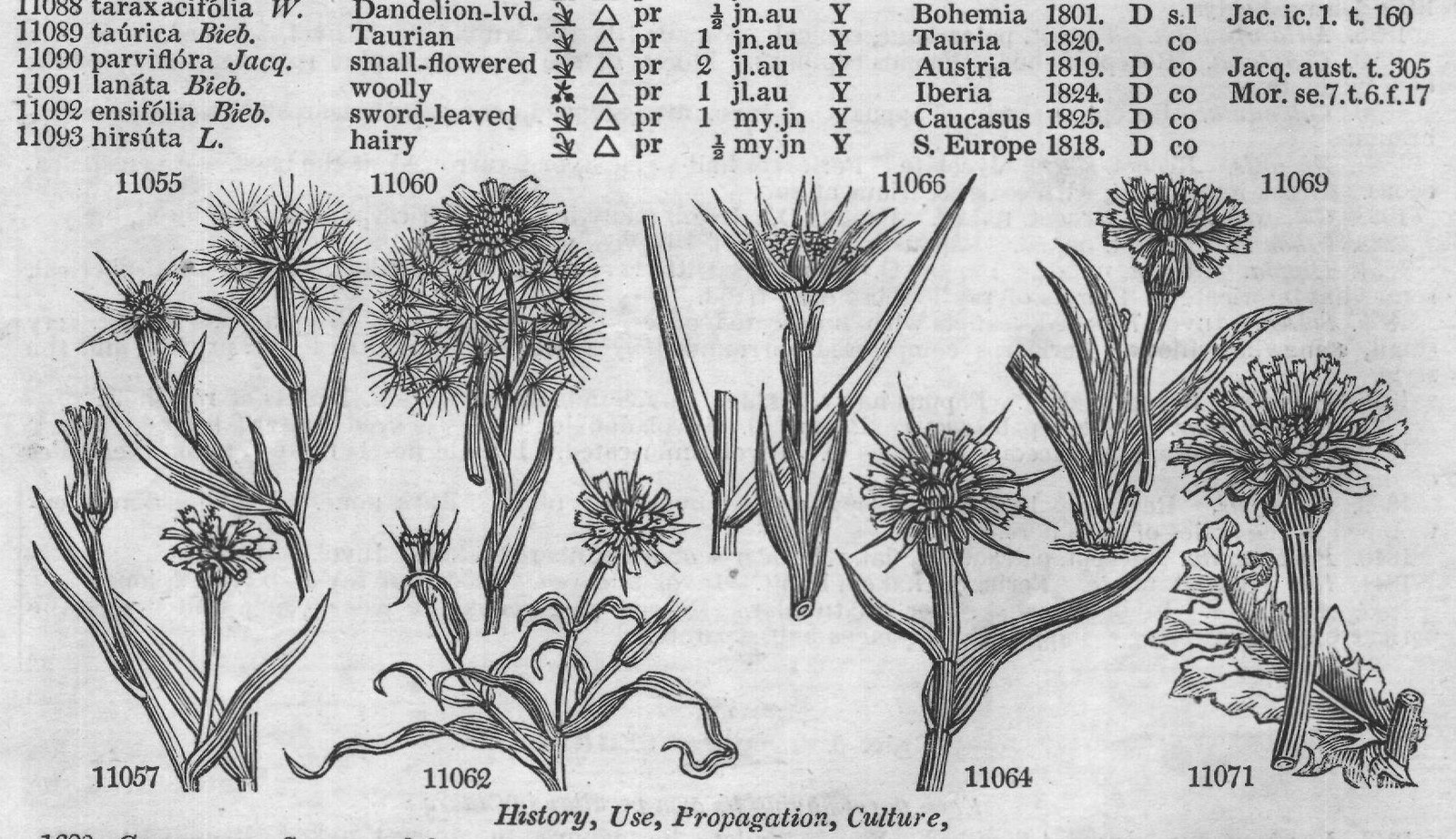
ÆQUALIS. 1620. GEROPO'GON. W. OLD MAN'S BEARD.
Compositæ.
Sp. 3-6. 11055 giáber W. smooth or 1½ jl.au Pk 11056 hirsútus W. hirsute Oor 1 jl.au R Italy Italy 1704. S co Bot. mag. 479 1759. S co Col. ecph.1. t.231 11057 calyculátus W. perennial or 2 jl,au Pk Italy 1774. S co Jac. vind.2. t. 106 1621. TRAGOPO'GON. W. GOAT'S BEARD.
Compositæ.
Sp. 11-17. 11058 cánus W. & K. hoary or 1 jl.au Pu Hungary 1824. S co 11059 angustifólius L. narrow-leaved or jl.au Pu Italy 1823. S co 11060 pratensis W. yellow or 2 my.jn Y Britain past. Sr.m