Home › E › Eng (Bot Schmd ic t Bot mag History)
Eng (Bot Schmd ic t Bot mag History)
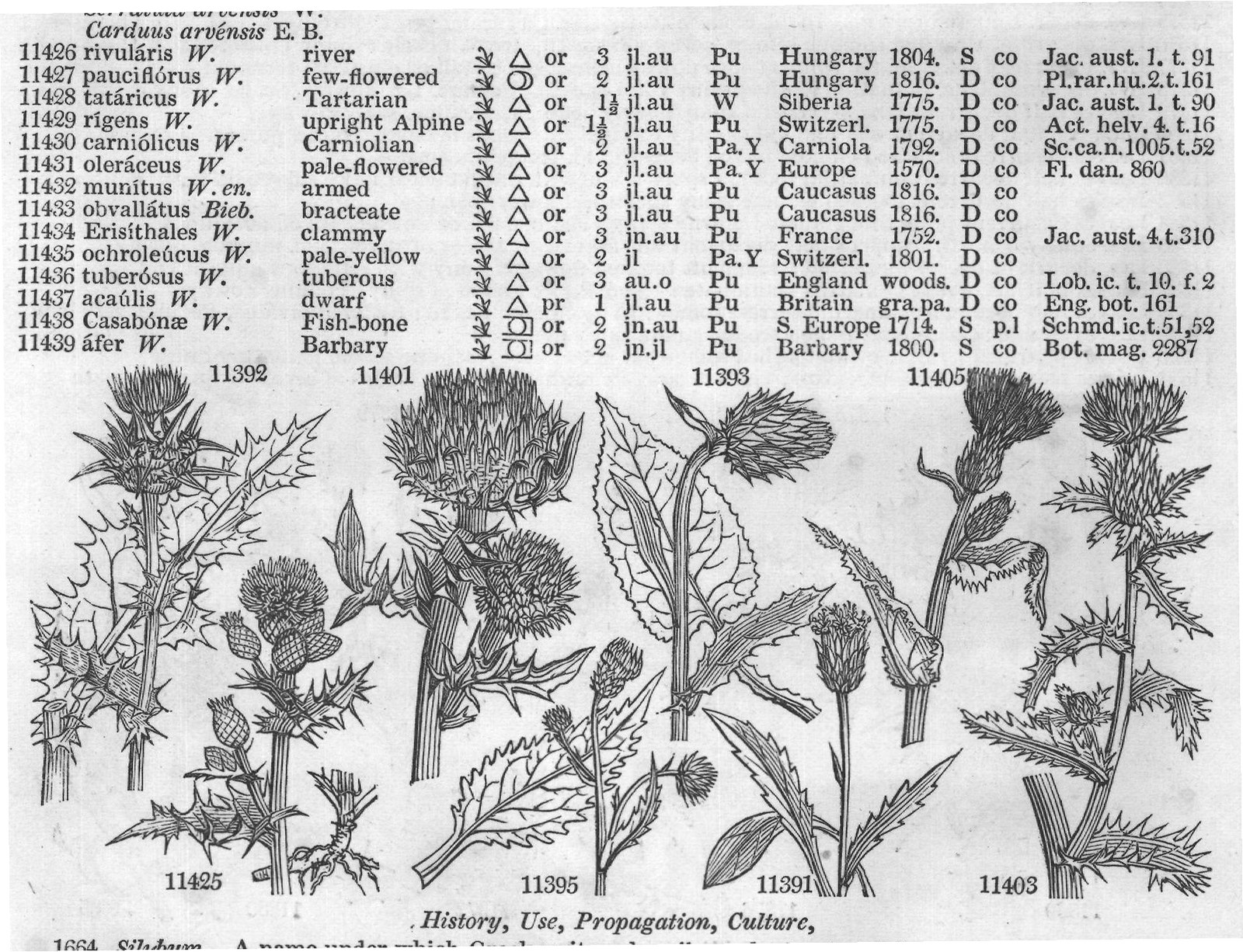
bot. 161 Schmd.ic.t.51,52 Bot. mag. 2287 11392 11401 11393 11405 11425 11395 11391 11403 History, Use, Propagation, Culture, 1664. Silybum. A name under which Greek writers describe a plant not well known at present. Sprengel refers it to S. marianum. This plant was formerly cultivated, and the young leaves used in spring as a salad, or boiled as pot greens; the young stalks, peeled and soaked in water, to extract a part of their bitterness, were also eaten, and were said to be excellent. In the spring of the second year, the root is prepared like salsafy or skirret; and the receptacle of the flower is pulpy, and eats like that of the artichoke. In Apulia the whole plant is much used as fodder for cattle. 1665. Cnicus. This is a name under which Dioscorides describes a prickly rough plant; derived from κviζω, to prick. It is now referred to a tribe of plants having such characters in an eminent degree. Acarna and prick. It is now referred to a tribe of plants having such characters in an eminent degree. Acarna and Erisithales are both names by which the ancients distinguished plants, either the very same as those now so called, or very similar to them. The tender stalks of C. palustris, as of most of the species, being peeled, are eatable either raw or boiled. C. arvensis is well known as one of the most troublesome weeds in arable land. It is never found, however, in very sandy, gravelly, or peaty soils; but generally in such as are loamy and dry. An instance is given in the Farmer's Magazine, of the descending roots of this plant having been dug out of a quarry nineteen feet long; nor is it less remarkable for its horizontal roots. Mr. Curtis planted about two inches of a root in his garden in April, and by November following it had thrown out under ground stolones on every side, some of them eight feet long; some of these stolones had thrown up leaves five feet ORDER I.
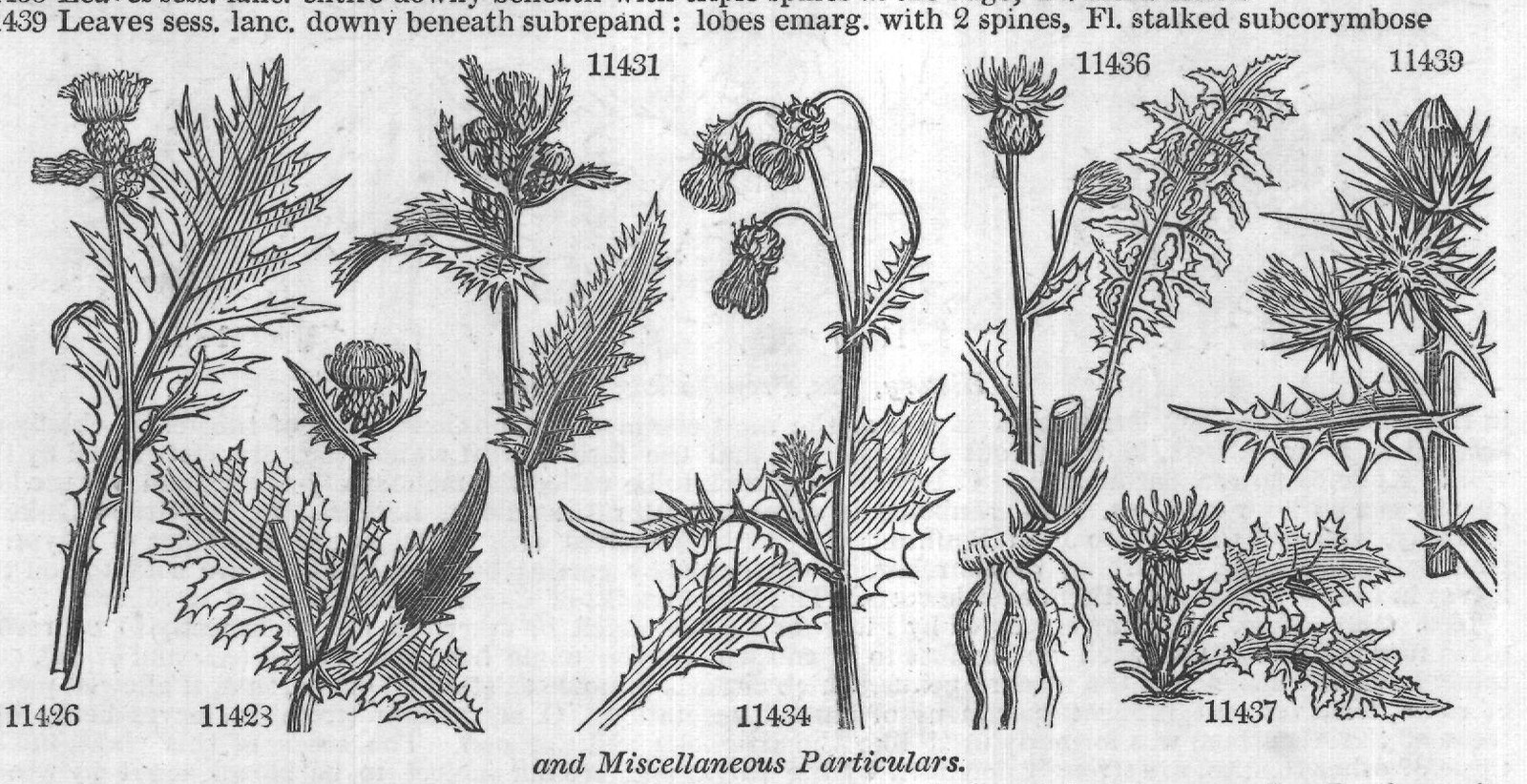
SYNGENESIA ÆQUALIS. 11392 Lvs. amplexicaul. waved spinous: radic. ones pinnati. Scales of invol. subfoliac. recurved spinous at margin 11393 Leaves downy beneath ovate toothed: radical cord. Petioles winged toothed, Invol. subsolitary cernuous 11394 Lvs. decurrent scabr. pinnatif. spinous, Invol. ovate clustered their scales ovate-lanc. mucro. appressed 11395 Lvs. half decurrent somew. hoary lanc. ciliate spiny, Pedunc. naked downy solit. Scales of invol. appressed 11396 Leaves decurrent lanc. hoary toothed spiny, Fl. aggregate involucrate, Invol. with pinnated spines 11397 Lvs. decurrent lanc. smooth subrepand uneq. ciliated, Pedunc. naked downy alternate [lanc. spreading 11398 Lvs. decurr. hispid pinnatif their segm. generally 2-lobed spreading spinous, Invol. ov. toment. their scales 11399 Lvs. subdecurr. pinnatif.: segm. 2-lobed spreading spiny vill. beneath, Invol. hemispher. sessile 11400 Lvs. amplexicaul. hispid pinnatif.: segm. 2-lobed spreading spiny downy beneath, Invol. ovate 11401 Leaves sess. pinnatif. every other segm. pointing upwards spin. scabr. Involucres spherical woolly 11402 Leaves sess. pinnatif. hairy downy beneath: segm. 2-lobed spreading spiny, Invol. globose with cobweb down 11403 Leaves sess. obl. lanc. scabrous downy beneath toothed ciliated: radic. pinnatifid, Invol. bracteate ovate 11404 Leaves sess. lanc. waved at the edge and unequally spin. pubesc. cottony beneath, Flowers mostly solitary 11405 Lvs. amplexic. lanc. ciliato-dentate undivided or laciniated white and downy beneath, Fl. mostly solitary 11406 Lvs. subcordate amplexicaul. lanc. ciliated downy beneath: lower somewhat cut, Fl. clustered 11407 Lvs. lanc. sessile ciliated strigose beneath: radical sinuated, Scales of invol. recurved at end 11408 Lvs. pinnatifid with strong spines somewhat downy beneath, Fl. sess. aggregate, Lvs. of invol. spiny 11409 Lvs. half decurr. obl. sinuate toothed spiny hoary beneath, Heads close together with appressed scales 11410 Leaves half decurrent lanc. entire ciliated, Pedunc. very long 1-fl. woolly 11411 Very like C. arvensis, but the leaves are decurrent 11412 Stem somew. downy, Lower lvs. sinuate-toothed with strong spines rough above finely downy beneath 11413 Lvs. amplexic. hispid pinnatifid: segm. 2-lobed spreading spiny downy beneath, Heads ov. glabrous spiny 11414 Lvs. amplexic. hispid pinnatif.: segm. 2-lobed spread. spiny downy beneath, Heads ov, cobwebbed with down 11415 Lvs. amplexic. hispid pinnatif.: segm. 2-lobed spread. spiny beneath naked subvillous, Heads ov. cobwebbed 11416 Lvs. amplexic. hispid pinnatifid: segm. 2-lobed spreading spiny naked beneath, Heads ov. glabrous 11417 Lvs. amplexicaul. hispid pinnatifid prickly: segm. angular lobed spiny, Heads nodding cobwebbed 11418 Stem branched many-fl. Heads terminal solitary spiny at base, Lvs. amplexicaul. sinuate toothed spiny 11419 Leaves sess. pinnatifid hispid woolly beneath: segm. 2-lobed spreading spiny, Invol, ovate woolly 11420 Leaves sess. lanc. cut-toothed: radical. pinnatifid, Scales of invol. ovate lanc. membranous at edge 11421 Leaves ciliate spiny downy beneath: lower stalked obl. acum. subsinuate; upper pinnatifid auricled 11422 Like the last, but the leaves of involucrum are reflexed 11423 Leaves obl. smooth serrulate with bristly ciliæ blunt mucro. Stem corymbose 11424 Leaves unarmed sess. obl. toothed: radical undivided and pinnatifid, Invol. scarious villous 11425 Leaves sess. pinnati. spin. Stem panicled, Invol. ovate, Scales appressed mucronated / 11426 Leaves toothed ciliated naked: cauline amplexicaul.: lower and radical pinnatifid, Fl. clustered capitate 11427 Leaves amplexicaul. ovate sublyrate ciliate serrate scabrous: radic, lyrate, Fl. clustered 11428 Leaves amplexicaul. obl. lanc. toothed ciliate-spiny, Pedunc. 1-fl. Invol. bracteate 11429 Leaves sess. pinnatifid: segm. cut serrate spiny at edge, Invol. bracteate: scales ovate appressed 11430 Leaves cordate amplexicaul. ovate obl. toothed ciliated: radical obl. blunt ciliated sinuate 11431 Leaves amplexicaul. cord. pinnatif. ciliate serr. Fl. terminal subracemose bracteate, Bractes colored ovate 11432 Leaves amplexicaul, obl. pinnatif. toothed spiny hispid above downy beneath, Term. fl. sess. axill. stalked 11433 Leaves amplexicaul. pinnatif. toothed spiny glabrous, Fl. term. aggreg. sess. surrounded by colored bractes 11434 Leaves amplexicaul. pinnatifid ciliated, Pedunc. cernuous, Invol. glutinous: scales lanc. spreading 11435 Leaves amplexic. pinnati,-downwards ciliated: pinnæ lanc. 3-nerved; upper confluent, Pedunc. cernuous 11436 Leaves amplexicaul. pinnatifid ciliate-spiny: segm. 2-lobed toothed upwards at the base 11437 Stemless, Invol. glabrous 11438 Leaves sess. lanc. entire downy beneath with triple spines at the edge, Fl. axill. sessile 11439 Leaves sess. lanc. downy beneath subrepand: lobes emarg. with 2 spines, Fl. stalked subcorymbose 11426 11423 11431 11434 11436 11437 11439 and Miscellaneous Particulars. from the original root. The whole together, when dug up and washed, weighed four pounds. In the spring following, it again made its appearance, on or about where the small piece was originally planted. There were between fifty and sixty young plants, which must have sprung from fragments of the roots that had eluded the gardener's search, though he was particularly careful in extracting them. From these facts it may readily be conceived how difficult it is to eradicate this weed from arable land; a naked fallow, with frequent and deep ploughing, will not accomplish it, unless the season is more than usually dry. Laying land down to grass, keeping it in that state seven or eight years, and during the whole time pulling up every shoot as soon as it appears, is found fully more effectual than a naked fallow. But the plant is so common by road sides, and seeds so abundantly, that it is hardly possible to effect its extermination. In common field lands, and others indifferently cultivated, it often forms the larger half of the produce, and formerly used to be pulled when beginning to come into flower, and given as food to horses and cows. Those who pull this weed require to be furnished with strong gloves, or thistle pincers. (Ency. of Agr. 2394.) Some English botanists seem doubtful if horses and cows will eat it; but those who know any thing of the history of agriculture in Scotland will recollect, that before the introduction of naked fallows and turnips, it formed the suppering of housed cattle, during five or six weeks of every summer. The ashes of the plant yield a very pure vegetable alkali. C. canus has fleshy white roots like the skirret, and may be dressed and eaten 11440 diacánthus Lab. 11441 stellátus W. 11442 syríacus W. 11443 spinosíssimus W. 11444 centauroídes W. 11445 uniflórus IV.
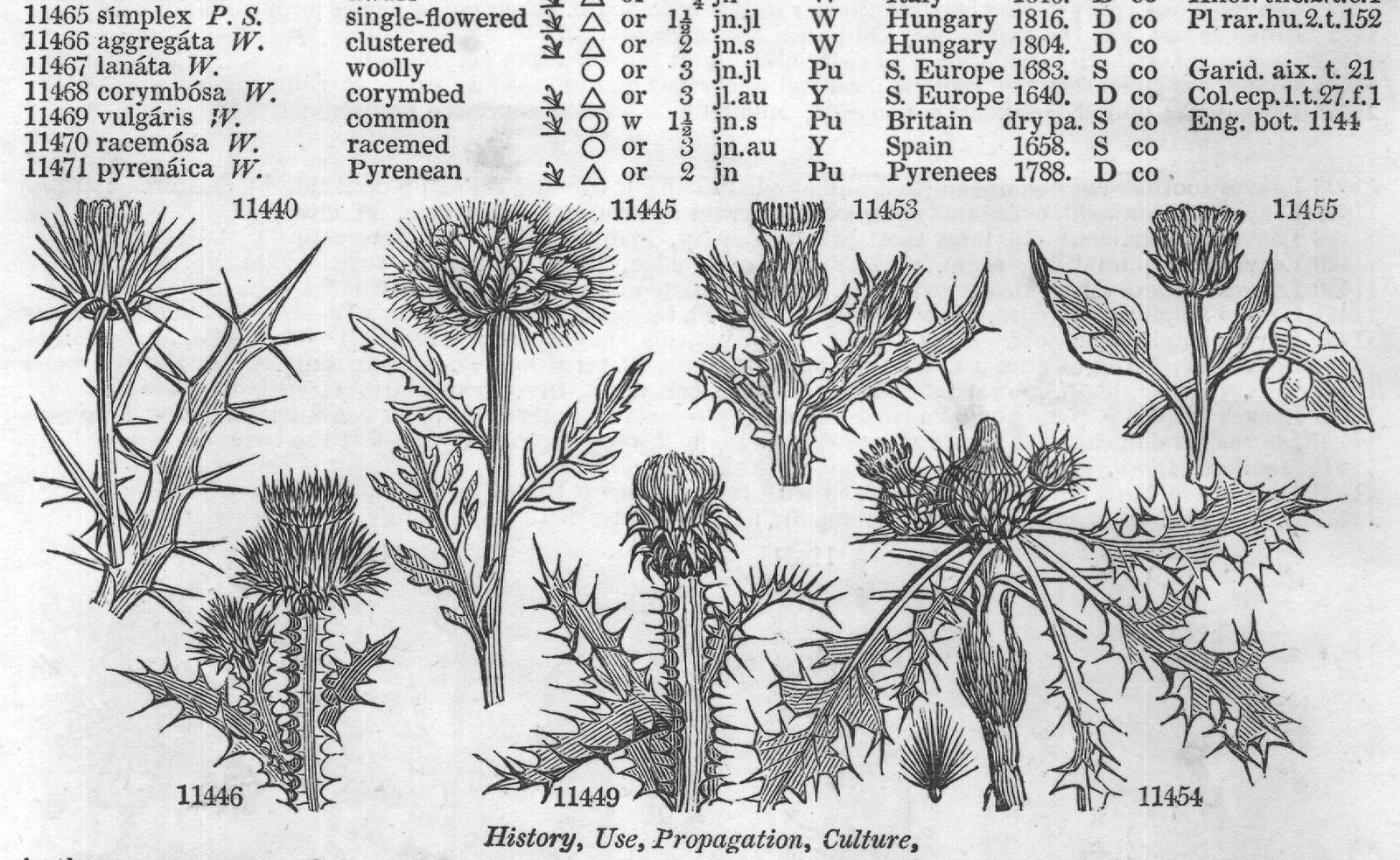
SYNGENESIA ÆQUALIS. two-spined starry Syrian Artichoke-lvd. one-flowered feathery-head. 1666. ONOPOR'DUM. W. COTTON THISTLE. woolly Taurian 11448 macracánthum W. long-spined 11446 Acánthium W. 11447 taúricum W. 11449 illýricum W.
Illyrian 11450 deltoídeum W.
Siberian 11451 græ cum W.
Grecian 11452 cynaroídes Stev. artichoke 11453 arábicum W.
Arabian 11454 acaúlon W. dwarf 1667. BERAR DIA. Vill. BERARDIA. મજાય છેાત્ર મા ચચત્ર CLASS XIX. or 3 jn.jl Pu Syria 1800. S co or 2 jn.jl Pu Italy 1665. S co Lab.ic.pl.sy.2.t.3 Triumf.obs. t.96 ☐ or 1½ jl. au W Levant 1771. S co Camer.hort. t.10 or 3 jn.au Pa. Y Switzerl. 1759. D co Bot. mag. 1366 or 3 jl.au Pu or 2 jl.au Vi Compositæ. or 6 jl.au Pu ☐ or 12 jl.au Pu Oor 10 jl.au Pu or 6 jl.au Pu or 12 au Pu Oor 10 jn.jl Pu or 10 jn W or 8 jl Pu or jl.au W ......
Compositæ. 11455 subacaúlis P. S. round-leaved Apr 1 jl.au Pu A'rctium lanuginósum Dec.
Sp. 1.
Italy 1668. CY'NARA. W.
ARTICHOKE.
Compositæ.
Sp. 7-10. 11456 Scólymus W. garden cul 8 au.s Pu 11457 hórrida W.
Madeira or 6 au.s Pu 11458 Cardúnculus W.
Cardoon cul 5 au.s Pu S. Europe 1548. D co Madeira 1778. D co Candia 1658. D co Pyrenees 1640. D co Siberia 1796. D co Sp. 9-14.
Britain gra.ba. S co Tauria 1800. S co Barbary 1798. S co S. Europe 1648. S co Siberia 1784. D co Levant 1799. D co Caucasus 1823. S co S. Europe 1686. S co 1739. S co Moris.s.7.t.25.f.2 Gmel. sib.2. 1.38