Ericea
Sp. 5-13. heath-leaved or 2 au.o Pu C. G. H. 1774. C s.p P.gz.471. t.2. f.10 jointed or 2 my.jn Pk C. G. H. 1795. C s.p Lam. ill. t. 78 purple-flowered or 2 my.jn Pu C. G. H. 1791. C s.p Moss-leaved or 1 jn.au C. G. H. 1774. C l.p 1737 ciliáris W. ciliated or 2 jn.au W C. G. H. 1795. C s.p Wend.col.2. t.49 285. CHOMELIA. W.
CHOMELIA.
Rubiaceæ. Sp. 1-2. 1738 spinósa W. spiny or 12 W ...
W. Indies 1793. C p.l Jac.amer.18.t.13 286. ADI'NA. Sal.
ADINA.
Rubiacea. globe-flowered or 1739 globiflóra Sal. 287. BOUVAR'DIA. H. K. BOUVARDIA. 1740 triphýlla H. K. three-leaved or 1741 versicolor B. Reg. various-colored or 2 jl.au W Rubiaceæ. 2 ap.n S 2 jl.s R Mexico 1794. Cs.p Par. lond. 88 S. Amer. ? 1814. C l.p Bot. reg. 245 Sp. 1.
China Sp. 2. 1804. C s.l.p Pár. lon. 115 1704 1710 1711 1716 1722 1729 1728 History, Use, Propagation, Culture, respects the flower-stalks. Zappa of Milan, and A. Young, speak in high terms of it; but the general feeling and practice of scientific agriculturists is against it, and it is now seldom sown. P. major is a native of most parts of Europe and of Japan, and always by way-sides, whence its name of waybread or way-bred. The seeds afford food to linnets, finches, and other small birds, and the leaves are a common application to wounds and cutaneous sores. An American negro once received a reward from an assembly of South Carolina for a cure for the bite of the rattle-snake; and in the receipt, it is said by Woodville (Med. Bot.), plantain was a principal ingredient. There are several varieties of this species to be met with in rich pastures and in botanic gardens, such as the rose P., in which the flower appears changed into a tuft of leaves expanded like a rose, and the besom P., in which the spike-leaves are imbricate and pyramidal. P. maritima varies in size and situation more than most plants. Its leaves are sometimes scarcely an inch, and at other times more than a foot in length; and the number of flowers in the spike varies extremely. Like Statice armeria and Sambucus nigra, it is found on the summits of the highest mountains, in the clefts of rocks, on the sea-shore, in salt marshes, and muddy banks.
P. coronopus is a singular-growing plant, with recumbent stems pressing closely on the ground. The leaves have a very peculiar flavor, and are rather disagreeable, but were formerly used in salads. P. psyllium is sometimes imported from the south of France in a dried state for the druggists. 279. Buddlea. In honor of Adam Buddle, a name well known to the English botanist as authority for many rare British plants. B. globosa is a very handsome shrub, and though rather tender, flowers freely in warm situations, or against a wall, with protection in very severe winters. Its leaves are long, narrow, pointed, ORDER I.
TETRANDRIA MONOGYNIA. 1704 Leaves semicylindrical entire woolly at base, Scape rounded 1705 Leaves lin. flat somew. toothed smooth at base, Spike cyl. Scape rounded hairy scarcely longer than leaves 1706 Leaves linear channelled recurved naked 1707 Leaves linear channelled entire beneath with rigid ciliæ hairy at base, Scape rounded pubescent 1708 Leaves spatulate cut-toothed, Teeth imbricated mucronated, Scape rounded hairy 1709 Leaves lanceolate 5-nerved toothed serrate, Scape rounded 1710 Leaves linear pinnate toothed, Scape rounded 1711 Leaves linear sub-toothed, Scape rounded, Head ovate, Bractes keeled membranous 1712 Leaves ovate entire fleshy rough woolly at base, Capsules 4-seeded 1713 Stem erect simple short, Leaves lanceolate fleshy entire stem-clasping hairy, Heads oblong leafless 1714 Stem branched herbaceous, Leaves somewhat toothed recurved, Heads leafless 1715 Hoary, Stem erect branched herbaceous, Leaves nearly entire, Heads leafy and sepals ovate 1716 Herbaceous, Stem branched diffuse decumbent, Leaves linear entire, Heads squarrose 1717 Stem branched herbaceous, Leaves linear entire reflexed, Heads leafy 1718 Stem branched herbaceous erect, Leaves linear channelled entire, Heads leafless 1719 Stem branched herbaceous weak, Leaves subulate entire, Heads leafy 1720 Stem branched suffruticose, Leaves entire filiform straight, Heads somewhat leafy 1721 Stem branched shrubby, Leaves lanceolate toothed, Heads leafless 1722 Leaves lanceolate acuminate crenulate beneath hoary, Heads globose stalked 1723 Leaves lanceolate subserrate hoary underneath, Spikes terminal lengthening with flowers threefold 1724 Leaves lanceolate cordate crenate rugose beneath tomentose, Flowers panicled 1725 Leaves linear lanceolate entire revolute at edge tomentose beneath, Corymbs terminal 1726 Leaves oblong nerved stem-clasping, Bractes cordate perfoliate longer than calyx 1727 Flowers spiked whorled and ternary, Leaves ovate lanceolate, Stem nearly simple 1728 Limb spreading, Stem filiform branched, Radical leaves roundish, Cauline subulate 1729 Flowers 5-cleft, Sepals cordate striated membranous keeled, Stem dichotomous, Leaves cordate 1730 A singular plant found in morasses in North America, and resembling Swertia 1731 Flowers terminal, Leaves cordate acuminate smooth 1732 Leaves rhomboidal wedge-shaped fleshy smooth, Flowers terminal 1733 Anthers exserted awnless, Cal. 4-leaved, Bract. 3 length of cal. Leaves 4 oblong acerose hairy imbricated 1734 Anthers exserted awnless, Leaves 4 ovate smooth, Flower-heads cernuous 1735 Anthers included awnless, Leaves 4 ovate subciliated, Flowers umbelled, Stem flexuose erect 1736 Anthers subexserted awnless, Cal. 1-leaved pilose, Cor. campanulate pilose above, Flowers axillary 1737 Leaves 4 smooth, Calyx lacerated ciliated 1738 Leaves ovate acuminate entire, Peduncles axillary 1739 The only species 1740 Leaves ternate lanceolate, Stamens included 1741 Leaves opp. Cor. clavate, Tube smooth inside 1734 1740 1741 1730 1732 1736 1739 and Miscellaneous Particulars. rugose, of the color of the common sage, and the flowers are very fragrant. It is commonly propagated by layers; but cuttings of the young wood of all the species root freely in common earth under a hand-glass. Buddlea Neemda is one of the most beautiful plants of India. 280. Exacum. The ancient name of a plant nearly related to Centaurium; said to have been derived from εξ and aγω, to conduct out, on account of its properties of expelling poison taken into the stomach. 281. Sebœa. A genus nearly related to the last, named after the famous Albert Seba, whose museum was once one of the wonders of Europe. 282. Frazera. After Mr. John Frazer, an indefatigable collector of plants in North America. 283. Penæa. In honor of P. Pena, who published Adversaria Botanica, Botanica, 1570, in conjunction with Lobel. A handsome genus, readily propagated by cuttings in sand under a hand-glass. Many of the finest species remain to be introduced from the Cape of Good Hope. 284. Blæria. In honor of Patrick Blair, who practised physic at Boston in Lincolnshire, and was one of the fellows of the Royal Society. He published Botanical Essays in 1778. The species resemble some kinds of heaths, and require the same treatment. 285. Chomelia. Named after Pierre Jean Baptiste Chomel, a French botanist, physician to Louis XV.; he died in 1740. Culture as for Siderodendrum. 286. Adina. From aδivoς, clustered, its flowers being in heads. A small Chinese plant, with flowers looking like those of a Cephalanthus. It is probably not different from Cephalanthus. 287. Bouvardia. Named after Dr. Charles Bouvard, formerly a superintendent of the Jardin du Roi at H 2 288. IXO'RA. W. 1742 grandiflóra B. R. 1743 Bandhúca Roxb. 1744 coccínea W. 1745 barbáta Roxb. 1746 parviflóra W. 1747 rósea Wall. 1748 álba W. 1749 strícta Roxb. 1750 blánda B. Reg. 1751 cuneifólia Roxb. 1752 crocáta B. R.
IXORA. sessile-leaved or 4 au Or Bandhooka or 3 jl F. scarlet or 4 jl.au S TETRANDRIA MONOGYNIA.
Rubiaceæ. Sp. 11-16.
CLASS IV.
E. Indies 1814. Cl.p Bot. reg. 154 E. Indies 1815. C p.l Bot. reg. 513 China C p.l bearded or 12 jn.jl W small-flowered ☐ or 20 au.o W E. Indies 1823. C p.1 E. Indies 1800. C p.1 highland or 4 jl F Bengal 1819. C p.1 Rhed.
Bot. mag. 2505 Va.sy.3.p.11.t.52 Bot. reg. 540 white or 4 jn W E. Indies 1768. C p.l upright or 3 jl.au S Moluccas 1690. C p.l Bot. mag. 169 charming or 4 au E. Indies ...
C p.l Bot. reg. 100 wedge-shaped or 3 jn.jl S E. Indies 1822.
C p.l Bot. reg. 648 orange or 3 au.s 0 E. Indies 1822.
C p.l Bot. reg. 782 289. CATESBÆ'A. W. 1753 spinósa W.
LILY-THORN.
Rubiaceæ.
Sp. 2-3. spiny or 12 my.s Y I. Provid. 1726. C s.p Bot. mag. 131 1754 parviflóra P. S. small-flowered or 1 W ...
Jamaica 1810. C l.p Sl.his.2. t.207. f.1 290. PAVETTA. W.
PAVETTA.
Rubiaceæ. Sp. 1-13. 1755 índica W.
Indian or 4.au.o W E. Indies 1791. C p.l Bot. reg. 198 291. ERNO'DEA. Swz.
ERNODEA.
Rubiacex. Sp. 1-3. 1756 montána Sm. mountain or jn.jl R Sicily 1820. Drk Bot. mag. 292. SIDERODEN DRUM. W. IRON-TREE.
Rubiacea. Sp. 1. 1757 triflórum W. three-flowered tm 20 ...
Pk W. Indies 1793.
C p.l Jacq.am.t.175.f.9 293. COCCOCYP'SILUM. W. CocCOCYPSILUM.
Rubiaceæ. Sp. 1-5. 1758 répens W. creeping W my Pu W. Indies 1793.
D s.p Bro. jam. t.6. f. 1 294. MITCHELLA. W. MITCHELLA.
Rubiacea. Sp. 1. 1759 répens W. creeping or דול jn W N. Amer. 1761.
L s.p Cat. car. 1. t. 20 295. OLDENLANDIA. W. INDIAN MADDER.
Rubiaceæ. Sp. 2-3. 1760 umbelláta W. common W jl.au W E. Indies 1792. R s.p Roxb. cor. 1. t. 3 1761 corymbósa W.
Hyssop-leaved W jn.o W Jamaica 1739. S s.I Eh. pic.t.2.f.1.t.4 296. MANET'TIA. W.
MANETTIA.
Rubiaceæ.
Sp. 1-8. 1762 coccínea W. pink 오 or 20 my.jl Pk Guiana 1806. C l.p Bot. reg. 693 297. EPIMEDIUM. W. BARREN-WORT.
Berberideæ.
Sp. 1. 1763 alpínum W.
Alpine or ap.my Bd England m. thi. C p.1 Eng. bot. 438 298. PTELEA. W.
SHRUBBY-TREFOIL.
Terebintacece. Sp.1-2. 1764 trifoliata W. three-leaved 299. MONETIA. W. 1765 barlerioídes W.
MONETIA. four-spined or 12 jn.jl G N. Amer. 1704. L co Incerta. Sp. 1.
Schm. ar. 2. t. 76 or 300. CURTISIA. W. 1766 fagínea W.
HASSAGAY-TREE.
Beech-leaved tm 30 301. HARTO'GIA. W. 1767 capénsis W.
HARTOGIA.
Cape or 1742 1753 G E. Indies 1758. C s.p L'Her. st.n.1. t.1 3 jl Incerta. Sp. 1. ...
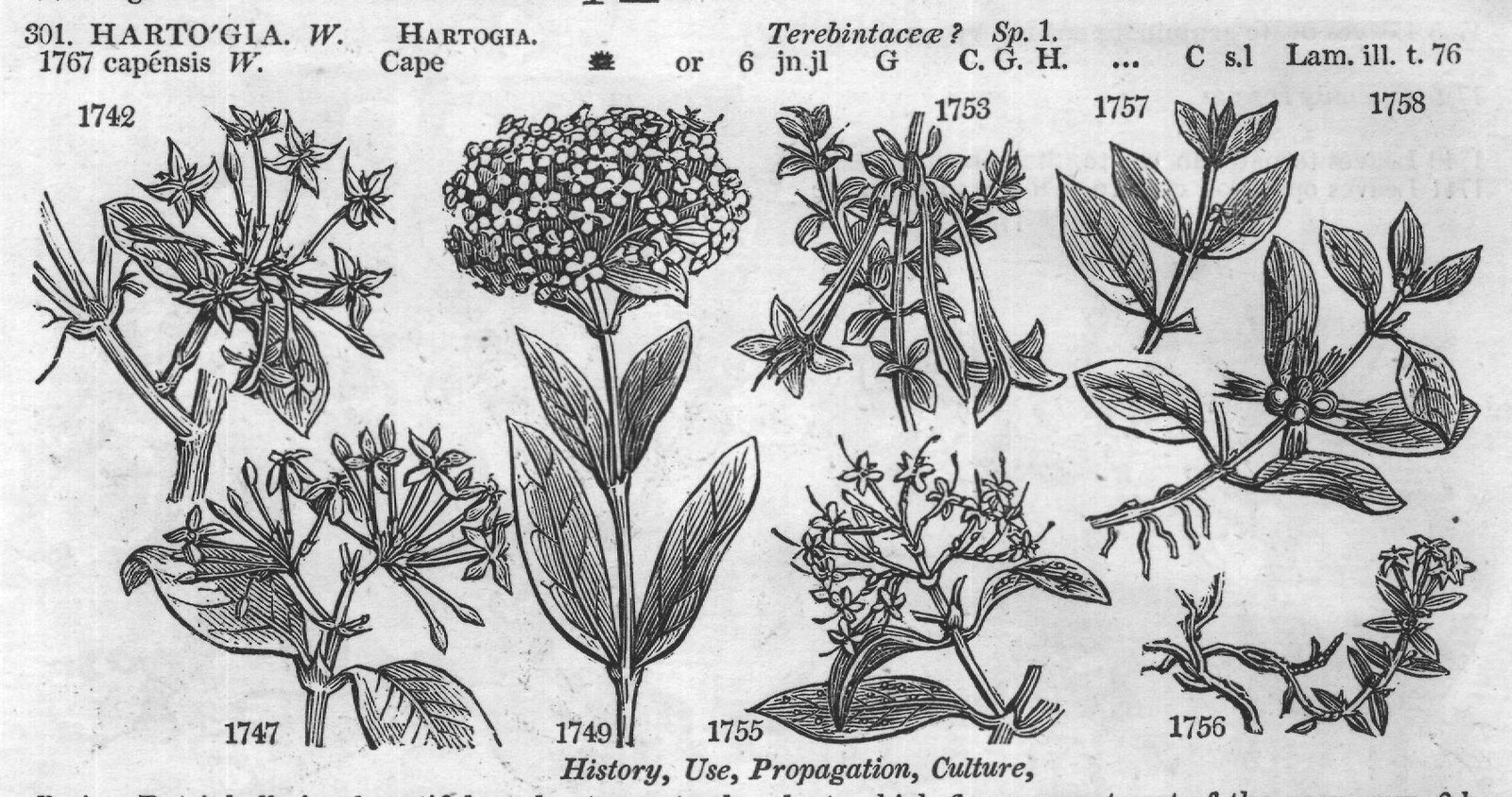
Pa C. G. H. 1775. C s.l Bur. afr.235. t.82 Terebintace ? Sp. 1. 6 jn.jl G C. G. H. ... 1757 C s.1 Lam. ill. t. 76 1758 1747 1749 1755 1756 History, Use, Propagation, Culture, Paris. B. triphylla is a beautiful, and not very tender plant, which flowers great part of the year; var. ẞ has smooth shining leaves, and flowers of a deeper scarlet than the other. B. versicolor requires the warmest part of the green-house, and the cuttings require bottom heat, with the same soil as the plants. 288. Ixora. A name of doubtful origin. Iswara is the name of an Indian divinity. According to Sweet, the species of this beautiful genus "require to be kept in a moist heat to thrive well; ; but not plunged in tan, as that is almost certain to injure their roots. A mixture of sandy loam and peat is the best soil for them. Care must be taken to keep them clean and free from insects, or they will not thrive. Cuttings root very freely in sand under a hand-glass. 289. Catesbæa. So named by Gronovius, in honor of Mark Catesby, author of the natural history of Carolina, and who discovered the first species of this genus. It is very ornamental. C. spinosa has flowers about six inches long, in the form of a Roman trumpet, and succeeded by fruit the size of a pullet's egg; the skin smooth and yellow, and the pulp like that of a ripe apple, with an agreeable taste. It does not flower very freely, but strikes root readily in sand under a bell-glass, and in moist heat. 290. Pavetta. The name of the plant in Malabar. A small genus nearly related to Ixora, with flowers usually white, as those of Ixora are red. 291. Ernodea. From ερvωδης, branching, in allusion to the habit of the plant. 292, Siderodendrum. From σiδηρoς, iron, and δεvδρov, a tree. Wood, compared for hardness to iron. This tree may be noticed on account of an anomaly which occurs in the corolla, which is often changed, perhaps by some insect, into an oblong bag, half an inch in length, fleshy, and hollow within, and ending in a point at top like a fruit. Cuttings of ripened wood root in sand under a hand-glass. 293. Coccocypsilum. From zoκκoς, fruit, and κuψελη, a vase, its berry being surmounted by a corona resembling a little cup. Cuttings root freely in sand under a bell-glass. 294. Mitchella. Named after John Mitchell, an Englishman, who travelled in Virginia, and left some papers upon North American plants behind him. This is one of those plants which Humboldt (De Distrib. Plant.) calls ORDER I.
TETRANDRIA MONOGYNIA. 1743 Shrubby spreading, Lvs. oval stem-clasping, Corymbs crowded, Segm. of cor. ovate obt. Berries crowned 1744 Leaves elliptical acute cordate at base sessile, Umbels terminal aggregate, Segm. of cor. ovate acute 1745 Corol. long bearded at mouth, Lvs. opp. obl. entire smooth shining, Floral lvs. round cord. sess. Pan. open 1746 Leaves subsessile oblong smooth, Panicles ovate oblong decussated, Pet. oval, Style hairy 1747 Leaves obl. acute with a contr. emarg. base pubesc. beneath subsessile, Corymbs large, Pet. cuneate acute 1748 Leaves sessile broad lanceolate, Corymbs decompound dense, Pet. obovate reflexed 1749 Shrubby straight, Lvs. subsess. obl. Corymbs dense, Pet. round spreading, Anthers round bristle-pointed 1750 Leaves ovate-lanceolate, Cyme trichotomous contracted 1751 Leaves wedge-shaped lanceolate acuminate, Corymbs terminal, Sepals conical 1752 Leaves coriaceous oval lanc. Cymes decompound close, Petals wedge-shaped obovate, Anthers sessile 1753 Tube of corolla very long, Berries oval 1754 Tube of corolla 4-cornered short, Berries roundish 1755 Leaves smooth entire, Panic. fastigiate axillary and terminal, Style twice as long as corol. Stigma entire 1756 Leaves in 4s oblong obtuse smooth, Stem shrubby 1757 The only species. Branches 4-cornered, Leaves 5-6 inches long elliptic lanceolate 1758 Stem herbaceous creeping, Leaves ovate, Flowers clustered axillary sessile 1759 A little creeping plant with flat round leaves and little scarlet berries 1760 Umbels naked lateral alternate, Leaves linear 1761 Pedunc. many-flowered, Leaves linear lanceolate 1762 Leaves ovate acuminate, Racemes many-flowered, Stem twining shrubby 1763 The only species 1764 Leaves on long stalks ternate, Fruit with two wings 1765 A small prickly shrub, Leaves opposite ovate acute entire. The only species 1766 The only species. Leaves ovate oblong acute serrated opposite 1767 Leaves opposite elliptical obtuse emarginate serrated 1759 1766 1765 1760 1762 1763 1764 1767 and Miscellaneous Particulars. social, being always found in quantities. Barton says, it is the plant most extensively spread in North America, covering the surface from the 28th to the 69th degree of north latitude. 295. Oldenlandia. In honor of H. B. Oldenland, a Dutch naturalist, who travelled in Africa, where he died about the end of the 17th century. O. umbellata, the chay-root, grows on light sandy ground near the sea, and is much cultivated on the coast of Coromandel for dyeing red, purple, brown, and orange, and to paint the red figures on chintz. The coloring matter resides in the bark, which gives it out to water. Malabar physicians say that the roots cure poisonous bites, colds, and cutaneous disorders, and warm the constitution. The 296. Manettia. In honor of Xavier Manetti, an Italian, and professor of botany at Florence. Some of the species are rather pretty, but they are seldom seen in collections. 297. Epimedium. A name of Dioscorides, applied to this little elegant alpine plant, without any assignable reason. 298. Ptelea. The Greek name of the elm. It is derived from πτaω, to fly, in allusion to the winged seedvessels. A hardy shrub of North_America, not unlike a laburnum in foliage, but with small green flowers. 290. Monetia. So named by L'Heritier, in honor of the Chevalier Jean Bapt Baptiste Monet de la Marck, a celebrated French botanist, now dead; who, unfortunately for botany, many years ago diverted his attention from that science to conchology. Cuttings root in sand under a bell-glass, and in bottom heat. 300. Curtisia. Named in honor of W. Curtis, lecturer on botany, author of the Botanical Magazine and other works; he died in 1799. This is one of the largest trees of Africa, from which the Hottentots and Caffres make the shafts of their javelins. It has fine broad leaves, but small flowers, which, however, have not yet appeared in this country. 301.. Hartogia. Named after John Hartog, a Dutchman, who travelled in Southern Africa and Ceylon. The plant called by this name in the gardens is probably only a variety of the common laurel, and nearly as hardy as it. The flowers grow in axillary racemes like bunches of currants. H 3 TETRANDRIA MONOGYNIA. 302. AMMAN'NIA. W. AMMANNIA.
CLASS IV, Salicariæ. Sp. 6-20, 1768 latifólia W. broad-leaved w 1 jl.au W 1769 débilis W. cluster-flowered W 1 jl.au Pu 1770 cáspica Ledeb.
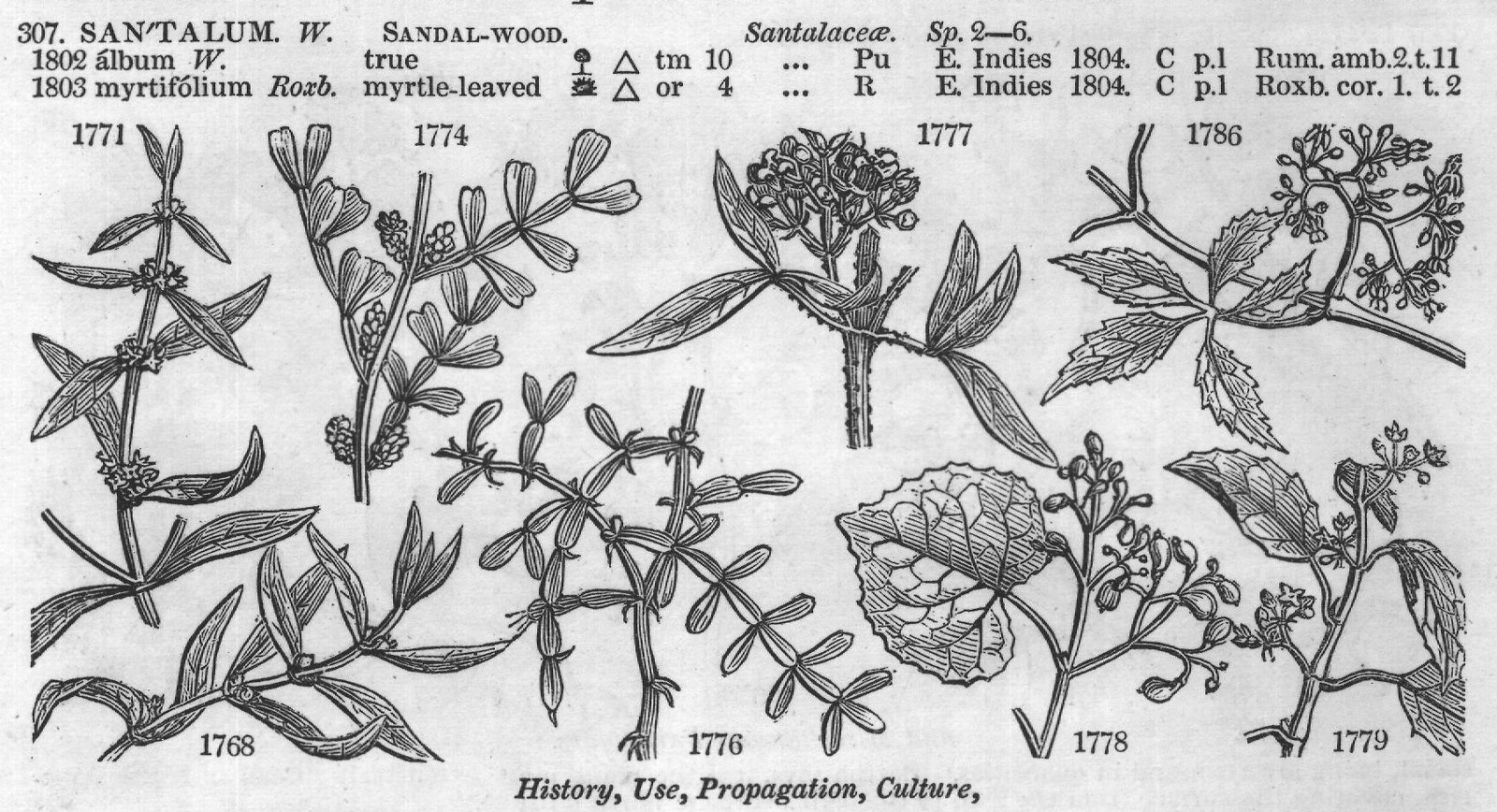
Caspian W jl.au Ap 1771 baccífera L. berry-bearing w jn.jl Ap 1772 ramósior W. branching W 2 jl.au Pu W. Indies 1733. S s.1 Slo. jam. 1. t.7. f.4 E. Indies 1778. S s.l Astracan 1821. S s.l India 1820. S s.1 Virginia 1759. S sl Lam. ill. t.77. f.5 Bocc. mus. t. 104 1773 sanguinolénta W. bloody W jl.au R Jamaica 1803. S s.l 303. FAGA'RA. W.
FAGARA.
Terebintaceæ. Sp.3-18. 1774 Pteróta W.
Lentiscus-leav. tm 20 au.s G 1775 Piperíta W. ash-leaved or 10 s W 1776 tragódes W. prickly-leaved or 5 W ...
Jamaica 1768. C p.1 Japan 1773. L p.1 W. Indies 1759. C 1.p Bro.ja.146.t.5.f.1 Kæmpfr. t. 893 Jac. am. 21. t. 14 304. ZIERIA. Sm.
ZIERIA. 1777 Smithii Sm.
Smith's or Rubiaceæ. Sp. 1. 2 ap.jl W N. S. W. 1808. C s.p Bot. mag. 1395 305. CIS SUS. W.
CISSUS.
Sarmentaceæ. Sp. 13-50. 1778 vitigínea W. vine-leaved or 20 ...
G India 1772. C p.1 Pl.m.27. t.337.f.2 1779 antárctica Vent.
Kanguru-vine ☑ ☐ or 20 jn.au G N. S. W. 1790. C s.l Bot. mag. 2488 1780 heterophýlla Lk. various-leaved 1 ☐ or 10 ...
G ...... 1822. D co 1781 glandulósa Horn. glandular or 10 ...
G 1819. D co ...... 1782 sicyoídes W. naked-leaved or 10 ...
G Jamaica 1768. C s.p Jac.amer.22.t.15 1783 quadranguláris W. square-stalked or 30 G ...
E. Indies 1790. C p.l