England Wales
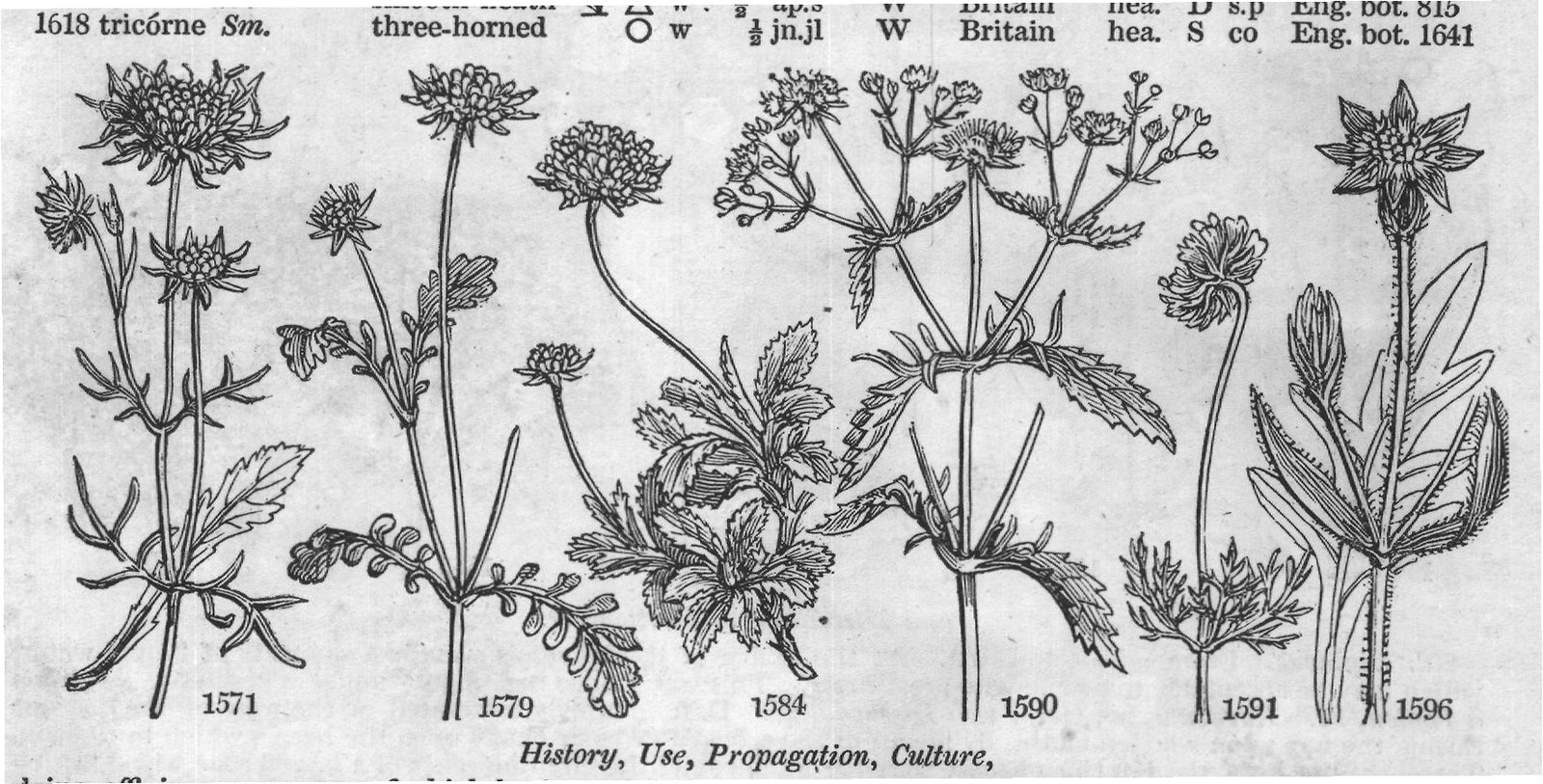
D s.l Eng. bot. 1871 Eng. bot. 1972 Eng. bot. 384 three-horned smooth-heath. ap.s W jn.jl W Britain Britain hea. D s.p hea. S co Eng. bot. 815 Eng. bot. 1641 1571 1579 1584 1590 1591 1596 History, Use, Propagation, Culture, dying off, in consequence of which horizontal roots naturally protrude themselves. Why it should rot off is another matter, but readily accounted for by ascribing it to a bite from the devil. The same appearance is found in Plantago, Trifolium, and some other plants with subfusiform roots. A decoction of S. succisa is an empirical specific for the gonorrhœa.
S. atropurpurea is the handsomest species, and is cultivated as a border annual and biennial. It has been so long in cultivation that its native country is unknown. Linnæus and Miller consider it a native of India; Professor Martyn of the south of Europe. 265. Knautia. So named by Linnæus in honor of Christopher Knaut, physician at Halle in Saxony: born in 1636; died in 1694. Another Knaut (Christian) published a system of plants in 1705, which has nothing to recommend it. 266. Galium. Derived from γaλa, milk; because one sort is used for the purpose of curdling milk. This is a very natural genus; the roots of most of the sorts dye red, and the herb, like madder, colors the bones of anivery natural genus; the roots of most of the sorts dye red, and the herb, like madder, colors the bones of animals that feed on it. The stems of all the species are four-cornered, and the leaves in whorls; the flowers ge- ORDER I.
Corollas 5-fid. 1569 Hoary, Coroll. radiant, Stem many-flowered, Radical leaves ovate lanceolate entire, Cauline pinnatifid 1570 Calyx very short, Cauline leaves bipinnate filiform 1571 Coroll. radiant, Radical leaves ovate or lyrate pubescent crenate, Cauline pinnate setaceous 1572 Coroll. radiant, Radical leaves oblong crenated, Caul. pinnatifid: the pinnæ linear lanceolate spreading 1573 Coroll. radiant, Leaves smooth, Radical ovate oblong serrate or lyrate, Caul. pinnate: the segm. lin. cut 1574 Coroll. equal shorter than calyx, Leaves lyrate pinnatifid hairy, Stem branched divaricating 4 1575 Leaves pinnate: the upper linear, Calyces 1-leaved 5-cleft 1576 Coroll. radiant shorter than calyx, Leaves pinnated the upper linear entire 1577 Silky, Lower lvs. stalked roundish or cuneate rugose cren. upper pinnat. Florets uniform longer than invol. 1578 Hoary very soft, Radical leaves obl. crenated upper caul. pinnatifid with ovate or lanc. crenated segm. 1579 Coroll. radiant, Lvs. cut, Recept. of fruit roundish, Outer limb of calyx broad membran. Stem branched 1580 Coroll. radiant, Flowers subsessile, Stem dichotomous, Leaves oblong lanceolate nearly entire pubescent 1581 Coroll. radiant, Leaves cut, Receptacles of the flower subulate 1582 Coroll. radiant, Leaves pinnatifid, Segments linear, Peduncles very long, Stem rounded 1583 Calyx multifid urceolate, Coroll. radiant, Leaves fleshy pinnatifid with linear stiff pinnæ 1584 Coroll. equal, Stem shrubby, Leaves sim simple erect 1585 Coroll. radiant, Leaves undivided elliptical serrated shining stalked 1586 Coroll. radiant, Leaves lanceolate nearly entire, Stem shrubby 1587 Coroll, radiant, Leaves linear lanceolate entire, Stem herbaceous 1-flowered 1588 Coroll. radiant, Radical leaves lanceolate stalked entire, Cauline pinnated, Stem 1-flowered 1589 Coroll. radiant, Segments entire, Lower leaves oblong coarsely serrated upper pinnatifid at base 1590 Coroll. radiant, all the segments trifid, Leaves undivided subserrate the upper pinnatifid at base pinnatifid at base 1591 Coroll, radiant longer than calyx, Leaves bipinnate longer than stem 1592 Coroll, radiant, Radical leaves pinnatifid, Cauline linear fringed at base 1593 Coroll. radiant, Radical leaves bipinnate with linear leaflets, Cauline pinnate with perfoliate stalks 1594 Coroll, radiant, Radical leaves lyrate, Cauline sub-bipinnate, Calyxes as long as disk 1595 Leaves cut, Cor. 5 longer than calyx 1596 Upper leaves lanceolate entire, Cor. 10 as long as calyx Fruit smooth. 1597 Leaves 4 ovate lanceolate 3-nerved beneath scabrous, Stem erect simple 1598 Leaves 4 obovate unequal obtuse, Stems diffuse 1599 Leaves 5 reflexed lanceolate awned ciliated, Stem erect simple scabrous 1600 Leaves linear smooth mucronate, Stems 4-cornered diffuse 1601 Leaves 6 linear mucron. roughish, Peduncles trichot. Stems prostrate diffuse 4 angular winged branched 1602 Leaves 8 lanceolate prickly serrate forwards, Panicles trichotomous, Stems smoothish flaccid 1603 Leaves 8 hispid lanceolate linear acuminate subimbricate, Peduncles twice dichotomous 1604 Leaves 8 linear furrowed with stem smooth to the touch, Branches flexible, the flow.-bearing ones short 1605 Leaves 8 elliptical lanceolate obtuse mucronate at the edge rough horizontally spreading, Stem flaccid 1606 Leaves 8 smooth lanc. scabrous beneath, Floral in pairs, Panicle term. Ped. capill. Stem rounded smooth rounded smooth 1607 Leaves 8 linear lanceolate very smooth, Peduncles panicled capillary, Stem rounded 1608 Leaves whorled linear above scabrous, Panicle divaricating, Stem erect rounded pilose roughish 1609 Leaves 8 lanceolate smooth mucronate, Panicle capillary, Petals awned, Stem 4-cornered weak 1610 Leaves 8-6 obovate lanc. mucr. rough at edge, Peduncles 3-flow. Petals awned, Stem 4-cornered smooth 1611 Leaves whorled linear, Peduncles dichotomous flower-bearing from the top of the stem which is smooth 1612 Leaves whorled linear setaceous, Peduncles capillary longer than the leaves. 1613 Leaves whorled linear spreading, Peduncles very short 1614 Leaves 6 lanceolate keeled rough aculeate backwards joints simple 1615 Leaves 6 or 8 lanceolate prickly serrate backwards mucronate stiff, Cor. larger than fruit 1616 Leaves 6 linear lanceolate mucronate thin, edges and the stem scabrous, Peduncles bifid, Fruit granular Fruit rough or hispid. 1617 Leaves 4-6 oblong with short point rough at edge, Panicles close, Stem weak short smooth 1618 Leaves 8 lanc. at edge and stem aculeate backwards, Peduncles axillary 3-fl. Fruit granular nodding 1598 1600 1606 1611 1617 1614 1616 1618 and Miscellaneous Particulars. nerally axillary, but sometimes panicled. G. verum, petit Muget, Fr. is called bed-straw, from the verb to strew, strow, or straw being one among a variety of odoriferous herbs which were formerly used to strew beds with. The bruised plant is sometimes put in milk intended for cheese to give it a flavor and color. Boiled in alum-water, the flowering stems dye a good yellow color, and the roots a red equal to madder. They were once cultivated like that plant, at the recommendation of the Committee of Council for Trade, and yielded 12 cwt. of dried roots per acre. G. mollugo, of which there are several varieties, and G. sylvaticum and boreale have similar qualities, though in a less degree. G. aparine, (from aπaiρω, to lay hold of), has the fruit set with hooked bristles which adhere to whatever they come in contact with, whence it was called by the Greeks Philanthropon (man-lover), and by us cleavers, , catch-weed, scratch-weed, &c. ; and from being a favorite food or medicine with geese, goose-grass, &c. Linnæus informs us, that they use the stalks in Sweden as a filtre to strain their milk through. Dioscorides relates, that the shepherds made the same use of it in his time; and certainly it is no bad thing to take hairs from milk, where a sieve is not at hand. It is reckoned to purify the blood, and for that purpose the tops are 1619 boreáie W. 1620 Aparine W. 1621 pilósum W. 1622 græcum W. 267. KU'BIA. W. 1623 tinctórum W. 1624 peregrína W. 1625 lúcida W. 1626 fruticosa W. 1627 angustifólia W. 1628 cordifólia W. 268. ASPE'RULA. W. 1629 odoráta W. 1630 arvénsis W. 1631 hírta P. S. 1632 hirsúta Desf. 1633 taurína W. 1634 crassifólia W. 1635 aristáta L. w 1 از W W 3 my.au W hairy Candian jn.jl Pu TETRANDRIA MONOGYNIA. cross-leaved Cleavers W 1 jn.jl W cu Britain moun. D co Britain CLASS IV.
Eng. bot. 105 hedg. S co Eng. bot. 816 1798. D co N. Amer. 1778. D co Candia MADDER.
Rubiaceæ.
Sp. 6-17. dyer's wild ☑ag 4 jn Y W 2 jl Y shining W 2 jl Y prickly-leaved W 4 s Y narrow-leaved w 2 jl.au Y heart-leaved cu از W S. Europe 1596. D s.l England bu. pl. D co Majorca 1762. C l.p Canaries 1779. C p.l Minorca 1772. C l.p Siberia 1783. D p.l Alp.ex.167. t. 166 Lam. ill. t.60. f.1 Eng. bot. 851 Fl. græc. t. 142 Jac. ic. 1. t. 25 Lam. ill. t.60. f.2 Pall. it. 3. t. 2. f.1 WOODROOF.
Rubiaceæ.
Sp. 14-30. sweet-scented field or my.jn W Britain woods. D s.1 Eng. bot. 755 W jl Li hairy pr hirsute pr broad-leaved pr 121 jn.jl Pu my.jn W Europe 1596. S co Pyrenees 1817. D co Lob. ic. t.801. f.2 ap.jn W thick-leaved pr jn W awned Apr 1 jl.au Y 1636 scábra Lk. rough Apr 1 jn.jl W 1637 tinctória W. narrow-leaved pr jn.jl Pk 1638 cynánchica W. small prjl F 1639 supína Bieb. supine pr jn Pk 1640 arcadiénsis B. M.
Arcadian pr my 1641 lævigáta W. shining Apr 1 jn W 1642 montána W. en. mountain Apr 1 jn.jl Pk 269. SHERAR DIA. W. FIELD-MADDER.
Rubiacee.
Sp. 2. 1643 arvénsis W. little W ap.s B 1644 murális W. wall W 270. SPERMACO'CE. W. BUTTON-WEED. jn.au Y Rubiacea.
Sp. 13-65. 1645 tenúior W. slender W 1646 latifólia W. broad-leaved w 2 jn.au 2 jl Pk W 1647 strigósa B. M.
Cross-wort w 1 jl.au W 1648 radícans W. rooting w از W 1649 verticilláta W. whorl-flowered 业 W 2 jn.au W 1650 híspida W. bristly w 1½ au.s V 1651 rúbra Jacq. 1652 stricta L. red w 1 jn.au Pu ......
Portugal 1819. D co Italy 1739. D s.l Moris.s.9.t.21.f.1 Levant 1775. D s.l S. Europe 1823. D co Italy 1824. D co Europe 1764. D s.l England ch. hil. D s.l Caucasus 1821. D co Arcadia 1819. D co S. Europe 1775. D s.l Hungary 1801. D co Britain Italy cor. fi. S co 1805. S co W. Indies 1732. S co Guiana 1803. S s.1 W. Indies 1760. S s.l Guiana 1803. S s.l Africa 1732. S s.p E. Indies 1781. S s.1 1804. S s.l Tab. ic. t.733. f.1 Eng. bot. 33 Bot. mag. 2146 Mor. his. t. 21. f.4 Eng. bot. 891 Allion. t. 77. f. 1 Sch. hand.1. t.22 Aublet. t. 19. f.1 Bot. mag. 1558 Aublet. 1.t.20.f.4 Dii.el. t.277.f.358 Mur.co.got.3. t 6 Jac.schen. t.256 upright w jn.jl W 1653 stylósa Lk. long-styled w 1654 cornifólia Fisch. 1 my.jn W dogwood-leav'd w 1655 Fischéri Lk. 1 my.jn R E. Indies 1820. S s.l Manilla 1819. S s.l Brazil 1819. S s.l Fischer's w 1656 suffruticósa Jacq. 1657 mucronáta Nees. 1 my.jn W Jamaica 1821. S s.l suffruticose W jn.au F .. 1824. C s.l Jac.schœn. t.322 mucronate w 2 jn.jl W Jamaica 1822. D s.l 271. CRUCIANELLA. 1658 angustifolia W.
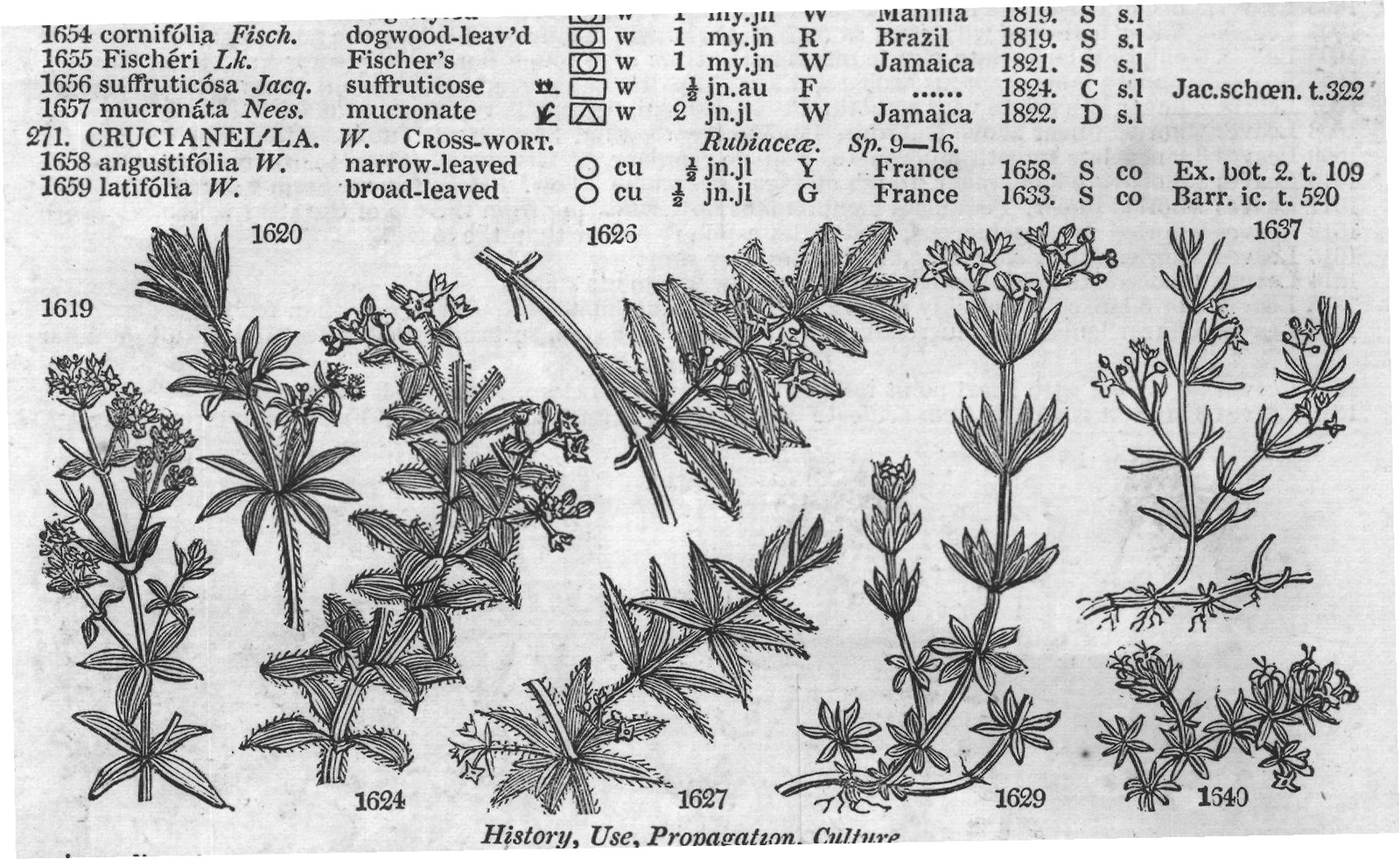
W. CROSS-WORT. narrow-leaved Rubiaceæ. Sp. 9-16. 1659 latifólia W. cu jn.jl Y France 1658. S co broad-leaved cu jn.jl G France 1633. S co Ex. bot. 2. t. 109 Barr. ic. t. 520 1620 1626 1637 1619 1624 1627 History, Use, Propagation, Culture, 1629 1540 an ingredient in spring-broth. The expressed juice of the herb, taken to the amount of four ounces or a quarter of a pint night and morning, during several weeks, is very efficacious in removing many of those cutaneous eruptions, which are called, though improperly, scorbutic. The seeds have been substituted for coffee. The roots, like those of most of the species, will dye red; and, eaten by birds, tinge their bones of that color. It is a very troublesome weed, particularly in young hedges, but being an annual is easily eradicated.
G. tuberosum is cultivated in China for the roots, which are eaten boiled, either whole or in meal, and Loureiro says, are esteemed salubrious. It has not yet been introduced. 267. Rubia. From ruber, red. R. tinctorum has an annual stalk, which trails or climbs, supporting itself half in an inch in case by leaves and prickles. Its root is composed of many long thick succulent supporting itself the latter case by its leaves and prickles. Its root is composed of many long thick succulent shoots nearly half an inch in diameter, striking deep into the ground, and growing to the length of three or four feet. From them is procured a well-known red and scarlet dye used by clothiers and callico -printers, and employed to a great extent, though chiefly from foreign roots. England was formerly supplied with this article exclusively from Holland, and as in times of political derangement the price was greatly increased, its dearness induced some patriotic individuals, who had recently set on foot the Society of Arts, to attempt its culture in England.
Miller paid great attention to the subject about 1758, publishing separately , as well as in his Dictionary, the Dutch practice as observed by him while in Holland. A. Young, in his " Annals," details several trials; the result of which, and especially those of J. Arbuthnot in 1765, proves, that it could be grown here to as great perfection as in Holland, but not sold at so low a price. Its culture was not therefore encouraged, and we are now supplied from Holland, France, Italy, and Turkey, and the cochineal is very generally in use as a substitute.
Like others of the natural order of Rubiaceæ, madder tinges with a florid red color the milk, urine, and bones of the animals that feed on the plant. The hardest part of the bones receives the color first , which gradually extends through the whole substance; but if the plant be alternately given and inter- ORDER I.
TETRANDRIA MONOGYNIA. 1619 Leaves 4 lanceolate 3-nerved smooth, Stem erect, Fruit hispid 1620 Leaves 8 lanc. keels and edge scab. acul. backw. Stem flaccid, Joints vill. Fruit covered with hooked hairs 1621 Leaves 4 subovate pilose nerveless, Fruit hairy 1622 Hairy leaves about 6 linear lanceolate, Stems woody 1623 Leaves 6 lanceolate smooth above: their edge and keel beneath scabrous, Stem herbaceous aculeate 1624 Leaves 4 perennial lanceolate above shining smooth their edge and rib beneath scabrous 1625 Leaves perennial 6 elliptical shining, Stem smooth 1626 Leaves perennial elliptical at the edge and keel very prickly, Stem rough shrubby 1627 Leaves perennial linear above scabrous 1628 Leaves perennial 4 cordate oblong stalked 3-nerved above and at the edges scabrous 1629 Leaves 8 lanceolate, Corymbs terminal stalked, Seeds echinate 1630 Lower leaves 4 obovate, upper 5-6-8, Flowers terminal sessile aggregated, Involucres ciliated 1631 Leaves hairy acute 6 longer than the joint, Flowers terminal aggregate sessile longer than involucrum 1632 Leaves 6 linear acute toothletted: the lower hirsute, Flowers aggregate terminal 1633 Leaves 4 ovate lanceolate 3-nerved, Flowers fascicled terminal 1634 Leaves 4 together oblong: the lateral revolute obtuse pubescent 1635 Leaves linear fleshy: the lower 4, Flowers 3 awned 1636 Cauline leaves 4 linear the lower elliptical the upper in pairs all rough awned, Cor. rough 1637 Leaves linear the lower 6 3-nerved, the middle 4, the upper opposite, Stem flaccid, Cor. smooth 3-fid 1638 Lower leaves 4 lanceolate upper linear very unequal in pairs, Stem erect, Fruit smooth tubercled 1639 Leaves 4 linear the lower imbricate, Stem much branched at base procumbent, Flowers 4-fid 1640 Hispid, Leaves 6 oblong-ovate acute revolute at edge, Stems decumbent 1641 Leaves 4 elliptical obsoletely nerved smooth glabrous at edge, Fruit scabrous 1642 Leaves linear the lower 6, middle 4, upper opposite, Stem flaccid, Cor. 4-fid scabrous outside 1643 Lower leaves 8 and 4, Flowers terminal, Stem and branches scabrous, Involucres naked 1644 Leaves 6 linear: floral in pairs opposite, Branches simple, Flowers two, Fruit hispid subsessile 1645 Smooth, Leaves lanceolate, Stamens included, Flowers whorled, Seeds hairy 1646 Smooth, Leaves ovate, Stamens exserted, Flowers whorled ciliated 1647 Leaves and bractes oblong ovate hispid, Stalks stem-clasping, Flowers capitate, Stamens exserted 1648 Smooth, Leaves subsessile lanceolate acute, Flowers whorled small, Stem procumbent rooting 1649 Smooth, Leaves lanceolate, Whorls globose 1650 Hispid, Leaves obovate oblique, Flowers axillary in pairs 1651 Hairy, Leaves ovate the upper four together, Heads terminal 1652 Leaves linear-lanceolate lined 1653 Stem decum, rounded smooth, Lvs. obl. lanc. atten. at base, Stipules setose, Fl. whorled, Style exserted 1654 Stem erect slightly downy, Leaves stalked oblong acute rough and pubescent at edge, Stamens exserted 1655 Stem erect 4-cornered hairy, Leaves acute entire lined pubescent with very short hairs, Flowers termina. 1656 Stem ascending very smooth 4-cornered, Leaves stalked ovate acuminate thin, Flowers whorled 1657 Resembles Sp. verticillata, but the leaves are shorter and obtuse with a point, at the edge and back rough 1658 Erect, Leaves 6 linear, Flowers spiked 1659 Procumbent, Leaves 4 lanceolate, Flowers spiked 1644 1643 1647 1646 1648 1656 1651 1658 and Miscellaneous Particulars. mitted, the bones are found to be colored in concentric circles. In medicine, madder was formerly used in complaints of the kidnies.
To cultivate the madder, choose a deep sandy loam, and prepare it by trenching or very deep ploughing. Plant cuttings of the roots in rows, eighteen inches by one foot in the row, in March, and the third year they may be taken up in September. The roots are next kiln-dried, and afterwards threshed to clean them from earth and dust. They are then dried a second time, and immediately afterwards pounded or stamped in a mill. It is cultivated extensively in Zealand, and especially in the isle of Schowen: round Avignon and in Lombardy it is grown on narrow ridges, and irrigated by directing water along the furrows. 268. Asperula. From asper, rough. The species cynanchica is so called from κuvaγχεiv, to choak, it being a specific in cases of squinancy. The English name of this genus is supposed to be a corruption of the word woodrowel, the whorls of leaves, according to Turner, representing certain kinds of "rowelles of sporres." All the species, excepting arvensis and cynanchica, will thrive in the shade and drip of trees in a moist soil. A. odorata has a pleasant scent like Anthoxanthum: it imparts a grateful flavor to wine, an agreeable perfume to clothes, and preserves them from insects. It is eaten by cattle and horses, and from containing an acid principle, with much fixed alkaline salt, has been thought useful in obstructions of the liver and biliary ducts. The roots of A. tinctoria are used in Gothland to dye wool a red color. 269. Sherardia. So named in honor of the famous Sherard, of whose noble garden at Eltham Dillenius's Hortus Elthamensis is a living monument, and whose herbarium is still one of the few things which recommend Oxford to the notice of a botanist. This is a little insignificant weed, by no means worthy to be consecrated to the memory of so celebrated a man. 270. Spermacoce. From σπερμa, seed, and axy, point. The seeds have two remarkable points. The rubbish of the tropics.
TETRANDRIA MONOGYNIA.
CLASS IV. 1660 ægyptíaca W.
Egyptian jn.jl Y Egypt 1800. S co 1661 pátula W. spreading jn.jl Y Spain 1798. S co 1662 pubéscens W. pubescent 1 jl.au Pu Candia 1799. C l.p 1663 ciliáta W. ciliated jl.au Y Levant 1805. S co 1664 marítima W. sea 1 jl.au Y France 1640. C l.p 1665 monspelíaca W.
Montpelier jl.au Y France 1791. S 1.s.p 1669 lanáta W. hoary woolly law. 274. ÆGI PHILA. W. 1666 molluginoides W.en. Mollugo-like 272. CALLICAR'PA. W. CALLICARPA. 1667 americána W. American 1668 cána W. 1670 macrophýlla 1671 ferrugínea W. 273. WITHERIN GIA. 1672 solanácea W. 1673 martinicénsis W. long-leaved rusty W. WITHERINGIA. yellow-flower'd 1 jl.au G Caucasus 1800. D co Bux.cn.2.t.30.f.1 Verbenaceæ.
Sp. 5-22. or 6 jn.jl R N. Amer. 1724. C s.p Cat. car. 2. t. 47 or 3 Pu E. Indies 1799. C s.p Bot. mag. 2107 or 4 jn.jl Pu E. Indies 1788. C 1.p or 6 ...
Pk India 1808. C s.p Vah.symb.3.t.53 or 2 jn.jl B Jamaica 1794. C 1.p Solanaceæ Sp. 1-12. 1 my.s Y S. Amer. 1742. D l.p L'Her.ser.33. t.1 ÆGIPHILA.
Verbenaceæ.
Sp. 4-12.
Martinique or 6 n W W. Indies 1780.
S p.1 Jac. obs. 2. t. 27. 1674 fœtida W. fœtid or 2 jn.jl Li W. Indies 1800.
C 1.p 1675 diffúsa Andr. diffuse or 2 jl.au Y W. Indies 1804.
C l.p 1676 obováta Andr. oval-leaved or 2 jl.au Y W. Indies 1804.
C l.p Bot. rep. 578. f. 1 Bot. rep. 578. f. 1 Bot. rep. 578. f. 2 275. CEPHALAN'THUS. W. BUTTON-WOOD.
Rubiacece.
Sp. 1-10. 1677 occidentális W.
American or 7 au W N. Amer. 1735. S s.1 Schm. arb. 1. t.45 276. SCOPA'RIA. W.
SCOPARIA, Scrophularinæ. Sp. 1. 1678 dúlcis W. sweet cu 3 jn.s W Jamaica 1730. S s.l Herm. par. t. 241 277. CENTUN/CULUS. W. BASTARD-PIMPERNEL.
Primulaceæ. Sp. 1-4. 1679 mínimus W. least cu jn.jl F Britain moi. h. S p.1 Eng. bot. 531 278. PLANTA'GO. W.
Plantagineæ. 1680 májor W. greater W 1 my.jn W 1681 críspa Jacq. thick-leaved W jn.jl W 1682 asiática W. 1683 máxima W. 1684 média W. 1685 virgínica W. 1686 altíssima W. 1687 lanceoláta W. 1688 capénsis W. 1689 Lagōpus_W. 1690 túmida Lk. 1691 mexicána Lk. 1692 kamtchática Lk. broad-leaved W 1 jl W hollow-leaved W 2 jl.au G hoary W 1½ my.jl G Virginian W jn.s G tall W jn.jl G Rib-grass ag my.jl G Cape W 1 my.au G round-headed w 1 jn.jl G swelling w 1 jn.jl G Mexican W 1 jn.jl G Kamtchatka W jn.jl G 1693 tenuiflóra W. & K. slender-flower.
W jn.jl G 1694 sálsa Pall. grassy W jl.s G 1695 lusitánica W.
Portuguese W jl.au W 1696 álbicans W. woolly W 1697 patagónica W.
Patagonian W jn.s G jn.s Y 1698 hirsúta W. hairy w 1 jn.jl G 1699 villósa P. S. villous 1700 Wulféni W. en.
Wulfen's 1701 alpína W. 1702 Bellárdi W. 1703 crética W. 1668 Alpine Bellardi's Cretan 1673 OODDO W 1 AW W W 414 14 14 jn.jl G jn.jl W W jn.jl G jn.jl G jn.jl G Sp. 42-115.
Britain me. pa. D co S. Europe 1793. D s.l Siberia 1787. D s.l Siberia 1763. D co Britain me. pa. D co N. Amer. 1688. S co Italy 1774. S co Britain me. pa. S co C. G. H. 1788. C co Spain 1683. S co Chili 1819. S co Mexico 1820. D co Kamtsch. 1819. D co Hungary 1802. S s.1 Siberia 1804. D s.l Spain 1781. D s.l S. Europe 1776. D s.l Patagonia 1793. S s.l C. G. H. 1801. S s.l Germany 1804. S s.l Germany 1802. D co Austria 1774. D s.l S. Europe 1797. S co Candia 1711. S co 1677 Eng. bot. 1558 Jc.co.sup.34.t.16 Gmel.sib.4. t.37?
Jac. ic. 1. t. 26 Eng. bot. 1559 Mor.h.3. t. 15. f.8 Jac. obs. 4. t. 83 Eng. bot. 507 W. ph.4.t.820.f.2 Pl. rar. hn. 1. t.39 Bar. ic.119. t.745 Cav. ic. 2. t. 124?
Jac. ic. 2. t. 306 Jac.schœ.3.t.258 Jac.vind. 2. t.125 Al. ped.1.t.85.f.3 1679 1666 1672 1675 1678 History, Use, Propagation, Culture, 271. Crucianella. A diminutive of crux, a cross; some of the roots having their leaves in whorls of four. These are small herbaceous plants of little beauty, natives of the south of France, and rarely seen in this country except in botanic gardens. 272. Callicarpa. From κaλoς, beautiful, and κaρπoς, fruit. Its berries are of a bright purple color. 273. Witheringia. In honor of Dr. W. Withering, the author of a classification of English plants, which has been one of the most popular of our English botanical works, and deservedly so, although it has now yielded to others of a more modern character. 274. Ægiphila. From aiξ aiγoς, a goat, and φiλoς, friend, beloved by goats. In Martinique the plant is called Bois de Cabri. 275. Cephalanthus. From κεφaλη, a head, and avθoς, a flower; because the flowers grow in heads. This is a low evergreen shrub, with large light green leaves, and the flowers in spherical heads, about the size of a musket bullet. It has a good effect on lawns in scattered groups, or in the front ranks of shrubberies. Sweet says, "soil that has some peat in it suits them best," and that they are readily propagated by layers, or ripened cuttings under a hand-glass. Miller, in whose time the art of striking cuttings was not nearly so well understood as at present, recommends a moist light soil, and propagating from seeds. ORDER I.
TETRANDRIA MONOGYNIA. 1660 Leaves 4 sublinear, Flowers spiked 5-cleft 1661 Diffuse, Leaves 6 revolute at edge, Bract. linear subulate roughish, Flowers scattered 1662 Erect, Leaves 6 linear pubescent, Heads stalked axillary and terminal 1663 Diffuse, Leaves 4 or 2 lin. keeled, Bract. ciliated loosely spiked, Seeds oval covered with obtuse tubercles 1664 Procumbent suffruticose, Leaves 4 mucronate, Flowers opposite 5-cleft 1665 Procumbent, Leaves acute, of the stem in 4s ovate, of the branches 6 linear, Flowers spiked 1666 Erect, Leaves whorled 8-12 linear lanc. scab. Fascic. of flowers stalked term, and axillary, Cor. 5-cleft 1667 Lvs. ovate acum. uneq. obtusely toothed at base wedge-shaped atten. entire beneath and branches toment. 1668 Leaves ovate toothletted running down the petiole beneath hoary villous, Panic. dichotomous 1669 Leaves ovate rounded at base entire somewhat toothletted rugose above beneath with the branches woolly 1670 Leaves ovate lanc. serrulate reticul. hoary beneath, Corymbs axillary dichotomous longer than petioles 1671 Leaves broad lanceolate serrate roughish beneath, Cymes terminal and axillary 1672 Stem hairy herbaceous angular, Leaves ovate lanceolate pilose, Stalks 1-flowered umbelled axillary 1673 Leaves ovate lanceolate acuminate smooth, Branches diffuse, Panic. terminal and axillary, Cal. smooth 1674 Leaves ovate lanceolate beneath and the stalks hairy, Peduncles axillary solitary 1675 Leaves ovate lanceolate with a long point smooth on both sides, Pan. diffuse axillary and terminal 1676 Leaves obovate acuminate smooth on both sides, Pan. axillary and terminal, Stalks and calyxes less pub. 1677 Leaves opposite and ternate oblong oval acuminate 1678 Leaves 3 together, Flowers stalked 1679 Leaves alternate ovate, Flowers sessile 1680 Lvs. ovate smoothish generally shorter than footst. Scape rounded, Spike cyl. slender, Caps. many-seeded 1681 Leaves ohovate shining undulated fleshy sessile, Scape compressed below, Flowers imbric. remote at base 1682 Leaves ovate smooth somewhat toothed, Scape angular, Spike with distinct flowers 1683 Leaves ovate subdenticulate 9-nerved pubescent, Spike cylindrical imbricated, Scape rounded 1684 Leaves ovate pubescent longer than the footstalk, Scape rounded, Spike short cylindrical, Filam. lilac 1685 Leaves lanceolate ovate pubescent toothletted, Spikes cylindrical pubescent, Scape angular 1686 Leaves lanceolate 5-nerved toothed smooth, Spike oblong cylindrical, Scape angular 1687 Leaves lanceolate acuminated both ways, Spike short ovate cylind. Scape angular, Caps. 2-seeded 1688 Leaves elliptical, Spike with distinct flowers 1689 Leaves lanceolate somewhat toothed, Spike ovate hairy, Scape rounded 1690 Leaves linear lanceolate toothletted silky, Scapes ascending with appressed hairs, Caps. tumid 1691 Leaves lanceolate linear entire, Hairs scattered, Scapes erect rounded, Spike cylindrical dense 1692 Leaves oblong toothed 5-nerved hairy, Scapes ascending angular hairy, Spike cylindrical dense 1693 Leaves linear nearly entire obtuse fleshy, Scape rounded, Spike erect, Flowers distant 1694 Leaves linear convex beneath a little toothed smooth, Scape rounded hirsute, Spike cylindrical smooth 1695 Leaves broad lanceolate 3-nerved a little toothed pilose, Scape angular, Spike oblong hairy 1696 Leaves lanceolate oblique villous, Spike cylindrical erect, Scape rounded 1697 Leaves lanc. lin. somew. chan. ent. woolly; Scape rounded hirsute, Spike cyl. Stam. not longer than flower 1698 Leaves linear ciliated, Spike cylindrical, Stem hirsute 1699 Subcaulescent, Lvs. lin. lanc. obsol. 3-nerv. toothl. hoary, Spike roundish, Br. winged keeled shorter than fl. 1700 Leaves linear attenuated both ways flat 3-nerved, Scape rounded 1701 Leaves lin. atten. remotely toothed, Scape rounded hairy, Spike obl. acute, Br. ovate membranous at edge 1702 Leaves linear lanceolate hairy longer than the rounded hairy scape, Spike ovate erect, Bractes lanceolate 1703 Leaves linear, Scape rounded very short woolly, Spike roundish nodding 1683 1684 1687 1693 1701 1697 1696 and Miscellaneous Particulars. 276 Scoparia. From scopa, a broom. In the Antilles brooms are made of the twigs. This plant is treated as a tender annual, and after being raised in the hot-house or hot-bed, is potted off, and kept in the greenhouse, or planted out in the flower borders. 277. Centunculus. A name given by the Romans to a small plant found in cultivated lands. The present is a little mean weed of no use or beauty. little mean weed of no use or beauty. 278. Plantago. A name of which no satisfactory explanation has been given. Of the species, Psyllium is derived from ψύλλoς, a flea, in allusion to the appearance of its little seeds. Lagopus, from λaγoς, a hare, and πες, foot; its velvety or silky spike resembling the foot of such an animal. Coronopus, from κoρωvη, a crow, and πες, foot; its deeply -cut leaf having been compared to a bird's foot. Cynops, signifying dog's-eye, is the name of a plant of Pliny, and one of his plantains. This is a genus of little beauty, and no great utility. Like all other plants known to our botanical forefathers, they were said to have their medical virtues; but that is nothing, or at least but little guide to their absolute use in the arts. P. lanceolata (rib-grass) has been employed in agriculture as a herbage plant, but to which it appears to have no great claim. Where it abounds naturally, it is a certain indication of a dry soil. Haller attributes the richness of the milk in the alpine dairies to this plant and Alchemilla vulgaris, but Linnæus says cows refuse it. This every shepherd knows to be the case as far as H TETRANDRIA MONOGYNIA.
CLASS IV. 1704 marítima W. 1705 gramínea P. S. 1706 recurváta W. sea W jl G Britain grass-leaved w jn.jl France G sea co. S co 1804. D co Eng. bot. 175 recurved-leav'd W jn.jl G S. Europe 1799. S s.l 1707 subuláta W. awl-leaved W jl W 1708 macrorhíza W. large-rooted W jl.au Br 1709 Serrária W. saw-leaved W 1 jn.jl G 1710 Corónopus W.
Star of the earth clt ap.s G 1711 Lœffíngii W. narrow-leaved W 1712 Cornúti W. rough-leaved W 142 jl.au G jl.au G 1713 amplexicaúlis W. stem-clasping W jn.jl G 1714 Psyllium W.
Fleawort W jl.au G 1715 arenária P. S. sand W my.au G 1716 squarrósa W. leafy-spiked W 2 au.s G 1717 índica W.
Indian W jl.au G 1718 strícta P. S. upright W 1 jl.au G 1719 púmila W. dwarf W jl.au G 1720 Cýnops W. shrubby 杯 W my.au G 1721 áfra W.
Barbary w 1 jn G S. Europe 1596. D s.l Morocco 1798. D s.1 Barbary 1640. D s.1 Britain sea sh. S s.1 Spain Spain ...
Sco 1801. S co 1797. S co S. Europe 1562. S co Hungary 1804. S co Egypt 1787. S co • India 1780. S co Morocco 1804. S co S. Europe 1790. S s.1 S. Europe 1596. C s.1 Sicily 1640. S s.1 Mor. h.3. t. 17. f.2 Col.ecphr. t. 259 Eng. bot. 892 Jac. vind.2. t. 126 Cav. ic. 2. t. 125 Mor.h.3. t. 17. f.4 W. & Kit. t. 51 Jac. ic. 1. t. 28 M.co.go.1778.t.5 Dod. pempt. 108 M.co.go.1780. t.6 Lob. ic. 439 Sch.mar.1.ic.145 W.ph.4.t.837.f.a Mor.h.3. t. 17. f.4 279. BUD DLEA. W.
BUDDLEA.
Scrophularinæ. Sp. 4-26. 1722 globósa W. round-headed or 15 my.jn Or Chili 1723 Neem'da Buch.
Indian 1724 salvifólia W.
Sage-leaved 日 or 15 W Nepal or 3 au.s C C. G. H. 1774. C co 1824. C 1.p 1760. C s.1 Bot. mag. 174 Jac.schœn.1.t.28 1725 salígna W. en.
Willow-leaved or 280. EX'ACUM. W.
EXACUM. 1726 viscósum Sm. 1727 spicátum Vahl. 1728 filifórme W. clammy spiked least au.s W Gentianeæ. or 2 jn.jl C. G. H.
Sp.3-18.
Y or 2 ... ... cu jn.jl Y 281. SEBÆ'A. R. Br.
SEBÆA.
Gentianeæ. 1816. Cl.p Jac.schœn.1.t.29 Canaries 1781. S p.1 Smit.ic.fas.3.t.18 S. Amer. 1823. S m.p Aub. gui. 1. t. 27 Britain Eng. bot. 235 Sp. 1-4. sa. ma. S s.l 1729 cordáta R. Br. heart-leaved or jl.au Y C. G. H. 1815. S co Bur. afr. t.74. f.5 282. FRASE'RA. Walt. 1730 carolinénsis P.S.
FRASERA.
Gentianeæ. Sp. 1.
Carolina or 4 jl.au G Carolina 1795. S co Bart. m. bot. t.35 283. PENÆ'A. W.
PENÆA.
Epacridea? Sp. 2-14. 1731 mucronáta W. heart-leaved or 2 jn.jl RC. G. H. 1787. S p.1 Vent. mal. 87 1732 squamósa W. 284. BLÆ'RIA. W. 1733 ericoídes W. 1734 articuláta W. 1735 purpúrea W. 1736 muscósa W. scaly or 1 jn.jl R C. G. H. 1787. S p.1 Bot. reg. 106 BLÆRIA.