Newfoun
1748.
L s.p Bot, cab. 530 dwarf cuf.ap W ...
Ls.p Bot. cab. 862 narrow-leaved or 3 f.ap W N. Amer. 1748.
L s.p Ericca. Sp. 1? 1017. ENKIANTHUS. B. M. ENKIANTHUS. 5961 quinqueflóra B. M. Canton IIII el 3 f.s Pk China 1812. C s.l.p Bot. mag. 1649 W N. Amer. 1762. Sk s.p Bot. rep. 116 1018. GAULTHERIA. W. GAULTHERIA.
Ericeæ. Sp. 1-3. 5962 procúmbens W. trailing pr jl.s 1019. AR BUTUS. W.
STRAWBERRY-TREE.
Ericeæ. Sp. 8-15. 5963 Unédo W. common or 10 s.d W Ireland ir. ro. S co Eng. bot. 2377 ẞ rúbra red-flowered or 10 s.d plena double-flowered or 5 s.d integrifólia entire-leaved or 6 s.d Pk W.G Pk ...... ... ...... ...
L co L co L co 1 ...... ... 5964 canariensis Lam. long-leaved or 8 my.jn W.G Canaries 1796. L co Bot. mag. 2319 Bot. mag. 1577 5965 Andráchne W. oriental or 6 mr.ap W.G Levant 5966 alpína W. black-berried or 5967 Uva-ur'si W.
Bear-berry or 5968 phillyréæfólia P.S. Phyllyrea-leav.or ap.my W.G Scotland Britain Peru ap.jn F ... ... 1724. G p.l sc. mo. Sk s.p al.hea. L s.p 1812. C s.p Bot. reg. 113 Eng. bot. 2030 Eng. bot. 714 5969 Andrachnoides Link. hybrid or 8 f.my W.G ...... ...
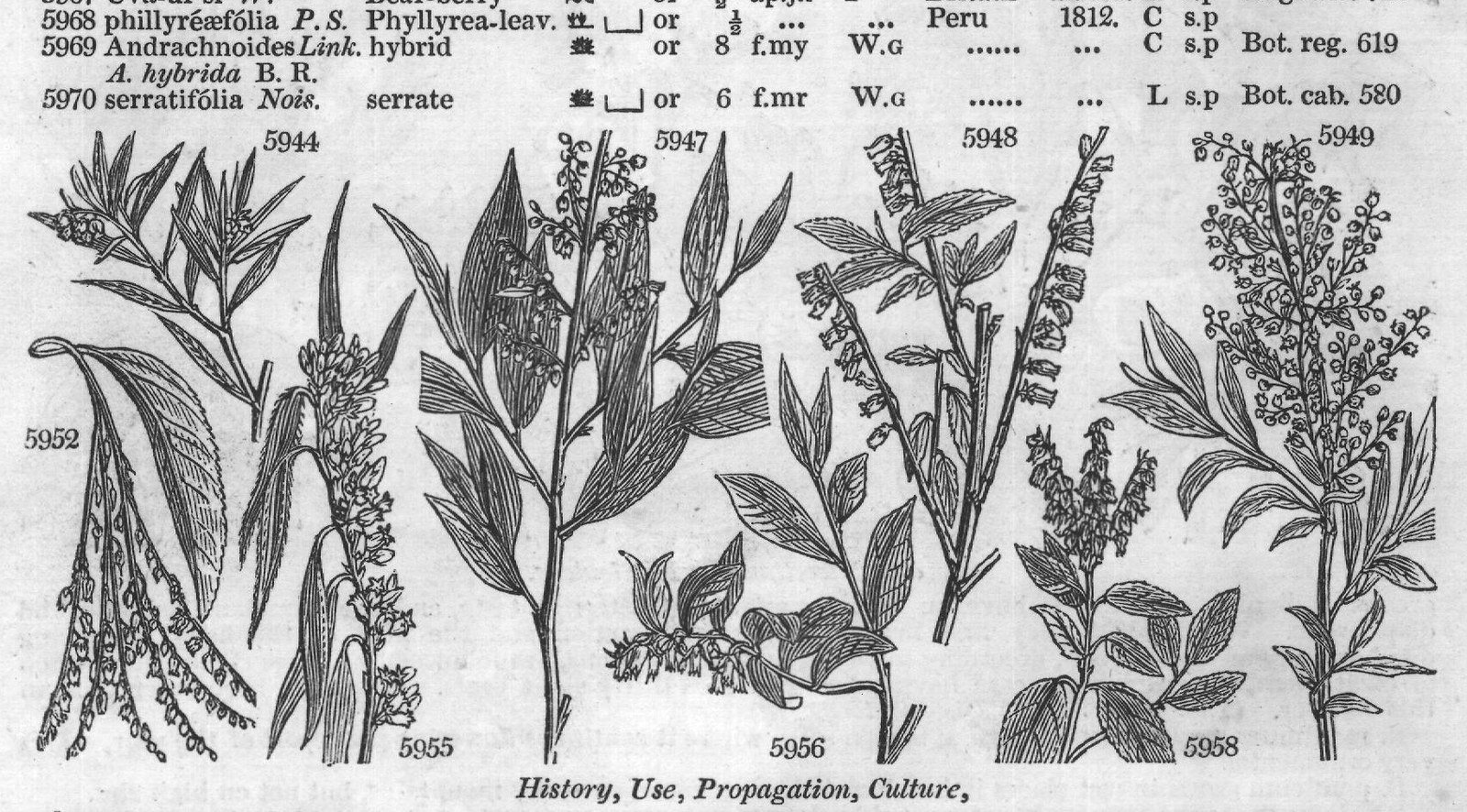
Cs.p Bot. reg. 619 A. hybrida B. R. 5970 serratifólia Nois. serrate or 6 f.mr W.G ...... ... 5944 5947 5948 Ls.p Bot. cab. 580 5949 5952 5955 5956 History, Use, Propagation, Culture, 5958 when about an inch high they should be planted out thinly in other pots, where they will grow strong, and, when large enough, may be planted in the open ground. Spring is the best time to plant them out, as the frost and worms are apt to throw them out of the ground in winter, if planted out in autumn. (Bot. Cult. 278.) 1017. Enkianthus. From εγκuoς, a pregnant woman, a name given to the plant by Loureiro, because the great colored buds appear as if pregnant with the flowers which afterwards appear. This beautiful genus, as Sweet observes, has generally been considered difficult to propagate: the difficulty is now removed, as ripened cuttings root readily planted in pots of sand, and placed under a hand-glass, without bottom heat. The best soil for it is an equal mixture of sandy loam and peat, and care must be taken not to overwater it when not in a growing state when it gets pretty large it is one of the most ornamental plants for the greenhouse or conservatory. (Bot. Cult. 186.) There are several species confounded under the common name Enkianthus quinqueflora. 1018. Gaultheria. Named after one Gaulthier, a French physician at Quebec. A small evergreen plant, cultivated in the American border for the sake of its ornamental bright scarlet berries. The species may be increased by dividing at the root, by suckers, layers, or from seeds. 1019. Arbutus. An ancient name of this plant, said to be traceable to the Celtic ar boise, austere bush, in allusion to the roughness of the fruit. In like manner Unedo is said by Pliny to have been so called from unum edo, I eat one, because, being found disagreeable, no one could eat a second. L'Arbousier, Fr., Landbeere, ORDER I.
DECANDRIA MONOGYNIA. 5944 Pedunc. aggregate, Cor. ovate, Leaves alternate lanceolate revolute a Leaves oblong Leaves linear-lanceolate ẞ Leaves lanceolate Leaves subulate 5945 Racemes 1-sided panicled terminal, Leaves lanceolate obovate acute serrulate at end 5946 Racemes terminal panicled, Cor. roundish, Leaves ovate entire 5947 Raceme compound, Leaves lanceolate subserrulate hairy shining 5948 Spikes terminal 1-sided, Leaves membranous smooth oval-lanceolate serrulate acute 5949 Raceme compound terminal crowded, Leaves narrow lanceolate rough at edge pilose beneath 5950 Leaves lanceolate wavy beneath rusty scaly, Cor. campan. finally of 5 petals, Anthers awned 5951 Hispid with pubescence, Leaves obov. lanc. acute serrul. Cor. globose hispid, Anthers awned 5952 Panicles terminal, Cor. pubescent, Leaves elliptical acuminate toothletted 5953 Racemes term. simple bracted, Cor. cylindrical, Leaves obl.-lanceolate serrated 5954 Racemes terminal and axillary 1-sided, Cor. ventricose tubular, Leaves oblong lanc. finely serrated 5955 Racemes axillary simple, Cor. oblong, Leaves ovate acute serrulate 5956 Racemes axillary simple, Leaves ovate entire shining, Branchlets 3-cornered 5957 Racemes axillary simple, Leaves ovate lanceolate acuminate serrate 5958 Quite smooth, Leaves obl. ovate acute finely serrulate, Racemes axillary and terminal clustered 5959 Peduncles solitary axillary 1-sided Bractes 2, Leaves oval scaly dotted obsoletely serrated a Cor. ventricose, Leaves obl. lanceolate Cor. obl. cylindrical, Leaves oblong oval obtuse Very dwarf 5960 Pedunc. solitary axillary, Bractes 2, Leaves narrow oblong lanceolate, Corolla oblong oval 5961 The only species 5962 Leaves oblong obovate mucronate toothed crowded, Stem procumbent 5963 Stem arborescent, Leaves oblong lanceolate, Panicles smooth nodding, Berries many-seeded 5964 Leaves oblong-lanceolate serrated, Panicles vertical hispid glutinous 5965 Stem arborescent, Leaves ovate entire or serrated, Pan. pubescent erect, Berries many-seeded 5966 Stems procumbent, Leaves rugose serrated 5967 Stems procumbent, Leaves entire 5968 Stem much branched, Leaves lanceolate acuminate acutely serrate, Flowers axillary 5969 Bark deciduous, Ovary smooth. The same as next? 5970 Leaves lanceolate serrated very thin a little wavy 5966 5959 5961 5967 5962 5969 5970 5963 and Miscellaneous Particulars.
Ger., and Arbuto, Ital. This genus includes one of the most elegant of hardy shrubs, the A. unedo. This evergreen is peculiarly beautiful in October and November, covered at once with blossoms and ripe fruits. It is a native of the south of Europe, and is found also near Killarney in Ireland, where it has probably been brought from Spain or Italy at an early period by the priests. It grows there on limestone rocks, in greater luxuriance than it is often to be met with in the woods of Italy: in both countries the fruit is eaten; and in Spain both a sugar and spirit is extracted from it.
A. uva ursi, La Busserole, Fr., Barrenbeere, Ger., and Uva d'orzo, Ital., is abundant in many parts of the continent, especially the alpine regions. It dyes an ash color; tans leather; the berries are food for grouse and other game, and the leaves are used in medicine. The fresh leaves are inodorous, and have a slightly bitter astringent taste, leaving a sweet sensation in the mouth. When properly dried and powdered, they acquire an odour similar to that of hyson tea; but the taste remains the same, the degree of bitterness only being increased. (Thomson's London Dispensatory, 163.) It is used sometimes in calculous complaints and ulcerations of the urinary organs. The dwarf species of this genus and those of Rhododendron and Andromeda, are very fit plants for rock work. A. alpina thrives best in peat kept moist and shaded. All the species may be increased by seeds, or by budding and inarching on each other: the dwarf kinds root readily by layers. The Uva ursi has been brought into notice in modern times as an efficient remedy in nephritic and even in calculous cases. European practitioners have doubted its powers, but it has found many supporters of respecor or 4 au.o or ..or or 2 au.o Privet-like WINTER-GREEN. round-leaved cu cu 1020. CLE'THRA. W. 5971 alnifólia Ph. 5972 tomentósa Ph. 5973 scábra Ph. 5974 paniculáta W. 5975 acumináta Ph. 5976 arbórea W.
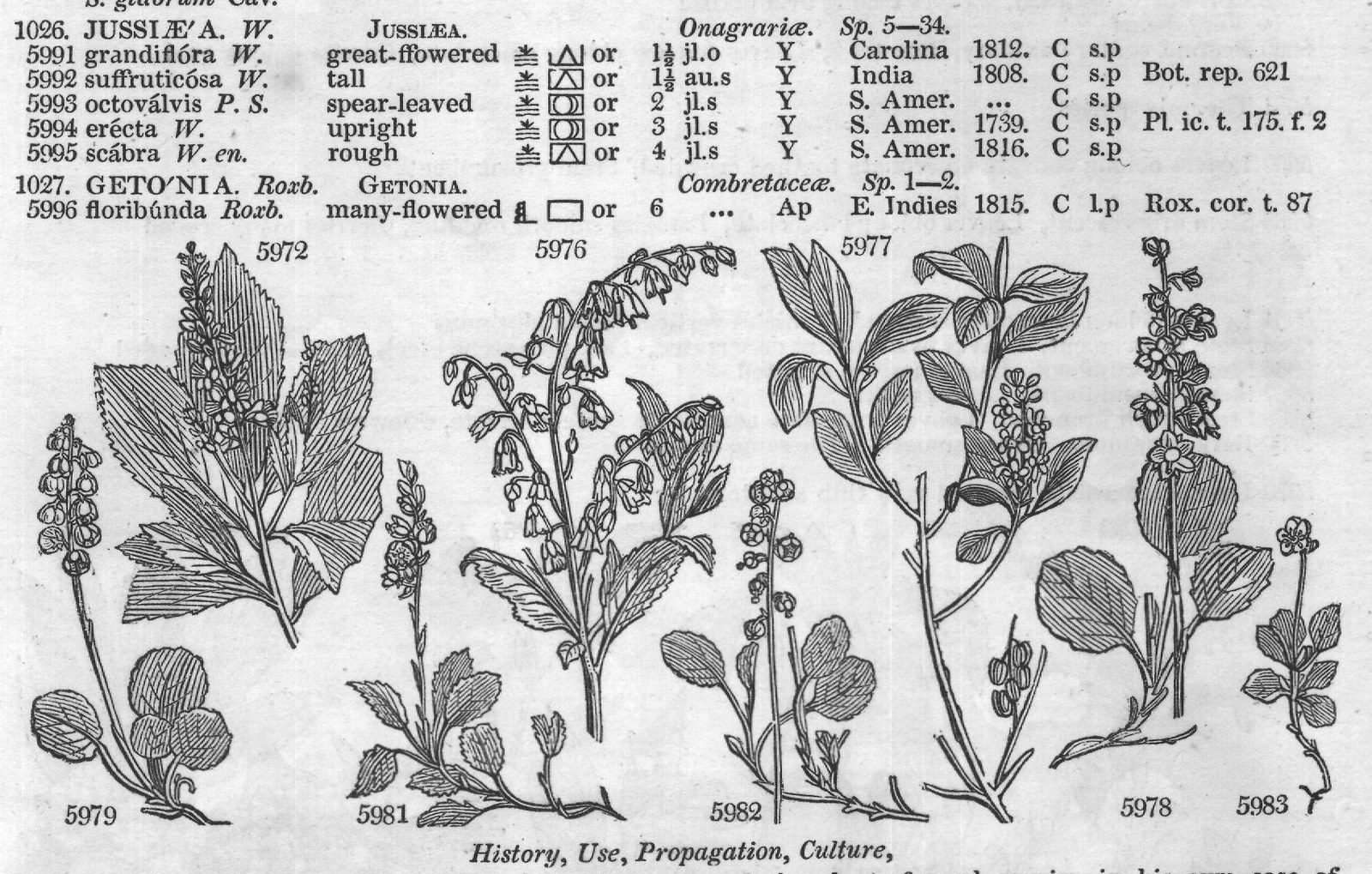
B mínor 1021. MYLOCA RYUM. 5977 ligustrínum Ph. 1022. PY ROLA. W. 5978 rotundifólia W. 5979 média E. B.
DECANDRIA MONOGYNIA.
CLETHRA.
Alder-leaved woolly-leaved rough-leaved panicled acute-leaved tree dwarf