New S
Wales or 12 jn.jl Pk or 30 jl.au Or or 30 jl.au Or or 20 jl.au S or 30 jl.au Or 8555 índica W. 8556 prócera W.
Indian Box-leaved 8557 lineáris Cav. 1295. JACARAN'DA. Juss. JACARANDA. linear-leaved 8558 caroliniána R. Br.
Carolina 8559 ovalifólia R. Br. oval-leaved 어어어 띠어어어어어 or 12 au Y or 30 R ... or 30 ... ...
Plum.amer. t.94 Plum.ic. t.55.f.1 Bot. reg. 741 Plum. ic. 56. f. 1 Plum. ic. t. 58 Bot. mag. 1511 Bot. mag. 864 Vah. symb. t. 66 W. Indies 1759. L s.p Guiana 1768. C s.I Brazil 1820. C s.l W. Indies 1790. C 1.p Guiana 1804. C l.p W. Indies 1738. C 1.p S. Amer. 1759. L s.p Guiana 1804. L s.p N. Amer. 1710. C s.p Campeachy1759. C s.p Caraccas 1823. C s.p Jac.schon. t. 210 Santa Cruz1823. C s.p N. Holl. ?
C s.p Caraccas 1816. C p.1 S. Amer. 1816. C 1.p Guiana 1804. C l.p S. Amer. 1733. R l.p Jamaica 1733. C 1.p W. Indies 1759. C l.p N. Amer. 1640. R s.p N. Amer. 1640. R s.p N. Amer. 1640. C s.p China 1800. Cr.m America 1730. S 1.p E. Indies 1808. R 1.p WE. Indies 1794. C l.p Bot. reg. 418 Bot. reg. 249 Aub. gui.2. t.264 Marcg.bra.t.118 Bot. rep. 43 Bot. mag. 485 Cates. car.1. t.65 Bot. mag. 1398 Plum. ic. t. 54 Rhee.mal.6. t.26 Rox. cor.2. t.144 or ap.jl or 40 ... or 80 W B ...
N. S. W.
India Guiana or 20 Pk ... 1793. C s.p 1775. C 1.p 1793. C 1.p Mexico 1825. C p.l Bot. mag. 865 Aub. gui.2. t.265 Cav. ic. 3. t. 269 Bignoniacea. Sp. 2-4. or 10 jl.au B Bahamas 1724. C p.1 Cates. car.1. t.42 or 10 ap.my B Brazils 1818. C p.l Bot. reg. 631 1296. SE'SAMUM. W.
OILY-GRAIN.
Pedalinæ. Sp. 2-4. 8560 orientále W. oriental clt 1 jl W E. İndies 1731. S co Rhee.mal.9. t.54 8561 índicum W.
Indian clt 1 jl Pa.pu E. Indies 1731. S co Bot. mag. 1788 1297. PENTSTE'MON. W. PENTSTEMON. 8562 campanuláta W.
Scrophularineæ. Sp.9-11. bell-flowered or 1½ mr.o L.Pu Mexico 1794.
D p.l Bot. mag. 1878 8563 lævigáta W. smooth or 2 au.s L.Pu N. Amer. 1776.
D p.l Bot. mag. 1425 8564 hirsúta W. narr.-lvd.-hairy or 1 au.s L.Pu N. Amer. 1758.
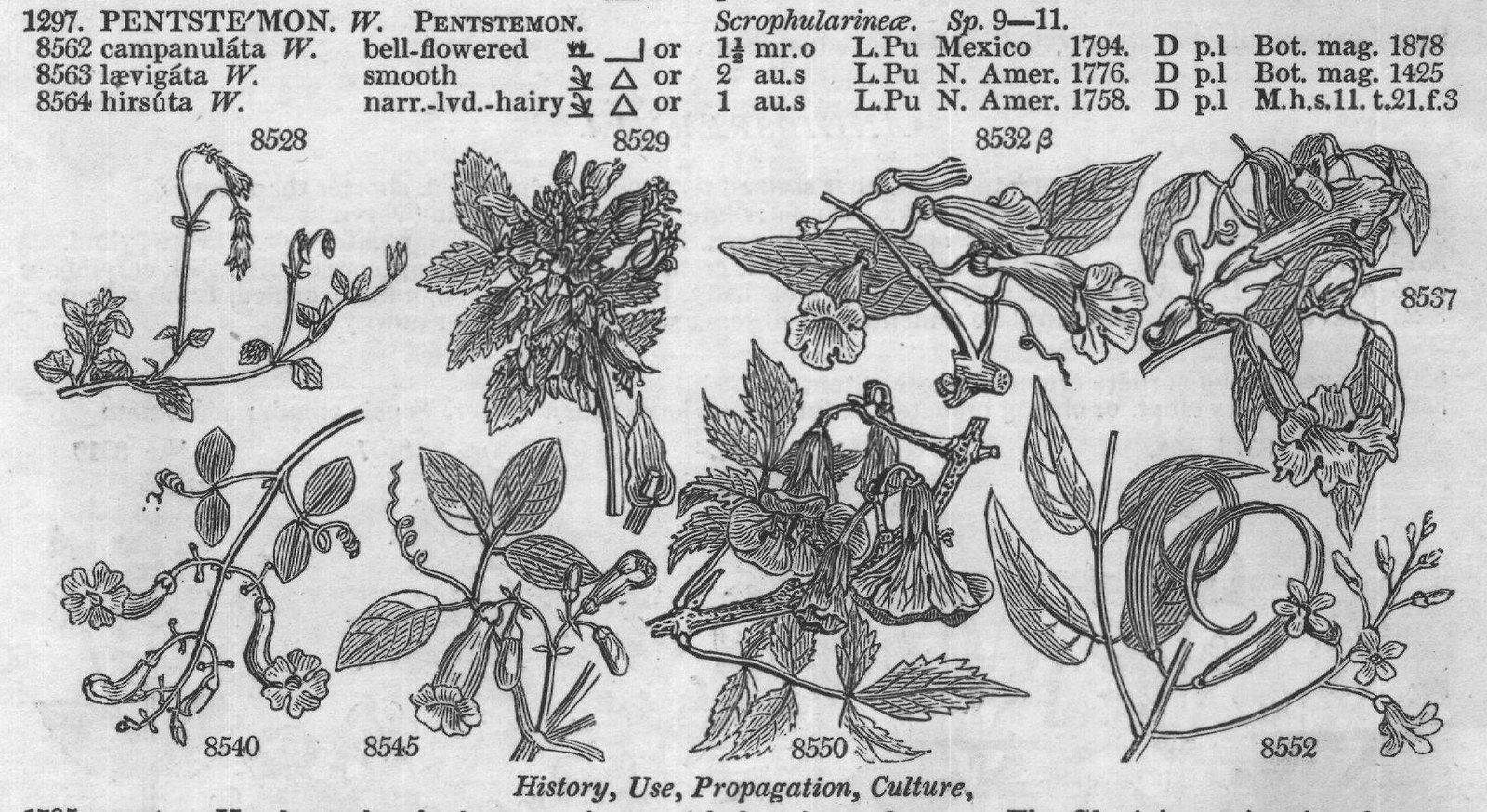
D p.l M.h.s.11. t.21.f.3 8528 8529 8532 β 8540 8545 8550 8552 8537 History, Use, Propagation, Culture, 1785, quarto. Handsome low herbaceous plants, with fine shewy flowers. The Gloxinia speciosa is a favorite in every hothouse, on account of the beauty of its rich purple blossoms. 1292. Linnæa. So named by Gronovius, in honor of the celebrated Carl von Linné, the reformer of natural history, and the father of the modern physical sciences. His works are not less numerous than important; it is to be wished that such another man, with equal talent, industry, and judgment, could be found at the present day, to rescue the science of natural history from the confusion to which it is fast approaching. 1293. Melianthus. From μελi, honey, and avθoς, flower. A shrub, native of the Cape of Good Hope, the blossoms of which are a great attraction to bees. Both the known species are common in collections, but seldom flower. 1294. Bignonia. In memory of Abbé Bignon, librarian to Louis XIV., born 1662, died in 1743. He was the friend and patron of most of the learned men of his time, and especially of Tournefort, by whom this truly noble genus was named. The species are trees or shrubs, inhabitants of hot climates: the leaves are opposite, pinnate, ternate, or conjugate: the flowers in panicles, large, and handsome, of various colors, red, blue, yellow, or white, and eminently beautiful. The stove sorts grow freely in loam and peat, and young cuttings root in sand under a hand-glass. The hardy species grow in any soil, but will not flower well unless the situation be warm. They are increased by cuttings of the roots, by layers, or by young cuttings on gentle heat under a hand-glass or frame. B. radicans is a well known and much admired species, capable of living in the open air in this country against a wall. 1295. Jacaranda. The name of the tree in Brazil. Two kinds remarkable for the goodness of their wood, are described by Piso. Those in the gardens are lofty stove plants with fern-like, elegant leaves, and panicles of beautiful blue flowers. They grow with facility, but flower seldom, ORDER Il. 8528 The only species DIDYNAMIA ANGIOSPERMIA. 8529 Stipules solitary adhering to stalk, Leaves smooth 8530 Stipule Stipules twin distinct, Leaves hoary beneath 8531 Leaves conjugate cirrhose, Leaflets ovate acuminate, Peduncles axillary 1-flowered 8532 Leaves conjugate cirrhose, Leaflets ovate-lanceolate, Pedunc. 2-flowered, Pods linear 8533 Leaves conjugate, Leaflets elliptical entire coriaceous, Pedunc. 5-flowered axillary, Calyx entire 8534 Lvs. conjugate obl. smooth, Racemes term. Branches dichotomous, Corollas very soft and downy outside 8535 Leaves conjugate cordate ovate, Flowers racemose, Calyx with a double limb 8536 Leaves conjugate cirrhose: lower ternate, Leaflets ovate cord. acuminate, Racem. axill. Stem muricated 8537 Leaves conjugate quite smooth, Tendrils longer than petiole trifid at end hooked 8538 Leaves conjugate cirrhose, Leaflets cordate lanceolate, Lower leaves simple 8539 Leaves conjugate cirrhose, Leaflets cordate ovate downy beneath 8540 Leaves conjugate cirrhose, Leaflets elliptical blunt, Flowers racemose, Pedunc. 3-fil. Calyxes toothed 8541 Leaves conjugate cordate ovate smooth, Lower racemes leafy, Limb of calyx leafy entire 8542 Leaflets 9-lanceolate subserrate dotted beneath, Corollas ventricose bearded in the orifice 8543 Lvs. conjugate cirrhose, Leafl. obl. acute at each end, Corymb trifid term. Ped. petioles and branches rough 8544 Climbing, Lvs. smooth upper conjugate cirrhose obl. ovate acumin. Peduncles corymbose many-flowered 8545 Lower leaves ternate, upper conjugate, Petioles dichotomous cirrhose, Fruit echinate 8546 Leaves ternate smooth, Leaflets ovate acuminate, Stem shrubby erect 8547 Leaves digitate, Leaflets entire obovate 8548 Leaves digitate, Leaflets lanceolate acuminate entire smooth, Flowers terminal solitary 8549 Lvs. pinnate, Leaflets ovate acuminate toothed, Corymb terminal, Tube of cor. thrice as long as calyx 8550 Leaves pinnate, Leaflets ovate acuminate toothed, Panicle terminal, Tube of cor. the length of calyx 8551 Leaves pinnate, Leaflets oblong lanceolate serrate, Raceme simple terminal, Stem erect 8552 Leaves pinnate with an odd one, Leaflets ovate entire pubescent, Corollas bearded half pentandrous 8553 Leaves pinnate with an odd one, Leaflets ovate hirsute, Cal. 1leaved spathaceous, Cor. hypocrateriform 8554 Leaves pinnate of four pair, Leaflets elliptical generally entire, Racemes compound 8555 Leaves bipinnate, Leaff. roundish ovate cordate acuminate, Fl. pentandrous, Calyx tubular, Cor. 5-fid 8556 Leaves bipinnate, Leaflets oblong obtuse, Panicle terminal, Peduncles with bractes, Pods oblong blunt 8557 Leaves simple linear acuminate, Flowers terminal subumbellate, Stem erect 8558 Leaves bipinnate, Leaflets lanceolate acute, Panicle terminal, Peduncle naked, Pods long emarginate 8559 Leaves bipinnate oblong villous oval oblong mucronate, Panicle large lax branched, Corollas silky 8560 Leaves ovate oblong entire 8561 Leaves ovate lanceolate: lower 3-lobed; upper undivided, Stem erect 8562 Stem smooth, Sterile filament bearded upwards, Leaves lanceolate acuminate all finely serrate 8563 Leaves polished ovate-oblong amplexicaul finely toothletted, lower entire, Flowers panicled 8564 Leaves serrulate lanceolate oblong sessile downy obscurely toothed narrow, Flowers panicled 8557 8554 8558 8560 8553 8561 8562 8563 Jews make them chiefly into cakes. and Miscellaneous Particulars. 1296. Sesamum. From the Arabic word semsem. Forskahl, p. 68. These plants were introduced into Jamaica The by the Jews, and are now cultivated in most parts of the island. They are called vanglo or oil-plant. by the Jews, and are now cultivated in most parts of the island. The seeds are frequently used in broths by many of the Europeans, but the Many of the oriental nations look upon the seed as a hearty wholesome food, and express an oil from them, not unlike, or inferior to, the oil of almonds. It has been also manufactured for salad oil in this country, but without much success.
S. orientale is frequently cultivated in the Levant, and also in Africa, as a pulse: the seeds have been introduced in Carolina by the African negroes. An oil is extracted from the seeds which will keep many years, and not acquire any rancid smell or taste, but in two years become quite mild, so that when the warm taste of the seed, which is in the oil when first drawn, is worn off, it is used as salad oil, and for all the purposes of sweet oil. The seeds are also used by the negroes for food: they parch them over the fire, then mix them with water, and stew other ingredients with them. A pudding is made with them, in the same manner as with millet or rice.
In Japan, China and Cochin-China, where they have no butter, they use the oil for frying fish, and in dressing other dishes; as a varnish; and medicinally as a resolvent and emollient. Nine pounds of the seed yield upwards of two pounds of neat oil. 1297. Pentstemon. From πεvτε, five, and 5ημov, a stamen, because of the four perfect and one imperfect stamen of the genus. Beautiful herbaceous plants, deserving a place in every garden.
L12 8565 pubéscens W. 8566 erianthéra Ph. 8567 angustifólia Ph. 8568 glábra Ph. 8569 Bradbúrii Ph. broad-lv.-hairy or 1½ au.s dwarf or Pu au.s narrow-leaved or Nuttal's 1½ jl.s large-flowered or Aor 1 jl.s 2 jl.s DIDYNAMIA ANGIOSPERMIA.
CLASS XIV.
L.Pu N. Amer. 1758. D p.l Bot. mag. 1424 Louisiana 1811. D p.l L.Pu Louisiana 1811. D p.1 D.Pu Louisiana 1811. D p.l Bot. mag. 1672 Pu Louisiana 1811. D p.l 8570 al bidum Nutt. whitish or jl.s W Missouri 1823. D p.l 1298. CHELO'NE. W.
CHELONE.
Scrophularinea. Sp. 4-6. 8571 glábra W. white-flowered or 4 au.o W N. Amer. 1730.
D p.1 Trew.ehret. t.83 8572 oblíqua W. red-flowered or 4 au.o Pu N. Amer. 1752.
D p.l Bot. reg. 175 8573 Lyóni Ph.
Lyon's Aor 4 jl.s Pu N. Amer. 1812.
D p.l Bot. mag. 1864 8574 barbáta W. scarlet or 3 jn.s O.s Mexico 1794. D p.l Bot. reg. 116 8575 lappácea W. 1299. TOURRETTIA. J. TOURRETTIA. 1300. MARTY'NIA. W. MARTYNIA.
Scrophularinea. Sp. 1. scarlet-flowered cu 6 jn.au R.G Peru 8576 diándra W. two-stamened or 1½ jl.au R 8577 Craniolária W. white-flowered 8578 proboscídea W. horn-capsuled or 8579 longiflóra W. long-flowered or 2 jl.au 1301. ACAN'THUS. W. BEAR'S-BREECH.
Acanthaceæ. Sp.5-14. 8580 móllis W. smooth 8581 níger Mill. shining-leaved 8582 spinósus P. S. prickly-leaved 8583 spinosíssimus P. S. white-spined পপপপ 3 jl.s A or or 3 jl.s or 3 jl.s or 3 jl.s 8584 ilicifólius W.
Holly-leaved or 2 ... ...
Pedalinæ. Sp. 4-6. or 1 jl.au W 1788. S s.1 Sal.stir. 5. t. 3 New Spain1731. S s.1 S. Amer. 1733. S s.1 jn.au L.B America 1738. S r.m Pa.pu C. G. H. 1781. S sl P.w Italy P.w Portugal 1759. D co 1629. D co P.w Italy P.w S. Europe 1629. D co E. Indies 1759. D co Bot. rep. 575 Jac. amer. t. 110 Bot. mag. 1056 Meerb. ic. 1. t. 7 1548. D co Lam, ill. t. 550 Bot. mag. 1808 Rhee.mal.2. t.48 1302. BARLE'RIA. W. BARLERIA.
Acanthaceæ.
Sp. 8-18. 8585 longifólia W. long-leaved or 2 jl.s W E. Indies 1781. S l.p Pluk.al. t.133.f.4 8586 Prionítis W. thorny or 3 jl.au Or E. Indies 1759. C p.l Rhee.mal.9. t.41 8587 buxifólia W.
Box-leaved cu 2 jn.jl W E. Indies 1768. D 1.p Rhee.mal.2. t.47 8588 purpúrea Lodd. purple 业 pr 2 s Pu E. Indies 1814. D l.p Bot. cab. 344 8589 álba Hort. white or 3 jn.jl W N. Holl. 1815. C co Bot. cab. 360 8590 cristáta W. crested or 2 jn.s B E. Indies 1796. C p.1 Bot. mag. 1615 8591 mítis B. Reg. 8592 longiflóra W. 1303. PHAYLOP'SIS.
Juss. PHAYLOPSIS. 8593 longifólia Sims. yellow-flowered long-flowered long-leaved or 3 jn.s Y E. Indies 1816. C p.1 Bot. reg. 191 or 3 jn.s ...
E. Indies 1816. C p.1 Vah.symb.1.t.16 pr 2 ap.o 1304. RUEL/LIA. J. 8594 ováta W. 8595 strépens W. 8596 ocymoídes Cav. 8597 pátula W. 8598 láctea W. 8599 clandestína W. 8600 paniculáta W. 8601 tuberósa L. 8602 biflóra W. 8603 formósa H. K. 8572 RUELLIA. oval-leaved pr 2 jl.au whorl-flowered pr 2 jl.au Basil-like pr 1 jl.au B spreading pr 1 jl.au white pr2jn.au three-flowered ✗ ☑ pr 2 jl.au panicled B pr 3 au Pu B Acanthaceæ. Sp. 1-6. tuberous-rooted ☑ pr 2 jl.au two-flowered splendid 8568 pr 1 jl pr 2 jn.s 8565 W S. Leone 1822. C co D.B Mexico 1800. Dl.p Pa.B N. Amer. 1726.
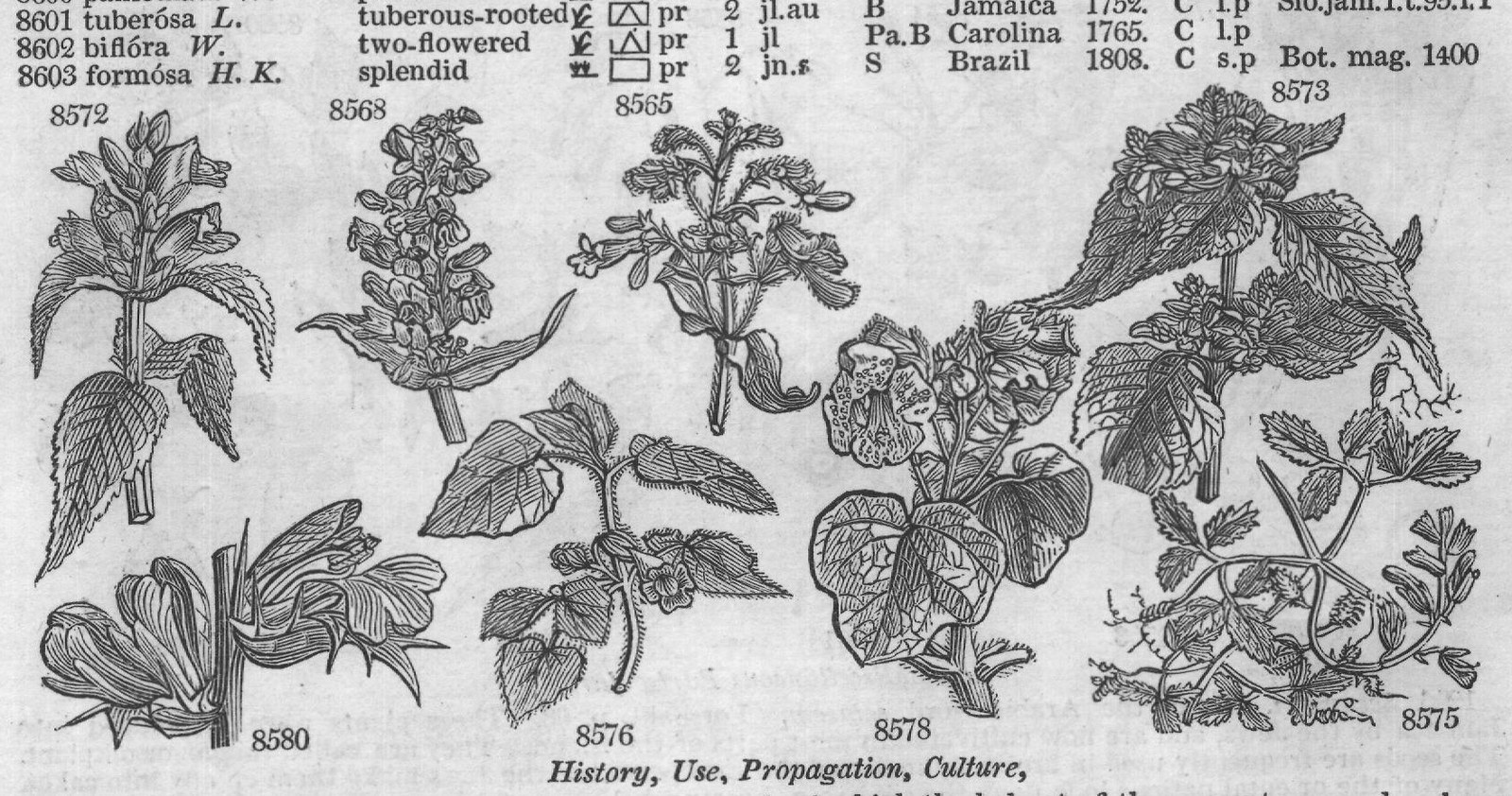
Mexico 1815. C 1.p Pa.V E. Indies 1774. C l.p Pa.V Mexico 1796. C 1.p Barbadoes1728. C l.p W. Indies 1768. C s.p Jamaica 1752. C 1.p Pa.B Carolina 1765. C 1.p S Brazil 1808. C s.p Cav. ic. 3. t. 254 Sch. han.2. t.177 Cav. ic. 5. t. 456 Jac. ic. 1 t. 119 Cav. ic. 3. t. 255 Dil.el.t.248.f.320 Slo.ja.1. t. 100. f.2 Slo.jam.1.t.95.f.1 Bot. mag. 1400 8573 Bot. mag. 2433 Acanthaceæ. Sp. 18-70. 8580 8576 8578 History, Use, Propagation, Culture, 8575 1298. Chelone. Xελωvη signifies a tortoise, to the back of which the helmet of the present genus has been fancifully compared. The species are handsome border flowers, of easy culture in loamy soil, or loam and a little peat. 1299. Tourrettia. Named in honor of Marc Antoine Louis Claud la Tourrette, to whom some of Rousseau's Letters on Botany are addressed. A singular climbing annual plant, producing its flowers sparingly from the tips of the branches. Seldom preserved long in a garden, as it produces seed very sparingly. 1300. Martynia. In honor of John Martyn, F. R. S., professor of botany at Cambridge, author of Historia Plantarum Rariorum, and many other works: died in January, 1768. His son is the editor of the last edition of Miller's Dictionary. Handsome tropical annuals, remarkable for the size of their flowers compared with their leaves. 1301. Acanthus. From aκavθa, a spine: many of the kinds are very spiny. The species are generally large, with a single herbaceous stalk, and great pinnatifid leaves. The flowers are produced in terminating spikes. Some of the species are shrubby and thorny, with undivided leaves, toothed, and having a thorn at the end of the teeth.
A. mollis was formerly used in medicine under the name of Branca ursina: the root abounds in mucilage, and may be substituted for those of the marsh mallow. Virgil has two very different plants under the name of Acanthus: one a tree, supposed to be the Mimosa nilotica, which produces the gum Arabic: the other an ORDER II.
DIDYNAMIA ANGIOSPERMIA. 8565 Stem pubescent, Sterile filament bearded from the end to the middle 8566 Leaves oblong acute subhirsute, Flowers racemose, Leaves of calyx linear very hairy 8567 Stem smooth long linear entire, Flowers in racemose panicles, Leaves of calyx smooth. 8568 Stem and lvs. smooth, Lvs. subamplex, ovate obl. ent. Barren filam. naked clav. Sepals roundish acuminate 8569 Very smooth, Lvs. subamplexicaul, ov. obl. ent. upper roundish, Barren filam. with a short beard at end 8570 Leaves ovate lanc. subserrulate smooth, Fl. fascicled axillary and terminal, Cor. equal 5-cleft spreading 8571 Leaves stalked lanceolate serrate: upper opposite 8572 Leaves lanceolate oblique stalked opposite finely serrated at edge 8573 Smooth much branched, Leaves stalked cordate ovate serrated, Spikes terminal dense 8574 Leaves opposite connate lanceolate entire, Lower lip of corolla bearded 8575 The only species. Leaves pinnated cut cirrhose 8576 Stem branched, Leaves opposite cordate toothed, Flowers diandrous 8577 Stem branched, Leaves opposite 5-lobed toothed 8578 Stem branched, Leaves alternate cordate entire 8579 Stem simple, Leaves roundish repand, Tube of cor. at base gibbous flattened 8580 Leaves sinuated unarmed 8581 Leaves sinuated unarmed glabrous shining green 8582 Leaves pinnated spiny 8583 Leaves laciniate pinnatifid blistered spiny, Spines white 8584 Leaves repand spiny-toothed, Stem shrubby prickly 8585 Spines of whorls 6, Leaves ensiform very long rough 8586 Spines axillary pedate in fours, Leaves quite entire lanceolate ovate 8587 Spines axillary opposite solitary, Leaves roundish entire 8588 Unarmed, Leaves lanceolate, Flowers axillary solitary sessile 8589 Leaves ovate lanceolate rough, Flowers capitate terminal, Bracteæ ciliate 8590 Leaves oblong entire, Two lateral leaves of calyx ciliated wider than the rest; two linear acute 8591 Unarmed, Leaves lanceolate hairy entire, Fl. aggregate terminal tubular, Bractes very narrow setose 8592 Unarmed, Leaves ovate silky, Bractes cordate scarious, Corollas very long 8593 Leaves lanceolate on long stalks, Flowers in terminal and axillary heads, Cor. small 8594 Leaves sessile oblong entire acute at each end villous, Fl. 3-subsessile, Stem ascending 8595 Leaves stalked ovate entire, Peduncles 3-flowered very short, Stem erect 8596 Subvillous, Stem dwarf branched erect, Leaves ovate concave entire 8597 Leaves stalked ovate very blunt entire pubescent, Flowers 3 subsessile, Stem erect divaricating 8598 Lvs. stalked obl. ovate ciliated somewhat toothed, Pedunc. very short about 3-fl. Stem very villous erect 8599 Leaves stalked oblong blunt attenuated at base somewhat toothed, Pedunc. 3-fl. shorter than leaf 8600 Leaves entire, Peduncles dichotomous lateral, Calyxes sessile, with the upper segment largest 8601 Leaves cuneate ovate crenated, Peduncles 3-parted, Stem simple 8602 Flowers twin sessile 8603 Leaves stalked entire ovate downy, Pedunc. axillary alternate few-flow. very long 8586 8587 8589 8593 8584 8594 8599 8603 and Miscellaneous Particulars. herb, supposed to be this plant. Pliny mentions an Acanthus which covered part of his lawn, which some conjecture to be a moss, a thing very improbable in a climate and situation where the musci are seldom seen even in winter.
The leaf of Acanthus mollis is supposed to have furnished the ancients with the elegant Acanthus leaf of their architecture. 1302. Barleria. In honor of the Rev. James Barrelier, a Dominican, and M. D. of Paris, who travelled from France into Spain and Italy, and died aged sixty-eight, 1673; author of Icones, 1714, Paris, folio, a useful work, containing, even at the present day, figures of many things which are to be found nowhere else. The species flower freely and are of easy culture: loam and peat, with a little rotten dung mixed with it, is the best soil for them. Cuttings root freely; they strike best from the young wood, under a hand-glass, in the same kind of soil as the plants grow in. (Bot. Cult. 21.) 1303. Phaylopsis. Named by Willdenow, from φauλoς, vile or contemptible, and oψiς, aspect. Tropical weeds 1304. Ruellia. In honor of John Ruelle, a native of Soissons, the physician of Francis I. He published a work De Natura Plantarum, in 1536, and Commentaries upon Dioscorides, in 1516. The species are pretty plants, free flowers, and of the easiest culture and propagation. L13 DIDYNAMIA ANGIOSPERMIA.
CLASS XIV. 8604 fúlgida H. K. bright-flowered pr 2 jl.au Sc W. Indies 1804. Cl.p Bot. rep. 527 8605 ciliata W. en. ciliated 业 pr 2 jl Pu 8606 ríngens W. gaping-flower'd pr 3 jl.au Pu E. Indies 1807. C l.p 8607 pubescens Pers. pubescent pr 2 jn.au D.B E. Indies 1806. C 1.p C. G. H. 1823. C l.p 8608 fœtida W. en. fœtid un 2 jn.au B S. Amer.
Cl.p 8609 macrophýlla Vahl. long-leaved pr 3 R ...
S. Martha 1824. Cl.p Vah.symb.2.t.39 8610 unduláta Vahl. wavy pr 2 ... ...
E. Indies 1824. C l.p 8611 tetragóna Link. four-cornered ☑ ☑ pr 2 jn.jl B Brazil 1824. C l.p 1305. BLE CHUM. R. Br. BLECHUM.
Acanthaceæ. Sp. 1-15. 8612 Brównei H. K. dense-spiked or 2 jn W. Indies 1780. C l.p Slo. ja. 1. t. 109.f.1 1306. APHELAN DRA. R. Br. APHELANDRA. 8613 cristáta H. K.
Acanthaceæ. Sp. 1. dense-spiked spl 3 jn.s S W. Indies 1733. C 1.p Bot. mag. 1578 1307. CROSSANDRA. P. L. CROSSANDRA.
Acanthaceæ. Sp. 1. 8614 undulæfólia P. S. wave-leaved 姓 spl 1 ja.jn Or.s E. Indies 1800. C p.l Bot. reg. 69 1308. THUNBERGIA. W. THUNBERGIA. 8615 frágrans W.
Acanthaceæ.
Sp. 2-7. twining or 4 my.s W E. Indies 1796. S p.l Bot. mag. 1881 8616 grandiflóra R. large-flowered or 6 my.s B E. Indies 1820. C p.l Bot. mag. 2366 1309. HEBENSTREITIA. W. HEBENSTREITIA.
Verbenaceæ.
Sp. 8-12. 8617 albiflóra Lk. white-flowered pr 1 my.s W C. G. H. 1822.
C p.l 8618 chamædryfólia Link.saw-leaved pr 2 my.s W C. G. H. 1822.
C p.l 8619 dentáta W. toothed pr 1 my.s W C. G. H. 1739.
S p.1 Bot. mag. 483 8620 integrifólia W. entire-leaved pr 1 my.jn W C. G. H. 1792.
C p.l Bot. rep. 252 aúrea B. Rep. 8621 ciliáta W. ciliated pr 1 my.jl W C. G. H. 1815.
C p.l 8622 spicáta Thunb. spiked pr 1 my.jl W C. G. H. 1815.
C p.l 8623 erinoídes Th.
Erinus-leaved pr 1 my.n W C. G. H. 1816.
C p.l 8624 cordáta W. heart-leaved pr 1 jl.au W C. G. H. 1774. C p.l 8628 míxta W. 1310. HOS'TA. Jac. 8625 cærúlea Jac. 1311. GMELI'NA. W. 8626 asiática W. 8627 parviflóra Rox. 1312. LANTA'NA. W. 8629 trifólia W. 8630 ánnua W. 8631 strícta W. 8632 Rádula W. 8633 Cámmara W. 8634 involucráta W. 8635 récta W. 8636 odoráta W. 8637 melissifólia W. 8638 scábrida W. 8639 nívea Vent.
HOSTA. blue-flowered or 4 Verbenaceæ.
B Sp. 1.
S. Amer. ... ...
Cl.p Jac.schœ.1.t.114 GMELINA. oval-leaved Verbenaceæ. Sp. 2. or 10 Y ...
E. Indies 1792. C 1.p Lam. ill. t. 542 obovate-leaved or 10 0 ...
E. Indies 1817. C l.p Roxb. cor. t. 32 LANTANA.
Verbenaceæ.
Sp. 17-35.
Nettle-leaved ✓ ☐ or 5 au.o R.Y W. Indies 1732. C p.l Bot. cab. 68 three-leaved or 3 jn.s Pu W. Indies 1733. C p.l Bot. mag. 1449 annual or S jl.au F S. Amer. 1733. C p.1 Bot. mag. 1022 narrow-leaved or 3 ...
Pa.pu Jamaica 1733. C p.1 Slo.ja.2. t.195. f.4 Rasp-leaved or 3 ...
Pu various-colored or 6 ap.s R.o round-leaved or 3 my.jl Pk upright or 2 jn.au Pu sweet-scented or 2 my.n W Balm-leaved 业 or 2 jl.s Y rough or. 2 s ...
W. Indies 1803. C p.l W. Indies 1691. C p.1 W. Indies 1690. C p.l Jamaica 1758. C p.1 W. Indies 1758. C p.l W. Indies 1732. C p.1 W. Indies 1774. C p.l Dill.elt. t.56. f.65 Plu.alm.t.114.f.5 Jac.schœ.3.t.360 Plum.ic. t.71. f.2 Dill.elt. t.57. f.66 white-flowered or 3 jl.s 8640 aculeata W. changeable-col. or 10 ap.n R 8641 fucáta Ker. painted or 2 ap.n Pk 8642 salvifólia W. sage-leaved or 3 ap.n R 8643 braziliénsis Link.
Brazilian or 3 ap.n W 8644 álba Mill. white or 3 ap.n W ...
WE. Indies ...
Cp.l W. Indies 1692. C p.l S. Amer. 1822. C p.l C. G. H. 1823. C p.1 Brazil 1823. C p.1 S. Amer.
C p.l Bot. reg. 798 Jac. schö.3. t.285 Vent. malm. t. 8 Bot. mag. 96 1313. ALOY'SIA. Fl. Per. ALOYSIA. 8645 citriodóra Fl. Per. Lemon-scented or Verbéna triphýlla B. M. 8604 Verbenaceæ. Sp. 1-2. 3 my.s Pa.pu Chili 1784. C 1 Bot. mag. 367 8609 8612 8614 8616 8619 8620 8613 History, Use, Propagation, Culture, 1305. Blechum. Bληχωv, was the Greek name of a plant resembling Marjoram. This genus has also the flowers in a dense bracteated spike. It has been separated from Justicia by Jussieu. 1306. Aphelandra. From aφελης, simple, and avής, a male, on account of the single cell of the anthers. 1307. Crossandra. From κρόσσoς, a fringe, and avng, a man; or, in botanical language, an anther, alluding to the fringed anthers. A fine shewy shrub with large orange flowers. 1308. Thunbergia. In honor of Charles Peter Thunberg, M. D., knight of the order of Vasa, professor of botany in the university of Upsal, member of several learned societies; author of Travels into Europe, Africa and Asia; Flor. Japonica, &c. Handsome climbing flowers with a fragrant odor. 1309. Hebenstreitia. John Ernest Hebenstreit, was a professor of botany in the university of Leipsig, and published, in 1728, a dissertation upon plants. Small Cape undershrubs, occasionally cultivated for the sake of their neat foliage and simple modest flowers. They require an airy greenhouse, and are easily propagated from cuttings. 1310. Hosta. After Dr. Nicholas Thomas Host, the author of the superb Gramina Austriaca, in four volumes, folio, and other important works. Smith thinks the genus the same as Linnæus's Cornutia pyramidata. ORDER II.
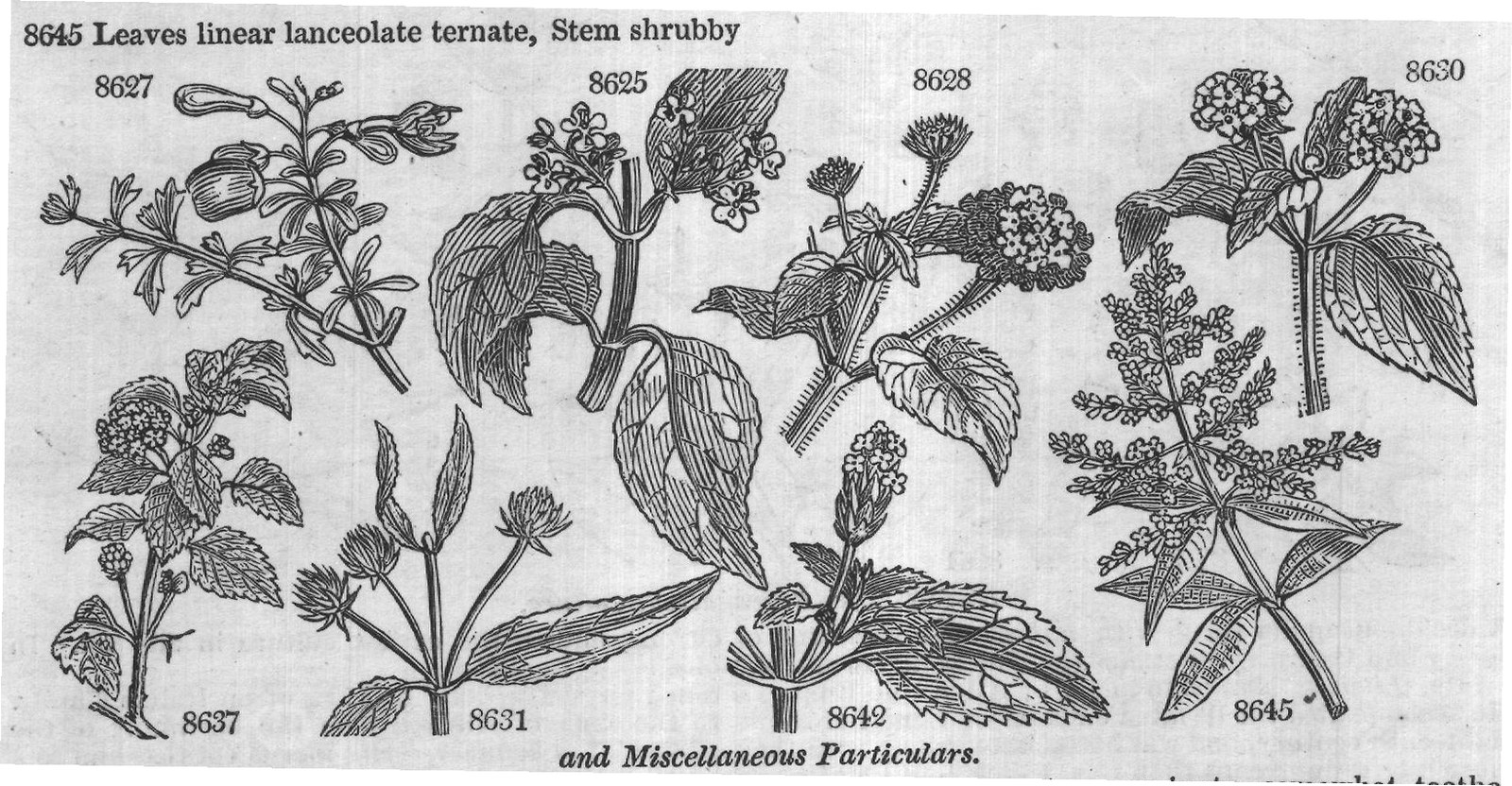
DIDYNAMIA ANGIOSPERMIA. 8604 Leaves stalked ovate acuminate wavy crenate, Fascicles axillary on long stalks 8605 Leaves ovate somewhat toothletted ciliated at edge on long stalks, Flowers solitary axillary sessue 8606 Leaves oblong entire, Flowers solitary sessile, Stem procumbent 8607 Leaves entire ovate subpubescent, Flowers solitary axillary, Stem erect 8608 Leaves ovate lanceolate entire stalked smooth, Fl. solitary axillary sessile, Branches warted 8609 Leaves ovate lanceolate acuminate entire, Peduncles long 2-flowered 8610 Leaves stalked oblong wavy, Heads axillary sessile, Stem erect 8611 Stem erect hairy, Leaves stalked ovate acuminate repand toothed hairy, Spike whorled 8612 Leaves ovate elliptical somewhat toothed, Spikes 4-cornered, Bractes ovate down 8613 The only species 8614 The only species 8615 Leaves cordate acuminate somewhat angular at base, Stem climbing 8616 Leaves angular cordate, Inner calyx none, Anthers bearded spurred 8617 Leaves linear toothed, Bractes oval linear hairy 8618 Leaves sessile oblong lanceolate blunt serrated hairy at base, Bractes ciliated 8619 Leaves linear toothed, Spikes smooth 8620 Leaves linear quite entire 8621 Leaves linear toothed, Calyxes 3-valved ciliated 8622 Leaves linear toothed at end, Bractes ovate villous, Stem herbaceous 8623 Leaves lanceolate oblong serrated pilose, Bractes entire ciliated hispid 8624 Leaves cordate somewhat fleshy sessile 8925 Corymbs axillary trichotomous 8626 Spines opposite, Leaves ovate entire 8627 Leaves obovate subtrifid and simple, Prickles nearly straight, those of the stem alternate 8628 Leaves opp. ovate acute hairy, Stem prickly downwards, Heads round, Bractes lanceolate 8629 Leaves 3 or 4-ellipt. rugose above villous beneath, Stem unarmed, Spikes oblong imbricated 8630 Leaves opposite, Stem unarmed, Spikes oblong 8631 Leaves opp. oblong lanc. acute, Stem unarmed, Heads roundish, Bractes ovate-lanceolate and squarrose 8632 Lvs. opp. ov. acute serr. rugose rough hairy ben. Stem nearly unarm. rough, Heads obl. Bractes ovate acute 8633 Leaves opposite, Stem unarmed branched, Flowers in leafless capitate umbels 8634 Leaves opp. or in 3s rhomboid ovate blunt rugose downy, Stem unarmed, Heads squarrose, Bractes ovate 8635 Leaves opposite oval rugose, Stem unarmed, Heads squarrose, Bractes oblong, Pedunc. longer than leaf 8636 Lvs. opp. or in 3s ellipt. rugose , Stem unarmed, Heads squarrose with lanc. bractes, Ped. shorter than leaf 8637 Leaves opp. ovate obl. villous soft, Stem prickly, Spikes hemispherical, Bractes half as short as tube 8638 Lvs. opp. ovate ellipt. rough, Stem prickly, Spikes hemispherical, Bractes half as short as tube lanc. acute 8639 Leaves ovate lanceolate acuminate crenulate, Stem prickly, Head hemispherical, Bractes linear ovate subcordate softish beneath, Stem prickly, Bractes of heads linear cuneiform 8641 Lvs. ovate rugose crenate blunt downy running down the foot-stalk, Head depressed shorter than leaf 8642 Leaves opposite ovate rough above hoary beneath, Heads conical, Bractes squarrose ovate acute nerved 8643 Leaves narrowed from an ovate base sessile serrate pubescent, Bractes lanceolate concave 8644 Leaves ovate narrowed into the stalk acuminate acutely crenate pubescent, Outer bractes cordate 8645 Leaves linear lanceolate ternate, Stem shrubby 8627 8637 8631 8625 8642 8628 8645 8630 and Miscellaneous Particulars.
A small shrub rising to the height of four feet. Leaves opposite, ovate, acuminate, somewhat toothed, smooth. Flowers blue, in axillary corymbs, which are shorter than the leaves; they are dotted all over with minute white glandular spots. 1311. Gmelina. In honor of John George Gmelin, a German naturalist, professor of medicine and botany at Tubingen, who travelled in Siberia and Kamtchatka , by order of the Empress Anne of Russia. His Flora Sibirica, in four quarto volumes, is a book of continual reference. These are fine arborescent Indian plants with beautiful flowers, which are seldom produced in this country. They require the utmost heat of the stove. 1312. Lantana. One of the ancient names of the Viburnum, which this resembles a little in foliage The species are rapid growers and free-flowerers, and readily increased by cuttings. They form small bushes with pink, yellow, orange, or changeable heads of flowers, and a peculiar aromatic odor. 1313. Aloysia. Named by Don Antonio Palau, professor of botany at Madrid, and author of an excellent translation of the Linnæus's Species Plantarum into Spanish, after her majesty Maria Louisa, queen of Spain, and mother of the reigning king, Ferdinand.
L14 1314. LIP PIA. L. 8646 purpúrea Jacq. or DIDYNAMIA ANGIOSPERMIA.
LIPPIA. purple Verbenaceæ. Sp. 1-5.
CLASS XIV. 3 jn.jl R Mexico 1823. C p.l Jacq. ecl. t. 85 1315. MELAMPY RUM. W. CoW-WHEAT.
Scrophularineæ. Sp.4-7. 8647 cristátum W. crested W 3 jl.au Y England corn fi. S co Eng. bot. 41 8648 arvénse W. purple 8649 pratense W. common 8650 sylváticum W. wood 000 W 3 jn.jl Y England corn fi. S co Eng. bot. 53 W 3 jl.au Y Britain woods. S co Eng. bot. 113 W 3 jl.au Y Britain m. wo. S co Eng. bot. 804 1316. SELA'GO. W.
SELAGO.
Verbenaceæ.
Sp. 13-40. 8651 spínea Link. spiny pr 3 Pu ...
C. G. H. 1824. C p.l 8652 diffúsa Th. spreading pr 1 jl.au Pu C. G. H. 1807. C p.l 8653 fulvo-maculata Link.spotted pr 2 ...
V C. G. H. 1824. C p.1 8654 polygaloídes L.
Milkwort-like pr jl.o Pu C. G. H. 1807. C p.l 8655 spicáta Link. spiked prjl.o Pu C. G. H. 1824. C p.1 8656 spúria W. linear-leaved pr 1 jl.o V C. G. H. 1779. S p.1 Bur. afr. t.42. f.3 8657 fasciculáta W. cluster-flower'd pr 12 jn.jl Pu C. G. H. 1774.
S p.l Bot. reg. 184 8658 lúcida Vent. 8659 ramulósa Link. shining-leaved pr 1½ jn.jl Pu C. G. H. 1812. C 1.p Vent.malm. t.10 8660 teretifólia Link. branchy round-leaved pr 1 W ...
C. G. H. 1824.
C p.l pr 1 jl.au W C. G. H. 1823.
C p.1 8661 ováta W. oval-headed pr 1 jn.jl 8662 canéscens W.
D.Pu C. G. H. 1774.
C p.l Bot. mag. 186 canescent pr 1 jl.n Pa.pu C. G. H. 1812.
C p.l 8663 corymbósa W. fine-leaved pr 2 jl.au Pu C. G. H. 1699.
C p.1 Com.hort.2. t.40 1317. VITEX, W.
CHASTE-TREE.
Verbenaceæ.
Sp. 8-15. 8664 ováta W. oval-leaved or 4 jl.au Pu China 1796. C l.p 8665 altíssima W. tall or 8 Pu ...
Ceylon 8666 A'gnus-Castus W. common or 6 s W.B Sicily 1802. C l.p 1570. C co Woodville t. 222 ẞ latifólia broad-leaved or 6 s W.B Sicily 1570. C co 8667 incísa W. cut-leaved or 4 jl.s Pu China 8668 Leucóxylon W. 1758. C p.l. Bot. mag. 364 white-wooded or 4 ...
Pu Ceylon 1793. C l.p 8669 Negúndo W. quadrangular or 4 Pu ... 8670 bícolor W.en.
E. Indies 1812. C l.p Rump.am.4.t.19 two-colored or 4 Pu ...
E. Indies 1810. C l.p 8671 trifólia W. three-leaved or 4 Pu ...
E. Indies 1759. C p.l Bot. mag. 2187 1318. CORNUTIA. W.
CORNUTIA.
Verbenaceæ.
Sp. 1-2. 8672 pyramidáta W. pyramidal cu 4 B ...
W. Indies 1733. C l.p Lam. ill. t. 541 1319. ZAPA'NIA. J.
ZAPANIA.
Verbenaceæ.
Sp. 2-10. 8673 stæchadifólia P. S. oval-spiked un 1 au.s Pu 8674 nodiflóra Ph. knot-flowered un 1 jlau Pu 1320. PRIVA. P. S.
PRIVA.
Verbenaceæ. 8675 mexicana P. S.
Mexican pr 2 au.s V 8617 Verbéna mexicana W. 8676 leptostáchya P.S. rough Tortula aspera W. 1321. SPIELMAN'NIA. W. SPIELMANNIA. 8677 africána W. 1322. VERBENA. L. 8678 bonariénsis W. 8679 hastáta W. 8680 paniculáta P. S. cluster-flower'd halberd-leaved panicled 8648 pr 2 jl.au V Verbenaceæ.
Ilex-leaved or 3 f.n W VERVAIN.
Verbenaceæ.
B un 6 jl.o un 5 jn.au V Aun 3 jl.au B 8649 W. Indies 1732. C l.p Brow.jam.t.3.f.1 America 1664. C l.p. Fl. græc. 553 Sp. 2-6.
Mexico 1726. C l.p Dil.el.t.302.f. 389 E. Indies 1799. C l.p Rox. cor.2. t.146 Sp. 1.
C. G. H. 1710. C r.m Bot. mag. 1899 Sp. 14-36.
B. Ayres 1732. R co Canada 1710. D co N. Amer. 1800. D co Dil.el.t.300.f.387 Her.parad. t.242 8650 8669 8661 8672 8673 History, Use, Propagation, Culture, A deciduous under shrub with a most agreeable odor of citrons, and of the easiest culture in any soil. In Jersey and Guernsey, it stands the winter in warm situations. 1314. Lippia. Named in honor of Augustine Lippi, a French physician, born in Paris of an Italian family. He accompanied the ill-fated embassy of Lenoir Duroule to the king of Abyssinia, in the beginning of the accompanied the ill-fated embassy of Lenoir Duroule to the king of Abyssinia, in the beginning of the eighteenth century, and was assassinated along with the ambassador at Sennaar. His merits entitled him to a more interesting genus than this, which consists of obscure weedy shrubs of South America. 1315. Melampyrum. From μελaς, black, and wuρoς, wheat. Its grain resembles a grain of wheat, and gives a singularly black color to bread in which it is ground. Smooth narrow-leaved weeds, not uncommon in corn singularly black color to bread in which it is ground. Smooth narrow-leaved weeds, not uncommon in corn fields and copses. M. pratense is considered nutritive, and was formerly cultivated by the Dutch and Flemish in the manner of Spurrey. 1316. Selago. This has nothing beyond its name in common with the Selago of the ancients; nor is it possible to imagine what induced Linnæus to apply it to the present plants, which are pretty half-shrubby Cape plants, with beautiful corymbs or spikes of flowers. Hardy greenhouse plants, propagated with facility by cuttings. 1317. Vitex. An ancient name applied to some plant of the osier tribe. V. Agnus Castus is an autumn shrub, with whorled spikes of blue and white flowers from seven to fifteen inches long. The dried leaves have a whorled spikes of blue and white flowers from seven to fifteen inches long. The dried leaves have a powerfully aromatic odor. The seeds, from the time of Dioscorides and Pliny, have been highly celebrated Agnus castus; aγvoς, in Greek, being the same with castus in Latin: and hence the Athenian matrons, in the sacred rites of Ceres, used to strew their ORDER II.
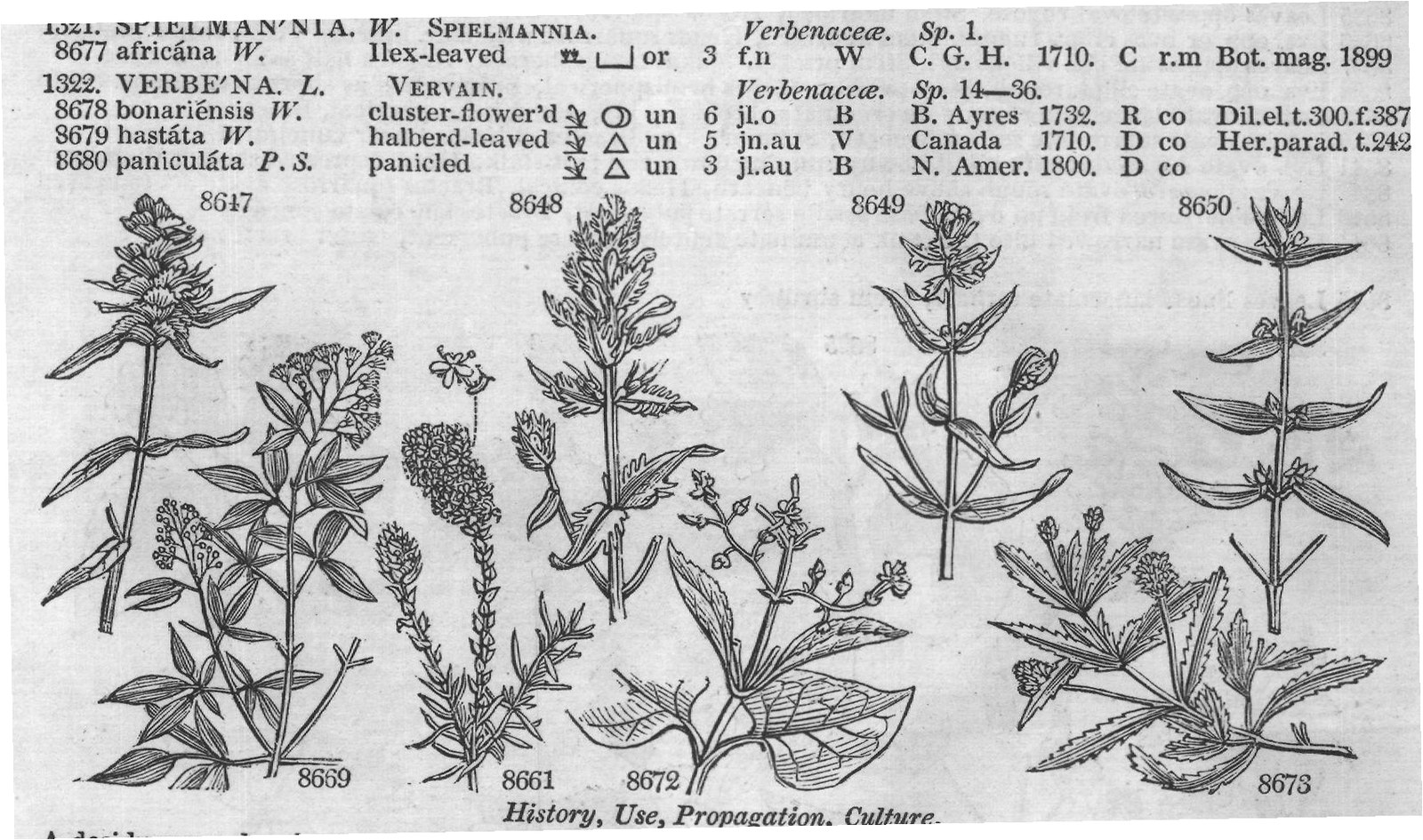
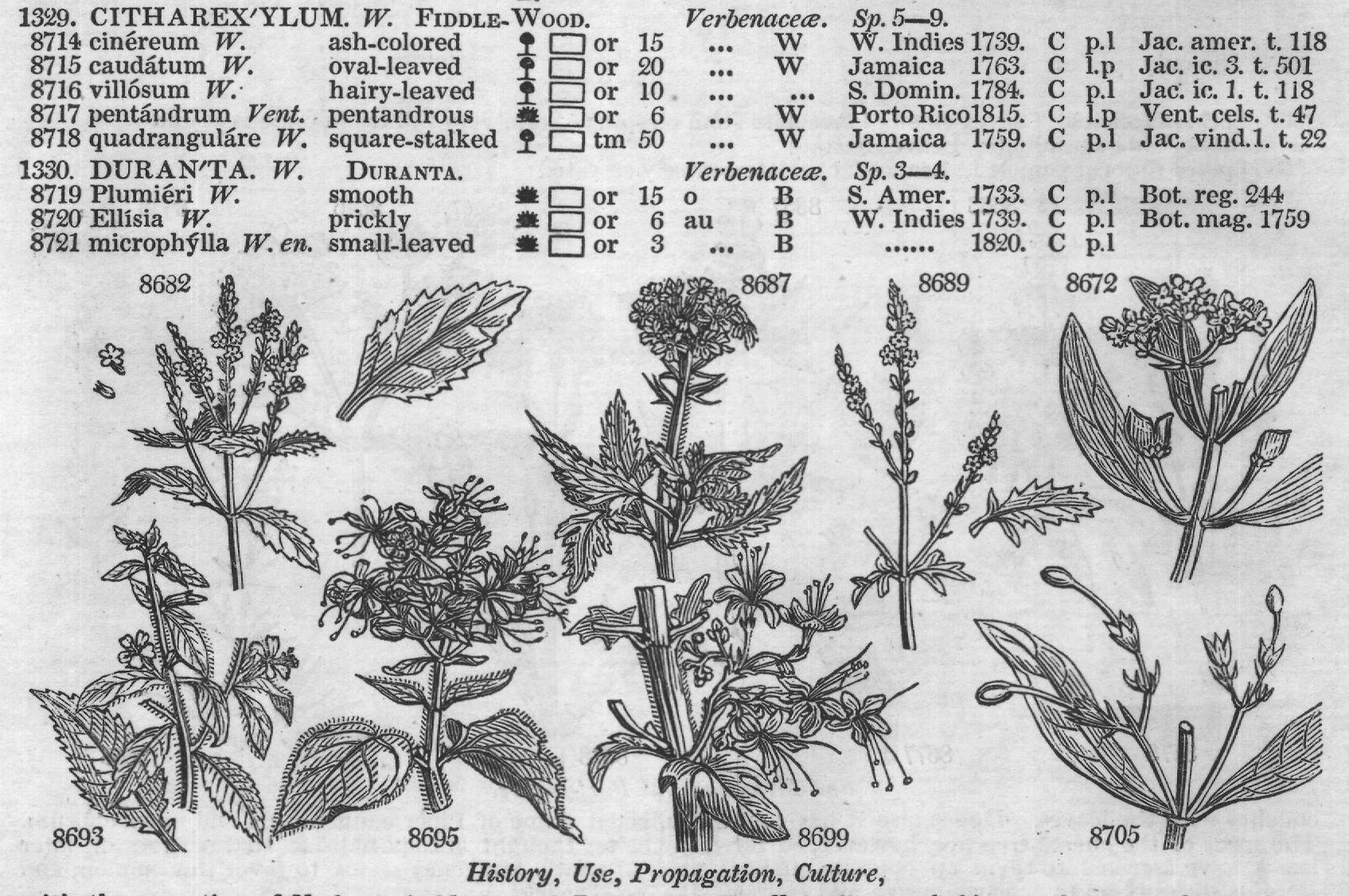
DIDYNAMIA ANGIOSPERMIA. 8646 Leaves oblong acute serrate rough above pubescent beneath, Heads globose, Bractes obl. lowest longest 8647 Spikes quadrangular, Bractes cordate compact toothletted imbricated 8648 Spikes conical lax, Bractes toothed setaceous colored, Teeth of calyx rough, Corolla closed 8649 Flowers axillary 1-sided, Corollas closed, Leaves lanceolate; floral hastate 8650 Flowers axillary 1-sided, Corollas gaping, All the leaves lanceolate 8651 Leaves linear acute entire reflexed rigid fleshy smooth, Spikes terminal 8652 Leaves linear smooth, Spikes terminal, Branches diffuse 8653 Leaves linear serrate toothed subciliated fleshy, Spikes corymbose 8654 Spikes terminal, Bractes and calyxes keeled rough, Leaves linear smooth reflexed at edge 8655 Leaves sessile linear lanceolate acute entire smooth, Spikes terminal solitary 8656 Spikes corymbose, Leaves linear toothletted 8657 Corymb multiplex, Leaves obovate smooth serrated 8658 Leaves obovate entire shining, Spikes rounded terminal, Stem shrubby 8659 Stem diffuse pubescent upwards, Lvs. lanceolate blunt finely serrate smooth, Spikes terminal subsolitary 8660 Lvs. rounded with a furrow on each side acutish somewhat toothed smooth fleshy, Spikes term. aggregate 8661 Spikes cone-like ovate terminal, Leaves scattered linear, Stem shrubby 8662 Spikes terminal, Leaves filiform fascicled smooth 8663 Leaves filiform fascicled smooth, Panicle compound 8664 Leaves simple ovate 8665 Leaves ternate entire, Panicle whorled, Berry 3-seeded 8666 Leaves digitate 7 or 5 lanceolate nearly entire, Spikes whorled panicled 8667 Leaves digitate 5, Leaflets cut-pinnatifid, Spikes somewhat whorled 8668 Leaves digitate 5, Leaflets stalked oblong entire, Panicle dichotomous, Berry 1-seeded 8669 Leaves quinate and ternate serrate, Flowers in panicled racemes 8670 Lvs. ternate and quinate, Leafi. lanc. acum. ent. beneath white with down, Branches of pan. dichotom. 8671 Leaves ternate and quinate, Leaflets ovate acute entire hoary beneath, Panicle with a straight rachis 8672 Panicle terminal naked elongated 8673 Spikes ovate, Leaves lanceolate serrated plaited, Stem fruticose 8674 Spikes roundish conical, Leaves cuneiform toothed, Stem creeping 8675 Spikes lax, Cal. of fruit reflexed roundish didymous hispid 8676 Spikes filiform very long, Cal, of fruit reflexed hispid, Tube of corolla spiral 8677 The only species 8678 Spikes fascicled, Leaves oblong lanceolate stem-clasping, Stem very tall trichotomous at end 8679 Spikes long acuminate, Leaves hastate 8680 Spikes filiform panicled, Leaves lanceolate coarsely serrated 8675 8666 8667 8677 8678 and Miscellaneous Particulars. 8646 8656 8668 1 couches with the leaves. Hence also it has had the affected name of Piper eunuchorum and monachorum. The seeds of the chaste-tree are, however, so far from being thought antiaphrodisiac, that writers of later times have ascribed to them an opposite quality; their aromatic pungency seems to favor this opinion, and Bergius states them to be carminative and emmenagogue. (Woodville.) The fruit of V. trifolia is reputed in the eastern countries to be warm, discutient, nervine, cephalic, and emmenagogue; and to be of service in paralysis, weakness, and pains of the limbs. It is in great use among the Indian practitioners, both internally and externally. The plant has a bitter taste, and a strong somewhat aromatic smell. 1318. Cornutia. So named after Jacques Cornut, a French physician, who travelled into Canada, and published an account of the plants of that country in 1635. Cornutia pyramidata is a shrub with square branches, elliptical ovate entire hoary leaves, and naked pyramidal terminal branches of flowers. 1319. Zapania. Named by Scopoli, after Paul Anthony Zappa, an Italian botanist. 1320. Priva. A genus of small Verbena-like herbaceous plants, with little blue flowers. The derivation of the name is unknown. 1321. Spielmannia. In honor of James Reinhold Spielmann, professor of medicine and botany at Strasburg, author of Prodromus Floræ Argentoratensis; Pharmacopœia Generalis, &c. A shrub of easy culture in any light soil, and cuttings root freely under a glass. 1322. Verbena. Said by De Theis, to be derived from ferfaen, its name in Celtic. A genus of weedy plants, Carolina Nettle-leaved upright Rose DIDYNAMIA ANGIOSPERMIA. 8681 angustifólia H. K. narrow-leaved 8682 caroliniána W. 8683 urticifólia W. 8684 strícta Ph. 8685 Aublétia W. 8686 bracteósa Ph. 8687 Lambérti B. M. 8688 spúria Ph. 8689 officinalis W. long-bracted Lambert's jagged-leaved common 业 un 3 jn.au B CLASS XIV.
N. Amer. 1802. D co Aun 6 jn.s W N. Amer. 1732. D co Dil.el.t.301.f.388 un 3 jl.s W N. Amer. 1683. C co Rob. ic. 26 Aun 3 jl.au B N. Amer. 1802.
D co Bot. mag. 1976 or 1 jn.au Pu N. Amer. 1774.
Sr.m Bot. mag. 308 prjl Pu N. Amer. 1812.
D co or 1 jl Pu S. Amer.
D co ...
Bot. mag. 2200 un 2 jl.au B N. Amer. 1731. C p.l Aun 2 jn.s Pu 8690 supína W. trailing un jn.jl B Britain ro.sid. D co Spain 1640. S co Eng. bot. 769 Park.the.675. f.2 8691 prostráta H. K. prostrate Aun jn.jl B N. Amer. 1794. D co 1323. AVICENNIA. L.
AVICENNIA.
Myoporineæ. Sp. 1-3. 8692 tomentósa L. downy-leaved un 20 Pk 1324. CALDA'SIA. W.
CALDASIA. 8693 heterophýlla W. blue pr 2 my.d B 1325. CLERODEN DRUM. B. P. CLERODENDRUM. 8694 frágrans H. K. fragrant or 6 au.d W ẞ flore pleno 8695 viscosum H. K. clammy double-flowered or 6 au.d W 6 my.au W or 8696 infortunatum P. S. long-flowered or 6 ... ... 8697 fortunátum W. spear-leaved or 6 jl 8698 squamátum H. K. scarlet or 10 jn.s S 8699 paniculátum W. panicled or 6 jl.o W 8700 trichótomum W. three-forked or 6 ... ... 8701 tomentósum R. Br. downy or 5 mr.ap W 8702 ligustrínum H. K. Privet-leaved or 3 au.n W 8703 heterophyllum H.K. various-leaved or 3 au.s W 8704 inérme H. K. smooth or 4 au.n W 8705 Siphonánthus H. K. whorl-leaved 8706 macrophyllum B. M. large-leaved 8707 phlomoides L. Phlomis-like or 6 W ... or 8 jl or 4 au.s 8708 costátum R. Br. ribbed or 6 ... ... 1326. VOLKAME RIA. 8709 aculeáta H. K.
H. K. VOLKAMERIA. prickly or 4 au.o 8710 buxifólia W. en. box-leaved or 4 au 8711 japónica Thunb.
Japan 오 1327. HOLMSKIOL/DIA. H. K. 8712 sanguínea W. scarlet 1328. PETREA. W.
PETREA. 8713 volúbilis W. climbing 1329. CITHAREX'YLUM. W. FIDDLE-WOOD. 8714 cinéreum W. ash-colored 8715 caudátum W. oval-leaved 8716 villósum W.. hairy-leaved 8717 pentándrum Vent. pentandrous 8718 quadranguláre W. square-stalked 오오오오 1330. DURAN'TA. W.
DURANTA. 8719 Plumiéri W. smooth 8720 Ellísia W. prickly 8721 microphýlla W. en. small-leaved 8682 or 50 HOLMSKIOLDIA. or 4 or 20 jl.au Pu Verbenaceæ. or 15 W ... or 20 W ... or 10 ... ... or 6 W ... tm 50 W ...
Verbenaceæ. or 15 o B or 6 au B or 3 ...
B 8687 ... ...
India 1793. C l.p Fl. d'Owar.t.47 Verbenaceæ. Sp. 1.
New Spain1813. S co Verbenaceæ. Sp. 15-27.
China 1790. R s.p China 1790. R s.p E. Indies 1796. C s.p E. Indies C 1.p ...
WE. Indies 1784. C 1.p China 1790. R s.p Java 1809. C s.p Japan 1800. Cl.p N. S. W. 1794. S s.p Mauritius 1789. C p.1 Mauritius 1805. C 1.p E. Indies 1692. C p.l E. Indies 1796. C p.1 W.B E. Indies 1815. C p.1 W E. Indies 1820. C p.1 N. Holl. 1823. C 1.p Verbenaceæ. Sp. 3-5.
Vent. malm. 70 Bot. mag. 1834 Bot. mag. 1805