Home › E › Eng (Bot Bauh pr t Bot mag Bot mag)
Eng (Bot Bauh pr t Bot mag Bot mag)
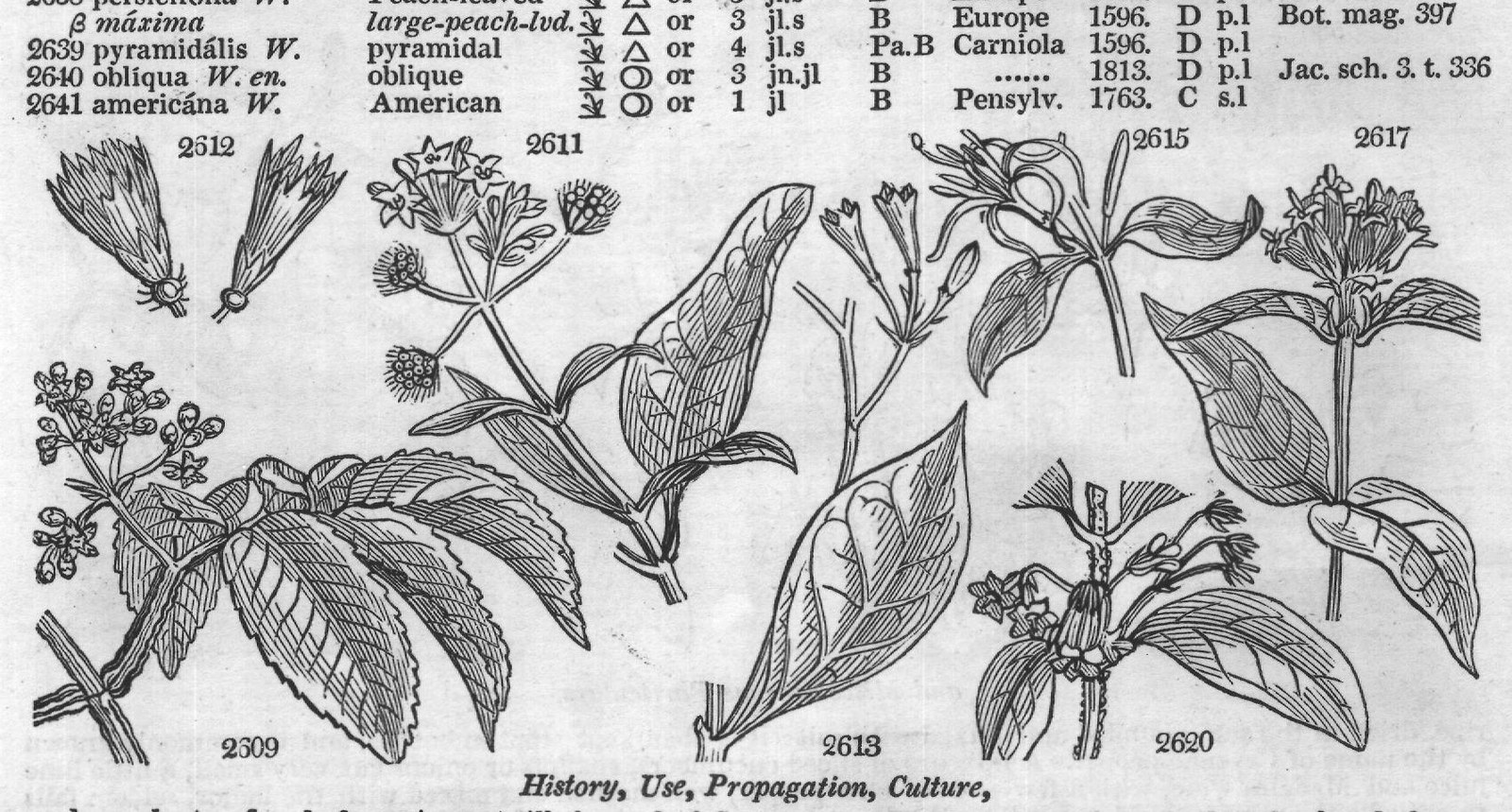
bot. 866 Bauh. pr. 34.t.34 Bot. mag. 512 Bot. mag. 691 Bot. cab. 485 2612 2611 2615 Jac. sch. 3. t. 336 2617 2609 2613 History, Use, Propagation, Culture, 2620 produce plenty of pods from August till the end of September. They may be also raised under hand-glasses, and in very warm situations treated as common annuals. C. cerasiforme is sometimes cultivated for the same purposes as the common capsicum. 454. Leea. Named after the first James Lee, of the Hammersmith Nursery, an excellent cultivator and most worthy man. The plants have little more beauty than a hemlock. Cuttings root easily under a handglass in heat. 455. Spermadictyon. From σπερμη, seed, and δiκτuov, a net, on account of the manner in which the seeds cover the placenta. A pretty stove plant with sweet white flowers. 456. Dentella. A diminution of dens, a tooth; the divisions of the corolla having each three little teeth. 457. Macгocпemum. From μaκρoς, long, and vημa, a stamen. 458. Exostemma. From εξ, out, and στεμμa, a crown, in allusion to the protrusion of the stamens; one of the characters on account of which the genus has been separated from Cinchona. The genus Cinchona, which was so named after the Countess of Cinchon, who being cured by the use of this plant, first brought it into notice, is very nearly related to this, and is a most important genus, as furnishing the Peruvian or Jesuit's bark. The bark is taken from various species; but that which produces the best is said to be C. officinalis, a native of Peru, and not yet introduced to this country. The Jesuit's bark tree of Jamaica is the Exostemma caribæum, but land there is too valuable for its culture. Our species are not very common in collections, being of slow growth, and not very easily propagated. Sweet ORDER I.
PENTANDRIA MONOGYNIA. 2607 Stem furrowed angular smooth, Leaves nearly bipinnate 2608 Stem rounded pubescent, Leaves pinnated 2609 Stem angular fringed, Leaves pinnated 2610 Stem angular, Stalks smooth, Leaves broad ovate serrated 2611 Leaves opposite ellipt. Flowers terminal in umbels 2612 Stem creeping much branched smooth, Leaves stalked opposite oval flat entire 2613 Corymbs axillary long naked 2614 Leaves elliptical acute opposite, Flowers whorled sessile 2615 Peduncles axillary and terminal 1-flowered, Leaves ovate lanceolate 2616 Flowers terminal panicled smooth, Caps. terminal smooth, Leaves elliptical acuminate smooth 2617 The only species. A fine plant with tubular red flowers like a honeysuckle 2618 Leaves sessile, Panicle dichotomous 2619 Leaves stalked elliptical acute smooth 2620 Leaves oblong acuminate hairy rigid nerved beneath, Stalks axillary erect 2621 The only species. An hexandrous plant 2622 Flowers pentandrous, Leaves lanceolate elliptical 2623 Flowers pentandrous, Leaves ovate coriaceous §1. Leaves smooth. 2624 Stems 1-flowered, Leaves ovate smooth subciliated 2625 Lower leaves obovate wedge-shaped crenate, Upper linear entire, Stem simple 1-flowered 2626 Stem 1-flowered naked, Leaves stalked elliptical lanceolate deeply toothed 2627 Little stems 1-flowered, Radical and cauline leaves ovate subcrenate, Cal. cernuous 2628 Stems about 3-fil. Lvs. entire, the rad. ov. on ong stalks, the cauline obl. ov. sessile obtuse, Fls. nodding 2629 Lvs. all cordate serrate stalked smooth, Branches filiform 1-flow. Cal. reflex. glutinous, Cor. spreading 2630 Smooth, Radical leaves oblong and kidney-shaped serrate: cauline linear entire 2631 Smooth, Leaves all serrate: radical cordate ovate firm shining; cauline linear alternate remote 2632 Radical leaves ovate crenate with flattened stalks, Flowers racemose 1-sided cernuous 2633 Stem hairy decumb. angular, Lvs. stalk. ser. smooth, rad. cordate, lower cauline ovate, Cor. short large 2634 Stem filiform angular striated, Branches about 1-flowered, Leaves lanceolate or linear, Flowers 5-cleft 2635 Pubescent, Lvs. rather hairy: rad. obov. rounded serrated; cauline clustered lin. entire, Sepals setaceous 2636 Leaves upright: radical lanceolate-oval, Panicle spreading 2637 Leaves wavy: radical lanceolate-oval, Panicle contracted 2638 Stem angular, Lvs. stiff obsoletely crenate serrate: rad. obl. obovate; cauline lanc. lin. Flow. large 2639 Lvs. smooth ov. cord. cartilaginous-serrated, the caul. lanc. Stem upright elong. branch. Lower ped. 3-fl. 2640 Lvs. obl. lanc. point. at each end serr. with veins hairy beneath, Stem erect, Rac. term. Seg. of cor. obliq. 2641 Lvs. cord. and lanc. serr. lower stalks ciliated, Fls. axill. sessile, Cor. 5-parted flat, Style longer than cor. 2627 2630 2638 2621 2622 2629 2637 and Miscellaneous Particulars. advises cuttings to be "taken off when ripe, planted in a pot of sand, plunged in moist heat, and covered with a bell-glass." 459. Burchellia. Named by Mr. Robert Brown, after William Burchell, a traveller in the southern part of Africa, from whom we have two volumes of travels, and the promise of other works hereafter. The species is a beautiful dwarf shrub with scarlet flowers in terminal clusters. 460. Rondeletia. Plumier established this genus in memory of William Rondelet, a scientific physician, whose attention was chiefly occupied by fishes and algæ. He was born in 1507, and died in 1566. Rabelais ridicules him under the name of Rondibilis. He is said to have given a disgusting proof of his fondness for anatomy by dissecting his own son. 461. Coutarea. So named by Aublet from its vernacular name in Guiana, Coutari. A most beautiful plant, requiring the utmost heat of the stove; but very rare in gardens, if it indeed exists in cultivation at all now. 462. Portlandia. In honor of the Duchess of Portland, once a famous patroness of botany. Splendid plants of the natural order Rubiaceæ. Portlandia grandiflora is common and easily grown. P. coccinea is perhaps not in the country, although stated to have been introduced in 1775. 463. Campanula. A diminution of campana, a bell; on account of the form of the corolla, which resembles a little bell. Rapunculus is a diminution of rapa, a radish, in allusion to the nature of its root. C. speculum is so called because the corolla in its form resembles a little round and elegant mirror (speculum), whence in M 2 PENTANDRIA MONOGYNIA.
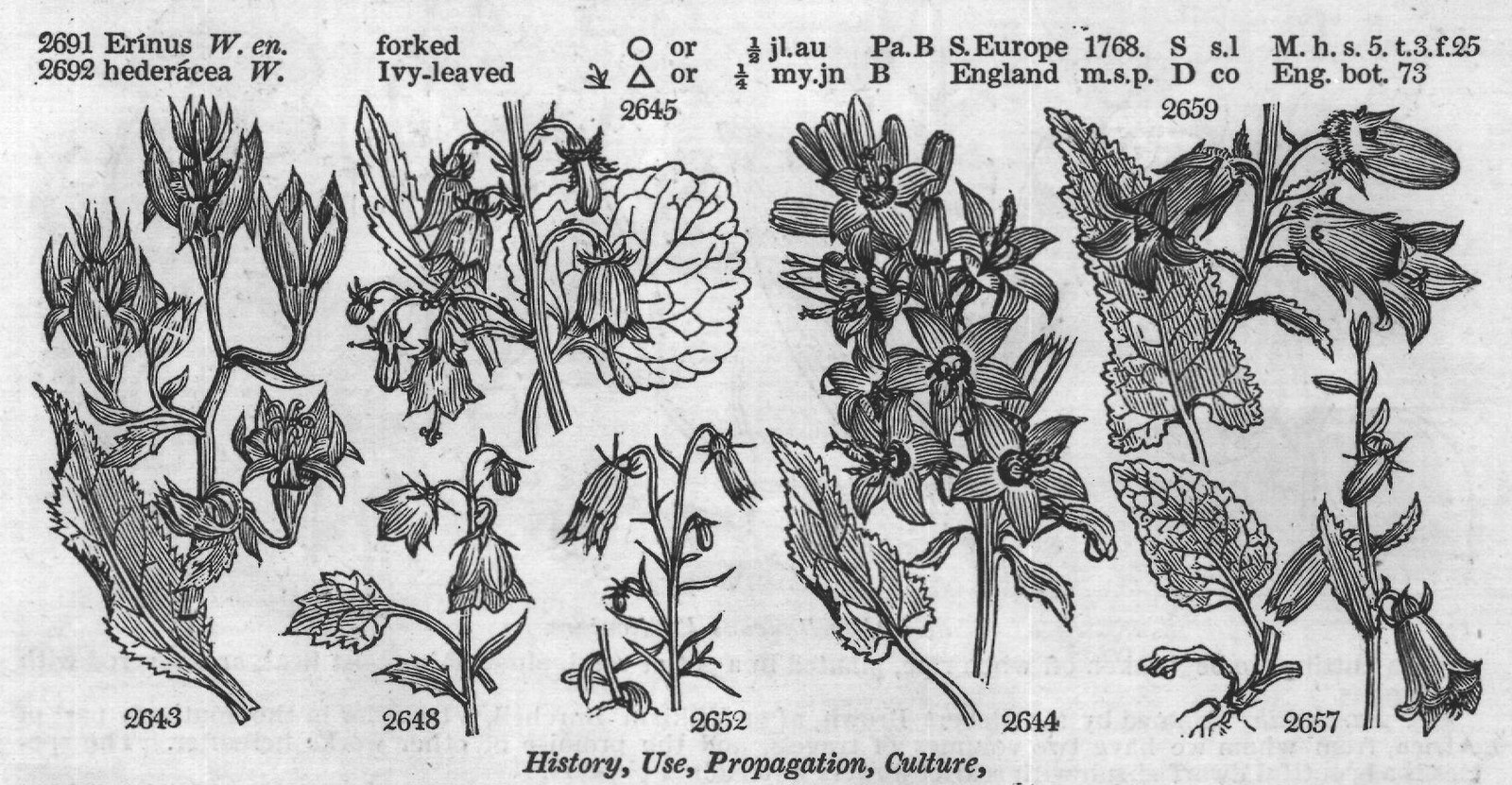
CLASS V. 2642 nítida W. smooth-leaved or jl W 2643 aúrea W. golden-flowered or 3 jl.s Y 2644 versícolor H. K. various-colored or 4 jl.s St N. Amer. 1731. D p.1 Madeira 1777. S s.p Greece 1788. D s.I Dod. me. 4. t.111 Bot. reg. 57 Bot. rep. 396 2645 lilifólia W.
Lily-leaved or 2 my.s Pa.B Siberia 1784. D p.l Bot. reg. 236 2646 stylósa Lam. long-styled or 1½ my.jn Pa.B Siberia 1820. R co 2647 grandiflóra W. great-flowered or 1 jn.au B Siberia 1782. D p.1 2648 rhomboídea W.
Germander-lvd.or 2 jl Pa.B Switzerl. 1775. D p.1 Gmel. sib. 3. t. 27 Bot. mag. 252 Bot. cab. 603 2649 verticilláta W. whorled or 2 jn L. B Siberia 1783. D s.l Pal. it. 3. t. G. f.1 2650 marsupiiflóra Fisch. cernuous or 1½ jn.jl Pa.B 1818. R co 2651 Lobelioídes W. small-flowered or 1 jl.au 2652 excísa Schl. bitten or my.jn B 2653 latifólia W. giant or 4 jl Pu 2654 eriocárpa Bieb. woolly-fruited or 2 jn.jl B 2655 urticifólia W.
Nettle-leaved or 3 au Pu W.P Madeira 1777. S s.l Switzerl. 1820. R co Bot. cab. 561 Britain s. m. p. S p.1 Eng. bot. 302 Caucasus 1823. R co Germany 1800. D co 2656 Trachélium W.
Throatwort or 4 jn.au V Britain woods. D p.l