Important: Safety Warning
This page gives first-aid or emergency advice that predates modern medicine and can make an emergency worse. Do not follow it. In any medical emergency, call emergency services and follow current first-aid guidance.
This page states that certain wild plants are safe to eat. Its identifications and edibility claims are more than a century old and in some cases simply wrong, and deadly look-alikes exist for many edible species. Never eat a wild plant on the strength of this text.
This information has been left in for historical purposes but should not be acted upon.
Home › E › Eng (Bot History Use Propagation) (II)
Eng (Bot History Use Propagation) (II)
bot. 707 11106 11100 11110 11105 11111 History, Use, Propagation, Culture, given rise to this belief, rather than exceptions, that all plants used as food by man, possess very inactive qualities. If their action was powerful, any quality inherent in the plant: for it is a rule to which there are few they would be unfit for food.
Scorzonera hispanica is esteemed diuretic, stimulant, and sudorific. A drink is made from it for variola; and a distilled water is also prepared from it. It is also an esculent of occasional culture. The root is carrota distilled water is also prepared from it. It is also an esculent of occasional culture. The root is carrotshaped, about the thickness of one's finger, tapering gradually to a fine point, and thus bearing some resemblance to the body of a viper. The outer rind being scraped off, the root is steeped in water, in order to abstract a part of its bitter flavor. It is then boiled or stewed in the manner of carrots or parsneps. The roots are fit for use in August, and continue good till the following spring. Its culture is the same as that of carrot or salsafy. 1626. Picridium. A diminutive of Picris, which see. the spring as a small salad, and, if not allowed to become too old before it is cut, is an excellent vegetable, with 1626. Picridium. A diminutive of Picris, which see. Picridium sativum, Picridium cultivé, Fr., is sown in spring as a small salad, and, if not allowed to become too old before it is cut, is an excellent vegetable, with Picridium sativum, Picridium cultivé, Fr., is sown in a pleasant delicate flavor, wholly devoid of the bitterness of endive, and of the insipidity of very young lettuces.
P. tingitanum is a favorite border annual. 1627. Sonchus. Σovχoς, in Greek, said to be altered from σoμφoς, hollow, or soft, in allusion to the soft feeble stem of the plants. Sonchus oleraceus, Sow-thistle, Eng., Hasenkohl, Ger., seems to have nearly the same of the plants. Sonchus oleraceus, Sow-thistle, Eng., Hasenkohl, Ger., seems to have nearly the same properties as the Dandelion and Succory, but it is little regarded as a medicine. It is a favorite food with hares and rabbits; and is said to be eaten by goats, sheep and swine , but not to be relished by horses. The young tender leaves are in some countries boiled and eaten as greens: and it is even affirmed, that the tender ORDER I.
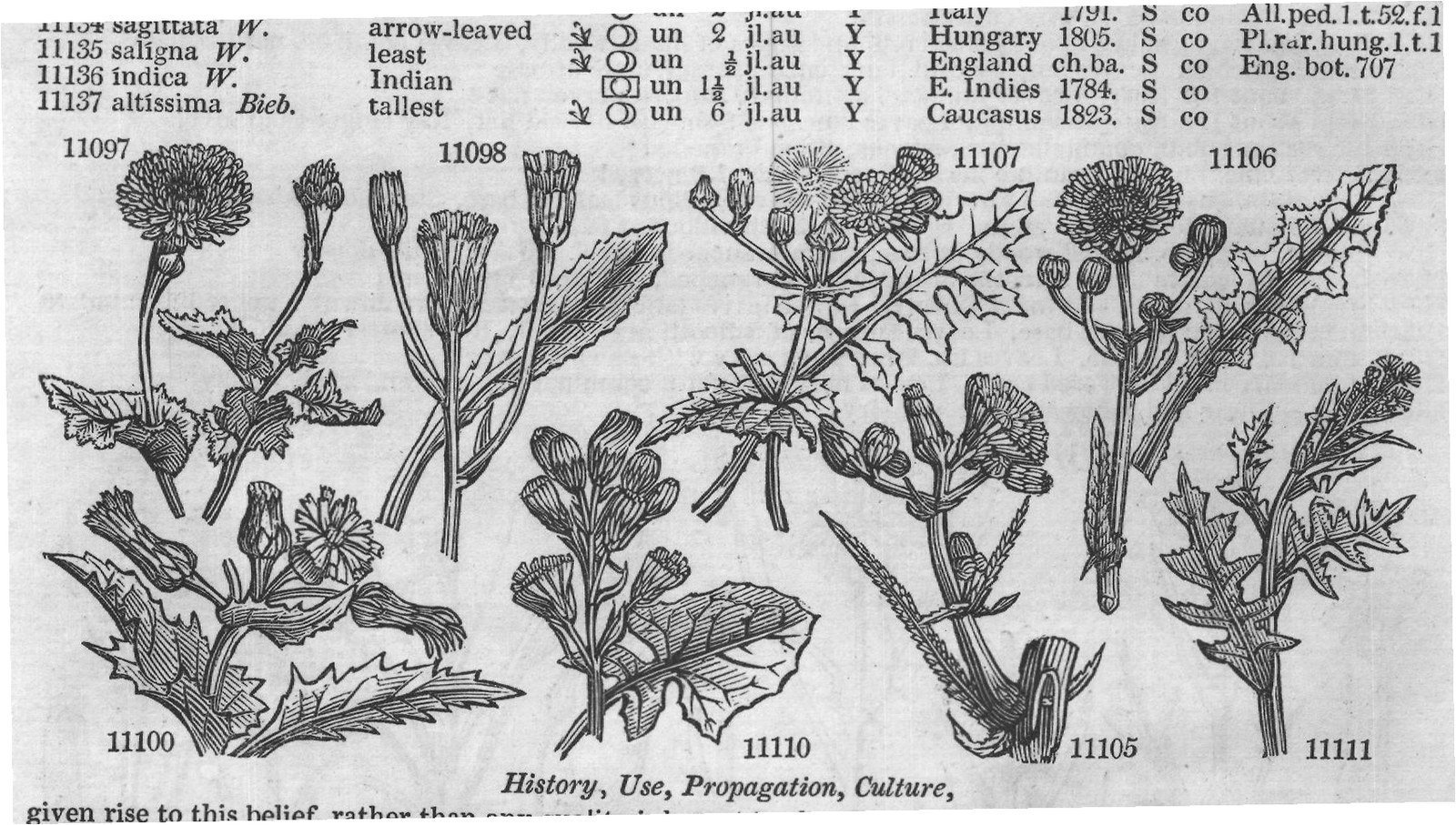
SYNGENESIA ÆQUALIS. 11095 Leaves runcinate hispid, Stem about 2-fl. somewhat leafy hispid 11094 Lower leaves linear: upper pinnatifid, Lobes remote linear 11096 Cauline leaves amplexicaul. obl. nearly entire: radical sublyrate runcinate, Scales of invol. appressed 11097 Leaves amplexicaul. obl. pinnatifid toothed, Invol. squarrose 11098 Leaves scabrous, Scales of invol. membranous at edge ciliated 11099 Pedunc. subsol. term. naked, Leaves lanc. amplexicaul. undivided finely toothed backwards 11100 Pedunc. branched somewhat scaly, Leaves lanc. runcinate, Stem shrubby 11101 Pedunc. naked, Invol. smooth, Leaves pinn. Pinnæ lin.-lanc. somewhat toothed 11102 Pedunc. naked, Invol. turbin. smooth: lower scales reflexed at end, Leaves pinnatifid 11103 Pedunc. naked, Inv. turbin. smooth: low. scales reflexed at end, Lvs. lyrate pinnatif. Corymb divaricating 11104 Pedunc. naked and invol. smooth, Stem nearly naked, Radic. lvs. lyrate smooth on each side, Lobes triang. 11105 Pedunc. and invol. hispid somewhat umbelled, Leaves runcinate sagittate at base [ovate 11106 Peduncles and invol. hispid sub-umbellate, Leaves runcinate dentato-ciliate cord. at the base 11107 Peduncles sub-tomentose umbellate, Involucre glabrous, Lvs. runcinate dentato-ciliate amplexic. at base 11108 Pedunc. downy umbell. Invol. hairy, Leaves bipinnatifid cordate sagittate at base 11109 Pedunc. naked, Flowers panicled, Leaves runcinate 11110 Peduncles and involucre hispid racemose, Leaves sublyrate, Terminal lobe deltoid very large 11111 Pedunc. squarrose, Fl. racemose, Leaves runcinate acuminate smooth glaucous beneath 11112 Pedunc. sub-squarrose, Fl. panicled, Leaves lyrate-runcinate toothletted stalked 11113 Leaves sessile: lower cordate toothed; upper hispid entire, Peduncles scaly 11114 Pedunc. sub-squarrose, Fl. panicled, Radic. leaves sub-runcinate: cauline ovate acuminate stalked 11115 Raceme comp. terminal, Leaves lanc. ensiform amplexicaul. toothed 11116 Pedunc. squarrose, Fl. corymb. Leaves lanc. sessile: lower runcinate toothed; upper entire 11117 Pedunc. naked, Fl. in corymbose panicles, Leaves lanc. runcinate narrowed at base 11118 Leaves pinnatifid with little white spiny teeth, Calyx slender 11119 Pedunc. and invol. smooth a little downy, Leaves sub-runcinate spiny-toothed amplexicaul. 11120 Pedunc. somewhat downy umbellate, Invol. smooth, Leaves pinnatif. toothed auricled cordate at base 11121 Radic. leaves unequally pinnatifid: cauline linear lanc. toothed, Pedunc. long 1-flowered 11122 Peduncles hirsute naked, Fl. panicled, Leaves lyrate cordate at base hairy beneath 11123 Pedunc. scaly, Fl. racemose, Leaves runcinate acuminate, Stem panicled virgate 11124 Leaves rounded: cauline cordate, Stem corymbose 11125 Leaves sinuate-crenate toothed wavy curled: radical with a hairy keel, Florets 5-parted 11126 Lower leaves tripartite pinnatifid with obl. blunt segm.: upper cordate 11127 Leaves runcinate tooth-ciliated blunt amplexicaul. sagittate: radical obovate, Stem panicled 11128 Leaves smooth beneath: lower runcinate toothletted at base dilated and sagittate; upper lanc. sagittate 11129 Leaves smooth beneath: radical runcinate lyrate toothed; upper runcinate pinnatifid 11130 Leaves smooth beneath: lower runcinate entire amplexicaul.: upper lanceolate sessile 11131 Leaves vertical prickly at keel acute at end sagittate at base runcinate pinnatifid 11132 Leaves oblong toothed horizontal, their keel prickly, their apex obtuse 11133 Leaves smooth beneath obl. lanc. ciliate-toothed sagittate at base 11134 Leaves smooth beneath: lower oblong narrowed at base toothletted; upper lanceolate entire 11135 Leaves with a prickly keel: radical lanc, pinnatifid; cauline linear entire sagittate 11136 Leaves laciniate ensiform sessile unequally toothed 11137 Leaves toothletted smooth: lower sinuated; upper lanceolate sagittate acuminate, Pan. much branched 11135 11116 11134 11129 11127 11133 11132 11121 and Miscellaneous Particulars. shoots of the smooth variety, boiled in the manner of spinach, are superior to any greens not in common use.
Nearly the same thing may be affirmed of S. arvensis, palustris, and other species. Sonchus floridanus is used as a cure for the bite of the rattle-snake, in the same way as Prenanthes serpentaria. It is called by the American settlers Gall of the Earth. . It is called by the American settlers Gall of the Earth.
S. tenerrimus is eaten by the common people in Italy as a salad. 1628. Lactuca. From lac, milk, on account of the milky sap, which flows copiously when the plants are cut. Besides Lactuca sativa, the French cultivate as small salad both L. quercina, palmata, and intybacea, which are Lactuca sativa, the French cultivate as small salad both L. quercina, palmata, and intybacea, which are all excellently adapted for such a purpose.
L. sativa is well known as furnishing among its numerous varieties the best vegetable of the salad kind grown in the open garden. Whoever has the command of lettuce, onions, and cucumbers, may well dispense with most other acetarious plants. It is questioned by some, whether the greater number of what are set down as species in this genus, are any thing more than variations of one type; and, at all events, it is thought L. virosa, a poisonous plant, is the parent of our cultivated sorts; which would not be more remarkable than the fact that the indigenous celery is one of our strongest poisons. All the species of Lactuca abound in a milky juice, which is found to partake, in a considerable degree, of the qualities of opium. The production of this juice is lessened by culture, and especially by blanching. It is qualities of opium. The production of this juice is lessened by culture, and especially by blanching. It is most abundant in plants in a wild state, and in both wild and cultivated lettuce during inflorescence. Of late years, this juice has been collected by incisions and scraping off the thickened juice, as in the collecting the opium of the poppy ( See p. 461.), and an opium has been produced little inferior to that of the East. It is called 11138 vimínea Link. rushy-twigged 11139 segusiána Balbis.
Italian un 1 jl.au Y Pu SYNGENESIA ÆQUALIS.
CLASS XIX.
Austria 1789. S co Jac. aust. 1. t. 9 Piedmont 1822. S co 11140 sonchifólia W.
Sow-thistle-lvd. un 2 jl.au 11141 tenérrima W. purple-flowered un jl.au Pa.B Candia 1822. D co Pu 11142 perénnis W. perennial un 2jn.au L.B S. Europe 1815. D co Germany 1596. D co Bot. mag. 2130 11143 júncea W. 1629. CHONDRIL/LA. W. GUM-SUCCORY. 11144 gramínea Bieb. 1630. PRENAN'THES. 11145 purpúrea W. 11146 álba W. 11147 altíssima W. 11148 cordáta Ph. 11149 spinósa W. 11150 murális W. 11151 pinnáta L. 11152 arbórea Brouss. 11153 hieracifólia W.
Crepis púlchra L.
W. PRENANTHES. 1631. LEON'TODON. W. DANDELION. 11154 Taráxacum W.
Compositæ. common Aun 1 s.o Y Sp. 2-5.
France 1633. D co Jac. aust. 5. t.427 grass-leaved un 1 S.O Y Volga 1824. D co Compositæ.
Sp. 9-13. purple-flowered or 4 jl.s Pu Germany 1658. D co Jac. aust. 4. t.317 white-flowered or 2 jl.au W N. Amer. 1762. D p.l Bot. mag. 1079 tall or 6 jl.au L.Y N. Amer. 1696. D p.l Plu.alm.t.317.f.2 heart-leaved or 4 jl.au Pa.Y N. Amer. 1816. D co prickly ☐ un 3 mr.my Y wall W 2 jl Y pinnate un 3 jn.jl Y arborescent un 3 jn.jl Y small-flowered Oun 1 jn.s Y Compositæ.
Sp. 6-9. common W 1 ap.jl Y 11155 serótinus W. late-flowering Aun 1 jl.s Y 11156 palústris E. B. marsh Aw 1 jn.jl Y moi.p. D co Barbary 1640. C co Britain woods. D co Teneriffe 1820. S co Teneriffe 1824. S co Park.the.804. f.7 Scotland sc.roc. S co Eng. bot. 2325 Britain me.pa. D co Hungary 1816. D co Britain