Important: Safety Warning
This page presents medical treatment from an era before modern medicine. The remedies described are ineffective against the conditions named, and some of the ingredients or doses are harmful. Do not use them to treat any illness; consult a qualified medical professional.
This information has been left in for historical purposes but should not be acted upon.
Euphorbiacea
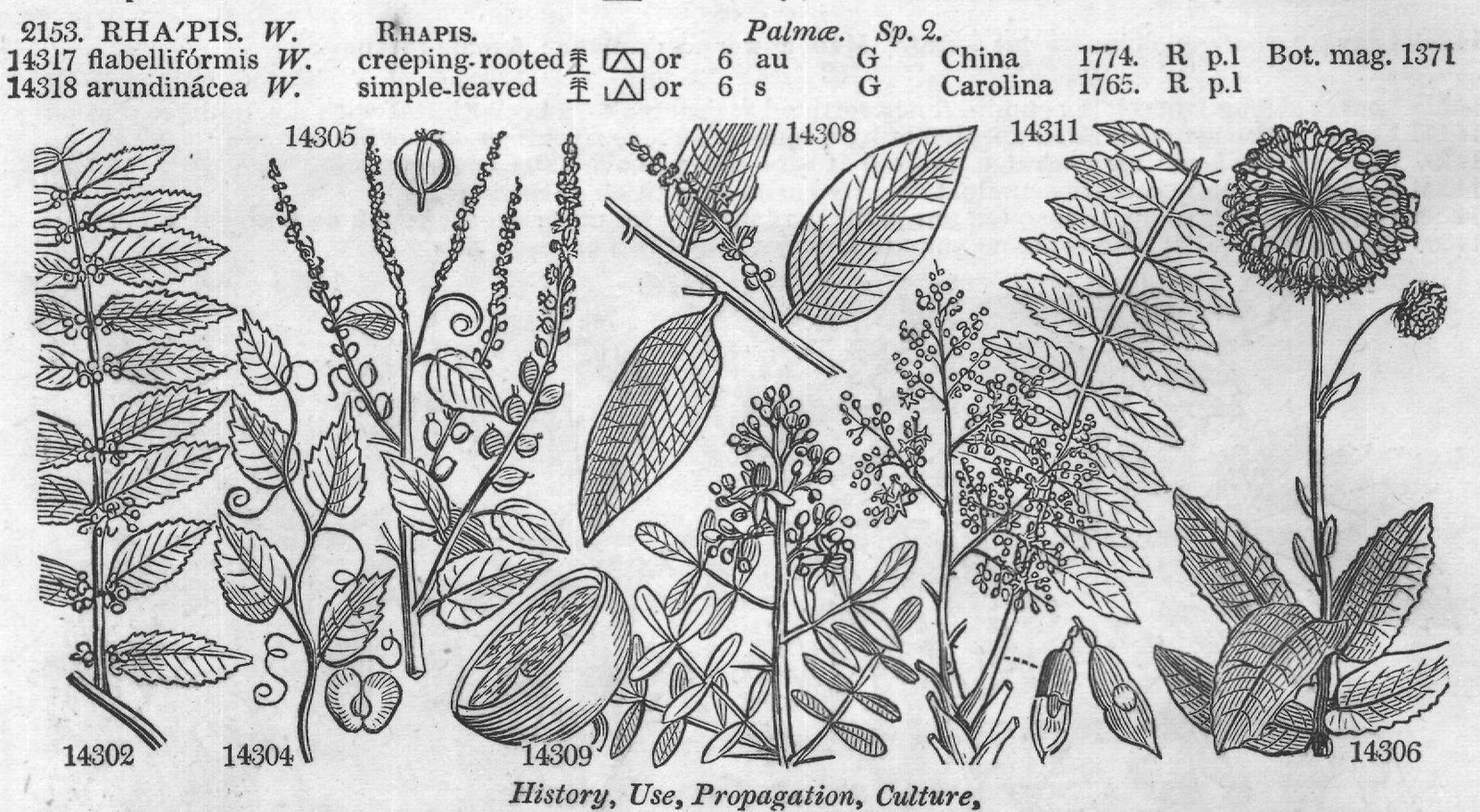
Sp. 1-5. 14308 spinósa W. prickly or 6 jn.jl Ap 2149. FERO'NIA. Correa. ELEPHANT APPLE. 14309 elephántum Corr. Indian 오 ft 40 2150. AILAN'TUS. W.
AILANTUS. 14310 glandulósa W.
Chinese 14311 excélsa W.
Indian or 20 au G or 50 G ...
China 1751. R l.p E. Indies 1800. C s.p 2151. CLU'SIA. W.
BALSAM TREE.
Guttiferæ. 14312 rósea W. 14313 álba W.
Rose-colored white-flowered 14314 flava W. 14315 venósa W. yellow-flower'd veiny-leaved or 30 jl.au R or 30 W or 30 s Y or 20 ... ... ... 2152. OPHIO XYLON. 14316 serpentínum W.
W. OPHIOXYLON. red-flowered or 3 my.jn W 2153. RHA'PIS. W. 14317 flabellifórmis W. 14318 arundinácea W.
RHAPIS. creeping-rooted simple-leaved or 6 au or 6 s 14305 14308 E. Indies 1823. C l.p Roxb. cor. t. 172 Aurantiaceæ. Sp. 1. ...
W E. Indies 1804. C 1.p Rox. cor. 2. t. 141 Terebintaceæ. Sp. 2-4.
Sp. 4-16.
Dend. brit. 104 Rox. cor. 1. t. 23 Carolina 1692. Cr.m Cat. car. 2. t. 99 S. Amer. 1752. C l.p Jac. amer. t. 166 Jamaica 1759. Cr.m Bot. rep. 223 S. Amer. 1733. Cr.m Plum. ic. 87. f. 2 Sp. 1-3.
Palmæ. Sp. 2.
E. Indies 1690. Rr.m Bot. mag. 784 G China 1774. R p.l Bot. mag. 1371 G Carolina 1765. R p.l 14311 14302 14304 14309 History, Use, Propagation, Culture, 14306 C. australis, sometimes called the lote tree, is reckoned among the largest timber trees of the south of Europe. The wood is one of the hardest we are acquainted with; it is also very tough and flexible. In France, the forked branches are peeled, and cut so as to resemble rude hay-forks, and in that state used for various agricultural purposes. The leaves have a cheerful light green color; the berries are the size of a small cherry, first yellow and then black; they are eaten by birds and children. C. occidentalis bears a great resemblance to the first. The leaves come out late in the spring, but they are also the latest in fading of any of the deciduous sort; the timber is tough and pliable, and imported by coachmakers for the frames of their carriages. It grows more freely in this country than the European species, and in some years bears abundance of fruit.
C. orientalis is a low-spreading tree or bush; the timber is white, aud yields a gum like that of the cherry. C. aculeata is an inelegant little tree, with a drupe double the size of a pea, which is eaten by the natives of the Caribbee Islands and the neighbouring continent. All the species are easily increased by layers or seeds. 2146. Gouania. Antoine Gouan was professor of botany at Montpellier in the middle of the eighteenth century, and was a good botanist. The species are increased by ripened cuttings under a hand-glass in heat. 2147. Hermas. A name, the meaning of which is wholly unknown. An inconspicuous starved-looking plant of no known use; whence it is called depauperata. 2148. Bridelia. Named in honor of Professor Bridel, the celebrated muscologist. Small bushes or trees, with little beauty to recommend them. 2149. Feronia. Elegantly named by the classical Correa de Serra, after Feronia, the goddess of the forests. This is a noble Indian timber tree, bearing a fruit not unlike an orange, to which it is botanically related. 2150. Ailantus. Derived from Ailanto, the name of one species in the Moluccas. The usual way of writing it, Ailanthus, is therefore incorrect. A. glandulosa is a tree which may be compared to a gigantic stag's-horn sumach; it has very large leaves, unequally pinnate, with foot-stalks from one to two feet in length, and numerous flowers in a terminating pedicel, which exhale a disagreeable odor. The tree grows very fast, and on very poor soil, especially if it be calcareous. If the bark be wounded, a resinous juice flows out, which hardens in a few days. The wood is hard, heavy, glossy like satin, and susceptible of a very fine polish. It is propagated by cuttings of the roots. In general the trees bear only male flowers; but in France it has produced both male and female flowers, and fruit twice in ten years. 2151. Clusia. So called, in honor of the celebrated Charles de l'Ecluse, born at Artois in 1526, and died in 1609. He was one of the most excellent botanists who ever lived, and author of many works whose value will only cease with the world. But he is not more known for his mental excellence, than for his personal calamities. In his early youth he undertook to travel through Portugal, Spain, England, Hungary, and other countries in pursuit of plants; no easy task in those days. By excessive fatigue he contracted, so soon as in his twenty-fourth year, a dropsical complaint, of which he was afterwards cured with chicory by the celebrated ORDER I.
POLYGAMIA MONŒCIA. 14301 Leaves broad ovate acuminate serrate smooth on each side 14302 Leaves ovate oblong acuminate serrulate unequally cordate at base rough above hairy beneath 14303 Lvs. ovate obl. acum. equally cordate at base entire obsoletely serrated at end smooth, Branches prickly 14304 Leaves ovate acuminate bluntly serrated smooth 14305 Leaves cordate-ovate with glandular serratures roughish, Racemes terminal downy 14306 Stem downy, Leaves oblong sessile toothed downy beneath 14307 Leaves lanceolate ovate woolly above downy beneath entire 14308 Shrubby erect spiny, Leaves ovate entire acute glabrous 14309 The only species 14310 Leaves pinnated with an odd one, Leaflets toothed at base, Teeth glandular 14311 Leaves abruptly pinnated, Leaflets serrated 14312 Leaves obovate blunt veinless, Cor. hexapetalous twice as large as calyx 14313 Leaves obovate blunt veinless, Cor 5-7 petalous half as large again as calyx 14314 Leaves obovate blunt veinless, Cor. 4petalous twice as large as calyx 15315 Leaves obovate blunt veiny, Flowers tetrapetalous 14316 Leaves in fours 14317 Fronds palmate plaited, Plaits and margins prickly 14318 Fronds simple 2-parted, Lobes acute plaited, Plaits roughish 14310 14312 14316 14313 14314 14315 14317 and Miscellaneous Particulars.
Rondelet. See Kondeletia. At the age of thirty-nine he broke his right arm, during one of his botanical rambles; and a short time afterwards his right thigh. When fifty-five, he dislocated his left ancle while at Vienna; and eight years after his right hip. Having been ' walk with and eight years after his right hip. Having been "unskilfully treated, he was ever after while at exercise brought on other diseases, among not the least distressing of which were calculus and hernia. After having been the director of the Imperial Gardens of Vienna for fourteen years, he finally returned to his native country, Flanders. He was named professor of botany at Leyden, where he gave botanical lectures for by of botany at Leyden, where he gave botanical lectures for sixteen years, when he died overwhelmed was named unimpaired to the last.
The species are trees abounding in a tenacious glutinous juice, of a balsamic flavor, whence the English name. C. rosea has handsome flowers, in which the stamina and pistillum are covered with a gelatinous gluten.
The fruit is green and of the size of a middling apple, with eight lines running, like meridians on a globe, from the stalk to the crown of it- When it ripens, it opens at these lines, and divides into eight parts, disclosing many mucilaginous scarlet seeds, resembling those of the pomegranate . The whole tree is exceedingly beautiful, and the structure of the fruit is a most exquisite piece of mechanism . It grows on rocks, and frequently on the trunk and limbs of trees, occasioned by birds scattering or voiding the seeds, which being glutinous, like those of the misletoe, take root in the same manner; but the roots not finding sufficient nutriment, spread on the surface of the tree till they find a decayed hole , or other lodgment, wherein is some small portion of soil; the fertility of this being exhausted, a root is discharged out of the hole till it reaches the ground, where it fixes itself, and the stem becomes a large tree. Roots have been known to do this at forty feet from the surface. The resin is used to cure sores in horses, and instead of tallow for boats. 4 C. alba is an elegant tree, and epiphytical on other vast trees, like the foregoing; the trunk is frequently a foot in diameter, and supports a spreading head. The whole abounds in a balsamic juice, of a green color, but becoming of a brownish color on being exposed to the air. The flowers are white, and of no great beauty; the fruit scarlet, with a scarlet pulp; the birds are very fond of them , hang over them on the wing, and pluck out the seeds with the pulp adhering.
C. flava bears in all respects a considerable resemblance to the former. A very good idea of the progress of culture since Miller's time, may be formed by comparing his directions for propagating this plant, and those of Sweet. Mr. Miller says, the best way is to have them brought over in tubs from the West Indies: according to Sweet, the pots should be well drained, the soil for rooted plants should be a light sandy loam, and "cuttings root very freely in sand under a hand-glass." 2152. Ophioxylon. From όφiς, serpent, and ξuλov, wood. In Ceylon they employ the plant in cases of the bite of serpents. It grows freely in a mixture of loam and peat, and may be increased by cuttings in sand under a hand-glass. of serpents. It grows freely in a mixture of loam and peat, and may be increased by cuttings in sand under a hand-glass. 2153. Rhapis. So named by Loureiro, from ρaφiς, a needle, on account of the acute awns of the corolla, which stick into the clothes. Culture as in the other palms; that is, abundance of heat and room, both for the roots and top. 3 K 2 POLYGAMIA DIŒCIA..
CLASS XXIII. 2154. CHAMÆ'ROPS. W. CHAMÆROPS.
Palmæ. Sp. 4. 14319 húmilis W.
Dwarf Fan Palm or 10 f.mr 14820 serruláta W. saw-leaved or 10 ... 14321 Hýstrix Ph.
Porcupine or 10 ...
G.w S. Europe 1731. Sk r.m Bot. rep. 599 G.w N. Amer. 1809. Sk r.m G.w Georgia 1801. Sr.m 14322 Palmetto W. smooth-stalked or 20 ...
G.w Carolina 1809. Sr.m 2155. GLEDITS CHIA. W. GLEDITSCHIA.
Leguminosæ.
Sp. 5-7. 14323 triacanthos Ph. Honey-locust Tree or 30 jn.jl G N. Amer. 1700. S s.1 Dend. brit. 138 ẞinérmis smooth or 30 jn.jl G S s.l ... 14324 brachycárpa Ph. curved-spined or 30 jn.jl G N. Amer.
S s.l ... 14325 monospérmaPh. Swamp Locust Tree or 20 jn.jl G N. Amer. 1723. S p.1 Cat. car. 1. t. 43 14326 hórrida W. strong-spined or 10 jn.jl G China 1774. L p.l Dend. brit. 75 14327 sinensis P. S.
Chinese or 10 G China 1812. L p.l ... 2156. CERATO'NIA. W. CAROB TREE.
Leguminosæ.
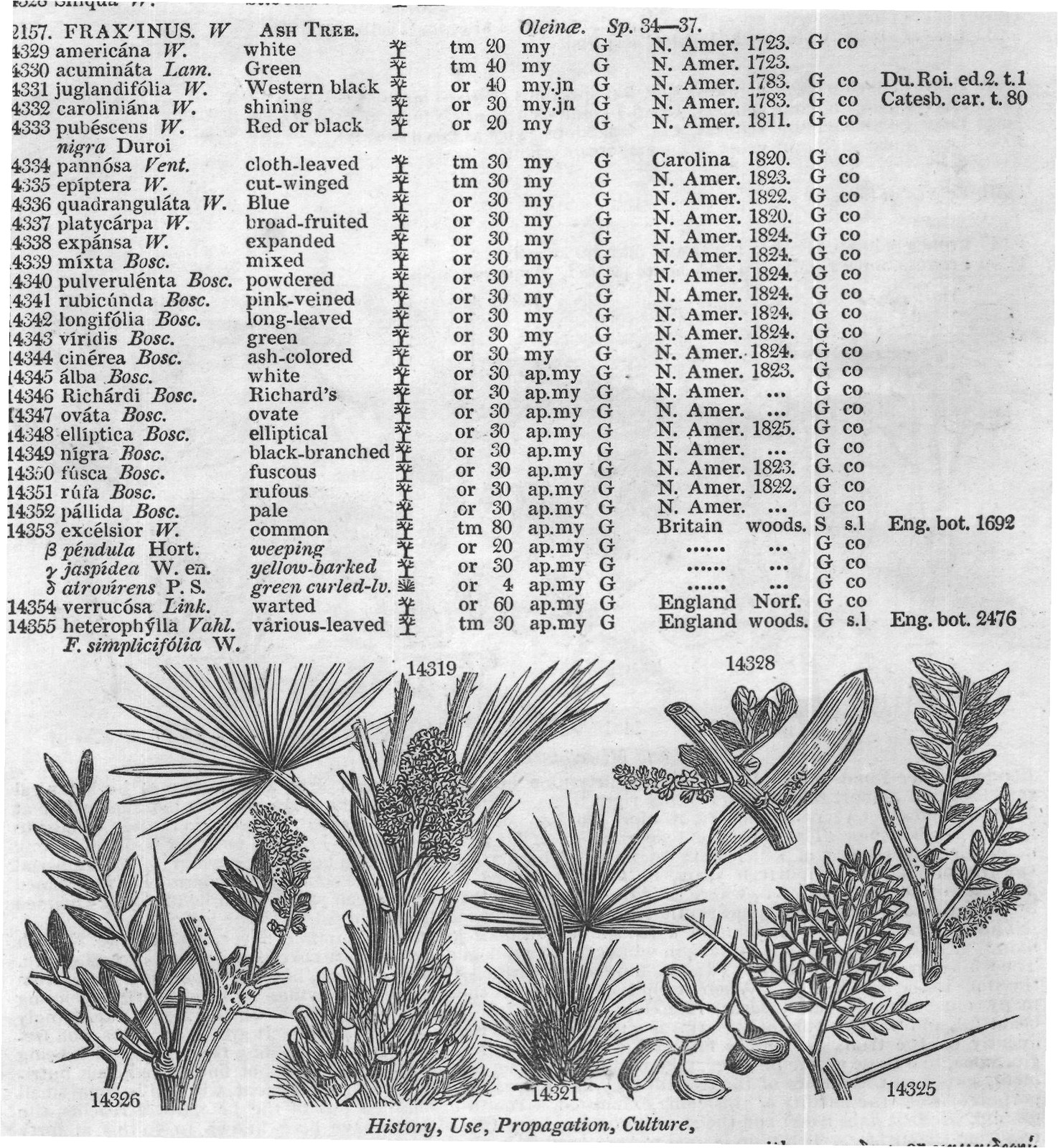
Sp. 1. 14328 Síliqua W. t.John's Bread ec 15 S.O R.Y Levant 1570. S s.l Bot. rep. 567 2157. FRAXINUS. W ASH TREE.
Oleinæ. Sp. 34-37. 14329 americána W. white tm 20 my G N. Amer. 1723. G co 14330 acumináta Lam.
Green tm 40 my G N. Amer. 1723. 14331 juglandifólia W.
Western black or 40 my.jn G N. Amer. 1783. G co Du. Roi. ed.2. t.1 14332 caroliniána W. shining or 30 my.jn G N. Amer. 1783. G co Catesb. car. t. 80 14333 pubéscens W.
Red or black or 20 my G N. Amer. 1811. G co nigra Duroi 14334 pannósa Vent. cloth-leaved tm 30 my G 14335 epíptera W. cut-winged tm 30 my G 14336 quadranguláta W. Blue or 30 my G 14337 platycárpa W. broad-fruited or 30 my G 14338 expánsa W. expanded or 30 my G 14339 míxta Bosc. mixed or 30 my 14340 pulverulénta Bosc. powdered or 30 my 14341 rubicúnda Bosc. pink-veined or 30 my G 14342 longifólia Bosc. long-leaved or 30 my G 14343 víridis Bosc. green or 30 my G 14344 cinérea Bosc. ash-colored or 30 my G Carolina 1820. G co N. Amer. 1823. G co N. Amer. 1822. G co N. Amer. 1820. G co N. Amer. 1824. G co GN. Amer. 1824. G co GN. Amer. 1824. G Co N. Amer. 1824. G co N. Amer. 1824. G co N. Amer. 1824. G co N. Amer. 1824. G co 14345 álba Bosc. white or 30 ap.my G N. Amer. 1823. G co 14346 Richárdi Bosc. 14347 ováta Bosc. 14348 ellíptica Bosc. 14349 nigra Rosc. 14350 fúsca Bosc. 14351 rúfa Bosc. 14352 pállida Bosc. 14353 excélsior W. 2 B péndula Hort. jaspidea W. en. airovirens P. S. 14354 verrucósa Link. 14355 heterophylla Vahl.
F. simplicifólia W.
Richard's or 30 ap.my G N. Amer.
Gco ... ovate or 30 ap.my G N. Amer.
Gco ... elliptical or 30 ap.my G N. Amer. 1825. G co black-branched or 30 ap.my G N. Amer.
G co ... fuscous と or 30 ap.my G N. Amer. 1823. G. co rufous or 30 ap.my G N. Amer. 1822. G co pale or 30 ap.my G N. Amer.
Gco ... common tm 80 ap.my G weeping or 20 ap.my G Britain woods. S s.1 Eng. bot. 1692 ... yellow-barked or 30 ap.my G ...... ... green curled-lv. or 4 ap.my G Gco Gco Gco .. .. ... warted or 60 ap.my G various-leaved tm 30 ap.my G England Norf. G co England woods. G s.l Eng. bot. 2476 14319 14328 14326 14321 History, Use, Propagation, Culture, 14325 2154. Chamærops. This word is said by etymologists to be synonymous with χaμaiδεuς, or χaμaiδρωψ, a dwarf oak.
The modern genus consists of ornamental palms, which are fine hardy greenhouse plants. 2155. Gleditschia. Called in honor of John Gottlieb Gleditsch, a native of Leipzig, and member of the academy of Berlin, and the author of several works, among which his Arrangement of Fungi, published in 1753, and his Botanical System, are the most remarkable. G. triacanthos, the honey locust of North America, attains the size of a large tree, but very seldom flowers and ripens its seeds in this country. All the species grow in common garden soil, and are generally raised from seeds. 2156. Ceratonia. This name has been derived from κερaς, a horn, in allusion to the long horn-like pods of this plant, which contain a sweet fæcula, for the sake of which they are often imported from Spain under the name of the Algaroba bean. This last word is a slight alteration , by the prefix of the article al, of the Arabic name of the tree, Kharroùb, whence also our English name Carob-tree. This is generally considered the of name Carob-tree. This is generally considered the locust-tree of scripture; and in Spain, where the seeds are eaten, it is called Saint John's bread. Ignorance of eastern manners and natural history, Professor Martin observes, induced some persons to fancy that the locusts on which John the Baptist fed, were the tender shoots of plants, and that the wild honey was the pulp of the pod of the Carob, whence it had the name of Saint John's bread. There is better reason to suppose, he adds, that the shells of the carob pod might be the husks which the prodigal son desired to partake ORDER II.
POLYGAMIA DICECIA.
DIŒCIA. 14319 Fronds palmate with spiny stalks, Spathe simple 14320 Fronds palmate with spiny stalks, Caudex creeping 14321 Stem creeping, Stalks with very long entangled prickles, Fronds palmate 14322 Fronds palmate with unarmed stalks, Spathes double, Stem arboreous 14323 Branches spiny, Spines thick triple, Leaflets linear oblong, Pods many-seeded 14324 Spines short thick triple, Leaflets oblong blunt, Pods oblong short 14325 Branches somewhat spiny, Leaflets ovate-oblong, Pods 1-seeded 14326 Trunks spiny, Spines branched, Leaflets oval-oblong 14327 Spines robust alternately branched, Leaflets elliptical smooth 14328 The only species 14329 Leaflets stalked oblong shining acuminate entire glaucous beneath, Buds yellowish 14330 Leaflets quite entire with long points glaucous beneath, Buds tawny 14331 Leafl. stalked ovate opaque serrated glaucous ben. Axils of veins downy, Branches smooth, Buds fuscous 14332 Leaflets stalked lanceolate serrulate shining smooth, Branches smooth, Buds fuscous 14333 Leaflets stalked elliptical ovate serrated beneath with the petioles and branchlets downy 14334 Lvs. of 3 pair shining above vill. with down ben. Leafl. stalk. ov. ent. taper. toward each end, Buds tawny 14335 Leaflets oblong lanceolate subserrated, Wing of fruit stalked cuneate emarginate, Buds fuscous 14336 Leaflets subsessile lanc. ellipt. serrated downy beneath, Branches square with winged angles, Buds grey 14337 Leaflets subsessile serrated outwardly and fruit lanceolate elliptical 14338 Leaflets ovate oblong unequally serrate about 11 smooth stalked, Branchlets smooth, Buds fuscous 14339 Leaves of 5 pair smooth above, Veins above hairy, Leaflets oblong subsessile unequally toothed 14340 Lvs. of 6 pair somew. downy ben. Leafl . on long stalks oblong acute sinuated, Petioles somew. powder 14341 Lvs. of 3 pair coriac. a little downy ben. Leafl. obl. acute somewhat toothed, Veins and petioles ben. pink 14342 Lvs. of 3 pair shining above ben. with the petioles downy, Leaflets obl. lanc. acuminate, Branches hirsute 14343 Lvs. of 3 pair shining above with veins downy ben. Leaflets oblong acute finely serrated, Branches green 14344 Lvs. of 3 pair smooth, Veins ben. rather hairy, Leaflets lanc. unequally toothed, Buds lin. cinereous hairy 14345 Lvs. of 3 pair beneath and petioles hirsute, Leafl. lanc. unequally and finely toothed acum. Branches grey 14346 Lvs. of 3 pair smooth, Veins ben. rather hairy, Leafl. obl. acute toothed, Branches cinereous hairy at base 14347 Leaves of 3 pair downy beneath, Leaflets ovate acute equally toothed, Buds tawny 14348 Lvs. of 3 pair hairy ben. Leaflets oblong mucronate somew. toothed, Branches brownish-black, Buds tawny 14349 Leaves of 3 pair smooth, Leaflets oblong acute subsinuate toothed, Branches blackish 14350 Lvs. of 3 pair smooth above, Veins beneath villous, Leafl. obl. mucron. equally toothed, Branches fuscous 14351 Leaves of 2 pair with rufous hairs beneath, Leaflets lanceolate acuminate cuspidate unequally toothed 14352 Leaves of 3 pair smooth, Leaflets subsessile ovate lanceolate toothed, Branches yellow 14353 Leaflets somewhat stalked lanceolate acuminate serrated smooth cuneate at base, Branches flat smooth 14354 Leafl. somewhat stalked lanceolate acuminate serrate smooth, Branches round warted 14355 Leaves simple and compound tooth-serrated, Buds black 14336 14334 14332 14355 14387 14335 14358 and Miscellaneous Particulars. of with the swine. The tree is very common in the south of Spain, and the seeds or beans, as they were there called, often formed the principal food of the British cavalry horses during the war of 1811 and 1812. In our greenhouses the plant seldom flowers, but it grows very well in loam and peat, and ripened cuttings root in sand under a hand-glass. 2157. Fraxinus. The origin of this word is far from certain. Linnæus says, it has been taken from the Greek φρaξiς, a separation, in allusion to the facility of splitting its wood. De Theis remarks, that M. A.
Dureau de la Malle has proved, in a learned dissertation published in 1804, that the Fraxinus of the Latins and the Melia of the Greeks are our Ornus europæus, while the Ornus of the Latins and the Boumelia of the Greeks are, in fact, our Fraxinus excelsior, or common ash. Le Frêne, Fr., Esche, Ger., and Frassino, Ital. The English name is from the Celtic esc, a pike. F. excelsior is one of the most useful of our native timber trees. It is peculiarly adapted for implements of husbandry, and the coachmaker and wheeler; it makes excellent fuel, with very little smoke; good hoppoles and hoops, excellent handles for tools, and very good walking-sticks. Its period of leafing is very late, being seldom earlier than the last week of April, and not unfrequently about the middle of May: the leaves have been used to adulterate tea; they are bitter, and said to communicate a rank taste to the milk and butter of cows which eat them. The roots spread to a great extent, and lie very near the surface; and these, together with the shade of the head, are found very injurious to hedges and pastures. The variety of this species, F. pendula, was first discovered in a field at very Gamblingay, 3K 3 POLYGAMIA DIECIA.
CLASS XXIII. 14356 macrophýlla Thouin large-leaved or 40 ap.my G 1823. Gco 14357 parvifólia W. small-leaved or 20 ap.my G Levant 1822. G co Willd.arb.t.6.f.2 14358 lentiscifólia W.
Aleppo or 6 my.jn G Aleppo 1710. G co Pluk.al. t. 182.f.4 14359 argentea Lois. silvery or 15 my.jn G Corsica 1825. G co 14360 sambucifólia W.
Water or 30 my.jn G N. Amer. 1800. G s.l 14361 nána Bosc. dwarf or 6 my.jn G Gco ...... 14362 oxycárpa W.
Caucasian * or 20 G Caucasus 1815. G co ...
B oxyphýila F. narrow-leaved or 20 G ...
S. Europe 1821. G co 2158. BRO'SIMUM. W. BREAD NUT. 14363 Alicástrum W.
Jamaica or 6 ...
Ap 14364 spúrium W.
Milkwood or 6 ...
Ap Sp. 2-4.
Jamaica 1776. Cr.m S. ff. i. oc. 1.t.1.f.1 Jamaica 1789. Cr.m 2159. DIOSPYROS. W. DATE PLUM.
Ebenacea.
Sp. 12-29. 14365 Lótus W.
European clt 20 jn.jl Y.G Italy 1596. L s.l Mill. ic. t. 116 14366 virginiána W.
American * clt 20 jn.jl Y.G N. Amer. 1629. S s.1 Dend. brit. 146 14367 pubéscens Ph. pubescent clt 20 ap Y.G N. Amer. 1812. Cs.l 14368 sylvática W. wood or 20 W E. Indies 1812. C 3.1 Roxb. cor.1. t.47 ... 14369 E'benum W. smooth tm 30 ...
W 14370 Káki W.
Japan fr 12 ...
W.G. Japan E. Indies 1792. C s.l Ro.in.ac.ha.2.t.5 1789. Lr.m Kæm.amœ.t.806 14371 Embryópteris Pers. polyandrous or 25 jl W.G E. Indies 1818. L r.m Bot. reg. 499 14372 vaccinioides Lindl. Vaccinium-like pr 2-ap.my W China 1823.
Cr.m Hook. ex. fl. 139 14373 díscolor W.
Mabolo-fruit fr 20 ... ...
Philippin. 1823.
Cr.m 14374 montána W. mountain or 6 ...
W.G E. Indies 1822. Cr.m 14375 cordifólia W. heart-leaved ☐ or 15 ... 14376 obováta W. four-seeded or 15 ...
W.G E. Indies 1794.
W.G W. Indies 1796.
G co G co Roxb. cor. 1. t.50 Jac.schœ.3.t.312 2160. MYRSI'NE. R. Br. MYRSINE.
Myrsineæ. Sp. 4-13. 14377 africána W.
African or 2 mr.my Br C. G. H. 1691.
C p.1 Com.hort. 1. t.64 14378 retúsa W. round-leaved pr 2 jn W.G Azores 1778. C p.1 Vent. cels. 86 14379 Samára R. Rr. oval-leaved pr 3 f.n W.G C.G.H. 1770. C 1.p Samára pentándra W. 14380 melanóphleos R. Br. Laurel-leaved pr Sideróxylon melanophleum W. 3 ...
W.G C. G. H. 1783.
C l.p Jac.vind.1. t.71 2161. NYS'SA. W.
TUPELO.
Santalaceæ? Sp. 5-9. 14381 villósa W.
Sour-gum 仕 or 10 my G N. Amer. 1806. L s.1 Mich. arb. 21 14382 biflóra W. mountain 14383 capitáta H. K. round-headed or 10 ap.my G or 10 N. Amer. 1739. C s.1 Mich. arb. 22 G N. Amer. 1806. C s.l ... 14384 tomentósa W. downy or 15 ap.my G N. Amer. 1818. C s.l grandidentata Mich. 14385 can dicans W.
Ogechee lime or 20 G N. Amer. 1812. C s.1 Mich. arb. 20 ... 14386 denticuláta W. water or 30 ...
G N. Amer. 1735. L s.l Cat. car. 1. t. 60 2162. HAMILTONIA. W. OIL NUT.
Sp. 1. 14387 oleífera W.
Olive-bearing or 6 ...
G.Y N. Amer. 1800. Cs.l Pyrulária púbera Mich. 2163. LAUROPHYLLUS. W. LAUROPHYLLUS.
Sp. 1. 14388 capénsis W.
Cape or 6 ... G 14368 14365 C. G. H. 1801. L p.1 14366 14371 14363 14372 14375 14376 History, Use, Propagation, Culture, in Cambridgeshire. There are other varieties with curled leaves, striped leaves, variegated bark, &c. and some consider F. simplicifolia only a variety. F. Americana is a lofty tree, in few respects different from the common ash. Those species which do not produce seeds, are readily increased by grafting.
Little is known of the qualities of the greater part of the numerous varieties of American ash, distinguished by Bosc. They probably all form fine trees ; the young plants in our gardens grow freely, and exhibit indications of valuable properties as ornamental trees. 2158. Brosimum. From βρωσiμoς, good to eat. B. Alicastrum is common in the woods of Jamaica. The timber is not despicable; but the leaves and younger branches are more useful, and a hearty fattening fodder for all sorts of cattle. The fruit, boiled with salt fish, pork, beef, or pickle, has been frequently the support of the negroes and poorer sort of white people in times of scarcity, and proved a wholesome, and not unpleasant food, when roasted, it eats something like our European chestnuts, and is called bread-nut. The leaves and younger shoots are full of gum, which renders them disagreeable to most cattle at first, but they soon grow very fond of them.
B. spurium is also common in woods in the West Indies, but its timber is of little value. In our stoves both species thrive well, and like loamy soil; and old cuttings, with their leaves on, root in sand in moist heat. 2159. Diospyros. From Δioς πuρoς, the fruit of Jove, or heavenly fruit. It has been fancied that the European species of this plant produced that famous fruit, which, according to ancient romancers, caused oblivion. D. Kaki is a valuable Japanese tree, which bears the fruit sometimes received from China in a dried form under the name of dates. D. discolor also bears a fine fruit. D. lotus produces fruit the size of a ORDER II.
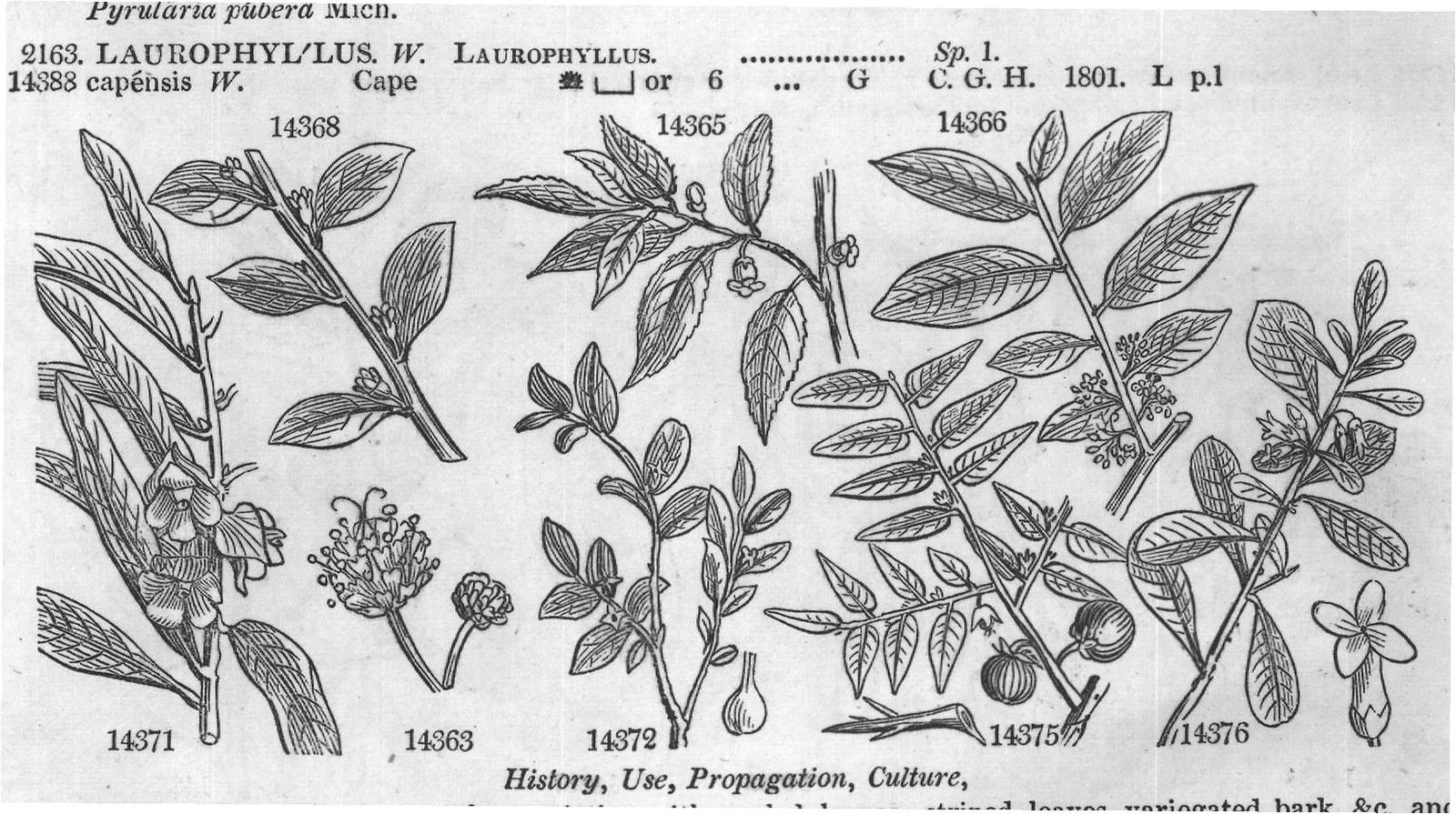
POLYGAMIA DIŒCIA. 14356 Leaves simple blistered ovate coarsely serrated dark-green quite smooth 14357 Leafl. ovate subsessile acute mucronate serrate smooth cuneate at base 14358 Leafl, oblong stalked acute at each end mucronate serrated smooth 14359 Leaves unequally pinnated of 3 pair, Leaflets stalked lanceolate acuminate serrated silvery 14360 Leafl. sessile ovate lanc. serrated rugose-shining rounded at base unequal, Axils of veins villous beneath 14361 Lvs. of 3 pairs smooth, Leafl. obl. acum. tooth Com. petiole winged at base, Branches ciner. Buds blackish 14362 Leaflets subsessile lanc. acuminate serrated smooth, Fruit lanc, narrowed at each end with a long point 14363 Leaves ovate lanc. evergreen, Catkins globose stalked twin axillary, Fruit coated 14364 Leaves lanceolate-ovate acuminate, Catkins subsessile ovate axillary twin, Fruit soft 14365 Leaves obl. acuminate downy beneath, Buds hairy inside 14366 Leaves ovate bluntish shining smooth netted with veins, Petioles downy, Buds smooth 14367 Leaves obl. acute downy beneath, Petioles long, Fruit few-seeded 14368 Lvs. obl. acute at base and end smooth on each side, Fl, trigynous erect, Hermaphrodite cor. as long as cal. 14369 Leaves ovate-lanc. acuminate, Buds hairy 14370 Leaves ovate-elliptical acuminate acute at base downy beneath, Branches downy 14371 Leaves lanc, oblong, Flowers axillary polyandrous, Berry 8-seeded 14372 Lvs. simple fleshy nerveless cover. on each side with scatter. stell. scales, Sterile obl.-lanc. Fert. lin.-lanc. 14373 Leaves oblong acute rounded at base acute at end: smooth above; silky and glaucous beneath 14374 Leaves oblong rounded at base acute at end smooth on each side 14375 Spiny, Leaves oblong acuminate cordate downy beneath 14376 Leaves obovate blunt smooth on each side 14377 Leaves obovate elliptical acute serrated at end, Pedunc. umbelled axillary, Stamens exserted 14378 Leaves obovate retuse toothletted, Flowers axillary clustered, Stamens included 14379 Leaves ellipt. Corymbs axillary aggregate 14380 Leaves oblong lanc. subcoriaceous entire, Flowers axillary clustered 14381 Leaves oblong entire acute at each end, Petiole middle rib and edge villous, Female peduncles about 3-fl. 14382 Leaves ovate-oblong entire acute at each end smooth , Female peduncles 2-flowered 14383 Leaves cordate ovate slightly serrated glaucous beneath, Flowers in globose heads, Drupes oblong 14384 Leaves on long stalks obl. acuminate remotely serrate downy beneath, Female peduncles 1-flowered 14385 Leaves on short stalks obl. nearly entire cuneate at base whitish beneath, Female peduncle 1-fl. 14386 Leaves on long stalks obl. acuminate remotely serrated smooth on both sides, Female pedunc. 1-fi. 14387 Leaves oval-oblong acuminate entire 14388 Leaves stalked oblong acute serrated coriaceous veiny smooth 14377 14388 14378 14380 14382 14386 14385 and Miscellaneous Particulars. cherry, yellow when ripe, sweet, and somewhat astringent; they are recommended as a cure for the diarrhœa. D. virginiana has a white brittle wood, covered with a dark brown bark. The fruit is in form and bigness like a date, very firm, like that fruit, and almost as sweet , with a large kernel. 2160. Myrsine. A Greek word synonymous with Myrtle. Modern botanists have applied the name to a genus of African myrtle-like shrubs. The species grow freely in loam and peat, and are increased by young cuttings in sand under a hand-glass. of African myrtle-like shrubs. The species grow freely in loam and peat, and are increased by young cuttings in sand under a hand-glass. 2161. Nyssa. A name of a nymph, according to Linnæus. The species are large shrubs, which grow freely in any soil or situation, but prefer moisture. N. denticulata grows naturally in wet swamps in Carolina grow and any soil or situation, but prefer moisture. N. denticulata grows naturally in wet swamps in Carolina and Florida, and rises there to the height of eighty or hundred feet. Marshall, in his American Grove, describes it as a tree of great singularity and beauty. It produces fruit about the size and shape of small olives, which are preserved like them by the French inhabitants of the Mississipi, where it greatly abounds, and is called the olive-tree. The timber is white and soft when unseasoned, but light and compact when dry, which renders it very proper for the carver and turner. All the species are readily propagated by layers or seeds. 2162. Hamiltonia. Dedicated by Muhlenburg, to Mr. Hamilton, an American botanist. A shrub growing to height of from three to six feet. The flowers grow in terminal racemes from an inch to an inch and a half long. the height of from three to six feet. The flowers grow in terminal racemes from an inch to an inch and a half long. 2163. Laurophyllus. An hybrid name created by Thunberg, to express the resemblance of the leaves, φuλλa, to a laurel. A shrub with stalked, oblong, acute, serrated, coriaceous leaves, and minute flowers growing in panicles three or four inches long. a laurel. A shrub with stalked, oblong, acute, serrated, coriaceous leaves, and minute flowers growing in panicles three or four inches long. 3 K 4 2164. BURSE/RA. W.
BURSERA. 14389 gummífera W.
Jamaica 오 or 20 2165. ARCTOPUS. W.
ARCTOPUS. 14390 echinátus W. rough POLYGAMIA DICÆCIA.
Terebintaceæ. Sp. 1.
W.G W. Indies 1690. S p.l Umbelliferæ. Sp. 1. 1 my.jn G CLASS XXIII.
Jac. amer. t. 65 2166. PA'NAX. W.
PANAX.
Araliacee. 14391 quinquefólium W. Ginseng 14392 trifólium W. lesser pr Apr 1 jn L.Y my.jn G 14393 aculeátum W. prickly m 1½ n G C. G. H. 1774. D p.1 Sp. 4-16.
N. Amer. 1740. D s.p N. Amer. 1759. D s.p China Bot. reg. 705 14394 fruticósum W. shrubby pr 6 au.s G 1773. C. s.p Ternate 1800. R r.m Bot. mag. 1333 Bot. mag. 1334 Jac. ic. 3. t. 634 Bot. rep. 595 2167. FICUS. W.
FIG TREE.
Urticeæ. Sp. 47-143. 14395 Cárica W. common fr 15 jn.jl Ap S. Europe 1548. C co Tre. ehret. t.73,4 14396 rubrinérvia Link. red-nerved or 10 ...
Ap Brazil 1824. C co 14397 aquática W. rough-leaved or 10 ...
Ap E. Indies 1758. Cl.p Rhee.mal.3. t.62 14398 nymphæifólia W.
Water-lily-lvd. or 10 ...
Ap E. Indies 1759. C p.1 14399 crassinérvia W. 14400 religiósa W. thick-nerved or 10 ...
Ap S. Amer. 1823. C p.l Poplar-leaved ec 25 ...
Ap E. Indies 1731. C p.1 Rhee.mal.1. t.27 14401 benghalénsis W.
Bengal or 25 ap Ap E. Indies 1690. C p.l Rhee.mal.1. t.28 14402 venósa W. vein-leaved or 10 ...
Ap E. Indies 1763. C p.1 W.ho.ber.1. t. 36 14403 Bras sii Sabine Brass's or 20 ...
Ap S. Leone 1822. C p.l 14404 coriácea W. leathery-leaved or 10 ...
Ap E. Indies 1772. C p.1 14405 lasiophýlla Link. 14406 costáta W. woolly-leaved or 10 ...
Ap 1820. C p.1 ...... rib-leaved or 10 ...
Ap E. Indies 1763. C p.l 14407 lúcida W. shining-leaved or 10 ...
Ap E. Indies 1772. C p.l 14408 oblongata Link. oblong-leaved or 6 ...
Ap C. G. H. 1825. C p.l 14409 martinicénsis W. round-fruited or 10 ...
Ap W. Indies 1759. C p.1 Sloa.jam. 2. t. 223 14410 infectória W. veiny or 15 ...
Ap E. Indies 1763. C p.l Rhee.mal.3. t.64 14411 superstitiósa Link. superstitious or 6 ...
Ap 1763. C p.1 ...... 14412 pedunculáta W.
Willow-leaved or 6 ...
Ap S. Amer. 1776. C p.1 Pluk.al. t.178.f.4 14413 ulmifólia IV. elm-leaved or 4 ...
Ap Phillipin. 1813. C p.l 14414 cordáta W. heart-leaved or 6 ...
Ap C. G. H. 1802. C p.l Thunb.diss.c.ic. 14415 macrophýlla P.S. large-leaved 14416 obtusáta Link. or 14 ...
N. Holl. Ap ...
C p.l blunt or 4 ...
Ap 1821. C p.l 14417 Mun'tia Link. doubtful or 4 ...
Ap N. Holl. 1822. C p.l 14418 austrális W. ferruginous or 6 mr.jn Ap N. S. W. 1789. C p.l Ven.malm. t.114 14419 elástica Rox.
Elastic-gum 오or 20 ...
Ap E. Indies 1815. C p.1 14420 microcárpa Vahl. small-fruitedor 20 ...
Ap Guinea 1819. C p.l 14421 ciliolósa Link. ciliated or 4 ....
Ap 1823. C p.l 14422 stipuláta W. trailing or ...
Ap China 1771. C p.l 14423 púmila W. dwarf உட 1 or ...
Ap China 1759. C p.1 Kæm.ame.t.804 14424 tinctória W.
Otaheite 오 or 15 my.jn Ap Society I. 1793. C p.l 14425 brasiliensis Link.
Brazilian or 4 ...
Ap Brazil 1823. C p.l 14426 benjámina W. oval-leaved 오 or 10 ...
Ap E. Indies 1757. C p.l Rhee.mal. 1. t.26 14427 Lichtensteínii Link.
Lichtenstein's or 3 ...
Ap C. G. H. 1824. C p.l 14428 pertúsa W.
Laurel-leaved or 8 Ap S. Amer. 1780. C p.l ... 14429 nítida W. glossy-leaved or 6 mr.jn Ap E. Indies 1786. C p.l Hook. ex. fl. 111 14430 índica W.
Banyan Tree or 30 ...
Ap E. Indies 1759. C p.1 Khee.mal. 3. t.63 14431 popul'nea W. poplar-leaved or 12 ...
Ap S. Amer. 1812. C p.1 14432 lævigáta Vahl. polished or 6 ...
Ap W. Indies 1823. C p.l 14433 racemósa W. clustered or 4 ...
Ap E. Indies 1753. C p.l Rhee.mal. 1. t. 25 14434 retúsa W. blunt-leaved or 2 ...
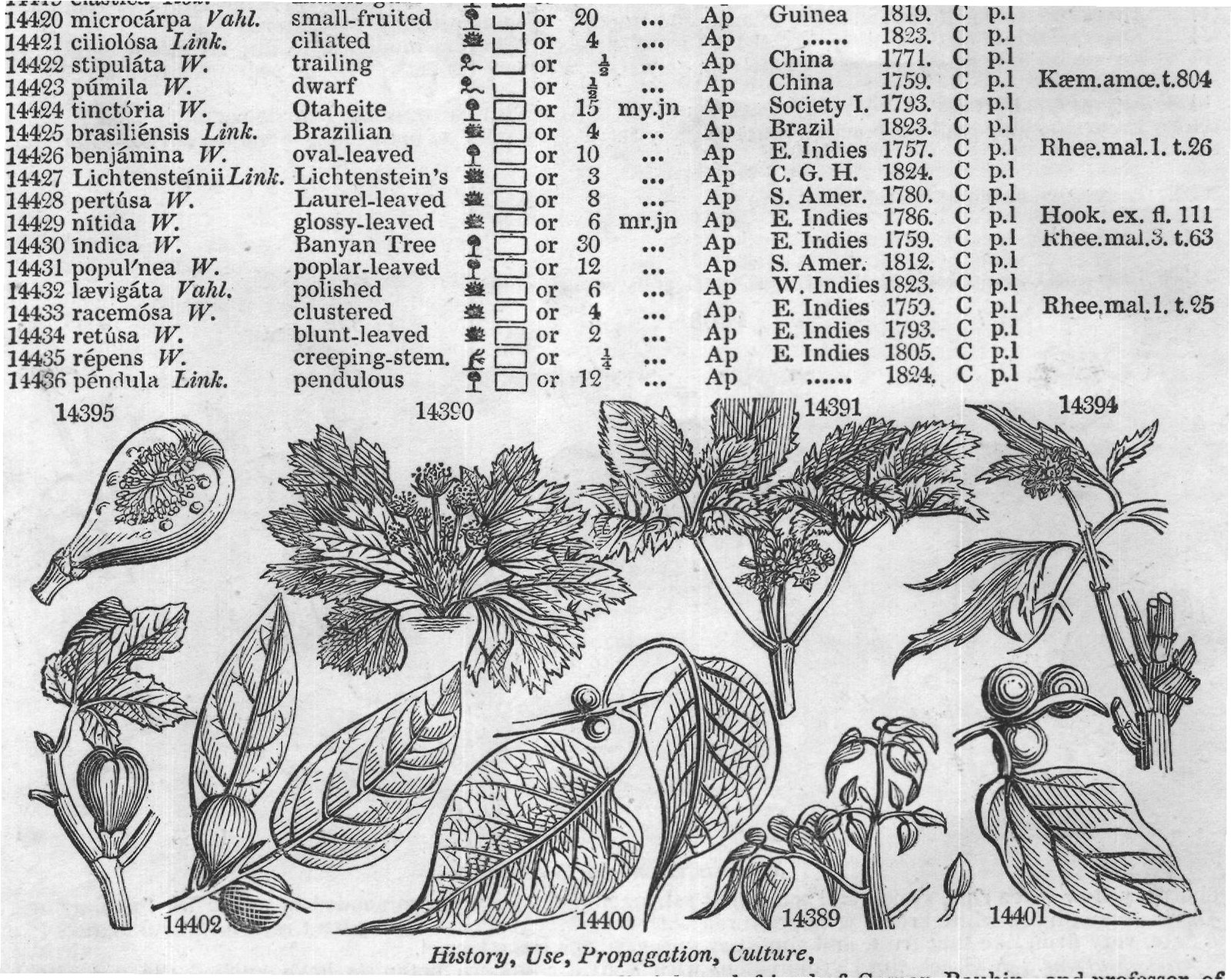
Ap E. Indies 1793. C p.l 14435 répens W. creeping-stem. E or 4 Ap E. Indies 1805. C p.l 14436 péndula Link. pendulous 오 or 12 Ap ...... 1824. C p.l 14395 14390 14391 14394 14402 14400 14389 14401 History, Use, Propagation, Culture, 2164. Bursera. So called after Joachim Burser, a disciple and friend of Caspar Bauhin, and professor of botany at Sara, in Naples. He is said to have left behind him an Herbarium, in twenty-five volumes. B. gummifera is a large tree with a fine leafy head, and abounds in copious watery balsamic fluid, which soon becomes inspissated by exposure to the air. The root is said to possess the same properties as Quassia. Hedges are made of it by the Spanish residents in South America, who call it Almacigo. 2165. Arctopus. Literally, bear's foot, aρκτε πες. An inconspicuous prickly umbelliferous plant. The roots are used with success at the Cape, in cases of siphilis; but upon trial here some years since, they were found to be less efficient than Sarsaparilla. 2166. Paпax. A high-sounding title, meaning little less than that the plant which bears it is the long sought universal elixir; the name has been taken from πav, and aκoς, a remedy; a remedy for all things. P. quinquefolium is a native of Chinese Tartary, and also of North America. In the former country it has been gathered as an invaluable drug from time immemorial. The roots, which are said to bear some resemblance to the human form, are gathered and dried, and enter into almost every medicine used by the Tartars and Chinese. Osbeck says, that he never looked into the apothecaries' shops, but they were always selling Ginseng, that both poor people and those of the highest rank made use of it, and that they boil half an ounce in their ORDER II.
POLYGAMIA DIECIA. 14389 Racemes axillary, Leaves pinnated with an odd one, Leaflets ovate acute 14390 Leaves prickly with stellate spines 14391 Stem herbaceous, Leaves ternate or quinate, Leafl. ovate acuminate serrated 14392 Stem herbaceous, Leaves ternate or quinate, Leafl. oblong lanc. serrated 14393 Leaves ternate: the upper near the flowers clustered simple, Petioles and branches prickly 14394 Leaves supradecompound toothed-ciliated, Stem shrubby 14395 Leaves cordate 3-5-lobed repand-toothed: lobes blunt rough above downy beneath 14396 Leaves ovate with a short point netted beneath very smooth 14397 Leaves oblong 3-lobed and sinuated entire rough on each side 14398 Leaves cordate roundish mucronate entire glabrous glaucous beneath 14399 Leaves ovate oblong entire acute blunt at base smooth 14400 Leaves subcordate ovate with very long points 14401 Leaves ovate entire very blunt rounded at base subcordate 5-nerved 14402 Leaves oblong ovate entire acute subcordate at base impressed with dots on the upper surface 14403 Leaves oblong pointed smooth on both sides widely toothed, Branches covered with brown hairs 14404 Leaves oblong smooth narrowed at base cordate coriaceous, Veins immersed 14405 Leaves ovate blunt soft with down beneath 14406 Leaves ovate-cordate with a deep narrow sinus quite entire smooth acute green on each side 14407 Leaves ovate-cordate entire smooth blunt 3-nerved at base, Branches erect 14408 Leaves cordate oblong with a short point obtuse smooth with parallel nerves 14409 Leaves oblong-lanc. entire narrowed and acute at end rounded at base with white dots above 14410 Leaves obl. quite entire narrowed and acute at end rounded and subcord. at base: with punctures above 14411 Leaves ovate tapered at the base with a long point 14412 Leaves ovate-obl. entire acuminate blunt obsoletely cordate at base 14413 Leaves ovate unequal-sided toothed acuminate rough on each side 14414 Leaves ovate-lanc. entire slightly cordate at base 14415 Leaves cordate oblong entire nerved shining 14416 Leaves ovate-oblong bluntly serrate crenate hairy on each side 14417 Leaves oval acute serrated rough above soft beneath 14418 Leaves ellipt. entire rounded at each end smooth: young ones rusty with down beneath 14419 Leaves smooth elliptical entire shining very large 14420 Leaves oblong ovate blunt smooth, Fruit twin globose sessile 14421 Leaves oblong acuminate blunt tapered at base netted beneath, Stipules scarious 14422 Leaves ovate blunt entire cordate unequal at base, Stipules membranous twin persistent, Stem creeping 14423 Leaves ovate bluntish entire netted beneath 14424 Leaves obliquely ovate blunt 14425 Leaves broad lanc. with a short point tapered at base shining very smooth netted beneath 14426 Lvs. ellipt. obl. ent. narrow. at base bluntly acum. at end with fine parallel veins; dotted with white above 14427 Leaves cordate lanc. repand toothed obtuse downy beneath 14428 Leaves obl. acuminate entire narrowed at base about 3-nerved with parallel veins 14429 Leaves obovate entire with very short points and fine parallel veins shining smooth 14430 Leaves ovate acuminate entire acute at base 14431 Leaves obl. with short points entire smooth 14432 Leaves cordate ovate acuminate veiny very smooth, Fruit stalked globose smooth 14433 Leaves oblong-lanc. acute quite entire somewhat narrowed at base 3-nerved veiny dotted beneath 14434 Leaves obovate entire blunt smooth, Branchlets furrowed 14435 Leaves cordate ovate acute serrated unequal at base scabrous above hairy beneath, Stem creeping 14436 Leaves oblong acuminate tapered at base, Branches pendulous 14409 14412 14439 14410 14429 14430 14433 and Miscellaneous Particulars. 14426 tea or soup every morning, as a remedy for consumption and other diseases. Jartoux relates, that the most eminent physicians of China have written volumes on the medicinal powers of this plant, asserting that it gives immediate relief in extreme fatigue, either of body or mind, that it dissolves pituitous humours, and renders respiration easy, strengthens the stomach, promotes appetite, stops vomiting, removes hysterical, hypochondriacal, and all nervous affections, giving a vigorous tone of body even in extreme old age. The French in Canada use this root for curing the asthma, and as a stomachic. After all, our physicians say, that we have no proofs of the efficacy of Ginseng in Europe, and that from its sensible qualities it seems to possess very little power as a medicine. The hardy species thrive well in light rich soil; the others grow in loam and peat, and are increased by cuttings in sand under a hand-glass 2167. Ficus. It is not known what the derivation of this word is; but in most languages it is nearly the same. In Greek it is σuχη, in Latin Ficus, in Celtic Figuezen, in Teutonic feige, in Sclavonic fige, in Hungarian fuge, in Anglo-Saxon fic. The species are trees or shrubs, abounding in a milky juice, The fruit is turbinate, fleshy, soft, and hollow within. All the species are natives of warm countries. F. Carica, le figuier, Fr., Feigenbaum, Ger, and Fico, Ital., is supposed to be originally from Caria, in Asia, though it is now acclimatized, and in some respects naturalized in the Levant and POLYGAMIA DIJECIA.
CLASS XXIII. 14437 myrtifólia Link.
Myrtle-leaved or Ap 1824. C p.l 14438 áspera W. rough-leaved or 3 mr.jn Ap N. Holl. 1807. C p.1 14439 oppositifólia W. opposite-leaved or Ap E. Indies 1802. C p.1 Roxb.cor.2.t.124 scábra P. S. 14440 arbutifólia Link.
Arbutus-leav'd or 3 Ap 1825. C p.l 14441 capénsis W.
Cape or 4 ...
Ap C. G. H. 1816. C p.1 History, Use, Propagation, Culture, the south of Europe. In these countries the fruit green and dried forms an important part of the food of the inhabitants. In this country it is cultivated as a fruit tree, but not generally or extensively. It is only in very warm situations that it will ripen its fruit in the open air, even though trained against a wall; though there are one or two exceptions in Sussex on the sea-coast, where it ripens its fruit on standards. The only certain mode, however, is to grow it in houses built on purpose. No tree is more robust or more prolific. Even plants in pots or tubs kept in a temperature adapted for the orange-tree will fruit freely, and ripen two crops a year. Kept in the temperature of the pine-apple, Mr. Knight has proved, that the fig will go on growing and ripening fruit without intermission. A variety of curious and important matter respecting this tree will be found in the Transactions of the Horticultural Society, and in the Encylo- CLASS XXIV. - CRYPTOGAMIA.
Sexual organs hidden; either imperfect, or not existing. THIS class differs essentially from all the preceding in the peculiar conformation of the organs of reproduction, which are not formed of male and female parts, like those of the higher classes of plants, but are of a nature altogether different, consisting either of buds under a particular form, or of vessels containing vegetable substances analogous to seeds, but differing in not being the result of impregnation, and in having the power of striking root indifferently from any point of their surface. The internal composition of these vegetable substances, which are denominated sporules, is, on account of their extreme minuteness, unknown. Willdenow describes Cryptogamous plants to be vegetables without any visible flower, and differing from other plants in their external characters, in which respect they also differ from each other. By more modern botanists they are said to be distinguished from other plants by the absence of lymphatic vessels, and of pores of the epidermis; but the latter character has been disputed, and neither apply to the three first orders of Cryptogamia. For the purposes of this work, which follows the system of Linnæus, the definition, if it can be so called, of Willdenow is most applicable. In the arrangement of the orders of Cryptogamia, it has been found advisable to adhere to the divisions of modern writers, who, by extensive observations, and great powers of perception, have brought this most abstruse part of botany to a considerable degree of perfection. The orders which are here adopted, are I. FILICES. Reproductive organs uniform. Thecæ naked, or covered by an involucre, placed on the back of a frond, which is either foliaceous, or contracted in such a way as only to cover the clusters of thecæ, and always circinate when young.
II. EQUISETACEE. Reproductive organs uniform, in terminal spikes, composed of peltate, several-sided scales, producing on their under surface 4-7 elongated involucres containing the seeds. Branches whorled, rigid. III. LYCOPODINEÆ. Reproductive organs axillary, sometimes apparently spiked. Thecæ? of two kinds, the one containing granules, the other larger bodies. Stems covered with many small leaves. IV. MARSILEACEÆ. Reproductive organs radical, uniform. Sporules? contained in roundish, one or manycelled indehiscent heads. Plants simple, aquatic. V. MUSCI. Reproductive organs of two kinds. Thecæ many-seeded, solitary, furnished with an operculum and columella. Plants leafy.
VI. HEPATICE. Reproductive organs of two kinds. 1st. Thecæ without an operculum, either naked or sessile, or furnished with a veil, through which they are, more or less, protruded. Sporules naked, or mixed with spiral threads. 2d. Minute, roundish, or oblong bodies variously situated. Plants frondose, of a cellular structure, not submersed.
VII. ALGÆ. Reproductive organs of two kinds. 1st. Thecæ or tubercles variously situated. 2d. Sporules or granules naked, or immersed in the frond. Plants always aquatic, and submersed. VIII. LICHENES. Reproductive organs uniform. Sporules deposited in receptacles of various forms, distinct in substance from the thallus, which is either pulverulent, crustaceous, membranous, foliaceous, or branched and shrub-like.
IX. FUNGI. Reproductive organs uniform. Sporules arranged in tubular cells, placed in some part of the external surface. Substance various, mostly thick and fleshy, sometimes vesicular. Thallus none. A few other divisions, such as Hypoxyla, &c., which have been proposed by some writers of authority, nct having appeared to possess characters of sufficient importance, are here merged in others. In consequence of the wide difference which exists between the lower orders of vegetables and the higher, and the impossibility of subjecting the former to cultivation, it has been found requisite, with the exception ORDER II.
POLYGAMIA DIECIA. 14437 Leaves oblong acute subcordate at base netted beneath 14438 Leaves ovate unequal-sided sinuate-toothed cordate at base rough on each side 14439 Leaves opp. obovate oblong serrated acute scabrous above hairy beneath 14440 Leaves oblong acuminate blunt tapered at base netted beneath, Stipules scarious smooth 14441 Leaves ovate-oblong acute sinuate toothed smooth and Miscellaneous Particulars. pædia of Gardening. (§ 4839.) F. elastica as well as some other plants produce the gum known as Indiarubber. F. indica is an immense tree, spreading very wide, the branches ash-colored, and throwing down roots into the soil. Marsden mentions one of these growing near Memgee, twenty miles west of Patna, in Bengal, which was in diameter 370 feet; the circumference of the shadow at noon was 1116 feet, and there were fifty or sixty stems. It is called the priest's tree, and held in so much veneration by the Gentoos, that if any one cuts or Lops off a branch, he is looked upon with as great abhorrence as if he had broken a cow's leg. F. religiosa is so called, because it is sacred to the idol Vishnu. The horizontal branches root into the soil like the other; all the species are of remarkably easy culture, and root easily from large cuttings. of Filices and their nearest allies, to introduce some alterations into the form of the pages of this work. These alterations commence with Musci.
The orders of Cryptogamia being equal in importance to the classes of flowering plants, they will be treated of as the classes have hitherto been treated. Each order will, therefore, stand by itself, and will have its genera and species arranged under it, without immediate connection with any other order. d C C Order 1. b FILICES. a Reproductive organs uniform. Thecæ naked, or having an involucre placed on the back of a frond, which is either foliaceous , or contracted so as only to cover the clusters of thecæ, and always circinate when young. This is the most beautiful of all the orders of Cryptogamic plants, and has always been a favorite tribe, to which the most celebrated botanists of all modern times have given their attention. Till some time, however, the most celebrated botanists of all modern times have given their attention. Till some time, however, after the death of Linnæus, ferns shared the fate of all other departments of botany, being viewed rather as objects of elegant form than of scientific examination. Sir James Edward Smith was the first author who attempted to distribute them into genera, by characters derived from a minute inspection of their organs of reproduction; and his arrangement, however imperfect it may now be considered, is certainly that upon the principles of which the more precise divisions of recent authors have been effected. He was succeeded by Swartz, Willdenow, Brown, and many others, and lastly by Dr. George Frederick Kaulfuss, Professor of Botany at Halle, whose arrangement of 1824 is chiefly here adopted as being the most recent which has been published.
The principal distinction which exists between ferns and other orders of Cryptogamous plants is found in the situation of what are called their sori, or patches of reproductive organs, which are in all cases inserted upon of what are called their sori, or patches of reproductive organs, which are in all cases inserted upon the back surface of the leaf, or, as it is called in ferns, the frond, sometimes appearing only in the form of little spots, sometimes covering the whole of the under side of the frond, and sometimes contracting the substance of the frond , so as to give it the appearance of a single mass of fructification, bursting in a determinate manner, as in Ophioglossum, Schizæa, &c. Besides this character, the fronds are always rolled up in a circinate manner when they are first developed.
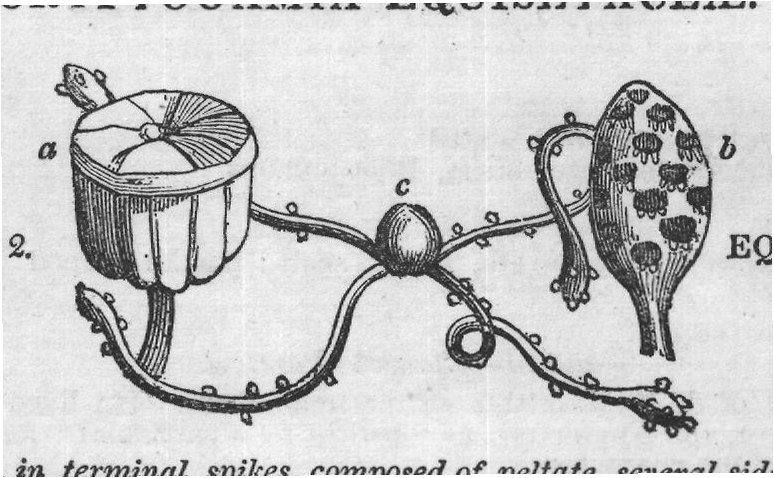
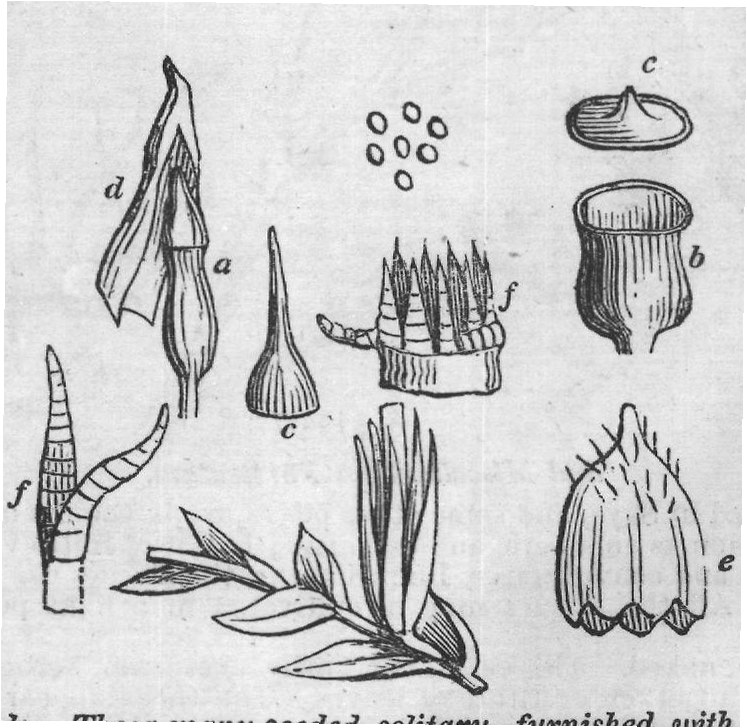
That part of the frond which occupies the place of the petiole of a compound leaf is called the rachis. The groups of thecæ forming the organs of reproduction are called sori (a), which are either naked or covered with an involucrum, or, as it is more frequently termed, indusium. (b) This latter organ, when present, either bursts outwardly towards the margin of the frond, or inwardly towards the midrib or rachis. It may also be either single or double; the latter term signifying, that there is a cover on each side the sorus. The bodies which are called thecæ by some authors, and capsules by others, are constructed in two ways; they are either surrounded CRYPTOGAMIA.
CLASS XXIV. by an elastic furrowed ring, when they are called Annulate (c), or they are destitute of such a ring, in which case they are termed Exannulatæ (d). They contain the minute powdery matter, which is that by which ferns are reproduced; the constituent parts of this matter are called sporules (e), and are analogous to seeds in more perfect plants.
TRIBE I.
POLYPODIACEE.
Thecæ 1-celled, with an articulated, elastical, longitudinal ring, bursting across in an irregular manner. 2168. Polybotrya. Thecæ closely covering the whole surface of the pinnules of an altered frond. Indusium none. 2169. Acrostichum. Thecæ scattered, occupying all the lower surface of the frond, or a part of it. Indusium none. 2170. Hemionitis. Thecæ seated on the reticulated veins of the frond. 2171. Gymnogramma. Thecæ seated on the forked veins of the frond. Indusium none. 2172. Meniscium. Sori linear, lunulate, somewhat parallel, placed across the spaces between the veins of the fronds. Indusium none. 2173. Xiphopteris. Sori oblong, oblique, placed on the reflexed points of the frond. Indusium none. 2174. Ceterach. Sori linear, transverse, concealed under paleæ. Indusium none. 2175. Polypodium. Sori in little round scattered convex spots. Indusium none. 2176. Tænitis. Sorus linear, longitudinal, placed between the midrib and margin of the frond under the end. Indusium none. 2177. Nothochlæna. Sori almost marginal, continuous, covered by the scales, setæ, or hairs of the frond. Indusium none. 2178. Onoclea. Sori globose, inserted upon columnar receptacles, inclosed within the berry-like pinnules. Indusium double: common placed on the edge of the pinnule, and united into the form of a berry; proper membranous enwrapping the sori. 2179. Struthiopteris. Sori linear, crossing, inserted upon crested receptacles, included in a double row within the somewhat articulated pinnæ. Indusium double: common marginal opening inwards in a rugged manner; proper membranous, and resembling a partition. 2180. Allosorus. Sori placed on the transverse forked veins of spike-like pinnules, finally becoming confluent. Common indusium very narrow, arising from the revolute margin which is rolled inwards. 2181. Ellebocarpus. Thecæ globose, irregularly attached to the longitudinal veins of the frond. Indusium transparent, discolored, arising from the revolute edge of the frond, continuous, and opening by a longitudinal suture. 2182. Lomaria. Sori linear, continuous, occupying the surface of the linear pinnæ of a particular frond. Indusium marginal or submarginal, conniving, involute. 2183. Blechnum. Sori linear, continuous, (sometimes interrupted) contiguous to the midrib. Indusium membranous, superficial, continuous, opening inwards. 2184. Woodwardia. Sori oblong, distinct, in rows, parallel, contiguous to the midrib. Indusium membranous, superficial, vaulted, opening inwards. 2185. Doodia. Sori lunulate, distinct, parallel with the midrib. Indusium membranous, superficial, flat, separating inwardly. 2186. Asplenium. Soli linear, placed upon lateral veins. Indusium membranous, flat, separating inwardly. 2187. Allantodia. Sori oblong, oblique with respect to the midrib. Indusium membranous, vaulted, cylindrical, adhering to a vein, opening inwards, finally spreading outwards. 2188. Scolopendrium. Sori linear, oblique, opposite, double, parallel. Indusia membranous, opening in opposite pairs. 2189. Diplazium. Sori linear, double alongside the veins. Indusia double, narrow, placed between the sori, fixed lengthwise by the middle, with their exterior margin separate. 2190. Pteris. Sori continuous, linear, marginal. Indusium from the inflexed edge of the frond, opening inwards.
POLYPODIACEE.
Sp. 1-17. ap.my Br Jamaica 1823. Dl.p Petiv.fil. t. 8. f. 3 2168. POLYBOTRYA. H. & B. POLYBOTRYA. 14442 cervína Kaulf. hart's-tongue or History, Use, Propagation, Culture, 2168. Polybotrya. So called in allusion to the numerous bunches of the fertile divisions of its frond; from πoλuς, many, and βoτεuς, a bunch. Handsome species of West Indian and South American ferns. The genera of ferns are not very dissimilar in habit, so that it will be seldom that any remarks upon that subject will be found in these notes, which must necessarily consist chiefly of the etymology of the names. The medical properties are probably the same in all the genera; such as appear of any consequence are, however, inserted in the proper places. We will here take occasion to remark, that the cultivation of ferns is nearly the same in all cases, and that the soil best adapted for their growth is light peaty earth with a little loam. They are propagated by division of the roots, or by seeds or sporules. The latter plan has been practised at Liverpool, CLASS XXIV.
CRYPTOGAMIA. 2191. Vittaria. Sori solitary, continuous, linear, marginal or submarginal, immersed. Indusium double, superficial. 2192. Lonchitis. Sori lunate, marginal, placed under the recesses of the frond. Indusium from the margin of the frond, inflexed, opening inwards. the frond, inflexed, opening inwards. 2193. Antrophyum. Sori linear, continuous, immersed in the reticulated veins of the frond. Indusium double, opening in the middle. . 2194. Adiantum. Sori inserted into the indusium, linear, contiguous, or roundish. Indusium marginal, opening inwards, either nearly continuous, or squamiform, or reniform. inwards, either nearly continuous, or squamiform, or reniform. 2195. Cheilanthes. Sori dot-like, separate, marginal in the recess of the indusium. Indusium either reflexed crenules inwards. of the frond, or squamiform, membranous, and arising from the margin, or nearly continuous, opening of the frond, or squamiform, membranous, and arising from the margin, or nearly continuous, opening inwards. 2196. Davallia. Sori roundish, nearly terminal and marginal, distinct. Indusium superficial, attached inwards, and opening outwards. , and opening outwards. 2197. Dicksonia. Sori dot-like, marginal, solitary in the recesses of the frond. Indusia membranous, nearly globose, marginal, adnate, opening unequally with lacerated orifices, and spreading back in all directions. 2198. Balantium. Sori oblong-linear, ear, nearly terminal and marginal, 2198. Balantium. Sori oblong-linear, nearly terminal and marginal, transverse. Indusium coriaceous, reniform, 2-valved, opening outwards: upper valve marginal, patera-shaped; lower nearly flat. , 2-valved, opening outwards: upper valve marginal, patera-shaped; lower nearly flat. 2199. Aspidium. Sori roundish, scattered. Indusium solitary, orbicular, peltate, or reniform. 2200. Woodsia. Sori dotlike, scattered. Indusium membranous, placed under the sori, somewhat paterashaped and ciliated. 2201. Cyathea. Sori globose, scattered, inserted upon an elevated receptacle, which arises from a division of the vein. Indusium spherical, opening in the middle, and finally becoming patera-shaped. vein. Indusium spherical, opening in the middle, and finally becoming patera-shaped. 2202. Trichomanes. Sori marginal, inserted upon a long setaceous receptacle. Indusium erect, campanulate. 2203.
Hymenophyllum. Sori marginal, inserted upon a claviform receptacle. Indusium erect, 2-valved. TRIBE II. OSMUNDACEÆ.
Thecæ without a ring, netted, pellucid, with radiating striæ upon their top, bursting lengthwise on one side. 2204. Todea. Sori oblong, seated upon forked veins of an unchanged frond. Thecæ globose, stalked, netted, opening from their base as high as a pellucid dorsal projection. Indusium none. from their base as high as a pellucid dorsal projection. Indusium none. 2205. Osmunda. Sori nearly globose, alternately arising from the margin of a frond, which becomes changed into a panicle. Thecæ globose, stalked, netted, opening from their base as high as a pellucid dorsal projection. Indusium none. 2206. Lygodium. Thecæ oblong-ovate, striated at the end in a radiate manner, seated in two rows upon 1-sided marginal spikelets, fixed by their backs and opening lengthwise in front. Indusium funnel-shaped, covering up each capsule 2207. Anemia. Thecæ ovate, striated at the top in a radiated manner, disposed in compound unilateral spikes, attached by the base, and opening lengthwise. Indusium none. TRIBE III. OPHIOGLOSSEÆ.
Thecæ 1-celled, adnate at base, roundish, coriaceous, opaque, without a ring, not vascular, sometimes fastened together, half-bivalved. 2208. Botrychium. Thecæ naked, globose, distinct, attached to the rachis of a compound spike, half 2-valved, opening nearly at one side. nearly at one side. 2209. Ophioglossum. Thecæ naked, connate in a distichous jointed spike, half 2-valved, opening at the side . 2210. Marattia. Sori oval, somewhat marginal. Thecæ united in a double row, opening inwards by a cleft. Indusium arched, opening lengthwise above, 2-valved, inclosing on each side a row of theca. arched, opening lengthwise above, 2-valved, inclosing on each side a row of thecæ. POLYPODIACEE. 14442 Ster. fronds pinnat. Pinn. ov. lanc. ent. margin. Fert. fr. bipinn. Pinnæ lin. Pinnul, obl. flatt. runn. together and Miscellaneous Particulars. by Mr. H. Shepherd, with so much success, that his method has been made the subject of a communication to the Horticultural Society, of which the following is an extract. "Having provided a common garden-pot four and a half inches in depth, and three and a half wide, let the bottom part, to the height of one inch, be filled with fragments of broken pots, by way of drain. Over these should be spread a stratum of such soil as is commonly used for potting greenhouse plants, of the depth of two inches; the remaining inch and half should be filled with brown loamy earth sifted through a hair-sieve, the surface being made perfectly smooth, and on this the seeds are to be scattered as evenly as possible. Care must be taken that the wind be not sufthe seeds away, leaving nothing but empty capsules. The seeds being sown, no other covering is CRYPTOGAMIA.
CLASS XXIV. 2169. ACROS TICHUM. L. ACROSTICHUM.
Sp. 5-42. 14443 símplex W. simple or Br 14444 crinítum W. hairy or Br 14445 alcicórne W.
Elk's-horn cu au.o Br 14446 sorbifolium W.
Sorbus-leaved or 1 Br 14447 aúreum L. golden or 4 au Br Jamaica 1793. Dl.p W. Indies 1793. D 1.p N. S. W. 1808. R s.p W. Indies 1793. Dl.p W. Indies 1815. D l.p Bot. cab. 709 Plum. fil. t. 125 Bot. reg. 262-3 Plum. fil. t. 117 Plum. fil. t. 104 2170. HEMIONI TIS. L. HEMIONITIS.
Sp. 1-5. 14448 palmáta L. palmated el jn.au Br W. Indies 1793. D l.p Hook. ex. fl. 33 2171. GYMNOGRAM'MA. Desv. GYMNOGRAMMA.
Sp. 6-26. 14449 pedátum Kaulf. pedate pr jn.jl Br 14450 rúfum Desv. rusty-haired prjn.au Br N. Spain 1822. D l.p Jamaica 1793. D 1.p Sw.syn.fil. t. 1.f.3 Schk. fil. t.17. 21 Hemionitis rúfa W.. 14451 trifoliátum Desv. three-leaved or 1 jl.au Br 14452 sulphúreum Desv. sulphury el 1 jn.jl Br 14453 tartáreum Desv. whitened el 1 au Br Jamaica 1810. Dl.p Jamaica 1808. D 1.p W. Indies 1817. D 1.p Plum. fil. t. 144 Schku. crypt. t.4 Hemionitis dealbata W. 14454 calomélanos Kaulf. mealy el 1 jl.au Br W. Indies 1790. D s.p W. hort. ber. 41 Acrostichum calomelanos W. 2172. MENIS CIUM. Schreb. MENISCIUM. 14455 reticulátum Schr. netted el 2173. XIPHOP'TERIS. Kaulf. SWORD-FERN. 14456 serruláta Kaulf. serrulate pr Sp. 1-6. ap.my Br Sp. 1-2. jn.jl Br Martinico 1793. Dl.p W. Indies 1823. Dl.p Plum. fil. t. 110 Schku. crypt. t.7 Grammitis serrulata W. 2174. CETERACH. W. CETERACH.
Sp. 1-4. 14457 officinárum W. common m my.o Br Britain cal.ro. Dl.p Eng. bot. 1244 2175. POLYPODIUM. L. POLYPODY.
Sp. 27-160. 14458 piloselloídes W.
Mouse-ear or au Br W. Indies 1793.
Dl.p Plum. fil. t. 118 14459 lycopodioídes W.
Club-moss or jl Br W. Indies 1793.
D l.p Schk. fil. t. 8. c.p 14460 phyllitidis W.
Hart's-tongue or 2 jn.s Br W. Indies 1793.
Sk s.p Plum. fil. t. 130 14461 Lingua W. tongue-leaved or 1 my.jl Br China 1817.
D l.p Thunb. jap. t. 38 14462 aúreum W. golden or 3 mr.ap Br W. Indies 1742. Sk s.p Plum. fil. t. 76 14463 vulgáre W. common or 1 my.o Br Britain sha.ba. Dl.p Eng. bot. 1149 ẞ cámbricum Welsh cu 1 my.o Br Britain ...
Dl.p Bolt. fil. t. 2. f.5.a 14464 virginiánum W.
Virginian or 1 jl Br N. Amer. ...
D 1.p Plum. fil. t. 77 14465 pectinátum W. comb-leaved or 1½ jn.s Br W. Indies 1793.
Sk s.p Bot. cab. 748 14466 asplenifólium W.
Spleenwort-lvd. or 2 jl Br Martinico 1790.
Sk s.p Plum. fil.t. 102. A 14467 incánum W. hoary or از Br 14468 Phegópteris W.
Sun-fern or 3 4 jn.jl Br Britain 14469 hexagonópterum W. triangular or I jl Br 14470 pruinátum W. white-leaved or 2 s Br 14471 effúsum W. spreading or 3 n Br 14472 Dryópteris W. tender-branch.or 1 jn.s Br 14473 calcáreum W. rigid-branched or jl Br 14474 crassifólium W. thick-leaved or 3 au.s Br N. Amer. 1811. D l.p moun. D l.p N. Amer. 1811. D 1.p Jamaica 1793. D l.p Jamaica 1769. Sk s.p Britain moi.pl. D l.p Britain cal.ro. D 1.p W. Indies 1823. D 1.p Schk. fil. t. 11. b Eng. bot. 2224 Pluk.al. t.284.f.2 Slo.jam.1.t.57.f.3 Eng. bot. 616 Eng. bot. 1525 Plum. fil. t. 123 14445 14448 14455 14442 14443 14454 14451 History, Use, Propagation, Culture, required than a bell-glass, which should just fit within the rim of the pot, so as to exclude all air. The pot is then to be kept in a pan always half full of water, and set in a shady part of the stove or hot-house, being always regularly watered as above directed. When the young plants have acquired their second leaf, it is proper to give them a little air, by placing a small piece of wood under the edge of the glass, at one side. In a short time afterwards the glass may entirely be removed." The vegetation of ferns appears to be less tardy than botanists have supposed. Specimens of Gymnogramma tartareum having been brought from Jamaica to Liverpool, on the tenth of July 1817, a few seeds were brushed off them and sown immediately. Several plants thus obtained perfected seeds by the fifth of August 1818, which being committed to the earth, had produced young plants, covering the surface like a fine moss, by the eighth of September following. Specimens of Pteris cretica, and another marked Pteris acrostichoides, from William Jackson Hooker, Esq., afforded seeds which have vegetated and produced very fine plants of both species. Dr. William Carey sent from Serampore specimens of Polypodium giganteum, and what appears to be a new Diplazium. These reached Liverpool, July the tenth 1818; their seeds being immediately sown, had produced young plants by the eighth of September. A small fern from Sicily, with several others of this tribe, collected in the Brazils by William Swainson, Jun., Esq., afforded ripe seeds, which being sown in the spring of 1818, had partly vegetated, and in September had produced Polypodum decumanum, as well as Gymnogramma calome- Ianos. Mr. Shepherd obtained two plants of the latter from seeds brushed from the specimens in the Herbarium of Dr. John Reinhold Forster, now belonging to the botanic garden at Liverpool, and perhaps fifty years old. He made the experiments on other ferns in that collection, but without success, which, indeed, is not wonderful.
The seeds of this order of plants are of course liable to damage from damp or other accidents, like those of plants in general. It seems, moreover, that they are very soon shed by the bursting of their capsules, so that ORD. I. TRIBE I.
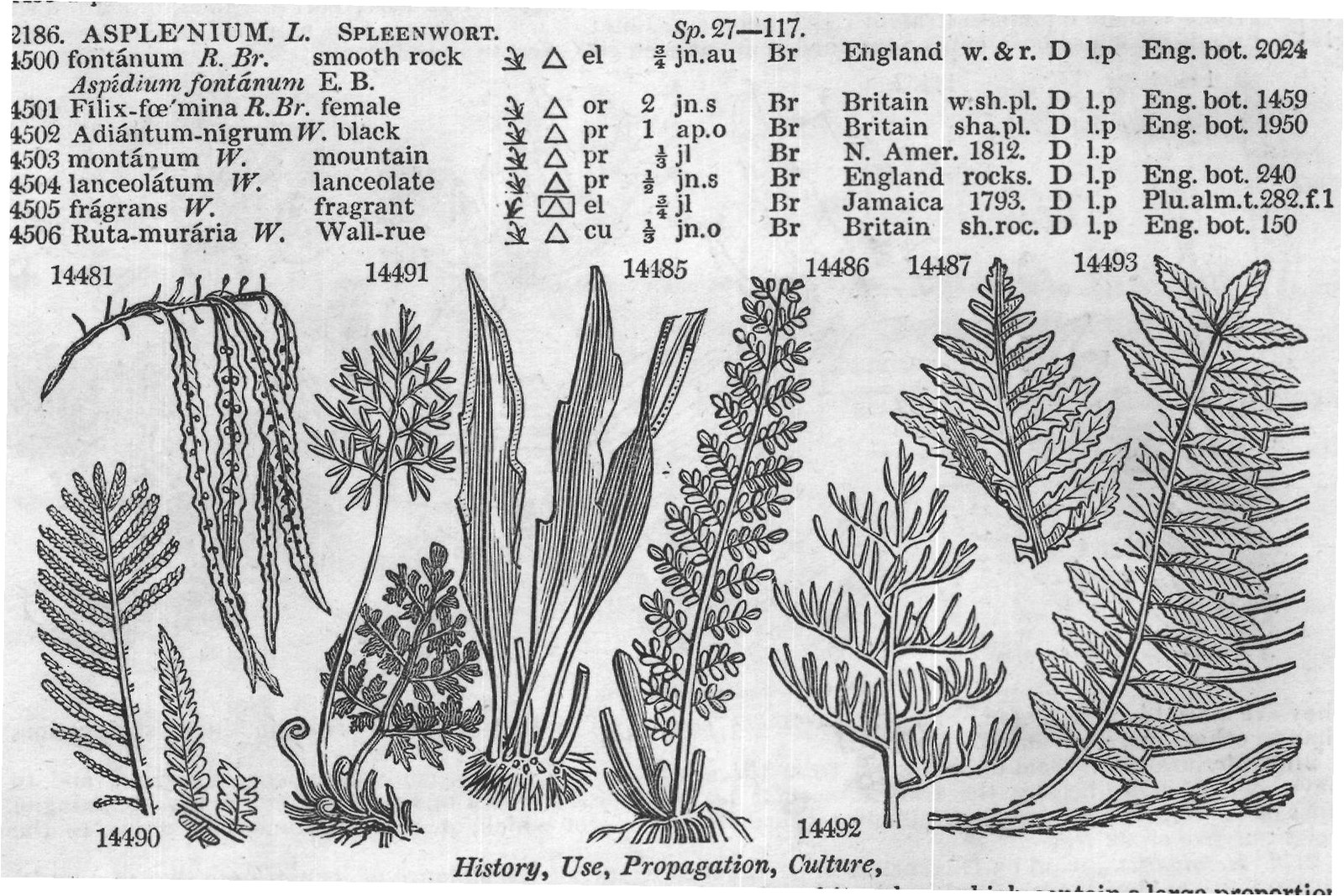
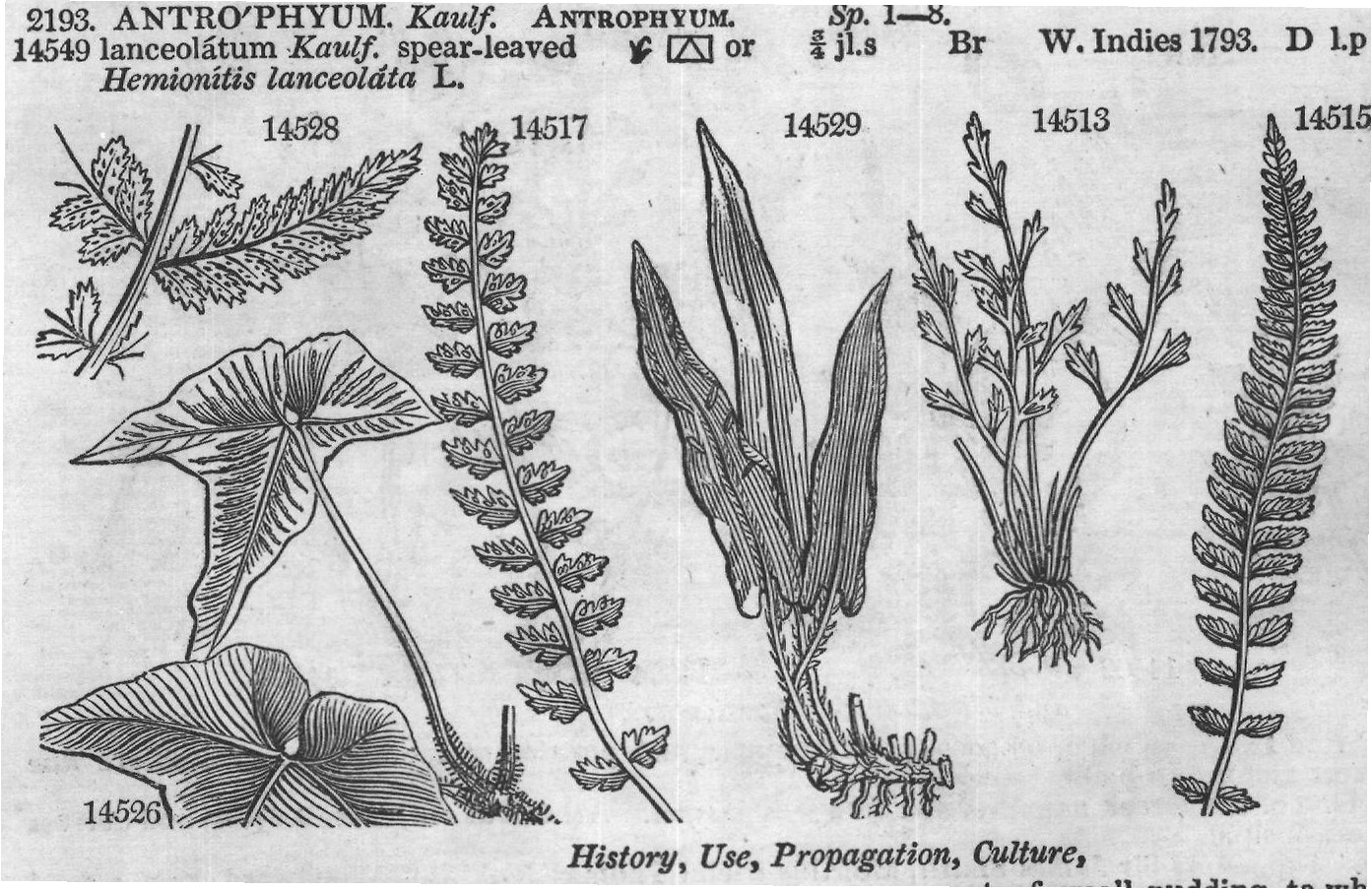
FILICES POLYPODIACEÆ. 14443 Fronds lanceolate tapered each way smooth: fertile linear lanceolate, Stalks very short naked 14444 Fronds elliptical obtuse at each end hairy villous at the edges, Stalk villous 14445 Ster. fronds renif. somew, lobed entire horizontal: fert. erect palmate dichotom. bearing fr. on lanc. segm. 14446 Fronds pinnated: pinn. lanc. acumin. serr. cuneate at base, Fert. pinn.: pinn. linear entire, Stem climbing 14447 Fronds pinnated: pinn. altern. obl. lanceolate ent. cuneate and equal at base, all acum.: the upper fertile 14448 Fronds cordate 5-lobed toothed ciliated, Stalk long 14449 Fronds pinnate: pinnæ pinnatifid acuminate hairy 14450 Fronds pinnate: pinnæ oblong acutish subcordate subserrate on each side as well as the stalk hairy 14451 Fronds pinnate: pinnæ ternate in pairs and solitary stalked lin. crenul.; fertile yellow with meal beneath 14452 Fronds bipinnate: pinnulæ pinnatifid; segm. cuneate truncate at end toothletted yell. with meal beneath 14453 Fronds bipinnate: upper pinn. confluent obl. obt. serrul.; lower somew . pinnatif. white with meal beneath 14454 Fronds bipinnate: pinn. lanc. white with meal beneath; lower pinnatifid auricled at base, upper confluent 14455 Fronds pinn.: pinn, lanc acuminate cuneate at base all repand: lower opposite, Stem none 14456 Fronds linear toothed when fructifying entire at the end, Stem filiform ascending simple 14457 Fronds pinnatifid: segm. oblong obtuse chaffy with entire paleæ beneath 14458 Fronds hairy: sterile oblong ovate entire; fertile lanceolate, Sori solit. Stem filiform rooting chaffy 14459 Fronds lanceolate entire smooth, Sori solitary, Stem filiform creeping with bristly paleæ 14460 Fronds lanceolate margined acute tapered at base smooth , Sori in two rows 14461 Fronds oblong obtuse entire smooth above rusty with down beneath, Sori contiguous copious 14462 Fronds deeply pinnatifid glaucous: segm. lanc. acuminate entire, Lower sori scattered; upper solitary 14463 Fronds deeply pinnatifid: segm. lin. lanc. blunt crenul. contig.: upper smaller by degrees, Sori solitary 14464 Fronds deeply pinnatifid: segm. lanc. blunt entire contig.; upp. smaller by degrees, Sori solit. Stalk naked 14465 Fronds deeply pinnatifid: segm. lanc. acute entire parallel smooth; upper and lower smallest, Sori solitary 14466 Fronds pinnatifid hairy: segments half ovate blunt, Sori solitary 14467 Fronds deeply pinnatifid: segm altern. lin. ent. obt.; upper smaller by degrees ben, as well as stalk chaffy 14468 Fronds bipinnatif.: 2 lower pinnæ defl.; segm. lin.-lanc. blunt ent. ciliat. Veins hairy, Sori solit. marginal 14469 Fronds downy and ciliated bipinnatifid, Membranes connecting the opposite pinnæ oblong hexagonal 14470 Fronds 4-pinn. Branches and branchlets lanc. Pinnæ lanc. pinnatifid , Segm. ovate acute glaucous beneath 14471 Fronds 3-pinn.: pinnulæ pinnatif.; segm. lin. serrat, acute, Rachis edged naked, Sori solit. Stalk smooth 14472 Fronds ternate bipinnate spreading deflexed: segments blunt nearly entire, Sori marginal, Root filiform 14473 Fronds ternate bipinnate straight rigid: segments bluntish nearly entire, Sori marginal confluent 14474 Fronds oblong smooth entire margined acute at each end, Sori in rows 14456 000 14462 14463 14472 0 0 200 14457 14465 and Miscellaneous Particulars. 14468 they are more likely to be found in such specimens as are just beginning to turn brown in their fructification, than in others more advanced. 2169. Acrostichum. Said to be formed from the words aκρoς σiχoς, the commencement of a verse, and to have been so called because the reverse of their leaves indicates traces of lines, resembling the beginning of lines of poetry. These are fine, chiefly tropical, ferns, one of which, height of five or six feet. are fine, chiefly tropical, ferns, one of which, A. aureum, sometimes grows beginning to the of height of five or six feet. 2170. Hemionitis. Said by Dioscorides to be so called from the resemblance of its nature to that of a mule, ἡμiovoς ; it was always considered sterile, bearing neither flowers nor fruit. 2171. Gymnogramma. Named by Desvaux from γuμvoς, naked, and γρaμμa, writing, in allusion to the disposition of the naked sori upon the forked veins of the frond, whence they seem to resemble Roman letters.
The species have been separated from Hemionitis and Acrostichum. 2172. Meniscium. From μηvη, the moon; the sori are crescent-shaped. These ferns are remarkable for the arrangement of their veins. The little veins which unite the transverse veins of the sterile frond are usually at right angles, and generally united with each other by a little branch which sets off from one or other of their angles. In the fertile fronds the veins on which the sori are placed are either curved or straight. 2173. Xiphopteris. Divided from Grammitis by Kaulfuss, who seems to have named it from ξiφoς, a sword, and πτερuξ, a fern, on account of the sword-like form of their fronds. 2174. Ceterach. The name employed by the Arabian and Persian physicians for this plant was Chetherak. for disorders of the spleen. p. 377.) They employed the plant in obstructions of the viscera, for plant the Was jaundice, Chetherak. and Gazoph. Ling. Pers. p. 377.) They employed the plant in obstructions of the viscera, for the jaundice, and for disorders of the spleen. 2175. Polypodium. From πoλuς, many, and πες πoδoς, a foot, on account of the multitude of the roots which form close entangled patches. Many of the species of this genus are noble plants. entangled patches. Many of the species of this genus are noble plants. multitude They are of mostly the roots epiphytic which CRYPTOGAMIA. 14475 decumánum W. 14476 fraxinifólium W. tall el 5 au Br Brazil ash-leaved el 2 au Br 14477 lanceolátum W. lanceolate or 1 au Br 14478 phymatódes W. red or jn.au Br 14479 quercifólium W. oak-leaved or 1 S Br 2 14480 répens W. creeping pr 2 my.jn Br 14481 sérpens W. gliding pr my.jn Br 14482 tæniósum W. jointed pr 2 my.jn Br 14483 pertúsum bored pr ja.d Br 14484 crenátum W. crenate pr 1 au Br 1818. D 1.p Caraccas 1817. D 1.p W. Indies 1812. Dl.p E. Indies 1823. D 1.p E. Indies 1824. D l.p W. Indies 1810. Dl.p W. Indies 1816. D l.p S. Amer. 1815. D l.p CLASS XXIV.
Jacq. ic. t. 639 Plum. fil. t. 137 Plu. phyt.404.f.5 Rumph. 6. t. 36 Plum. fil. t. 134 Plum. fil. 121 China 1821. D l.p Jamaica 1823. D l.p Hook. ex. fl. 162 2176. TÆNITIS. Swz.
TÆNITIS.
Sp. 1-5. 14485 lanceoláta Kaulf. lanceolate pr 1 au Br 2177. NOTHOCHLÆ/NA. R. Br. NOTHOCHLENA.
Sp. 1-16. 14486 lanuginósa Desv. woolly or au.s Br W. Indies 1818. Dl.p Plum. fil. t. 132 Madeira 1778. R s.p Desf. atl.2. t. 256 Acróstichum vel'leum W. 2178. ONOCLE'A. L.
ONOCLEA.
Sp. 2. 14487 sensíbilis W. sensitive or 1½ au Br Virginia 1799. D 1.p Schk. fil. t. 102 14488 obtusilobáta Schk. obtuse-lobed or 1 jl Br N. Amer. 1812. Dl.p Schk. fil. t. 103 2179. STRUTHIOPTERIS. W. STRUTHIOPTERIS.
Sp. 2. 14489 germánica W.
Russian or 2 jl.au Br Europe 1760. Dl.p Schk. fil. t. 105 14490 pensylvánica W.
Onoclea-like or 2 au Br N. Amer. 1812. Dl.p Schk. fil. t. 111 2180. ALLOSO'RUS. Bernh. ALLOSORUS.
Sp. 1.. 14491 críspus Bernh. curled cu 출 Pteris crispa L. 2181. ELLOBOCAR PUS. Kaulf. POD-FERN. 14492 oleráceus Kaulf. eatable or 2182. LOMA'RIA. W.
LOMARIA. 14493 longifólia Kaulf. long-leaved or 2183. BLECH'NUM. L. BLECHNUM. 14494 boreále W. northern 14495 austrále W.
Cape 14496 occidentále W.
American পসস 334 pr Apr 2184. WOODWAR DIA. Sm. WOODWARDIA.
Sp. 1-20. 2 jn.jl Br Sp. 3-29.
Br jl Br mr.s pr 1 mr.s Br Britain sto. hi. Dl.p Eng. bot. 1160 Tranqueb. 1818. Dl.p Plu.alm.t.215.f.3 W. Indies 1810. D l.p Pl.fil.t.117.dextr hea. Dl.p 1691. R s.p Britain C. G. H.
S. Amer. 1777.
Eng. bot. 1159 Schk. fil. t.110. b Jac. ic. 3. t. 644 jl.au Br Sp. 1-2. 1 au Br Sp. 2-7. 14497 rádicans W. rooting-leaved or s Br 14498 virgínica Ph.
Virginian or 1 au.s Br Madeira 1779. R s.p N. Amer. 1774. D l.p Schk. fil. 1. 112 Plu.alm.t.179.f.2 2185. DOO'DIA. R. Br. DOODIA. 14499 áspera R. Br. rough-stalked pr Sp. 1-3. mr.s Br N. S. W. 1808. R. s.p 2186. ASPLENIUM. L. SPLEENWORT.
Sp. 27-117. 14500 fontánum R. Br. smooth rock el jn.au Br England w. & r. Dl.p Eng. bot. 2024 Aspidium fontánum E. B. 14501 Filix-fœ'mina R. Br. female or 2 jn.s Br 14502 Adiántum-nigrum W. black Apr 1 ap.o Br 14503 montánum W. mountain pr jl Br 14504 lanceolátum W. lanceolate Apr jn.s Br 14505 frágrans W. fragrant el jl Br 14506 Ruta-murária W.
Wall-rue cu jn.o Br Britain w.sh.pl. Dl.p Britain sha.pl. Dl.p N. Amer. 1812. D l.p England rocks. Dl.p Jamaica 1793. Dl.p Britain sh.roc. Dl.p Eng. bot. 1459 Eng. bot. 1950 Eng. bot. 240 Plu.alm.t.282.f.1 Eng. bot. 150 14481 14491 14485 14486 14487 14493 14490 14492 History, Use, Propagation, Culture, upon trees. Polypodium vulgare is sometimes burnt for the sake of its ashes, which contain a large proportion of carbonate of potash, which is employed in the fusion of flint for some kinds of glass-ware. 2176. Tænitis. From the resemblance of the interrupted line of sori to the tænia or tape-worm. 2177. Nothochlæna. From voθoς, spurious, and χλaiva , a cloak. So called because the sori are not enclosed in a genuine indusium, but are frequently covered over by the paleæ of the frond. A genus extracted by Mr. Robert Brown from the ancient Acrostichum . 2178. Onoclea. A name given by Dioscorides, Pliny, and Galen, to a Boragineous plant, and strangely applied by the moderns to a genus of ferns. O. sensibilis has been so called from the delicacy of its frond, which is so impatient of injury as to perish with almost the least violence. 2179. Struthiopteris. Named from στρouθoς, an ostrich, and πτερiς, a fern, on account of the similarity between its fine fronds and the feathers of an ostrich. A genus divided from Osmunda by Willdenow. 2180. Allosorus. From aλλoς, various, and sorus; a name contrived by Bernhardi, in a paper printed in Schrader's Journal, we presume in allusion to the different states of the sori at different periods. A curious little rock plant. 2181. Ellobocarpus. Named by Kaulfuss , from ελλaβoς, enclosed in a pod, and κaρπoς, fruit, in allusion to the pod-like form of the divisons of the fronds on which the sori are placed. ORD. I. TRIBE I.
FILICES POLYPODIACEÆ. 14475 Fronds deeply pinnatifid glaucous: segments lanceolate acuminate repand serrate, Sori in rows 14476 Fronds pinnate, Leaflets lanceolate acuminate repand wavy distant 14477 Fronds lanceolate entire smooth or somewhat scaly rigid erect, Sori solitary 14478 Fronds simple 3-lobed and pinnatifid: segments lanceolate acuminate opposite, Sori scattered immersed 14479 Sterile fronds sessile ovate sinuated: fertile pinnatifid; segments lanceolate 14480 Fronds on a creeping stem lanceolate acuminate entire sublucid with flexuous veins, Sori scattered 14481 Sterile fronds oblong entire: fertile linear lanceolate repand, Sori solitary, Stem paleaceous rooting 14482 Fronds linear lanceolate much tapered at the base somewhat repand quite smooth, Sori scattered 14483 Ster. fronds obl. lanc. taper. at base: fert. lin.-lanc. bear. sori on upp. half, Sori oval immers. in dense wool 14484 Fronds pinnate, Pinn, somewhat stalked oblong acuminate coarsely and bluntly serrated, Sori in rows 14485 Fronds simple lanceolate acute at each end nearly entire fructifying at end 14486 Fronds bipinnate woolly: pinnules elliptical obtuse covered all over with long wool 14487 Pinnæ lanceolate acute cut toothed: pinnules and rachis smooth 14488 Pinnæ pinnatifid with rounded lobes: pinnules villous, Rachis scaly 14489 Sterile fronds bipinnatifid: segments entire acute equal 14490 Sterile fronds bipinnatifid: segments entire obtuse; lower long acute 14491 Fronds supradecompound, Pinnæ alternate roundish cut 14492 Alternate pinnæ pinnulate on the upper-side linear: lower 2-parted 14493 Sterile pinnæ long-lanceolate acuminate cuneate at base repand-toothed: fertile linear 14494 Fronds pinnated smooth, Pinnæ linear bluntish entire nearly equal at base 14495 Fronds pinnated, Pinnæ linearlanceolate mucronate auricled at base scabrous at edge 14496 Fronds pinnated, Lower pinnæ opposite lanceolate entire subcordate at base: upper alternate united 14497 Fronds pinnate-pinnatifid: segments lanceolate acuminate somewhat repand finely serrulate 14498 Fronds very smooth pinnate, Pinnæ sessile lanceolate pinnatifid, Segments oblong blunt crenulate 14499 Fronds lanceolate pinnatifid: segm. linear ensiform acuminate spinulose, Sori lanceolate in two rows 14500 Fronds pinn.: pinnæ cordate pinnatifid; segm. ovate rather acute, lower and terminal usually 3-lobed 14501 Fronds bipinn.: pinnules obl. lanc. cut serrated: serratures 2 or 3-toothed nearly acute, Sori obl. straight 14502 Fronds bipinn.: pinnæ obl. lanc. acute; pinnules oblong pinnatifid cut , Sori becoming confluent 14503 Fronds bipinn.: pinnules pinnatifid; segments 3 or 2toothed 14504 Fronds bipinn.: pinnules obovate blunt cuneate at base acutely toothed at end, Sori becoming confluent 14505 Fronds bipinn.: pinnules oblong acute at each end serrated at end : upper confluent 14506 Fronds alternately decompound: pinnæ rhomboid cuneiform spreading bitten at end 14501 14494 14497 14502 14504 and Miscellaneous Particulars. 14499 14506 14500 2182. Lomaria. From λωμa, an edge, on account of the marginal position of the indusia. These are fine plants, resembling Acrostichum in habit. 2183. Blechnum. One of the Greek names of the fern was βλέχvov. Athenæus writes it βλaχvov, and derives it from βλaξ, powerless, insipid. 2184. Woodwardia. Named by Sir James Smith, after his friend Thomas Jenkinson Woodward, Esq., a good practical English botanist. One of the species produces little hairy bulbs at the axillæ of the leaves, which either fall off and strike root in the ground, or vegetate while attached to the parent plant. This property is common to many other ferns, and in one instance, the young plants so produced have been mistaken in Pteris cornuta for parasites by an acute cryptogamic botanist. 2185. Doodia. So called in honor of Samuel Doody, a London apothecary, who was almost the first investigator of British cryptogamic plants. Small rough-leaved ferns of rigid texture. 2186. Asplenium. From a, privative, and σπληv, the spleen. This plant was formerly held to be a sovereign remedy for all diseases of this organ, and to be so powerful as even to destroy it if employed in excess. 3 L 14507 præmórsum W. 14508 striátum W. snip-leaved striated el 14509 rhizóphorum W. root-bearing 14510 víride W. green pr jn.s 14511 melanocaúlon Ph. black-stalked 14512 Trichómanes W.
Maiden-hair pr my.o Br 14513 alternifólium Sm. alternate-leav'd cujn.o Br 14514 ebéneum Ph. ebony-stalked or S Br 14515 monánthemum W. one-flowered cu 1 jl Br 14516 Nídus W.
Bird's Nest el 2 au Br 14517 marínum W. sea or jn.o Br 14518 angustifolium W. narrow-leaved el 1 jn.jl Br 14519 septentrionale W. forked or jn.o Br 14520 rhizophýllum W. 14521 serrátum W. rooting-leaved saw-leaved cu jn.jl Br pr 1 Br ... 14522 biséctum Swz. split or 1½ au Br 14523 púmilum W. pygmy pr jn.jl Br 14524 zamiæfólium W.
Zamia-leaved cu 1 jn.s Br 14525 acútum W. acute or 2 ap.my Br 14526 palmátum W. palmate or au.s Br 2187. ALLANTO DIA. R. Br. ALLANTODIA.
Sp. 2-3. 14527 axilláris Kaulf. axillary or 2 jn.s Br 14528 umbrósa R. Br.
Madeira or 4 jn.s Br CRYPTOGAMIA. pr au Br 1 jn.au Br pr 1 au Br Br pr jl Br Jamaica 1793. R s.p W. Indies 1793. R s.p Jamaica 1793. D l.p Britain al roc. D l.p N. Amer. 1812. D l.p Britain sh.roc. D l.p Scotland ...
D 1.p N. Amer. 1779. D l.p C. G. H. 1790. Dl.p E. Indies 1820. D 1.p Britain rocks. R s.p N. Amer. 1812. Dl.p Britain rocks. Dl.p N. Amer. 1680. D 1.p W. Indies 1793. D 1.p Jamaica 1821. D l.p W. Indies 1823. D 1.p Caraccas 1820. D 1.p Teneriffe 1818. D l.p CLASS XXIV.
Plu.alm. t.73. f.5 Plum. fil. t. 18, 19 Sl.ja. I.t.29,30.f.1 Eng. bot. 2257 Eng. bot. 576 Eng. bot. 2258 Schk. fil. t. 73 Smith ined. t. 73 Breyn. cent. t.99 Eng. bot. 392 Schk. fil. t. 67. 69 Eng. bot. 1017 Pluk.al. t.105.f.3 Schk. fil. t. 64 Plum. fil. t.66. A.
S. Europe 1816. D 1p Bot. cab. 868 Madeira 1779. D l.p Madeira 1779. D 1.p Schk. fil. t. 61 Polypódium umbrósum H. K. 2188. SCOLOPEN DRIUM. Smith. HART'S TONGUE. Sp. 1. 14529 officinárum Swz. common cu 1 jl.au Br Britain m.s.pl. D l.p Eng. bot. 1150 B críspum curled-leaved cu 1 jl.au Br Britain ...
D 1.p yundulátum wave-leaved cu 1 jl.au Br Britain ...
D.l.p Plu.phyt.248. f.1 d multifidum clustered A cu 1 jl.au Britain Br ...
D l.p e ramósum branching cu 1 jl.au Britain Br ...
Dl.p Plu.phyt.248. f.1 2189. DIPLA'ZIUM. Swz. DIPLAZIUM.
Sp. 2-13. 14530 grandifólium W. large-leaved or 2 au Br Jamaica 1793. D l.p 14531 auriculátum Kaulf. auricled or 10 au Br Caraccas 1820. D l.p 2190. PTE'RIS. L.
BRAKE.
Sp. 15-37. 14532 longifólia W. long-leaved or 2 jl.s Br W. Indies 1770.
Sk s.p J.sch.3.t.399,400 14533 grandifólia W. large-leaved or 2 au Br W. Indies 1793.
Sk s.p Schk. fil. t. 89 14534 serruláta W. various-leaved pr 1 au.s Br India 1770.
Sk s.p Schk. fil. t. 91 14535 atropurpúrea W. purple pr au.s Br N. Amer. 1770.
D 1.p Schk. fil. t. 101 14536 argúta W. sharp-notched el au.s Br 14537 aculeata W. prickly-stemm. or 10 au.s Br W. Indies 1793. D 1.p 14538 esculénta Swz. esculent or 3 au.s Br 14539 caudáta W.
American Apr 2 s.d Br 14540 aquilína W. common or 3 jl.au Br 14541 podophýlla W. pedated pr 1 jn.jl Br 14542 crética W.
Candian cu 1 jl.au Candia Br 14543 hastáta W. hastate or 2 jl.s Br 14544 palmáta W. palmate or jn.au Br 14545 pedáta W. pedate or jl.au Br 14546 Plumiéri Link.
Plumier's or 2 jl Br Madeira 1778. D 1.p N. S. W. 1815. D 1.p N. Amer. 1777. D l.p Britain hea.w. Dl.p Jamaica 1793. Dl.p 1820. D 1.p C. G. H. 1823. Dl.p Caraccas 1821. D l.p Virginia 1820. D 1.p S. Amer. 1818. D l.p Jac. ic. 3. t. 645 Plum. fil. t. 152 Plu.alm.t.290.f.2 Plum.fil.t.5.et11 La.n.hol.2. t.244 Eng. bot. 1679 Brow. jam.89.t.1 Schku.crypt.t.90 Pl. phyt.t.403.f.5 2191. VITTA'RIA. Sm. VITTARIA.
Sp. 1-10. 14547 lineáta W. linear-leaved ☑ ☑ cu 2 au Br America 1793. Dl.p Schk. fil. t. 101.b. 2192. LONCHITIS, L. LONCHITIS.
Sp. 1-5. 14548 hirsúta W. hairy pr 1 jn.s Br W. Indies 1793, D l.p Schk. fil. t. 86 2193. ANTROPHYUM. Kaulf. ANTROPHYUM.
Sp. 1-8. 14549 lanceolátum Kaulf. spear-leaved or jl.s Br W. Indies 1793. Dl.p Schk. fil. t. 6 Hemionitis lanceoláta L. 14528 14517 14529 14513 14515 14526 14510 History, Use, Propagation, Culture, 2187. Allantodia. So named from aλλavτoς, a sausage, or sort of small pudding, to which the cylindrical arched indusia bear considerable resemblance. 2188. Scolopendrium. On the lower surface of the fronds of this plant are to be seen little marks which bear a likeness to the insect called Scolopendra. It is probable that the supposed varieties of this plant are distinct species. One of them has been ascertained not to alter in being raised from seed. 2189. Diplazium. From δiπλaσiς, double; the indusia are double. Handsome ferns of large size; one forms a small tree. 2190. Pteris. The Greeks called ferns in general by this name, because they generally resemble plumes, στερuξ, in their light and divided appearance. Pteris aquilina is the common brake, well known as an excellent covert for game, and for serving for many household purposes in the north of England. It is used as litter for ORD. I. TRIBE I.
FILICES POLYPODIACEÆ. 14507 Fronds pinnated: pinnæ cuneate ovate acute deeply pinnatifid; segments lanc. cuneate unequally toothed 14508 Fronds pinnated: pinnæ stalked oblong acuminate pinnatif.; segm. obl. obť. sharply serrat. Sori parallel 14509 Fronds pinnated: pinnæ ovate repand somew. auricled; term. remote small entire, Fronds rooting at end 14510 Fronds pinnated: pinnæ alternate elliptical roundish crenate, Rachis flattened beneath 14511 Fronds pinnated: pinnæ roundish blunt crenated cuneate at base, Stalk discolored 14512 Fronds pinnated: pinnæ ovate-roundish crenate, Rachis shining keeled beneath 14513 Fronds pinnated: pinnæ alternate cuneiform erect eroded at end 14514 Fronds pinnated: pinnæ sessile lanceolate serrulate cordate at base auricled upwards 14515 Fronds pinnated: pinnæ lanceolate blunt equally and bluntly serrated, Sorus one on each pinna 14516 Fronds broad-lanceolate subsessile, Sori very near parallel contiguous to the midrib 14517 Fronds pinnated: pinnæ ovate oblique serrated obtuse unequal at base cuneate 14518 Fronds pinnat.: pinnæ altern.; upp. usually opp. lin.-lanc. subrepand truncat. at base above rounded below 14519 Fronds pinnated trifid: pinnæ alternate linear torn at end 14520 Fronds lanceol. stalked rather crenate auricled cordate at base at the end very long linear-filiform rooting 14521 Fronds lanceolate on short stalks acuminate serrated tapered at base and entire, Sori contiguous parallel 14522 Fronds pinnate: pinnæ lanceolate taper-pointed at end pinnatifid; segments bifid, Stalk shining glabrous 14523 Fronds ternate: : middle leaflet pinnatifid; lateral 3-parted toothed 14524 Fronds pinnated: pinnæ obl. lanceolate acuminate coriaceous serrated at end tapered at base, Stalk chaffy 14525 Fronds 3 pinnated: pinnæ oblong lanceolate with very long points, Sori becoming confluent 14526 Frond 5-lobed cordate, Three middle lobes acuminate 14527 Fronds bipinnate: pinnules oblong pinnatifid; segments lanceolate finely bidentate, Sorus solit. at base 14528 Fronds 3-pinnate: pinnules lanceolate decurrent cut serrated, Sori contiguous finally becoming confluent 14529 Frond simple cordate-lingulate smooth beneath 14530 Fronds pinnat.: pinnæ lanc. serrat. at end truncate at base above rounded and somew. wedge-shaped below 14531 Fronds pinnat.: pinnæ lanc. coarsely toothed; teeth rounded serrated at end tapered and finely toothed 14532 Fronds pinnated: pinnæ linear auricled cordate at base serrulate, Stalk and rachis paleaceous hairy 14533 Fronds pinnated: pinnæ oblong lanceol. on short stalks entire cuneate at base, Stalk and rachis smooth 14534 Fronds pinnated: pinnæ lin. decurrent; lower 3-parted, Sterile acutely serrated: fertile ent. serrul. at end 14535 Fronds decompound: lower bipinnate; pinnules lanceol. retuse at base, terminal longer, Stalk pubescent 14556 Fronds bipinnatifid, Lower branches twin 2-partite below, Pinnules lanceolate subfalcate sharply serrated 14537 Fronds supradecompound: pinnæ broad-lanceolate pinnatifid, Stem and branches prickly 14538 Fronds tripinnate: pinnules linear decurrent downy beneath; those at the end longest, Rachis smooth 14539 Frond 3-parted, Branches bipinnate, Pinnules linear elongated blunt entire: lower bipinnatifid 14540 Frond 3-parted, Branches bipinn. Pinnules lin. lanc.: upper undivided; lower pinnatif. Segm. obl. blunt 14541 Frond pedate, Branches pinnate, Pinnules obl. lanceolate acumin. pinnatifid, Segm, oblong acute serrated 14542 Fronds pinnat.: pinnæ lanc. acum. on short stalks tapered and serrated at base; lowest 2-parted or ternate 14543 Fronds bipinn.: pinnules somew. stalked ovate-lanc. blunt crenulate; lower hastate 3-lobed, Stalk smooth 14544 Fronds deeply 5-lobed palmate, Lobes pinnatifid: segments linear lanceolate acumin, Recesses rounded 14545 Fronds deeply 5-lobed palmate, Lobes pinnatifid: segments linear lanceolate acute, Recesses acute 14546 Pinnæ opposite pinnatifid, Nerve above a little strigose, Pinnules lanceolate blunt entire, Petiole smooth 14547 Fronds linear very long pendulous, Sori solitary within the margin 14548 Fronds bipinnate hairy: pinnæ pinnatifid acuminate; segments blunt, Stalk and rachis villous 14549 Fronds linear-lanceolate tapered at each end ribbed, Sori reticulated 14535 14530 14548 14547 14537 14538 14549 and Miscellaneous Particulars. cattle, and very frequently for the purpose of thatching cottages. The ashes are employed in the manufactory of soap and glass. Its astringent quality has recommended it in dressing and preparing kid or chamois leather. The country people take it medicinally to destroy worms, and a bed made of the green plant is esteemed a sovereign cure for the rickets in children. 2191. Vittaria. From vitta, a ribband, on account of the narrow ribband-like appearance of the fronds. Small simple-leaved grass-like plants, of difficult cultivation. 2192. Lonchitis. From λovχη, a lance, on account of the form of the fronds of some species. The Greeks had a plant named λovχiτiς, but it must have been very different from that of the moderns. 2193. Antrophyum. A genus divided by Kaulfuss from Hemionitis, and named from avτρoς, a cavern, and φuω, to grow, in reference to its native places of habitation. 3L2 2194. ADIANTUM. W. MAIDENHAIR. 14550 renifórme W.
Kidney-leaved 14551 radiátum W. radiated 14552 macrophýllum W. large-leaved 14553 pedátum W.
Canadian el 1 au.s 14554 villósum W. hairy-stalked or 14555 pulveruléntum W. dusty el 14556 trapezifórme W. rhomb-leavedel 1 jn.jl Br ☑ CLASS XXIV.
Jamaica 1793. Dl.p N. Amer. 1640. R s.p Jamaica 1775. D s.p W. Indies 1793. D s.p W. Indies 1793. R s.p Bot. cab. 841 CRYPTOGAMIA.
Sp. 10-63. pr jn.s Br Madeira 1699. R s.p prap.au Br W. Indies 1776. Dl.p Plum. fil. t. 100 pr 1 jl.au Br Bro. jam. t. 38 f.1 Br Schk. fil. t. 115 1 jn.s Br Schk. fil. t. 120 1½ jn.s Br Schk. fil. t. 119 Schk. fil. t. 112 14557 Capillus-véneris W. true el my.s Br 14558 ténerum W. tender el 1 jl Br Britain rocks. R s.p Jamaica 1793. D s.p Eng. bot. 1564 Pluk. al. t.354.f.1 14559 serrulátum W. serrulate or 1 au Br Jamaica 1822. Dl.p Pluk. al. t. 125.f.2 2195. CHEILAN'THES. Swz. CHEILANTHES.
Sp. 4-30. 14560 pteroídes W.
Pteris-like Apr jl.s Br C. G. H. 1775.
D l.p Ho.n.his.t.96.f.3 14561 vestíta Swz. hairy prau Br N. Amer. 1812.
D l.p 14562 frágrans W. sweet-scented prau Br Madeira 1778.
D l.p Schk. fil. t. 124 Sw. syn.fi. t.3.f.6 14563 lentígera Swz. chaffy 14564 pyxidáta W. shining or Hare's-foot 14566 arboréscens W. tree 14567 dissécta W. cut-leaved 14568 pilosiúscula W. hairy pr 2196. DAVAL/LIA. Sm. DAVALLIA. 14565 canariénsis W. 2197. DICKSO'NIA. L'Her. DICKSONIA. pr jn.au Br or 1 ap.s Br or 15 jn.d Br pr 3 s.o Br N. S. W. 1808. D l.p Canaries 1699. R s.p Jac. ic. 1. t. 200 St. Helena 1786. D l.p Jamaica 1793. D l.p N. Amer. 1811. Dl.p Schk. fil. t. 131 N. Spain ...
D l.p Sp. 2-39. ap.s Br Sp. 3-23. 2 jl.s Br 2198. BALAN'TIUM. Kaulf. BALANTIUM.
Sp. 1-2. 14569 Cúlcita Kaulf. smooth-stemm. or 3 au Br Madeira ...
D 1.p Dicksónia Culcita W. 2199. ASPIDIUM. Swz. SHIELD FERN.
Sp. 30-160. 14570 dentátum W. toothed or jl Br Wales 4 rocks. D l.p Eng. bot. 1588 14571 bulbíferum W. bulbiferous or 1 jl.au Br 14572 frágile W. brittle el jn.au Br N. Amer. 1638. D l.p Britain walls. D 1.p Eng. bot. 1587 14573 régium W. laciniated el jn Br Britain al.roc. Dl.p Eng. bot. 163 14574 rhæticum W. stone el jn.jl Br Britain rocks. D 1.p 14575 irríguum E. B. brook or 1 jn.jl Br Britain w.sh.p. D l.p 14576 æmulum W. dwarf or 2 au Br Madeira 1779. D l.p 14577 trifoliátum W. three-leaved or 1½ ap.au Br W. Indies 1769. D 1.p Jac. ic. 3. t. 638 14578 Lonchitis W. rough Alpine Aor my.au Br 14579 auriculátum W. eared or jl Br 14580 exaltátum W. lofty or 4 jl Br 14581 unítum W. smooth or 2 au Br 14582 propinquum Kaulf. pubescent 14583 pátens W. downy 14584 noveboracénse W. river-side 14585 Oreópteris W.
Heath 14586 Thelýpteris W. 14587 cristátum W. 14588 aculeátum W. 14589 marginále W. 14590 Filix-mas W. 14591 lobátum W. 14550 Lady-fern lesser-crested com.-prickly marginal-flow.
Male-fern close-leaved 14557 અપ્રત્રાણ માત્ર સત્રમ or 2 au Br ☑ or 2 jl.s Br or 1 jl Br Britain al.roc. D l.p E. Indies 1793. D 1.p Jamaica 1793. Dl.p E. Indies 1793. D 1.p E. Indies 1793. D l.p Jamaica 1784. D l.p N. Amer. 1812. D 1.p Eng. bot. 797 Schk. fil. t. 32. b.
Schk. fil. t. 334 Schk. fil. t. 46 Aor 3 jl Br Britain hea. Dl.p Eng. bot. 1019 or 1 jlau Br Britain or 1½ jn.au Br or 2 jn.au Br mar. D l.p England bog.h. D 1.p Britain sha.pl. D 1.p Eng. bot. 1018 Eng. bot. 2125 Eng. bot. 1562 Aor 2 jn.s Br W 3 jn.au Br or 2 jn.au Br 14561 N. Amer. 1772. D 1.p Britain sha.pl. D 1.p England sha.pl. Dl.p Schk. fil. t.45. b.
Eng. bot. 1458 Eng. bot. 1563 14561 14568 14569 14566 History, Use, Propagation, Culture, 2194. Adiantum. From aδiavτoς, dry. In vain you plunge the Adiantum in water, says Pliny, it always remains dry. The prettiest of all ferns, on account of the delicate slender stalks on which the pinnules are balanced in the air; one species on this account is called Capillus Veneris, or in English, Maiden's Hair. 2195. Cheilanthes. From χεiλoς, a lip, and avθoς, a flower, in allusion to the lip-like form of the indusium. Pretty plants, formerly referred to Pteris. 2196. Davallia. Named by Sir James Smith, after his friend M. Davall, a Swiss botanist, who sent him large collections of plants. D. canariensis is popularly called the hare's-foot fern, on account of the peculiar form of its rootstock, which curves over the side of the pot in which it grows, and, being covered with close brown hairs, resembles very perfectly the foot of a hare. 2197. Dicksonia. In honor of the late Mr. James Dickson, a celebrated British cryptogamic botanist. A noble genus containing several arborescent species, among which the tree-fern of St. Helena is placed. This plant is often brought in a living state to this country, but the mode of cultivating it being unknown, it rarely survives more than a few months. 2198. Balantium. A genus of Madeira ferns, divided from Dicksonia by Kaulfuss, on account of its transverse two-valved indusium; and named from βaλάvτiov, a purse, on account of the form of the indusium. ORD. I. TRIBE I.
FILICES POLYPODIACEÆ. 14550 Fronds simple reniform-orbicular crenate, Both diameters equal 14551 Frond digitate, Branches pinnate, Pinnæ linear-oblong obtuse nearly halved crenate, Stalk smooth 14552 Fronds pinnate: pinnæ ovate acuminate cuneate at base toothed at end, Sori continuous upon each edge 14553 Frond pedate, Leaflets pinnate, Pinnæ rhomboid-oblong somewhat lunate cut-lobed 14554 Fronds bipinnate: pinnules trapezoid-obl. blunt, Sori oblong at the end of the upper edge, Stalk villous 14555 Fronds bipinnate: pinnules rhomboid oval serrated at end, Sorus lin. solitary on upper edge, Stalk hairy 14556 Fronds supradecomp.: pinnules trapezoid acum. cut crenate towards end of upper edge, Sori on crenatures 14557 Frond alternately decompound: pinnules stalked cuneiform lobed 14558 Fronds supradecompound: pinnules rhomboid blunt cut lobed on upper edge, Lobes toothl. bearing sori 14559 Fronds pinn. or bipinn.: pinnæ obl. lanc. halved truncate at base serrul. Sori on upper edge, Stalk smooth 14560 Fronds bipinnate, Lower pinnæ bipinnate: pinnules ovate-ellipt. obtuse obsoletely subcordate crenulate 14561 Fronds bipinn. hairy on each side: pinnules pinnatif.; segments obl. blunt entire, Stalk and rachis hairy 14562 Fronds bipinnate smooth: pinnules obl. lanc. obtuse pinnatifid cut; segments subbifid, Stalk paleaceous 14563 Fronds tripinnate somewhat villous, Leaflets orbicular very small 14564 Fronds bipinnate alternate, Leaflets lanceolate pinnatifid, Sori linear oblong 14565 Fronds 3-parted alternately decompound: segments lanceolate; those bearing sori obovate 14566 Fronds supradecompound villous, Leaflets nearly entire, Stem arboreous 14567 Fronds tripinnate: pinnæ tapered; pinnules oblong blunt pinnatifid, Segments blunt toothed 14568 Fronds bipinnate: pinnæ pinnatifid; segments toothed, Rachis somewhat hairy 14569 Fronds tripinnate smooth: pinnules ovate oblong cuneate cut-toothed 14570 Fronds pinnate: pinnæ ovate-oblong pinnatifid; segments oblong blunt toothletted 14571 Fronds pinnate remotish: pinnules oblong serrated bulb-bearing beneath; lower pinnatifid 14572 Fronds bipinnate: pinnules oblong blunt cut-serrated, Serratures blunt toothletted, Rachis winged 14573 Fronds bipinn.: pinnules ov. obl. lobed pinnatif.; segm. linear-oblong blunt nearly entire, Rachis winged 14574 Fronds bipinn.: pinnules lanceolate acuminate pinnatifid; segments linear acute serrated, Rachis winged 14575 Frond lanceolate pinnate: pinnæ deeply pinnatifid cut toothed, Rachis quadrangular, Sori lateral 14576 Fronds tripinnate: pinnules pinnatifid; segments linear toothed at end 14577 Fronds simple cordate 3-lobed or ternate: middle larger; lateral auricled at base 14578 Fronds pinnate: pinnæ ciliate serrate, Stalk strigose [marginal 14579 Fronds pinnate: pinnæ falcate lanceolate serrate truncate at base auricled above 14580 Fronds pinn.: pinnæ lanc. subfalcate cordate at base gibb. and somew. serrul. on upper edge, Sori solitary 14581 Fronds pinnate: pinnæ ensiform serrated, Serratures half ovate ovate nerved 14582 Fronds pinn.: pinnæ ensiform attenuated at end downy ben. cut. pinnatif. Sori almost marginal contiguous 14583 Fronds pinn.: pinnæ pinnatif.; segm. lanc, ac, Lowest of last pinnæ longest pinnatif. cut, Veins hairy ben. 14584 Pinnæ pinnatifid somewhat linear: pinnules oblong nearly entire, Sori in rows near the edge of pinnæ 14585 Fronds pinnate: pinnæ lanceolate glabrous resinous glandulose beneath pinnatifid; the segm. lanceolate obtuse entire, lowermost ones longer, Sori marginal 14586 Fronds pinn.: pinnæ lin.-lanc. pinnatif. glab.: segm. ov. ac. ent. Sori marginal contigu. at length confluent 14587 Fronds pinnate: pinnæ subcordate oblong pinnatifid; segments oblong obtuse dentato-serr. Stalk chaffy 14588 Fronds bipinnate: pinnules rigid ovate sublunate acum. aristate oblique and cuneate at base and decurr.; the margins faintly serrated spinulose with a tooth near the base on upper side, Stalk and rachis chaffy 14589 Fronds bipinnate: pinnules oblong obtuse decurrent crenate. Crenatures of base deepest, Sori marginal 14590 Fronds bipinn.: pinnules obl. obt. serrat. mutic. Sori near the central nerve, Stalk and rachis chaffy 14591 Fronds bipinnate: pinnules scarcely rigid ovate rather obt. aristate truncate at base which has a lobe on the upper margin shortly petiolate; the margin deeply serrated and spinulose, Stalk and rachis chaffy 14578 14585 14570 14572 14573 14586 14588 14590 and Miscellaneous Particulars. 2199. Aspidium. From aσπiς, a little buckler, on account of the form of the indusia. Fougère, Fr., Johannis wurtzel, Ger., Feli Maschia, Ital., and Polypodio Helecho Masculino, Span. The male fern is common to Europe, in shady places and woods. The root consists of many matted fibres, forming a turfy or cæspitose head, of the thickness of the finger, blackish and scaly. It has been celebrated from time immemorial as a specific for worms. It appears to have been used as such by Theophrastus, Dioscorides, and Galen; but seems to have been neglected by the moderns, with the exception of empiric practitioners, until the publication of Madame Nufer's specific for the tape-worm by the French government again brought it into notice. According to her plan of administering it, from one to three drachms of the powdered root were directed to be taken in a large cupful of water in the morning, while the patient was in bed; and two hours afterwards, a strong cathartic of calomel and gamboge, proportioned to the age and strength of the patient, was given; and if necessary, the further operation was promoted by a dose of purging salts; nothing but broth being taken till the worms came away. If this, however, did not happen on the same day, the process was ordered to be repeated on the next day. In the present state of medical science, oil of turpentine is considered a certain specific for expelling tænia. (Thom. Lond. Disp. 186.) Aspidum Baromez is the famous Scythian lamb, of which so many fables have been related. Although it 3L3 CRYPTOGAMIA. 14592 spinulósum W. 14593 dilatátum W. crested-prickly great-crested 14594 elongátum W. cut-leaved 14595 villósum W. villous 14596 mólle W. soft 14597 acrostichoídes W. Acrostichum-like- 14598 intermédium W. intermediate পপসসসপ or 1 jn.au Br or 2 jn.au Br or 2 jl.au Br or 3 jl Br or 2 au.s Br or 1½ jl.au Br or 2 jn.s Br 14599 asplenioídes W.
Asplenium-like or 1½ jn.s Br CLASS XXIV.
Britain mar. Dl.p Britain w.sh.p. Dl.p Madeira 1779. D L.p W. Indies 1793. Dl.p Caraccas 1824. D 1.p N. Amer.
D l.p N. Amer. 1823. D l.p N. Amer. 1823. D l.p ...
Eng. bot. 1460 Eng. bot. 1461 Schk. fil. t. 46. b.
Jacq. ic. t. 640 Schk. crypt. t. 30 Schk. crypt. t. 78 2200. WOOD'SIA. R. Br.
WOODSIA.
Sp. 2-4. 14600 hyperbórea R. Br. hairy Alpine el jl.s Br Scotland al.roc. Dl.p 14601 ilvénsis R. Br. rock el jn.jl Br N. Amer. 1812. D 1.p Eng. bot. 2023 Schk. fil. t. 19 2201. CYATHE'A. Sm. CYATHEA.
Sp. 1-22. 14602 arbórea W. tree 오 or 15 Br W. Indies 1793. Dl.p Plum. fil. 1. t.1,2 2202. TRICHO MANES. L. TRICHOMANES. 14603 brevisétum H. K. short-styled el Sp. 1-40. my.jn Br Britain moi.ro. D 1.p Eng. bot. 1417 Hymenophýllum alatum E. B. 2203. HYMENOPHYLLUM. Sm. FILMY-LEAF.
Sp. 1-38. 14604 tunbridgénse W. Tunbridge r el my.jn Br Britain moi.ro. Dl.p Eng. bot. 162 OSMUNDACEE. 2204. TO'DEA. W.
TODEA.
Sp. 1. 14605 africána W.
African or 2 my.au Br C. G. H. 1805. D 1.p Schk. fil. t. 147 2205. OSMUN'DA. L.
OSMUNDA.
Sp. 5-8. 14606 cinnamómea Ph. woolly or 2 jn Br 14607 regális W.
Flowering-Fern or 2 jl.au Br N. Amer. 1772. D 1.p Britain sha.bo. Dl.p Schk. fil. t. 146 Eng. bot. 209 14608 Claytoniána W.
Clayton's or 2 au Br N. Amer. 1772. D 1.p 14609 interrúpta W. interrupted or 2 jn.jl Br 14610 spectábilis W. showy el 2 jl Br N. Amer.
N. Amer. 1811. D 1.p ...
Dl.p Dl.p Schk. fil. t. 144 Plu.alm.t.184.f.4 2206. LYGO'DIUM. Swz. SNAKE'S-TONGUE.
Sp. 3-18. 14611 scándens Swz. climbing el 3 my.s Br 14612 circinátum Swz. circinate el 3 au Br 14613 palmátum Swz. palmate el 3 au.s Br E. Indies 1793. D l.p E. Indies 1823. Dl.p N. Amer.
D l.p ...
Bot. cab. 742 Rum. amb.6.t.33 Ac.E.1802.t.1.f.2 2207. ANE/MIA. Swz.
ANEMIA.
Sp. 2-19. 14614 hirsúta Sw. hairy or 3 ...
Br 14615 adiantifólia Sw.
Maiden-hair-lvd.or 3 au.s Br Jamaica 1794. D 1.p Plum. fil. t. 162 W. Indies 1793. D p.l OPHIOGLOSSEÆ. 2208. BOTRY CHIUM. Swz. MOONWORT.
Sp. 5-10. 14616 Lunária W. common 14617 fumarioídes W.
Fumitory-leav. cu cu my.jn Br Britain hil.pa. D p.1 Eng. bot. 318 jl.au Br Carolina 1806. D p.1 Schk. fil. t. 157 14618 disséctum W. cut-leaved cu jl Br 14619 virgínicum W.
Rattlesnake Fern cu 1 au Br 14620 oblíquum W. oblique cu au Br N. Amer. 1806. D p.1 N. Amer. 1790. D p.1 N. Amer, 1821. D p.l Schk. fil. t. 158 Schk. fil. t. 156 14602 14592 14593 14600 14604 14605 14603 History, Use, Propagation, Culture, is often brought in a fresh state to the markets of Macao, as an article of medicine, no plants have ever reached this country alive. Its name has arisen from the resemblance which its brown hairy rootstalk bears to a little rufous dog couching; and the belief in its animal nature has been confirmed by the color of the juice, which is of a rich blood color, and soon becoming thick by exposure to the air. It is needless to add, that the stories about no plant being able to grow near it are mere fables. Kæmpfer says, that borannek is the name which the people on the borders of the Caspian Sea give to a kind of sheep of that country. 2200. Woodsia. Small ferns formerly referred to Polypodium, Aspidium, and Nephrodium, by various writers; and distinguished from all these by Mr. Brown, who named the genus after Mr. Joseph Woods, an ingenious British botanist. 2201. Cyathea. From κuaθoς, a cup; on account of the cup-shaped form of the indusia. A fine tropical genus of ferns, which does not appear to have been well understood by its author, who confounds it with little British plants referred by all other botanists to Aspidium. Nearly all the species are arborescent, and arrive at the greatest height of which ferns are susceptible. C. glauca forms a lofty tree in the Island of Bourbon, and C. speciosa and excelsa are not less than twenty-four feet in height. 2202. Trichomanes. From Iρiξ τρiχoς, hair, and μavia, excess. The Greeks gave this name to the plant now called Asplenium trichomanoides, on account of its fine shining stems, which resemble hairs. Elegant plants with almost transparent foliage.
ORD. I. TRIBE I.
FILICES POLYPODIACEÆ. 14592 Frond somew. bipinn.: pinnules decurrent ellipt. pinnatifid serrul. spiny, Rachis smooth, Nerves flexuose 14593 Fronds bipinnate: pinnules oblong distinct inciso-pinnatifid; segments mucronato-serrate, Stalk chaffy 14594 Fronds bipinnate: pinnæ pinnated bipinnatifid below; pinnules lanc. blunt, Segments ovate toothletted 14595 Fronds 3-pinnate: pinnules oblong blunt hairy above, toothed, Stalk and rachis bristly chaffy 14596 Fronds pinnate pinnæ lanc. hairy on each side pinnatifid ; segm. oblong blunt entire, lowest nearly equal pinn.: pinnæ altern. subsess. subserr. ciliat. auric. at base on upp. edge, Upp. pinnæ bear. sori, Stalk 14598 Fronds bipinnate: pinnules lin. pinnatifid cut; segm. mucronate serrate at end, Stalk chaffy 14599 Fronds bipinn.: pinnules lin. lanc. cut serr. Serrat. 2 or 3 toothed: those at end most ac. Sori obl. lunate 14600 Frond lanceolate pinnate: pinnæ cordate pinnatifid hairy on each side, Lobes rounded repand 14691 Fronds bipinnatifid: pinnæ oblong blunt; lower repand, upper entire [chaffy 14602 Fronds bipinnate: pinnules lanceolate serrate sharpish; upper confluent, Stalk smooth, Stem arboreous 14603 Frond tripinnatifid lobed smooth: segments linear entire, Stalk winged, Columella included 14604 Frond alternately bipinnatifid: segments and invol. serrated, Sori solitary axillary OSMUNDACEÆ. 14605 The only species 14606 Fronds pinnat.: ster. bipinnatif.; segm. ov. obl. obt. entire, Stalk woolly, Fertile fronds bipinnate woolly 14607 Frond bipinnate bearing the spike at end: pinnules cordate-lanceolate smooth 14608 Fronds bipinnatifid rusty with down contracted and fertile at the end 14609 Fronds bipinnatifid entire smooth interrupted in the middle by 3 pair of fertile pinnated racemes 14610 Fronds bipinn.: pinnules lanc. sharply serrat. cune. at base; all altern. A fert. bipinn. panic. at end of frond 14611 Stem flexuose round, Fronds conjugate pinnate, Leaflets bearing spikes on each edge 14612 Stem flexuose climbing, Fronds conjugate 3-4-lobed palmate, Lobes lanceolate acute entire 14615 Stem flexuose climbing, Fronds conjugate cord. 5-lobed palmate, Lobes lanc. ent. obt. obscurely sinuated 14614 Frond bipinnatifid hirsute: segments cuneate lined blunt and serrated at end 14615 Frond 3-pinnatifid triangular: segm. ovate acute toothletted at end, beneath and the rachis downy OPHIOGLOSSEÆ. 14616 Scape with a simple frond above, Frond pinnate: pinnæ lunate entire 14617 Scape none, Fronds radical 3-parted bipinnate: pinnules lunate crenate 14618 Scape with a simple frond at bottom, Frond 3-parted bipinnatifid: segm. linear 2-parted 2-toothed at end 14619 Scape frondose in midd. Frond subtern. 3-parted bipinnatifid, Leaflets cut pinnatif. Segm. obtuse 3-toothed 14620 Scape with a simple frond at bottom, Frond mostly bitern. Leaflets obl. lanc. serrul. unequally cord, at base 14607 14612 14624 14611 14614 14619 14621 14616 and Miscellaneous Particulars. 2203. Hymenophyllum. From ὑμηv, a membrane, and φuλλov, a leaf, in allusion to the tenuity of the foliage. This and the last are the most elegant of all ferns; they generally grow in damp shady places among moss, and have hitherto refused cultivation under any plan which has been devised. 2204. Todea. Named after Tode, an experienced mycologist, author of Fungi Mecklenburgensis. Mr. Brown unites this genus to Osmunda, but Kaulfuss keeps them distinct. this genus to Osmunda, but Kaulfuss keeps them distinct. 2205. Osmunda. A word said to be of northern origin, and to have received its name on account of its potential qualities in medicine. Osmunder was one of the names of Thor, a Celtic divinity, and mund, in Anglo-Saxon, is expressive of force or power. These are noble species of hardy ferns. O. regalis is the finest of all our native species. 2206. Lygodium. From λuγoς, a band. The species are elegant twining plants, which bind together the grass or small shrubs near which they chance to grow. L. palmatum, although a North American plant, must have the protection of a good frame. 2207. Anemia. From avεiμωv, naked ; in allusion to the naked spikes of inflorescence; whence some authors write the word Aneimia. the word Aneimia. 2208. Botrychium. Derived from βoτρuς, a buncn, on account of the bunch-like form of its fructification. Botrychium virginicum is the largest of the American kinds, and is called the rattle-snake fern, from the circumstance of its generally growing where these venomous reptiles are usually found. 3L4 CRYPTOGAMIA. 2209. OPHIOGLOSSUM. L. ADDER'S-TONGUE.
Sp. 3-9. my.jn Br pr 1/4 my.jn Br jl.au Br Sp. 1-6. 1½ au Br 14621 vulgátum W. common * cu 14622 reticulátum W. netted 14623 bulbósum W. bulbous pr 2210. MARATTIA. Swz. MARATTIA. 14524 aláta W. winged or Britain m.me. D p.1 Eng. bot. 108 W. Indies 1793. D p.1 N. Amer. ... D 1.p ...
CLASS XXIV.
Plum. fil. t. 164 Jamaica 1793. D l.p Sm. ined. t. 46 History, Use, Propagation, Culture, 2209. Ophioglossum. From opis, a serpent, and γλωσση, a tongue. The little green narrow-pointed leaves, seated on a narrow stalk or neck, and peeping up from among the grass, may be not unaptly compared to a snake's tongue.
ORD. I. TRIBE III. 14621 Frond ovate veinless FILICES OPHIOGLOSSEÆ. 14622 Spike cauline, Frond cordate acute reticulated 14623 Spike cauline, Frond subcordate ovate obtuse, Root bulbous 14624 Fronds bipinnate: pinnules acutely serrate, Rachis scaly: partial winged and Miscellaneous Particulars. 2210. Marattia. In honor of J. F. Maratti, a writer upon ferns. He lived at Vallombrosa, in Tuscany. Kaulfuss considers this, Danæa, and Angiopteris as constituting a particular tribe, which he calls Marattiaceæ, but of which he has not given the characters.
CRYPTOGAMIA EQUISETACEÆ.
CLASS XXIV.
C Order 2.
EQUISETACEE.
Reproductive organs uniform, in terminal spikes, composed of peltate, several-sided scales, producing on their under surface 4-7-elongated involucres containing the seeds. Branches whorled, rigid. THIS order contains one genus only, which is among the most puzzling of all the anomalous formations which are so frequently met with among the lower orders of vegetation. Both the stems and branches are regularly articulated, and arise from a tubular sheath. There are no leaves, and the reproductive organs are arranged in a terminal spike (6), on all sides of which are inserted many peltate scales (a) with several sides or angles. Several wedge-shaped hollow bodies project from the surface of these scales, and bursting inwardly, discharge their contents, which are not yet well understood. They consist of a number of green roundish bodies, surrounded by minute granules, and furnished at the base with four elastic filaments (c), thickened at their apex. By some observers the granules have been considered pollen, the filaments stamens, and the green bodies ovaries; by others the granules have been called naked seeds; by Kaulfuss the wedge-shaped hollow bodies are considered capsules, and the green bodies, seeds. It is probable that none of these theories are true. 2209. Equisetum. Character the same as of the order. 2211. EQUISETUM. L. HORSE-TAIL. corn great-water Sp. 7-18. 14625 arvénse W.
W mr.ap Br Britain moi.fi. D p.1 Eng. bot. 2020 14626 fluviatile W.
W 6 ap.my Br Britain wat.pl. D p.1 Eng bot. 2022 14627 sylváticum W. wood W 1 ap.my Br Britain m.s.pl. D p.l Eng. bot. 1874 14628 limósum W. smooth naked W 2 jn.jl Br Britain wat.pl. D p.1 Eng. bot. 929 14629 palústre W. marsh W 1½ jn.jl Br Britain bog.pl. D p.1 Eng. bot. 2021 14630 variegátum W. variegated Aor jn.jl Br Scotland sc.sh. D p.l Eng. bot. 1987 14631 hyemále W.
Dutch Rush ec jl.au Br Britain moi.w. D p.l Eng. bot. 915 14625 14626 14627 14628 14631 14630 14629 History, Use, Propagation, Culture, 2211. Equisetum. Literally, horse-hair, from equus, a horse, and seta, hair; so called, in allusion to the fine branches of all the species. The first five species are noxious weeds on deep loamy soil, especially such as branches of all the species.
The first five species are noxious weeds on deep loamy soil, especially such as has been gained from rivers or lakes. E. fluviatile rises three or four feet high, the thickness of a finger, with numerous branchlets or leaves proceeding from the whorls; according to Haller, this species was eaten by the common people among the Romans. Linnæus affirms, that rein-deer, who refuse hay, will, however, eat this; ORDER II.
CRYPTOGAMIA EQUISETACEÆ. 14625 Ster. stems decumb. with simp. branches, which are rough. tetragon.: fertile ones erect simp. their sheaths cylind. inciso-dentate 14626 Sterile stems with very numerous simple branches, which are roughish octagonal: fertile ones simple; the sheaths infundibuliform laciniato-dentate, their teeth setaceous 14627 Sterile and fertile stems with their branches comp. roughish deflexed 4-sided, Branchlets subtriquetrous 14628 Stems branch. upw with branches about 12 in a whorl simple pentagon, smooth, Spike or catkin terminal 14629 Stems branched glabrous sulcate, Branches simple pentagonal, Spike terminal 14630 Stems naked very rough branched at base, Sheaths black with white membran. lanc. teeth, Spike terminal 14631 Stems simple erect very rough bearing spikes at the extremity, Sheaths whitish black at base and summits, Teeth aristate deciduous 14634 14632 14633 14635 14636 14637 and Miscellaneous Particulars. that it is cut as fodder for kine, but that it is not so acceptable to horses. E. hyemale is the best species for polishing wood and metal, and is imported from Holland for that purpose under the name of Dutch rushes. It is much used by whitesmiths, cabinet-makers, and comb-makers, and formerly it was in demand for scouring pewter and wooden things in the kitchen. CRYPTOGAMIA LYCOPODINEÆ.
CLASS XXIV.
Order 3. a a LYCOPODINEÆ.
Reproductive organs axillary, sometimes apparently spiked. Thecæ? of two kinds, the one containing minute granules, the other larger bodies. Stems covered with many small leaves. THE reproductive organs of these plants are always axillary, the apparently spiked arrangement which they occasionally present being caused by the partial abortion of the leaves, at the base of which they are seated. The thecæ (a)? the nature of which is very doubtful, and which have accordingly been called by different writers capsules, conceptacula, and cocci, are formed of from one to three valves, and of a similar number of cells, and contain either a mass of minute powdery granules, or some corpuscles of a larger size. The nature and properties of both these are uncertain. Decandolle imagines that one may be the means of fertilizing the other. 2210. Lycopodium. Thecæ reniform, 1-celled, 2-valved, with many sporules. Sporules very minute, powdery. 2211. Psilotum. Thecæ 3-coccous, 3-celled; cells opening upwards, half 2-valved. 2212. LYCOPODIUM. L. CLUB-Moss. 14632 clavátum W. common cu 14633 complanátum W. Arbor-vitæ-lvd. 14634 alpínum W.
Savin-leaved cu 2014 cu Sp. 15-114. jl.au Br jl.au Br + au Br Britain hea. D p.l Eng. bot. 224 N. Amer. 1770. D p.1 Britain al,bogs. D p.1 Fl. dan. 78 Eng. bot. 234 14635 dendroídeum W. fan Acujl 14636 annotínum W. 14637 inundátum W. marsh A cu jn.au cujn.jl interrupted fan E cu 1/4 jl Br Br N. Amer. 1770. Britain al.hea. D D p.l Hook. ex. fl. 7 Br N. D Britain al.hea. D p.1 Britain tur.bo. D p.l Eng. bot. 1727 Eng. bot. 239 14638 Selaginoídes W prickly cu au Br 14639 ornithopódioídes W. Bird's-claw A cu jn.au Br .....
Britain w.al.h. D p.l 1812. D p.1 Eng. bot. 1148 Dil. M.t.66.f.1. B. 14640 helvéticum W. Swiss cu lin ... 14641 denticulátum W... toothed Acu lin jl Br Br Switzerl. 1779. D p.1 Switzerl. 1779. D p.1 Dill. M. t. 64. f. 2 Dil. M.t.66.f. 1. A 14642 Selágo W.
Fir cu au Br Britain w.al.h. D p.1 Eng. bot. 233 14643 rupéstre W. rock A cu au Br N. Amer. ...
D p.l Schk. fil. t. 165 14644 lucídulum W. glittering cu au Br N. Amer. 1823.
D p.1 Schk. fil. t. 159 14645 apódum W. stemless cu au Br N. Amer. 1819.
D p.l Dill. mus.t.64.f.3 14646 alopecuroídes W.
Walking Fern 2 cu au Br N. Amer. 1821.
D p.l Dill. mus.t.62.f.6 2213. PSILOTUM. Swz. PSILOTUM.
Sp. 1-3. 14647 tríquetrum Swz. 14638 triangular cu jl.au Br W. Indies 1793. D p.1 Schk. fil. t.165.b. 14639 14642 14540 生业 14641 History, Use, Propagation, Culture, 14643 2212. Lycopodium. From λuκoς, a wolf, and 785, a foot; on account, as Dalechamp assures us, of the resemblance the roots bear to a wolf's foot. Selago is an ancient word applied to some succulent plant, and derived, according to De Theis, from the Celtic sel, sight, and jach, salutary, as being useful for complaints in the eyes. From the same root sel, was formed selma, the name of Fingal's hall, which in modern language would be called Belle-vue. The species are neat little evergreen moss-like herbaceous plants, some of which are found in all parts of the world. L helveticum is a pretty prostrate plant, with small bright green leaves; for the beauty of which it is often cultivated in hothouses on the edge of the aquarium, or in pots set in pans of water. L. Phlegmaria is a fine species found in various parts of the East Indies, but hitherto a stranger of water . L. Phlegmaria is a fine species found in various parts of the East Indies, but hitherto a stranger to our gardens. It is a parasite upon the trunks of trees, whence it hangs down in tufts from six inches to a ORDER III.
CRYPTOGAMIA LYCOPODINEÆ $93 14632 Stem creeping, Branches ascending, Leaves scattered incurved and hair-pointed, Spikes geminate cylindrical pedunculate: their scales ovate acuminate eroso-dentate 14633 Stem erect, Branches altern. dichotom. Leaves bifarious connate spreading at end, Spikes 4 round cylind. 14634 Stems prostrate, Branches dichotomous and fasciculated, Leaves quadrifarious oblong convex acute appressed, Spikes terminal solitary sessile short cylindrical 14635 Stem erect, Branches alternate compact dichotomous spreading, Spikes solitary terminal sessile 14636 Stem creeping, Branches ascending dichotomously branched, Branchlets simple, Leaves in 5 rows linear lanceolate mucronate serrulate patent, Spikes oblongo-cylindrical solitary sessile terminal 14637 Stem creeping, Branches simple solitary erect with a single sessile leafy spike at its extremity, Leaves linear scattered acute entire curved upwards 14638 Stem creep. Branches ascend. simple, Lvs. scattered lanc. subpatent ciliato-denticul. Spikes term. solitary 14639 Leaves bifarious spreading ovate acute: of the surface distichous ciliated flat, Spikes roundish sessile 14640 Lvs. bifar. -cord. blunt.: of surface altern. distichous ovate-obl. blunt, Spikes stalked term. mostly in pairs 14641 Lvs. bifarious ovate subcord. acute toothletted : of surface altern. ovate acute, Spikes terminal short sessile 14642 Stems dichotomously branched erect fastigiate, Leaves scattered in 8 rows linear-lanceolate acuminate entire imbricated rigid, Capsules scattered not spiked 14643 Stem creeping branched, Leaves scatt. imbric. ciliated with a hair at end, Spikes solitary sessile terminal 14644 Leaves in 8 rows linear-lanceolate toothletted acute spreading reflexed, Stem ascending bifid (4645 Lvs. bifarious roundish ovate acute flat toothl. Stem branched rooting at base, Spikes term. sess. subsolit. 14646 Branches nearly simple long ascend. with one spike at top, Lvs. lin.-subul. toothed at base, Spike sess. leafy 14647 Stem dichotomous, Branches 3-cornered 14644 14646 14648 14645 14647 14649 and Miscellaneous Particulars. foot in length, L. Selago is used in Skye, and some other places, to fix colours in dying, instead of alum. The Highlanders employ it in infusion as an emetic and cathartic; but it operates violently, and, unless taken in a small dose, brings on giddiness and convulsions. Linnæus says, the Swedes use a decoction of it to destroy lice abundance of moisture. on swine and other animals. All the species may be cultivated in a light peaty soil, but they require an swine and other animals. All the species may be cultivated in a light peaty soil, but they require an abundance of moisture. 2213. Psilotum. From ψiλoς, naked. This is a little bushy evergreen herbaceous plant of no beauty. Its branches are 3-cornered, and altogether destitute of leaves. The theca appear from the little indentations of are 3-cornered, and altogether destitute of leaves. The thecæ appear from the little indentations of the branches, and are of a whitish-yellow color.
It is easily cultivated in a little peat and sand, but it has no merit except as an object of curiosity.
CRYPTOGAMIA MARSILEACEE.
Order 4. a b CLASS XXIV.
MARSILEACEÆ.
Reproductive organs radical, uniform. Sporules contained in roundish one or many-celled indehiscent heads. Plants simple, aquatic.
VERY few plants are found in this order. Their vegetation is various; they are at most a few inches high, and are more or less aquatic. In Isoetes the leaves resemble those of a young rush. The organs of reproduction are always near the root, and are variable, and their nature is by no means understood. In Pilularia (a) it consists of a roundish head, divided internally into 1-4-cells, each cell containing small bodies of two kinds. In Isoetes (6) the fructification is even less known and understood. 2214. Isoetes. Head membranous, not opening, immersed in the base of the frond, 1-celled. Sporules angular, inserted upon many filiform receptacles. 2215. Pilularia. Heads imbricated, solitary, nearly sessile, globose, coriaceous, 4-celled. Cells containing two kinds of bodies. 2214. ISOETES. L. 14648 lacústris W. 14649 globulífera W.
QUILLWORT. marsh 2215. PILULA'RIA. L. PILLWORT.
Pepper-grass cu cu Sp. 1-2. my.o Br Sp. 1. jn.s Br Britain al.lak. D p.1 Britain moi.h. D p.l Eng. bot. 1084 Eng. bot. 521 History, Use, Propagation, Culture, 2214. Isoetes. From iσoς, equal, and ετoς, the year; a plant which remains the same through all the seasons. A very curious little submersed aquatic, which grows at the bottom of some of the Scotch lakes. The leaves are long and cylindrical, whence the English name Quill-wort.
Order 5. f d C b a C e MUSCI.
Reproductive organs of 2 kinds. Theca many-seeded, solitary, furnished with an operculum and columella. Plants leafy.
MOSSES are distinguished from all other similar plants, by the peculiar nature of the reproductive organs, which are of two kinds. The principal and the most obvious is a theca (a, b), which is furnished with an operculum or lid (c), by means of which the sporules are retained in the theca, and a columella, or central axis, to which they are attached, The other consist of minute spherical pedicellated organs, concealed in the axils of some of the leaves, and called anthers by Hedwig. The theca is either entire, or split into four valves, as in Andreæa when in a very young state it is enclosed in an indusium, which is torn asunder as the theca is elongated, and being carried up with it, remains upon the summit of the theca in the form of a little extinguisher called ORDER IV.
CRYPTOGAMIA MARSILEACEÆ. 14648 Fronds subulate half-cylindrical, Heads roundish 2-celled 14649 Filiform branched creeping, Heads brown and Miscellaneous Particulars. 2215. Pilularia. From pilula, a pill. The little heads in which the reproductive organs are enclosed resemble pills. An obscure little plant plan found creeping among grass in meadows in many parts of England, and especially in damp places which are overflowed during winter. calyptra (d); if the calyptra is slit up one side it is called dimidiate(d), if divided at the base into many short clefts, it is termed mitriform (e). The orifice of the theca, when the operculum is removed, is either covered by a simple membrane, or by various processes called the peristome (f), either annular, or in the form of teeth, and arranged in a single or double row. These processes vary in number, and in the manner of their division; from such differences excellent characters for the genera have been obtained. The minute attention which mosses have received in modern times has brought their arrangement to a degree of perfection unknown in other Cryptogamic orders. This has been effected by the labor of Hooker, Greville, and Brown in our own country, and of Hedwig, Swartz, Bridel, Schwaegrichen, Palisot de Beauvois, Nees von Esenbeck, and Hornschuch abroad. The arrangement of the two last authors is chiefly adopted here from their excellent Bryologia Germanica.
With this order, the alteration in the form of our page, of which we have already spoken, commences. The columns indicating the habit, habitation in the garden, propagation, and soil, are necessarily omitted; and their place is supplied by a more extended popular character, and more detailed references to plates. The heights indicated are to be understood as in inches, and not as feet; and the colors as the general color of the plant. In the figures it has been also found necessary to represent the plants in many cases much magnified; whenever this has taken place, the figures which are larger than nature are distinguished by a * affixed to their number. The popular synonyms of this and the succeeding orders have been rendered as complete as possible, especially with reference to Sowerby's English Botany, to which valuable work this will be a complete modern index even in Cryptogamia.
TRIBE I. EVAGINULATI.
Theca entirely sessile; its receptacle stalked, and without perichætial leaves. 2216. Sphagnum. Receptacle of theca stalked. Peduncle resembling a fruitstalk. Theca sessile on the receptacle. Mouth naked.
TRIBE II. VAGINULATI OLOCARPI.
Theca more or less stalked: with perichætial leaves; not valvular. A. Theca terminal. * Theca indehiscent. 2217. Phascum. Theca entire, adnate with the persistent lid. Calyptra shorter than the theca. CRYPTOGAMIA.
CLASS XXIV. ** Theca dehiscent. Peristome absent. 2218. Schistostega. Fruitstalks terminal; mouth of theca naked. Lid laciniated, with deciduous segments. 2219. Gymnostomum. Fruitstalk terminal. Calyptra dimidiate. Mouth of theca naked. *** Theca dehiscent. Peristome present. + Peristome single. 2220. Hymenostomum. Fruitstalk terminal. Peristome destitute of teeth, but having an inner horizontal membrane perforated in the middle. 2221. Tetraphis. Fruitstalk terminal. Peristome of 4 erect teeth. 2222. Encalypta. Fruitstalk terminal. wholly concealing the nature of the theca. 2223. Grimmia. Fruitstalk terminal.
Calyptra mitriform.
Peristome single of 16 teeth. Calyptra cylindrico-campanulate, Peristome single, of 16 entire or perforated rarely cleft teeth. 2224. Weissia. Fruitstalk terminal. Peristome single, of 16 entire equidistant teeth. Calyptra dimidiate. 2225. Dicranum. Fruitstalk terminal. Peristome single, of 16 bifid equidistant teeth. Calyptra dimidiate. 2226. Trichostomum. Fruitstalk terminal. Peristome single, of 16 equal teeth divided to the base, or 32 in pairs. Calyptra mitriform. 2227. Cinclidotus. Fruitstalk terminal. Peristome single, of 32 filiform twisted teeth anastomosing at their base. Calyptra mitriform. 2228. Tortula. Fruitstalk terminal. Peristome single, of 32 filiform twisted teeth, nearly free, or more or less united by a tubiform membrane. Calyptra dimidiate. 2229. Pterogonium. Fruitstalk lateral. Peristome single, of 16 entire equidistant teeth. Calyptra dimidiate. 2230. Didymodon. Fruitstalk terminal. Peristome single, of 16 bifid equidistant teeth. Calyptra dimidiate. 2231. Splachnum. Fruitstalk terminal. apophysis. Columella exserted, capitate. Calyptra mitriform. 2232. Conostomum. Fruitstalk terminal. number, united at the tips.
Peristome single, of 8 geminate teeth. Theca with an evident Peristome simple; teeth solitary, entire, separate at base, 16 in ++ Peristome double. 2233. Orthotrichum. Fruitstalk terminal. Peristome mostly double; outer one of 16 teeth, approaching in pairs; inner one of 8-16 ciliary processes or none. Calyptra mitriform. Columella capitate. 2234. Zygodon. Fruitstalk terminal. Peristome double or simple; teeth in pairs. Calyptra cucullate. 2235. Diphyscium. Fruitstalk terminal. Peristome always double; outer with 16 teeth: teeth obscure. Theca subsessile.
EVAGINULATI.
Systematic Name and Authority.
Fnglish Name.
Popular Character.
Length in inches.
Time of flowering, or when most conspicuous.
Color of the Plant Locality. امر Reference to Figures. 2216. SPHAG NUM. L. 14650 obtusifólium Ehr. a vulgáris Hooker S. latifolium E. B.
B minus Hooker fluitans Turner 14651 squarrósum Web. 14652 acutifólium Ehr. capillifólium E. B. 14653 cuspidátum Ehr.
SPHAGNUM.
Sp. 4-11. blunt-leaved aquatic 7 all months Y.G bogs common aquatic 7 all months Y.G bogs Musc. brit. t.4 Eng. bot. t. 1405 small aquatic 3 all months Y.G bogs Schwægr.sup.t.3 floating aquatic 24 all months Y.G bogs squarrose aquatic 7 all months Y.G bogs Musc. brit. t.4 sharp-leaved aquatic 6 all months Y.G bogs Musc. brit. t.4 cuspidate aquatic 6 all months Y.G bogs Musc. brit. t.4 VAGINULATI OLOCARPI. 2217. PHAS CUM. L. 14654 serrátum Schreb.
PHASCUM. serrated solitary Sp. 11-39. spring Pa.G shady banks Musc, brit.t.5 stoloníferum E. B. t.2106 美業業 History, Use, Propagation, Culture, 2216. Sphagnum. A name employed by Pliny to distinguish some kind of moss that grew upon trees. In this genus the theca is sessile, being entirely destitute of a real fruitstalk. That which appears like one is the footstalk of the receptacle, which in most of the Sphagna is so much lengthened out as greatly to exceed the perichætial leaves. All the species agree in the peculiar structure of the leaves, of which the reticulation is ORDER V.
MUSCI. 2236. Buxbaumia. Fruitstalk terminal. Stem none. Theca oblique, gibbous. Peristome double: outer one of many filiform, torulose processes; inner one of a conical plicate membrane. Calyptra mitriform. many filiform, torulose processes; inner one of a conical plicate membrane. Calyptra mitriform. 2237. Funaria. Fruitstalk terminal. Peristome double, oblique; outer and inner ones each of 16 teeth, opposite to each other. 2238. Bartramia. Fruitstalk terminal. Theca subglobose. Peristome double: outer one of 16 teeth; inner one of a membrane cleft into 16 bifid segments. Calyptra dimidiate. 2239. Pohlia. Fruitstalk terminal. Peristome double: teeth separate acute; membrane with 16 processes, which are entire at the end without ciliæ. 2240. Bryum. Fruitstalk terminal. Peristome double: outer one of 16 teeth; inner one of a membrane cut into 16 equal segments, with filiform processes often placed between them. Calyptra dimidiate. into 16 equal segments, with filiform processes often placed between them. Calyptra dimidiate. 2241. Polytrichum. Fruitstalk terminal. Peristome double: outer one of 32 or 64 equidistant incurved teeth ; inner one of a dense horizontal membrane connected with the outer teeth. Calyptra dimidiate. ; inner one of a dense horizontal membrane connected with the outer teeth. Calyptra dimidiate. B. Theca lateral.
Calyptra mitriform. Mouth of theca naked. 2242. Anictangium. Fruitstalk lateral. 2243. Fissidens. Fruitstalk lateral. 2244. Leucodon. Fruitstalk lateral. 2245. Fontinalis. Fruitstalk lateral. cesses formed by transverse bars into a 2246. Anomodon. Fruitstalk lateral. cesses arising from the teeth. Calyptra dimidiate.
Peristome simple. Calyptra smooth. Teeth bifid.
Peristome simple, with bifid processes.
Peristome double: outer one of 16 teeth; inner one of 16 ciliary pro- Peristome double: the first of 16 teeth; the second of 16 ciliary proreticulated cone. Calyptra mitriform. 2247. Neckera. Fruitstalk lateral. Peristome double: outer one of 16 teeth; inner of 16 ciliary processes, connected only at the base by a short membrane.
Calyptra dimidiate. 2248. Daltonia. Fruitstalk lateral. Peristome double: membrane figured, with 16 ciliæ and reflexed teeth. 2249. Hookeria. Fruitstalk lateral. Peristome double: outer one of 16 teeth; inner one of a membrane cut into 16 entire segments. Calyptra mitriform. . 2250. Leskea. Fruitstalk lateral. Peristome double. Membrane with 16 entire processes. Teeth erect or reflexed. Calyptra cucullate. 2251. Hypпиt. Fruitstalk lateral. Peristome double: outer one of 16 teeth; inner of a membrane cut into 16 equal segments, with filiform processes often between them. Calyptra dimidiate. 16 equal segments, with filiform processes often between them. Calyptra dimidiate.
TRIBE III. VAGINULATI SCHISTOCARPI.
Theca more or less stalked, with perichætial leaves, valvular. 2252. Andreæa. Theca 4-valved: valves cohering at apex, and adnate with the persistent lid. 14650 Branches tumid, Leaves ovate obtuse EVAGINULATI. a Stems loosely tufted, Leaves closely imbricated ẞ Stems densely tufted, Leaves closely imbricated Stems much lengthened, Leaves scattered remote 14651 Branches attenuated at their extremities, Leaves ovato-acuminate squarrose recurved 14652 Branches attenuated, Leaves ovate-lanceolate crowded 14653 Branches attenuated, Leaves lanceolato-subulate lax VAGINULATI OLOCARPI. * Shoots creeping, leafless, articulated, branched. 14654 Shoots branched conferva-like, Perichætial leaves lanceolate serrated nerveless 14655 14656 14658 b 14660 14661 and Miscellaneous Particulars. large, and the interstices or areolæ oblong, interrupted by transverse lines. The leaves are always destitute of a nerve, and are of a singularly whitish color. 2217. Phascum. One of the ancient Greek names of the moss was фиonov. This genus contains species 3 M CRYPTOGAMIA. 14655 alternifólium Dicks. alternate-leav. solitary 14656 cris'pum Hedw. crisp solitary spring +spring CLASS XXIV.
Pa. G moist banks Musc. brit. t.5 Pa. G banks and fi. Musc. brit. t.5 multicap'suláre E. B. 618 14657 subulátum Linn. subulate small patches spring L.G dry banks Musc. brit. t.5 14658 axilláre Dicks. axillary lax. sol. spr. and sum. Y. G moist banks Musc. brit. t.5 stric'tum E. B. t. 2093 14659 pátens Hedw. spreading solitary spr. and sum. Pa. G clay fields Musc. brit. t.5 14660 múticum Schreb. pointless solitary spr. and sum. Bt. G moist banks Musc. brit. t.5 14661 cuspidátum Schreb. a május Hooker ẞ mínus Hooker Schreberiánum E. B. t. 2026 large solitary spr. and sum. Bt. G moist banks Eng. bot. t. 2027 small solitary spr. and sum. Bt. G sea coast Musc. brit. t.5 cuspidate solitary spr. and sum. Gr hed. moi. ba. Musc. brit. t.5 a apiculátum Hooker pointed solitary spr. and sum. Gsh hed. moi. ba. Eng. bot. t. 2025 curvisétum E. B. t. 2259 B pilíferum piliferous solitary spr. and sum. Hoa sandy downs Eng. bot. t. 1888 14662 bryoídes Dicks.
Bryum-like solitary spr. and sum. G banks and fi. Musc. brit. t.5 14663 rectum Withering upright solitary spr. and sum. L.G moist banks Musc. brit. t.5 14664 curvicóllum Hedw. bent-necked solitary spr. and sum. L.G moist banks Musc. brit. t.5 2218. SCHISTOSTE GA. Mohr. SCHISTOSTEGA.
Sp. 1. 14665 pennáta Hooker feathery solitary +spring L.G banks, Dev. Musc. brit. t.8 Gymnóstomum pennátum E.B. t. 2219 2219. GYMNO'STOMUM. Hedw. GYMNOSTOMUM.
Sp. 13-47. 14666 lappónicum Hedw.
Lapland dense tufts 1 spring D.G alpine rocks Musc. brit. t.6 14667 æstívum Hedw. summer thick tufts 1½ spring Bt. G wet rocks Musc. brit. t.6 lutéolum E. B. t. 2201 14668 viridis'simum E. B. very green tufts summer Bt. G trees & rocks Musc. brit. t.6 Grim'mia Forstéri E. B. 2225 14669 curviróstrum Hedw. bent-pointed tufts 1½ spring Pa. G moist rocks Musc. brit. t.6 stellígerum E. B. t. 2202 14670 rupes'tre Schwægr. rock large tufts æruginósum E. B. t. 2200 14671 Griffithsiánum E. B. Griffith's little spots summer 14672 ovátum Hedw. ovate broad patches all months Gr a vulgáre Hooker common broad patches all months Gr ẞ gracile Hooker slender broad patches all months Gr 14673 truncátulum Hoffm. truncate patches all months intermédium E. B. t. 1976 14674 Heímii Hedw.
Heim's small patches 1 summer obťúsum E. B. t. 1407 14675 cónicum Schwægr. conical little spots summer 14676 fasciculáre Hedw. bundled patches summer 14677 pyrifórme Hedw. pyriform dense patches summer 14678 tenue Hedw. slender little patches 14 spring paucifólium E. B. t. 2506 14679 Donniánum Smith Donn's solitary 12 spring 1½ spr. and sum. D. G moi.mou. ro. Schwæg.sup.t.11 Pa.G mountains Musc. brit. t.7 ba. & wa.tops Musc. brit. t.7 ba. & wa.tops Eng. bot. t. 1889 ba. & wa.tops Bt. G fields & ban. Musc. brit. t.7 Rsh marit. banks Musc. brit. t.7 Pa. G fields, S. Irel. Musc. brit. t.7 Y.G clayey banks Musc. brit. t.7 Bt. G moist places Musc. brit. t.7 Bt. G sandst. rocks Musc. brit. t.7 Pa.G Scotch rocks Musc. brit. t.7 14681 pellúcida Hedw. 2220. HYMENO'STOMUM. R. Brown. HYMENOSTOMUM. 14680 microstómum R. Br. small-mouthed little-patches Gymnóstomum micróstomum E. B. t. 2215 2221. TETRAPHIS. Hedw. TETRAPHIS. 14682 Browniána Greville Brown's Sp. 1. spring Pa.G banks Musc. brit. t.7 Sp. 2-5. pellucid wide tufts solitary 1 all months Musc. brit. t.8 Pa.G dry banks Ol.G roofs of caves Musc. brit. t.8 ováta Hooker Grim'mia Browniána E. B. t. 1422 14662 14663 14664 14665 14667 14668 100 000 100 14666 14669 History, Use, Propagation, Culture, 14670 which are not only amongst the minute of mosses, and often scarcely discernible to the naked eye, but also extremely dissimilar in appearance to each other. 2218. Schistostega. From σχiζω, to split, and σεγη, a covering, in allusion to the singular character of the lid splitting at the margin. The only known station for this minute moss is said by Dr. Hooker, from whose Muscologia Britannica, many of the remarks in this work upon the genera of mosses are borrowed, to be in the road from Zele to South Tawton church, near Okehampton, Devonshire. 2219. Gymnostomum. From youvoς, naked, and soua, the mouth, in allusion to the processes called teeth, from the orifice of the theca. Very minute plants, many of which are barely distinguishable by the naked eye. ORD. V. TRIBE II. MUSCI VAGINULATI OLOCARPI. ** Creeping shoots none. 14655 Leaves entire lanceolato-subulate, Innovations elongated 14656 Leaves lanceolato-subulate flexuose crisped when dry 14657 Leaves subulato-setaceous straight: their nerve disappearing below the point 14658 Leaves lanceolato-subulate straight: their nerve disappearing below the point, Fruit at length lateral 14659 Leaves patent narrow-ovate serrated: their nerve disappearing below the point 14660 Leaves ovato-rotundate acuminate concave connivent: the nerve reaching to the point a Leaves sharply serrated at point B Leaves entire 14661 Leaves ovato-acuminate erect: their nerve reaching to the point a Leaves apiculate Leaves hair-pointed 14662 Leaves ovate apiculate, Thecæ elliptical 14663 Leaves ovate with a short point, Thecæ globose, Fruitstalk nearly erect 14664 Leaves narrow-ovate acuminated, Thecæ globose, Fruitstalk curved 14665 The only species * Stem long, branched. 14666 Leaves linear lanceolate crisped when dry: perichætial broadly ovate, Thecæ turbinate striated 14667 Lvs. lanc. twist. when dry: the perichætial ones broadly ovate; their marg. involute, Thecæ obl. smooth 14668 Leaves broadly lanceolate, Thecæ ovate, Lid obliquely rostrate 14669 Leaves subulate, Thecæ turbinate ovate, Lid obliquely rostrate 14670 Lvs. lin. subul. spreading flexuose twisted when dry, Thecæ ovate, Lid conical rost. shorter than thecæ ** Stems short simple. 14671 Lvs. obov.-rotund. reticul.: their nerve disappear. below summit, Fruitstalk carnose thick, Lid hemispher. 14672 Lvs. ovate erect concave piliferous: their nerve furnished with a granuliferous membrane, Lid rostrate a Thecæ ovate Thecæ oblong 14673 Leaves ovate apiculate patent nearly plane, Lid obliquely rostrate 14674 Leaves lanceolate serrated at the point, Thecæ ovato-oblong, Lid obliquely rostrate 14675 Leaves oblongo-obovate apiculate, Thecæ ovate, Lid conical obtuse 14676 Leaves oblongo-acum. nearly plane subserrated margined, Thecæ pyriform, Lid plane submammillate 14677 Leaves ovato-acum. concave serrated not margined, Thecæ roundish obovate, Lid convex shortly rost. 14678 Stem scarcely any, Outer leaves very short ovate lanceolate: inner ones linear lanceolate; all erect obtuse with a strong nerve disappearing below the summit, Thecæ oblong 14679 Stem very short, Leaves subulate straight, Thecæ turbinate [subulate incurved 14680 Lvs. broadly subul.: marg. invol. above flexuose crisped when dry, Thecæ ellipt. contracted at mouth, Lid 14681 Stems elongated, Leaves ovato-acuminate: those of the perichætium lanceolate, Thecæ cylindrical 14682 Stems very short, Lvs. few lin. slightly incrassated upw.: those of perichætium ovate obtuse, Thecæ ovate 14671 14672 14673 14676 D 14675 14680 14677 14679 14681 14682 and Miscellaneous Particulars. 2420. Hymenostomum. From ὑμηv, a membrane, and 5oμa, a mouth. This genus differs from the last in having a membrane stretched across the orifice of the theca, a character first discovered by Mr. Brown. Minute plants, with the habit of Gymnostomum. 2221. Tetraphis. The peculiar character of this genus is to have four teeth (τετρa, four). The lid in the only known species of this genus is remarkably thin and scariose in texture, and the teeth are reticulated, not striated as in most mosses. The calyptra is striated or furrowed; the leaves are rigid. 3 M 2 CRYPTOGAMIA.
CLASS XXIV. 2222. ENCALYP'TA. Hedw. ENCALYPTA. 14683 streptocárpa Hedw. twisted-fruited tufts Sp. 4-7. 1 all months Bt. G moist rocks 14684 vulgáris Hedw. common wide patches all months Dl.G wall tops Musc. brit. t.13 Musc. brit. t.13 Bryum extinctórium E. B. t. 558 14685 ciliáta Hedw. ciliated tufts spring ẞalpina Hooker a cóncolor Hooker whole-colored tufts alpine 14686 rhaptocarpa Schwæg. straight-fruit. tufted 2223. GRIM'MIA. Hedw. GRIMMIA. 14687 apocárpa Hedw. alpine dense tufts a nigro-viridis Hooker dark-green tufts 14 all seasons ẞ stric'ta Turner straight loose tufts all seasons 14688 marítima Turn. sea-coast tufted 14689 saxícola Hooker rock 14690 pulvináta E. B. cushion subsolitary round tufts summer 14691 leucophæ'a Grev. mottled broad tufts 14692 Daviésii Turn.
Welsh little patches all seasons spring Encalyp'ta Daviésii E. B. t. 1281 14693 ováta Web. & Mohr. ovate tufts spring spring all months Sp. 9-29. 1½ all months spr. and aut. all seasons D.Ol rocks & trees Musc. brit. t.13 D.Ol rocks & trees Eng. bot. t. 1134 Ruf mountains Tu.mu.hi. t.2.f.1 Br. G marinerocks Musc. brit. t.13 Bt. G rocks Musc. brit. t.13 Br.G house-tops Musc, brit. t.13 D.Ol subalp. rocks Wer. trans.4. t.6 Br.G marit. rocks Musc. brit. t.13 spr. and sum. D. G alpine rocks Musc. brit. t.13 Pa. G mountains Pa.G mountains Eng. bot. t. 1418 Pa. G Scotch alps Eng. bot. t. 1419 D.G Scot. mount. Gre.cryp.fi.t.163 Musc. brit. t.13 Dicránum ovále E. B. t. 2165 14694 trichophýlla Greville hair-leaved 14595 Doniána Smith tufts Don's little tufts summer spring Hoa D.G stone w., Sc. loose stones Musc. brit. t.13 2224. WEIS'SIA. Hedw.
WEISSIA.
Sp. 19-54. 14696 splachnoides Schwæg. Splachnu.-like broad tufts 3 summer D.G Scotch bogs Grev.cryp.fl.145 Grim'mia splachnoides E. B. t. 2164 Splach'num lingulátum lingulátum E. B. t. 2095 14697 T Templetóni 14697 Templetóni Hooker Irish little patches spring L.G banks, Irel. Musc. brit. t.14 Funaria Templetóni E. B. t. 2524 14698 núda Hooker naked little patches summer L.G clayey soil Musc. brit. t.14 Grim'mia núda E. B. t. 1421 14699 nigríta Hedw. dark-colored tufts summer Br.G mount. ban. Musc. brit. t.14 Grim'mia nigríta E. B. t. 1825 14700 latifólia Schwæg. broad-leaved 14701 Starkeána Hedw. Starke's Grim'mia Starkeána E. B. t. 1490 14702 affinis Hooker 14703 lanceoláta Hook.
Grim'mia lanceoláta E. B. t. 1408 14704 striáta Hooker a minor Hook.
ẞ májor Hook. 14705 trichódes Hooker Grim'mia trichódes E. B. t. 2563 14706 cirráta Hedw.
Grim'mia cirráta E. B. t. 2356 Grim'mia Dicksóni E. B. t. 1420 14707 curviróstra Hook. bent-beaked Grim'mia recurviróstra E. B. t. 1438 14708 cris pula Hedw. crisp Grim'mia cris'pula E. B. t. 2203 14709 controvérsa Hedw. disputed Grim'mia controvérsa E. B. t. 1367 14710 calcárea Hedw. chalk Brýum calcáreum E. B. t. 191 14711 recurváta Hooker recurved Grim'mia recurváta E. B. t. 1489 14687 14684 tufted autumn little patches spring Pa.G Scot. mount. Grev. cryp.fl.149 D.G banks and fi. Musc. brit. t.14 kindred lanceolate subsolitary spring Pa. G fields Musc. brit. t.14 subsolitary summer L.G moist banks Musc. brit. t.14 striated small large hairy round tufts spring round tufts spring round tufts spring Bt. G alpine banks Musc. brit. t.15 Bt. G alpine banks Hed.sp.mus.t.13 Bt. G alpine banks Schwæg.sup.t. 19 minute patch. spring Bt. G granite roc. Musc. brit. t.15 cirrhate tufts summer L.G decay. wood Musc. brit. t.15 tufts 1 all seasons R.G roc. and ban. Musc. brit. t.14 dense tufts sum. and aut. D.G rooks Musc. brit. t.15 dense patches all seasons Bt. G banks Musc. brit. t.15 subsolitary spring Ol.G chalk cliffs Musc. brit. t.15 solitary spring L.G rocks Musc. brit. t.15 14690 14693 History, Use, Propagation, Culture, 2222. Encalypta. From ev, within, and κaλύπτης, a covering or extinguisher, on account of the unusual size of the calyptra, which entirely encloses the theca; a character by which the genus may be distinguished at first sight. Small plants, forming imperfect tufts of green among moist rocks, or on mud-capped walls. 2223. Grimmia. Named in honor of I. F. C. Grimm, a German botanist, who published a Flora of Eisenach. ORD. V. TRIBE II. MUSCI VAGINULATI OLOCARPI. 14683 Stems elong. Lvs. elliptico-lanc. somew.obt.: nerve not produced beyond sum. Thecæ cylind. spiral. striat. [Calyptra toothed at the base 14684 Stems short, Leaves oblongo-elliptical obtuse: their nerve produced a little beyond the summits, Theca cylindrical smooth, Calypt. entire at the base 14685 Stems short, Lvs. obl, acum.: nerve produced considerably bey. summ. Thecæ cylind. Calyp. tooth. at base a Leaves apiculate: their points of the same color, Theca smooth ẞ Leaves much acuminate: their points diaphanous, Theca smooth 14686 Leaves oblong acute: nerve as long or longer than the leaves, Theca straight striated * Fruitstalks scarcely any. 14687 Stems branched, Leaves ovato-lanceolate recurvo-patent: their margins reflexed; the perichætial ones having their nerve disappearing immediately below their summits, Thecæ ovate sess. Lid shortly rost. a Leaves broad dark-green ẞ Stem long, Leaves narrow and rufous [running beyond summits, Theca ov. sess. Lid shortly rost. 14688 Stems short pulvin. Lvs. lanc. acum. nearly erect crisp. when dry: marg. recurv.; perich. ones with nerve ** Fruitstalks longer than leaves. 14689 Stem scarcely any, Lvs. lin.-subulate crisped when dry, Theca ovate, Fruitst. geniculate, Lid rost. straight 14690 Stems short pulvinate, Leaves narrow elliptical: their margins recurved; points diaphanous piliform, Theca ovate striated, Fruitstalks curved, Lid conical acuminate 14691 Stem rather short, Lvs. ov. with long white pilifer. points, Footst. very short, Theca ov. Lid obscurely rost. 14692 Stems short, Leaves lanceolate acuminate carin. entire much crisped when dry: their margins recurved; those of the perichætium broad and convol. Theca turbinate, Lid rostrate 14693 Stems slightly branched, Leaves lanceolate-subulate gradually produced into long diaphanous hair-like points: their margin incurved, Theca ovate, Teeth of the peristome often perfora. and split, Lid rost. 14694 Lvs. lanc. subul. carin. recurv. at edge with a hair-like point, Seta curv. and flex. Theca ov. ellipt. Lid rost. . lanc. subul. carin, recurv. at edge with a hair-like point, Seta curv. and flex. Theca ov. ellipt. Lid rost. 14695 Stems short, Leaves lanceolate-subulate produced into long diaphanous hair-like points: their margin incurved, Theca ovate, Teeth of the peristome quite entire, Lid shortly rostrate * Theca with an apophysis. 14596 Lvs. lingul. rounded at top: nerve disappear, before summ. Theca obov. Apophy. obcon. Lid convex acum. 14697 Leaves ovato-lanceolate acute, Theca (with the apophysis) narrowly pyriform, Lid nearly plane ** Theca destitute of an apophysis. 1. Leaves ovate or lanceolate. 14698 Stems scarcely any, Leaves ovato-lanceolate nerveless, Theca ovate gibbous on one side cernuous 14699 Stems elongat. Lvs. lanc. acum. Theca obovate cernuous gibbous sulcate, Lid hemispheric. obtusely point. 14700 Stem simple short, Leaves broad and bluntly ov. with a short point imbric. Nerve shorter than leaf, Theca [erect -cernuous, Lid rostrate 14701 Stems very short, Lvs. ov. with an excurr. nerve, Theca ov. erect, Lid conical, Teeth of perist. subul. acute 14702 Stems very short, Lvs. ov. with an excurr, nerve, Theca ov. erect, Lid conic. Teeth of perist. subulate acute 14703 Stems somew. elongat. Lvs. 14703 Stems somew. elongat. Lvs. ov. with an excurr. nerve almost piliferous, Theca ovate, Lid obliquely rostrate . with an excurr. nerve almost piliferous, Theca ovate, Lid obliquely rostratę 2. Leaves lincar or subulate. 14704 Leaves linear denticul. crisped when dry, Theca ovato-turbinate sulcate erect, Lid obliquely subulate a Leaves linear-subulate subserrulate ẞ Leaves broad-linear denticulate 14705 Stems scarcely any, Leaves subulato-setaceous entire, Theca ovate striated, Lid rostrate 14706 Leaves broadly subulate crisped when dry: their margins recurved, Theca ovate, Lid rostrate 14707 Leaves linear-subulate, Theca ovate cylindraceous, Lid rostrate 14708 Stems divid. Lvs. from a broad base lanc.-subul. crisp. when dry: marg. incurv. Theca ov, ellipt. Lid rostrate 14709 Stems nearly simple, Lvs. lin.-subul. crisp. when dry: their marg. incurv. Theca ovato-ellipt. Lid rostrate 14710 Stems scarcely any, Lvs. from a broad base lin. obt. thick with a very broad nerve, Theca turbin. Lid rost. 14711 Stems scarcely any, Leaves subulate, Theca broadly ovate, Fruitstalks curved, Lid rostrate 14698 14701 14703 14705 14710 MA and Miscellaneous Particulars.
Plants growing in roundish tufts, and nearly related to Trichostomum. G. pulvinata is the moss which forms those little cushion-like dark brownish green lumps which are so commonly spotted over the tops of old walls and houses. 2224. Weissia. In honor of J. W. Weiss, a German cryptogamic botanist. There was also a John 3M 3 CRYPTOGAMIA.
CLASS XXIV. 14712 pusílla Hedw. dwarf dense patches spring Bt. G calcar. rocks Musc. brit. t.15 Grim'mia pusílla E. B. t. 2551 14713 verticilláta Schwæg. whorled tufts summer Bt. G moist rocks Grim'mia verticillata E. B. t. 1258 14714 acúta Hedw. acute tufts 1 sum. and aut. Ol.G moist rocks Musc. brit. t.15 Musc. brit. t.15 Grim'mia acúta E. B. t. 1644 2225. DICRA NUM. Hedw. DICRANUM.
Sp. 23-47. 14715 glaúcum Hedw. 14716 latifólium Hedw. broad-leaved Trichóstomum pilíferum E. B. 2536 glaucous broad tufts subsolitary 4 autumn W.G moors Musc. brit. t.16 spring Bt. G moun. banks Musc. brit. t.16 14717 longifólium Hedw. long-leaved 14718 flexuósum Hedw. flexuose dense tufts 3 win. and spr. Bt. G wet rocks Musc. brit. t.16 loose tufts 3 win. and spr. D.G peat bogs Musc. brit. t. 16 14719 flavéscens Smith yellowish tufts 3 win. and spr. Y.G river banks Musc. brit. t.17 14720 squarrósum Schrad. squarrose large masses 3 summer Y wet san. pl.
Musc. brit. t.17 14721 pellúcidum Swz. pellucid tufts 1½ spr. and sum. D.G wet san. pl.
Musc. brit. t.17 14722 spúrium Hedw. spurious dense masses 4 summer Bt. G bogs Musc. brit. t.17 14723 cris'pum Hedw. crisp loose patches all months Bt.G moist banks Musc. brit. t.17 14724 Scottiánum Turn.
Scott's large masses flagelláre E. B. t. 1977 14725 polycárpon Ehr. prolific round tufts all seasons Bt. G rocks 2½ sum. and aut. Bt. G mount.rocks Musc. brit. t.18 Bruntóni E. B. t. 2509 14726 undulátum Ehr. wave-leaved tufts 2½ summer Bt. G woods & roc. Musc. brit. t.18 14727 scopárium Hedw. a május Hooker B fuscéscens Turner 14728 várium Hedw. a viride Hooker callis'tomum Smith rock large patches patches 3 win. and spr. Dp. G woods & ban. Musc. brit. t.18 3 win. and spr. Dp. G woods & ban. Eng. bot. t. 354 brownish tufts 2 spring various loose patches spring Brsh heathy plac. Eng. bot. t. 1597 D.G moist banks Musc. brit. t.17 green loose patches spring D.G moist banks Eng. bot. t. 1215 Fl. Brit.
B ruféscens brown loose patches spring Rsh moist banks Eng. bot. t. 1216 y lúridum Hooker lurid loose patches spring Lur 14729 fulvéllum Smith tawny dense tufts spr. and sum. Bt. G crev.ofrocks Grev. cryp.fl.188 14730 heteromállum Hedw. interrupted large patches spring Bt. G moist banks Musc. brit. t.18 14731 subulátum Hedw. subulate loose patches spring Bt. G moist banks Musc. brit. t.18 14733 vírens Hedw. 14735 falcátum Hedw. green falcate 14713 14732 cerviculátum Hedw. hooked pusíllum E. B. t. 2491 uncinátum E. B. t. 2261 14734 strumíferum Smith thick-necked 14736 Schreberiánum Hedw. Schreber's 14737 Stárkii Web. & Mohr. Starke's tufts 2226. TRICHOSTOMUM. Hedw. TRICHOSTOMUM. 14738 pátens Schwægr. spreading Dicránum pátens E. B. t. 1990 Tr. obtúsum Fl. Brit. 14739 lanuginósum Hedw. woolly 14740 canéscens Hedw. hoary T. ericoides E. B. t. 1991 deep tufts 4 all seasons tufted creep. 1½ all seasons broad tufts 1 all seasons 14742 microcarpon Hedw. small-fruited deep patches 2 all seasons 14741 heteróstichum Hedw. branched 14715 14718 small spots spring Str bogs Musc. brit. t. 16 tufts 1½ all seasons tufts 1 all seasons Bt. G mount. mar. Musc. brit. t. 17 Bt. G mount. mar. Musc. brit. t.17 large patches 2 spr. and aut. tufted spring 1 spring Bt. G alpine rocks Hoo.mus.br.t.17 Bt.G moi.pl., Scot. Grev. cryp.fl.116 Bt. G alpine rocks Musc. brit. t.17 Sp. 9-18. deep patches 6 all seasons Hoa mountains Musc. brit. t.19 Hoa stonymount. Musc. brit. t.19 Y.G heaths Musc. brit. t.19 Hoa ston, on mo. Musc. brit. t.19 01 rocks Musc. brit. t.19 14723 History, Use, Propagation, Culture, Christopher Weiss, who published, in 1712, a Dissertation on the pomegranate. These plants are chiefly found in wet places, most frequently in alpine countries; in habit they resemble Gymnostomum. 2225. Dicranum. Named by Hedwig, from δiκρavoς, forked, in allusion to the division of the teeth. This is one of the finest genera of mosses, containing many species which form broad masses of turfy vegetation, giving a decided character to the face of the earth where they grow. Like most of the genera of this order, 14730 ORD. V. TRIBE II.
MUSCI VAGINULATI OLOCARPI. 14712 Stems scarcely any, Leaves subulate, Theca ovate, Fruitstalks always erect, Lid rostrate 14713 Stems branched, Leaves broadly subulate nearly flat rather flaccid, Theca ovate, Lid rostrate 14714 Stems branched, Leaves subulate-setaceous subsecund rigid canaliculate, Theca turbinate, Lid rostrate * Theca without a struma. 14715 Stems branched fastigiate, Lvs. erecto-patent ov. lanc. straight nerveless ent. Theca ov. cern. Lid rostrate 14716 Stems short, Leaves oblong concave entire apiculate or piliferous, Theca erect ovato-oblong, Lid rostrate [nearly erect, Lid rostrate 14717 Stems elongat. Lvs. very long subul.-setace. falcato-secund serrul.: nerve very broad, Theca oblongo-ovate 14718 Stems nearly simple rigid, Leaves lanceolato-subulate acuminated straight: their nerve very broad, Fruitstalks flexuose, Theca ovate striated, Lid rostrate 14719 Stems branched, Lvs. long lanc. serrul. point. in all directions crisp. when dry, Thecæ obl. erect, Lid rost. 14720 Stems somewhat branched, Leaves from a broad sheathing base lanceolate obtuse recurved and patent directed to every side crisped when dry, Theca ovate subcernuous, Lid rostrate all directions, Theca ovate subcernuous, Lid rostrate 14721 Stems branched, Leaves lanceolate: their margins slightly undulated serrated rather obtuse pointing in 14722 Stems elongated, Leaves fasciculated concave erecto-patent directed to every side ovate: the superior 14723 Stems short, Leaves from a sheathing base setaceous nearly distichous flexuoso-recurved crisped when ones lanceolate serrulate, Theca oblong curved, Lid rostrate dry, Theca erect ovate, Lid with a long beak 14724 Stems branched, Leaves erecto-patent directed to every side subulate: their margins plane subserrated crisped when dry, Theca ovate cylindraceous nearly erect, Lid with a long beak 14725 Stems branched, Lvs. patent directed to every side lanceolate-subulate: their margins recurved flexuose subserrulate crisped when dry, Theca obovate subcernuous, Lid rostrate 14726 Stems elongated, Leaves nearly plane lanceolate attenuate serrulate at the points transversely undul. Theca cylindrac. cernuous, Lid with a long beak 14727 Stems elongated, Lvs. narr. subul, canalicul. sec. Theca cylindrac. arched cernuous, Lid with a long beak a Leaves falcato secund ẞ Leaves subsecund narrow crisped when dry 14728 Stems short, Leaves narrow hastato-lanceolate, Theca ovate, Lid rostrate 1 & Leaves pointing all ways lanceolate green, Theca subcernuous ẞ Leaves subsecund lanceolate subulate reddish, Theca erect Leaves subsecund subulate lurid, Theca subcernuous [stalk, Lid short rostrate 14729 Stem near. simp. Lvs. very long subul. setac.: nerve obsolete. percurr. Theca obov. erect striat. with a short 14730 Stems branched, Leaves subul. falcato-secund nearly ent. Theca ovate subcernuous, Lid with a long beak 14731 Stems branch. Lvs. from a broad sheath. base subul. setace. sec. ent. Theca ov. subcern. Lid with long beak ** Theca with a struma. 14732 Stems short, Lvs. lanc. subul. ent. subsec.: nerve very broad, Theca ovate subcern. strumose, Lid rost. [tions, Theca furrowed oblongo-ovate subcern, strum. Lid rost 14733 Stems elongat. Lvs. from a broad sheath. base subul. ent.: marg. plane crisp. when dry pointing in all direc- 14734 Stems elongated, Leaves from a broad sheathing base subulate entire: their margins plane crisped when dry pointing in all directions, Theca furrowed oblongo-ovate subcernuose strumose, Lid rostrate 14735 Stems nearly simple, Lvs. long lanc.-subul. falcato-secund nearly ent. Theca ov. subcern. strum. Lid rost. 14736 Stem erect simple, Lvs. spread. long subul. dilated and amplexic. at base, Theca ov. cernu. strum. Lid rost. 14737 Stems somew. branch. Lvs. lanc. subul. falcato-secund entire, Theca oblongo-ov, suberect strum. Lid rost. 14738 Stems elongat. Lvs. lanc. acuminated carinated: margins recurv. Theca ovate, Fruitst. curved, Lid conic. 14739 Stems elongated subpinnate, Leaves lanceolato-subulate acuminate: their long diaphanous points serrat.; margins recurved, Theca ovate, Fruitstalk short on lateral branches, Lid rostrate 14740 Stems elongated irregularly branched, Leaves ovato-lanceolate: their diaphanous acuminated points slightly serrated, Theca ovate, Teeth of the peristome very long and filif. Lid subulate 14741 Stems elongated branched, Leaves ovato-lanceolate: their diaphanous acuminated points slightly serrat. Theca oblong, Teeth of the peristome rather short, Lid rostrate 14742 Stems elongated branched, Leaves lanceolate: their diaphanous acuminated points slightly serrated, Theca oblong, Teeth of the peristome rather short, Lid rostrate 14728 14732 14734 14737 14738 14740 and Miscellaneous Particulars. کا 14741 there are species included in this which vary considerably from the common appearance of the group. The most distinct of these forms is, however, removed, after the example of the German muscologists, to Fissidens; which see. 2226. Trichostomum. From θρiξ τρiχoς, hair, and 5oμa, a mouth; the divisions of the mouth of the theca being very fine. The species are for the most part dark green mountain plants, with hair-pointed leaves, 3 M 4 CRYPTOGAMIA. 14743 aciculáre Beauv. needle-pointed loose tufts Dicránum aciculáre E. B. t. 1978 14744 fasciculáre Schrad. bundled 14745 polyphýllum Schwæg. many-leaved Dicránum polyphýllum E. B. t. 1217 Tr. cirrátum Fl. Brit. 14746 ellipticum Hook. elliptical Dicránum ellipticum E. B. t. 1901 2227. CINCLIDO'TUS. Pal. de Beauv. 14747 fontinaloídes Beauv. water Fontinalis minor E. B. t. 557 2228. TOR'TULA. Ehr. broad patches round tufts 1½ summer 2 all seasons summer CLASS XXIV.
Ol.G wet rocks Musc. brit. t.19 little tufts Y.G moun. rocks Musc. brit. t.19 Bt. G moun, rocks Musc. brit. t.19 spr. and sum. Bt. G moun. rocks Musc. brit. t.19 CINCLIDOTUS. floating Sp. 1. 5 summer D.Ol in streams Musc. brit. t. 11 TORTULA.
Sp. 11-38. 14748 rígida Swz. rigid 14749 murális Hedw. wall small patches all seasons tufts 1 all seasons D.G rocks & walls Musc. brit. t.12 D.G everywhere Musc. brit. t.12 14750 rurális Ehr. country deep patches 2 all seasons D.G trees & ban. Musc. brit. t.12 14751 subuláta Hedw. subulate thick tufts 1½ all seasons Y.G banks Musc. brit. t. 12 14752 cuneifólia Roth. wedge-leaved solitary spring Y.G banks Musc. brit. t.12 14753 stelláta Smith. stellate solitary spring Y.G 14754 tortuósa Hedw. tortuous broad masses 1 spr. and sum.
L. G 14755 fállax Swz. deceitful tufts 1½ all seasons L.G riv. sides, Sc. Musc. brit. t.12 limest. rocks Musc. brit. t.12 everywhere Musc. brit. t.12 T. unguiculáta E. B. t. 2316 T. imber'bis E. B. t. 2329 14756 revolúta Brid. revolute tufts spring L.G banks Musc. brit. t.12 T. nervósa E. B. t. 2383 14757 unguiculáta Hooker unguiculate T. mucronuláta E. B. t. 1299 tufts spring Dp. G ban. & hedg. Musc. brit. t.12 T. aristáta E. B. t. 2392 T. barbáta E. B. t. 2391 T. húmilis E. B. t. 1663 T. apiculáta E. B. t. 2494 14758 convolúta Swz. convolute 2229. PTEROGO'NIUM. Swz. PTEROGONIUM. 14759 Smith'ii Swz. 14760 grácile Swz. 14761 filifórme Hedw.
Smith's slender filiform loose patches spring Sp. 3-7 creeping 3 all seasons Bt. G trees, S. Eng. Musc. brit. t.14 creeping 1½ all seasons Bt. G subalp. rocks Musc. brit. t.14 creeping 1½ all seasons Bt.G mountains Musc. brit. t.14 Sp. 10. large patches all seasons Rsh moist rocks Musc. brit. t.20 Y.G moist banks Musc. brit. t.12 14767 trifárium Swz.
P. cæspitósum E. B. t. 2526 2230. DIDY'MODON. Hedw. DIDYMODON. 14762 purpúreum Hedw. purple Bryum bipartitum E. B. t. 2357 Dicránum strictum E. B. t. 2294 Dicránum Cel'sii E. B. t. 2414 Trichostomum papillósum E. B. t. 2533 14763 inclinátum Swz. inclining Grim'mia inclináta E. B. t. 1824 14764 nervósum Hook. nerved Grim'mia atrovirens E. B. t. 2015 14765 flexifólium Hook. bent-leaved spots Trichóstomum flexifólium E. B. t. 2490 14766 rigídulum Hedw. rigid three-rowed tufted spring L.G moun, rocks Musc. brit. t.20 loose patches spring Dp. G dry banks Musc. brit. t.20 loose tufts spr. and sum. Bt.G banks Musc. brit. t.20 tufts spr. and sum. Br walls & roc.
Musc. brit. t.20 Trichóstomum rigídulum E. B. t. 2178 spr. and sum. Bt. G moist banks Musc. brit. t.20 Trichóstomum trifárium E. B. t. 1707 Trichóstomum linoídes E. B. t. 2295 14743 14745 14748 14753 14746 14747 14751 14755 History, Use, Propagation, Culture, which give them the appearance of being hoary. The genus is nearly related to Grimmia both in natural and essential characters. 2227. Cinciidotus. So called from κiγκλiδωτoς, grated, in allusion to the peculiar netted manner in which the ciliæ of the peristome are united in parcels. A plant from four to six inches long, growing on stones and wood in streams of water, in many places exceedingly common. Its general appearance is that of Trichostomum, whilst the peristome more resembles that of a Tortula. 2228. Tortula. From torqueo, to twist, in allusion to the singular manner in which the teeth of the peristome are twisted together. Small plants, frequently forming thick tufts, and common in almost all situations from ORD. V. TRIBE II. MUSCI VAGINULATA OLOCARPI. 14743 Stems elongat. branch. Lvs. lanc. obt. serrulat. at points: nerve vanish. before summ. Theca obl. Lid rost. 14744 Stems elongat. branch. Lvs. lanc. ent.: summ. never diaphan.; margins recurv. Theca ovato-obl. Lid rost. 14745 Stems branch. Lvs. lanc.-subul.: marg. recurv.serrat. above very much crisp. when dry, Theca obl. Lid rost. 14746 Stems short nearly simple, Lvs. lanc. acum. straight: nerve broad; margins plane, Theca ellipt. Lid rost. 14747 The only species 14748 Stems scarcely any, Lvs. patent obl. rigid: marg. much inflex. Nerve broad, Theca obl. Lid conic. acum. 14749 Stems short, Leaves patent linear-oblong: their margins recurved, Nerve produced beyond the leaf into a white hair-like point, Theca oblong, Lid conical acuminate 14750 Stems elongated, Leaves oblong carinated patent and recurved, Nerve terminating in a long generally diaphanous serrated point, Theca oblong, Lid subulate, Teeth of the peristome united below in a tube 14751 Stems very short, Leaves oblongo-lanceolate acuminate: the nerve excurrent often forming an apiculus, Theca cylindrical, Lid conico-subul. Teeth of the peristome united nearly to the apex into a long tube 14752 Stems scarcely any, Lvs. broadly obov. conc. Nerve terminating beyond top of leaf in a rather long and frequently serrulated point, Theca oblong, Lid shortly rost. Teeth of the peristome united at the base 14753 Stems scarcely any, Leaves ovate concave, Nerve running beyond points, Theca ovate striated, Lid rost. 14754 Stems elongat. branch. Lvs. lin.-subul. carinate undulate much twisted when dry, Theca cylind. Lid rost. 14755 Stems elongat. branch. Lvs.lanc. subul. pat. or recurv.: marg. refl. Theca obl. Lid rost. nearly as long as theca 14756 Stems short, Leaves lanceolate acum.: the margins of those of the stem remarkably revolute; perichætial leaves sheathing, their sides involute, Theca oblong, Lid rostrate shorter than the theca 14757 Stems branched, Leaves linear-lanceolate obtuse: their nerve produced into an apiculus; the marg. nearly plane, Theca oblong, Lid rostrate nearly as long as the theca 14758 Stems short, Lvs. obl. rather obt.: nerve not protruded; perichæt. remarkably convol, Theca obl. Lid rost. [above half-way up, Fruitstalks very short, Lid rostrate 14759 Stems much branch. Branches pinn. Lvs. lingul. obt. ent. crisp. when dry: marg. recurv.; nerve reaching 14760 Branches fascicled curved, Leaves broadly ovate acute concave: their margins plane; summits serrated, 14761 Stems irregularly branched curved, Leaves ovate subacuminated concave: their margins recurv. serrated; nerve single or forked: shoots faint, Lid conical faintly 2-nerved at the base, Lid conical 14762 Stems scarcely branched, Leaves lanceolate acuminate carinate: their margins recurved entire, Theca ovato-cylindraceous oblique substrumose furrowed when dry, Lid conical 14763 Leaves bifarious from a sheathing base subulate, Theca ovate inclined, Lid conical 14764 Leaves obovate shortly apiculate: their nerve incrassated above, Theca ovate erect, Lid shortly rostrate 14765 Stems more or less elongat. Lvs. oblon.-ov. flexu. strongly serrat. at point, Theca erect cylindrac. Lid rost. 14766 Leaves closely imbricated on all sides lanceolate much acumin. carinate with the rigid nerve running beyond the point, Theca oblongo-ovate erect, Lid rostrate 14767 Leaves rather distant somewhat trifarious lanc. rather obtuse carinated with the nerve scarcely reaching to the point, Theca oblongo-ovate erect, Lid rostrate 14750 14757 14756 14759 14761 14765 14764 14766 14762 and Miscellaneous Particulars. the banks of the sea-shore to the limits of perpetual snow. The character from which the genus has received its designation, will always indicate the species with perfect truth. 2229. Pterogonium. A name altered by Swartz from the Pterigynandrum of Hedwig, which was contrived to express that the male and female flowers of this genus of mosses are both present on a pinnated stem. An elegant collection of species, generally found in subalpine countries, where they enliven the trunks of trees and rocks with their bright green trailing entangled stems, which have altogether the habit of Hypnum. P Smithii has only been found in this country upon trees in the southern counties, especially in Devonshire. 2230. Didymodon. So called, by Hedwig, from δiδuμoς, double, and oδες, a tooth, in reference to the geminate CRYPTOGAMIA. dense tufts patches 14768 capilláceum Schrad. hairy Trichostomum capilláceum E. B. t. 1152 Grim'mia heteromálla E. B. t. 1899 14769 heteromálium Hook. variable 14770 obscúrum Kaulf. obscure 14771 glaucéscens Greville glaucous CLASS XXIV. broad tufts 1 spr. and sum. L.G closely tufted 1 sum.and win. Gl 4 all seasons Bt. G moun, banks Musc. brit. t. 20 spring Y.G mountains Musc. brit. t. 20 alpine rocks Grev. crypt. 193 Scot. moun. Grev. crypt. 127 2231. SPLACH NUM. L. SPLACHNUM.
Sp. 7-19. 14772 sphæricum Linn. spherical solitary 2 summer Pa. G dung. of ani. Musc. brit. t. 9 ovátum E. B. t. 1590 rugósum E. B. t. 2094 14773 ténue Dicks. slender subsolitary 1½ summer Pa. G Scot. moun.
Musc. brit. t. 9 Grim'mia splachnoides Fl. Brit. 14774 mnioides Linn. clustered tufts 2 all Bt. G mountains a minus Hooker small tufts all seasons D.G mountains ẞ május Hooker large tufts 2 all seasons Pa.G mountains Musc. brit. t. 9 He.sti.cry.2.t.11 He.sti.cry.2.t.38 fastigiátum E. B. t. 786 14775 angustátum Linn. narrowed tufts spring Pa. G cow-dung Musc. brit. t. 9 14776 ampulláceum Linn. bottle-headed solitary 3 sum. and aut. Pa. G bogs Turneriánum E. B. t. 1116 14777 vasculósum Hedw. vascular tufts 2 spring Pa.G mountains little tufts CONOSTOMUM. small tufts rugósum E. B. t. 2094? 14778 Frölichiánum Hedw. Frölich's reticulátum E. B. t. 2507 2232. CONOSTOMUM. Swz. 14779 boreále Swz. northern Grim'mia conóstoma E. B. τ. 1135 2233. ORTHOTRICHUM. Hedw.
ORTHOTRICHUM. creeping broad tufts tufted 14780 Drummondi Hooker Drummond's 14781 anómalum Hedw. anomalous 14782 cupulátum Hoffm. naked núdum E. B. t. 1325 anómalum E. B. t. 1423 1½ summer all seasons 1 all seasons Bt. G moun., Scot. Musc. brit. t. 10 Sp. 13-49.
Drk trun. of trees Grev. crypt. 115 D.OI rocks & walls Musc. brit. t. 21 D.Ol wo. & stones Musc. brit. t. 21 1½ summer Pa. G mountains Musc. brit. t. 9 Grev.
Musc. brit. t. 9 Sp. 1-4. 1 summer 14783 críspum Hedw. crisp round tufts 1 summer Bt. G trees & ston. Musc. brit. t. 21 14784 Ludwígii Bridel Ludwig's creep., branc. 3 sum. and aut.
Pa. G smth. branc. Grev. crypt. 133 14785 rupíncola Funck rock branched, lax 1 may to july 14786 Hutchinsiæ Smith Miss Hutchins's tufts 1 spring Br rocks & walls Grev. crypt. 105 Br. G rocks Musc. brit. t. 21 14787 affine Schrad. akin tufts a május Hook. large tufts B púmilum E. B. dwarf tufts 1½ spring 1½ spring Pa.G trun. of trees Musc. brit. t. 21 Pa. G trun. of trees Eng. bot. t. 1323 Pa. G trun, of trees Eng. bot. t. 2168 14788 diáphanum Schrad. transparent tufts spr. and sum. Hoa trees & walls Musc brit. t. 21 aristátum Turn. hib. t. 9. f. 2 14789 pulchéllum Smith pretty tufts all seasons L.G trun. of trees Musc. brit. t. 21 14790 rivuláre Turn. rivulet floating 2 all seasons Ol.G roc. in strea. Musc. brit. t. 21 14791 striátum Hedw. striated tufts 2 all seasons Bt.G trees Musc, brit. t. 21 14792 Lyéllii Hook.
Lyell's branched 3 all seasons Y.G trees Musc. brit. t. 22 14768 14772 14774 14779 14769 14773 History, Use, Propagation, Culture, 14775 14776 arrangement of the teeth of the theca. In natural habit, the plants of this genus approach on the one hand to Weissia, and on the other to Dicranum. With the former, Dr. Hooker observes that two species are liable to be confounded, viz. Didymodon inclinatum, and D. heteromallum, each of which has but sixteen teeth, and their approximation in pairs is with difficulty discoverable. D. inclinatum is a very rare plant, having been scarcely found any where in this country, except upon the mountains of Cunnemara, in Ireland. 2231. Splachnum. Σπλaγχvov was one of the Greek names of moss. Generally elegant little plants, with thecæ of exquisitely beautiful forms. The annual species are usually found growing upon dung, while the perennial are found in more permanent situations. They are in all cases of rare occurrence. S. Frælichianum was found on the summit of Ben High, in the Scotch Highlands. 2232. Conostomum. From κωvoς, a cone, and 5oμa, a mouth, the teeth of the theca being always united at ORD. V. TRIBE II.
MUSCI VAGINULATI OLOCARPI. 14768 Stems elongated, Leaves nearly distichous subulato-setaceous, Theca erect ovato-cylindrace. Lid conical 14769 Stems rather short, Leaves subsecund subulate, Theca ovate cylindraceous, Lid conical 14770 Leaves lanceolate subulate tortuose when dry, Nerve strong, Theca suberect ovate, Lid obliquely rostrate 14771 Stem branched erect, Leaves lanc. acum. spreading, Nerve reaching apex, Theca oblong with a short lid 14772 Leaves obovato-rotundate acuminate slightly serrated, Apophysis ovate globose wider than the theca a Deeper color with shorter stems ẞ Paler color with longer stems 14773 Leaves obovato-acuminate serrated, Apophysis obconical narrower than the theca, Columella exserted 14774 Leaves ovato-lanceolate much acuminat. concave entire, Apophysis obovate nearly as narrow as the theca a Deeper color with shorter stems 14775 Lvs. ovato-lanc. much acuminat. serrat. Apophy. obov. somew. narrow. than theca, Fruitst. scarcely longer [than the leaves 14776 Leaves ovato-lanceolate acuminated serrated, Apophysis inversely flagon-shaped twice as wide as theca 14777 Lvs. rhombo-rotund. obt.: the nerve disappearing before point, Apophysis globose much wider than theca 14778 Lvs. ov. rounded at points: nerve disappear. before summ. Apophysis obovate much narrower than theca 14779 Stems rather short, Leaves lanceolate acuminated carinated slightly toothed * Peristome without ciliary processes. 14780 Lvs. obl. lanc. slightly curl. Theca clav. furrow. Lid with a long beak, Teeth 16 simple, Calyptra very hairy 14781 Leaves lanceolate erecto-patent, Fruitstalks exserted, Peristome of 8 double teeth, Calyptra slightly pilose 14782 Leaves lanc. erecto-patent, Theca nearly sessile, Peristome of 16 double teeth, Calyptra slightly pilose ** Peristome with 8 ciliary processes. 14783 Leaves lanceolato-subulate much crisped when dry, Fruitstalk much exserted, Theca striated, Peristome with 8 ciliary processes, Calyptra very pilose 14784 Leaves erect spreading narrow-lanceolate crisp when dry, Theca pyriform smooth plaited and contracted at orifice, Calyptra very hairy 14785 Lvs. erect rigid broad-lanc. Theca somew. immersed striat. toward mouth, Teeth 16, Calyptra very hairy 14786 Leaves lanceolate erect and nearly straight when dry, Fruitstalks much exserted, Theca striated, Perist. with 8 ciliary processes, Calyptra very pilose 14787 Leaves patent broadly lanceolate, Theca sessile, Peristome with 8 ciliary processes, Calyptra subpilose *** Peristome with 16 ciliary processes. 14788 Stems short, Lvs. lanc. acum.: points diaphan. Theca sess. Perist, with 16 ciliary process. Calypt. subpilose 14789 Stems short, Lvs. pat. narr. lanc. crisp when dry, Footst. exserted, Perist. with 16 slender ciliary processes, Calyptra subpilose 14790 Stems elongated much branched, Leaves broadly lanceolate obtuse, Theca sessile, Peristome with 16 slender ciliary processes, Calyptra smooth 14791 Stems elongated branched, Leaves lanceolate-patent slightly twisted when dry, Theca sess. ovate smooth, 14792 Stems elongated much branched, Leaves long linear lanceolate recurvo-patent much crisped when dry, Theca obl. striat. Peristome with 16 rather broad distinctly jointed ciliary processes, Calypt. very hairy Peristome with 16 torulose ciliary processes, Calyptra subpilose 14781 14783 14786 14787 14782 14789 14791 14792 and Miscellaneous Particulars. the points. A curious genus, first established by Swartz, in Schrader's Journal. The British species approaches in habit to Bartramia fontana. It is quite an alpine plant, not growing in Switzerland at a lower elevation than 7 or 8000 feet. With us it inhabits the summits of the highest Scotch mountains, particularly in the Breadalbane district. 2233. Orthotrichum. From oρθoς, straight, and θρiξ τρiχoς, hair, on account of the straight, not twisted direction of the teeth of the peristome. No genus can be more natural than this, notwithstanding some variations in the peristome of some of the species from the ordinary structure. Thus O. decipiens and anomalum have no ciliary processes; and O. striatum has them of a peculiar shape and beaded appearance. Many of the plants referred to this genus are common occupants of the aged trunks of trees, where they vegetate among the soft earth which collects in the clefts of the dead bark. O. Lyellii, which is the finest of our species, is only found on trees in the New Forest. tufts apple-fruited tufts small tufts large tufts stiff-leaved tufts slender deep patches fountain thin tufts large thin tufts 2235. DIPHYS CIUM. Mohr. DIPHYSCIUM.
CRYPTOGAMIA.
CLASS XXIV. 2234. ZYGODON. Hook. ZYGODON. 14793 conoídeum Hooker conical small tufts Sp. 1. spring Pa. G trun. of trees Musc. brit. t. 21 Mníum conoídeum E. B. t. 1239 Sp. 1. 14794 foliósum Mohr. leafy matt. patches spring D.G woods Musc. brit. t. 8 Sp. 1. 14795 aphýlla L. leafless 2237 FUNA'RIA. Hedw. FUNARIA. solitary 1 summer Br