Dil
el. t. 32. f.36 4933 4909 4937 4938 4940 History, Use, Propagation, Culture, 833. Richardia. So named by Houston, after Richard Richardson, an English botanist. Cuttings root in sand under a glass. 834. Canarina. That is to say, a plant native of the Canaries. This plant, Sweet observes, " is very desirable, as it flowers in autumn and winter, when few other plants are in bloom. After flowering, the stem lies down, and the roots continue dormant all the summer, when they need but little water. When they begin to grow they had better be placed in the stove, as they will not flower so abundantly in the greenhouse. A light loamy soil suits them best, or a mixture of loam and peat; and they are readily increased by dividing the roots, or from cuttings planted in the same kind of soil under a hand-glass." (Bot. Cult. p. 162.) 835. Frankenia. In honor of John Frankenius, professor of botany at Upsal, who first enumerated the plants of Sweden in Speculum Botanicum, 1638, and Speculum Botanicum Renovatum in 1659. 836. Peplis. One of the Greek names of the Purslane. The plant now so called resembles the Purslane in some points. 837. Oryza. From the Arabic word éruz, the Greeks coined their word oξuζa, and the various modern nations of Europe their rice, riz, reis, &c. O. sativa, the common rice, has the culm from one to six feet in length, annual, erect, simple, round, jointed. Leaves subulate-linear, reflex, embracing, not fleshy. Flowers in a terminating panicle. Calycine leaflets lanceolate. Valves of the corolla equal in length; the inner valve even, awnless; the outer twice as wide, four-grooved, hispid, awned. Style single, two-parted. O. mutica, the dry or mountain rice, cultivated in Ceylon, Java, and of late in Hungary, has the culm three feet high, and more slender. Fruit longish, with awns the longest of all. It is sown on mountains and in dry soils; rots with a long inundation, and perishes with sea water. The varieties of rice, as of other cultivated grain, are as numerous as the different soils, climates, and other physical circumstances, in which it is cultivated: besides the dry rice, the chief sorts, by some considered species, are the O. præcox, or early rice, and the O. glutinosa, or clammy rice, both cultivated in irrigated lands. The native place of rice, like that of the other sorts of grain in common use, is unknown; it is cultivated in great abundance all over India, where the country will admit of being flooded; in the southern provinces of China, in Cochinchina, Cambodia, Siam, Japan, &c. In Japan it is very white, and of the best quality. It has also been introduced into cultivation in the southern kingdoms of Europe, Italy, Spain, the south of France, and within a few years into Hungary and Westphalia. In Carolina it has long been a staple commodity. Houghton's account of its introduction there is, that Ashby was encouraged to send a hundred pound bagfull of rice to that province, from which, in 1698, sixty tons were imported into England. Dalrymple says, that rice in Carolina is the result of a small bag of paddy, given as a present from Dubois, treasurer of the East India Company, to a Carolina trader. A Dutch vessel also, from Madagascar, brought rice into the same province; and to this is attributed their having two kinds. (Oriental Repertory, 1.) In the hilly parts of Java, and in many of the Eastern islands, the mountain rice is planted upon the sides of hills, where no water but rain can come; it is, however, planted in the beginning of the rainy season, and reaped in the beginning of the dry season. The natives call it Paddy Gunung, which signifies mountain rice. It is entirely unknown in the western parts of India, but it is well known in Cochinchina, where it thrives in dry light soils, mostly on the sides of hills, not requiring more moisture than the usual rains and dews supply, neither of which are frequent at the season of its vegetation. There is a kind of hill rice which is hardy enough to grow on the edge of the Himalayan snows. It is almost to be expected, that this will, at some future time, prove an acquisition of value to the European cultivator.
Rice is extensively cultivated in the East Indies and China, and chiefly on low grounds near large rivers, ORDER I.
HEXANDRIA MONOGYNIA. 4936 The only species, Leaves lanceolate ovate rough 4937 The only species, Leaves stalked hastate toothed 4938 Flowers solitary, Petals repand obtuse, Leaves linear ciliated at base 4939 Flowers fascicled, Petals acute, Leaves linear ciliated at base 4940 Flowers fascicled, Petals repand repand obtuse, Leaves linear oblong hairy at base 4941 Flowers solitary, Petals subrepand, Leaves roundish ovate powdery beneath 4942 Flowers hexandrous axillary solitary, Flowers stalked rounded ovate 4943 The only species 4944 Prickly 4045 Unarmed, Leaves wavy 4945 4944 4943 DIGYNIA. 4946 4951 and Miscellaneous Particulars. 4942 4952 which are liable to be annually inundated, and enriched by the deposition of mud. According to Sir George Staunton's account, the Chinese obtain two crops of rice in a year from the same ground, and cultivate it in this way from generation to generation on the same soil, and without any other manure than the mud deposited by the water of the river used in overflowing it. After the waters of the inundation have withdrawn, a few days are allowed for the mud to get partially dry; then a small spot is enclosed by a bank of clay slightly ploughed and harrowed, and the grain, previously steeped in dung, diluted with animal water, is then sown very thickly on it. A thin sheet of water is immediately brought over it, either by a led stream, or the chainpump. Thus a seed-bed or nursery is prepared, and, in the meantime, the remainder of the tract is preparing for being planted. When the plants are six or seven inches high, they are transplanted in furrows made by the plough, so as to stand about a foot apart every way; water is then brought over them, and kept on till the crop begins to ripen, when it is withheld; so that when harvest arrives the field is quite dry. It is reaped with a sickle, threshed with a flail or the treading of cattle, and the husk taken off by beating it in a stone mortar, or passing it between two flat stones, as in a common meal mill. The first crop being cut in May, a second is immediately prepared for by burning the stubble, and this second crop ripens in October or November. After removal, the stubble is ploughed in, which is the only vegetable manure such lands can be said to receive from man. In Japan, Ceylon, and Java, according to Thunberg, Davis, and Raffles, aquatic rice is cultivated nearly in the same manner. Mountain-rice is grown much in the same way as our barley. In Lombardy and Savoy rice is sown on rich lands, the sower often wading to the knees in water: one crop a year only is obtained; but four crops are often taken in succession. In America a similar practice obtains. In Westphalia, and some other parts of the south of Germany, rice has long been cultivated; there it is sown on lands that admit of irrigation; but the water is not admitted till the seed has germinated, and it is withdrawn, as in Italy, when the crop comes into flower. From long culture in a comparatively cold country, the German rice has acquired a remarkable degree of hardiness and adaptation to the climate; a circumstance which has frequently been alluded to as an encouragement to the acclimating of exotics. It is found, Dr. Walker remarks (Essays on Nat. Hist.), that rice seeds direct from India will not ripen in Germany at all, and even that Italian or Spanish seeds are much less early and hardy than those ripened on the spot. In Hungary rice has not been long cultivated: the mountain sort has chiefly been tried, and that in the manner of our barley or summer-wheat.
In England a crop of rice has been obtained near Windsor, on the banks of the Thames. In the stove, or in a hot-bed, rice may be grown in pots of rich soil placed in pans of water, and in August they may be set in the greenhouse, or under any glass roof open at the sides, and they will produce perfect grains.
By far the best imported rice is that from Carolina: it is larger and better tasted than that of India, which is small, meagre, and the grains frequently broken. As an article of diet, rice has been extolled as superior almost to any other vegetable: but, whatever it may be in warmer climates, where it is a common, and to many persons almost their only food, it does not appear so well calculated for European constitutions as the potatoe; for we find that the poor constantly reject the use of rice when potatoes are to be had; and whilst these can be obtained, we may venture to predict, that rice will always be considered in this country, rather as a dainty, to be eaten with sweet condiments, spices, fruit, &c. than as ordinary food. (Willich's Family Cyclopædia.) 838. Atraphaxis. A name given by the Greeks to the Atriplex of the Latins; derived from a, privative, and τρaφεiv, to nourish; that is to say, a plant yielding no nourishment. Cuttings root freely in sand under a glass; but the plants are of neither beauty nor curiosity. U HEXANDRIA TRIGYNIA.
CLASS VI. marsh 839. FLAGELLA'RIA. W. FLAGELLARIA. 4946 índica W.
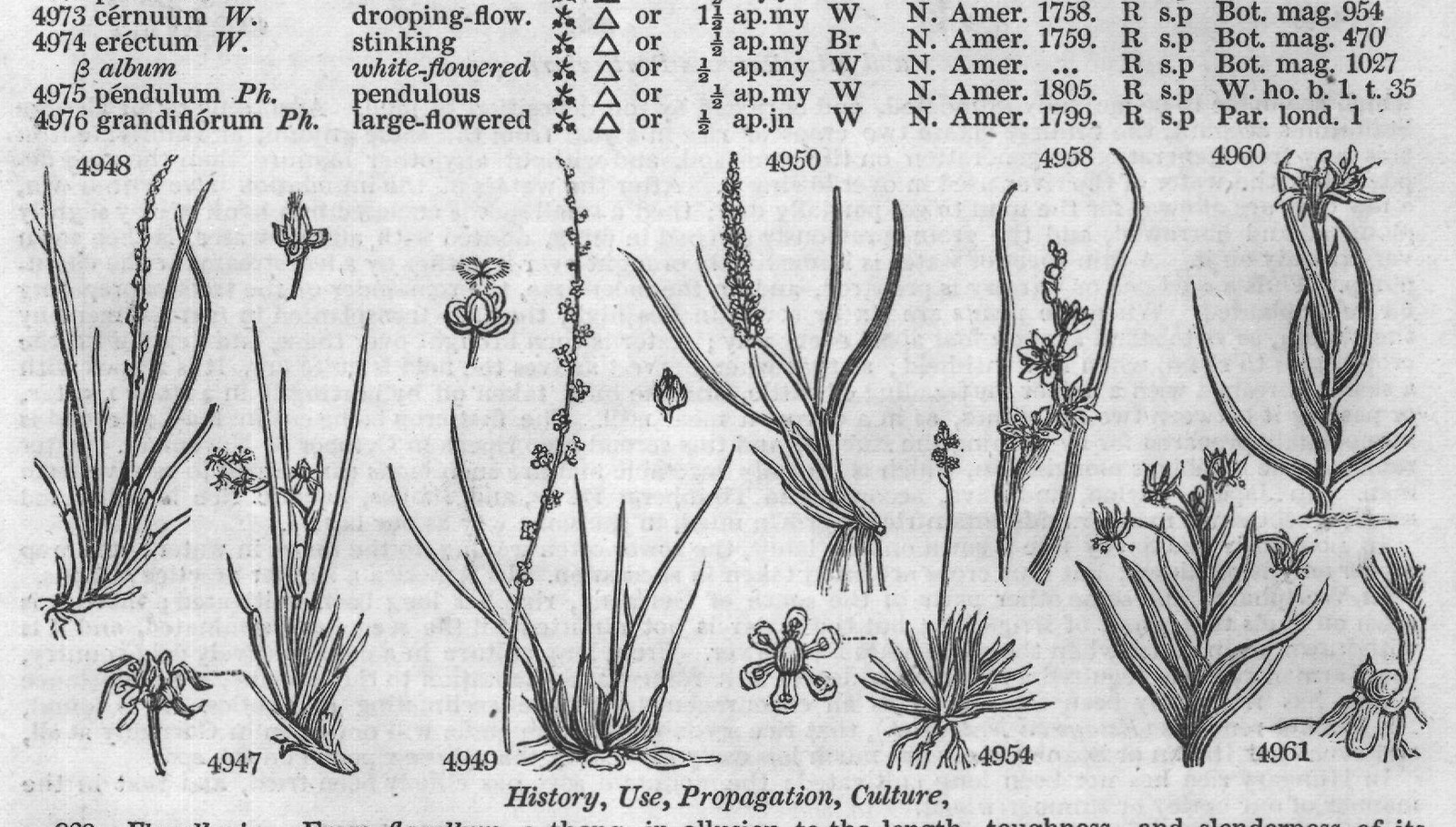
Indian 840. SCHEUCHZE'RIA. W. SCHEUCHZERIA. 4947 palústris W.
TRIGYNIA.
Junceæ? Sp. 1. cu 7 jn.jl W India 1782. Sk p.1 Red. lil. 257 Alismaceæ. Sp. 1. my.jn Br England sp. bo. S m.s Eng. bot. 1801 841. TRIGLO CHIN.
W. ARROW GRASS. 4948 palústre W. marsh ec 1 jl.au 4949 bulbósum B. M. bulbous-rooted cu 10 Alismaceæ.
G Pu Sp. 3-7. 4950 marítimum W. sea ec 1 my.au G 1806. S s.p sal. m. S m.s Britain wa.me. S m.s Eng. bot. 366 C. G. H.
Bot. mag. 1445 Britain