Bot (IV)
mag. 1628 588. ASCLEPIAS. R. Br. SWALLOW-WORT.
Asclepiadeæ.
Sp. 15-65. 3235 syríaca W.
Virginian or 4 jl.au Pu N. Amer. 1629.
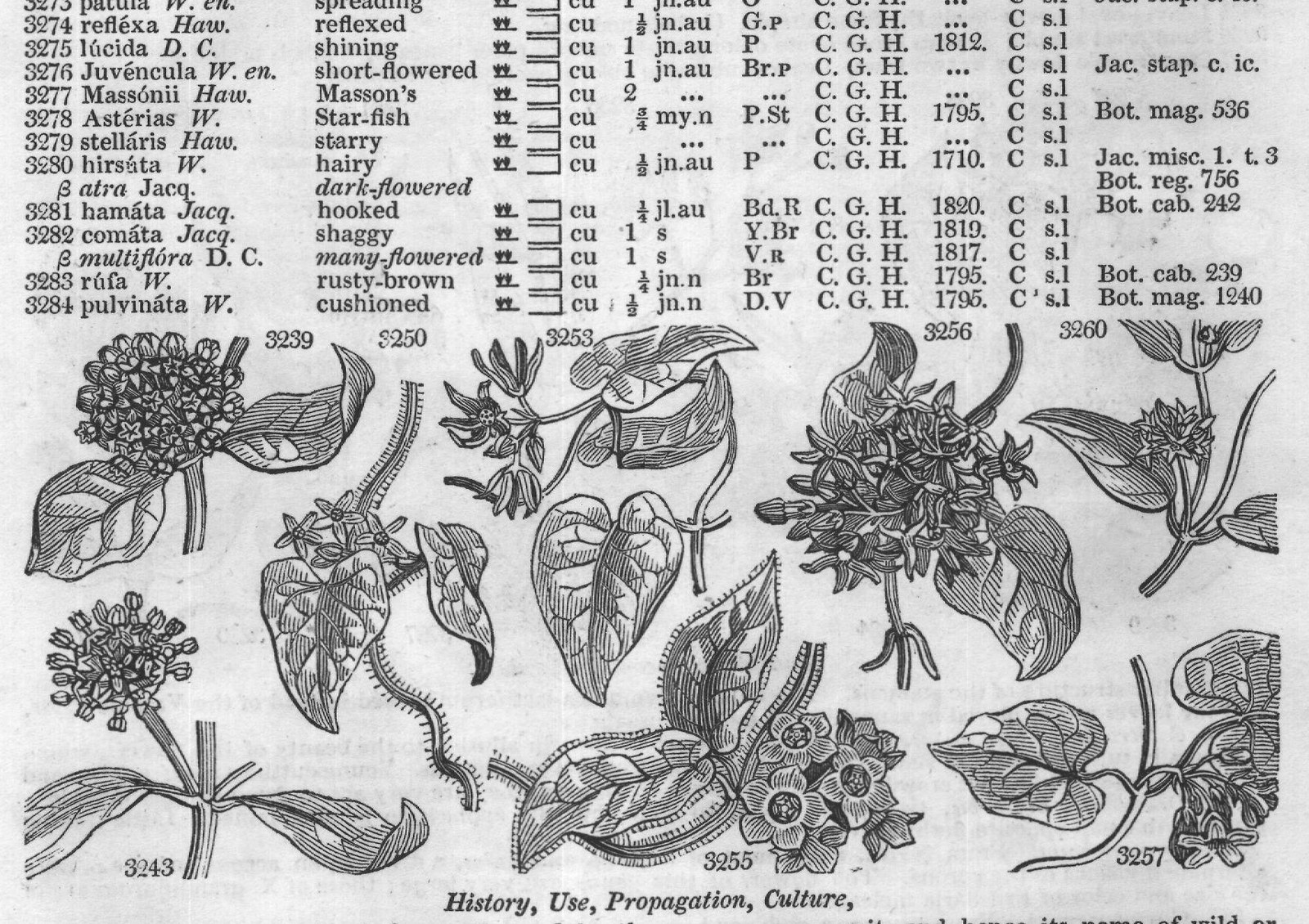
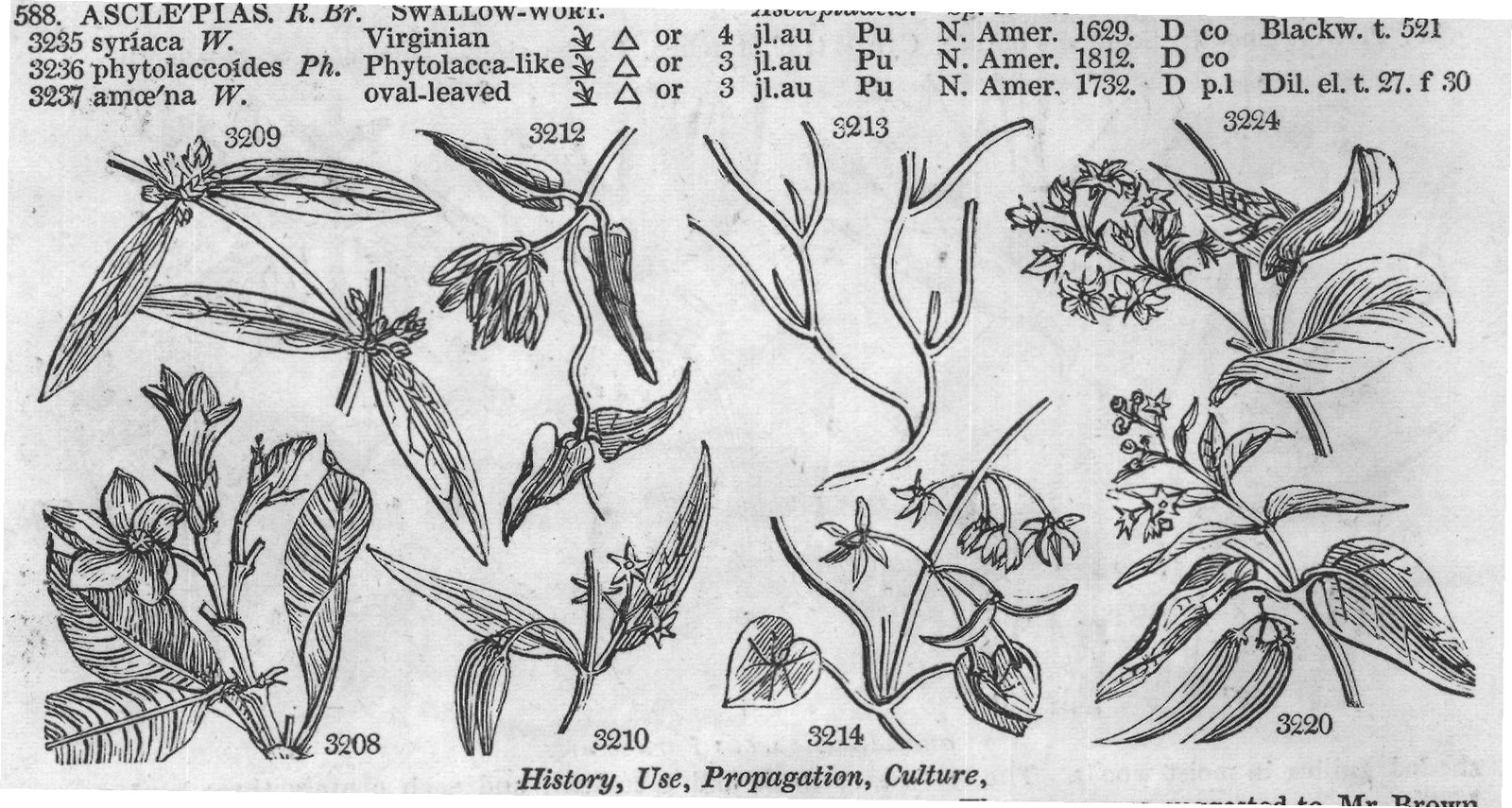
D co Blackw. t. 521 32:36 phytolaccoídes Ph. Phytolacca-like or 3 jl.au Pu N. Amer. 1812. D co 3237 amœ'na W. oval-leaved or 3 jl.au Pu N. Amer. 1732. D p.l Dil. el. t. 27. f 30 3209 3212 3213 3224 3208 3210 3214 History, Use, Propagation, Culture, 3220 575. Cryptostegia. From κρuπτoς, concealed, and σεγη, a covering. The name was suggested to Mr. Brown by the circumstance of the enclosure of the corona within the tube of the corolla, and its not being exposed to view, as in the other neighbouring genera. 576. Hemidesmus. From ἥμiσuς, half, and δεσμoς, a bandage; in allusion to the incomplete coherence of the anthers with the stigma, by which the genus is principally distinguished from Periploca. Cuttings root readily in sand in heat. 577. Secamone. The meaning of this word is very obscure. None of the explanations which have been offered of it are even tolerable. Culture as in Periploca. 578. Microloma. From μiκρoς, small, and λῶμa, a fringe ; but the application is unexplained by the author of the name. Small climbing shrubs, with opposite leaves and interpetiolar umbels. 579. Sarcostemma. From σaρκoς, flesh, and σεμμa, a crown; on account of the thick succulent nature of the coronal processes. 580. Dæmia. Dæmia appears to be an Arabic name. It has been applied by Forskâhl to a species of Asclepias referred hither. A genus of twining plants. 581. Cynanchum. From κuωv, a dog, and aγκεiv, to strangle. A word having the same meaning and application as Apocynum. This is a genus of low shrubs and herbaceous plants, for the most part twining, and all of easy culture and propagation. 582. Oxystelma. From oξuς, sharp, and σελμa, a crown; the corona being very much pointed. 583. Gymnema. From γuμvoς, naked, and vῆμa, a thread, or, in botanical language, stamen; in allusion to ORDER II. 3208 The only known species PENTANDRIA DIGYNIA. 3209 Spikes axillary imbricated, Leaves elliptical obtuse mucronate, Stem smooth 3210 Flowers hairy inside panicled, Leaves lanceolate elliptical 3211 Flowers smooth, Corymbs few-flowered axillary, Leaves linear lanceolate without veins 3212 Leaves sagittate pubescent, Limb of the corolla acute 3213 Stem twining perennial leafless 3214 Stem twining shrubby, Leaves cordate acute, Flowers hairy at edge 2215 Leaves oblong ovate cordate acute, Segments of cor. oblong obtuse 3216 Leaves reniform contracted at end lanceolate, Segm. of cor. lanceolate obtuse 3217 Leaves cordate ovate obtuse fleshy with a little point smooth, Crown 10-cleft as long as corolla 3218 Leaves ovate acute and calyxes hairy, Crown 10-cleft as long as corolla 3219 Stem erect, Flowers beardless, Partial stalks of umbel twice as long as common stalks, Crown 5-lobed 3220 Stem climbing upwards, Fl. bearded, Partial stalks of simple umbel scarcely longer than common stalk 3221 Leaves lanceolate linear opposite and three together, Stem decumbent 3222 Stem twining upwards, Corollas beardless, Stalks of umbel divided, Corona 5-lobed 3223 Leaves oblong cordate acuminate wavy, Umbels axillary proliferous 3224 Stem hairy, Leaves heart-shaped mucronate, Umbels axillary proliferous 3225 Leaves cordate ovate acuminate, Umbels simple solitary, Partial flower-stalks longer than common one 3226 Cor. smooth rotate, Racemes axillary, Leaves linear lanceolate veiny 3227 Leaves rounded ovate netted pubescent beneath, Flowers in umbels 3228 Segments of cor. spreading 3229 Segments of cor. reflexed involute 3230 Leaves thick fleshy ovate 3231 Leaves sessile oblong lanceolate wavy smooth, Umbels lateral, Petals ciliated 3232 Leaves ovate-oblong smooth obtuse with a point 3233 Leaves cordate lanceolate wavy hispid 3234 Leaves linear lanceolate smooth 3235 Leaves oval downy beneath, Stem simple, Umbels nodding 3236 Stem erect simple, Leaves broad ovate oblong acute smooth paler beneath, Umbels nodding 3237 Stem simple downy in two rows, Leaves subsessile oblong oval downy beneath 3229 3228 3234 3236 3231 3227 3230 3237 and Miscellaneous Particulars. the peculiar structure of the stamens. The milk of Gymnema lactiferum is used instead of the Vaccine ichor, and the leaves are employed in sauces in the room of cream. 584. Calotropis. From κaλoς, beautiful, and τρεπω, to turn, in allusion to the beauty of the flowers, which continually turn towards the sun. This is a handsome freeflowering genus. Young cuttings root freely in sand under a hand-glass, but not crowded, as, if the leaves are injured, they are very apt to damp and get mouldy. 585. Dischidia. From δiς, twice, and σχίζω, to split; but the application is unexplained. Little trailing plants with small opposite fleshy leaves. 586. Xysmalobium. From ξuσμa, a fragment of a thing, and λoβoς, a division, on account of the minute alternate divisions of the corona. The flowers of this genus are very large; those of X. grandiflorum are of the size and color of Fritillaria meleagris. 587. Gomphocarpus. From γoμφoς, a club, and κaρπoς, fruit. A genus resembling Asclepias in habit, but well distinguished by the inflated club-like fruit. 588. Asclepias. The name of many ancient physicians. It is the Greek name of the Esculapius of the Latins. This is a genus of tall-growing herbaceous plants, which thrive best in peat or any very light soil. They . This is a genus of tall-growing herbaceous plants, which thrive best in peat or any very light soil. They require a good deal of room to show their characters, and are readily propagated by seeds or dividing the roots. A. syriaca is very odoriferous, and in Canada, when in flower, charms the traveller, especially when passing through woods in the evening. The French there eat the tender shoots in spring as we do asparagus. The natives make a sugar of the flowers, gathering them in the morning when they are covered with dew, and collect the cotton from the pods to fill their beds. On account of the silkiness of this cotton, Parkinson calls the plant Virginjan silk. A. nivea has jointed fleshy roots, the juice of which is very effective in bringing away worms. The root 3238 purpuráscens W. 3239 variegáta W. 3240 curassávica W.
ẞ alba 3241 nívea W. 3242 parviflóra W. 3243 incarnata W. 3244 púlchra W. en. 3245 decúmbens W. 3246 verticilláta W. 3247 longifölia Ph. 3248 tuberósa W. 3249 Linária W. 589. GONO'LOBUS. R. Br. GONOLOBUS. purple A or 3 jl.au P.G variegated Aor 4 jl.au W PENTANDRIA DIGYNIA.
N. Amer. 1732. D p.1 N. Amer. 1597. D p.l CLASS V.
Dil. el. t. 28. f. 31