Home › B › Bot (Mag History Use Propagation) (III)
Bot (Mag History Use Propagation) (III)
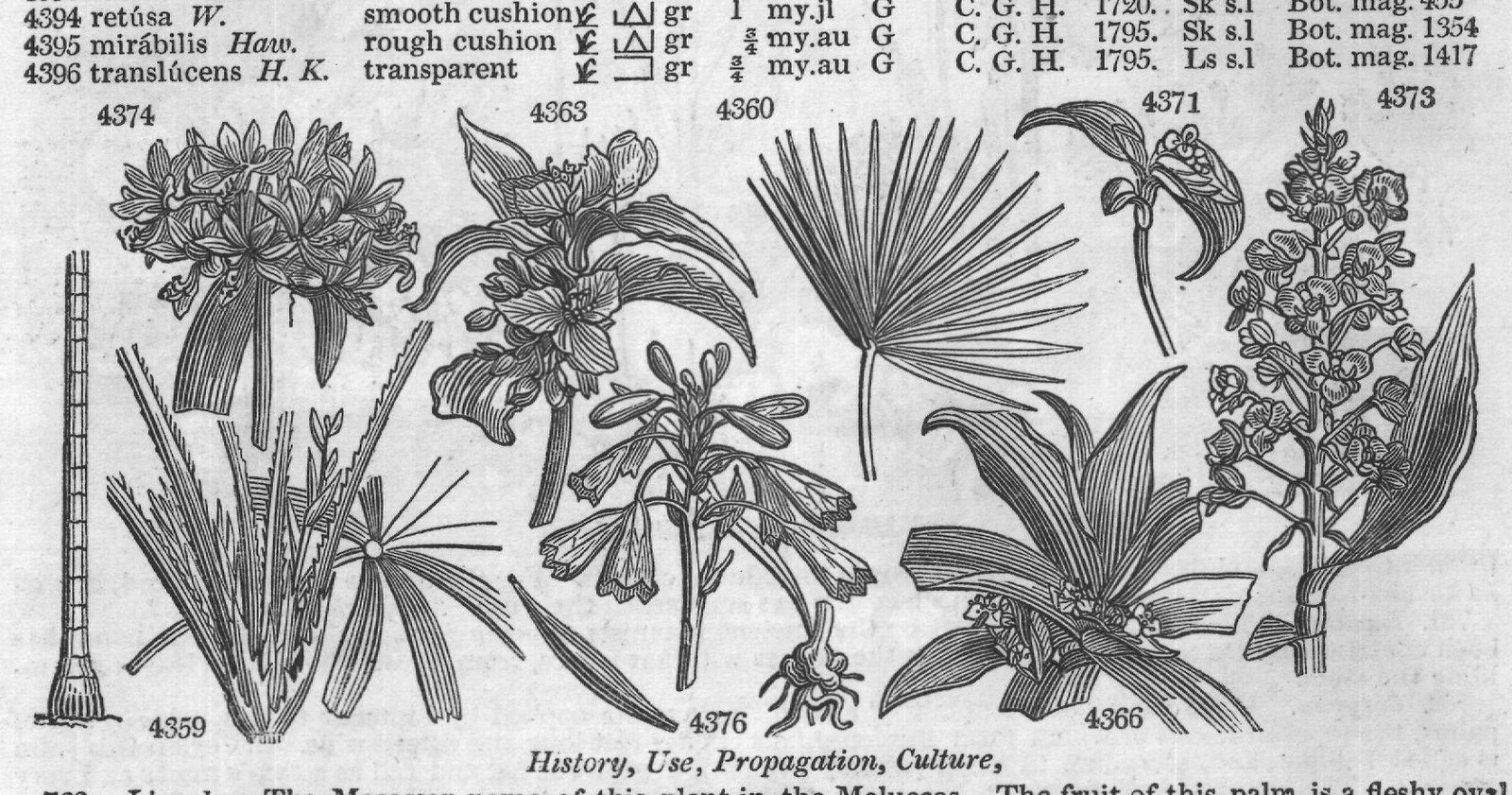
mag. 1417 4374 4363 4360 4371 4373 4359 4376 4366 History, Use, Propagation, Culture, 763. Licuala. The Macassar name of this plant in the Moluccas. The fruit of this palm is a fleshy oval drupe, about the size of sweet-bay berries; it continues long green, but finally becomes brown or blackish : the nut is oblong, hard, and striated. In the Isle of Celebes, and in Macassar, they make much use of the narrow leaves for tobacco pipes, and of the middle broad one for wrapping up fruit, &c. The wood, if the pith and hard rind may be so called, like that of most palms, is of little use. 764. Thrinax. From θρivaξ, a fan. The leaves of this little palm form a sort of fan. Brown (Hist. of Jamaica.) says, that this tree covers whole fields in many parts of Jamaica; that it grows both in the rocky hills and low moist plains near the sea, but seems to thrive best in the former. It shoots by a simple stalk, and rises generally from four or five, to ten or fourteen feet in height. It is always furnished with leaves in form of a fan, sustained by slender compressed foot-stalks, and bears a great abundance of small berries, which serve to feed both the birds and beasts of the wood, when they are in season. The trunk seldom exceeds four or five inches in diameter: it is much used for piles in wharfs, and other buildings made in the sea; for it stands the water well, and is never touched by the worms. The foot-stalks of the leaves split and pared, serve to make baskets, bow-strings, ropes, &c. where strength and toughness are required. The leaves are called thatch, and are used as such, especially for out-houses, and stand the weather many years; but such coverings are apt to harbour rats and other vermin. 765. Tradescantia. So named by Ruppius, in memory of John Tradescant, gardener to Charles I. He introduced the first species to Europe. The museum of the Tradescants is celebrated as one of the earliest ever ORDER I.
HEXANDRIA MONOGYNIA. 4359 Frond palmate, Segments linear toothed truncate at end, Stem spiny 4360 Fronds flabelliform palmate plaited with stiff lanceolate segments, Stem compressed not prickly 4361 Erect, Leaves lanceolate smooth, Flowers umbelled clustered terminal 4362 Erect, Leaves grassy very long, Peduncles few-flowered, Cal. smooth 4363 Erect smooth branched, Leaves long recurved ciliated, Pedunc. lat. and term. 4364 Leaves ovate at the edge and under woolly, Flowers umbelled clustered terminal 4365 Erect, Leaves ovate narrow at base smooth, Peduncle terminal naked bifid racemose 4366 Stemless smooth, Bractes equitant compressed, Leaves lanceolate colored beneath 4367 Erect smooth, Peduncles solitary very long 4368 Stemless with rusty hairs, Leaves elliptical acuminate radical 4369 Creeping, Leaves ovate oblong: under the flowers cordate, Pedunc. umbelled axillary 4370 Procumbent hairy 4371 Creeping smooth, Spathes 2-leaved imbricated 4372 Erect, Leaves broad lanceolate, Pedunc. lateral solitary many-flowered, Bractes double 4373 Leaves oval lanceolate whole-colored, Racemes thyrsoid many-flowered 4374 Peduncles length of corolla, Leaves linear 4375 Peduncles twice as long as corolla, Leaves linear 4376 Bractes twice as short as flower-stalks, Leaves very narrow 4377 Bractes as long as flower-stalks: the inner much the shortest 4378 Leaves linear keeled, Three inter. petals wavy, Nerves of the petals undivided 4379 Leaves linear keeled, Petals flat acute, Nerves of the petals undivided 4380 Leaves linear keeled distichous, Sepals wavy acute spreading reflexed, Nerves branched 4381 Leaves linear keeled, Three inner petals obtuse wavy, Nerves of outer petals branched 4382 Leaves linear flat, Scape simple, Nerves of petals undivided 4383 Leaves cordate acuminate, Cor. funnel-shaped 4384 Leaves ovate acuminate, Limb of cor, campanulate §1. Flowers small. Cor. bilabiate. (APICRA. W.) 4385 Leaves spreading ovate 3 cornered, Edge and keel with short subulate teeth 4386 Leaves spirally trifarious spreading blackish, on the outside smooth, Stem much twisted 4387 Nearly stemless, Leaves multifarious green not spotted: the upper horizontal rugose 4388 Leaves trifarious orbicular ovate acuminate green beneath very rough, Stem erect 4389 Leaves trifarious ovate acute very green not warted, Stems upright simple 4390 Leaves polished mucronate whitish, Edges and keel cartilaginous 4391 Leaves cymbiform obtuse glaucous very hollow above, Suckers numerous 4392 Leaves equilaterally triquetrous obtuse glaucous netted above concave 4393 Leaves subulate thick erect recurved concave above warted beneath, Edges obscurely pearly 4394 Leaves 6-farious at the end retuse deltoid pale-green lined above 4395 Leaves ciliate spiny 5-farious deltoid cuspidate at the edge and keel ciliate spiny, Obsoletely netted below 4396 Proliferous, Leaves multifarious lanceolate rounded elegantly ciliated; at end with obl. pellucid spots 4381 4378 4384 4390 4389 4396 4394 4392 and Miscellaneous Particulars. formed in this country: it was left to Ashmole, from whom it came to the university of Oxford, bearing his name. All the species are of the easiest culture, but few of them can be called beautiful. T. virginica is usually admitted as a border-flower. 766. Dichorizandra. A name contrived by Mikan, from δiς, two, χωρiς, separately, and avης, in botanical composition, a stamen; to express the separation of two anthers, upon which the character of the genus depends. Beautiful herbaceous stove plants, with the foliage of Commelina or Tradescantia. 767. Agapanthus. From aγaπaω, to love, and avθoς, a flower; lovely-flower. The blossoms are of a bright agreeable blue color, and the plant itself much prized. It is nearly hardy, and cultivated without any trouble, in large pots of common earth. 768. Blandfordia. In compliment to George, Marquis of Blandford, son of the second Duke of Marlborough, a lover of plants, but not of honor. Beautiful New Holland liliaceous plants, very rarely seen in collections. Their flowers resemble those of Cyrtanthus. 769. Hemerocallis. From ἥμερa, the day, and κaλoς, beautiful: beautiful day-lily. This is an ornamental genus of the easiest culture. The species are remarkable among border flowers for their fine orange, yellow, or blue flowers. The Hemerocallis cærulea has been considered a distinct genus by Mr. Salisbury, and called Saussurea. 770. Aloe. A word for which several derivations have been offered. That it has been obtained from the Arabic álloèh, seems most probable. The genus has been divided by Mr. A. H. Haworth and others into S3 HEXANDRIA MONOGYNIA.
CLASS VI. 4397 púmila Haw. small-cobwebgr 1 my G C. G. H.
Sk s.l