Home › B › Bot (Mag Bot reg History Use)
Bot (Mag Bot reg History Use)
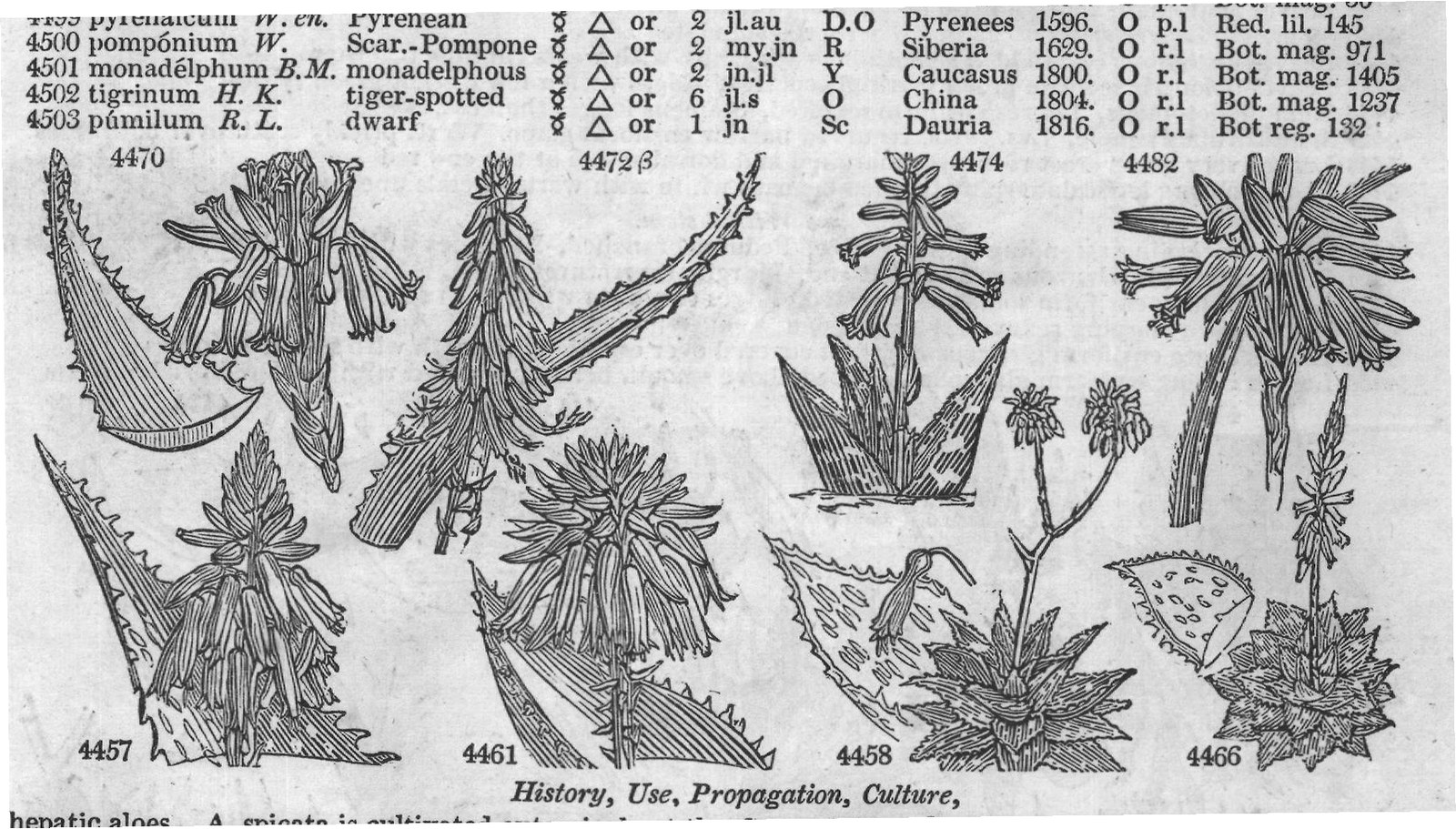
mag. 1237 Bot reg. 132 4482 4457 4461 4458 4466 History, Use, Propagation, Culture, hepatic aloes. A. spicata is cultivated extensively at the Cape of Good Hope, and a considerable part of what is sold as coming from Socotora is from that quarter. All the medicinal aloes are grown on the poorest soil. In preparing the drug, the leaves are cut off close to the stem, then cut in pieces, and the juice expressed; this is allowed to remain at rest for forty-eight hours, during which time a feculent matter is deposited; after which the supernatant liquor is poured off into flat dishes and evaporated in the sun. the month of July, the leaves are pulled, then cut into pieces, the juice expressed, and inspissated by means of At the Cape, in heat.
The month of March is the period for cutting the aloes in the island of Barbadoes. The leaves are cut off close to the stem, and disposed in tubs, in such a manner that the juice runs out. After a sufficient quantity of it is collected, it is exposed to heat in copper boilers ; and as it becomes more inspissated by a constant and regular fire, it is ladled from one boiler to another, and fresh juice added, until that in the last, which is called the teache, acquires the consistence of honey; when it is poured into calabashes, and hardens by age. It is ORDER I.
HEXANDRIA MONOGYNIA. 4456 Suckers from the root, Lvs. obl. acum. glauc. spread. cover, at side and back with very broad brown spines 4457 Caulescent, Leaves ensiform toothed mottled spreading 4458 Leaves ovate lanc. pale-green with obl. obsolete whitish barred spots, Spines rufous 4459 Leaves obl. lanc. dull green rather glaucous with obl. large transverse spots and rufous spines 4460 Leaves spotted, Edges and keel serrulate at end 4461 Leaves thick spiny at edge below spinulose appressed not dotted, Racemes in umbels 1462 Leaves erect broadly ovate acute, Spines marginal numerous white 4463 Leaves erect spreading remote ovate acute, Spines marg. few large yellow 4464 Leaves ovate acum. green, Edge and keel very spiny, Spines long very white 4455 Leaves cæspitose very short glaucous 3-cornered at end, Angles with numerous white spines 4466 Distinguished from A. serra by the spines not being united at base 4437 Leaves acuminate above flat smooth beneath warted 4468 Leaves glaucous streaked, Edges obsoletely toothletted 4469 Leaves green lined, Spines red 4470 Leaves very glaucous, Spines red 4471 Leaves lorate ensiform downward spotted with white, Marginal spines middle-sized red 4472 Leaves broad ensiform recurved smooth hard, Spines marginal and dorsal red at end 4473 Leaves tongue-shaped smooth distichous, Flowers racemose pendulous cylindrical 4474 Leaves trifarious painted channelled, Angles cartilaginous 4475 Leaves ovate oblong attenuate spreading glaucous, The edge and keel upwards with white spines 4476 Caudex leafy, Leaves lorate ensiform channelled spreading green serrulate 4477 Glaucous polished, Leaves oblong acuminate with a deep white entire cartilaginous edge 4478 Leaves tufted with the spines of the edge united at base, Scape toothed 4479 Leaves smooth pale-green straight erect-spreading soft 4480 Leaves lorate lanceolate acuminate green, Edge red with many white teeth 4481 Stem shrubby, Leaves long-lanceolate recurved at end glaucous smooth spotted with red spines 4482 Lvs. narrow sword-shaped beneath spotted with white, Spots warty scatt. Edge with minute white spines 4483 Caulescent, Lvs. ovate acum. glaucous spreading at the edge and back spiny, Spines very broad yellow 4484 Leaves lanc. scattered narrowed at base, Cor. camp. smooth inside 4485 Leaves scattered lanc. Cor. cernuous campanulate 4486 Leaves scattered lanceolate, Cor. tubular campan. Stem smooth 4487 Leaves nerveless whorled cuneate-lanceolate, Flowers solitary with revolute spotted sepals 4488 Leaves scattered, Cor. campan. upright rough inside 4489 Leaves scattered lanc.: the upper whorled, Stem 1-flowered winged 4490 Leaves scatt. lanc. obl. Cor. erect revol. camp. within papillose without smooth 4491 Leaves scatt. lin. lanc. Stem 1-flowered, Cor, erect, Pet. with long claws wavy at edge reflexed at end 4492 Leaves whorled, Flowers erect, Cor. campan. Petals clawed 4493 Leaves whorled linear, Flowers reflexed, Cor. revolute campanulate 4494 Lower leaves whorled; upper scatt. Flowers racemose reflexed, Cor. revolute 4495 Leaves whorled ovate lanceolate, Flowers reflexed, Cor. revolute 4496 Leaves ternate or scattered lin. falc. 3-nerved ciliated, Pedunc. pubes. Cor. erect rough inside 4497 Leaves ternate or scattered linear 3-nerved ciliated, Pedunc. tomentose, Flowers erect rough inside 4498 Leaves lin. lanc. scattered, Flowers reflexed, Cor. revolute dotted inside 4499 Leaves scattered linear, Pedunc. long, Flowers reflexed, Cor. revolute papillose inside 4500 Leaves scattered lin. subulate, Flowers reflexed, Cor. revolute toothed and warted inside 4501 Like a Martagon, but the stamens are united in a tube 4502 Leaves scattered sessile 5-nerved, The upper cord. ovate, Cor. revolute papillose inside 4503 Leaves linear subulate scattered smooth, Flowers reflexed, Sepals revolute smooth inside 4487 4495 4493 4485 4497 4489 4503 4493 and Miscellaneous Particulars. brought home in these calabashes, or large gourd-shells, which contain from sixty to seventy pounds weight each. (Thomson's Mat. Med. 141.) In the West Indies, the Cape, and most countries where the woody prickly species abound naturally, they are planted as hedges, and the fibres of the leaves, after being macerated for juice, manufactured into cordage or coarse cloth A. picta, latifolia, and saponaria are so named from the spots of the leaves, which are of the color of soft soap.
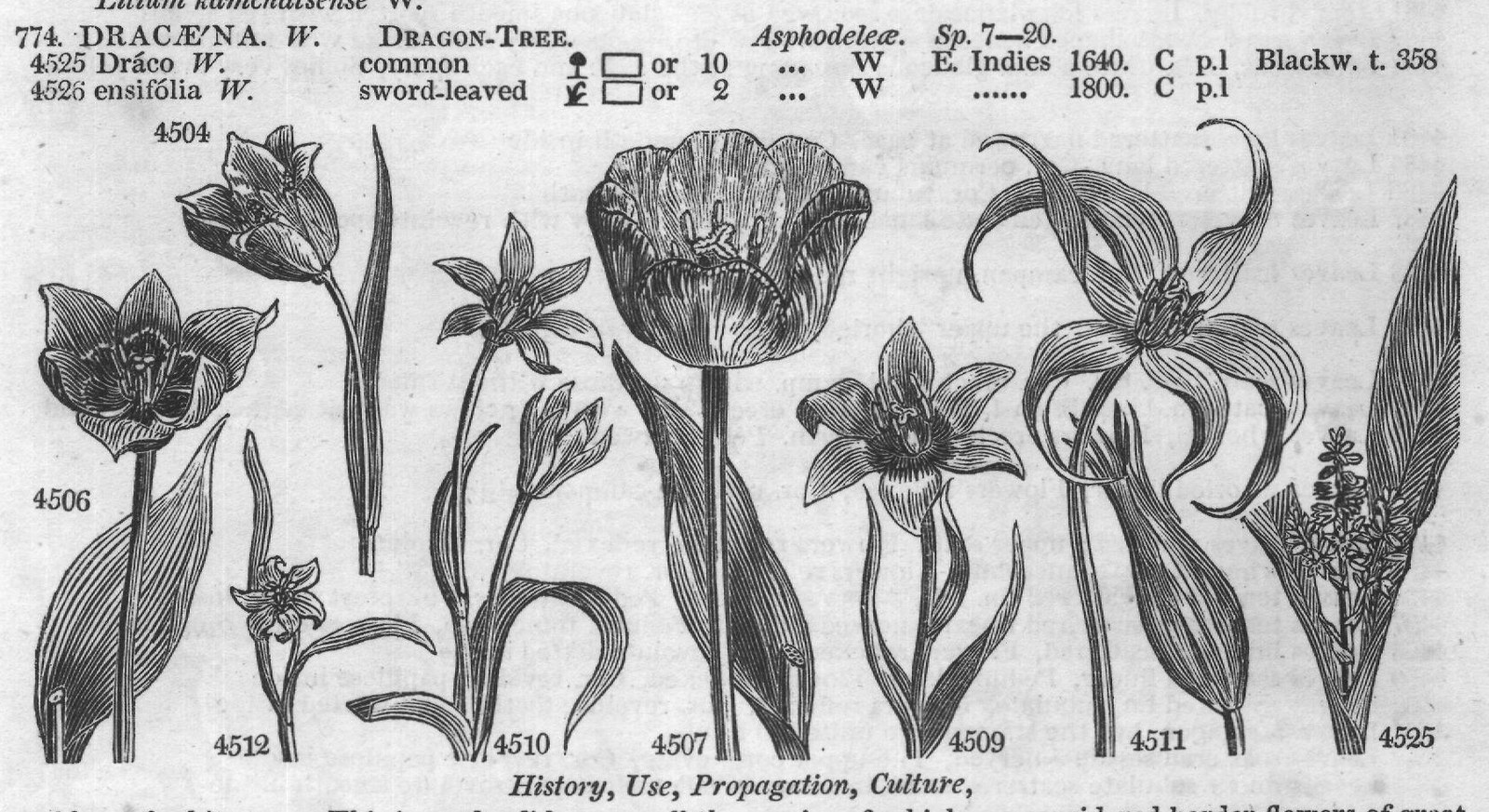
The curious species of aloes, inhabitants of the greenhouse, require but little water: sandy loam, mixed with a little lime rubbish or gravel, suits them best; and they flower more abundantly by being exposed to the open air in summer. They are increased by suckers; or leaves, stripped off the plants and laid on a pot of mould, or planted shallow in it, will produce young plants. (Bot. Cult. 130.) 771. Lilium. From the Celtic word Li, which signifies whiteness. The lily has always been considered the 772. TULIPA. W.
TULIP. 4504 sylvéstris W. wild 4505 túrcica Roth. nar.-waved-lvd.or 4506 óculus sólis R. L. Agen or 4507 Gesneriána W. common or 4508 suavéolens W.
Van Thol or HEXANDRIA MONOGYNIA.
Liliaceæ. Sp. 9-11. or 1 ap.my Y England ch. pit. O s.1 CLASS VI.
Eng. bot. 63