Bot (XVII)
reg. 584 ...
W.G Martiniq. 1800. C l.p Plum: amer.t.79 or 15 ...
W.G W. Indies 1781. C p.l Plum. amer.t.81 or 15 W ...
St. Domin.1817. C p.1 Plum. ic. 139. f.1 9400 9401 9404 9409 9410 9412 9415 History, Use, Propagation, Culture, mixed immediately with wine or spirits; and the composition is generally thought a very effectual and easy narcotic.
P. incarnata, the May apple, has a perennial root, herbaceous shoots, and sweet-scented flowers, variegated with purple. The fruit is about the size of an apple, orange-colored, with a sweetish yellow pulp, but it requires the heat of the stove to bring it forward.
P. cærulea is the tallest and most ligneous of the species. The stem will grow almost as large as a man's arm, and the shoots will often grow the length of fifteen feet in one summer. The leaves are the most elegant of the genus. The flowers are blue outside, and purple and white within: they have a faint scent, and continue but for one day. The fruit is egg-shaped, of the size and color of the Mogul plum, the yellow skin of which encloses a sweetish disagreeable pulp and black seeds. Besides the species thus enumerated, some varieties have been procured by cross impregnation, which are very remarkable for their beauty, and for having acquired the hardihood of their parent. The most valuable of these artificial productions, is the P. cæruleo-racemosa, raised by Mr. Milne, of Fulham, from seed of P. racemosa impregnated by P. cærulea, and figured in the Transactions of the Horticultural Society, vol. 3. tab. 3., and the P. alato-cærulea, obtained by Mr. J. H. Masters of Canterbury, between P. alata of the West Indies, and P. cærulea.
All the species grow and flower freely in a mixture of loam, and light rich earth or peat, with plenty of room. Most of them fruit in the stove, but the P. cærulea seldom fruits in the greenhouse. They are all easily increased either by seeds or very young cuttings, in a close moist heat. As fruit-bearing plants the Passifloras are thus treated: " Having procured plants with good roots, plant such as are intended to fruit in a border in the stove, and train them to a trellis near the glass; they will in general produce fruit the second year. The seedlings of the P. incarnata, will produce fruit the first year. All the species will fruit even in large pots; but Sabine says, the "best method is to plant them in an angle of the bark-bed, which has been parted off, either by boards or brick-work, as low as the pit goes. At the bottom of ORDER II.
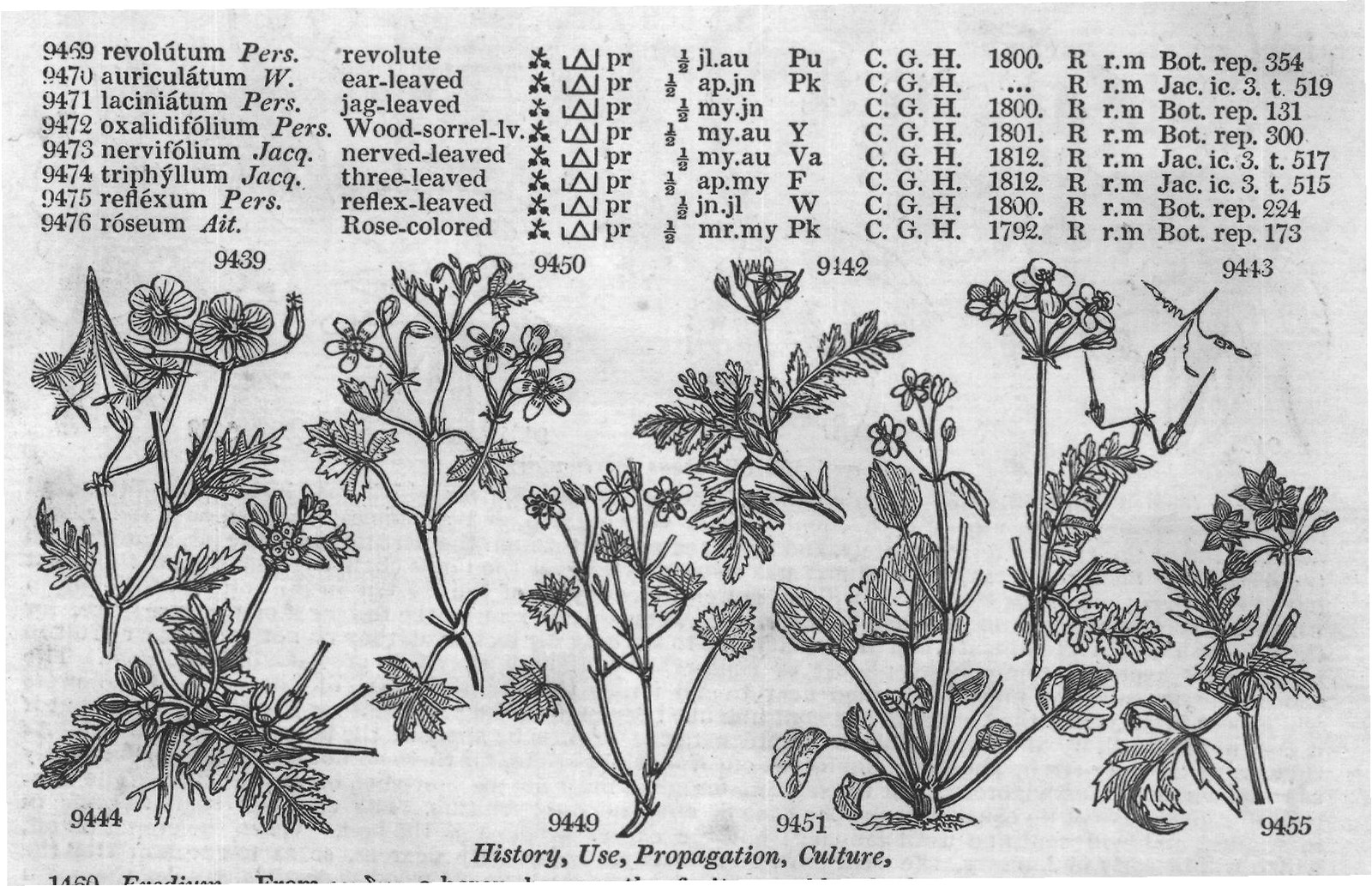
MONADELPHIA PENTANDRIA. 9397 Leaves obl. ovate subcord, ent. veiny, Petioles with 4 glands, Stip. lanc. falcate subserrate, Invol. 3-leaved 9398 Leaves oblong entire veiny, Petioles with 2 glands, Invol. 3-leaved toothed at end 9399 Leaves obl. ent. acute 3-nerved veiny, Petioles with 2 glands, Ped. aggregate axill. Fl. apetalous, Invol. O. 9400 Leaves 2-lobed bluntly emarginate, Petioles without glands, Corona campanulate truncate entire 9401 Lvs. cord. 2-lobed blunt mucron. ; up. somew. stem-clasp. Petiol. without glands, Pet. twice as long as cal. somew.stem-clasp. Petiol. without glands, Pet. twice as long as cal. 9402 Leaves cordate 2-lobed acute mucronate pubescent beneath, Petioles without glands, Fruit obovate 9403 Lvs. 2-lobed emarginate at base, Lobes linear blunt divaricating; the intermediate obsolete mucronate 9404 Lvs. cord. 2-lobed blunt smooth, Petioles without glands, Pedunc. axillary twin, Threads of corona clav. . 9405 Leaves cuneiform acuminate divaricating with 2 glands at base, Petioles without glands, Invol. O. 9406 Lvs. round. shortly and bluntly 3-lobed dott. downy ben. Petiol. without glands, Pet. twice as short as cal. ben. Petiol. without glands, Pet. twice as short as cal. 9407 Lvs. round. subcord, blunt obsoletely 3lobed smooth dott. Petioles without glands, Pet. twice as short as cal. 9408 Lvs. cord. 3-lobed blunt smooth, Petioles without glands, Pedunc. axill. twin, Pet. twice as narrow as cal. 9409 Lower leaves 3-lobed acuminate; upper undivided lanceolate, Petioles with 2 glands, Flowers apetalous 9410 Leaves roundish cordate, Petioles with 2 glands, Flowers solitary long-stalked, Cal. keeled, Stam. 1-sided 9411 Leaves ovate entire 3-nerved veiny, Petioles with 2 glands, Flowers apetalous, Involucrum O. 9412 Lvs. 3-lobed smooth, Lobes lanc. ; middle one longest, Petioles with 2 glands, Fl. apetal. Stem corky at base longest, Petioles with 2 glands, Fl. apetal. Stem corky at base 9413 Leaves subcordate 3-lobed, Lobes rounded with 2 glands, Pedunc. axillary solitary, Flower apetalous 9414 Lvs. 3-lobed smooth, Lobes oblong; lat. very short, Petioles with 2 glands, Fl. apetal. Stem corky at base , Petioles with 2 glands, Fl. apetal. Stem corky at base 9415 Lvs. peltate deeply 3-lobed smooth, Lobes lin. lanc. divaricating, Petioles with 2 glands, Flow. apetalous 9416 Leaves peltate half 3-lobed smooth, Lobes ovate blunt, Petioles with 2 glands, Fl. apetalous 9417 Leaves peltate cordate 3-lobed, Lobes equal oblong blunt, Petioles with 4 glands, Petals length of calyx 9418 Leaves discolored peltate 9419 Leaves 3-lobed downy with a reflexed tooth on each side at the base 9420 Leaves 3-lobed vill.; lower smooth above, Lobes obl. entire; intermediate longest, Petioles with 2 glands 9421 Leaves 2-lobed glandular beneath, Lobes oblong erect, Peduncles twin 9422 Leaves palmate about 5-parted subserrulate, Involucre 3-leaved entire, Rays a little shorter than corolla 9423 Leaves 3-lobed cordate hairy, Involucres multifid capillary 9424 Leaves and stems all fringed with red hairs 9425 Leaves 3-lobed cordate smooth ciliated serrated, Involucres multifid capillary 9426 Downy, Leaves cordate 3-lobed, Peduncles twice as short as petiole, Corona much shorter than corolla 9427 Lvs. rounded trun. at base slightly 3-5-lobed, Lobes blunt, Petioles without glands, Pet. shorter than cal. . 9428 Stem square, Leaves 3-lobed: lobes nearly equal serrated, Pedunc. long 1-flowered 9429 Leaves 3-lobed serrated smooth, Invol. glandular serrulate caducous, Övary naked 9430 Lvs. 3-lobed serr. Lobes obl. acute, Petioles with 2 glands, Inv. 3-leaved, Threads of corona longer than cor. 9431 Lvs. palmate 5-parted entire, Petioles gland. Invol. 3-leaved entire, Threads of corona shorter than corolla 9432 Leaves palmate 5-parted serr. Petioles gland. Invol. 3-leaved serrate, Threads of corona longer than cor. 9433 Leaves palmate 7-parted serrated, Petioles glandular, Invol. 3-fid entire 9434 Leaves 7-pedate serrated, Petioles glandular, Invol. 3-leaved serrated 9435 Upper leaves quinate pedate obovate somewhat cut lower ternate linear-lanceolate or simple somewhat cut; lower ternate linear-lanceolate or simple 9425 9417 9429 9431 9418 9432 9423 and Miscellaneous Particulars. the cavity formed by this division, should be laid some brick-rubbish, over which may be thrown a little dead tan, and the whole be then filled with equal parts of very old tan, and a compost of leaf-mould and rotten dung. Herein the roots will strike freely, and will even spread through the partition into the pit, growing into the fresh tan. Such roots may be trimmed and reduced whenever the tan is changed; but should the plant have been some time in its station, it will be as well to leave part of the old tan in the bottom of the pit, in which the protruded roots may remain undisturbed. They do not require the full heat of the pine stove, for they flourish best in a temperature of from sixty-five to seventy degrees but they do not bring their fruit to perfection if kept in a common greenhouse or conservatory, though they will grow and flower in it. The shoots, as they advance, must be trained near to and under the inclined glass of the stove: the flowers will appear in May, and the blooming will continue until September, the fruit setting the whole time but if it does not set well, it will be advisable to impregnate the stigmas by applying the pollen with a feather. As they grow, the very strong shoots should be cut out from their origin, for these do not bear fruit so abundantly as those which are less vigorous but the fruiting branches must not be shortened on any account. The temperature must be kept up equally during the time of flowering and fruiting. The crop will begin to come in in August, and will continue until January; but the earlier produce is the best. When the crop is all off, which will be early in January, the heat must be reduced to about fifty degrees, so as to check or stop the growth this being effected, the shoots must be well cut in. As little old wood as possible, besides the main stem, which rises from the pit to the glass, and a few pieces (about two or three feet of each) of the old branches should be retained; for all that is to be trained under the glass to bear in each year, ought to be the growth of the same season. It is found that the shoots break better, and in greater quantity, from the older wood than from that of two years' standing. In this dormant and reduced state it is to be kept during January and February, after which the necessary heat may be applied to cause it to resume its functions for the ensuing season." (Hort. Trans. iii. and iv.) 1460. ERO'DIUM. W. 9436 petræ'um W. 9437 glandulósum W. 9438 alpínum W. 9439 crassifólium W. 9440 laciniátum W. 9441 cicónium W. 9442 cicutárium W.
ẞ bipinnátum W. 9443 románum W.
MONADELPHIA PENTANDRIA.
HERON'S BILL. rock glandular Alpine thick-leaved laciniated long-beaked Hemlock-leav'd Numidian Roman ẞ caucalifólium Sweet Caucalis-leaved অল্প pr pr pr or or un W Geraniacea. Sp. 20-45.
Pu jn.jl jn.jl Pu Spain my.au R mr.au S my.au R jn.jl Pu ap.s Pu unmy.jn Pu O pr my.jn Pu pr 1 my.au Pu pr 1 my.jl Pu un un jn.jl R 1 jn.jl R ja.d Pk 1 ja.d 9444 moschátum W. musky 9445 gruínum W. broad-leaved 9446 chíum W.
Chian 9447 hymenódes W. three-leaved pr 9448 Gussóni Tenore.
Gousson's or 9449 malacoides W. mallow-leaved or my.jl B 9450 incarnátum W. flesh-colored or my.jl Fl 9451 glaucophýllum W. glaucous-leaved un jl.au R 9452 marítimum W. sea W my.s Fl 9453 Reichárdi Dec. dwarf Apr 1 ap.s W 9454 littóreum Dec. shore Aun ap.s R 9455 serotínum Stev. late prjl.s B multicaúle Link. পপপপ S. Europe 1640. D co 1798. C l.p Italy 1814. D co Cyprus 1788. R r.m Crete 1794. R r.m S. Europe 1711. S co Britain ro.sid. S co Numidia 1803. C s.1 Rome 1724. S co France 1816. S co England m.pas. S s.1 Crete 1596. S s.l Levant 1724. S co Barbary 1789. Sr.m Pa.pu Naples 1821. D co S. Europe 1596. S co C. G. H. 1787. Cr.m Egypt 1732. S co England san.sh. D co Minorca 1783. C s.l S. Europe 1821. D co Siberia 1821. D co CLASS XVI.
Gouan.il.t.21.f.1 Lapey. pyr.1. t.1 L'Her. ger. t. 3 Sweet ger. 111 Ca.dis.4.t.113.f.3 Jac. vind. 1. t. 18 Eng. bot. 1768 Ca.dis.5.t.126.f.3