Buen
Ay. ...
Rs.p Bot. reg. 105 730. PONTEDE'RIA. W. PONTEDERIA.
Commelineæ.
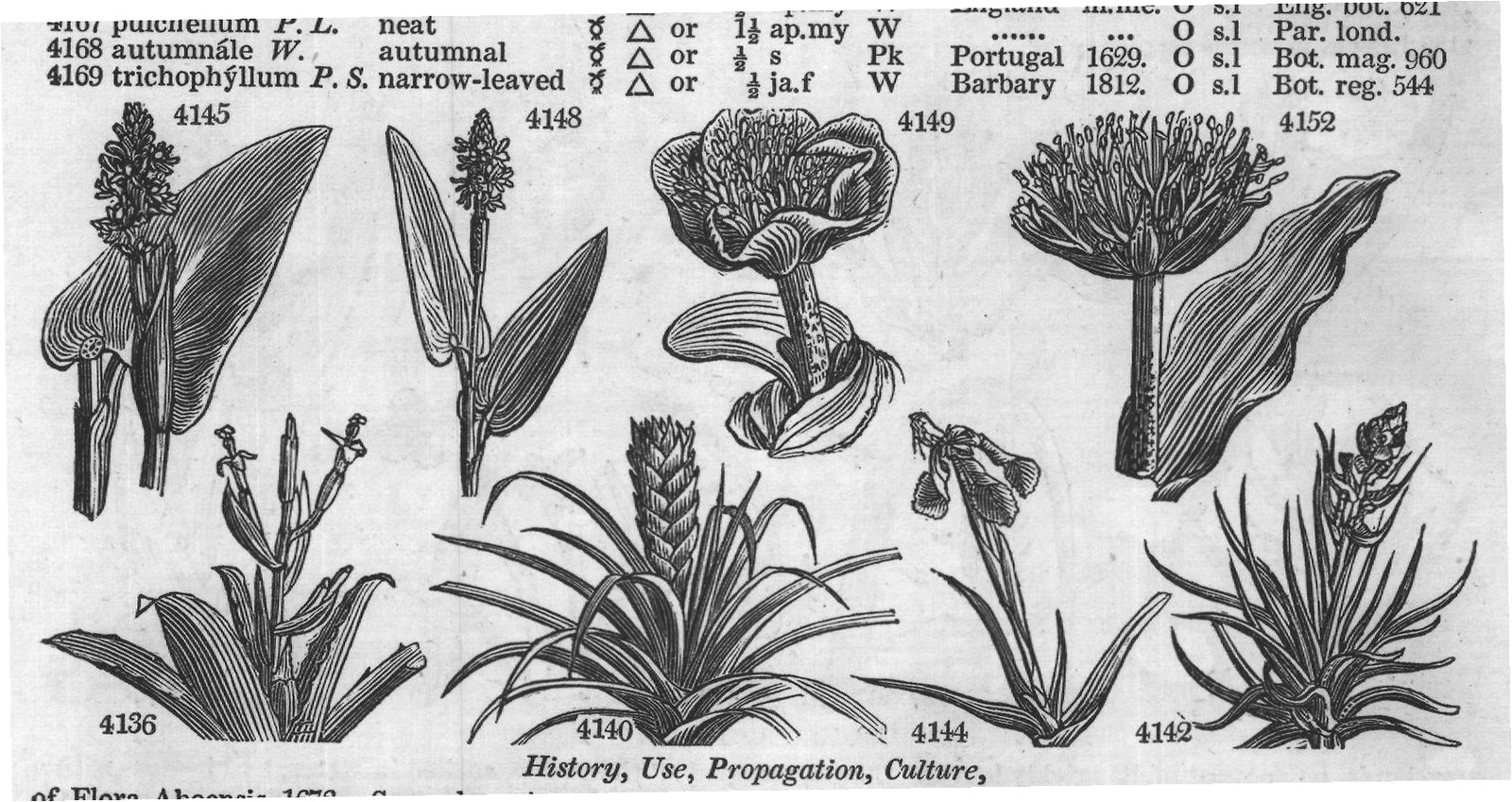
Sp. 4-7. 4145 cordáta Ph. heart-leaved or 2 jn.au B N. Amer. 1759. D 1 Bot. mag. 1156 4146 angustifólia Ph. narrow-leaved or 2 jn.au B N. Amer. 1806. D 1 4147 dilatáta H. K. spreading or 2 my B E. Indies 1806. D 1 Bot. rep. 490 4148 lanceoláta Lodd. lanceolate or 2 au B N. Amer. 1815. D 1 Bot. cab. 613 731. HÆMANTHUS. W. BLOOD-FLOWER.
Amaryllideæ. Sp. 14-16. 4149 coccíneus W. salmon-colored or 1 au.o R C. G. H. 1629.
O r.m Bot. mag. 1075 4150 coarctátus W. compressed or 1 f.mr Pk C. G. H. 1795.
O r.m Bot. reg. 181 4151 rotundifólius B. M. round-leaved or 1 jn.o S C. G. H. 1790.
O s.l.p Bot. mag. 1618 4152 puníceus W. wave-leaved or 1 my.s S C. G. H. 1722.
O r.m Bot. mag. 1315 4153 multiflórus W. many-flowered or 1 my.s D.R S. Leone 1783.
O r.m Bot. mag. 961 4154 tigrínus W. tiger-spotted or 1 f.d F C. G. H. 1790.
O r.m Bot. mag. 1705 4155 quadriválvis W. four-valved or 1 s.o F C. G. H. 1790.
O r.m Bot. mag. 1523 4156 pubéscens W. pubescent or 1 au W C. G. H. 1774.
O r.m Bot. cab. 702 B albiflós W. 4157 maculátus Jacq. white-flowered or 1 ap.au W C. G. H. 1791.
O r.m Bot. mag. 1239 spotted-leaved or ap.au ...
C. G. H. 1790.
O s.l.p 4158 lanceæfólius W. spear-leaved or 1 s.o R C. G. H. 1794.
O r.m Jac. sch. 1. t. 60 4159 carinátus W. keel-leaved Aor au.s Pk C. G. H. 1759.
O r.m 4160 pumílio W. dwarf or au.s Pk C. G. H. 1789.
O s.l.p Jac. sch. 1. t. 61 4161 cárneus Ker. flesh-colored or jn.jl Pk 4162 Hyalocárpus Jacq.
C. G. H. 1819.
O s.l.p Bot. reg. 509 china-fruited or 1 jl R C. G. H. 1822.
O s.l.p Jacq. sch. t. 409 732. GALAN'THUS. W. SNOWDROP.
Amaryllideæ.
Sp. 2. 4163 nivális W. common 4164 plicátus Bieb. plaited 733. LEUCO'JUM. W.
SNOW-FLAKE. 4165 vérnum W. spring 4166 æstívum W. summer 4167 pulchéllum P. L. neat 4168 autumnále W. autumnal of YOR YOR YOR YOR YO or ja.mr W Britain mea. O co Eng. bot. 19 or ja.ap W Crimea 1818. O co Bot. reg. 545 Amaryllideæ. Sp. 5. 4145 4148 4169 trichophýllum P. S. narrow-leaved or 1½ ap.my W Pk Germany 1596. O s.l England m.me. O s.l ...
Portugal 1629. O s.l W Barbary 1812. O s.l 4149 or ja.mr W Aor 1 ap.my W Aor or S ja.f Bot. mag. 46 Eng. bot. 621 Par. lond.
Bot. mag. 960 Bot. reg. 544 4152 4136 4140 4144 History, Use, Propagation, Culture, 4142 of Flora Aboensis, 1673. Several species of this genus are parasitical, and others require the same treatment as Pitcairnia or Bromelia.
T. utriculata is a valuable plant in the woods of the West Indies, as containing a supply of water in dry seasons. The seed being pappose, is carried about by the wind, and sticks readily on the bark of trees: there, especially on decaying ones, it sends out small brown fibres which take hold of the bark, and weave and mat themselves among one another: from this foundation rise several leaves on every side, like those of Aloes or Ananas; they are folded or inclosed one within another , each three feet and a half long, and three inches broad at the base, but ending in a point, having a very hollow or concave inward side, and a round or convex outward one, forming a bason or cistern, containing about a quart of water, which, in the rainy season falls upon the upper parts of the spreading leaves, and being conveyed down them by channels, lodges in the bottom as in a bottle; for the leaves, having swelled out at the base, bend inwards close to the stalk, thus hindering the evaporation of the water by the heat of the sun . smooth, straight, green stalk, three or four feet high, having many branches, and when wounded yielding a clear white mucilaginous gum. The flowers come out here and there on the branches. The corolla is of a yellowish-white or herbaceous color; and the calyx is made up of three green viscid leaves with purple edges.
Men, birds, and insects supply themselves with water from this plant. Dampier says, he has many times, to his great relief, stuck his knife into the leaves just above the roots, and let out the water into his hat.
From the midst of the leaves rises a round, T. usneoides deserves, for its appearance and uses, to be shortly described. The stem is no bigger than a thread; the skin whitish, as if covered with hoar-frost, within tough and black like a horse hair. Many of these together stick on the branches of the ebony or other trees superficially by the middle, and send down on each side some of the same stems, very often a yard long, hanging on both sides, curled, or turning and winding one within another, and resembling an old man's beard, whence its common name in Jamaica. The stems are branched, and the branches, which are two or three inches long, are set with roundish, white, frosted leaves. The flowers come out at the end of the branches. This slender parasitical plant is found among the trees in many parts of Jamaica, but does not grow so commonly there, nor so luxuriantly, as it does in the more northern provinces of the main continent, where it is said to overrun whole forests. It is frequently imported from Jamaica to North America, for the use of the ORDER I.
HEXANDRIA MONOGYNIA. 4136 Leaves lanceolate channelled slightly prickly, outer acute inner retuse 4137 Filiform branched twisted rough 4138 Leaves lanceolate ligulate entire ventricose at base 4139 Leaves linear subulate entire imbricate, Spike lax 4140 Leaves narrow channelled recurved, Spike imbricated simple oval two-edged 4141 Spikes subdivided nodding, Flowers distinct ovate, Leaves ovate lanceolate membranous 4142 Leaves radical stiff frosted, Flowers imbricated in an ovate spike of whitish bractes 4143 Leaves subulate rough reclinate, Stems 1-flowered, Glumes 2-flowered 4144 Flower tubular trfiid, Segments of the tripetaloid limb reflexed twice as short as tube, Lvs. entire 4145 Leaves cordate, Flowers spiked 4146 Leaves long-triangular narrowed by degrees, at the base truncate cordate, Petals lin. lanc. 4147 Leaves sagittate obtuse, Flowers in crowded umbels 4148 Leaves lanceolate elliptical cordate, Spike oblong 4149 Leaves linguiform flat smooth pressed on the ground 2-ranked, Umbel shorter than the spathe 4150 Leaves linguiform oblong flat smooth callous at end, Umbel contracted shorter than spathe, Limb erect 4151 Leaves rounded fringed with pink hairs, Umbel few-flowered, Leaves of spathe cordate blunt 4152 Leaves oblong elliptical acute retuse wavy, Umbel contracted, Limb and stamens erect 4153 Leaves ellipt. lanceol. acute concave erect, Umbel longer than spatha, Limb spreading, Stam. ascending 4154 Leaves linguiform flat smooth fringed at edge depressed, Umbel contracted, Limb and stamens erect 4155 Leaves lanceolate ciliated villous above smooth beneath, Spathe campanulate 4-valved 4156 Leaves oblong lanceolatc hairy all over, Umbel fastigiate rounded, Limb and stamens erect 4157 Leaves broad much spotted with brown 4158 Lvs. ellipt. atten, at base depressed flat smooth ciliated at edge, Pedunc. longer than spathe and flower 4159 Leaves linear carinated 4160 Leaves linear lanceolate erect smooth, Peduncles length of spathe and flowers, Limb spreading 4161 Leaves 2 round ovate acuminate and scape hairy backwards, Spathe reflexed withered, Stam, included 4162 Leaves oblong obtuse smooth erect not spotted, Umbel rounded, Limb erect 4163 Leaves smooth 4164 Leaves plaited 4165 Spathe 1-flowered, Style clavate 4166 Spathe many-flowered, Style clavate 4167 A slight variety of the last 4168 Spathe many-flowered, Style filiform 4169 Vernal, Sepals entire, Style filiform with a blunt stigma 4156 4154 4161 4164 4163 4168 4164 41651 and Miscellaneous Particulars. sadlers and coachmakers, who commonly stuff their pannels, cushions, &c. with it. In Louisiana and the neighbouring settlements, this plant being very carefully gathered and stripped of the bark, is made into mattrasses, cushions, pannels, &c. It is manufactured by tying the stalks in bunches, and sinking them in water, or burying them under ground in a moist place, until the bark rots: they are then taken up, boiled in water, and washed, until the fibres are quite cleared of the pulp. These are not only used instead of horsehair, but are so very like it, that a man cannot distinguish them, without a strict examination, and that even with a glass, unless he observes the branchings of it. The Bonana bird's nest is always made of the fibres of this plant, and is generally found hanging by a few threads from the tops of the most expanded branches of the most lofty trees, especially those that spread over ponds or rivers.
In cultivating Tillandsia in our stoves, the parasitical species may either be hung up in baskets of moss, or fastened in moss to some plant, or to the stump of a tree set up on purpose: if planted in pots, they require but little water, and a sandy loam, with bits of sticks and small pieces of potsherds mixed with it. (Sweet.) They are, however, extremely difficult to manage under any mode of treatment. 730. Pontederia. So named in memory of Julius Pontedera, professor of botany at Padua, author of Tabulæ Botanicæ, 1718, &c. This is a genus of aquatic, herbaceous, perennial plants, with fibrous roots sheathing stem-leaves, and blue flowers in spikes or umbels from the cloven sheath of the leaves. A loamy soil in a cistern of water grows them well, and they are not without beauty. 731. Hæmanthus. From ἁiμa, blood, and avθoς, a flower, in allusion to the brilliant red colors of the flowers. An ornamental genus, which thrives best in sandy loam and a little peat, and placed in a dry stove or bulb-house near the glass. The species require no water when in a dormant state, as the bulbs then ripen, and afterwards flower freely. (Sweet.) 732. Galanthus. From γaλa, milk, and avθoς, a flower, on account of the milky whiteness of the blossoms. It is rather singular, and also to be regretted, that no variations or hybrids have been produced from this early and pretty little flower. 733. Leucojum. From λεuκoς, white, and ἴov, a violet. A genus resembling the last in habit, but differing in technical characters. The little autumn species is very pretty, but difficult to cultivate. HEXANDRIA MONOGYNIA. 734. STRUMA'RIA. Jac. STRUMARIA.
CLASS VI.
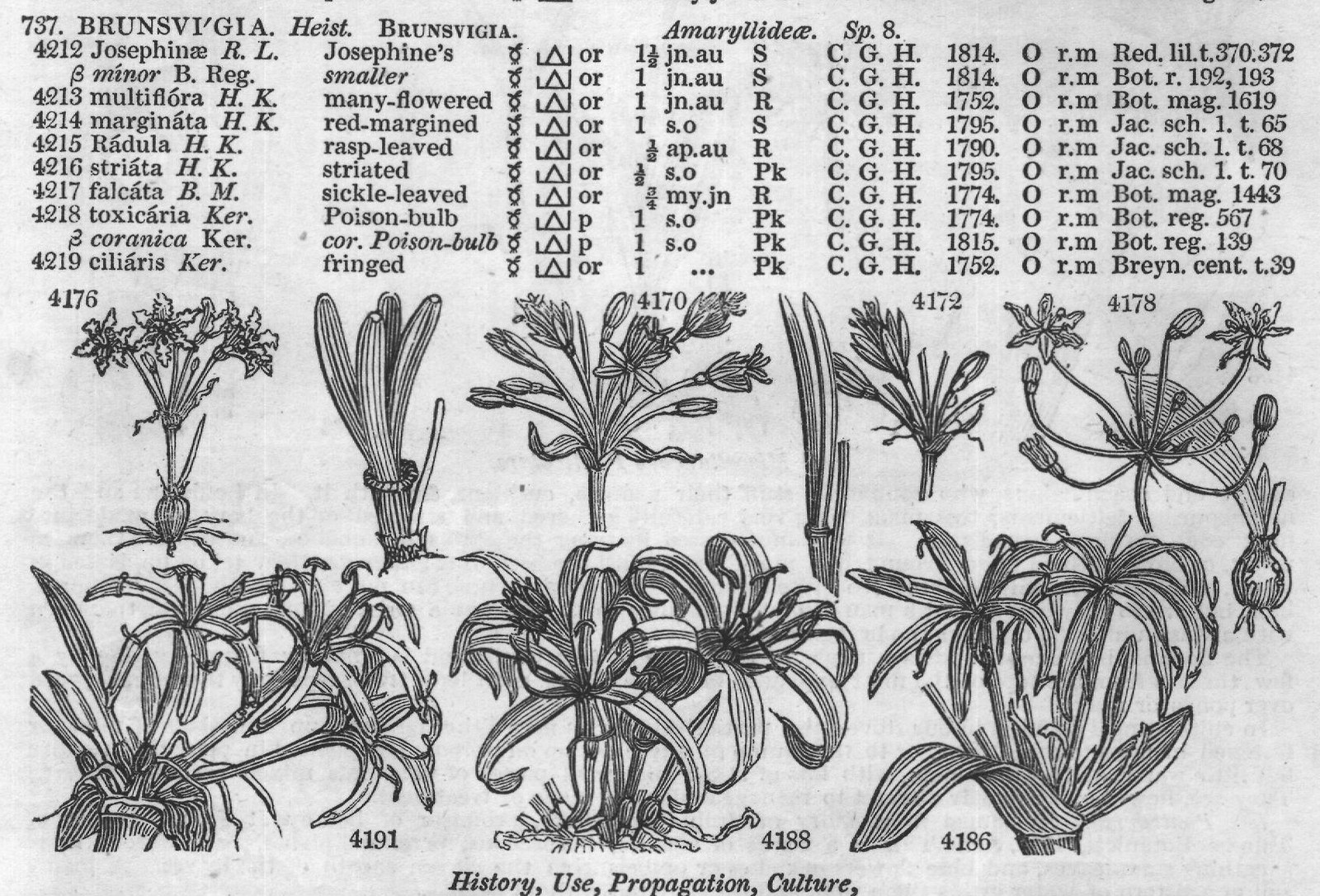
Amaryllideæ. Sp. 9-11. 4170 truncáta W. truncated or ap.my W C. G. H. 1795. O 8.1 Jac. 1c. 2. t. 357 4171 rubélla W. pale-red or my.jn Pk C. G. H.
O s.l Jac. ic. 2. t. 358 4172 angustifólia W. narrow-leaved or ap.my Pk C. G. H.
O s.l Jac. ic. 2. t. 359 4173 línguæfólia W. tongue-leaved orap.my W C. G. H.
O s.l Jac. ic. 2. t. 356 4174 filifólia H. K. fine-leaved or n W C. G. H. 1774.
O s.l Bot. reg. 440 4175 spirális H. K. spiral or ap.au Pk C. G. H. 1774.
O s.l Bot. mag. 1383 4176 críspa B. M. 4177 stelláris Jacq. 4178 gemmáta B. M. curled-flower'd or ap.au Pk C. G. H. 1790.
O s.l Bot. mag. 1363 starry or o.n Pk C. G. H. 1794.
O s.1 Jac. sch. 1. t. 71 Jewel-flowered or au Pa.Y C. G. H. 1812.
O s.l Bot. mag. 1620 735. CRI NUM. W. 4179 americánum W. 4180 erubéscens W. 4181 Commelíni Ker. 4182 defíxum Ker. 4183 amœ'num Roxb. 4184 sumatránum Ker. 4185 longifólium Ker. 4186 cruéntum Ker. 4187 asiáticum W.
C. toxicarium Roxb. 4188 amábile Donn. beautiful 4189 bracteátum W. bracteated 4190 canaliculátum Ker. channelled-lvd. 4191 pedunculátum B. R. long-peduncled 4192 ensifólium Roxb. sword-leaved 4193 lorifólium Roxb. 4194 augústum Roxb. noble CRINUM.