Home › B › Bromeliaceæ (Sp ja d S)
Bromeliaceæ (Sp ja d S)
Sp. 9-14. 2 ja.d S 1789.
Skr.m Bot. cab. 801 Sk r.m Jac. ic. 1. t. 60 Sk r.m Bot. reg. 766 Sk s.p Bot. mag. 824 Sk s.p Bot. mag. 1547 4127 intégrifólia B. M. entire-leaved or 2 au R W. Indies 1800.
Sk s.p Bot. mag. 1462 4128 latifólia W. broad-leaved or 2 au.s S W. Indies 1785.
Sk s.p Bot. mag. 856 4129 bracteáta H. K. large bract.-red or 2 ap.my R W. Indies 1799. Sk s.p Red. lil. 73, 74 4130 sulphúrea B. R. yellow-flower'd or 2 jn.au Y W. Indies 1797.
Bot. mag. 1416 4131 furfurácea W. en. drooping-leav'dor 2 jn.au R 4132 coarctáta R. & P. contracted or 2 my.jn Y S. Amer. 1816. Sk r.m Chile 1822.
Sk r.m Feuill. chil. t. 39 4133 stamínea B. M. long-stamened or 2. ja S S. Amer. 1823. Sk r.m Bot. mag. 2411 729. TILLANDSIA. W. TILLANDSIA.
Bromeliacea. Sp. 11-27. 4134 utriculáta W. bladder or 2 ...
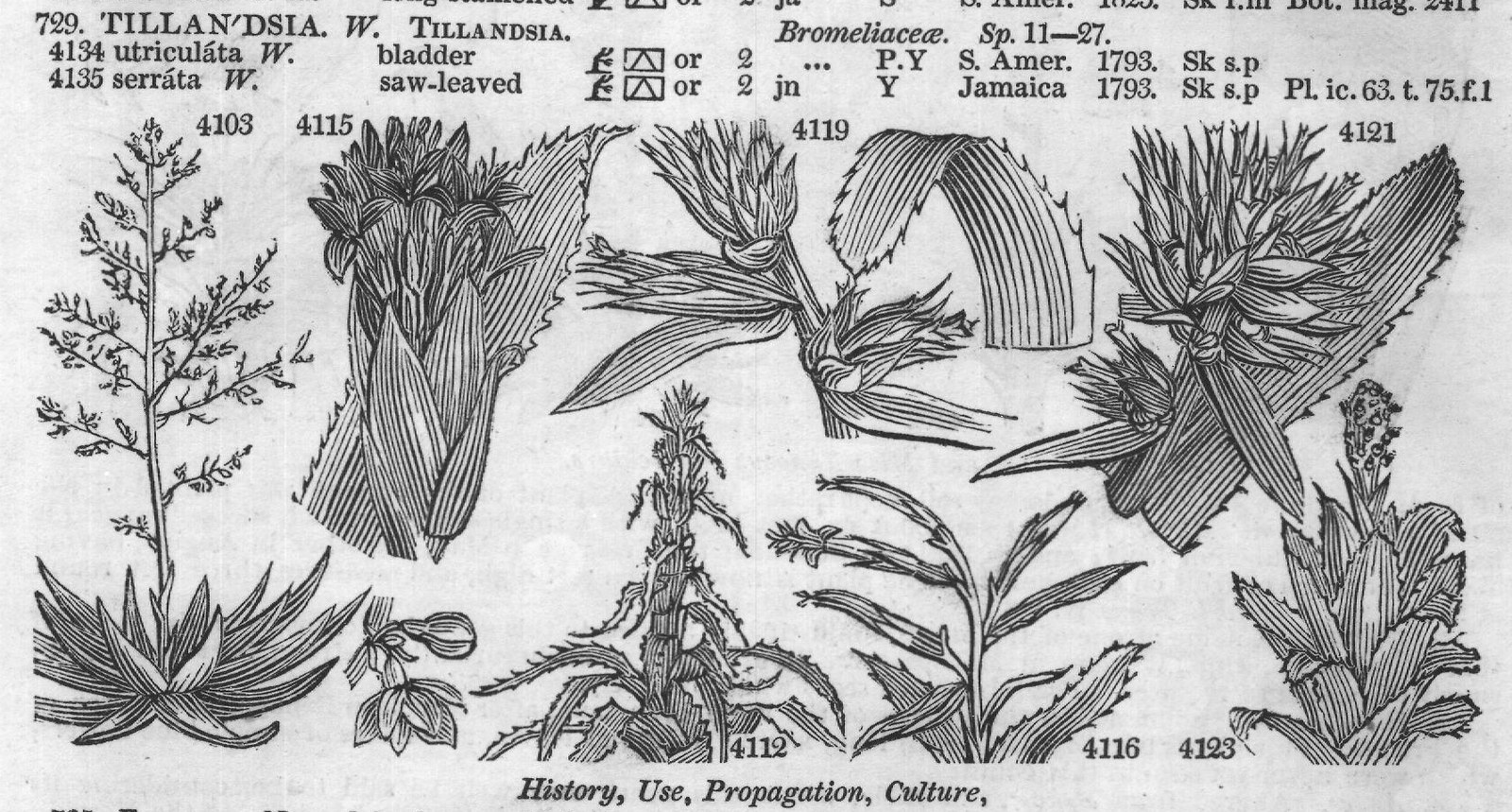
P.Y S. Amer. 1793. Sk s.p 4135 serráta W. saw-leaved or 2 jn Y Jamaica 1793. Sk s.p Pl. ic. 63. t. 75.f.1 4103 4115 4119 4121 4112 History, Use, Propagation, Culture, 4116 4123 725. Furcræa. Named in honor of M. Fourcroy, the famous French chemist. A noble genus resembling the last. 726. Bromelia. So named by Linnæus, in memory of Olaus Bromel, a Swede, author of Lupulogia, and other works, 1694, &c. Ananas, Fr., Ger., and Ital.; and Nanas among the Peruvians, where it was originally found by Europeans. This fruit may, without hesitation, be pronounced the first in the world, though it has not been known in Europe above two centuries, and has only been cultivated about a century as a fruit plant in Britain. It passed from Brazil to the West, and thence to the East Indies, where it has long been successfully cultivated. About the middle of the seventeenth century it was brought to Holland, by Mr. La Court, a merchant, and cultivated at Driehoek, his seat, near Leyden; and from thence it was imported into this country, and first fruited by Sir Matthew Decker, at Richmond, about 1715, or earlier. La Court began by growing his pines without bottom heat, as dry stove plants; but afterwards had recourse to low pits and tanner's bark. Plans of his pits, and an account of his mode of culture, are published in his work, entitled, Aenmerkingen over Lusthoven, Plantagion, &c. (See Ency. of Gard. p. 1129, Anno. 1737.) Sir M. Decker, Bradley informs us, adopted pits; and soon after pine stoves, or larger and more commodious pits, were, by the year 1730, in most of the first English gardens, and some also in Scotland, where the pine-apple was first fruited by Justice, at Crichton, near Edinburgh, in 1732. The pine is now cultivated very generally in Britain, in several places in Ireland, and at most of the capital cities on the continent. In one or two of the southern provinces of Spain, it is grown in sheltered situations in the open air. There are many varieties of the pine in the West Indies, procured by raising from seed: in this country there are upwards of thirty sorts, but the queen, New Providence, and one or two others, are most esteemed, The plants are propagated by suckers, and by that singular production, proceeding from the summit of the fruit, called a crown: from large suckers fruit is sometimes obtained in eighteen months, but, in general, a period of two or three years is required, and for the New Providence sometimes longer. Loamy soil well enriched with rotten dung, and the pots sufficiently drained, with abundance of heat without sudden extremes, will ensure large and well flavored fruit. (See The various Modes of cultivating the Pine-Apple from its first Introduction to the Improvements of Mr. Knight, &c. 8vo. 1822.) Some of the other species of true Bromelia have crowns, and the fruit of most of them is eatable, though small. B. Pinguin has the fruit separately in clusters, and not in a cone or pine, as in the Ananas. It is very common in Jamaica, in most of the Savannahs, and on the rocky hills. It is used there for fencing pas- ORDER I.
HEXANDRIA MONOGYNIA. 4103 Leaves entire, Scape branched 4104 Root tuberous, Leaves very long spiny at edge 4105 Cor. hexapetalous, Leaves ciliate spiny 4106 Leaves linear lanceolate entire upwards, at the base serrate spiny 4107 An obscure plant described by Haworth only and supposed to be Doryanthes excelsa!! 4108 Leaves fringed with spines mucronate, Spike comose 4109 Leaves at the end toothed spiny, Spike comose 4110 Leaves entire, Spike comose 4111 Leaves ciliated spiny mucronate, Raceme terminal 4112 Leaves ciliated spiny with a very long point, Raceme term. comp Flowers sessile shorter than bractea 4113 Leaves ciliated spiny with a very long point, Raceme rigid compound, Flow. in numerous spikes compound, Flow. in numerous lateral spikes 4114 Leaves erect, Flowers stemless sessile aggregate 4115 Radical leaves toothed spiny: cauline entire 4116 Panicle lax few-fl. spreading, Peduncles 1-flowered, Upper spathes fertile as long as flower spreading 4117 Leaves serrate spiny, Bractes lanceolate toothed, Raceme compound shorter than leaves 4118 Leaves serrated spiny obtuse, Spikes alternate 4119 Leaves serrate spiny, Bractes ovate lanceolate, Scape elongated, Raceme compound 4120 Panicle diffuse, Leaves ciliate spiny mucronate recurved 4121 Raceme compound, Flowers heaped shorter than the long red entire bracteæ, Calyx acute 4122 Nearly stemless, Leaves aggregate sessile, Axillæ stoloniferous 4123 Leaves ligulate oblong very blue, Spike oval woolly with small sessile flowers 4124 Scape upright, Spike imbricated, The lower bracteæ green; the upper scarlet 4125 Leaves ciliate spiny, Peduncles and germens quite smooth 4126 Leaves ciliate spiny, Peduncles and germens downy 4127 Leaves narrow glaucous entire, Calyx villous 4128 Leaves entire somewhat spiny at base 4129 Leaves entire a little spiny at base, Bractes as long as peduncle and calyx 4130 Leaves entire white beneath, Raceme imbricated dense 4131 Leaves toothed spiny recurved, above shining smooth, beneath mealy 4132 Spike compound contracted, Leaves ensiform aculeate, Cor. with a black spot at bottom 4133 Leaves linear lanc. entire, Petals revolute, Stamens longer than cor. 4134 Culm panicled 4135 Leaves upwards serrate spiny, Spike comose 4124 4130 4133 4135 4125 4127 4128 and Miscellaneous Particulars. ture lands, on account of its prickly leaves. These, stripped of their pulp, soaked in water, and beaten with a wooden mallet, yield a strong thread which is twisted into ropes and whips, and manufactured by the Spaniards into a good cloth. The juice of the fruit in water makes a cooling draught in fevers; it is extremely diuretic, destroys worms, and makes a good vinegar.
B. Karatas, so called from its Brazilian name, Karaguata-acanga, generally grows at the root of some shady tree, in hilly and woody places in America and the Caribbee islands. It is an elegant plant, producing numerous radical leaves, which are of a subulate-linear shape, sharp pointed, and edged with spines. The flowers are scentless, seated in the bosom or middle part of the plant, rose colored, with the calyx and germ downy.
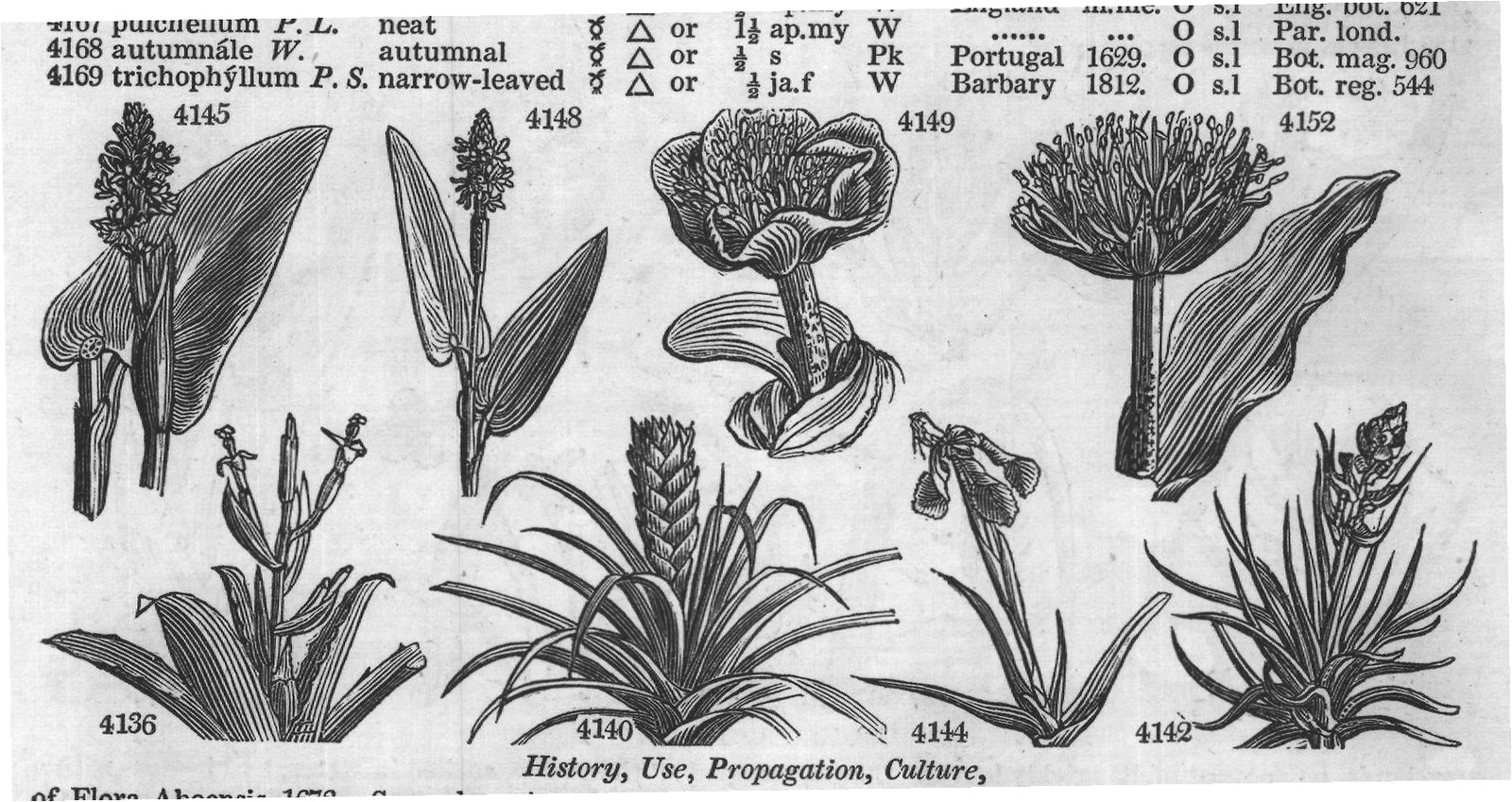
The length of the leaves is six or seven feet. The fruits are oval, two or three hundred in number, and grow sessile in a heap or central group, surrounded by paleaceous expanded leaves or bractes they far from a expanded leaves or bractes; they contain a succulent whitish or yellowish flesh, under a coriaceous and yellowish bark. When ripe, they are of this and yellowish bark. When ripe, they are far from unpleasant but when unripe they set the teeth on edge, and excoriate the mouth. The economy of the , and excoriate the mouth. The economy of this plant in the preservation of its fruit to maturity is wonderful being so protected by the spines suris wonderful: being so protected by the spines of the surrounding leaves, as to be secure from all injuries. B. humilis propagates itself by runners or shooting processes, which proceed from the axillæ of the lower leaves, and produce a young plant from their extremities. Bromelia fastuosa is the most beautiful of the genus. It has never flowered more than once in this country, when the figure in Mr, Lindley's Collectanea Botanica was obtained. Bromelia sylvestris resembles this, but is less beautiful. 727. Guzmannia. Named after Anastatio Guzman, an industrious apothecary, and zealous collector of objects of natural history in South America. A beautiful evergreen herbaceous plant, with the foliage of Tillandsia, and a spike of bracteæ, the uppermost of which are richly colored with rose. 728. Pitcairnia. So named by Mons. L'Heritier, in honor of William Pitcairn, M. D. an eminent physician of London, and a collector of foreign plants, particularly from the Alps. The species are remarkable for their long, narrow, green, prickly leaves, and for their uniform panicles of bright red. Pitcairnia very panicles of bright red. Pitcairnia staminea is very handsome. They require the same treatment as Bromelia. 729. Tillandsia. So named by Linnæus, in memory of Elias Tillandsius, professor of physic at Abo, author R4 HEXANDRIA MONOGYNIA. 4136 amœ'na Lodd. charming or 2 jn W. Indies 1819.
Sk s.p 4137 usneoídes W. 4138 linguláta W. pendulous or 6 Pu W. Indies 1823.
Sk p CLASS VI.
Bot. cab. 76 Pl. alm. t. 26. 1.5 tongue-leaved or 2 jn.jl Y Jamaica 1776.
Sk s.p 4139 flexuósa W.
Jac. amer. t. 62 flexuose or B W. Indies 1790.
R s.p Jac. amer. t. 63 B pállida pale or 1 jn.jl Y W. Indies 1815. R s.D Bot. reg. 749 4140 ánceps Lodd. 4141 nútans W. two-edged or ap B W. Indies 1820. R s.p Bot. cab. 771 nodding or 2 au B Jamaica 1793. R s.p 4142 strícta B. M. stiff-leaved or n B Brazil 1810. Rs.p Bot. mag. 1529 4143 recurváta W. recurve-leaved or jl Pu Jamaica 1793. R s.p 4144 xiphioides B. Reg.
Sl. ja. 1. t. 121.f.1 Air-plant or jl W