Home › B › Bot (Mag Eng bot Lin tr t)
Bot (Mag Eng bot Lin tr t)
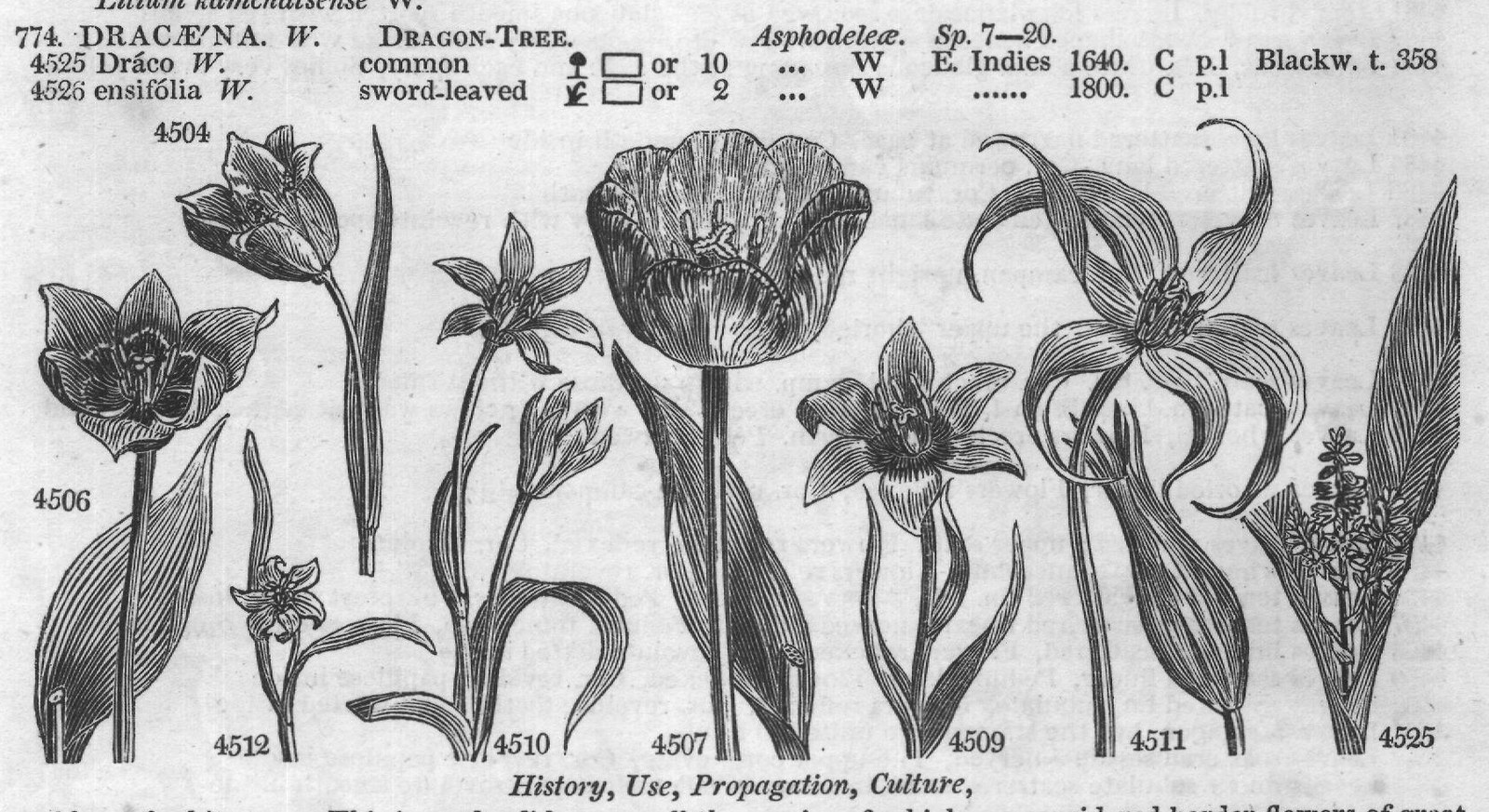
mag. 853 Eng. bot. 622 Lin. tr. 10. t. 11 DRAGON-TREE. common sword-leaved or 10 or 2 W ...
W ... ......
Asphodeleæ. Sp.7-20.
E. Indies 1640. C p.1 Blackw. t. 358 1800. C p.l 4506 4504 4512 4510 4507 4509 4511 4525 History, Use, Propagation, Culture, emblem of whiteness. This is a splendid genus, all the species of which are considered border flowers of great beauty. The more common sorts, species, and varieties, will thrive in any soil and situation, even under the shade of trees. The Canadian, Pomponian, and Philadelphian martagons are somewhat tender, and require the protection of ashes or rotten bark in winter. They are generally planted in borders, and need not be taken up oftener than every three or four years in September, and replanted six inches deep in the October following. None of the species can be safely transplanted after they have pushed leaves, without weakening them so as to prevent their flowering for several years. This remark, indeed, will apply to most bulbous rooted plants. Mr. Griffin, of South Lambeth, whose superior skill in the cultivation of bulbous plants is well known (Hort. Trans. iv. 544.), has been in the practice of keeping the lilium japonicum in pots, protected by a greenhouse or garden frame; but he thinks they thrive best in the former. He places the bulb in twenty-four sized pots, not lower than an inch from the surface of the mould, which is composed of about two-thirds peat and one-third loam, the bottom of the pot being covered to the depth of two inches, with broken pieces of tile and the rough siftings of peat. The plants are kept entirely from frost, and are watered very little when in a dormant state, for they are then very impatient of wet in excess. The pots kept in the greenhouse are placed at a distance from the flue to prevent the mould drying quickly. (Hort. Trans. iv. 554.) Mr. S. Brooks grows in a brick-pit, which he can cover with mats or glasses at pleasure; but he says, it "appears to be sufficiently hardy to endure our winters, as I have had a bed of them two years in the open ground without protection." (Hort. Trans. iv. 552.) 772. Tulipa. Linnæus classed this among barbarous names. In Persian it is called thoùlybân (De Souza), whence undoubtedly its origin. In old French it is called tulipan. T. Gesneriana (Gesner, a Zurich botanist), may be called the king of florists' flowers, having been a prime object of attention with this class of cultivators for nearly three centuries. It appears to have been brought to Europe from Persia by way of Constantinople in 1559, and in a century afterwards to have become an object of considerable trade in the Netherlands, and a sort of mania among the growers, who bought and sold bulbs at prices amounting to 5001. sterling and upwards; in those days an immense sum. The taste for tulips in England was at its greatest height about the end of the seventeenth and the beginning of the eighteenth century. It afterwards declined, and gave way to a taste for rare plants from foreign countries. The tulip, however, is still extensively cultivated in Holland, from which all Europe is supplied with bulbs, and also to a considerable extent in England, both in tradesmen's gardens and in those of the opulent. It is, however, like the auricula, pink, &c. more the poor man's flower than that of the botanists or country gentleman. The varieties of the tulip are endless, and their names arbitrary, like those of all florists' flowers. One of the latest London catalogues (Mason's) enumerates six sorts of early blowing tulips; four perroquets or middle blowers; twenty-two double sorts; and upwards of 600 single late sorts; the last being the only sorts valued by florists as competition flowers. These late sorts are classed by the Dutch as under: -- Prime baguets (baguette, Fr., a rod or wand); very tall; fine cups with white bottoms, well broken with fine brown, and all from the same breeder.
Baguets Rigaut's (supposed from Rigaud, some eminent florist's name, or rougeaude, red face); not quite so tall, but with strong stems, and very large well-formed cups, with white bottoms, bottoms , well broken with fine brown, and all from the same breeder.
ORDER I.
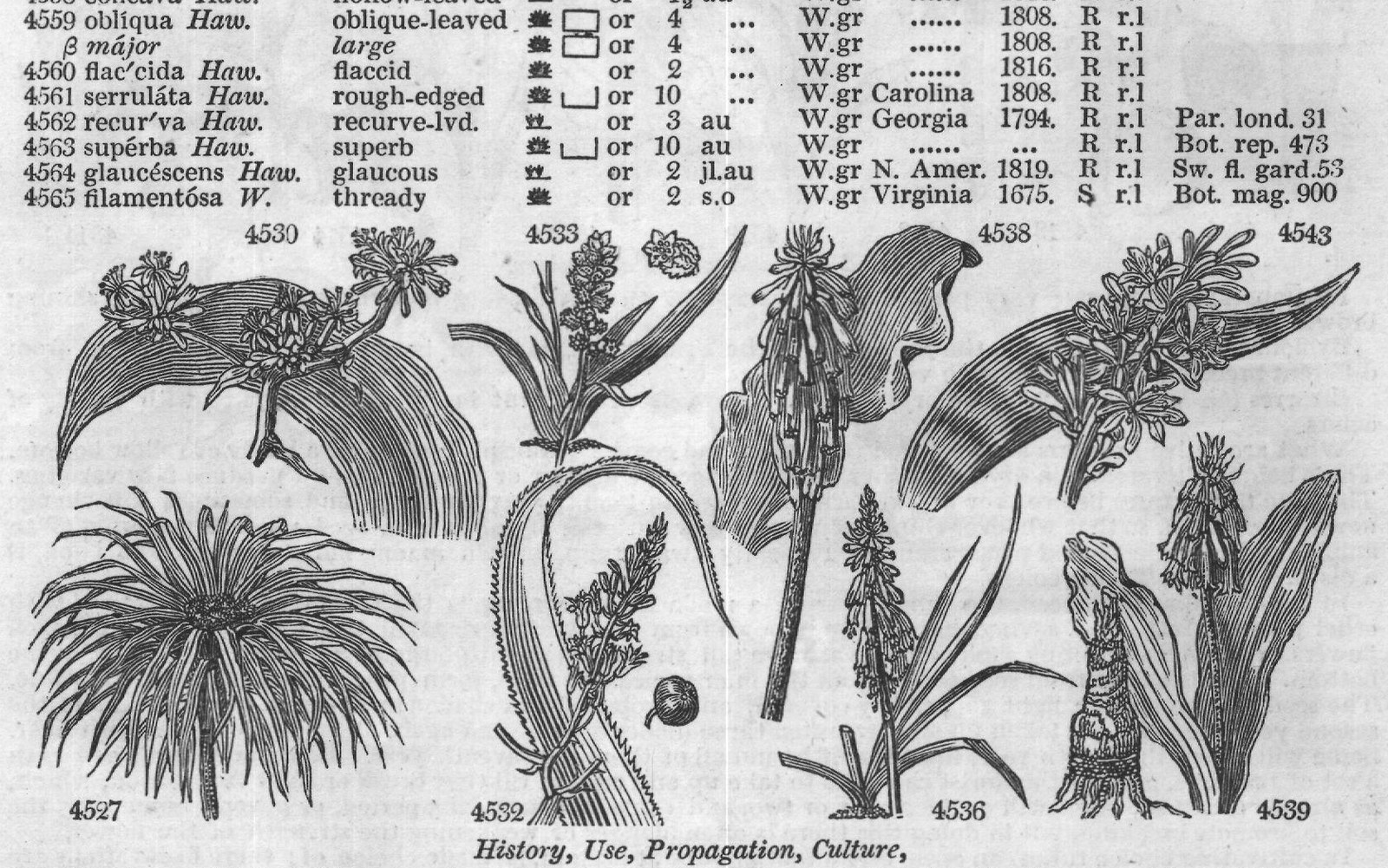
HEXANDRIA MONOGYNIA. 4504 Stem 1-fl. smooth, Flower nodding, Petals acute bearded at end, Leaves lanceolate 4505 Flower erect, Petals lanceol. acuminate, Leaves lanceolate linear 4506 Coat of bulb woolly inside, Leaves ciliated glaucous, Stem and flower smooth 4507 Stem 1-fl. smooth, Flower erect, Petals obtuse smooth, Leaves ovate lanceolate 4508 Stem 1-fl. pubescent, Flower erect, Petals obtuse smooth, Leaves ovate lanceolate 4509 Flower erect stellate with a dark eye, Leaves linear lanceolate 4510 Leaves lin. lanc. convolute, Petals lanceolate greenish outside 4511 One-flowered, Flower from fusiform spreading, Sepals very long caudate 4512 Flowers erect flat, Stem 2-leaved 2-3-flowered, Leaves linear subulate 4513 Raceme comose naked below, Leaves entire 4514 Raceme naked, Leaves oblique 4515 Leaves glaucous numerous oblique, Cor. turbinate 4516 Leaves lanc. alternate remote, Stem 1-flowered naked upwards, Angles of caps, obtuse 4517 Leaves linear whorled opp. and alternate when old cirrhose, Stem many-flowered, Capsule winged 4518 Lower leaves opp. Inner flowers among the leaves 4519 Leaves scattered flat coriaceous glaucous, Cor. campanulate revolutc at end 4520 Leaves alternate linear nerved flat, Stem 1-flowered 4521 Leaves lin. lanc. alternate; the upper approximated shorter than the terminal solitary flower 4522 Leaves lanc. approximated, the upper opp. as long as the terminal solitary flower, Capsule obtuse angled 4523 Leaves alternate linear channelled, Stem one-flowered 4524 Leaves whorled, Flower erect, Cor. campanulate, Petals sessile 4525 Leaves fleshy spiny at end 4526 Herbaceous caulescent, Leaves ensiform 4521 4518 4513 4519 4513 β 4515 4514 4514 β and Miscellaneous Particulars.
Incomparable Verports; very perfect cups, cherry and rose, and white bottoms, well broken with shining brown.
Byblomens, or mixt flowers, the flamands of the French florists, with bottoms white, or nearly so, from different breeders, and broken with variety of colors. Bizarres (bizarre, Fr. odd, irregular); ground yellow, from different breeders, and broken with variety of colors.
What are called breeders are procured from seed, and consist of one plain color on a white or yellow bottom. These being cultivated on a dry and rather poor soil, become broken or variegated, and produce new varieties. The time that elapses before they break, varies from one to twenty years or more, and sometimes this change never takes place, so that whoever thinks of raising new varieties of tulips from seed, must be possessed of an ample fund of patience and perseverance. The early dwarf tulip, known among florists as the Van Tholl, is a distinct species, T. suaveolens.
In raising tulips from seed, the florists pursue a mode in some respects the reverse of that practised with other plants. Instead of saving the seed to be sown from the finest variegated tulips, they prefer unbroken flowers or breeders, selecting such of these as have tall strong stems, with large well-formed cups, clear in the bottom. Plants raised from seed saved from the finer variegated sorts, form poor weak breeders of no value. The seed is sown on fine light soil, thinly covered, and protected and shaded by a frame. At the end of the second year the bulbs are taken up and replanted three inches apart; and again at the end of the fourth year. Some will bloom the fourth year, most the fifth, and all of them the seventh year. Being now furnished with a set of breeders, all that the florist can do is to take up and replant till they break or shew variegation, which, as already observed, some will do in a year or two, and some not for a long period, or never. Some vary the soil to promote breaking, but in doing this there is often danger of weakening the strength of the flower. In cultivating choice tulips, an open airy situation, dry at bottom, is made choice of; there excavations are made commonly in the form of beds four feet broad, of any convenient length, and two and a half or three feet deep. In the bottom a layer of well rotten hot-bed dung is laid and well trod in, and on this two or two and a half feet of rich fresh sandy loam. On this the roots are planted six inches apart, and covered four inches. The best season is the beginning of November. In very severe winters, protection by mats or by a layer of decayed tanner's bark, may be requisite; but the tulip is very hardy, and almost the only protection it requires is shading and shielding from rain and winds during full bloom. The bulbs should be taken up annually, as soon as the flowers are decayed, and kept in a dry airy situation till wanted for planting. (See Madocks, Hogg, Emerton, &c.) T. clusiana and T. celsiana are both elegant little border bulbs, inferior indeed to their prototypes in splendour of coloring, but more elegant in their simplicity. 773. Fritillaria. Fritillus signifies a dice-box, and is said to have been the origin of this name. This is a genus with flowers shewy and singular in appearance. They require a deep loamy soil, and are readily increased by offsets or seeds. They will grow in the shade of trees and shrubs, and do not require to be taken up above once in three years. 774. Dracena. From Δρaκaiva, the female of δράκωv, a dragon, because the inspissated juice becomes a red powder very like the eastern dragon's blood, D. draco has the habit of a palm. The trunk is nearly 4531 ováta B. M. 4527 umbraculifera W. umbel-flowered 4528 cérnua W. 4529 férrea H. K. 4530 frágrans H. K. 775. PHYLLO'MA. B.M. PHYLLOMA. drooping purple or 8 mr.ap W sweet-scented or 6 f.my W oval-like or 2 au.s Pk HEXANDRIA MONOGYNIA. 어어어어 or 10 W or 10 my W Mauritius 1788. C p.l Mauritius Cpl China 1771. R p.1 1768. R p.1 R p.l CLASS VI.