Home › E › Euphorbiaceæ (Sp nap if lia W)
Euphorbiaceæ (Sp nap if lia W)
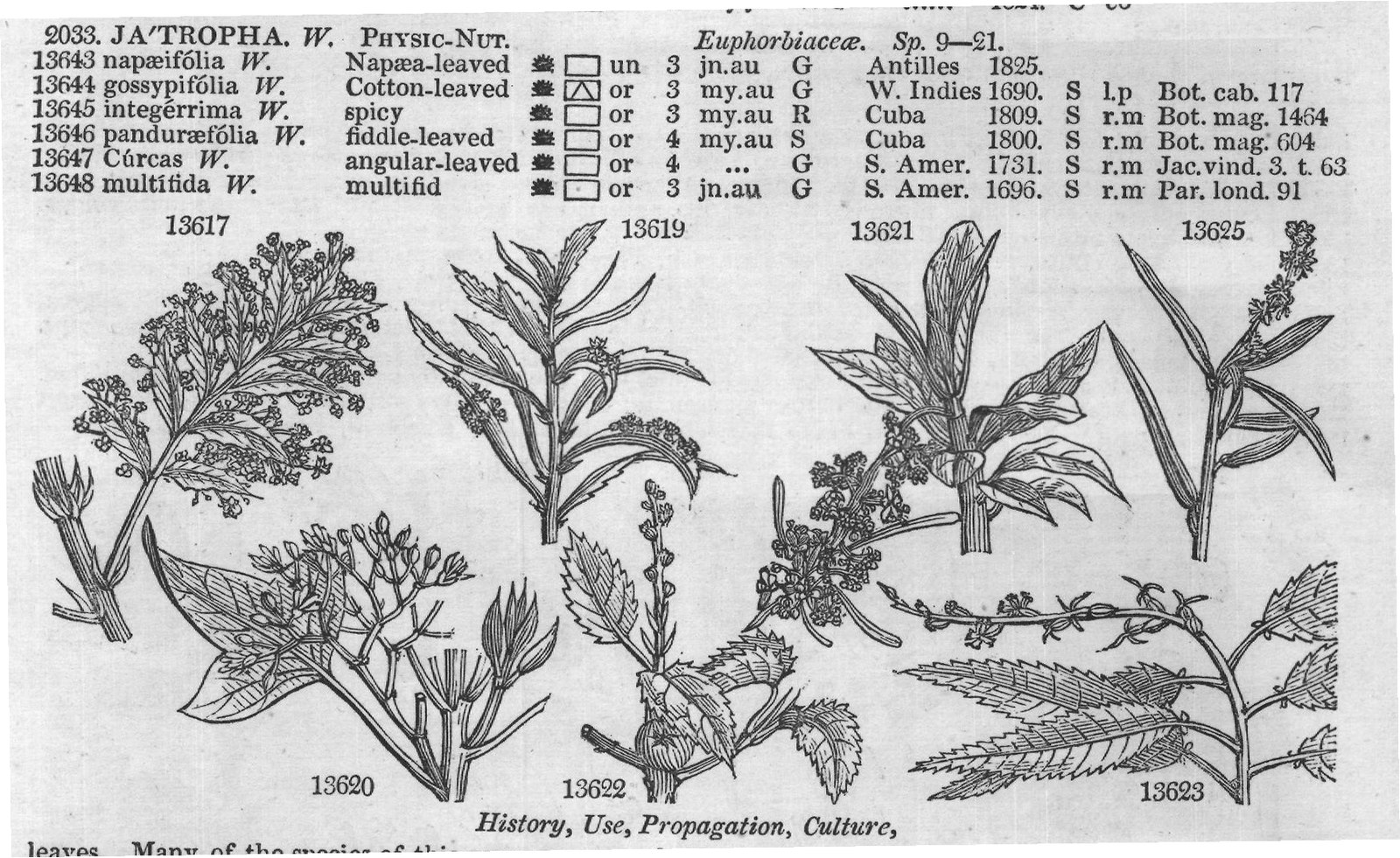
Sp. 9-21. 13643 napæifólia W.
Napæa-leaved un 3 jn.au G Antilles 1825. 13644 gossypifólia W.
Cotton-leaved or 3 my.au G 13645 integérrima W.
W. Indies 1690. spicy or Cuba 3 my.au R 13646 panduræfólia W. 1809. fiddle-leaved or 4 my.au S Cuba 1800.
S l.p Bot. cab. 117 Sr.m Bot. mag. 1464 Sr.m Bot. mag. 604 13647 Cúrcas W. angular-leaved or 4 G ... 13648 multífida W. multifid or 3 jn.au G 13617 13619 S. Amer. 1731. S r.m Jac.vind. 3. t. 63 S. Amer. 1696. Sr.m Par. lond. 91 13621 13625 13620 13622 History, Use, Propagation, Culture, 13623 leaves. Many of the species of this genus are remarkable for the neatness of their foliage and general aspect. The abolished genus Xylophylla, which is now included in Phyllanthus, is very generally cultivated on account of the pretty and at the same time singular appearance of its leafless leaf-like branches, covered over at the edges with multitudes of pink flowers. All the species require common stove culture. 2028. Aleurites. From aλείaς, flour, all the parts of the plant seeming to be dusted with a farinaceous substance. A handsome plant of easy culture, and ripe cuttings with their leaves untouched, root in sand under a hand-glass. 2029. Omphalea. A curtailment of Omphalandria, a name under which Dr. Patrick Browne, in his History of Jamaica, first described the plant. He formed it from a navel, and avns, a stamen ; because the Jamaica, first described the plant. He formed it from oμφaλoς, a navel, and avης, a stamen; because the male organs are collected in a fleshy navel-like mass occupying the centre of the flowers. It grows freely in light loamy soil, and cuttings, with their leaves uninjured, root in sand under a hand-glass. 2030. Hippomane. From ἰππoς, a horse, and μavia, madness; the name was given by the Greeks to a plant which grew in Arcadia, and which possessed the dangerous property of making horses furious. This Hippomane must not, however, be confounded with that of Virgil (third Georgic), which is an animal substance.
The Manchineel-tree grows to a vast size on the sea coast of the Caribbee Islands and neighbouring continent. The leaves are ovate, serrated, acute, and very shining. The fruit fall off from the tree spontaneously, and leaves are ovate, serrated, acute, and very shining. The fruit fall off from the tree spontaneously, and pave all the ground with their numbers. They are highly poisonous , and are said to be eaten by the sea-crabs, which collect about the trees in vast numbers. But this is supposed by Jacquin to be a vulgar error. The whole tree abounds with a white milk, which is highly poisonous, and so very caustic, that a single drop placed upon the skin instantly causes the sensation of a hot iron, and in a short space raises a blister. It is a common belief that to sleep beneath the branches is death; but Jacquin and his companions reposed under it for three hours at a time without inconvenience. The wood is a most beautiful material for furniture, being finely variegated with brown and white, and susceptible of a high polish. The workmen who fell the trees, first kindle a fire around the stem, by which means the juice becomes so much inspissated as not to follow the blows of their axes. Whole woods on the sea-coast of Martinique have been burnt, in order to clear the country of such a dangerous pest.
ORDER VIII.
MONECIA MONADELPHIA. 13617 Leaves pinnate lanceolate acuminate subcrenate coriaceous, Flowers stalked 13618 Leaves pinnate linear-lanceolate lined crenate, Flowers stalked hermaphrodite 13619 Leaves scattered linear-lanceolate subfalcate crenate, Flowers subsessile 13620 Leaves 3-lobed 13621 Leaves oblong blunt very smooth, Flowers triandrous, Stem arborescent 13622 Leaves ovato-serrated 13623 Leaves oblong acuminate serrulate, Petioles with 2 glands at the end 13624 Leaves lanceolate entire smooth variegated stalked 13625 Leaves linear entire stalked downy beneath 13626 Leaves elliptical entire bluntish hoary downy beneath stalked, Spikes terminal few-flowered 13627 Leaves ovate lanceolate plaited serrated scabrous 13628 Leaves ovate bluntish entire smooth, Fruit stalked 13629 Leaves ovate rhomboid repand entire at base hoary on each side, Pedunc. terminal about 3-fl. 13630 Leaves ovate serrated at end hoary downy beneath, Stipules ciliated, Spikes terminal subcapitate bracteate 13631 Leaves ovate acuminate serrated smooth with 2 glands at base, Petioles shorter than leaf, Racemes term. 13632 Leaves ovate acuminate entire smooth silvery with scales ben. Racemes comp. axillary, Stem arborescent 13633 Leaves cordate ovate attenuate somewhat toothletted warted and green above, silvery and shining beneath 13634 Leaves cordate acuminate serrulate rough above downy beneath with 4 glands at the base 13635 Lvs. round.-cord. acum. ent. glandular-ciliated downy beneath, A fascicle of stalked glands at base of lvs. 13636 Leaves oblong subcordate serrulate scabrous downy beneath with 2 glands at the base, Raceme terminal 13637 Leaves ovate acute subcordate entire scabrous above downy beneath 13638 Leaves subcordate angular blunt repand scabrous downy beneath 13639 Leaves obl.-lanc. subcordate scabrous downy beneath and with 2 glands at base, Branches densely downy 13640 Leaves 3-5-lobed serrated with hairy petioles, Stem herbaceous 13641 Leaves oblong-lanceolate obtuse at base variegated and stained with red, Spikes axillary suberect 13642 Downy, Leaves cordate roundish blunt repand greenish above hoary beneath 13643 Leaves palmate 7-lobed hispid beneath stinging: lobes pinnatifid, Petiole with 1 gland at end 13644 Lvs. cord. 5-lobed serrated fringed with glands, Branched glandular hairs in axillæ of leaves and petioles 13645 Leaves ovate acuminate entire very smooth, Racemes subcymose 13646 Leaves oblong subpanduriform acuminate entire angular at base with 2 teeth on each side 13647 Leaves cordate angular 13648 Leaves palmate 11-lobed smooth: lobes pinnatifid cuneate, Stipules setaceous multifid 13644 13631 13636 13635 13646 13641 13648 and Miscellaneous Particulars. 2031. Sapium. A name unaer which Pliny indicates a sort of pine, so named from the abundance of resin which it produces; from sap, fat or greasy in Celtic. The Americans employ the juice of Sapium aucuparium as bird-lime, for catching parrots and other birds. For this purpose they cut off a limb of the tree, and the next day collect the sap which has flowed out and become inspissated. They call it Mangle cautivo. The juice is also burned in lamps. Cuttings root freely in sand under a hand-glass. 2032. Croton. The Greek name of a certain insect called ricinus by the Latins, which the fruit of Croton resembles.
Croton Tiglium affords an oil used in medicine, which is so powerfully irritating, that a small drop placed upon the tongue, has the effect of exciting an irritation along the whole intestinal canal, which does not soon subside. It is usually employed in mixture with oil of almonds, in order to weaken its too violent powers. C. lineare in its general appearance resembles rosemary, and is called wild rosemary in Jamaica. C. tinctorium is used to dye both silk and wool of an elegant blue color, and the juice is used to color wines and jellies. The substance for this purpose is called Turnsol, and is made of the juice which is lodged between the calyx and the seeds: this, if rubbed on cloths, appears at first of a lively green, but soon changes to a blueish purple; if these cloths are put into water, and afterwards wrung, they will dye the water of a claret color; the rags thus dyed are brought to England, and sold in the druggists' shops by the name of Turnsol. C. Eleuteria furnishes the Cascarilla bark, which is chiefly imported from Eleutheria, one of the Bahama Islands. It consists of pieces of about six or eight inches long, scarcely one-tenth of an inch thick, quilled, and covered with a thin whitish epidermis.. It has a pleasant spicy odor, and a bitter warm aromatic taste. It is very inflammable, and is easily distinguished from all other barks by emitting, when burnt and extinguished, a fragrant smell resembling that of musk. Medically, this bark is a valuable carminative and tonic, and is an excellent adjunct to the Cinchona bark in fevers. C. lacciferum, a plant not yet in gardens, is one among several species on which the gum lac is said to be produced. Some of the spines we are in possession of, are much admired for their variegated leaves: all of them are freely propagated by cuttings with the leaves on, planted in sand, and plunged in moist heat under a hand-glass. 2033. Jatropha. From iaπρov, a remedy, and φaγω, to eat. The J. Manihot (Mandioka, Brazilian) or Cassa- MONECIA MONADELPHIA.
CLASS XXI. 13649. Mánihot W. 13650 úrens W.
Cassava clt 3 jl.au G stinging or 3 my.jl G 13651 herbácea W. annual un jl.au G S. Amer. 1739.
Brazil 1690.
Vera Cruz 1759.
Sr.m Sloan.jam. 1. t.85 S r.m Bot. cab. 478 Sr.m Reliq.hou.6. t. 15 2034. RICINUS. W.
PALMA-CHRISTI.
Euphorbiacca. Sp. 9-10. 13652 commúnis W.
Castor-oil plant m 6 jlau G 13653 víridis W. green or 6 au G E. Indies 1548. S co E. Indies 1802. S s.p Bot. mag. 2209 W. hort. ber. 49 13654 africánus W. 13655 lívidus W.
African or 15 jl.au G Africa ...
S s.p. livid-leaved or 8 jl Pu C. G. H. 1795. S s.p Jac. ic. 1. t. 196 13656 inérmis W. smooth-capsul. or 6 jl.au Pu India 13657 armátus B. R. rough-capsuled or 6 jl.s G Malta 1758. S s.p 1807. S s.p 13658 Tanárius W. scollop-leaved or 4 jl.s G E. Indies 1810. S s.p Jac. ic. 1. t. 195 Bot. rep. 430 Rum.am.3. t. 121 2035. HU'RA. W.
SANDBOX-TREE.