Home › E › Euphorbiaceæ (Sp twin-spined gr jn au Ap C G)
Euphorbiaceæ (Sp twin-spined gr jn au Ap C G)
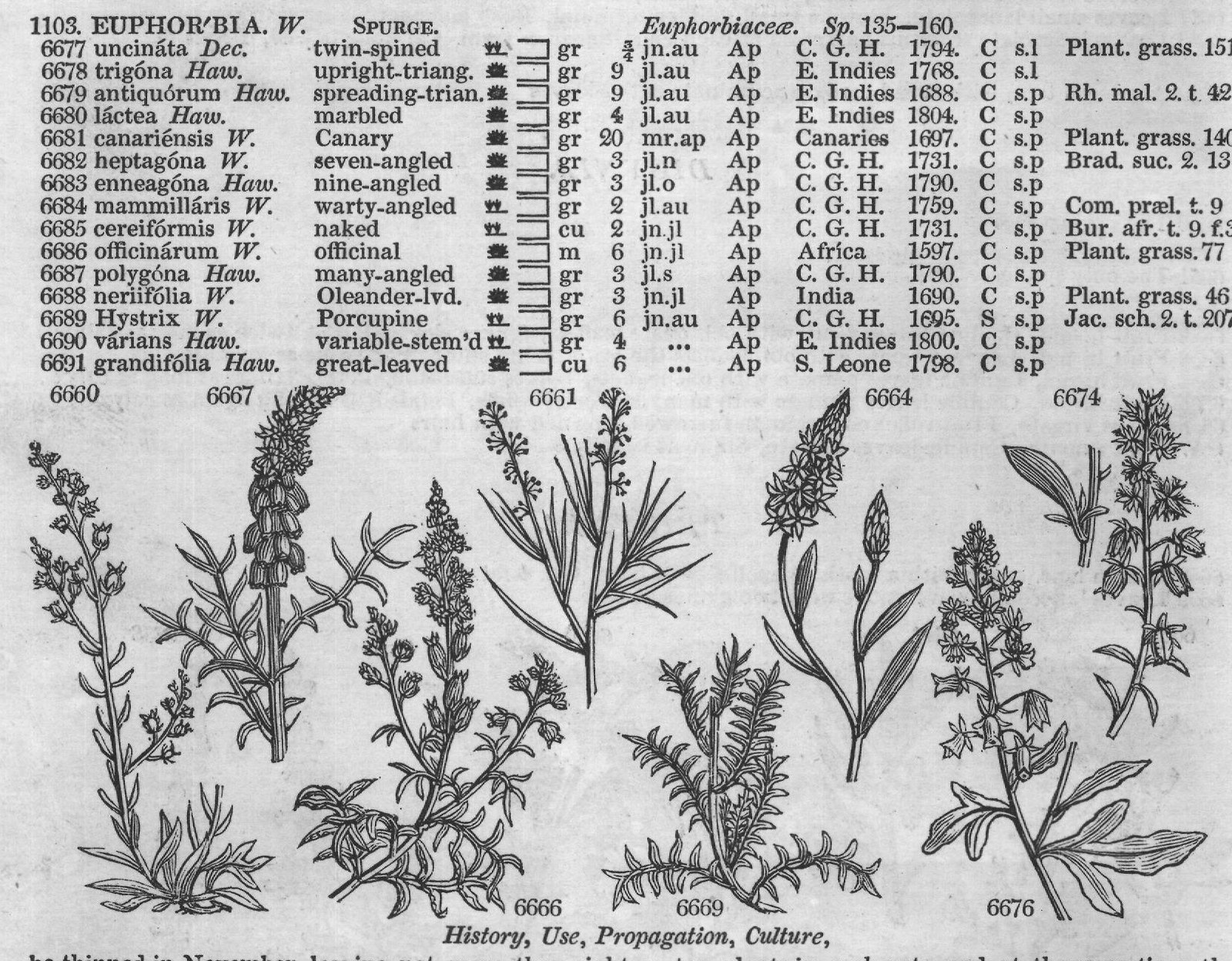
Sp. 135-160. twin-spined gr jn.au Ap C. G. H. 1794. C s.l Plant. grass. 151 upright-triang. gr 9jl.au Ap E. Indies 1768. C s.l spreading-trian. gr 9 jl.au Ap E. Indies 1688. Cs.p Rh. mal. 2. t. 42 marbled gr 4 jl.au Ap E. Indies 1804. C s.p Canary gr 20 mr.ap Ap Canaries 1697. C s.p Plant. grass. 140 140 seven-angled gr 3 jl.n Ap C. G. H. 1731. C s.p Brad. suc. 2. 13 nine-angled gr 3 jl.o Ap C. G. H. 1790. C s.p warty-angled gr 2 jl.au Ap C. G. H. 1759. C s.p Com. præl. t. 9 naked cu 2 jn.jl Ap C. G. H. 1731. C s.p Bur. afr. t. 9. f.3 officinal m 6 jn.jl Ap Afríca 1597. Cs.p Plant. grass. 77 many-angled gr 3 jl.s Ap C. G. H. 1790. C s.p Oleander-lvd. gr 3 jn.jl Ap India 1690. C s.p Plant. grass. 46 Porcupine gr 6 jn.au Ap C. G. H. 1695. S s.p Jac. sch. 2. t. 207 variable-stem'd gr 4 ...
Ap E. Indies 1800. C s.p 6691 grandifólia Haw. great-leaved cu 6 ...
Ap S. Leone 1798. C s.p 6660 6667 6661 6664 6674 6666 6669 History, Use, Propagation, Culture, 6676 be thinned in November, leaving not more than eight or ten plants in each pot; and at the same time, the pots being sunk about three or four inches in some old tan or coal ashes, should be covered with a frame, which it is best to place fronting the west: for then the lights may be left open in the evening, to catch the sun whenever it sets clear. The third, or spring crop, should be sown in pots, not later than the twenty-fifth of February; these must be placed in a frame, on a gentle heat, and as the heat declines the pots must be let down three or four inches into the dung-bed, which will keep the roots moist, and prevent their leaves turning brown, from the heat of the sun, in April and May. The plants thus obtained, will be in perfection by the end of May, and be ready to succeed those raised by the autumnal sowing. (Rishon in Hort. Trans. ii. 372.) R. odorata frutescens, if left to itself, hardly appears a distinct variety, but trained against a wall or to a stick it, and also the common mignonette, may be made to assume a frutescent character. According to Sabine, the tree mignonette is to be propagated from seeds sown in spring; it may also be increased by cuttings, which will readily strike. The young plants should be put singly into small pots, and brought forward by heat, that of a gentle hot-bed being preferable, but they will grow well without artificial heat. As they advance, they must be tied to a stick; taking care to prevent the growth of the smaller side shoots, by pinching them off, but allowing the leaves of the main stem to remain on for a time to support and strengthen it. When they have attained the height of about ten inches or more, according to the fancy of the cultivator, the shoots must be suffered to extend themselves from the top, but must be occasionally stopped at the ends, to force them to form a bushy head, which by the autumn will be eight or nine inches in diameter, and covered with bloom. Whilst the plants are attaining their proper size, they should be shifted progressively into larger pots, and may ultimately be left in those of about six inches in diameter at top. (Hort. Trans. iii. 181.) Mr. Lindley's theory of the nature of the inflorescence of this genus being remarkable, and only explained in his Collectanea Botanica, which is in few hands, it is here transcribed entire. "The usual idea of the flower of Reseda has been, that it is furnished with a calyx of a variable number of divisions, with as many petals, producing from their surface certain anomalous appendages, and with an ovary and stamens inserted on a great fleshy body, called nectary by Linnæan botanists, squama by others, and raised to the rank of a distinct organ by M. Mirbel, under the name of Gynophore. To us, however, it has always appeared, that this could by no means be the real structure of the plant, and that by a slight alteration of terms it not only might be much more satisfactorily explained, but its real affinity ascertained with some degree of probability. For even allowing for a moment an analogy between the nectary of this plant and the discus of others, particularly of some Tiliaceæ, there is still a great difficulty remaining to be overcome in the anomalous structure of the supposed petals, of which we can imagine no probable explanation. We are therefore of opinion, that a much more natural mode of understanding Reseda is to consider it as having compound flowers; taking the calyx of authors for an involucrum, their petals for neutral florets, and their nectary for the calyx of a fertile ORDER III.
DODECANDRIA TRIGYNIA. 6660 Leaves lanceolate wavy hairy 6661 Leaves linear toothed at base, Styles 4 6662 Leaves linear entire, Styles 4, Barren florets 2 6663 Leaves linear entire, Fl. trigynous, Fruit clavate, Stem twiggy 6664 Leaves lanceolate entire, Fruit stellate 6665 Nearly related to R. luteola, but the leaves are not toothed at base 6666 Leaves pinnate recurved at end, Styles 4, Involucre 5-parted spreading, Stem half shrubby 6667 Leaves pinnate, Styles 4, Involucres 6-parted 6668 Branches above and younger leaves covered with large distinct blisters 6669 Leaves pinnate wavy, Styles 3 or 4 6670 Leaves bipinnatifid very rough, Flowers spiked 6671 Leaves all trifid: segments of the upper leaves linear flat; of the lower lanceol. wavy, Stem quite simple 6672 Leaves linear simple or trifid, Stem erect branched, Fruit obovate 6673 Leaves all trifid: the lower pinnate 6674 Leaves entire and 3-lobed, Involucres 6-parted very large 6675 Leaves entire and 3-lobed, Involucres shorter than florets 6676 Leaves entire and 3-lobed, Involucres as long as florets §1. Stem thick, fleshy, naked, or with a few leaves, Flowers dispersed. * Prickly. 6677 Fleshy prickly compressed channelled inflexed at end, Prickles twin diverging 6678 Naked erect prickly triangular jointed, Branches erect somewhat channelled 6679 Prickly nearly naked triangular jointed, Branches spreading 6680 Naked prickly jointed with 3-cornered expanded branches obsoletely marbled with white 6681 Prickly naked nearly quadrangular, Prickles twin hooked, Fl. subsessile 6682 Prickly naked with 7 angles, Prickles solitary subulate flower-bearing 6683 Prickly naked erect with 9 angles, Prickles solitary flower-bear. ascending fuscous, Branches pendulous 6684 Prickly half naked, Angles warted with spines between, The young warts leafy 6685 Prickly naked with many angles, Prickles solitary subulate 6686 Prickly naked with many angles, Prickles twin 6687 Prickly naked with numerous simple erect 10-13-angled stems, Prickles dark 6688 Prickly half naked, Prickles twin, Angles obliquely warted leafy upwards, Leaves oblong 6689 Stem round half naked leafy upwards, Leaves lanc. linear, Peduncle 1-fl. at length spiny 6690 Prickles twin, Stem rounded or angular, Angles obliquely warted, Leaves nearly oblong 6691 Prickles twin horizontal, Stem rounded simple, Leaves oblong spatulate very large 6686 6681 6679 6682 6685 6689 6688 and Miscellaneous Particulars. floret in the middle. In support of this opinion, we may observe, firstly, that there is a difference in the time of expansion of the neutral florets, and of the stamens of the fertile one; the former being quite open, in very many capituli, before one anther of the latter has burst in a single flower. Secondly, that there is an evident analogy between the appendages of the neutral florets, and the stamens of the perfect florets; inasmuch as in Reseda odorata those of the upper sterile florets are of nearly the same number as the real stamens; because in Reseda alba, and some others, in which a union of filaments takes place in the perfect floret, there is a corresponding but more complete union of the sterile appendages; and because occasionally, in Reseda odorata, stamens are changed into bodies altogether similar to the sterile appendages, and in Reseda Phyteuma the same appearance is always assumed by the perfect stamens after the anthers have performed their functions. Thirdly, that there is an equal analogy between the calyx of the neutral florets, and that of the perfect floret; because both have a peculiar glandular margin; the same form; both produce their stamens from their surface; and because the upper edge of the calyx in sterile florets has the same relation to the axis of each particular head, as that of the perfect floret has to the axis of the whole inflorescence. In Reseda Phyteuma, which has the margin of its neutral florets rolled back, the same thing occurs in the perfect floret. Fourthly, that there is no instance of the same analogy existing between the discus and petals of other plants. We may also observe, that in Reseda Phyteuma, there is a campanulate tube to the calyx, into the upper edge of which the stamens are inserted. "To determine the affinity of Reseda to other orders, will not be so easy as to explain its structure. One cannot avoid remarking the resemblance between its calyx and the squama of Amentaceæ and Ultaceӕ. Ficoideæ, Grossulaceæ and Cacti, on account of placentation and structure of seed, may be supposed to have a certain relation to it: as may Chenopodeæ with regard to inflorescence, absence of petals, and habit. But we are disposed to believe its real place in the system is in the neighbourhood of Euphorbiaceæ, where we have placed it in Flora Scotica. They agree with it in having the same sort of aggregation of flowers, similar habit, no corolla, and ternary division of ovarium. The insertion of their ovula is the same, as is also the direction of the radicle. They differ, however, firstly, in the presence of albumen; which yet is not entirely absorbed in Reseda till the seed is perfectly ripe, and which exists even after that time in the seed of R. alba, where it is fleshy as in Euphorbiaceæ. Secondly, in their solitary seeds; in which respect Resedaceæ may be supposed to bear the same relation to Euphorbiaceæ as Campanulaceæ do to Composite; or as some sections of Rubiaceæ to the others. In R. suffruticulosa the ovules appeared to be reduced to a single row, and the same is said to obtain in Ochradenus. Thirdly, in elastic dehiscence of capsule; but as this is not universal in Euphorbiaceæ, it is not, strictly speaking, an objection of importance." (Lindley's Coll. Bot.) 1103. Euphorbia. Euphorbus was physician to Juba, king of Mauritania, and first used this plant in medicine. This is a genus of grotesque and curious plants, few of them of either beauty or use, and most of 6696 melofórmis W.
Cucumber-like 6692 cucumerína W. 6693 magnimam'ma Haw.large-warted 6694 lanífera Haw. wool-bearing 6695 geminispína Haw. double-spined Melon-like DODECANDRIA TRIGYNIA. gr gr Ap C. G. H.
CLASS XI.
Cs.p Vail. it. t. 5 Ap Mexico 1823. C s.p gr 3 Ap Mexico 1823. C s.p gr 3 Ap Mexico 1823. C s.p gr my.s Ap C. G. H. 1774. C s.p Bot. rep. 617 6697 Caput-medúsæ W. gr. Med. Head gr 2. au Ap Africa 1731. Cs.p Bot repe 617. 7 Com. præl. t. 7 6698 tesselláta Haw. chequer'd M.H. gr 1 au Ap .. 1788. C s.p 6699 fructuspína Haw. small Med. Hd. grau Ap C. G. H. 1731. C s.p Plant, grass. 150 6700 procúmbens Haw. least M. Hd. gr au Ap C. G. H. 1768. C s.p Bur. afr. t. 10. f.1 6701 anacántha W. 6702 cláva W. scaly gr 1 s.o Ap C. G. H. 1727. Cs.p Plant. grass. 144 club gr 1 mr.au Ap C. G. H. 6703 bupleurifólia W. 6704 mauritánica W. cone-shaped 业 gr 1½ jn.jl Ap C. G. H.
Barbary cu 1 jn.au Ap Africa 6705 hamáta Haw. hooked cu 1 ...
Ap C. G. H. 1795. Cs.p 1774. C s.p 1791. C s.p 1732. C s.p Jac. ic. 1. t. 85 Di. el. t. 289.f.373 Bur. afr. t. 6. f. 3 Jac. sch. 1. t. 106 6706 Ornithópus Jacq.
Bird's-foot gr 1 jn.au Ap C. G. H. 1816. C s.p Jac. frag. t. 120 6707 aphýlla Brouss. leafless cu 1 jn.au Ap Teneriffe 1815. C s.p 6709 Tirucálli W. 6711 piscatória W. 6708 balsamífera W. 6710 atropurpúrea. W. en. dark-purple smth. spear-lvd.
Balsam cu 1 ...
Ap Canaries 1779. C s.p Indian-Tree gr 3 ...
Ap India 1690. C s.p Rh. mal. 2. t. 44 6712 bracteáta Jacq. 6713 péndula Haw. bracteated pendulous VOCC cu cu 3 3 ...
Ap Teneriffe 1815. C s.p ...
Ap Canaries 1777. C s.p cu 1 ...
Ap ...... 1809. Cs.p Jac. sch. 2. t. 276 cu 1 ...
Ap ...... 1808. C s.p 6714 dendroídes W. tree-like 业 cu 1½ 2 ...
Ap Italy 1768. C s.p 6715 cyathóphora W. colored pr 1 jl.au Ap S. Amer. 1806. C s.p Bot. reg. 765 6716 repánda Haw. waved ✓ cu 2 au Ap E. Indies 1808. C s.p 6717 biglandulósa Haw. 6718 nudiflóra Jac. twin-glanded cu 3 s Ap Bourbon 1808. C s.p naked-flowered cu 6 au Ap ...... 1800. C s.l Jac. ic. 3. t. 470 6727 hypericifólia W. 6728 Humbóldtii W. en. 6730 rósea W. 6719 cotinifólia W. 6720 petioláris Sims. 6721 mellifera W. 6722 linarifólia W. 6723 variegáta B. M. 6724 prunifólia Jacq. 6725 ocymoídea W. 6726 dentáta Mich. 6729 prostráta W. 6731 maculáta W. long-stalked honey-bearing.
Toad-flax-lvd. pie-bald Plum-leaved Cotinus-leaved or 10 jl.au Ap S. Amer. 1690. C s.p Hook. ex. fl. 59 cu 3 my.jn Ap pr 6 ap.my Ap cu 3 ...
Ap ......
W. Indies 1800. C s.p Madeira 1784. C s.l 1794. C s.l Bot. mag. 883 Bot. mag. 1305 Jac. ic. 1. t. 86 cu S Ap Louisiana 1811. S s.l Bot. mag. 1747 cu 2 jn.jl Ap ...... 1799. S s.l Jac. sch. 3. t. 277 Basil-leaved w 1 jn.au Ap toothed W 1 jn.jl Ap Hypericum-lv.
W 1½ jn.s Ap Humboldt's w 1 jl.o Ap trailing red w jl.o Ap resy w au Ap spotted W 1 jl Ap 6732 pícta W. painted w 1 my.jl Ap 6733 pilulífera W. globular w jn.au Ap 6734 hyssopifólia W. 6735 thymifólia W.
Hyssop-leaved w 1 au.s Ap thyme-leaved w jl.au Ap 6736 chamæsýce W. scollop-leaved Ow jlau Ap 6737 Péplis W. purple W 1 jl.au Ap 6738 polygonifólia W. knot-grass-lvd.
W jn.jl Ap Ap 6739 Ipecacuánhæ W.
Ipecacuanha W 2 jn.jl Ap 6740 canaliculáta Pers. channelled W 1 jn.jl Ap 6741 Péplus W. petty 6742 falcáta W. 6743 exígua W. sickle-leaved dwarf 000 W jl.au Ap 12 6696 6703 W W 6702 1 jn.au Ap Ap jl S. Amer. 1733. S s.l N. Amer. 1806. S s.l America 1727. S s.1 Hook, ex. fl. 36 S. Amer. 1809. C s.l W. Indies 1758. S s.l S. Amer. 1789. S s.1 E. Indies 1800. C s.l W. Indies 1787. C s.l India 1699. S s.1 S. Europe 1752. S s.1 England sea.sh. S s.l N. Amer. 1704. S s.l N. Amer. 1812. D s.l Carthagin.1819. S co Britain clt. gr. Cs.l S. Europe 1699. C s.l Britain cor. fi. C s.l Jac. vin. 2. t.186 Pl. alm.t. 113. f.2 Mo.h. 10. t.2.f.19 Eng. bot. 2002 Jac. co. s. t.13.f.3 Bot. mag. 1494 Bot. cab. 727 Eng. bot. 959 Jac. aus. 2. t. 121 Eng. bot. 1336 E. Indies 1808. S s.l S. Amer. 1660. S s.1 Jac. ic. 3. t. 477 Jac. ic. 3. t. 478 90 bive 6706 6709 6712 History, Use, Propagation, Culture, 6619 the annuals poisonous weeds. One species (E. edulis), not yet introduced, is said to be used as a pot-herb in Cochin China; one (E. punicea) is a very splendid plant, and the E. officinarum, and one or two other species gathered along with it, are used in medicine. They are all milky, mostly herbaceous, several however shrubby, upright for the most part, very few of them creeping; some are leafless, but most of them are leafy. Stems angular or tubercled, or more frequently cylindric or columnar; unarmed, or in the angular sorts resernbling the upright Cactuses, and armed with prickles, which are either solitary or in pairs, placed in a single row on the top of the ridges. Such as have leaves have them simple, most frequently alternate and naked; in some sorts, however, they are opposite, and are then commonly attended with stipules, and in a few they are placed by threes in whorls. Peduncles in the leafless sorts naked, bearing from one to three flowers; in the leafy ones axillary, but more frequently from two to five or more in a terminating umbel; each some- ORDER III.
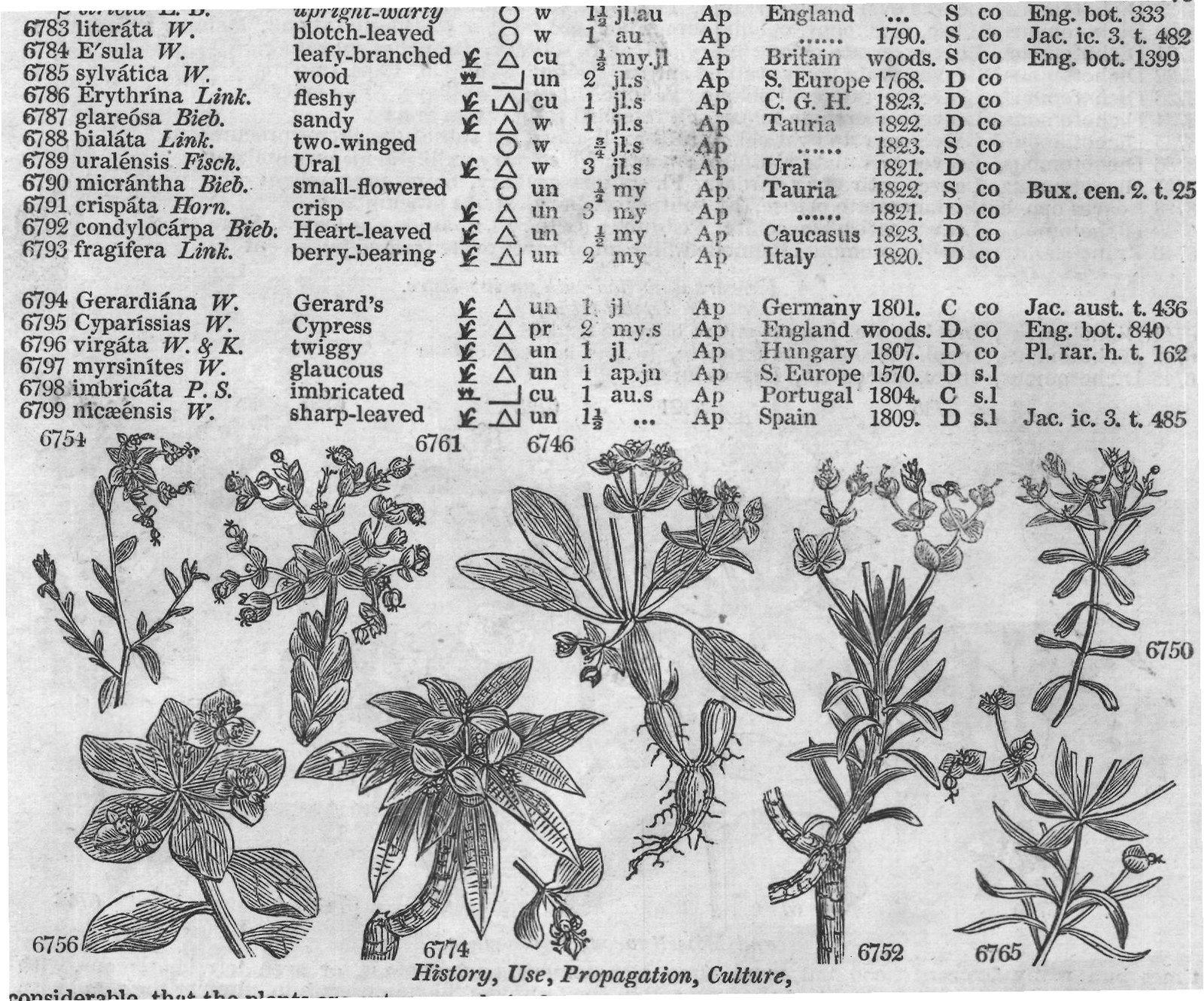
DODECANDRIA TRIGYNIA. 6692 Prickly elliptical obtuse furrowed, Prickles subsolitary, Peduncles 3-flowered 6693 Warts very large green downy at end, Spines about 4 strong black at end 6694 Simple rounded obovate with warts woolly at end [than the rest 6695 Columnar, Warts small numerous with many small spines between, Two spines in each cluster longer 6696 Unarmed globose with many angles ** Unarmed. 6697 Unarmed imbricated, Warts with one leaf, Flowers somewhat stalked, Divisions palmate 6698 Stem closely tessellated with warts upwards thickly branched 6699 Unarmed imbricated with warts bearing a linear leaf 6700 Unarmed with round procumbent branches, Warts 4-cornered $$6701 Unarmed imbricated, Warts with a roundish leaflet, Fl. term. solitary sessile with palmate segments 6702 Unarmed imbricated, Warts with a lanceolate leaflet, Fl. stalked with entire segments 6703 Unarmed imbricated capitate, Warts rhomboid with lanceolate stalked leaves, Segm. of flower entire 6704 Unarmed half naked shrubby filiform flaccid, Leaves alternate 6705 Warts large imbricated hooked at end: the upper having an oval leaflet at length withering 6706 Unarmed warted, Warts with a deciduous leaf, Pedunc. solitary or 3 terminal 1-flowered 6707 Unarmed naked leafless branched, Branches square, Fl. solitary terminal 6708 Unarmed shrubby upright, Head terminal, Leaves lanceolate smooth glaucous 6709 Unarmed half naked shrubby filiform erect, Branches spreading regularly clustered §2. Stem uniform, shrubby, upright, Flowers scattered or aggregate, not in umbels. 6710 Unarmed, Leaves lanceolate clustered entire, Umbel terminal sessile, Invol. connate colored . connate colored 6711 Unarmed shrubby upright, Umbel 5-fid term. Invol. oblong, Leaves lanc. smooth 6712 Unarmed shrubby, Leaves oblong alternate distichous, Bractes persistent 6713 Unarmed shrubby naked, Branches rounded effuse dependent jointed 6714 Umbel multifid dichotomous, Invol. subcordate: the first 3-leaved 6715 Unarmed, Leaves panduriform ovate, Fl. term, suberect, Invol. colored 6716 Villous, Leaves with long stalks alternate broadly ovate repand-toothed, Stem erect striated 6717 Leaves opp. minute stalked obovate entire, Two glands on the stem at the base of petioles 6718 Unarmed shrubby, Leaves ovate entire, Cyme axillary naked 6719 Leaves opp. subcordate stalked emarginate entire, Stem shrubby 6720 Stalks whorled longer than the orbicular leaf, Fl. solitary, Stem unarmed naked 6721 Leaves scattered lanceolate acute smooth, Pedunc. dichotomous, Caps. muricate 6722 Unarmed shrubby, Leaves scattered lanc. mucron. Fl. solitary term. with a 3-leaved invol. Caps. muricate 6723 Leaves oval entire wavy edged with white, Caps. smooth, Stem hairy 6724 Dichotomous, Leaves ovate serrate acute villous, Fl. solitary, Upper dichotomies cymose §3. Dichotomous, herbaceous, Flowers solitary or aggregate, not umbelled. 6725 Unarmed branched, Leaves subcordate entire shorter than their stalk, Fl. solitary 6726 Dwarf hairy, Leaves opp. oval toothed, Flowers clustered at the end of branches 6727 Dichotomous, Leaves serrate oval-obl. smooth, Corymbs terminal, Branches divaricate 6728 Dichotomous, Leaves ovate obl. acute at each end smooth stalked entire, Capsules smooth smooth stalked entire, Capsules smooth 6729 Dichotomous, Leaves oval obsol. serrated, Pedunc. axill. 3flowered, Stems diffuse smooth 6730 Dichotomous diffuse, Lvs. obov. oblique somewhat cord. at base toothletted at end, Pedunc. 1-fl. axillary 6731 Dichotomous, Leaves serrate oblong hairy, Fl. axill. solitary, Branches spreading 6732 Dichotomous, Leaves ovate hairy stalked entire, Pedunc. axill. 1-fi. Caps. smooth 6733 Dichotomous, Leaves serrate oval oblong, Pedunc. 2-headed axillary, Stem erect 6734 Dichotomous, Leaves subcrenate linear, Fl. fascicled term. Stem erect 6735 Dichotomous, Leaves serrate oval-obl. Heads axill. clustered subsessile, Stems procumbent 6736 Dichotomous, Leaves crenulate roundish smooth, Fl. solitary axill. Stems procumbent 6737 Dichotomous, Leaves entire half cordate, Fl. solitary axillary, Stems procumbent 6738 Leaves opp. entire lanceolate obtuse, Fl. solitary axillary, Stems procumbent 6739 Dichotomous, Leaves entire lanceolate, Peduncles axillary 1-fl. as long as leaves, Stem erect 6740 Branches alternate dichotomous channelled filiform, Leaves ovate stalked pubescent §4. Flowers umbelled with an involucre. * Umbel trifid. 6741 Dichotomous, Invol. ovate, Leaves entire obovate stalked 6742 Dichotomous, Invol. subcordate mucronate, Leaves lanceol. obtuse 6743 Dichotomous, Invol. lanceolate, Leaves linear 6715 6721 6723 6737 6739 cara 6740 6741 6743 and Miscellaneous Particulars. times in a many-flowered head, but more often dichotomous, trichotomous, or even tetrachotomous, with single flowers between the divisions at the base and in the forkings; having bractes in number the same with the peduncles, forming a sort of involucre. The juice of every species of Spurge is so acrid that it corrodes and ulcerates the body wherever it is applied so that it is seldom used internally. Externally it is dropped on warts or corns to remove them, and in the hollow of a decayed tooth, to remove the pain by destroying the nerve, or it is rubbed behind the ears to give relief in the tooth-ache by blistering.
E. officinarum, and also antiquorum and canariensis, furnish the Euphorbium of the Materia Medica. In the lower regions of Mount Atlas, the inhabitants collect the concreted gum resin, which they call furbiune, in September. It is obtained by making slight incisions in the branches of the plant with a knife, from which a milk-like juice exudes, and forms into tears of an oblong or roundish form. The quantity yielded is so Dd 2 6744 mínima Haw. 6745 micrántha W. 6746 tuberósa W. least DODECANDRIA TRIGYNIA.
CLASS XI. small-flowered tuberous 6747 acumináta Bieb. pointed ㅇㄷㅇㅇ W jl.s Ap 1800. C s.l W 1. jl.s Ap Persia 1803. C s.l cu o.d Ap Ethiopia 1800. C s.l Bur. afr. 9. t. 4 W 1 o.d Ap Albania 1820. S co Boc. sic. t. 13. f.1 6748 Láthyris W.
Caper W 6749 valentína Pers. 3 my.o Ap England d.st.pl. Sco Eng. bot. 2255 Spanish W 1 jl.au Ap 6750 diffúsa W. diffuse W jlau Ap Spain 1804. S s.l Austria 1798. S s.l Jac. ic. 1. t. 88 6751 A'pios W.
Pear-rooted W jn.jl Ap Candia 6752 læta W.
Mezereon-lvd. cu 1 jn.jl Ap 6753 genistoídes W.
Genista-like cu 1 jlau Ap C. G. H. 6754 spinósa W. prickly cu 2 my.s Ap Levant 1596. D s.l 1758. C s.l 1808. C s.l 1710. C s.l Jac. ic. 1. t. 87 Dend. brit. 45 6755 nummulariæfólia W.en. Moneyw. lvd.. cu از Ap ...... 1800. C co 6756 epithymoídes W. broad-leaved cu 6757 dúlcis W. 1 my.jn Ap sweet cu 1 my.jn Ap 6758 carniólica W.
Carniolian cu 1 au Ap 6759 Pithyúsa W.
Juniper-lvd. cu 1 jn.jl Ap 6760 portlándica W.
Portland my.s Ap 6761 Parálias W. sea pr 1 jl.s Ap 6 suffruticosa shrubby-sea cu 1 jl.s Ap ...... ... 6762 rígida Haw. rigid 业 cu 2 jl.au Ap Austria 1805. D co S. Europe 1759. D co Carniola 1795. D co S. Europe 1741. C s.l Britain sea.sh. D s.l England sea.sh. C s.l 1795. C s.l Bot. rep. 616 Jac. aus. 3. t. 213 Scop.carn. t. 21 Boc. sic. t. 5 Eng. bot. 441 Eng. bot. 195 6763 júncea W. rushy cu 1 jl.au Ap Madeira 1779. D s.l Jac. sch. 1. t. 107 6764 aléppica W.
Aleppo cu 1 jl.au Ap Crete 1739. D s.l Alp. exot. t. 64 6765 segetális W. corn W jl.au Ap 6766 biumbelláta Pers. double-umbell. cu 1 au Ap 6767 angustifólia Haw. narrow-leaved cu 1 jl S. Europe 1699. D s.l Barbary 1780. D s.1 Jac. aus. 5. t.450 Po. it. ed. ger.t.1 Ap ...... 1780. D s.l 6768 multicorymbósa Ha. many-flowered cu 1 jl Ap ...... 1805. D s.l 6769 provinciális W. linear-leaved W 1½ au.n Ap 6770 juncoídes Haw.
Rush-like w 1 jl Ap ...... 6771 helioscópia W.
Wart-wort W jl.au Ap 6772 serráta W. narr. notch-lvd. cu 1 jl Ap 6773 crética Haw.
Cretan hoaryun 3 ...
Ap 6774 punícea W. scarlet-flowered spl 6 ja.s Ap 6775 verrucósa W. warted un jn Ap 6776 corolláta W. great-floweredun 1 jl.s Ap 6777 spathulæfólia Haw. spatula-leaved ☐ cu 2 au Ap ......
S. Europe 1800. S s.l Britain cor.fi. S s.1 S. Europe 1710. D s.l Levant 1768. Cr.m Jamaica 1778. C s.l France 1800. C s.1 N. Amer. 1803. D s.I 1800. C s.l Eng. bot. 883 Jac. ic. 3. t. 483 Bot. reg. 190 Mor. s. 10. t.3.f.3 Bot. cab. 390 6778 corallioídes W.
Coral-stalked un 1 jn.s Ap 6779 androsæmifólia Donn. Tutsan-leaved Aun 2 jl.s Ap 6780 pilósa W.
S. Europe 1752. D s.l Hungary 1804. D s.l hairy Eun 1 my.au Ap Siberia 1758., D s.l Gm. sib. 2. t. 93 6781 orientális W. oriental Aun 1 jn.jl Ap Levant 1739. D s.1 6782 platyphýllos W. annual-warty W 1 jl.au Ap England cor.fi. S co Jac. aust. t. 376 ẞ stricta E. B. upright-warty W 14 jl.au Ap England ....
Sco Eng. bot. 333 6783 literáta W. blotch-leaved Ow 1 au Ap 1790. S co Jac. ic. 3. t. 482 6784 E'sula W. leafy-branched cu 6785 sylvática W. my.jl Ap Britain woods. Sco Eng. bot. 1399 wood un 2 jl.s Ap S. Europe 1768. D co 6786 Erythrína Link. fleshy cu 1 jl.s Ap C. G. H. 1823. D co 6787 glareósa Bieb. sandy W 1 jl.s Tauria Ap 1822. D co 6788 bialáta Link. two-winged W jl.s Ap 1823. S co 6789 uralénsis Fisch.
Ural W 3 jl.s Ap Ural 1821. D co 6790 micrántha Bieb. small-flowered un my Ap 6792 condylocárpa Bieb. 6791 crispáta Horn. 6793 fragífera Link. 6794 Gerardiána W. 6795 Cyparíssias W. 6796 virgáta W. & K. 6797 myrsinítes W. 6798 imbricáta P. S. 6799 nicæénsis W. 6754 Cypress twiggy glaucous imbricated sharp-leaved crisp Aun 3 my Ap Heart-leaved un my Ap berry-bearing Aun 2 my Ap Tauria 1822. S co Bux.cen. 2. t. 25 1821. D co Caucasus 1823. D co Italy 1820. D co Gerard's Aun 1 jl Ap Germany 1801. C co Jac. aust. t. 436 Apr 2 my.s Ap England woods. D co Eng. bot. 840 un 1 jl Ap Aun 1 ap.jn Ap cu 1 au.s Ap un 1 ...
Ap Hungary 1807. D co S. Europe 1570. D s.l Portugal 1804. C s.l Spain Pl. rar. h. t. 162 1809. D s.l Jac. ic. 3. t. 485 6761 6746 6750 6756 6774 History, Use, Propagation, Culture, 6752 6765 considerable, that the plants are cut once only in four years; the supply then obtained being sufficient for that space of time for all Europe. The recent juice is so corrosive as to erode the skin wherever it touches; and the people who gather the gum are obliged to tie a cloth over their mouth and nostrils, to protect them from the acrid dust of the withered branches, which induces the most violent sneezing. It is inodorous; and, when first chewed, has little taste, but it soon gives a very acrid burning impression to the tongue, palate, and throat, which is very permanent, and almost insupportable . Euphorbium possesses powerful cathartic, emetic, errhine, and rabefacient properties. It has been given as a hydragogue in dropsies; but, owing to the violence of its effects, its internal use is now exploded: neither as an errhine can it be used alone, for it occasions so ORDER III.
DODECANDRIA TRIGYNIA. 6744 Dichotomous, Umbel trifid, Invol. broad obovate, Leaves entire obovate spatulate on long stalks 6745 Dichotomous, Leaves lanceolate obovate serrate, Invol, cordate, Caps. warted 6746 Invol. 4-leaved, Stem naked, Leaves oblong emarginate 6747 Umbel subtrifid, Leaves mucronate, Cauline spatulate lanc. Invol. ovate, Caps, smooth ** Umbel 4 or 5-fid. 6748 Umbel 4-fid dichotomous, Leaves opposite entire 6749 Umbel 4-fid trifid, Invol. ovate acute, Leaves lanc.: lower spatulate 6750 Umbel 4-fid dichotomous, Invol. obtuse, Leaves altern. lin. cuneate emarginate mucron. Stem diffuse 6751 Umbel 4-fid bifid, Invol. reniform: the first obcordate 6752 Umbel 4 or 5-fid twice dichotomous, First invol. oblong: upper rhomboid-roundish, Leaves lin. lanceol. 6753 Umbel 5-cleft bifid, Invol. ovate, Leaves linear erect 6754 Umbel 5-cleft simple, Invol. ovate: first 3-leaved, Leaves oblong entire 6755 Umbel 5-cleft bifid, Upper leaves rounded obovate serrulate mucronate: lower lanc. reflexed 6756 Umbel 5-cleft bifid, Invol, ovate toothletted, Leaves entire lanc. oblong villous beneath 6757 Umbel 5-cleft bifid, Invol, subovate toothletted, Leaves lanc. obtuse, Caps. warted hairy 6758 Umbel 5-cleft bifid, Rays nodding, Invol. ovate entire, Leaves lanc. acute, Caps. warted smooth 6759 Umbel 5-cleft bifid, Invol. ovate mucronate, Leaves lanc.: the lower involute imbricated downwards 6760 Umbel 5-cleft dichotomous, Invol. subcordate concave, Leaves lin. lanc. acute smooth spreading 6761 Umbel 5-cleft bifid, Invol. cordate reniform, Leaves imbricated upwards 6762 Branches filiform, Leaves numerous linear oblong retuse, Rib mucronate, Fl, solitary terminai 6763 Umbel 5-cleft dichotomous, Leaves and invol. linear lanceolate acute 6764 Umbel 5-cleft dichotomous, Invol. ovate lanceolate mucronate, Lower leaves setaceous 6765 Umbel 5-cleft dichotomous, Invol, cordate acute, Leaves lin. lanceolate: the upper broadest 6766 Umbel multifid double, Invol. subcordate, Leaves linear 6767 Umbel multifid clustered, Invol, subcordate, Leaves numerous close very narrow 6768 Umbel multifid dichotomous, Invol. half orbicular cordate, Sterile branches many, Lvs. lin. lanc. obtuse 6769 Umbel 5-cleft bifid, Invol. cordate mucronate, Leaves oblong 6770 Umbel 5-cleft bifid, Invol. half orbic. cordate submucronate, Leaves linear imbricated backwards 6771 Umbel 5-cleft bifid dichotomous, Invol. obovate, Leaves cuneiform serrate smooth, Caps. smooth 6772 Umbel 5-cleft trifid dichotomous, Invol. 2-leaved reniform, Leaves amplexicaul. cordate serrate 6773 Umbel multifid bifid, Invol. orbicular, Leaves linear lanc. villous 6774 Umbel 5-cleft trifid, Invol. oval acuminate colored, Caps. smooth, Leaves glaucous beneath 6775 Umbel 5-cleft trifid, Invol. ovate, Leaves lanc. serrulate villous, Caps, warted 6776 Umbel 5-cleft trifid dichotomous, Invol. and leaves oblong obtuse, Divisions of invol. white 6777 Umbel 4-fid bifid, Invol. obovate, Leaves spatulate lanc. entire reflexed, Stem half shrubby branched 6778 Umbel 5-cleft trifid dichotomous, Invol. ovate, Leaves lanceolate, Caps. woolly 6779 Naked smooth, Umbel 5-cleft bifid, Leaves sessile lanceolate veiny on each side 6780 Umbel 5-cleft trifid bifid, Invol. ovate entire, Leaves lanc. hairy subserrulate at end 6781 Umbel 5-cleft 4-fid dichotomous, Invol. roundish acute, Leaves lanceolate 6782 Umbel 5-cleft 3-fid dichotomous, Invol. with a hairy keel, Leaves serrate lanceolate, Caps. warted 6783 Umbel 5-cleft 3-fid dichotomous, Invol. lanceolate, Leaves lanc. toothed pubescent, Caps, smooth warted 6784 Umbel multifid bifid, Invol. subcordate 2-horned, Barren branches with 1-shaped leaves 6785 Umbel 5-fid bifid, Invol. perfoliate cordate acute, Leaves lanc. entire 6786 Leaves lanc. obtuse, Umbel 5-fid dichotomous, Invol. ovate obtuse 2-horned 6787 Umbel 5-fid bifid, Leaves spatulate lanc. mucronate coriaceous serrulate, Invol. ovate, Caps. smooth 6788 Leaves obversely obl. Invol. oblong and ovate serrulate at end, Umbel 5-fid dichotom. Caps. keeled twice 6789 Leaves linear with long points entire smooth, Umbel 5-fid bifid, Invol. lanceolate, Leaves 2-horned 6790 Umbel trifid dichotomous, Leaves serrate somewhat hairy: lower spatulate; upper and invol. spatulate 6791 Upper branches hairy, Leaves smooth lanceolate, Caps. warted, Invol. cordate 6792 Umbel sub-5-fid bifid, Caul. leaves and invol. cordate lanceolate obtuse toothletted, Invol. reniform 6793 Leaves lanceolate, Umbel 5-fid, Invol. oval obtuse, Caps. ramentaceous hairy *** Umbel 6-many-fid. 6794 Umbel multifid dichotomous, Invol. roundish entire, Branches none 6795 Umbel multifid dichotomous, Invol. subcordate, Branches sterile, Leaves setaceous, Cauline lanceolate 6796 Umbel multifid bifid, Invol. subtriangular, Leaves sessile erect, Caps. rough 6797 Umbel 8-fid bifid, Invol. subovate, Leaves spatulate spreading fleshy mucronate rough at edge 6798 Umbel dichotomous bifid, Invol. roundish mucronate, Leaves obovate imbricate serrulate 6799 Umbel 5-fid bifid, Invol. cordate roundish entire, Leaves lanceolate mucronate coriaceous 6772 6782 6780 6783 6799 6796 and Miscellaneous Particulars. much inflammation as to produce hæmorrhage from the nostrils, and swells the integuments of the head. When properly diluted, however, with starch or any other inert powder, and cautiously used, it is an effectual and excellent errhine in lethargy, deafness, palsy, amaurosis, and similar cases. (London Dispensatory, 298.) E. Lathyris has seeds about the size and color of caper buds, and in Paris is sometimes substituted for that pickle. Eaten in any quantity they must prove highly deleterious. E. helioscopia has a peculiarly acrid milky juice, which is often applied by country people to eat off warts; but should be used with caution where the parts are tender. According to Linnæus, sheep eat it, and are purged by it, and their flesh acquires a bad taste; but this is not the case with cows. Dd3 6800 palústris W. marsh 6801 emargináta W. freckled Aun 2 jl.au Ap 6802 hibérnica W.
Irish 6803 salicifólia W. willow-leaved W 2 my.jn Ap 6804 amygdaloídes W.
Almond-leav.姓 or 6805 charácias W. upright-red pr 4 mr.jn Ap 6806 glaucéscens W. glaucous 6807 agrária Bieb. field 6808 pállida W. pale 6809 prócera Bieb. tall 6810 ceratocar'pa Ten. horn-fruited 6811 salicifólia Hort. willow-leaved Ap Aun 1 jn Ap Aun 2 au un 1 jl.au un 1 jn DODECANDRIA TRIGYNIA.
Aun 4 my.au Ap cu 1 my.jn Ap 1570. D s.l 1758. D co fields. D co Hungary 1804. D co 2 mr.jn ApEngland woods. D co un 1 mr.jn Ap W 1 jn CLASS XI.
Fl. dan. 866 Sweden Italy Britain Ap Ap Ap England mo. pl. C co 1823. D. co Crimea 1821. S co Hungary 1822. D co Crimea 1819. D co Naples 1823. D co Hungary 1820. D co Eng. bot. 1337 Pl. rar. h. t. 55 Eng. bot. 256 Eng. bot. 442 Gmel. sib. t. 94 Ten. neap. t. 63 1104. PEDILAN THUS. Neck. SLIPPER PLANT.