Home › E › Ericeæ (Sp macul ta Ph spotted-leaved)
Ericeæ (Sp macul ta Ph spotted-leaved)
Sp. 2. 5984 maculáta Ph. spotted-leaved pr jn .W N. Amer. 1752. Sk s.p Bot. mag. 897 5985 corymbósa Ph. corymb-flower. pr jn Pk N. Amer. 1752.
Sk s.p Bot. mag. 778 Pýrola umbelláta B. M. 1024. INOCARPUS. W. OTAHEITE-CHESTNUT.
Sapoteæ. Sp. 1. 5986 édulis W. eatable fr 20 ...
W South S. Is. 1793. C 1.p Lam. ill. t. 362 1025. STY'RAX. W.
STORAX.
Ebenacee. Sp. 4-6. 5987 officinále W. officinal or 12 ji W Italy 1597.
L s.1 Bot. rep. 631 5988 grandifolium W. great-leaved or 6 W N. Amer. 1765.
L s.l Dend. brit. 129 5989 pulveruléntum Ph. powdery or 4 jn.jl W N. Amer. 1794.
L s.l Dend. brit. 41 5990 lævigátum W. smooth or 4 jlau W N. Amer. 1765.
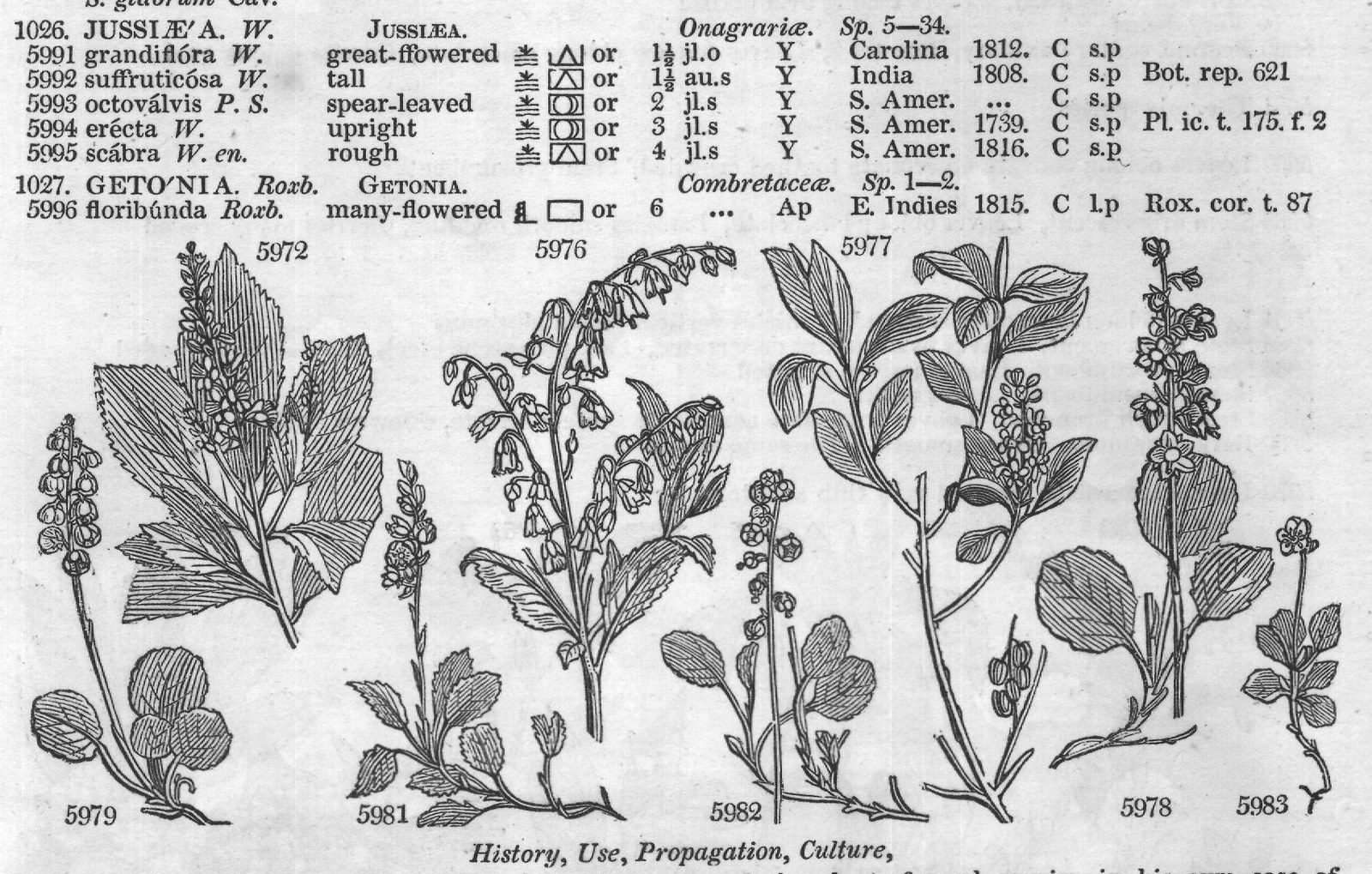
L s.1 Dend. brit. 40 S. glâbrum Cav. 1026. JUSSIE'A. W. 5991 grandiflóra W. 5992 suffruticósa W. 5993 octoválvis P. S. 5994 erécta W. 5995 scábra W. en.
JUSSLÆA.
Onagrariæ.
Sp. 5-34. great-ffowered or 1½ jl.o Y Carolina 1812. C s.p tall or 1½ au.s Y India 1808. C s.p Bot. rep. 621 spear-leaved or 2 jl.s Y S. Amer. ...
Cs.p upright or 3 jl.s Y S. Amer. 1739. C s.p Pl. ic. t. 175. f. 2 rough or 4 jl.s Y S. Amer. 1816. C s.p 1027. GETONIA. Roxb. 5996 floribúnda Roxb.
GETONIA. many-flowered or 6 ...
Combretacea. Sp. 1-2.
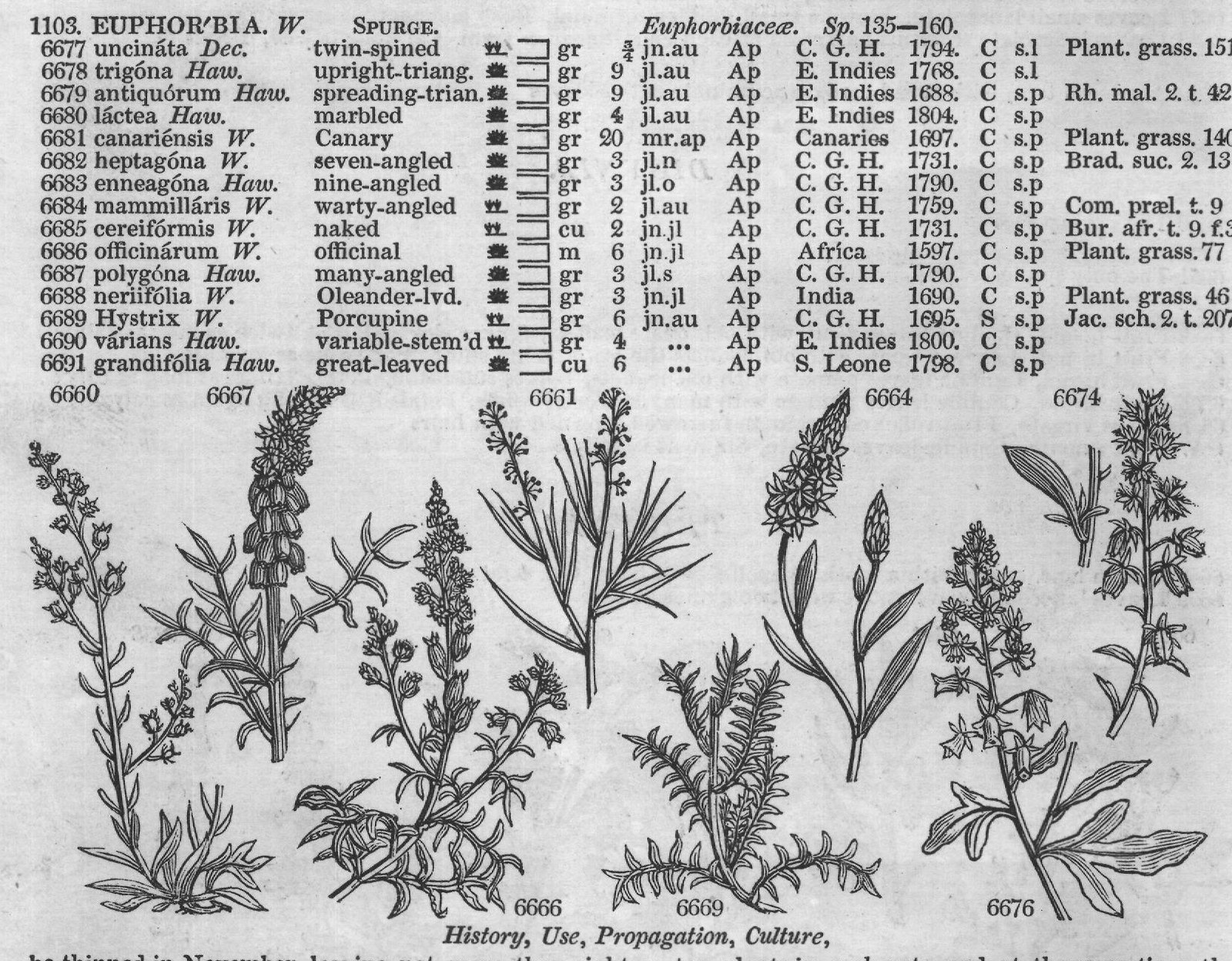
Ap E. Indies 1815. C L.p Rox. cor. t. 87 5972 5976 5977 5979 5981 5982 5978 5983 History, Use, Propagation, Culture, tability in North America. The late professor Barton found the plant of much service in his own case of nephritic paroxysms alternating with gout in the feet. It has also been recommended as a remedy in pulmonary complaints. (See Bigelow's Med. Botany.) 1020. Clethra. Kληθρa was the name given by the Greeks to the Alder, to which, in its leaves, this bears some resemblance. Pretty upright North American plants, with white flowers. One species is a native of Madeira. 1021. Mylocaryum. From μuλη, a mill, and κaρua, a kernel or stone; the four wings of the nut may be easily likened to the four sails of a small mill. A North American plant, with the habit of Andromeda, or rather of Clethra. 1022. Pyrola. A diminution of Pyrus, to which, in the leaves, this is thought to be similar. A genus of elegant little plants, mostly evergreens. They grow naturally in the shade, and in rocky or very poor soils; in the garden on sand or gravel shaded; and they are increased by seeds or young cuttings, planted under a handglass. All the species are powerfully astringent and tonic, and one or more of the American sorts is said to constitute the chief ingredient in the scorbutic draughts of Whitlaw. P. uniflora, Sir J. E. Smith says is one of the most curious and elegant of British flowers. 1023. Chimaphila. From χεῖμa, winter, and φiλεω, to love; a sort of translation of the English name winter-green. The species may be treated as Pyrola, which they much resemble. 1024. Inocarpus. From 15 ivos, fibre, and κaρπoς, fruit. The envelope of the nut is composed of tough interwoven fibres. It is a lofty tree, with alternate subcordate leaves, and flowers in racemes succeeded by by nuts called Ratta in Otaheite. The kernel of these, which is kidney-shaped, and about an inch in diameter, is eaten roasted by the inhabitants of the Society and Friendly Isles, the New Hebrides, New Guinea, the Molucca isles, &c. It is sweetish, but less pleasant than the chesnut, harder and less farinaceous. The bark is astringent, and is used in the dysentery. In New Guinea they smear the heads of their arrows with the expressed resinous juice. (Forst. Escul.) 1025. Styrax. A name altered by the Latins from the Arabic assthirak. Pliny says, that the Arabs in his time used the resin to flavor the perfumes of which they are so fond. S. officinale is a low tree with slender branches, ovate leaves, flowers in racemes from the sides of the branches, succeeded by ovate globular juiceless drupes, containing one or two angular nuts. From this tree storax is obtained in Asiatic Turkey. It issues from incisions made in the bark; and as it was formerly the custom to collect and export it in reeds, it was named Styrax calamita It has a fragrant odour, and a pleasant subacidulous, slightly pungent, and ORDER I.
DECANDRIA MONOGYNIA. 5971 Leaves obovate serrate beneath pubescent, Raceme simple bracted 5972 Leaves cuneate obovate acute upwards finely serrated beneath white with down 5973 Leaves broad cuneate obovate acute coarsely serrated rough on each side 5974 Leaves lanceolate obovate serrated smooth, Panicle narrow bracted 5975 Leaves oval acuminate smooth on each side glaucous beneath, Racemes white with down 5976 Leaves oblong acuminate serrated smooth, Racemes panicled, Peduncles hairy 5977 Leaves cuneate lanceolate acute, Racemes spiked terminal 5978 Stamens ascending, Style declinate, Raceme many-flowered 5979 Stamens straight, Style declinate long, Peduncle twisted, Raceme many-flowered 5980 Stamens and styles straight, Flowers racemose spreading 5981 Raceme 1-sided 5982 Stamens and styles straight, Flowers racemose closed, Petals rounded obtuse, Peduncle straight, 5983 Peduncle 1-flowered 5984 Peduncles 2-flowered 5985 Peduncles umbelled 5986 The only species 5987 Leaves ovate beneath villous, Racemes simple shorter than the leaf 5988 Leaves obovate villous beneath, Lower peduncles axillary solitary 1-flowered 5989 Leaves subsessile oval or obovate beneath powdery, Fl. axill. and term. in threes on short stalks 5990 Leaves oblong smooth on each side, Peduncles axillary 1-flowered solitary or twin 5991 Root creeping, Stems erect with peduncles and calyxes villous, Lower leaves spatulate upper lanceolate 5992 Erect villous, Flowers tetrapetalous octandrous stalked 5993 Erect, Flowers tetrapetalous octandrous stalked, Caps. many-valved, Leaves lanceolate 5994 Erect smooth, Flowers tetrapetalous octandrous sessile 5995 Flowers tetrapetalous octandrous, Stem erect angul, hairy, Leaves oblong hairy 5996 Leaves opposite ovate, Flowers panicled, Bractes lanceolate 5984 5988 5985 5990 5992 5996 5987 5986 and Miscellaneous Particulars. aromatic taste; is stimulant, and in some degree expectorant. It was formerly much prescribed in asthma, catarrh, phthisis, and menstrual obstructions; but it is now scarcely ever employed, except as an adjunct on account of its fragrance.
Benzoin is obtained from the S. Benzoin, by wounding the bark near the origin of the lower branches. The tree is never wounded under six years of age; and cannot sustain these annual incisions above twelve years. (Thomson's London Dispensatory, 525.) As shrubs this genus affords some plants that may be considered pretty and desirable, on account of their small size and free flowering. They grow best in sandy loam, are commonly propagated by layers, and may also be increased by seeds, which they occasionally ripen. 1026. Jussiea. An obscure and most uninteresting genus of plants, selected, not very happily, to commemorate the family of the Jussieus, which has for more than a century and a half been at the head of botanical science. Antoine de Jussieu, born in 1686, and died in 1758, was professor of botany at the Jardin du Roi, and member of the academy of sciences. He published various papers upon exotic plants, and a discourse upon the progress of botany. He also edited the works of Barrelier. Bernard de Jussieu, his brother, born in 1698, died in 1777, was professor at the same garden, and member of the same academy. He also was author of various papers upon plants, a second edition of Tournefort's History of the Plants growing near Paris, and an arrangement of the plants growing in the garden of Trianon, which was published by his nephew. Joseph de Jussieu, a third brother, born in 1704, and died 1779. He was sent to South America by Louis XV., and remained there for six and thirty years. He made many discoveries, and brought home many new plants. Lastly, Antoine Laurent de Jussieu, their nephew, born in 1748, and still living, as demonstrator of botany at the Jardin du Roi, member of the Institute and of every learned body in Europe. He brought, in his Genera Plantarum, published in 1789, to a degree of extraordinary perfection, that system, the outlines of which had been traced by the hand of Tournefort, and partially filled up by his uncle Bernard. That system has now superseded, among men of science, all others, and if as yet inapplicable to merely popular purposes, can never be dispensed with in all philosophical investigations. 1027. Getonia. A Malabar plant, the meaning of whose name has not been explained. Cuttings root freely in sand, under a hand-glass, and plunged in heat. Indian 5998 pubéscens Burm. pubescent DECANDRIA MONOGYNIA. 1028. QUISQUAʼLIS. W. QUISQUALIS. 5997 índica W. 1029. MELASTOMA. W. MELASTOMA.
Combretaceæ. Sp. 1-4.
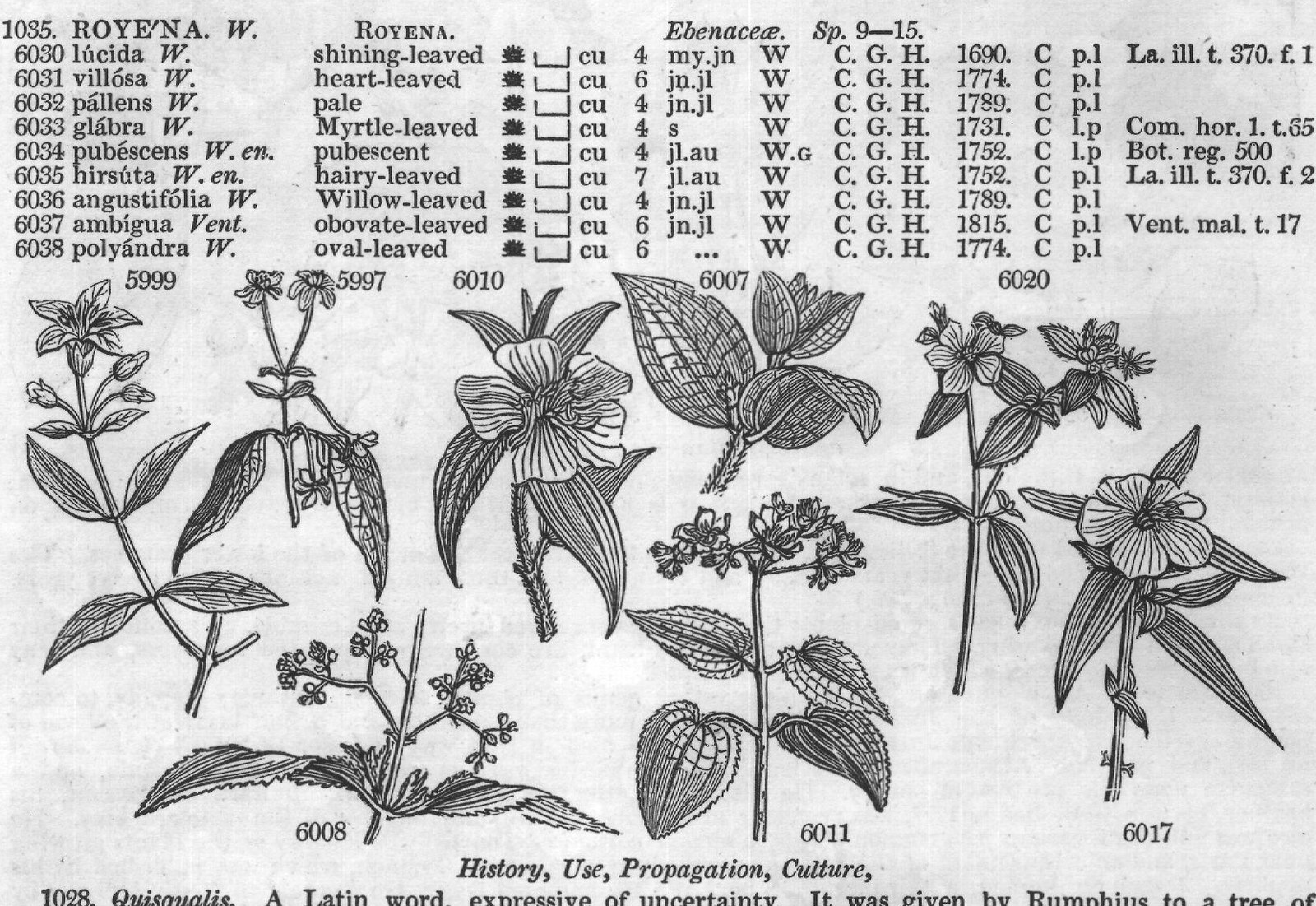
CLASS X. or 20 my.au O.R E. Indies 1815. C l.p Bot. mag. 2033 உ or O.R E. Indies 1815. C l.p Bur. ind. t. 35.f.2 Melastomaceæ. Sp. 23-196. 5999 áspera W. rough or 6 au.n P 6000 velutína W. velvetty-leaved or 8 jl.o Pu 6001 trinérvia W. three-nerved or 8 jl Pu E. Indies 1815. C l.p W. Indies 1815. C l.p Jamaica 1793. C s.p Bur. zeyl. t. 72 6002 octándra W. octandrous or 3 W ... 6003 tetrándra W. tetrandrous or 2 ... ... 6004 hírta W. hairy or 6 s.d Pu 6006 cymósa W. 6007 rúbra W. 6005 Acinodendron W. oval-leaved 6008 purpúrea W. or 6 ...
Pu cyme-flowered or red or purple or 8 2 ap.au Pu 6 my.jn Pu Pu ... 6009 gróssa W. large-leaved or 12 ... ... 6010 malabáthrica W. bristly or 6 jn.au Pu 6011 corymbósa H. K. corymb-flower. or 6012 ecostáta H. K. ribless 6013 Tamonéa Aubl.
Fothergill's 오 or 20 Pu ... 2 mr.o Pk or 4 my.jn Pu Ceylon 1815. C l.p Jamaica 1815. C l.p Jamaica 1740. C s.p Jamaica 1804. C 1.p S. Amer. 1792. C 1.p Guiana 1793. C s.p Guiana 1804. Cl.p S. Amer.
Cl.p ...
E. Indies 1793. C s.p S. Leone 1792. C s.p Jamaica 1793. C s.p Pl. al. t. 264. f. 1 Plu. ic. 142. f. 2 Sert. han. t. 8 Au. gui. 1. t. 161 Au. gui. 1. t. 154 Bot. mag. 529 Bot. mag. 904 S. Amer. 1815. C s.p Au. gui. 1. t. 175 Fothergillia Hort. 6014 álbicans Swz. white-leaved or 6 ...
Pu Jamaica 1815. C s.p 6015 lævigáta W. smooth cu 6 ...
W.G S. Amer. 1815. C s.p Bot. reg. 663 6016 díscolor W. two-colored or 15 ...
Pu W. Indies 1793. C s.p Plu. ic. t. 42. f. 1 6017 nepalénsis Lodd.
Nepal or 2 au Pu Nepal 1820. C p.1 Bot. cab. 707 6018 heteromálla Don.
Brazil or 6 ja.d Pu Brazil 1819. C p.1 Bot. reg. 644 6019 granulósa Lam.
Commerson's or 10 au.s Pu Brazil 1819. C p.1 Bot. reg. 671 6020 osbeckioídes Sims. osbeckia-like pr 2 s.o Pu 6021 sanguínea Sims. bloody or 6 s.o Pk Mauritius 1817. C p.1 China 1818. C p.1 Bot. mag. 2235 Bot. mag. 2241 1030. PETALO MA. W. PETALOMA.
Melastomaceæ. Sp. 1-2. 6022 myrtilloídes Swz.
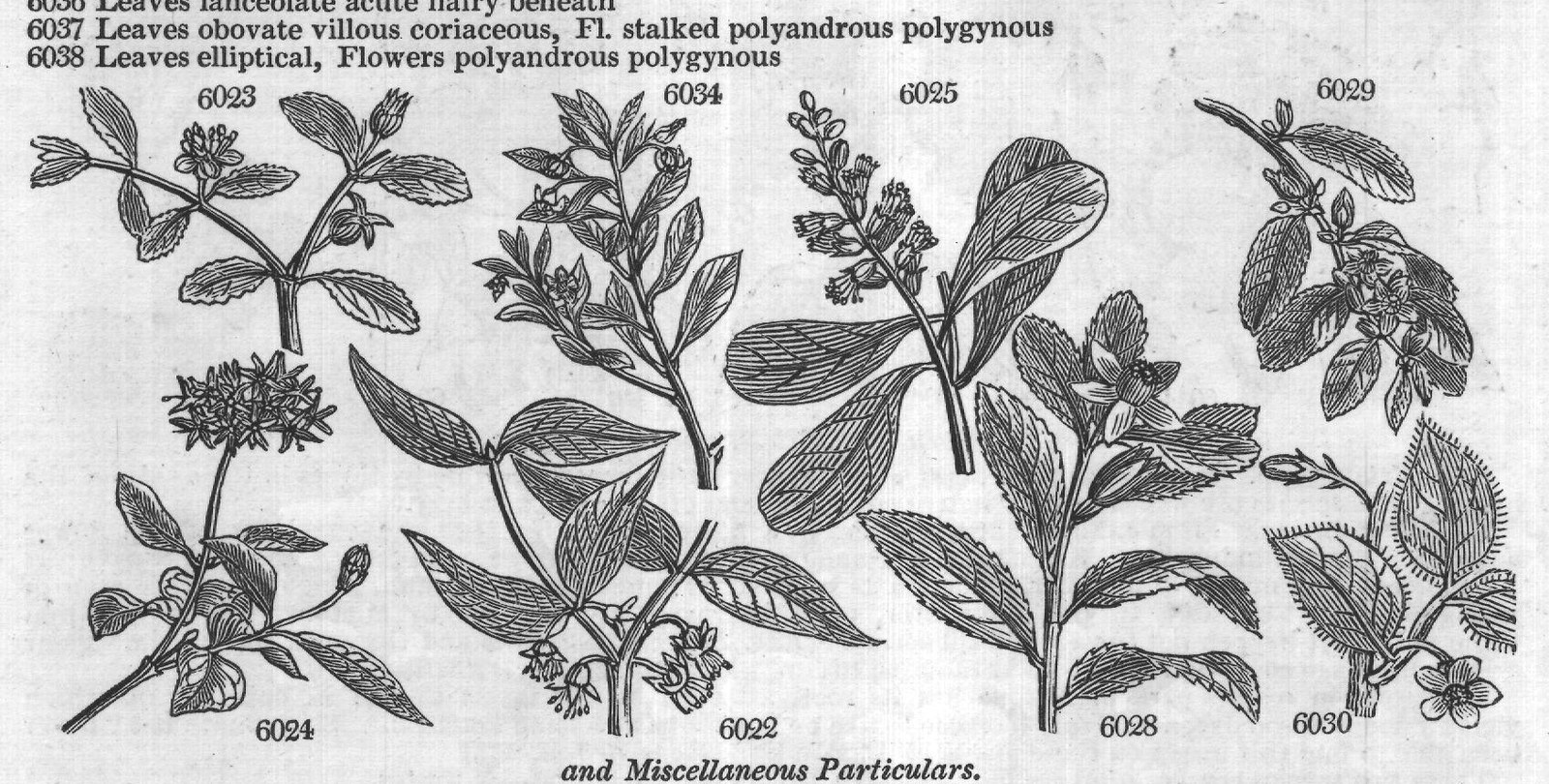
Bilberry-like or 10 1031. ACISANTHE'RA. J. ACISANTHERA. 6023 quadráta P. S. four-sided cu 3 DAIS. 1032. DA'IS. W. 6024 cotinifólia W. 1033. BUCI'DA. W. 6025 Búceras W. 1034. SAMY'DA. W. 6026 nítida W. 6027 pubéscens W. 6028 serruláta W. 6029 rósea H. K.
W.Y W. Indies 1823. C p.1 Sl. hist. t. 187.f.3 Salicariæ. Sp. 1. ... ...
Jamaica 1804. C p.1 Thymelææ. Sp. 1-7.
Cotinus-leaved or 10 jn.jl W.G C. G. H. 1776. R. s.l OLIVE-BARK-TREE.
Jamaica SAMYDA. glossy pubescent Elm-leaved rose-colored 오 ec 25 au.s Y.w Jamaica 1793. Cl.p ... 1035. ROYENA. W. 6030 lúcida W. 6031 villósa W. 6032 pállens W. 6033 glábra W. 6034 pubéscens W. en. 6035 hirsúta W.en. 6036 angustifólia W. 6037 ambígua Vent. 6038 polyándra W. 5999 5997 Br. jam. t. 22. f.1 Bot. mag. 147 Santalaceæ. Sp. 1-2.
Lam. ill. t. 356 Samydeæ. Sp. 4-12. un 7 ...
W.G W. Indies 1793.
C l.p Br. jam. t. 23. f.3 un 4 my.au pr 3 jl ...
W. Indies 1793.
C 1.p Jac. amer. 132 WW. Indies 1723.
C s.p Ja. co. 2. t.17. f.1 pr 4 jn.jl Pk W. Indies 1793.
C s.p Bot. mag. 550 DIGYNIA.
ROYENA. shining-leaved Ebenacea. Sp. 9-15. cu 4 my.jn W C. G. H. 1690.
C p.l La. ill. t. 370. f. 1 heart-leaved cu 6 jn.jl WC. G. H. 1774.
C p.l pale cu 4 jn.jl WC. G. H. 1789. C p.1 Myrtle-leaved cu 4 S W C. G. H. 1731. C L.p pubescent cu 4 jl.au W.G C. G. H. 1752. C 1.p Com. hor. 1. t.65 Bot. reg. 500 $ hairy-leaved ☐ cu 7 jl.au W C. G. H. 1752. C p.l La. ill. t. 370. f. 2 Willow-leaved cu 4 jn.jl W C. G. H. 1789. C p.l obovate-leaved oval-leaved cu 6 jn.jl W C. G. H. 1815. C p.1 Vent. mal. t. 17 cu 6 W ...
C. G. H. 1774. C p.1 6010 6007 6020 6008 6011 6017 History, Use, Propagation, Culture, 1028. Quisqualis. A Latin word, expressive of uncertainty. It was given by Rumphius to a tree of Amboyna, because it was subject to variation. It is a fine climbing genus of easy culture. The best soil for the species is a mixture of loam and peat; and cuttings root freely in sand, under a hand-glass. (Bot. Cult. 100.) 1029. Melastoma. From μελaς, black, and 5oμa, mouth. Many of the species produce black berries similar to gooseberries, and which stain the mouth black. This is a very numerous genus of shrubs and low trees; the species display great unity of character, and may be considered ornamental. They require but little water in winter, and are easily increased in sand, plunged in a moist heat. 1030. Petaloma. From πετaλov, a petal, and λωμa, an edge. Flowers of which the petals are inserted on the edge of the calyx. A small plant with the leaves, but not flowers, of Melastoma. 1031. Acisanthera. From axis, a point, the anthers being pointed. Plants with the habit of Melastoma. ORDER I.
DECANDRIA MONOGYNIA. 5997 Leaves ovate 5998 Leaves subcordate pubescent 5999 Leaves ovate-lanc. entire 3-nerved rough, Fl. terminal subcorymbose 6000 Leaves 3-nerved entire sessile ovate acute villous silky, Racemes brachiate, Stems square 6001 Leaves 3-nerved without a marginal one entire smooth on each side thin, Racemes term. Fls. sessile 6002 Leaves entire 3-nerved ovate-lanc. smooth, Margin and nerves hispid beneath, Fl. terminal 6003 Leaves entire 3-nerved oblong emarginate at base, Raceme erect term. Fl. tetrandrous 6004 Leaves toothletted 5-nerved ovate-lanceolate, Stem hispid 6005 Leaves ovate acuminate toothletted 5-nerved, Cymes axillary 6006 Leaves cordate acumin. 5-nerved serrulate pubescent, Cymes terminal, Sepals roundish, Stamens 5 sterile 6007 Leaves cordate subcrenate beneath rusty with down, Flowers axillary and lateral solitary sessile 6008 Leaves ovate lanceolate acuminate 5-nerved pilose somewhat toothletted, Branches bifid, Panic. term. 6009 Leaves entire 5-nerved subcordate scabrous, Cor. little hairy outside 6010 Leaves entire 5-nerved lanceolate ovate rough 6011 Leaves 7-nerved ovate subcordate acuminate ciliated with teeth, Corymb terminal, Flowers 1-sided 6012 Leaves 3-nerved without ribs ovate-lanceol, acuminate toothletted, Corymbs term. trichotomous powdery 6013 Leaves 5-nerved obl. lanceol. acute entire hoary beneath, Pedunc. umbelled, Bractes double 6014 Leaves 5-nerved entire ovate acute smooth above beneath hoary, Flowers clustered sessile 6015 Leaves entire 5-nerved ovate-oblong smoothish acuminate smooth at edge 6016 Leaves 5-nerved nearly entire oblong acuminate smooth beneath yellowish, Racemes cymose 6017 Leaves lanceolate ciliated 3-nerved obtuse at base, Stems square, Flowers terminal solitary 6018 Leaves cordate oval entire stalked beneath woolly, Petals obcordate, Petals bowed at base 6019 Branches winged, Leaves oval-lanceol. with a long point, Petals obovate pointed, Filam. woolly above 6020 Leaves oblong elliptical 3-nerved ciliated, Calyx setose at end 6021 Stamens 12, Leaves ovate-lanceolate 5-nerved, Stems and globose ovaries very hispid 6022 Peduncles solitary 1-flowered 6023 Leaves 3-nerved ovate crenate opposite 6024 Leaves obovate obtuse, Flowers 5-cleft decandrous 6025 Spikes elongated, Leaves wedge-shaped smooth 6026 Flowers octandrous, Leaves cordate smooth 6027 Flowers dodecandrous, Leaves ovate downy beneath 6028 Flowers 12-androus, Leaves ovate oblong serrulate 6029 Flowers 12-androus clustered, Leaves oblong obtuse serrated pubescent on each side DIGYNIA. 6030 Leaves ovate roughish 6031 Leaves cordate oblong downy beneath 6032 Leaves oblong obovate obtuse smooth 6033 Leaves lanceolate smooth 6034 Leaves obovate lanceolate pubescent 6035 Leaves oblong lanceolate very villous 6036 Leaves lanceolate acute hairy beneath 6037 Leaves obovate villous coriaceous, Fl. stalked polyandrous polygynous 6038 Leaves elliptical, Flowers polyandrous polygynous 6023 6034 6025 6029 6024 6022 6028 6030 and Miscellaneous Particulars. 1032. Dais. A name of unknown application. The plant resembles in its leaves the Rhus cotinus, whence its specific name. It may be increased by cuttings of the roots placed in a warm situation. 1033. Bucida. From ẞ8s, an ox. The form of the fruit when ripe resembles the horn of such an animal. This tree grows in Jamaica in low swampy lands near the coast; it is remarkable for its slender crooked branches, and the tufted disposition of the leaves: it grows to a considerable size, is reckoned an excellent timber tree, and the bark is greatly esteemed by the tanners. Well ripened cuttings root in sand, plunged in heat, and covered. 1034. Samyda. Σaμuδa is the Greek name of the birch, to which this genus may be likened in its leaves. The species are rather tardy in growth, but not difficult to root in sand under a hand-glass. 1035. Royena. So named by Linnæus, in honor of Adrian Van Royen, who with his son David were successively professors of botany at Leyden. It consists of shrubs of little beauty, which are increased by ripened cuttings in sand under a hand glass. They are chiefly natives of the Cape of Good Hope. trailing DECANDRIA DIGYNIA. 1036. TRIAN'THEMA. W. TRIANTHEMA. 6039 monógyna W. Purslane-leav.w 6040 decándra W.
CLASS X.
Portulaceæ. Sp. 2-12. w 2 jl.au G 1½ jl.au G Jamaica 1710. S co India 1762. S co Plant. grass. 109 Bur. in. t. 31, f. 3 1037. SCLERAN'THUS. 6041 ánnuus W.
W. KNAWEL.
Portulaceæ.
Sp. 2-3. annual W jl.au G Britain sa. fi. S co Eng. bot. 351 6042 perénnis W. perennial W au.s G Britain sa.hea. D co Eng. bot. 352 1038. CUNONIA. W.
CUNONIA.
Cunoniaceæ. Sp. 1-2? 6043 capénsis W.
Cape 오니 20 au W C. G. H. 1816. C co Bot. reg. 828 1039. HYDRANGEA, W. HYDRANGEA.
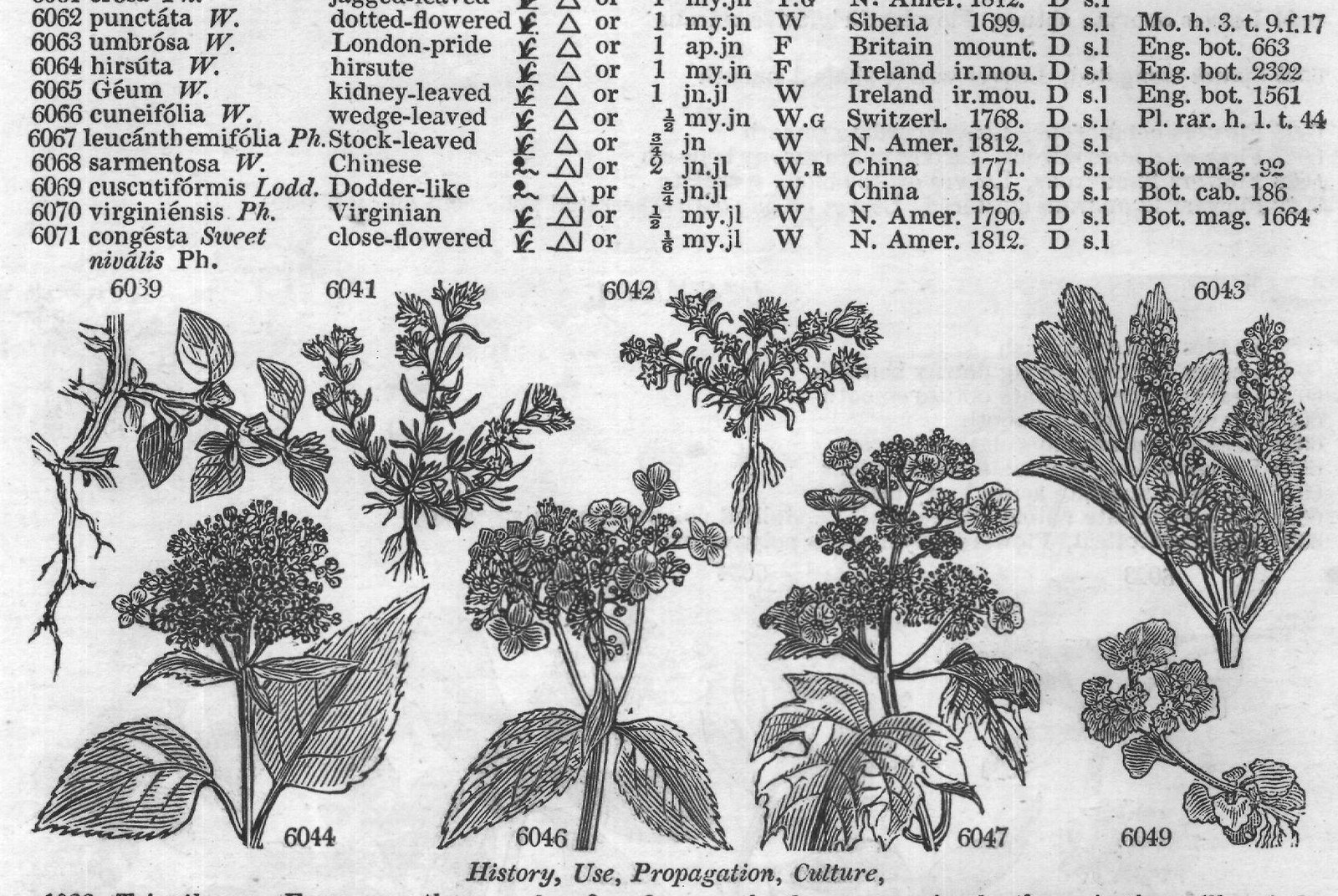
Saxifrageæ? Sp. 5. 6044 arboréscens W. shrubby or 6 jl.au W.G Virginia 1736. L p.1 Bot. mag. 437 6045 cordáta Ph. heart-leaved or 8 jl.au W.G Carolina 1806. L p.1 Dend. brit. 42 6046 nivea Ph. white-leaved or 5 jl.au W.G Carolina 1786. L p.1 Dend. brit. 43 radiata W. 6047 quercifólia W.
Oak-leaved 黍 or 4 jn.s W.G Florida 1803. C p.1 Bot. mag. 975 6048 horténsis W. changeable or 3 ap.s Pk China 1788. C p.1 Bot. mag. 438 1040. CHRYSOSPLENIUM. W. GOLDEN SAXIFRAGE. 6049 alternifólium W. alternate-leav. cu Saxifrageæ. Sp. 2. ap.my Y Britain w.sh.p. D. m.l Eng. bot. 54 6050 oppositifólium W. opposite-leaved cu ap.my Y Britain w.sh.p. D m.l Eng. bot. 490 1041. SAXI FRAGA. W. SAXIFRAGE.
Saxifrageæ.
Sp. 56-70. 6051 liguláta Wall. ligulate or 1 ap.jn W Nepal 1821. D p.l Bot. cab. 747 6052 crassifólia W. thick-leaved or 1 mr.my P Siberia 1765.
D s.l Bot. mag. 196 6053 cordifólia M. n. heart-leaved or 1 mr.my P Siberia 1779.
D s.l 6054 Cotylédon W. pyramidal or 2 my.jl W.G Al. of Eur. 1596.
D s.l Fl. dan. 241 6055 récta P. S. straight-leaved or 1 my.jl W.G Al. of Eur. ...
D s.l Pl. ph. t. 221. f. 1 6056 Aizóon P. S. large-margined or 1 my.jl W.G 6057 intácta W. en. small-margined or 1 my.jl W.G 6058 mutáta W. en.
Saffron-colored or jn.jl L.Y 6059 pensylvánica W.
Pensylvanianor 2 my.jn G.Y Switzerl. 1779. D s.l Jac. aus. 5. t. 438 Hort. ber. 2. t.75 Al. of Eur.1731.
D s.l Tyrol ...
D s.1 Bot. mag. 351 N. Amer. 1732.
D s1 Di. el.t.253. f.328 6060 hieracifólia W.
Hawkweed-lvd.or 2 my.jn W.G Hungary 1789. D s.1 Pl. rar. h. 1. t.18 6061 erósa Ph. jagged-leavedor 1 my.jn Y.G 6062 punctáta W. dotted-flowered or 1 my.jn W N. Amer. 1812. D s.l Siberia 1699. D s.l Mo. h. 3. t. 9.f.17 6063 umbrósa W.
London-pride or 1 ap.jn F Britain mount. D s.1 Eng. bot. 663 6064 hirsúta W. hirsute or 1 my.jn F Ireland ir.mou. D s.1 Eng. bot. 2322 6065 Géum W. kidney-leaved or 1 jn.jl W Ireland ir.mou. D s.l Eng. bot. 1561 6066 cuneifólia W. wedge-leaved 6067 leucanthemifólia Ph. Stock-leaved or my.jn W.G orjn W 6068 sarmentosa W. Chinese or 2 jn.jl W.R 6069 cuscutifórmis Lodd. Dodder-like 6070 virginiénsis Ph. pr Virginian 6071 congésta Sweet nivális Ph. 6039 or close-flowered or jn.jl W my.jl W my.jl W Switzerl. 1768. D. s.1 N. Amer. 1812. D s.l China 1771. D s.1 China 1815. D s.l N. Amer. 1790. D s.1 N. Amer. 1812. D s.l Pl. rar. h. 1. t. 44 Bot. mag. 92 Bot. cab. 186 Bot. mag. 1664 6041 6042 6043 6044 6046 6047 6049 History, Use, Propagation, Culture, 1036. Trianthema. From τρεiς, three, and avθoς, flower; the flowers growing by threes in the axillæ of the leaves. The species are weeds in their native countries, and of little interest here. 1037. Scleranthus. From σκληρoς, hard, and avθoς, a flower; when in seed the envelopes of the flower appear very much indurated. S. annuus is common throughout Europe and Siberia on a sandy soil. It flowers about the middle of summer, and sows its seeds very abundantly in autumn, which produce a crop of young plants that generally survive the winter, or, if destroyed, are replaced by another crop arising from those seeds that happen not to vegetate till spring. (Eng. Bot.) The Swedes and Germans receive the vapour arising from a decoction of it into their mouths, to cure the tooth-ache. (Withering.) S. perennis in several parts of Europe has its roots attacked by the insect Coccus Polonicus, Lin. which yields a fine crimson dye, and is said likewise to live on S. annuus and some Potentillæ. Sir J. Smith has "never been able to find this insect on these plants in England." (Flora Brit. ii. 283.) These two species are occasionally found in abundance upon barren heathy wastes. 1038. Cunonia. In memory of John Christian Cuno, of Amsterdam, who described his own garden in Dutch verse in 1750. This is a handsome tree, with fine shining green foliage, contrasted by numerous dense elongated branches of small milk-white flowers, and twigs of a red color: having the habit of a tropical rather than of a Cape plant. Its colonial name is Rood Elze (red alder), although the tree has not in any point of view the least resemblance to the alder of Europe. 1039. Hydrangea. From ύδως, water, and aγγεiov, a vessel. The common garden species, H. hortensis, is quite a marsh plant, and to be managed well should have a very copious supply of water in summer. A large plant will consume ten or twelve gallons daily, in warm weather. H. quercifolia is an elegant plant when in leaf; but as it is barely within the limits of ligneous plants, it dies down to the ground on the approach of frost. H. hortensis is much valued on account of the great profusion of its very elegant flowers, which are monstrous in the same manner as the Viburnum opulus. It has never DECANDRIA DIGYNIA.
ORDER II. 6039 Flowers pentandrous monogynous 6040 Flowers about decandrous digynous 6041 Calyx of fruit spreading 6042 Calyx of fruit closed 6043 The only certain species 6044 Cymes naked, Leaves oblong ovate acuminate toothed smooth 6045 Cymes radiate, Leaves cordate toothed 6046 Leaves ovate acuminate toothed beneath white with down, Serratures mucronate 6047 Cymes radiate, Leaves oblong sinuate-lobed toothed 6048 Cymes radiate, Leaves elliptical narrowed at each end toothed smooth 6049 Leaves alternate 6050 Leaves opposite roundish hairy, Stems decumbent 6051 Leaves orbiculate or oval stalked pimpled ciliate cordate at base, Petals round, Sepals mucronate 6052 Leaves oval retuse obsoletely serrated stalked, Stem naked, Panicle bearded 6053 Leaves cordate orbicular serrated stalked, Panicle headed 6054 Leaves radical ligulate with cartilaginous teeth, Stem panicled leafy, Cal. hairy with glands 6055 Radical leaves rosed straight glaucous supine crenate, Panicle simple 6056 Leaves radical lingulate with cartilag. teeth, Stem simple racemose leafy, Cal. smooth 6057 Radical leaves aggreg. lanc. obov. with cartilaginous teeth, Stem leafy clammy, Calyxes glandular 6058 Leaves rad. lingulate with a cartilaginous repand edge, Stem racemose leafy, Cal. with gland. hairs 6059 Leaves obl. lanc. hairy toothletted, Stem naked, Peduncles alternate in corymbose heads 6060 Leaves obl. lanc. smooth repand toothed, Stem naked, Peduncles 1-flowered aggregate 6061 Smoothish, Leaves oblong-lanc. acute eroded, Stem naked, Panicle oblong 6062 Leaves roundish toothed with long stalks, Stem naked 6063 Leaves obovate retuse with cartilaginous crenæ, Stem naked panicled 6064 Leaves cordate oval retuse with cartilaginous crenæ, Stem naked panicled 6065 Leaves reniform toothed, Stem naked panicled 6066 Leaves cuneiform very obtuse repand, Stem naked panicled 6067 Very hairy, Lvs. elongate spatulate acutely toothed, Stems divaricate dichotomous, Panic, capillary lax 6068 Leaves roundish toothed hairy, Runners creeping, Two petals long 6069 Leaves rhomboid toothed variegated hairy, Runners very weak, Petals nearly equal 6070 Leaves cuneate obovate somewhat toothed shorter than stalk, Stem panicled 6071 Leaves roundish cuneate crenate in front, Stem naked simple, Flowers clustered racemose 6064 6051 6054 6065 6058 6063 6063 6070 and Miscellaneous Particulars. been found in a wild state, but is extensively cultivated in the gardens of China and Japan, from whence it was introduced to Kew by Sir Joseph Banks. The flowers are almost always barren; they are naturally of a rose color, but under certain circumstances of culture they become blue. The yellow loam of Hampstead Heath and some other places, and some sorts of peat earth are found to produce this effect; but the cause is not yet ascertained. Dr. Daalen, of Antwerp, finds that turf-ashes, and, still more effectually, those of the Norway spruce, the wood generally used as fuel by him, applied to the roots of Hydrangea, produced the blue color of the petals. (Neil's Hort. Journ. 122.) According to Busch, of Petersburgh, "the hydrangea will be turned blue by watering the young plant, the summer before, with alum water. Our grey colored earth, under the black moor-earth, has the same effect, being combined with aluminous salt." (Hort. Trans. vol. iv. 568.) Sweet recommends a bed of peat, and says, the longer it remains there the bluer will be the flowers.
The hydrangea, to flower freely, must not be allowed more than three or four strong shoots from the same root; it must have abundance of pot room, and plenty of water when in flower. It is a good plan to shift the plants twice or oftener during the early part of the season. If plunged and turned out of the pot into an open border in the end of May, they will flower vigorously, and will even stand the winter around and south of London, and flower yearly, and if well protected in winter very freely and strongly. The flowers are produced from the extremities of the shoots of the current year. 1040. Chrysosplenium. From χρuσoς, gold, and σπληv, the spleen; a figurative name applied to this plant, with reference to its medicinal qualities. It is said to be a powerful cathartic. In the Vosges the plants are used copiously as a salad, under the name of Cresson de Roche. 1041. Saxifraga. Saxum-frango, to break the stone; a name contrived in reference to supposed medicinal qualities which are now forgotten.
An elegant genus of alpine plants, which have long been favorites in gardens. Many of the species are 6072 nivális W. 6073 stelláris W. 6074 bryoídes W.
DECANDRIA DIGYNIA.
CLASS X. clustered-Alp.or jn.jl W Britain sc. alp. D s.1 Eng. bot. 440 starry orjn.jl W Britain al. riv. D s.l Eng. bot. 167 thrd.-moss-like or jn.jl W Switzerl. 1752. D s.l Jac. m. 2. t. 5. f.1 6075 cæ'sia W. gray or my.jn W Switzerl. 1752. D s.l Bot. cab. 421 6076 androsácea W.
Androsace-lvd.or my.jn W Austria 1792. D s.1 Jac. aus. 4. t. 389 6077 oppositifólia W. opposite-leavedor mr.ap Pu Britain al. roc. D s.1 Eng. bot. 9 6078 áspera W. rough or au W Switzerl. 1752. D s.l Jac. aust. 5. t. 31 6079 Hirculus W. yellow-marshor au Y England tu. bo. D s.1 Eng. bot. 1009 6080 Aizoídes Haw. smaller-mount. A or jl.au Y Britain al. riv. D s.l 6081 autumnális Haw. 6082 rotundifólia W. larger-mount. or jl.au Y.R Britain Ds.l Eng. bot. 39 round-leaved or 1 my.jn W.R Austria 1596. D s.1 Bot. mag. 424 6083 granuláta W. grain-rooted or 1 my W ẞ pléna double-flowered or 1 ap.jl W ...... 6084 cérnua W. drooping or jl W Britain me. pa. D s.1 ...
Scotland sc. alp. D s.l Eng. bot. 500 D s.l Eng. bot. 664 6085 rivuláris W.
Alpine-brookor jn.jl W Scotland sc. alp. D s.1 Eng. bot. 2275 6086 hederácea W.
Ivy-leaved or W Levant 1752. S s.l 6087 pentadactyla Lap. five-fingered or my.jn W Pyrenees 1815. D s.1 Lapey. fl. t. 40 6088 geranioídes W.
Crane's-bill-lvd. or ap.my W Pyrenees 1770. D s.1 Lapey. fl. t. 43 6089 pedatífida L. T. pedatifid or my.jn W Scotland sc. alp. D s.1 Eng. bot. 2278 6090 ceratophýlla H. K. shining-calyxed or my.jn W Spain 1804. D s.1 Bot. mag. 1651 6091 ajugifólia W.
Bugle-leaved or 1 jn.jl W Pyrenees 1770. D s.1 Lapey. fl. t. 31 6092 platypétala L. T. broad-petalled or 1 jn W Scotland al. roc. D s.1 Eng. bot. 2276 6093 sibírica W.
Siberian or 1 my.jn W Siberia 1802. D s.l 6094 tridactýlites W.
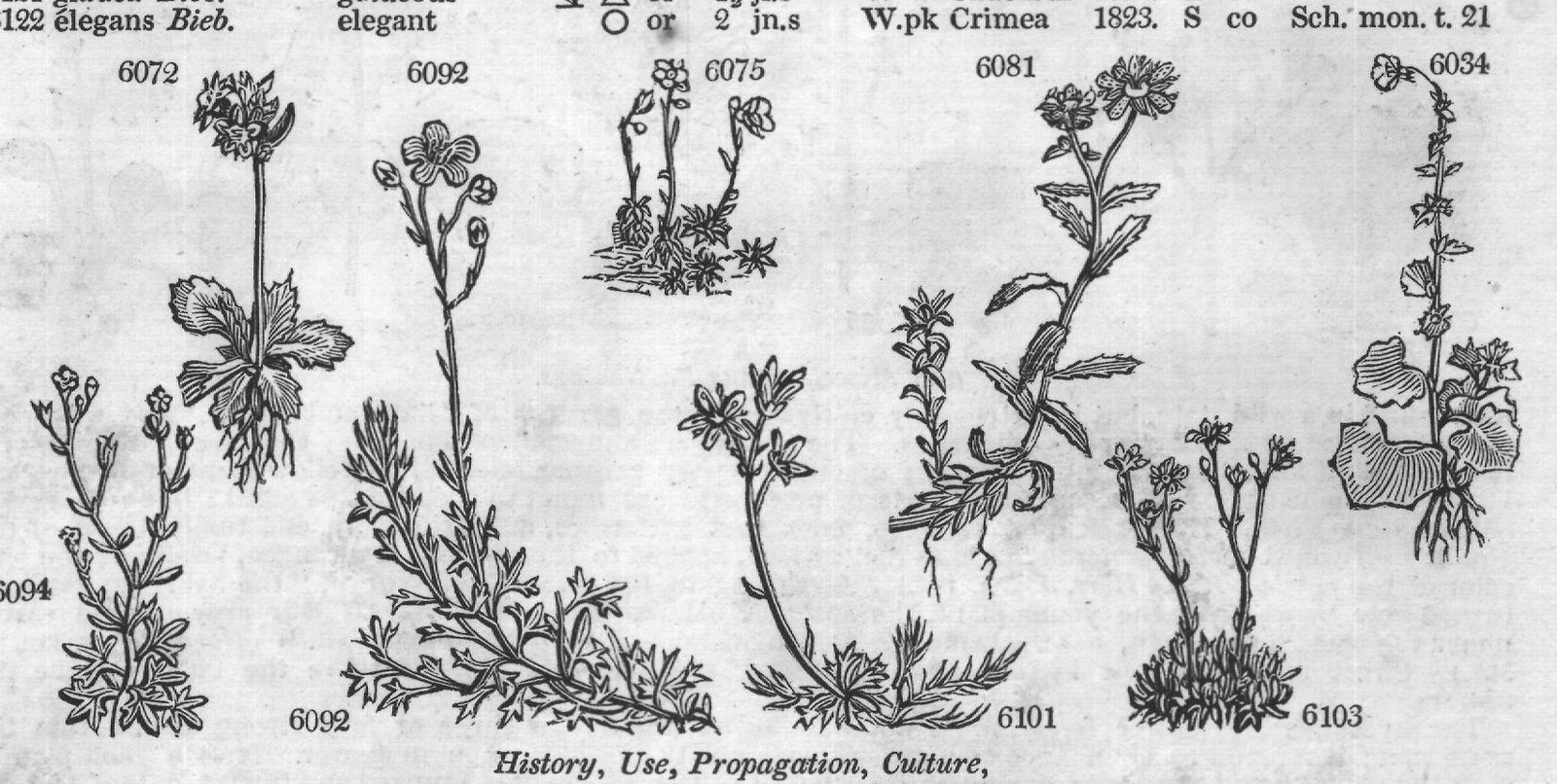
Rue-leaved W ap.my W Britain walls. S s.1 Eng. bot. 501 6095 petræ'a W. rock or ap.my W Norway 1752. D s.l Fl. dan. 68 6096 adscéndens W. ascending or my W Pyrenees 1752. D s.l Jac. ic. 1. t. 81 6097 Sternbergii W. en. large-flowered or 1 my W Germany D s.l ... 6098 hírta E. B. hairy or 1 jn W 6099 palmáta E. B. palmate or my.jn W 6100 elongélla L. T. long-stalked or 1 ap.my W 6101 hypnoídes W. mossy or ap.jn W 6102 moscháta W. musky Pyrenees 6103 pygmæ'a Haw." pigmy or my.jn W. moschata E. B. 6104 cæspitósa W. tufted 6105 grænlandica H. K. Greenland 6106 muscoídes W.
Moss-like 1042. TIAREL'LA. W.
TIARELLA. 6107 cordifólia Ph. heart-leaved 6108 Menziésii Ph. leafy-stemmed 6109 biternáta Vent. biternate সসসসসস or or my.jn Cr jl W or my.jn W.Y Pyrenees ormy.jn L.Y Scotland sc. alp. D s.1 Wales wal. p. D s.l Scotland sc. alp. D s.1 Britain al. roc. D s.1 D s.l Scotland sc. alp. D s.1 Wales w. alp. D s.1 Pyrenees 1732. D s.1 D s.l Eng. bot. 794 Lapey. fl. t. 19 Labey Lapey. fl. t. 34 Eng. bot. 7919 Eng. bot. 2291 Eng. bot. 455 Eng. bot. 2277 Eng. bot. 454 ...
Lapey. fl. t.37, 38 Eng. bot. 2314 ...
Saxifrageæ.
Sp. 3-10. or ap.my W N. Amer. 1731. D s.p Bot. mag. 1589 or 1 ap.my W N. Amer. 1812. D s.p Aor 2 my.jn W Carolina 1812. D s.p Vent. malm. 54 6111 cordifólia Ph. 1043. MITEL/LA. W. 6110 diphýlla W. 6112 núda W.
MITELLA.
Saxifrageæ.
Sp. 5-10. two-leaved pr ap.my W N. Amer. 1731.
D p.l Bot. reg. 166 heart-leaved prap.my W N. Amer. 1812.
D p.l La. ill. t. 373. f. 3 Kidney-leaved pr jn.au W N. Amer. 1758.
D p.1 La. ill. t. 373. f. 2 1044. GYPSOPHILA.
W. GYPSOPHILA.
Caryophylleæ. Sp. 16-36. 6113 Struthium L. fleshy-leaved or 2 jl.au W Spain 1729. D p.1 Bar. ic. t. 119 6114 fastigiáta L. one-rowed or 1½ jn.jl W 6115 arenaria W. & K. sand or 1 jl.au W 6116 viscósa Murr. clammy or 1 jn.jl W Germany 1759. D p.1 Hungary 1801. D p.l Levant 1773. S p.1 G. sib. 4. t. 61.f.1 6117 altíssima L. upright or 1 jl.au St Siberia 6118 perfoliáta L. perfoliate or 2 jl.au F Spain 6119 acutifólia Fisch. acute-leaved or 3 jl.au W.G Siberia 1759. D p.1 1732. D p.l 1820. D co Pl. rar. h. t. 41 Mur, co. g. t. 3 Gm. sib. 4. t. 60 Dill. elt. t. 276 6120 paniculáta L. panicled or 4 jn.jl W Siberia 1759. D p.1 Jac. au. 5. t. ap.1 6121 glaúca Bieb. glaucous A or 1 jl.s W Caucasus 1822. D co 6122 élegans Bieb. elegant or 2 jn.s W.pk Crimea 1823. S co Sch. mon. t. 21 6072 6092 6075 6081 6034 6094 6092 6101 6103 History, Use, Propagation, Culture, quite easy to cultivate, and although naturally mountaineers, not incapable of breathing the more impure air of towns and vallies. The greater part known are delicate and difficult to rear: they are regardless of cold, but suffer from mild and humid weather during the winter months. Most of the species are perennial, with either fibrous or granular roots, and a few are annual. Of the latter one species, S. tridactylites, is common upon very old walls in England, flowering in the beginning of the spring. The parts of fructification are extremely variable in this genus, and have given rise to the construction of many supposed genera, the constituents of which have the recommendation of agreeing with one another pretty well in habit. The limits, however, of these genera are too obscure, and the gradations by which they are united so obvious, that they have not yet been adopted by men of science generally. Without interfering with that question, the old mode of considering Saxifrage has been here adhered to, as being the most popular and the best under- ORDER II.
DECANDRIA DIGYNIA. 6072 Leaves obovate crenate subsessile, Stem naked, Flowers headed 6073 Leaves serrate, Stem naked branched, Petals acuminate 6074 Leaves lanc. mucronate with a cartilaginous ciliated edge, Stem naked few-fl. Cal obtuse 6075 Leaves linear perforated dotted aggregate recurved, Stem many-fl. 6076 Leaves lanc, obtuse hairy, Stem naked 2-flowered 6077 Leaves ovate opposite imbricated: the upper ciliated 6078 Cauline leaves lanc. alternate ciliated, Stems procumbent 6079 Cauline leaves lanc. alternate naked unarmed, Stem erect 6080 Cauline leaves lin. subul. scattered naked unarmed, Stem decumbent 6081 Cauline leaves linear alternate ciliated: radical aggregate 6082 Cauline leaves reniform toothed stalked, Stem panicled 6083 Cauline leaves reniform lobed, Stem branched, Root granular 6084 Cauline leaves palmate stalked, Stem very simple 1-fl. bulbiferous 6085 Cauline leaves palmate: the upper floral ovate, Stem simple about 2-flowered 6086 Cauline leaves ovate lobed, Stem filiform weak 6087 Leaves cuneiform 3-parted with trifid linear segments, Stem simple ascending, Petals lanceolate 6088 Radical leaves reniform 5-lobed many-cleft, Cauline linear, Stem nearly naked branched 6089 Rad. Ivs. reniform pedatifid 7-lobed, Caul. palmate and lin. Stem nearly naked branched, Pet. lin. obov. 6090 Smooth, Radical leaves 3-lobed, Lobes many-cut; lateral segments falcate, Stem panicled, Cal. colored 6091 Radic. leaves palm. 5-parted, Cauline linear undivided, Stems ascending many-fl. 6092 Leaves hairy trifid or 5-fid bearded, Runners procumbent, Stem leafy, Petals obovate rounded 6093 Leaves reniform palm. hairy, Stem and flower-stalks filiform 6094 Caul. leaves wedge-shaped trifid alternate, Stem erect branched 6095 Leaves wedge-shaped, Radic. entire and 3-toothed, Cauline 5-toothed; upper trifid, Pedunc, about 3-fl. 6096 Leaves palmate 3-parted, Segments subtrifid, Stem branched ascending 6097 Leaves cuneiform palmate 5-fid ciliated longer than the linear petiole, Runners very short tufted 6098 Leaves hairy 3 or 5-parted, Lobes elliptical acute, Runners ascending, Petals obovate 3-nerved 6099 Leaves hairy palmate 5-cleft and trifid, Stem leafy panicled, Petals roundish 6100 Leaves ciliated cuneate trifid nearly 5-cleft, Pedunc. solitary elongate 1-fl. 6101 Cauline leaves lin, entire and trifid, Runners procumbent, Stem erect nearly naked 6102 Radic. leaves aggregate entire and trifid acute linear, Stem viscid nearly racemose, Petals length of cal. 6103 Radic. leaves aggregate membranous lin. lanceolate entire or trifid, Stem nearly naked about 2-fl. 6104 Radic. leaves aggr. linear obtuse trifid cut, Stem erect many-fl. Petals twice as long as cal. 6105 Leaves imbric. cuneate-palmate ciliated, Petals round, Styles spreading, Stigmas flat woolly 6106 Radical leaves aggregate entire and trifid oblong obtuse, Stem filiform about 2-fl, Pet. as long as calyx 6107 Leaves cordate acutely lobed toothed, Scape racemose 6108 Leaves ovate cordate acute shortly lobed toothed, Raceme filiform spiked 6109 Leaves biternate 6110 Leaves cordate about 3-lobed toothed, Scape 2-leaved 6111 Leaves orbiculate reniform doubly crenate lucid, Scape setaceous lucid 6112 Leaves reniform repand ciliated, Scape naked 1. Calyxes not scaly. 6113 Flowers clustered, Stems simple roughish, Leaves linear fleshy 6114 Flowers corymbose, Stem ascending, Leaves lanc. lin. obsoletely 3-cornered obt. 1-sided, Stam. exserted 6115 Flowers corymbose, Petals rarely subemarginate, Leaves linear fleshy smooth flat 6116 Flowers corymbose, Branches divaricating, Leaves ovate lanc. smooth at the base cordate amplexicaul. 6117 Branches spreading, Flowers panicled small, Pan. much branched, Fl.-stalks viscid 6118 Flowers panicled, Panic. much branched polished, Leaves ovate lanc. half stem-clasping 6119 Fl. trichotomous panicled, Pedunc. villous viscid, Petals emarginate twice as long as calyx 6120 Fl. panicled very minute diœcious, Peduncles smooth filiform divaricating, Leaves lin. lanc. rough 6121 Fl. panicled, Panic. divaricating, Branches few-flowered pubescent viscid, Leaves lin. lanc. obtuse 6122 Fl. dichotomous, Panic. smooth, Pet. emarg. twice as long as cal. Leaves lanceolate fleshy 6104 6118 6111 6107 6114 6110 6112 6117 and Miscellaneous Particulars. stood. The species are subject to great variation in appearance, and to much diversity of opinion among those who profess to be best acquainted with them. A middle course has here been taken, by which the doubtful kinds have been omitted, and those which are recognized, if not defined, satisfactorily, are alone admitted. 1042. Tiarella. From tiara, a particular kind of head-dress, a mitre, in allusion to the form of its capsule. Pretty little North American herbaceous plants, related to saxifrage, and easily cultivated in pots of light sandy peat and loam. 1043. Mitella. A diminutive of mitra, a mitre; so named for the same reason as the last genus, which it altogether resembles in habit and constitution. 1044. Gypsophila. From γuψoς, chalk, and φiλεω, to love; most of the species delight in chalky districts. Bb DECANDRIA DIGYNIA.
CLASS X. 6123 Stevéni Fisch.
Steven's or 6124 répens L. creeping or 6125 dúbia W. doubtful or 6126 prostráta L. trailing or 2 jl.au W Iberia jl.s St Siberia 1 my.s W 1 jl.s W 6127 murális L. wall or jn.o F 1822. D co 1774. D p.l 1815. D p.1 Siberia 1759. D p.l Germany 1739. D s.l Bot. mag. 1448 Bot. mag. 1281 La. ill. t. 375. f. 1 6128 Saxífraga L.
B rígida Dec. 1045. SAPONA'RIA. 6129 officinális W. small or jl.au Pk Germany 1774. D p.l Ex. bot. 2. t. 90 rigid or jn.au Pk France 1769. D s.l W. SOAPWORT.
Caryophylleæ. Sp. 6-17. common or 2 jl.o Pk plena double-flower. or 2 jl.o Pk ...
England hed. D co Eng. bot. 1060 D co 6130 vaccária W. perfoliate or 2 jl.au Pk Germany 1596. S s.l. 6131 pórrigens W. hairy or 1 jl.au Pk Levant 1680. S s.l 6132 ocymoídes W.
Basil-leaved or my.jl R France 6133 orientális W. small-annual or 1 jn.au Pk Levant 1768. R s.p 1732. R s.p 6134 lútea W. yellow or jn.au Y Switzerl. 1804. R s.p J. vind. 2. t. 109 Bot. mag. 154 Di. el.t.167. f.204 Smith spic. t. 5 1046. DIANTHUS. W.
PINK.
Caryophylleæ. Sp. 60-113. 6135 prólifer L. proliferous 6136 diminutus L. small-flowered 00 pr jl.au Pk England gra.pa. S p.1 Eng. bot. 956 prjl Pk S. Europe 1771. S p.l 6137 arméria L.
Deptford or 1 jl.s R 6138 pseud-armeria Bieb. false Deptford or 1 jl.au Pu England gra.pa. S p.1 Crimea 1820. C p.l Eng. bot. 317 Bot. mag. 2288 6139 díscolor Sims. two-colored or 1 jn.s Pu Caucasus 1803. C s.l Bot. mag. 1162 6140 barbátus L.
Sweet-William or 14 jn.jl Pk Germany 1573. C r.m 6141 latifólius W. broad-leaved or 1½ jl.s Pk ......
C s.l 6142 japónicus Thunb.
Japanese or 1 jn.o Pk China 1804. C p.l Bot. mag. 207 Sw. fl. gard. 2 Thunb. jap. t. 23 6143 cephalótes Ser. headed Aor 1½ jn.o Pk 6144 capitátus Dec. capitate or 1½ jn.o Pu 61-45 polymorphus Bieb. variable or 1 jn.o R 1823. C p.l Caucasus 1822. C p.1 Crimea 1822. C p.l e diutinus Lk. 6146 ferrugi'neus L. rusty or 1½ jl.s Br 6147 Carthusianórum L. Carthusian or 1 jl.au R 6148 atrorúbens All. dark-red or 1 jl.s Cr 6149 arbóreus L. tree or 1½ jn.au Pk 6150 fruticósus L. fleshy-leaved 2 or 12 jn.s Pk Greece 6151 suffruticósus W. shrubby or 1 jn.jl Pk 6152 caroliniánus Walt. Carolina or 1 jn.s Pu Italy 1756. S p.1 Germany 1573. C s.l Italy 1802. C s.l Greece 1820. C s.l Siberia 1815. Cr.m 1804. C p.l N. Amer. 1811. Cr.m Mi. ic. 1. t. 81. f.1 Loes. pruss. t. 7 Jac. ic. 3. t. 467 Bot. cab. 459 Tourn. it, 1. t. 9 6153 ásper W. rough-stalked or jl.s Pk Switzerl. 1822. C s.1 6154 collínus W. & K. hill or jl.s W Hungary 1800. C s.l Par. lond. 62 6155 campéstris Bieb. field or 1 jl.au 6156 nítidus W. & K.
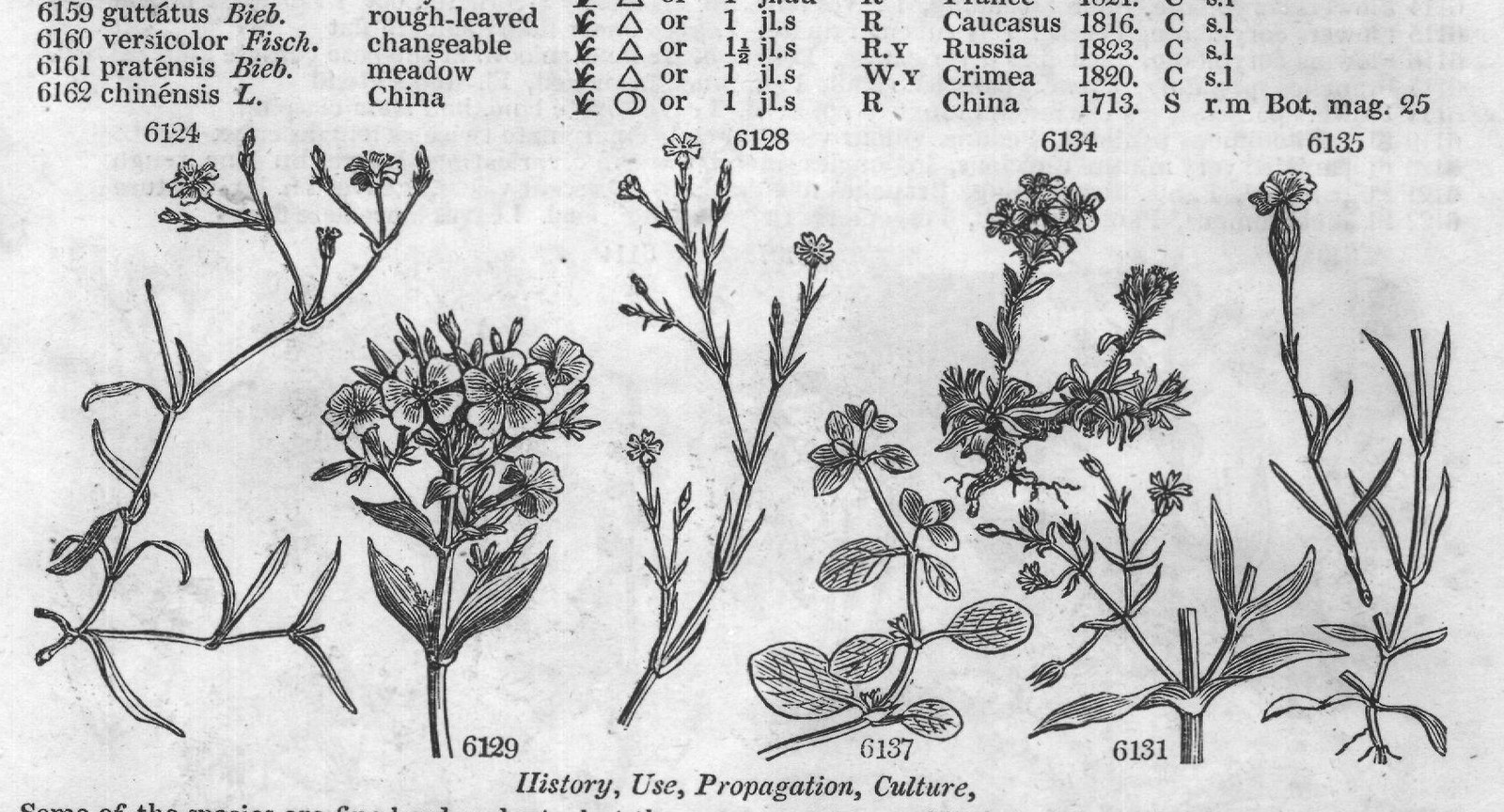
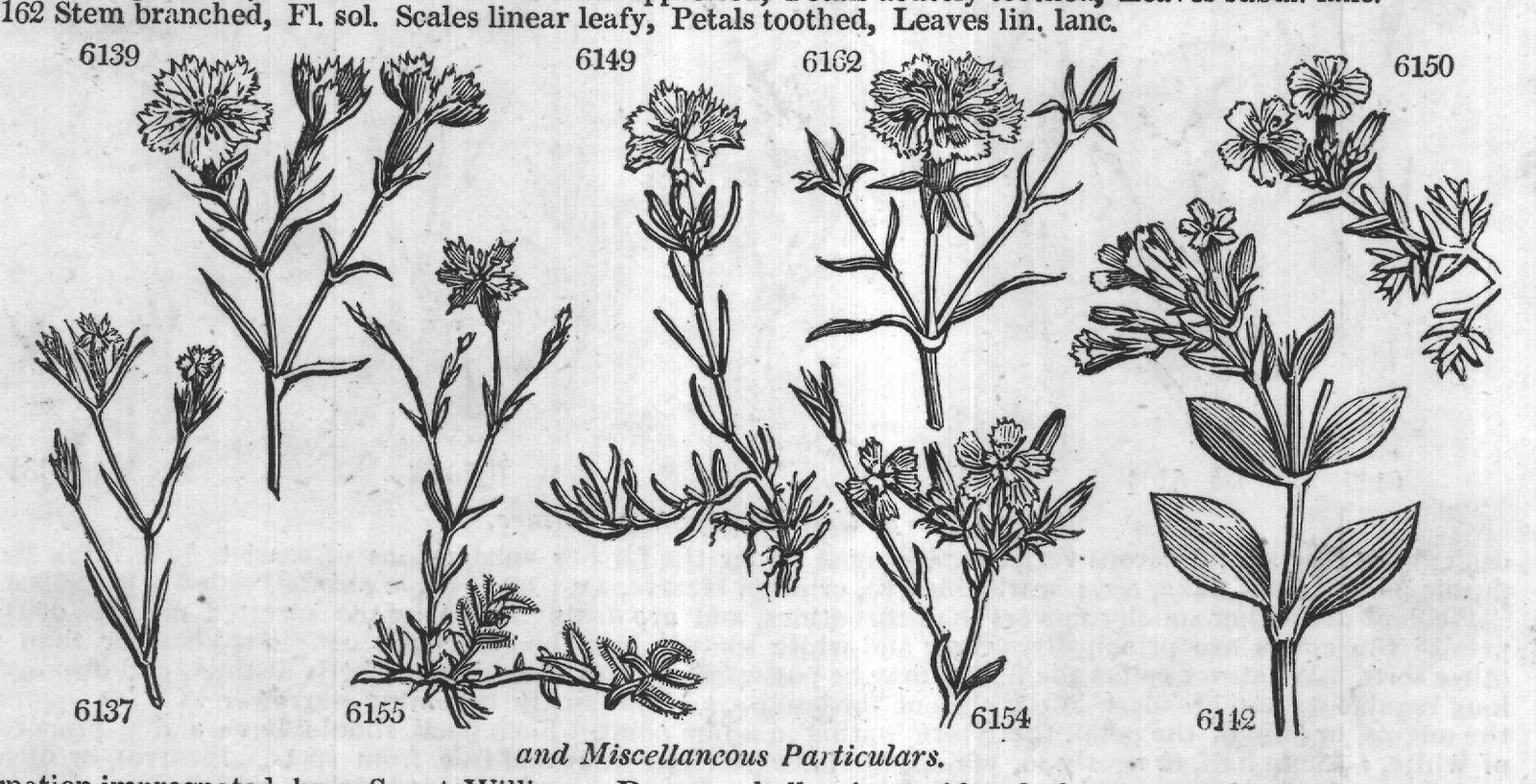
W.R Tauria 1815. C s.l Bot. mag. 1876 shining or 1 jl.au R Carpath. 1822. C s.l 6157 diffúsus Sibth. diffuse or 1½ jl.au R 6158 hir'tus Vill. hairy or 1 jl.au R Cyprus 1820. C s.l France 1821. C s.l 6159 guttátus Bieb. rough-leavedor 1 jl.s R Caucasus 1816. C s.l 6160 versicolor Fisch. changeable or 1½ jl.s R.Y Russia 1823. C s.1 6161 pratensis Bieb. 6162 chinénsis L. 6124 meadow or 1 jl.s China or 1 jl.s China W.Y Crimea 1820. C s.l R 6128 1713. S r.m Bot. mag. 25 6134 6135 6129 6137 6131 Ilistory, Use, Propagation, Culture, Some of the species are fine border plants, but the greater part are of little beauty, and only grown in botanic gardens. 1045. Saponaria. In allusion to its mucilaginous sap, which is said to be fit for supplying the place of soap, sapo. S. officinalis plena is considered a border flower, but is inconvenient unless kept in pots, from its spreading very much by the roots, which are underground creepers, like those of couch. The leaves form a lather with soap, and take out spots of grease in the same manner. The whole plant is bitter, and was formerly used to cure the itch and the venereal disease. 1046. Dianthus. Δioς avθoς, the flower of God, or divine flower; so named on account of its pre-eminent beauty. Most of the species of this genus are highly valued, not only for the beauty of their flowers, but also as being evergreens; their foliage during winter being as abundant and vivid as in summer. The fragrance of some of the species is peculiarly grateful, and no plant in this respect surpasses the carnation. D. barbatus is an old inhabitant of the flower garden, and was much esteemed in Gerarde's time " for its beauty to deck up the bosoms of the beautiful, and garlands and crowns for pleasure." The varieties are numerous, but as the plant has never been treated by florists as a leading flower, they have not been named or improved. A hybrid variety called the Mule, or Fairchild's Sweet-William, is supposed to have been produced from seeds of the ORDER II.
DECANDRIA DIGYNIA. 6123 Fl. panic. Stem diffuse, Leaves lin. lanc. grassy carinate cæsious 6124 Stems panic. few-fl. Stam. shorter than emarginate petals, Leaves linear smooth 6125 Petals obovate emarginate campan. Stamens shorter than corolla, Leaves linear somewhat fleshy 6126 Stems panicled, Styles longer than emarginate petals, Leaves lin. lanc. smooth 6127 Stem dichotomous panicled much branched, Fl. axill. solitary, Leaves lin. flat as long as fl.-stalks 2. Calyxes supported by 2-4 scarious scales. 6128 Stems numerous erect stiff, Fl. panicled terminal, Leaves linear rigid 6129 Flowers fascicled panicled, Cal. rounded villous yellowish, Leaves ovate lanc. acute or not 6130 Fl. panicled, Cal. pyramid. 5-ang. smooth, Bractes membranous acute, Leaves ovate lanc. sessile 6131 Stem erect, Branches divaric. with clammy hairs, Fl. on long stalks axill. Leaves lanc. linear 6132 Stems erect branched, Fl. panic. and corymbose, Cal. slender glandular purple, Lvs. ovate lanc. 1-nerved 6133 Stem dichotomous, Branches divaricating, Fl. axill. Cal. hispid round, Leaves linear spatulate 6134 Tufted, Stems 2-leaved, Flowers headed with an involucre, Cal. woolly §1. Flowers capitate or corymbose, sessile or stalked. * Bractes ovate, blunt. 6135 Scales of calyx ovate pointless longer than tube, Leaves serrulate 6136 Like the last, but the flowers nearly solitary ** Bractes lanceolate, acute, Calyxes villous. 6137 Flowers loosely bundled, Scales lanc. subul. as long as tube, Leaves subulate, Calyxes hairy 6138 Flowers densely bundled, Scales ovate subul, as long as tube, Pet. beard. Lvs. subul. pub. rough upright 6139 Fls. aggreg. Scales long. than cal. striat. rough, Lvs. lin. short. than joints rough, Stem simple rough upw. *** Bractes ovate or lanceolate, Calyxes smooth. 6140 Flowers aggregate fascicled, Scales ovate subulate as long as tube, Leaves lanceolate 6141 Flowers aggregate racemose corymbose, Scales ovate lanceolate finally longer than calyx, Lvs. obl. lanc. 6142 Flowers aggregate fascicled, Scales acute ciliated twice as short as tube, Leaves ovate short 6143 Fls. subsess. capitate, Scales imbric. mucron. at end spreading a little short. than tube, Lvs. long narrow 6144 Glaucous, Fls. sess. capitate, Scales broad ovate with a long awn longer than head, Upper lvs. dilat. at base 6145 Dark green, Flowers sessile capitate, Scales ovate very short pointless, Leaves narrow rough Flowers panicled fastigiate and solitary stalked 6146 Fl. aggregate, Involucres and scales scarious rufous oblong awned a little shorter than cal. 6147 Fl. aggregate sessile and stalked, Scales ovate awned shorter than tube, Leaves linear 3-nerved 6148 Like the last, but flowers aggregate headed sessile 3-8 6149 Flowers aggregate, Claws of petals very long, Scales mucronulate closely imbricated, Leaves subul. fleshy 6150 Flowers aggregate, Claws of pet. as long as cal. Scales mucr. closely imbric. very short, Leaves lanc. obt. 6151 Flowers aggregate, Scales ovate subulate thrice as short as tube, Leaves lin. lanc. narrowed at each end 6152 Flowers aggregate on long stalks, Scales twice as short as tube §2. Flowers panicled or solitary. * Petals toothed. 6153 Flowers fascicled, Scales ovate lanceolate shorter than tube, Petals acutely toothed, Lvs. lin. lanc. rough 6154 Like the last, but the flowers more numerous, and the leaves linear lanc. 6155 Stem panicled somewhat hairy, Fl. sol. Scales ovate acute twice as short as cal. Leaves subul. 6156 Flowers fascicled twin, Scales awned as long as calyx, Petals crenate, Stem decumbent, Lvs. anc. obt. 6157 Flowers somewhat corymbose, Scales furrowed mucron. twice as short as tube, Stems diffuse smoothish 6158 Flowers nearly sol. Scales 6 ovate mucron. much shorter than cal. Pet. crenate, Lvs. subul. rough at edge 6159 Stem panicled smooth, Flowers solitary, Scales ovate awned as long as tube, Leaves subulate nerved 6160 Stem many-fl. smooth, Scales cuspid. spreading shorter than tube, Pet. downy at orifice, Lvs. lin. roughish 6161 Stem panicled, Fl. sol. Scales acuminate appressed, Petals acutely toothed, Leaves subul. lanc. 5162 Stem branched, Fl. sol. Scales linear leafy, Petals toothed, Leaves lin, lanc. 6139 6149 6162 6150 6137 6155 and Miscellancous Particulars. 6154 6112 carnation impregnated by a Sweet-William. D. caryophyllus is considered the source whence have sprung the numerous varieties of the carnation, and some think those also of the pink. The pink, however, is more probably derived from some of the smaller growing species, as plumarius, deltoides, armeria, carthusianorum, &c. The carnation is rarely found wild in England, but it may be gathered on the south side of the Swiss Alps. It seems to have been unknown to the ancients, at least in its cultivated state, not being mentioned by Pliny, or sung by any of the Roman poets. It has, however, been cultivated from time immemorial in Europe, and is in the highest favor for its beauty and rich spicy odour. It is the principal florist's flower of Germany and Italy, from which countries the British florists procure their best carnation seed, and also some esteemed varieties.
The varieties of carnation amounted to nearly 400 named sorts in the beginning of the eighteenth century, and the number has not since diminished. They are arranged in three classes; flakes, bizarres, and picotees. Flakes have two colors only, and their stripes large, going quite through the leaves; bizarres, Fr. (odd, irregular) are variegated in irregular spots and stripes, and with no less than three colours; picotees, Fr. (piquettée, pricked or spotted) have a white ground, spotted or pounced with scarlet, red, purple, or other colors. Of Bb 2 DECANDRIA DIGYNIA.
CLASS X. 6163 montánus Bieb. 6164 caryophýllus L. two-colored or jn.s R Caucasus 1803. C s.l Clove or 2. jn.au F England walls. Cr.m Eng. bot. 214 ẞ flore pléno Carnation or 2 jn.au Cr England fruticosus tree-Carnation or 3 jn.au Cr England Cr.m Bot. mag. 39 Cr.m imbricátus wheat-ear or 1 jn.au F England Cr.m Bot. mag. 1662 6165 virgíneus Sims. virgin or 1 jn.jl W S. Europe 1732. C s.l Bot. mag. 1740 D. sylvestris Jacq. 6166 monadélphus Vent. procumbent or 1 jn.jl Pk Levant ...
Cs.l Vent. cels. t. 39 D. procumbens Pers. 6167 sylváticus Hoppe wood or 1½ jn.s R Ratisbon 1815. S p.l 6168 pomeridiánus L. afternoon or 1 jn.jl Levant Y 1804. C $.1 Par. lond. 57 6169 leptopétalus W. narrow-petalled or 1 jl W 6170 púngens L. pungent or 1 au.o Pk Caucasus 1814. C s.l 1781. C s.l Spain Bot. mag. 1739 6171 deltoídes L. maiden or jn.o F Britain gra.pa. C s.1 6172 glaúcus L. glaucous-leaved or 4 jno W Britain Cs.l Eng. bot. 61 Di. el. t.298.f.348 ... 6173 crenátus Thunb. long-cupped or 1 au F C. G. H. 1817. C s.l Bot. reg. 256 6174 rígidus Bieb. rigid or jn.o R Casp. Sea 1802.
C s.l 6175 clavátus Spr. clavate or 1 jn.o F C s.l ... 6176 suavis W. sweet or 1 jn.o Pa.pk C s.l ...... ... 6177 cæsius Sm. mountain or 1 4 jn.jl F Britain rocks. C s.1 Eng. bot. 62 6179 Hornemánni Ser. 6180 Sternbergii Sibth. 6178 alpínus L. 6181 petræus W. & K. 6182 gállicus Pers. 6183 álbens H. K. 6184 plumárius L. 6185 horténsis W. 6186 caucásicus Sims. 6187 frágrans Bieb. 6188 punctátus Spr. 6189 serotínus W. & K. 6190 arenárius L. alpine or 1 4 jn.jl R Austria 1759. C s.l Bot. mag. 1205 Hornemann's or 1 jn.jl R Italy Cs.l ...
Sternberg's or jn.jl R C s.l ... rock or jl.au Pk Hungary 1804. C s.1 Bot. mag. 1204 French or jn.au Pu S. France C s.l ...
Cape feathered garden Caucasian or au W C. G. H. 1787. C. p.l or jn.au W.pu Europe 1629. C s.l or 1 jl.au St Hungary 1805. Cr.m or 1 jn.s Pu fragrant EΔor 1 jn Pu Caucasus 1803. C s.l Bot. mag. 795 Austria 1804. Cr.m Bot. mag. 2067 dotted or 1 jn PaLi Cr.m Bot. cab. 896 .... 1 late-flowering or 1 jl.s Pu sand 6191 fimbriátus Bieb. fringed A or my Pu Europe Hungary 1804. C s.1 Cs.l Pl. rar. h. 2.t.172 ... or 1 jn.au Li Iberia 1815. C s.l Bot. mag. 1069 D. orientalis Sims. 6192 plumósus Spr. 6193 monspessulánus L. Montpelier 6194 supérbus L. feathered or or superb or 1½ jl.s 1 jl.au 2 jl.s W.Li M. Bald.
C s.l ...
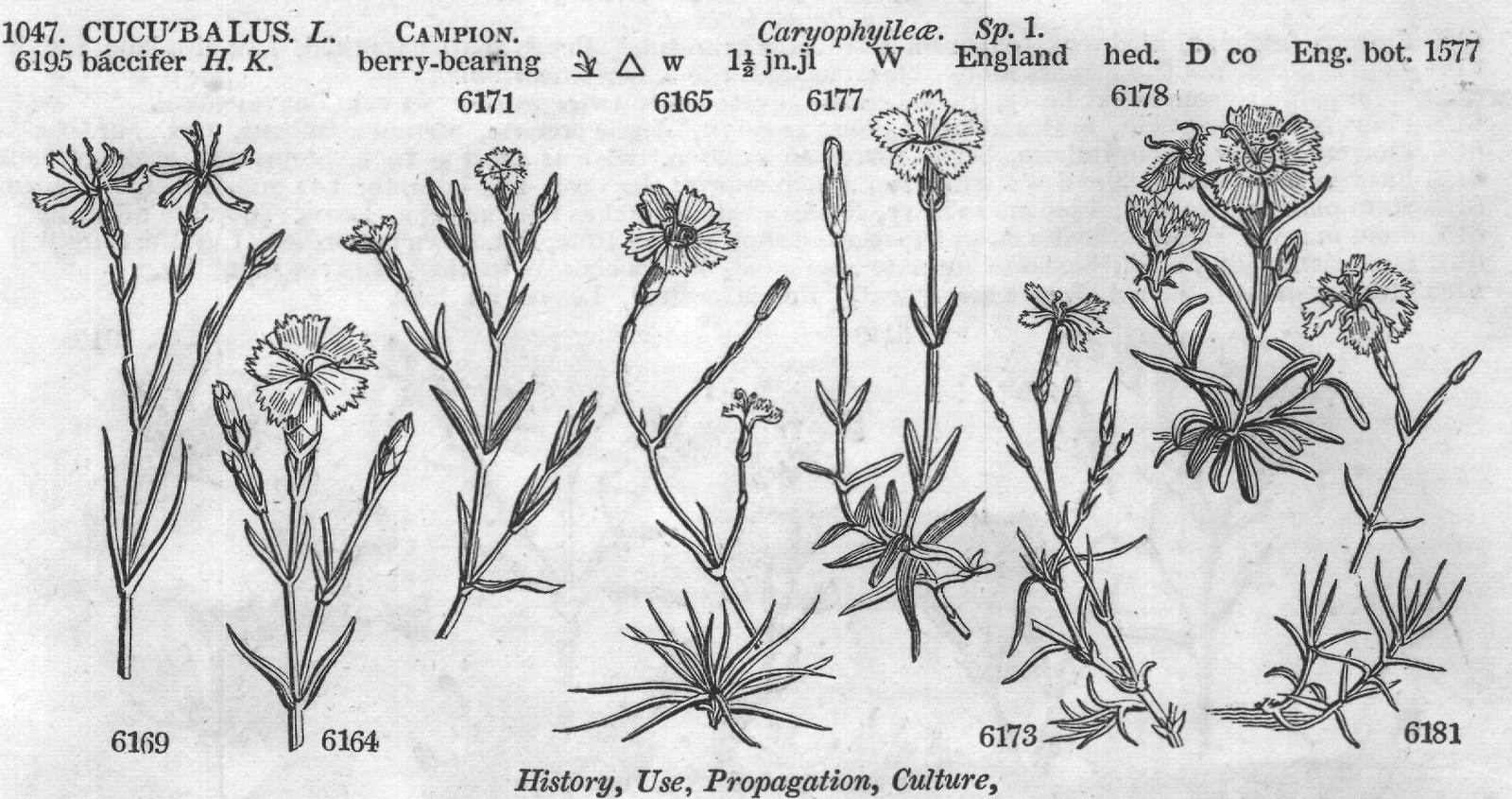
R W Montpel. 1764. C p.l Europe 1596. C s.l Bot. mag. 1148 TRIGYNIA. 1047. CUCU BALUS. L. 6195 báccifer H. K.
CAMPION. berry-bearing 6171 6169 6164 W 6165 Caryophylleæ. Sp. 1. 1½ jn.jl W England hed. D co Eng. bot. 1577 6177 6173 6178 6181 History, Use, Propagation, Culture, each class there are numerous varieties, arranged under the farther subdivisions of scarlet flake, pink flake, purple flake, yellow flake, &c.; scarlet bizarre, crimson bizarre, &c.; and purple picotee, yellow picotee, &c. Picotees are rather smaller flowers than carnations, and are distinguished by the serrated margins of their petals; the colors are principally yellow and white spotted, and the plants are considered hardier than the other sorts. Whatever colors the flower may be possessed of, they should be perfectly distinct, and disposed in long regular stripes, broadest at the edge of the lamina, and gradually becoming narrower as they approach the unguis, or base of the petal, there terminating in a fine point. Each petal should have a due proportion of white, i. e. one half, or nearly so, which should be perfectly clear and free from spots. Bizarres, or such as contain two colors upon a white ground, are esteemed rather preferable to flakes, which have but one, especially when their colors are remarkably rich, and very regularly distributed. Scarlet, purple, and pink are the three colors most predominant in the carnation; the two first are seldom to be met with in the same flower, but the two last are very frequently.
New varieties are procured from seeds, and thousands of seedlings are annually blown by florists and amateurs, sometimes without one being found worth keeping. Established or approved varieties are continued by layering and cuttings, or, as they are commonly called, pipings. The soil in which the carnation thrives best is a rich loam rather sandy than otherwise; the climate should be free from extremes of every kind, for which reason they are commonly grown in pots, and protected by a frame during winter, and covered by an awning while in bloom. Carnations grow exceedingly well in beds of properly prepared soil, over which frames are placed in winter, and an awning of canvass or bunting when the plants are in blossom. Those who are curious in blowing their carnations have a great many nice and curious operations to perform when they come into flower. Such petals as are plain, or run from the proper colors of the variety, are extracted by a particular instrument; the remaining petals are next arranged so as to form a convex imbricated surface; the calyx being slit down or tied up as may be necessary to aid this end. Then the flowerstalks are neatly tied to sticks, and the flower supported in a pendant attitude by means of properly formed brass wires. ORDER II.
DECANDRIA DIGYNIA. 6163 Stem branch. upw.closely dichotom. Fl. sol. Bract, with a spread. leafy point, Lvs. lin, subul. 3-nerv. hairy 6164 Stem branched, Fl. sol. Scales very short ovate, Petals very broad beardless, Lvs. lin. sub. channelled glauc. 6165 Stem branched or simple, Fl. sol. Scales very short 4 ovate, Pet. broad beardless toothed 6166 Stem dichotomous panicled many-fl. glaucous, Fl. sol. Scales 4 pungent spreading shorter than tube 6167 Fl. sol. subcorymb. Scales ov. lanc. short. than tube, Lvs. lin. lanc, obsol. 3-nerv. smooth, Pet. twice toothed 6168 Fl. sol. Scales ovate acute very short, Petals emarginate or nearly entire 6169 Stem branched, Fl. sol. Scales ovate acute very short awned, Pet. lanc. narrow, Leaves subul. roughish 6170 Stem few-fl. Fl. sol. Scales very short mucron. spreading, Tube gibbous, Pet. entire, Lvs. cæspitose subul. 6171 Stem decumb. branched, Fl. sol. Scales ovate lanc. acute twin, Upper leaves narr. acute: lower oblong obt. 6172 Like the last, but flowers white, Leaves and stem glaucous 6173 Stem branched, Fl. sol. Scales 6 lanc. appressed, Pet. smooth cuneate obovate, Lvs. lin. acum. channelled 6174 Stems tufted few-fl. Fl. sol. Scales ovate acute short, Leaves subul. spreading downy rough 6175 Stem 1-fl. Scales 2 ovate acute short spreading, Cal. contracted in middle, Lvs. lin. chann, roughish at edge 6176 Stem 1-fl. Scales 4 acute short, Petals bearded doubly serrated, Leaves lin. spreading 6177 Stems tufted about 1-fl. Scales roundish short, Pet. crenate downy, Leaves bluntish rough at edge 6178 Stem 1-fl. Outer scales as long as tube: inner much shorter, Pet. crenate, Leaves obl. obtuse 6179 Pedunc. bitid term. Scales lanc. cusp. erect short. than tube, Pet. cut, Lvs. lin. nerved serrul. rough at edge 6180 Stems about 2-fl. Scales 4 ovate acute twice as short as tube, Petals serrate downy, Leaves linear 6181 Stem about 1-fl. Scales obovate mucronate, Pet. beardless many-cut, Leaves subul. entire smooth nerved ** Petals fringed. 6182 Stems ascending about 1-fl. Scales short ovate, Pet. toothed many-cut, Leaves lin. ciliated 6183 Fl. sol. Scales 4 lanc. short, Petals emarginate at the end fringed toothed 6184 Glaucous, Stems 2-3-fl. Teeth blunt, Bractes ovate very short pointed, Leaves lin. rough at edge 6185 Like the last, but the petals bearded at their orifice 6186 Stem pan. few-fl. Fl. sol. Scales ovate acum. Petals equally cut crenate, Leaves glaucous rough at edge 6187 Stems 1-fl. Scales ovate lanceolate acuminate shorter than tube, Pet. beardless, Lvs. subul. rough at edge 6188 Stem branched few-fl. Scales 4 blunt short, Petals beardless dotted, Leaves glaucous linear flaccid 6189 Stems 1-fl. Scales ovate obtuse four times as short as calyxes, Pet. naked, Leaves subul. glauc. ciliated glauc, ciliated 6190 Stems 1-fl. Scales ovate obtuse, Leaves linear 6191 Stem half-shrubby branched at base 2-fl. Scales 6 lanc. shorter than cal. Leaves subul. rough 6192 Fl. scattered solitary, Scales lanc. lin. spreading a little shorter than tube, Leaves lin. nerved flaccid 6193 Stem panicled few-fl. Fl. sol. Scales subul. straight twice as short as tube, Petals digitate, Lvs. lin. serrul. Lvs. lin. serrul. 6194 Stem panic, many-fl. Fl. fastigiate, Scales short ov. mucron. Pet. beyond the middle pinn, many-cut hairy [at orifice TRIGYNIA. 6195 Branches divaricating, Leaves ovate, Cal, campanulate, Pet. distant 6147 6189 6188 6187 6186 6194 6191 6195 and Miscellaneous Particulars.
Behind the petals a circle of card paper is sometimes fixed to keep them in position, and the pot in which the plant grows is placed on a particular description of saucer, by which it is surrounded by water, in order to prevent the approach of ground insects, and especially of the earwig. These and a number of other operations will be found described at length in Maddock's Florist's Directory, and in the Encyclopædia of Gardening. (Sec. 6406.) The pink, as a florist's flower, is of much less antiquity than the carnation: it is scarcely mentioned by Gerarde, and Parkinson has given very few varieties. It was chiefly grown as a border flower till within the last fifty years, since which it has been greatly improved and many fine varieties originated. Being one of the hardiest and least expensive of fine flowers, it is much cultivated by operative mechanics and manufacturers round large towns, and no where to such an extent as about Paisley, by the muslin weavers there. The varieties of pink most cultivated are chiefly those called pheasant's eyes, which seem to have sprung from D. plumarius. Cob pinks are a large sort seemingly intermediate between pinks and picotee carnations; red early pinks are smaller plants than cobs, but larger than pheasant's eyes, and seem to have sprung from cobs and D. armerius or deltoides. The Paisley growers reckon above three hundred varieties of the pheasant's eyes. To garden pinks in general Wildenow gives the appellation of D. hortensis. The propagation and culture of the pink is the same as that of the carnation, excepting that it is less frequently kept in pots or frames, but planted in beds of fresh loamy soil, and the small side shoots reduced in the autumn in order to throw more strength into those intended to produce flowers the following season. Some cover their pink bed with an awning. Not more than eight or ten flowers are ever allowed to expand on one plant, and these, if they shew a tendency to bursting at the calyx, are to be tied as in carnation culture. 1047. Cucubalus. A name signifying a bad subject; an evil weed. According to Miller, the berries of this plant are no less deadly than those of Nightshade.
Bb 3 1048. SILENE. L. 6196 acaulis L.
CATCHFLY.
DECANDRIA TRIGYNIA.
Caryophylleæ. Sp. 107-217. stemless pr jn.au Pk 6197 pumílio Sturm.
Britain sc.alp. D p.1 CLASS X.
Eng. bot. 1081 dwarf pr jn.au Pu Germany 1823. D co Stur. d. f. 1. t. 11 6198 fimbriáta Sims. 6199 lácera Sims. fringed-flower. torn 6200 stelláta H.K. four-leaved 6201 infláta Sm. inflated 6202 marítima W. sea 6203 fabária H. K. thick-leaved 6204 Béhen L. bladder 6205 indica Roxb.
Nepal 6208 rubélla L. 6209 apétala W. 6206 viscaginoides Horn. simple 6207 procumbens Murr. procumbent 6210 spergulifólia Bieb. spurrey-like small-red petalless 6211 Gypsophila Desf. little માત્રસ્ત્રાસ્ત્ર પ્રામ મમ Apr 1 my.au W Apr 1 my.au W Apr 1 jn.au Caucasus 1803. D s.1 Bot. mag. 908 Caucasus 1818. D co Bot. mag. 2255 W cu 1 my.s W N. Amer. 1696. D co Britain Bot. mag. 1107 co. fi. C co Eng. bot. 164 cu au.s W Britain sea sh. D s.l cu jn.au W Sicily 1731. S co Eng. bot. 957 Boc. m. 133. t. 92 W 2 jn.jl W Crète 1713. S co Di. el. t.317.f.409 W 2 jn.jl Pu Nepal 1823. C co cu jn.jl Pk Dauria 1824. D co cu jn.jl Pk Siberia 1823. D co pr my.jn F Portugal 1732. S co Di. el. t.314.f.406 O cu 1 jn.jl Ap 1801. S co pr jn.jl W Armenia 1824. D co pr jn.jl W ...... 1822. D co 6212 carnósa Mönch. fleshy W 1 jn.jl Pu ...... 1823. S co 6213 Otítes Pers.
Spanish cu 2 jl.au Y 6214 volgénsis Otth.
England gra.so. D co Eng. bot. 85 Volga pr 1 jl.au Pk Volga 1824. D co 6215 parviflóra Pers. small-flowered pr 1 jl.au Pk Hungary 1796. D co 6216 effúsa Otth. effuse pr 1 jl.au Pk 6217 sibírica Pers.
Siberian 6218 multiflóra Pers. cu 1 jn.au Pk Volga 1823. D co Siberia 1773. D co H. go. 1.p.150.ic. many-flowered cu 1 jn.au R 6219 tatárica Pers.
Hyssop-leaved pr 2 jn.au Pk 6220 gigantéa L. 6221 viscósa Pers. gigantic pr 3 jn.jl R clammy or 2 jl R 6222 cónica L. 6223 conoídea L. 6224 unduláta H. K. 6225 ánglica L. 6226 lusitánica L. 6227 tridentáta Desf. 6228 gállica L. 6229 ocymoídes Desf. 6230 dísticha W. 6231 cerastoídes L.
English Portugal three-toothed French Basil-like two-ranked Cerastium-lvd. 6232 quinquevúlnera L. variegated 6233 noctúrna L. 6234 refléxa L. 6235 micropétala Dec. 6236 micrántha Lk. 6237 canéscens Ten. 6238 dichotoma Ehr. 6239 nyctántha W. 6240 bellidifólia Jacq. 6241 vespertína Retz. 6242 crassifólia L. 6243 grácilis Dec. 6244 jeniseénsis W. 6245 ciliáta Pourr. 6245 péndula L. two-colored ciliated pendulous 6247 quadridentata Dec. four-toothed 6248 pusílla W. & K. 6249 alpéstris Jacq. corn W 1 jn.jl Pu conoid pr 1 jn.jl Pu wave-leaved cu 1 au R W jn.jl W pr 1 jn.jl Pk pr my.jn Pk 6250 rupéstris L. 6200 spiked reflexed small-petaled cu un minute-flower'd un jn.jl R jn.jl R hoary un 1 jn.jl R dichotomous Oun 1 jn.jl Pk Pl. rar. h. t. 29 various-leaved O cu 1 jn.au Br ...... 1815. S co Daisy-leaved evening pr 1 jn.jl Pk 1794. S s.l Jac. vind. 3. t. 81 cu 2 jl.au Br Barbary 1796. S co Bot. mag. 677 thick-leaved slender cu 1 jl.au Br C. G. H. pr 1 jl.au W 1823. S co Apr. 1 jn.jl Pk Siberia O cu jn.au Pu Crete or 1 my.jl R Sicily pr my.jl W Alps 1822. D co dwarf un jn.jl Pk Austrian rock un my.jl R un my.jl R Hungary 1804. D s.l Austria 1774. D s.l Switzerl, 1774. D s.1 1774. R p.l 1817. D s.l 1804. S s.l 1731. S s.l Bot. mag. 114 Pl. rar. h. 3.t.212 Jac. aus. 1. t. 96 Fl. dan. 4 6204 6196 pr 1 my.jn Pk pr 1 mr.jn Pu Opr 1 jn.jl R cu jl.au W O or 1 jn.au Bd O cu 2 jn.au Br Br 1 jl.au England san.fi. S s.l S. Europe 1683. S s.1 C. G. H. 1775. S p.l Britain san.fi. S co Portugal 1732. S co Barbary 1823. S s.l France 1683. S s.1 1823. S co 1817. S s.l S. Europe 1732. S s.1 England san.fi. S co S. Europe 1683. S s.l S. Europe 1726. D co 1821. S co Portugal 1823. S co ..
Naples 1822. D co Hungary 1791. S s.l Walt. ho. t. 11 Tour. it. 2. p. 361 Eng. bot. 922 Mor. s.5. t. 36.f.6 Eng. bot. 1178 Di.
Di. el.t.310.f.399 Schra. pl. r. t. 39 Di. el.t.309. f.397 Eng. bot. 86 Di. el.t.310.f.400 Mag. mo. 171.ic.
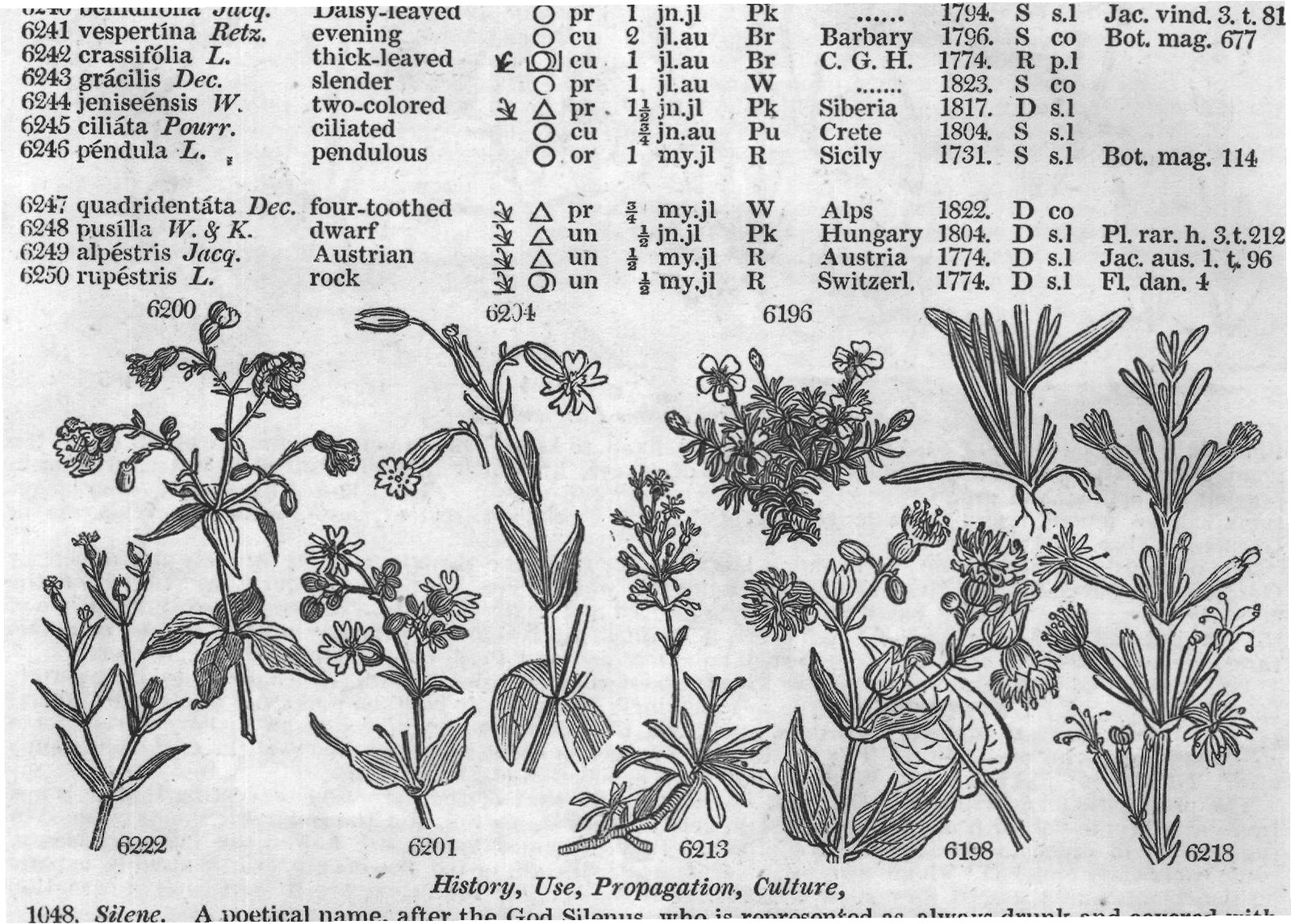
Hungary 1794. S co Russia 1769. D co Africa 1738. C s.l Levant 1739. D. co Pl. rar. h. 1. t. 56 History, Use, Propagation, Culture, 1048. Silene. A poetical name, after the God Silenus, who is represented as always drunk and covered with slaver, as the species of this genus usually are with a viscid secretion. This is a large family of small plants, neither remarkable for use, beauty, or as bad weeds. S. inflata, the Cucubalus Behen L., may be used as a substitute for asparagus or green pease, the young shoots having the flavor of both. They ought to be gathered - ORDER III.
DECANDRIA TRIGYNIA. 1. Tufted, Stems scarcely any, Calyx sowewhat inflated, Peduncles 1-flowered. 6196 Smooth, Stems dense, Leaves lin. lanc. Flowers diœcious, Calyx campanulate 6197 Stems less dense, Leaves lin. spatulate pubescent, Cal. inflated hairy §2. Caulescent, Flowers solitary or panicled, Calyx bladdery inflated. 6198 Pubescent, Leaves large ovate-lanc. Fl. in large panicles, Cal. much inflated, Petals fringed 6199 Hispid, Leaves ovate-lanc. on long stalks wavy, Cal. much inflated, Pet. lacerated crowned 6200 Stems erect branched pubescent, Leaves 4 whorled lanc. with long points smooth, Fl. pan. Cal. bladdery 6201 Stems branched, Fl. pan. Cal. bladdery ovate, Pet. bifid naked, Styles very long 6202 Like the last, but hairy with ovate lanc. leaves 6203 Like the last, but creeping with smaller nearly spatulate leaves 6204 Smooth branch. Lvs. lanc.: the lower stalk. Fl. pan. Cal. ovate veiny, Pet. with 2 very short lobes crowned 6205 Pubescent, Stems very tall branch. Lvs. large lanc. Fl. pan. Cal. ov. netted, Pet. with a claw hairy at base 6206 Smooth, Stem erect simple rather leafy, Lvs. lin. scarcely ciliat. Fl. in pan. spikes, Claws of pet. not ciliated 6207 Smooth with very leafy branched procumbent stems, Leaves lanc. Fl. axill opp. and terminal, Petals bifid 6208 Nearly smooth, Stems little branched, Leaves obovate serrulate-ciliated, Fl. pan. Pet. obcordate crowned 6209 Hoary, Stem erect branched, Leaves lanc.: the upper linear, Fl. few term. Petals O 6210 Stems procumb. diffuse 2-3-chotomous branched, Lvs. small lin. Petals half-bifid with an obcord. crown 6211 Nearly smooth, Stems wavy branched leafy, Leaves lin. lanceolate, Petals 2-lobed 6212 Smooth, Stem erect, Leaves acute glaucous, Fl. solitary, Pet. lanceolate with a 2-lobed crown : §3. Caulescent, Flowers spiked in whorls. [Fl. small diœcious 6213 Leaves erect, with a few branches, which are scarcely pubesc. or leafy, Lower lvs. numerous spatul. fleshy, 6214 Stem pubesc. branched, Lower leaves large lanc. spatulate: upper lin. long, Fl. panicled with linear petals 6215 Hoary, Stems assurgent nearly simple, Leaves spatulate lanc. Cal. spherical 10-striped 6216 Stems erect nearly simple, Lvs. lin.: lower obt. Fl. very numerous and small, Cal. obov. clavate 10-striped 6217 Half-shrubby smooth, Stems much branch. Lvs. lin. lanc. shortly ciliat. numerous, Cal. infl. clav. 10-striped 6218 Stem simple, Lvs. lin. lanc.: lower broader stalk. Cal. clavate cylindr. 10-strip. Pet. 2-part. Stam. very long 6219 Smooth, Stems erect simple very leafy, Lvs. lanc. small, Spike dense, Cal. clavate netted, Stam, very long 6220 Velvety, Radical leaves cochleate smooth, Cal. tubular 10-striped, Pet. 2-fid, Stamens very long 6221 Pubescent very viscid, Stem simple thick leafy, Leaves large lin. lanc. wavy, Fl. large nodding 4. Caulescent, Calyx conoid, at the bottom retracted, with very long teeth. 6222 Pubescent, Leaves linear soft, Cal. short conical 6223 Stems pubescent, Leaves lanc. lin. nearly smooth, Cal. long conical 6224 Pubescent, Leaves lanceolate wavy: the lower stalked, Fl. large in loose dichotomous panicles §5. Caulescent, Flowers spiked, axillary, not opposite, Calyx with 10 stripes. * Calyx cylindrical. 6225 Hairy, Stems branched, Leaves lanc. acute, Cal. ventricose with very long teeth, Petals small crowned 6226 Very hairy, Stems much branched, Lower leaves obovate spat.: upper lanc. obtuse, Petals undivided 6227 Stems branched, Leaves lin. lanc. Spike 1-sided, Cal. cylindrical with 10 ribs, Teeth long, Pet. 3-toothed 6228 Hairy, Stems branched, Lower lvs. spatulate: upper lanc. obtuse, Cal.-teeth short, Pet. obov. crowned 6229 Hairy, Stems branched, Leaves spatulate, Spike 1-sided few-fl. Cal. very hairy, Pet. obovate crowned 6230 Hairy, Stem much branched, Leaves lanc. cusp. Spikes twin dense, Pet. small bifid 6231 Stems simple vill. Leaves pub.: lower spatul.; upper lanc. Spike 2-ranked few-fl. Pet. obcv. retuse crowned 6232 Pubesc. Stems branch. Lvs. lanc.: lower obt. Spike 1-sid. Cal. vill. with short teeth, Pet. roundish crowned 6233 Stem branch. hairy below, Lvs. pubesc. with a long fringe at base, Cal. cyl. nearly smooth ribbed and netted 6234 Like the last, but flowers few distant, Petals smaller 6235 Hairy, Stem branched leafy, Leaves lin. lanc. Flowers terminal, Cal. cylindr. Pet. bifid 6236 Hairy, Fl. sessile 1-sided, Cal. cylindr. appressed, Petals small deeply emarginate ** Calyx clavate. 6237 Hoary, Stems prostrate branched, Lvs. obovate spatulate ciliated at base, Fl. 1-sided erect, Pet. bifid 6238 Stems branch. pubesc. Lvs. scabrous cil. at base: lower spatul.; upper lanc. Fl. sess. nodding, Pet. 2-parted 6239 Pubescent, Lvs. somewhat fleshy: lower spatulate; upper lanceolate, Cal. long clavate, Petals 2-fid 6240 Hairy, Stem erect slender branched, Lvs. lanc. Spikes twin 2-sided, Cal. cylindr. clavate, Pet. bifid 6241 Pubesc. Stems branch. Lvs. spatul. obt. Spikes twin 1-sided, Cal. bladdery, Pet. 2-parted with ov. lobes 6242 Velvety, Stem procum. branch. leafy, Lvs. ov. spatul. fleshy, Bract. very small, Pet. with long claws emarg. 6243 Smth. Stem erect slend. branch. Lvs. lin. scarcely ciliat.: low. ov. Fl. on long stks. Pet. 2-part. with lin. lobes 6244 Smooth, Stems usually simple, Lvs. somewhat fleshy lin. lanc. Cal. ov. ventric. Pet. bifid with 4-lob. append. 6245 Pubesc. Stems numerous prostrate very leafy at base, Lvs. lin. setaceous ciliated, Recesses of calyx deflexed 6246 Pubescent branched supine, Leaves ovate lanc. Fl. axillary pendulous, Petals bifid crowned §6. Caulescent, Stems upright, Peduncles filiform, Calyx campanulate or cylindrical. 6247 Tufted, Stems erect slender branched, Lvs. small linear very narrow, Fl. small, Petals short 4-toothed 6248 Like the last, but the radical leaves broader, Peduncles long upright 6249 Root branched, Stems simple leafy, Lvs. lanc. lin. obt. Fl. large panicled, Petals broad 4-cleft, Seed ciliated 6250 Smooth, Stems erect branched, Leaves ovate lanc. Fl. panicled very small, Petals obcordate 6225 6231 6232 6246 and Miscellaneous Particulars. when about two inches long, and the more they are blanched the better. Bryant (Flora Dietetica) says, its culture would well reward the gardener's trouble. S. viscosa is a popular border flower, especially the double variety.
S. quinquevulnera was formerly in culture as a border flower, but is now seldom used for that. purpose: Bb 4 DECANDRIA TRIGYNIA.
CLASS A. 6251 inapérta L. unopen-flower. un 2 jn.jl Br 6252 clandestína Jacq. hidden-flower. un 1 jn.jl R Madeira 1732. S s.1 C. G. H. 1801. S co Di. el. t.315.f.407 Jac. col. s. t. 3.f.3 6253 antirrhína L.
Snap-dragon un 1 jn.jl 6254 geminiflóra W. twin-flowered cu 1 jn.jl Pu RN. Amer. 1732. S p.l 1816. S co Di. el. t.313.f.403 6255 flavéscens W. & K. yellowish pr 1 jn.jl Y Hungary 1804. D p.1 Pl. rar. h. 2.t.175 6256 linifólia W.
Flax-leaved pr 1 jl.au G.Y 1817. S s.l 6257 crética L.
Cretan O pr my.au G.w 6258 sedoídes Jacq.
Sedum-like O prjl G.w 6259 saxífraga L. 6260 petræ'a W. & K.
Saxifrage rock 6261 campánula Pers.
Bell-flowered A cu jn.au F Aprjn.au W pr jn.au G.w Candia Crete 1804. S co France 1640. D s.I Hungary 1822. D co Piedmont 1823. D co 1732. S s.1 D.e. t.314.f.404,5 Jac.co. s. t.14.f.1 Bot. cab. 454 1 6262 longipétala Vent. 6263 nútans L. 6264 saxátilis Sims. long-petaled Nottingham stone pr W cu jn.jl G 6265 lívida W. livid Apr 1 jn.jl W 1 jn.au G.w Barbary 2 jn.jl W Britain Siberia 1822. S co cal. ro. D co 1800. D s.l Carniola 1816. D s.I Eng. bot. 465 Bot. mag. 689 6266 ténuis W. slender pr 6267 viridiflóra L. green-flowered cu 2 jn.jl 6268 chlorántha W. pale-flowered cu 1 jn.au G.w Baical 1816. D p.l G.w Spain 1739. S p.l G.w Germany 1732. D s.l Herm. par. 199 Di. el. t.316.f.408 6269 cathólica Otth. 6270 élegans Brot. 6271 répens Dec. 6272 virgínica L. 6273 strícta L. 6274 muscípula L. 6275 noctiflóra L. panicled elegant creeping Virginian upright cu 1 jl.s G.w pr 1 jl.s W Apr 1 jl.s Pk Italy 1711. D co Portugal 1819. S co Siberia 1822. D co Jac. vind. 1. t. 59 Aor 1 my.au Pu N. Amer. 1783. D p.1 Pl. alm. t.203. f.1 pr 1 jn.jl Pu Spain 1802. S co Spanish or 1 jl.au R Spain 1596. S p.1 night-flowering O cu 2 jl Pk England san.fi. S s.1 Eng. bot. 291 6276 ornáta H. K. dark-colored cu 1 my.s Pu C. G. H. 1775. S p.1 Bot. mag. 382 6277 ægyptíaca L.
Egyptian cu 1 jl.au Pk Egypt 1800. S s.l 6278 serícea All. silky Ocu 1 jn.au Pk 6279 pícta Pers. painted pr 1 jn.au Pk S. Europe 1801. S s.1 1822. S co All. ped. t.79. f.3 ...... 6280 porténsis Bon.
Oporto cu 1 jl.au Pk Portugal 1759. S s.l 6281 reticuláta Desf. netted cu 1 jl.au Pk 6282 pennsylvánica Mich. Pennsylvanian or 1 jn.jl R 6283 vallésia L.
Woolly-leaved cu jn.au F 6284 fruticosa L. shrubby ✓ ✓ pr 1 jn.jl Pk 6285 caspica Pers.
Caspian pr 3 jn.jl Pk 6286 amœ'na L.
Tartarian 6287 supína Bieb. trailing pr jn.au 6288 paradóxa L.
Dover cu 1 jl Pk Pk 6289 chloræfólia Sm.
Armenian cu 6290 itálica Dec.
Italian 6291 pátula Desf. spreading 6292 polyphýlla L. many-leaved cu 1 my.jn Apr 1 my.jn Apr 1 jn.jl W Pk R 6293 nemorális W. & K. grove ✓ ☐ pr 1 jn.jl R 6294 longiflóra Ehr. long-flowered or 1 jl.s 6295 bupleuroídes L. spear-leaved cu 2 jn.jl 6296 mollíssima Pers. velvet cu 1 jl.s 6297 régia Sims. splendid or 6298 ascéndens Lag. ascending cu 1½ my.au Cr my.au Pk 4 Apr 1 jl W 1 au.s L.Y ..
D p.l Barbary 1804. S p.l N. Amer. 1806. D p.1 Switzerl. 1765. D s.1 Sicily 1629. C p.l Caucasus 1823. D co Tartary 1779. D p.l Caucasus 1804. D s.l Europe Armenia 1796. D p.1 Italy 1759. S co Barbary 1823. D co Germany Hungary 1822. S co L.Pu Hungary 1793. D p.1 W.pu Persia 1801. C p.1 Italy 1739. D co N. Amer. 1811. D p.1 Spain 1822. S co Pk ...
D p.1 Desf. atl. 1. t. 99 Bot. reg. 247 Boc. mus. t. 54 Com. hort. t. 33 Bot. mag. 1997 Jac. vind. 3. t. 84 Bot. mag. 807 Jac. obs. 4. t. 79 Cl. hist. 1. t. 290 Pl. rar. h. 1. t. 8 Tourn. it. t. 154 Bot. mag. 1724 6299 cæspitósa Stev. tufted pr my.au Pk 6300 atócion Murr. orchidéa L. f. orchis-flowered pr my.jl Pk Caucasus 1824. D co Levant 1781. S s.l Jac. vind. 3. t.32 6301 arméria L.
Lobel's or 1 jl.s Pk England cor.fi. S s.l Eng. bot. 1398 Balba white-flowered 6302 compácta Fisch. compact or 1½ jl.s Pk Caucasus 1823. S co 1049. STELLA'RIA. W. STITCH-WORT.
Caryophylleæ. Sp. 18-56. 6303 némorum W. wood W 1 ap.jn W Britain moi.wo. D co Eng. bot. 92 6304 latifólia P. S. broad-leaved 6305 média E. B. 6258 chickweed W W 1 jn.au W ja.d W Germany 1816. D co England rubb. S co Eng. bot. 537 Alsine média W. 6300 History, Use, Propagation, Culture, being very low and prolific in flowers, it is well adapted for sowing in pots. S. Armeria is one of the annual border flowers of the seed shops. 1049. Stellaria. The parts of the flower are stellate. The species are grassy-looking plants of the easiest ORDER III.
DECANDRIA TRIGYNIA. 6251 Smooth, Stems erect branched, Lvs. lanc. acute: lower obt. Petals not opening obcordate, Stam. usually 5 6252 Pubesc. Stem erect much branched slender, Lower lvs. obl. obt.: upper lanc. narrow, Pet. short erect bifid 6253 Nearly smooth, Stem erect branched somewhat leafy, Leaves lanc. acute ciliated, Fl. small panicled 6254 Pubescent, Stems branched, Lower leaves ellipt. spatulate: upper lanc. Fl. term. twin, Petals bifid 6255 Pubescent, Stems erect branch. straight, Low. lvs. lanc. spat. : up. linear, Fl. loosely panicled, Pet. 2-lobed , Pet. 2-lobed 6256 Stems branched, Leaves lin. spatulate, Fl. term. Cal. cylindr. clavate, Petals 2-fid 6257 Smooth, Stems erect branched, Low. lvs. ov. stalked obt.: up. lin. acute, Fl. loosely panic. Cal. ov. clavate 6258 Viscid pubesc. Stems erect much branch. Lvs. fleshy: low. spatul.; up. ov. Fl. small, Pet. obcord. crowned 6259 Tufted, Stems assurgent, Lvs. lin. acute, Peduncles very long, Cal. long clavate, Petals 2-parted crowned 6260 Tufted shortly bristly, Stems assurgent, Leaves lin. with bristly teeth, Fl. small, Petals 2-fid crowned 6261 Smth. Stems erect or assurg. somew. branch. leafy at base, Lvs. lanc. lin. acute: low. spat. Pet. 2-part. naked §7. Caulescent, Flowers panicled, rarely solitary, Pedicels opposite short, Calyx tubular. * Flowers nodding, Calyxes cylindrical. [reflexed 6262 Smooth viscid, Stems erect, Lvs. somewhat fleshy lin.-lanc. fringed with fine bristles, Pet. very long 2-part. 6263 Pubesc. Stems leafy at base, Radical lvs. spatul.: upper lanc. lin. Pet. 2-parted reflexed with a long crown 6264 Like the last, but smooth, less branched, and less leafy, Leaves linear, Petals often green 6265 Like the last, but stems flexuose broken down, Petals white above beneath livid green 6266 Smooth, Leaves lin. lanc. ciliated at base, Fl. pan. erect, Cal. ventricose cylindr. Petals 2-parted 6267 Hairy soft, Stem branch. leafy, Lvs. large ov. acum. Fl. in large nodding panicles, Pet. with very long claws 6268 Smooth, Stems erect simple scarcely leafy, Petals 2 parted with filiform lobes ** Flowers erect, Calyxes clavate. [crowned 6269 Velvety glutinous upwards, Stem erect branched leafy, Fl. small loosely panicled, Stamens very long 6270 Stem short about 2-flowered pubescent, Radic. leaves lanc. lin. acute, Cauline very short, Pet. bifid 6271 Scarcely pubesc. Root long creeping, Stem erect almost simple, Lvs. lin. grassy acute, Fl. few erect panic. 6272 Viscid pubesc. Stem procumb. assurgent branch. Fl. large panic. Cal. large clavate, Pet. broad bifid crowned 6273 Scarcely pubesc. Stem upright branched, Lvs. lin. lanc. Fl. panicled erect, Cal. netted, Pet. small emarginate 6274 Smoothish viscid, Stem crect, Alternate branches long, Cal. large clavate netted, Petals bifid 6275 Visc. pubes. Stems erect branch. Lvs. large, Fl. large panic.: every other stripe of cal. veiny, Teeth very long 6276 Pubes. Stems erect branch. Lvs. lanc. obt. Fl. panic.: every other stripe of cal. veiny, Pet. with broad toothl. 6277 Subtomentose, Stems branch. Lvs. obov. stalked, Fl. term. erect, Pet. obcord. 2-toothed at base [lobes 6278 Silky, Stems branched, Lvs. with a long fringe at base, Fl. large term. Pet. 2-parted crowned 6279 Stems much branch. scarcely pubesc. Lower lvs. obov. spatul. Lvs. lin. acute, Cal. clavate striped with red 6280 Tufted smooth subviscid, Stems branched at base, Lvs. lin. Fl. panic. Cal. netted, Pet. bifid with lanc. lobes *** Flowers erect, Calyxes long clavate. [at base 6281 Smooth visc. Stems branch. Lvs. lanc. lin. Cal. very long. clav. nett. Pet. obcord. with a tooth on each side 6282 Viscid pubescent, Stems procumbent, Leaves lin. long, Cal. long tubular, Petals slightly emarg. crenate 6283 Tufted viscid pubesc. Root woody, Stems low assurgent little branched, Cal. long netted, Petals bifid 6284 Suffruticose, Stems suberect smooth branched at base, Cal. long cylindr. viscid-villous, Petals 2-lobed 6285 Scabrous, Stems bran. Fl. term. in the dichotomies, Cal. long cylin. Pet. 2-part. tooth. on each side at base 6286 Pubescent, Root woody, Stems diffuse branched, Leaves soft numerous below, Petals half bifid 6287 Tufted viscid pubescent, Stems woody supine branched, Lvs. lin. acute, Petals with narrow diverging lobes 6288 Stems erect pub. Lvs. roughish scarcely ciliat. Fl. large pan. Pet. with broad obov. lobes & 2-part. append. 6289 Very smooth glaucous, Stems branched, Leaves roundish acuminate, Fl. large, Cal. not striped 6290 Pilose pubesc. Stems much branch. Lower lvs. ovate-spatul: up. lin. Fl. in large panic. Pet. 2-lob. naked 6291 Pubesc.visc. Stems erect branch. Branch. spread. Low. lvs. ov. spatul. Cal. long narrow, Pet bifid crowned 6292 Pubescent, Stems assurgent much branched leafy, Leaves linear acute, Cal. clavate, Petals bifid 6293 Stem simple pubescent, Leaves pubescent: lower large rounded stalked, Petals 2-parted crowned 6294 Smooth, Stem twiggy, Leaves lin. lanc. radical very long, Cal. very long, Petals 2-parted crowned 6295 Smooth clammy, Stem assurgent branch. Lvs. lin. lanc. acute: lower very long, Upper bractes with a broad 6296 Silky, Stems erect branch. Lvs. wavy, Calyxes long clavate, Pet. 2-part. crowned [membranous margin 6297 Viscid pubescent, Lvs. lanceol. Cal. long tubular, Petals lanceolate crowned, Stamens very long 6298 Villous viscid, Lvs. lin. lanceol. obt. ciliated, Peduncle 1-fl. spreading in seed, Cal. circularly reflexed at base 8. Caulescent, Flowers corymbose, Cal. clavate, 10-striped. 6299 Tufted roughish, Root thick woody branch. Stems simple slender very leafy at base, Lvs. small lin. acute 6300 Viscid, Stem much branch. pubesc. Lvs. round subciliated: the lower on long stalks, Fl. loosely corymb. 6301 Very smooth glaucous viscid, Leaves ovate-lanc. Fl. in panicled corymbs, Petals obcordate crowned 6302 Smooth, Stems erect branched, Upper leaves lanceolate: lower linear lanc. Umbel dense, Petals obovate 6303 Lower leaves cordate stalked: upper lanc. sessile, Petals twice as long as calyx 6304 Stems diffuse dichotomous rooting at base, Lower lvs. ovate stalked cord.: upper sess. Pet. shorter than cal, 6305 Stems procumbent with a lateral 1-sided hairy line, Leaves lanc. very tender, Fruit deflexed 6259 6275 6282 6303 and Miscellaneous Particulars. culture. S. media is a well known weed, never found but on rich friable soils in a state of culture: the seeds and flower buds are a favorite food of finches and other small birds. 6306 dichotoma W. 6807 bulbósa Wulf. 6308 vis'cida Bieb. 6309 Holóstea W. 6310 Laxmánni Fisch. 6311 gramínea W. 6312 glaúca H. K. clammy greater Laxmann's DECANDRIA TRIGYNIA.
CLASS X. forked W 14 ja.d W Britain clt. gr. Sco bulbous W 1 ja.d W Carinthia 1823. S co Jacq. icon. t. 468 W 1 ja.d W Hungary 1820. S co Wal. & Kit. t. 22 W 1 ap.jn W Britain woods. D co Eng. bot. 511 W 1 ap.jn W Siberia 1823. S co lesser W 1 ap.jn W Britain hed. b. D co Eng. bot. 803 6313 crassifólia Ehr. 6314 uliginósa H. K. 6315 cerastoídes W. glaucous marsh thick-leaved W my.au W Britain moi.m. D p.1 Eng. bot. 825 W 1 my.au W Germany ...
D co bog W 1 jn.jl W Alpine W jn.jl W 6316 Arenária W.
Britain rivul. S co Scotland sc. alp. D co Eng. bot. 1074 Eng. bot. 911 sand W jn W 6317 scapígera W. 6318 dahúrica W. naked-stalked W jn.jl W daurian W 6319 murális Link. wall W 6320 longipes Hook. long-stalked w jn.jl W 1050. ARENA'RIA. W. SANDWORT. 6321 segetális Lam. 1 jn.jl W Spain 1799. S co Scotland sc.rivu. D co Dahuria 1818. S co Candia 1824. S co N. Amer. 1820. S p.l Caryophylleæ. Sp. 45-140.
Eng. bot. 1269 corn W jn.o W Alsine seg France 1805. Sco Vail. par. t.3. f. 3 Alsine segetális W. 6322 purpúrea Pers. purple cu از Pu Spain 1823. S s.l 6323 rúbra L. red cu jn.au Pu Britain 6324 marína Roth. san.fi. S s.1 Eng. bot. 852 marine cu jn.jl Pu Britain 6325 média L. sea co. D s.1 Eng. bot. 958 downy W jl W France 1795. S co 6326 canadénsis Pers.
Canada W jn.jl W N. Amer. 1812. S p.l 6327 graminifólia Schr. grass-leaved pr jn.jl W Siberia 1815. D co 6328 longifólia Bieb.
Sch. gott. t. 5 long-leaved pr jn.jl W Siberia 1823. D co Gmel. si. t.63. f.2 6329 rígida Bieb. stiff pr jn.jl W Siberia 1823. D co 6330 pinifólia Bieb. pine-leaved cu jl.au W subulate pr Juniper-leaved pr upright pr Larch-leaved pr striated Apr Austrian pr three-flowered pr great-flowered pr vernal W Gerard's pr rock pr pendulous pr fine-leaved 6354 cherlerioídes Vill. cherleria-leaved 6356 serpyllifólia L. 6357 pubéscens Dec. 6358 brevicaúlis Stern. 6359 scábra Poir. 6360 ciliáta L. 6361 multicaúlis Jacq. 6362 trinérvis L. 6311 thyme-leaved pubescent short-stalked rough fringed many-stalked Plantain-leaved 11 21* ાાત્રા পপপপ পপ 6331 subuláta Ser. 6332 juniperína L. 6333 strícta Mich. 6334 laricifólia L. rostráta W. & K. 6335 striáta Vill. 6336 Austríaca Jacq. 6337 triflóra L. 6338 grandiflóra L. 6339 vérna L. 6340 Gerárdi W. 6341 saxátilis L. 6342 péndula W. & K. 6343 tenuifólia L. 6344 mediterránea Lk. 6345 recúrva All. 6346 setácea Thuill. 6347 fasciculáta Gouan. 6348 filifólia Forsk. 6349 mucronáta Dec.
Mediterranean recurved setaceous level-topped thread-leaved bristly Alsine mucronáta W. 6350 polygonoídes Jacq. knotgrass-like 6351 verticilláta W. whorled 6352 tetráquetra L. square 6353 lanceolata All. lanceolate 6355 montána L. mountain pr jn.jl W cu jn.jl W Aprjn.jl W W pr Switzerl. 1683. D s.p Austria 1793. D s.p S. Europe 1816. D s.p Switzerl. 1783. D s.p Britain mount. D s.p France 1822. D s.p Germany 1732. D s.p Hungary 1816. D co England san.fi. S co Mediterr. 1823. S co Alps 1822. D co France Sco Scotland sc. mo. S s.p Arabia D s.p S. Europe 1777. S co ... ...
Jac. aus. 3. t. 270 C. ic. 3. t. 249. f. 2 All. ped. 10. f. 1 Eng. bot. 512 Gm. si. 4. t.63.f.2 Pl. rar. h. 2. t. 87 Eng. bot. 219 Jac. col. t. 16 jn.jl W cu W jn W jn.jl W jn W Eng. bot. 1744 Vah. sym.1. t. 12 Hall. hist. 1. t. 17 cu jl.au W pr 2 از W Switzerl. 1822. S co Armenia 1823. C s.p Al. ped. t. 64. f. 4 prau cu pr W au W jl.au W cu ap.jl W France France W jn.jl W Britain pr jl W ...... ...
Pyrenees 1731. D s.p Switzerl. 1823. D s.1 D s.p ... 1800. D s.p walls. S co Sco Bot. mag. 1118 Eng. bot. 923 All. p. 2. t. 89. f.1 Al. ped. t. 26. f.5 pr jn.jl W Alps 1823. D co cu jn.jl W Alps 1822. D co pr mr.au W Ireland ir.mou. S s.p Eng. bot. 1745 pr jl.au W Europe 1794. D s.p J. co. 1. t. 17. f.1 W my.jn W Britain woods. S s.p Eng. bot. 1483 6314 6333 6343 jl.au W Caucasus 1823. D s.p Caucasus 1822. D s.p jn.jl W my.jn W au W Armenia 1800.
N. Amer. 1812.
Britain D s.p Sm. ined. 1. t. 35 D s.p ...
D s.p Jac. aus. 3. t. 272 jn.au W All. pe. 2.t.26.f.4 jn.s W W my.au W my.au W jl.au W ap.jl W jn.s jn.jl W 6317 6362 History, Use, Propagation, Culture, 1050. Arenaria. From arena, sand, in which most of the species are found. They are of most difficult discrimination, and are chiefly diminutive weeds found almost exclusively on sandy soils, The flowers vary ORDER III.
DECANDRIA TRIGYNIA. 6306 Hairy, Lvs. cord. ovate stem-clasping, Stem dichotomous, Fl. solitary, Sepals lanc. ac. longer than petals 6307 Leaves ovate lanceol. nearly veinless, Pedunc. 1-fl. Sepals lanc. acute twice as short as petals 6308 Villous viscid, Leaves lin. lanc. Stems dichotomous diffuse, Petals and capsule longer than calyx 6309 Lvs. lanc. acum. serrulate roughish: the upper broader and shorter, Pedunc. filiform very long, Pet. 2-fid 6310 Stem erect few-fl. Lvs. linear acute entire smoothish, Pedunc. filiform very long, Petals 2-parted 6311 Leaves linear smooth at edge, Stems diffuse, Fl. panicled divaricating, Petals the length of calyx 6312 Glaucous, Leaves lin. lanc. smooth at edge, Floral scarious, Petals twice as long as cal. Stem erect weak 6313 Leaves ovate-lanceol. entire smooth thick, Sepals ovate-lanceol. much shorter than petals 6314 Leaves ovate-obl. Pet. deeply divided shorter than calyx, Caps. ovate oblong longer than calyx 6315 Leaves obl. pubescent, Pedunc. 1-fl. twin, Pet. larger than cal. Caps. obl. nearly twice as long as sepals 6316 Leaves spatulate, Stem erect bifid viscid, Branches alternate, Petals emarginate 6317 Leaves linear lanc. obtuse very dense, Pedunc. 1-fl. and umbelled, Pet. scarcely longer than calyx 6318 Leaves lanc. entire sessile acute, Base and stem pubescent, Fl. axill. solitary 6319 Glandular pubescent, Stem procumbent, Leaves ovate fleshy, Petals scarcely longer than calyx cut 6320 Very smooth, Leaves linear-lanc. Pedunc. terminal dichotomous bracted, Pet. broad obovate 2-parted §1. Caps. 3-valved, Leaves linear, with scarious stipules at base. 6321 Smooth, Stem erect, Leaves subulate 1-sided, Petals shorter than calyx 6322 Hispid, Stem erect, Branches divaricating, Lvs. setaceous twice as short as joints, Pet. obt. shorter than 6323 Stems prostrate hairy, Leaves filiform shorter than the joint, Sepals lanceolate obtuse scarious at edge 6324 Like the last, but nearly smooth 6325 Stems prostrate, Leaves half cylindrical fleshy as long as joints, Seeds with a membranous wing 6326 Pilose subhispid, Leaves filiform longer than joint, Stamens 5, Seeds obcord. compressed, Caps. globose §2. Leaves grassy, linear, lanceolate or rounded, without stipules, Caps. 3-valved. * Leaves grassy. 6327 Stems erect simple, Lvs. subul. filiform rough, Panic. trichotomous pubescent lax, Calyxes very obtuse 6328 Leaves subulate-filiform serrulate, Stems erect simple, Panicle trichotomous smooth compact 6329 Leaves lin. setaceous ciliated rough, Stems erect rigid simple, Sepals acute scarcely longer than corolla 6330 Stems ascending few-fl. pubescent, Lvs. setaceous rigid, Cauline straight, Sepals obtuse striated villous 6331 Leaves setaceous rigid mucronate striated, Stems panicled few-fl. Sepals lanc. much shorter than corolla ** Leaves subulate or linear. 6332 Lvs. subulate rigid spiny: lower fascicled; upper distant, Stems erect firm, Pet. obov. twice as long as cal. 6333 Erect smooth many-stemmed, Leaves subulate linear erect, Pan. few-fl. Petals conspicuously striated 6334 Leaves subulate tooth-ciliated, Stems ascending 3-6-fl. roughish, Cal. cylindrical, Sepals 3-nerved hairy 6335 Like the last, but stems rigid few-fl. Leaves long straight, Pedunc. and calyx viscid hairy 6336 Lvs. lin. subul. 3-nerved, Stem panicled, Pedunc. terminal very long twin downy, Pet. obt. emarginate 6337 Like the last, but stems 2-4-fl. Leaves narrow recurved 6338 Lvs. subulate broadish flat 3-nerved ciliated, Radical clustered, Stems 1-fl. Pedunc. very long pubescent 6339 Tufted many-stemmed, Leaves subulate obtuse nerved, Stems panicled elongated 6340 Erect branched, Leaves linear subulate 3-nerved, Pedunc. twin terminal 1-flowered 6341 Leaves subulate, Stems panicled, Sepals ovate 6342 Stems filiform rooting very long diffuse, Flowering branches erect few-fl. Lvs. lin. flat acute fascicled 6343 Leaves subulate setaceous, Stem branched dichotomous, Sepals subulate striated much longer than petals 6344 Stem much branched, Leaves lin. recurved, Sepals with a long point and membranous edge 6345 Radical lvs. clustered recurved subul. 1-sided, Stems tufted simple 3-fl. Sepals and peduncles hairy gland. 6346 Stem much branched, Fl. panicled fastigiate, Leaves setaceous fascicled 1-sided ciliated at base 6347 Leaves subulate fascicled setaceous, Stems erect straight simple, Sepals acuminate with 2 lines 6348 Leaves setaceous fascicled with 2 stripes, Stems suffruticose dichotomous, Pedunc. term. 1-2-flowered 6349 Lvs. setaceous not ciliated at base, Stems tufted prostrate at base, Pedunc. longer than leaf, Sepals awned 6350 Procumbent, Leaves linear obt. Peduncles 2 or 3 1-flowered with 2 bractes at base, Sepals without nerves 6351 Leaves subulate rigid spiny and flowers whorled, Pedunc. 4-fl. capitate *** Leaves lanceolate, oval or rounded. 6352 Leaves ovate carinate recurved edged imbricated 4 ways, Stems straight downy, Sepals rigid acute keeled 6353 Tufted villous, Branches ascending, Leaves lanceolate narrow acute rigid nerved 6354 Like the last, but smaller, with creeping and tufted stems, and imbricated leaves 6355 Pubescent, Leaves lanc. linear, Barren stems very long procumbent, Pedunc. terminal long 1-flowered 6356 Leaves ovate acute sessile regular ciliated and smooth, Sepals lanceolate 3-nerved acute green opaque 6357 Pubescent, Lvs. ovate acute stalked, Stems spreading branched elongated, Sepals acute shorter than cor. 6358 Leaves oblong acute 3-nerved ciliated imbricated, Stem prostrate, Sepals lanceolate acuminate striped 6359 Leaves lanc. acute spreading hard rough, Stem simple short, Sepals ovate acuminate striped imbricated, 6360 Leaves ovate and obovate blistered rugose more or less nerved and ciliated, Stems procumbent 6361 Like the last, but leaves pulpy thick and sepals scarcely nerved 6362 Stem slender branched, Lvs. ovate acute stalked ciliated nerved, Pedunc. long bent down after flowering 6307 6328 6338 6349 and Miscellaneous Particulars. considerably in the number of their stamens, more generally falling short of than exceeding the regular number. 6363 baleárica L.
Majórca Apr 6364 peploídes L.
Sea-chickweed pr 6365 procúmbens Vahl. procumbent Apr 1051. CHERLERIA. W. CHERLERIA. 6366 sedoídes W. dwarf Aor 1052. BRUNNI CHIA. W. BRUNNICHIA. 6367 cirrhósa W Carolina or 6 ... 1053. GARIDEL/LA. W. GARIDELLA. 6368 Nigellástrum W. Nigella-leaved O or DECANDRIA TRIGYNIA. mr.au W my.jl W sea sh. D s.p jl.au R Egypt 1801. D s.p Caryophylleæ. Sp. 1-2. jlau Y.w Scotland sc. alp. D s.l Polygoneæ. Sp. 1.
Pk Carolina 1787. Cl.p Ranunculacea. Sp. 1-2. 1½ jn.jl B.G France 1736. S co Gær. s. 1. t. 45.f.2 CLASS X.
Majorca 1787. D s.p Britain L. h. stir. 1. t. 15 Eng. bot. 189 Vahl. sy. 2. t. 33 Eng. bot. 1212 Bot. mag. 1266 1054. MALPIGHIA. W. BARBADOES CHERRY.
Malpighiaceæ. Sp. 18-70. 6369 glábra W. smooth-leaved fr 16 mr.jl R W. Indies 1757. C p.l Bot. mag. 813 6370 punicifólia W.
Pomegran.-lvd. or 12 ...
Pk W. Indies 1690. C p.1 Plum.ic.t.166.f.2 6371 polystáchia H. K. many-spiked or mr.my Y W. Indies 1806. C p.l Bot. rep. 604 6372 média H. K. intermediate ☐ or 10 mr.my Y W. Indies 1790. C p.l 6373 glandulífera Jacq. quadriglandular or 10 mr.my Y W. Indies 1806. C p.l 6374 glandulósa W. biglandular or 10 ...
Y W. Indies 1804. C p.l 6375 nítida W. glossy-leaved or 6 mr.au Pk W. Indies 1733. C p.1 Jac. ic. 3. t. 469 Ca.dis.8.t.239.f.2 Ca.dis.8.t.239.f.1 6376 fucáta B. Reg. painted or 8 mr.au R ...... 1814. C p.1 Bot. reg. 189 M. macrophylla Desf. 6377 urens W. 6378 angustifólia W. 6379 canéscens W. 6380 crassifólia W. 6381 Mouréila Aubl. 6382 lúcida W. 6383 coriácea W. stinging narrow-leaved downy-leaved thick-leaved fr 3 jl.o Pk or 7 jl.au Pk ☐ or 20 ... ... or 20 au Y yellow-spiked ☐ or 20 au Y wedge-leaved or 6 my.au Pk leathery-leaved 6384 volúbilis Sims. twining 走 or 30 my.au Pk or 10 au.s Y S. Amer. 1737. C p.1 W. Indies 1737. C p.l W. Indies 1742. C p.l S. Amer. 1793. C p.l S. Amer. 1823. C p.l W. Indies 1759. C p.l Jamaica 1814. C p.1 W. Indies 1793. C p.1 Bot. cab. 321 Aub. gu. 1. t. 182 Aub.gu. 1. t. 183 Bot. reg. 96 6385 aquifólium W.
Holly-leaved 潮 6386 coccífera W.
Kermes'Oak-lv. ... 1055. BANISTERIA. W. BANISTERIA. 6387 ciliáta W. ciliated or 10 ... 6388 purpúrea W. purple or 10 Y Pu ... 6389 chrysophýlla W.
Star-apple-lvd. ☐ or 10 ...
Y 6390 laurifólia W.
Bay-leaved or 10 jl.au, Y 6391 nítida W. glossy or 10 ... ... 6392 sericea P. S. silky or 10 ...
Y 6893 fúlgens W. shining-fruited or 6 Y ... 6394 heterophýlla W. various-leaved ☐ ☐ or 10 ...
Y 6395 brachiáta W. cross-branched ☐ ☐ or 10 Y ... or 7 au.s Pk or 2.
Pk Malpighiaceæ. Sp. 9-60.
Cav. dis. 9. t. 254 C. di. 9. t. 246. f.1 Jac. sch. 1. t. 105 Brazil 1796. C s.l W. Indies 1759. C s.l Brazil 1793. Cr.m Jamaica 1733. C s.l S. Amer. 1809. C s.l Brazil 1810. C s.1 W. Indies 1759. Cr.m S. Amer. 1812. C s.l Cav. dis. t. 253 W. Indies 1759. C s.l Cav. diss. t. 244 Cav. dis. 9. t. 258 Bot. mag. 2462 Slo. h. 2. t.163.f.1 Bot. mag. 809 S. Amer. 1759.
W. Indies 1733.
C p.l C p.l C. di. 8. t. 236. f.2 Bot. reg. 568 1056. HIRE'A. W.
HIRMA.
Malpighiaceæ. Sp. 1-19. 6396 reclináta W. reclined or 10 ...
Y 1057. CNES TIS. Lam.
CNESTIS. 6397 glábra Lam. smooth or 10 ...
W. Indies Connaraceæ. Sp. 1-9.
W.G ...
C s.l Jac. am. t. 176 Mauritius 1823. C s.1 Lam. il. t. 387. 1 PENTAGYNIA. 1058. AVERRHO'A. W. AVERRHOA.
Terebintacea. 6398 Bilímbi W. 6399 Carambola W.
Bilimbi-tree Carambola-tree fr 8 au.s R.Y fr 14 ... 6364 6366 Sp. 2-3.
E. Indies 1791. C s.1 G.R E. Indies 1793. C s.l 6367 Cav. dis. 7. t. 219 Cav. dis. 7. t. 220 6368 6377 6376 6370 6373 History, Use, Propagation, Culture, 1051. Cherleria. John Henry Cherler was an assistant of John Bauhin in preparing his Historia Plantarum. A little obscure weed. 1052. Brunnichia. A catalogue of the books upon natural history was published by one Mr. F. Brunnich, a Danish naturalist, in 1793. 1053. Garidella. So named by Tournefort, in honor of Pierre Garidel, M. D., physician at Aix in Provence, author of Histoire des Plantes qui naissent en Provence, 1719, with many figures. A plant of little curiosity or beauty. Small inconspicuous plants of the easiest management. 1054. Malpighia. So named by Plumier in honor of Marcello Malpighi, professor of medicine at Bologna, author of Anatome Plantarum, 1765 and 1769; a celebrated work, the best of its time on the structure of vegetables. The species are handsome evergreen trees and shrubs, some of them fruit-bearing and others climbers. M. glabra is grown for its fruit in the West Indies, and the fruit of M. urens is also eaten under the name of Barbadoes cherry, but that of both species is much inferior to European cherries. All the species have the under sides of their leaves covered with prickly bristles which when handled run into the fingers. Ripened cuttings root freely in sand under cover. 1055. Banisteria. So named by Dr. Houstoun, in memory of the Rev. John Banister, a curious botanist, who lost his life in search after plants in Virginia. The species are chiefly evergreen climbers and twiners; some of them, as B. fulgens and chrysophylla, have fine shewy foliage as well as beautiful flowers. ORDER III.
DECANDRIA TRIGYNIA. 6363 Tufted creeping, Leaves ovate shining fleshy ciliated, Pedunc. long 1-fi. Flowers cernuous 6364 Leaves ovate acute fleshy approximated, Fl. solitary on short stalks, Sepals obl. acute as long as cor. 6365 All over pubescent, Leaves lin. lanceol. Stems prostrate much branched, Seeds very minute 6366 Leaves spreading 6367 Leaves cordate sagittate 6368 Petals sessile spreading, Stamens 10-12 6369 Leaves ovate entire smooth, Peduncles umbelled 6370 Leaves ovate entire smooth, Peduncles 1-flowered 6371 Leaves entire oblong acute smooth shining with 2 glands beneath at the base 6372 Leaves entire oblong lanceolate acute smooth with 2 glands at a distance from the base 6373 Leaves ovate nearly entire with hairs on both sides, Fl.-stalks with a truncate gland at top 6374 Leaves ovate elliptical acuminate entire smooth with 2 glands at base 6375 Leaves oblong acuminate entire smooth, Racemes axillary, Fl. monogynous 6376 Leaves elliptical shining hairy beneath, Fl. axillary corymbose 6377 Leaves obl. ovate with decumbent stiff bristles, Peduncles 1-fl. aggregate 6378 Leaves lin. lanceol. with decumbent bristles on each side, Peduncles umbelled 6379 Leaves obl. obtuse pubescent, Racemes axillary axillary compound 6380 Leaves ovate entire obtuse downy beneath, Racemes terminal 6381 Leaves ovate downy beneath acute, Flowers yellow spiked 6382 Leaves obovate wedge-shaped entire veinless shining, Raceme terminal 6383 Leaves ovate acute entire smooth on each side, Racemes terminal spiked 6384 Leaves oval acuminate shining, Racemes corymbose terminal 6385 Leaves lanceol, toothed-spiny hispid beneath 6386 Leaves subovate toothed-spiny 6387 Leaves orbicular cordate ciliate toothletted smooth, Petioles with 2 glands 6388 Leaves roundish ovate obtuse smooth, Racemes axillary and terminal, Seeds erect 6389 Leaves ovate oblong acutish towards the end obsoletely ciliated beneath shining gold-colored 6390 Leaves ovate-oblong rigid, Racemes terminal 6391 Leaves ovate oblong entire beneath shining, Panicle terminal leafy 6392 Branches 2-edged, Leaves ovate downy beneath, Petioles with 2 glands 6393 Leaves subovate downy beneath, Racemes brachiate, Peduncles umbelled 6394 Leaves downy beneath orbicular cordate, Branches divaricating roundish, Petioles with 2 glands 6395 Leaves subovate, Branches brachiate, Seeds narrower inwards 6396 Leaves simple obovate obtuse pubescent above smooth beneath 6397 Leaves pinnated, Leaflets ovate stalked smooth on each side, Racemes fascicled PENTAGYNIA. 6398 Leaves pinnated, Leaflets ovate-lanceolate, Fruit oblong with obtuse angles 6399 Leaflets ovate unequal acuminate, Fruit obl. acute-angled 6382 6392 6396 6385 6397 6388 6398 6389 and Miscellaneous Particulars.
All of them root freely in ripened wood in sand under a hand-glass. In most respects they resemble the last genus. 1056. Hirea. Named after John Nicholas de la Hire, a French physician, who died in 1727. Plants with the appearance of Banisteria. 1057. Cnestis. From κvηθω, to scratch. The capsules, covered with hairs, excite a troublesome itching. Fine evergreen stove shrubs. 1058. Averrhoa. So named in honor of Ebn Elvelid Ebn Rushad, commonly called Averrhoes, of Corduba in Spain, a famous commentator on Aristotle and Avicenna. He also published Calliget, or the plants used in food, &c. He died at the beginning of the thirteenth century. The specific names are vernacular appellations. The species are evergreen trees, singular for the fruit growing frequently on the trunk itself, below the leaves: the flowers grow in racemes; the fruit is a five-celled pome. A. Bilimbi is a beautiful tree with a green fleshy oblong fruit the thickness of the finger, filled with a grateful acid juice; the substance and seeds not unlike those of cucumber. They make a syrup of the juice, and a conserve of the flowers, which are esteemed excellent in fevers and bilious disorders. A. carambola bears a fruit the size of a hen's egg, with a pulpy subacid juice, used ripe and also pickled green, and employed also in dying, and other economical purposes. The petioles and branches of this tree are said to have a peculiar sensitive quality, of which an account is given by Dr. Bruce in the Philosophical Transactions, DECANDRIA PENTAGYNIA.
CLASS X. 1059. SPON DIAS. W.
HOG PLUM.
Terebintaceæ. Sp. 3-7. 6400 Mómbin W. flat-stemmed pr 10 Y.G W. Indies 1817.
C s.p Slo. his. 2. t. 219 6401 Myrobalanus W. yellow pr 30 YG W. Indies 1739.
C s.p Slo, his. 2. t. 219 Mer. sur. t. 13 6402 dúlcis W.
Otaheite-apple pr 50 YG Society Is. 1793.
C s.p Lam. ill. t. 384 1060. COTYLEDON. W. NAVEL-WORT.
Semperviveæ. Sp. 17-20. 6403 orbiculáta Haw. round-leaved cu 2 jl.au R C. G. H. 1789. C s.l 6404 ováta Haw. ovate-leaved cu 2 jl.o R C. G. H. 1789. C s.l Bot. mag. 321 6405 papilláris L. conical cu 1 au R C. G. H. 1822. C s.l Bot. mag. 6406 oblónga Haw. oblong-leaved cu 2 jl.s R C. G. H. 1690. C s.l 6407 curviflóra curve-flowered cu 10 Or C. G. H. 1818.
C s.l Bot. mag. 2044 6408 ramosíssima Mill. many-branched cu 2 C. G. H. 1768. C s.l ... 6409 fasciculáris W. cluster-leaved ☐ cu 1 jl.s R C. G. H. 1759. C s.l Burm. afr. t. 18 6410 coccínea W. scarlet cu 20 Sc C. G. H. 1816. C s.1 Bot. cab. 832 6411 decussata Sims. cross-leaved cu 1 au Sc C. G. H. 1819. Cs.l Bot. mag. 2518 6412 hemisphærica W. thick-leaved cu 1 jn.jl ...
C. G. H. 1731. C s.l Plant. grass. 87 6413 spúria W. narrow-leaved ☐ cu 1 jl.au ...
C. G. H. 1731. C s.l Com. rar. t. 23 6414 cæspitósa Haw. tongue-leaved cu 1 jn.au Y California 1796. C s.l linguæfórmis H. K. 6415 serráta W. notch-leaved 6416 hispánica W.
Spanish 6417 Malacophyllum W. annual 6418 umbilícus W.
Penny-wort ẞ Mucizóni Brot.
Portuguese 6419 lútea W. yellow F r cu 1 jn.jl Y pr jn.jl Y pr jn.jl pr jn.jl Apr jn.jl Y pr jn.jl Y Siberia 1732. C s.l Spain 1796. C s.l P.v Davuria 1815. C s.1 Y Britain sha.roc. C s.l Portugal 1823. S s.l England moi.ro. C s.l Di. el. t. 95. f.112 Plant. grass. 122 P.it. 3.ap.t. G. f.1 Eng. bot. 325 Eng. bot. 1522 1061. SE DUM. W.
STONE-CROP.
Semperviveæ. Sp. 41-60. 6420 verticillátum W. whorl-leaved or 1 jl.s Pk S. triphyllum Haw. 6421 máximum Haw. great-purple or 2 jl.s W 6422 álbicans Haw. great-white or 2 jl.s W 6423 Teléphium E. B. common Orpine A or 2 jl.s Pu 6424 Telephioides Mich. Rhodiola-lvd.A or 1 jl.s Pu 6425 Anacampseros W. evergreen or jl.au Pu 6426 divaricátum W. spreading or jn.jl Pk 6427 Aizóon W. yellow or jl.s Y 6428 spúrium W. cn. fringed or jl.s Pk 6429 oppositifolium B. M. opposite-leavedor jl.s W 6430 hýbridum W.
Germander-lvd.or my.jl Pu 6431 populifólium W.
Poplar-leaved or 1 jl.au W 6432 ternátum Ph.
Purslane-leaved or jl.au W 6433 stellátum W. starry or jn.jl W 6454 spathulátum W. en. spathulate or jn.jl W 6435 Cepæa W. panicled or 1 jl.au W 6436 spinósum W. en. spiny Aor au W Crássula spinósa W. 6437 dasyphýllum W. thick-leaved pr jn.jl W 6438 refléxum E. B. reflex-leaved or 1 jn.jl Y 6439 glaúcum E. B. glaucous or jl.au Y 6440 collínum W. en. hill or 1 jn.au Y ...... 6441 viréscens W.en. greenish-flower.or 1 jn.au G.Y ...... 6443 virens W. 6144 rupéstre W. 6446 cærúleum Vahl. 6442 septanguláre Haw. seven-rowed 6445 Forsteriánum H. K. Forster's 6417 sempervivoides Bieb. Semperviv.-like or green or jn.jl jn.jl Y ......
Y rock pr or jl.au Y jl.au pale-blue or or 6400 6404 S. Europe D s.1 Am. ac.2.t.4.f.14 Spain 1794. D s.l Europe 1794. D s.l Britain bor.fi. D s.l N. Amer. 1810. D s.l France 1596. D s.l Madeira 1777. R s.l Siberia 1757. D s.1 Caucasus 1816. D s.1 Caucasus ...
D s.1 Siberia 1766. D s.1 Siberia 1780. D s.1 N. Amer. 1789. D s.l S. Europe 1640. S s.1 Hungary 1815. S s.l France 1640. S s.l Siberia 1790. D s.l England walls. D s.1 Britain walls. D s.1 England bar.sa. D s.l 1815. D s.l 1815. D s.l 1795. D s.l Portugal 1774. D s.l England rocks. D s.1 w. roc. D s.l 1822. D s.l 1823. D s.l Y Wales jl.au P.B Africa jl.au R Iberia 6407 Eng. bot. 1319 Bot. mag. 118 Plant. grass. 101 Bot. mag. 2370 Bot. mag. 1807 Mur. c. go. 6. t. 5 Bot. mag. 211 Bot. reg. 142 Cam. ho. 7. ic. 2 Pl. ra. h. 2. t.104 Gm. sib. t. 67. f.2 Eng. bot. 656 Eng. bot. 695- Eng. bot. 2477 Plant. grass, 115 ...
Eng. bot. 170 Eng. bot. 1802 Bot. reg. 520 Bot. mag. 2474 6410 6402 6415 64.18 6419 History, Use, Propagation, Culture, Both species form handsome plants in our stoves; they grow freely, and ripened cuttings root readily in sand under a hand glass. 1059. Spondias. One of the Greek names of the plum. The plants of this genus bear fruit like plums, which are also called hog plums in the West Indies.
These are deciduous fruit-bearing trees, natives or cultivated in both Indies. S. Mombin (the South American name) flowers from the sides of the branches, and is known by its oblong or ovate fruit like a plum, having a luscious thin pulp covering a large fibrous stone. The skin is yellow, purple, or variegated; the pulp is yellow and thin, having a singular but not unpleasant taste, and a sweet smell. The seed scarcely ever ripens, but it is so easily increased by cuttings, that if a branch laden with young fruit be set in the ground, it will grow, and the fruit will soon come to maturity. In St. Domingo they make hedges of the boughs, which flower and bear fruit in a few months. It is also cultivated for the sake of the fruit, though it is not in much esteem in Jamaica.
The flowers of S. Myrobalanus (the Myrobalanus of Dioscorides was an Egyptian or Arabian tree, which ORDER IV.
DECANDRIA PENTAGYNIA. 6400 Common petiole compressed 6401 Common petiole round, Leaves shining acuminate 6402 Common petiole round with 6 pairs of leaflets which are serrated and ribbed 6403 Leaves orbicular spatulate powdery obtuse with a point, Fl. panicled, Stem erect branched 6404 Leaves ovate spatulate obtuse powdery with a point edged with red, Fl. panicled, Stem erect branched 6405 Leaves opp. rounded ovate, Flowers corymbose 6406 Leaves obl. spatulate obtuse smooth with a point, Fl. panicled, Stem erect branched 6407 Leaves semicylindrical scattered, Fl. panicled nodding, Tube curved 6408 Leaves ovate spatulate ulate obtuse with a point powdery, Fl. panicled, Stem much branched divaricating 6409 Leaves wedge-shaped fascicled, Stem thickened, Branches fleshy conical 6410 Leaves obovate acute fleshy, Spike leafy terminal 6411 Leaves crossing rounded mucronate glaucous, Fl. panicled pendulous 6412 Leaves half orbicular scurfy dotted flat above, Fl. few small sessile 6413 Leaves spatulate obtuse naked with a point 6414 Leaves glaucous narrow tongue-shaped at the end obcuneate mucronate, Fl. cymose, Stem leafy 6415 Leaves oval crenate, Stem spiked 6416 Leaves oblong nearly round, Flowers fascicled 6417 Leaves lanceolate acute fleshy, Spike cylindrical terminal leafless 6418 Leaves peltate crenate, Stem nearly simple, Fl. pendulous, Bractes entire 6419 Leaves peltate crenate, Stem nearly simple, Flowers erect, Bractes toothed 6420 Leaves whorled 4 6421 Leaves amplexicaul. cordate ovate obtuse unequally and deeply serrated 6422 Leaves amplexicaul. cordate oblong obtusely serrated whitish 6423 Leaves flattish serrated, Corymb leafy, Stem erect 6424 Leaves flat ovate acute at each end toothed, Flowers in corymbose fascicles 6425 Leaves wedge-shaped narrowed at the base subsessile, Stems decumbent, Fl. corymbose 6426 Leaves wedge-shaped rhomboid emarginate stalked, Stems branched, Pan. term. divaricating 6427 Leaves lanceolate serrated flat, Stem erect, Cyme ne sessile terminal 6428 Leaves roundish obovate flat crenated at end with a cartilaginous muricated edge 6429 Leaves flat opposite spatulate toothed 6430 Leaves wedge-shaped concave somewhat toothed aggregate, Branches creeping, Cyme terminal 6431 Leaves flat cordate toothed stalked, Corymbs terminal 6432 Leaves whorled obovate entire smooth, Cyme in three divisions 6433 Leaves flattish angular, Fl. lateral subsessile solitary 6434 Stems branched, Leaves entire: lower spatulate, Stigmas acute 6+35 Leaves flat lanceolate, Stem branched, Flowers panicled, Petals acute awned 6436 Radical leaves obovate with a long mucronate point, Stem simple, Spike term. long 6437 Leaves opposite ovate obtuse fleshy, Stem weak, Fl. scattered 6438 Leaves subulate scattered separate at base: the lower recurved 6439 Leaves giaucous subulate scattered separate at base, Fl. cymose, Cal. lanceolate 6440 Lvs. rounded subulate acute: those of the barren branches glaucous spreading, Branches of cyme recurved 6441 Lvs. rounded subulate acute: those of the barren branches glaucous spreading, Branches of cyme compact 6442 Leaves subulate in 7 rows glaucous very close distinct at base 6443 Leaves subulate scattered separate at base, Fl. in cymes, Petals half as long as lanceolate calyx 6444 Leaves subulate scattered separate at base glaucous, Fl. in cymes, Petals twice as long as calyx 6445 Leaves subulate spreading in many rows close, Cal. short obtuse 6446 Leaves oblong alternate obtuse separate at base, Cyme bifid smooth 6447 Leaves flat spatulate ovate acute entire pubescent, Corymb hemispherical [erect 6432 6423 6437 6425 6444 6429 6447 6431 and Miscellaneous Particulars. bore a perfumed fleshy fruit. Jacquin applied the name to this South American plant, which is nearly similar in properties) come out before the leaves make their appearance, and are succeeded by yellow plums the size of a pigeon's egg, which are eaten by children, and considered excellent food for hogs. It grows by large cuttings as freely as the other. S. dulcis is a handsome tree; the pulp of the fruit is firmer than that of the others, and tastes like a Reinette apple. It is cultivated in the Society and Friendly islands, especially in Otaheite; the fruit is of a gold color, hangs in little nodding bunches, and is esteemed both tasteful and wholesome: its flavor resembles that of the pine-apple. 1060. Cotyledon. From κoτuλη, a vessel or cup. Many of the species of this genus have cup-shaped leaves. The species are succulents of little beauty, and of the easiest culture in light earth and lime rubbish, or in sand and loam. 1061. Sedum. From sedere, to sit these plants growing upon the bare rock, look as if sitting upon it. The species are low succulents, some of them pretty, others curious; but none of them remarkable in any way. 6448 altíssimum P. S.
F or jl.au 6449 quadrífidum W. four-cleft or از 6450 hispár.icum W.
Spanish or jn.jl 6451 álbum W. white Apr jn.jl 6452 ácre W. biting pr jn Y 6453 sexanguláre W. insipid Apr jn.jl 6454 ánglicum W.
English Apr jl.au tall Sempervivum sediforme W.
DECANDRIA PENTAGYNIA.
P.Y S. Europe 1769. D s.l N. Asia 1800. D s.1 Spain 1732. D s.l England rocks. D s.l Britain walls. D s.l England walls. D s.l CLASS X.
Jac. vind. 1. t.81 Pa. it. 3.a.t.P.f.1 Jac. au. 5. t. a.47 Eng. bot. 1578 Eng. bot. 839 Eng. bot. 1946 Eng. bot. 171 Y P.Y W Y W 6455 ánnuum W. annual pr au W 6456 villósum W. hairy pr jn.jl Pk Britain rocks. Ds.l N. Europe 1739. S s.l Britain m.al.p. D s.l Eng. bot. 394 6457 monregalénse P. S. clammy A pr jn.jl W 6458 atrátum W. dark-annual pr au Pu 6459 núdum W. naked-branch. pr jl.au W S. Europe 1816. D s.1 Italy 1795. S s.l Madeira 1777. R s.1 Bot. cab. 464 Jac. aus. 1. t. 8 1062. PENTHOʻRUM. W. PENTHORUM.
Semperviveæ. Sp. 1. 6460 sedoídes W.
American cu 1 jl.au G.Y 1063. GRIE'LUM. W. GRIELUM. 6461 tenuifólium W.
Rosaceæ. Sp. 1.
Virginia 1768. D s.l Lam. ill. t. 390 Sp. 1. slender-leaved un 1064. BIO'PHYTUM. D. C. BIOPHYTUM. 6462 sensitívum D. C. sensitive pr 2 ap.my Y Oxalideæ. jl.s Y Sp. 1-2.
China Oxalis sensitiva L. 1065. OX'ALIS. W.
OXALIS.
Oxalideæ.
Sp. 72-154. 6463 Plumiéri Jacq.
Plumier's or 2 ja.d Y 6464 perénnans Haw. 6465 Dillénii Jacq. perennial or 2 my.s Y N. S. W. ...
O s.p ẞ flórida Salisb. 6466 stricta L. 6467 corniculáta L. 6468 microphýlla Poir. rúbens Haw. 6469 répens Thunb. 6470 rósea Jacq. annual free-flowering upright procumbent red-flowered pr 2 my.au Y C. G. H. 1790. R p.l Sw. ger. 2. t. 171 1823. S s.l Jac. ox. t. 78. f. 4 S. Amer. 1823. C p.l Bot. reg. 810 America 1798. S s.p Dill. elt. t. 221 pr 2 my.au Y Apr 1 jn.o Y Apr my.o Y America 1798. S s.p N. Amer. 1658. O s.p Jac. ox. t. 4 Britain sh. roc. O s.p Eng. bot. 1726 pr Y N. S. W. ... ...
S s.p creeping-stalk.
Apr 1 mr.ap Y C. G. H. 1793.
O s.p Jac. ox. t. 78. f.1 rosy pr mr.ap R Chili 1823.
O s.p Bot. mag. 2415 6471 lateriflóra Jacq. lateral pr mr.ap Pu C. G. H. 1824.
O s.p Jac. sch. t. 204 6472 macróstylis Jacq. long-styled oro.n Pu C. G. H. 1793.
O s.p Jac. ox. t. 9 6473 tubiflóra Jacq. tube-flowered or 1 o.n Pk C. G. H. 1790.
O s.p Jac. ox. t. 10 6474 secúnda Jacq. side-flowering or o.n Li C. G. H. 1790.
O s.p Jac. ox. t. 12 6475 hírta L. hairy-stalked or o.n Li C. G. H. 1787.
O s.p Jac. ox. t. 13 6476 multiflóra Jacq. many-flowered or f.mr Li C. G. H. 1789.
O s.p Jac. ox. t. 15 6477 rubélla Jacq. branching-red or s.n Pk C. G. H. 1791.
O s.p Bot. mag. 1031 6478 rosácea Jacq. rose-colored pr s.n Pk C. G. H. 1793.
O s.p Bot. mag. 1698 6479 reptátrix Jacq. creeping-rooted prn.d F C. G. H. 1795.
O s.p Jac. ox. t. 20 6480 incarnáta L. flesh-colored pr ap.jn F C. G. H. 1739.
O s.p Jac. ox. t. 71 6481 serícea L. silky orap.my Y C. G. H. 1794.
O s.p Jac. ox. t. 77. f. 1 6482 violácea L. violet-colored or my.jn L.Pu N. Amer. 1772.
O s.p Jac. ox. t. 80. f.2 6483 caprína L.
Goat's-foot ormr.jn F C. G. H. 1757.
O s.p Jac. ox. t. 76. f.1 5484 cérnua Thunb. drooping or f.my Y C. G. H. 1757.
O s.p Jac. ox. t. 6 6485 compréssa Jacq. compressed orja.d Y C. G. H. 1794.
O s.p Jac. ox. t. 78. f.3 6486 dentáta Jacq. toothed or n.d F C. G. H. 1793.
O s.p Jac. ox. t. 7 6487 lívida Jacq. livid oro.n F C. G. H. 1793.
O s.p Jac. ox. t. 8 6488 lobáta Sims. lobed Apr o.n Y C. G. H. 1823.
O s.p Bot. mag. 2386 6448 6452 6457 6461 6450 6460 6462 History, Use, Propagation, Culture, They seem destined by nature to clothe rocks and dry arid places, after a certain portion of vegetable soil has been generated by lichens and mosses.
Orpine is the French name of two or three species. S. album is said to have the same virtues as used to be attributed to the houseleek, Sempervivum tectorum: it is pickled by some in the manner of samphire. S. acre is considered antiscorbutic; its juice applied to the skin blisters it, taken inwardly it vomits, and applied externally to gangrenes promotes suppuration. 1062. Penthorum. From πεvτa, five, in allusion to the five-marked angles of the capsules. Succulent North American plants of no beauty whatever. 1063. Grielum. A small uninteresting Cape plant, with yellow flowers and hoary leaves like southernwood. Derived from γρήϊoς, old, in allusion to its hoary aspect. 1064. Biophytum. Biε φuτov, plant of life, in allusion to the lively irritable nature of the foliage. This genus, the Oxalis sensitiva of Jacquin, has been lately divided by M. De Candolle from Oxalis, chiefly on ORDER IV.
DECANDRIA PENTAGYNIA. 6448 Petals 8, Leaves scattered: the lower rounded; upper depressed 6449 Leaves scattered rounded obtuse, Stem simple, Fl. in umbels with 4 petals 6450 Leaves linear rounded depressed scattered, Cyme open, Petals 4 6451 Leaves oblong obtuse roundish sessile spreading, Cyme branched 6452 Leaves subovate adnate-sessile gibbous nearly erect alternate, Cyme trifid 6453 Leaves subovate adnate-sessile gibbous nearly erect imbricated six ways 6454 Leaves subovate adnate-sessile gibbous alternate, Cyme branched bifid 6455 Stem erect solitary annual, Leaves ovate sessile gibbous alternate, Cyme recurved 6456 Leaves oblong flattish above and peduncles axillary about 1-fl. pubescent, Petals ovate obtuse 6457 Leaves whorled linear, Stem procumbent panicled, Peduncles villous viscid 6458 Stem erect, Flowers corymbose fastigiate 6459 Leaves scattered oblong-cylindrical obtuse, Stems shrubby much branched, Cymes terminal 6460 The only species 6461 Peduncles simple 1-fl. Leaves tripartite multifid linear downy 6462 Peduncles many-fl. at end §1. Peduncles many-flowered, Stems suffruticose, Cells of ovary usually 1 seeded. 6463 Stem erect leafy, Umbel 4-fl. the length of leaves, Leaflets entire ovate obtuse §2. Caulescent, Leaves palmate 3-foliate, Leaflets all sessile, obcordate. 6464 Pedunc. 2-3-fl. somewhat longer than leaf-st. Lvs. 2-lobed obcord. ciliated, Styles a little longer than inner 6465 Stem hairy, Umb. 5-6-fl. longer than leaves, Lvs. obcordate, Styles longer than both stamens [stamens 3 Stem decumbent, Peduncles 2 or 3-flowered 6466 Stem erect, Umbels 2-6-fl. about as long as leaves, Leafl. obcord. Styles the length of inner stamens 6467 Stem rooting, Peduncles shorter than leafst. Leafl. obcordate, Styles the length of inner stamens 6468 Smoothish, Pedunc. 2-fl. longer than leafst. Leafl. 2-lobed, Styles the length of inner stamens 6469 Stem rooting, Pedunc. 2-fl. the length of leafst. Leaflets obcordate, Styles middling 6470 Stem erect, Pedunc. axill. four times as long as leaf at the end corymbose racemose, Leafl. obcordate 6471 Stem naked at base, Pedunc. lateral umbell. at end, Leafl. cun. emarg. Styles shorter than outer stamens §3. Caulescent, Leaves sessile, 3-leaved, villous, not glandular, Pedunc. axillary, 1-flowered. 6472 Stem branch. Ped. much long. than lvs. Bractes next cal. Leafl. lin. emarg. Styles long. than inner stam. 6473 Ped. 4 times as long as lvs. Bractes appressed to cal. Leafl. lin. cun. obt. Styles shorter than outer stamens 6474 Stem declined, Branches 1-sided, Leafl. lin.-cuneiform, Peduncles scarcely longer than leaves 6475 Leafl. lin. cun. ret. Ped. much long. than lvs. Bractes remote from cal. Stam, with neither teeth nor glands 6476 Stem much branched, Leafl. lin. cuneate obt. Pedunc. much shorter than lvs. Bractes remote from cal. 6477 Leafl. lin. cuneate, Pedunc. much longer than leaves, Bractes remote from cal. Styles intermediate 6478 Leafl. obl. cuneiform, Pedunc. much longer than leaves, Bractes remote from cal. Styles intermediate §4. Caulescent, sparingly leafy, Leaves stalked, 3-5-leaved, Pedunc. axill. 1-flowered. 6479 Stem short, Leaves on long stalks, Leafl. 3 ovate-rounded, Styles very short 6480 Stem branched, Leaves stalked in fascicled whorls with 3 obcordate leaflets, Styles very long 5. Stemless, Pedunc. 1-2 or many-flowered, Leaves radical, many-leaved, usually 3-leaved. 6481 Leafl. 3 obcordate silky, Umbel longer than leaves, Fl. nodding, Styles intermediate 6482 Leafl. 3 obcordate smooth, Umb. 3-9. fl. Styles very short, Fl. nodding 6483 Leafl. 3 obcordate 2-lobed smooth, Umb. 2-4-fl. Flowers erect, Styles very short 6484 Leafl. 3 obcordate 2-lobed smooth subciliated, Umb. many-fl. Fl. drooping, Styles very short 6485 Petiole flattish, Leafl. 3 obcordate pubescent, Umb. 2-fl. Sepals entire, Styles very long 6486 Leafl. 3 obcordate smooth subciliate, Umb. 2-5-fl. Sepals 3-toothed at end, Styles very long 6487 Leafl. 3 obcordate 2-parted beneath violet, Umbel 2-fl. Styles middling 6488 Smooth, Pedunc. 1-fl. longer than leaf, Leaflets obcordate, Root tuberous 6465 6483 6477 6488 6163 6469 6480 and Miscellaneous Particulars. 6484 account of its irritable pinnated foliage, and its stamens being distinct, and five of them only being perfect. It is a very pretty annual, and if well managed so as to acquire, as in China, a stem six or nine inches high, is quite a remarkable object. Cultivated in common earth, and propagated by seeds, which it produces in abundance. 1065. Oxalis. The Oxalis of the ancients, which was named from oξuς, sharp, or sour, was a very different plant from this, which is thought to have been the Oxys of Pliny. The name employed by Linnæus has, however, been adopted by his followers, although Clusius, Ray, Plumier, Tournefort, Haller, and others, called the genus Oxys.
This is a tribe of pretty little plants, of which most of the species flower freely, but all of them are without their leaves half the year. The root is commonly bulbous; in some species only thick and fleshy; in a few branched the bulbs consist of fleshy scales, sometimes closely imbricate, sometimes loose and diverging. In a few the subterraneous stipe and the terminating fibre of the bulb produce little dog-toothed bulbs, in such DECANDRIA PENTAGYNIA.
CLASS X. 6489 monophýlla L. simple-leaved pro.n Y C. G. H. 1774. O s.p Jac. ox. t. 79. f 3 6490 rostráta Jacq. beaked pr o.n P.v C. G. H.
O s.p Jac. ox. t. 22 6491 críspa Jacq. curled pro.n W C. G. H. 1793.
O s.p Jac. ox. t. 23 6492 leporína Jacq. hare's-eared pro.n W C. G. H. 1795.
O s.p Jac. ox. t. 25 6493 asinína Jacq.
Jaca ass's-eared prn.d Y C. G. H. 1792.
O s.p Jac. ox. t. 24 6494 lanceæfólia Jacq spear-leaved Apr o.n Y C. G. H. 1795.
O s.p Jac. ox. t. 26 6495 fabæfólia Jacq.
Bean-leaved pro.n Y C. G. H. 1794.
O s.p Jac. ox. t. 27 6496 laburnifólia_Jacq.
Laburnum-lvd. pr S.O Pu C. G. H. 1793.
O s.p Jac. ox. t. 28 6497 sanguínea Jacq. bloody-leaved pro.d Y C. G. H. 1795.
O s.p Jac. ox. t. 29 6498 trícolor Jacq. three-colored pr o.d W.R C. G. H. 1794.
O s.p Jac. ox. t. 17 6499 ciliáris Jacq. ciliate-leaved oro.n Pu C. G. H. 1793.
O s.p Jac. ox. t. 30 6500 arcuáta Jacq. bowed or o.n V C. G. H. 1795.
O s.p Jac. ox. t. 31 6501 fláccida Jacq. flaccid pro.n W.R C. G. H. 1812.
O s.p Jac. ox. t. 51 6502 ambígua Jacq. ambiguous Apr s.d W C. G. H. 1790.
O s.p Jac. ox. t. 43 6503 unduláta Jacq. 6504 fuscáta Jacq. wave-leaved pro.n W C. G. H. 1795.
O s.p Jac. ox. t. 44 brown-spotted pr my.jn Y C. G. H. 1795.
O s.p Jac. ox. t. 45 6505 sulphúrea Jacq. 6506 speciósa W. 6507 variábilis Jacq.
ẞ grandiflóra Jacq.
Simsii D. C. 6508 purpúrea W. 6509 convéxula Jacq. 6510 margináta Jacq. 6511 pulchélla Jacq. 6512 obtúsa Jacq. 6513 lanáta L. 6514 acetosélla L. 6515 americána Dec. 6516 tenélla Jacq. 6517 nátans L. 6518 filicaúlis Jacq. 6519 bífida Thunb. 6520 cuneifólia Jacq. 6521 lineáris Jacq. 6522 reclináta Jacq. beautiful sulphur-color. pr o.n P.Y C. G. H. 1795.
O s.p Jac. ox. t. 63 specious variable Apr s.n Pu C. G. H. 1690.
O s.p Jac. ox. t. 60 oro.d W.R C. G. H. 1795.
O s.p Jac. ox. t. 52 great-flowered or o.d W C. G. H. 1790.
O s.p Jac. ox. t. 54- Sims's oro.d W C. G. H. 1790.
O s.p Bot. mag. 1683 purple pr o.n Pu C. G. H. 1812.
O s.p Jac. ox: t. 56 convex-leaved green-edged or n.ja Pk C. G. H. 1789.
O s.p Jac. ox. t. 55 Apr s.d W C. G. H. 1812.
O co Jac. ox. t. 68 elo.n W C. G. H. 1795.
O co Jac. ox. t. 69 blunt-leaved or o.n R C. G. H. 1812.
O s.p Jac. ox. t. 79. f.1 woolly-leaved or o.n W C. G. H. 1791.
O s.p Jac. ox. t. 77. f.2 common culap.my F Britain grov.
O co Eng. bot. 762 American Apr ap.my W N. Amer.
O co slenderor ap.my Li C. G. H. 1793.
O s.p Jac. ox. t. 19 floating ors.d W C. G. H. 1795.
O s.p Jac. ox. t. 76. f.2 bilobed-leaved or S.O V C. G. H. 1815.
O s.p Jac. sch. 2. t.205 cloven-leaved or 334 S.O V C. G. H. 1791.
O s.p Jac. ox. t. 79. f.4 wedge-shaped or ap.my W C. G. H. 1793.
O s.p Jac. ox. t. 41 linear-shaped ors.n V C. G. H. 1795.
O s.p Jac. ox. t. 32 reclining or s.n Pk C. G. H. 1795.
O s.p Jac. ox. t. 34 6523 glábra Thunb. 6524 versicolor L. 6525 elongáta Jacq. 6526 tenuifólia Jacq. 6527 polyphýlla Jacq. 6528 filifolia Jacq. smooth striped-flower.or elongated fine-leaved many-leaved thread-leaved 6531 fláva L. 6532 pectináta Jacq. 6534 tomentósa L. 6529 pentaphýlla Sims. 6530 lupinifólia Jacq. 6533 flabellifólia Jacq. five-leaved Lupine-leaved narrow-leaved pectinated fan-leaved downy-leaved You you you you you you you You you you you yo or my.jn Pu C. G. H. 1795.
O s.p Jac. ox. t. 76. f.3 ja.mr Cr C. G. H. 1774.
O s.p Bot. mag. 155 ors.O W C. G. H. 1791.
O s.p Jac. ox. t. 37 or o.n W.R C. G. H. 1790.
O s.p Jac. ox. t. 38 or ja.s Pa.pu C. G. H. 1791.
O s.p Jac. ox. t. 39 Aor ja.s Pk C. G. H. 1822.
O s.p Jac. sch. t. 273 pr f.n Pk C. G. H. 1800.
O s.p Bot. mag. 1549 pr o.n Y C. G. H. 1791.
O s.p Jac. ox. t. 72 pr mr.ap Y C. G. H. 1775.
O s.p Bot. reg. 117 pr s.n Y C. G. H. 1790.
O s.p Jac. ox. t. 75 prs.n Y.R C.G.H. 1789.
O s.p Jac. ox. t. 74 pr ap.my W C. G. H. 1791.
O s.p Jac. ox. t. 81 6489 6491 6493 6495 6496 6498 6499 6501 History, Use, Propagation, Culture, abundance as to fill the whole pot to the very bottom, as in purpurea, cernua, reptatrix. Sometimes the bulb strikes very deep, as in tomentosa; the original bulb near the surface striking a radical fibre downright from its base, which puts out from its side a new bulb, producing the next year's plant, whiist the former perishes. Sometimes fusiform, thick and long fibres spring in a monstrous form from the bulbs, as in glandulosa and some others. Some of the species have a proper stem (Caulis), when it bears all the leaves and peduncles alternately, and not in a terminating umbel: this is either branched or quite simple, and that for the most part inconstantly. Others have a stipe; the leaves and flowers being aggregate together at the end of the stalk; this bears none or very few leaves along it, seldom many. In some species the stipe is always subterraneous, as in breviscapa, purpurea, &c.; in others it is always above ground, as in gracilis, versicolor, tenuifolia. Stipes are commonly quite simple; some, however, are branched, the branches terminating in umbels, as in incarnata and polyphylla. Hence the division of the species into caulescent and stipitate. The leaves are not, perhaps, truly sessile in any of the species; they are subsessile in a few, but in most are petioled. They are simple in three species, binate in four, digitate in six, in the rest ternate: almost all of them have an acid ORDER IV.
DECANDRIA PENTAGYNIA. §6. Stemless, Leaves simple. 6489 Leaves ellipt. obtuse, Scape 1-fl. Filam. smooth, Styles middling covered with glandular hairs 6490 Leaves obovate retuse, Scape 1-fl. Styles very short, Filaments glandular 7. Stemless, Leaves 2 or 3-leaved, Stalks winged. 6491 Leafl. 2 roundish obovate emarginate wavy at edge, Styles very long and filaments glandular 6492 Leafl. 2 ellipt. emarg. with a cartilaginous toothletted edge, Filam. glandular 6493 Leafl. 2 lanceolate with a cartilaginous toothletted edge, Filam. glandular 6494 Leafl. 2-3 with a cartilaginous scabrous edge, Filam. smooth 6495 Leafl. 3 obovate emarg. mucronate, Styles and filaments glandular $8. Stemless, Leaves stalked, 3-leaved, Stalks not winged. 6496 Pubescent, Lateral leaflets obliquely oblong: middle lanceolate, Scapes higher than petioles 6497 Pubescent, Leafl. obl. obt.: middle cuneate at base, Scapes length of petiole 6498 Pubescent, Leafl. obl. obt.: middle subcuneate, Scapes longer than petiole 6499 Pubesc. Leafl. obl. obt. subemarg. Pedunc. longer than petiole with 2 bractes immediately below the cal. 6500 Pubescent, Leafl. obl. emarg. Pedunc. length of petiole with 2 bractes immediately below the cal. 6501 Pubescent, Leafl. obl. retuse: middle cuneate, Peduncles twice as long as leaves with 2 bractes in middle 6502 Subhirsute, Leafl. obov, obl. obt. Pedunc, equal to petiole with 2 bractes in their middle, Styles glandular 6503 Subhirsute, Leafl. obov. obl. obt. Ped. longer than petioles with 2 bractes below their middle, Styles hairy 6504 Pubesc. Leafl. obt. lateral ovate: midd. cuneate, Pedunc. twice as long as petiole with 2 bractes in midd. 6505 Pubesc. Leafl. roundish, Pedunc. as long as pet. with 2 bractes at base, Calyx with clavate hairs at edges 6506 Pub. Leafl. roundish, Ped. as long as pet. with 2 bractes below mid. Cal. with simple and glan. hairs mixed 6507 Pub. Leafl. round.: mid. cun. at base, Ped. as long as lvs. or long. with 2 bractes below mid. Styles very short β Flowers large, Leaves red beneath Flowers large, Leaves green on both sides 6508 Pubesc. Leafl. roundish, Scapes longer than leaf with 2 bractes below the middle 6509 Smooth, Leafl. roundish dotted, Stipules dilated acuminate, Bractes alternate 6510 Pub. Leafl. obcor, roundish, Scapes nearly twice as short as pet. with 2 bractes in mid. Styles intermediate 6511 Pub. Leafl. obcor. roundish, Scapes thrice as short as petiole with 2 bractes in midd. Styles very long 6512 Densely pubesc. Leafl. obcordate, Scape longer than leaves with 2 bractes above middle, Cal. obtuse 6513 Woolly, Leafl. obcordate, Ca. acute 6514 Root toothed creeping, Leafl. obcord. downy, Scape longer than leaves, Petals oval obtuse 6515 Root toothed creeping, Leafl. obcord, downy, Scape longer than leaves, Pet. obl. unequally emarginate 6516 Smoothish, Leaflets obcordate, Scape longer than the leaves, Styles very short 6517 Leaflets obcordate smooth, Pedunc. the length of leaves, Styles very short 6518 Leafl. obcord. 2-lobed, smooth, Pedunc. longer than leaf, Styles intermediate 6519 Leafl. obcord. 2-lobed smooth, Pedunc. longer than leaf, Styles very long 6520 Leafl. cuneate emarg. hairy, Pedunc. the length of petiole, Styles very short, Filam. glandular 6521 Leafl. lin. emarg. downy, Pedunc. shorter than petiole with 2 bractes at summit, Styles very long 6522 Leaflets linear subcuneate emarginate, Pedunc. as long as petiole, Style intermediate $9. Leaves 3 or 5-leaved, glandular at end. 6523 Leaflets 3 linear cuneiform emarginate ciliated with many glands beneath 6524 Leaflets 3 linear emarginate with 2 glands beneath, Styles and filaments glandular 6525 Leaflets 3 linear emarginate with 2 calli at end, Styles very short 6526 Leaflets 3 linear emarginate with many glands beneath, Styles very short, Inner filaments glandular 6527 Leaflets 3 linear emarginate with 2 glands beneath, Styles intermediate and filaments glandular 6528 Leaflets 3 linear entire at end and glandular, Styles very long and inner filaments glandular 6529 Leaflets 5 linear at the end nearly entire with 2 callous glands, Styles intermediate §10. Leaves palmate or peltate, many-leaved, not glandular at end. 6530 Leaflets 7 lanceolate acutish smooth spotted at base, Petioles compressed, Styles very short 6531 Leaflets 6-7 smooth linear channelled acute, Styles very short, Filam. glandular 6532 Leaflets 7 smooth lin. lanc. obtuse, Cal. appressed, Styles very long and filaments glandular 6533 Leaflets 7-9 smooth lin. emarg. Cal. reflexed at end, Styles intermediate 6534 Leaflets 9-19 all over downy lanceolate cuneate emarginate 6517 6520 6534 6525 and Miscellaneous Particulars. 6538 6530 6531 taste; whence their names of Oxalis or Oxys, wood Sorrel, &c. The partial stem bearing the flower is a peduncle in the caulescent, a scape in the stipitate species. Many of the species ripen seeds, from which, or from offsets, they are readily propagated, and grown in light sandy soil: care being taken to give the pots little or no water when the plants are in a dormant state. An excellent work has been written on the genus by Jacquin, in which ninety-six species are described. All that were known in Europe at that time, were cultivated in the Imperial gardens of Schönbrunn with great success, under the immediate inspection of Jacquin, by whom the following directions are given for their management. They are best kept in pots which will hold a good many roots. The earth should be so light and sandy as never to become hard, but always to be soft enough not to resist the point of the finger when pressed upon it; when the flowering time is passed, the pots should be placed aside, where they require neither care nor water; but are well protected from mice. In the beginning of August they should be placed in the open air and moderately watered. About the end of that month, or a little later, the leaves should appear. About the middle of September, earlier or later, according to the weather, they should be placed in a very sunny, airy greenhouse, Cc2 DECANDRIA PENTAGYNIA. 1066. AGROSTEM'MA. W. ROSE-CAMPION.
CLASS X.
Caryophylleæ. Sp. 4. 6535 Githago W.
Corn-cockle 3 jn.jl Pu Britain cor. fi. S co Eng. bot. 741 B nicæen'sis W.
Italian or 3 jn.jl W Italy 1794. S co 6536 coronária W.
B alba y plena 6537 Flos-jóvis 6538 Cæli-rósa 1067. LYCH NIS. W. common or 3 jn.s R Italy 1596. S co Bot. mag. 24 white-flowered or 3 jn.s W Sco double-flowered or 1½ jn.s R ... .. ...
Cr.m umbelled or 1 jl R Germany 1726. S co Bot. mag. 398 smooth-leaved or 1 jl.au F Levant 1713.
D s.l Bot. mag. 295 LYCHNIS.
Caryophylleæ. Sp. 9-12. 6539 chalcedónica W. scarlet B alba v plena 6541 coronáta W. 6542 fúlgens Fisch. 6540 Floscúculi W. white-flowered double-flowered Ragged-Robin Chinese splendid পপপপপপ or 2 jn.jl R or 2 jn.jl W Russia 1596.
Russia ...
D p.1 Bot. mag. 257 C p.1 or 2 jn.jl Russia B ... or 1½ jn.s Pk Britain or 1½ jn.s R China or 1 jn.jl Sc Siberia 6543 viscária W. viscid or 1 my.jn Pk Britain C p.l m. me. D co 1774. C p.1 1822. C p.1 rocks. D co Eng. bot. 573 Bot. mag. 223.
Bot. mag. 478 Eng. bot. 788 B pléna double 6544 alpína W.
Alpine 6545 læta W. small or or ap.my Pk jl F 6546 diúrna With. red-flowered or 2 jn.jl Pu Scotland sc.roc. D p.l Portugal 1778. C s.l Britain D co Eng. bot. 2254 ...
Eng. bot. 1579 sylvestris W. en. 6547 vespertína With. white-flowered or 2 jn.jl WBritain wa.&fi. D co Eng. bot. 1580 dioica W. en. 3 6548 perfoliátum W. 6549 vulgátum W. 6550 viscósum W. 6551 diffúsum P. S. 6552 brachypétalum P.S. small-flowered 6553 semidecándrum W. least 6554 tetrándrum H. K. tetrandrous 6555 arvénse W. perfoliate common narrow-leaved spreading W W সসস W W W W W field W 6556 dichótomum W. forked W 121212 34 1068. CERASTIUM. W. MOUSE-EAR CHICKWEED. Caryophylleæ. Sp. 18-69. ap.s W ap.s W ap.my W Greece 1725. S co Britain san.pl. S co Britain pas. D co 1816. D co ...... .... ...
Britain walls. S co Scotland san.sh. S co Britain Eng. bot. 1630 Eng. bot. 166 Eng. bot. 93 2 jn.jl W ap.jn W Di. el. t.217.f.284 Eng. bot. 789 Eng. bot. 790 mr.ap W my.jn W my.au W jn.jl W Spain 6557 alpínum W.
Alpine W jn.jl W 6558 ovátum W.en. oval-leaved W jn.jl W 6559 stríctum W. upright W 1 my.jl W ẞ suffruticosum W. 6560 máximum W. suffruticose W 1 my.jl W greatest W 2 jn.jl W 6561 dahúricum Fisch. glaucous W 1½ my.s W Siberia cor. fi. D co 1725. S co Britain w. alp. D co Carinthia 1816. D co Austria 1793. D co S. Europe 1796. D co Siberia 1792. S co 1815. D co Eng. bot. 472 Sc. car. t. 19. f. 1 Gm. si. 4. t.62.f.2 Bot. mag. 1789 amplexicaule B. M. 6562 dioícum W.
Spanish W jn.jl W Spain 1766. D co 6563 latifólium W. broad-leaved W jn.jl W 6564 tomentósum W. white W jn.jl W Britain w. alp. D co S. Europe 1648. D co Eng. bot. 473 6565 mánticum W. long-peduncled W jn.jl W Hungary 1801. S co Pl. rar. h. t. 96 1069. LARBREA. St. Hil. LARBREA.
Caryophylleæ. Sp. 1. 6566 aquática St. Hil. water W 1 jl W 6535 6536 6537 Britain wat. pl. D co Eng. bot. 538 6538 6553 6554 History, Use, Propagation, Culture, 6555 6557 when they will flower well. Oxalis monophylla and rostrata will not, however, blossom unless placed in a very hot stove.
O. Acetosella, la petite oseille or surelle, Fr., is used as a salad plant, and is more delicate than the Rumex salads: its acid approaches nearly to that of the juice of lemons, or the acid of tartar, with which it also corresponds in its medical effects, being esteemed refrigerant, antiscorbutic, and diuretic. An infusion of the leaves, or a whey made by boiling the plant in milk, given in ardent fevers, is said to allay inordinate heat, and to quench thirst. The expressed juice depurated, properly evaporated, and set in a cool place, affords a crystalline acid salt in considerable quantity, which may be used whenever vegetable acids are wanted. It is employed to take iron moulds and ink stains out of linen, and is sold under the name of essential salt of lemons. (Withering.) This salt when genuine, which it seldom is, consists of the vegetable alkali and a peculiar acid, which, according to Bergman, seems more allied to the acid of sugar than that of tartar. What is sold for it in this country, appears sometimes to consist of C. Tart., with the addition of a small quantity of vitriolic acid. For taking out spots in linen, the stained part is dipped in water, sprinkled with a little of the salt powdered, then rubbed on a pewter plate, after which the spot is washed out with warm water. (Curtis, from Newm. Chem. by Lewis.) Twenty pounds of leaves fresh yield six pounds of juice, from which two ounces, two drachms, and one scruple of salt have been obtained. (Lewis.) 1066. Agrostemma. Ayes crown of the field. The beauty of the flowers of the common cockle weed well entitles it to such a distinction. The foreign species are very pretty annuals. A. Githago (git or gith was the name of certain black and aromatic grains, supposed to have been of Nigella sativa, which were employed by the Romans in cookery. The seeds of the plant Githago are externally similar) is an ornamental weed, and along with corn poppy and blue bottle makes a fine appearance in the fields of the slovenly husbandman, where the soil is dry and gravelly.
ORDER IV.
DECANDRIA PENTAGYNIA. 6535 Hairy, Stem dichotomous, Flowers on long stalks, Leaves linear 3 A slight variety, with longer divisions to the calyx 6536 Downy, Stem dichotomous, Peduncles long 1-fl. Cal. campanulate ribbed 6537 Downy, Flowers in umbellate heads, Cal. cylindr. clavate ribbed 6538 Smooth, Stem dichotomous panicled erect, Flowers terminal solitary 6539 Smoothish, Flowers fascicled, Cal. cylindr. clavate ribbed, Petals 2-lobed 6540 Stems ascending smoothish, Fl. dichotomous fascicled, Cal. camp. 10-ribbed, Pet. torn with an appendage 6541 Smooth, Flowers terminal and axillary 1-3, Cal. rounded clavate ribbed, Petals torn 6542 Hairy, Fl. 2-3 fastigiate, Cal. rounded clavate woolly, Petals 4-cleft 6543 Stem viscid about the joints, Limb of petals nearly entire, Leaves linear spatulate 6544 Smooth, Stems tufted upright, Fl. in dense capitate umbels, Cal. camp. Petals bifid 6545 Fl. solitary, Cal. with ten keels, Petals bifid, linear-lanc. subciliated 6546 Fl. dichotomous panicled diœcious, Petals-bifid, Lobes narrow diverg. Caps. round 6547 Fl. dichotomous panicled diœcious, Petals-bifid, Lobes broad avvroximating, Caps, conical 6548 Smooth glaucous, Stem erect branched or simple, Leaves lanceolate connate obtuse 6549 Hairy pale green viscid, Leaves ovate, Petals length of calyx, Fl. longer than fl.-stalk 6550 Hairy viscid diffuse, Leaves lanceolate oblong 6551 Stem much branched villous, Leaves ovate-lanc. hispid, Flowers numerous in dichotomous panicles 6552 Leaves ovate, Flowers panicled, Cal. villous longer than petals, Caps. scarcely longer than sepals 6553 Hairy viscid, Flowers pentandrous, Petals emarginate 6554 Hairy subviscid, Flower 4-fid 4-androus, Pet. bifid shorter than calyx 6555 Leaves linear lanceolate obtuse ciliated at base, Pet. twice as long as calyx 6556 Glutinous hairy, Fl. solitary in the dichotomies, Sepals lanc. acute the length of petals, Leaves lanc. 6557 Leaves ellipt. naked or hairy, Pan. dichotomous few-fl. with bractes, Caps. oblong recurved 6558 Stems prostrate, Leaves ovate acute subciliated smooth, Flowers terminal subcorymbose 6559 Leaves sublinear acuminate smooth, Peduncles glandular, Pet. twice as large as calyx ẞ Leaves very narrow and smooth 6560 Downy, Leaves lanc.-lin. acute, Flowers very large in dichotomous umbels, Pet. crenate and 2-lobed 6561 Leaves cordate ovate, Stem clasping, Peduncles in fruit very long deflexed 6562 Hairy viscid, Leaves lanceolate, Fl. diœcious, Petals thrice as long as calyx 6563 Leaves elliptical scabrous, Pedunc. terminal simple subsolitary, Capsule ovate 6564 Leaves oblong spatulate hoary, Sepals hoary scarious at edge, Caps. cylindr. longer than calyx 6565 Very smooth, Leaves lanc. linear, Pedunc. very long, Caps, acute shorter than corolla 6566 This is the Cerastium aquaticum of English botany 6544 6539 6546 6541 6540 6543 6547 and Miscellaneous Particulars.
A. coronaria and flos-jovis are shewy border flowers, the first generally increased by seeds, and the other by cuttings or division of the plant. 1067. Lychnis. From λύχvoς, a lamp, in allusion to the cottony leaves of some species, which have been used as wicks to lamps. L. chalcedonica, Croix de Malthe, Fr. and Portug., Croce de Cavaliere, Ital., and C. de Jerusalem, Span., is an old and much esteemed border flower, the double varieties of which require some care in cultivation, to prevent their returning to the single state, and to propagate them by cuttings. L. fulgens and coronata are also very handsome species. "They do best in a light rich loamy soil, but they must be often taken up and divided, or they dwindle away; the best time of doing this is early in spring. L. coronata thrives and flowers abundantly if planted out in the open ground in spring; but it requires to be taken up in autumn and potted, or the severe frosts in winter will kill it, or injure it very much. All may be raised by cuttings planted under hand-glasses, or by seeds, which often ripen in abundance. (Bot. Cult. 389.) L. viscaria and floscuculi are more hardy, and grow in common_garden soil, and increase abundantly by division: they are both old inhabitants of the flower garden. L. diurna and vespertina are also border flowers in their double varieties. 1068. Cerastium. Derived from κερaς, a horn, in allusion to the cornute form of the capsule of many species. Most of the annual species, and some of the others, are weeds; a few may be grown in pots or on rock-work, for both of which they seem well adapted. They are very prolific in seeds, and contribute materially to the support of small birds. 1069. Larbrea. A genus founded by Aug. St. Hilaire, in the second volume of Mémoires du Muséum, upon the Cerastium aquaticum of Linnæus. He named it after the Abbé de Larbre, who at the age of 80, published a Flora of Auvergne.
C e 3 DECANDRIA PENTAGYNIA.
CLASS X. 1070. SPER GULA. W.
SPURREY.
Caryophylleæ. Sp. 5-14. 6567 arvénsis W. rough-seeded W jl.au W Britain san. fi. S co Eng. bot. 1535 6568 pentándra W. smooth-seeded W jn.jl W England san. fi. S co Eng. bot. 1536 6569 nodósa W. knotted W jl.au W Britain san.he. D co Eng. bot. 694 6570 saginoídes W. smooth-awl-sh.
W jn.au W Scotland sc.alp. D co Eng. bot. 2105 6571 subuláta W. ciliated-awl-sh.w jn.jl W Britain san.he. D co Eng. bot. 1082 DECAGYNIA 1071. PHYTOLACCA. W. PHYTOLACCA.
Chenopodeæ. Sp. 6. 6572 octándra W. white-flowered or 6 jl.n W.G Mexico 1732. Cs.l Di. el. t.239.f.308 6573 abyssínica W.
African or 6 my.jn W.G Africa 6574 dodecandra W. en. recurved-leaved or 6 my.jn R 1775. Rs.1 C s.l Hoff. c. goet. t.2 ...... ... 6575 decándra W.
Virginian Poke cul 5 au.s 6576 icosándra W. red or 3 jl.n 6577 dioíca W. tree or 8 ...
L.Pu Virginia 1615. Cs.p WE. Indies 1758. C s.p W.G S. Amer. 1768. C s.p Bot. mag. 931 Mill. ic. t. 207 L'her. st. no.t.70 6549 6550 6565 6560 6561 4 6563 6566 6548 History, Use, Propagation, Culture, 1070. Spergula. From spargere, to scatter, because it scatters its seeds abroad, to the great profit of the farmer in Holland, who obtains from it meadows affording the most delicious butter. S. arvensis is a common weed in sandy soils, in Scotland called yarr, and in Norfolk pickpurse. In the Netherlands and in Germany it is sown on corn stubbles, to supply a bite for sheep during winter. It may be sown and reaped in eight weeks, either in autumn or spring. It is said to enrich the milk of cows, so as to make it afford excellent butter; and the mutton fed on it is preferable to that fed on turnips. Hens eat spurry greedily, and it is supposed to make them lay a great number of eggs, whether in hay, or cut green, or pasture. Von Thaer observes, it is the most nourishing, in proportion of its bulk, of all forage, and gives the best flavored milk and butter. It has been recommended to be cultivated in England; but it is not likely that such a plant can ever pay the expense of seed and labour in this country, even on the poorest soil; or at all events, as Professor Martyn observes, we have many better plants for such soils. 1071. Phytolacca. From φuτov, a plant, and lacca, lac; that is to say, a plant whose fruit gives out a fine red color like lac. The English-American name Poke, applied to one species, is a corruption of Pocan, the name by which it was formerly known in Virginia.
P. decandra has large ramose roots, shoots half an inch in diameter, and five or six feet high; the leaves five inches long, and two and a half inches broad, smooth and of a deep green. It grows vigorously in a good deep soil, and furnishes ample supplies of young shoots, which in America and the West Indies are boiled and eaten as spinage. (Correa de Serra, in Hort. Trans. iv. 446.) ORDER IV.
DECANDRIA PENTAGYNIA. 6567 Leaves whorled, Pedunc. in fruit reflexed, Seeds reniform angular rough 6568 Leaves whorled, Flowers pentandrous, Seeds depressed winged smooth 6569 Leaves opposite subulate smooth: upper fascicled, Cal. not nerved 6570 Leaves opposite subulate blunt naked, Pedunc. solitary very long smooth 6571 Leaves opposite subulate awned ciliated, Pedunc. very long solitary hairy DECAGYNIA. 6572 Flowers octandrous octogynous 6573 Flowers decandrous pentagynous 6574 Flowers dodecandrous octogynous, Leaves ovate obl. with a recurved point 6575 Flowers decandrous decagynous 6576 Flowers icosandrous decagynous 6577 Flowers diœcious 6572 6568 6571 6573 6575 and Miscellaneous Particulars. 6569 6570 6577 An ounce of the dried root, infused in a pint of wine, and given to the quantity of two spoonfuls, operates kindly as an emetic, and is preferable to most others, as it hardly alters the taste of the wine. In its medicinal properties, the Phytolacca approaches nearer to Ipecacuanha than to any other vegetable; but it is slower in its effects, and it remains longer in action, although it may be checked by an opiate. Sometimes its operation produces vertigo and stupor. The powder of the leaves possesses the same virtues as the root, but in a weaker degree. It is one of the plants which have had a temporary reputation for the cure of cancer, and some sensible men have been converts to its efficacy. The fermented berries give out a liquor which yields alcohol by distillation. From half a bushel of the berries, six pints of spirits were obtained, sufficiently strong to take fire and burn with readiness. Two ounces of this given to a dog occasioned nausea and drowsiness, with slight spasmodic motions, but no vomiting. Poultry are fond of the berries, but if eaten in large quantities, they give the flesh a disagreeable flavor. The juice stains paper and linen of a beautiful purple color, but it will not last long; if a method could be found of fixing the dye, it might be very useful. The vignerons in Portugal for many years used the juice of the berries of the elder-bush to give a deep color to the Port wines, to which it was thought to communicate a disagreeable taste when mixed in too great a quantity. Complaint of this practice having been made to government, orders were given that the stems of that plant should be cut down and destroyed before they produced berries: but they forgot to include the Phytolacca in the proscription, so that the berries of that plant supply the same purpose in a much worse manner.
Cc4 DODECANDRIA.
CLASS XI.
CLASS XI. - DODECANDRIA. 12 STAMENS.
This is a small incongruous class, containing no extensive genus of importance except Euphorbia. Some botanists have been of opinion that it ought to be cancelled, but it is probable that Linnæus understood the application of his own principles as well as some of his more pretending followers, and it is certain that if the Linnean plan can be made to act successfully, its artificial arrangement must be rigorously observed. Euphorbia and Reseda, which are usually referred hither, should more properly be referred, the former to Monœcia, and the latter to Polygamia.
Order 1. MONOGYNIA. 12 Stamens. 1 Style. 1072. Asarum. Cal. 3-4-cleft, superior. Cor. O. Capsule coriaceous, crowned. 1073: Bocconia. Cal. 2-leaved. Cor. O. Style bifid. Caps. 2-valved, 1-seeded. 1074. Bassia. Sepals 4. Cor. 8-cleft, with an inflated tube. Stamens 16. Drupe 5-seeded. 1075. Blakea. Sepals 6, inferior, with a superior entire calyx. Petals 6. Caps. 6-celled, many seeded. 1076. Bejaria. Cal. 7-cleft. Petals 7. Stamens 14. Berry 7-celled, many-seeded, 1077. Agathophyllum. Petals 6. Calyx truncate. Drupe 1-seeded. 1078. Rhizophora. Cal. 4-parted. Cor. 4-parted. Stigmas 2. Seed 1 very long, fleshy at base. 1079. Garcinia. Sepals 4, inferior. Petals 4. Berry 8-seeded, crowned by the peltate stigma. 1080. Grangeria. Cal. 5-cleft. Petals 5. Stamens 15. Drupe 3-cornered. Nut 3-cornered, bony, 1-seeded. 1081. Halesia. Cal. 4-toothed, superior. Cor. 4-cleft. Nut quadrangular, 2-seeded. 1082. Decumaria. Sepals 8-12, superior. Petals 8-12. Caps. 8-celled, many-seeded. 1083. Eurya. Cal. 5-leaved, with 2 bractes at base. Petals 5. Caps. 5-celled, many-seeded. 1084. Aristotelia. Sepals 5. Petals 5. Style trifid. Berry 3-celled. Seeds twin. 1085. Canella. Cal. 3-lobed. Petals 5. Anthers 16, united to an urceolate nectary. Berry 1-celled, 2-4-seeded. 1086. Cratæva. Petals 4. Cal. 4-cleft. Berry 1-celled, many-seeded. 1087. Triumfetta. Petals 5. Sepals 5. Capsule hispid, opening in four. 1088. Peganum. Petals 5. 1089. Hudsonia. Petals 5. 1090. Nitraria. Petals 5, 1091. Portulaca. Petals 5. 1092. Talinum. Petals 5. not winged.
Sepals 5, or O. Capsules 5-celled, 3-valved, many-seeded. Sepals 3, tubular. Stamens 15. Capsules 1-celled, 3-valved, 3-seeded. vaulted at end. Cal. 5-cleft. Stamens 15. Drupe 1-seeded. Cal. 2-fid. Capsule 1-celled, cut across.
Sepals 2. Capsule 3-6-valved, many-seeded.
Leaves without stipules. Seeds 1093. Anacampseros. Like Talinum, but having stipules and winged seeds. 1094. Lythrum. Cal. 12-toothed, tubular, unequal at base. Petals 6, inserted in calyx. Caps. 2-celled, many -seeded. 1095. Nesœa. Like Lythrum, but calyx campanulate. 1096. Heimia. Cal. 12-toothed. Petals 6. Capsule 4-celled. MONOGYNIA.
Aristolochiæ. Sp. 4-5. cujn Br ASARABACCA.
Am my P Acu ap.jl Br cu ap.my Br 1072. A'SARUM. W. 6578 arifólium Mich. 6579 europæ'um W. 6580 canadénse W. 6581 virgínicum W. 1073. BOCCO'NIA. W. 6582 frutéscens W. 6583 cordáta W. arum-leaved common Canadian sweet-scented BOCCONIA.
Tree Celandine heart-leaved 6579 N. Amer. 1823. D p.l England woods. D p.l Eng. bot. 1083 Canada 1713. D p.1 Virginia 1759. D p.1 Hook. ex. fl. 40 Eng. bot. 1083 Bot. cab. 889 Sweet fl. gard.
Papaveraceæ. Sp. 2-3. or 10 ja.ap W.Y W. Indies 1739. Sr.m Bot. cab. 83. 6 my.au W.Y China 1795. C s.l Bot. mag. 1305 6580 6578 or 6581 History, Use, Propagation, Culture, 1072. Asarum. An ancient name, said to have been formed from a, privative, and σεiρa, bandage, because it was not used in garlands of which the ancients were SO fond in that case it should be Asarum. The common not used in garlands of which the ancients were so fond; in that case it should be Asarum. The common name, Asarabacca, is Latin, qu: the berry of Asarum? Little inconspicuous herbaceous plants. The leaves of A. europæum are emetic, cathartic, and diuretic; and, perhaps, as Dr. Cullen has remarked, they form the most useful species of errhine stimulants. A proper dose snuffed up the nose for a few successive evenings at CLASS XI.
DODECANDRIA. 1097. Cuphea. Cal. 6-12-toothed, occasionally gibbous at base. Pet. 6, inserted in calyx, or O. Caps. 1-celled, opening on one side longitudinally along with the calyx. 1098. Kleinhovia. Sepals 5. Petals 5. Nect. campanulate, 5-toothed, staminiferous, united to the column of ovary. Ovary stalked. Caps. with 5-angles and 5-cells inflated, cells 1-seeded. Order 2.. DIGYNIA. 12 Stamens. 2 Styles. 1099. Callicoma. Flowers in round heads. Calyx 4-5-leaved. Corolla O. 1100. Heliocarpus. Sepals 4. Petals 4. Styles simple. Caps. 2-celled, compressed, radiating on each side longitudinally. dinally. amany. 1101. Agrimonia. Cal. 5-toothed, surrounded by another. Petals 5. Grains 2, in the bottom of the calyx. Order 3. TRIGYNIA. 12 Stamens. 3 Styles. 1102. Reseda. Involucre many-leaved spreading. Hermaphrodite flower central, apetalous, surrounded by several fringed petaloid barren flowers. 1103. Euphorbia. Involucre 1-leaved, ventricose, regular. Flowers naked, aggregate. Female floret surrounded by many monandrous male florets. 1104. Pedilanthus. Like Euphorbia, but involucre calceiform. 1105. Visnea. Cal. 5-leaved, inferior. Petals 5. Stigmas 3. Nut 2-3-celled, half inferior. Order 4. TETRAGYNIA. 12 Stamens. 4 Styles. 1106. Calligonum. Cal. 5-parted. Corolla O. Filaments about 16, united at base. Ovary superior, 4-cornered. Styles 4. Nut with a many winged crust, 1-celled. Order 5. PENTAGYNIA. 12 Stamens. 5 Styles. 1107. Glinus. Sepals 5. Cor. O. Nectary with bifid bristles. Caps. 5-angular, 5-celled, 5-valved, manyseeded. 1108. Blackwellia. Cal. -superior, persistent, at the base turbinate, many-parted; with villous ciliated segments. Petals 15. Capsule 1-celled, many-seeded. 1109. Gastonia. Cal. entire. Petals 5-6. Stam. 10-12: two opposite each petal. Styles 10-12, very small, united at base. Capsules 10-12-celled.
Order 6. DODECAGYNIA. 12 Stamens. 12 Styles. 1110. Sempervivum. Cal. 12-parted. Petals 12. Caps. 12, many-seeded. MONOGYNIA. 6578 Leaves subhastate cordate, Calyx tubular shortly trifid 6579 Leaves reniform obtuse twin 6580 Leaves reniform mucronate 6581 Leaves cordate obtuse smooth stalked 6582 Leaves oblong sinuated 6583 Leaves cordate somewhat lobed 6584 6588 6590 and Miscellaneous Particulars. 6586 6587 bed time occasions a copious discharge from the nostrils, which continues to flow for several days. (London Dispensatory, 185.) The herb was formerly employed to correct the effects of excessive drinking, whence in French it is still called cabaret. 1073. Bocconia. In memory of Paolo Boccone, M. D., a Sicilian, and Cistercian monk under the name of Sylvius; author of Icones et Descripţiones rariorum Plantarum Siciliæ, Melitæ, Galliæ, et Italiæ; pub- 1074. BAS'SIA. W. 6584 longifólia W. 6585 latifólia W. 1075. BLA'KEA. W.
DODECANDRIA MONOGYNIA.
CLASS XI.
BASSIA.
Sapoteæ. Sp. 2-4. long-leaved 오 broad-leaved 호 or 40 E. Indies 1811. C p.1 or 40 Y E. Indies 1799. C p.1 Lam. ill. t. 398 Rox. cor. 1. t. 19 BLAKEA.
Melastomeæ. Sp. 1-4. 6586 trinérvia W. three-ribbed 오 or 14 jn.jl W Jamaica 1789. L s.p Bot. mag. 451 1076. BEJA'RIA. Ph.
BEJARIA.
Rhodoraceæ. Sp. 1-3. 6587 racemósa Ph. sweet-scented or 4 jn.jl Pu Florida 1810. C l.p Vent. cels. t. 52 1077. AGATHOPHYLLUM. W. MADAGASCAR-NUTMEG. 6588 aromáticum W. aromatic 오 or 30 ...
W Sp. 1.
Madagasc.1823. C p.1 Sonn. it. t. 127 1078. RHIZOPHORA. W. MANGROVE. 6589 Man'gle W. common 오 cu 10 Rhizophoreæ. Sp. 1-9. ...
E. Indies 1820. C p.1 Jacq. am. t. 89 1079. GARCINIA. W. MANGOSTEEN.
Guttiferæ. 6590 Mangostána W. common 오 fr 20 Pu Sp. 1-8.
Java ... 1789. Cr.m Bot. cab. 845 1080. GRANGE'RIA. Lam. GRANGERIA.
Sp. 1. 6591 borbónica. Lam.
Bourbon 오 or 40 W ...
Bourbon 1823. C p.l. Lam. ill. t. 427 1081. HALE/SIA. W.
SNOWDROP-TREE.
Ebenacea.
Sp. 2-4. 6592 tetráptera W. four-winged or 6 ap.my W Carolina 1756. C p.1 Bot. mag. 910 6593 díptera W. two-winged or 6 ap.my W N. Amer. 1758. C p.1 Cav. dis. 6. t. 187 1082. DECUMA'RIA. W. DECUMA RIA.
Myrtaccæ.
Sp. 2. 6594 bárbara Ph. smaller or 4 jl.au W Carolina 1785. L p.l 6595 sarmentósa Ph. larger or 30 jl.au W Carolina 1758. L p.1 Act. par. 1. t. 13 1083. EU'RYA. Thunb.
EURYA.
Ternströmeacea. Sp. 1-4. 6596 chinénsis Abel.
Chinese pr 2 f.d W China 1823. C p.l Abel.China,c.fig 1084. ARISTOTELIA. W. ARISTOTELIA.
Rhamneæ? Sp. 1. 6597 Mácqui W. shining-leaved or or 4 ap.my W.G Chili 1733. C 1.p Dend. brit. 44 1085. CANEL/LA. W. CANELLA. 6598 álba W.
Laurel-leaved or 40 ...
W 6591 6592 Guttiferæ. Sp. 1.
W. Indies 1735. Lr.l Linn.trans.1. t.8 6595 6597 6593 6596 6598 History, Use, Propagation, Culture, lished by Morrison at Oxford, 1764, quarto, and other works. B. frutescens is very ornamental in its foliage. The Indian kings, Hernandez tells us , planted it in their gardens, which must have been for its beauty, as it is neither culinary nor medicinal, though the juice is acrid, and used in the West Indies to take off warts. 1074. Bassia. So named by Koenig, in honor of Ferdinando Bassi, curator of the botanic garden at Bologna. Tall trees, natives of the hottest parts of the East Indies, with tufted alternate leaves growing only at the end of the shoots. Ripened cuttings root freely in sand. 1075. Blakea. So named by Dr. Patrick Browne, after Mr. Martin Blake of Antigua, a great promoter of useful knowledge, and a patron of the doctor's Natural History of Jamaica. This is one of the most beautiful knowledge, and a patron of the doctor's Natural History of Jamaica. This is one of the most beautiful plants of the West Indies. It supports itself for a time by the help of some neighboring shrub or tree, but it grows gradually more robust, and at length acquires a pretty moderate stem, which divides into a thousand weakly declining branches, well supplied with beautiful rosy blossoms on all sides. It cannot display itself to so great advantage in our stoves; but it flowers freely, and thrives well in loam and peat, well supplied with water. Ripe cuttings root in sand in moist heat and covered. 1076. Bejaria. So named by Mutis, in honor of Bejar, a Spanish botanist. The original species are natives of New Grenada. That in gardens, which is a native of the southern states of North America, is a beautiful New Grenada. That in gardens, which is a native of the southern states of North America, is a beautiful shrub from three to four feet high, with pink flowers of an agreeable scent. It is found upon the banks of swamps and ponds, and requires the protection of a frame or greenhouse. 1077. Agathophyllum. From aγaθoς, good, and φuλλov, a leaf. The leaf has a pleasant smell like cloves. In Madagascar, where it is called Ravendsara, it forms a large tree with a rufous aromatic bark, and a heavy Madagascar, where it is called Ravendsara, it forms a large tree with a rufous aromatic bark, and a heavy insipid wood. The leaves are alternate and coriaceous. The dried fruit is very aromatic. 1078. Rhizophora. From ῥiζa, a root, and φερω, to bear, in allusion to the numerous roots which are emitted by the seeds, which vegetate among the branches of the tree while yet adhering to their footstalk. This is the the seeds, which vegetate among the branches of the tree while yet adhering to their footstalk. This is the common Mangrove, which covers immense tracts of coast within the tropics, rooting and vegetating even as far as low water mark. 1079. Garcinia. So named in honor of Laurent Garcin, M. D., F. R. S., who travelled into the East Indies. Mangostans is the Malayan name. This tree bears a fruit , which in the East Indies ranks with that of the pine-apple. It rises with a taper stem , sending out many branches, not unlike a fir-tree, with oval leaves, seven or eight inches long. The flower is like that of a single rose; the fruit round, the size of a middling orange; the shell is like that of the pomegranate, the inside of a rose color, divided by thin partitions, as in oranges, in which the seeds are lodged , surrounded by a soft juicy pulp, of a delicious flavor, partaking of the strawberry and the grape, and is esteemed one of the richest fruits in the world. It is a native of the Molucca islands, whence it has been transplanted to Java and Malacca. The head of the tree is in the form of a parabola, so fine and regular, and the leaves so beautiful, that it is looked upon in Batavia as the tree most proper for adorning a garden, and affording an agreeable shade. It was introduced to England in 1789. According to Dr. Garcin, (Phil. Trans.) " it is esteemed the most delicious of the East Indian fruits, and a ORDER I.
DODECANDRIA MONOGYNIA. 6584 Leaves lanceolate, Peduncles 1-flowered very long horizontal axillary 6585 Leaves elliptical acute, Peduncles 1-flowered nodding terminal 6586 Calyxes two, Leaves with three nerves finely striated across beneath 6587 Leaves ovate-lanceolate smooth, Flowers terminal in panicled racemes 6588 Leaves stalked alternate obovate obtuse coriaceous entire smooth 6589 Leaves acute, Fruit subulate-clavate 6590 Leaves ovate, Peduncles 1-flowered 6591 Leaves alternate stalked ovate entire smooth veiny 6592 Leaves ovate acuminate, Veins hairy beneath, Wings of the fruit equal 6593 Lvs. obl. ovate obtusely pointed green on both sides very soft beneath, Wings of fruit alternately larger 6594 Leaves all ovate, Stem climbing 6595 Lower leaves rounded: upper ovate-lanceolate, Stem sarmentose 6596 Branches at end pubescent, Leaves cuneate oval, Flowers axillary 6597 Leaves opposite evergreen ovate shining serrated 6598 Leaves oblong obtuse shining, Racemes terminal 6600 6599 6606 6601 6602 6603 6607 6604 and Miscellaneous Particulars. great deal of it may be eaten without any inconvenience; it is the only fruit which sick people are allowed to eat without scruple. It is given with safety in almost every disorder and we are told that Dr. Solander, in the last stage of a putrid fever in Batavia, found himself insensibly recovering by sucking this delicious and refreshing fruit. The pulp has a most happy mixture of the tart and sweet, and is no less salutary than pleasant. It is propagated by ripe cuttings in sand in moist heat. But the plant rarely survives long after its importation. 1080. Grangeria. Named after N. Granger, a traveller in Egypt, Persia, &c. who died at Bassora in 1733. His voyage into Egypt was published in 1745. This is a tree the size of an oak, with alternate ovate entire leaves. The flowers are small, in small terminal and axillary racemes. 1081. Halesia. So named by Ellis, in honor of the learned and venerable Stephen Hales, D. D., F. R. S., author of Vegetable Staticks, 1727. The species are very ornamental shrubs, valuable for blossoming early in the season. The flowers hang in small bunches all along the branches, each bud producing from four to eight or nine; they appear before the leaves, are of a pure snowy whiteness, and last for two or three weeks they are succeeded by pretty large winged juiceless drupes, hanging likewise in bunches. The leaves of H. diptera are six times the size of those of H. tetraptera, and the fruit has two large wings and two minute ones. They are propagated by cuttings of the roots. 1082. Decumaria. Derived from decem, ten, all the parts of fructification answering to the number 10. It is commonly propagated by layers, but will grow by cuttings in sand under a hand-glass. 1083. Eurya. A name of Thunberg's, supposed to have been formed from εuρuς, broad; its application no one has been able to discover. The Eurya chinensis is a little evergreen bush, bearing many whitish flowers on the under side of the branches and hidden by the leaves. It is easily propagated by cuttings. 1084. Aristotelia. After the celebrated ancient philosopher and naturalist Aristotle. Macqui is the name of this shrub in Chili. It grows freely in a sheltered situation; but its flowers are of little beauty. They are succeeded by small berries of a purple or black color, slightly acid and eatable the inhabitants of Chili make a wine from them, which they give in fevers, and for curing the plague. It is increased by layers or ripened cuttings. 1085. Canella. A name given by Murray, on account of the resemblance between its wood and the aromatic flavor of Canella, Cinnamon. This tree rises very straight, from ten to fifty feet in height. The branches are erect, not spreading, and only at the top of the tree; furnished with petiolated leaves of a dark green color, thick, and shining like those of the laurel, and emitting a similar odor. The flowers, which exhale a powerful aromatic perfume, are small, seldom open, and in bunches. The inner bark of the branches is freed from the cuticle, and dried in the shade. This bark is stimulant, and slightly tonic. It is a useful adjunct to bitters in some cases of dyspepsia and atonic gout; but it is employed chiefly on account of its flavor, and to correct the griping quality of the resinous cathartics. It is said to prove useful in scurvy (London Dispensatory, 207.) 1086. CRATEVA. W.
GARLICK-PEAR. 6599 gynándra W. thin-leaved 6600 Tápia W. smooth or 12 or 30 6601 frágrans H. K. sweet-scented or 1087. TRIUMFETTA. W. TRIUMFETTA.
Tiliaceæ. Sp. 9-29. 6602 Láppula W. prickly-seeded un 6 jl.au Y.G 6603 Bartrámia W.
Currant-leav'd un 3 jn.jl DODECANDRIA MONOGYNIA.
Capparideæ. Sp. 3-12.
W W.pu Jamaica 1789. Cr.m Plu.alm.t.147.f.6 India 1752. Cr.m Com.hort.1. t.67 6 jn.jl W S. Leone 1795. Cr.m Bot. mag. 596 Y.G E. Indies 1739. C 1.p Plum. ic. t. 255 CLASS XI.
Jamaica 1739. C 1p Ru. am.6.t.25.f.2 6604 semitríloba W. mallow-leaved un 6 jl Y 6605 grandiflóra W. large-flowered un 3 ...
Y W. Indies 1773. C co W. Indies 1810. C co Jac. vind. 3. t.76 6606 an'nua W. annual un 2 au.s Y 6607 rhomboídea Jacq. rhomboidal un 3 au.s Y E. Indies 1760. C co Peru Bot. mag. 2296 1818. C co Lind. coll. 29 6608 macrophýlla Vahl. large-leaved un 3 au.s Y 1820. S co 6609 trichocláda Link. hairy-branched un 3 au.s Y Nepal 1823. S co 6610 oblongáta Wall. oblong un 2 au.s Y Nepal 1823. S co 1088. PEGANUM. W.
PEGANUM.
Rutaceæ. Sp. 2. 6611 Hármala W.
Syrian-Rue cu 1 jl.au W Spain 1570. C co Lam. ill. 401 6612 daúricum W.
Milkwort-lvd. cu 1 jl.au W Siberia 1816. C s.l Gm. sib. 4. t. 68 1089. HUDSO'NIA. W. HUDSONIA.
Cistineæ. Sp. 1. 6613 ericoídes W.
Heath-leaved pr my.jl Y N. Amer. 1805. Ls.p Bot. cab. 192 1090. NITRA'RIA. W. NITRARIA.
Ficoideæ.
Sp. 1-3. 6614 Schobéri W. thick-leaved cu 1 my.au P.b Siberia 1778. C s.l Dend. brit. 130 1091. PORTULA'CA. W. PURSLANE.
Portulaceæ.
Sp. 8-12. 6615 satíva H. S. garden Ocul 1 au.s 6616 oleracea H. S. small Y Y 6617 parvifólia H. S. small-leaved cu au Y 6618 pilósa W. hairy cu jn Pk 6619 quadrífida W. creeping Y 6620 Meridiána W. noonday 6621 foliósa Lindl.
Guinea prjn Y cul jn.jl cuau.s O pr my.jn Y S. Amer. 1652. S co Europe 1582. Sr.m Plant. grass. 123 Jamaica 1799. S s.l W. Indies 1690. S s.l E. Indies 1773. S s.l E. Indies 1791. S s.l Guinea 1822. S s.l Bot. reg. 792 Jac. col.2.t.17.f.4 Bot. reg. 792.f.4 Bot. reg. 793 6622 mucronáta Link. mucronate O pr jn Y ...... 1822. S s.J 1092. TALI'NUM. Haw. TALINUM.
Portulaceæ.
Sp. 6-18. 6623 teretifólium Psh. round-leaved Apr 1 au Pu 6624 ciliátum R. & P. ciliated pr 1 au Pu 6625 trianguláre W. triangular pr au.s W 6626 crassifólium W.
N. Amer. 1823. D s.l Chili 1823. S s.p W. Indies 1739. C p.1 thick-leaved pr 1 au.s R ...... 6627 pátens W. spreading-flow. pr 1 au.o R 6628 refléxum H. S. yellow-flower. pr 1 au.o Y 1800. C p.1 S. Amer. 1776. C p.1 S. Amer. 1800. C p.1 Bot. cab. 819 Hook. ex. fl. 82 Jac. obs. 1. t. 23 Jac. vind. 3. t. 52 Bot. rep. 253 Bot. mag. 1543 1093. ANACAMP'SEROS. L. ANACAMPSEROS. 6629 rotundifolia B. M. round-leavedcu Portulaceæ.
Sp. 5-7. jl.s Pk C. G. H. 1732. C s.1 Bot. cab. 591 Talinum Anacampseros W. 6630 arachnoides B. M. cobweb cujl.s Pk C. G. H. 1790. C s.l 6631 rúbens Haw.
Bot. mag. 1368 red-leaved cu jl.s R C. G. H. 1796. C s.l 6632 filamentósa B. M. thready cu 1 au,s Pk 6633 lanceoláta Haw.
C. G. H. 1795. C s.l Bot. mag. 1367 spear-leaved cu 1 au.s Pk C. G. H. 1796. C s.l 6611 6612 6613 6619 6618 6614 6624 6626 History, Use, Propagation, Culture, 1086. Cratæva. In honor of Cratævus, a Greek botanist and contemporary of Hippocrates. C. Tapia, an American name, produces a fruit about the size of an orange, with a mealy pulp and a strong smell of garlic, which is communicated to the animals that feed on it. All the species prefer a rich loamy soil, and may be increased by cuttings in sand under a hand-glass. 1087. Triumfetta. So named by Plumier, in memory of Giov. Battista Triumfetti, prefect of the botanic garden at Rome, author of Hortus Romanus, 1681, and other works. T. semitriloba has a tough strong bark which serves for ropes and other conveniences of that kind in the inland parts of the West Indies. The whole plant is mucilaginous and emollient. Cuttings root in sand under a hand-glass. All the species are uninteresting weed-like shrubs of tropical countries. 1088. Peganum. Πηγavov was the Greek name of the rue, which the modern plant resembles. Harmala light soil. is the Arabic name (hharmel) of the species SO called. The species are of easy culture and propagation in any the Arabic name (hharmel) of the species so called. The species are of easy culture and propagation in any light soil. 1089. Hudsonia. So named by Linnæus, in honor of William Hudson, apothecary of London, F. R. S., and author of Flora Anglica, 1762 and 1778, octavo. It is a heath-like plant which grows in peat soil, and S., author of Flora Anglica, 1762 and 1778, octavo. It is a heath-like plant which grows in peat soil, and young cuttings are rooted in sand under a bell-glass. It is extremely rare in gardens. 1090. Nitraria. So named by Schreber, who first found it in Siberia near the nitre works, with other saline vegetables. This is a curious thorny shrub, peculiar to the salt deserts of Siberia. Pallas informs us, that the berries, though saltish and insipid, are eaten in the Caspian desert, but in that arid soil they are almost the only luxury. Camels feed on the twigs. Linnæus had the shrub twenty years before it flowered in Sweden; ORDER I.
DODECANDRIA MONOGYNIA. 6599 Unarmed, Leaves entire, Flowers gynandrous 6600 Leaflets ovate acuminate, Petals ovate roundish obtuse with globose ovaries 6601 Stem twining, Cor. regular, Petals very long wavy, Peduncles capitate-racemose 6602 Leaves emarginate at base, Flowers without calyx 6603 Leaves entire at base undivided 6604 Leaves half three Jobed, Flowers complete 6605 Leaves subcordate ovate entire serrated rather hairy: the floral ones lanceolate, Branches hairy 6606 Leaves ovate undivided rarely lobed 6607 Leaves rhomboid: the upper lanceolate ovate, Flowers complete 6608 Leaves ovate cordate entire unequally serrated acuminate downy glandular at base, Fl. complete 6609 Leaves ovate cordate 7-nerved acuminate serrate hairy, Flowers clustered 6610 Leaves oblong serrate 5-nerved softly hairy, Fl. terminal clustered 6611 Leaves multifid, Stem herbaceous 6612 Leaves oblong acute, Stem herbaceous 6613 Leaves subulate acerose hairy, Calyx erect pubescent 6614 Leaves entire obtuse 6615 Leaves wedge-shaped fleshy, Fl. sessile, Stem and branches nearly erect 6616 Leaves wedge-shaped fleshy, Fl. sessile, Branches prostrate 6617 Much branched prostrate, Leaves wedge-shaped minute fleshy, Fl. on long stalks and sessile 6618 Leaves subulate alternate hairy at the axillæ, Flowers sessile terminal 6619 Bractes 4, Flowers 4-fid, Joints of the stem hairy 6620 Leaves elliptical fleshy flat, Joints hairy, Flowers sessile terminal 6621 Leaves subulate, Cal. hairy, Involucre many-leaved, Flowers about 3, Petals retuse 6622 Axils hairy, Leaves obversely oblong, Involucre 8-leaved 6623 Leaves cylindrical fleshy, Corymbs terminal stalked 6624 Leaves linear oblong ciliated, Flowers solitary 6625 Leaves flat chann. wedge-shaped emarg. mucronate, Raceme simple with a 3-cornered peduncle 6626 Leaves flat obovate mucronate, Corymb long, Peduncle 3-cornered 6627 Leaves ovate flat, Panicle terminal, Peduncle dichotomous 6628 Leaves lanc. ovate sessile opposite, Panicle branched 6629 Leaves ovate difform smooth green, Peduncles round long panicled 6630 Leaves ovate acuminate difform green shining cobwebbed, Raceme simple, Peduncles round long 6631 Leaves ovate acuminate difform shining cobwebbed dark-red, Rac. simple, Pedunc. very long 6632 Leaves imbricated expanded dark-green cobwebbed rugose above, Threads axillary longer than leaves 6633 Leaves lanceolate fleshy convex beneath, Scape leafy short 1-flowered 6621 6616 6623 6627 6629 6628 6630 6632 and Miscellaneous Particulars. and during ten years having in vain tried to make it flower in the garden at Upsal, he at length succeeded by watering the plant with salt water; it flowered, however, at Gottingen without this assistance. Murray expresses a surprise that it has not been used in its native soil for making soda: but perhaps it does not grow in sufficient quantity, or there may be an ample harvest in that salt region of plants that answer the same purpose.
In this country it thrives in sandy loam with a little salt put round it, and is increased by layers, or cuttings in sand under a hand-glass. 1091. Portulaca. An ancient name of unknown origin. The species are succulents of the easiest culture. P. sativa and oleracea were formerly cultivated as potherbs, salads, for garnishings and pickling, though now little used for any of these purposes. 1092. Talinum. One of those names invented by Adanson, which probably were the mere creations of that botanist's erratic brain. This is a succulent genus allied in habits to Portulaca, and of the easiest culture. 1398. Anacampseros. Avaκaμψερως was the name of a plant, to which the ancients attributed the quality of restoring the passion of love, for which purpose it was used in philtres and incantations: from avaκaμπτω, to return, and ερως, love. The species are succulents, and grow freely in a sandy loam mixed with a little lime rubbish, and require but little water. Cuttings root readily, but should be laid to dry a few days before being planted. Leaves taken off close to the plants, and laid to dry a few days, and then planted, will root, and shoot out young plants at their base. 1094. LYTH'RUM. W.
LYTHRUM. 6634 Salicária W. common or 6635 virgátum W. fine-branched 6636 alátum Ph. 6637 lineáre W. winged-stalked white-flowered 6638 hyssopifólium W.
Hyssop-leaved or or W 1 au Pu 1095. NESÆ'A. Kunth. 6639 triflóra Kunth. three-flowered or Lythrum triflorum W. 6640 verticilláta Kunth. whorl-flowered or 2 jl.s 1096. HEIMIA. Link. 6641 salicifólia Link. or 5 au.s 1097. CUPHEA. Jacq. 6642 viscosíssima W.
CUPHEA. clammy or 1 jl.au 6643 procúmbens Cav. 6644 lanceoláta H. K. 6645 decándra H. K. procumbent > smooth-styled decandrous 6646 circæoídes Sims. 6647 multiflóra Lodd.
Circæa-like many-flowered Pu 6648 Melvílla Lindl. scarlet & green or 2 au Sc DODECANDRIA MONOGYNIA.
HEIMIA. willow-leaved Salicariæ. Sp. 5-10. 4 jl.au Pu Aor 3 jn.s Pu Aor Pu 3 my.n 1½ jl.au Salicariæ. 2 au B Pu Britain riv. ba. D co Austria 1776. D co N. Amer. 1812. D s.l N. Amer 1812. D s.l England wat.pl. S s.l Sp. 2-3.
America 1802. D p.l N. Amer. 1759. D p.l Salicariæ. Sp. 1. or 1 jl.s or 1 ...
Y Pu Mexico 1821. C p.l.
Salicariæ. Sp. 7-19.
America 1776. C s.l Pa.pu Mexico 1816. S s.1 Pu Mexico 1796. C s.l Pu Jamaica 1789. C s.l Pu S. Amer. 1821. C s.l Trinidad 1820. C p.l Guiana 1823. C p.l or 1 jn.o or 3 S 4 pr 1s CLASS XI.
Eng. bot. 1061 Bot. mag. 1003 Bot. mag. 1812 Eng. bot. 292 Sw. fl. gard. 60 Bot. reg. 182 Bot. mag. 2201 Bot. cab. 808 Bot. reg. 852 1098. KLEINHOFIA. W. KLEINHOFIA.
Malvaceæ. Sp. 1. 6649 Hóspita W. heart-leaved 오 or 20 Pu ...
E. Indies 1800. C p.l Cav. dis. 5. t. 146 1099. CALLI COMA. B. R. CALLICOMA. 6650 serrátifólia B. R. saw-leaved 1100. HELIOCAR PUS. W. HELIOCARPUS. 6651 americánus W. American DIGYNIA.
Cunoniaceæ. Sp. 1. or 4 my.au Y N. S. W. 1793. C s.p Bot. rep. 566 Tiliaceæ. Sp. 1-2. or 16 ...
Pu Vera Cruz 1733. C p.1 Lam. ill. t. 409 1101. AGRIMO'NIA. W. AGRIMONY.
Rosacea. Sp. 6-9. 6652 Eupatória W. common m 3 jn.jl Y Britain bor. fi. D co Eng. bot. 1335 6653 odoráta W. sweet-scented or 4 jl Y Italy 1640. D co 6654 répens W. creeping or 2 jl.s Y Levant 1737. D co 6655 parviflóra W. small-flowered or 2 jl Y 6656 striáta Ph. white-flowered or 2 jn.au W N. Amer. 1766. D co N. Amer. 1812. D co 6657 Agrimonoídes W. three-leaved or 1½ jn.au Y Italy 1739 D co Col. ecp. 1. t.144 1102. RE'SEDA. W.
RESEDA. 6658 Lutéola W.
Dyer's-weed 6659 crispáta Link. curled 6634 6635 TRIGYNIA.
Resedaccæ.
O ag 2 jn.jl Ap un 2 jn.jl Ap Sp. 19-23.
Britain wa.gr. S s.l Eng. bot. 320 Portugal 1823. S co 6636 6638 6643 6646 6647 History, Use, Propagation, Culture, 6648 1094. Lythrum. From λuθρa, black blood, in allusion to the color of the flowers. L. Salicaria (willowlike, from Salix) although a common British plant, is considered a handsome border flower, and several varieties, differing chiefly in size, are in cultivation. The whole plant is astringent, and has been used in medicine and tanning. 1095. Nesea. Plants formerly referred to Lythrum, from which they seem to be satisfactorily distinguished. 1096. Heimia. Named by Link, in honor of Dr. Heim, a celebrated Berlin physician A beautiful stove shrub with fine spikes of yellow flowers. 1097. Cuphea. From κuφoς, curved, in reference to the form of its capsule. Pretty herbaceous or shrubby plants, resembling Lythrum in aspect. C. Melvilla is a very handsome stove shrub resembling Bouvardia coccinea. 1098. Kleinhofia. So named by Linnæus, after Kleinhoff, formerly director of the botanic garden in Java. The leaves when bruised smell like violets; the flowers appear the greater part of the year, and the tree is seldom without fruit in all its different stages. Cuttings root in sand under a hand-glass. 1099. Callicoma. From κaλoς, beautiful, and κoμη, hair, in allusion to the tufted yellow heads of flowers, for which the plant is remarkable. Ripened cuttings root in sand under a hand-glass. 1100. Heliocarpus. From ήλioς, the sun, and κaρπoς, fruit. The valves of its round and elegantly ciliated capsule resemble a little sun surrounded by its rays. Cuttings root in sand under a hand-glass; and Miller found the seeds to vegetate after being kept ten years. 1101. Agrimonia. A corruption of the word Argemone, by which name the ancients distinguished a plant reputed useful in cataract of the eye, which in Greek was termed argema. A. Eupatoria was formerly regarded as a remedy of much importance as a tonic and deobstruent; but though still retained in the London Materia Medica, is seldom or never prescribed. The root in spring is sweet scented, and the flowers fresh ORDER I.
DODECANDRIA MONOGYNIA. 6634 Leaves opp. cordate lanceolate, Flowers spiked 12-androus 6635 Leaves opp. lanc. Panicle virgate, Flowers 12-androus 3 together 6636 Leaves opp. ovate obl. acute cordate at base closely sessile, Branches 4-winged, Fl. axil. sol. 6-androus 6637 Leaves opposite linear, Flowers opp. hexandrous 6638 Leaves alternate linear, Flowers hexandrous 6639 Smooth, Leaves opp. subsessile lanceolate entire, Pedunc. axill, opposite, Head 3-flowered 6640 Leaves opp. somewhat downy stalked, Flowers whorled linear 6641 Leaves linear-lanceolate acute, Flowers axillary 6642 Fl. axill. solitary, Leaves ovate-lanceolate scabrous above, Stem erect hispid, Style hairy 6643 Branches decumbent viscous, Leaves ovate lanceolate hispid on short stalks 6644 Fl. axill. sol. Lvs. lanc. hairy, Stem erect hairy, Style smooth, The 2 long filam, having a tuft of wool longer 6645 Raceme term. Leaves ellipt. and branches pubesc. Stem shrubby, Fl. decandrous 6646 Raceme term. Pedicels scattered, Bractes linear, Leaves ovate stalked pubescent 6647 Leaves small lanceolate, Flowers small solitary terminal, Bush compact [than anthers 6648 Leaves lanceolate scabrous narrowed at each end, Racemes term. Cal. long bowed, Petals O 6649 A smooth tree, with broad cordate acuminate entire leaves DIGYNIA. 6650 The only species 6651 The only species 6652 Fruit hispid, Cauline leaves pinn. with obl. ovate leaflets, Spikes elevated, Pet. twice as long as calyx 6653 Fruit hispid, Leaves pinnate with obl, leaflets the lower veiny short, Pet. twice as long as calyx 6654 Fruit hispid, Cauline leaves pinnate with obl. leaflets, Spikes subsessile, Petals 3 times as long as calyx 6655 Fruit hispid, Cauline leaves pinnate with many lanceol. leaflets, Petals half as long again as calyx 6656 Spikes virgate, Fruit reflexed turbinate furrowed crowned with hairs 6657 Fruit smooth, Cauline leaves ternate, Stamens usually 8 TRIGYNIA. 6658 Leaves lanc. entire with a tooth on each side at base, Cal. 4-fid 6659 Leaves lanceolate wavy entire with two glands at base 6639 6641 6650 6658 6649 6651 and Miscellaneous Particulars. 6652 gathered smell like apricots. When the plant is coming into flower it will dye wool a full nankeen color, and gathered in September a darker yellow. It has been used for dressing leather. Sheep and goats eat it, but kine, horses, and swine refuse it. 1102. Reseda. From resedo, to calm, to appease. The Latins thought it useful as a topical application in external bruises. R. Luteola, a diminutive of lutea, yellow, is used by dyers, especially in France. (Chaptal's Chimie appliqué à l'Agriculture, &c.). It affords a most beautiful yellow dye for cotton, woollen, mohair, silk and linen. Blue cloths are dipped in a decoction of it, in order to become green. The yellow color of the paint called Dutch Pink, is obtained from this plant. The entire plant, when it is about flowering, is pulled up and employed both fresh and dried. Mr. Swayne observes, that it is one of the first plants which grow on the rubbish thrown out of coal pits. It flowers in June and July. The root and bottom leaves are formed from the fallen seeds before winter; and thus it happens in this, as in many other cases, that the wild plant is biennial, whilst the cultivated plant, growing from seeds sown in the spring, is annual. It is an observation of Linnæus's, that the nodding spike of flowers follows the course of the sun, even when the sky is covered; pointing towards the east in a morning, to the south at noon, westward in the afternoon, and to the north at night.
R. odorata is a well known and universal favorite. The flowers are highly odoriferous, and there are very few to whom this odor is offensive. The plant is in great demand in London for rooms and placing in balconies, and forms for these purposes an extensive article of culture among the florists and market gar. deners. The plants are in many cases sown and transplanted into pots, three or four plants to a pot four inches in diameter. To obtain plants for blowing from December to February, a sowing should be made in July in the open ground, and the plants potted in September. The crop for March, April, and May, should be sown not later than the twenty-fifth of August, the plants from this sowing will not suffer by exposure to rain, whilst they are young; they must, however, be protected from early frosts, like the winter crop; they are to un 1 jl.au Oun 1 jl.au un 3 my.o 6668 pruinósa Delisle. 6669 undáta. W. wave-leaved A cu 1 jn Aun 1 jn.au 6660 canéscens W. 6661 glaúca W. 6662 dipétala W. dipetala 6663 scopária Brouss. 6664 sesamoídes W. 6665 viréscens Horn. 6666 fruticulósa W. 6667 álba W.
DODECANDRIA TRIGYNIA. hoary glaucous Aun 1 my.jl Aun 1 my.jl Ap Ap Flax-leaved Broom-like spear-leaved green shrubby upright-white frosted un 1 au Ap un au.s Ap Ap ✓ ☐ un 1s Ap Spain 1597. D s.1 S. Europe 1700. D s.l C. G. H. 1774. C s.l Teneriffe 1815. C s.l CLASS XI.
Cl. his. 1. t. 295 Pl. alm. t.107. f.2 France 1787. S s.l All. p. 2. t. 88. f.3 Ap Spain 1820. S co Ap Spain 1794. C s.l S. Europe 1596. C s.l Jac. ic. 3. t. 474 Lob. ic. 222 Ap Egypt 1824. C s.l Ap Spain 1739. D s.l Bar. rar. t. 587 6670 bipinnáta W. bipinnate-leav. un 2 jn.au Ap Spain 1816. C s.l 6671 saxátilis Pourr. rock un 1 jn.au Ap Spain 1816. D s.l 6672 ramosissima W. branching ✓ un 2 jn.au Ap Spain 1816. D s.l 6673 lútea W.
Base-rocket un 3 jl.au Ap Britain ch. so. C s.l Eng. bot. 321 6674 Phyteúma W. trifid un 1 jn.s Ap S. Europe 1752. S s.l Jac. aust. 2. t.132 6675 mediterránea W. Mediterranean Oun 1 jn.s Ap Palestine 1791. S s.1 Lind. coll. 22 6676 odoráta W.
Mignonette ft 1 jn.o Ap Egypt 1752.
Sr.m Bot. mag. 29 B frutescens tree-mignonette or 2 jn.o Ap Egypt 1752.
Sr.m Bot. reg. 227 1103. EUPHORBIA. W. 6677 uncináta Dec. 6678 trigóna Haw. 6679 antiquórum Haw. 6680 láctea Haw. 6681 canariénsis W. 6682 heptagóna W. 6683 enneagóna Haw. 6684 mammilláris W. 6685 cereifórmis W. 6686 officinárum W. 6687 polygóna Haw. 6688 neriifólia W. 6689 Hystrix W. 6690 várians Haw.
SPURGE.