Home › B › Bot (Mag History Use Propagation)
Bot (Mag History Use Propagation)
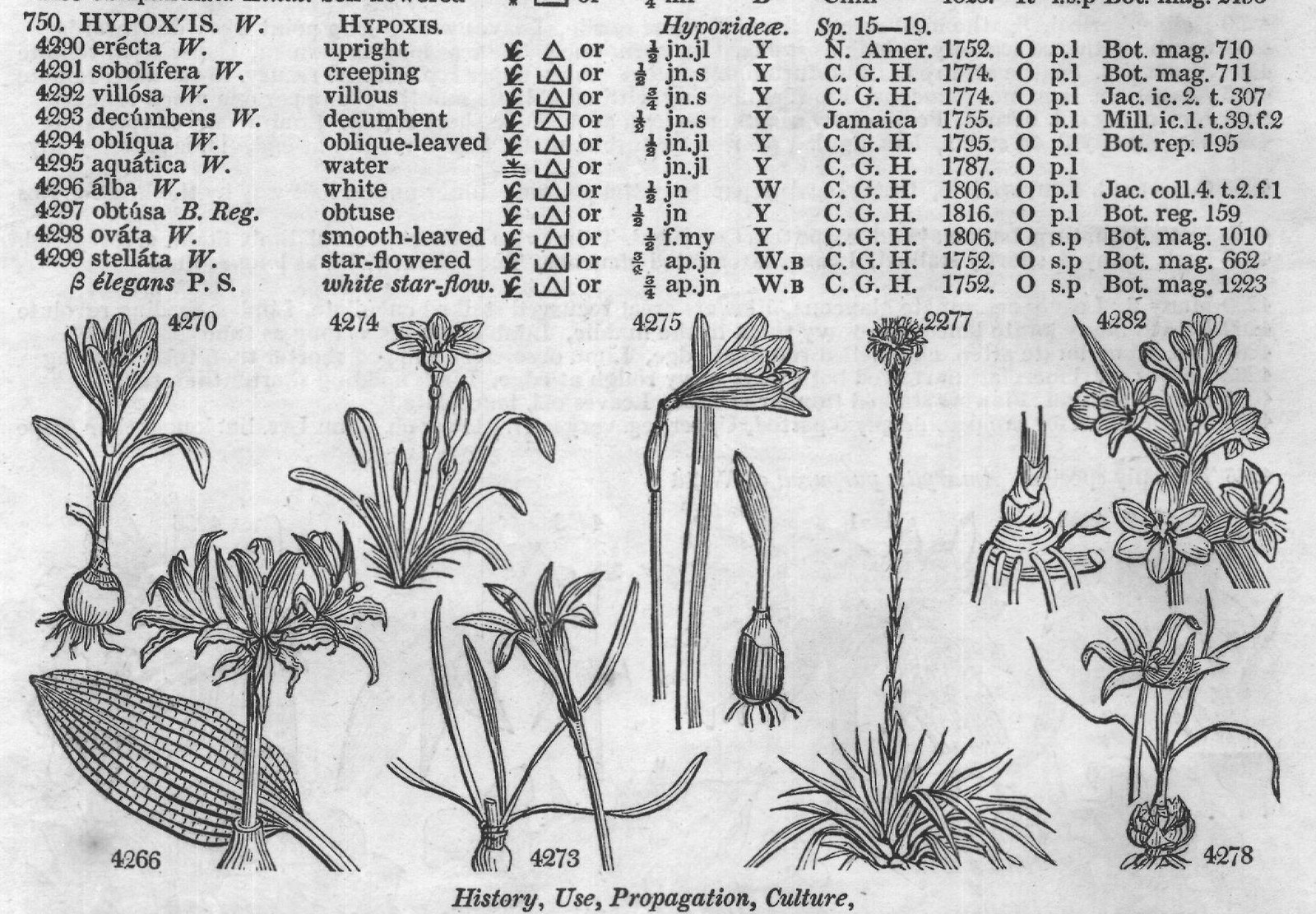
mag. 1223 4270 4274 4275 2277 4282 4266 4273 History, Use, Propagation, Culture, 4278 741. Griffinia. Named by Mr. Ker, after William Griffin, Esq. of South Lambeth, an amiable man, and most assiduous and successful collector of bulbous plants. His collection is even now one of the finest in Europe. These species resemble Amaryllis, but have broad-stalked leaves, and blue flowers. 742. Sternbergia. Named after Count Caspar Sternberg, a celebrated botanist and patron of botany. The species consist of the hardy plants formerly referred to Amaryllis; they are all hardy, and, with the exception of S. lutea, very rare. 743. Zephyranthes. A fanciful name employed by Mr. Herbert. It seems to mean wind-flower. These are pretty plants, with solitary white or pink flowers. The species are so nearly hardy, as to survive in a warm border all but our severest winters. 744. Habranthus. From ἁβρoς, delicate, and avθoς, a flower. Small Chilian plants resembling the last in habit, and principally distinguished by their very unequal declinate stamens. 745. Doryanthes. So called by Correa de Serra, from dogu, spear, and avθoς, a flower, on account of the long straight stem, surmounted by a head of crimson flowers. This is a fine plant from New South Wales. It grows freely in a mixture of sandy loam and peat, but does not flower till it gets large: a conservatory is the most proper place for it, as the flower-stem grows to a great height before the flowers expand. It may be increased by suckers from the roots, but these are sparingly produced. (Bot. Cult. 181.) 745. Gethyllis. From γηθεw, to rejoice. The flowers are much valued at the Cape of Good Hope for the delicious perfume of their flowers. The species are very curious: but few have been introduced. Their bulbs re quire the usual attention as to not watering them when in a dormant state; they are increased by offsets or seeds.
ORDER I.
HEXANDRIA MONOGYNIA. 4266 Leaves with a flat stalk, The three lower sepals wavy, Scape with a prominent line along each side 4267 Leaves oval-lanceol. with a stalk two-edged crosswise, Umbel remarkably stalked, Sepals uniform 4268 Leaves linear obliquely twisted shining 4269 Leaves lorate flat very glaucous laxly spiral 4270 Leaves many-keeled, Flower sessile on a two-edged scape, Sepals oval-oblong obtuse 4271 About 2-flowered, Leaf linear, Tube very short, Sepals rounded at end 4272 Leaves few linear, Spathe 1-leaved sheathing erect bifid twice as short as stalk 4273 Leaves many ligulate, Spathe bifid longer than stalk, Sepals acuminate 4274 Leaves lying flat on the ground shorter than the one-flowered scape, Spathe bifid fleshy at end 4275 Leaves linear 4276 Leaves cylindrical 4277 The only species 4278 Leaves linear spiral smooth, Sepals ovate oblong 4279 Leaves linear spiral ciliated, Sepals ovate oblong 1280 Leaves linear filiform spiral villous, Sepals ovate oblong 4281 Leaves lanceolate flat, Sepals lanceolate 4282 Leaves linear lanceolate, Sepals oblong 4283 Leaves linear, Scape racemose, Sepals linear 4284 Stem erect, Cor. spreading, Three outer sepals wedge-shaped 3-toothed, Leaves lin. lanc. sessile 4285 Stem erect, Leaves spatulate oblong, Pedunc. longer than involucr. Cor. 2-labiate 4286 Stem twining, Cor. cylindrical in branched umbels 4287 Stem erect, Leaves linear lanceolate, Flower-stalks twisted, Outer sepals obcordate mucronate 4288 Stem weak, Leaves spatulate ciliated, Umbel many-flowered, Peduncles 2-flowered 4289 Flower campanulate spreading 4290 Hairy, Scape 4-fl. shorter than lin. lanc. leaves, Pedunc. twice as short as leaves 4291 Like the last, but the leaves are shorter more villous and incurved, Petals more obtuse 4292 Villous, Scape 4-fl. shorter than lin. lanc, lvs. Pedunc. shorter than flower, Fruit cylindrical 4293 Pilose, Scape 2-fl. decumbent shorter than lin. lanc. leaves 4294 Scape 3-fl. pilose as long as leaves, Pedunc. thrice as long as fl. Leaves lanc. smooth obliquely bent 4295 Leaves linear, Scapes umbelliferous or 1-fl. Height depending on depth of water 4296 Scape 1-flowered shorter than filiform rounded smooth leaves 4297 Leaves at the edge and keel hairy, Scape hispid many-flowered racemose, Sepals obtuse 4298 Leaves ovate-lanceolate entire smooth, Scapes 1-flowered 4299 Scape 1-flowered shorter than the lin. lanc. loose keeled smooth leaves 4284 4286 4289 4237 4298 4291 4297 4299 β and Miscellaneous Particulars. 747. Polianthes. From πoλuς, many, and avθoς, a flower; in allusion to the abundance of the blossoms. This is a very popular bulb, on account of its highly odoriferous flowers. It is imported annually from Italy and America, and flowers freely in pots of sandy loam and some rotten dung or leaf mould. R. A. Salisbury is of opinion that we might grow our own bulbs, by planting the offsets in such a situation as would obtain for them a " sufficient degree of heat in summer to bring their leaves out to their full magnitude, that of the roots following of course." "The theory," he adds, " which I would recommend any intelligent gardener to adopt in its general management is, to keep the roots growing as vigorously as possible from May to October, but in a state of complete rest and drought for the rest of the year." (Hort. Trans. i. 53.) 748. Alstræmeria. So named from Baron Claudius Alstræmer, of Sweden, who in his travels through Europe sent many plants to Linnæus. The species are beautiful, and A. Ligtu is as fragrant as mignionette. A. Salsilla is cultivated in Peru and the West Indies for its roots, which are used like the tubers of the potatoe. A. Ligtu, Sweet observes, " is generally considered difficult to flower; but it will blossom well by letting the pots be dry for a considerable time till the shoots are all dried up; then give it a good watering, and put it in a moist heat, and it will flower abundantly. It may be increased by parting the roots or by seed." (Bot. Cult. 15.) The finest kinds have not yet been introduced to this country. 749. Conanthera. From zovoς, a cone, and avθηρa, an anther; their anthers being, which is singular among these plants, united into a cone. A pretty little Peruvian genus, of which two species are now known. 750. Hypoxis. From ύπo, beneath, and oξuς, pointed, in allusion to the sharp points of the inferior sepals. The species are plants with yellow flowers of little beauty, if we except H. stellata, which has a dark spot at the claws of its white petals. They increase fast by seeds or offsets. 4300 stellipílis Ker. 4301 veratrifólia W. 4302 lineáris B. Rep. 4303 serráta W. 4304 júncea w. 751. CURCU'LIGO. H. K. CURCULIGO. 4305 sumatrána Roxb. 4306 plicáta H. K.
HEXANDRIA MONOGYNIA.
CLASS VI. starry-haired or 1 jl Y C. G. H.
O s.p