Home › B › Bot (Mag Mor h t f Jac vind t Lobel)
Bot (Mag Mor h t f Jac vind t Lobel)
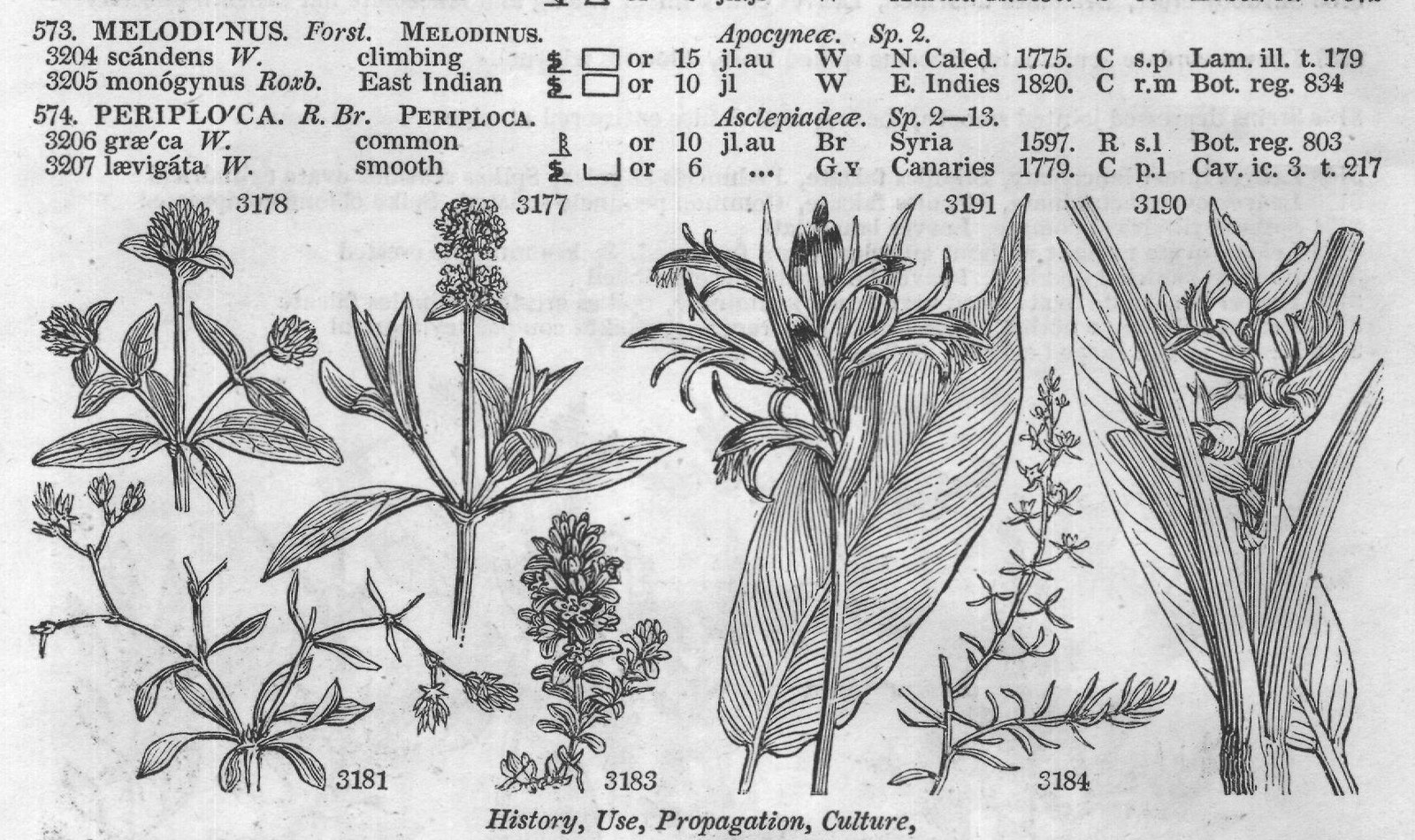
mag. 280 Mor. h.3. t.3.f.14 Jac. vind. 3. t.66 Lobel. ic. t. 372 N. Caled. 1775. C s.p Lam. ill. t. 179 E. Indies 1820. Cr.m Bot. reg. 834 Sp. 2-13.
Syria 1597. R s.l. Bot. reg. 803 Canaries 1779. C p.1 Cav. ic. 3. t. 217 3191 3190 3181 3183 History, Use, Propagation, Culture, 3184 which measured eighteen inches in width, and seven inches in height from the top of the stalk thick, full, and of the most intense purplish red. (Hort. Trans. iv. 322.) To produce this, the great object was to retard the protrusion of the flower-stalk. Hence, a rich compost was employed, the plants put first into pots of four inches diameter, and then transplanted to others a foot in diameter; the object being not to compress the roots, as that has a tendency to accelerate the flowering of all vegetables. The plants were placed close to the glass in a heat of from 70 to 100 degrees, all side branches removed, and pigeon-dung water used in watering. Had the shiftings from pot to pot been more frequent, it appears probable the size might have been still greater. 566. Gomphrena. Gromphrena is a name applied by the ancients to a plant bearing red and green leaves on the same stem; probably our Amaranthus tricolor. G. globosa is a popular tender annual, valued for its heads of flowers, which, if gathered before they are too far advanced, will retain their beauty several years. The other species propagate readily by cuttings under a glass. 567. Mollia. So called from its softness. The species are small weeds. 568. Glaux. From γλauκiov, a name under which Dioscorides describes a maritime plant with glaucous leaves. This plant is maritime, and has glaucous leaves. A pretty little plant, and well adapted for pots and rock work. It will grow at a considerable distance from the sea in sand kept moist. 569. Thesium. Athenæus says, on the authority of Timachides, that this plant was called θησεiov, because it formed part of the garland presented by by Theseus to Ariadne. If this be so, the accent should be placed on the -penultimate and not on the antepenultimate syllable. It is, however, very certain that the Thesion of the ancients had no resemblance to that of the moderns, which is a genus of little obscure plants or weeds. 570. Heliconia. A name given to this plant in an ingenious sense, as indicating its affinity with Musa. H. Bihai is a large herbaceous plant, bearing considerable resemblance to Strelitzia. It grows in rich well ORDER 11.
PENTANDRIA DIGYNIA. 3178 3177 Stem Leaves erect hairy, Leaves oblong pubescent, Heads globose solitary 2-leaved, Keels of bracteæ winged perianthium 3179 Hairy twining 3180 Stem ascending, Leaves oblong silky beneath, Spikes clustered panicled terminal interrupted 3181 Stem branched diffuse, Leaves spatulate whorled about 7, Calyxes with a membranous margin 3182 Stem branched diffuse, Leaves lanceolate silky bearded 3183 The only species 3185 3184 Stems Spike branched, Bractes 3, Leaves linear lanceolate with a very short tube to the , Flowers sessile surrounded by bracteæ 3186 Stem erect simple, Raceme leafy, Flowers stalked without smaller bracteæ 3187 Leaves obovate mucronate, Flowers racemose 3188 Leaves cordate stem-clasping, Racemes terminal 3189 Leaves at the base and end acute, Spadix erect radical, Spathes 2-ranked many-flowered 3190 Leaves narrowed at base at end acumin. Spadix erect flexuose radical, Spathes 2-ranked many-flowered 3191 Leaves very smooth nerved rounded at base, Inflorescence very smooth, Spadix erect without bracteæ 3192 Scape half as short as leaf-stalks which are hardly twice as long as the 6 feet leaf 3193 Scape scarcely longer than the leaf-stalks which are three times as long as the oval leaf 3194 Scape longer than leaf-stalk and leaves, Leafstalk twice as long as the ovate oblong leaf 3195 Scape a little longer than the leaf-stalks which are half as long again as the obl. leaf unequal at the base 3196 Scape as long as leaf-stalk which is 7 times longer than the lanceolate leaf 3197 Scape the length of the leaf-stalk which is 20 times longer than the linear lanceolate leaf 3198 Scape as long as leaf-stalk which is twice as long as the ovate concave leaf 3199 Leaf-stalk very long with no leaf DIGYNIA. 3200 Stem upright herbaceous, Leaves ovate smooth on each side, Cymes terminal smooth 3201 Stem upright herbaceous, Leaves oblong tomentose beneath, Cymes lateral longer than the leaves 3202 Stem erect herbaceous, Leaves oblong cordate smooth, Cymes shorter than the leaves 3203 Stem erect herbaceous, Leaves elliptical lanceolate mucronate at the edge rough with little teeth 3204 Leaves oblong ovate thick at edge, Panicle downy 3205 Leaves oval lanceolate acuminate, Panicle smooth 3206 Flowers terminal hairy inside 3207 Flowers smooth, Segments obtuse, Cymes trichotomous, Leaves oblong lanceolate veiny smooth 3197 3193 and Miscellaneous Particulars. 3194 3200 3205 3206 shaded gullies in moist woods. The berries are small and succulent, and each contain three hard rugged seeds.
H. Psittacorum bears a great resemblance to Canna: it grows in the wet parts of woods, and on the highest mountains. All the species require a strong heat to make them flower freely. 571. Strelitzia. So named by Sir Joseph Banks, in honor of Charlotte, queen of George III., of the family of Mecklenburgh Strelitz, and said to have patronized botany. This is a splendid genus, generally kept in the stove; but which , Sweet observes, "will thrive, and flower as well in the greenhouse or conservatory. A light sandy loam is the best soil for the species, and they may be increased, but the light pollen sandy on loam the stigma, is the best when soil for the species, and they may flower be as increased, well in the but greenhouse slowly, by or conservatory. rubbing A the pollen on the stigma , when the plants are in bloom, perfect seeds are readily obtained." (Bot. Cult. 111.) 572. Apocyпиt.
From aπo, away, and κuωv, a dog; that is to say, a plant from which dogs must be driven.
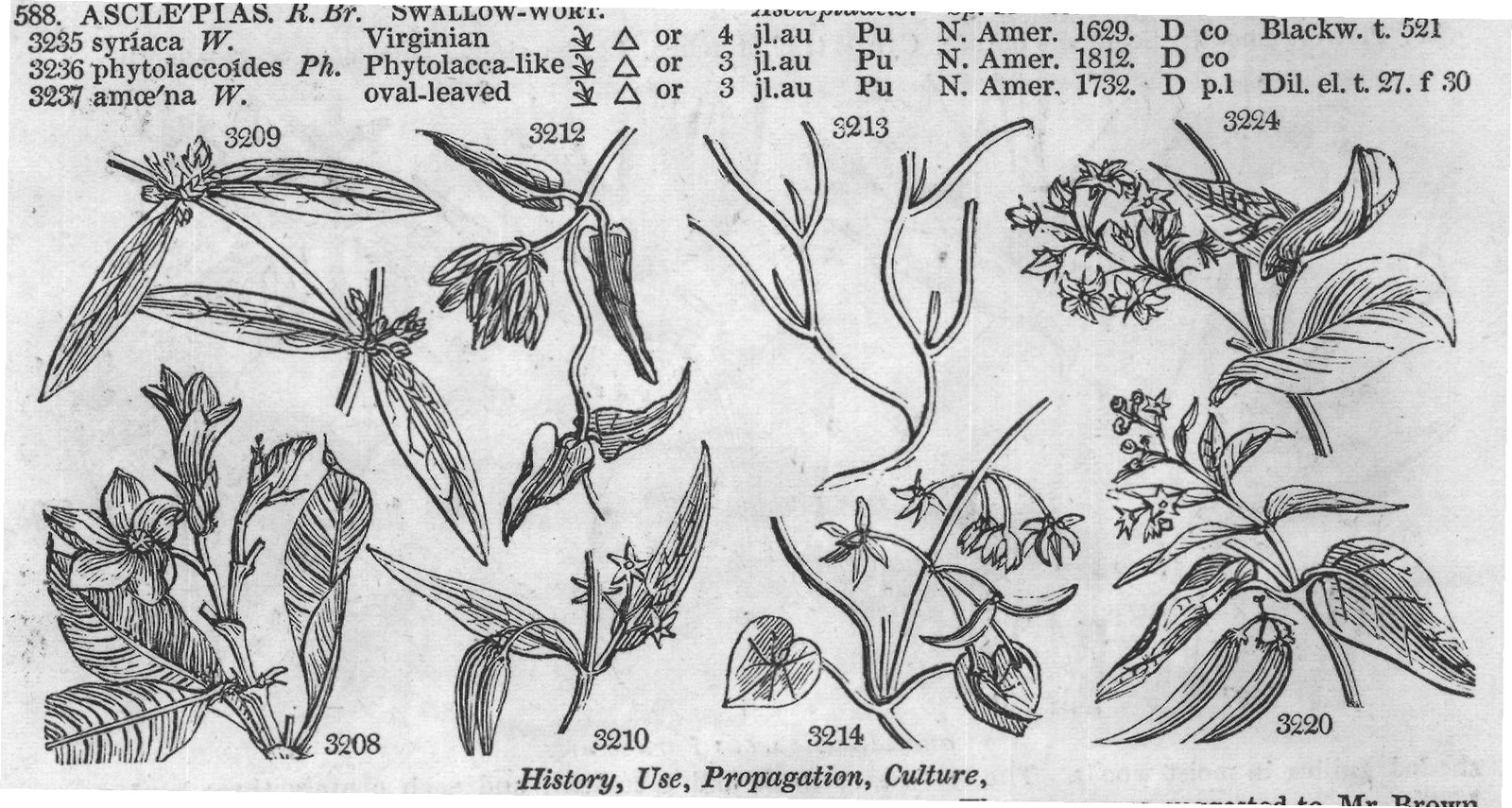
Pliny says his Apocynum is mortal to them. This is a genus of plants of little beauty, but of easy culture in any soil. The first species is acrid and blisters the skin. From the stalks of A. North America acrid and blisters the skin. From the stalks of A. cannabinum easy culture in North America prepare a substitute for hemp, of which they make twine, bags , fishing-nets and lines, and linen for their own wear. 573. Melodinus. So named by Forster, from μηλov, an apple, and δivεω, to turn round; this plant bearing a round fruit like an apple, and having a twining stem by which it climbs trees. It is a very smooth shrub, with oblong-ovate leaves, and nearly allied to Rauwolfia. Cuttings root readily in sand under a hand-glass. This, and the succeeding genera, as far as No. 592, are all Asclepiadeous plants, and require nearly similar management 574. Periploca. From περiπλoκη, intertwining, in allusion to the habit of the plants. P. græca is a handsome climber, and grows freely in common garden soil, and is propagated by cuttings under a glass, or by layers. 575. CRYPTOSTE GIA. R. Br. CRYPTOSTEGIA. 3208 grandiflóra R. Br. large-flowered or 576. HEMIDES MUS. R. Br. HEMIDESMUS. 3209 indicus H. K.
Indian or 577. SECAMO'NE. R. Br. SECAMONE. 3210 ægyptíaca H.K.
Egyptian cu 3211 emética R. Br. narrow-leaved m 578. MICROLO'MA. R. Br. MICROLOMA. 3212 sagittátum H. K. arrow-leaved cu 3213 viminále H. K. twisting 走 cu 580. DE/MIA. R. Br.
DEMIA. 3214 exténsa H. K. smooth-leaved & PENTANDRIA DIGYNIA. $ PA 579. SARCOSTEM'MA. R. Br. SARCOSTEMMA.