Important: Safety Warning
This page prescribes plants as medicine according to pre-modern medical theory. Several of the plants named are toxic, correct identification is difficult, and the doses given have no scientific basis. Do not ingest or apply any preparation described here.
This page presents medical treatment from an era before modern medicine. The remedies described are ineffective against the conditions named, and some of the ingredients or doses are harmful. Do not use them to treat any illness; consult a qualified medical professional.
This information has been left in for historical purposes but should not be acted upon.
Home › B › Bur (Ind t f Bot reg pulch rrima B)
Bur (Ind t f Bot reg pulch rrima B)
ind t.48. f.2 Bot. reg. 447 10106 pulchérrima B. M. Mysore un 2 jn.jl Y Mysore 1814. C co Bot. mag. 2027 10107 paniculáta W. panicled or 3 Y ...
E. Indies 1807. C 1.p 10108 lotifólia W.
Lotus-leaved un 3 jn.jl Y.G Jamaica 1732. S co Dil.el.t.102.f.121 10109 laburnifólia W.
Laburnum-lvd. un 5 jl.s Y E. Indies 1739. S co Rhee.mal.9. t.27 10110 cordifólia W. 10111 purpúrea H. K. 10112 pulchella H. K. 10113 Saltiána B. Rep. 10114 axilláris W 10115 orixénsis W.en. 10116 incanéscens W. 10117 incána W. 10118 pállida W. 10119 angustifólia W. heart-leaved un 8 ap.jn D. Pu C. G. H. 1790. C p.l dark-purple un 4 mr.my Pu C. G. H. large-flowered un 3 il.au Y C. G. H.
Salt's un 3 jn.jl Y axil-flowered un 1 jl.au Y strigose un 1 jl.au Y spreading un 6 jn.o Y hoary pale-flowered un 2 jn.jl un 2 jn.jl narrow-leaved un 1½ my.s 10120 quinquefólia IW. five-leaved jun 1 jn.jl 1531. BOSSIÆ'A. Sm.
BOSSIEA. 10121 Scolopendrium H. K. Plank-plant or 10 my.jl Y N. S. W. 10122 rúfa H. K. red-flowered or 6 jn.s R 10123 heterophylla V. various-leaved or 3 my.d Y 10124 linephýlla H. K. narrow-leaved or 3 jl.s Or 101.25 prostráta H. K. procumbent orjl.s Y 10126 cinérea H. K. downy sharp-lv. or 3 my.jl Y 10127 microphýlla H. K. small-leaved or 3 my.au Y 10128 dentáta R. Br. 1532. SCOTTIA. R. Br. SCOTTIA. 1533. TEMPLETONIA. H. K. TEMPLETONIA.
Legurvinosa.
G.Y 1790. C p.1 1800. C p.1 Abyssinia 1810. C p.l Guinea 1781. S p.l E. Indies 1816. S p.l C. G. H. 1774. S s.p W. Indies 1714. S s.p Pa.Y Africa 1775. S s.p Pa.Y C. G. H. 1815. S s.p Y E. Indies 1792. C s.p Legurinose. Sp. 8-12.
Jac. vind. 3. t. 64 Bot. reg. 377 Jac.schœ.2. t.219 Rhee, mal.9. t.28 1792. C s.l.p Bot. rep. 191 N. Holl. 1803. C s.l.p N. S. W. 1792. C N. Holl. 1803. C N. S. W. 1803. C V. Di. Isl. 1803. C N. S. W. 1803. C Sp. 1. s.l.p Bot. mag. 1144 s.l.p Bot. mag. 2491 s.l.p Bot. mag. 1493 s.l.p Bot. reg. 306 s.l.p Bot. cab. 656 Bot. reg. 128 Bot. mag. 1699 Bot. rep. 648 tooth-leaved or 3 jn.s N. Holl. 1803. C s.p Leguminosæ.
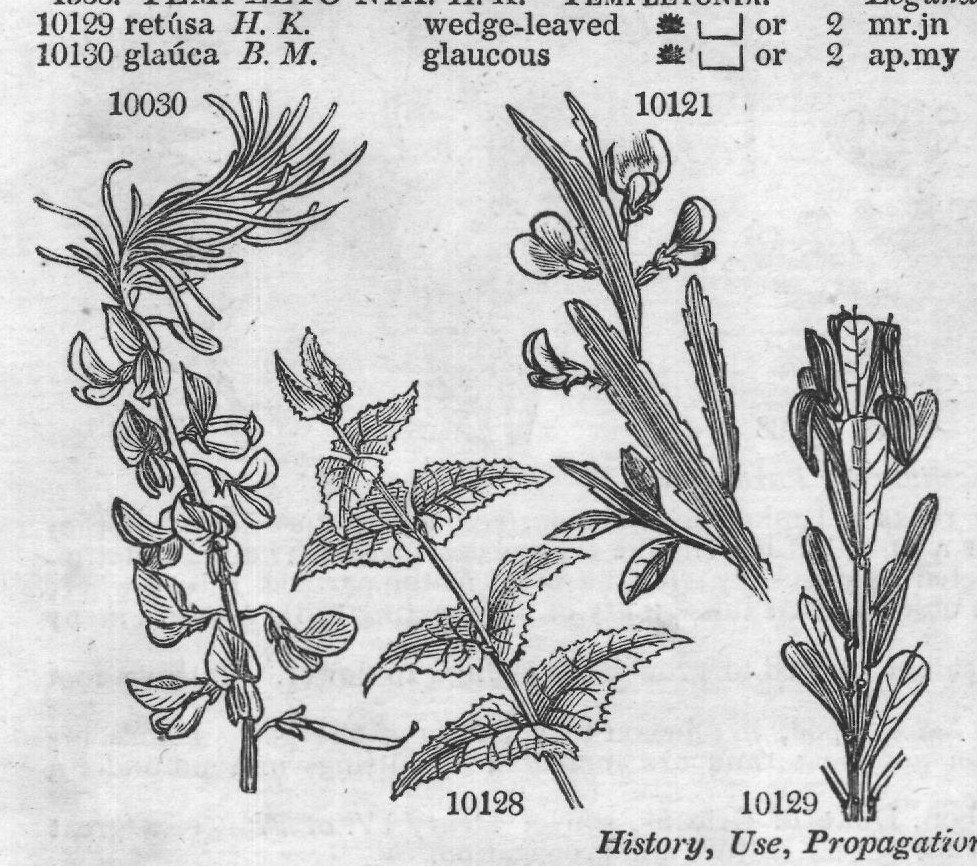
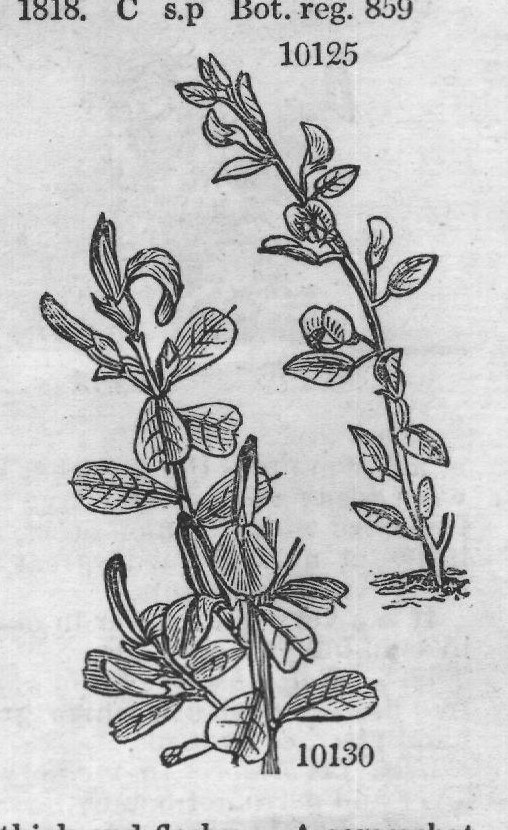
Sp. 2. 10129 retúsa H. K. 10130 glaúca B. M. wedge-leaved or glaucous or 2 mr.jn R 2 ap.my R N. Holl. 1803. C s.p N. Holl. 1818. C s.p 10030 10121 10123 Bot. mag. 2334 Bot. reg. 859 10125 10128 10129 History, Use, Propagation, Culture, 10130 1529. Sarcophyllum. From σaρξ, flesh, and φuλλov, a leaf. The leaves are thick and fleshy. A somewhat succulent plant, easily injured by over-watering; but otherwise not difficult to preserve or increase. 1530. Crotalaria. Kρoτaλov was the name of a noisy Greek musical instrument, similar to the cymbals of the present day. The pods of this genus are inflated, and rattle, when shaken, in a similar manner. The species are all of easy culture, mostly free-flowerers; but they are shabby plants under cuitivation, and possess no good quality which can render them objects of interest or beauty. 1531. Bossiæa. Named by Ventenat, after M. Boissieu-Lamartiniére, who accompanied the unfortunate La Pérouse in his voyage round the world. This beautiful genus, according to Sweet, "thrives best in an equal mixture of sandy loam and peat; if not very sandy, some sand must be added to it to have the plants in health. The pots must be well drained with broken potsherds, as nothing injures them more than too much ORDER IV. 10080 The only species DIADELPHIA DECANDRIA. 10081 Leaves simple obl. lanceolate, Stipules lanceolate acuminate decurrent, Racemes opposite the leaves 10082 Leaves simple lanc. ellipt. blunt downy beneath, Racemes opposite the leaves 10083 Leaves very small ternate glaucous, Racemes few-flowered, Vexillum reflexed 10084 Leaves simple lanc. villous, Upper stipules lanc. decurrent, Racemes opposite the leaves, Cal. villous 10085 Branches winged upwards, Lower leaves obl.: upper lanc. acute hairy, Racemes lateral 10086 Leaves simple lin. lanc. acute villous beneath, Flowers and pods inclosed in hairy calyx 10087 Leaves simple long-lanc. Pods downy, Raceme terminal, Stem square 10088 Leaves obl. lanceolate silky beneath, Fl. racemose, Bractes linear much shorter than pedicel 10089 Leaves simple lanc. Upper stipules decurrent with 2 short teeth, Racemes opposite the leaves 10090 Leaves lanceolate subsessile. Lower lip of cal. 3-parted beyond the middle, Stem virgate simple 10091 Leaves simple lanc. subsessile, Pods smooth, Raceme terminal, Stem furrowed 10092 Leaves lanceolate blunt hairy, Fl. terminal, Calyx hairy as long as corolla 10093 Leaves lanceolate, Raceme terminal, Cal. very villous as long as corolla 10094 Leaves simple ov. lanceolate silky ciliated, Standard large erect pointed 10095 Leaves simple lanc. beneath, Pods silky, Raceme terminal, Stem furrowed 10096 Leaves simple obl. cuneiform retuse, Raceme terminal 10097 Leaves simple ovate retuse, Stipules lunate declinate, Raceme term. Branches square 10098 Leaflets 3 oval acute, Hairs shining scattered, Racemes opposite the leaves 10099 Leaflets 3 oval blunt with scattered hairs, Raceme terminal long, Keel shorter than vexillum 10100 Leaves simple obovate oblong silky on each side, Pod 4-seeded length of calyx 10101 Stems round striated, Leaves oval emarginate mucronate, Stipules lunate amplexicaul 10102 Leaves simple lin.-lanceolate blunt hairy, Pedunc. terminal subsolitary, Stem branched diffuse 10103 Leaves simple obl. blunt hairy, Stems prostrate herbaceous, Pedunc. 2-3-fl. axillary 10104 Leaflets 3 oblong blunt mucronate with scattered hairs beneath, Raceme terminal, Calyxes silky 10105 Leaves ternate, Leaflets oval-lanc. acute twice as long as villous petiole, Pods pendulous 10106 Leaves obovate cuneate silky, Racemes term. Bractes and calyx colored 10107 Leaves obl. blunt silky villous, Stipules linear subulate reflexed, Panic. terminal bracteate 10108 Leaves ternate, Leaflets cuneiform emarginate silky beneath, Peduncles axillary solitary 1-flowered 10109 Leaves ternate ovate acuminate smooth, Stipules none, Raceme terminal, Pods stalked pendulous 10110 Leaves ternate obcordate mucronate, Flowers corymbose, Stem shrubby 10111 Leaves ternate, Leaflets obovate retuse, Racemes terminal 10112 Leaves ternate, Leaflets linear lanceolate acute half as long again as petiole downy beneath 10113 Leaves ternate on long stalks, Leaflets oval downy, Racemes axillary lax, Standard blunt 10114 Leaves ternate obl. lanceolate acute silky beneath, Stipules lanceolate subulate, Pedunc. axill. 1-flowered 10115 Leaves ternate obovate strigose beneath, Stipules lanceol, and bractes ovate reflexed, Racemes terminal 10116 Leaves ternate obovate, Stipules leaf-like stalked, Racemes terminal, Pods stalked 10117 Leaves ternate oval villous beneath, Racemes spiked, Keel downy at edge, Pods sessile hairy 10118 Leaves ternate lanceolate smooth, Racemes terminal spiked 10119 Leaves ternate lanc. hoary silky shorter than petiole, Raceme terminal 10120 Leaves quinate 10121 Branches flat linear leafless, Denticulations flower-bearing, Keel naked, Calyx smooth 10122 Branches flat linear leafless, Denticulations flower-bearing, Keel fringed, Calyx smooth 10123 Branches leafy compressed, Leaves obovate and linear flat, Pod many-celled with spongy septa 10124 Branches leafy compressed, Leaves linear with recurved edges, Pod 1-celled 10125 Branches leafy filiform, Leaves oval smooth, Stipules shorter than petiole, Pod 1-celled 10126 Branches leafy round, Stem erect much branched, Leaves ovate-lanc. rough above 10127 Branches leafy spiny round, Leaves obcordate cuneiform 10128 The only species 10129 Leaves green retuse 10130 Leaves glaucous blunt 10083 10094 10097 10105 10108 10112 10113 10116 and Miscellaneous Particulars. water. Cuttings, not too ripe, will strike root if planted in sand under a bell-glass, not too close together, as they are apt to damp; when rooted, they must be potted off in little pots and kept in a close frame, and hardened to the air by degrees." (Bot. Cult. 151.) 1532. Scottia. Named in memory of Robert Scott, M. D., formerly professor of botany at Dublin. A shrub found by Mr. Brown upon the south-west coast of New Holland. Young cuttings root in sand under a bellglass. 1533. Templetonia. Named after John Templeton, Esq., of Orange Grove, near Belfast, a gentleman to whom the editor of the English Botany was under frequent obligations for Irish plants during the progress of that work.
Rr DIADELPHIA DECANDRIA.
CLASS XVII. 1534. GOODIA. R. Br. GOODIA.
Leguminosæ. Sp. 2. 10131 lotifólia H. K. smooth or 3 ap.jl Y V. Di. Isl. 1793. S s.p Bot. mag. 958 10132 pubescens H. K. downy or 3 ap.jl Y V. Di. Isl. 1805. S s.p Bot. mag. 1310 1535. LODDIGE'SIA. B. M. LODDIGESIA.
Leguminosæ. Sp. 1. 10133 oxálidifólia B. M.
Oxalis-leaved pr 1 my.s Pa.pu C. G. H. 1802. C p.1 Bot. mag. 965 1536. HOVEA. H. K.
HOVEA.
Leguminosæ. Sp. 5. 10134 lineáris H. K. linear-leaved or 3 mr.jl Pu N. S. W. 1796. S s.p Bot. reg. 463 10135 longifólia H. K. long-leaved or 3 jn.s Pu N. S. W. 1805. S s.p Bot. reg. 614 10136 lanceoláta B. M. spear-leaved or 3 mr.jl Pu N. Holl. 1805. S s.p Bot. mag. 1624 10137 elliptica oval-leaved or 3 mr.jl Pu 4 N. Holl. 1817. C s.p 10138 Cel'si Bonpl.
Cels's or 4 mr.jl B N. Holl. 1818. C s.p Bot. reg. 280 10139 júnceum W. flore-pleno 1537. SPARTIUM. W. BROOM. 10140 monospérmum W. white single-seed. 10141 sphærocarpon W. yellow single-seed.
Leguminosæ.
Sp. 21-37.
Spanish double-flowered ec 6 jl.s Y S. Europe 1548. S co Bot. mag. 85 or 6 jl.s Y S. Europe 1548. S co 10142 prócerum W. en. tall 10143 congéstum W.en. close-branched CCCC or 4 jn.jl W S. Europe 1690. S p.l Bot. mag. 683 or 4 jn.jl Y S. Europe 1731. S p.l Reneal.spec. t.33 or 8 jn.jl Y . or 4 ap.jl Y Portugal 1816. C s.l Teneriffe C s.l 10144 virgátum W. long-twigged or 5 mr.jn Y Madeira 1777. C p.1 Jac. ic. 1. t. 147 10145 púrgans W. purging or 4 jn.jl Pa.Y 10146 umbellátum W. umbelled or 3 ap.jn Y 10147 Scorpius W.
Scorpion or 4 mr.ap Y 10148 seríceum Vent. silky or 3 my.au Y 10149 multiflórum W. 10163 tríquetra W. 10164 sagittális W. 10150 angulátum W. 10151 pátens W. 10152 pilocárpum Link. 10153 cinéreum W. 10154 nubígenum W. 10155 linifólium W. 10156 scopárium W. 10157 radiátum W. 10158 férox W. 10159 spinósum W. 1538. GENISTA. W. 10160 canariensis W. 10161 cándicans W. 10162 viscósa W. white Portugal small-flowered hoary clammy triangular jointed or 6 my W or 3 my.jn Y woolly-podded or 4 jn.jl Y hairy-fruited or 4 jn.jl Y cinereous or 4 jn.jl Y cluster-flower'd; ft 6 my.au W Flax-leaved or 3 ja.jn Y common ec 6 ap.jn Y starry fierce or jn.jl Y or 1 jn.jl Y prickly or 2 jn.jl Y GENISTA.
Leguminosæ.
Canary ft 2 my.s Y or 2 ap.jl Y or 2 ap.jl Y 2 or 3 my.jn Y or my.jn Y 10165 trianguláris W. 10166 tinctória W. three-sided or 2 my.jn Y Green-weed or 3 jn.au Y 10167 sibírica W. 10168 ováta W. 10169 scariósa Viviani Siberian or 2 jn.au Y oval-leaved or 3 jn.au Y scariose or 6 jn.jl Y 10131 10133 S. France 1768. S p.l Barbary 1799. C p.l S. Europe 1570. S p.l Mogadore 1812. C p.l Portugal 1752. S co Levant 1739. C p.l Portugal 1752. S p.l 1823. S p.l Sco ...
S. Europe Teneriffe 1779. C p.l Spain 1739. C p.l Britain dry hil. S co Italy 1758. S s.p Barbary 1800. C p.l S. Europe 1596. C p.l Sp. 21-42.
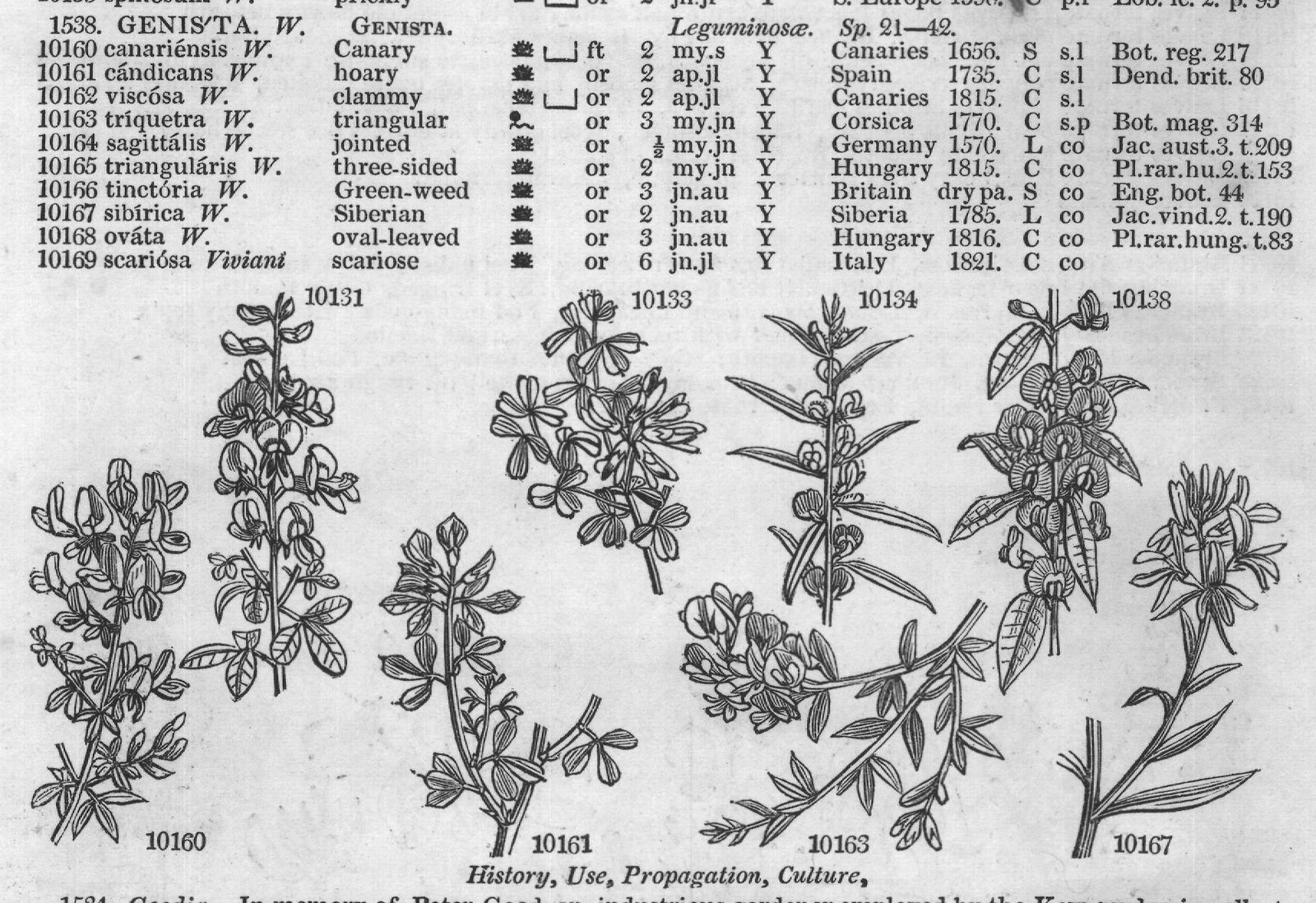
Canaries 1656. S s.l Spain 1735. C s.l Canaries 1815. C s.l Corsica 1770. C s.p Germany 1570. L co Hungary 1815. C co Britain dry pa. S co Siberia 1785. L co Hungary 1816. C co Italy 1821. C co 10134 Desf. atl. 2. t.180 Dend. brit. 78 Vent.choix. t.17 Duham.arb. t.23 Vent. cels. 87 Cav. ic. 2. t. 176 Bot. mag. 442 Eng. bot. 1339 Bot. mag. 2260 Bot. reg. 368 Lob. ic. 2. p. 95 Bot. reg. 217 Dend. brit. 80 Bot. mag. 314 Jac. aust.3. t.209 Pl.rar.hu.2.t.153 Eng. bot. 44 Jac.vind.2. t.190 Pl.rar.hung. t.83 Bull. herb. t.115 Dend, brit. 76 10138 10160 10161 10163 10167 History, Use, Propagation, Culture, 1534. Goodia. In memory of Peter Good, an industrious gardener employed by the Kew garden in collecting seeds in New Holland, where he died. 1535. Loddigesia. Named in compliment to Mr. Conrad Loddiges, a successful cultivator of plants, an assiduous collector, and a most worthy man, whose virtues are inherited by his sons. 1536. Hovea. In honor of Mr. Antony Pantaleon Hove, a Polish botanist, who travelled in the Crimea and Persia, whence many plants were sent to Kew garden. He is still alive, and naturalized in England. Pretty plants, easily cultivated in sandy loam and peat, and rooted in sand under a hand-glass. 1337. Spartium. From σπaρτov, cordage; the earliest ropes were made of this and similar tough plants. The species are shrubs thick-set with verdant flexible rush-like twigs, which are very ornamental in winter, and generally profusely covered with shewy white or yellow odoriferous and mellifluous blossoms in summer. S. junceum is grown as a green food for sheep in the south of France, and there and in Spain it affords a thread from its fibres, which is sometimes wove into cloth, but more generally twisted into cordage. Bees are very fond of the flowers, as they are of those of most of the species. S. monospermum, is a very handsome shrub, remarkable for its numerous snow-white flowers. Osbeck remarks, that it grows like willow-bushes along the shore of Spain, as far as the flying sands reach, where scarcely any other plant exists except the Ononis repens, or creeping Restharrow. The use of this shrub is very great in stopping the sand. The leaves and young branches are delicious food for goats. It converts the most barren spot into a fine odoriferous garden by its flowers, which continue a long time. It serves to shelter hogs and goats against the scorching heat of the sun. The twigs are used for tying bundles; and all kinds of herbs that are brought to market are fastened together with them. Forskahl found it in Arabia; and Desfontaines in Barbary, on the sandy coast. The Spaniards call it Retamas, from the Arabic name Rætam.
ORDER IV.
DIADELPHIA DECANDRIA. 10131 Leaflets obovate and calyxes smooth, Pod varicose 10132 Leaflets obovate cuneate and calyxes downy, Pod smooth 10133 The only species 10134 Leaves linear hairy beneath, Pods smooth 10135 Leaves long linear; beneath veiny, Pods downy 10136 Branches twiggy, Leaves lanc. mucronate downy beneath, Fl. axill. twin 10137 Leaves elliptic oblong 10138 Leaves lanc. somewhat rhomboid blunt at end mucronate, Peduncles axillary many-flowered 10139 Branches opposite round flowering at end, Leaves lanceolate 10140 Branches round striated, Racemes lateral few-fl. Flowers subaggregate, Leaves lanceolate silky 10141 Branches round striated, Racemes lateral many-fl. Flowers remote, Leaves lanc. sessile a little hairy 10142 Branches round striated, Fl. solitary axillary, Pods villous, Leaves lanceolate hairy 10143 Branches round striated very close, Fl. terminal racemose, Vexillum smooth, Leaves lanc. silky 10144 Branches round striated, Fl. axill. solitary subracemose, Standard and keel downy, Lvs. obl. lanc. silky 10145 Branches round striated, Fl. axillary solitary, Leaves lanc. silky subsessile 10146 Branches round striated, Fl. term. capitate, Leaves lin. lanc. silky 10147 Branches round striated spreading spiny, Pedunc. axill. many-fl. Leaves obl. acute silky 10148 Leaves lanc. silky beneath, Corolla silky, Branches erect round 10149 Leaves ternate and simple silky, Twigs straight striated flowering on all sides 10150 Leaves solitary and ternate linear lanceolate hoary, Branches hexangular flowering at the ends- 10151 Leaves ternate stalked obovate, Branches round striated, Lateral flowers twin nodding 10152 Branches angular, Leaves simple lanceolate silky beneath, Fl. racemose, Pods hairy 10153 Branches round with ten furrows, Flowers axillary solitary downy 10154 Leaves ternate lanc. hairy stalked, Fl. lateral fascicled, Pods smooth, Branches round striated 10155 Leaves ternate sessile lit ear silky beneath, Raceme terminal, Branches round furrowed 10156 Leaves ternate and solitary oblong, Fl. axillary, Pods hairy at edge, Branches angular 10157 Leaves ternate linear, Petioles dilated persistent, Racemes capitate term. Branches angul. opp. clustered 10158 Leaves ternate and simple oblong mucronate, Raceme terminal, Branches striated round spiny 10159 Leaves ternate obovate, Peduncles axillary, Cal. and pods smooth, Branches angular spiny 10160 Leaves tern. obl. downy beneath with spreading hairs, Pedunc. many-fl. terminal, Branches angular 10161 Leaves ternate obovate downy with closely pressed hairs, Pedunc. many-fl. terminal, Branches angular 10162 Leaves ternate obl. smooth, Racemes terminal, Cal. and pods glandular viscid, Branches round striated 10163 Leaves ternate: upper simple, Branches triquetrous procumbent 10164 Branches 2-edged membranous jointed, Leaves ovate lanceolate 10165 Leaves lanceolate mucronate smooth, Branches 3-cornered ascending, Pods smooth 10166 Leaves lanceolate smooth, Branches round striated erect, Pods smooth 10167 Leaves lanceolate smooth, Branches equal round erect 10168 Leaves oblong ovate and pods hairy, Branches round striated 10169 Quite smooth, Leaves not ciliated, Cor. 5 lines long, Calyx smooth 10110 10144 10147 10151 10153 10155 and Miscellaneous Particulars. 10157 S. scoparium, though in some places a troublesome weed in old pastures, is a very ornamental shrub in garden scenery: it is also useful in agriculture, domestic economy, and medicine. It is sometimes used as winter food for sheep, frequently for thatching cottages and ricks, and as litter. Bees are fond of the flowers: the flower-buds, just before they become yellow, are pickled in the manner of capers: the branches are said to be capable of tanning leather, and of being manufactured into coarse cloth; when tender, they are mixed with hops in brewing: the old wood furnishes the cabinet-maker with a beautiful material for veneering. The twigs, when bruised, smell disagreeably, which perhaps may be one reason why our broom is generally rejected by cattle (Curtis); but they have also a nauseous bitter taste. The plant when burnt affords a tolerably pure alkaline salt. Broom tops are diuretic and cathartic; the seeds are said to be emetic. The effects of this plant have been very long known to the common people; and both Mead and Cullen found them useful in dropsy. The usual mode of exhibiting them is in the form of decoction, made by boiling the green tops in water. Speaking of this decoction, of which two table spoonfuls were given every hour till it operated by stool, Cullen says, "it seldom fails to operate, both by stool and urine, and by repeated exhibition every day, or every second day, some dropsies have been cured. (Thompson's London Dispensatory, 514.) 1338. Genista. Gen, signifies, in Celtic, a small bush, whence also Génet, French. The species are shrubs or undershrubs, some of them evergreen, and many with numerous flexible rush-like green twigs like the brooms. They are of easy culture and free flowerers. G. tinctoria is common in most parts of Europe, in unimproved pastures on dry gravelly soils. When cows feed on it, their milk, and the butter or cheese made from it, are said to be very bitter. A bright yellow color may be prepared from the flowers; and for wool that is to be dyed green with woad, the dyers prefer it to all others. A dram and a half of the powdered seeds operates as a mild purgative. A decoction of the plant is sometimes diuretic, and therefore Rr2 DIADELPHIA DECANDRIA. 10170 flórida W.
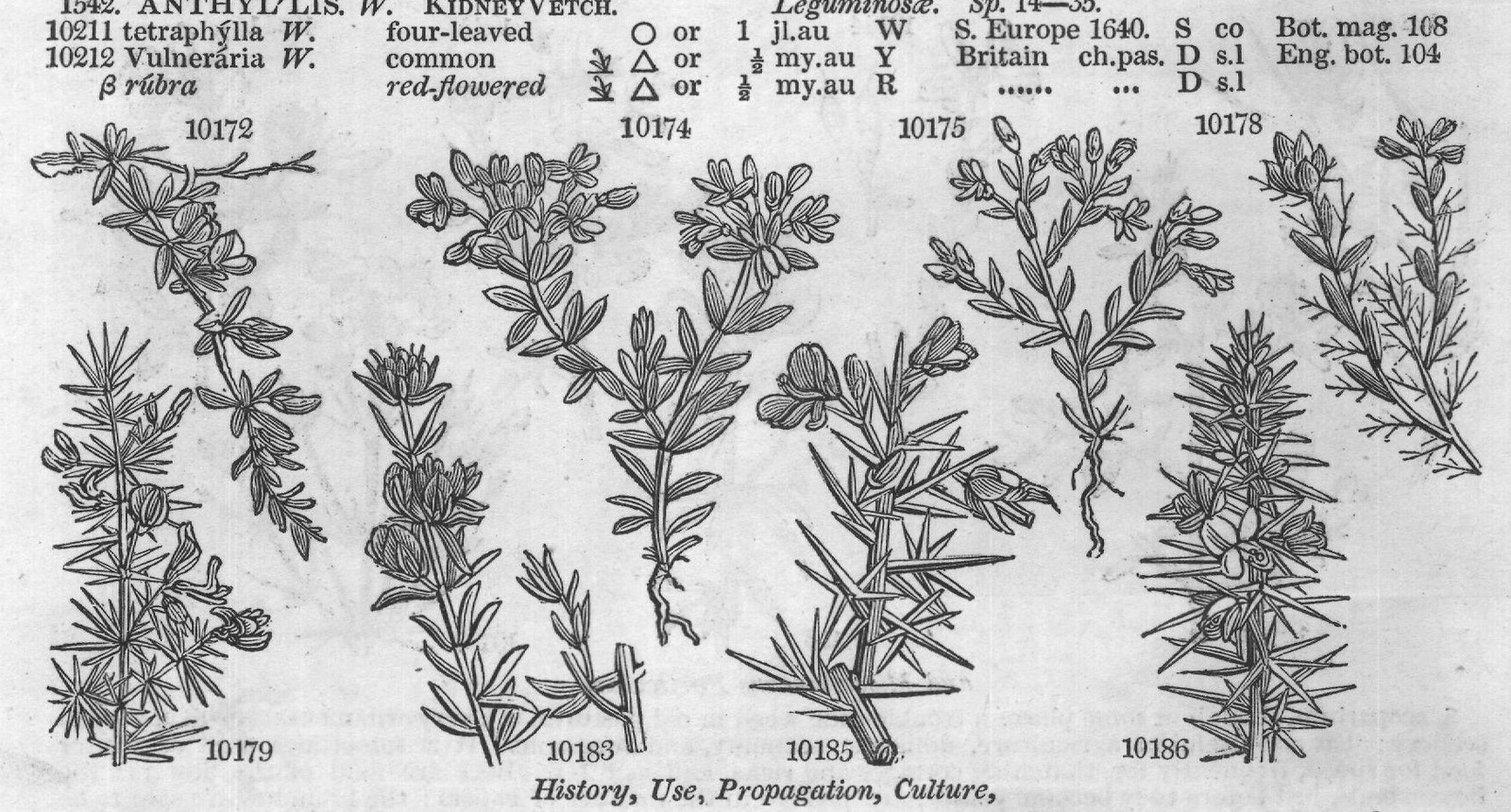
Spanish or 6 jn.au Y Spain 10171 procúmbens W. procumbent or 1½ jn.au Y 10172 decúmbens W. trailing or my.jn Y 10173 pilósa W. hairy green-weed or 6 my.jn Y 10174 diffúsa W. diffuse or 3 my.jn Y 10175 serícea W. silky or 3 my.jn Y 10176 ánglica W.
Petty whin or 2 my.jn Y 1752. S co Hungary 1816. C co France 1775. L p.l England san.he. S co Italy 1816. C co Austria 1812. S s.l Britain moi.he. S co CLASS XVII.
Bot. cab. 718 Eng. bot. 208 Jac. ic. 3. t. 555 Jac. ic. 3. t. 556 Eng. bot. 132 10177 germánica W.
German or 2 jn.au Y Germany 1773. L co 10178 hispánica W. dwarf-prickly or 2 jn.jl Y 10179 lusitánica W.
Portugal or 2 mr.my Y Spain 1759. C co Portugal 1771. C co